Category Archives: Work of Other Artists

“Christmas” Heraldry

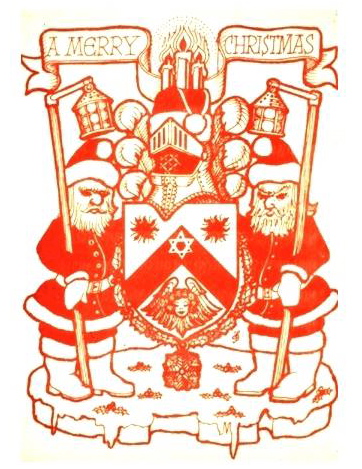
Each year at this time I always seem to get involved in a conversation with at least one other heraldry enthusiast about coats of arms associated with Christmas or the Christmas season. Here are a few tidbits I offer for your amusement. (Keep in mind the ancient custom of attributed arms, that is, coats of arms attributed to people who were not necessarily armigerous themselves, especially if they lived prior to the advent of heraldry and/or coats of arms devised for and attributed to people who may or may not be fictitious!)

Santa Claus (Saint Nicholas)

Here is a a coat of arms recently devised by a friend for St. Nicholas

10704163_656270491979_8257133350987141788_n

Here is another said to be of “Father Christmas”

10428443_962514470444895_2628170149422247155_n

The Three Wise Men (or Kings)

The arms attributed to Kaspar, Balthasaar and Melchior (depicted beautifully by the Italian heraldic artist, Marco Foppoli)

260210_2

The Blessed Virgin Mary

A coat of arms attributed to the Mother of Jesus, Mary

Mar_a_la_madre_de_Jes_s_CON_CORONA

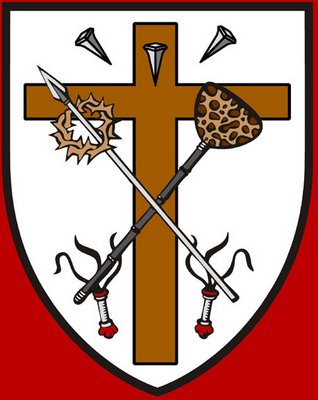
Jesus (you know…the One whose birthday we’re celebrating?)

This is just one of many different attributed arms for Jesus, the Christ depicting the implements of His passion.

Arms of Christ

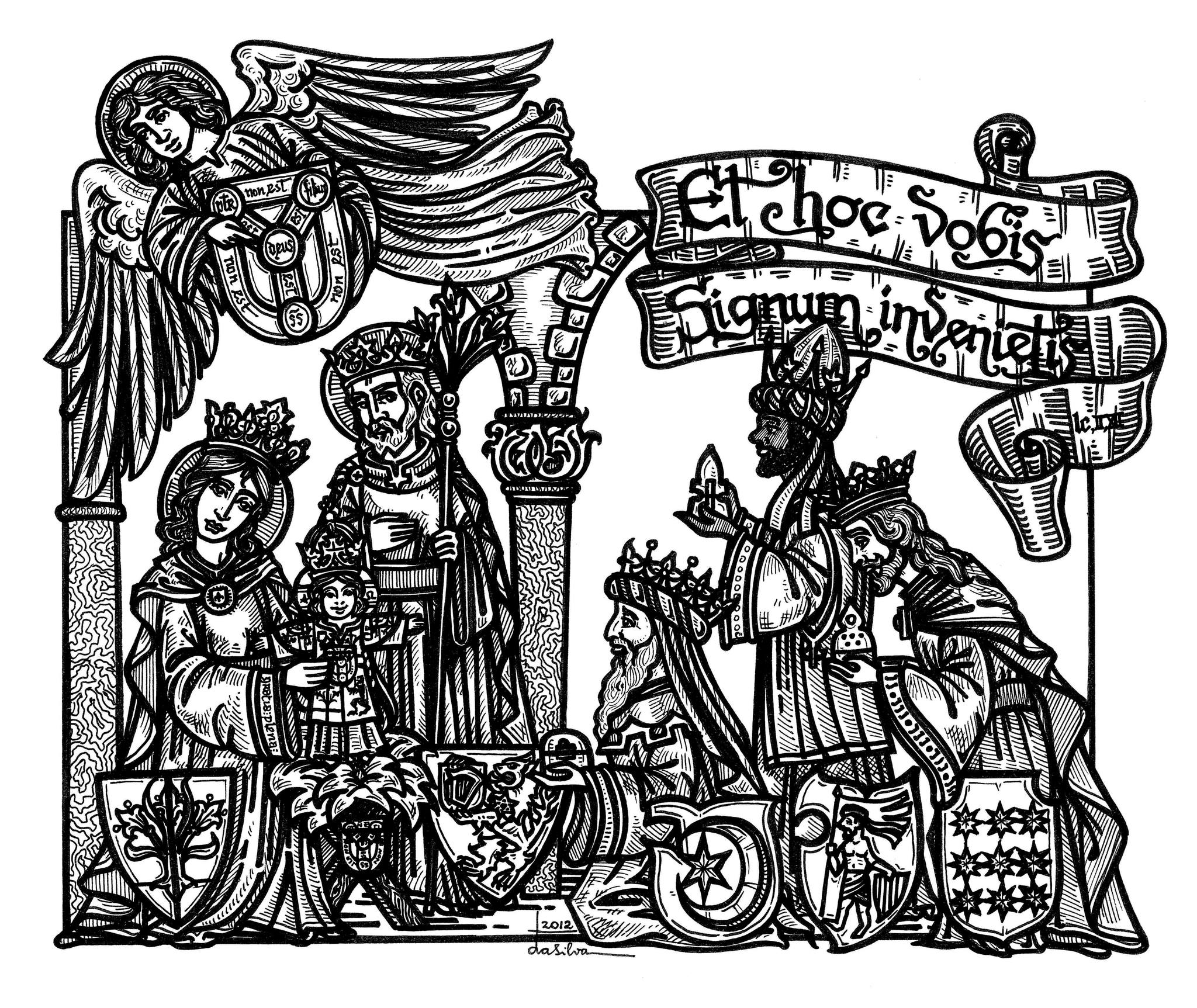
The Holy Family

A wonderful Christmas scene showing all the principal armigerous figures of the story of the Nativity with their corresponding attributed arms. (by daSilva)

966494_618639514870198_1761667505_o

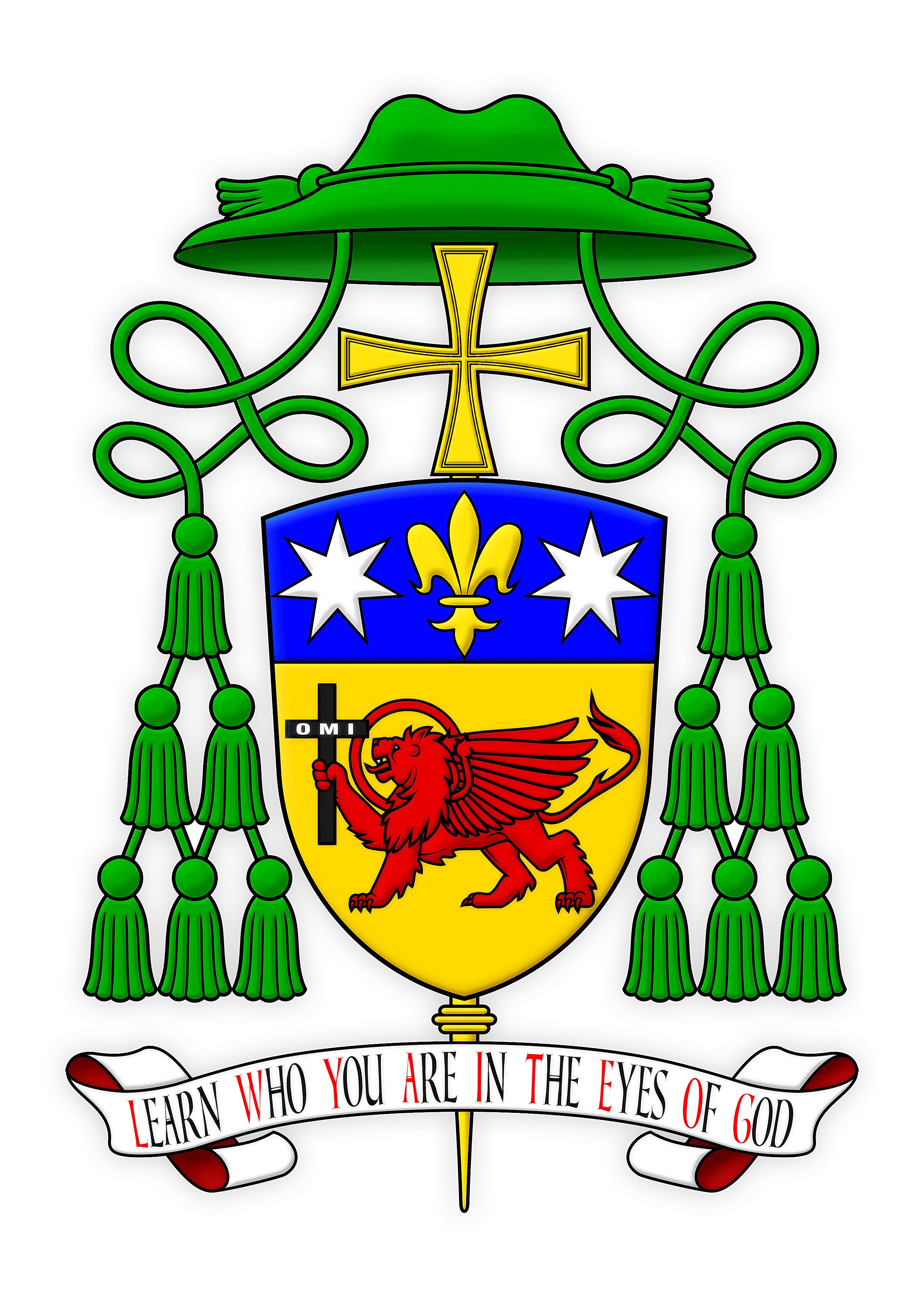
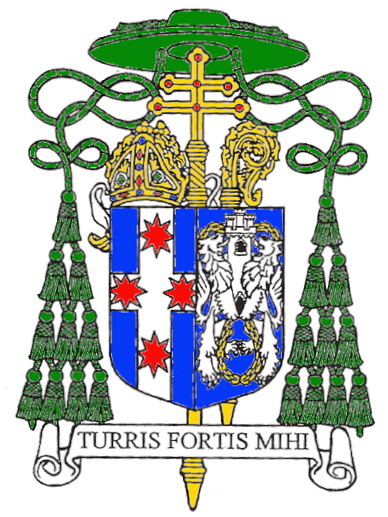
Bishop Mark Edwards, OMI

Image 1

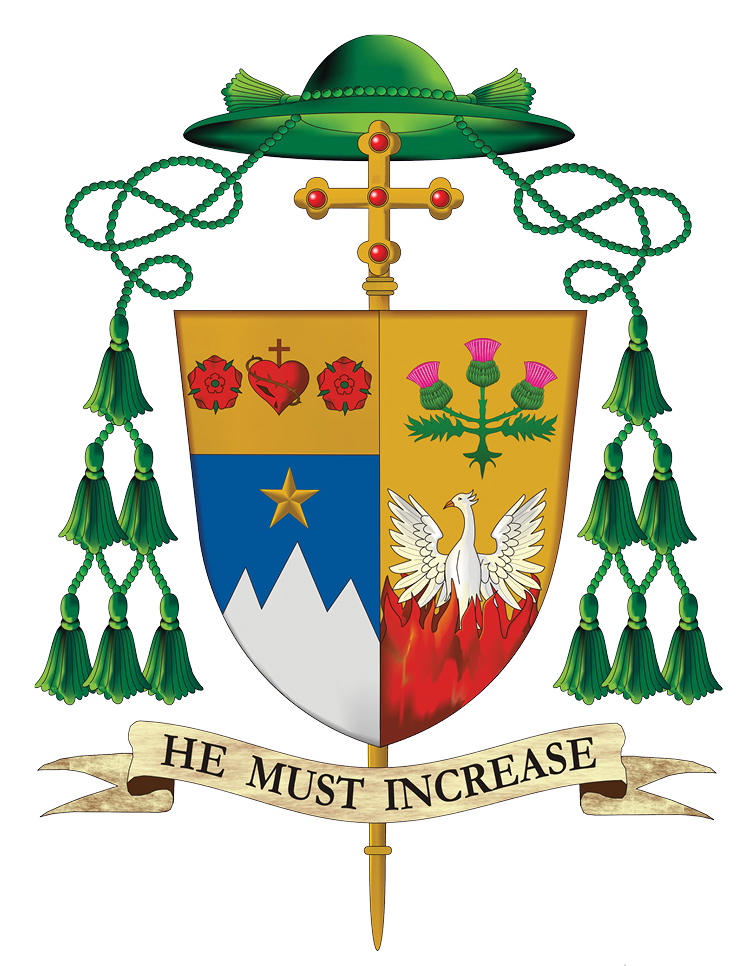
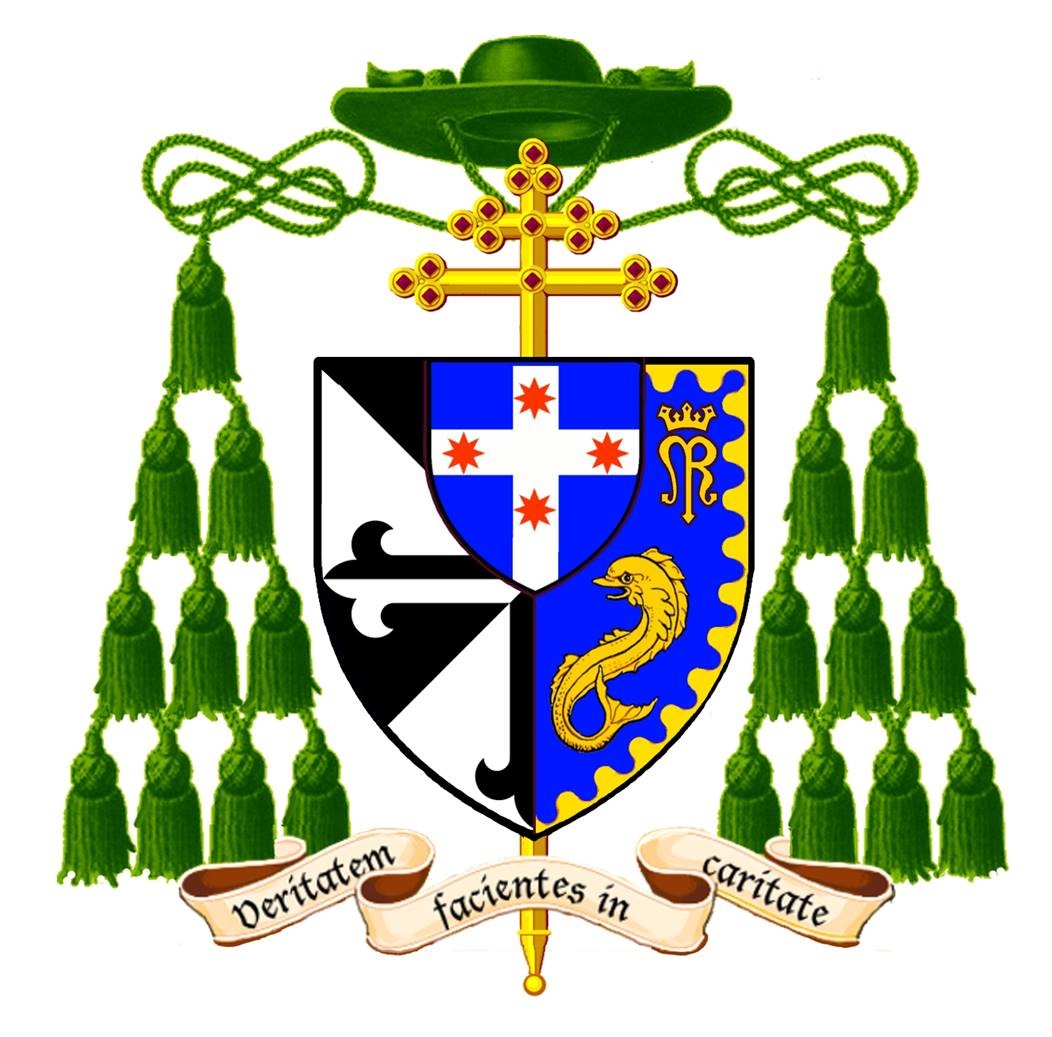
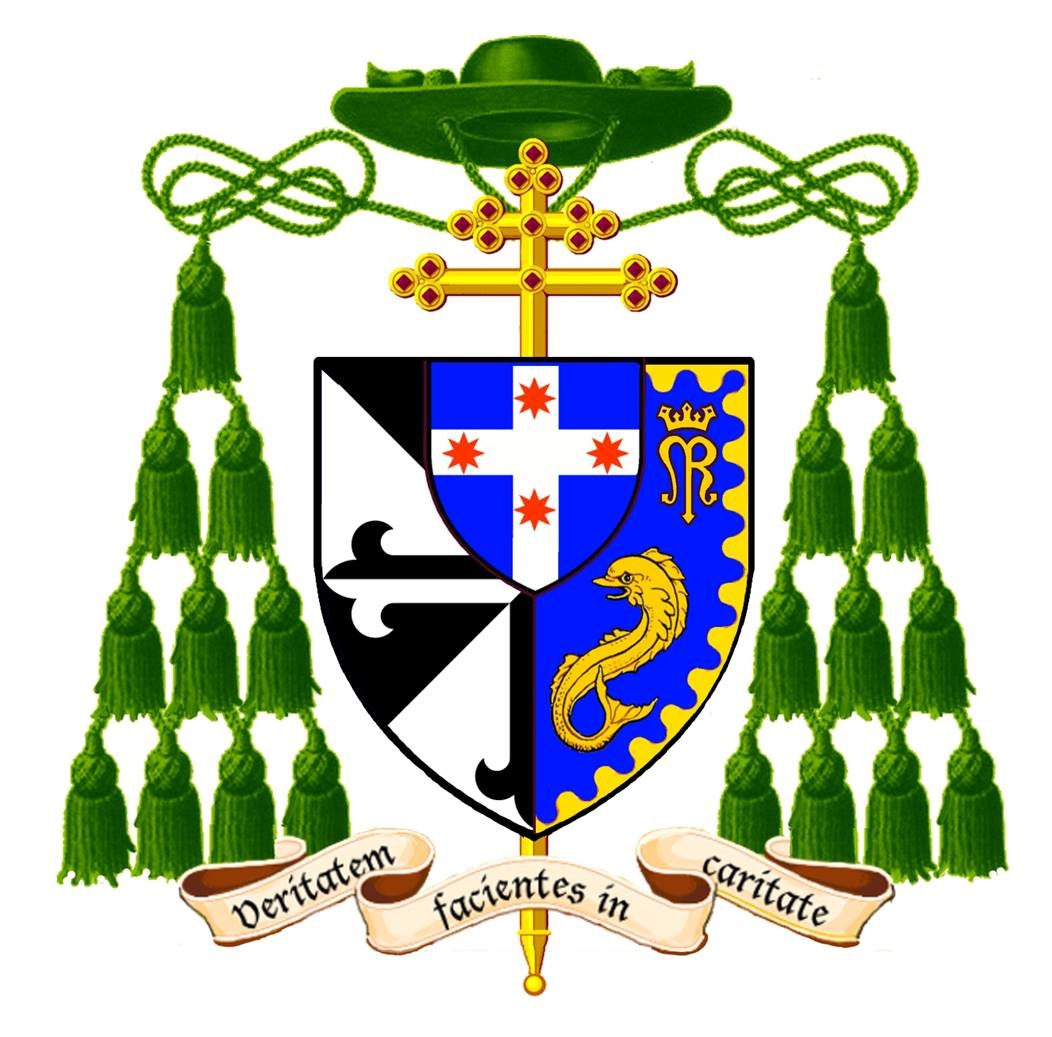
On December 17 Mark Stuart edwards, OMI will be ordained (along with Terence Curtin) as auxiliary bishop of Melbourne, Australia. Bishop Edwards is also the Titular Bishop of Garba.

His newly assumed arms (above) reflect his baptismal patron, St. Mark, as well as the Oblates of Mary Immaculate, the Religious community to which he belongs. In addition, Our Lady and Australia are alluded to on the chief.

These arms were designed by me and Mr. Richard d’Apice of the Australian Heraldry Society and emblazoned by Sandy Turnbull also of the Australian Heraldry Society.

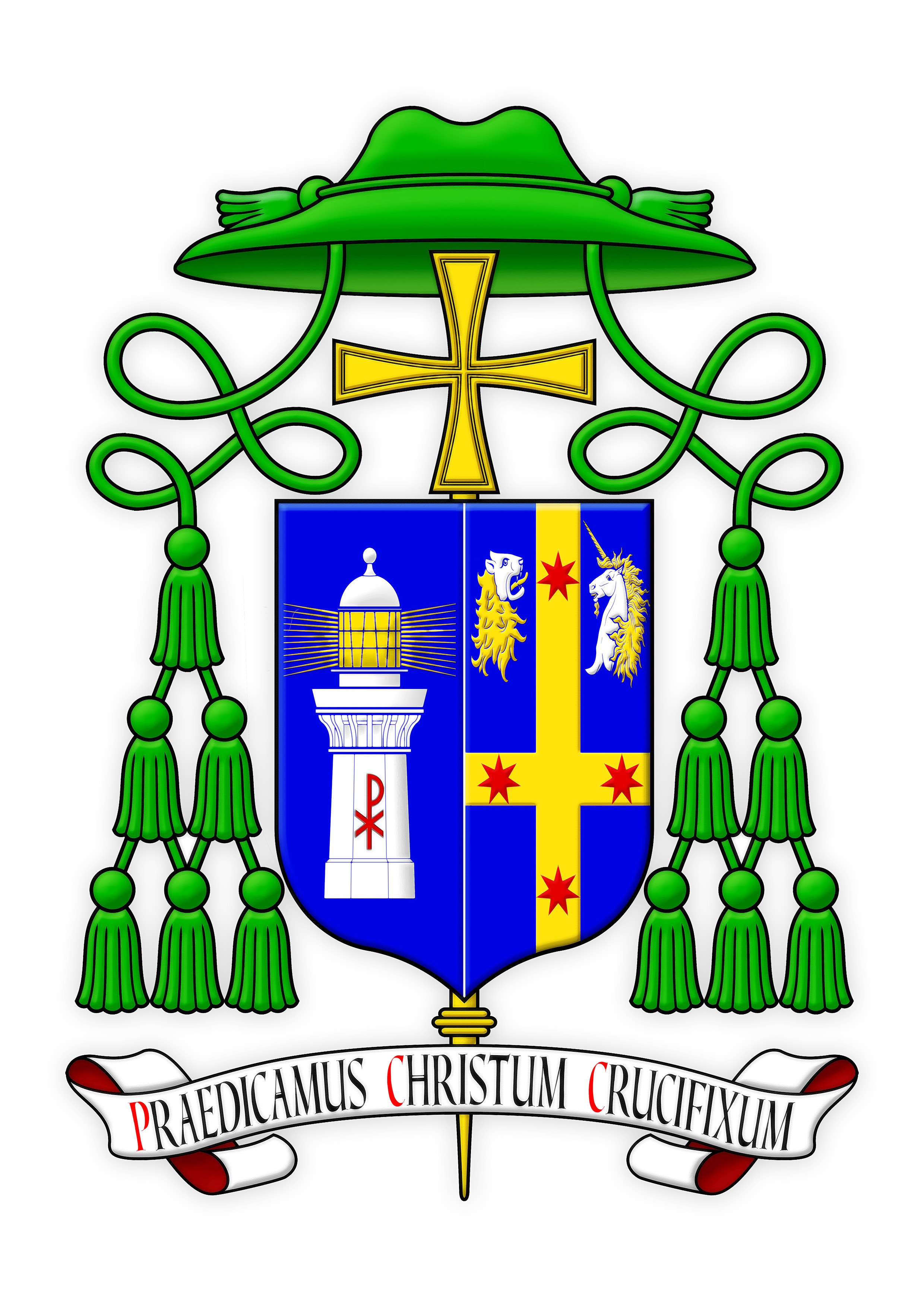
Bishop Comensoli of Broken Bay, Australia

Image 11

The Broken Bay diocesan Arms display a lighthouse spreading the light of the gospel over the diocese. The detail echoes the detail of the Barrenjoey lighthouse which unites the two main land masses that comprise the regions of the diocese.

The arms and motto which Bishop Comensoli adopted at the time he was named Auxiliary Bishop of Sydney in 2011 are of a personal character and are blazoned: Azure, on a Latin cross inverted Or four seven-pointed mullets (or Commonwealth stars) Gules, in the first quarter a lion’s head erased Argent crined and langued Or and in the second a unicorn’s head erased Argent crined and armed Or respectant.

In layman’s terms, the arms may be described as: On a blue field, a gold cross inverted with a red seven-pointed (or Commonwealth) star at each extremity, in the upper left quarter, a silver lion’s head erased at the neck with gold mane and tongue and in the upper right quarter a silver unicorn’s head erased at the neck with gold mane and horn. The motto ‘Praedicamus Christum Crucifixum’ is a quotation from the Apostle Paul’s first epistle to the Corinthians (1Cor1.23), and can be translated as ‘We preach Christ crucified’.

The inverted Latin Cross symbolises the Bishop’s nominal patron, the Apostle Peter and the stars reflect the Southern Cross, which shines out over the Great South Land of the Holy Spirit. The lion and the unicorn respectively symbolise the mind and the heart of love. The meaning of these symbols, while of medieval provenance, is especially associated with the seminal work on Christian love by the English Jesuit, Martin C D’Arcy SJ, “The Mind and Heart of Love: Lion and Unicorn: A Study in Eros and Agape”. Bishop Comensoli will be installed as the Third Bishop of Broken Bay on Dec. 12.

The personal arms were designed by me and Mr. Richard d’Apice of the Australian Heraldry Society and originally emblazoned as well as marshaled with the arms of the diocese and emblazoned again by Mr. Sandy Turnbull also of the Australian Heraldry Society.

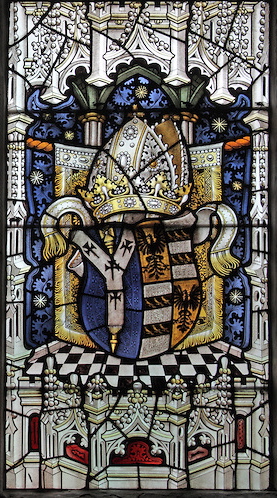
Archbishops of Sydney

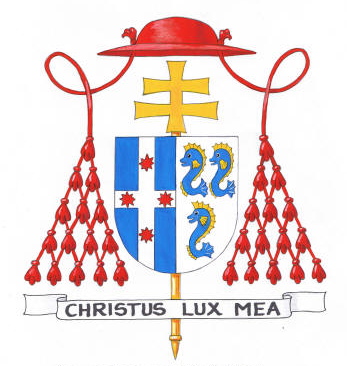
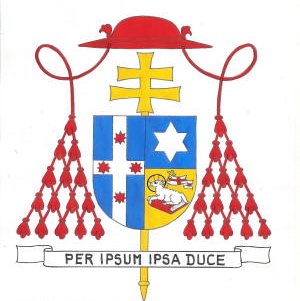
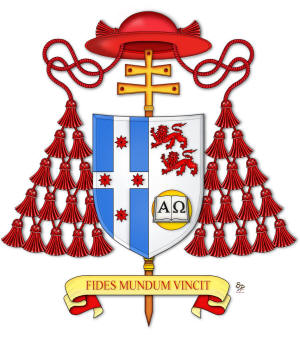
With the recent installation of the IX archbishop of Sydney Australia, The Most Rev. Anthony Fisher, OP several have asked about the arms of the other archbishops, five of whom have also been cardinals. Here they are:

1. Bede (John) Polding, OSB

sc0070423d

2. Bede (Roger) Vaughan, OSB

sc007050b5b

3. Patrick Francis Cardinal Moran

MORAN  PATRIZIO FRANCESCO

4. Michael Kelly

sc0070641b

5. Norman Thomas Cardinal Gilroy, KBE

GILROY-3 My painting0001

6. James Darcy Cardinal Freeman, KBE

FREEMAN  JAMES DARCY

7. Edward Bede Cardinal Clancy

CLANCY

8. George Cardinal Pell, AC

sostituisciPellbis0001

9. Anthony Colin Fisher, OP

image-11

Archbishop Cupich (Third Time’s A Charm)

I have already written about the coat of arms of Archbishop Blase Cupich who will be installed today as the Archbishop of Chicago. Not only has the Archbishop modified his coat of arms when he moved from Rapid City to Spokane and again from Spokane to Chicago now he is also employing a new rendering of the coat of arms done by someone other than Paul Sullivan (below). May the Archbishop’s tenure in Chicago be a spiritually fruitful and successful one.

cupich_coa_200a

And Still More Noble Cardinals

Since these have been so well received I thought I would share some more of my favorites from among those Cardinals of the Holy Roman Church who were from well known armigerous and noble aristocratic families.

First we see the arms of Johann Theodor Cardinal Wittelsbach von Bayern, Cardinal Priest of S. Lorenzo in Panisperna. He was created cardinal “in pectore” in 1743 and proclaimed in 1746. He was also Prince-Bishop of Liège, Friesing & Regensburg. The arms are:

Quarterly of six; 1 (Friesing) Or a moor’s head Sable couped at the neck crowned and collared Gules, 2 (Regensburg) Gules a bend Argent, 3 to 6  (Liège) Gules a column Argent, Gules a fess Argent, Argent three lions rampant vert, Barry Or and Gules a point in point Or three hunting horns Azure; Overall on an escutcheon Bavaria (fussily in bend Argent and Azure) quartering Palatinate (Sable a lion rampant Or). The supporters are two lions Or.
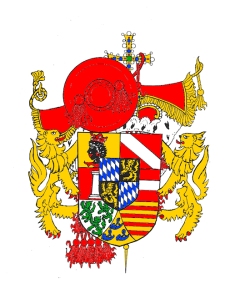
sc01ad6190a

Next are the arms of Luis Antonio Jaime de Borbón y Farnesio, de Baviera y d’Este who was born the youngest son of King Philip V, King of Spain, and his second wife, Elizabeth Farnese. While barely eight years of age, Luis was created 699th Knight of the Order of the Golden Fleece in 1735 and ordained Archbishop of Toledo and Primate of Spain on 9 September 1735, and subsequently named Cardinal Deacon of the Title of the church of Santa Maria della Scala in Rome on 19 December. On 18 December 1754 he abandoned the ecclesiastical life for lack of vocation, renounced his ecclesiastical titles and dignities and assumed the title of 13th Conde de Chinchón granted by his brother Infante Felipe.

When his older half-brother King Ferdinand VI died without issue in 1759, Luis claimed the throne on the grounds that, he was the only surviving son of Philip V who was born in Spain, and the only one still residing in Spain (his older brothers were Charles, King of Naples and Sicily, and Philip, Duke of Parma, both reigning in Italy). However valid his claim, Luis lost the succession to his oldest brother Charles, while Charles’ third son became Ferdinand I of the Two Sicilies.

The arms are: Quarterly 1: (Castile) Gules a triple towered castle Or quartering (Leon) Argent a lion rampant Purpure; 2: (Argaon) Or five pallets Gules impaling (Sicily) Per saltire Aragon and Argent two eagles in fess displayed Sable; a point in point between the two quarters of (Granada) Argent a pomegranate Proper; 3: Per fess (Austria) Gules a fess Argent and (Burgundy  ancient) bendy Or and Azure, a border Gules; 4: Per fess (Burgundy modern) Azure, semeé de lis Or, a border compony Argent and Gules and (Brabant) Sable a lion rampant Or; two inescutcheon in pale the first (Bourbon) Azure three fleurs-de-lis Or, a bordure Gules; the second tierces in pale (Visconti) Argent a viper vorant Azure crowned Or and devouring a child Gules; (Flanders) Or a lion rampant Sable membered Gules, And (Tyrol) Argent, an eagle displayed Gules.
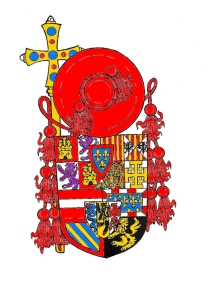
sc01ad84d4a

This cardinal, because of his failed claim to the throne, could also be numbered among the “royal” cardinals as well.

(artwork by the late Michael McCarthy)
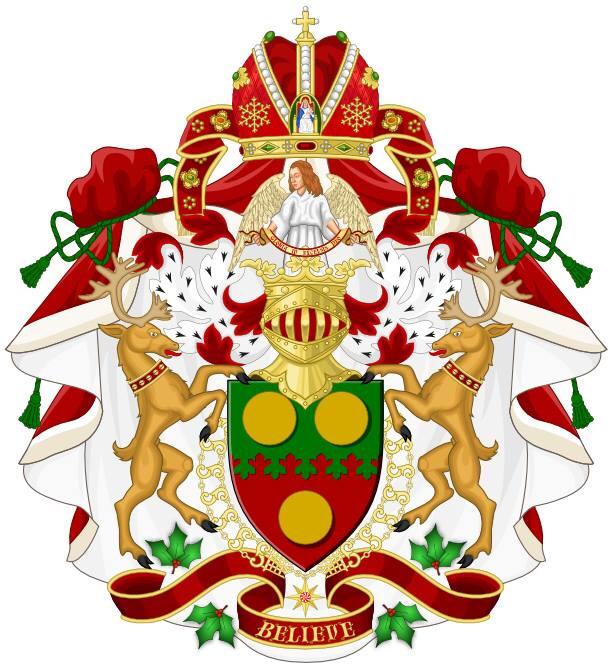
More Royal Cardinals

Back in October of last year I posted about a Cardinal who was also the King of Portugal. He wasn’t alone in the College of Cardinals. In addition to numerous noblemen there have been other royal Cardinals as well. Below we see two more.

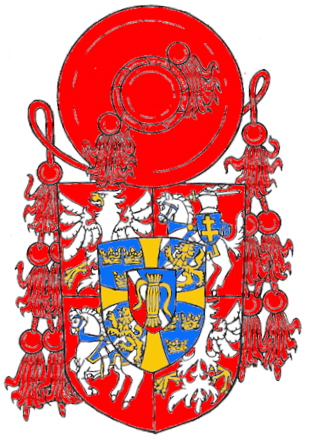
Casimir of Poland who was named a cardinal in 1646 but resigned from the College of Cardinals in 1648 to assume the throne as Jan II Casimir, King of Poland. His arms depict what was then the arms of Poland, namely:

Quarterly 1&4 Gules, an eagle displayed Argent membered and armed Or; 2&3 Gules a knight on horseback (Vytautas) Argent saddled Azure holding a shield Azure charged with a double-barred cross Or. Overall an escutcheon bearing Sweden: A cross patteé throughout Or between 1&4 Azure three crowns Or; 2&3 bendy sinister Argent an Azure overall a lion rampant Or; on an escutcheon in pretense per bend wise Azure, Argent, Gules all charged a Vasa Or.

sc01ad3a68a copy

Next is the possibly familiar arms of Henry Cardinal Stuart, acknowledged by many to be the legitimate heir to the English crown as Henry IX. Henry Benedict Mary Clement Stuart was the Duke of York as well as the Cardinal Priest of S. Maria in Portico. He was later made Bishop of Frascati, Bishop of Ostia & Velletri in 1803. He died in 1807 never having taken his rightful place on the throne of Great Britain & Ireland. His arms were the royal arms of the Stuarts, namely:

Quarterly 1&4 Grand Quarters (England & France) 1&4 Azure three fleur-de-lis Or and 2&3 Gules three lions passant guardant Or; 2 (Scotland) Or a lion rampant Gules armed Azure within a double treasure flory counter flory Gules; 3 (Ireland) Azure a harp Or. The arms are supported by the lion of England and the unicorn of Scotland, royal supporters since the time of James I. The arms usually depicts the cadence mark of a silver crescent at the center but this was omitted after he assumed the title Henry IX as Pretender to the throne. This version also include the royal crown rather than a ducal coronet.

sc01ada403

(all artwork by the late Michael McCarthy)
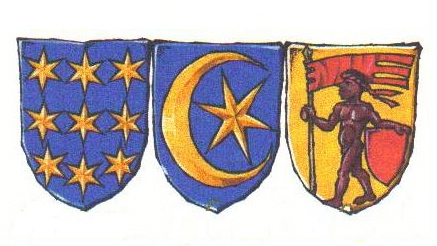
The Nobility in The Clergy

Here we have two examples of the arms that became well known in Europe as being associated with territories or noble families being employed by members of the hierarchy, Cardinals to be exact, in their ecclesiastical achievements. The first is of Innio de Avalos de Aragon Cardinal Deacon of S. Lucia in Silice. He was Bishop of Sabina in 1586, Bishop of Frascati in 1589 and Bishop of Porto in 1591. The arms are:

Quarterly, 1&4 per pale Aragon, Hungary, Anjou (ancient) and Jerusalem; 2&3 Grand Quarterly 1&4 Azure, a triple towered castle Or, a bordure compony Argent & Gules; 2&3 Bendy Or and Gules quartering per fess Or and Gules a lion rampant Counterchanged.

sc0180689ca

The next one is the arms of Damian Hugo Philip von Schönborn, Cardinal Deacon of S. Nicolo in Carcere, Prince-Bishop of Speyer. The arms are:

Speyer (Quarterly 1&4 Azure a cross throughout Argent; 2&3 Gules a crozier in bend Or debruised by a two towered castle Or) overall on an escutcheon Gules on three piles issuant in base Argent a lion passant crowned Or (Schönborn) and below the shield on another shield Argent the cross of the Teutonic Order. Supporters: Two lions affronteé crowned Or, armed and langued Gules each supporting a banner, to dexter of the Empire and to sinister of Austria

sc0180c614a

(artwork for both is by the late Michael McCarthy)
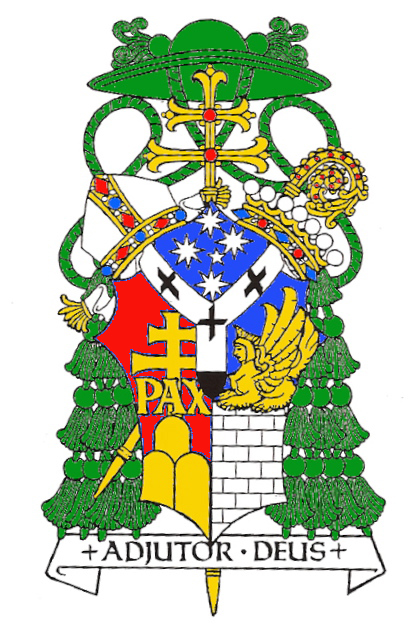
Archbishop Anthony Fisher of Sydney

Image 11

The Most Rev. Anthony Fisher, OP until now Bishop of Parramatta and previously auxiliary bishop of Sydney will be installed as the IX Archbishop of Sydney on November 12. His coat of arms (above) was prepared by Mr. Chris Wolter who had also done the work on the archbishop’s arms in Parramatta and as auxiliary bishop (below).

BishopAF-CoatArms

In the interest of full disclosure I, along with the President of the Australian Heraldry Society, Mr. Richard d’Apice, AM, were consulted on this coat of arms. As with any such consultation some of our advice was followed and some was not but the archbishop and Mr. Wolter were very open to hearing suggestions. Essentially, the archbishop retains the arms he first assumed when becoming auxiliary bishop of Sydney. Those arms combine the armorial bearings of the Order of Preachers (more commonly referred to as the Dominicans) of which he is a member impaled with arms that are based on the arms used by St. John Cardinal Fisher when bishop of Rochester, England with some minor alterations for difference (i.e. the inclusion of the Marian symbol). Over this on an inescutcheon (sometimes referred to as an escutcheon “in pretense” although that expression isn’t wholly appropriate in this case) is the arms of the See of Sydney.

Very Nice Diocesan Arms

On Sept. 24th Edgar da Cunha will be installed as the new bishop of Fall River, MA. The diocese possesses a very nicely designed coat of arms that even includes a nice “can’t” or heraldic pun based on the name of the See. The wavy line that crosses the shield from the upper left to the lower right depicts a river that falls as one looks at it from left to right. Thus, it “says” the name of the diocese. In addition, the overall design is simple and uncluttered. The cross is a sign of the faith and the grace of God and the star is a symbol of the titular of the cathedral: St. Mary. The arms were designed by Pierre Chaignon la Rose.

640px-Roman_Catholic_Diocese_of_Fall_River.svg

Bishop Rozanski of Springfield

15583692-large

On August 12 Bishop Mitchell Rozanski, until now Auxiliary Bishop of Baltimore, will be installed as the IX Bishop of Springfield, Massachusetts. The coat of arms of the new bishop (above) combines his personal arms with those of the see of Springfield. (the four roundels with waves symbolize a field of springs and the cross is associated with St. Michael, patron of the cathedral.)

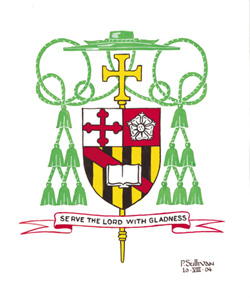
His personal arms (below) were assumed in 2004 at the time he became a bishop when he was appointed as Auxiliary in Baltimore.

RozanskiCrest

The small cross is symbolic of St. Michael (a name from which Mitchell is derived); the red and white colors allude to the national colors of Poland; the flower alludes to his surname which, in Polish, means “rose flower”. The lower portion uses the colors derived from the arms of Calvert, Lord Baltimore. The red bend (vertical stripe) and open book are for preaching the Word. The motto is taken from Psalm 100.

(Artwork by Paul Sullivan)

Bishop Jenik

Bishop_Jenik_Coat_of_Arms_2014

On August 4, 2014 Cardinal Dolan of New York ordained three Auxiliary Bishops for the Archdiocese. They are the Most Revs. Peter Byrne, John O’Hara and John Jenik. While I have not yet seen the coats of arms assumed by all three I did come across the interesting and distinctive coat of arms assumed by Bishop Jenik. He designed the coat of arms himself and I am not sure of the symbolism behind the design. Many might see this as strange because it does not follow the usual “lucky charms” notion of heraldry with an overloaded shield filled with charges meant to be a pictorial CV of the bearer. Good for him! Such heraldry is atrocious and all too common among the American Catholic hierarchy.

Rather, Bishop Jenik’s coat of arms is very simple. This is one of the earmarks of good heraldry. The use of black and white may make it stark but not knowing the meaning of the design there may very well be a good reason for the choice of these colors. In addition, since heraldry is, at its heart, about identification and nothing else, the design is clear to see and easily identifiable. Again, these are attributes of good heraldry. It reminds me of some of the most ancient heraldic designs that present clear images and use as few colors as possible.

I say hats off to Bishop Jenik for an excellent and unique design for his coat of arms!

(Artwork by Paul Sullivan)

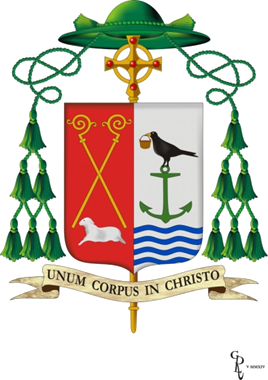
Bishop Doran of Elphin, Ireland

crest of bishop kevin doran

Father Kevin Doran is being ordained Bishop of Elphin, Ireland on July 13. The description of his coat of arms (above) taken from the website of the diocese:

In the right side of the shield (seen from the point of view of the one holding the shield) we find represented the Coat of Arms of the Diocese of Elphin; two golden crossed croziers surmounting a lamb as the central symbol reflecting Jesus, the Lamb of God who takes away the sins of the world.  The red (gules) color is the color of love, of blood; the infinite love of the Father who sent the Son to shed His blood for us, the ultimate act of love.

The personal arms of Bishop Kevin occupy the left side. This part of the shield is in silver (argent). The anchor, symbol of hope, is taken from the Doran family motto, Spes Ancora Vitae (Hope is the Anchor of Life).  The anchor is in green (vert), the symbolic colour of hope.

The blackbird references the legend of St. Kevin and the Blackbird, which is so well captured in the poem by Seamus Heaney. It reminds Bishop Kevin of the importance of fidelity to prayer and the relationship between prayer, compassion and service. The blackbird carries in his beak a copper pot, symbol of St Asicus, patron saint of the diocese of Elphin. St. Asicus was a coppersmith.

Fr. Kevin spent some years as parish priest of Glendalough, Co. Wicklow (The Valley of the Two Lakes). As he ministered to parishioners and pilgrims around the lakeshore, he was often reminded of the ministry of Jesus, much of which took place around the lake (or sea) of Galilee.  As he undertakes his new mission in the Diocese of Elphin, (a diocese bounded on one end by the River Shannon and on the other by the Atlantic Ocean), he takes the ministry of Jesus as his model and inspiration. This is the symbolism of the wavelets in the lower part of the shield.