Best wishes to Her Majesty, Queen Margrethe II of Denmark on her 75th birthday!
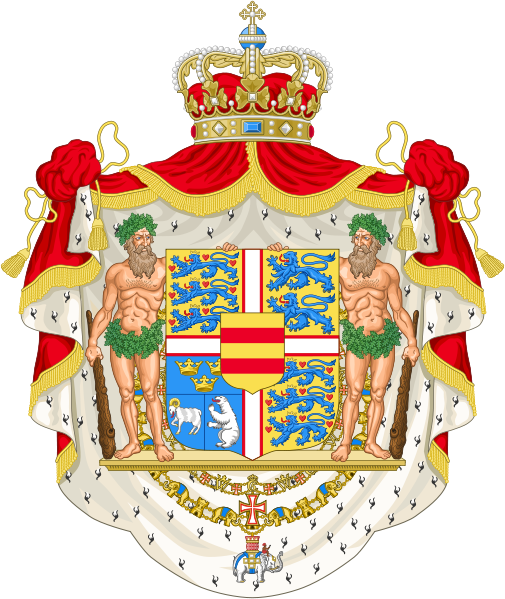
Best wishes to Her Majesty, Queen Margrethe II of Denmark on her 75th birthday!
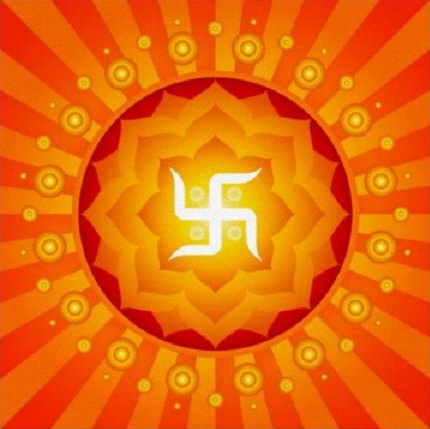
I recently came across an article on Huffpost about the swastika, the ancient religious symbol co-opted by the National Socialist German Worker’s Party, more commonly known as the Nazis, and whether or not the symbol which has deep significance for Buddhists, Hindus and Jains (the populations of which are growing in the USA) could ever be rehabilitated or is forever associated with evil, hatred and genocide.
This is something that has long interested me as a devotee of heraldry. I have often said, long before I knew about the religious significance of the swastika, that the Nazis chose a particularly striking symbol but that it was ruined for all time. In the summer of 1989 I was working in a parish in Baltimore that had been built in the 1920s before the Nazis came to dominate Germany and Europe. The floor tiles were plain but were interspersed with colored tiles depicting the cross in various forms. One such form was a swastika, or hooked cross (hakenkreuz) as the Germans called it. At first I was appalled seeing it there until I was told that it used to be seen simply as a form of the cross long before it became associated with the Nazis. From that point on I became interested in how this ancient symbol had been ruined forever and wondered if it might ever lose that connection with evil.
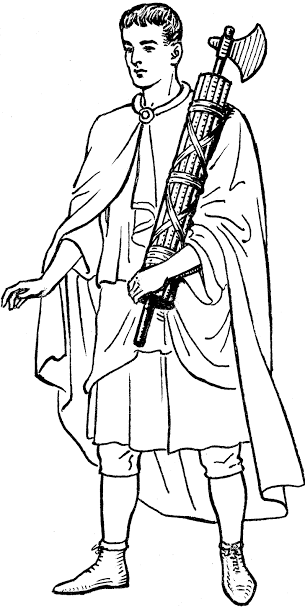
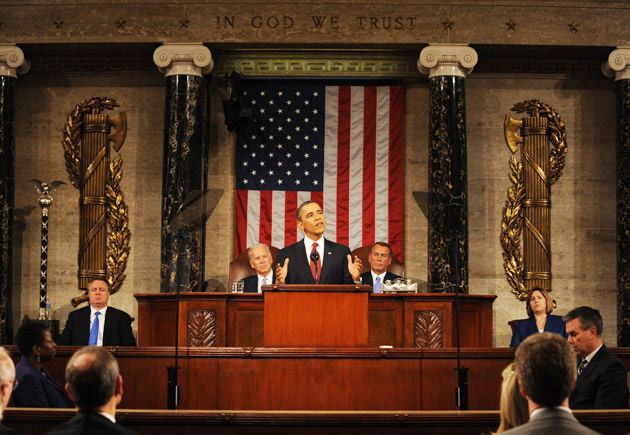
After all, the other big symbol associated with Fascism was also an ancient one: the fasces. This symbol, dating from the time of the Roman Empire, was the symbol used by Mussolini and his blackshirts in Italy after their rise to power. For centuries it had already existed as a symbol of justice and of legislative power. The fasces were used in the ancient Roman Senate in the time of the Republic and also, later, carried before the Emperor. Yet, during and after World War II no one seemed to feel the need to destroy this ancient symbol. Indeed depictions of the fasces appear on the wall behind the dais in the United States House of Representatives to this very day.
And the famous statue of Abraham Lincoln in the Lincoln Memorial in Washington, DC does not depict Honest Abe seated between two books, as is often erroneously thought. Rather, he is seated on a chair the arms of which are composed of fasces!
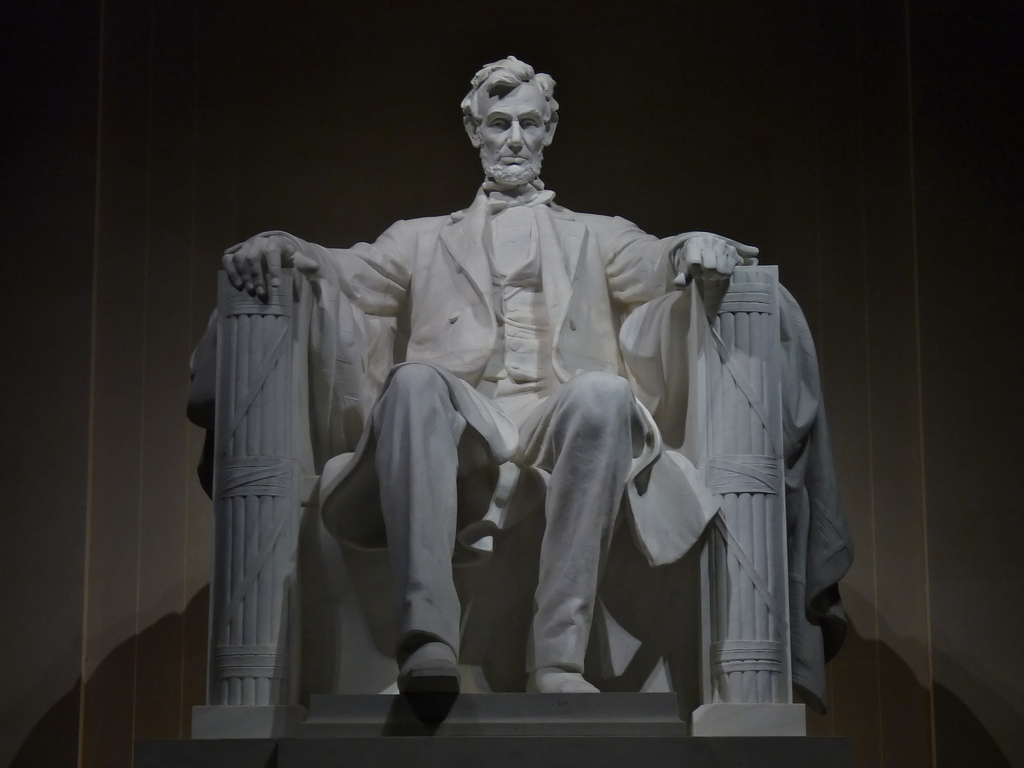
So, why did the fasces get a pass and not the hakenkreuz? Why was one symbol so closely associated with the totalitarianism and oppression of Fascism allowed simply to continue in its original use while another with equally ancient origins and religious significance for several different religions become vilified as a universally deplored symbol signifying hatred especially when one considers that it was only used as a Nazi symbol for about 20 years? It helps to look at what Adolf Hitler did with a pre-existing symbol and how that affected its transformation.
Hitler didn’t invent the swastika, we know that. In fact, as I have already mentioned swastika is the word used for this symbol coming from the Sanskrit word for “well-being” and used by Buddhists, Hindus and Jains who consider it an auspicious sign. It was also seen as a sign of well-being and prosperity by Mesopotamian, Mayan and other early indigenous cultures. However, as a form of the Christian cross with hooked ends it was referred to by Europeans as the hooked cross (hakenkreuz). The Nazis never used the word “swastika” for their party symbol. But why would they, a neo-pagan cult which rejected the basic tenets of Christianity, adopt a form of the cross as a symbol? One theory is rooted in, of all things, Adolf Hitler’s Roman Catholic upbringing.
Born in Austria, a country that remained staunchly Catholic even after the Reformation, the young Hitler was educated at Lambach Abbey School run by Benedictine monks. Day after day the boy was surrounded by decorative motifs placed on doors and gateways throughout the abbey by one of its former (and deceased) abbots, Theodor Hagn. The device Hagn had used to decorate the abbey (below) contained his initials, T-H and the abbreviation A-L for Abbey Lambach surrounding an ancient form of the cross: a hooked cross. It was thought by many that this symbol stayed in the mind of the impressionable boy and he recalled it years later when choosing a symbol for the party in which he was rapidly rising to the top as its leader.
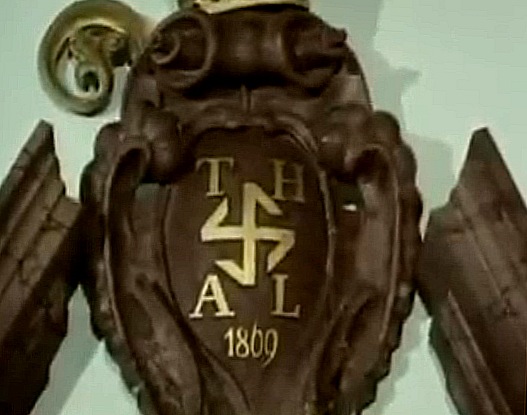
There is good reason to doubt this as the origin of the Nazi party symbol since party members had already been using the hakenkreuz as a symbol even before Adolf Hitler became a member. In addition, it is worth mentioning the ridiculous and false claims that the Nazis had that somehow they, as a “master race” were descended from the ancient Aryans for whom the swastika was a symbol used in their ancient culture. However, one thing is certain. Regardless of where Hitler got the symbol he is the one who decided on its particular depiction as the Nazi Party emblem. It was Hitler, the talentless frustrated artist who took the normally squared off swastika and tilted it on an angle. He then also insisted it be depicted in black on a white circle and the whole surrounded in red. Thus, did Hitler take an ancient form of the Christian cross (as well as an even more ancient symbol of well-being and auspiciousness to other religions of the world) and turn it into the forever recognizable armband and flag of the Nazis still associated with them long after their well-deserved demise.
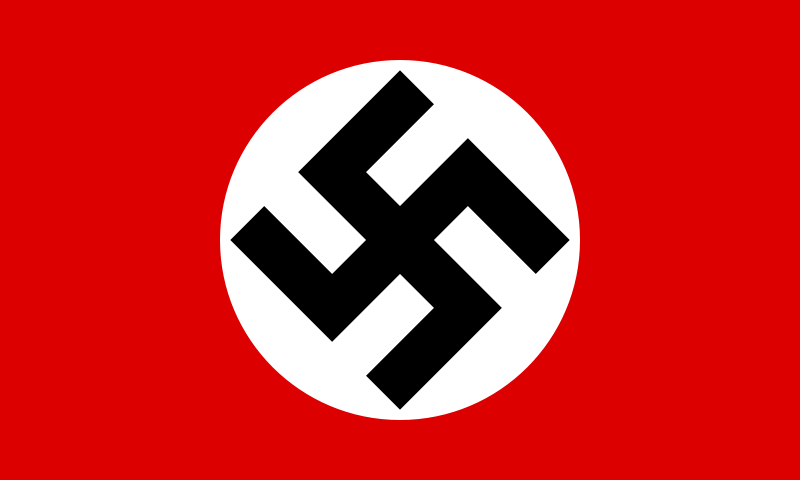
So, since the hakenkreuz had a particular depiction (tilted, black on white surrounded by red) and the swastika has a similar but distinct depiction, as it also has a distinct meaning, and since the world was content to allow the fasces to continue in use as understood to have a distinct original meaning why has the swastika become so reviled?
The simple answer is, I think, because it has, that’s why. Because it became associated with man’s inhumanity to man. It became associated with the senseless slaughter of millions motivated by nothing other than blind, irrational hatred. It became associated with the people who perpetrated one of the greatest, if not the greatest, crime against humanity ever recorded. It became associated with the terrifying hatred of others as less valuable and less than valuable as human beings to be seen, instead, as a lower form of life to be exterminated.
In addition, unlike the fasces which, in a sense, reverted to their formerly respected and respectable symbolism and adopted by no one else as a symbol of attempting a continuance of the misguided oppression of the Fascists the hakenkreuz, or swastika, continues to be used by groups who represent nothing other than hatred and racism. The Nazi party as a party may no longer exist but there remain pockets of those who still espouse its ideas and its twisted philosophies. They think of themselves as the natural heirs to the Third Reich and imagine that they, too, are somehow descended of the “master race” of Arayans. Their delusion is all the more frightening because it persists so long after its originators were vanquished.
Nevertheless, despite the clear association with hatred of the hakenkreuz, itself most unfortunate because it is a bastardization of the cross of Christ which, for faithful Christians, is the symbol of their faith and a sign of life and salvation and mercy and reconciliation, the swastika, a different though unfortunately similar symbol, remains one of auspice and well-being to millions of people around the world. I think it is precisely because of their migration to the Western world that this has become more of an issue. In places like India the swastika is as commonly seen as the cross is in Europe or America.
The article I mentioned in Huffpost mentions how most people who adhere to one of the religions that make use of the swastika don’t feel an urgent need to assert its rehabilitation. That’s not because they don’t think it’s a good idea. Rather, it just isn’t seen as an important fight right now. They are able to see and understand the horrible connotation that symbol has in the eyes of many. As one man interviewed in the article states, “(it isn’t) up to the Hindus or necessarily in their interest to change what the swastika means to the Jews. They should be allowed to be repulsed by it just like Hindus should be allowed to be bolstered by its auspiciousness.”
Perhaps, several hundred years from now people will be able to look at a swastika and primarily see the symbol of well-being that it is for Hindus and acknowledge as footnote that, for a time, it had been appropriated as a symbol by a bunch of thugs who tried to take over the world and that bad connotation hung on for a century or two. That would be progress, I think. As to whether or not the hakenkreuz (I’ll never incorrectly use the term “swastika” for the Nazi symbol again) will ever be rehabilitated in Western society I think that the answer is certainly not in my lifetime and, i suspect, not for quite some time after that as well. As long as Holocaust survivors still live and the immediate families of both Holocaust victims and survivors, whose lives were torn apart and irrevocably changed by that horrible event, still live how can it be? In addition, as long as hate-filled anti-Semites still appropriate the symbol as theirs how can it? The Nazis may have used it for only about 20 years but countless numbers of bigots continue to infuse the symbol with their racial, religious and cultural hatred. The Nazis may have, in my poor opinion, “ruined” the swastika by using the hakenkreuz for a time but others continue to ruin it, and to misuse it as symbol that strikes fear into the hearts of all good people even now.
Can the swastika ever be allowed to be used in the West without being associated with the Nazis? Can the hakenkreuz ever be rehabilitated as merely one form of the cross? Perhaps. But, not now…nor anytime soon.
On February 20, 2015 the opening session of the diocesan inquiry into the beatification of the Servant of God, Fra” Andrew Bertie, 78th Prince and Grand Master of the Sovereign Military and Hospitaller Order of Saint John of Jerusalem, Rhodes and Malta took place. Of course Fra” Andrew, an Englishman, was armigerous.
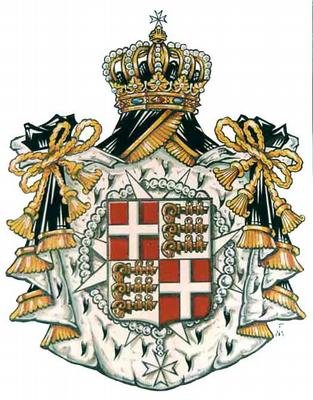
(artwork: Marco Foppoli)
Just today the news has been spreading that, for the first time, the polls are showing that those who seem to favor voting for Scottish independence are in the majority, albeit an ever so slight one (within the margin of error, in fact). The vote is less than two weeks away and what once seemed like a proposition that was surely not going to pass now looks like it may have a fighting chance. It will be interesting to see the result of the vote. Polls can be deceiving and in the time remaining it may swing the other way agin. I’m not interested in discussing the politics involved. However, there is a possibility, and it is just that: merely a possibility, that there could be some heraldic ramifications for the Queen if Scotland becomes independent.
At present, the plan is that even if Scotland votes for independence it would remain a constitutional monarchy. Scottish First Minister, Alex Salmond, has indicated that there is no plan to declare a republic, at least not immediately. Rather, Her Majesty would still be Queen of Scotland and act as the Scottish Head of State in an independent Scotland. However, such a scenario could remove Scotland from the United Kingdom. So, as the Queen is in some sixteen countries already she would be the sovereign of Scotland and she would continue to be the sovereign of the U.K. with the difference that the U.K. would no longer include Scotland. This would not be unique. The Queen is Queen of Canada, Queen of Australia and Queen of New Zealand, for example. None of those countries is in the U.K but she is, nonetheless, sovereign of those nations.
With an independent Scotland the United Kingdom would consist of England (including Wales) and Northern Ireland. Currently the U.K is described as a united kingdom of “Great Britain and Northern Ireland” meaning all of the territory on the island of Britain as well as the northern part of the the separate island where Ireland is located. (NOTE: the Channel Islands are possessions of the Queen but not part of the U.K.) I suppose it could be argued that if she remains the Queen of Scotland then she could still be said to be Queen of Great Britain. However, the point of this referendum is that now Great Britain and N. Ireland is all one country and the Scottish people will be voting on whether or not they want Scotland to be a separate country. This would make it a separate country with its own monarch who happens to be the same person as the monarch of the U.K. as is the case with Canada, Australia, etc. While those working for an independent Scotland have assured the voters that there is no plan at present to dump the monarchy that does not mean it might not be considered at some future time, such as after the passing of the present Queen. In fairness, it should be pointed out that it would also be possible to have a politically independent Scotland while maintaining a monarchial union, that is to say, that Scotland would continue to be part of a United Kingdom with its own separate government.
So, all of this could, I say could, potentially have heraldic ramifications. The current coat of arms used by HM reflects, in its quarterings, the various lands that make up the United Kingdom: England, Scotland and Northern Ireland. Wales does not have a separate quartering because it is considered to be part of England, although, in fairness, perhaps not by all the Welsh! Many are probably familiar with the fact that the Queen uses a slightly different coat of arms when in Scotland. In that version the Scottish quarter receives pride of place, as does the Scottish supporter (the unicorn), the crest is different and the collar encircling the shield is that of the Order of the Thistle instead of the Garter. Nevertheless, this is a different version of the arms of the United Kingdom. The quarters for England and N. Ireland are still included. However, the Queen also has a separate coat of arms in right of Canada and also makes use of badges and other heraldic insignia in her other realms.
This begs the question of what may, again I say may, happen to the royal arms if Scotland becomes an independent country and is no longer part of the United Kingdom. Officials at Buckingham Palace have indicated that the Queen may find it better to appoint a Governor-General to represent her in Scotland as there is in places like Canada, Australia and New Zealand. In such a case then perhaps HM will make use of the Scottish royal arms all alone as would be her lawful right as sovereign of an independent Scotland?
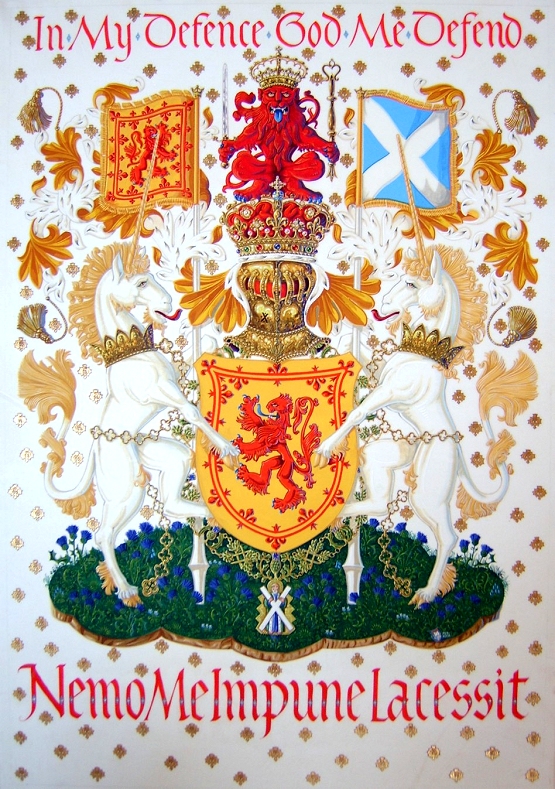
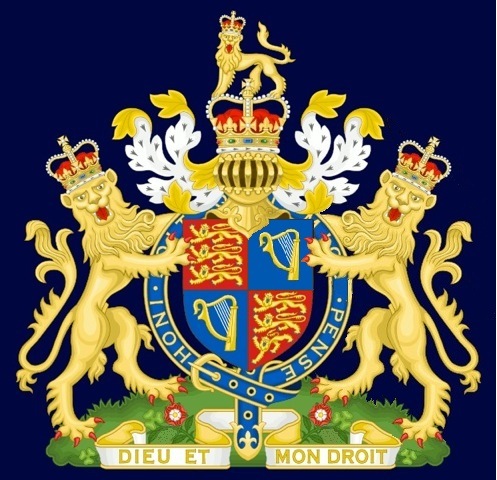
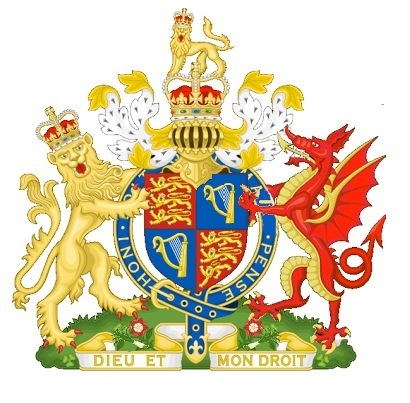
In addition, modifications would need to be made to the royal arms as used in the U.K. This would mark the first major change in the royal arms since the accession of Queen Victoria in 1837 at which time the inescutcheon of Hanover was removed from the royal arms because the Salic Law prevented a woman from succeeding to the throne of Hanover. It would also mark the first time there was a significant change in the four quarterings of the arms since 1801 when the quarter for France was removed from the arms of George III. The quarter for Scotland would be removed from the royal arms as it would no longer be part of the U.K. and, very likely the thistle would be removed from the compartment at the base of the achievement. It might also be possible that the unicorn supporter might be replaced. So instead of the current royal arms (below left) we could conceivably end up with something more like (below right)
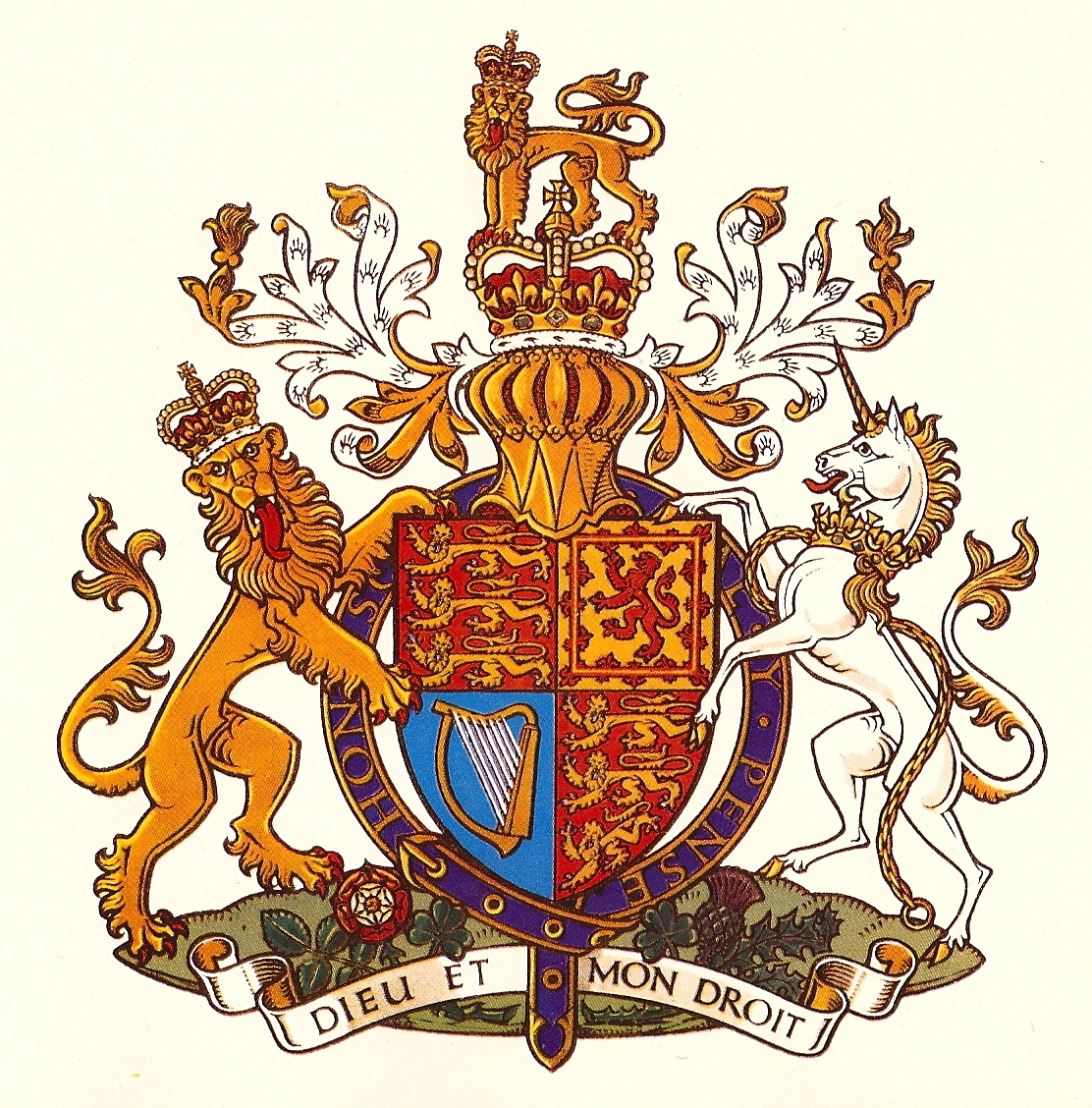
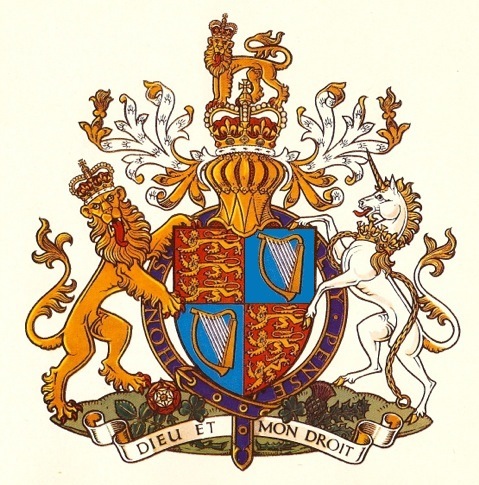
Again, it is worth noting that in this hastily prepared image I did not take the time to remove the thistle from the compartment or to replace the unicorn supporter. While the former would almost certainly be done it is really uncertain that the supporter would be changed so that there would be two lion supporters. The last time one of the supporters in the royal arms was changed was 1603 when James I succeeded Elizabeth I and replaced the dragon with a unicorn. It could be argued that leaving the unicorn supporter in the royal arms even if Scotland becomes independent is acceptable. It would also not be unthinkable simply to have two lion supporters as in the image below (left). Personally, I’d like to see the reintroduction of the Welsh dragon supporter especially as Wales doesn’t get a quarter of its own on the shield. (Image below right). But, I am getting waaaaaaay ahead of things. All of this would have to be discussed and worked out properly in consultation with the Earl Marshal and HM College of Arms in London as well as the Court of Lord Lyon in Edinburgh. It seems, however, that there would be little reason to include a quarter for Scotland in royal arms of the sovereign of the U.K. if Scotland is no longer in that same U.K. Otherwise, quarterings for all of HM realms and territories would already be included in the royal arms and, of course, such is not the case.
Indeed, it will be interesting and, by all recent accounts, now much more exciting to see the outcome of the September 18 referendum. Most people will, rightly, be concerned with the political, the economic, and the social aspects of an independent Scotland. It will also be interesting to see if and how the admittedly minor heraldic aspect of it all is resolved as well.
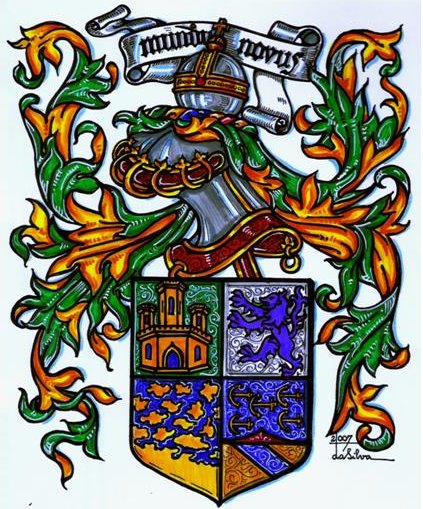
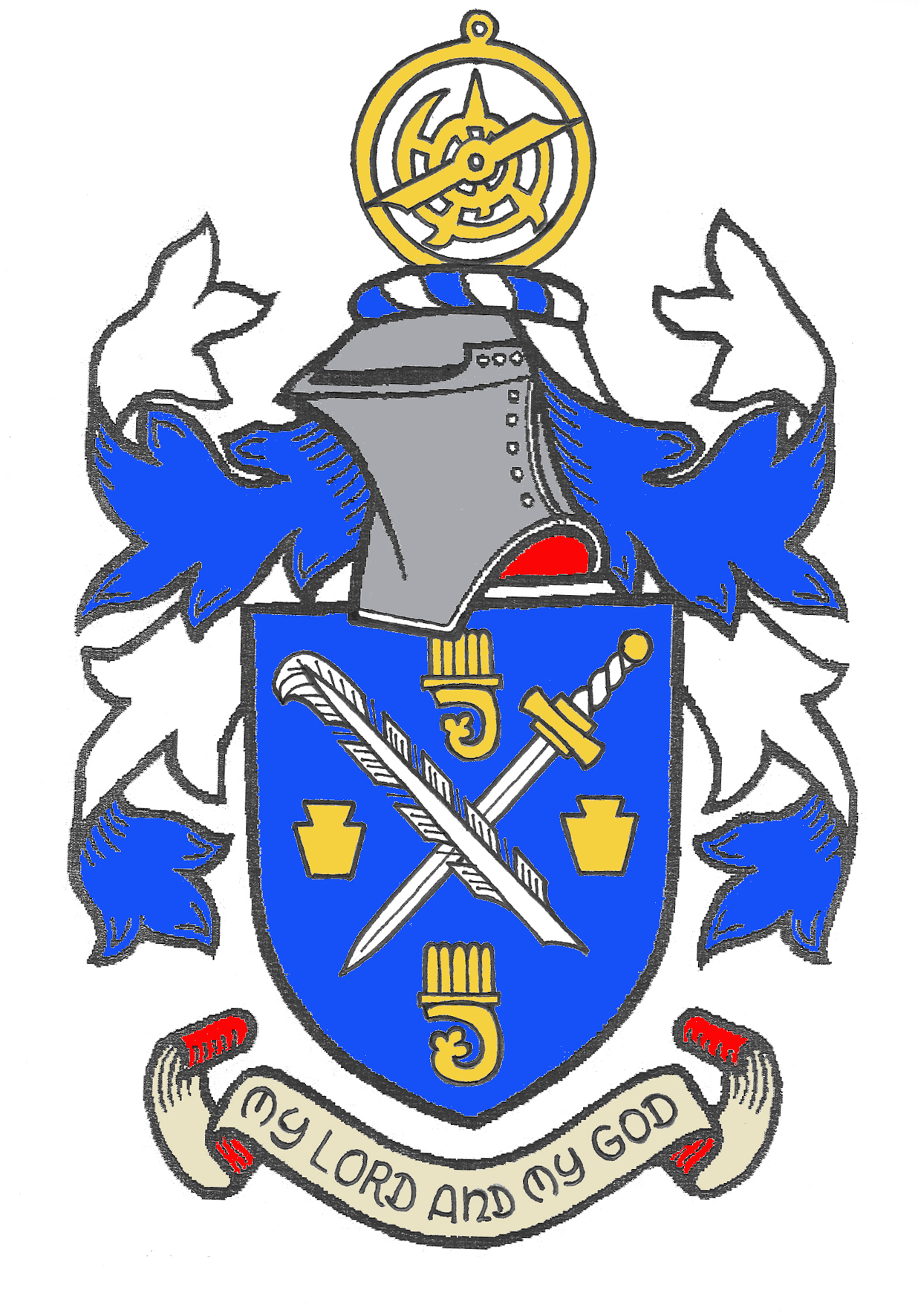
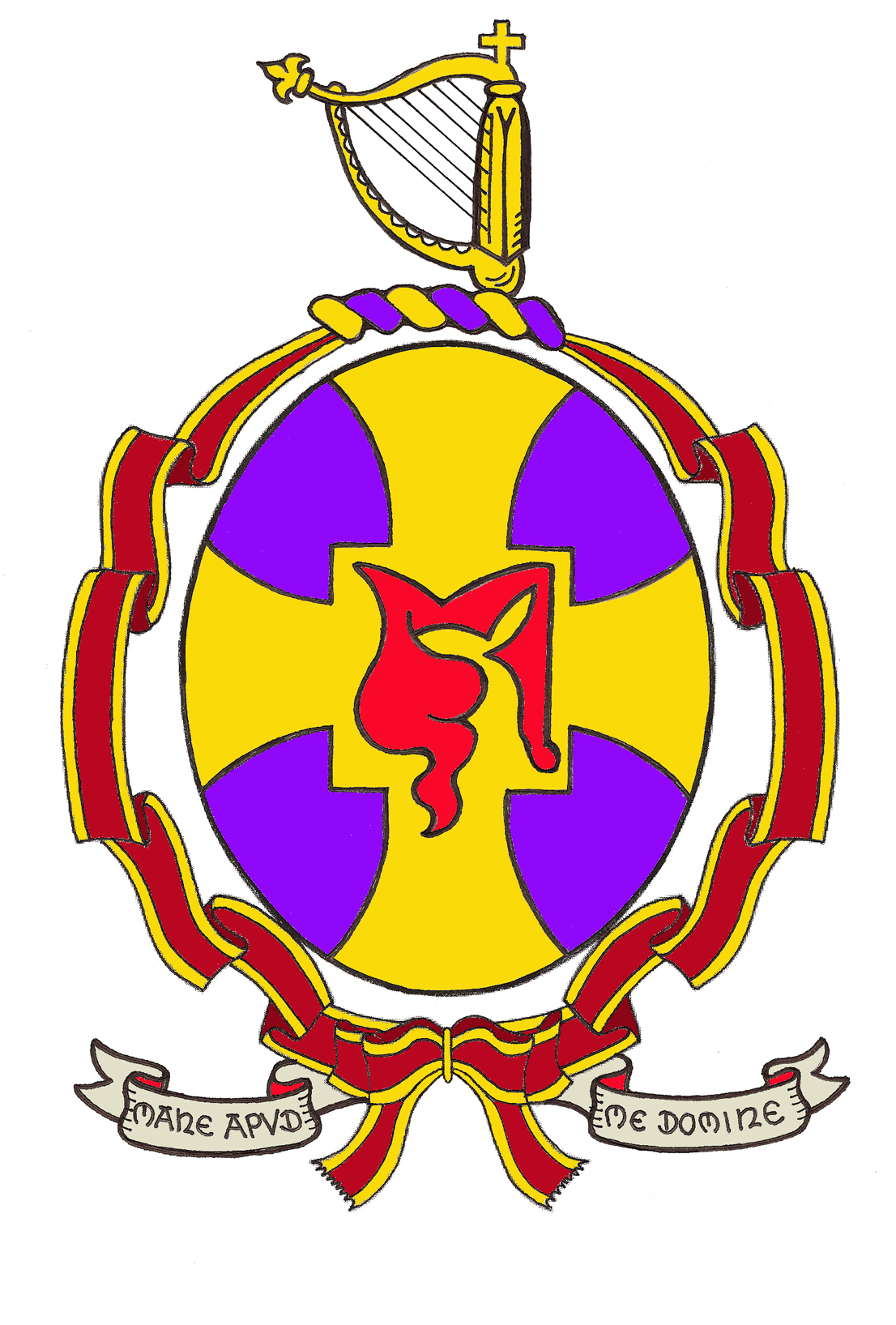
Below are two coats of arms, one for a man and the other for a woman, that I was recently commissioned to do. The ribbon surrounding the woman’s oval shield has personal meaning to her and is decorative. The common practice in heraldry is that women don’t use helm and mantling in their achievements which leaves them looking rather empty artistically. Decorative knots, ribbons and wreaths are often employed to surround the shield.

As Queen Elizabeth begins her annual week of engagements in Scotland and is in residence at Holyrood in Edinburgh we will be seeing a lot of the royal arms as used in Scotland. The Scottish quarter takes precedence as does the unicorn supporter. The crest and motto are also different as is the Order of the Thistle surrounding the shield as opposed to the Garter.

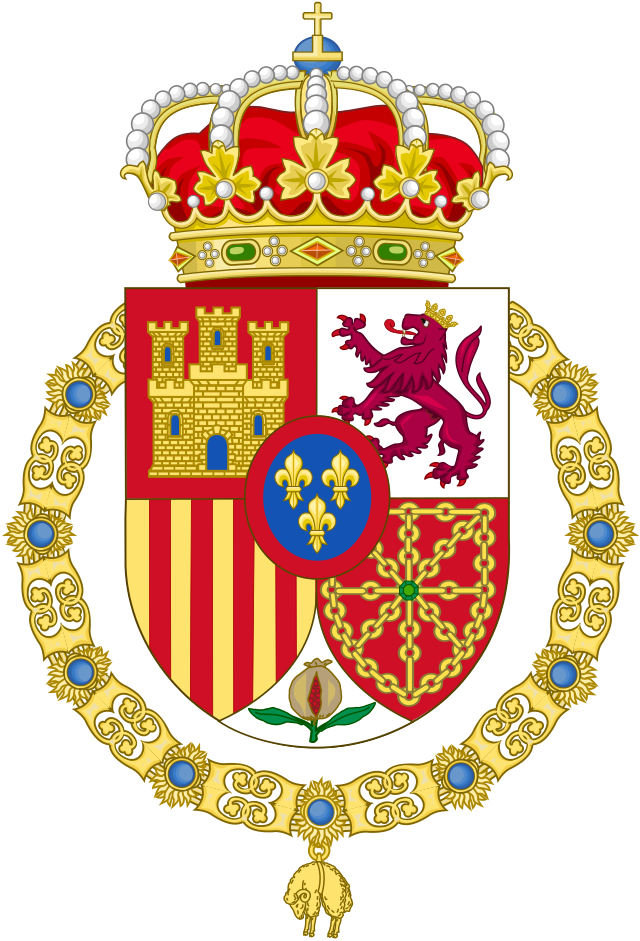
The new royal standard which will be used by King Felipe VI. Juan Carlos will continue to use his own standard which has a blue field.
Viva el Rey!
The coat of arms that will be used by King Felipe VI after his proclamation as king on June 19. The lion of Leon is correctly depicted as Purpure rather than Gules. In addition, the yoke and arrows used by Juan Carlos I as well as the Burgundian saltire behind the shield will not be used by Felipe VI.
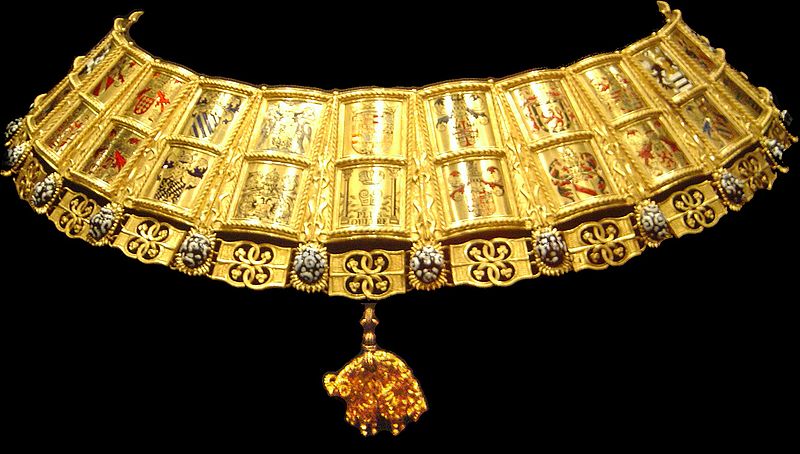
On June 19 when the Prince of the Asturias is proclaimed King Felipe VI of Spain he will also become sovereign of the Order of the Golden Fleece (Spanish Branch). Here is the fantastic heraldic collar of the herald of the order (Austrian Branch) kept in Vienna.


Now that the Spanish Cortes has voted on and passed the law allowing for the abdication of King Juan Carlos I it has prepared the way for proclamation of the Prince of the Asturias as King Felipe VI on June 18. The arms borne by Felipe as Prince (left) will be replaced by the royal arms (right). It has not yet been determined what title Juan Carlos will hold or what arms he shall bear. Perhaps it will be something similar to the arms borne by his father, Don Juan? (below) Of course, Don Juan, however, had renounced his rights to the throne and, while having been for a time the Pretender to the Headship of the Royal House, was never King.

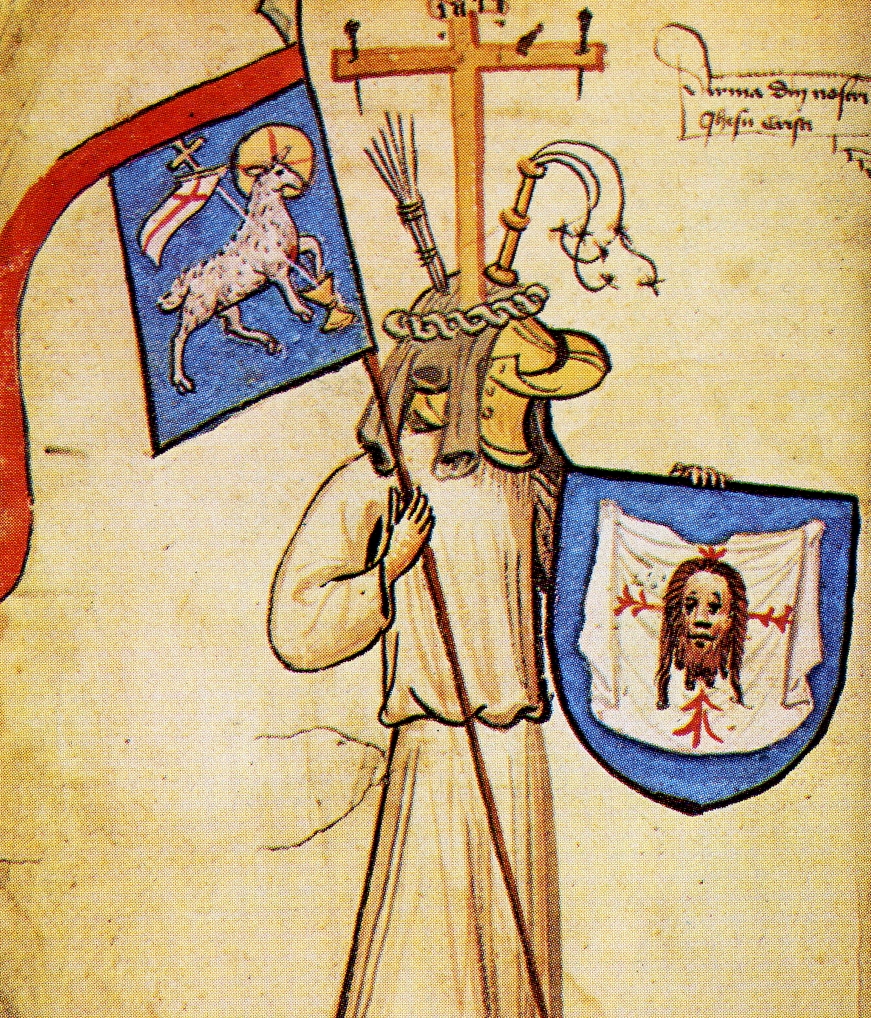
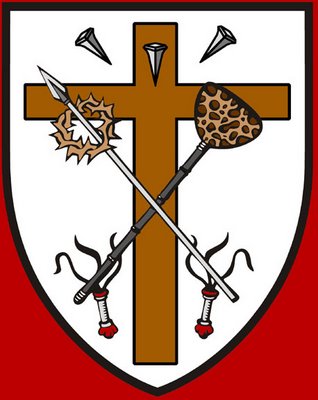
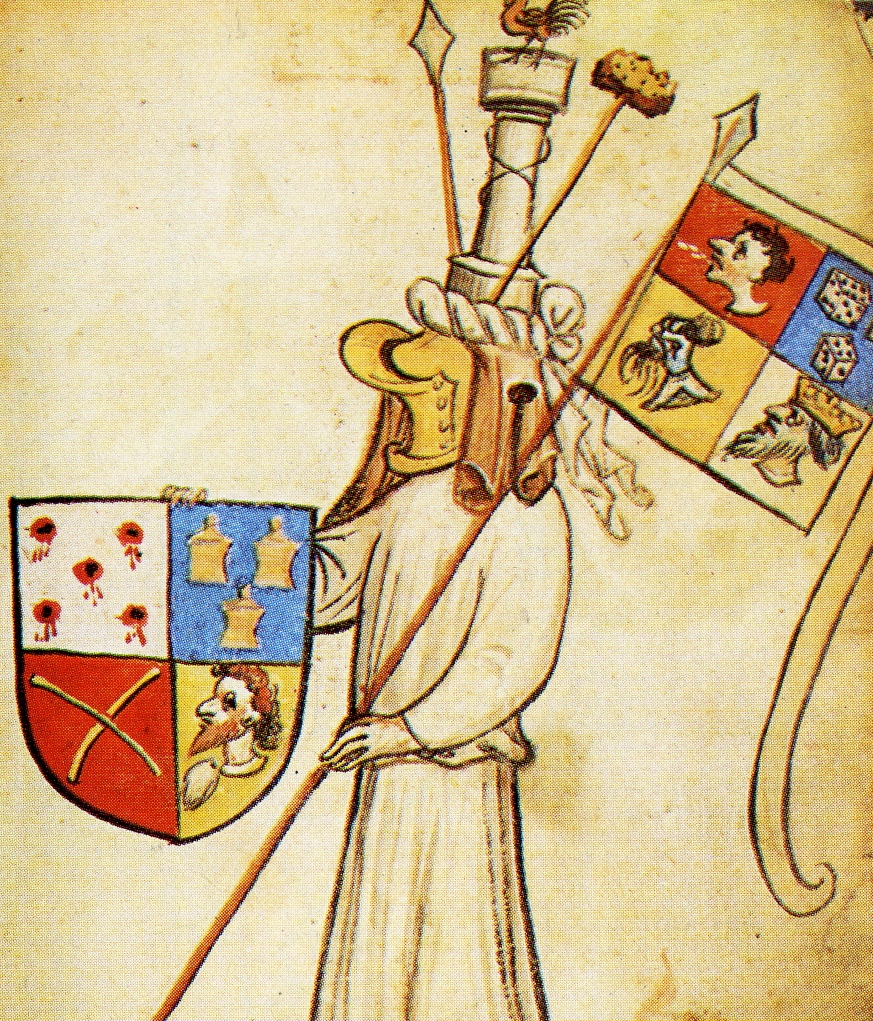
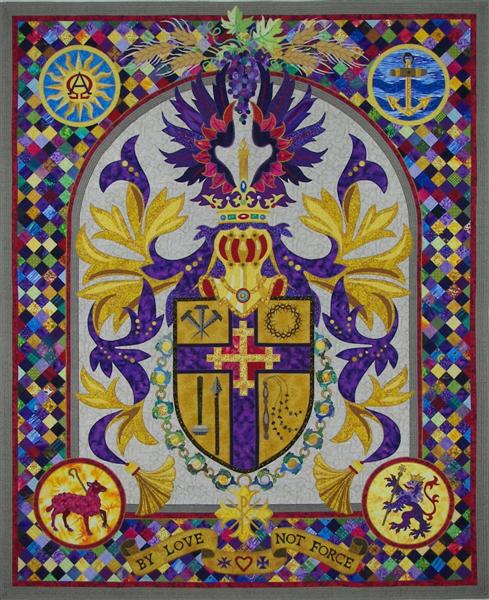
There is an old custom in the world of heraldry of attributing a coat of arms to fictional characters or to people who were real but who lived long before the dawn of heraldry. Great figures from throughout history have had a coat of arms devised for them and attributed to them. This includes people such as Constantine the Great, King Arthur, the Blessed Virgin Mary and even her divine Son, Jesus Christ. On this Good Friday I wanted to highlight some examples of the arms attributed to Jesus. Most include the instruments of His Passion. In addition, this fascination with attributing arms to Jesus seems to have been at its height in the medieval period but the last example I share today is very recent.

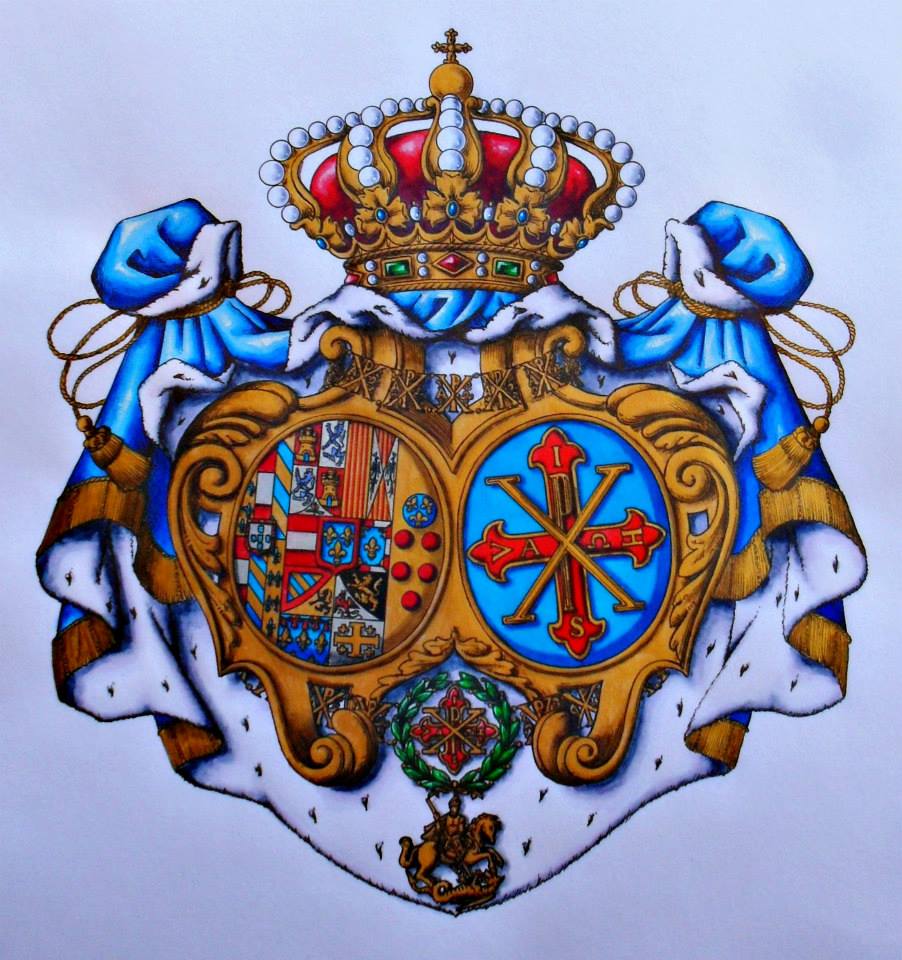
It was announced yesterday that the Duke of Noto (Spanish branch) and the Duke of Castro (Neapolitan branch) of the royal house of the Two Sicilies signed an accord which, while it does not completely solve the issue of the headship of the royal house more closely ties the two heads of the royal orders together in closer cooperation as co-grand masters with equal footing of the Sacred Military and Constantinian Order of St. George. This is a positive step toward healing a very long-standing rift.
(artwork by Carlos Navarro)
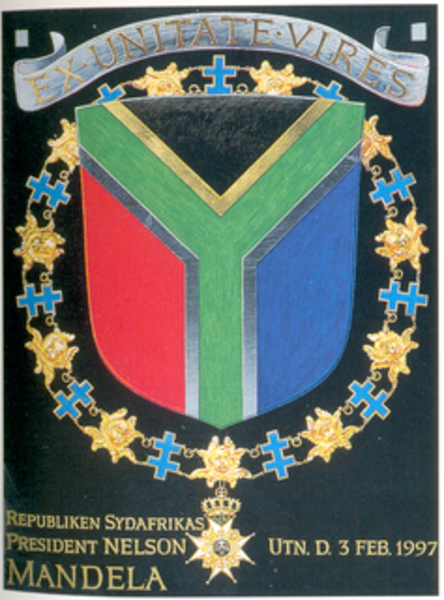
The national flag of South Africa (NOTE: I had originally written it was the coat of arms of South Africa but the South African state arms are a separate design entirely from the flag), used as a coat of arms by President Mandela when he had the Order of the Seraphim conferred on him by the King of Sweden.
May he rest in peace.
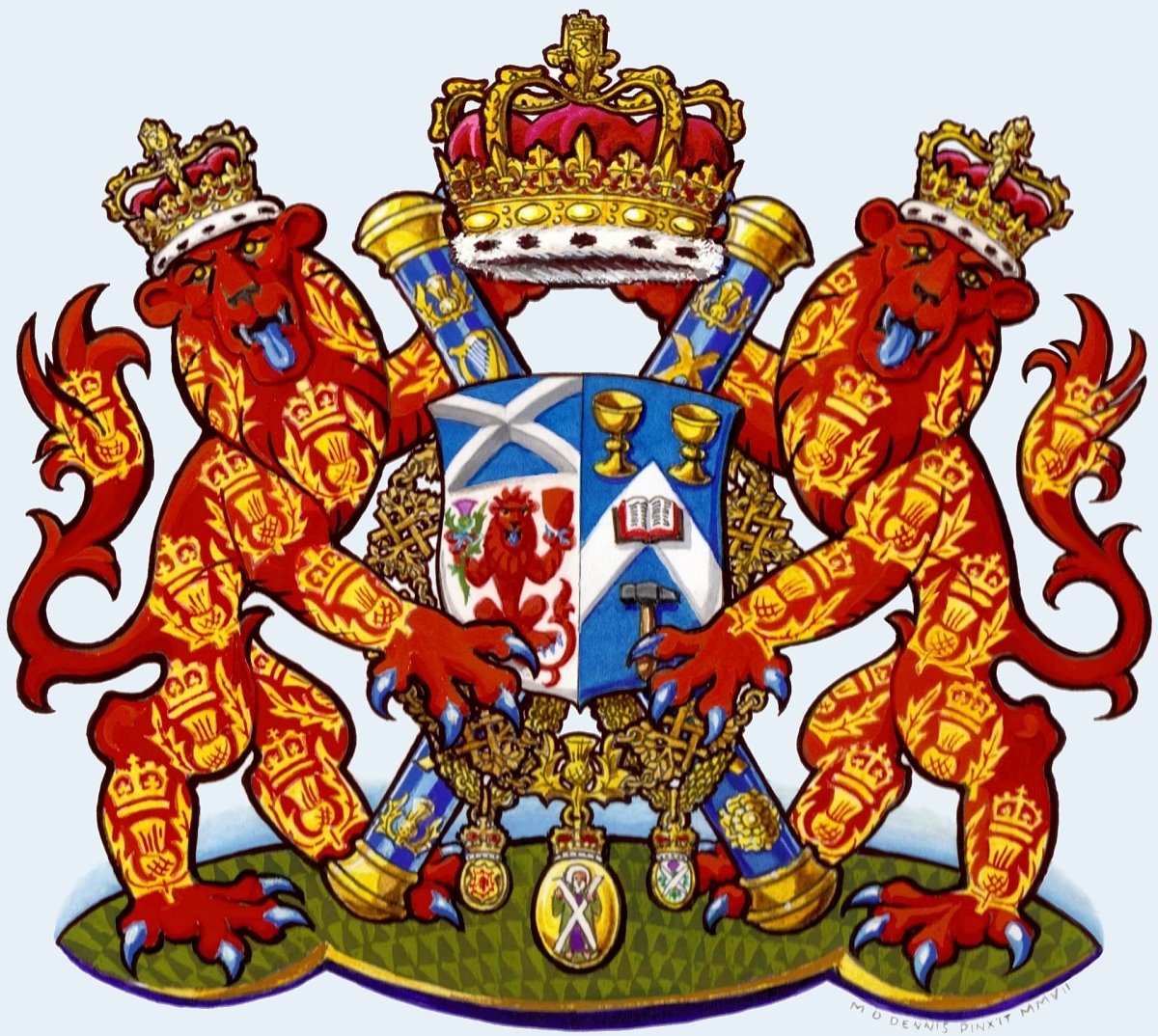
The Office of Lord Lyon King of Arms will fall vacant at the end of December 2013, when Mr. David Sellar the current Lord Lyon steps down. The Lord Lyon is appointed by Her Majesty, the Queen on the recommendation of the First Minister under section 3 of the Lyon Kings of Arms (Scotland) Act 1867.
The Lord Lyon is the sole King of Arms in Scotland. He is the Head of the Heraldic Executive and the Judge of the Court of the Lord Lyon, which has jurisdiction over all heraldic matters in Scotland. The office has both judicial and administrative functions. The Lord Lyon is also responsible for State Ceremonial in Scotland.
Applications to fill this Office must be legally qualified. An independent panel will consider the applications and make recommendations to the First Minister.
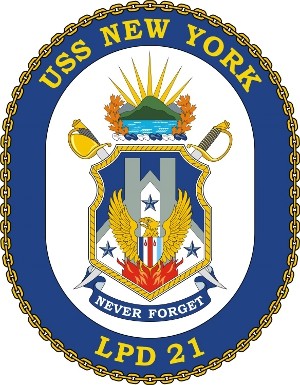
This is the emblem containing the coat of arms of the USS New York a naval vessel of the US Navy. The ship was constructed with seven tons of steel recovered from the wreckage of the World Trade Center in its bow. The twin towers and a chevron. representing the bow of the ship form a central feature in the coat of arms. The phoenix rising from the ashes is an allusion to carrying on and rebuilding the World Trade Center in the aftermath of the terrorist attack. The escutcheon on the breast of the phoenix contains the colors of the first responders on 9/11: the NY police department, NY fire department and the Port Authority of New York & New Jersey. The drops of blood on the escutcheon commemorate the fallen. The three stars depicted are for those earned by the former battleship USS NEW YORK (BB34) in World War II at Iwo Jima, Okinawa and North Africa. Above the shield the crest is taken from the central landscape charges on the coat of arms of the State of New York. Here the rays of the sun are depicted as seven in imitation of those radiating off the crown atop the Statue of Liberty in New York harbor.
This may not be the best heraldic design I’ve ever seen but it is a fine example of how heraldry, even in our own time, can be filled with poignant meaning and, in a simple artistic design, depict and commemorate so much. This coat of arms was devised, as are all US military insignia by the US Army’s Institute of Heraldry in Virginia.
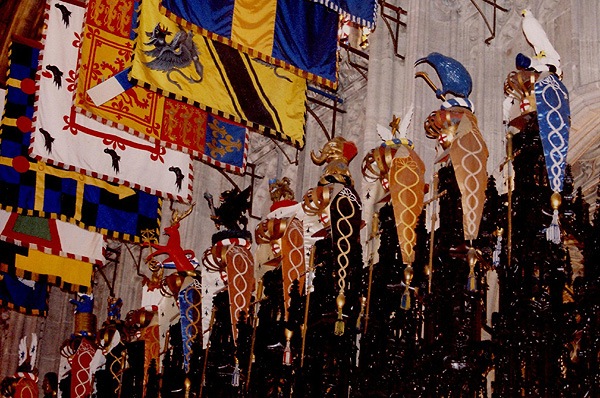
This photo illustrates something well. The banners at the top of the photo contain the coats-of-arms of the individuals who bear them. In the middle part of the photo there are those sort of dorky looking statues standing on top of the helmets. THOSE are crests. (They are placed at the crest of the helmet…get it?) The two terms are NOT synonymous. Many people use the word crest to mean a coat-of-arms. I know, those extra two syllables are a killer to have to say! A crest is a part of the full achievement of arms but it may be depicted alone. However a coat-of-arms and a crest are different things.
Fr. Guy Selvester's blog of Ecclesiastical Heraldry
Fr. Guy Selvester's blog of Ecclesiastical Heraldry
Fr. Guy Selvester's blog of Ecclesiastical Heraldry
Fr. Guy Selvester's blog of Ecclesiastical Heraldry
Fr. Guy Selvester's blog of Ecclesiastical Heraldry
Fr. Guy Selvester's blog of Ecclesiastical Heraldry
Fr. Guy Selvester's blog of Ecclesiastical Heraldry
Fr. Guy Selvester's blog of Ecclesiastical Heraldry
Fr. Guy Selvester's blog of Ecclesiastical Heraldry
Fr. Guy Selvester's blog of Ecclesiastical Heraldry
Fr. Guy Selvester's blog of Ecclesiastical Heraldry
Fr. Guy Selvester's blog of Ecclesiastical Heraldry
 EXARANDORUM