Author Archives: guyselvester

Bishop Garcia

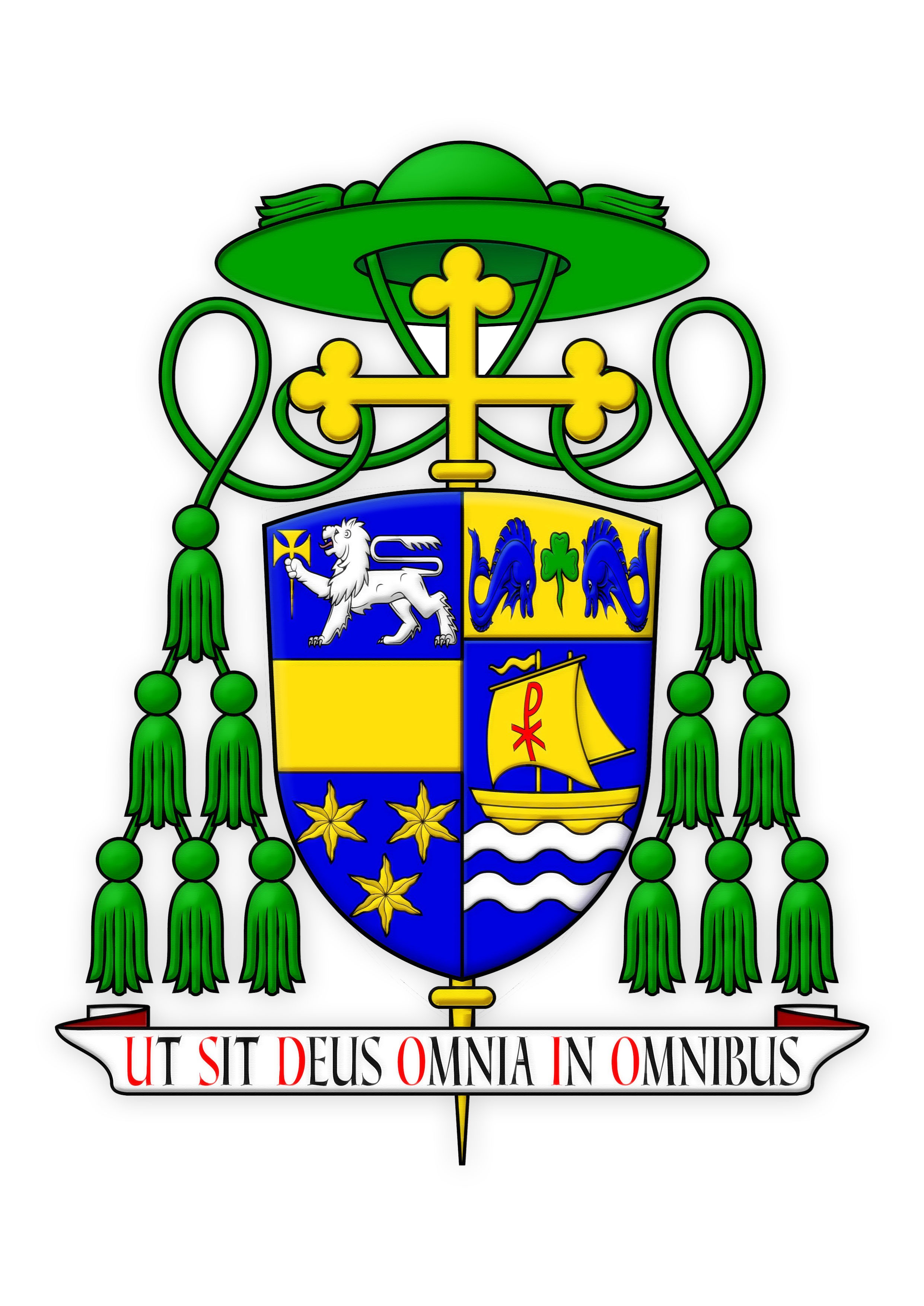
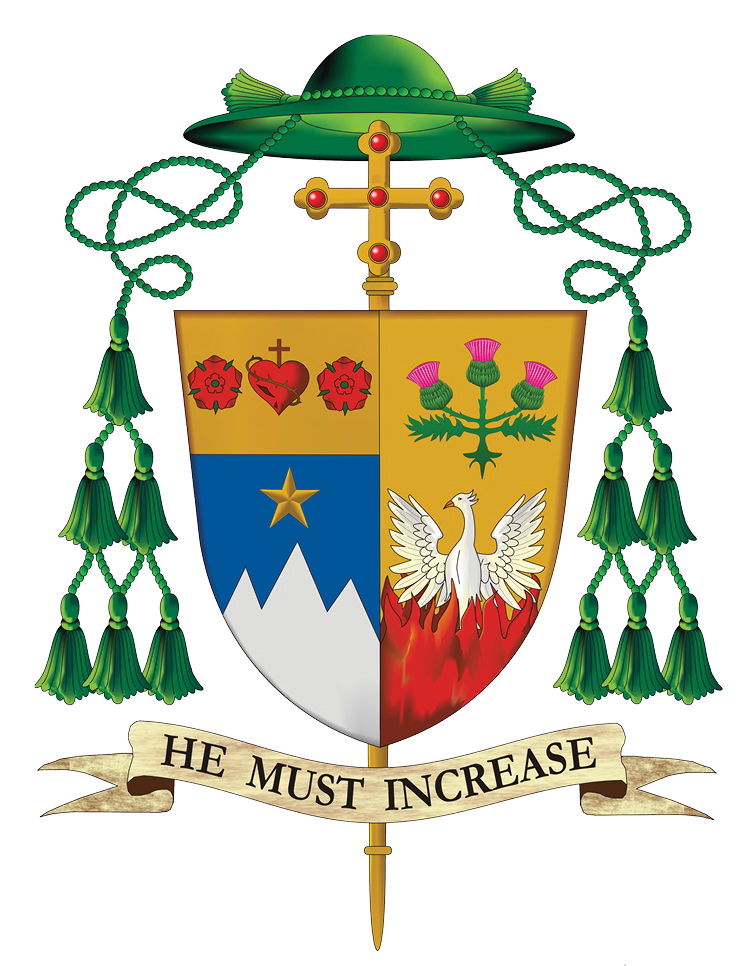
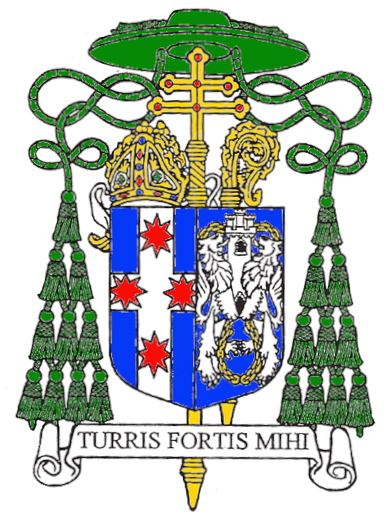
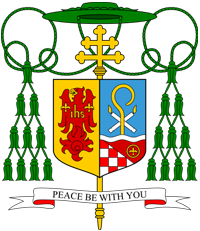
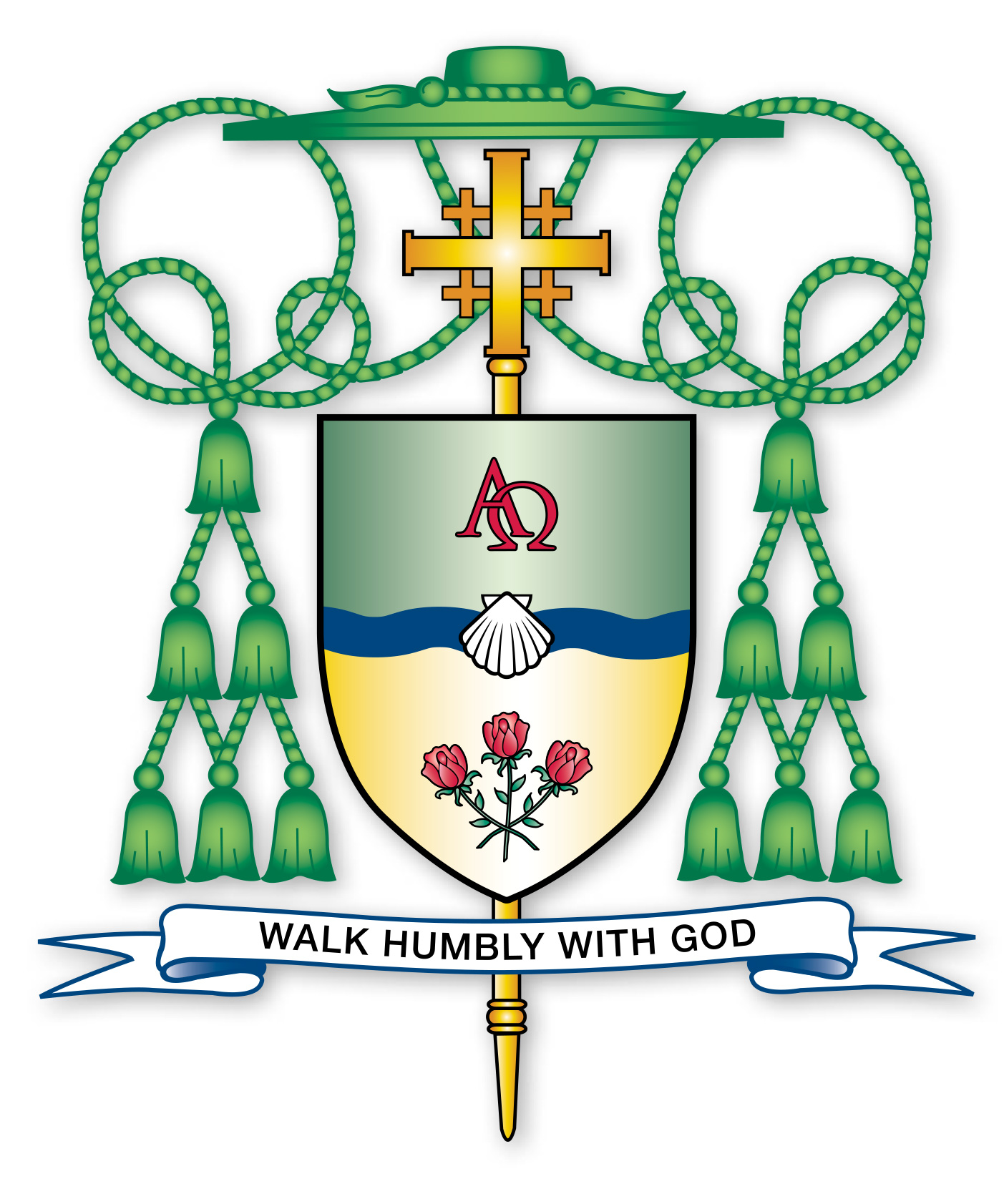
On March 3, the Most Rev. Daniel Elias Garcia was ordained as Titular Bishop of Capsus and Auxiliary Bishop of Austin, Texas. His adopted coat of arms (below) depicts his devotion to Our Lady (the roses), baptism (the shell), the Colorado River and Christ who is the First and the Last.

Dividing the field into two colors (green and gold) by a blue line isn’t really the best design choice. It would have been better if the whole field were gold. In addition, the description of the arms from the ordination program describes the “processional cross” as being in the form of a Jerusalem cross for apparently no reason. First of all it is not a processional cross. The external ornament in a bishop’s coat of arms more than any other that marks it as the coat of arms of a bishop (even more than a mitre or a galero) is the episcopal cross that stands vertically behind the shield. This type of cross, which resembles a processional cross, used to be carried directly in front of a bishop. Like the galero, also no longer in use, such episcopal crosses are no longer used but are retained as not only one of but actually as THE ensign of the coat of arms of a bishop. The galero is optional; the cross isn’t.

Second, it is not permitted to mandate that an external ornament like the episcopal cross, be depicted in a certain shape or style. The blazon concerns itself only with what is on the shield. That may indeed be mandated to be depicted in a particular way. No other artist is bound to depict the episcopal cross of Bp. Garcia’s arms as a Jerusalem cross. It may be his preference but it is not one to which others must adhere.
BishopGarciaBlazon

Bishop O’Regan of Sale, Australia

On February 26 Patrick M. O’Regan will be ordained and installed as the IX bishop of Sale, Victoria, Australia. The ship at sea is a reference to the diocese of Bathurst where the bishop previously served as a priest. In chief are charges that allude to St. patrick and to the arms traditionally associated with families of the name O’Regan or Regan. The arms were designed by me and Mr. Richard d’Apice and rendered by Mr. Sandy Turnbull.

Image 1

Coat of Arms of Pope Pius XII (Before and After)

Much has been written in recent years about the practice of a prelate modifying the design of his coat of arms when he moves from one position to another in the Church. Generally speaking I am against the practice. A coat of arms, even an assumed one, becomes a unique personal symbol and is associated with the person who bears the arms. To change the original design simply because one is taking up a new position or ministry is ill advised.
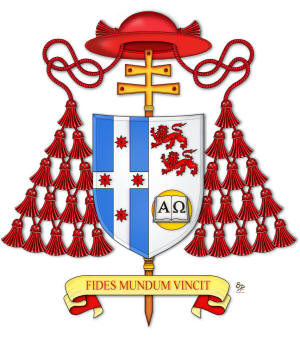
I am, of course, not referring to marshaling the personal arms with those of a jurisdiction (see, abbey, or even a parish). When a cleric is translated from one jurisdiction to another of course he will then marshal his personal arms to those of the new jurisdiction because, after all, impaling or quartering the personal arms with those of a jurisdiction is a means of displaying two or more separate coats of arms together on one shield. The arms of a diocese do not “become” part of the bishops personal coat of arms. They are displayed along with the personal arms of the incumbent during the tenure of his office as part of the overall achievement but that is all.

Rather, I am speaking of a cleric slightly modifying or even changing entirely the design on the shield of his personal coat of arms. In some cases the change is a result of unhappiness with the design originally adopted. Sometimes it is the case that a cleric is appointed to be a bishop and wishes to make use of his new coat of arms at his episcopal ordination which may be as soon as only six weeks away. So, a design is hastily adopted. later, when being translated to a new see the bishop has had time to second guess his original arms and wishes to tweak the design or even change it altogether. While this is understandable it still should be frowned upon. His new position doesn’t mean he is becoming an entirely new person.

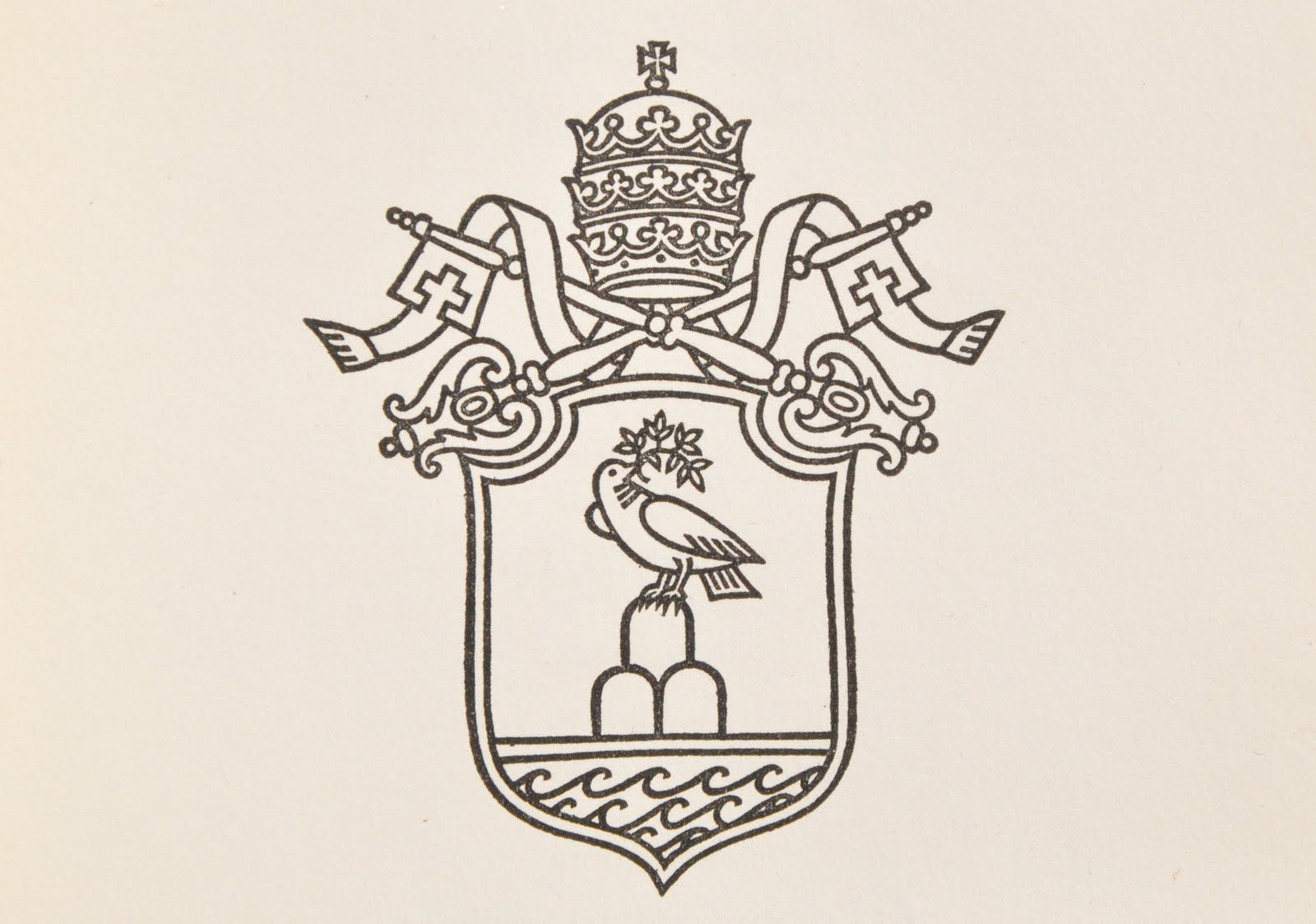
Yet we see that this has and continues to happen. Even no less than Pope Pius XII (Eugenio Pacelli 1939-1958) bore arms that were slightly different before and after he became pope. When a bishop and cardinal his arms depicted a dove displayed (i.e. with its wings spread) holding an olive branch in its beak. This is a reference to the name Pacelli which means “peace”. The dove was perched on a trimount and sitting below the arc of a rainbow, an allusion to the story of Noah from the Scriptures.

Danesi20

However, after his election to the papacy there are some differences. The dove now has folded wings and sits perched on the trimount which is depicted on field and above waves of water. In addition, the rainbow is now gone. Perhaps Pius XII felt the reference to the story of Noah was redundant or superfluous? Perhaps he wished to express a global desire for peace since he was elected at a time when the world was on the brink of World War II? Perhaps he simply liked this newer design more? We shall never know yet here is a good example of arms modified when going from one position in the Church to another.

piua xii arms in pen and ink

Bishop Christopher Coyne of Burlington, Vermont

Coat-of-Arms

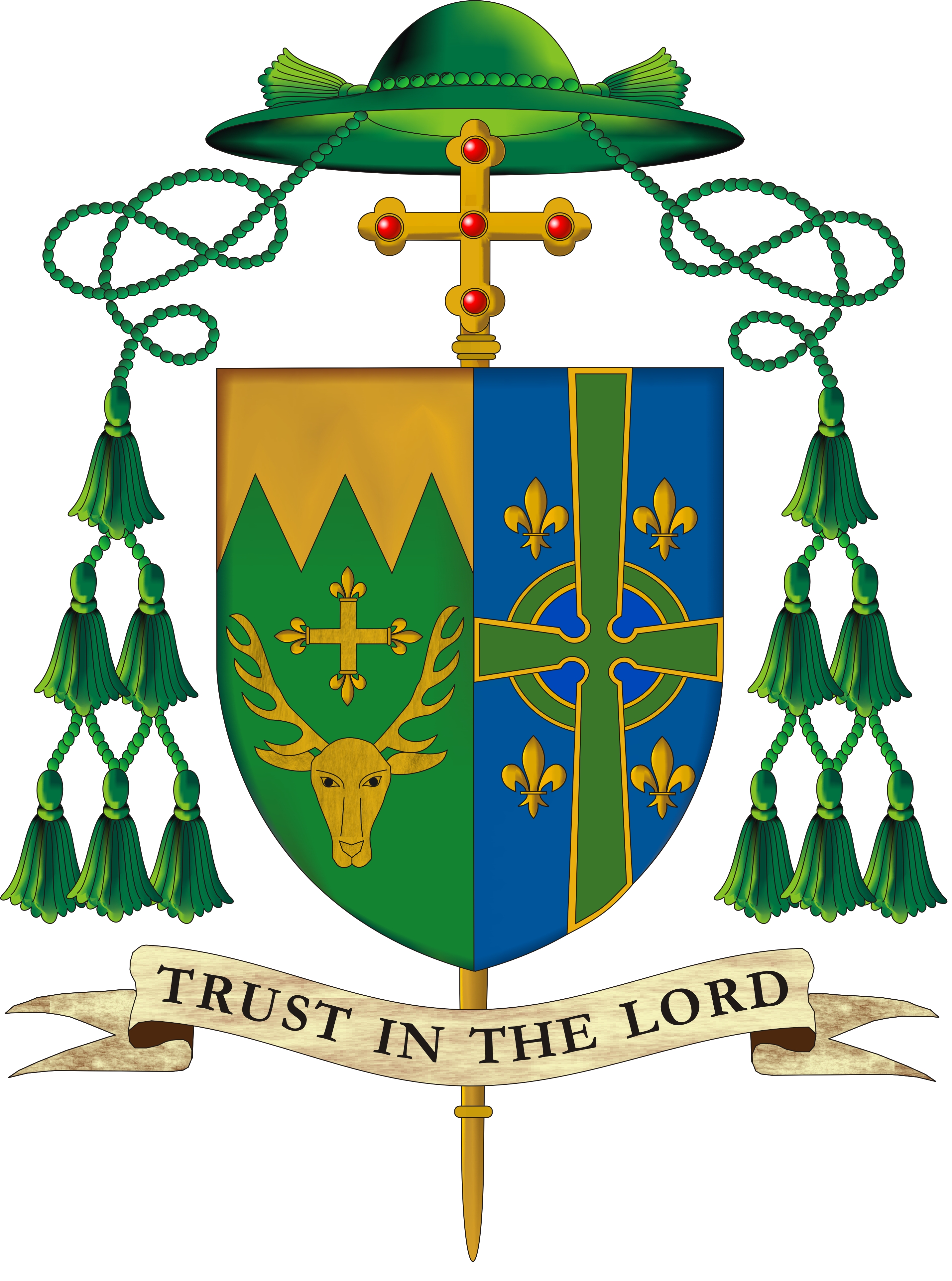
On January 29 Bishop Christopher Coyne, until now Auxiliary Bishop of Indianapolis and before that a priest of the Archdiocese of Boston, will be installed as the 10th Bishop of Burlington, Vermont.

The dexter side of the shield (to the viewer’s left), represents the coat of arms of the Diocese of Burlington and is composed of a green field, which meets a gold chief (upper one-third of the design) at a jagged line, called “dancetty,” to give the impression of green mountain peaks, thus honoring the Green Mountain State of Vermont. Below the mountain is a golden stag’s head that is taken from the arms of Lord Cavendish, Earl of Burlington, for whom the See City is named. Between the stag’s antlers, as seen in the arms of the Archdiocese of Boston, is a golden cross fleuretty. This cross, honoring the French missionaries who first brought The Faith to the region, signifies that the first priest to be stationed in the service of the people of Vermont, Father Jeremiah O’Callaghan, was sent by Boston Bishop Benedict Fenwick.

The sinister side (to the viewers right) ‘s occupied by the personal heraldry of Bishop Coyne; upon a blue (azure) field is Bishop Coyne’s coat of arms which blends images representing his love for God, family genealogy and ministry history in the Archdiocese of Boston.

Bishop Coyne’s grandfathers were Irish and his grandmothers were French. The coat of arms reflects those two heritages with the Celtic cross and the fleur de lis. The Celtic cross also calls to mind the centrality of the cross in the history of salvation and the sacrifice of Jesus which brings redemption. The fleur de lis also represent Mary, the Mother of our Savior, and Saint Joseph, her most chaste spouse. Finally, the blue (azure) field also calls to mind Mary, the Immaculate Conception, under whose patronage the Diocese of Burlington has been placed.

Pontifical Colleges and Schools

Pontifical College Josephinum (USA)

Image 4


Pontifical Catholic University of Sāo Paolo (Brazil)

PUC-logo

Pontifical Catholic University of Rio de Janeiro (Brazil)

Brasaov

Pontifical Lateran University (Rome)

sensi

Pontifical University of St. Thomas Aquinas (Rome)

Pontifical_University_of_Saint_Thomas_Aquinas_logo

Pontifical Gregorian University (Rome)

Estemma_UniGreg

Pontifical Scots College (Rome)

pontificio

Venerable English College (Rome)

coat_of_arms

Pontifical North American College (Rome)

nac-logo

Pontifical Athenaeum of Saint Anselm (Rome)

ateneo1


Not Louisiana, Paris, France, New York or Rome! But Gary, Indiana, Gary, Indiana, Gary, Indiana; My Home Sweet Home.

123014

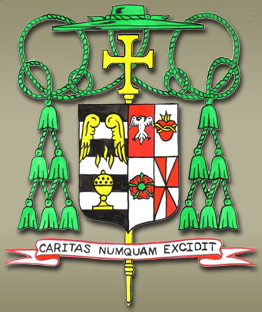
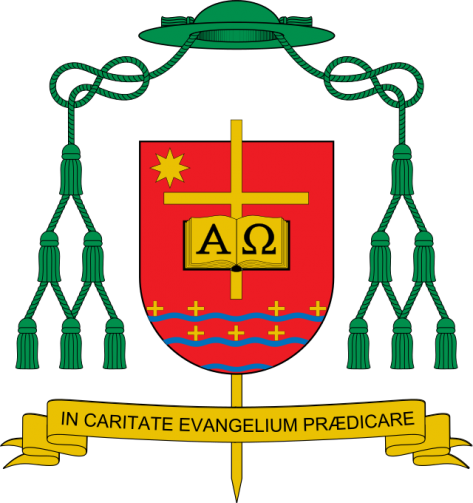
On January 6, 2015 the Most Rev. Donald J. Hying, a priest of the Archdiocese of Milwaukee, former Rector of the seminary there and, since 2011, Auxiliary Bishop of Milwaukee will be installed as the IV Bishop of the diocese of Gary, Indiana.

The Bishop’s coat of arms (above) depicting the arms of the See (dexter) which allude to the titular patron of the cathedral of the Holy Angels and his personal arms (sinister) which allude, in part, to the arms of the See of Milwaukee.

The motto translates to “Love never fails”. (1 Cor: 13)

(artwork by Paul Sullivan)

“Christmas” Heraldry

Each year at this time I always seem to get involved in a conversation with at least one other heraldry enthusiast about coats of arms associated with Christmas or the Christmas season. Here are a few tidbits I offer for your amusement. (Keep in mind the ancient custom of attributed arms, that is, coats of arms attributed to people who were not necessarily armigerous themselves, especially if they lived prior to the advent of heraldry and/or coats of arms devised for and attributed to people who may or may not be fictitious!)

Santa Claus (Saint Nicholas)

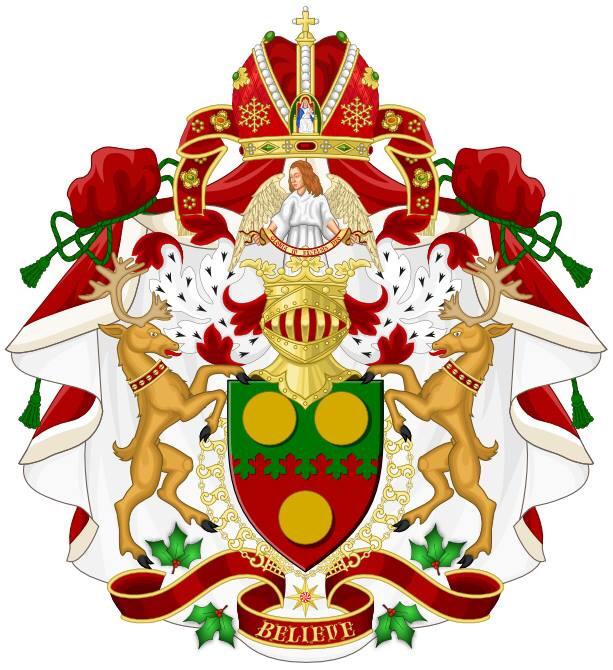
Here is a a coat of arms recently devised by a friend for St. Nicholas

10704163_656270491979_8257133350987141788_n

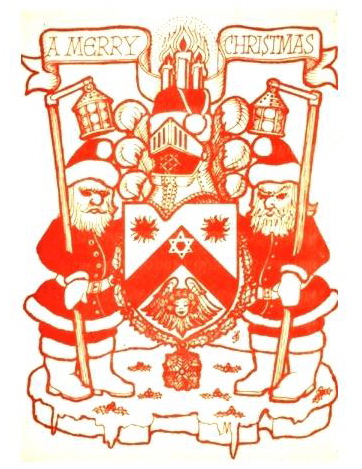
Here is another said to be of “Father Christmas”

10428443_962514470444895_2628170149422247155_n

The Three Wise Men (or Kings)

The arms attributed to Kaspar, Balthasaar and Melchior (depicted beautifully by the Italian heraldic artist, Marco Foppoli)

260210_2

The Blessed Virgin Mary

A coat of arms attributed to the Mother of Jesus, Mary

Mar_a_la_madre_de_Jes_s_CON_CORONA

Jesus (you know…the One whose birthday we’re celebrating?)

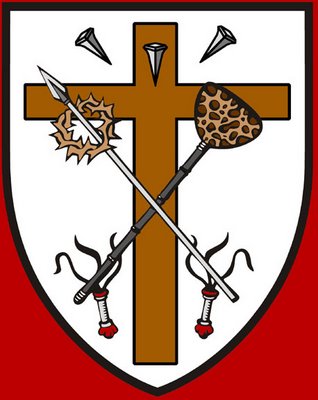
This is just one of many different attributed arms for Jesus, the Christ depicting the implements of His passion.

Arms of Christ

The Holy Family

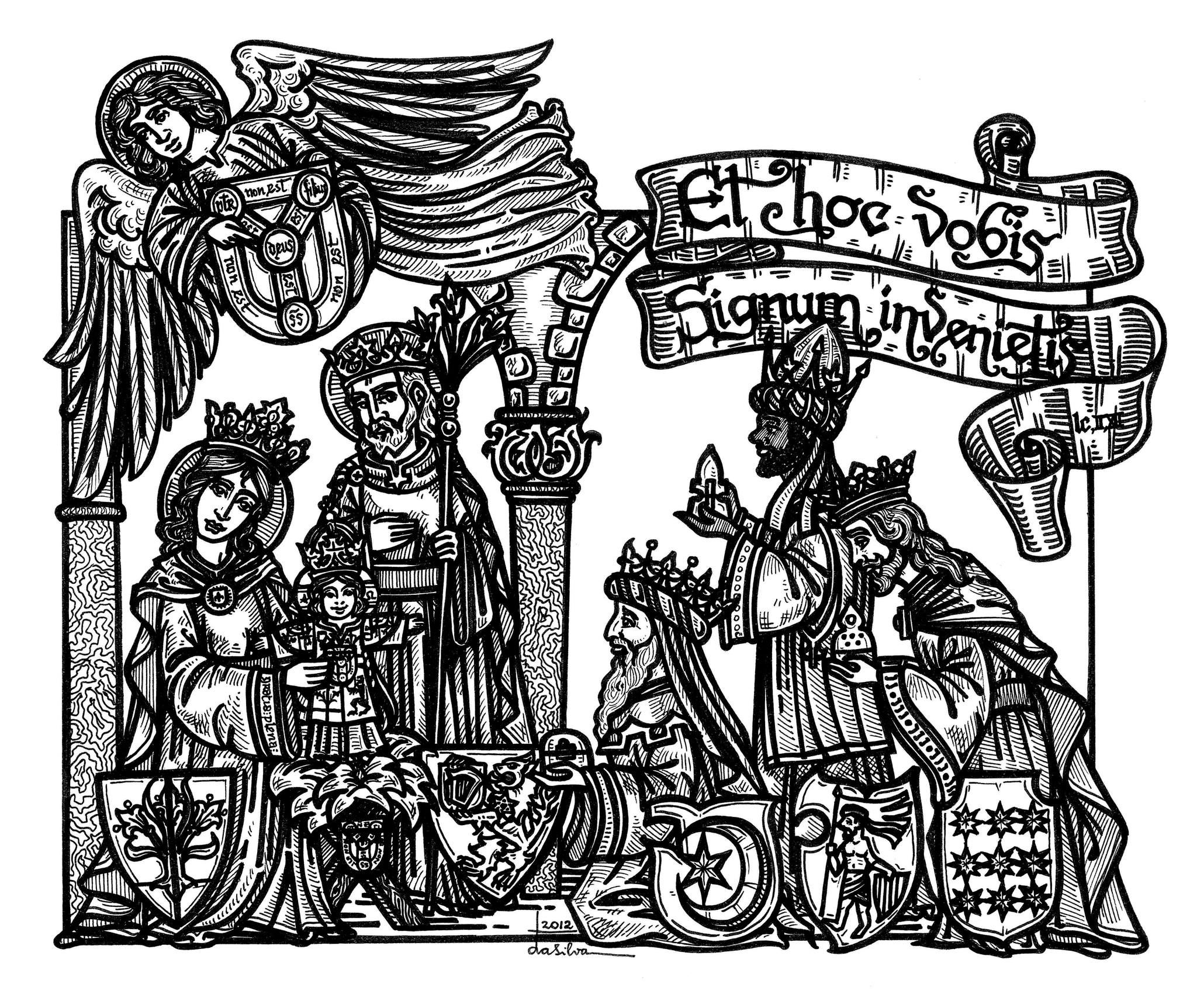
A wonderful Christmas scene showing all the principal armigerous figures of the story of the Nativity with their corresponding attributed arms. (by daSilva)

966494_618639514870198_1761667505_o

Bishop Mark Edwards, OMI

Image 1

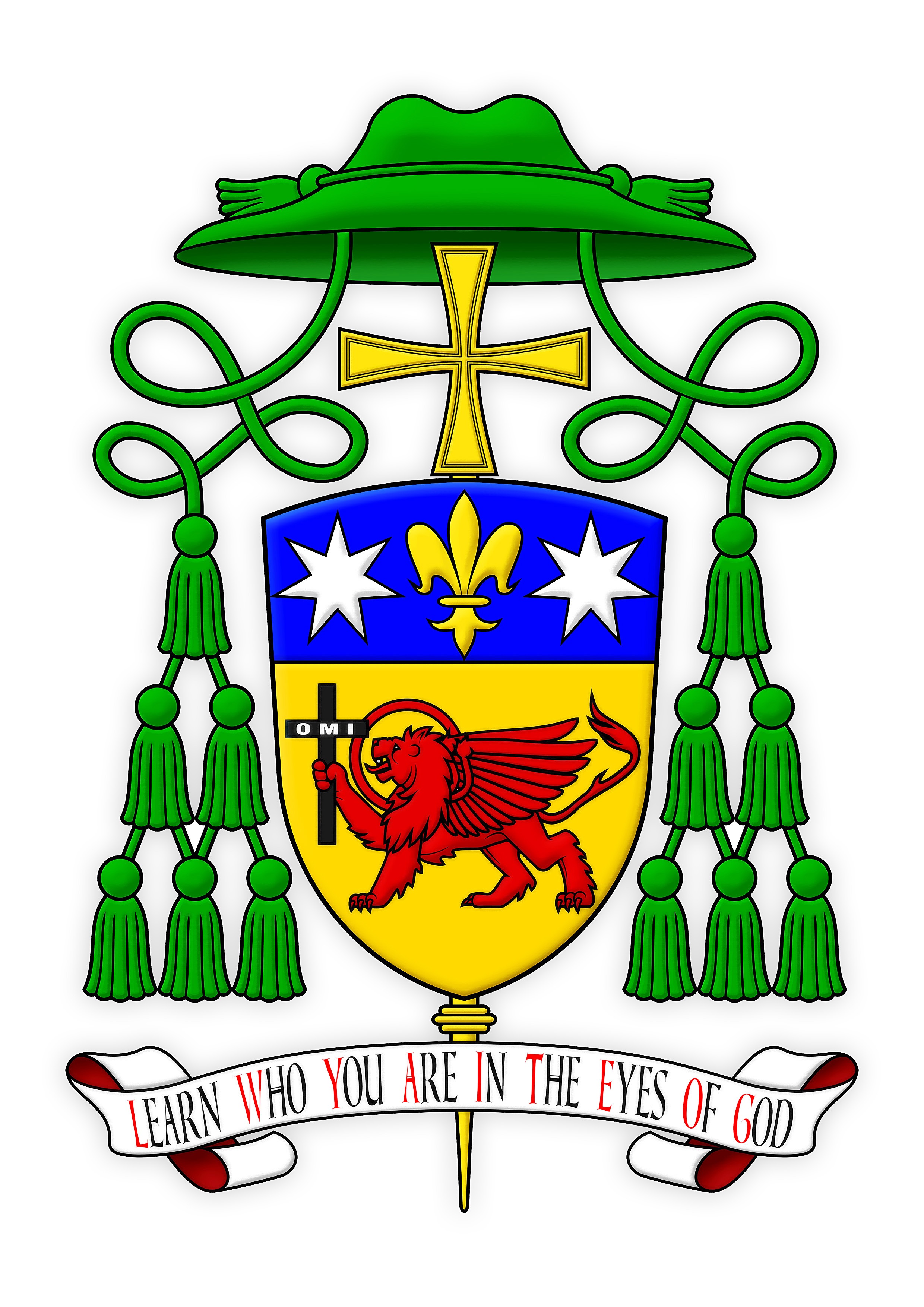
On December 17 Mark Stuart edwards, OMI will be ordained (along with Terence Curtin) as auxiliary bishop of Melbourne, Australia. Bishop Edwards is also the Titular Bishop of Garba.

His newly assumed arms (above) reflect his baptismal patron, St. Mark, as well as the Oblates of Mary Immaculate, the Religious community to which he belongs. In addition, Our Lady and Australia are alluded to on the chief.

These arms were designed by me and Mr. Richard d’Apice of the Australian Heraldry Society and emblazoned by Sandy Turnbull also of the Australian Heraldry Society.

Bishop Comensoli of Broken Bay, Australia

Image 11

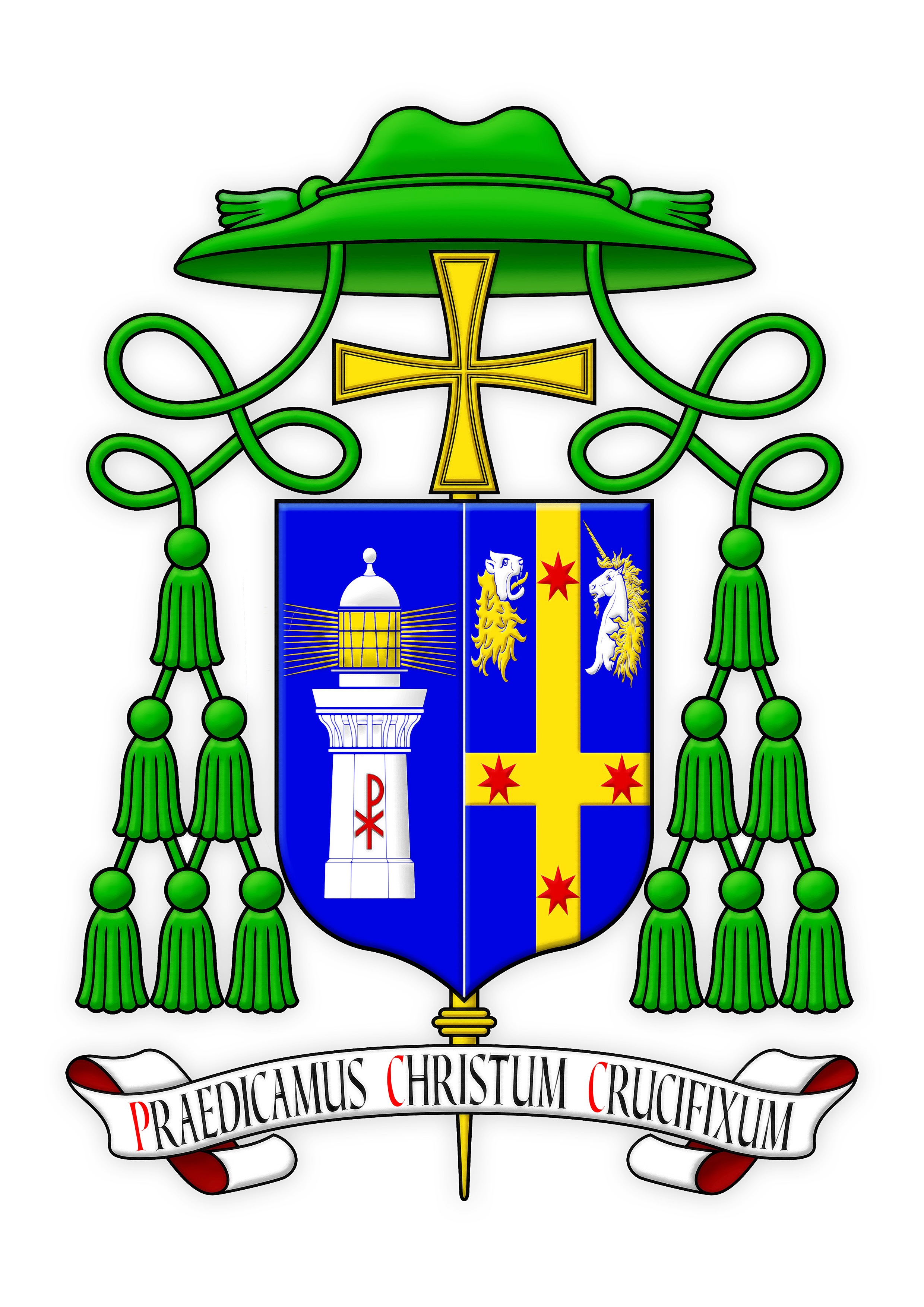
The Broken Bay diocesan Arms display a lighthouse spreading the light of the gospel over the diocese. The detail echoes the detail of the Barrenjoey lighthouse which unites the two main land masses that comprise the regions of the diocese.

The arms and motto which Bishop Comensoli adopted at the time he was named Auxiliary Bishop of Sydney in 2011 are of a personal character and are blazoned: Azure, on a Latin cross inverted Or four seven-pointed mullets (or Commonwealth stars) Gules, in the first quarter a lion’s head erased Argent crined and langued Or and in the second a unicorn’s head erased Argent crined and armed Or respectant.

In layman’s terms, the arms may be described as: On a blue field, a gold cross inverted with a red seven-pointed (or Commonwealth) star at each extremity, in the upper left quarter, a silver lion’s head erased at the neck with gold mane and tongue and in the upper right quarter a silver unicorn’s head erased at the neck with gold mane and horn. The motto ‘Praedicamus Christum Crucifixum’ is a quotation from the Apostle Paul’s first epistle to the Corinthians (1Cor1.23), and can be translated as ‘We preach Christ crucified’.

The inverted Latin Cross symbolises the Bishop’s nominal patron, the Apostle Peter and the stars reflect the Southern Cross, which shines out over the Great South Land of the Holy Spirit. The lion and the unicorn respectively symbolise the mind and the heart of love. The meaning of these symbols, while of medieval provenance, is especially associated with the seminal work on Christian love by the English Jesuit, Martin C D’Arcy SJ, “The Mind and Heart of Love: Lion and Unicorn: A Study in Eros and Agape”. Bishop Comensoli will be installed as the Third Bishop of Broken Bay on Dec. 12.

The personal arms were designed by me and Mr. Richard d’Apice of the Australian Heraldry Society and originally emblazoned as well as marshaled with the arms of the diocese and emblazoned again by Mr. Sandy Turnbull also of the Australian Heraldry Society.

Commandant Gets The Boot

It has been revealed that, due to personality clashes and the pope’s opinion of too much militarism, the Commandant of the Papal Swiss Guard, Daniel Anrig, has been asked by Pope Francis to step down at the end of January. Appointed by Benedict XVI Anrig has served in his position since 2008. I’m not exactly sure how the head of a military corps is supposed to act other than militarily but there is a lot happening in the Vatican these days that no one seems to be able to explain, at least not easily. Anrig’s coat of arms as Commandant of the Papal Swiss Guard is below. It employs the type of charge known as a house marking that is characteristic of Swiss heraldry. The arms of the Commandant is always depicted at the center point of the flag of the Swiss guard.

2000px-Esc_Daniel_Rudolf_Anrig.svg

Another Example of What NOT To Do

herb_bp._jana_piotrowskiego.svg_

Above is the coat of arms of Jan Piotrowski who will be installed on November 29 as the Bishop of Kielce, Poland. The bishop’s arms contain perfectly good charges and are arranged nicely with good composition with one exception. The episcopal cross (often mistakenly thought of as a processional cross) which is the one external ornament that indicates the arms belong to a bishop, since other prelates may use the green galero with 12 tassels, is depicted as passing in front of the shield and piercing it with the bottom of the cross protruding from behind the shield. It is as if the cross is depicted as both a charge on the field and an external ornament at the same time. This is most incorrect. Charges must never extend beyond the edges of the shield; external ornaments should not be placed in a position to obscure any of the shield; objects cannot be depicted as piercing the shield; external ornaments are to be just that: external to the shield. I’m sure the person who designed this and/or depicted it thought he was being very clever and innovative. Instead, it’s just wrong. EPIC FAIL.

Reginald Cardinal Pole

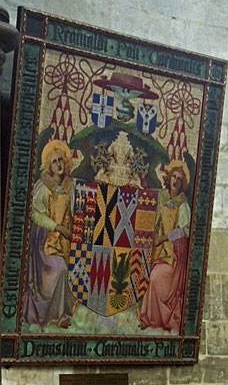
The other day I neglected to make note of the anniversary of the death of Reginald Cardinal Pole, Archbishop of Canterbury and a man with a better claim to the English throne than the illegitimate Elizabeth I. His impressive coat of arms depicts: Quarterly of eight: 1. Quarterly France (modern) and England with a label of three points each charged with a canton Gules (Clarence); 2. Per pale Or and Sable a saltire engrailed counterchanged (Pole); 3. Gules a saltire Argent with a label of three points gobony Argent and Azure (neville); 4. Gules a fess between six cross cross lets Or (Beauchamp); 5. Chequy Or and Azure a chevron ermine (Newburgh); 6. Argent three fusils in fess Gules (Montague); 7. Or an eagle displayed Vert armed and beaked Gules (Monthermer); 8. Quarterly i and iv Or three chevrons Gules (Clare); ii and iii Quarterly Argent and Gules, a fret Or, overall a bend Sable (Despencer). The two crosses indicate his archiepiscopal and legantine powers. On the small shields are the arms of the See of Canterbury and the Cathedral Chapter. The image is of the achievement of his arms hanging above his tomb.

Image 50_2

Archbishops of Sydney

With the recent installation of the IX archbishop of Sydney Australia, The Most Rev. Anthony Fisher, OP several have asked about the arms of the other archbishops, five of whom have also been cardinals. Here they are:

1. Bede (John) Polding, OSB

sc0070423d

2. Bede (Roger) Vaughan, OSB

sc007050b5b

3. Patrick Francis Cardinal Moran

MORAN  PATRIZIO FRANCESCO

4. Michael Kelly

sc0070641b

5. Norman Thomas Cardinal Gilroy, KBE

GILROY-3 My painting0001

6. James Darcy Cardinal Freeman, KBE

FREEMAN  JAMES DARCY

7. Edward Bede Cardinal Clancy

CLANCY

8. George Cardinal Pell, AC

sostituisciPellbis0001

9. Anthony Colin Fisher, OP

image-11

Archbishop Cupich (Third Time’s A Charm)

I have already written about the coat of arms of Archbishop Blase Cupich who will be installed today as the Archbishop of Chicago. Not only has the Archbishop modified his coat of arms when he moved from Rapid City to Spokane and again from Spokane to Chicago now he is also employing a new rendering of the coat of arms done by someone other than Paul Sullivan (below). May the Archbishop’s tenure in Chicago be a spiritually fruitful and successful one.

cupich_coa_200a