Monthly Archives: June 2026

Venice Gets a New Bishop

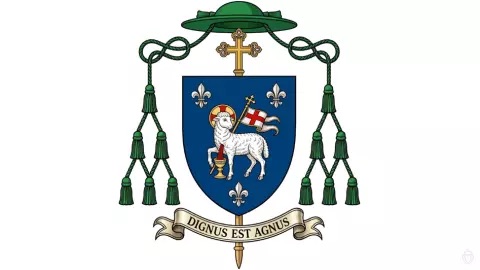
No, not the one in Italy; the one in Florida. On July 11, the Feast of St. Benedict, Patriarch of Western Monasticism, the Most Rev. Emilio Elpidio Biosca Agüero, OFM. Cap. (61) will be ordained a bishop and installed as the Third Bishop of Venice, Florida.

The coat of arms he will assume is:

My first response is to say, “Meh”. It’s not a bad coat of arms. The chief contains the symbol used throughout the Church by Franciscans of all types. The main field contains the hearts of Jesus, Mary and Joseph. Not “bad” per se, but rather unremarkable. Still, given the kind of ecclesiastical heraldry often being produced today it must be said that it could have been far worse.

I note that the Bishop chooses not to impale his personal arms with those of the diocese. In this he follows the custom set by his two predecessors who also bore only their own personal arms. This perhaps is because the complicated design of the arms of the See of Venice, Florida don’t lend themselves easily to being marshaled with other coats of arms. In my opinion, this is due to the fact that the diocesan arms were poorly designed in the first place.

I also note that the new bishop, who up until his appointment has been working in the Archdiocese of Washington, DC, must have received assistance from someone there in preparing his coat of arms. The episcopal cross and galero are the ones originally designed by the late A.C.W. Phelps of Cleveland and have been copied and used, and reused, in the Archdiocese of Washington since the time of Cardinal Hickey’s tenure.

SSPX Bishops

On July 1 the Priestly Society of St. Pius X (SSPX) founded by the late Archbishop Marcel Lefebvre, will ordain four new bishops without Papal consent, an act which will incur automatic excommunication for those ordained and for the one who ordains them. That topic—the validity or not of this action is not for me to discuss here on this blog. However, a few days ago the Society also published the armorial bearings that will be assumed by these four men upon their ordination.

The coats of arms themselves are nicely designed, in accord with good heraldic practices and are alo very nicely rendered. However, my one and only question has to do with the style of these coats of arms. The Society of St. Pius X is well known for rejecting far more in the Church than simply the Novus Ordo Mass. Essentially, the rejected all of the reforms of the Second Vatican Council, as well as the teachings in all of the Council’s documents and the practices that grew out of those reforms. So, that moves me to ask: why don’t these coats of arms also contain the mitre and the crozier as external ornaments to the shield? After all, such a practice was not only common but normative prior to the reforms in ecclesiastical heraldry made by the Instructions of St. Paul VI in 1967, 1968 and 1969. It is only from that time that episcopal coats of arms have regularly omitted the mitre resting on the shiled and the crozier standing behind the shield alongside the episcopal cross.

So, to be consistent with their usual practices why don’t they depict these new coats of arms in that way, that is to say in the “traditional” way? They seem to have no problem complying with the reform made to Catholic ecclesiastical heraldry made during the pontificate of the same Pope who reformed the Mass and many other things in the life of the Church. Doesn’t it seem a bit hypocritical to go along with this one change when refusing to accept all the others?

I think it does.

United States Coat of Arms

The coat of arms of the United States of America which appears on the great seal of the U.S., familiar to many by its depiction on the one dollar bill, was adopted officially by Congress 244 years ago on June 20, 1782. It was designed over a period of time by three different Congressional committees but the final design is essentially the work of Charles Thompson, Congressional Secretary and William Barton. Both the coat of arms and the great seal it is depicted on were adopted by the Congress at the same time.

The resolution of Congress adopting the arms, still in force, legally blazoned the shield as:

“Paleways of 13 pieces, argent and gules; a chief, azure.”

The word “paly”, rather than “paleways”, should have been used and a more technically proper blazon would have been “argent, six pallets gules” (six red stripes on a white field).

The shield bears a resemblance to the United States flag, with two exceptions in particular:

The blue chief contains NO STARS (although certain derivative arms do, e.g. the chief of the arms of the United States Senate). The outermost stripes are white, not red, to avoid violation of the rule of tincture, as the chief is blue. The single supporter of the shield is a bald eagle with its wings displayed. From the eagle’s perspective, it holds a bundle of 13 arrows in its left talon, and an olive branch in its right talon. Although not specified by law, the olive branch is usually depicted with 13 leaves and 13 olives. In its beak, the eagle clutches a scroll with the motto “E pluribus unum” (Out of Many, One). Over its head there appears a glory with 13 stars on a blue field.

INTERNATIONAL HERALDRY DAY

Each year the loose knit community of heraldic enthusiasts around the world observes International Heraldry Day. The holiday was established in 2013 at the initiative of the International Association of Amateur Heralds. The date of June 10 was chosen intentionally: on this day in 1128 in Rouen (France), Geoffrey V of Anjou was knighted by his future father-in-law, King Henry I of England. During the ceremony, Geoffrey received a shield bearing six golden lions on a blue background — one of the earliest known coats of arms in history.

So, this June 10 celebrate all things heraldic. If you are armigerous be sure to display your coat of arms!