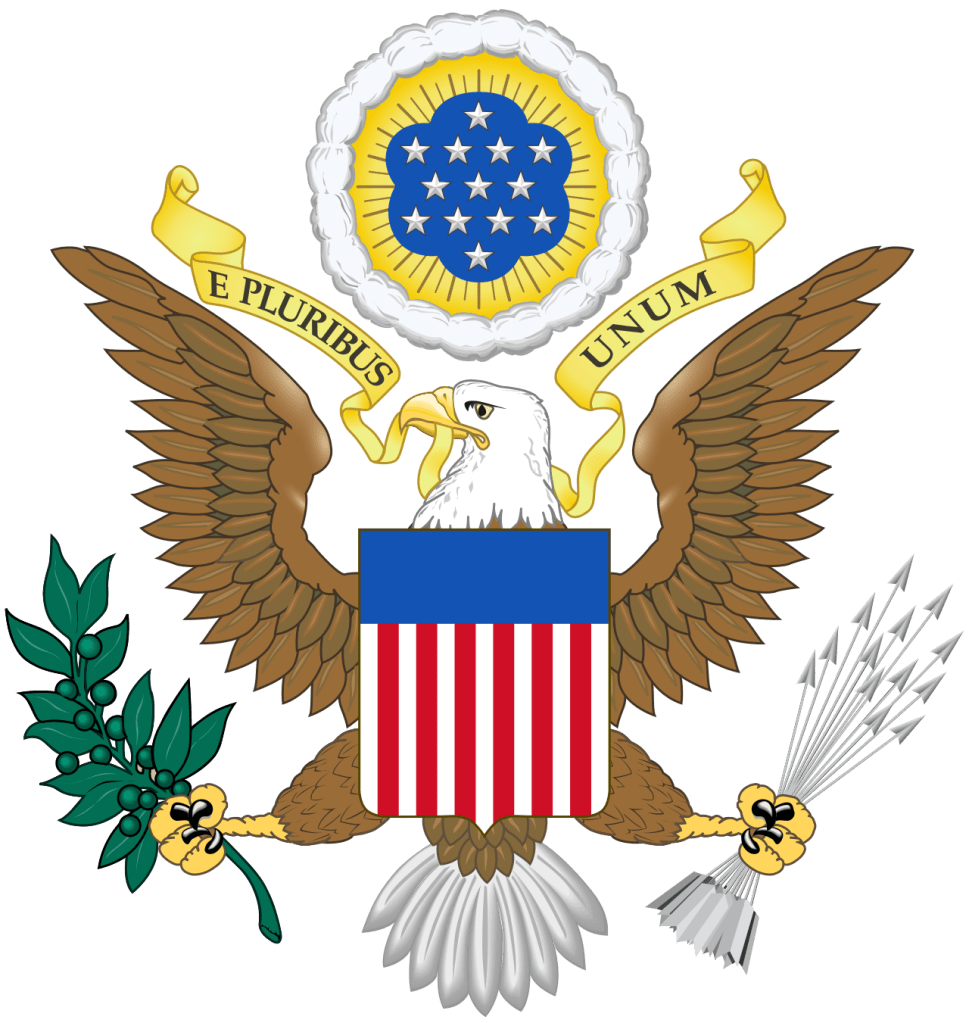
The coat of arms of the United States of America which appears on the great seal of the U.S., familiar to many by its depiction on the one dollar bill, was adopted officially by Congress 244 years ago on June 20, 1782. It was designed over a period of time by three different Congressional committees but the final design is essentially the work of Charles Thompson, Congressional Secretary and William Barton. Both the coat of arms and the great seal it is depicted on were adopted by the Congress at the same time.
The resolution of Congress adopting the arms, still in force, legally blazoned the shield as:
“Paleways of 13 pieces, argent and gules; a chief, azure.”
The word “paly”, rather than “paleways”, should have been used and a more technically proper blazon would have been “argent, six pallets gules” (six red stripes on a white field).
The shield bears a resemblance to the United States flag, with two exceptions in particular:
The blue chief contains NO STARS (although certain derivative arms do, e.g. the chief of the arms of the United States Senate). The outermost stripes are white, not red, to avoid violation of the rule of tincture, as the chief is blue. The single supporter of the shield is a bald eagle with its wings displayed. From the eagle’s perspective, it holds a bundle of 13 arrows in its left talon, and an olive branch in its right talon. Although not specified by law, the olive branch is usually depicted with 13 leaves and 13 olives. In its beak, the eagle clutches a scroll with the motto “E pluribus unum” (Out of Many, One). Over its head there appears a glory with 13 stars on a blue field.
 EXARANDORUM
Interestingly enough, one of the original proposals for the flag (the Hopkinson Flag) did follow the heraldic conventions of the coat of arms, with white outer stripes.