Category Archives: Work of Other Artists

Bishop Matano of Rochester, NY

Image

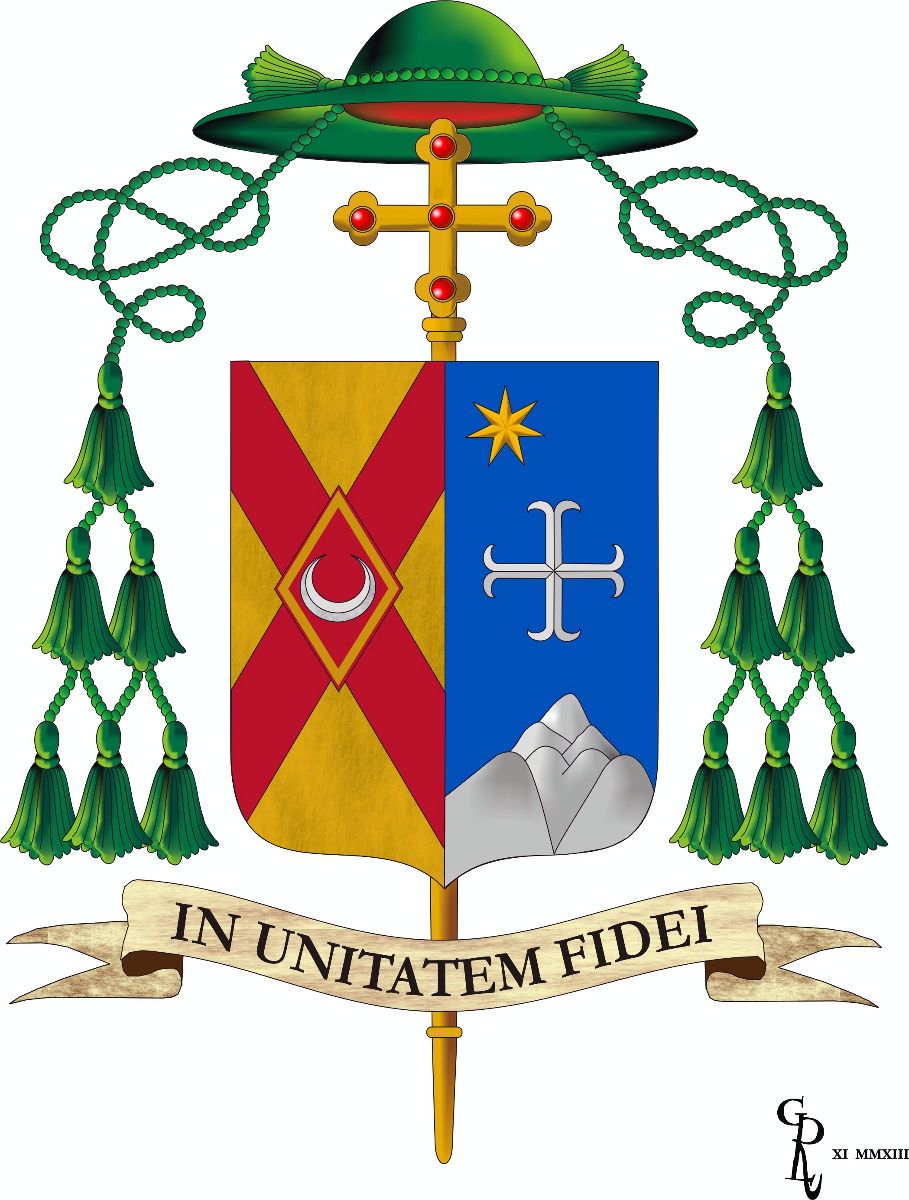
Salvatore Matano will be installed today as the ninth bishop of Rochester, New York succeeding Bishop matthew Clark who has served there for the last thirty four years. Rochester is also the diocese where the late Archbishop Fulton Sheen served as diocesan bishop briefly before being promoted to titular archbishop of Newport.

The description of the bishop’s coat of arms (taken from material provided by the diocese) is as follows:

“On a blue field is a silver moline cross taken from the heraldry of the bishop’s native diocese of Providence, Rhode Island; a golden star with seven points simultaneously recalls the Divine institution of the Seven Sacraments and the Seven Sorrows of Our Lady.  The liturgical memorial of Our Lady of Sorrows is observed on the 15th day of September, the day of Bishop Matano’s birth. In base are seven silver hills on which the Eternal City of Rome – the city of the Bishop’s priestly formation and graduate education – and the City of Providence – the city of the Bishop’s birth and preliminary education – are said to be built. The blue background symbolizes the ascent of the human soul towards God, with whom each of us was created to dwell in unapproachable light.”

The personal arms are those he assumed when he became a bishop in 2005.

Bishop Caggiano UPDATE

Image

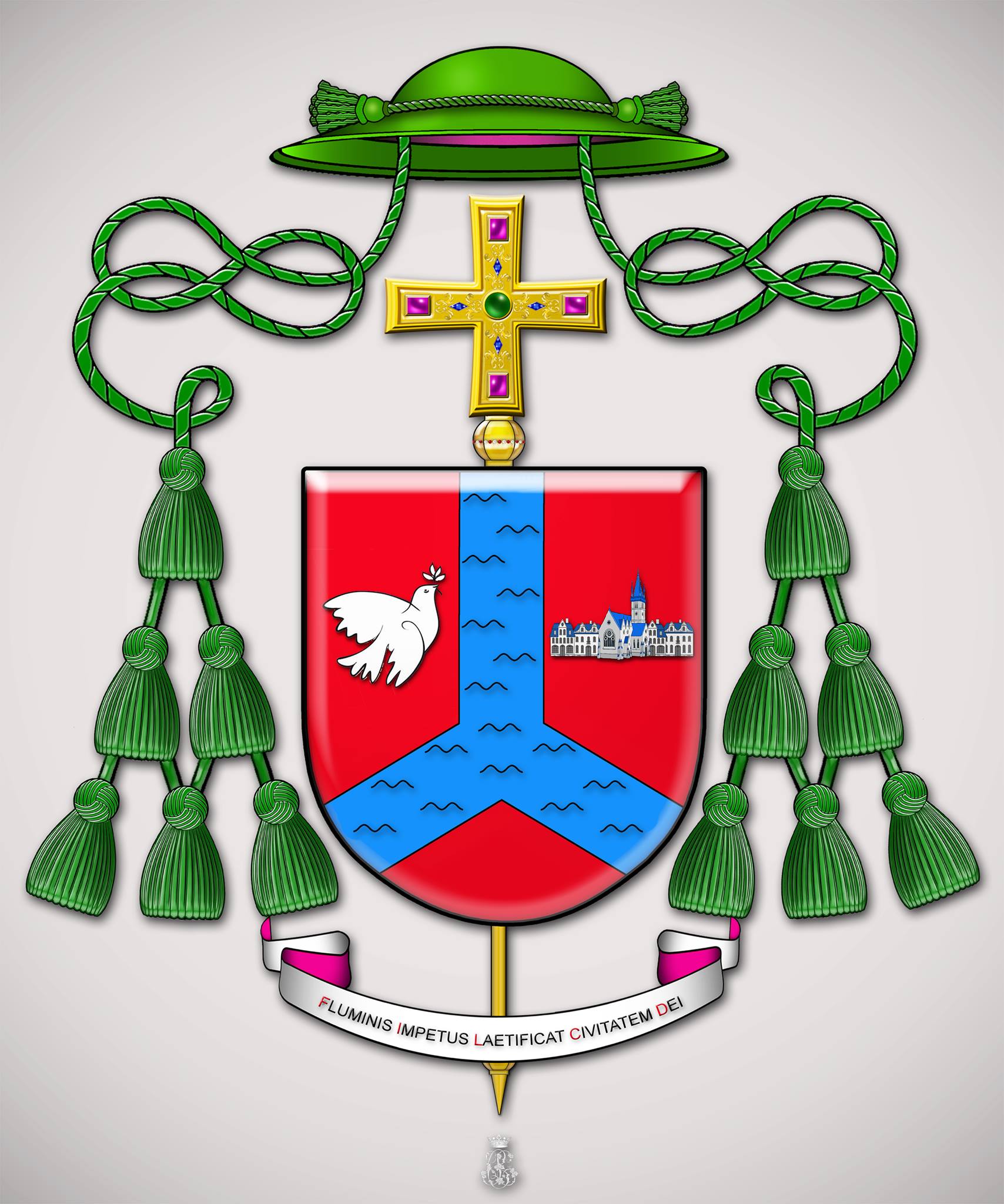
The diocese of Bridgeport, CT has finally released the coat of arms of Bishop Frank Caggiano which were posted here earlier. As has become increasingly frequent these days the bishop has chosen to completely redesign his personal arms in having them impaled (that is, marshaled together side-by-side on the same shield) with the arms of the See of Bridgeport. This is an ill-advised course of action. Nevertheless, many heraldic designers and artists who may be consulted to prepare the coat of arms of a bishop but who did not originally design the bishop’s personal arms encourage them to redesign their arms. One wonders if this is primarily because they wish to “have a crack at it” and improve on what they see to be an inferior design?

More often than not a competent artist can improve a poor design simply by the manner in which it is depicted artistically. This saves the unfortunate consequence of changing the personal arms of the bearer long after they have already become associated with him as his personal emblem. It can be seen as a repudiation of everything that came before. For a bishop this is, perhaps, not the best signal to send as it looks rather like he is negating all the ministry he did previous to the present moment and starting fresh rather than continuing in ministry. In fact, it was for this very reason that soon-to-be Saint John Paul II insisted on leaving the letter “M” in his coat of arms despite the protestations of the late great Bruno Heim that letters were inappropriate heraldic charges. John Paul II argued that even though it was heraldically a poor design he had already borne those arms for years and under Communist rule where the Church in Poland was seen as a haven for those who loved freedom. To change the arms upon election as pope might inadvertently send the signal that his stance against Communism would somehow modify or soften with his new position. This was something John Paul II wasn’t willing to risk even the appearance of. So, while he acquiesced to Heim’s suggestion of changing the colors from black on blue to gold on blue the “M” stayed.

So here we see that Bishop Caggiano, upon assuming the office of Diocesan Bishop of Bridgeport has chosen to mark the occasion not only by marshaling his personal arms with those of the diocese as is the usual custom in North America but also by abandoning the coat of arms he assumed upon becoming a bishop in favor of a redesigned coat of arms that retains the same basic elements rearranged in a new way…for reasons passing understanding.

If a redesign somehow greatly improves a coat of arms then it could be argued that it is justified. However, in this case any improvement is difficult to see.

Hartford

The arms of the newly installed (Dec. 16th) Archbishop Leonard Blair of Hartford, Connecticut. He is the former bishop of Toledo, Ohio and also formerly the auxiliary bishop of Detroit, Michigan. Below his arms are those of his two immediate predecessors, Abp. Henry Mansell and Abp. Daniel Cronin both of whom are still living. The arms of the archdiocese employ nice canting arms for “hart” and “ford”.

Image

Image

Image

Most Rev. James Daly, RIP

Image

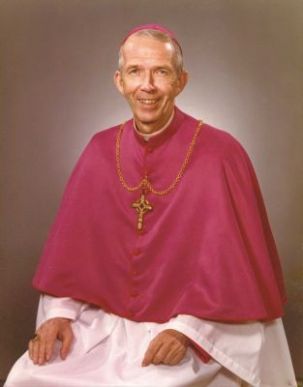
I learned only today of the October 14th death the the Most Rev. James J. Daly, DD Auxiliary Bishop of Rockville Centre, NY. He was 92. I grew up in that diocese and Bishop Daly (whose gentle demeanor and soft-spokeness earned him the ironic nickname “tiger”) was the bishop who confirmed me in 1977. In fact, he had only just become a bishop the same month. His first confirmation was, fittingly, for the parish where he had served as pastor up until becoming a bishop but ours was only the second time he had administered the sacrament of Confirmation.

The right-hand man to Bishop John McGann for years, Daly also served as dean of the Seminary of the Immaculate Conception in Huntington and was in charge of helping decide which parishes priests would serve in. Yet colleagues said he was unassuming and humble, and was happiest being a parish priest.

Daly was born in the Bronx, grew up in Jamaica, Queens attended a Catholic high school, and studied for the priesthood at the seminary in Huntington. His experience as a priest on Long Island started before the local diocese existed. When he was ordained in 1948, Nassau, Suffolk, Queens and Brooklyn made up the Diocese of Brooklyn. Nine years later, Nassau and Suffolk were carved out to create the Diocese of Rockville Centre. In 1958, Daly was assigned to the seminary, where he rose to the post of dean. By 1972, he was named pastor of St. Boniface parish in Elmont. By many accounts, it was one of the happiest times of his life. But the church hierarchy also needed him, and in 1977 Bishop John McGann requested that he be named auxiliary bishop. He eventually rose to vicar general, the No. 2 post in the diocese.

Daly retired in 1996, but remained active, visiting patients in hospitals and nursing homes. He also cared for a disabled brother in the house his family had bought decades ago in Blue Point, where Daly had his first assignment as a priest, from 1948 to 1951, at Our Lady of the Snow.

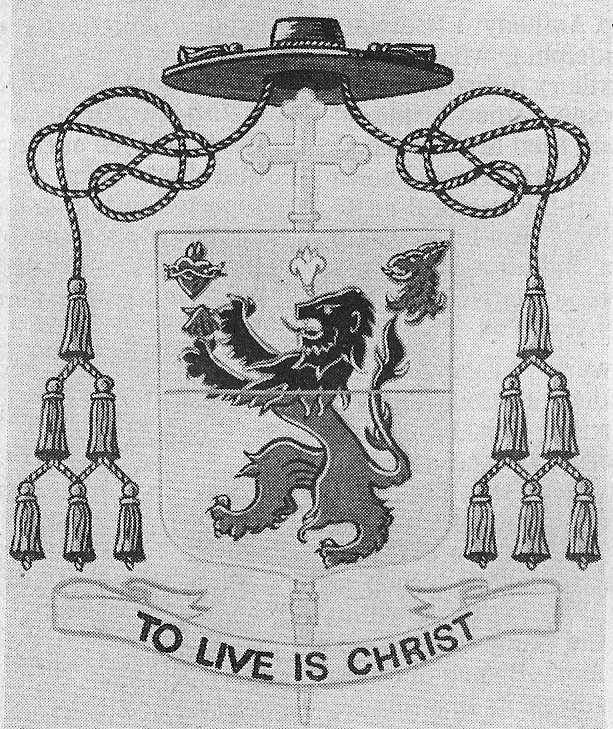
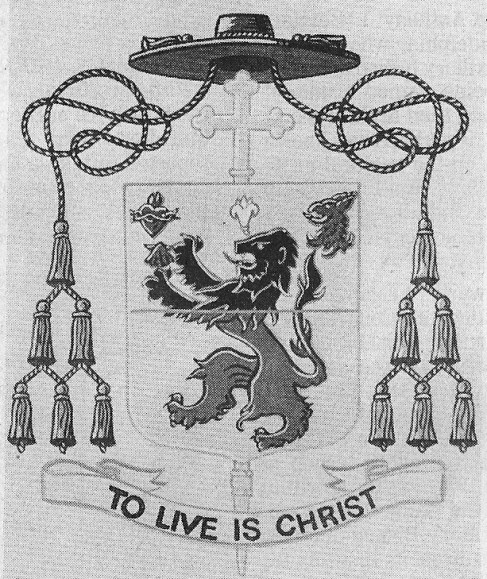
His coat of arms is based on the Irish arms associated with the name Daly. It has the addition of a scallop shell, a symbol of his baptismal patron, St. James, as well as the Sacred heart, a lily and a griffin’s head. These charges represent family allusions as well as his personal devotions. Unfortunately, I do not have a full color rendering.

He was a kind, gentle and very capable pastor, priest and bishop. Requiescat in pace.
Image

An “Oldie” But a “Goodie” (amended)

Image

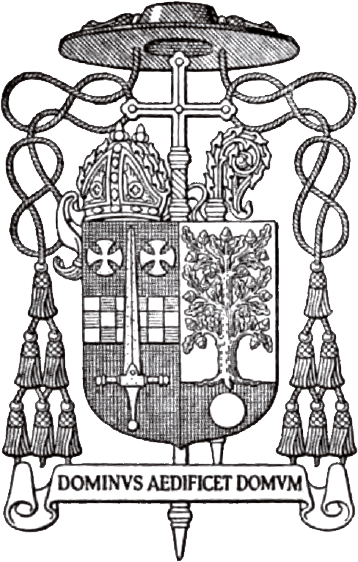
The coat of arms of the Most Reverend Hugh Charles Boyle, DD who served as the Sixth bishop of Pittsburgh, Pennsylvania from 1921-1950. His arms are in the older style popular at that time and include the mitre and crozier as well as the episcopal cross (not to be confused with a processional cross) and galero. In 1969 Pope Paul VI’s instructions discontinued the use of the mitre and crozier in the coats of arms of people even though they are frequently used as external ornaments in the coats of arms of corporate bodies such as dioceses and abbeys.

The arms of the See of Pittsburgh were based on those of the city of Pittsburgh which, in turn were based on those of William Pitt. In the diocesan arms the bezants (gold roundels) have been changed to crosses and the inclusion of the sword alludes to the titular patron of the cathedral: St. Paul.

Very nice! Unfortunately, I cannot find a color image.

UPDATE: An intrepid reader informs me this is actually the arms of Bishop Regis Canevin, also of Pittsburgh.

Most Rev. Anthony G. Bosco RIP

Image

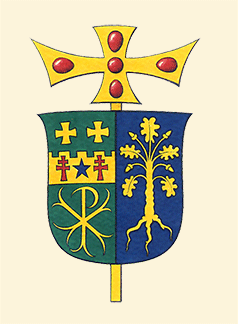
The Most Rev. Anthony G. Bosco (August 1, 1927-July 2, 2013) who served as Third Bishop of Greensburg, Pennsylvania from 1987-2004 has passed away. He was the bishop who installed me in the Ministry of Acolyte on my way to the priesthood. His coat of arms with the distinctive single charge of an oak tree as an allusion to the name “Bosco” was designed by the late Prof. Géza Grosschmid, who was my mentor in heraldry, and emblazoned by none other than the late (great) Abp. Bruno B. Heim. In fact, the bishop’s personal arms were used by Heim as part of the cover art for his seminal work, “Heraldry In The Catholic Church” (1978). Bishop Bosco purposely didn’t use a galero in his coat of arms and preferred to use the one external ornament that is exclusive to and truly indicates the coat of arms of a bishop. Namely, the episcopal cross. May he rest in peace.

Bishop Barber of Oakland

Image

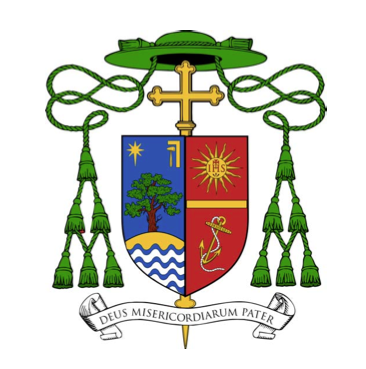
The coat of arms of newly ordained and installed Bishop Michael Barber, SJ of Oakland who was ordained a bishop and installed at the Cathedral of Christ the Light in Oakland today. The charge in chief of the personal arms is the insignia of the Society of Jesus to which the bishop belongs and which also features prominently in the arms of the pope who appointed him. The bishop also served as a US Navy chaplain. Hence, the anchor.

An Heraldic “CV”

Hcv1

Above you see what I like to call my “heraldic curriculum vitae”. (click on the image for a larger view) Essentially, it is a record of the various things I have done in my life illustrated by using heraldry. I commissioned the very talented architect, designer and graphic artist, Matthew Alderman to create this artwork. I conceived of the idea for this a few years ago when I received a friend’s bookplate that had not only his own coat of arms on it but the coats of arms of the various universities he attended and the dioceses in which he had served. A few months back Matt asked me to help him with some heraldic research for another commission on which he was working and when he showed me the sketches for it I knew he was the man to produce this heraldic CV.

My own coat of arms is at the center flanked by the coats of arms of the diocese in which I serve and the diocese in which I was born and grew up. Below that we see two other versions of my arms reflecting other capacities in which I serve with the coat of arms of the Roman Catholic Church between them. The bottom consists of the coats of arms of various schools I’ve attended and the sides are comprised of the coats of arms or other insignia for a variety of organizations to which I belong and/or serve as an officer or chaplain.

The image doesn’t really do it justice. In person it is stunning!

Prior’s Staff

Image

One of the lesser known and, indeed, lesser used external ornaments in ecclesiastical heraldry is the Prior’s Staff, sometimes called the Cantor’s Staff. Like the crozier of bishops and abbots it has its origin in the staff used by pilgrims as a walking stick. As it evolved it came to be depicted as a simple staff usually of metal which terminated at the top in a small ball, or an apple, a fleur-de-lis or even the small representation of a house or chapel.

It is most often used in ecclesiastical heraldry for monastics but can also be seen in those places that still have cathedral chapters. Those officials of the chapter who do not enjoy the right to pontifical insignia, such as Priors, Provosts, Precentors or Cantors make use of it as a sign of their office. At one time Precentors or First Cantors were in charge of music for the chapter and cathedral and actually used this long staff to conduct the choir. It’s easy to see how from there it became a symbol of their office. This type of staff was also used to direct ceremonies.

Using the Prior’s Staff as a heraldic emblem was for those officials who actually used one in real life. As its use became less frequent it then evolved into an emblem for those who held the office that used to employ such staves. It is seen very little in heraldry these days.

(The example above is the coat of arms of the Collegiate Chapter of Canons of St. Vittore of Arcisate rendered beautifully by Marco Foppoli)

One of the Best…Ever

Image

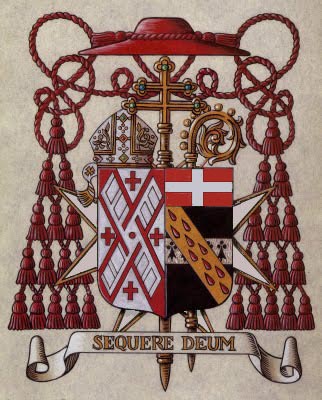
The coat of arms of His Eminence, Francis Cardinal Spellman, Archbishop of New York from 1939-1967. The blazon is: Arms impaled; in the dexter Argent on a saltire Gules between four  Greek crosses Gules the sails of a windmill in saltire Argent (New York Archdiocese). In sinister Sable, on a fess Argent four ermine spots Sable; overall a bend Or goutee de sang; a chief of the Religion (Spellman).

The arms of the archdiocese employ a red X-shaped cross of St. Patrick, the patron of the archdiocese. On this is superimposed the sails of a windmill to recall the Dutch who first settled the city of New Amsterdam, later called New York. The four red crosses represent the four Gospels. Spellman’s own arms were not the first that he adopted when he was made a bishop. His original coat of arms depicted the Santa Maria, flagship of Christopher Columbus, under full sail. He used these when he was Auxiliary Bishop of Boston. After he was translated to New York Spellman adopted the arms we see here. Unfortunately, I do not know the meaning behind the ermine spots or the gold bend. I know the drops of blood were an allusion to the Precious Blood of Christ. As a Bailiff of the Order of Malta he includes both the chief of that order (Gules a cross throughout Argent) and places the shield on the cross of the order.

The external ornaments include the galero and the mitre as well as the archiepiscopal cross and the crozier. These arms were designed long before the 1969 Instruction of Pope Paul VI forbidding the use of mitre and crozier in the arms of bishops, archbishops and cardinals.

I have always like this particular coat of arms. It is an exmaple of good heraldry which is a rare find among the coats of arms of American prelates…of any era!

Coat of Arms of Archbishop Gänswein

Image Image

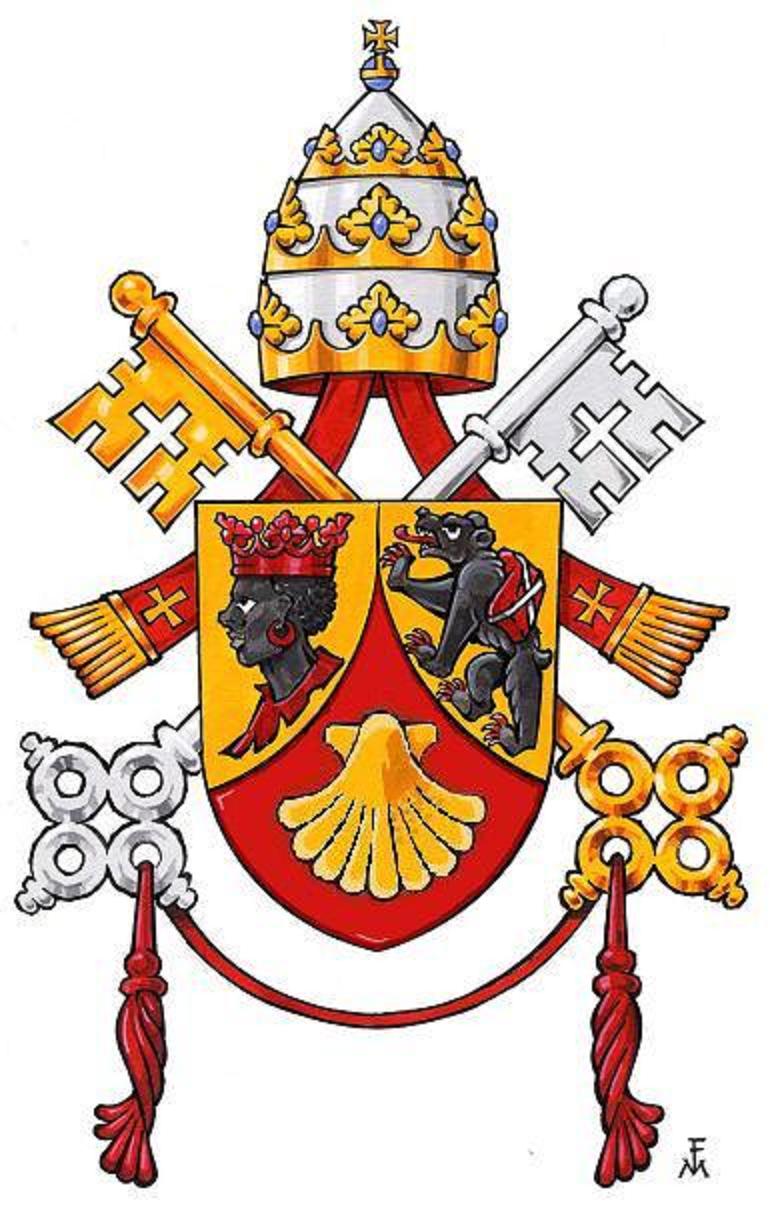
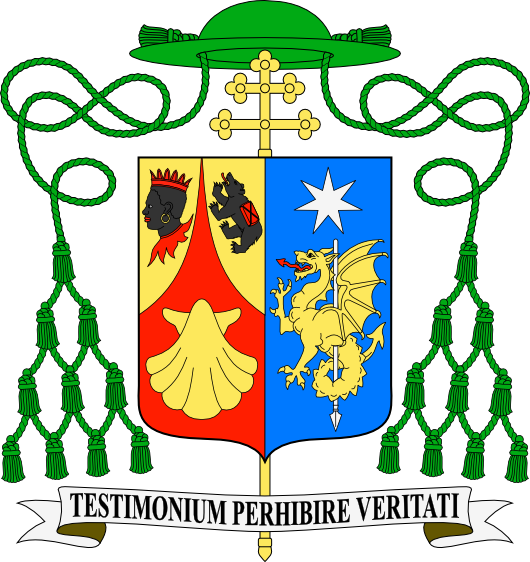
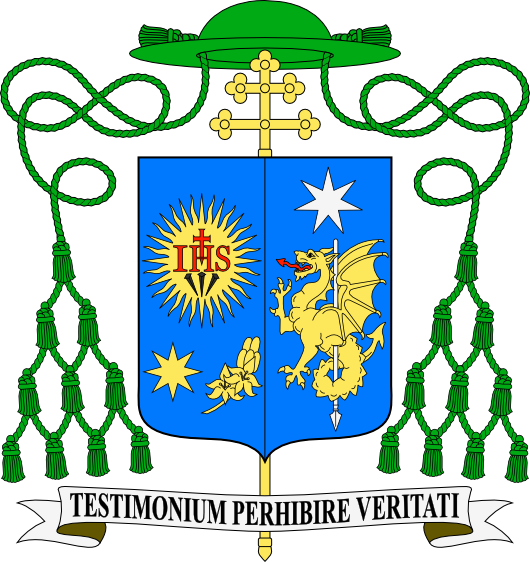
Having seen a Facebook post I wrote about this some time ago my friend and heraldic enthusiast and artist Xavi Garcia who writes the excellent blog Dibujo Heráldico posted recently about the coat of arms of the Prefect of the Pontifical Household (and former secretary to Pope Benedict XVI) Archbishop Georg Gänswein. It is the custom of the Prefect of the Pontifical Household to impale (combine on the same shield) his personal arms with those of the reigning pope. When Archbishop Gänswein was named an archbishop earlier this year he adopted personal arms that reflect St. George, his baptismal patron (the dragon being slain with a spear) and his devotion to Our Lady (the star). These were impaled with the arms of Pope Benedict (above). Now that Pope Francis has been elected and Archbishop Gänswein remains as Prefect of the Pontifical Household (at least for now) his arms are changed to be impaled with those of Pope Francis (below). Now there is a great deal of blue on one shield but that was not something that could have been forseen. Xavi has depicted the two coats of arms himself in his own style and I am happy to share them with you here. Check out his blog while you’re at it too!

(artwork: Xavi Garcia)

One of Bruno Heim’s Best

Image

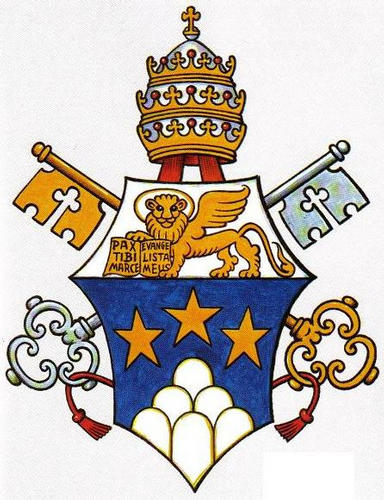
Arguably one of the best coats of arms designed and emblazoned by the late Archbishop Bruno Heim was that of Pope John Paul I who reigned as pope for just 33 days from August to September of 1978. The coat of arms was slightly modified from the one he had borne before becoming pope. Upon his election Albino Cardinal Luciani chose the unique double name of John Paul combining the papal names of his two immediate predecessors. The coat of arms was put together to reflect this double name. In chief we see the lion of St. Mark that makes up the arms of the See of Venice. Cardinal Luciani served as Patriarch of Venice before being elected to the papacy. In addition, two of his predecessors as pope, St. Pius X and Bl. John XXIII also were Patriarchs of Venice before their respective elections as pope and both retained the chief of St. Mark in their coats of arms as pope. In the arms of John Paul I the chief of St. Mark not only recalls his own time in Venice but evokes the memory of Pope John XXIII. The collee, or stylized mountains or hillocks in base are from the coat of arms of Pope Paul VI whose family name, Montini, means “little mountains”. In between the mountains and the chief there are three stars. Paul VI had three fleur-de-lis in the same position in his arms and Cardinal Luciani’s original arms had three stars but the stars had only four points each. Here they have been modified to five-pointed stars which are a heraldic symbol of Our Lady, specifically of the Assumption. Despite the fact that Pope John Paul I adamantly refused to be crowned as pope the papal tiara nevertheless appears in its usual spot ensigning the shield along with the keys of St. Peter. Truly, this is one of Heim’s best designs. Sadly, it was not seen by many because of the brevity of the pontificate of the “smiling pope”.