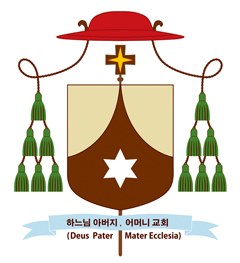
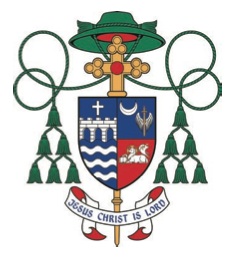
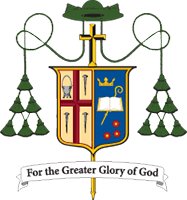
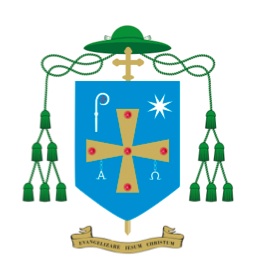
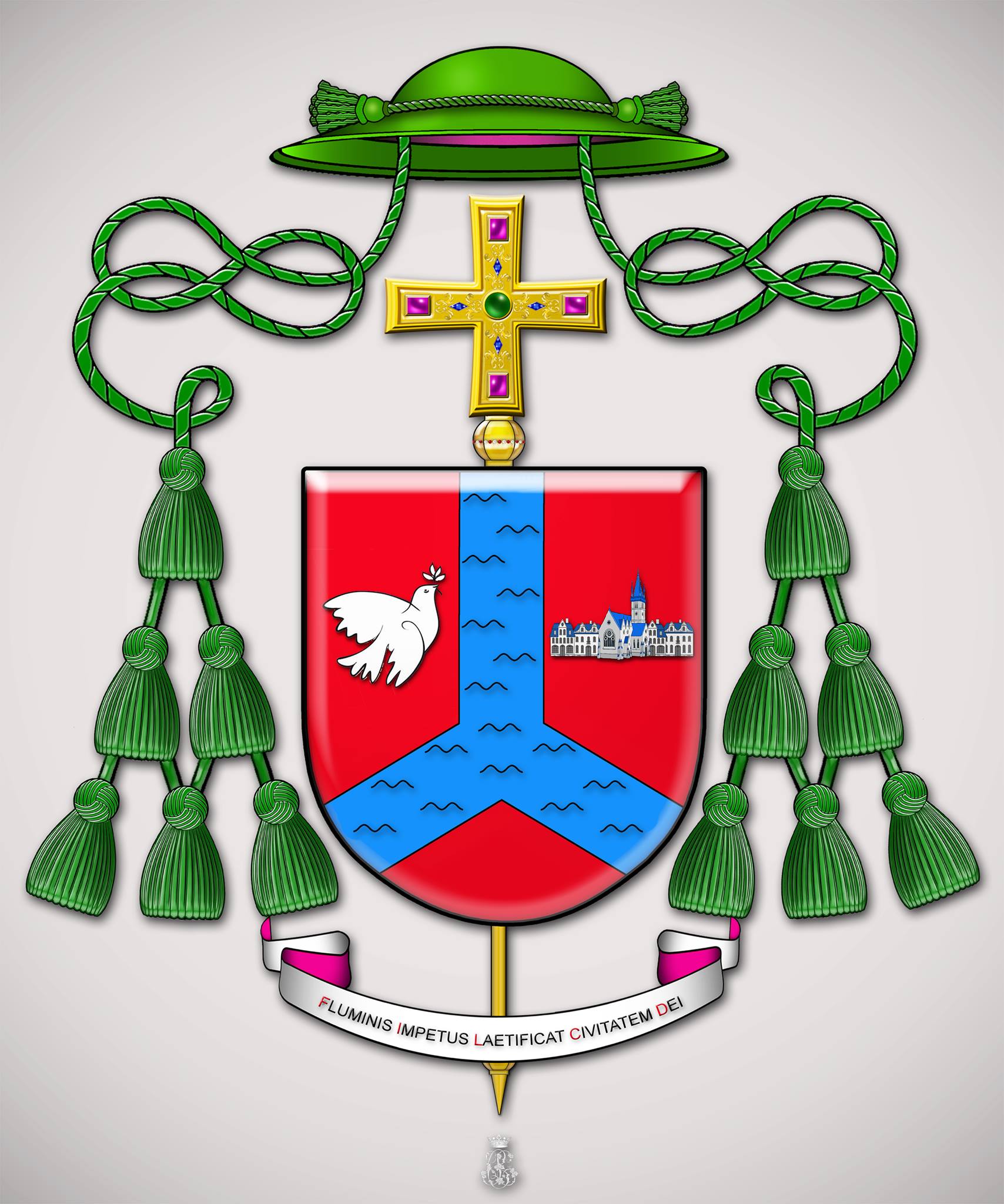
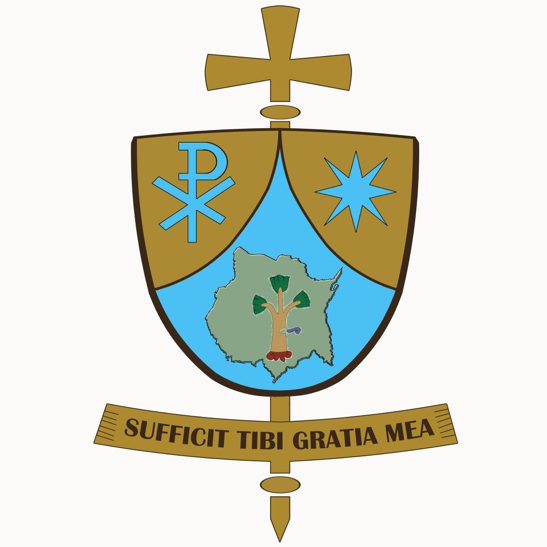
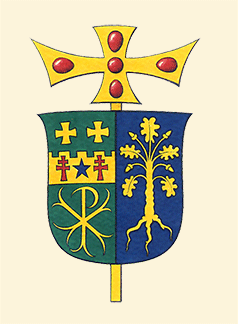
Two Auxiliary bishops of the Archdiocese of Seoul, Korea were ordained today. There coats of arms are interesting. They are Bishops Timothy Yu Gyoung-chon and Peter Chung Soon-taek, OCD. (that is, Order of Discalced Carmelites). The coat of arms of Bishop Timothy is unconventional bordering on the bizarre. It makes extensive use of writing and seems to have the motto on the shield itself. It also makes use of no external ornaments to indicate these are the arms of a bishop. On the other hand the coat of arms of Bishop Peter is more conventional in appearance. His arms are primarily composed of the coat of arms of the Order of Discalced Carmelites differenced by the exclusion of the two additional stars that usually appear in the upper left and right thirds of the shield. In addition, he employs a galero that is somewhat unique to Asian heraldry. The tassels are green as would be usual for a prelate with the rank of bishop. However, the hat is decidedly not green. Here it is a shade of red but sometimes a purple hat is used. This is to avoid the awkward and embarrassing situation that would arise from a bishop employing a green hat. To “wear a green hat” is a colloquial expression in many parts of Asia that means the man is a cuckold. To avoid this association with the well known expression many Asian bishops from various countries make use of a hat of some color other than green.
Category Archives: Bishops
Bishop Olson of Fort Worth
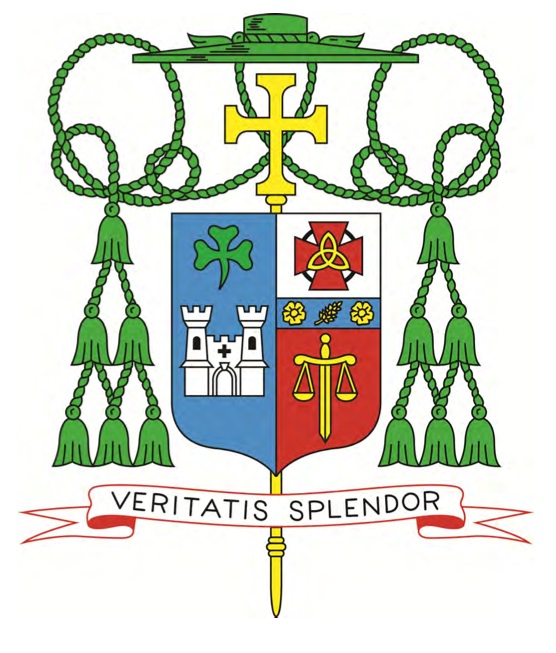
On January 29 the Most Rev. Michael Fors Olson will be ordained and installed as the fourth bishop of Fort Worth, Texas. His personal arms depict a symbol for the Holy Trinity as an allusion to Holy Trinity Seminary in Irving, Texas where the bishop served as Rector. Below the sword and pan balance is symbolic of his baptismal patron, St. Michael. The blue fess in the center bears the spikenard flower taken from the arms of Pope Francis as well as two yellow roses (a allusion to Texas) representing Our Lady of Guadalupe and St. Thérèse the “Little Flower”. The motto means “The Splendor of the Truth”. The coat of arms of Bishop Olson were designed and marshaled to those of the diocese by Deacon Paul Sullivan.
Auxiliary Bishop of Lausanne, Genève & Fribourg
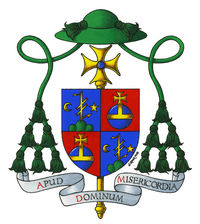
The coat of arms of the newly ordained auxiliary bishop of Lausanne, Genève & Fribourg in Switzerland, the Most Rev. Alain de Raemy. His arms are colorful and interesting and, in continental fashion, employ lots of elements repeated in four quarters. This method seems odd to those who are used to arms that are marshaled only to indicate jurisdiction over a territory like a diocese or abbey. But, it is not uncommon in Switzerland, Germany and Austria.
The artwork is by Laurent Granier.
Bishop Matano of Rochester, NY
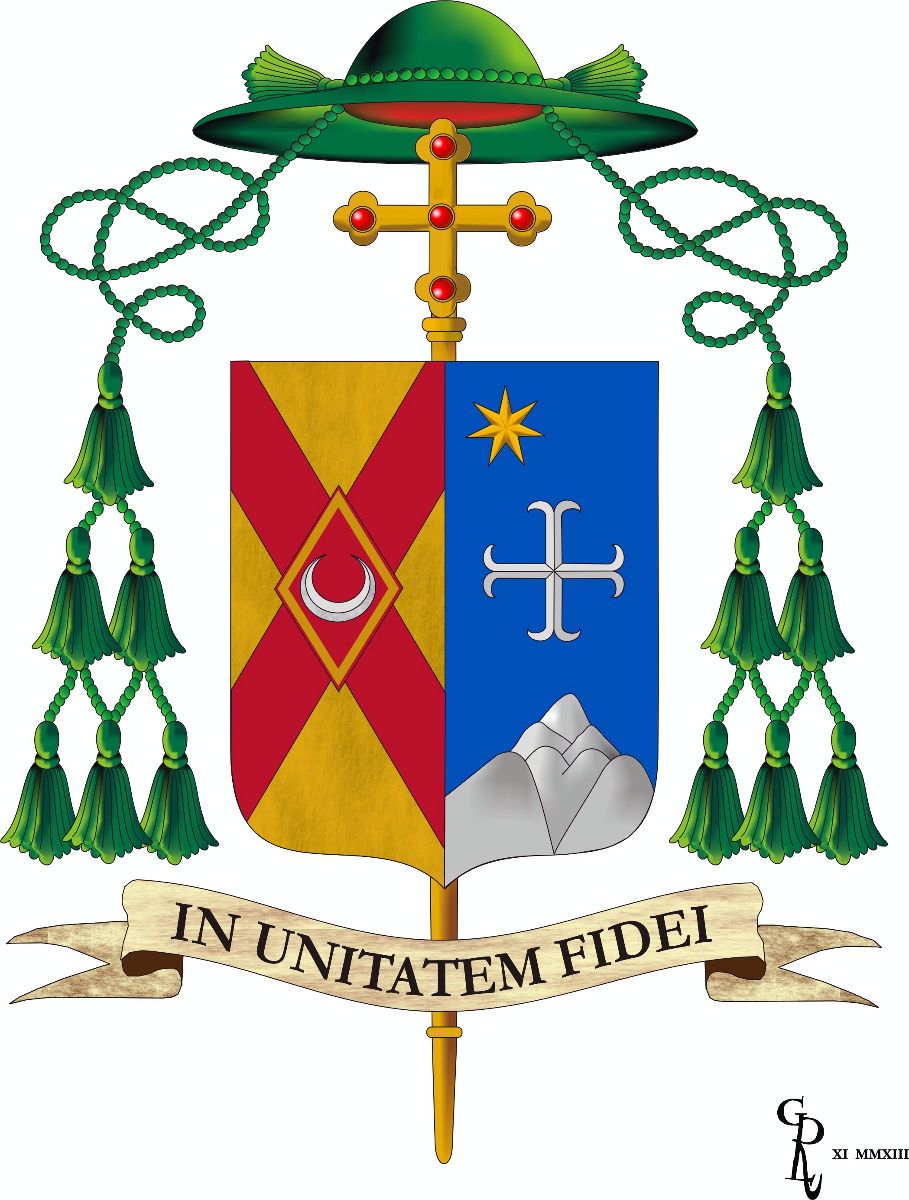
Salvatore Matano will be installed today as the ninth bishop of Rochester, New York succeeding Bishop matthew Clark who has served there for the last thirty four years. Rochester is also the diocese where the late Archbishop Fulton Sheen served as diocesan bishop briefly before being promoted to titular archbishop of Newport.
The description of the bishop’s coat of arms (taken from material provided by the diocese) is as follows:
“On a blue field is a silver moline cross taken from the heraldry of the bishop’s native diocese of Providence, Rhode Island; a golden star with seven points simultaneously recalls the Divine institution of the Seven Sacraments and the Seven Sorrows of Our Lady. The liturgical memorial of Our Lady of Sorrows is observed on the 15th day of September, the day of Bishop Matano’s birth. In base are seven silver hills on which the Eternal City of Rome – the city of the Bishop’s priestly formation and graduate education – and the City of Providence – the city of the Bishop’s birth and preliminary education – are said to be built. The blue background symbolizes the ascent of the human soul towards God, with whom each of us was created to dwell in unapproachable light.”
The personal arms are those he assumed when he became a bishop in 2005.
Bishop Caggiano UPDATE
The diocese of Bridgeport, CT has finally released the coat of arms of Bishop Frank Caggiano which were posted here earlier. As has become increasingly frequent these days the bishop has chosen to completely redesign his personal arms in having them impaled (that is, marshaled together side-by-side on the same shield) with the arms of the See of Bridgeport. This is an ill-advised course of action. Nevertheless, many heraldic designers and artists who may be consulted to prepare the coat of arms of a bishop but who did not originally design the bishop’s personal arms encourage them to redesign their arms. One wonders if this is primarily because they wish to “have a crack at it” and improve on what they see to be an inferior design?
More often than not a competent artist can improve a poor design simply by the manner in which it is depicted artistically. This saves the unfortunate consequence of changing the personal arms of the bearer long after they have already become associated with him as his personal emblem. It can be seen as a repudiation of everything that came before. For a bishop this is, perhaps, not the best signal to send as it looks rather like he is negating all the ministry he did previous to the present moment and starting fresh rather than continuing in ministry. In fact, it was for this very reason that soon-to-be Saint John Paul II insisted on leaving the letter “M” in his coat of arms despite the protestations of the late great Bruno Heim that letters were inappropriate heraldic charges. John Paul II argued that even though it was heraldically a poor design he had already borne those arms for years and under Communist rule where the Church in Poland was seen as a haven for those who loved freedom. To change the arms upon election as pope might inadvertently send the signal that his stance against Communism would somehow modify or soften with his new position. This was something John Paul II wasn’t willing to risk even the appearance of. So, while he acquiesced to Heim’s suggestion of changing the colors from black on blue to gold on blue the “M” stayed.
So here we see that Bishop Caggiano, upon assuming the office of Diocesan Bishop of Bridgeport has chosen to mark the occasion not only by marshaling his personal arms with those of the diocese as is the usual custom in North America but also by abandoning the coat of arms he assumed upon becoming a bishop in favor of a redesigned coat of arms that retains the same basic elements rearranged in a new way…for reasons passing understanding.
If a redesign somehow greatly improves a coat of arms then it could be argued that it is justified. However, in this case any improvement is difficult to see.
Bishop Cozzens
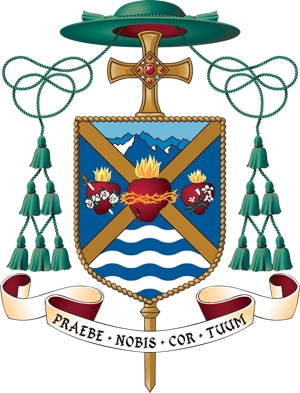
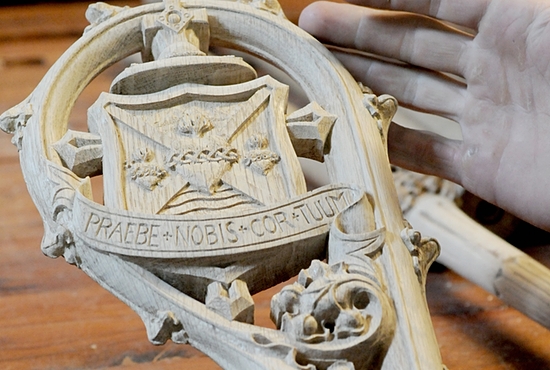
In an earlier post I noted how Auxiliary Bishop of St. Paul-Minneapolis, Andrew Cozzens, had his coat of arms carved into the crook of his crozier. Here now we see the coat of arms in its full achievement.
Hmmm. Less than wonderful.
The shield is divided by a saltire which is traditionally the X-shaped “St. Andrew Cross”. The three hearts represent the Sacred Heart of Jesus (center) the Immaculate Heart of Mary (to dexter) and the Heart of St. Joseph (to sinister). I have never heard of the latter being depicted either in heraldry or in any Catholic religious symbolism and art. Perhaps it was made up by the armiger to balance the other two? Either way, three hearts is a bit much and, if they were to be used, in heraldry it would have been better NOT to depict them in the traditional form with flames, roses, thorns, etc. and simply to depict three heart-shaped charges to stand for these three hearts.
The waves in base are from the arms of the See, which the bishop now serves and had served as a priest as well. However, the mountains in chief, to allude to his native Colorado, should be stylized and not depicted in a portrait landscape style. When…When…WHEN are people going to get it through their heads that you cannot simply take any image or picture you want, slap it onto a shield and call it heraldry???
The cord around the perimeter of the shield represents the bond of fraternity that the bishop has with a group of priests who form a priestly fraternity of which he is a member. That’s a perfectly good symbol for such a bond but should have been depicted within the edge of the shield as a bordure. Depicting it as the actual edge of the shield is heraldically unsupportable.
In the description of the achievement the episcopal cross is described as being Celtic. There are two problems there. The first is my often mentioned admonition that individual armigers are not free to determine the shape, style and manner of the depiction of the external ornaments. That creative freedom applies only to that which is on the shield. The second problem in this case is that the cross depicted is not even Celtic!
So, all in all there are nice ideas here and the charges were chosen to represent wonderful priestly and personal virtues but the overall effect is disappointing at best.
New Bishop Has Coat of Arms Carved Into His Crozier
When NOT to Use Heraldry Decoratively
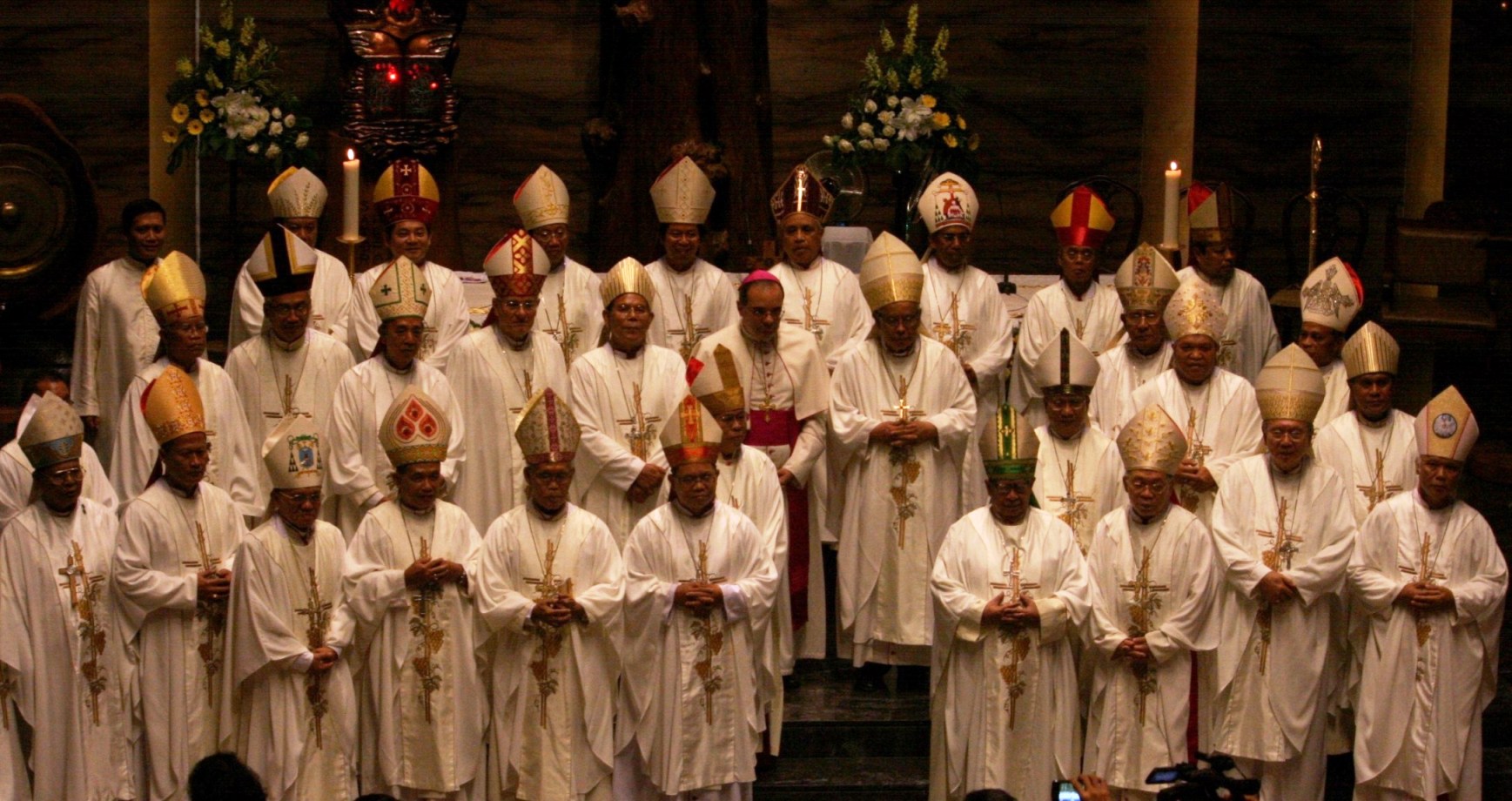
OK. I love heraldry. Can’t get enough of it. I like to see its use where and whenever I possibly can. I actually think it is underused in the Church. But, there are limits. As much as I love heraldry there are times and places when even I am forced to admit that slapping a coat of arms onto it is a bad idea. Case in point the photo below of the gathered bishops of Indonesia. The bishop in the back row third from the right and his fellow bishop in the front row third from the left look RIDICULOUS. Coats of arms on the front of a mitre? NO!
Most Rev. James Daly, RIP
I learned only today of the October 14th death the the Most Rev. James J. Daly, DD Auxiliary Bishop of Rockville Centre, NY. He was 92. I grew up in that diocese and Bishop Daly (whose gentle demeanor and soft-spokeness earned him the ironic nickname “tiger”) was the bishop who confirmed me in 1977. In fact, he had only just become a bishop the same month. His first confirmation was, fittingly, for the parish where he had served as pastor up until becoming a bishop but ours was only the second time he had administered the sacrament of Confirmation.
The right-hand man to Bishop John McGann for years, Daly also served as dean of the Seminary of the Immaculate Conception in Huntington and was in charge of helping decide which parishes priests would serve in. Yet colleagues said he was unassuming and humble, and was happiest being a parish priest.
Daly was born in the Bronx, grew up in Jamaica, Queens attended a Catholic high school, and studied for the priesthood at the seminary in Huntington. His experience as a priest on Long Island started before the local diocese existed. When he was ordained in 1948, Nassau, Suffolk, Queens and Brooklyn made up the Diocese of Brooklyn. Nine years later, Nassau and Suffolk were carved out to create the Diocese of Rockville Centre. In 1958, Daly was assigned to the seminary, where he rose to the post of dean. By 1972, he was named pastor of St. Boniface parish in Elmont. By many accounts, it was one of the happiest times of his life. But the church hierarchy also needed him, and in 1977 Bishop John McGann requested that he be named auxiliary bishop. He eventually rose to vicar general, the No. 2 post in the diocese.
Daly retired in 1996, but remained active, visiting patients in hospitals and nursing homes. He also cared for a disabled brother in the house his family had bought decades ago in Blue Point, where Daly had his first assignment as a priest, from 1948 to 1951, at Our Lady of the Snow.
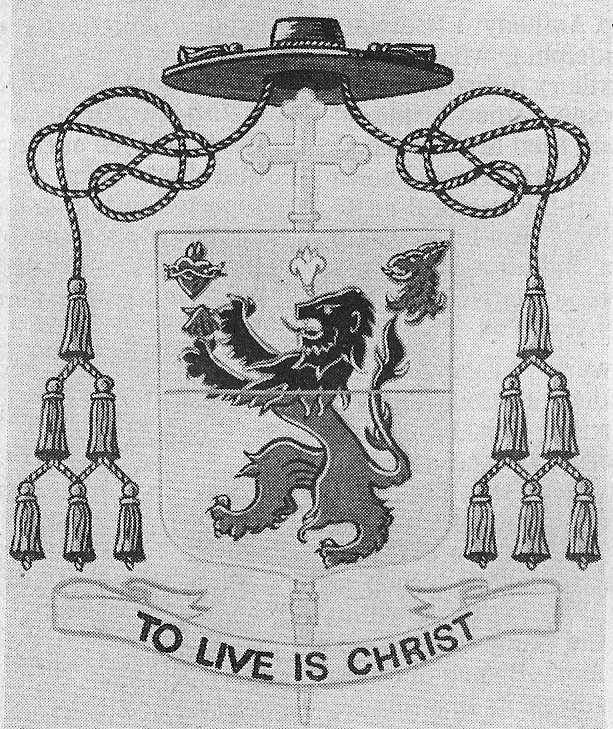
His coat of arms is based on the Irish arms associated with the name Daly. It has the addition of a scallop shell, a symbol of his baptismal patron, St. James, as well as the Sacred heart, a lily and a griffin’s head. These charges represent family allusions as well as his personal devotions. Unfortunately, I do not have a full color rendering.
He was a kind, gentle and very capable pastor, priest and bishop. Requiescat in pace.
New Bishop of San Diego
The pope accepted Bishop Brom’s resignation as Bishop of San Diego, California since he has reached the age of 75. He was immediately succeeded by his Coadjutor Bishop, the Most Rev. Cirilo Flores, the former auxiliary of the diocese of Orange, CA. Bishop Flores now impales his personal coat of arms with that of the diocese.
Bishop Fernandez Collado
An “Oldie” But a “Goodie” (amended)
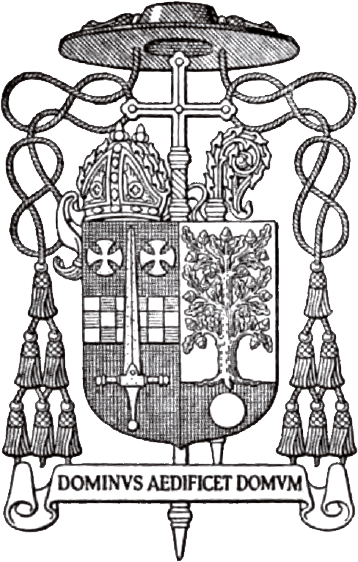
The coat of arms of the Most Reverend Hugh Charles Boyle, DD who served as the Sixth bishop of Pittsburgh, Pennsylvania from 1921-1950. His arms are in the older style popular at that time and include the mitre and crozier as well as the episcopal cross (not to be confused with a processional cross) and galero. In 1969 Pope Paul VI’s instructions discontinued the use of the mitre and crozier in the coats of arms of people even though they are frequently used as external ornaments in the coats of arms of corporate bodies such as dioceses and abbeys.
The arms of the See of Pittsburgh were based on those of the city of Pittsburgh which, in turn were based on those of William Pitt. In the diocesan arms the bezants (gold roundels) have been changed to crosses and the inclusion of the sword alludes to the titular patron of the cathedral: St. Paul.
Very nice! Unfortunately, I cannot find a color image.
UPDATE: An intrepid reader informs me this is actually the arms of Bishop Regis Canevin, also of Pittsburgh.
Bishop Peter Brown, CSsR of Samoa-Pago Pago
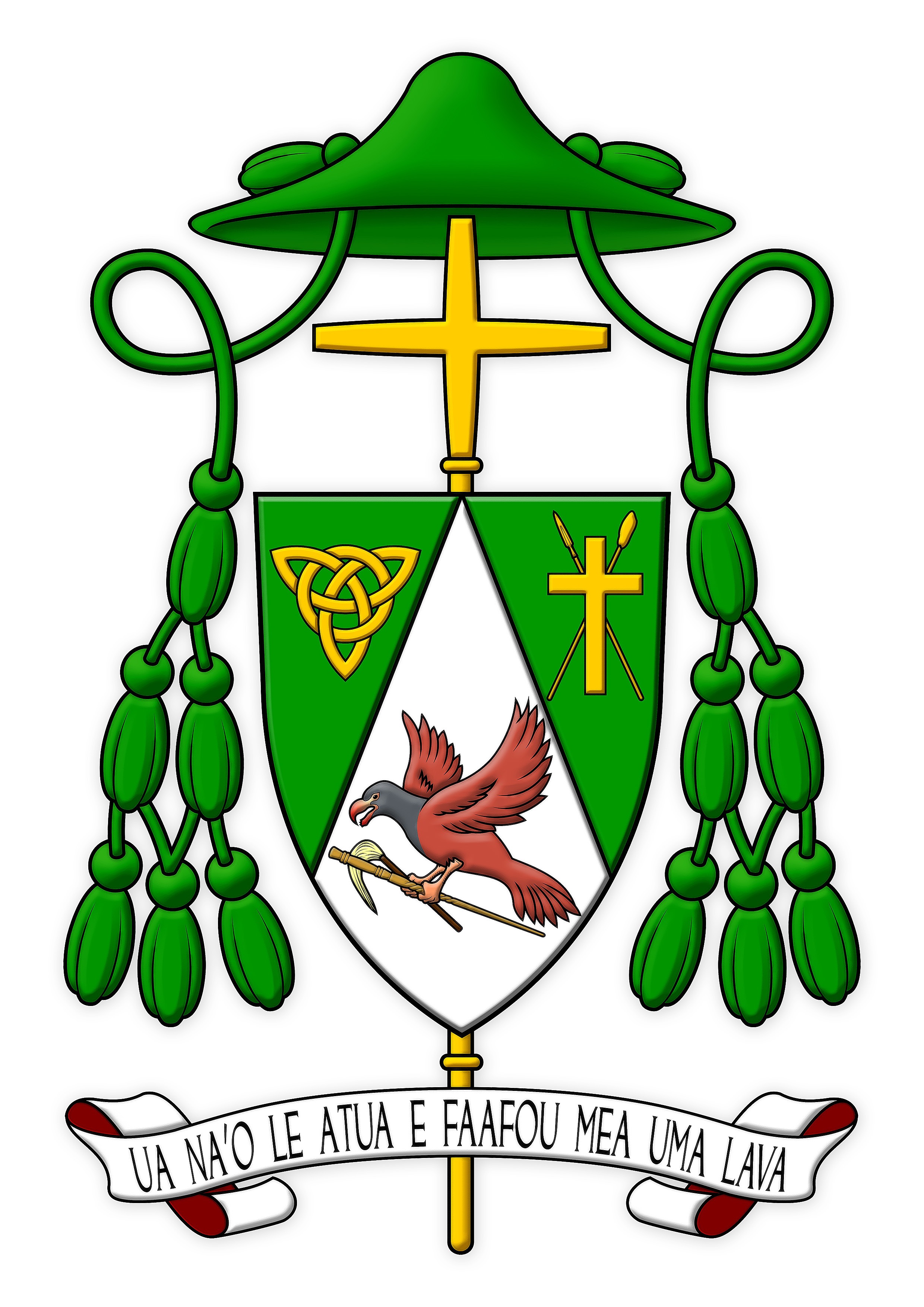
The coat of arms of the Most Rev. Peter Brown, CSsR who will be ordained a bishop and installed as the Bishop of Samoa-Pago Pago in American Samoa on August 22, the Feast of the Queenship of Mary.
The arms are loosely based on the flag of American Samoa and also contain symbols of the bishop’s native place in New Zealand, the Holy Family, his Religious Community and the Pacific Islands where he will serve as bishop.
The coat of arms was designed by me and Mr. Richard d’Apice and here rendered by Mr. Sandy Turnbull.
Bishop Caggiano of Bridgeport, CT
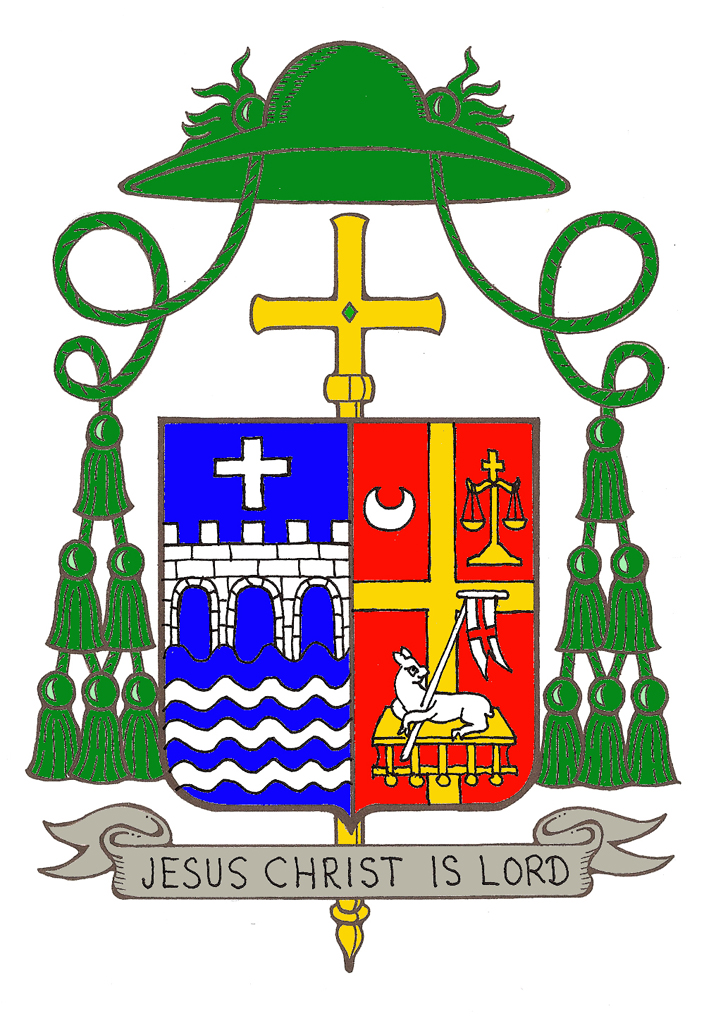
Yesterday, July 31 His Holiness, Pope Francis appointed the Most Rev. Frank Caggiano, Auxiliary Bishop of Brooklyn, to be the fifth bishop of Bridgeport, Connecticut. His coat of arms, adopted at the time he was ordained an auxiliary bishop reflects his native diocese (the crescent is a symbol of the Immaculate Conception, patroness of the Brooklyn diocese), his background in Canon Law (the scales of justice) and his devotion to Jesus, the Lord, the Lamb of God. These personal arms harmonize well with the attractive “canting” arms of the Bridgeport diocese.
Ad Multos Annos!
NOTE: It has been discovered that the scales of justice in this case are not a symbol of Canon Law but of St. Michael the Archangel, to whom the bishop has a great devotion.
Bishop Raymond Browne
Bishop Browne will be ordained a bishop and installed as the Bishop of Kerry, Ireland on July 21st. The arms are not personal arms impaled with those of his diocese as one might think. Rather, they are impaled arms that both represent his personal coat of arms.
Meh.
New Bishop of Liége
Bishop of Cuernavaca
The coat of arms of Bishop Ramón Castro Castro of Cuernavaca, Mexico who was installed on July 10th. It seems apparent that he based the overall design on the arms of Pope Benedict XVI who also employed the tripartite chape ployé. It is also interesting to see that he chose to omit the galero and use simply the episcopal cross to ensign the shield as I had just been remarking about recently.
Most Rev. Anthony G. Bosco RIP
The Most Rev. Anthony G. Bosco (August 1, 1927-July 2, 2013) who served as Third Bishop of Greensburg, Pennsylvania from 1987-2004 has passed away. He was the bishop who installed me in the Ministry of Acolyte on my way to the priesthood. His coat of arms with the distinctive single charge of an oak tree as an allusion to the name “Bosco” was designed by the late Prof. Géza Grosschmid, who was my mentor in heraldry, and emblazoned by none other than the late (great) Abp. Bruno B. Heim. In fact, the bishop’s personal arms were used by Heim as part of the cover art for his seminal work, “Heraldry In The Catholic Church” (1978). Bishop Bosco purposely didn’t use a galero in his coat of arms and preferred to use the one external ornament that is exclusive to and truly indicates the coat of arms of a bishop. Namely, the episcopal cross. May he rest in peace.