Some time ago I was approached to design a revamped school seal for St. Thomas Aquinas High School in Edison, NJ in my own Diocese of Metuchen, NJ. The school was founded in 1969 when Edison was still in the Diocese of Trenton, NJ. In 1981, St. John Paul II separated the four northern counties of the Trenton diocese to erect the new Diocese of Metuchen and the school found itself under a new jurisdiction. Around the time of the diocese’s creation, the name of the school was changed to honor a bishop of Trenton and it became Bishop George Ahr High School. More recently, it was decided to return the school to its original name and patron saint which it had borne for its first 12 years of existence. So, the idea was to replace the Bishop Ahr H.S. school seal with something new to reflect the current situation.
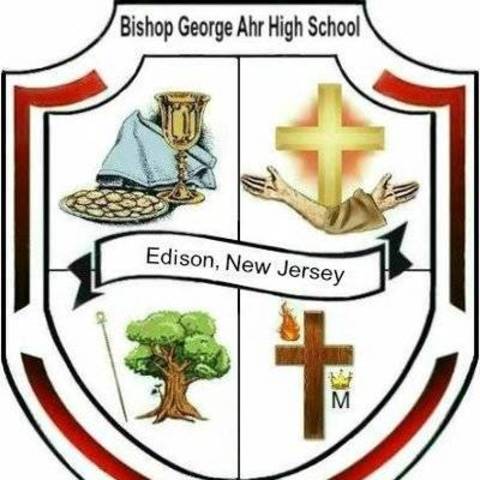
The Bishop Ahr H.S. seal, really a coat of arms was a poorly designed hodge-podge with everything in it but the kitchen sink (see the image above). The less said about it; the better. It has been being used in a monochrome format utilizing the school colors (red & white) since the return to the name St. Thomas Aquinas H.S. Nevertheless, something different to mark the new era was desired. So, I was happy to undertake to do a new design based on an armorial seal. (see image below)
Coats of arms and seals aren’t the same thing. People often use the words as synonyms which they most definitely aren’t. Seals developed far longer ago than coats of arms, which really didn’t appear on the scene until the XII C. Prior to the advent of heraldry seals often contained portraits either of the owner of the seal or of his or her patron saint. Later, as coats of arms became common seals often depicted the owner’s armorial bearings or elements from it. But, this is not mandatory. I’m frequently asked, “Doesn’t Canon Law require a bishop to have a coat of arms?” The answer is NO, it doesn’t. Canon Law requires a bishop to have his own seal for the purposes of authenticating documents. However, there is no rule, or even the expectation that a bishop’s seal will be armorial. It may be composed of anything, any image, any symbol he wishes. Since, however, seals lend themselves to making use of armorial imagery the idea was design something for this high school that would look reminiscent of a coat of arms without actually being one.
NOTE: The school also makes extensive use of a school logo, a capital letter “A” divided by a diagonal line to display the school colors of red and white. That is used a lot on all sorts of items and will continue to do so. The desired seal is for more formal uses.
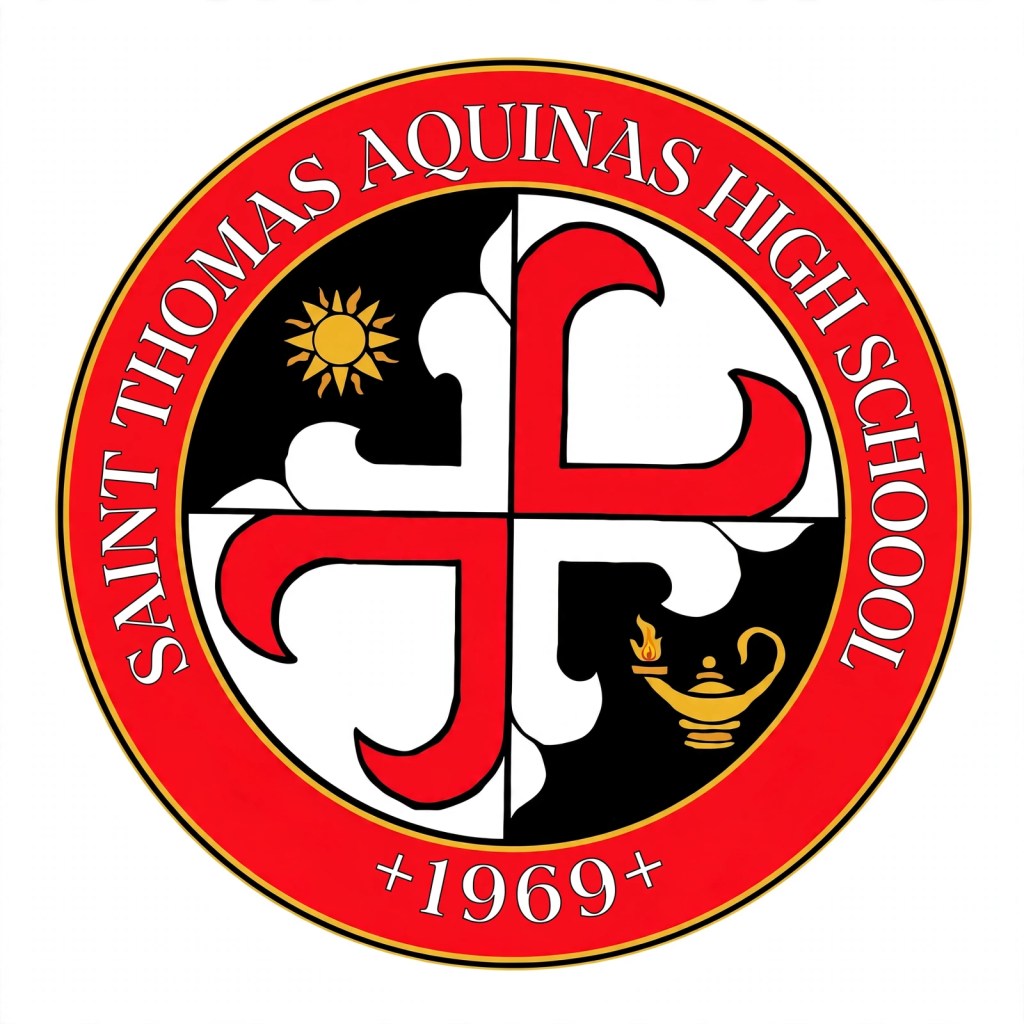
The seal is a traditional school seal with a circular shape. Around the perimeter of the circle is the simple legend, “Saint Thomas Aquinas High School”, and then centered in the bottom of the legend is the date 1969, that of the school’s foundation between two crosses to offset it from the rest of the legend.
The seal itself is armorial in nature, borrowing elements from the coat of arms of the Order of Preachers (Dominicans) to which the school’s patron, St. Thomas Aquinas, belonged. It also borrows from the coat of arms of the Diocese of Metuchen, where the school is located as well as the Diocese of Trenton, from which the Diocese of Metuchen was created and in the territory of which the school, had been located at the time of its founding in 1969. In addition, there are symbols of education and of St. Thomas Aquinas himself.
The seal is divided in quarters. Overall there is a cross, itself divided in quarters. In the upper left and lower right quadrants the cross is a white cross fleury (the ends of which terminate in a fleur-de-lis) on a black background. This mistaken directly from the coat of arms of the Order of Preachers which employs only the colors black and white—those of the Dominican habit— and such a cross. Also in the upper left quadrant is a gold sun in its splendor. This is a symbol most often associated with St. Thomas Aquinas, almost as his personal emblem. In the lower right quadrant is seen a gold ancient oil lamps. This has long been a symbol of learning and education, enlightening the mind, the purpose of a school.
In the upper right and lower left quadrant the cross appears as a red moline cross (the ends of which circle back on themselves) on a white background. This moline cross, so called because its shape resembles the metal centerpiece used on a mill-rind, or millstone, is used as the central symbol on the coat of arms of the Diocese of Metuchen. In turn, this diocese borrowed it from the coat of arms of the Diocese of Trenton, its mother diocese. The use of this cross as a symbol honors the two dioceses in which the school has been located. The red and white employs the school’s colors.
I was delighted to work on this project. I hope it gets use for many years to come.

