Category Archives: Work of Other Artists

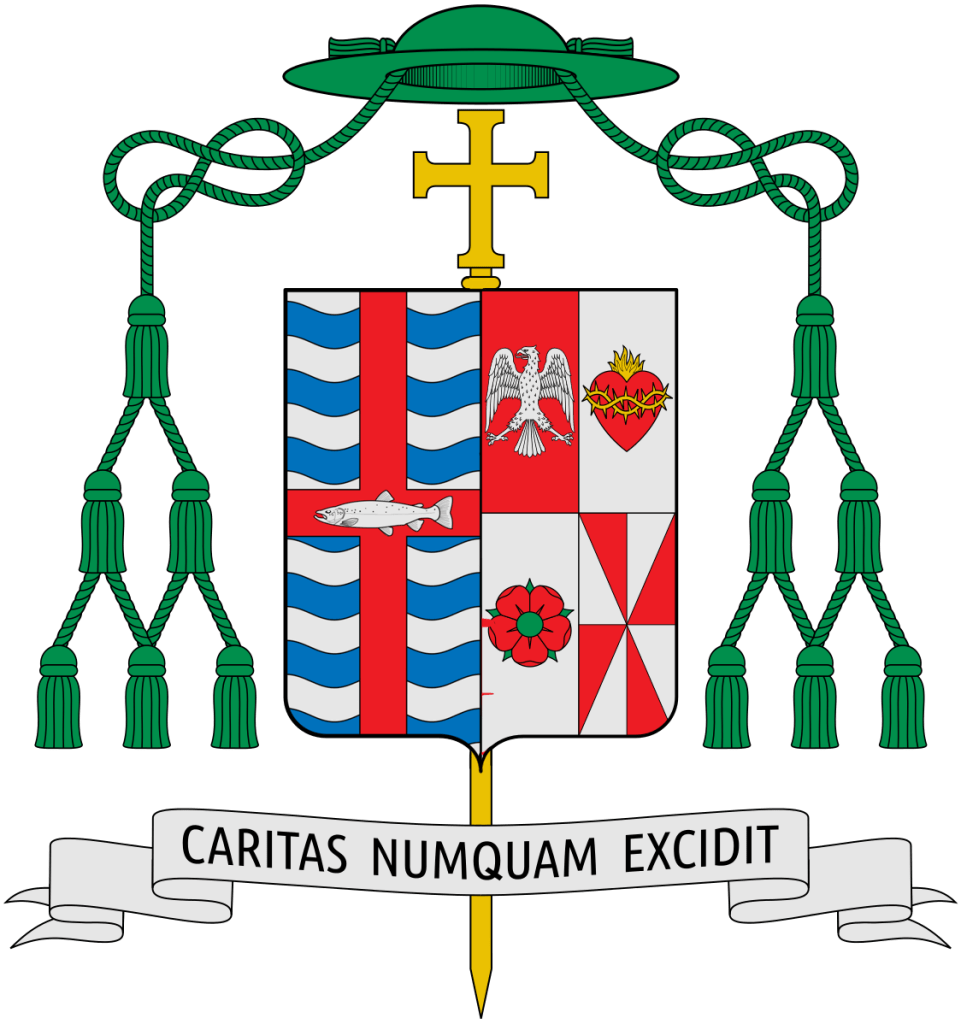
Bishop Joseph Galante, RIP

Bishop Joseph A. Galante, D.D., J.C.D. was born in Philadelphia and was ordained in 1964. He attended Lateran University in Rome, where he received his doctorate in canon law, and later the University of St. Thomas (Angelicum) in Rome, where he received his Master’s Degree in Spiritual Theology.

He served in the Archdiocese of Philadelphia until he was named by Pope John Paul II in December 1986 to be Undersecretary of the Congregation for Religious in Rome. He was a member of the Pontifical Council for Social Communications and chair of the United States Conference of Catholic Bishops’ Committee on Communications.

In October 1992 he was named Auxiliary Bishop of San Antonio, Texas. A year and a half later he was installed as Bishop of Beaumont, Texas. He became Coadjutor Bishop of Dallas in January 2000.

On April 30, 2004, Bishop Galante was installed as seventh bishop of the Diocese of Camden.

Bishop Galante retired on January 8, 2013. He entered into eternal life on May 25, 2019.

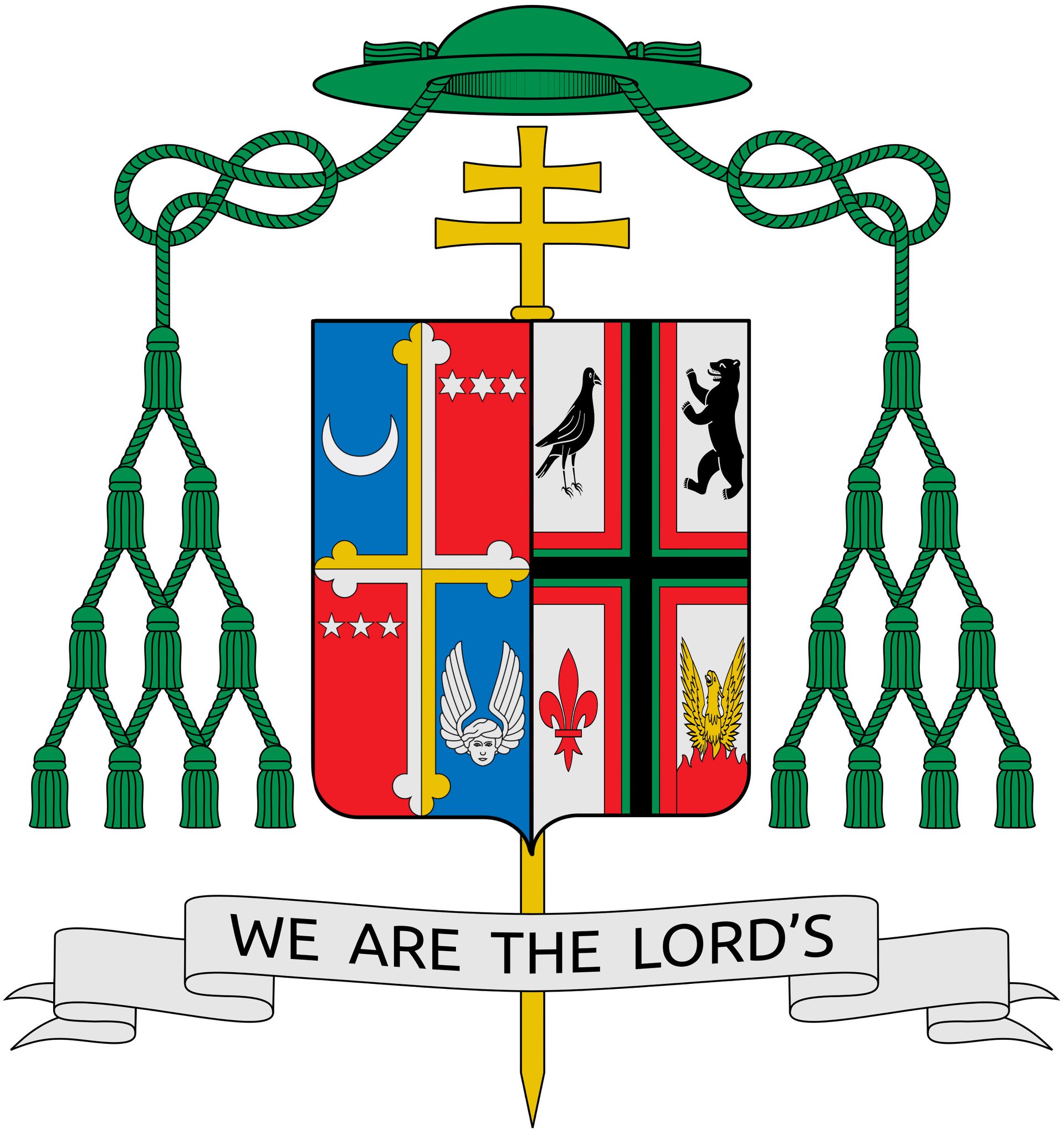
Archbishop Etienne moving from Anchorage to Seattle

On April 29 Pope Francis appointed Archbishop Paul Etienne (59) to be the Coadjutor Archbishop of Seattle. The archbishop was a priest of Indianapolis and also served from 2009-2016 as the Bishop of Cheyenne, Wyoming before becoming Archbishop of Anchorage, Alaska where he has served for just three years.

He will take up his new duties in Seattle in early June and then he and Archbishop Peter Sartain, who requested the coadjutor due to ill health, will determine when Archbishop Etienne (pronounced AY-chin) will succeed to the See as the ninth archbishop.

The archbishop famously redesigned his personal coat of arms when he moved from Cheyenne to Anchorage, a move that was highly criticized by me. Let’s hope he leaves well enough alone this time. Ironically, his original coat of arms would have ended up looking better marshaled to those of Seattle than his current design. This, then, is why one shouldn’t redesign personal arms to harmonize better with (arch)diocesan arms. It is impossible to know if you might be moving on.

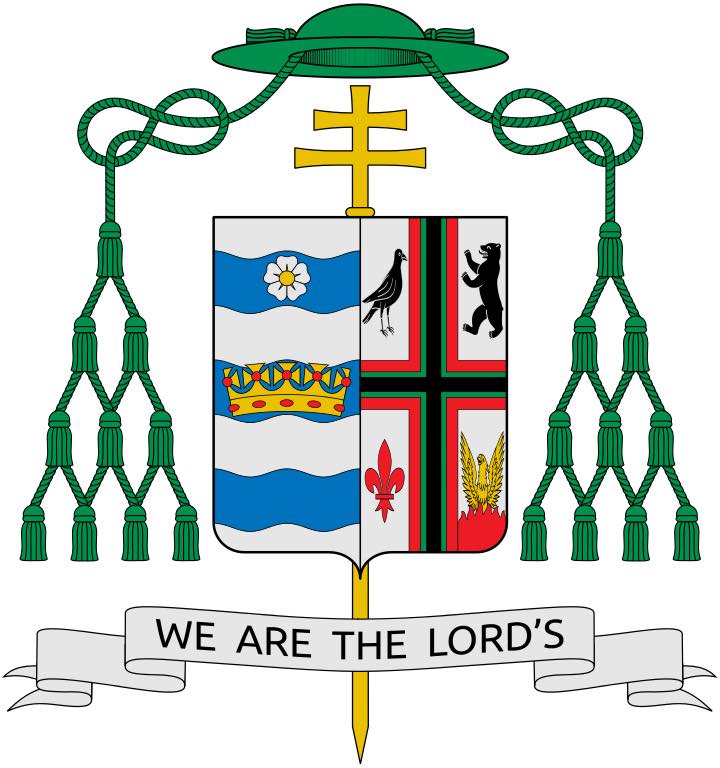
Most Rev. Wilton Gregory Translated to Washington

It was announced this morning that Pope Francis has appointed the Most Rev. Wilton Gregory, Archbishop of Atlanta to be the next Archbishop of Washington, DC. Archbishop Gregory was ordained a priest for the Archdiocese of Chicago originally and served as Auxiliary Bishop there before becoming the Bishop of Belleville, Illinois and eventually promoted to Archbishop of Atlanta. He also served at one time as President of the United States Conference of Catholic Bishops. He will be installed in Washington, DC on May 21.

The coat of arms he has used since becoming a bishop 36 years ago will now be marshaled to those of the Archdiocese of Washington, DC.

On a silver (white) field a cross composed of three colors; black on green on red. These colors are referred to as the African-American colors and by their use Archbishop Gregory honors the religious and racial heritage that has come to him from his parents, Wilton and Ethel ( Duncan ) Gregory. Within the quarters that are formed by the cross are a raven, to honor the Archbishop’s Benedictine education at Sant’ Anselmo (in Rome), and a black bear taken from the arms of His Eminence, Joseph Cardinal Bernardin, His Excellency’s principal Episcopal consecrator. Also within the quarters are a red fleur-de-lis taken from the arms of the Mundelein Seminary in Chicago , where Archbishop Gregory was a student and faculty member, and a golden phoenix, coming forth from red flames, to honor Chicago , the city reborn after the famous Chicago fire.

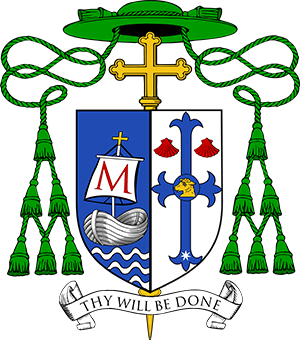
Most Rev. Robert Brennan of Columbus, OH

On Friday, March 29, 2019 the Most Rev. Robert Brennan, formerly Auxiliary Bishop of Rockville Centre, NY was installed as the twelfth Bishop of Columbus, Ohio. His personal arms now impaled with those of the See are described on the diocesan website.

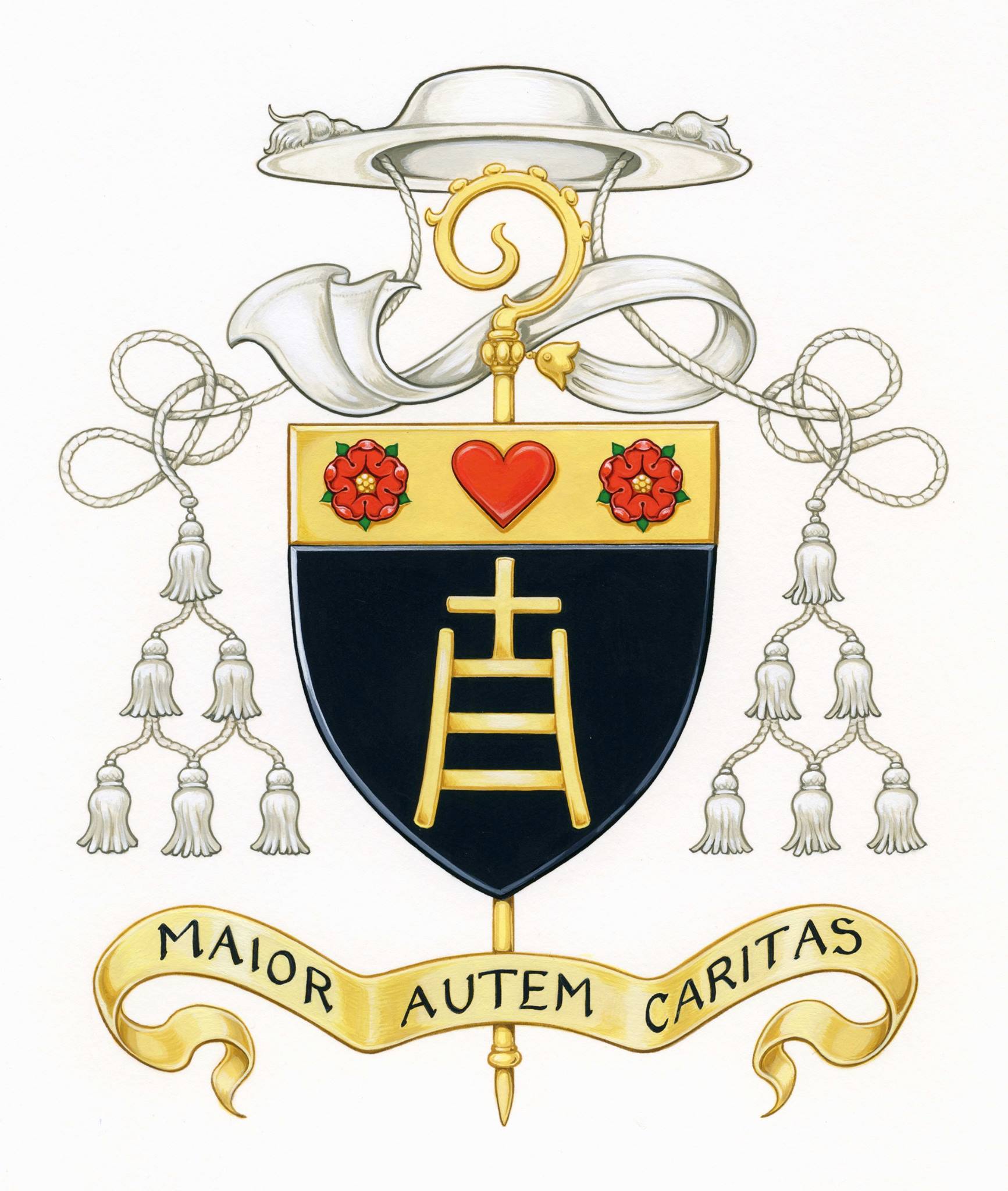
The Brennan coat of arms comprises a white shield with a blue heraldic lion, and two red hands in the top corners of the shield. Rather than use the original design Bishop Brennan has chosen to retain the overall coloration and layout of his family coat of arms, while employing charges more evocative of his own life of faith. 

The main charge on the shield is the Cross, the foundation of the Christian faith. The arms of this particular Cross resemble a fleur-de-lis, a stylized lily often used as a symbol of the Virgin Mary.  

At the bottom of the cross appears a small white star, a symbol of Our Lady. Its position recalls the moment of the Commendation, when, “standing by the cross of Jesus” (John 19:25), Mary became, at her Son’s command, the Mother of all of his disciples (cf. John 19:27). The star has seven points, recalling the seven Gifts of the Holy Spirit. 

At the center of the cross appears a lamb’s head painted gold. The same charge figures prominently on the coat of arms of the Diocese of Rockville Centre, which Bishop Brennan served as a priest and bishop for nearly 30 years. Saint Agnes is the patroness of the Diocese of Rockville Centre, and of its Cathedral church, where Bishop Brennan resided for 16 years. 

At the top of the shield are two scallop shells painted red. Although the charges are the same, they are used here to allude to two different saints: John the Baptist and James the Greater. Bishop Brennan attended Saint John the Baptist High School (West Islip) and Saint John’s University, and the patron of these schools is often depicted in sacred art using a shell to baptize the Lord Jesus. The date of Bishop Brennan’s ordination as a bishop — July 25, 2012 — is the feast of Saint James, the brother of Saint John the Evangelist and the first of the apostles to be martyred, during the persecution of the early Church (Acts 12:1-2). The red color of the shells recalls the fact that both of these saints gave their lives as martyrs for the faith. 

Most Rev. John M. Smith, RIP


bishopsmith_emeritus_crest

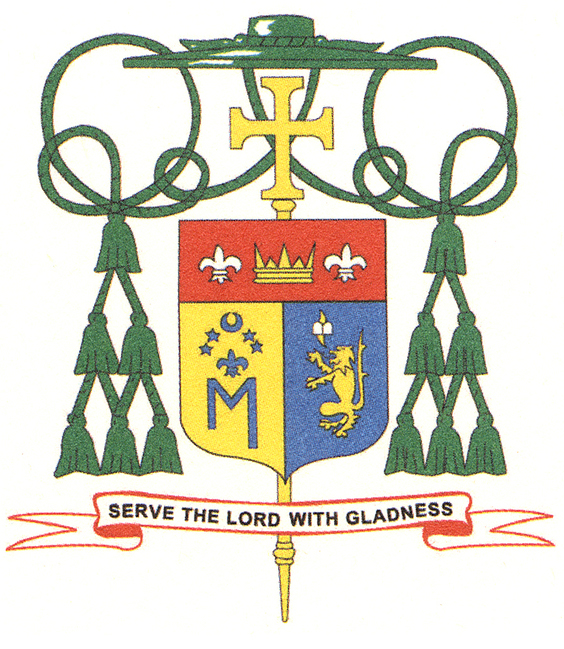
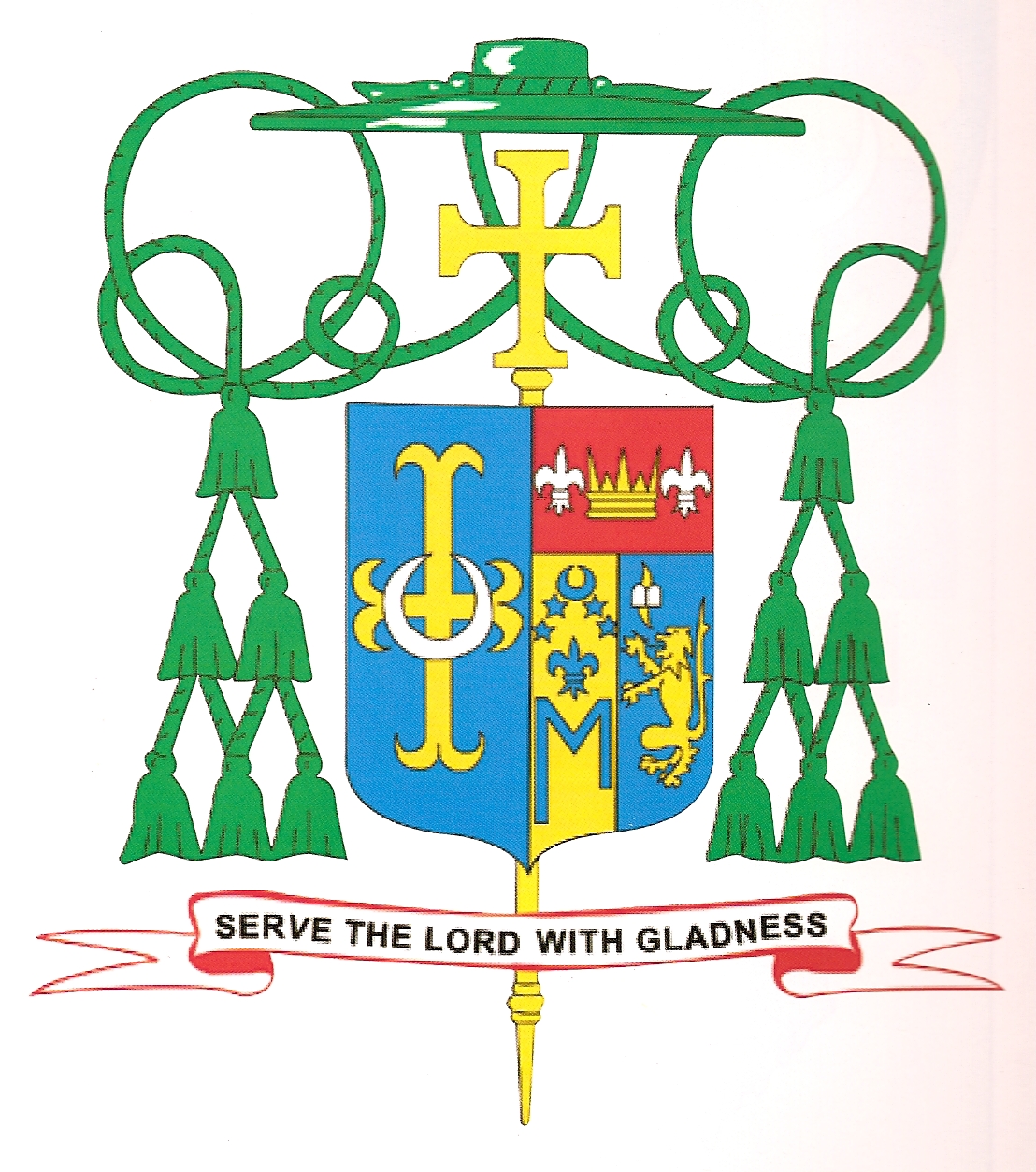
On Jan. 22, 2019 of the Most Rev. John Mortimer Smith, Bishop Emeritus (2010-2019) and Ninth Bishop of the Diocese of Trenton (1997-2010), former Coadjutor Bishop of Trenton (1995-1997), former Bishop of the Diocese of Pensacola-Tallahassee in Florida (1991-1995) and former Auxiliary Bishop of the Archdiocese of Newark (1988-1991) passed into eternal life.  Bishop Smith died in Morris Hall Meadows, Lawrenceville, after a long illness. He was 83 years old.

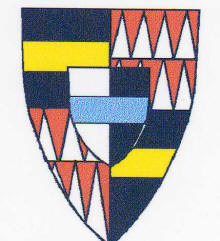
His coat of arms (above) was assumed at the time he was ordained an Auxiliary Bishop in 1988. It is, in my opinion, a little too “busy” insofar as he tried to do too much. All those various charges represent different events/aspects of his priestly life and ministry, a kind of pictorial CV, which is precisely the type of thing I encourage new armigers to avoid all the time. It was particularly problematic and a little bit unattractive when it was marshaled to the arms of a See, such as Trenton, because all this was then squeezed into a narrow impalement (below). Perhaps, it would have been better to marshal the arms differently or to have simply borne his personal arms alone (something of which most American bishops cannot conceive because they think it isn’t permitted!)

sc003412d4

Aside from his less-than-wonderful coat of arms I met Bishop Smith on several occasions and found him to be a warm, outgoing and very kind man. He was very down-to-earth and easy to talk with. In the days when he was bishop of Trenton I hosted a 30-minute weekly radio program for my diocese and he told me on more than once occasion how he enjoyed listening to it in the car while driving to some event at which he was to preside. He was one of our biggest fans. May he rest in peace and receive the reward of his labors in the Lord’s vineyard.

(Artwork for both images by Deacon Paul Sullivan)

Bishop Betancourt

Coat-of-Arms-BBetancourt-250

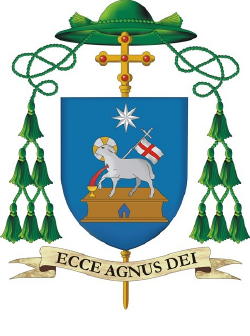
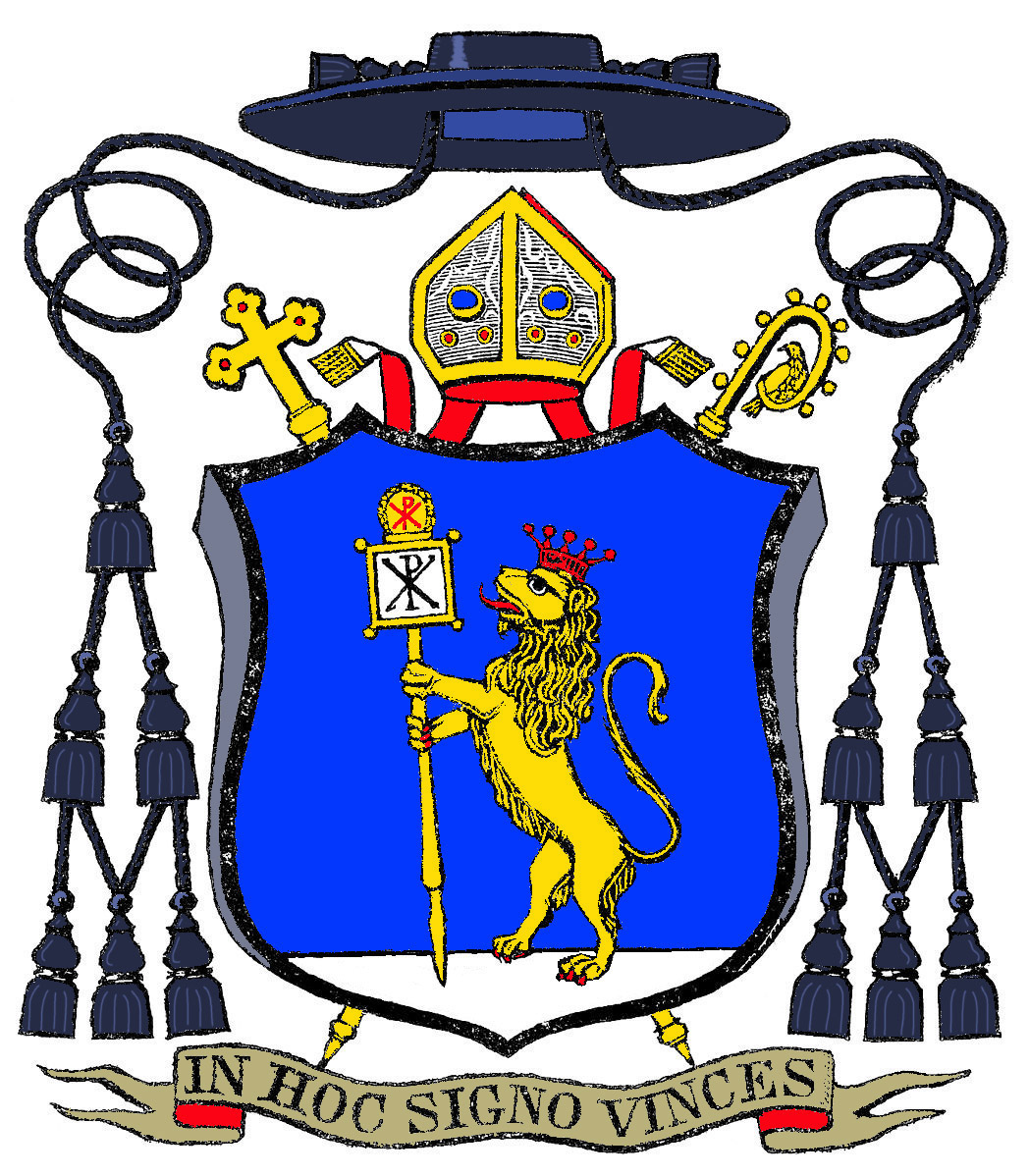
The Coat of Arms of Bishop Juan Miguel Betancourt, SEMV, depicts the Lamb of the Book of Revelation, slaughtered but victorious, the one who is the lamp for the Church (Rev 5:6; 21:23). The victory of Christ over sin and death through his sacrifice is reflected in the rays of power around his head (Rev 5:12; 17:14). The Lamb, giving his life for his Bride, the Church, through the shedding of his blood denotes the life of love and service of an ordained minister of the Church (Rev 14:1). The Lamb of God gives his life voluntarily so his Church can live and continue her mission of salvation in the world (John 10:17-18). The Lamb rests on a plain and unadorned wooden altar, evoking a life of simplicity, a life that wants to be spent in service signaling everyone to the Lamb, Christ the Savior. Finally, the Lamb also reminds us of Bishop Betancourt’s home, Puerto Rico, whose coat of arms is the oldest still in use in the New World.

The red and white banner, held by the Lamb, represents the local church of Hartford, which Bishop Betancourt has been called by the Lord to serve and give his life with joy and compassion, as well as his titular see of Curzola.

The Schoenstatt Shrine at the center of the altar represents the spirituality in which Bishop Betancourt has been formed through the charism of the Servants of the Holy Eucharist and of the Blessed Virgin Mary. The blue background is the presence of the Blessed Mother in the Church and the life of Bishop Betancourt. “Nothing without you, nothing without us” (Fr. Joseph Kentenich). “She is the great missionary, she will perform miracles” (St. Vincent Pallotti). The background also reminds Bishop Betancourt of the Church in the Archdiocese of Saint Paul and Minneapolis where he practiced his ministry of pastor, Scripture professor and formator of seminarians for more than a decade.

That strong presence of Mary is highlighted by the star. Mary, Stella Maris, reigns with her power of intercession and protection over every single member of the Body of Christ. In times of strife and distress in the Church, the Blessed Mother is the beacon of hope, promising strength, unity and security, inviting us to imitate the holiness and self-giving of her Son for the sake of his Bride. Traditionally, the eight-point star represents resurrection, salvation, super-abundance (of grace) and new beginnings.

He was ordained as the Auxiliary Bishop of Hartford on October 18, 2018.

Chicago’s Three New Auxiliaries

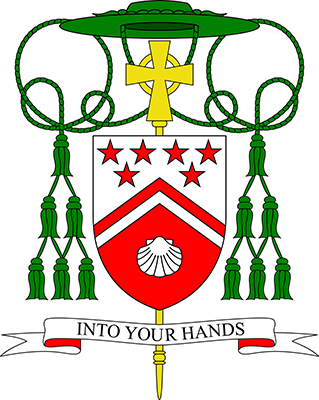
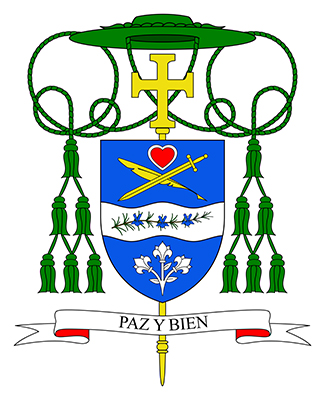
On September 17 Blase Cardinal Cupich, Archbishop of Chicago will ordain three new Auxiliary Bishops. They and their newly assumed coats of arms are:

Mark Bartosic (57) Titular Bishop of Novatcata

wbartosic coat of arms new

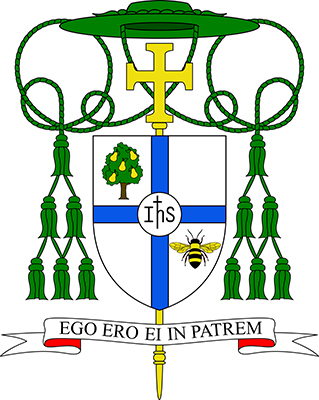
BLAZON: Argent, at center, upon a cross throughout azure, a plate charged with the monogram of the Holy Name, sable; to chief dexter a pear tree and to base sinister a bumble bee, both proper.

Robert Casey (50) Titular Bishop of Thuburbo Maius

wcasey_revised coat of arms

BLAZON: Argent and gules; a chevron party per chevron between in chief six stars, in two groups each two and one and in base an escallop all counterchanged.

Ronald Hicks (51) Titular Bishop of Munatiana

wHicks revised coat of arms

BLAZON: Azure, upon a fess wavy argent a sprig of rosemary proper; to chief per saltire a sword upon a quill below a heart gules fimbriated of the second, in base a spring of lily of three blossoms, also of the second.

All three (the work of Deacon Paul Sullivan) show a happy composition, good limited use of colors and make for nice clear designs. The arms of Bishop-elect Hicks is the most “crowded” and the fimbriation around the heart is probably there so that the heart could be depicted as red on a blue field. That’s unfortunate. It’s a “trick” to get around the tincture “rule” (of no color on color) but its a weak design element. It would have been better simply to have the heart be of gold or silver.


Norbertine Cardinals

There have been fewer cardinals in the Church from the Order of Canons Regular of Prémontré (aka Norbertines) than there have been of other orders and, as far as I can tell, two of those known to be associated with that Order were Abbots in Commendam only. The Premonstratensian Cardinals are:

riche

Armand Jean du Plessis, Duke de Richelieu, Bishop of Luçon, Commendatory Abbot of Prémontré, (also Territorial Abbot of Cluny and Abbot in Commendam of Citeaux)

mc BUCCA GIOVANNI 437

Johannes von Bucka, O.Praem. Archbishop of Olomouc

este2

Ippolito II d’Este, Archbishop of Auch, Archbishop of Arles, Commendatory Abbot of Prémontré

Benedictine Cardinals

Throughout the Church’s history there have been many members of the hierarchy who were members of Religious Communities. The present pope is a member of the Society of Jesus (Jesuits) and the first from that Order elected to the papacy. One of the oldest Orders in the Western Church is the Order of St. Benedict. Many monks have been made bishops and quite a few have been raised to the Sacred Purple as Cardinals. The following is by no means exhaustive but gives a sampling of some of the Benedictine Cardinals in recent history. (My gratitude to the fine website called Araldica Vaticana for many of these examples.

Enjoy!

Chiaramonti CORRECTION Chiaramonti Pius VII0001

Gregory Cardinal Chiaramonte, OSB (later Pope Pius VII)

pitra_stemma2a

Jean Cardinal Pitra, OSB

Maria Nova card Schiaffino stemma

Placido Cardinal Schiaffino, OSB Oliv

Ganglbauer manteled0001

Celestine Cardinal Ganglbauer, OSB (Archbishop of Vienna)

SEP28 Gasquet

Aidan Cardinal Gasquet, OSB (Vatican Archivist)

DUSMET GIUSEPPE BENEDETTO

Bl. Giuseppe Cardinal Dusmet, OSB (Archbishop of Catania)

COA_cardinal_HU_Vaszary_Ferenc_Kolos2

Kolos Cardinal Vaszary, OSB (Primate of Hungary)

2015 Saraiva 07051845

Francisco de S. Luiz Cardinal Soraiva, OSB (Patriarch of Lisbon)

NOTE: Cardinal Soraiva also had a version of his arms with a galero but also used the triple tiara as was customary for the Patriarchs of Lisbon until very recently.

SERAFINI DOMENICO 05031918

Domenico Cardinal Serafini, OSB

Schuster design0001CCC

Ildephonse Cardinal Schuster, OSB (Abbot of St. Paul Outside-the-Walls and later Archbishop of Milan)

BB-05 SEREDI0001

Justinian Cardinal Seredi, OSB (Primate of Hungary)

Coat_of_arms_of_Joaquín_Anselmo_María_Albareda_y_Ramoneda.svg

Joachim Cardinal Albareda y Ramoneda, OSB (Vatican Librarian)

51CS) Stemma Card. Gut Benno Walter (1897-1970)

Benno Cardinal Gut, OSB

Image 3

Basil Cardinal Hume, OSB (Archbishop of Westminster)

archbishop-hans-hermann-cardinal-groer-of-vienna-1986-1995

Hans Herman Cardinal Groer, OSB (Archbishop of Vienna)

88155b

Paul Augustine Cardinal Mayer, OSB

Archbishop Comensoli of Melbourne

On August 1, the Most Rev. Peter Comensoli (54) was installed as the Archbishop of Melbourne, Australia.

IMG_8322


The personal Arms of Archbishop Peter Comensoli were assumed in 2011 on his ordination as titular Bishop of Tigisi in Numidia and borne by him as Auxiliary of the Archdiocese of Sydney (2011-2014). He bore them impaled with the Arms of the Diocese of Broken Bay as its third Bishop (2014-2018). According to the usual custom in Melbourne he has chosen to use his personal arms alone.
The arms and motto are blazoned as follows: Azure, on a Latin cross inverted Or four seven-pointed mullets (or Commonwealth stars) Gules, in the first quarter a lion’s head erased Argent crined and langued Or and in the second a unicorn’s head erased Argent crined and armed Or respectant.
The motto ‘Praedicamus Christum Crucifixum’ is a quotation from the Apostle Paul’s first epistle to the Corinthians (1Cor1.23), and can be translated as ‘We preach Christ crucified.’
The inverted Latin Cross symbolises the Bishop’s nominal patron, the Apostle Peter and the stars reflect the Southern Cross, which shines out over the Great South Land of the Holy Spirit. The lion and the unicorn respectively symbolise the mind and the heart of love.
I was privileged to help design these arms back in 2011 along with Richard d’Apice. They are emblazoned by Sandy Turnbull.

More Clergy With Multiple Versions of Their Arms

A couple of years ago I wrote about clergy who make use of more than one version of their coats of arms depending on offices held or circumstances of use. Once again I’ve come across a fine example.

The current Lord Lyon King of Arms, the principal heraldic authority for Her Majesty in Scotland is not only a heraldic expert and a jurist but he is also an ordained clergyman in the Scottish Episcopal Church (a.k.a. the Anglican Church north of the border). The Rev. Canon Dr. Joseph John Morrow, CBE, KStJ, QC, DL, LLD possesses a very nice coat of arms of his own.

IMG_7668

This coat of arms can be displayed all alone or, as Lord Lyon sometimes has chosen to do, with the helm, mantling and crest of the typical armorial achievement.

IMG_7667

However, sometimes this coat of arms is also displayed with the external ornaments proper to the Office of Lord Lyon King of Arms.

IMG_6788

Additionally, the Office of Lord Lyon has its own armorial bearings which may be used by the incumbent of the office of Lord Lyon in a “greater” form:

IMG_7671

as well as a “lesser” or smaller version.

IMG_7669

Finally, the current Lord Lyon may choose to impale his personal arms with those of Lord Lyon and display them with the external ornaments of the office, including the red lion supporters:

IMG_6789

or he may impale his personal arms with the arms of office and display them with some of the external ornaments of Lord Lyon as well as his own crest and supporters.

IMG_7658


Same man; same arms; many versions.

Almost Identical

Sometimes, especially in the world of ecclesiastical heraldry, prelates aren’t always so creative and frequently they adopt arms that are very similar to each other’s. On occasion this may indicate a kind of patronage of one prelate over another. For example, St. John XXIII’s longtime secretary, Loris Capovilla, was later made an Archbishop and eventually a Cardinal. At the time of his episcopal ordination he adopted John XXIII’s coat of arms entirely with one tiny exception; he removed one of the fleur-de-lis in order to “difference” his arms from his patron.

Differencing is an old custom in heraldry and often misunderstood. Two different coats of arms might seem identical at first glance. Yet, as long as one element is changed, or “differenced” it makes for a sufficient differentiation between the two in order to avoid two armigers bearing identical coats of arms. Sometimes this could be the changing of a particular charge, the addition of a label or a mark of cadence or even simply changing the tinctures.

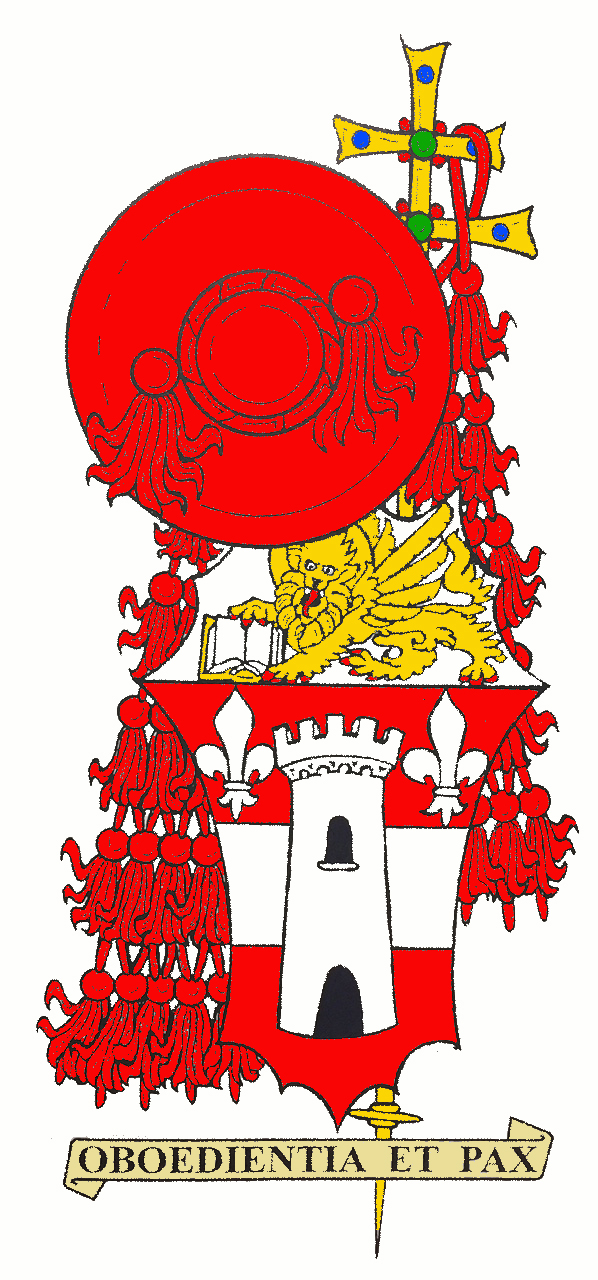
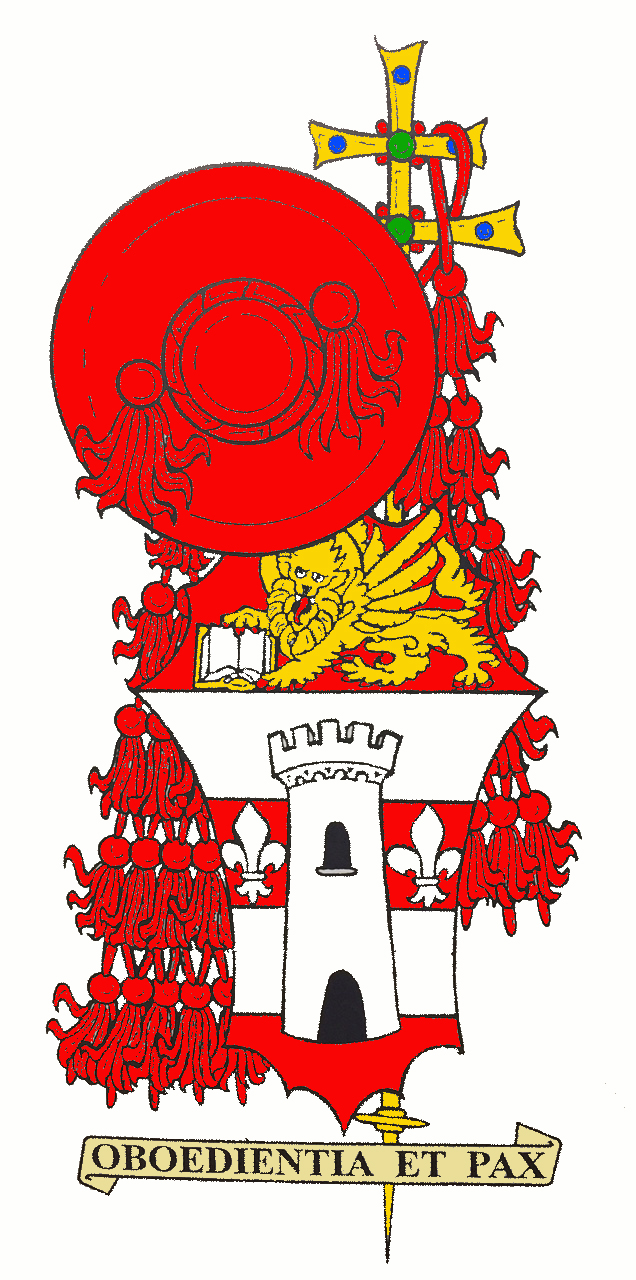
Here we see an interesting pair. Both Angelo Giuseppe Roncalli, Patriarch of Venice (later Pope St. John XXIII) and Carlos Maria Della Torre, Archbishop of Quito & Primate of Ecuador were created Cardinals by Pope Pius XII in 1953. The arms they each bore were almost identical showing a tower flanked by two fleur-de-lis on a red and white field.

J23  Torre

However, Roncalli’s arms showed a field “Gules, a fess Argent” and Della Torre’s showed a field, “Barry of four Argent and Gules”. These arms allude to his name, “Of the Tower”. In addition, Roncalli added the chief of Venice (depicting the gold lion of St. Mark on a silver (white) field) at the time he was promoted to Patriarch there as is usually the custom for the incumbents in that position. That provided a great visual difference between their arms. However, after Roncalli’s election as Pope in 1958 Della Torre once again made their arms very similar by adopting a chief with the gold lion of St. Mark on a red field; differenced from the Pope’s but only slightly. I suppose given the relative similarity of their coats of arms in the first place he wished to honor his “classmate” as a Cardinal who was also now his Pope.

What is more it is interesting to note that both men bore the same motto despite there being no particular relationship between the two.

These arms seem almost identical, but note quite.

Artwork: The late Michael McCarthy

Bishop Konzen

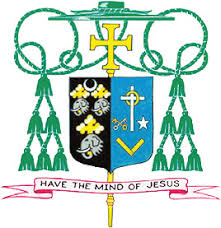
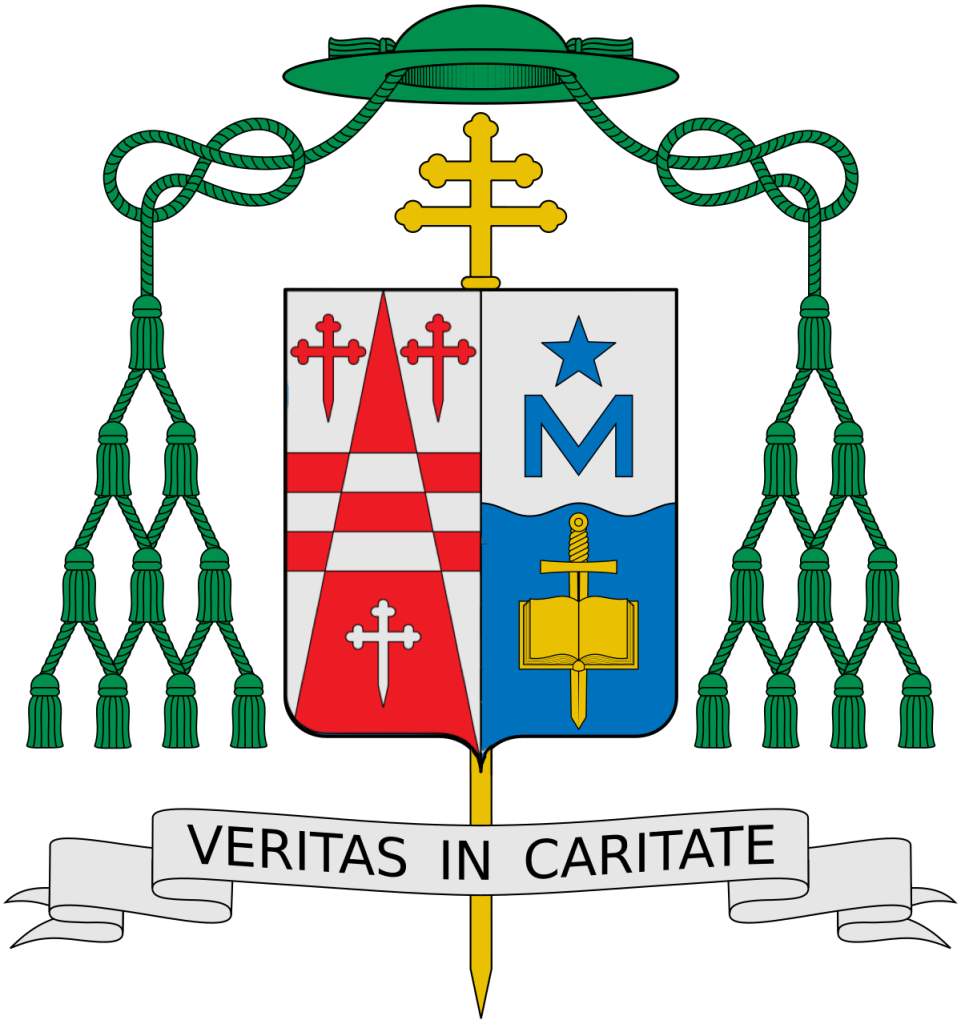
The Most Rev. Joel Matthias Konzen, S.M. (67) a priest of the Society of Mary (Marists) was ordained as the Titular Bishop of Leavenworth and Auxiliary to the Archbishop of Atlanta on April 3, 2018. His coat of arms is explained by its designer and artist, Deacon Paul Sullivan.

bjk_coat-of-arms

The episcopal heraldic achievement, or bishop’s coat of arms, is composed of a shield, that is the central and most important part of the design and tells to whom the design belongs, the external ornamentation, that tells the owner’s position or rank, and a motto, placed upon a scroll.

For Bishop Konzen the shield is silver (white) with a blue pile (an “A” shaped device) upon which is displayed the conjoined “A” and “M,” known an “the monogram of Mary,” in silver (white) that is the emblem of the Society of Mary, known as the Marists, that is the Bishop’s religious community. The pile resembles an inlet of water, such as a bay or harbor, and this pile is charged with a gold (yellow) oak leaf to signify Oak Harbor, Ohio, where Bishop Konzen was born and raised.

Above the pile are an open book (gold [yellow] with red edges) and a red cross of The Faith to signify that Bishop Konzen has spent most of his life in education, in a Catholic environment, including his last position, before coming to the fullness of Christ’s Most Holy Priesthood, as a Bishop, as President of the Marist School in Atlanta.

For his motto, His Excellency, Bishop Konzen has adopted the Latin phrase “MISERERE GAUDENS,” that is taken from the 8th verse of the 12th chapter of Saint Paul’s Letter to the Romans. This passage can be paraphrased as “Be merciful, and with a cheerful heart.”

The achievement is completed with the external ornaments that are a gold (yellow) episcopal cross, that extends above and below the shield and a pontifical hat, called a galero, with its six tassels, in three rows, on either side of the shield, all in green. These are the heraldic insignia of a prelate of the rank of bishop by instruction of the Holy See, of March 1969.
Archabbots of St. Vincent

St. Vincent Archabbey in Latrobe, Pennsylvania, the oldest monastery in the United States, was founded in 1846 by monks from St. Michael’s Abbey in Metten, Bavaria under the leadership of Fr. Boniface Wimmer. They came to Pennsylvania funded by the Ludwigs-Missionverein, an organization started by the King Ludwig I of Bavaria to minister to German immigrants throughout the world.

When the community had grown large enough to be elevated to the status of an independent abbey in 1855 it was decided to designate it an archabbey and Father Boniface was named Archabbot for life by Bl. Pius IX. His coat of arms (below) looks to be based in a quartering of the arms of the royal family of Bavaria, the House of Wittelsbach. The lion holding the banner of Christ was used not only by Archabbot Boniface as his coat of arms but also by the community as the heraldic symbol of the archabbey. It seems as though Wimmer’s first three successors, Archabbot Andrew Hintenach (1888-1892), Archabbot Leander Schnerr (1892-1918) and Archabbot Aurelius Stehle (1918-1930) also used this coat of arms. I have not been able to locate any other coats of arms for them.

Coat_of_Arms_of_Archabbot_Boniface_Wimmer2a

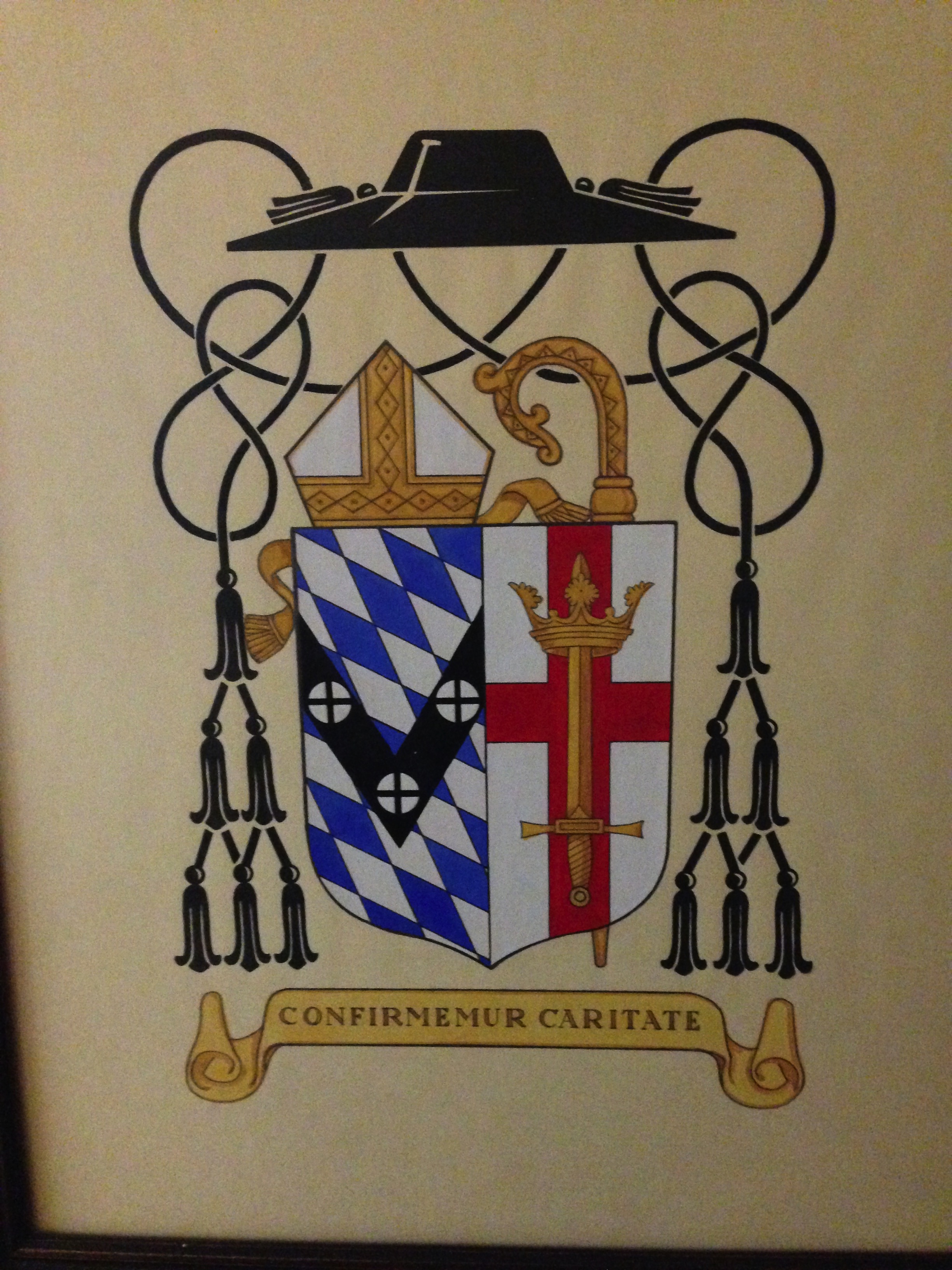
In 1930 with the election of St. Vincent’s fifth Archabbot, Alfred Koch (1930-1949), things changed. At that time the community decided to adopt a corporate coat of arms, which borrowed the blue and white fusils in bend from another Wittelsbach quartering and took the three plates on a black fess from the arms of William Penn, turned the fess into an inverted chevron (to create the letter “V” for “Vincent”) and charged the three plates with Benedictine crosses. Archabbot Alfred impaled this with a personal coat of arms. Thereafter, his successors did likewise.

Image 26

Archabbot Dennis Strittmatter (1949-1963)

Image 33

Coadjutor Archabbot Rembert Weakland (1963-1967) later Abbot-Primate and Archbishop of Milwaukee

Image 31

Archabbot Egbert Donavan (1967-1979)

Image 29

Archabbot Leopold Krul (1979-1983)

Image 37

Archabbot Paul Maher (1983-1990)

Image 35

Archabbot Douglas Nowicki (1991-present)

Image 5

During the tenure of Archabbot Egbert Bl. Paul VI changed the customary rules governing the external ornaments of prelates indicating that the mitre was no longer to be used in coats of arms. In addition, he called for the discontinuation of the crozier in arms of bishops. The crozier used to be included in the achievements of bishops in addition to the episcopal cross. Paul VI indicated in was the cross alone that would continue to be used in the arms of bishops and that the crozier should be excluded. This was interpreted by some, wrongly, to mean the crozier should no longer be used in the arms of abbots as well. However, it is the veiled crozier, not the galero, which indicates the rank of abbot in heraldry. Archabbots Leopold and Paul were advised incorrectly to leave the crozier out of their achievements. It was, however, restored to use in the coat of arms of Archabbot Douglas which was designed by me.

Abbot of Averbode

The Right Reverend Marc Fierens O.Praem. will be blessed and installed as the 53rd Abbot of Averbode, Belgium on March 11. This design was devised by the Abbot in consultation with with someone very well versed in heraldry. The drawing is by Prisca Van Dessel.

Averbode

It has long been customary for the Abbots of Religious Orders that wear a white or mostly white habit to use an abbatial galero that corresponds to the color of their habit. Since the Praemonstratensians wear a habit which is entirely white their abbots have traditionally used a white galero.

Personally, I have never agreed with this tradition. The color of the galero does not have to correspond with what is actually worn. Rather, in heraldry, color as well as number of tassels is an indication of rank. For example, bishops and archbishops use a green galero. This has its origin in the belief that the original color worn by bishops was green. However, when Roman purple was later adopted by bishops for their manner of dress the galero, which is after all symbolic, remained green for bishops and archbishops in heraldry.

Indeed, abbots do not, nor have they ever, wear a galero! It’s use in their heraldic achievements is purely symbolic. This is a further reason that it need not correspond to the color of their habit. The black galero with 12 tassels indicates the bearer is a Religious Superior, in this case an abbot, regardless of what we wears. The galero need not indicate the Order to which he belongs, just his rank. In abbatial heraldry it is the veiled crozier which indicates the arms are those of an abbot because the black galero with 12 tassels may be used by any Major Religious Superior of any Order, Institute or Congregation, as well as by secular Vicars General and Vicars Episcopal. Similarly, the galero that indicates the armiger is a priest is black with 2 black tassels regardless of whether the bearer is a secular clergyman or a member of a Religious Community. Franciscan priests do not use a brown galero, Sylvestrine priests do not use a blue galero,  Dominican priests do not use a white galero, etc. Nevertheless, among the Canons Regular of Premontré the canons, like their abbots, do indeed make use of a white galero.

I may not be in favor of it but it is, regardless of my personal opinion, a long-standing tradition in heraldry and done on a regular basis. The length of time this custom has been observed has made it into the commonly accepted practice. My contrary opinion is but wishful thinking on my part. I wish it otherwise and I have good reasons to support that opinion. Alas, it is not and I have to live with disappointment.