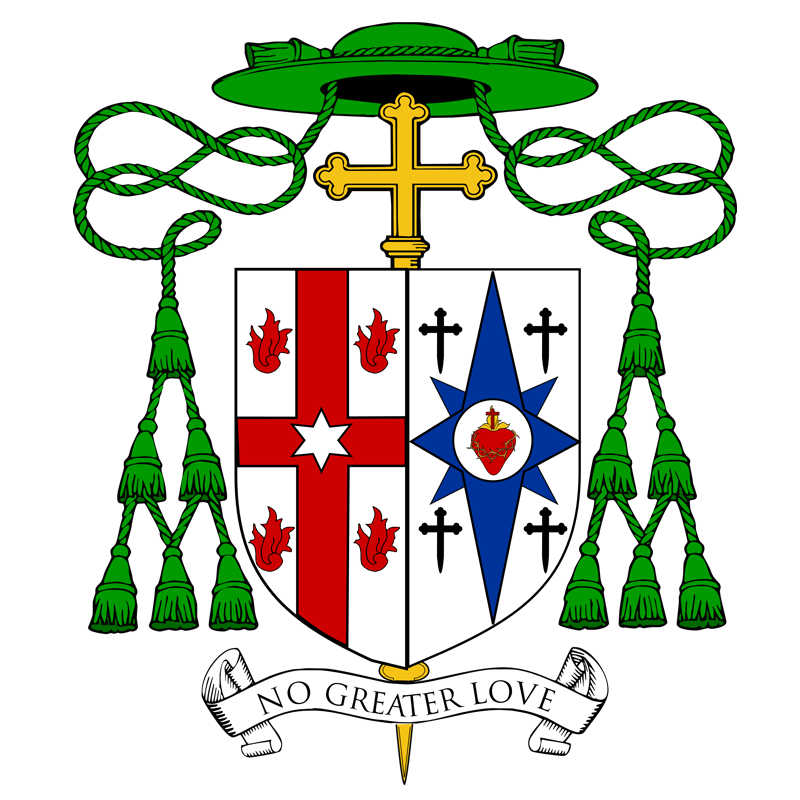
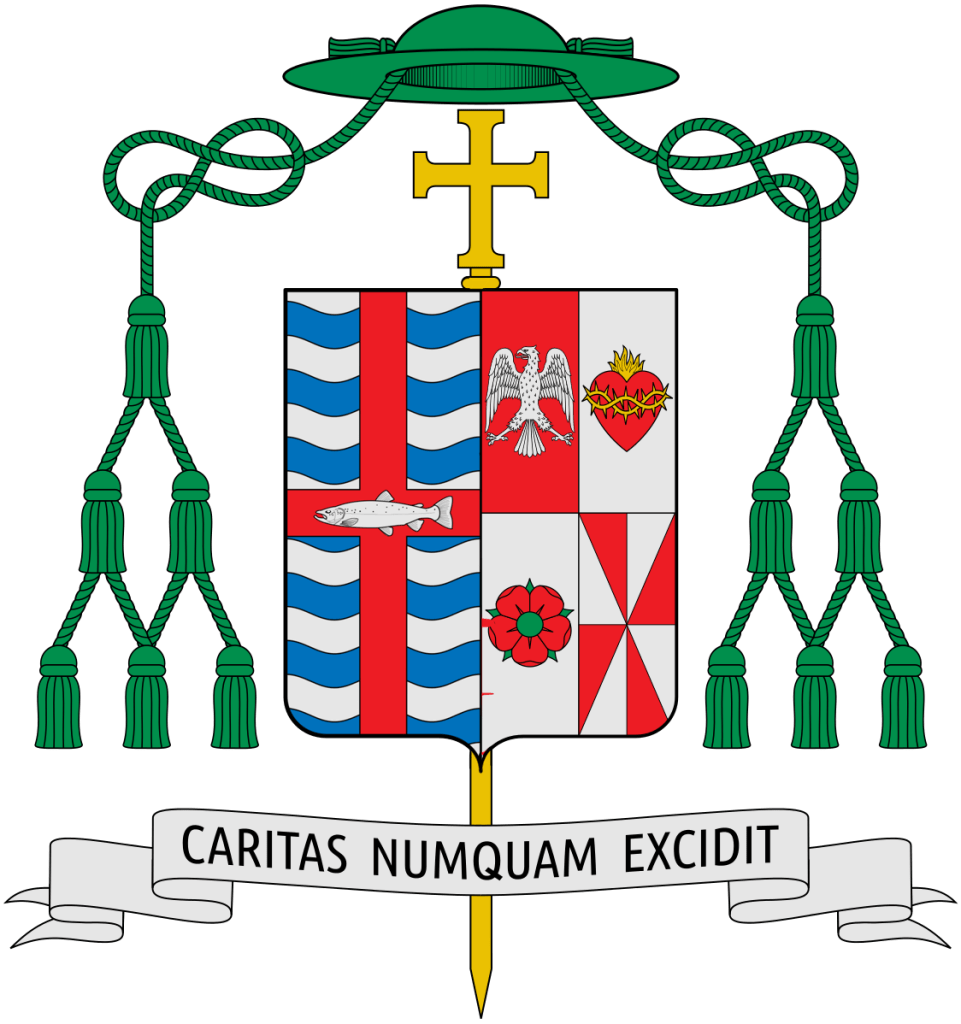
Archbishop elect Nelson Perez will be installed as the 16th Archbishop of Philadelphia on February 18. His coat of arms will appear as below. He has not really changed his arms but rather has decided to have the star in chief on his personal arms depicted differently that the five pointed star in the arms of the archdiocese. Originally, he had a five pointed star, borrowed from the arms of the See of Philadelphia, to commemorate his time as a priest there. Now that he will be serving as the archbishop there, the need for that is lessened. So, his arms remain the same with a slight tweak in the style of the star in chief.
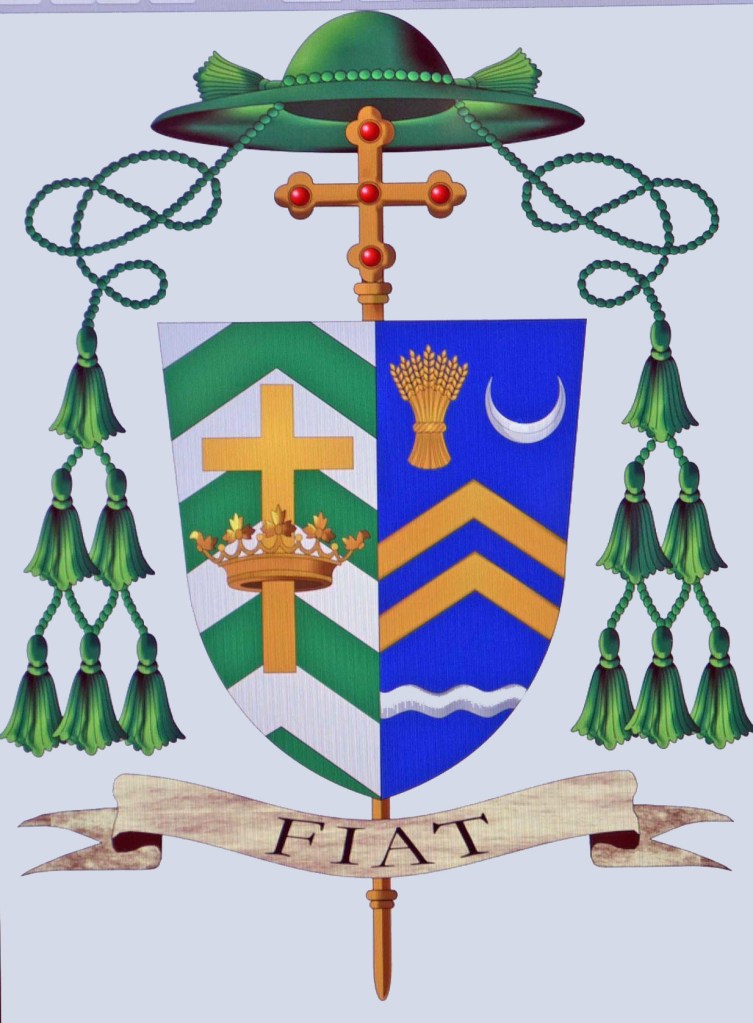
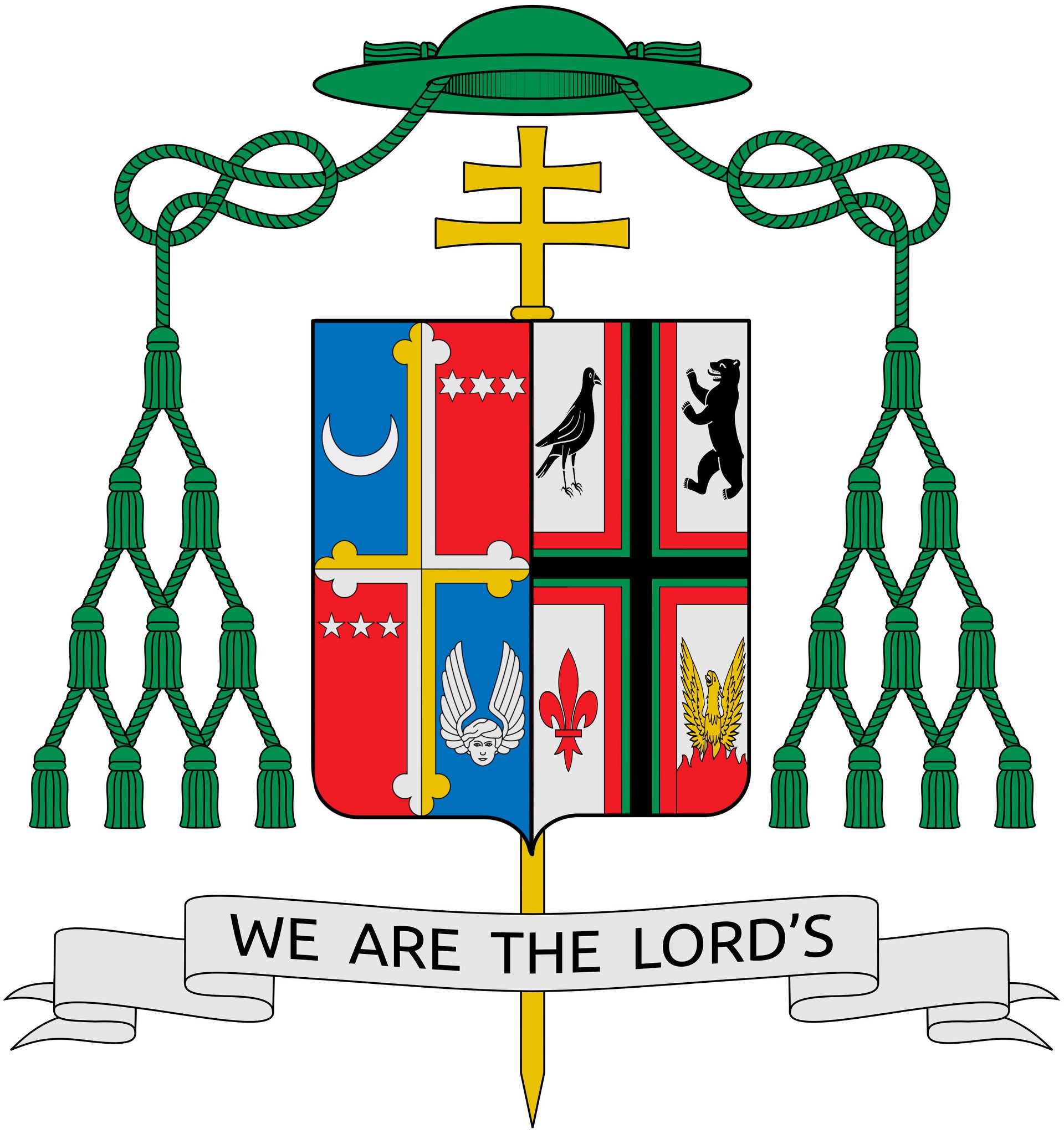
On Wednesday, November 20, the Most Rev. Austin Vetter (52), a priest of the Diocese of Bismarck, North Dakota, was ordained a bishop and installed as the 12th Bishop of Helena, Montana. He was formerly a Spiritual Director at the Pontifical North American College in Rome, the seminary which he himself attended. Like so many other American bishops coming from that source he decided to have his coat of arms designed and emblazoned by an amateur heraldist, a man with another profession, who has begun to work extensively in the field of ecclesiastical heraldry due to his many contacts in Rome. The results are usually somewhat disappointing – not bad; not incorrect; not poorly rendered – but just drab, unimaginative and a ceaseless repetition of the same things over and over again plugged into a basic template making all of them appear, essentially, the same.
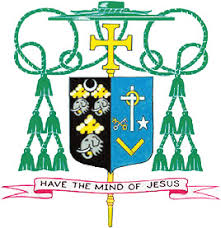
From the program prepared for the Ordination we read the following description prepared by the person who designed the coat of arms: “Bishop Vetter’s personal coat of arms blends images representing his origins: the crescent moon is for the Blessed Mother, the Immaculate Conception, patroness of the United States, the Diocese of Bismarck, and the Pontifical North American College (Bishop Vetter’s alma mater where he also later served on faculty); the sheaves of wheat which combine the concept of the Eucharistic symbol and the principle product of the farm where Bishop Vetter grew up; a “wavy barrulet,” the water representing “the spring of water welling up to eternal life” (John 4:14) and the Missouri River which begins in Montana and flows through Bismarck, North Dakota; and a “gemel in chevronwise,” one of them recalling the rafter holding the roof of the church which is set upon the foundation of the apostles with Christ Jesus as the cornerstone (meaning protection) and the second representing the Rocky Mountains of Montana.
The color blue (Azure) symbolizes the separation from the worldly values and the ascent of the soul toward God, therefore the run of the Celestial Virtues which raise themselves from the things of the earth toward the sk y. It als o represents the Blessed Mother and the “Big Sky” of Montana. The silver (Argent) of the crescent symbolizes the transparency and the purity of the Virgin Mary. The garb, sheaves of wheat, is in gold (Or), the first among the noble metals, then the symbol of the first of the Virtues , the Faith which enables us to believe in the Eucharistic Host, fruit of wheat, real body of Christ.”
Yeah…blah.
The second paragraph which goes on and on about the symbolism of the colors betrays an error that many amateur heraldist make. Namely, assuming that there are definite meanings assigned to different colors in heraldry. There aren’t. Perhaps, the armiger has chosen to assign meanings to certain colors for himself personally but if that is the case the explanation should stipulate that, as in, “The bishop feels that the color blue means XYZ to him because…” Otherwise, it’s simply made up out of whole cloth.
Another interesting thing in the explanation which goes to my point about the repetition in this person’s designs is the explanation of the use of the “gemel”. In heraldry the word gemel means “twin”. It is a term taken from Scottish heraldry primarily and does not describe a particular charge or object. Rather, it is an adjective that describes certain ordinaries or subordinaries as being depicted twinned, or in a pair. So, it’s not an object, a gemel “chevron wise” (i.e. arranged in the shape of a chevron). Instead, it should be blazoned “Two chevronels gemel”, that is, two thinner chevrons paired.
What is also interesting is this explanation of the coat of arms of a bishop this same artist did several years ago, “The chevron is an heraldic device, best described as an inverted “V”; it signifies the rafter, which holds the roof of the church, and symbolizes the concept of protection.” Does that sound familiar? Perhaps it is supposed that every bishop must have a chevron of some kind in his coat of arms as a symbol of a church? Are there no other symbols of a church, or of the Church, or of protection?
This bishop’s last name – Vetter – comes from the German for “cousin” and yet there was no attempt to try and symbolize that. His first name, Austin, is derived from the name Augustine and yet none of the symbols associated with that saint were used. Why do I point this out? Because a coat of arms is first and foremost a mark of personal identification. As I have written here numerous times, it is not a CV in pictures! It’s not supposed to be about where you are from, where you lived, where you went to school, etc. It is, instead, supposed to identify you, personally. So, using charges that in some way alluded to his name or family name, while far from a necessity in any coat of arms, might have proven a better starting point and certainly would have made for a mark of identity that was more personal.
Instead, there is another cookie-cutter coat of arms. And yet the question persists of “Why are so many bishops’ coats of arms so poorly done?” It is, I believe, because too many bishops are content to copy what they have seen before for the sake of “getting it done” instead of consulting with someone who is well versed in heraldic science as well as someone who can provide real heraldic art instead of something using a computer generated template. This coat of arms, like others is not, as I wrote above, bad, incorrect or poorly rendered. But, it is rather disappointing.
On October 16 the Most Rev. Shane Mackinlay (54), a priest of the diocese of Ballarat, was ordained a bishop and installed as the Eighth Bishop of Sandhurst, Australia.
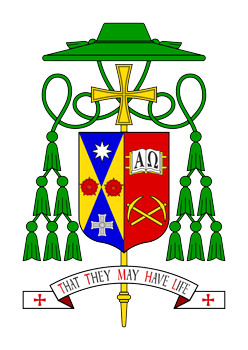
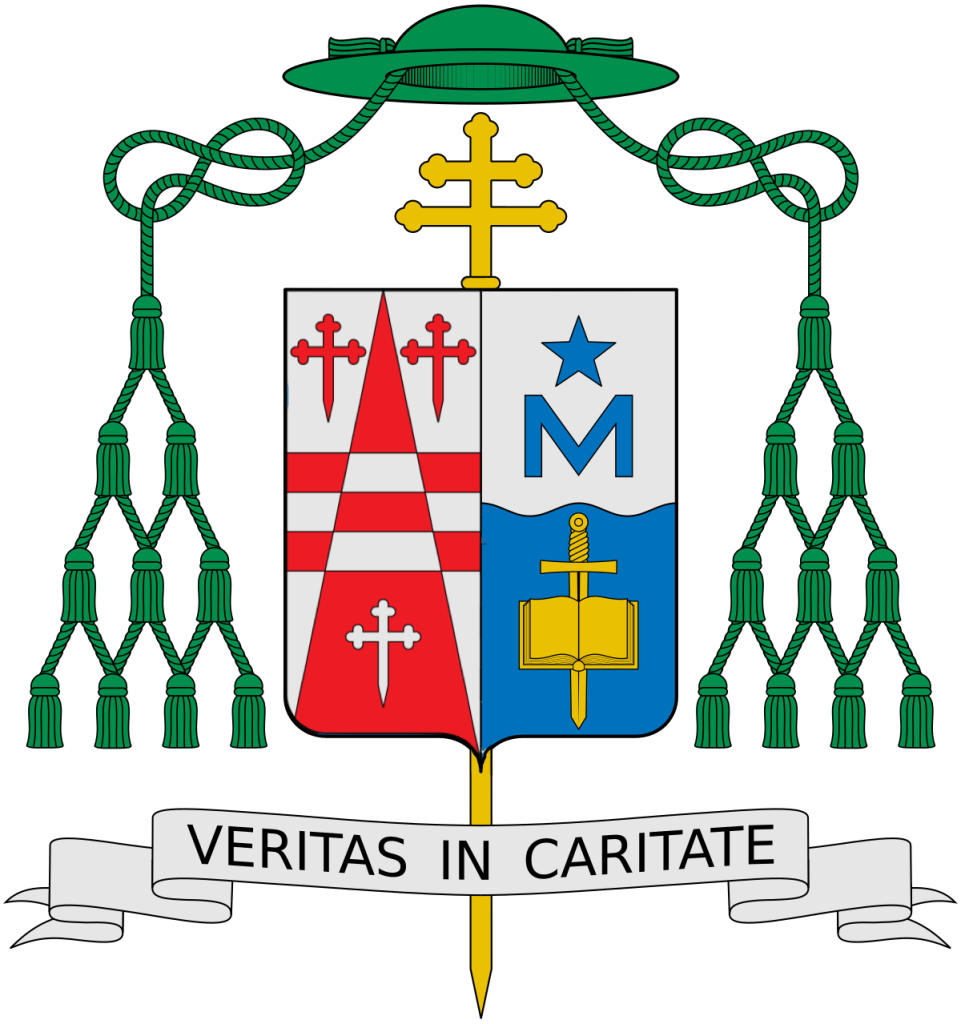
His coat of arms is blazoned: Gules, two pickaxes in saltire, blades upwards Or; in chief an open book Argent bound Or with the Greek letter Α on the dexter page and the Greek letter Ω on the sinister page both Sable; impaling Per saltire or and azure on the former in fess two roses gules, in chief an estoile (eight-pointed star) and in base a representation of the Paderborn Cross argent.
The crossed pickaxes are the tools of goldmining, which was integral to the founding of both Ballarat and Bendigo. The bible comes from the arms of Catholic Theological College and reflects its motto, Tolle lege, the admonition that prompted St Augustine to take up and read the bible, which led to his baptism. In the arms of the see the gold of the field represents the goldfields, which are located within the diocese. The blue and the roses represent the Virgin Mary, Mother of God, who, under the title Our Lady of Good Counsel, is Patroness of the Diocese. The Paderborn Cross at the base is an ancient Christian symbol discovered in an eighth-century grave beneath the Cathedral at Paderborn, Germany, which was the home city of Dr Henry Backhaus, the pioneer priest of the Bendigo Goldfields.
The diocesan arms were designed by myself and Bishop Shane’s personal arms were designed by Richard d’Apice AM KCSG and myself and both are illustrated by Sandy Turnbull.
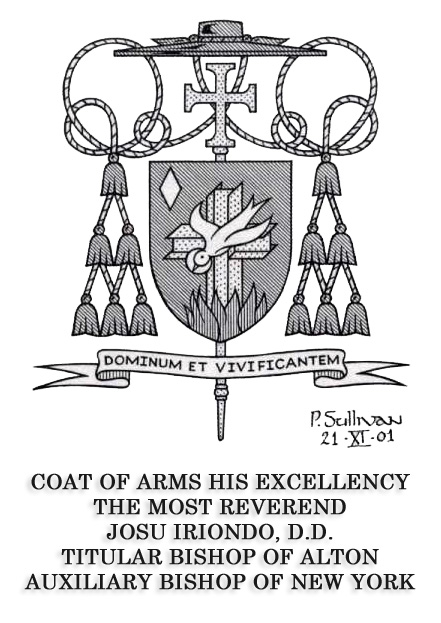
The Most Reverend Josu Iriondo, (80) formerly a Canon Regular of the Most Holy Savior of the Lateran, later incarnated as a priest of the Archdiocese of New York and retired Auxiliary Bishop of New York was appointed to be a bishop on October 30, 2001 and ordained the Titular Bishop of Alton and Auxiliary of NY on December 12, 2001 while the city was still reeling from the horrible terrorist attacks of 9/11. In his assumed coat of arms Bishop Iriondo decided to commemorate those horrible events and the faith that helped many cope with them by incorporating an image from Ground Zero into his coat of arms. There was a cross made of the remnant I-beams of one of the fallen towers that rescue workers erected over the site. That cross of steel I-beams was used as the image of the cross making up the principal charge of the bishop’s coat of arms.
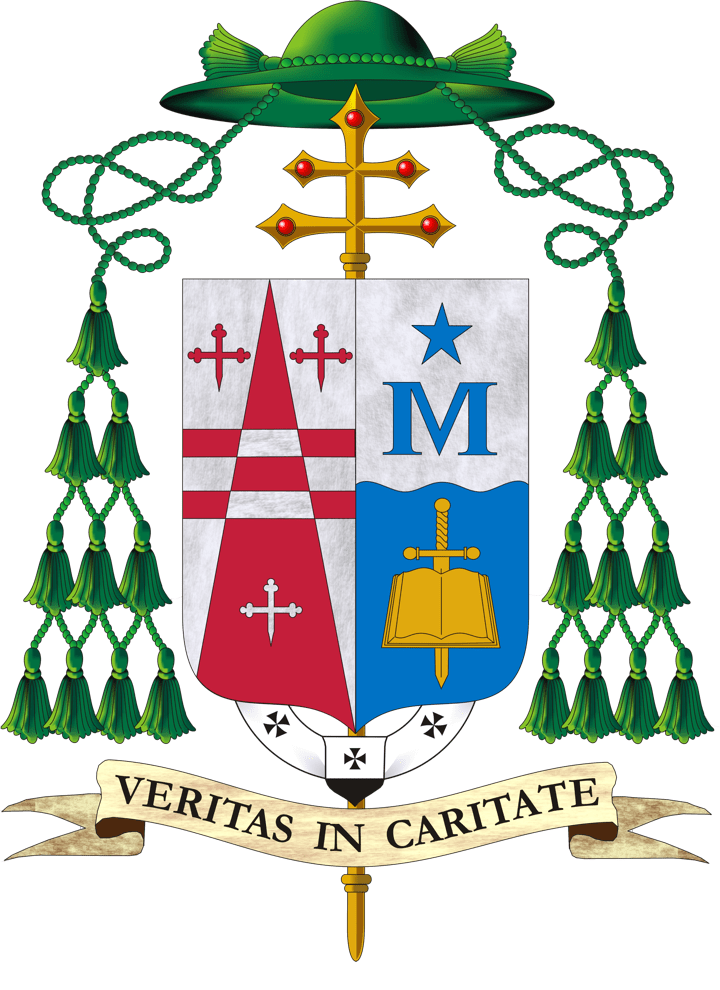
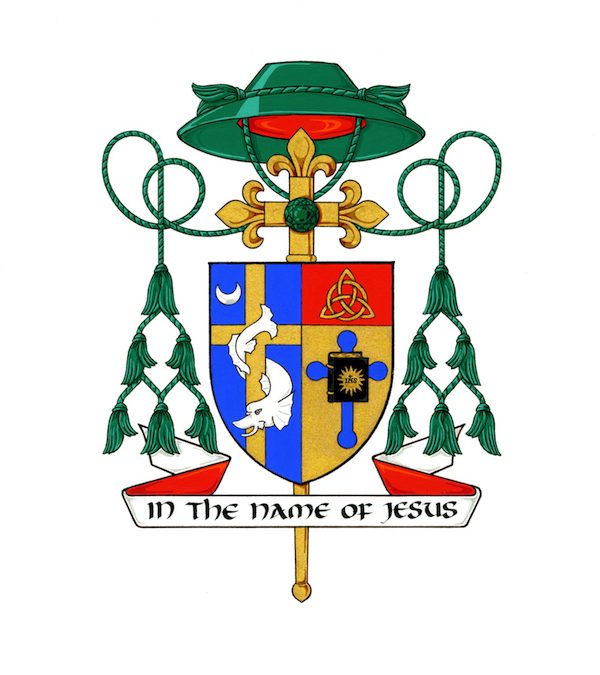
The Most Reverend Paul D. Etienne (60) who had been translated from Archbishop of Anchorage to Coadjutor of Seattle last April has now succeeded to the See of Seattle as of September 3, 2019. On that date Pope Francis accepted the resignation of Archbishop Peter Sartain for health reasons and Etienne becomes the 10th Metropolitan Archbishop of Seattle.
His coat of arms (above) combines the arms of the See of Seattle with his personal arms. It’s nice to see he didn’t once again change them as he did when going from Cheyenne (where he originally served as a bishop) to Anchorage. At that time I was very outspoken in my criticism of that decision. There is no such criticism this time around.
On August 8, Rev. Douglas Lucia (56) a priest of Ogdensburg, NY was ordained a bishop and installed as the 11th Bishop of Syracuse, NY. His coat of arms:
On Wednesday, August 21, the feast of St. Pius X, the Most Rev. Mark E. Brennan (72) until recently Auxiliary Bishop of Baltimore and Titular Bishop of Rusibisir, was installed as the 9th Bishop of Wheeling-Charleston, West Virginia. He succeeds the scandal ridden Bishop Michael Bransfield.
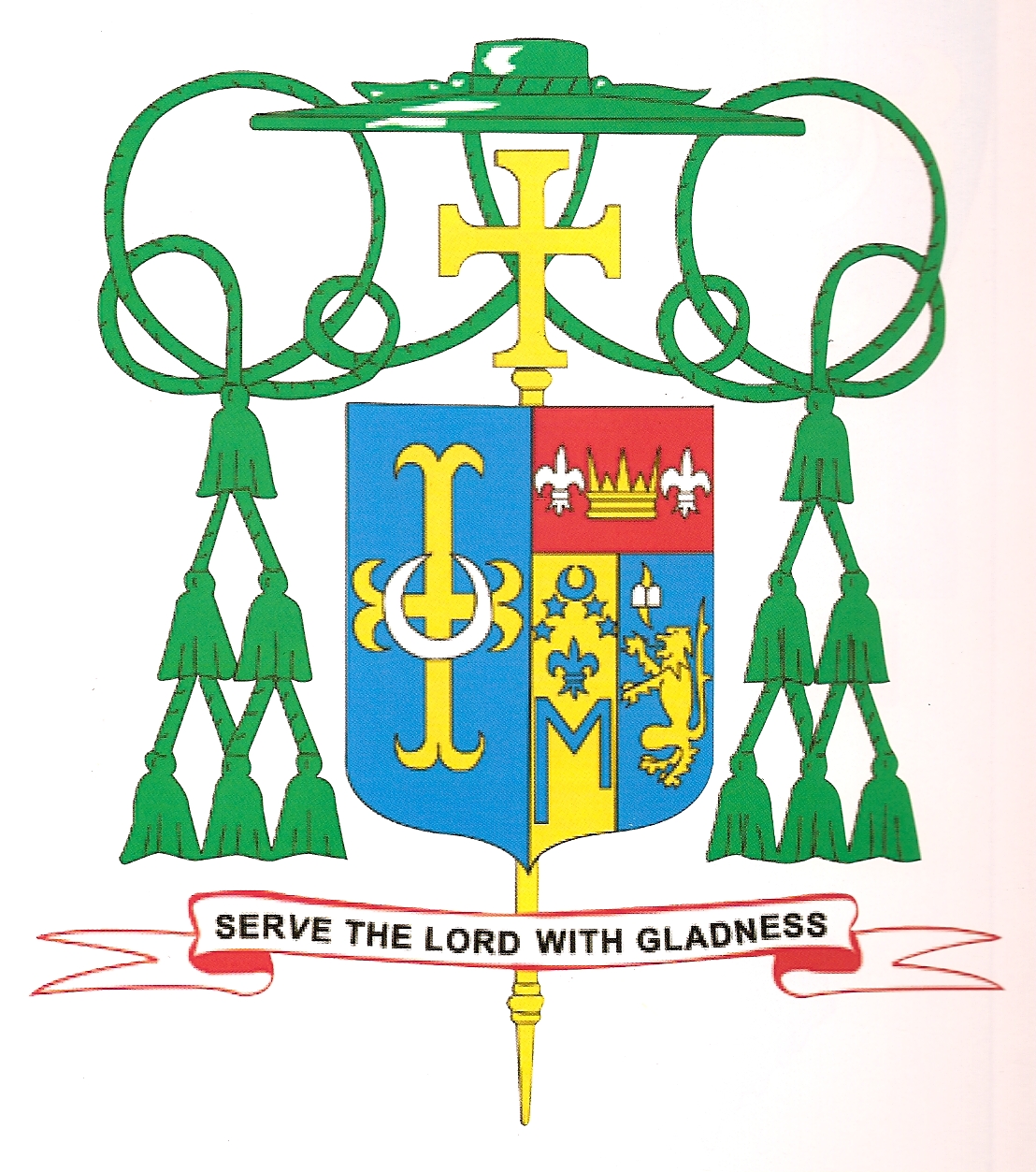
His coat of arms (above) is clearly a redesign of the coat of arms he assumed at the time he became a bishop. Normally, I am very critical of the practice of a bishop changing his coat of arms when transferring to a different assignment. A coat of arms is not “changeable” as it is a mark of personal identification.
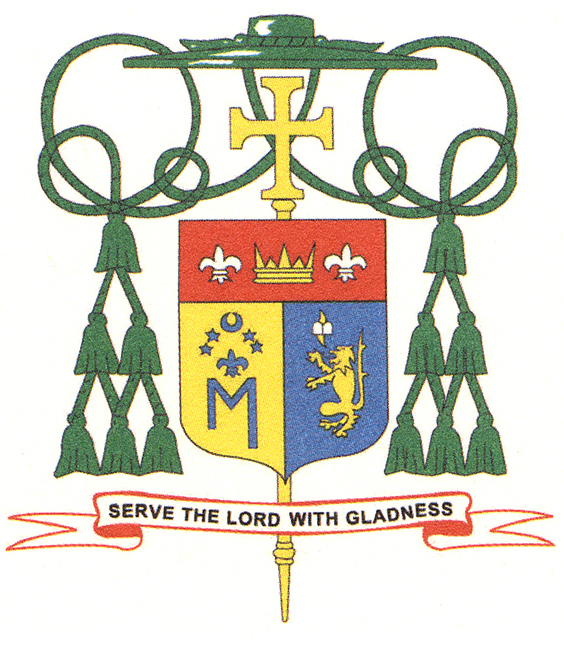
However, Bishop Brennan’s originally assumed arms (below) were rather busy and it would have been difficult to impale them well with the diocesan coat of arms. Of course, it is well worth pointing out that while impalement, symbolizing that the bishop is “married” to his diocese, is the norm for diocesan bishops in the United States but it is not mandatory by any means. I would hazard a guess that when Bishop Brennan assumed his coat of arms he did not think that he would ever be called upon to serve as a diocesan bishop and thought his episcopal ministry would be lived out as an Auxiliary of Baltimore. That’s not an unusual assumption when you consider he was already 69 years old when he was appointed a bishop and the mandatory age at which bishops must submit a resignation is 75!
Nevertheless, his personal coat of arms has been redesigned to better harmonize and more easily be impaled with the coat of arms of the See of Wheeling-Charleston. In my opinion, my misgivings about redesigning arms aside, I think it is an improvement over the original coat of arms. The change of the motto, also not an absolutely necessary part of a coat of arms although erroneously thought to be so by many, is less problematic.
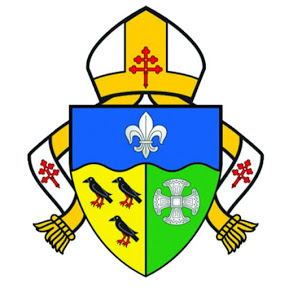
On July 25, 2019 the Most Rev. John Wilson (51), a priest and auxiliary bishop of Westminster was installed as the 11th Metropolitan Archbishop of Southwark. London is a unique city in that it contains two different ARCHdioceses, as well as also containing part of the territory of two dioceses. Everything south of the river Thames is in the Archdiocese of Southwark.
The archbishop employs the archdiocesan arms pictured below. They follow the more ancient custom in Britain of ensigning the shield with a bishop’s mitre rather than the more continental galero.
On July 26, 2019 the Most Rev. Robert Gruss (64), formerly Bishop of Rapid City, SD and prior to that a priest of Davenport, IA was installed as the seventh Bishop of Saginaw, MI. His coat of arms (below) is described on the diocesan website.
The Most Rev. Robert Christian, a Dominican friar, who has been the Auxiliary Bishop of the Archdiocese of San Francisco passed away on July 11, 2019 at age 70.
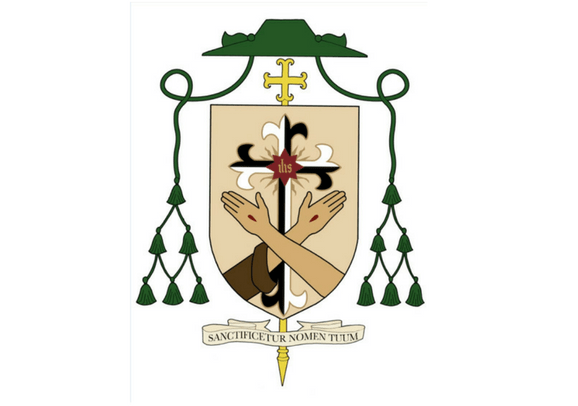
His coat of arms was assumed by him at the time of his episcopal ordination.
Umm…no. Sorry, but “beige” isn’t a heraldic color and, no, you may not just simply make up new rules and use whatever color you wish in heraldry. The science of heraldry limits the tinctures to be used and beige isn’t one of them. The Dominican cross and the usual Franciscan conformities (the arms of Christ and St. Francis crossed with each other) made for a nice combination of symbols for his Religious Community and the Archdiocese.
Bishop Joseph A. Galante, D.D., J.C.D. was born in Philadelphia and was ordained in 1964. He attended Lateran University in Rome, where he received his doctorate in canon law, and later the University of St. Thomas (Angelicum) in Rome, where he received his Master’s Degree in Spiritual Theology.
He served in the Archdiocese of Philadelphia until he was named by Pope John Paul II in December 1986 to be Undersecretary of the Congregation for Religious in Rome. He was a member of the Pontifical Council for Social Communications and chair of the United States Conference of Catholic Bishops’ Committee on Communications.
In October 1992 he was named Auxiliary Bishop of San Antonio, Texas. A year and a half later he was installed as Bishop of Beaumont, Texas. He became Coadjutor Bishop of Dallas in January 2000.
On April 30, 2004, Bishop Galante was installed as seventh bishop of the Diocese of Camden.
Bishop Galante retired on January 8, 2013. He entered into eternal life on May 25, 2019.
On April 29 Pope Francis appointed Archbishop Paul Etienne (59) to be the Coadjutor Archbishop of Seattle. The archbishop was a priest of Indianapolis and also served from 2009-2016 as the Bishop of Cheyenne, Wyoming before becoming Archbishop of Anchorage, Alaska where he has served for just three years.
He will take up his new duties in Seattle in early June and then he and Archbishop Peter Sartain, who requested the coadjutor due to ill health, will determine when Archbishop Etienne (pronounced AY-chin) will succeed to the See as the ninth archbishop.
The archbishop famously redesigned his personal coat of arms when he moved from Cheyenne to Anchorage, a move that was highly criticized by me. Let’s hope he leaves well enough alone this time. Ironically, his original coat of arms would have ended up looking better marshaled to those of Seattle than his current design. This, then, is why one shouldn’t redesign personal arms to harmonize better with (arch)diocesan arms. It is impossible to know if you might be moving on.
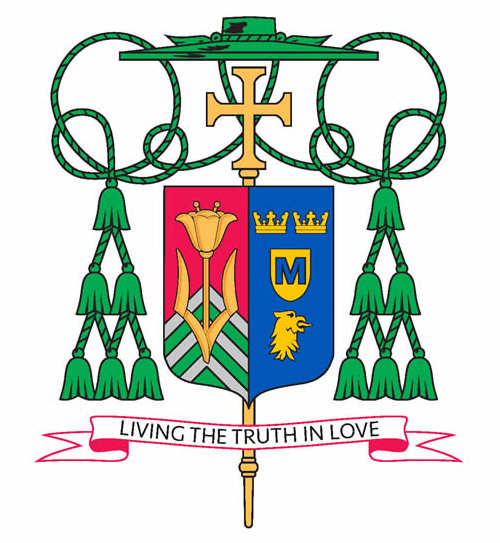
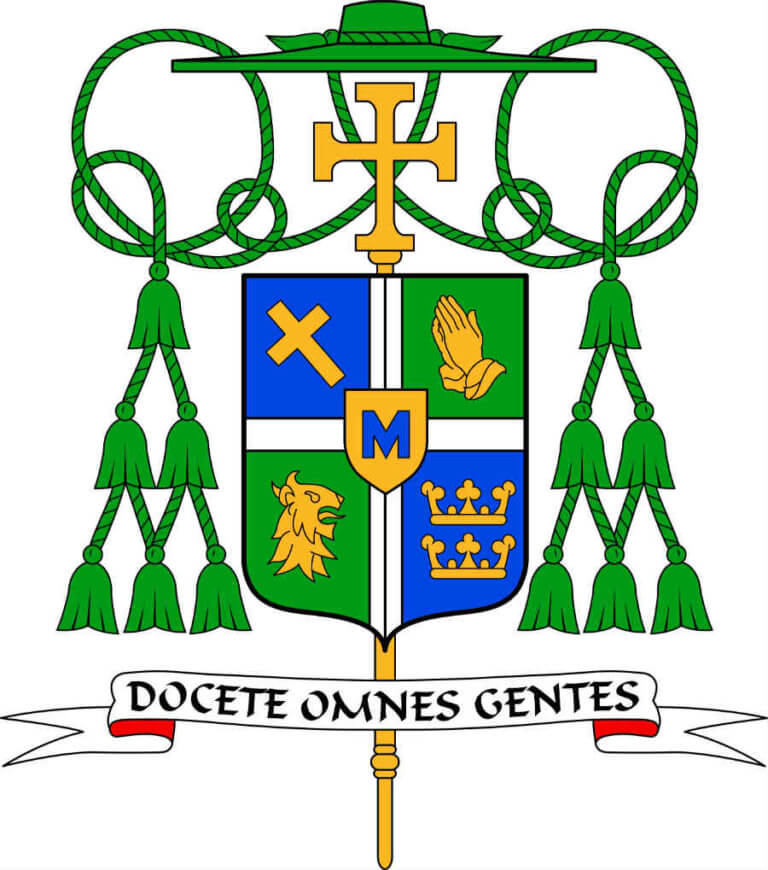
The Most Rev. Donald Hying (55), formerly a priest and auxiliary bishop of Milwaukee, Wisconsin and since 2014 the bishop of Gary, Indiana has been appointed the fifth Bishop of Madison, Wisconsin succeeding the late Robert Morlino. Bishop Hying will be installed in Madison on June 25, 2019.
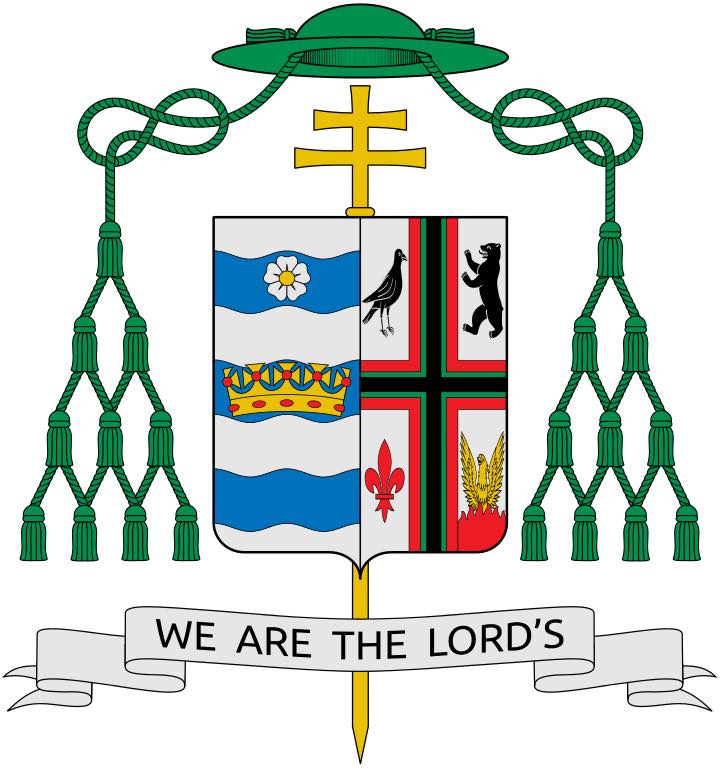
It was announced this morning that Pope Francis has appointed the Most Rev. Wilton Gregory, Archbishop of Atlanta to be the next Archbishop of Washington, DC. Archbishop Gregory was ordained a priest for the Archdiocese of Chicago originally and served as Auxiliary Bishop there before becoming the Bishop of Belleville, Illinois and eventually promoted to Archbishop of Atlanta. He also served at one time as President of the United States Conference of Catholic Bishops. He will be installed in Washington, DC on May 21.
The coat of arms he has used since becoming a bishop 36 years ago will now be marshaled to those of the Archdiocese of Washington, DC.
On a silver (white) field a cross composed of three colors; black on green on red. These colors are referred to as the African-American colors and by their use Archbishop Gregory honors the religious and racial heritage that has come to him from his parents, Wilton and Ethel ( Duncan ) Gregory. Within the quarters that are formed by the cross are a raven, to honor the Archbishop’s Benedictine education at Sant’ Anselmo (in Rome), and a black bear taken from the arms of His Eminence, Joseph Cardinal Bernardin, His Excellency’s principal Episcopal consecrator. Also within the quarters are a red fleur-de-lis taken from the arms of the Mundelein Seminary in Chicago , where Archbishop Gregory was a student and faculty member, and a golden phoenix, coming forth from red flames, to honor Chicago , the city reborn after the famous Chicago fire.
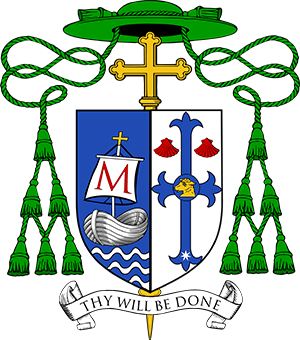
On Friday, March 29, 2019 the Most Rev. Robert Brennan, formerly Auxiliary Bishop of Rockville Centre, NY was installed as the twelfth Bishop of Columbus, Ohio. His personal arms now impaled with those of the See are described on the diocesan website.
The Brennan coat of arms comprises a white shield with a blue heraldic lion, and two red hands in the top corners of the shield. Rather than use the original design Bishop Brennan has chosen to retain the overall coloration and layout of his family coat of arms, while employing charges more evocative of his own life of faith.
The main charge on the shield is the Cross, the foundation of the Christian faith. The arms of this particular Cross resemble a fleur-de-lis, a stylized lily often used as a symbol of the Virgin Mary.
At the bottom of the cross appears a small white star, a symbol of Our Lady. Its position recalls the moment of the Commendation, when, “standing by the cross of Jesus” (John 19:25), Mary became, at her Son’s command, the Mother of all of his disciples (cf. John 19:27). The star has seven points, recalling the seven Gifts of the Holy Spirit.
At the center of the cross appears a lamb’s head painted gold. The same charge figures prominently on the coat of arms of the Diocese of Rockville Centre, which Bishop Brennan served as a priest and bishop for nearly 30 years. Saint Agnes is the patroness of the Diocese of Rockville Centre, and of its Cathedral church, where Bishop Brennan resided for 16 years.
At the top of the shield are two scallop shells painted red. Although the charges are the same, they are used here to allude to two different saints: John the Baptist and James the Greater. Bishop Brennan attended Saint John the Baptist High School (West Islip) and Saint John’s University, and the patron of these schools is often depicted in sacred art using a shell to baptize the Lord Jesus. The date of Bishop Brennan’s ordination as a bishop — July 25, 2012 — is the feast of Saint James, the brother of Saint John the Evangelist and the first of the apostles to be martyred, during the persecution of the early Church (Acts 12:1-2). The red color of the shells recalls the fact that both of these saints gave their lives as martyrs for the faith.
On Jan. 22, 2019 of the Most Rev. John Mortimer Smith, Bishop Emeritus (2010-2019) and Ninth Bishop of the Diocese of Trenton (1997-2010), former Coadjutor Bishop of Trenton (1995-1997), former Bishop of the Diocese of Pensacola-Tallahassee in Florida (1991-1995) and former Auxiliary Bishop of the Archdiocese of Newark (1988-1991) passed into eternal life. Bishop Smith died in Morris Hall Meadows, Lawrenceville, after a long illness. He was 83 years old.
His coat of arms (above) was assumed at the time he was ordained an Auxiliary Bishop in 1988. It is, in my opinion, a little too “busy” insofar as he tried to do too much. All those various charges represent different events/aspects of his priestly life and ministry, a kind of pictorial CV, which is precisely the type of thing I encourage new armigers to avoid all the time. It was particularly problematic and a little bit unattractive when it was marshaled to the arms of a See, such as Trenton, because all this was then squeezed into a narrow impalement (below). Perhaps, it would have been better to marshal the arms differently or to have simply borne his personal arms alone (something of which most American bishops cannot conceive because they think it isn’t permitted!)
Aside from his less-than-wonderful coat of arms I met Bishop Smith on several occasions and found him to be a warm, outgoing and very kind man. He was very down-to-earth and easy to talk with. In the days when he was bishop of Trenton I hosted a 30-minute weekly radio program for my diocese and he told me on more than once occasion how he enjoyed listening to it in the car while driving to some event at which he was to preside. He was one of our biggest fans. May he rest in peace and receive the reward of his labors in the Lord’s vineyard.
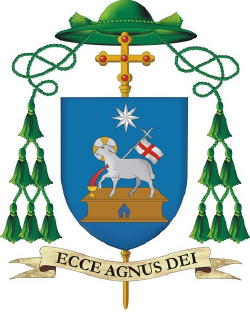
The Coat of Arms of Bishop Juan Miguel Betancourt, SEMV, depicts the Lamb of the Book of Revelation, slaughtered but victorious, the one who is the lamp for the Church (Rev 5:6; 21:23). The victory of Christ over sin and death through his sacrifice is reflected in the rays of power around his head (Rev 5:12; 17:14). The Lamb, giving his life for his Bride, the Church, through the shedding of his blood denotes the life of love and service of an ordained minister of the Church (Rev 14:1). The Lamb of God gives his life voluntarily so his Church can live and continue her mission of salvation in the world (John 10:17-18). The Lamb rests on a plain and unadorned wooden altar, evoking a life of simplicity, a life that wants to be spent in service signaling everyone to the Lamb, Christ the Savior. Finally, the Lamb also reminds us of Bishop Betancourt’s home, Puerto Rico, whose coat of arms is the oldest still in use in the New World.
The red and white banner, held by the Lamb, represents the local church of Hartford, which Bishop Betancourt has been called by the Lord to serve and give his life with joy and compassion, as well as his titular see of Curzola.
The Schoenstatt Shrine at the center of the altar represents the spirituality in which Bishop Betancourt has been formed through the charism of the Servants of the Holy Eucharist and of the Blessed Virgin Mary. The blue background is the presence of the Blessed Mother in the Church and the life of Bishop Betancourt. “Nothing without you, nothing without us” (Fr. Joseph Kentenich). “She is the great missionary, she will perform miracles” (St. Vincent Pallotti). The background also reminds Bishop Betancourt of the Church in the Archdiocese of Saint Paul and Minneapolis where he practiced his ministry of pastor, Scripture professor and formator of seminarians for more than a decade.
That strong presence of Mary is highlighted by the star. Mary, Stella Maris, reigns with her power of intercession and protection over every single member of the Body of Christ. In times of strife and distress in the Church, the Blessed Mother is the beacon of hope, promising strength, unity and security, inviting us to imitate the holiness and self-giving of her Son for the sake of his Bride. Traditionally, the eight-point star represents resurrection, salvation, super-abundance (of grace) and new beginnings.
He was ordained as the Auxiliary Bishop of Hartford on October 18, 2018.


 EXARANDORUM