Category Archives: External Ornaments

Royal Cardinal

Image

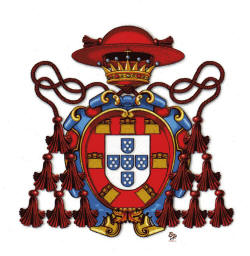
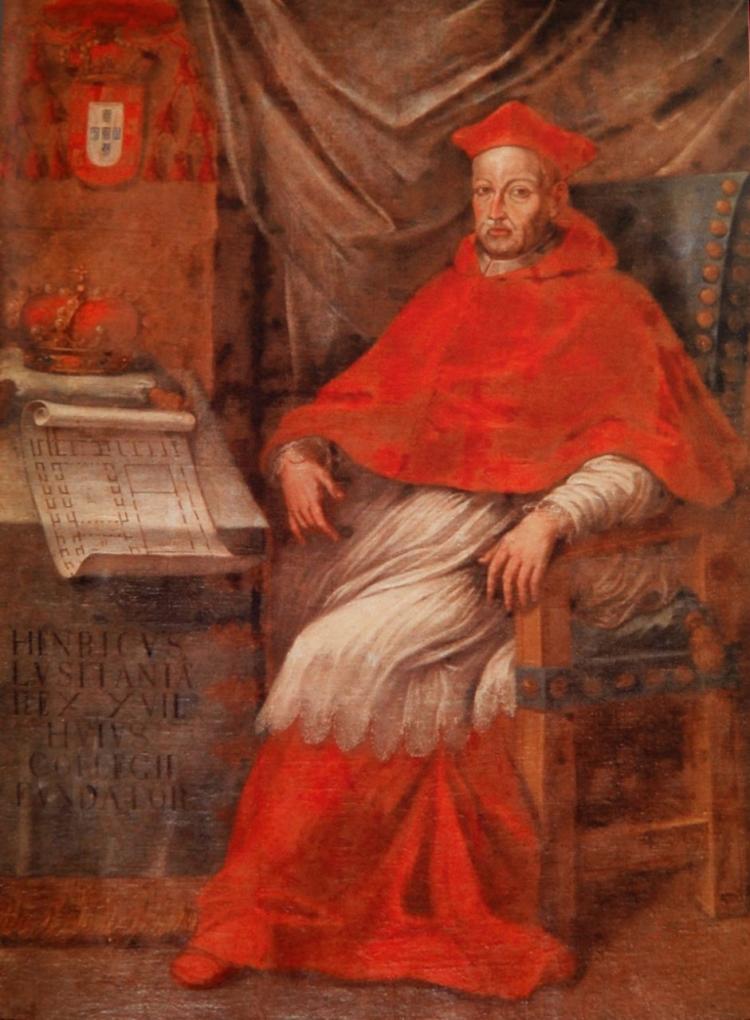
Henry (or Henrique) born on January 31, 1512 and died on January 31, 1580 reigned as King of Portugal and the Algarves and at the same time was a Cardinal of the Church. He ruled in Portugal between 1578 and 1580 and was known, for obvious reasons,  as “Henry the Chaste”.

Henry was the fifth son of King Manuel I of Portugal and Maria of Aragon and the younger brother of King John III. He was not expected to succeed to the Portuguese throne since he was a younger son. Ordained as a priest in order to promote Portuguese interests within the Church then dominated by the Spanish he, not surprisingly as the son of a king, rose fast through the hierarchy, becoming in quick succession Archbishop Braga, then Archbishop of Évora and eventually of Lisbon before receiving the red hat in 1545, along with the Titular Roman church of Quattro Coronati.

Henry served as regent for his grandnephew, Sebastian, after 1557, and then succeeded him as king after Sebastian was killed at the Battle of Alcázarquibir. Henry renounced his clerical offices on his own volition and sought to marry for the continuation of the House of Avis, but Pope Gregory XIII, closely tied to the Habsburgs who controlled Spain, did not release him from his vows. The Cardinal-King died in Almeirim without having appointed a Council of Regency to choose a successor.  Philip II of Spain who had a strong dynastic claim was elected King of Portugal at the Portuguese Cortes of Tomar in 1581.

For his arms he bore the royal arms of Portugal ensigned with a crown and a cardinal’s hat. (NOTE: the number of tassels was not fixed at 30 until the late 19th Century and prior to that cardinals often employed varying numbers of tassels on their galeri)
Image

Crest or Coat-of-Arms?

Image

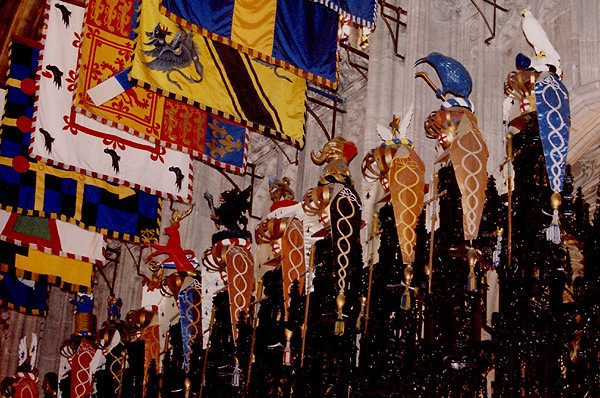
This photo illustrates something well. The banners at the top of the photo contain the coats-of-arms of the individuals who bear them. In the middle part of the photo there are those sort of dorky looking statues standing on top of the helmets. THOSE are crests. (They are placed at the crest of the helmet…get it?) The two terms are NOT synonymous. Many people use the word crest to mean a coat-of-arms. I know, those extra two syllables are a killer to have to say! A crest is a part of the full achievement of arms but it may be depicted alone. However a coat-of-arms and a crest are different things.

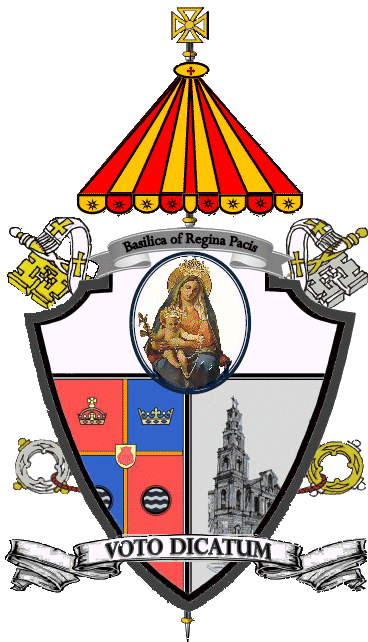
Basilica of Regina Pacis, Brooklyn, NY

Image

Arrrrrgh! This is horrible, Horrible, HORRIBLE!!! This coat of arms devised for the newly-designated Basilica Church of Regina Pacis in the Diocese of Brooklyn, NY is an excellent example of everything heraldry should NOT be. Do the “designers” (and I use the term loosely) of this monstrosity think that you simply take whatever images you want in whatever style you want and tack it to a shield and that’s called heraldry?

The only correct thing about this coat of arms is that basilica churches do, in fact, have the use of the ombrellino or pavilion and keys as external ornaments. Literally, everything else about it is horribly incorrect and completely lacking in imagination, creativity or even a passing knowledge of heraldic design.

The motto should not cross the shield but be depicted below it. Why is there a second scroll above the shield bearing only the name of the church? Is a coat of arms not identifying enough? The inclusion of the arms of the See of Brooklyn in its entirety is questionable but since it was done it would be good if part of it weren’t cut off! The pictorial images of Our Lady and of the church itself are wholly inappropriate and the whole is clearly a mish-mash of images cut and pasted together that don’t even match in style!

This is the worst kind of slap-dash, indifferent, ignorant heraldry that it sadly in use in far too many parts of the United States. IT STINKS!

Impalement is Not the Only Option

Image

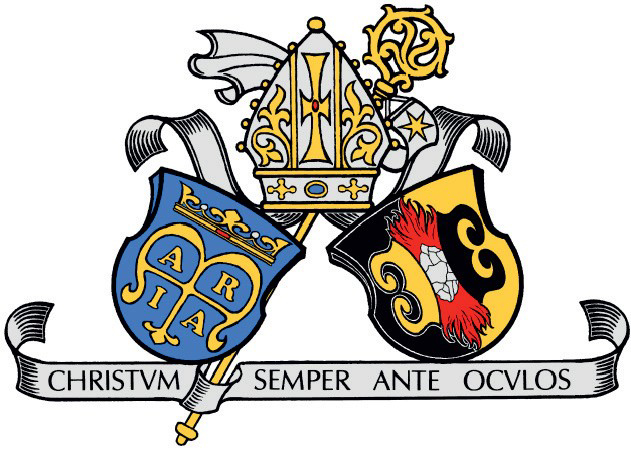
Here we see the coat of arms of Cistercian Abbot Christian Feuerstein, the Abbot of Monastery Rein in Steryia. Rather than marshaling his own arms with those of his abbey together on one shield by impaling them or by dimidiation his personal arms are depicted on a separate shield from those of the abbey thus retaining the clarity of each. His family name means “fire-stone” so his personal arms depict a flint being struck by steel to make fire. The two shields are then both surmounted by the external ornaments of an abbot, in this case the method often favored in Europe outside Italy of using the mitre and veiled crozier instead of the Roman galero. This is not, in the opinion of many, myself included, exactly correct. The galero should be used but, as I said, this more ancient method of ensigning the arms of an abbot is still employed by some.

Rosary As An External Ornament

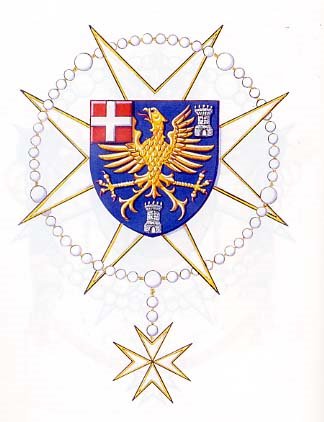
The rosary, or chaplet, is used in heraldry as an external ornament for those who are Professed Religious (men or women) and who are not also ordained to the priesthood. It is sometimes used by those who are officials and, therefore, entitled to use some other external ornament like a prior’s staff or even a crozier, in the case of Abbesses. The rosary is usually black and consists of five sets of ten beads, called decades, separated by five larger beads. It completely surrounds the shield and terminates at the bottom with three small beads and a cross.

The Prince and Grand Master of the Sovereign Military and Hospitaller Order of St. John of Jerusalem, Rhodes and Malta as well as professed knights of Justice of that order also make use of the rosary since they are actually Professed Religious in the Roman Catholic Church. However, they make use of a silver or white rosary that usually terminates in a Maltese cross.

Below is the coat of arms of the current Prince and Grand Master of the Order of Malta, His Most Eminent Highness, Frá Matthew Festing when he was Grand Prior of England which illustrates the use of the rosary well.

Image

Prior’s Staff

Image

One of the lesser known and, indeed, lesser used external ornaments in ecclesiastical heraldry is the Prior’s Staff, sometimes called the Cantor’s Staff. Like the crozier of bishops and abbots it has its origin in the staff used by pilgrims as a walking stick. As it evolved it came to be depicted as a simple staff usually of metal which terminated at the top in a small ball, or an apple, a fleur-de-lis or even the small representation of a house or chapel.

It is most often used in ecclesiastical heraldry for monastics but can also be seen in those places that still have cathedral chapters. Those officials of the chapter who do not enjoy the right to pontifical insignia, such as Priors, Provosts, Precentors or Cantors make use of it as a sign of their office. At one time Precentors or First Cantors were in charge of music for the chapter and cathedral and actually used this long staff to conduct the choir. It’s easy to see how from there it became a symbol of their office. This type of staff was also used to direct ceremonies.

Using the Prior’s Staff as a heraldic emblem was for those officials who actually used one in real life. As its use became less frequent it then evolved into an emblem for those who held the office that used to employ such staves. It is seen very little in heraldry these days.

(The example above is the coat of arms of the Collegiate Chapter of Canons of St. Vittore of Arcisate rendered beautifully by Marco Foppoli)