Category Archives: Bishops

Auxiliaries of Milwaukee

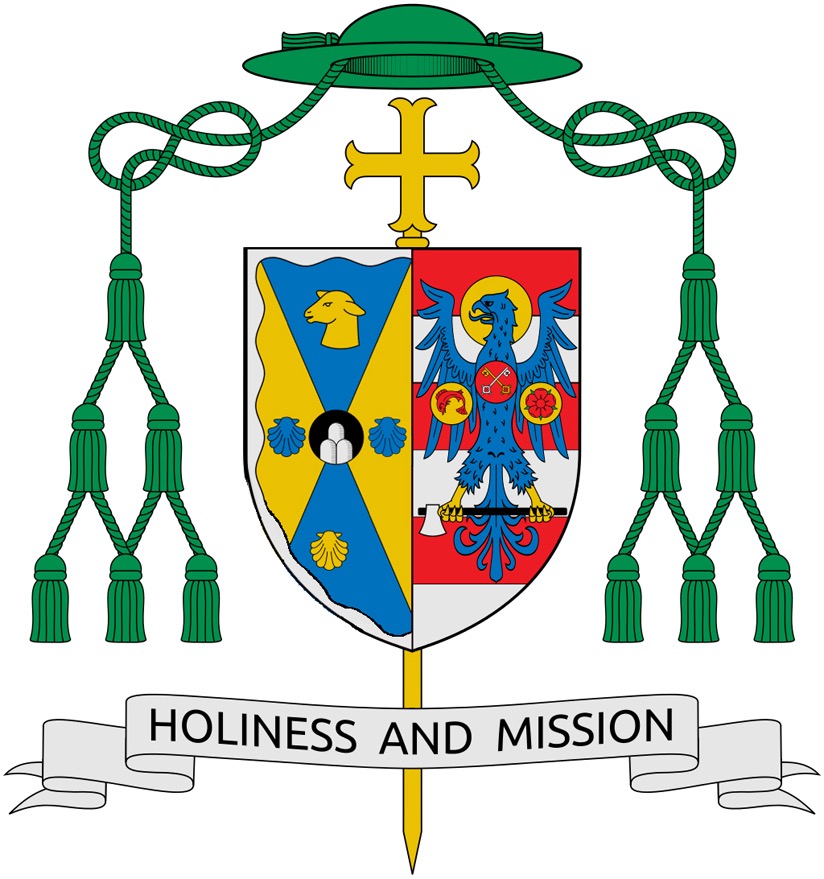
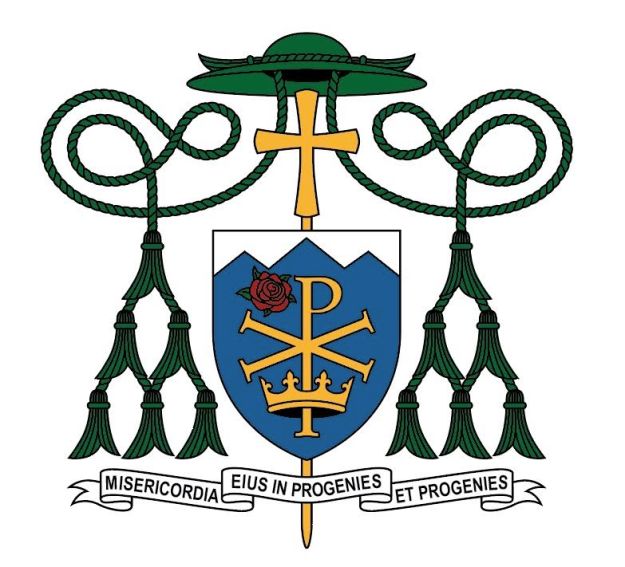
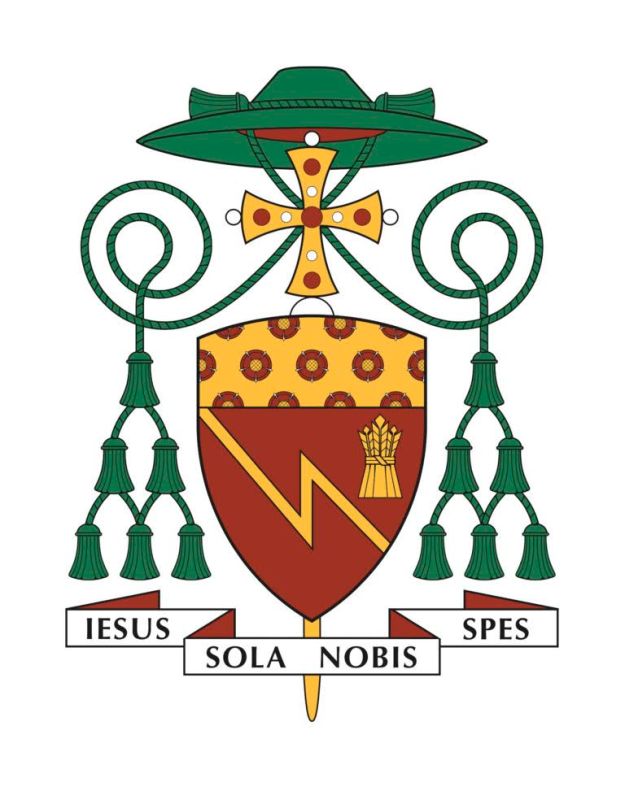
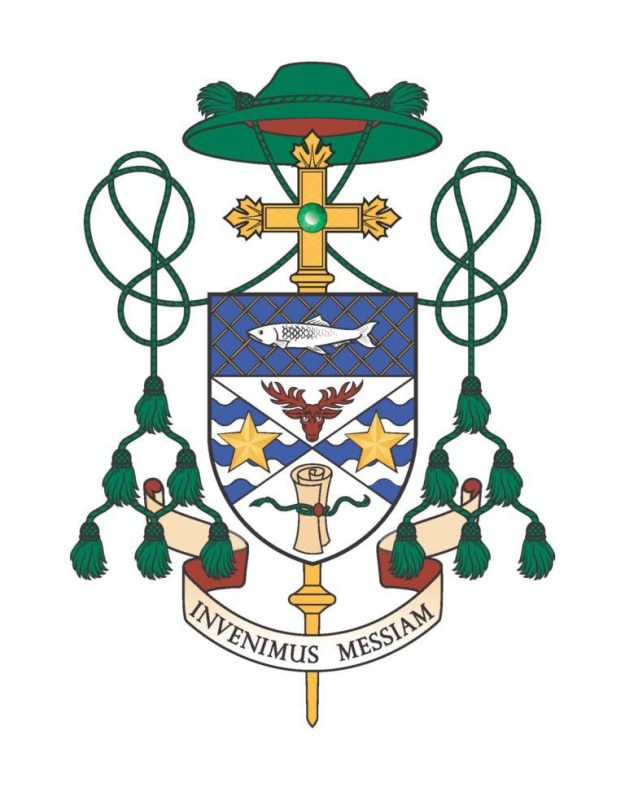
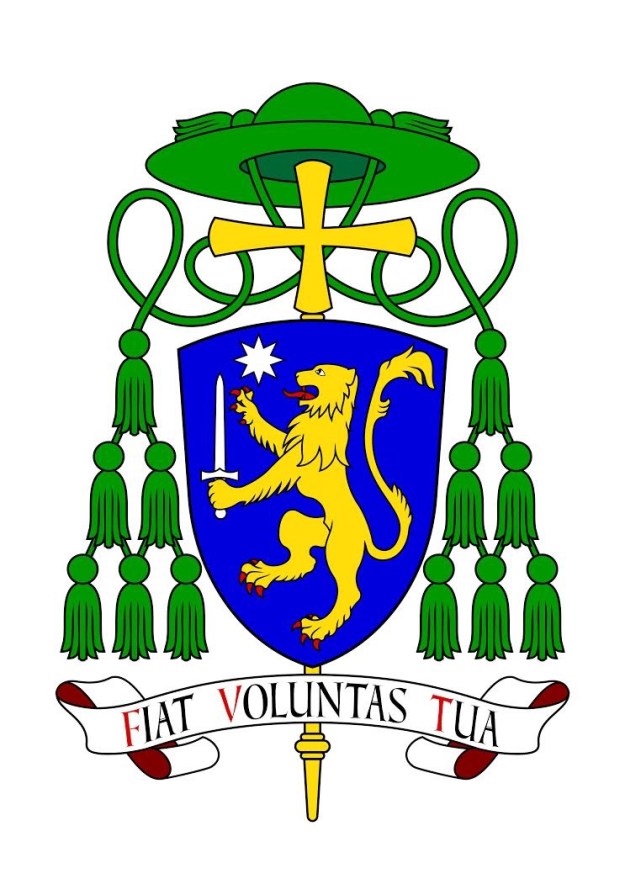
On March 17 last The Most Rev. Jeffrey Haines and The Most Rev. James Schuerman were ordained to the episcopate to serve as Auxiliary Bishops of Milwaukee. Their newly assumed coats of arms (by Deacon Paul Sullivan) display, for a refreshing change, choices on the part of new bishops that result in clear, simple and distinctive coats of arms. Those of Bp. Schuerman appear to have been inspired by those of St. Francis de Sales but contain enough heraldic differencing to make them his own. These are both good examples of nice coats of arms.

Jeffery_Haines_Coat_of_Arms

Bishop Haines’ Coat of Arms

James_T_Schuerman_Coat_of_Arms

Bishop Schuerman’s Coat of Arms

Bishop Solis

On March 7 the Most Rev. Oscar A. Solis, formerly Auxiliary Bishop of Los Angeles, was installed as the 10th Bishop of Salt Lake City, Utah. The first Filipino-American to head a diocese is now the shepherd of a diocese covering the entire state of Utah, famous for being “Mormon country”. His handsome coat of arms which refers to both the Filipino flag and to his surname, Solis, meaning “of the sun”, is now in place over the cathedra in the very beautiful cathedral of the Madeleine. This has the distinction of being one of the loveliest cathedrals in the United States.

Cathedral-Madeleine-fk-6154-300x300

A Gallery of Banality

In January several new Auxiliary Bishops have been ordained in the USA. Their choices regarding armorial bearings have been, shall we say, underwhelming. I am not commenting on the quality of the artwork, at least not for the moment. This post is concerned with the content and composition of these coats of arms from a heraldically correct viewpoint. Let’s have a look.

Most Rev. Timothy Freyer, Auxiliary of Orange, CA (ordained January 17)

freyer

Meh.

Most Rev. Mark Brennan, Auxiliary of Baltimore, MD (ordained January 19)

Print

Busy.

Most Rev. Adam Parker, Auxiliary of Baltimore, MD (ordained January 19)

Print

Gag. (and not entitled to the quarter of the Order of the Holy Sepulcher)

Most Rev. Gerard Battersby, Auxiliary of Detroit, MI (ordained January 25)

battersby_coat_of_arms_thumbnail

Yuck.

Most Rev. Robert Fisher, Auxiliary of Detroit, MI (ordained January 25)

fisher_coat_of_arms_thumbnail

Blech.

Bishop of London To Retire (UPDATED)

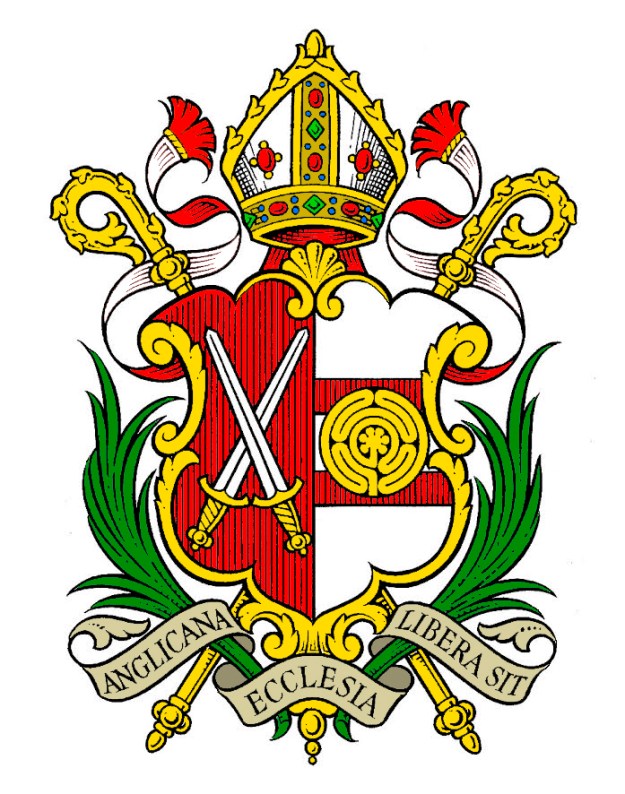
The Right Reverend and Right Honorable Richard Chartres, KCVO, ChStJ, PC, FSA will be stepping down this month after twenty-two years as Bishop of London, the third most senior position in the hierarchy of the Church of England.

london2

His coat of arms (above) depicts the arms of the See of London with its two crossed swords as an allusion to its patron, St. Paul impaled with his personal arms which depict a charge of a labyrinth. This, in my opinion, is a clever way to do a kind of canting arms the medieval labyrinth being a famous feature on the floor of Chartres cathedral.

Thanks to one of my regular correspondents for this fine image of the Bishop’s coat of arms.

Bishop Barres

Here is the version of the coat of arms of Bp. John O. Barres of Rockville Centre, NY published by the diocese.

coatofarms-barres

Hmmmmm…as one correspondent has already pointed out the blazon says that the bishop’s personal arms have a field that is “barry of six” yet seven are depicted here. In addition, the arms of the See are blazoned as having a bordure wavy but that is barely discernible.

Bishop Parkes of St. Petersburg

On Wednesday, January 4, 2017 the Most Rev. Gregory Parkes a 52-year-old Long Island native who has, since 2012 served as Bishop of Pensacola-Tallahassee, Florida will be installed as the fifth bishop of St. Petersburg, Florida.

At the time he was ordained a bishop and installed as the fifth bishop of Pensacola-Tallahassee he assumed a coat of arms (below) designed for him by the well-known Italian heraldic artist, Marco Foppoli:

344

Since the arms of the See of Pensacola-Tallahassee, a dual diocese with co-cathedrals, is divided per fess with each of the See’s two cities occupying, as it were, a quartering of the shield the bishop assumed personal arms that were similarly divided per fess so that when impaled on the same shield the overall effect suggests a quartered shield with a rather pleasing effect.

Upon his translation to the See of St. Petersburg the bishop had his arms rendered by a different artist and, according to the usual North American custom, impaled his arms with those of the very nicely designed and handsome arms of the See:

parkes2

However, we can now see that the bishop has decided to change his personal arms. Firstly, he has decided to add the charge of the Sacred Heart of Jesus in base as an allusion to the coat of arms of his former diocese, Pensacola-Tallahassee. This is not wholly a horrible idea. Rather, it serves almost as a kind of augmentation. However, having said that it also feeds into a very bad habit also present among many of the American bishops today who end up serving in more than one diocese over the course of their episcopal ministry. That is, deciding to add a charge from each place where they have served as though collecting charms for a charm bracelet throughout their lives. This, too, also gets back to the poor idea of having one’s coat of arms serve as a pictorial CV…which it decidedly is not.

I don’t know for certain but the desire to include the Sacred Heart charge which is usually emblazoned as “Proper” (shown in its natural color of red) could perhaps explain the otherwise inexplicable decision to change the tinctures of the section of the bishop’s personal arms in base from “Gules a chi-rho Or” to “Or a chi-rho Gules and the Sacred Heart Proper in bend“.

I think the bishop would have ended up with something better if he had augmented his arms by placing the Sacred Heart on an escutcheon or a bezant or plate imposed over the crossing of the chi-rho or possibly by simply placing it on a canton as a genuine augmentation. In that way he could have left the original tinctures intact and avoided what he essentially has now: an entirely new coat of arms!

Again, the translation to a new diocese is not sufficient justification for redesigning and changing a coat of arms in use for four years.

It’s sad that the age of the internet has created all sorts of new opportunities for the heraldic enthusiast as well as contributed to the proliferation of newly proclaimed heraldic “experts” and yet has, ironically and somewhat paradoxically, also led to the degradation of the quality of heraldic knowledge that is prevalent among those assisting with the preparation of coats of arms, in particular in ecclesiastical circles.

Archbishop Etienne’s Mistake

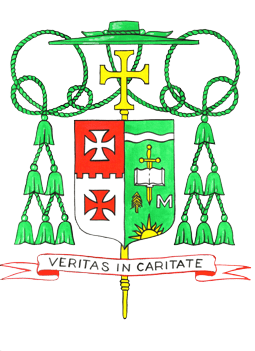
On November 9, 2016 the Most Reverend Paul D. Etienne was installed as the fourth Metropolitan Archbishop of Anchorage, Alaska. Since December of 2009, the 57-year-old Indiana native had been serving as the Bishop of Cheyenne, Wyoming. At the time of his election as a bishop he assumed a coat of arms which he bore during his tenure as Bishop of Cheyenne:
anc

The design was, in my opinion, a bit crowded and fell victim to the usual problem with most of the heraldry of the American hierarchy. Namely, he tried to include too much. Time and time again I warn on this blog and elsewhere against the practice of trying to have a coat of arms be a “CV in pictures”. Sadly, that advice seems to frequently go unheeded.

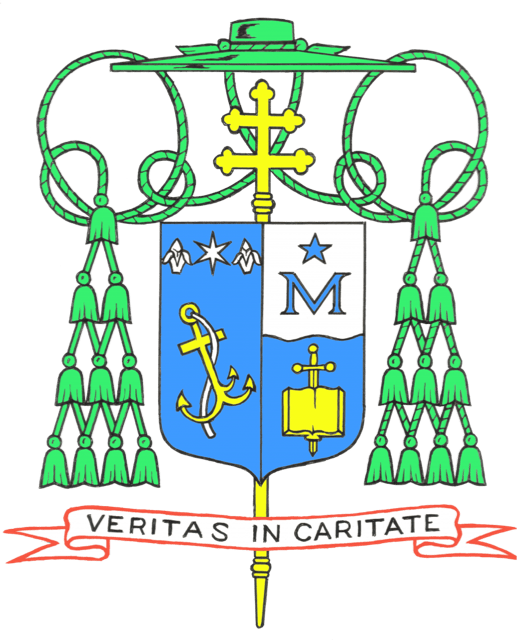
I noticed that when His Excellency was translated and promoted to Anchorage that he has assumed a new personal coat of arms:
anc2

I must say that the overall design is surely more simple and more clear. In addition, it seems apparent that upon further reflection he realized that he had included too many charges and decided that there were, indeed, some he could live without. I think its unfortunate that he decided to discard the green field because just as it contrasted so nicely with the red-dominated arms of the See of Cheyenne, similarly, the contrast with the predominantly blue arms of the See of Anchorage would have been more striking.

The overall appearance of the coat of arms as it is now is most definitely better. However, the “mistake” I believe the archbishop has made is in entirely changing the original design. He has, in fact, assumed a second new coat of arms. Many prelates feel that when they change assignments that this is a perfectly acceptable practice. It’s as if “a new coat of arms for the new job” is their thought. In addition, after having assumed arms originally, often hastily because of the unfortunate expectation that a bishop in the USA will have his coat of arms prepared and ready to be displayed at the time of his ordination and/or installation, which is an unreasonable and unnecessary expectation, the armiger has had a chance for second thoughts and wishes to make modifications. But there is a problem.

You CANNOT.

That is to say, you really REALLY shouldn’t. A coat of arms isn’t a “logo” which companies often feel free to update, modify or even discard in favor of a new one. A coat of arms is a personal mark of identification and it becomes identified with the particular armiger to whom it belongs. In places like the USA where arms are not granted by a heraldic authority but are legally and quite appropriately assumed (i.e. adopted) great care must be taken to design a coat of arms with which the armiger is happy at the time they are assumed and made public.

In the case of a bishop the personal arms should not be designed to harmonize with the arms of the See with which they will be impaled for the simple reason that bishops sometimes move and re-designing the personal arms to “go better” with the arms of the See is ill-advised. (see the three different versions of the personal arms borne by Cardinal Cupich of Chicago or Bishop Libasci of Manchester, NH. Cardinal O’Brien, the Grandmaster of the Order of the Holy Sepulcher has changed his coat of arms no less than four times!). Part of the problem is the truncated timeline with which so many bishops have to contend when the design process begins. It is not unheard of for there to be as little as six weeks in between the announcement of his appointment and the ordination/installation. The poor heraldic designer must then contend with constant pressure from diocesan officials and committee members demanding the finished artwork for use on things like invitations, programs and in press packets.

But, designing a good coat of arms takes time. Frequently the designer and the armiger will go through three or four sketches (or more) before settling on a proper design. More frequently because of the time constraint (and occasionally because of a complete lack of interest in the subject on the part of the new bishop) something deemed to be “good enough” is cobbled together in a slap-dash manner and the result is, at best, a less-than-perfect design and, at worst, downright ugly and/or ridiculous!

When designing a coat of arms for someone who is not on a three week deadline I often encourage them to use what is jokingly referred to as “the refrigerator test”. That is, they are asked to take a sketch of the coat of arms and put it somewhere, like their refrigerator, where they will see it everyday. The idea is to live with it for a time and keep seeing it over and over to see if the initial ideas have staying power. In the case of Archbishop Etienne such a test might have enabled him to see that the original design was cluttered and that those things he wanted to represent in his coat of arms could have been done with a simpler design. Part of the solution here is to abandon the idea that a new bishop’s coat of arms must be available immediately, in a manner of weeks, and in time for his ordination/installation. I can assure you that in places where arms are granted by a heraldic authority such an authority feels no obligation to do their work with such a ridiculous deadline. There is absolutely nothing that requires a bishop’s coat of arms to be finished and ready by the day of his ordination/installation. A few more weeks to get it right won’t kill anybody.

Part of this problem could be solved by bishops seeking the advice of those competent and well-versed in the principles, customs and traditions of good heraldic practice. More often than not they don’t. They need to stop turning to the myriad of lawyers, engineers, seminarians and other enthusiasts who have read “a whole book” on heraldry and have declared themselves to be “expert” in heraldic design. In addition, the computer age has also led to the advent of a plethora of the heraldic equivalent of the singer/songwriter: those people who are competent artists but who don’t really know the first thing about heraldry or its rules. They can create really nice artistic renderings but should be collaborating with a competent designer instead of trying to do it all. Expertise in DESIGNING a coat of arms and in DEPICTING that design are two very different things.

Finally, it has to be said that, in the Church anyway, it is unfortunate that those who make the most use of heraldry, prelates, are frequently the ones who both know the least about it and also frequently have little interest in learning about its proper use and application. (You know, once they make you a bishop they take the bone out of your head that allows you to remember you can occasionally still be taught something). As mentioned above, a coat of arms can’t simply be changed after several years because one feels like it. Despite the fact that it belongs to the armiger and, in many cases, was devised by him as well as adopted by him he is not free capriciously to change the design on a whim especially not after having borne a particular coat of arms for years. It is akin to deciding to use an alias after years of being known as something else. While there is no “heraldry police” in the Church to stop you it is, nevertheless, wrong to change the design of a personal coat of arms even when such changes result in the general improvement of the design.

Rather, the task is to have a well-designed and pleasing coat of arms the first time around and to use that same coat of arms no matter how often a bishop might be transferred to a new diocese. It is important to remember that impaling the personal arms with the arms of the See is a custom, not a requirement, and not even a universal one at that. It predominates in N. America but it is far from the usual custom throughout the world. When impalement is employed bishops need to remember that the dexter impalement (the arms of the See) does not become part of their coat of arms. Instead, by impaling there are two distinct coats of arms being displayed on one shield. It is a form of marshaling two or more coats of arms and even at that it lasts only for their tenure in that office. A bishop-emeritus of a given diocese has no right whatsoever to continue impaling his personal arms with the arms of the See once he has resigned that See.

The best process to use is the same one which circumstance forces onto those bishops who first become Auxiliary Bishops. Namely, they design and assume a personal coat of arms alone which fills the entire shield. Later, if they are promoted to be a Diocesan Bishop then they may choose to impale their personal arms with the arms of their diocese. If, by chance, such an impalement makes for an aesthetically unpleasing combination then the solution is NOT to change their personal arms (or the diocesan one for that matter). The better option would be for the bishop in question simply to bear his personal arms alone and not impale them at all. It is important, however, for the armiger to maintain that coat of arms which he first assumed and which has become identified with him as much as his signature or the appearance of his face. As already stated above even when the temptation is strong to re-design the coat of arms for the purpose of improving the design after further reflection such an impulse must be stifled and ignored. Once the arms have been assumed it is, frankly, too late. That’s why its better to be sure of what is being assumed in the first place; it cannot, and should not be changed later.

I have written in these pages extensively about the idea of employing various versions of a coat of arms to suit the occasion and/or office held. Sometimes, coats of arms receive legitimate augmentations to reflect some event or change in status. Frequently, the external ornaments in a heraldic achievement, even of a bishop, change or are added to in order to reflect an honor received. All of these are legitimate modifications. However, for a bishop who has assumed a coat of arms and several years later is then moved to a different diocese or some other such position within the Church simply to say to himself, “You know, I’ve had second thoughts about including thus-and-such in my coat of arms. If I had to do it over again I’d use something different. Let me take advantage of this change and the fact that new artwork has to be prepared to redesign the whole thing” is egregiously wrong and is, realistically, a gigantic abuse of his authority. After all, in the Church what a bishop wants is rarely questioned and even more rarely denied.

Nevertheless, it is of utmost importance to get it right the first time, that is, at the time of assuming the coat of arms. Changing it later ISN’T an option and bishops who ignore that are making a mistake.

(The artwork for Archbishop Etienne’s coats of arms is by Deacon Paul Sullivan)


Bishop Barres Appointed to Rockville Centre, NY

On December 9 it was announced that Pope Francis appointed the Most Rev. John O. Barres, since 2009 the Fourth Bishop of Allentown, PA, as the Fifth Bishop of Rockville Centre, NY. (the diocese on Long Island in which I was born and raised)

His coat of arms will be:


The personal arms depict red and silver bars as a canting device recalling the Bishop’s family surname “Barres.” The Bishop’s immigrant ancestor, Jacob Barres came from Prussia and first settled in Lehigh County in 1852.

The blue eagle with the halo is the symbol of St. John the Evangelist, honoring the Bishop’s baptismal name patron. The cross keys symbolically express the Bishop’s dedication and fidelity to the See of Peter and to the Pope. The dolphin is taken from the arms of St. John Fisher, and the rose represents St. Thomas More, particularly his chain of office as Lord Chancellor of England. Pope John Paul II, by motu proprio in 2000, declared Saint Thomas More the Patron of Statesmen, Politicians, and Lawyers. Both of these saints, one a prelate and one a layman, were martyrs for the Faith and remained loyal to the Church and the Holy See. Their symbols are depicted in red to indicate their martyrdom. The axe represents President Abraham Lincoln of whom the Bishop is a great admirer.
They are impaled with the arms of the See of Rockville Centre adopted in 1957. These arms are based on the history of Long Island and the etymology of the name Rockville Centre. The colors of the field within the bordure, gold and blue, appears on the coat of arms of King William III of the House of Nassau and on the arms which the county of Suffolk in England has used at times, these arms being those of Ipswich. Although there are more than 12 names for Long Island, the name generally preferred by the Indians of the mainland was Seawanhacky or “Island of Shells.” The scallop shell is also truly heraldic, and a symbol which is often used to signify the flowing of water in the Sacrament of Baptism.

The wavy silver bordure is the heraldic equivalent of water and surrounding, as it does, the other charges, signifies the insular nature of the diocese. The lamb’s head is the symbol of St. Agnes, virgin and martyr, the titular of the Cathedral of the Diocese of Rockville Centre. St. Agnes has been represented with a lamb, the symbol of her virginal innocence, since the Middle Ages.

The black roundel in the center of the shield with the three stones or rocks affords canting arms for Rockville Centre. The black roundel is in the exact center of the shield. The three rocks or stones are derived from the coat of arms of Pope Pius XII, who established the new Diocese of Rockville Centre in April, 1957. The roundel is tinctured in black to represent the seventeenth century name of Brooklyn, from the diocese from which the See of Rockville Centre was separated. The black tincture represents the marshes, which recalled to the Dutch their homeland in Breuckelen in the Province of Utrecht. The Dutch who first settled Brooklyn called it “Breuck-Landt’” meaning “broken land,’ or “marshland,” inasmuch as a great deal of the land was broken up by patches of water.

Barres will be installed in Rockville Centre on January 31, 2017.

Bishop of Aachen

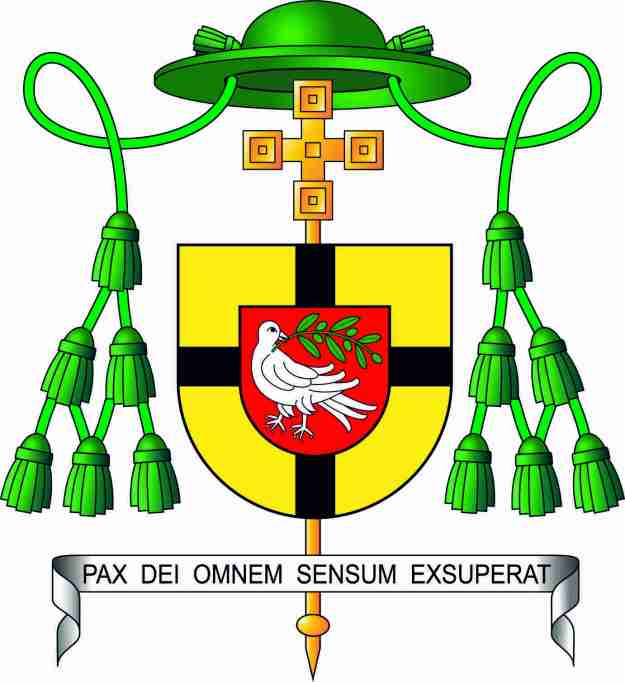
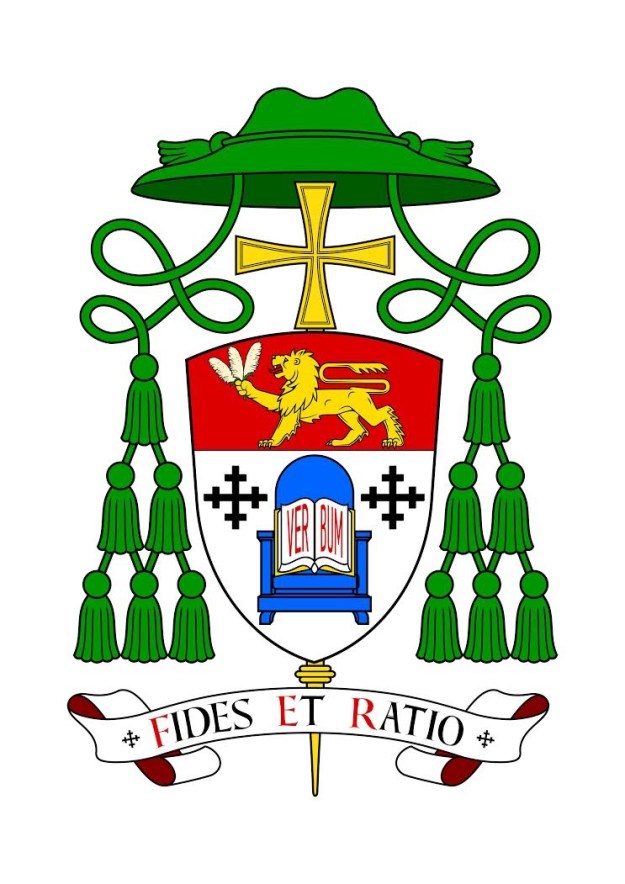
On November 12 the Most Rev. Helmut Dieser was installed as the VI Bishop of Aachen, Germany. His coat of arms is:

wappen-bischof-dieser-gr.jpg

The description (translated from the diocesan website) is:

The coat of arms of the new bishop of Aachen shows two motifs in the shield: the one stands for the diocese of Aachen, and the other identifies the person of the bishop.The Diocese of Aachen has a black cross on a golden ground in the shield. In the smaller Mittelschild, the person of Bishop Dr. Helmut is designated.

The middle shield shows a silver dove against a red background with a green olive branch in its beak. The new bishop accepted this motif from his former coat of arms as an auxiliary bishop in Trier. It symbolizes his episcopal motto from the Philippine letter: “The peace of God exceeds all understanding“. The two colors red and silver also recall his origin from the diocese of Trier, which is a red cross in front of a silver ground in the shield. The dove with the olive branch is used in Christian art as a symbol of the new peace that God wants to bring to all his creation. This goes back to the biblical narrative of Noah and the great flood in the Book of Genesis. When finally the water no longer rises and gradually begins to flow away, Noach lets a dove fly from the ark several times. The second time she comes back with a fresh olive branch in the beak (Gen 8, 9-11). Noah understands: God does not want to spoil the earth, but makes it back to the homeland for life. God creates a new peace, which Noah and his own may accept in faith.

Peace, which surpasses all understanding, and which the whole of creation longingly waits for (see Romans 8: 21-22), arises from the greatest love of God, in which he gives his Son, so that all may come to the new life. The embellishments surrounding the coat-of-arms signify its bearer as a bishop: the green hat with six green tassels on each side, and the gold episcopal cross.

Bishop Rodríguez

Today, November 4, in Denver, CO the Most Rev. Jorge Humberto Rodríguez-Novelo is to be ordained Titular Bishop of Azura and Auxiliary Bishop of Denver.

His coat of arms was designed by the Vicar General of the Archdiocese. However, early on in the process, very shortly after the bishop’s appointment was announced, the director of the Office of Worship of the Archdiocese contacted me to ask if I might be willing to act as a consultant during the design phase of the project which I was happy to do. In fact, I explained, this is really and truly the area of heraldry where I am most at home. I am far from a great artist but my real expertise is in the designing of a good coat of arms. I can tell you all the “whys and wherefores” about what goes into a good design. Once again, we see that heraldry is both an art and a science. It is not primarily the realm of the heraldic artist. Rather, first and foremost the whole thing must start with someone who is knowledgeable about the rules, customs and history of heraldry as well as have a good eye for composition, balance and proportion. I am far more at ease with the work of the herald than that of the heraldic artist.

Since its beginnings, and right down to our own day, the work of heralds has involved the devising, granting and recording of coats of arms. However, it has also included expertise in genealogy and family history, protocol and ceremony. In addition, it is rare that the herald actually renders the artistic depictions of the arms he designs. That task is left to those with expertise in drafting and art who are usually contracted independently by the herald or by the armiger to create beautiful emblazonments.

I have always been one of those who comes down firmly in this debate on the side of the herald, not the artist, as the person who does the “real work” of heraldry. This is not to disparage heraldic artist, whose work is not only painstaking and highly detailed but requires tremendous skill as well as training. But, the simple truth is that one can still paint a coat of arms while at the same time knowing absolutely nothing about the science of heraldry whereas one cannot claim to be competent at designing a coat of arms simply because one can paint or draw well. The heraldic world is best served when both act together in tandem to produce beautiful and correct heraldry.

Over the last thirty-three years my focus has been on learning as much as I can about the science of heraldry and only dabbling as an amateur in producing heraldic artwork. I do not now, nor have I ever, claimed otherwise. So, when a person contacts me to ask me to paint their coat of arms I usually balk but when they ask me to consult on a design I’m right in my comfort zone, as well as my “competency zone”.

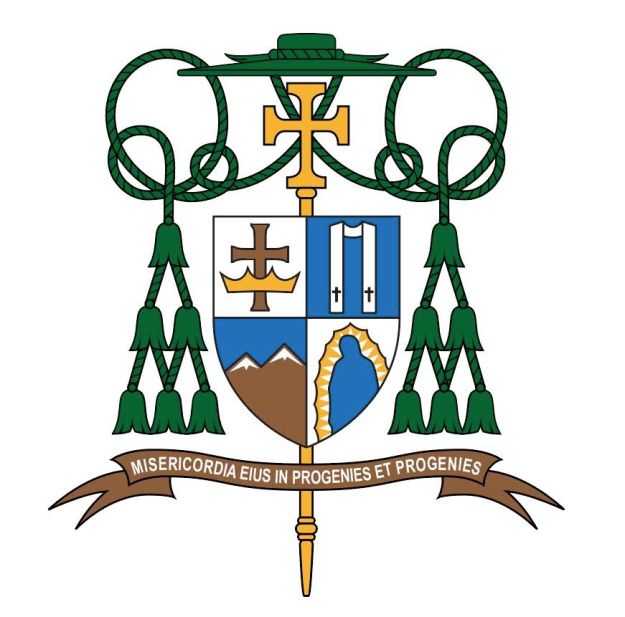
In the case of the coat of arms of Bishop Rodríguez there were several elements of his life and ministry he wished to represent in his coat of arms. In Denver they came up with an initial design, very much a work in progress and then asked for my in put. The bishop wanted to represent Christ the King, priestly ministry, the local church in Colorado and Our Lady of Guadalupe. This is the first draft:

rod1

After some discussion back and forth I made several proposals that sought to unify the imagery and create a single, more simple, more bold design. The first thing to be avoided was falling into the trap of quartering the field and then filling each quarter with things. It was also important to avoid the use of the color brown as this is not one of the tinctures used in heraldry. Since the symbol for Christ the King occupied the first quarter and was, in a sense, the principal element to be represented we first moved to create a large compound charge of the crowned Chi-Rho. This, then alludes to Christ, the King as well as to priestly service as all priests share in the High Priesthood of Jesus. Then it was a simple matter to allude to the Rocky Mountains of Colorado by a division line in the field and to add the rose as a fitting heraldic charge that is frequently used as a reference not only to Our Lady in general but to Guadalupe in particular. This is because of the roses that bloomed in December which were brought by Juan Diego to his bishop who asked for “proof” of the apparitions. I originally proposed placing the red rose on the silver chief or changing it to a golden rose. However, the bishop really wanted the rose depicted in the traditional red so we cheated a little on the tincture rule (avoiding a color on a color or a metal on a metal) by blazoning the rose as “Proper” which does permit such violations in the case of charges that are depicted Proper. After some of my suggestions were considered a second draft was prepared in Denver which also changed the general shape of the episcopal cross behind the shield and the galero and tassels in order to give the whole achievement a look that was unique. This draft met with the new bishop’s approval. So, the arms he has assumed today are:

rod2

These arms were designed and emblazoned by Fr. Randy Dollins with me acting as design consultant.


Auxiliaries of Boston

On August 24, 2016 two new Auxiliary Bishops to the Archbishop of Boston will be ordained. Their coat of arms are below for

The Most Rev. Robert Reed, Titular Bishop of Sufaritanus

reed

The Most Rev. Mark O’Connell, Titular Bishop of Gigthensis

o'connell

Hmmmm…interesting. Pretty. Busy. Good?

The designs, accompanied by very interesting descriptions, especially for lovers of fiction, are by J.C. Noonan and the artwork is by his usual collaborator Linda Nicholson.

Two New Auxiliaries for Sydney

On August 24 two new auxiliary bishops to the archbishop of Sydney will be ordained. I had a hand in designing both of their coats of arms along with Mr. Richard d’Apice and they were rendered by Mr. Sandy Turnbull. Both of these men are members of the Australian Heraldry Society. The two bishop are The Most Rev. Anthony Randazzo (49) a Sydneysider who is a priest of the Archdiocese of Brisbane. He will be Titular Bishop of Quiza. (arms below)

unnamed

And the Most Rev. Richard Umbers (45) born in New Zealand, a priest of the Personal Prelature Opus Dei who will be Titular Bishop of Thala. (arms below)

unnamed (1)

Clergy With More Than One Coat of Arms

We turn, this time, to the Church in Wales and the Church of England to see examples of a single armiger who employs more than one version of his coat of arms depending on the place, occasion, function or group.

13892221_10208127383875107_5503597389361931120_n
The first image (above) is the personal coat of arms of the Rt. Rev. Gregory Cameron, Bishop of St. Asaph in Wales. It is a an armorial achievement which is depicted in the traditional manner with shield, helm, mantle and crest. In addition, the bishop employs a version of his arms ensigned with the bishop’s mitre (below) as is the usual custom in the constituent churches of the Anglican Communion.

13872820_10208127384075112_4233918059583834479_n

Finally, there is also a version, as diocesan bishop, of his personal arms impaling those of his See.(below)

13886228_10208127384235116_4346056847431773851_n

The other example is the Rev. Canon Robin Ward, SSC, Principal at St. Stephen’s House, Oxford. The first example shows his personal arms as granted with helm mantling and crest. (below)

13876420_10208127384395120_4674437678405422823_n

The next image depicts an “ecclesiastical version” of the same arms ensigned with the ecclesiastical hat of a Canon according to the Earl Marshal’s Warrant of 1976.

13680924_10208127384675127_991321201882530396_n

Finally, there is an example, though not used by him, of his arms “as Principal” impaling the arms of St. Stephen’s House.

13892285_10208127384995135_6315993294064764138_n
In both cases it’s just one armiger but his coat of arms can be depicted in different exemplifications.

Bishop of Parramatta

On June 16, 2016 the Most Rev. Vincent Long Van Nguyen, OFM Conv, formerly Auxiliary of Melbourne, was installed as Bishop of Parramatta, Australia succeeding Archbishop Anthony Fisher, OP of Sydney.

His coat of arms (below) was assumed in 2011 when he became a bishop and is now impaled with the arms of his See. The design of his personal arms was undertaken by me with Mr. Richard d’Apice, AM, KCHS and rendered then as now by Mr. Sandy Turnbull both of the Australian Heraldry Society.

unnamed

Bishop James Checchio of Metuchen, NJ

image


On Tuesday, May 3, 2016 the Most Reverend James F. Checchio, a priest of the diocese of Camden, NJ and most recently until February of this year the Rector of the Pontifical North American College in Rome, will be ordained a bishop in the Church and installed as the fifth bishop of the diocese of Metuchen, NJ, the diocese in which I serve.

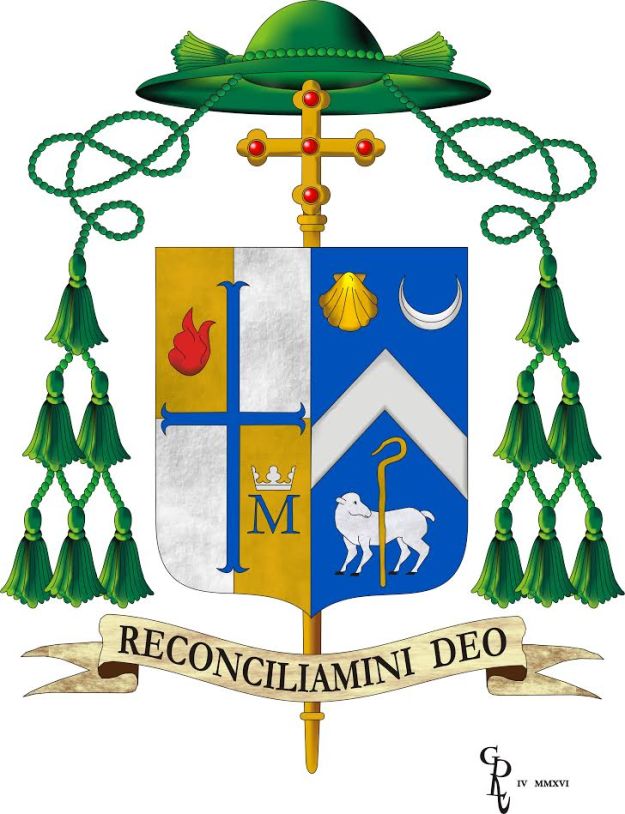
His newly adopted coat of arms is depicted, as is the usual custom in the United States for diocesan bishops, impaled with the arms of the diocese. The diocesan arms were designed in 1981 when the diocese was established and modified in 1998. The four quadrants, depicted in silver and gold, the colors of the flag of the Vatican City-State, represent the four counties of the diocese: Middlesex, Somerset, Hunterdon and Warren. The moline cross overall is taken from the arms of Trenton from which the diocese was separated in 1981. In the Trenton arms the cross is gold on a blue field. Originally, it was depicted in the Metuchen arms as black but that was changed in 1998. The red tongue of fire in the upper left alludes to both the Holy Spirit and to the name “Metuchen” which is a Lenne Lanape word meaning “land of firewood”. The crowned letter “M” in the lower right is a reference to St. John Paul II who, as pope, founded the diocese and whose arms depicted a letter “M” in the lower right corner. With the crown it is also a symbol of the Queenship of Mary, the patroness of the diocese. Originally the “M” was also black but when the late Bishop Vincent Breen asked me to undertake a redesign of the diocesan arms in 1998 the “M” was changed to blue along with the cross.

Bishop Checchio commissioned the Italian artist Renato Poletti to work with him on his personal arms and emblazon them marshaled to those of the diocese. The gold escallop shell is a reference to his baptismal patron, St. James the Greater and the silver crescent represents Our Lady under the titles of the Immaculate Conception the patroness of the cathedral of his native diocese of Camden, as well as of the Pontifical North American College and the United States of America. The chevron represents a roof beam and, as such, symbolizes protecting the flock which is the task of a bishop. The sheep and crook are an allusion to his work as rector of a seminary preparing men to be shepherds in priestly ministry.

The motto reads, “Let Us Be Reconciled to God” a fitting message for a bishop appointed during the Jubilee Year of Mercy.

Ad Multos Annos, Bishop Checchio!


Bishop J. Gregory Kelly

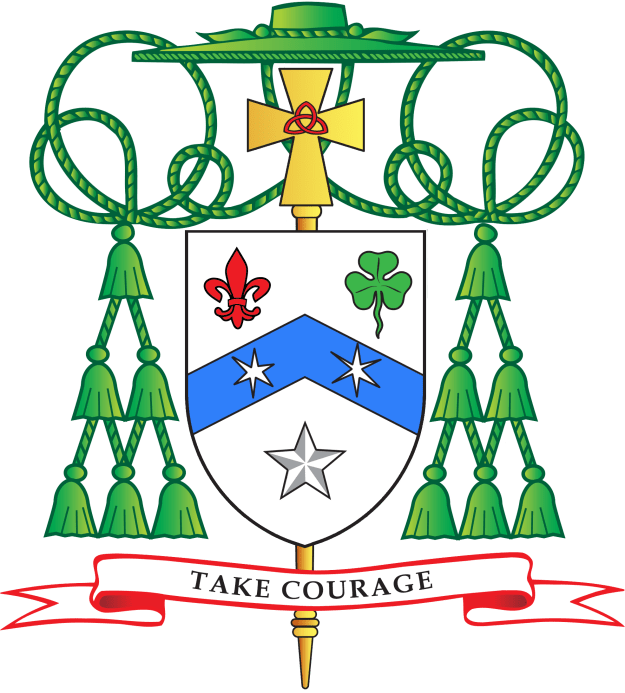
On February 11 the Most Rev. (John) Gregory Kelly was ordained as Auxiliary Bishop of Dallas. The description of the coat of arms (from the diocesan website):

“Bishop Kelly’s arms are based on the Kelly family design where the shield is silver (white) and the charges are black. For difference, and for his deep devotion to the Blessed Virgin Mary, the chevron is now blue. The chevron is reminiscent of the mountains of Colorado, so dear to His Excellency’s youth and the chevron is charged with two estoiles (special, six pointed stars) that are taken from the mantle of the image of Our Lady of Guadalupe to remind all of the profound Hispanic influence in Texas, the “Lone Star State“, represented by the single star below the chevron. Above the chevron are a fleur-de-lis and a trefoil (the heraldic representation of a shamrock) to honor the Bishop’s Irish and French-Canadian heritage.”

Once again we see here an example of the increasingly popular (and completely WRONG!) trend of personalizing one of the external ornaments, in this case, with the addition of the triquetra on the episcopal cross (erroneously referred to as a “processional” cross in the description) to represent the Holy Trinity because it was the name of the seminary the bishop attended.

It is necessary to repeat that the only thing subject to having charges particular to the bearer is the shield. The external ornaments may NOT be personalized in a heraldic achievement of this type and all those who advocate such a practice are both incorrect and foolish! The heraldic artist is completely free, in future, to depict this bishop’s coat of arms with an episcopal cross of any shape and manner he might wish. This is what happens when armigers turn to those who do not know what they are doing for the devisal of their coats of arms.

Kelly-COA

Artwork: P. Sullivan

New Bishop of Cremona

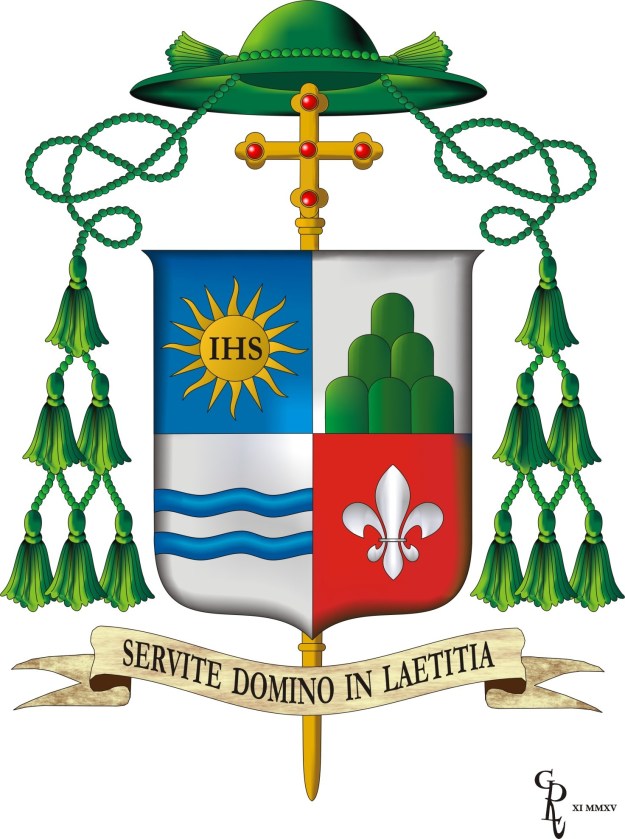
On January 30 the Most Rev. Antonio Napolioni will be ordained as the new Bishop of Cremona. His newly-adopted coat of arms (below) combines symbols of two popes he admires (the sun from the arms of Pope Francis and the fleur-de-lis from the arms of Bl. Paul VI), the rivers of Cremona and the mountains as a symbol of the journey of faith and, in particular, the Transfiguration. The motto, “Serve the Lord With Gladness” is from Psalm 99.

Stemma-vescovo-Antonio-Napolioni