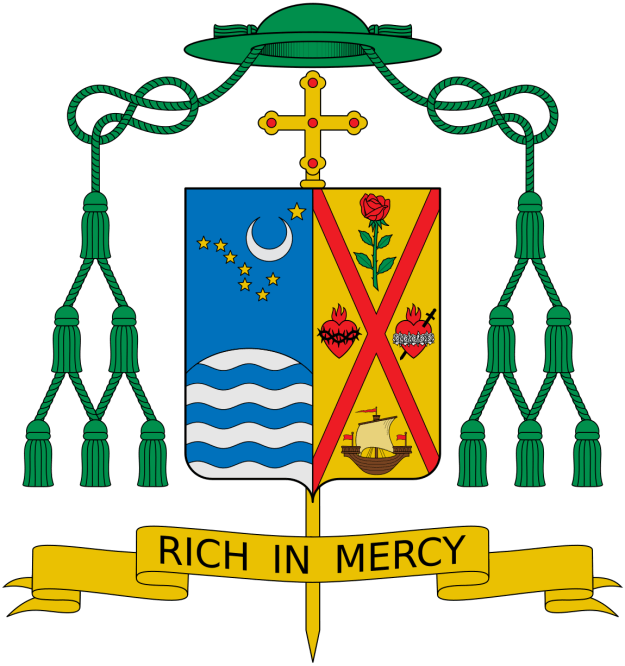
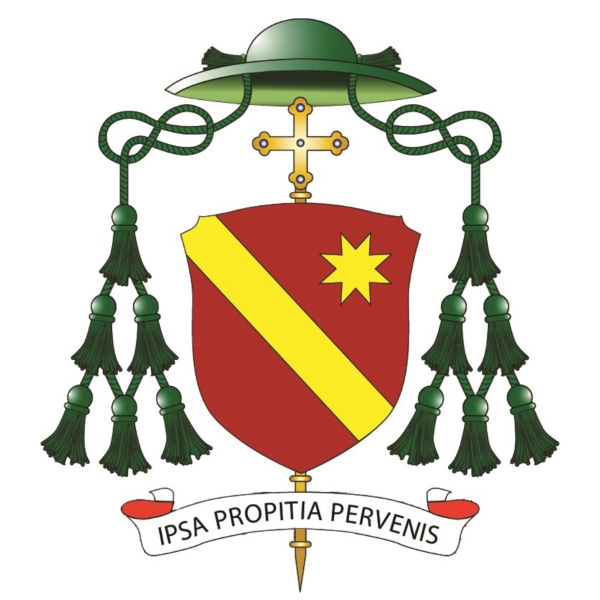
Congratulations to my own bishop, Most Rev. James Checchio, 5th Bishop of Metuchen, on the 2nd anniversary of his ordination and installation. Ad Multos Annos!

Congratulations to my own bishop, Most Rev. James Checchio, 5th Bishop of Metuchen, on the 2nd anniversary of his ordination and installation. Ad Multos Annos!

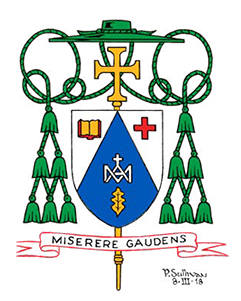
The Most Rev. Joel Matthias Konzen, S.M. (67) a priest of the Society of Mary (Marists) was ordained as the Titular Bishop of Leavenworth and Auxiliary to the Archbishop of Atlanta on April 3, 2018. His coat of arms is explained by its designer and artist, Deacon Paul Sullivan.

The episcopal heraldic achievement, or bishop’s coat of arms, is composed of a shield, that is the central and most important part of the design and tells to whom the design belongs, the external ornamentation, that tells the owner’s position or rank, and a motto, placed upon a scroll.
For Bishop Konzen the shield is silver (white) with a blue pile (an “A” shaped device) upon which is displayed the conjoined “A” and “M,” known an “the monogram of Mary,” in silver (white) that is the emblem of the Society of Mary, known as the Marists, that is the Bishop’s religious community. The pile resembles an inlet of water, such as a bay or harbor, and this pile is charged with a gold (yellow) oak leaf to signify Oak Harbor, Ohio, where Bishop Konzen was born and raised.
Above the pile are an open book (gold [yellow] with red edges) and a red cross of The Faith to signify that Bishop Konzen has spent most of his life in education, in a Catholic environment, including his last position, before coming to the fullness of Christ’s Most Holy Priesthood, as a Bishop, as President of the Marist School in Atlanta.
For his motto, His Excellency, Bishop Konzen has adopted the Latin phrase “MISERERE GAUDENS,” that is taken from the 8th verse of the 12th chapter of Saint Paul’s Letter to the Romans. This passage can be paraphrased as “Be merciful, and with a cheerful heart.”
The achievement is completed with the external ornaments that are a gold (yellow) episcopal cross, that extends above and below the shield and a pontifical hat, called a galero, with its six tassels, in three rows, on either side of the shield, all in green. These are the heraldic insignia of a prelate of the rank of bishop by instruction of the Holy See, of March 1969.
The Most Rev. Jon Hansen, C.Ss.R. (51) was ordained a bishop and installed as the seventh Bishop of Mackenzie-Fort Smith, Canada on March 16th. His coat of arms was designed by himself.

The Most Rev. Mario Aviles, C.O. (48) former Procurator General of the Confederation of Oratorians of St. Philip Neri, was ordained Titular Bishop of Cataquas and will serve as the first Auxiliary Bishop of Brownsville, Texas on February 22, 2018.

This morning Pope Francis named the Most Rev. Robert Coyle (53), Titular Bishop of Zabi, originally a priest of the Diocese of Rockville Centre, NY who has been Auxiliary Bishop of the Archdiocese for the US Military since 2013 to be the Auxiliary Bishop of Rockville Centre. Welcome home Bishop Coyle!
His arms (below) were designed by me in 2013.

The Most Rev. J. Mark Spalding (53) was ordained a bishop and installed as twelfth Bishop of Nashville on February 2, 2018.

The Most Rev. William Shawn McKnight (49) was ordained a bishop and installed on February 6, 2018 as the fourth Bishop of Jefferson City, Missouri.

Well…at least it IS uncomplicated and clear.

The coat of arms (above) of the Most Rev. Barry C. Knestout, since 2008 Titular Bishop of Leavenworth and Auxiliary Bishop of Washington, D.C., his native diocese, appointed as the 13th Bishop of Richmond, Virginia last December. He will be installed in Richmond on January 12.
His coat of arms, expertly rendered by Marco Foppoli, impale the arms of the See of Richmond with the personal arms of the bishop assumed finally, after two other previous iterations, shortly after he was ordained a bishop.
While Bishop Knestout was always rather clear on what charges (individual elements) he wished to employ on his coat of arms the composition of the design went through various changes until he finally settled on the arms he bears today. He always intended to pay homage to the Ordinary he would serve under as Auxiliary Bishop, HE Donald Cardinal Wuerl, by using the single charge in the cardinal’s own arms; a tower. In addition, Bishop Knestout wanted very much to honor the previous Archbishops of Washington whom he served for many years as private secretary, HE James Cardinal Hickey, and HE Theodore Cardinal McCarrick. From their respective arms he borrowed a lion. In addition, the bishop wished to include symbols alluding to his ancestry and his native state of Maryland. This was accomplished with the other charges and the choice of tinctures and metals to be employed.
At first the arms were to look like this:

However, on further reflection it was decided to try and incorporate the charges symbolic of the Archbishops together on the field and to bring greater uniformity to the other charges and keep them separated on the chief. In addition, he decided to render the motto in english rather than latin. The design then looked like this:

In fairness, it was probably not in the bishop’s mind that he would be made a diocesan bishop himself one day so he probably wasn’t thinking along the lines of how his coat of arms would look if impaled with the arms of a diocese. If he had he might have stopped here because this design would, indeed, have more easily impaled with another coat of arms and not suffered too much from being squeezed into one half of a shield. Finally, another decision was made to surround the field with a bordure (border) rather than use a chief and we arrived at the arms Bp. Knestout has used for almost ten years:

While it is not mandatory but merely customary for in North America for bishops to impale their arms with those of their See (i.e. depict their own personal coat of arms marshaled together side by side with the arms of their diocese on the same shield in the manner of two coats of arms of people married to each other) the decision to do just that has been made. It is the usual custom in the USA but it presents a problem.
The usual practice in heraldry when arms with a bordure are impaled is not to continue the bordure all the way around the field. Rather, along the line of impalement the bordure is not depicted. This is known as dimidiation. It applies not only to bordures but also to any kind of orle or tressure. If it were a plain bordure this wouldn’t matter so much. But, in the case of Bishop Knestout’s arms the bordure contains charges. Dimidiating the bordure leaves those charges out and/or cuts them in half.
Dimidiation would be most correct not only for the bordure around the field of the bishop’s personal arms but also the red tressure on the arms of the See of Richmond. As you can see in the coat of arms of the last bishop, the late Francis X. DiLorenzo:
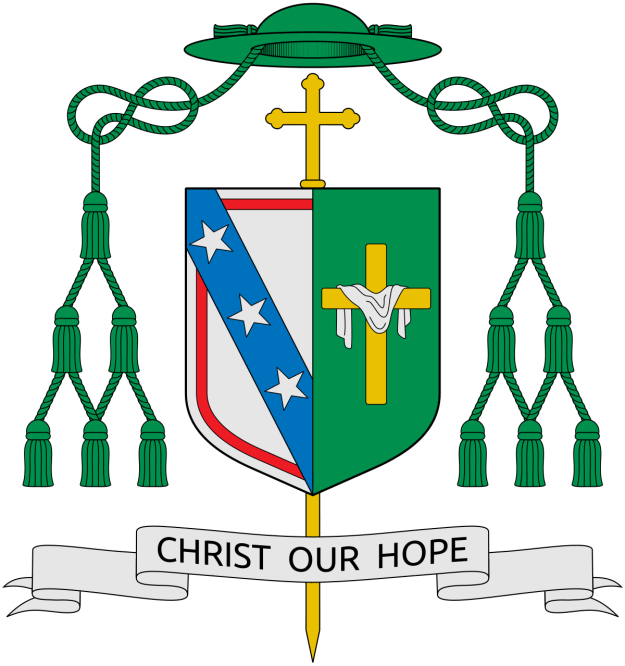
Plainly one can see that the red orle, or tressure, that surrounds the silver field is not entirely depicted. This has been the custom for previous bishops of Richmond as well. However, as I have already noted, this doesn’t have as big an impact as the dimidiation of the bordure in Bishop Knestout’s personal arms which would, of necessity, require one of the fish to be omitted and two of the crosses to be cut in half.
In addition, the space required to (incorrectly) depict the entire bordure forces the lion to be shown as “spilling over” the field and onto the bordure as well in order to be clearly seen and not reduced to the point of being difficult to discern. Again, this is problematic. I will simply quote the great Bruno Heim, “In heraldry the charges should never overlap.” The bordure is an ordinary charge that should entirely surround the field and contain those charges depicted thereon.
These criticisms I offer hesitantly because of the well deserved reputation of Marco Foppoli, the artist who depicted this rendering of the bishop’s impaled arms. Marco is an internationally known and respected heraldic artist of the highest calibre. However, he did not design the armorial bearings of Bishop Knestout or of the See of Richmond. Perhaps he was simply complying with the wish of his client to have his arms both impaled with the See of Richmond and depicted fully without the dimidiation?
So, what is the better, more “heraldically correct” solution to the problem? There are two options. The first is to respect the usual conventions of heraldic marshaling and dimidiate both the bordure in the bishop’s personal arms as well as the orle in the arms of the See. It is sometimes the case when two or more coats of arms are marshaled together on the same shield that such circumstances occur. Again, I will remind the reader that an individual does not assume a coat of arms by designing them to harmonize well with some yet unforeseen coat of arms with which they may be impaled or quartered. Anyone who does that would be, to put it mildly, slightly presumptuous! The second solution is the easier, albeit less conventional. Namely, in this instance the bishop could have chosen simply to bear his own arms and not impale them with the See of Richmond. As I indicated above impaling the arms is customary not mandatory. In addition, it just so happens there is adequate precedent for such a course of action in the history of the Diocese of Richmond. Bishop Knestout’s predecessor, Bishop DiLorenzo was himself preceded by Bishop Walter Sullivan who served from 1974-2003 and was also an Auxiliary Bishop of Washington prior to that from 1970-1974. Bishop Sullivan for all of his twenty-nine years as Bishop of Richmond bore his personal arms alone, the arms he assumed on becoming a bishop, and did not impale them with the arms of the See of Richmond.
My compliments to Marco Foppoli for another very nice artistic rendering. However, to whomever made the decision to impale the arms without the necessary dimidiations I would suggest that was an ill-conceived idea that flies in the face of accepted heraldic practices and was, furthermore, completely unnecessary given the precedents.
Heraldry has rules and you can’t just do whatever you wish!
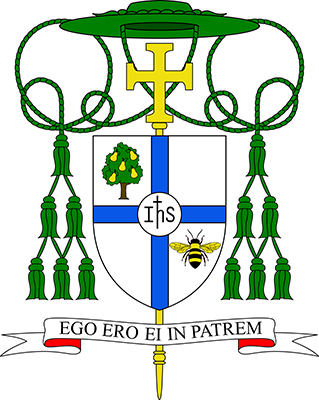
On November 29 the Most Rev. Edward Weisenburger (56), since 2012 the Bishop of Salina, Kansas, was installed as the Eighth Bishop of Tuscon, Arizona. When he was ordained a bishop in 2012 he assumed a coat of arms that was designed by J.C. Noonan and marshaled to the See of Salina. Once again Mr. Noonan has worked on Bishop Weisenburger’s current coat of arms:

Overall, a very pleasing design and nicely rendered by the artist who is Mr. Noonan’s regular collaborator.
However, the bishop, whether on his own or advised by Mr. Noonan has made the classic mistake of thinking that he is free simply to change the design of his arms on a whim simply because he is taking up a new position. Worse, the changes in the design are justified as harmonizing better with the arms of the See. That is a very poor justification for large scale changes to the design of personal arms, especially when one considers that while it is a long standing custom in the Church in the United States for diocesan bishops to impale their personal arms with those of the See it is not, by any means, a requirement. A good heraldic designer would know that if a man’s personal arms do not harmonize well with the arms of a See then it is, perhaps, a better design decision and a better heraldic decision for the bishop to refrain from marshaling his own arms with the diocesan arms.
As I said in my previous post about the arms of Bishop Siegel of Evansville, this is why it is important to settle on a good design at the time arms are assumed. You CANNOT change them later on a whim! Your coat of arms identifies you. Moving to a new assignment doesn’t change your identity.
The coat of arms originally assumed by Bishop Weisenburger was:

The charge of the Lamb of God is still prominent but has been moved from the main charge to being in a secondary position on the chief. For some reason the garbs have been eliminated. In the description provided of the arms in 2012 it said they represented the Eucharist and also, “Kansas wheat”. I suppose the thinking was to eliminate them since he no longer would be living in Kansas. But, as symbols of the Eucharist they are still justified in the design. Not to mention that as a part of his coat of arms for five years already they are part of his personal identifying mark.
Now the arrowhead has become the main charge and a star has been introduced. This effectively makes this an entirely new coat of arms.
The new description justifies all this in the following manner:
“The base of the bishop’s personal shield is worked entirely in gold—the color in Catholic heraldry representing the purity of the Triune God, Divinity and truth. Upon this gold field appears a large stone arrowhead, depicted here as those that may be found in archeological dig sites within the Tucson diocese’s borders. An arrowhead presented in the downward position is a heraldic sign of peace. Moreover, the arrowhead is worked in red, borrowing this color from the Tucson diocesan arms as a particular tribute to his new see. Red also represents the blood of the pierced heart of Saint Augustine, an homage to the patron saint of Tucson’s Cathedral. The arrowhead serves as a secondary homage to Oklahoma, the bishop’s home state and home archdiocese. Upon the arrowhead sits the six-pointed star of the Blessed Virgin Mary in her title of Our Lady of Perpetual Help, a secondary homage to the Diocese of Salina, which honors the Blessed Mother as their patron saint under this particular title.”
Now, all that sounds very nice and is probably appealing to many people. The problem is that it expresses very well everything that is wrong with this bishop’s new coat of arms. It falls right into the trap of thinking that his arms is his pictorial CV with it’s introduction of a new charge as an homage to his former diocese and the references to tincture changes to allude to the diocese of Tucson. Instead, the bishop’s original arms (with the blue field) “says” Edward Weisenburger. That gets “married” to Tucson since he is its new bishop and the arms are impaled to represent that “marriage”. That’s it; full stop. There is nothing more to be said, or done or, worse yet, re-done.
It is genuinely a shame that, with all of the best of intentions as well as what is, I’m sure, a real desire to create something unique, so many bishops get it so very, very WRONG!
On December 15, 2017 the Most Rev. Joseph M. Siegel (54), Auxiliary Bishop of Joliet, Illinois will be installed as the sixth Bishop of Evansville, Indiana. His coat of arms is:

Bishop Siegel of Evansville has correctly impaled his own personal arms, assumed when he was first made a bishop, with those of the See of Evansville. His is a pretty standard type of arms assumed by many American bishops. There’s nothing particularly bad about the design, except for that tendency, in which he is hardly alone among American bishops, to use what is often jokingly referred to as the “lucky charms” style of heraldry. That is, it includes too many charges attempting to represent too many things. Time and again I remind bishops that their coat of arms is not their CV in pictures. Time and again they adopt designs that attempt to do just that. Bishop Siegel’s coat of arms isn’t bad; it just isn’t very good either. There is a lack of coherency to the design.
Bravo to him, however, that in being translated from Auxiliary of one diocese to Ordinary of another the only change is to impale his personal arms with those of the See. He made no changes to his personal arms and did not see his translation to a new See as an opportunity to change his personal arms. This is, as readers of this blog will know by now, a pet peeve of mine and a problem which is occurring with increasing frequency. Too many bishops, advised by self-proclaimed “experts”, are tweaking, slightly changing or even entirely redesigning their coats of arms when they move from one diocese to another. This is why it is important to settle on a good design at the time arms are assumed. You CANNOT change them later on a whim! Your coat of arms identifies you. Moving to a new assignment doesn’t change your identity.
I also find it unfortunate that the arms of the See of Evansville continues to be depicted with a chief that is too narrow. The standard in heraldry is that a chief should occupy the upper one third of the field.
On December 19 the Most Rev. Thanh Thai Nguyen, 64, a priest of the Diocese of St. Augustine, Florida will be ordained the Titular Bishop of Acalissus and Auxiliary Bishop of Orange, California.
His coat of arms, designed by J.C. Noonan is:

This is a pretty typical design from what we have come to see from Mr. Noonan. As usual, he insists on personalizing the external ornaments by added symbols to the episcopal cross which, strictly speaking, should not and may not be done. The blazon of a coat of arms (its written description which describes the elements unique to that coat of arms and so, contains the essence of that particular coat of arms) concerns only that which appears on the shield. The external ornaments are enumerated in Roman Catholic heraldic custom but they are generic, not specific. In addition, for some reason the ribbon for the neck badge of the Equestrian Order of the Holy Sepulchre has been depicted here as brown. It should be black.
The wavy lines, lambs and lily in chief are a reference to the importance of waters in the bishop-elect’s personal journey, the 23rd Psalm and St. Joseph. The pelican in her piety is symbolic of the Eucharist and the arch of stars a reference to Our Lady under the title of Our Lady of La Vang.
On October 16, 2017 the Holy Father accepted the resignation of Bishop John W. Flesey, Titular Bishop of Allegheny and the Auxiliary Bishop of Newark, New Jersey.
Auxiliary Bishop-Emeritus’ Flesey’s arms are:

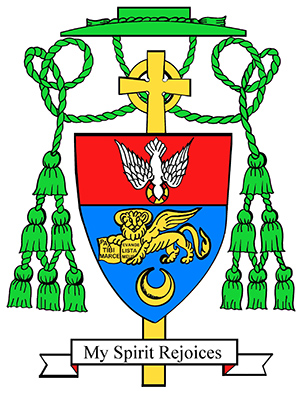
The shield bearing the personal arms of Bishop Flesey has been designed to reflect his personal history and ministry. The principal colours are blue and red, which when combined with the charges upon the shield in white, recall the colours of the shield of the Archdiocese of Newark. A further connection with the Archdiocese is made by the insertion of the crescent at the base of the shield which represents Our Lady of the Immaculate Conception, the principal patroness of the Archdiocese and Immaculate Conception Seminary where Bishop Flesey studied and taught for many years. In the centre of the shield is the Lion of St. Mark, one of the four living creatures of the Book of Revelation (Revelation 4:7), which from earliest times has been associated with St. Mark, the author of the oldest Gospel. In this context, the Lion is drawn to recall the Lion on the coat-of-arms of Blessed Pope John XXIII who borrowed it from the City of Venice where he served as Patriarch (Archbishop). It was Pope John who summoned the bishops of the world to the Second Vatican Council; the changes in the Church (aggiornamento) brought about by the Council have established the context in which Bishop Flesey has exercised his priestly ministry. The Lion also recalls Bishop Flesey’s home parish, St. Aedan in Jersey City where the symbols of the Evangelists are carved on the façade (but he did develop a fondness for Venice during the years he spent in Rome). At the top of the shield is a chief, a heraldic device often used as an augmentation to personal arms denoting an honour or membership in a group. In this case, the chief refers to Bishop Flesey’s doctorate in spirituality. It depicts the Holy Spirit descending with Wisdom and Grace fulfilling the promise of Jesus given to the Apostles that he would send the Spirit to instruct them in all Truth (John 16:13).
On October 10, 2017 the Most Rev. Andrew Bellisario, CM (60) was ordained and installed as the 6th Bishop of Juneau, Alaska.


On September 23rd the Most Rev. Claudio Palumbo (52) was installed as the 44th bishop of Trivento, Italy.
Two bishops were recently ordained and installed as Diocesan bishops in the United States and some have asked for my comment on their coats of arms.
Bishop Alfred Schlert of Allentown, PA

Good.
Bishop William Wack, CSC of Pensacola-Talahassee, FL

Not good.
On August 29, the Most Rev. Luis Rafael Zarama, until now the Auxiliary Bishop of Atlanta, will be installed in the brand new cathedral as the Sixth Bishop of Raleigh, North Carolina. His coat of arms (below) is explained on the diocesan website:

On a blue field is displayed an extra wide chevron of Gold (yellow). This device gives the illusion of two mountains; a gold one and a blue one. The gold mountain (the chevron) is charged with a scattering (semé) of red crosses to represent the bishop’s home city of Pasto, in southwestern Colombia, which is known as “The Theological City.” The lower mountain (part of the blue field) has a golden lion’s head to represent the Evangelist, Saint Mark, who is the titular patron of the parish in Clarkesville, Georgia, on a mountain, where Bishop Zarama served as pastor.
Above the chevron are a gold rose for Saint Theresa of the Child Jesus, also known as “The Little Flower,” and a silver (white) lily for Saint Joseph, the Foster Father of Jesus, who have served as Bishop Zarama’s particular patrons throughout his life as a priest and now as a bishop.
On June 8 the Most Rev. John Patrick Dolan (55), a priest of the Diocese of San Diego, California will be ordained the Titular Bishop of Uchi Maius and the Auxiliary Bishop of San Diego. He contacted me shortly after his appointment and asked me to design a very simple coat of arms for him. The result is:

The blazon and description is as follows:
BLAZON: Or an image of the Sacred Heart Gules; on a chief Azure two crescents Or. The shield is ensigned with an episcopal cross Or in pale behind the shield and surmounted by a galero with cords and six tassels on either side in three rows of one, two and three all Vert. On a scroll below the shield is the motto: “Abide in My Love”.
EXPLANATION: The bishop’s coat of arms, is composed of a shield upon which there are symbolic charges, a motto and the external ornaments of rank. The shield which is the most important feature of any heraldic device is blazoned (i.e. described) in heraldic language from the point of view of the bearer with the shield being held on his arm. For his personal arms Bishop Dolan has adopted a design to reflect his religious devotion, priestly ministry and family. The arms are composed of a gold (yellow) field on which there is a single charge of the Sacred Heart of Jesus depicted wounded, surrounded by a crown of thorns and enflamed all colored red. This reflects the bishop’s devotion to the Sacred Heart which is also symbolic of the mercy of God which he tries to reflect in his priestly ministry. All priests are exhorted to conform themselves more closely to Christ and strive to be shepherds after His own heart. The gold field is borrowed from the coat of arms of the diocese of San Diego to recall the local church he has served as a priest and will continue to serve as a bishop. The chief (upper third of the shield) replicates the blue field and crescents traditionally associated with the arms of Dolan in Irish heraldry. Here the usually silver crescents have been colored gold (yellow) and reduced in number from three to two for differencing. These charges are merely borrowed to act as an allusion to the bishop’s family name.
For his motto, Bishop Dolan has selected the phrase “ABIDE IN MY LOVE”.
The Rev. Kenneth Howell, 59, a priest of the Archdiocese of Brisbane has been appointed Titular Bishop of Thamugadi and Auxiliary Bishop of Brisbane by Pope Francis. He will be ordained on June 14.
His coat of arms (below), designed by me in collaboration with Mr. Richard d’Apice, AM, KCHS of the Australian Heraldry Society, employs a field borrowed from arms associated with “Howell” and also pick up on the theme of light and darkness in association with the cross of Christ. The escallop shell is a symbol of St. John the Baptist because the bishop-elect was ordained a priest on the eve of the Nativity of St. John.
The motto translates to, “Prepare the Way For Him”. The arms were rendered by Mr. Sandy Turnbull, also of the Australian Heraldry Society.

On May 3, the Feast of Ss. Philip & James, the Most Rev. Timothy Harris (54), a priest of the Archdiocese of Brisbane, was ordained a bishop in the Church and installed as the 6th Bishop of Townsville, Australia.
His personal arms, impaled with those of the diocese, make allusions to his family name (the crescent), his baptismal patron (the plates representing stones as a symbol of St. Timothy) and Pope Francis who appointed him a bishop and whose emphasis on mercy the bishop wishes to incorporate into his own ministry (the sprig of spikenard).
His arms were designed by me in close collaboration with Mr. Richard d’Apice, AM, KCHS and rendered by Mr. Sandy Turnbull, both members of the Australian Heraldry Society.

Fr. Guy Selvester's blog of Ecclesiastical Heraldry