Category Archives: Bishops

Bishop Seitz of El Paso

officialseitzcoa

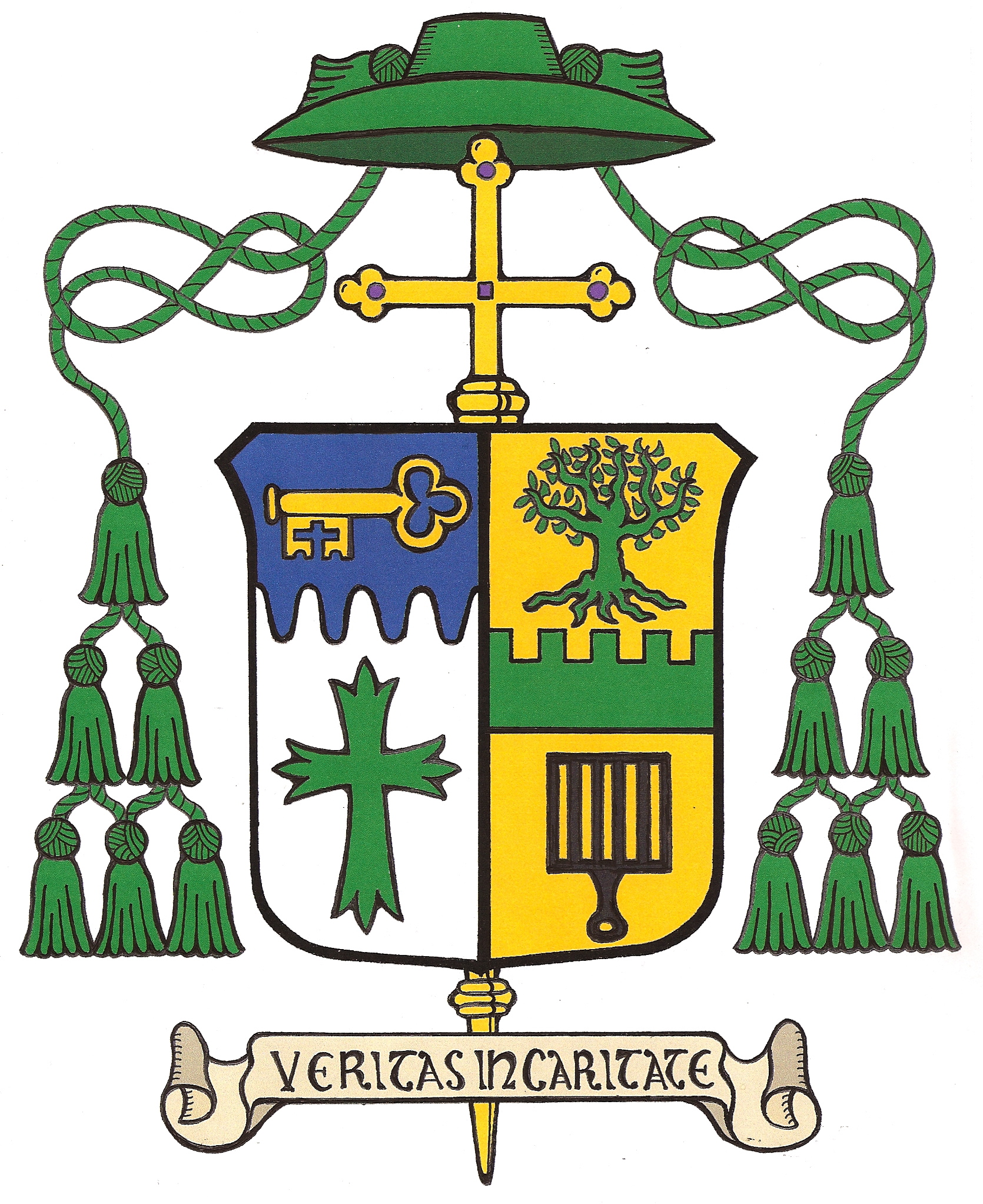
On July 9, Bishop Mark Seitz will be installed as the new bishop of El Paso, Texas. The bishop himself explains the symbolism of his coat of arms on the diocesan website:

In the diocesan arms (left) the blue and white honor Our Lady under the title of the Immaculate Conception, Patroness of the United States.  The wavy border symbolizes the Rio Grande River.  In the diocesan crest the river surrounds the “Ysleta”, or little island, which was the first name of El Paso. The two long triangular forms represent the mountains that form the pass for which the diocese is named.  They are topped by trefoils.  These, along with the triangular mountains, both invoke the Trinity which is at the foundation of the Faith.  The trefoils are also a homage to the titular patron of the Cathedral, St. Patrick. The star above the lower image is both a remembrance of the Lone Star for which Texas is named and the North Star, a reference to the full early name of “El Paso del Norte”.  For Christians, the North Star is also Christ who points them to their true home in heaven. In the upper left-hand corner is an anchor from the coat of arms of St. Pope Pius X, who erected the diocese.

The bishop’s personal arms contain the red “Rose for Life”.  The trefoil (shamrock) speaks to his Irish heritage. The pattern dividing the chief from the rest of the field is intended to honor the Native American heritage that he shares and his desire to serve our first Americans. It is really rather un-heraldic and un-blazonable. The winged lion is the symbol for St. Mark the Evangelist.

Bishop Walkowiak of Grand Rapids, Michigan

Image

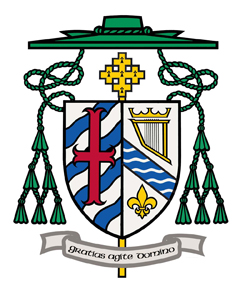
The coat of arms of the Most Rev. David Walkowiak who was ordained and installed today as Bishop of Grand Rapids, Michigan. In his personal arms the bend with wavy lines alludes to St. Mary’s Seminary in Cleveland where he studied for the priesthood. The five small silver lines or “barrulets” that make up the waves stand for the five great lakes. The crowned harp is an allusion to King David, his baptismal patron, who is thought to have composed the Psalms. In base the flour-de-lis is a symbol of Our Lady and also of St. Joan of Arc, the patroness of the parish in Ohio where the bishop used to serve as a pastor.

The arms of the diocese represent falling water or rapids in the Grand River, hence, Grand Rapids and the cross moline alludes to a mill rind thus symbolizing the agrarian roots of the region.

Bishop Folda of Fargo

Image

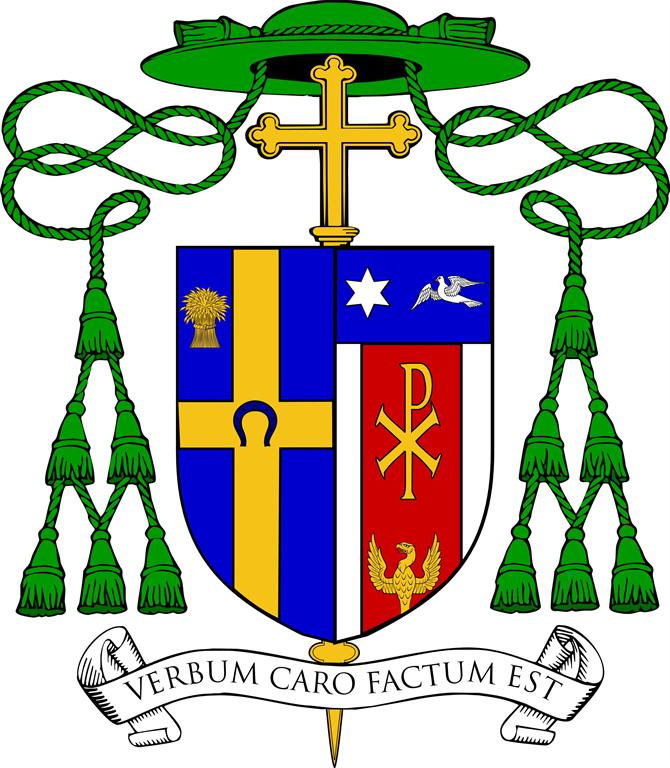
The colors of the arms of the diocese of Fargo, Or and Azure, are traditionally used to allude to the Virgin Mary, who is invoked as patron of the diocese under the title of her Immaculate Conception. In the center of the Cross is a horseshoe, alluding to William George Fargo (1818–81), the namesake of the See city and co-founder of Wells Fargo & Co. In dexter chief (upper left) is a garb of wheat which recalls the important agricultural product of North Dakota, as well as the bread that becomes the Body of Christ in the celebration of the Eucharist.

The arms of Bishop Folda utilize the colors and general design of the arms of the Diocese of Lincoln, Nebraska for which the bishop was ordained a priest in 1989. In the blue chief is a star to represent Our Lady. Next to the star is a dove, a symbol of the Holy Spirit and an attribute of Saint Gregory the Great, the pope and doctor of the Church, who is often depicted with the dove hovering at his ear as he writes. Bishop Folda served as Rector of Saint Gregory the Great Seminary in Seward, Nebraska, from 1999 to 2013. On the red pale is a Chi-Rho, the ancient monogram for Our Lord composed of the first two Greek letters in the name Christ. Rising from the base of the shield is an eagle, which has been used from ancient times to allude to St. John the Evangelist, Bishop Folda’s baptismal patron.

Bishop Folda will be ordained and installed in Fargo on June 18, 2013.

Not thrilling, but nice.

Bishop Barber of Oakland

Image

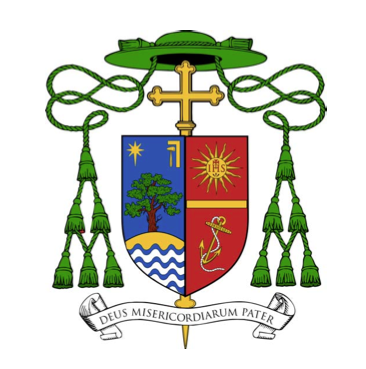
The coat of arms of newly ordained and installed Bishop Michael Barber, SJ of Oakland who was ordained a bishop and installed at the Cathedral of Christ the Light in Oakland today. The charge in chief of the personal arms is the insignia of the Society of Jesus to which the bishop belongs and which also features prominently in the arms of the pope who appointed him. The bishop also served as a US Navy chaplain. Hence, the anchor.

Monseigneur Pascal Roland

Image

The past few days I have found myself praying for this particular bishop. It’s not that anything unusual has happened to him or that he has been particularly recommended to my prayers. In fact, I’ve never even met him. However, I find myself, lately, in the diocese of Belley-Ars in France where Mons. Roland is the bishop. So, each day at Mass I pray for him after praying for the pope. I can recall his coat of arms being discussed on one of the many heraldic fora online in which I take part. The lamb is a reference to his given name and the border of flames alludes to the new evangelization.

Coat of Arms of the New Archbishop of Dubuque, IA

Image

Bishop Michael Jackels of Wichita has been named as the new archbishop of Dubuque, Iowa by Pope Francis (it was really decided by Pope Benedict XVI but not announced until after Francis was elected). The current coat of arms of the good bishop will present some interesting problems when he goes to Dubuque. The arms as they currently are depict two distinct impalements. They both comprise the bishop’s personal arms. Neither is the impalement of the arms of the See of Wichita. In North America it has become customary, although far from mandatory, for bishops to depict their own personal arms side by side on the same shield with the coat of arms of their diocese. This does not make the arms of the diocese part of their own coat of arms. Rather, it is a method called impalement used to depict to separate coats of arms on the same shield together in the same achievement. This is done to illustrate that the bishop is “married” to his diocese. Indeed, impalement was first employed in heraldry as a means of depicting the coats of arms of two armigerous people who were married to each other. The impalement of the husband is depicted in the dexter side of the shield (which appears on the left-hand side as we view the shield) and those of the wife in the sinister side (right-hand side as we view it). In the coats of arms of (arch)bishops we therefore would see the arms of the diocese in the position of the husband’s arms and the arms of the individual incumbent bishop in the place of the wife’s arms. It is worth noting that this is only while he is in office as the diocesan bishop. Auxiliary bishops are not entitled to do this as they do not enjoy jurisdiction over the diocese and, similarly, retired bishops must relinquish impaling their arms with those of the diocese as they no longer have jurisdiction over it. As I said before, the arms of the See do not become part of the bishop’s coat of arms. Rather, two distinct coats of arms are being depicted on the shield side by side to denote the “marriage” of the two.

Impalement is far from the only method of marshaling arms together to illustrate jurisdiction. A bishop may quarter his arms with those of the See. An older, and really antiquated, system of marshaling called dimidiation can also be used. In that method the two coats of arms are divided in half and the dexter half of the arms of the see appear in the dexter half of the shield while the sinister half of the bishop’s arms appear in the sinister half of the shield. This method is hardly ever used for the obvious reason that parts of both coats of arms are obscured from view. It is worth repeating that a bishop is under no obligation, as is often erroneously thought, to marshal his personal coat of arms with those of his See. He may simply bear his own personal arms alone. Indeed, if he chooses he may opt not to adopt a coat of arms at all and simply use the diocesan coat of arms during his tenure as his own emblem.

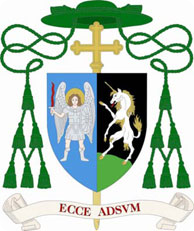
Bishop Jackels has chosen, during his time as Bishop of Wichita, to use his personal arms alone. (illustrated above) This was probably a wise decision since his personal arms are already impaled and impaling them with the arms of the See would have been disastrous. Of course he could have quartered the arms and repeated the arms of the See in the 1st and 4th quarters (upper left & lower right respectively) while depicting the two impalements in the 2nd and 3rd quarters. Which leads us to the question: why does he have impaled arms in the first place?

I think it is a design flaw borne, most likely, out of ignorance as to what the meaning of impalement is, heraldically speaking. At first glance his personal arms look like the unicorn in the sinister impalement combined with the arms of a See that consist solely of a depiction of St. Michael the Archangel. Or, to see these impaled arms in their historically original context, it looks like a “Mr. St.-Michael” married a “Miss Unicorn”. The bishop would have been far better off if he had adopted arms that were divided per fess (horizontally in a straight line) that then depicted St. Michael in chief and the unicorn in base, or vice versa. Better yet, the unicorn could have been depicted and a symbol for St. Michael (like a cross botonee, or a flaming sword, or angels’ wings, etc.) placed on a chief (a separated upper third section of the shield). All this, then could be marshalled to the arms of his See.

As it is now it seems that the very handsome arms of the See of Dubuque will, once again, have to be left out of the achievement of Archbishop-elect Jackels’ coat of arms. That’s not the end of the world but it is a shame. In addition, it really is poor heraldic design to impale what appear to be two separate coats of arms and call it one unified coat of arms. There is no way to avoid the appearance of two marshaled coats which is why this design falls short. Simply put, there are other and better ways of doing it.
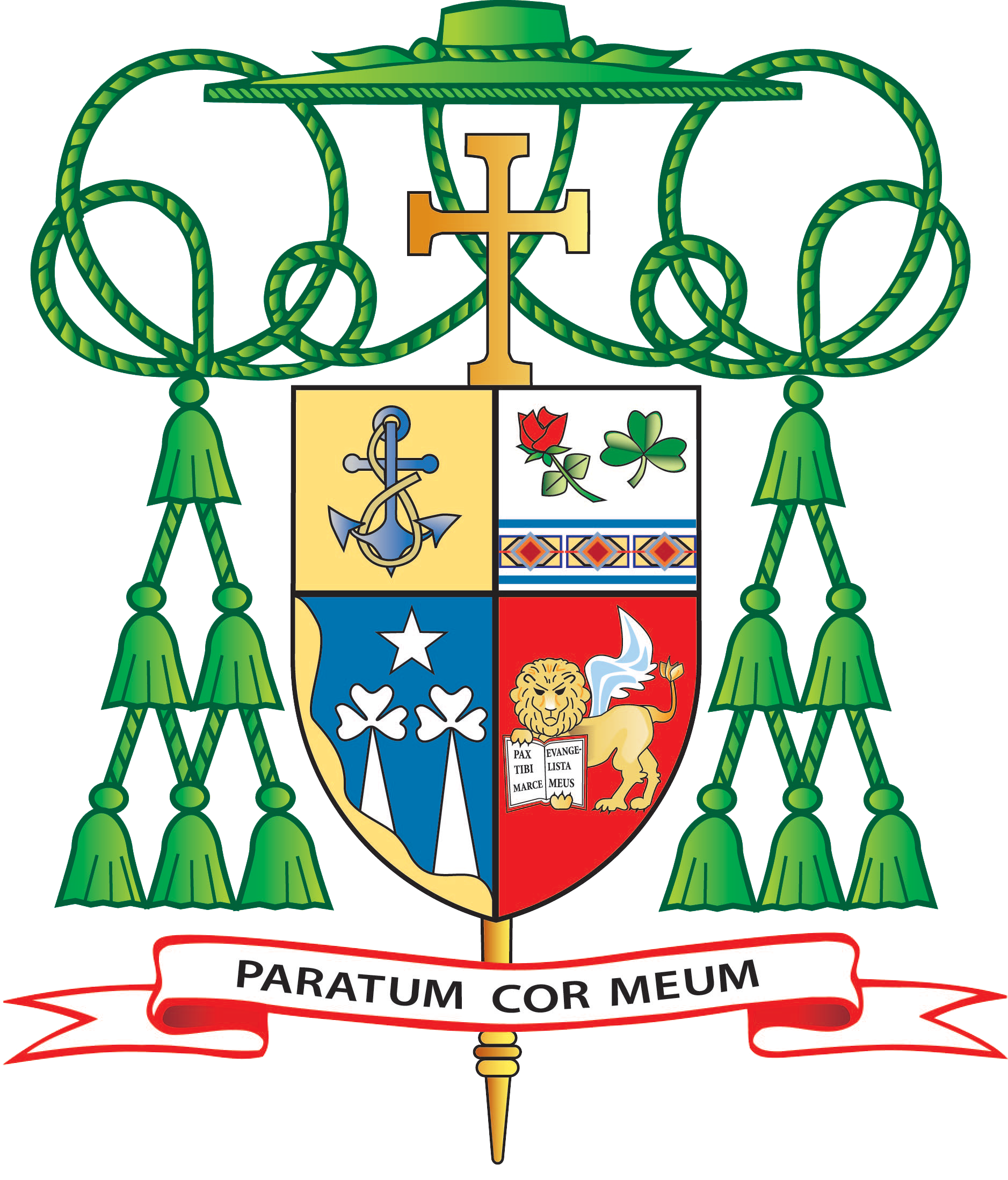
Coat of Arms of Bishop-Elect Robert Coyle

sc003a692e5

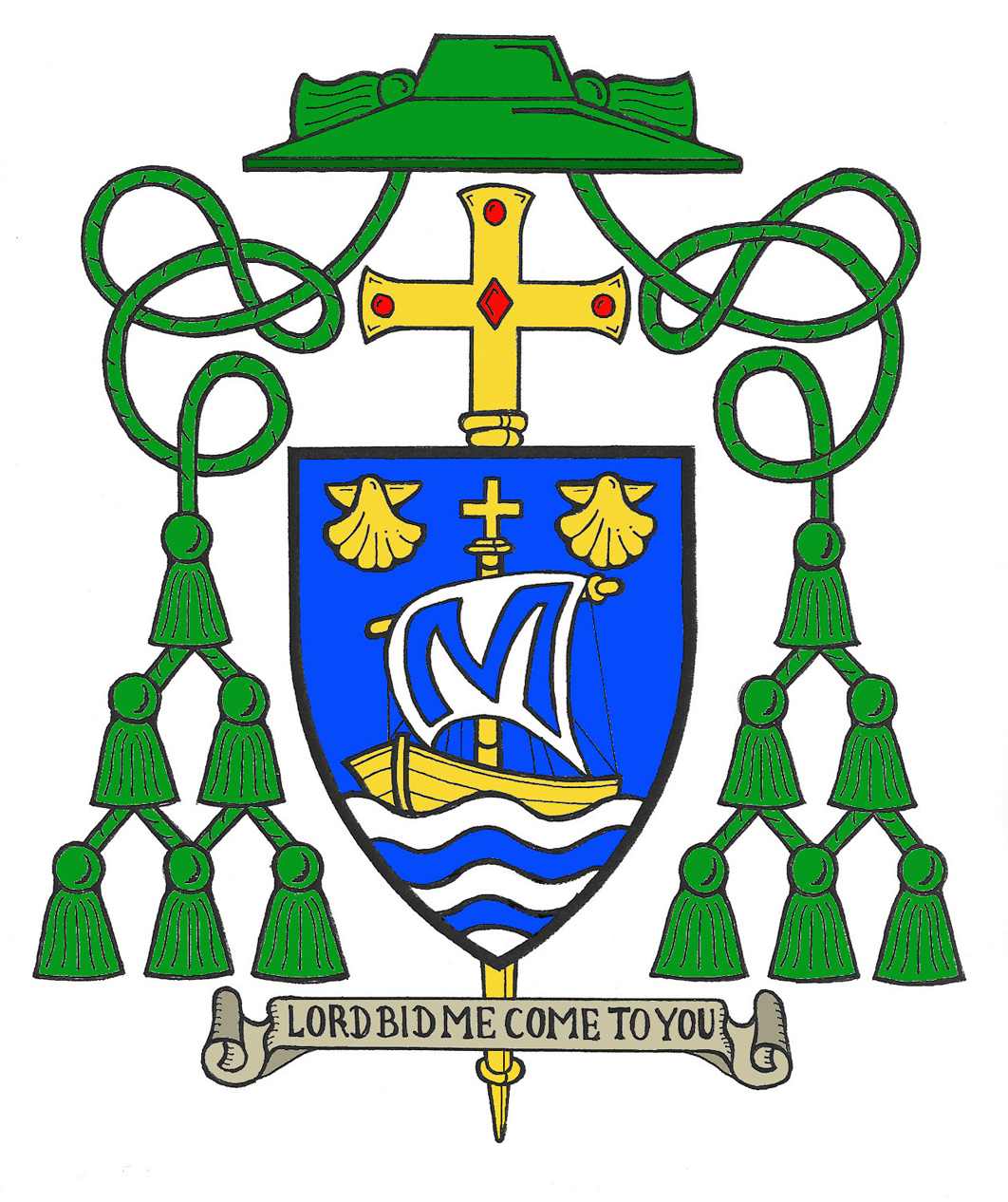
The Most Rev. Robert Coyle, who will be ordained the titular bishop of Zabi and auxiliary bishop for the Archdiocese of the Military Services, USA on April 25 has adopted the coat of arms above. They are based on a coat of arms he adopted at the time he was named a Chaplain to His Holiness.

BLAZON: Azure, on three barrulets wavy Argent in base a ship under full sail Or, masted of the same; on the sail Argent the letter “M” Azure; in chief to dexter and sinister two escallop shells Or. Ensigned with an Episcopal cross Or placed palewise behind the shield and surmounted by a galero with cords and twelve tassels disposed in three rows on one, two and three all Vert. On a scroll below the shield the motto: “Lord Bid Me Come To You”.

EXPLANATION: When describing things in heraldic terms the coat of arms is described from the perspective of one standing behind the shield and holding it in front of them. So the terms “dexter” (right) and “sinister” (left) are then reversed from the point of view of someone observing the coat of arms from the front.

The shield depicts the personal coat of arms of Bishop Coyle containing symbols having to do with his personal devotion, his service to his country, his home and his priestly ministry. The blue background and large letter “M” on the sail of the ship recall his devotion to Our Lady who is the patroness of the United States. The “M” is also a reference to the coat of arms of Bl. John Paul II during whose pontificate Bishop Coyle was ordained to the sacred priesthood. The ship at full sail is an obvious allusion to the more than 24 years Bishop Coyle has spent in the United States Navy. The ship is also an ancient symbol of the Church; the barque of Peter. It is a fitting symbol for anyone in God’s service to use and somewhat poignant that Bishop Coyle’s appointment as a bishop was announced by Pope Benedict XVI on the very same day he announced his abdication as pope initiating historic days of change in the Church which, nevertheless, did not swamp the barque of Peter which remains on course. In the upper portion of the field to the left and right are depicted two gold escallop shells. These shells appear in the coat of arms of the Diocese of Rockville Centre, Bishop Coyle’s native diocese for which he was ordained to the priesthood and also in the coat of arms of Pope Benedict XVI who called him to service as a bishop.

The external ornaments surrounding the shield indicate the rank of the armiger. In place of the martial helmet, mantling and crest ecclesiastics use a pilgrim’s hat called a “galero”. This broad-brimmed hat was, at one time in history, worn by all prelates. It exists now as a heraldic symbol. The Church has devised a system of various colors and numbers of tassels suspended from the hat to indicate various ranks of prelates. Since the original color worn by bishops was bright green this color has been retained in heraldry as the episcopal color. The galero therefore has twelve tassels suspended from cords and falling on either side of the shield. In addition a gold-colored episcopal cross is placed vertically behind the shield and extending above and below it. This cross, not to be confused with the processional cross used in the liturgy of the Church, is a heraldic symbol which has its origins in an actual cross, rather like a processional cross, which used to be carried immediately in front of any bishop whenever he was exercising his office. Throughout the Middle Ages such crosses were used in addition to the processional cross at the head of a liturgical procession. Eventually they fell into disuse but remain as a heraldic symbol of the office of bishop. These external ornaments conform with the Instruction of the Holy See, “Ut Sive Sollicite” of 1969 for the ornaments proper to a coat of arms for a prelate with the rank of bishop.

Below the shield on a decorative scroll we see the bishop’s chosen motto, “Lord Bid Me Come to You” from Gospel according to St. Matthew, chapter 14.

Coat of Arms of Bishop David Talley

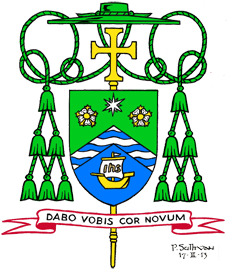
This is the coat of arms assumed on April 2, 2013 when David Talley was ordained an auxiliary bishop for Atlanta.

Bishop Talley’s arms are composed of a twelve-pointed silver (white) star known as the “Stellar Maris,” or “Star of the Sea,” a classic symbol honoring Our Blessed Mother between two Cherokee Roses that have silver (white) petals and gold (yellow) barbs and seed and are the state flower of Georgia displayed in the arms of the Diocese of Savannah and in the arms of the Archdiocese of Atlanta. The chevron, from the Prescott family arms is composed of Silver (white) and blue wavy bars, representing water and it signifies the Chattahoochee and the Savannah rivers that run throughout
the territories of the two Georgia dioceses.

In the base of the design, is the bark of St. Peter, gold (yellow) with a silver (white) sail charged with the IHS, the monogram of the Holy Name, in red. The bark is the central feature of the logo of the ”Year of Faith”.

(artwork by P. Sullivan)

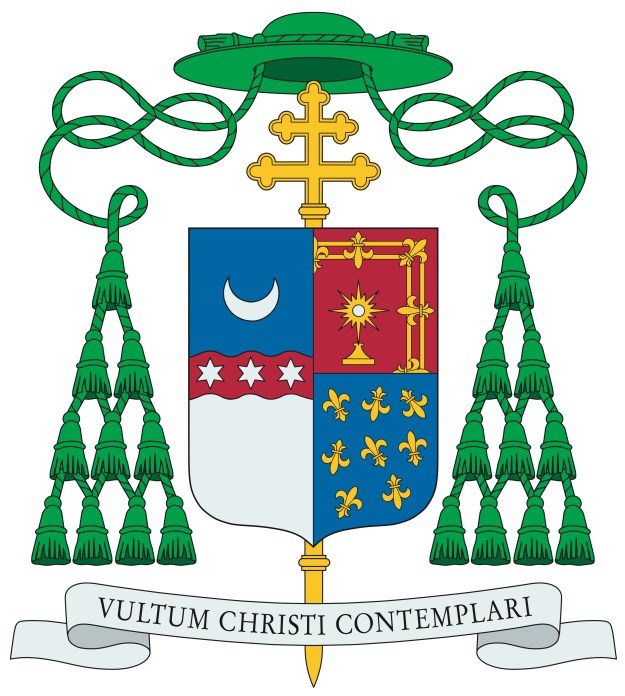
Coat of Arms of Archbishop Alexander Sample of Portland, OR

This is the coat of arms of the Most Rev. Alexander Sample, former Bishop of Marquette, MI who was installed on April 2 as Archbishop of Portland, OR. The left side of the shield (as we view it) depicts the arms of the archdiocese. They are impaled with the personal arms of the archbishop which he assumed at the time he became a bishop. In the upper section the border that is shown only partially employs a now-defunct method known as dimidiation. This manner of depicting charges fell out in favor of full impalement quite some time ago. It’s not that dimidiation is unheard of any longer. Rather, it is simply rarely used.