Category Archives: Bishops

Bishop Meier, OSB

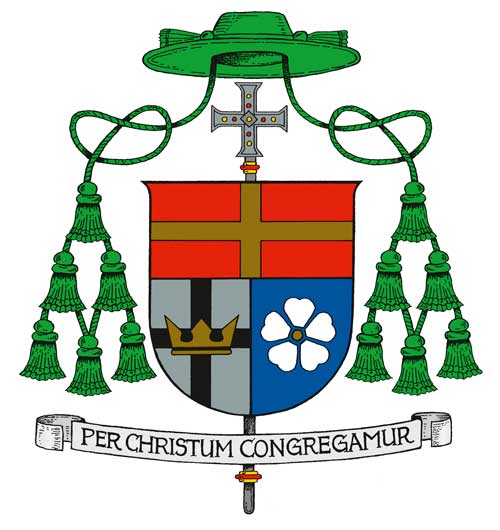
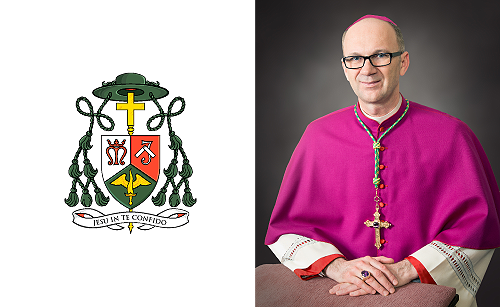
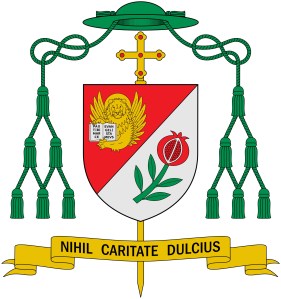
On September 27, 2015 The Most Rev. Dominic Meier, OSB, a Benedictine monk of Königsmünster Abbey was ordained Auxiliary Bishop of Paderborn, Germany.

His coat of arms is depicted below with the description from the archdiocesan website.

wappen-wbDominicus-web

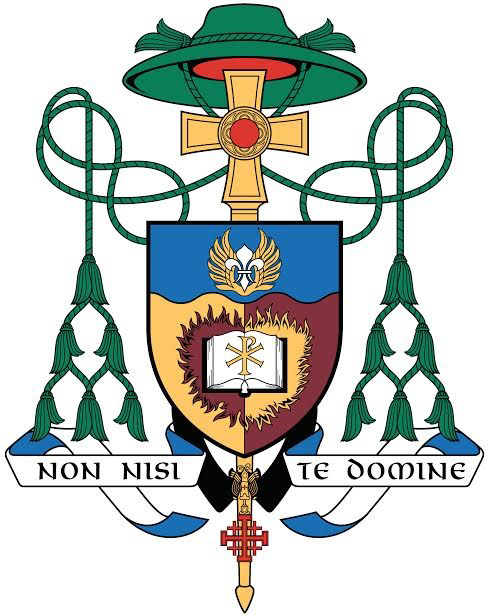
Das Wappen von Weihbischof Dr. Dominicus Meier OSB ist geteilt und halb gespalten. Das obere Feld bildet ein goldenes Kreuz auf rotem Grund, das Wappen des Erzbistums Paderborn.

Das kurkölnische Kreuz auf silbernem Grund und die Christuskrone aus dem Wappen der Abtei Königsmünster in Meschede sind im heraldisch rechten Feld dargestellt. Der Wappenträger stammt aus Lennestadt-Grevenbrück, einem Ort, der zum kurkölnischen Sauerland gehörte. Weihbischof Dr. Dominicus Meier OSB trat 1982 dem Benediktinerorden bei und war von 2001 bis 2013 dritter Abt der Benediktinerabtei Königsmünster in Meschede, aus deren Wappen die Krone entnommen ist.

Die heimische Heckenrose mit ihren fünf weißen Herzblättern und der goldenen Mitte auf blauem Grund im heraldisch linken Feld symbolisiert als Gabe und Aufgabe die Verbundenheit der Menschen mit Gott. Als „Weiße Rose“ ist sie eine herausfordernde Erinnerung an das mutige Eintreten von Studenten im nationalsozialistischen Deutschland für das Recht und die Würde des Menschen. Auch mit der Rose mit ihren fünf weißen Herzblättern in seinem neuen Wappen knüpft Weihbischof Dr. Dominicus Meier OSB an sein Wappen als Abt der Benediktinerabtei Königsmünster an.

Die Wappenzier besteht bei einem Bischof aus einem Kreuz und dem niedrigen geistlichen Hut mit breiter, flacher Krempe, aus dem an zwei verschlungenen Kordeln reihenweise, symmetrisch geordnet 1 + 2 + 3 Quasten hängen. Die Farbe des Hutes, der Kordeln und der Quasten ist grün.

Der Wahlspruch von Weihbischof Dr. Dominicus Meier OSB „PER CHRISTUM CONGREGAMUR“ lautet übersetzt: „Durch Christus werden wir zusammengeführt“. Er lehnt sich an den Hymnus „Ubi caritas“ der Liturgie des Gründonnerstags an. Diesen Wahlspruch hatte der neue Weihbischof bereits als dritter Abt der Abtei Königsmünster.

Three Los Angeles Auxiliaries

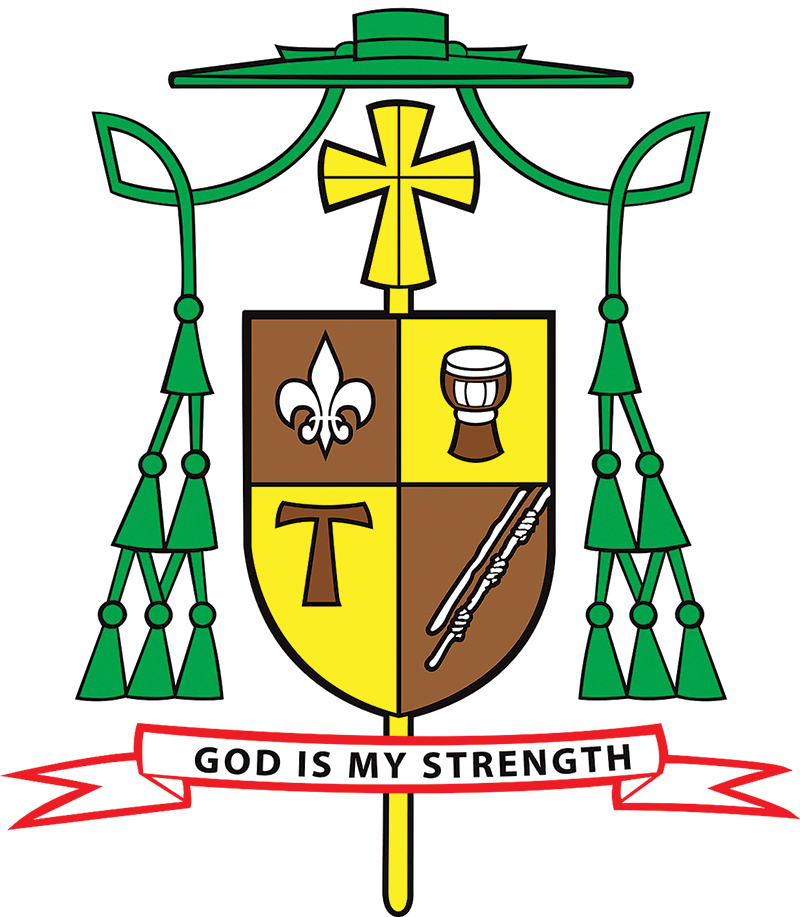
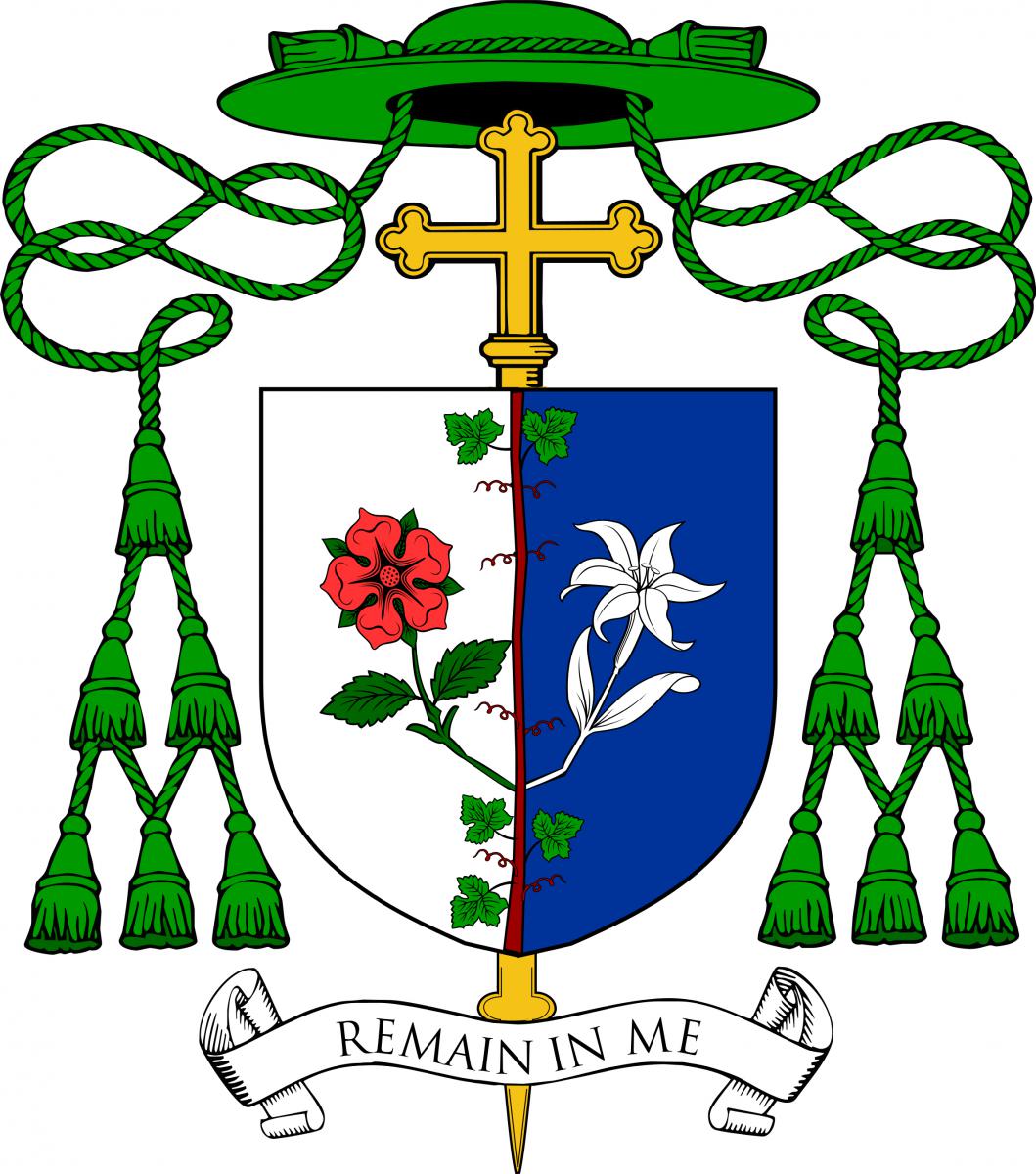
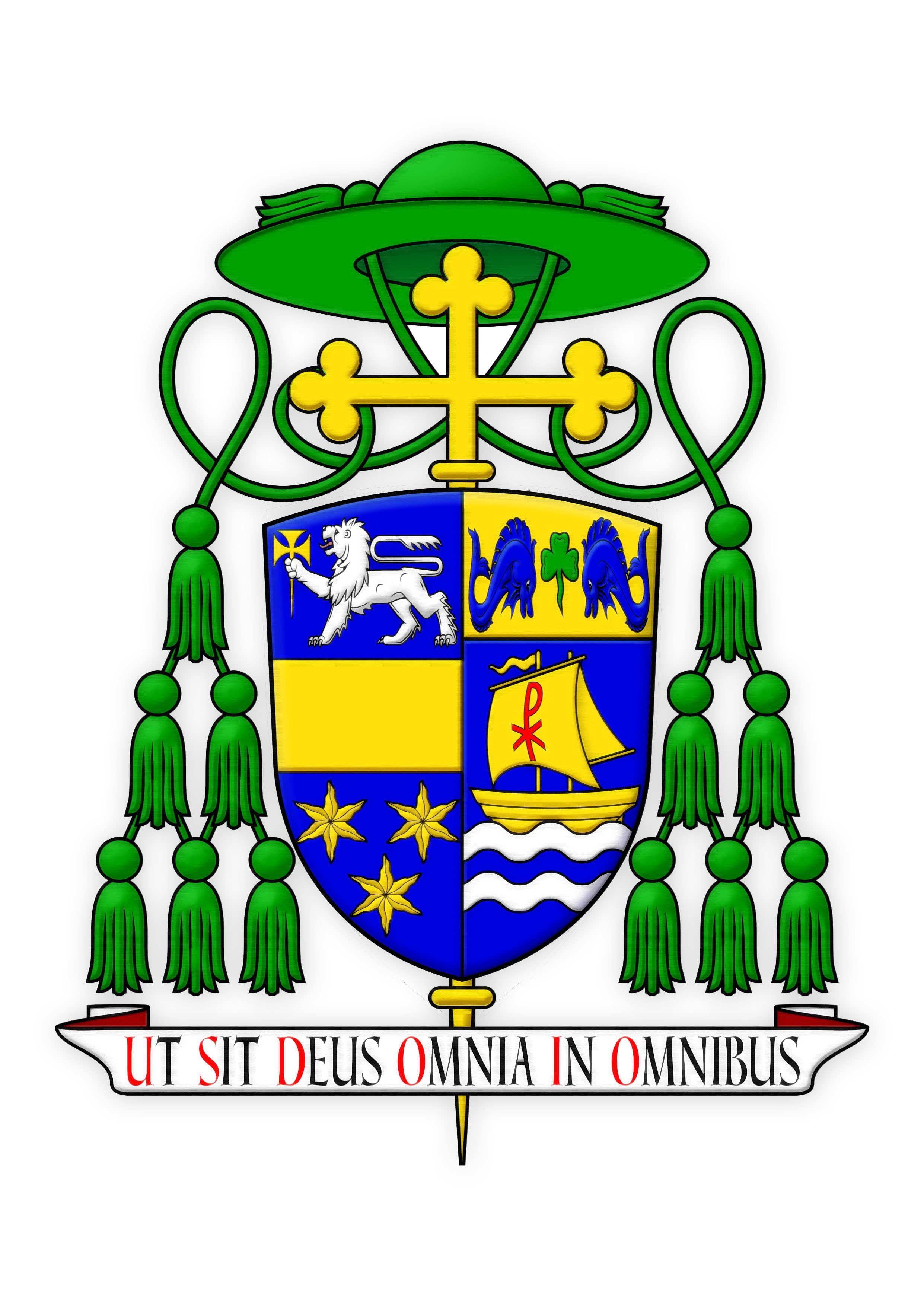
On Tuesday, September 8, 2015 the archdiocese of Los Angeles (largest in the USA with some 5 million Catholics in 280 parishes) received three new auxiliary bishops. The Most Rev. Joseph Brennan, The Most Rev. David O’Connell both priests of the archdiocese and The Most Rev. Robert Barron, a priest of the archdiocese of Chicago were ordained by The Most Rev. José Gomez, archbishop of Los Angeles. The coats of arms of Bishops Brennan, O’Connell and Barron are below. All three were designed by James Noonan and depicted by Linda Nicholson.

Brennan-COA Oconnell-COA Barron-COA

External Ornaments in Heraldry

The last post on the arms of the new Territorial Abbot of St. Maurice started an interesting conversation in the comments section. Namely, about the fact that the Abbot’s arms are ensigned with only the crozier that indicates the coat of arms belongs to an abbot. Many dislike it when the arms of a cleric do not employ the use of the distinctive galero, or broad-brimmed hat, which usually replaces both the helm and crest (with their accompanying torse and mantling) found in the heraldic achievements of lay people. This ecclesiastical hat is depicted in varying colors and with varying numbers of tassels to indicate the rank of the armiger. Both the Roman Catholic Church and the Church of England have developed elaborate systems for the use of the galero. Many other constituent churches of the Anglican Communion employ the system devised for the Church of England and approved by Earl Marshal’s Warrant in the 1960s.

However, while it is true that the galero certainly makes the coat of arms of a clergyman instantly recognizable as such it is not true that the galero is always and everywhere mandatory for clergy. In fact, there are no external ornaments that are mandatory in heraldry. A coat of arms, simply put, may consist of the shield alone. The motto, which many clerics spend way too much time on devising, is not a necessary component to a coat of arms for example.

In the case of a bishop the one single external ornament that marks the coat of arms as that of a bishop is the episcopal cross placed behind the shield. Full stop. There is no other external ornament necessary and quite a few bishops have chosen to display the episcopal cross (which is not to be confused, as it often is, with the liturgical processional cross) alone in their heraldic achievement. The green galero with twelve tassels is not exclusive to them so it is not the necessary element to indicate the arms of a bishop. Similarly, archbishops use the archiepiscopal cross which has two horizontal bars and is sometimes somewhat misleadingly referred to as the patriarchal cross, in their coats of arms. The green galero with twenty tassels is used almost exclusively by archbishops but it, too, is not a necessary or mandatory external ornament.

When it comes to cardinals the situation changes somewhat in that the red galero with its thirty tassels is, pretty much, the only external ornament that indicates the armiger is a member of the College of Cardinals.

For other clergy, again, the situation remains that the galero is usually employed and certainly makes it clear that the coat of arms belongs to a cleric rather than a laic but the privilege of ensigning the shield with various ornaments isn’t always absolutely necessary. In the case of an abbot it is the (usually veiled) crozier that indicates the arms of an abbot or abbess, the latter being easily distinguished by the lozenge or oval shape of the shield. If a coat of arms is ensigned with a veiled crozier then it is indicating the armiger is a cleric with the rank of abbot whether the black galero with twelve tassels is displayed or not. This is so because the black galero with twelve tassels may also be used by Vicars General; Vicars Episcopal; Non-Episcopal Ordinaries, Moderators of the Curia, Titular Abbots, Prelates of Chivalric Orders as well as Superiors General of Religious Orders and Clerical Religious Congregations. However, only an abbot may also employ a veiled crozier*. Thus it is the crozier that indicates the coat of arms belongs to an abbot, not the galero.

Similarly, the green galero with twelve tassels may be used by Territorial Abbots, Permanent Apostolic Administrators and Vicars or Prefects Apostolic who lack the episcopal character. However, only a bishop or archbishop may also ensign the shield with the episcopal or archiepiscopal cross.

It is worth mentioning that in some places bishops and abbots still use the mitre as well as the cross or crozier in ensigning their shields rather than the galero despite the preference as indicated by Papal Instruction for the use of the galero.

As I said jokingly to one of my sympathetic correspondents, “You don’t have to have all the doo-dads on your coat of arms when, frequently, there is only a single ornament that is the true indication of rank”.

*NOTE: Recently, the Church has established Ordinariates for former Anglicans who wish to come into the Roman Catholic Church. These are headed by Ordinaries who, while exercising Ordinary jurisdiction over the churches under their charge, do not possess the episcopal office. In some cases they were formerly bishops in some branch of the Anglican Communion. Of the three existing today they, too, ensign their shields with the proper galero of rank (usually that of a Prothonotary Apostolic, the highest rank of “monsignor” which is a purple hat with twelve red tassels) as well as a purposely UN-veiled crozier to distinguish it from the crozier of an abbot. This is because they exercise Ordinary jurisdiction of which the crozier is a symbol and they are entitled to use the pontificals liturgically so they actually carry a crozier at Mass but the veil on the crozier is particular to monastics which these Ordinaries are not.
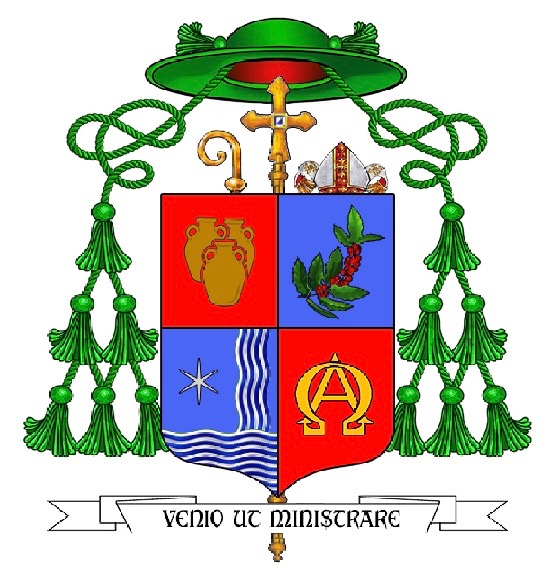
Bishop Massa & Bishop Mroziewski

On July 20 the Most Rev. Nicholas DiMarzio will ordain the Most Rev. James Massa and the Most Rev. Witold Mroziewski as auxiliary bishops of Brooklyn. Their newly-assumed coats of arms are pictured below without comment. I am personally acquainted with Bishop Massa and he had wanted me to design his coat of arms but others took that matter out of his hands. Therefore, I will refrain from expressing an opinion on the design of the arms.

imageimage

Bishop Malesic of Greensburg, PA

On July 13 the Most Rev. Edward Malesic, a priest of the Harrisburg, PA diocese will be ordained and installed as the fifth bishop of Greensburg, Pennsylvania at Blessed Sacrament Cathedral in Greensburg.

his newly assumed coat of arms is:

image

The explanation of the arms (provided by the diocese) is:

“The color of the field is BLUE (azure), the color of the sky, which symbolizes the direction of the soul’s ascent toward God and away from worldly values, therefore, the color represents the path set by the spiritual virtues, raising a person from the things of the earth toward the incorruptibility of heaven.

The CHEVRON is a heraldic device best described as an inverted “V” and is one of the most ancient figures in heraldry. Frequently, in Roman Catholic Church heraldry, it signifies the rafter which supports the roof of the church as a source of protection for the community of faith gathered under it. The THREE SHAMROCKS represent the Cathedral in Harrisburg, dedicated to St. Patrick, where Bishop Malesic was ordained to the priesthood by the imposition of the hands of Cardinal William H. Keeler, at that time Bishop of Harrisburg. The CHEVRON is in SILVER (argent), the color of transparency, also of truth and justice, fundamental requirements of the Bishop’s pastoral service.

The CROWN above the chevron is the symbol of Bishop Malesic’s given name, after St. Edward “The Confessor” (d.1066), King of England who gave witness to his Catholic faith through his life. The crown also recalls Mary, Queen of the Apostles, upon whose intercession Bishop Malesic relies.

The LINDEN TREE below the chevron expresses the Slovenian heritage of Bishop Malesic’s father. The linden tree is considered the national tree of Slovenia and is also a symbol of joy and safety. The community often gathered under the shade of the linden tree for fellowship and community discussions.”

The bishops of Greensburg have a pretty good tradition of having simple, well-designed coats of arms. Bishop Malesic is no exception. While he has still given in slightly to the “coat of arms as pictorial CV” school of heraldry it isn’t too bad and he’s far from the only American bishop to do so. I think that overall the design is clear, well done and blends well with the arms of the diocese. My only criticism, and it is a small one, is that the two crosses in chief in the arms of the diocese are incorrect. They should be patteé formeé, that is to say they should look like two round gold balls formed into crosses. This is because they are taken from the two identical crosses in the arms of the see of Pittsburgh, from which Greensburg was separated, where, in turn, they were derived from the gold bezants in the arms of William Pitt but turned into crosses to difference them. These crosses do not in any way resemble gold balls.

The personal arms of of Bishop Malesic were designed and rendered impaled with those of the diocese by Renato Poletti.

Bishop Moth of Arundel & Brighton

bhp-richard-coatofarms

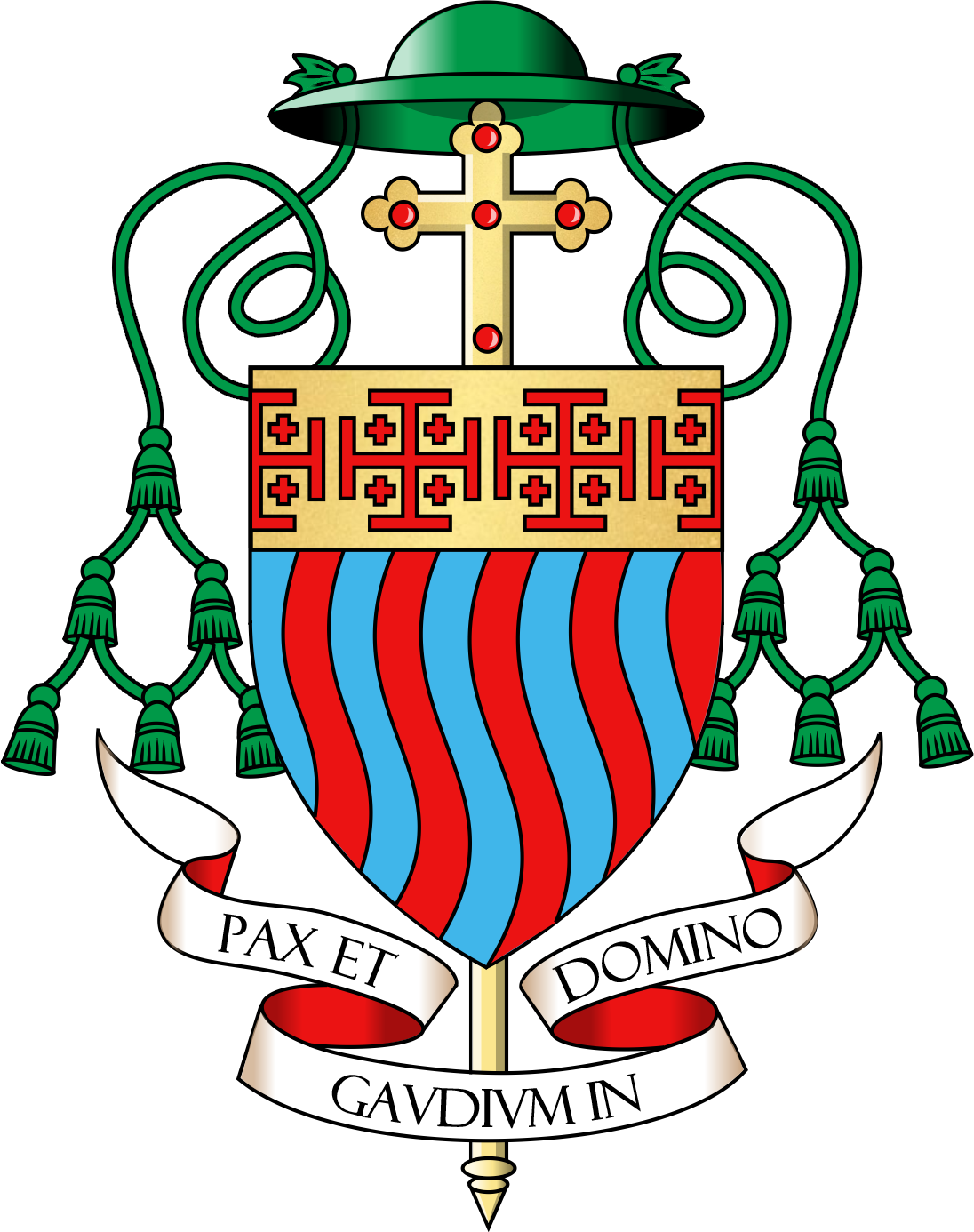
Today, May 28, the Most Rev. Richard Moth was installed in the beautiful Arundel Cathedral as the 5th Bishop of Arundel and Brighton. His coat of arms (above) is described as follows on the diocesan website:

The Grant of Arms contains the following description:
Paly-wavy of ten Bleu-celeste and Gules on a Chief Or four Crosses of Jerusalem the outer pair issuant Gules

Which might be expressed in modern English:
Ten wavy stripes in sky blue and red, with a gold field above containing four red Jerusalem Crosses, the outer pair appearing from the side

The wavy stripes hark back to Bishop Richard’s place of birth (the Zambian Arms consisting of similar stripes in black and silver), blue a reminder of Our Lady and the red a reminder of the English Martyrs. The Crosses of Jerusalem are a reference to Bishop Richard’s membership of the Equestrian Order of the Holy Sepulchre of Jerusalem.

Bishop Richard’s motto is Pax et Gaudium in Domino – Peace and Joy in the Lord.

Bishop Stowe of Lexington

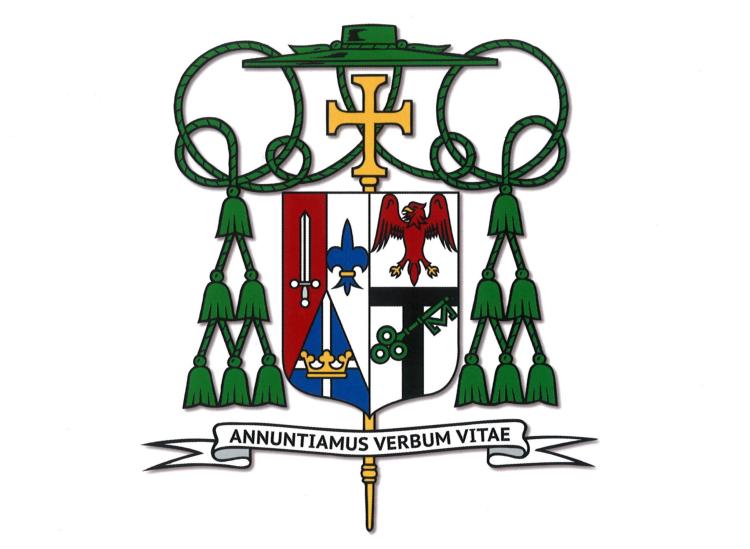
On May 5 the Most Rev. John Stowe, OFMConv was ordained and installed as the third bishop of Lexington, Kentucky. His coat of arms is:

stowe_coat_of_arms

The explanation of his personal arms and motto (from the diocesan website):

On the right side are the personal arms of Bishop John. These are composed of a white field on which is seen a red eagle, the symbol of Saint John, Bishop John’s baptismal and religious patron. Below the eagle is a black Tau cross, emblematic of Saint Francis of Assisi, founder of Bishop John’s religious order. The color black represents the dominant color of the Franciscan habit. Upon the tau is a green “Mary’s Key,” seen hanging from the belt of the Blessed Virgin Mary as Our Lady of Consolation, the national shrine of which Bishop John was rector.

For his motto, Bishop John has adopted the Latin phrase, “ANNUNTIAMUS VERBUM VITAE”, translated as, “We announce the Word of life.”

Bishop Dabrowski

On April 14 Fr. Jozéf Andrzej Dabrowski, C.S.M.A. will be ordained Auxiliary Bishop of London, Ontario, Canada which is one of the largest English-speaking dioceses in Canada. The new bishop, a member of the Congregation of St. Michael the Archangel was born in Poland in 1964.

15JAD

Bishop Cheri

Bishop Cheri Coat of Arms

Today Bishop Fernand Cheri, OFM was ordained as the auxiliary bishop of New Orleans, Louisiana. His coat of arms has so many things about it that go against accepted heraldic practices, to say nothing of good taste, that I won’t even begin to comment on it.

Except to say no…just…no.

Bishop Hanefeldt of Grand Island, Nebraska

On March 19 the Most Rev. Joseph Hanefeldt, a priest of the archdiocese of Omaha was ordained and installed as the 8th bishop of Grand Island, Nebraska. His personal arms (below) allude to his devotion to Our Lady and to St. Joseph. These will alternately be displayed impaled with those of the diocese as well.

hanefeldt_simple


Faenza-Modigliana

Stemma Toso

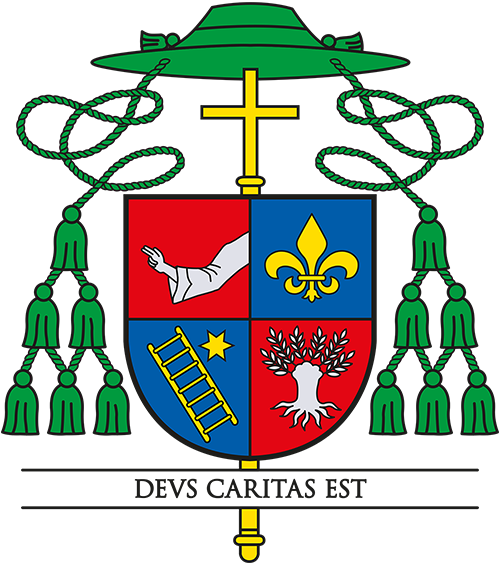
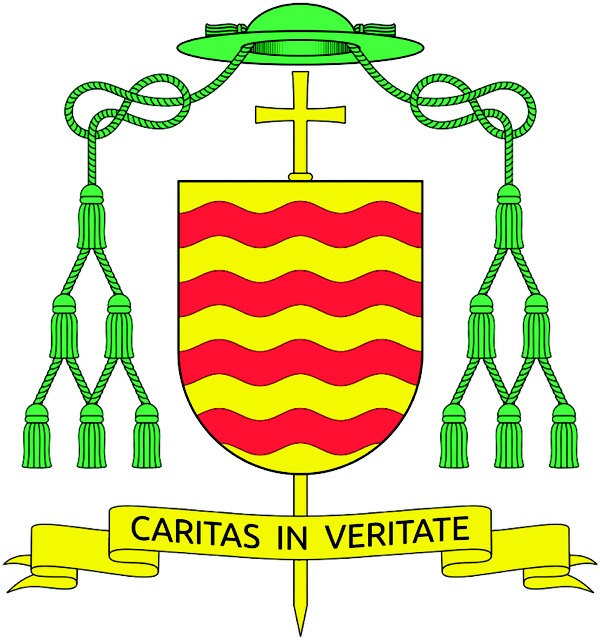
On March 15 the Most Rev. Mario Toso, SDB will be installed as the bishop of Faenza-Modigliana, Italy. His very attractive coat of arms makes reference to the motto he has chosen. The motto, “Caritas in Veritate” is taken from the first line of the encyclical of Pope Benedict XVI. The red wavy bars on the shield represent love and the gold background the splendor of the truth. Thus, the arms illustrate the motto, “Love in Truth”.

Bishop Garcia

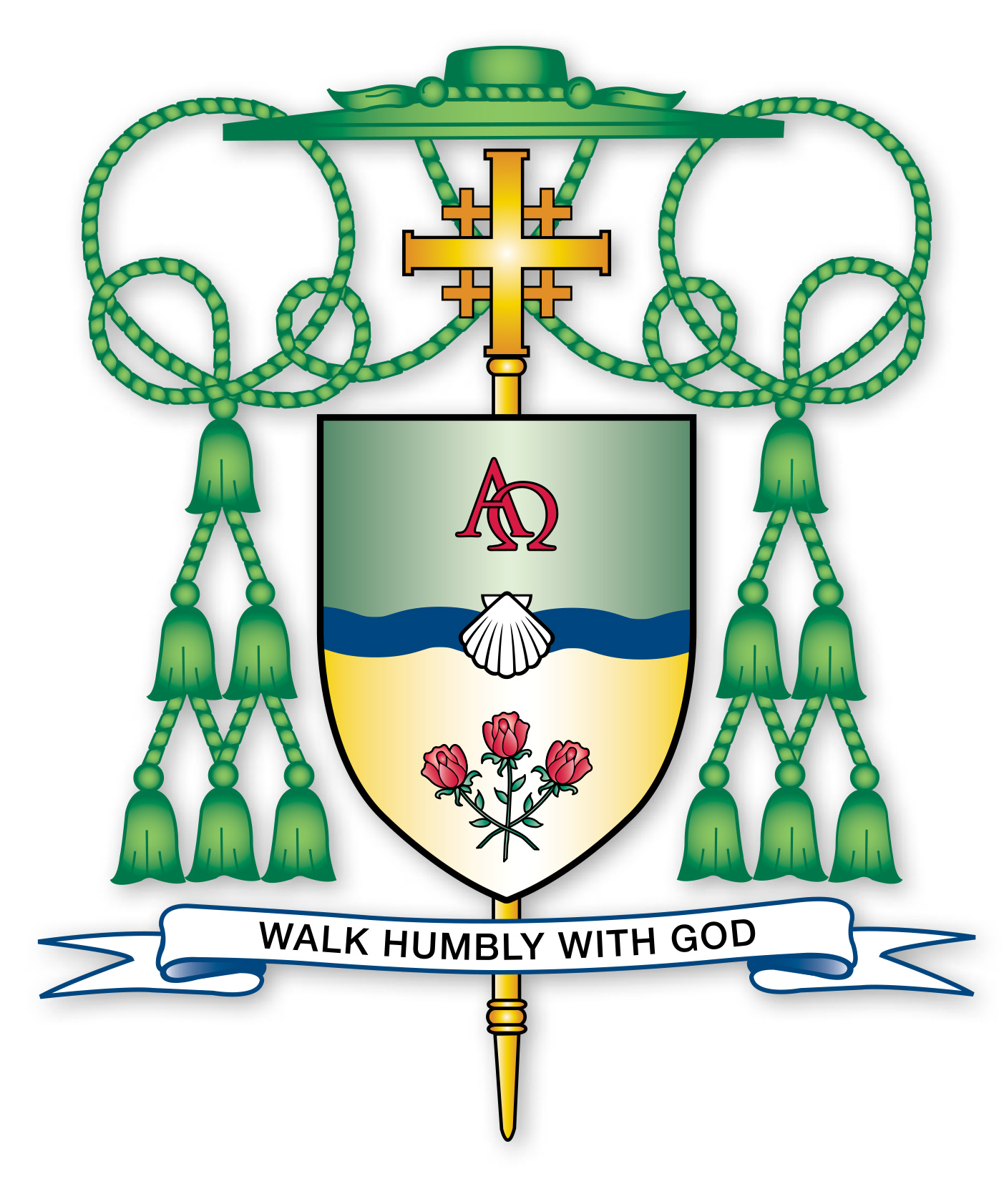
On March 3, the Most Rev. Daniel Elias Garcia was ordained as Titular Bishop of Capsus and Auxiliary Bishop of Austin, Texas. His adopted coat of arms (below) depicts his devotion to Our Lady (the roses), baptism (the shell), the Colorado River and Christ who is the First and the Last.

Dividing the field into two colors (green and gold) by a blue line isn’t really the best design choice. It would have been better if the whole field were gold. In addition, the description of the arms from the ordination program describes the “processional cross” as being in the form of a Jerusalem cross for apparently no reason. First of all it is not a processional cross. The external ornament in a bishop’s coat of arms more than any other that marks it as the coat of arms of a bishop (even more than a mitre or a galero) is the episcopal cross that stands vertically behind the shield. This type of cross, which resembles a processional cross, used to be carried directly in front of a bishop. Like the galero, also no longer in use, such episcopal crosses are no longer used but are retained as not only one of but actually as THE ensign of the coat of arms of a bishop. The galero is optional; the cross isn’t.

Second, it is not permitted to mandate that an external ornament like the episcopal cross, be depicted in a certain shape or style. The blazon concerns itself only with what is on the shield. That may indeed be mandated to be depicted in a particular way. No other artist is bound to depict the episcopal cross of Bp. Garcia’s arms as a Jerusalem cross. It may be his preference but it is not one to which others must adhere.

BishopGarciaBlazon

Bishop O’Regan of Sale, Australia

On February 26 Patrick M. O’Regan will be ordained and installed as the IX bishop of Sale, Victoria, Australia. The ship at sea is a reference to the diocese of Bathurst where the bishop previously served as a priest. In chief are charges that allude to St. patrick and to the arms traditionally associated with families of the name O’Regan or Regan. The arms were designed by me and Mr. Richard d’Apice and rendered by Mr. Sandy Turnbull.

Image 1

Bishop Christopher Coyne of Burlington, Vermont

Coat-of-Arms

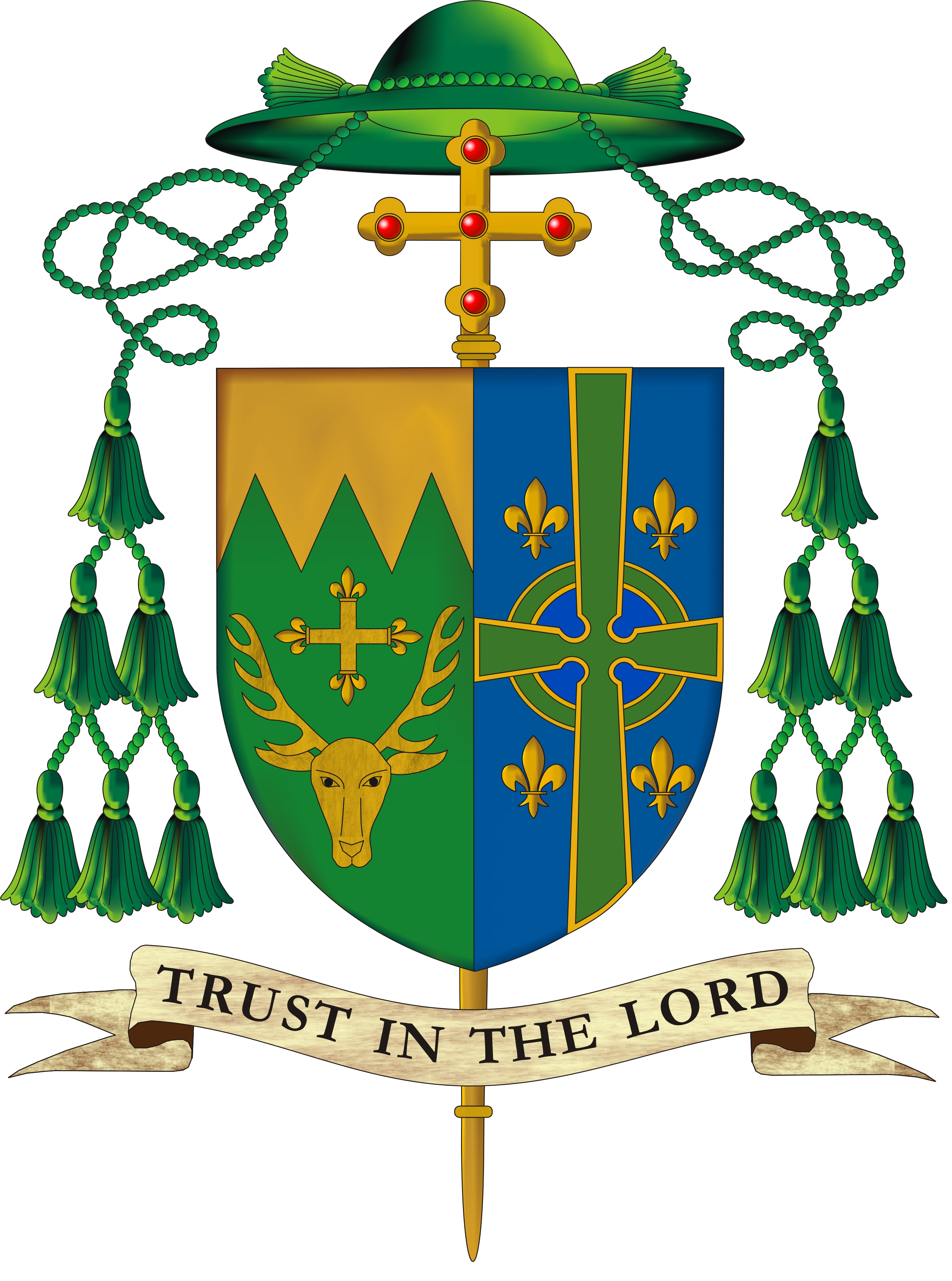
On January 29 Bishop Christopher Coyne, until now Auxiliary Bishop of Indianapolis and before that a priest of the Archdiocese of Boston, will be installed as the 10th Bishop of Burlington, Vermont.

The dexter side of the shield (to the viewer’s left), represents the coat of arms of the Diocese of Burlington and is composed of a green field, which meets a gold chief (upper one-third of the design) at a jagged line, called “dancetty,” to give the impression of green mountain peaks, thus honoring the Green Mountain State of Vermont. Below the mountain is a golden stag’s head that is taken from the arms of Lord Cavendish, Earl of Burlington, for whom the See City is named. Between the stag’s antlers, as seen in the arms of the Archdiocese of Boston, is a golden cross fleuretty. This cross, honoring the French missionaries who first brought The Faith to the region, signifies that the first priest to be stationed in the service of the people of Vermont, Father Jeremiah O’Callaghan, was sent by Boston Bishop Benedict Fenwick.

The sinister side (to the viewers right) ‘s occupied by the personal heraldry of Bishop Coyne; upon a blue (azure) field is Bishop Coyne’s coat of arms which blends images representing his love for God, family genealogy and ministry history in the Archdiocese of Boston.

Bishop Coyne’s grandfathers were Irish and his grandmothers were French. The coat of arms reflects those two heritages with the Celtic cross and the fleur de lis. The Celtic cross also calls to mind the centrality of the cross in the history of salvation and the sacrifice of Jesus which brings redemption. The fleur de lis also represent Mary, the Mother of our Savior, and Saint Joseph, her most chaste spouse. Finally, the blue (azure) field also calls to mind Mary, the Immaculate Conception, under whose patronage the Diocese of Burlington has been placed.