Category Archives: Bad Heraldry

Bishop Lewandowski, CSsR of Providence

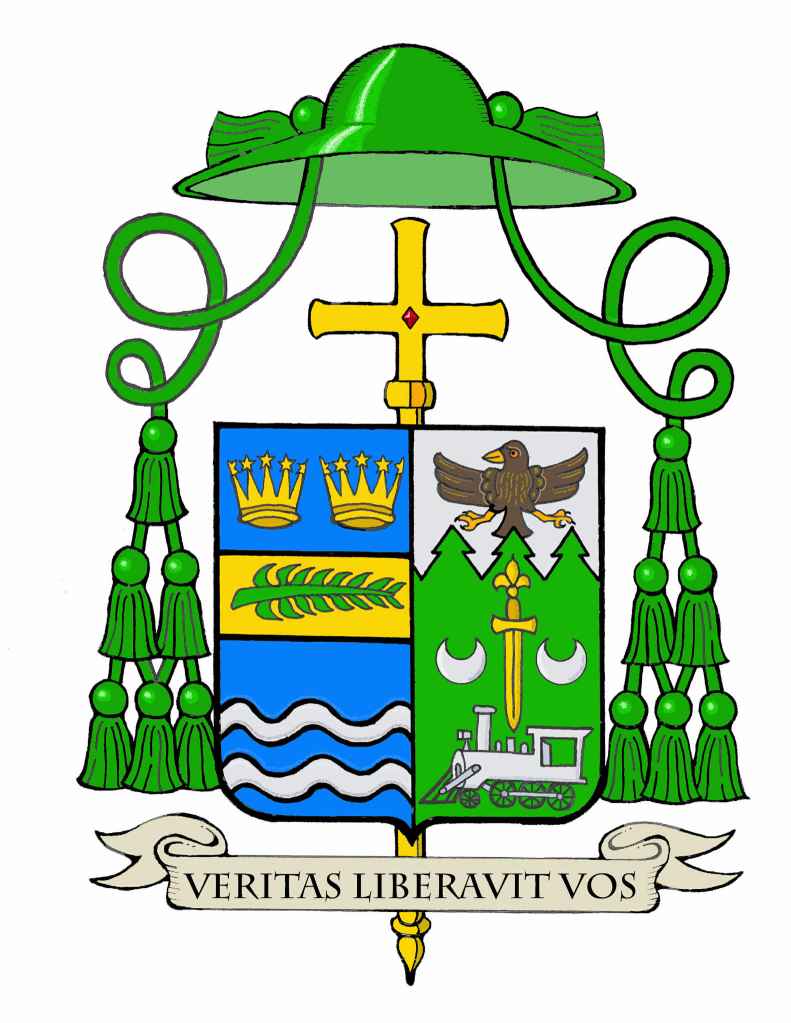
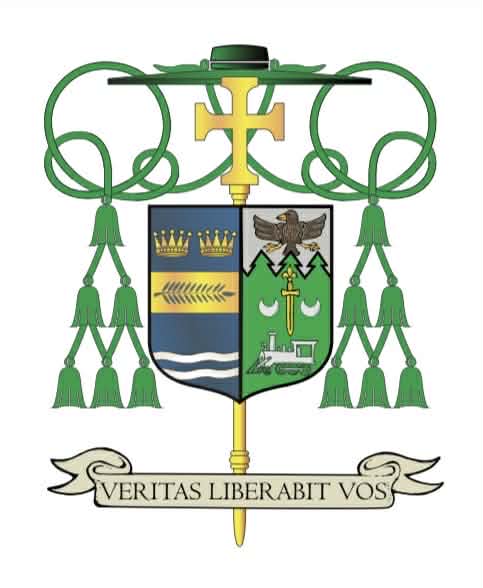
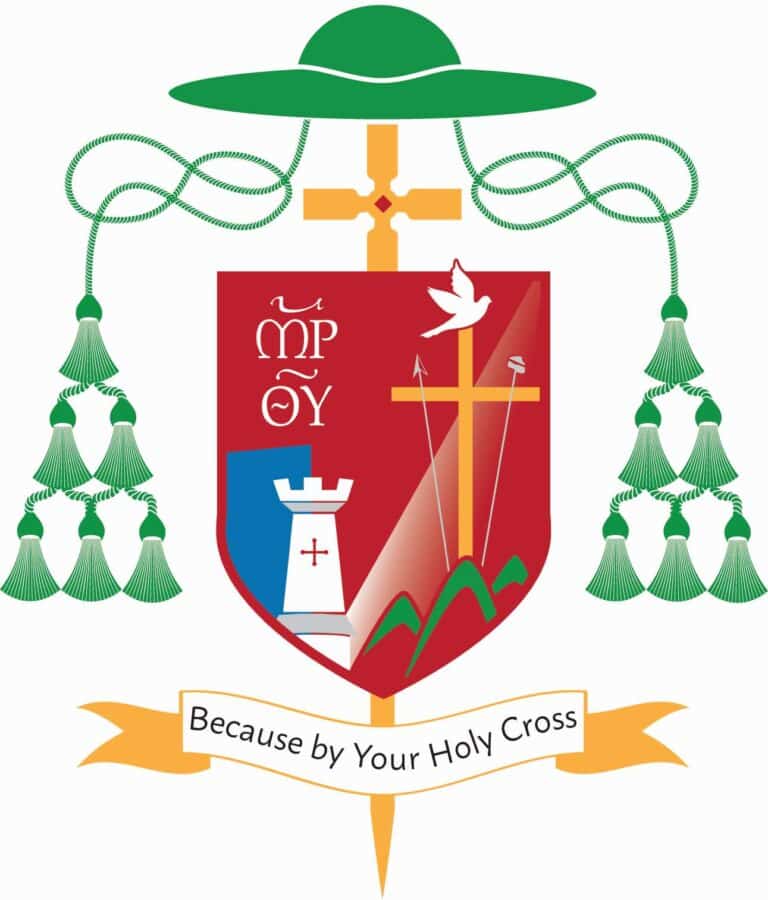
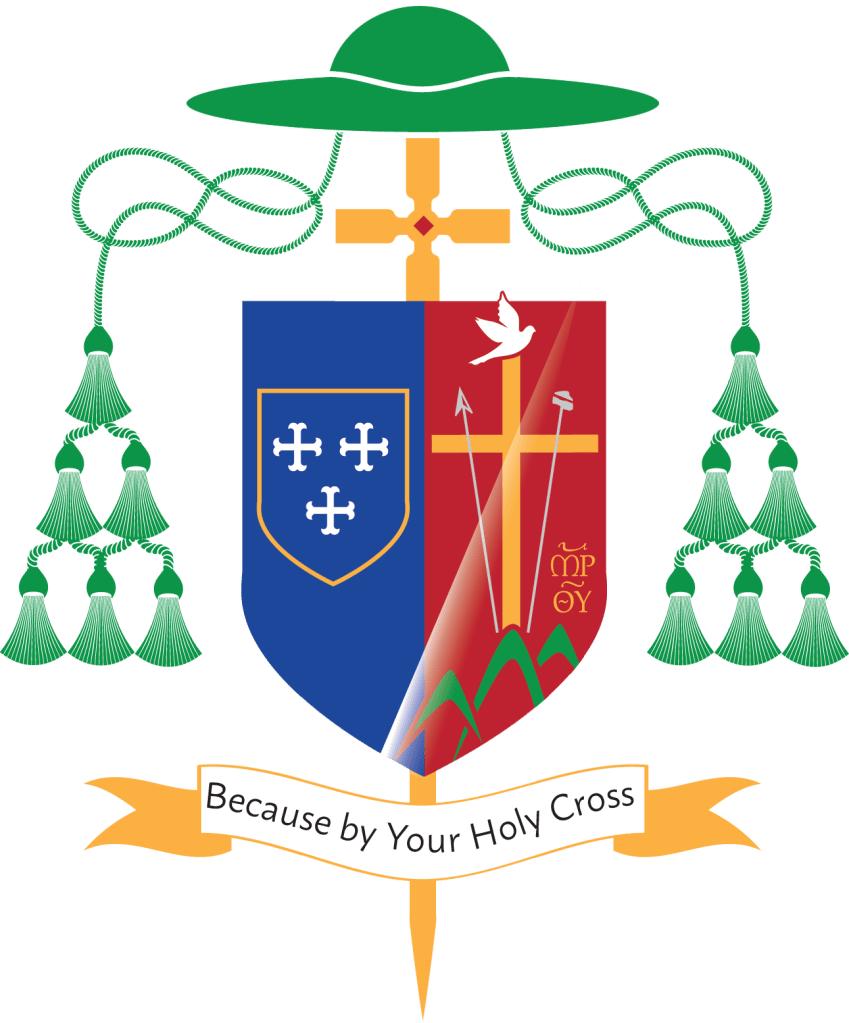
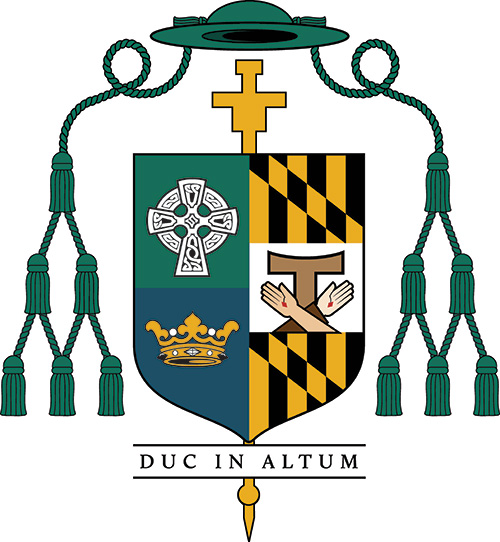
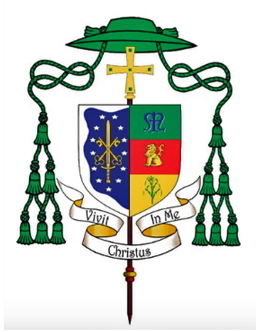
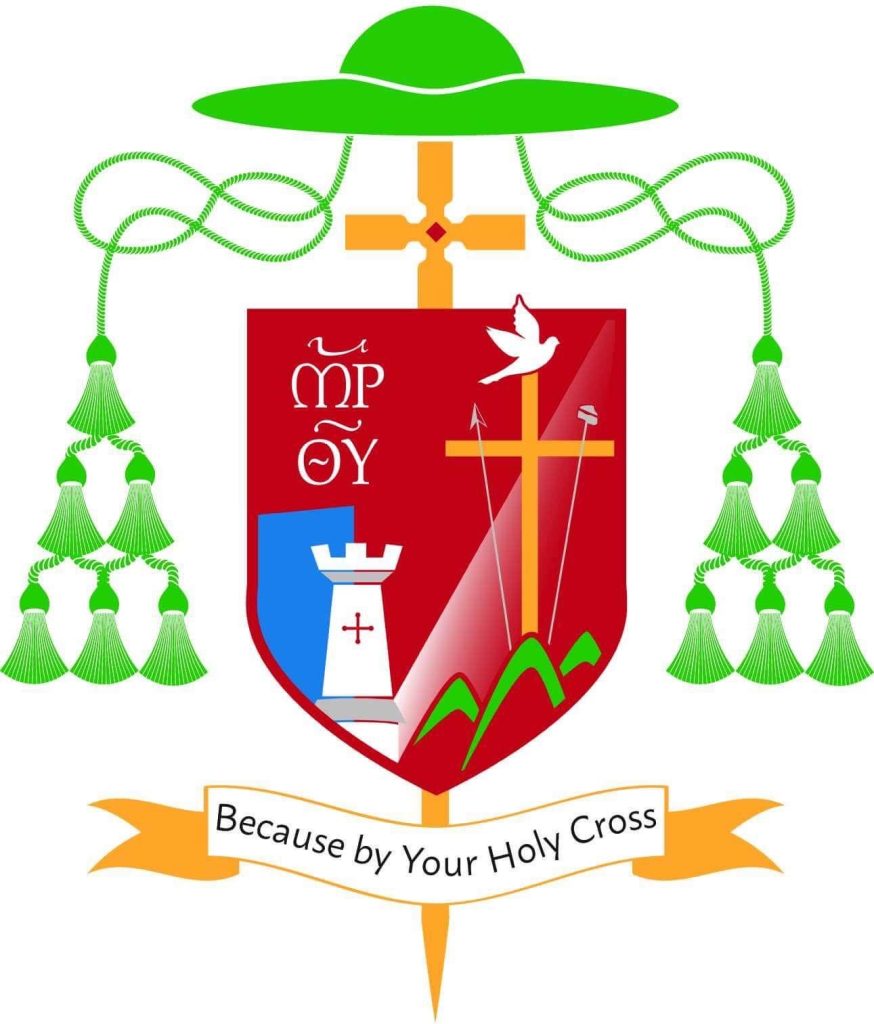
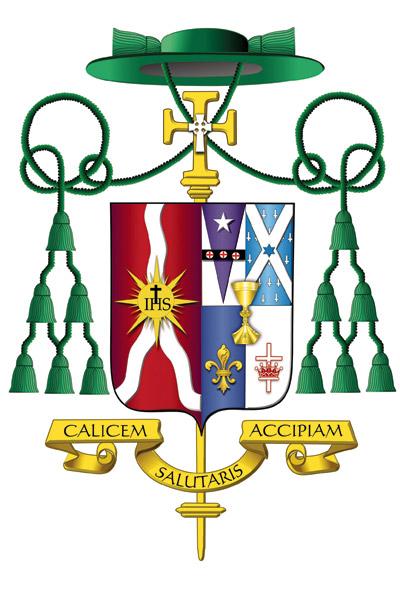
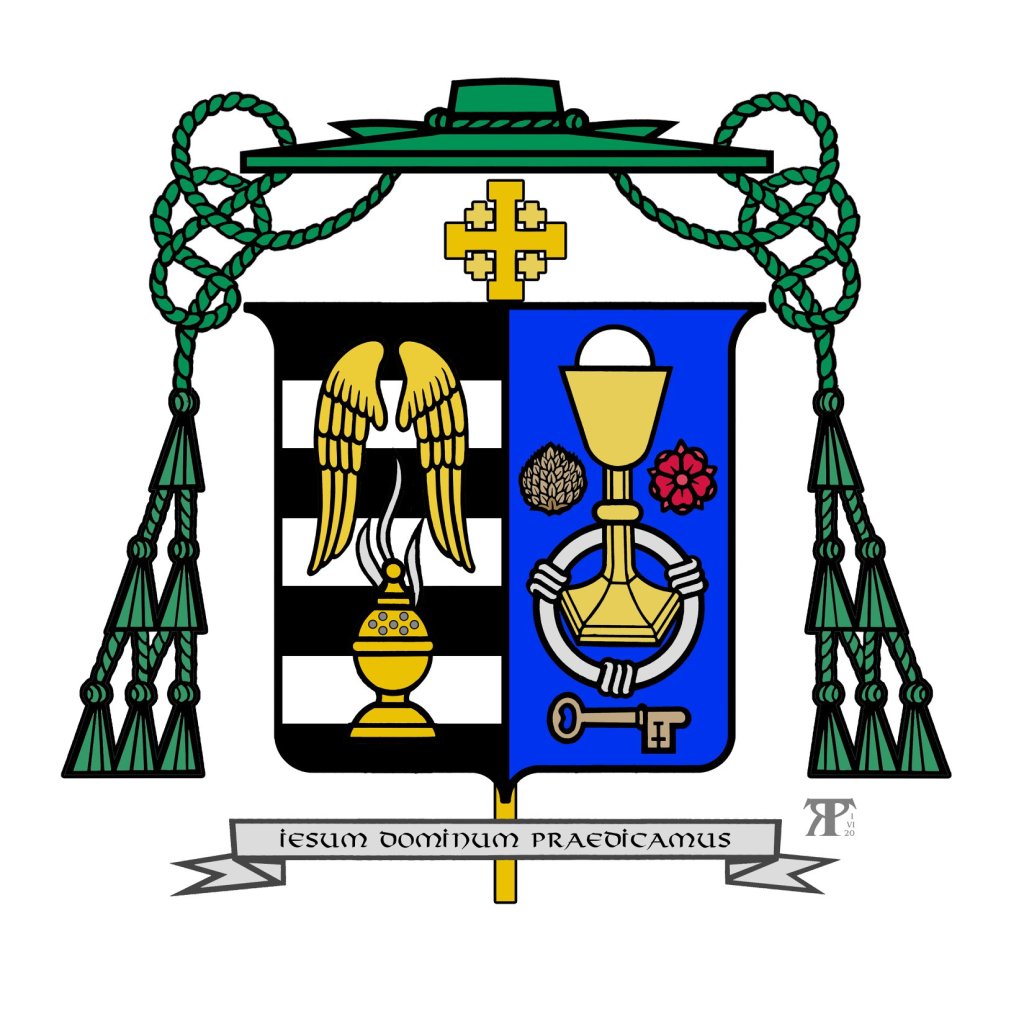
On May 20, the Most Rev. Bruce Lewandowski, CSsR (57), a Redemptorist and formerly Auxiliary Bishop of Baltimore, will be installed as the 10th Bishop of Providence, R.I. I had previously written about the bishop’s coat of arms when he was first made Auxiliary Bishop.

Now that he is moving to become a diocesan bishop his armorial bearings will now be marshaled to those of his diocese. The Bishop had employed his sister, a Felician Sister who “works in media” for her Province to design his coat of arms. As they were back then, so too, are they something of a dumpster fire, heraldically speaking.

In an interview for The Catholic Review, the Baltimore archdiocesan newspaper, in 2020 the Bishop said, “Why would I ask anyone else?” when asked why his sister was designing his coat of arms. I think I can answer that. How about: in order to turn to someone with knowledge of a specific topic that isn’t really a DIY project? How about that? In her own part of the same interview, Sr. Lewandowski remarked about some of the particular elements of her design:

The Holy Spirit is depicted as breaking the upper edge of the shield ‘as it is the privilege of the Holy Spirit to inspire new life and envision endless possibilities for the Church, God’s people,’ the description says. The designer noted that she was not sure if that was “allowed” but in her research she did not find any parameters that said it couldn’t be done that way.” (emphasis added)

All I can say is that must have been one quick and not very diligent Google search. Even the most cursory bit of online research should have clued her in to the fact that charges emerging through the edges of the field was a puerile and amateurish mistake. Quite frankly, I don’t see how she could have done any research and reached the conclusion that she did! There are numerous resources out there for someone unfamiliar with good heraldic practices, to say nothing of the huge online presence of groups and organizations that could have happily offered her assistance in her project.

But, this, instead, is the worst kind of so-called heraldry: heraldry as logo. (It summons up the bile just by thinking about it!).

In the same aforementioned article she said:

…she believes a bishop’s coat of arms should tell people who he is and what he stands for. And I believe it should be a more spiritual piece, not just a historical piece,” she said. “And a lot of the coats of arms that I’ve seen and that I kind of read into, it’s a real historical document, but it doesn’t always tell you who the bishop is. She said she tried to tie in Bishop-designate Lewandowski’s spirituality into the symbols she used.”

Well, she got the first part right. A coat of arms should tell people who the armiger is. But, then she rode that right off the rails with the second part. A coat of arms does not tell people what the armiger stands for. It is for identification alone. I have often mentioned that a coat of arms is not one’s C.V. in pictures. Similarly, it isn’t an expression of personal ideology; a manifesto of one’s own spirituality or (for the clergy) a catechetical tool that expresses one’s personal beliefs as a kind of pictorial homily. Unfortunately, that’s precisely how the Lewandowski kids decided to view this project, with disastrous results.

In the latest rendering the overcrowded and poorly composed original coat of arms now falls victim to, perhaps, my second favorite pet peeve: they were changed in order to combine well with the diocesan arms. That’s not an option, full stop. (I suppose Sister didn’t find anything in her research that said she couldn’t do that either!) In addition, the charges form the personal arms are still going beyond the divisions and boundaries of the shield and/or spilling over from one impalement to the other. Clearly, this is also the classic mistake of thinking that the diocesan arms now somehow “become” part of the bishop’s coat of arms rather than being an example of two distinct and separate coats of arms marshaled together on one shield so as to express the relationship between the two!

The list of things wrong with this just goes on and on, and on…

Suffice it to say that he had a poorly designed coat of arms to begin with which would have and could have benefitted greatly from some expertise and advice from an organization, an individual, or even a decent book on the subject in order to take the elements and arrange and depict them according to good heraldic practices. Now, that poorly designed coat of arms has been badly modified and marshaled inexpertly to the point that the diocesan coat of arms of the See of Providence is depicted incorrectly!

EPIC FAIL!

But…what do you expect when a coat of arms is approached as an exercise in graphic design to tell us who the armiger really is? I’ll leave that question unanswered, thank you.

What Do YOU Think of Pope Leo’s Coat of Arms?

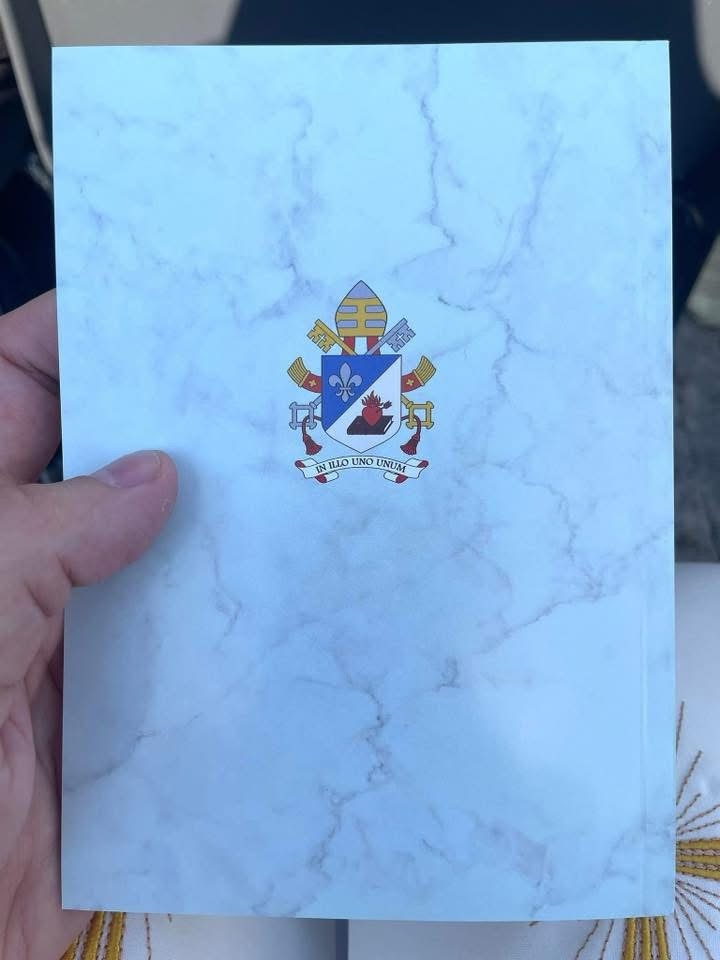
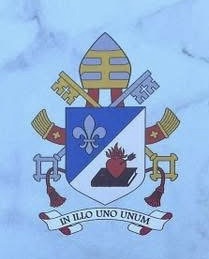
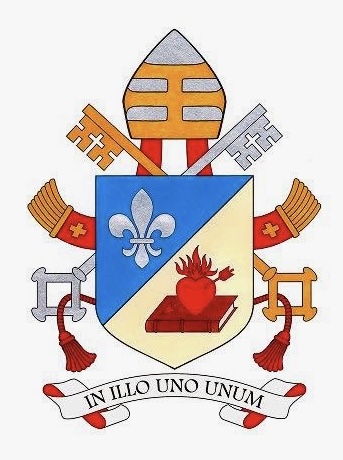
This question has been posed to me by numerous people since the Holy See released the image of the Pope’s coat of arms as pope. My answer is simply this: it looks pretty much like I expected.

Pope Leo already had a very good coat of arms as a bishop. I’m glad to see he didn’t feel the need to entirely change the design as others have done in the past. A coat of arms is a means of identification. It identifies you. It becomes associated with you in such a way that it shouldn’t be changed cavalierly. A change of position should warrant the use of different external ornaments to signify the new rank, not a full scale change in what is on the shield itself. So, I’m happy to see that the Pope left alone the arms that he assumed as a bishop 11 years ago.

I was not surprised to see the papal tiara rendered in the form of a kind of mitre. This began with Pope Benedict XVI and continued with Pope Francis I. So, we have now seen this for twenty years and I assumed it would be continued. It is, perhaps, important to note that the tiara has not been replaced with a mitre. Rather, it is the papal tiara rendered as a kind of mitre/tiara hybrid. This occurred at all because of ignorance. The argument to Benedict XVI was that since the tiara is, practically speaking, no longer worn it should not be depicted in the coat of arms. Nothing could be farther from the truth. In fact, since it is no longer worn that’s all the more reason it should be used in the coat of arms. It remains a symbol of the papacy. Most of the world’s monarchs no longer actually wear a crown but the use of a crown heraldically remains. Cardinals and bishops no longer wear an actual galero but the galero remains a heraldic emblem. (It is worth noting here that the tiara with the keys remains the emblem of the Holy See.)

St. Paul VI, in his reforms of 1969, decreed that the mitre and crozier which used to be in the coats of arms of all bishops in addition to the galero and episcopal/archiepiscopal cross should no longer be used in the arms of such prelates. He reasoned that the crozier and mitre were still used liturgically as emblems of the episcopal office and their practical use made using them as heraldic symbols redundant and inappropriate. (NOTE: the same is also true for the pallium) Whereas, the episcopal cross and galero—used at one time—had fallen into practical disuse and so were very appropriate to be used purely as heraldic ornaments. By that logic the same is true of the papal tiara. Since recent popes have chosen not to be crowned the use of the tiara as a purely heraldic emblem makes all the more sense.

Yet, those advising Benedict XVI, principally among them Archbishop Piero Marini and the late Cardinal di Montezemolo, argued that the tiara should be modified in its appearance to show that it is no longer actually worn. This was bad advice then and it has now been codified into enduring, though still equally poor advice. Nevertheless, it was easy to anticipate that Pope Leo would simply follow suit. So…no real surprise there.

Similarly, the slight change in tincture of the division of the field in base from Argent (silver or white artistically) to a kind of beige or buff color shows an appalling lack of understanding of heraldry. This is also displayed in the description of this tincture as “light”. Just what, precisely, is THAT supposed to mean ?!?! There isn’t an actual blazon to help clarify this. The lack of a proper blazon could be because no one at the Vatican knows how to write one; they simply don’t find it important enough to care about; or they feel it would be too esoteric and unintelligible for the average person. One can only hope that the reason is one of the latter two rather than the former.

But there isn’t a lot of evidence to dissuade me. For example, the tiara and keys and motto banner are all clearly just a “cut & paste” job from the arms of Pope Francis I. Really? With all the many competent heraldic artists and heraldic experts available to them no one at the Vatican bothered to reach out to anyone and just figured this could all be handled “in house” by someone with a computer? Is that the most appropriate way to prepare a new pope’s coat of arms? it shouldn’t be a matter of who can get it done first but of who can do it best. What a shame that it has been deemed acceptable simply to cobble something together from existing images.

It’s also probably worth noting that—just like all bishops—all of the popes have had an episcopal motto. However, by longstanding tradition and custom a motto is not supposed to be included in the armorial achievement of the Pope. In his seminal work, Heraldry in the Catholic Church (1978) Archbishop Bruno Heim notes that, “It is widespread custom to put a motto under the shield. It is often held, wrongly, by those who know little about heraldry, that the motto is indispensable; yet it is an addition which does not properly belong to the armorial bearings themselves.” (page 80)

So we see that, all in all, the new Pope’s coat of arms is unsurprising in its composition, disappointing in its execution, and uninspiring in its depiction with numerous errors that could have been avoided with a little creativity and some consultation with people who know what they are doing.

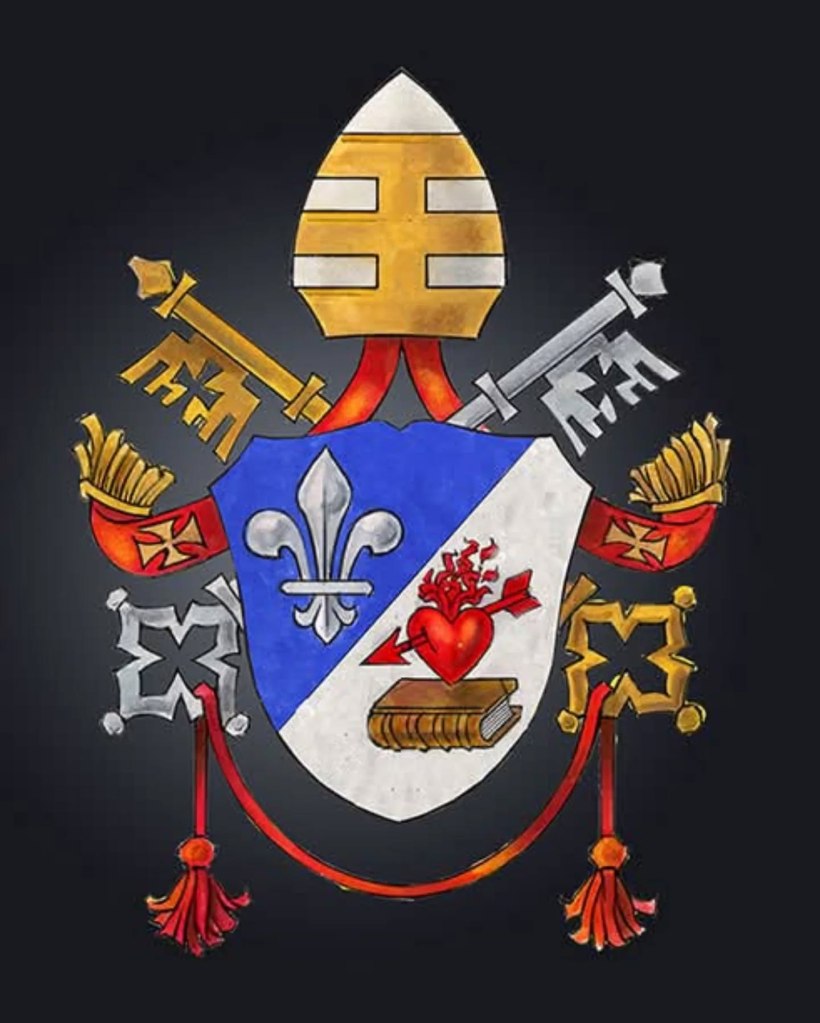
For example, in the hands of an artist of some merit the same exact design can be rendered in a manner that looks considerably better just by the good use of composition and artistic style.

Take, for example, this sketch of the arms of Pope Leo XIV done on the evening of his election by the noted and competent heraldic artist, Marco Foppoli. We can see here that, in the hands of an expert with a great deal of experience, the original heraldic design can be rendered with the appropriate external ornaments in a way that maintains the simplicity that is desired while also creating a new and unique achievement for the armiger. Too bad that someone like Foppoli wasn’t consulted by officials at the Holy See.

Papal heraldry has been in a slow decline since the death of Archbishop Heim. It is sad but true. Unfortunately, at the outset of this new pontificate, there are no signs that this is going to change for the better anytime soon.

God Bless Pope Leo XIV!

Marshaling is Everything! (Bp. Martin UPDATED)

You may recall that in a post about several new bishops’ installations I wrote the following about the coat of arms of Bp. Martin of Charlotte, N.C.:

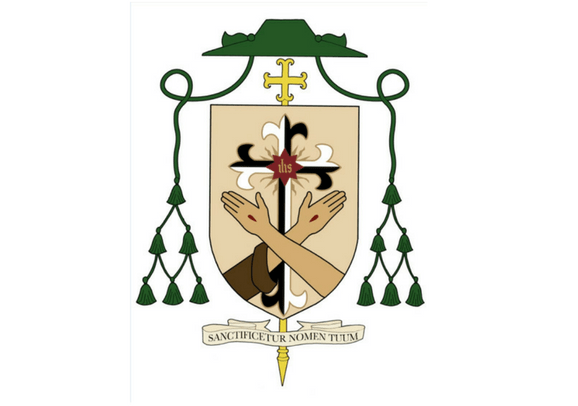
May 29 saw the ordination and installation of the Most Rev. Michael Martin, OFMConv (62) as the fifth Bishop of Charlotte, North Carolina.

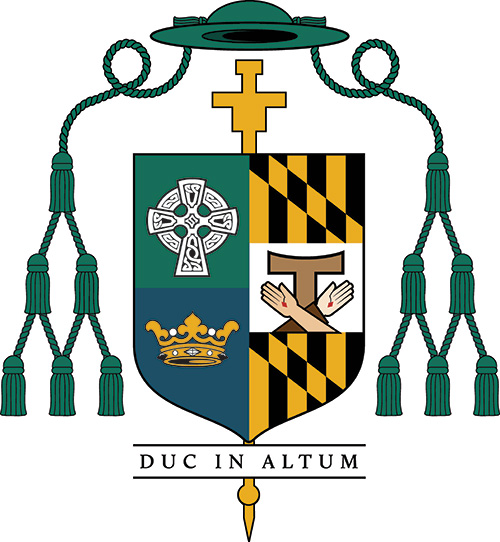
The diocesan website describes his personal arms, “To the viewer’s right is the Franciscan coat of arms. Featuring the traditional Franciscan Tau cross with two arms crossing one another, it is rich in symbolism. The two arms, one Christ’s and the other St. Francis of Assisi’s, both bear the stigmata. They symbolize God’s love and Francis’s loving response to the Word made incarnate, Taberski explained. It is an image found throughout the ministries, friaries, missions and sites served by the Franciscan order.

On the right side of the shield, the top (known as the “chief”) and the bottom (the “base”) feature references to George Calvert and his son Cecil Calvert – the first and second barons of Baltimore. The Calverts were among the first Catholics to arrive in colonial America. They established the then Province of Maryland as a safe place for English Catholics to emigrate to since they were no longer able to freely practice their faith at home. In the coat of arms, the use of six vertical stripes – alternately gold and black, with the diagonal stripe in color – recalls Bishop Martin’s hometown of Baltimore.”

A nice simple design but perhaps the arms of Calvert would have looked better depicted once in the main part of the field with the Franciscan symbols occupying a chief?

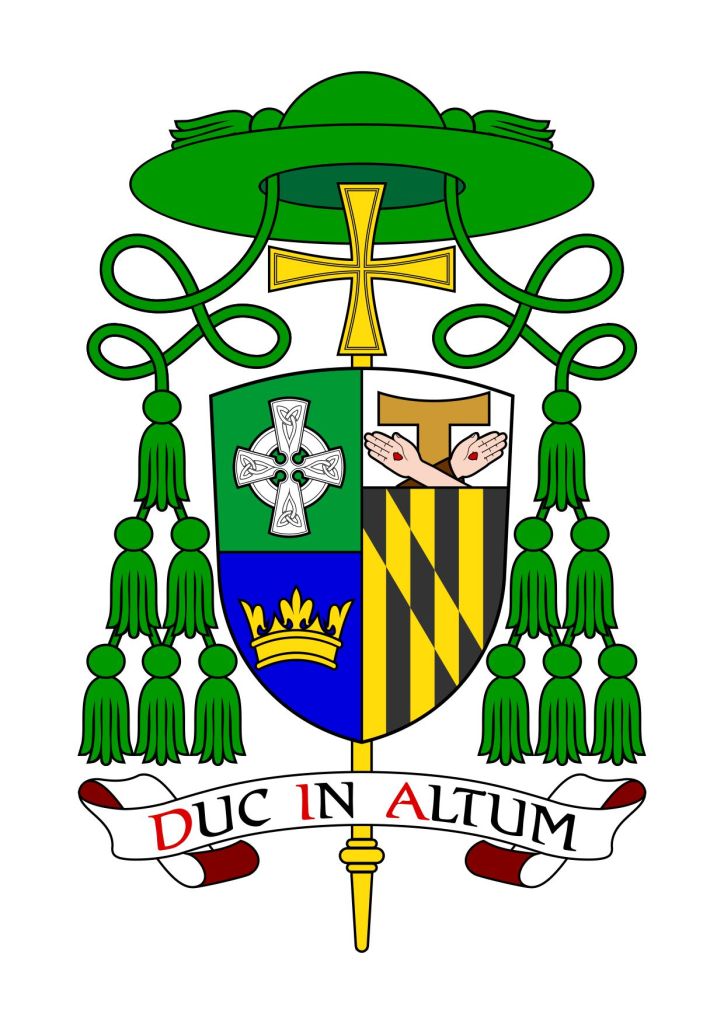
Well, my friend and frequent collaborator, Mr. Sandy Turnbull of the Australian Heraldry Society, read that post and decided to have a bit of fun and create a new emblazonment of Bp. martin’s coat of arms that followed my advice. I’d say the result (below) speaks for itself. I was right! The whole achievement does look better as I suggested. See? One can’t just throw things onto a shield and call it heraldry. How the design is arranged—to be aesthetically pleasing as well as heraldically correct—is a large part of good heraldic design.

Some Recent Installations/Ordinations in the U.S.

During the last month there have been some vacant Sees filled in the United States. The Most Reverend Christopher Coyne (65) succeeded to the See of Hartford on May 1 becoming its fourteenth bishop (and sixth archbishop). A very fine achievement depicted in the style of the late Deacon Paul Sullivan…except I think it is ill-conceived to place a green cross on a blue field. Yes, there is the slightest fimbriation on the cross to protect against violation of the so-called tincture “rule”. Nevertheless, the overall appearance is odd…and the fimbriation, such as it is, is entirely too narrow to the point of being almost invisible!

The Most Rev. James Ruggieri (56) was ordained a bishop and installed as the fourteenth Bishop of Portland Maine on May 7.

According to the diocesan website, “The personal arms of Bishop Ruggieri are divided horizontally (per fess). The upper half is painted white (argent) and bears an anchor painted blue (azure). It recalls the birthplace and home of the Bishop in the Diocese of Providence, Rhode Island. That state’s flag and seal comprise a gold anchor and a scroll with the motto “Hope.”

The anchor is an ancient symbol of the theological virtue of hope, deriving from the words of the Letter to the Hebrews: “We have this hope as a sure and steadfast anchor of the soul …” (Hebrews 6:19). In this depiction, the stock of the anchor is positioned on the shank to resemble a Passion Cross, an equally ancient symbol of the theological virtue of faith. As Pope Benedict XVI pointed out, “Hope, in fact, is a key word in Biblical faith—so much so that in several passages the words faith and hope seem interchangeable. Thus, the Letter to the Hebrews closely links the “fullness of faith” (10:22) to “the confession of our hope without wavering” (10:23).

In the lower half of the shield is a depiction of the five loaves and two fish that the Lord Jesus multiplied to feed five thousand men and their families. The only pre-resurrection miracle that is recounted in all four Gospels (Mt 14:13-21; Mk 6:32-44; Lk 9:10b-17; Jn 6:1-15), it holds a special place in the story of the public ministry of Jesus and points to the institution of the Eucharist at the Last Supper. The Feeding of the Five Thousand also highlights the cooperation of the apostles – whose successor the bishop is – with the Lord, both in the ministry of charity, and as celebrants and guardians of the Holy Eucharist and the other sacraments.”

The episcopal cross is depicted incorrectly, but more about that to follow.

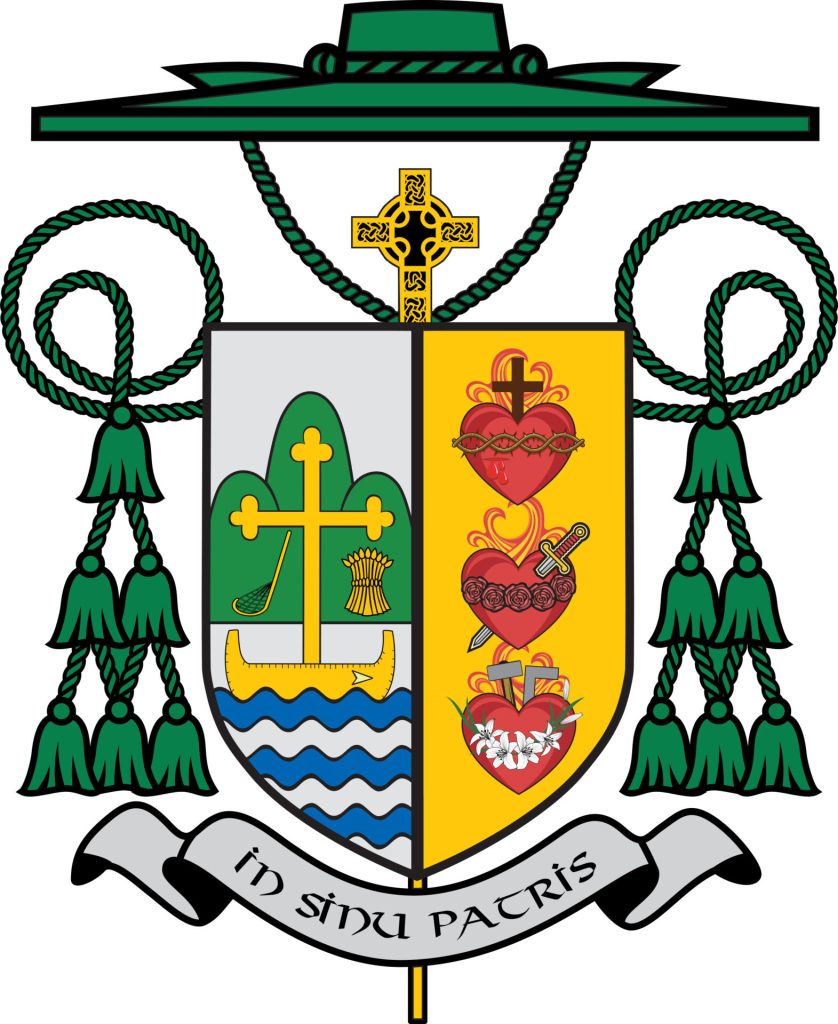
The Most Rev. William Battersby (64), Auxiliary Bishop of Detroit, was installed on May 20 as the eleventh Bishop of La Crosse, Wisconsin.

His coat of arms, while very simple, seems a bit overly given to the devotional. The explanation from the diocesan website says, “For the personal coat of arms of Bishop Battersby…at the top of the shield is a Celtic processional cross meant to honor Bishop Battersby’s Irish heritage. It is shaped like a traditional cross but with a ring, representing the sun, around the intersection of the stem and arms. The whole cross is decorated with ornate Gaelic patterns.

Bishop Battersby’s Coat of Arms includes the three Sacred Hearts. The hearts represent the Holy Family and symbolize the unending and boundless love for us. The wounded heart signifies his devotion to the Sacred Heart of Jesus. It also pays tribute to Sacred Heart Major Seminary where he prepared for the priesthood and at which he served as vice-rector and dean of seminarian formation at the time he was called to the episcopacy.

The second heart, the Immaculate Heart of Mary, signifies the trust and confidence that Bishop Battersby has in the Blessed Mother’s intercession and protection. The sword symbolizes the sorrows of Mary, the flames represent her burning love for Jesus and us, her children and the roses represent her purity. 

Bishop Battersby’s devotion to St. Joseph is represented in the third of the Sacred Hearts, the Chaste Heart of Joseph, inflamed with love and adorned with the white lily of purity, a symbol of his faith and steadiness.”

Again, I’ll say something about the episcopal cross below.

May 29 saw the ordination and installation of the Most Rev. Michael Martin, OFMConv (62) as the fifth Bishop of Charlotte, North Carolina.

The diocesan website describes his personal arms, “To the viewer’s right is the Franciscan coat of arms. Featuring the traditional Franciscan Tau cross with two arms crossing one another, it is rich in symbolism. The two arms, one Christ’s and the other St. Francis of Assisi’s, both bear the stigmata. They symbolize God’s love and Francis’s loving response to the Word made incarnate, Taberski explained. It is an image found throughout the ministries, friaries, missions and sites served by the Franciscan order.

On the right side of the shield, the top (known as the “chief”) and the bottom (the “base”) feature references to George Calvert and his son Cecil Calvert – the first and second barons of Baltimore. The Calverts were among the first Catholics to arrive in colonial America. They established the then Province of Maryland as a safe place for English Catholics to emigrate to since they were no longer able to freely practice their faith at home. In the coat of arms, the use of six vertical stripes – alternately gold and black, with the diagonal stripe in color – recalls Bishop Martin’s hometown of Baltimore.”

A nice simple design but perhaps the arms of Calvert would have looked better depicted once in the main part of the field with the Franciscan symbols occupying a chief? And again there is an incorrect episcopal cross!

So, my criticism of that, which I have often written about in this blog, is that, firstly, it is NOT a “processional” cross!! It is an episcopal cross—a heraldic symbol—which indicates the coat of arms belongs to a bishop. It is, in fact THE heraldic symbol indicating episcopal arms. The galero, while traditional, is not necessary, nor is a green galero with 12 tassels exclusive to the arms of bishops. But the inclusion of the episcopal cross is truly the sign—and the only essential one—to indicate that the achievement depicts the coat of arms of a bishop.

As an external ornament it is NOT subject to personalization. An armiger has a great deal of choice regarding what is depicted on the shield. However, the external ornaments are not subject to his whim, nor may they be used to convey further personal significance or symbolism. Rather, their purpose is to indicate rank in the overall achievement. The blazon may not specifiy a certain type, shape, color, ornamentation, or embellishment to the galero, or the episcopal cross. Each and every artist is free to depict the episcopal cross as he pleases.

This idea of extending the personal symbolism to the external ornaments is occurring more and more of late…as more and more people with very little background in, or knowledge of heraldry are being asked to design episcopal coats of arms. It is amateurish and a grossly mistaken thing to do.

Cardinal Gibbons

The varied armorial bearings of James Cardinal Gibbons. I often speak about the incorrect practice of a prelate deciding to change or modify his existing coat of arms. Even when arms are assumed (as opposed to granted by a heraldic authority) the bearer should not feel free to completely change them. Sometimes arms are augmented to reflect a new honor received or a change in status. However, completely changing a coat of arms, once assumed, should be avoided.

Gibbons was made Vicar Apostolic of North Carolina which did not yet have its own diocese, in 1868 and served there until he was made Bishop of Richmond, Virginia from 1872-1877. He bore the first coat of arms in both of those places. When he was made archbishop of Baltimore in 1877 he simply modified the external ornaments to reflect his promotion but still used the same shield depicting the seated Virgin Mary. Over the course of the next 44 years of his tenure in Baltimore he then changed his coat of arms no less than three times!

He adopted the arms showing the Holy Spirit descending from a cloud over the globe and also made use of an impalement depicting a pall (pallium). This would have been before the archdiocese had a coat of arms for itself and Gibbons was simply doing with this variant what many an archbishop had done. Namely, using an impalement with a pallium to indicate the status of a metropolitan archbishop.

In 1911, however, he changed his arms entirely again and adopted the coat of arms he bore until his death in 1921. These were done for him by Pierre Chaignon La Rose and I would think that what brought about the last change was the adoption of an archdiocesan coat of arms with which Gibbons’ personal arms were impaled. No doubt La Rose, who was fond of “correcting” coats of arms he didn’t like, convinced Gibbons to adopt the last design which was based on the arms of Gibbons used in Ireland (by a family the cardinal may or may not have had any connection to) differenced by the escallop shell, a symbol of St. James.

I have to admit his original coat of arms wasn’t very good and the final one he ended up with was rather good. But, the process of making many and varied changes throughout his life is not good at all.

Archbishop Sheehan of Santa Fe

On June 3 the Most Rev. Michael Sheehan, Archbishop Emeritus of Santa Fe where he served from 1993-2015, passed away. He was 84.

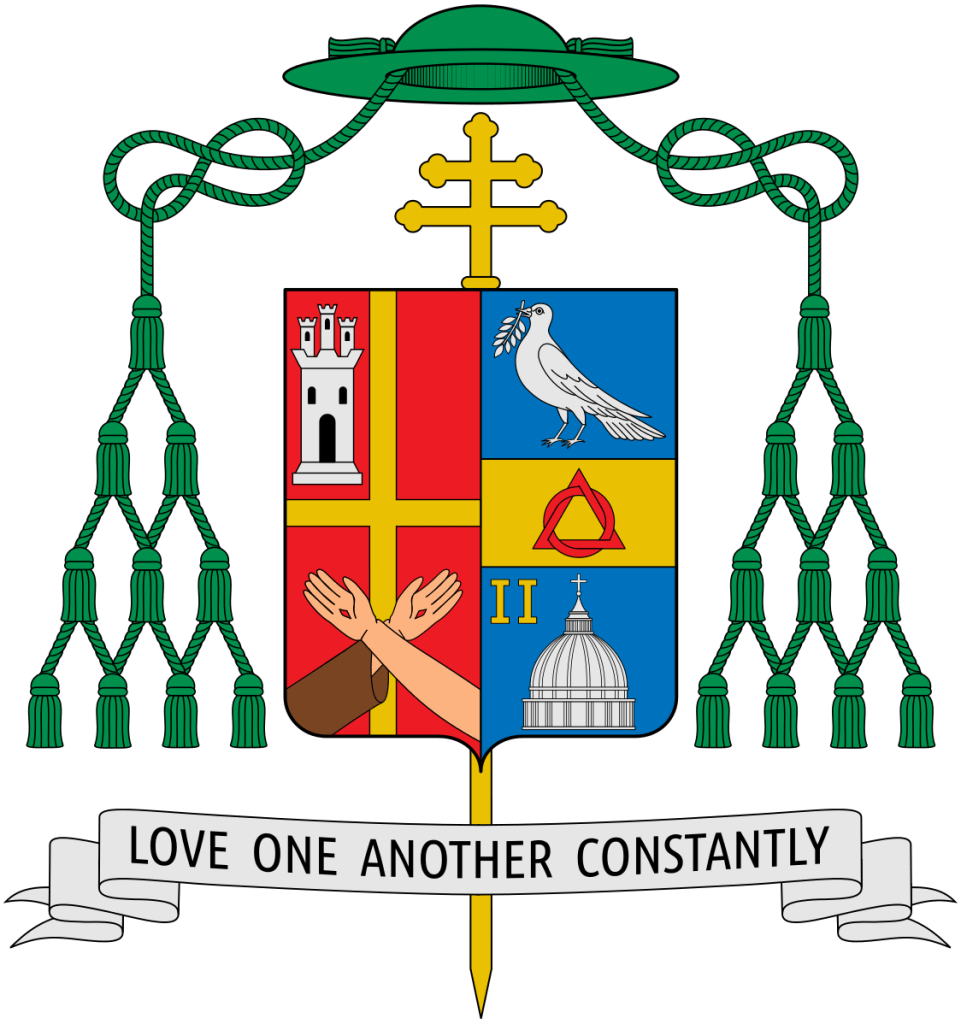
His armorial bearings had a rather unusual charge. “Issuing from the bottom of the Archbishop’s arms is the silver (white) dome of St. Peter’s Basilica, in Rome, which is placed below a gold (yellow) Roman Numeral two (II) to signify that Archbishop Sheehan was in St. Peter’s on the day that Vatican Council II opened.”

Uh-huh.

All I can say, while meaning no personal disrespect to the deceased archbishop, is: nice try.

Justin Trudeau Meddles in Heraldry

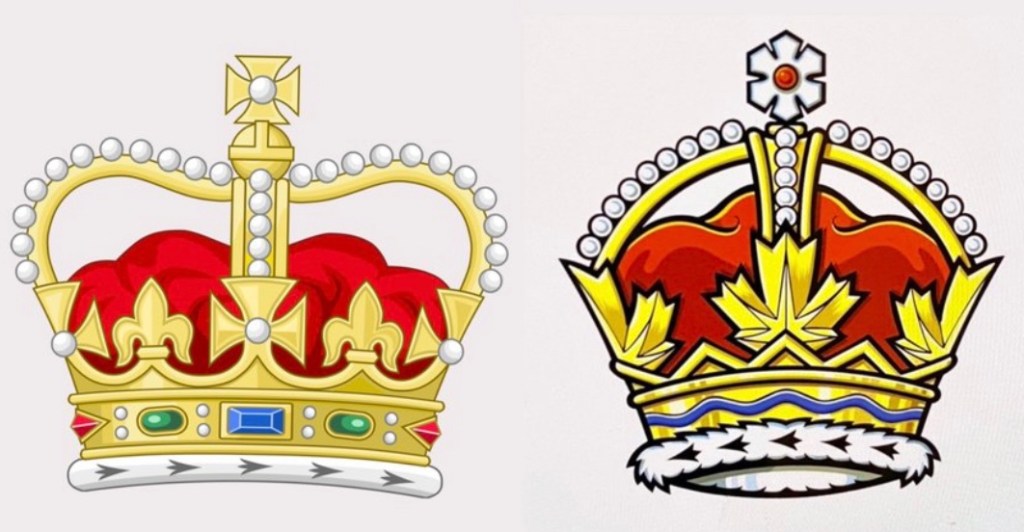
Today, the Canadian Government of Justin Trudeau unveiled a new heraldic Canadian Crown replacing the traditional St. Edward’s Crown used on Canada’s coat of arms, police & military badges. The design replaces what the government termed “religious symbols” (crosses & fleur-de-lis) with maple leaves & a snowflake.

The Canadian Heraldic Authority was apparently consulted in this process. Reactions so far have been mixed but mostly disapproving.

A Very Poor Example

At the recent installation of the Most Rev. Siegfried Jwara, CMM as Archbishop of Durban it was possible to see his personal symbol on a banner in the sanctuary. I don’t call it a coat of arms because it is composed entirely of reproductions of paintings: one of the Good Shepherd, one of Dom Francis Pfanner, OCSO, the founder of Marianhill and a portrait of another cleric.

This. Isn’t. Heraldry.

Below is a poor quality image taken from a screenshot of the video of the installation. Apologies for the poor quality. Although, perhaps it’s better not to see it more clearly. I’ll say again that you may not simply put whatever you’d like on a shield and call it a coat of arms.

DO NOT FOLLOW THIS EXAMPLE!

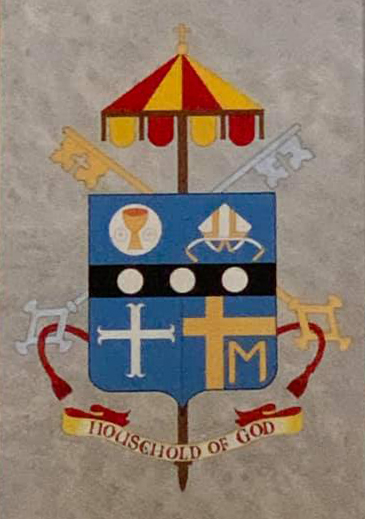
Recently, while taking a short trip for some post-Easter R&R I went to visit friends in western Pennsylvania. I found myself in the town of Loretto, PA where I had attended college at St. Francis University (but in my day it was still just St. Francis College). In that town is the fine parish church of St. Michael, built entirely at the expense of Charles M. Schwab, the US Steel president whose summer residence was located in Loretto. His former mansion is now the motherhouse of the TOR Franciscans who run the university. Schwab generously built the fine romanesque revival structure and donated it to the parish. Andrew Carnegie donated the church’s pipe organ. Some time ago the church was designated a minor basilica. It’s churchyard is the resting place of its founder, Father (Prince) Demetrius Gallitzin.

While looking around the lovely structure which has been spruced up since the the days when I occasionally saw it as a student some 37 years ago I noted in a side chapel a large display of the basilica’s coat of arms…and almost vomited.

What a poor coat of arms for the purpose intended. In fact, it is simply the Altoona-Johnstown diocesan coat of arms with the base changed to have the arms of St. John Paul II (who bestowed the dignity of basilica on the church) shoved in as well. The motto is the one used by the bishop at the time the church was raised to basilican rank.

The fess with three plates is borrowed from the arms of William Penn. The two charges in chief represent the cathedral of the Blessed Sacrament in Altoona and the co-cathedral of St. John Gualbert in Johnstown. The cross in base is borrowed from the coat of arms of the aforementioned Demetrius Gallitzin. Of course the ombrellino and crossed keys are typical external ornaments of a minor basilica.

But what a complete lack of creativity this design displays. Instead of alluding to the diocese or to the pope who bestowed the honor it is the arms of the diocese and the arms of that pope shoved together. There is absolutely nothing in there to identify the basilica as being dedicated to St. Michael the Archangel, or being located in Loretto, or to the Franciscan heritage of that place. The slender line dividing the silver Gallitzin cross from the arms of John Paul II is also heraldically unsupportable. From beginning to end this thing is junk.

It was so horribly disappointing to see this is what was used. The raising of the church to the rank of a basilica occurred only in 1996. By that time the internet was an easy place to find the right person or the right guidance on the design and creation of a fitting coat of arms. There is no excuse for the horrible result they ended up with, except the laziness or arrogance of those in charge of that decision.

This basilica coat of arms is useful for one thing and one thing only: to serve as an example of what not to do!

Bishop of the Virgin Islands

On April 17, 2021 the Most Rev. Jerome Feudjio (65) a priest of the Diocese of St. Thomas, American Virgin Islands was ordained a bishop and installed as the sixth Bishop of St. Thomas. The bishop is a native of Cameroon. The armorial bearings he has assumed are:

These are placed here for your information with no further comment. (I’m feeling charitable today)

Do The Work

I’m very gratified whenever someone tells me that they regularly take a look at this blog. Sometimes they will mention that they have learned a thing or two in what they’ve read here and sometimes they also, jokingly or occasionally chidingly, tell me that they are surprised at the sharpness of my criticisms. With increasing frequency, however, I’m also hearing often in both direct contact with me or in other places on the internet where heraldic enthusiasts congregate that those of us who seem to know more about heraldry should do more to educate those who wish to learn more.

First, let me say that the “those who wish to learn more” frequently fall into two categories. There are those who, for whatever reason, have an interest in learning as much as they can about heraldry for their own enrichment. They understand that a study of heraldry means delving into a world of history, genealogy, symbolism and, lastly, art. Heraldry is a science as well as an art. It isn’t just about pretty pictures or “cool” images of dragons and basilisks. It’s not the domain of medieval fantasists (although many of them do enjoy it) or social-climbing faux nobles. It is a perfectly good hobby, so to speak; a wonderful subject to which one can devote a lifetime of study and learning. In addition, a few also become intimately involved in it as a profession or as an avocation and create new coats of arms for the deserving and the desirous. Whether someone becomes a practitioner of heraldic design and art or simply remains a great enthusiast it is a topic about which you can never stop learning more.

But then there is the other type who, again for whatever reason, have an interest in heraldry but don’t really care all that much about learning the “why and wherefore” of heraldic history or design. They have no interest whatsoever in the many ways the development of heraldry differs from country to country or during different centuries. They have, perhaps, read one or two books on heraldry (or maybe even as many as three!) and have now decided that they’ve “got this”. They are now as expert on the topic as the Garter King of Arms. Therefore, the time has come for them to hang out a shingle and begin creating coats of arms themselves…as a “herald”.

Ironically, despite being convinced of their own expertise, it is this second category who seem to complain the most and the loudest that those individuals and organizations online who offer criticism of heraldic designs owe it to everyone else to educate them more.

Well, first of all, reading someone’s criticism of a design should actually help the less educated to learn more in itself. Although, having said that, I must admit that when I come across really appalling examples I often don’t go into a detailed analytical criticism of the coat of arms but just express my great displeasure by means of some exclamation like, “Awful!”. I’ll grant you that someone is hardly likely to learn much from that other than that I didn’t like it.

My area of particular interest is, obviously, ecclesiastical heraldry. This is an interesting sub-set of heraldry that crosses over time and boundaries and has many rules, customs and traditions of its own despite the fact that there is no umbrella heraldic authority over the entire Church. In places where a heraldic authority does exist the coats of arms of clerics are just as subject to that local authority as the armorial bearings of anyone else. The Church makes no claim to having some kind of supra-national jurisdiction over the regulation of heraldry worldwide. Famously, St. John XXIII (himself a heraldic enthusiast) wanted to establish a Pontifical Office of Heraldry. His former secretary and good friend, Abp. Bruno Heim, talked him out of it. Heim said that one couldn’t legislate in matters of taste. He also had a healthy respect for the different ways heraldry developed in different countries and a real love of heraldic creativity. He knew such a Pontifical Office would tend to standardize Church heraldry and stifle creativity.

So, that’s one of the reasons there isn’t now, nor is there likely to be, an office to regulate the armorial bearings of clergy, prelates and institutions in the Church.

Throughout history the Church has primarily concerned itself with the external ornaments of heraldry. That is, those things that are placed around the shield rather than on it which indicate the rank and/or function of the armiger in question. What actually goes onto the shield is a matter of individual taste or family history or inheritance or anything else that would make for a unique mark of identification for the bearer of the coat of arms. The Church has no great desire to get into that. Those are precisely the kinds of things some heraldic authorities do get into. I know someone who had applied for a grant from the College of Arms in England and the individual wanted the shield divided per bend. He was told to modify that request because, in England, they preferred not to divide the field that way. I know of another case where a bishop wished to receive a grant from the Court of Lord Lyon. His arms were designed by a very competent expert in heraldry but they contained a field chequy and Lord Lyon didn’t allow such a field so the design had to be changed. The Holy See has neither the time, the resources to devote, or the desire to get into that kind of heraldic regulation. Rather, it tends to concern itself with things like the appropriate color of the tassels on a galero to indicate a Prothonotary Apostolic, etc.

So claiming that it is the job of the Holy See to provide guidance in this area isn’t the answer especially as they already do to some extent. Similarly, it isn’t the job of the various heraldic societies that exist to make sure everyone knows every and any rule of the heraldic science. For the most part those societies exist for people who already know and appreciate heraldry somewhat and wish to share their love of the subject with other enthusiasts. There is an educational element to that but it comes primarily from mutual enrichment rather than mere instruction. There are the many heraldic artists in the world, many of whom now have a website to display their work and solicit business. But they are not necessarily experts in heraldry. Rather, many of them are happy to provide heraldic artwork, itself a speciality that not every competent artist can undertake, but it is not necessarily their task to educate. Finally, there are the heraldic enthusiasts like myself who have a website or blog and who, sometimes a bit flippantly, offer exposure and criticism in an effort promote good heraldic practices and, perhaps, help some people to avoid bad ones. But, I put it to you that while having such a blog may help others to learn that does not make it incumbent upon me to attempt to provide an exhaustive course of study in the particulars of ecclesiastical heraldry. After all, this is something I do for fun!

No, the problem in the world today, especially since the advent of the internet and social media, is that, as usual, people want something for nothing. They want some quick and easy way to skip over the hard stuff and be provided with all the answers they need at the click of a mouse. To put it another way, they don’t want to do the work.

Occasionally, someone is kind enough to describe me as an “expert” in ecclesiastical heraldry, especially Catholic heraldry. That’s very kind. To the extent that it may be true it is so for one reason and for one reason only. It’s because I undertook to begin a serious study of heraldry when I was a young man and have stayed with it for over 35 years. I started doing this before there was an internet (or one to speak of) and it was difficult to communicate with others who shared my enthusiasm. But, I was willing to delve, to do research, to read extensively, to slowly build up a personal heraldic library, to seek the advice of experts and then eventually to come under the tutelage of a person who could critique my own ideas and help me to learn by making mistakes. I did the work!

There are a lot of resources available…if you’re willing to roll up your sleeves and do some good, old-fashioned research. You can’t learn about heraldry by reading an book, or two, or even three. You definitely can’t learn about ecclesiastical heraldry by looking at pictures of other bishop’s coats of arms alone. For example, if you look in the back of a really good book on Church heraldry like Bruno Heim’s Heraldry in the Catholic Church you’ll find not only a bibliography but several appendixes quoting papal documents. How many people have undertaken to look up and obtain full texts of those documents and then have them translated into their own language if they don’t have a good command of Latin?

I did.

How many people who claim to really love Church heraldry look at the books in Heim’s bibliography and then set out to obtain as many of them as possible for your own library, or at least track copies of them down in a lending library?

I did.

How many heraldic enthusiasts who can draw reasonably well have said no to undertaking heraldic commissions because they realize they don’t really know enough about heraldry to create a coat of arms for someone else so they wait several years in order to learn more and become more competent in the field before daring to be so bold as to design a coat of arms for someone else?

I did.

To become really good at this -not the world’s greatest, but just really good- takes a lot of effort, a lot of time and a lot of work. Sadly, there are too many people involved with the creation of heraldry who simply don’t want to make the effort, put in the time or do the work. THAT’S why there is so much bad heraldry floating around the Church. It’s because too many people who have no business whatsoever creating coats of arms are doing so. For a bishop to go to a friend, or relative, or seminarian and say, “You draw well. Why don’t you do my coat of arms?” is like me going to a friend and saying, “You know how to sew on a button so why don’t you make me a chasuble?” It’s preposterous! But, it happens all the time. Ignorant dilettantes who don’t have the sense to seek out the advice of someone with greater expertise, let alone refer their “client” to someone with greater expertise, are getting involved in droves in the design and creation of coats of arms in the Church. Not only are the resulting designs really bad but then they have the audacity to say that someone else: the Holy See, a heraldic society, or even a blogger should provide more guidance and instruction to them so that they can avoid mistakes.

Well, I don’t agree. I’m living proof that the resources and material are out there and can be found with a little effort. What is required is having the humility to start out as a student and not jump immediately into attempting to do something about which you know very little as though anyone can do it. It requires the ability genuinely to learn from criticism instead of simply becoming defensive in the face of it. Most importantly, instead of expecting someone else to provide you with ready-made answers at your fingertips so that you can reap all the benefit of the years of effort someone else has made to increase their knowledge and expertise while at the same time barely lifting a finger yourself you need to…

DO. THE. WORK!

Bishop Lewandowski, C.Ss.R.

The coat of arms assumed by the Most Rev. Bruce Lewandowski, CSsR who will be ordained the Titular Bishop of Croae and Auxiliary Bishop of Baltimore on August 18th:

While many reactions leap to mind such as: incorrect, poorly-designed, clashing styles (the dove’s wing going right up off the shield is particularly ridiculous) among others there is really only one word to describe this:

HIDEOUS!

Three New Ones That Don’t Quite Hit the Mark

Recently, there have been several new bishops ordained and/or installed in the U.S. and in each case their new coats of arms are very disappointing. One of the most valuable sections of the famous book on ecclesiastical heraldry by the late (great) Bruno B. Heim entitled, Heraldry in the Catholic Church concerns the design and adoption of new coats of arms by clergy. In that section, among other pieces of advice, Heim cautions that the new armiger should seek out the advice of someone competent in heraldry and, in particular, ecclesiastical heraldry if they can. That person to be consulted may not be the one who actually does the artwork but they can advise on what is and, more importantly, isn’t appropriate in a coat of arms.

Sadly, none of these new bishops seems to have done that.

I would also add a piece of advice which I have found myself repeating so often over the years to clergy who wish to adopt a coat of arms that it has become, perhaps, the most important piece of advice I can offer. Your coat of arms is not your CV in pictures! A coat of arms is a unique mark of identification. It isn’t a pictorial mission statement, a review of every aspect of your life, a personal history in symbols, a catalogue of all your likes and dislikes or a statement on your ideas of ecclesiology and ministry.

Too many clergy, especially new bishops, don’t seem to understand this. As a result they do too much or they include things that are inappropriate. Let’s take a look.

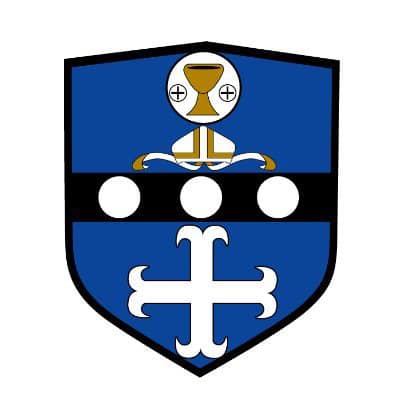
First, is the armorial bearings of Bishop Francis I. Malone (69) who was ordained and installed as the Third Bishop of Shreveport, Louisiana on January 28. The arms of the See of Shreveport are in the dexter impalement and they are not of any interest. However, the personal arms…oh boy! The chalice overall at the center is inappropriately placed and is also an almost photographic depiction of the bishop’s own personal chalice. Heraldry makes use of symbols, not portraits or photographs. An appropriate charge would be “a chalice” not a particular chalice.

The bishop has also quartered the field in such a way that he has marshaled arms that do not belong to him and appropriated them as his own. In the upper left and right of his arms he has, whole and entire, depicted the arms of the See of Philadelphia and the arms of the See of Little Rock; one because he was born there and the other because he served there as a priest. However, by including them entirely in his own arms it appears he is claiming jurisdiction over both! The better way to handle this would have been to borrow a single charge from each and incorporate them into the design of his own coat of arms rather than illicitly stealing the arms of two dioceses.

The charge on the lower left, the fleur-de-lis is fine and on the lower right the cross and crown is a logo used by his former parish which in and of itself is fine and even makes a nice heraldic charge but the overall arrangement is sloppy, and an attempt at a heraldic CV against which I warn people all the time.

Finally, the smaller Celtic cross superimposed over the episcopal cross which is an external ornament behind the shield is heraldically unsupportable. Whoever designed this coat of arms had the clear (and quite good intention) of including as many things from the bishop’s life and ministry as possible but arranged them in a way that suggests he really wasn’t that well versed in heraldic design to pull it off. Everything included in the coat of arms could have been correctly included in a more aesthetically pleasing manner if only someone who knew about heraldic design had been involved.

Second, is Bishop John McClory (56) a Detroit priest who was ordained and installed as the Fifth Bishop of Gary, Indiana on February 11. Again, the arms of the See are of no concern and, actually, are one of the better diocesan coat of arms in use in the USA with a nice reference to the Guardian Angels (titular patrons of the cathedral church).

This coat of arms is really rather nice. There is a good choice of the symbols to be used as charges. There are no tincture violations or indiscretions and, I would say the overall appearance of the coat of arms is aesthetically pleasing and harmonizes well with the arms of the See.

My criticism concerns the arrangement of the charges on the field which is rather like what has come to be known as the “lucky charms” style of heraldry. Namely, a bunch of charges scattered on the field and slapped onto a shield and called heraldry. In addition, trying to “personalize” the episcopal cross which is an external ornament which indicates the rank of the bearer and not a charge on the field which communicate the identity of the bearer is a mistake. It is in the form of a Jerusalem cross to indicate membership in the Equestrian Order of the Holy Sepulchre. This is not the way to depict such membership. Either a charge on the field would have been appropriate, or placing the Jerusalem cross near but outside the shield is also acceptable. In addition, the actual insignia of the Order can be depicted suspended below the shield by a black ribbon or, as a bishop, he could have placed the shield on the Jerusalem cross. But, shaping the episcopal cross to a personal preference is not an option.

Nevertheless, this is the best of the three.

Finally, we have the armorial bearings of Bishop Donald DeGrood (54) a priest of St. Paul-Minneapolis who is being ordained a bishop and installed as the Ninth Bishop of Sioux Falls, South Dakota today, in fact, even as I write this post.

Ugh!

For the third time I take no issue with the arms of the See and also think it is one of the better designed diocesan coats of arms in the USA.

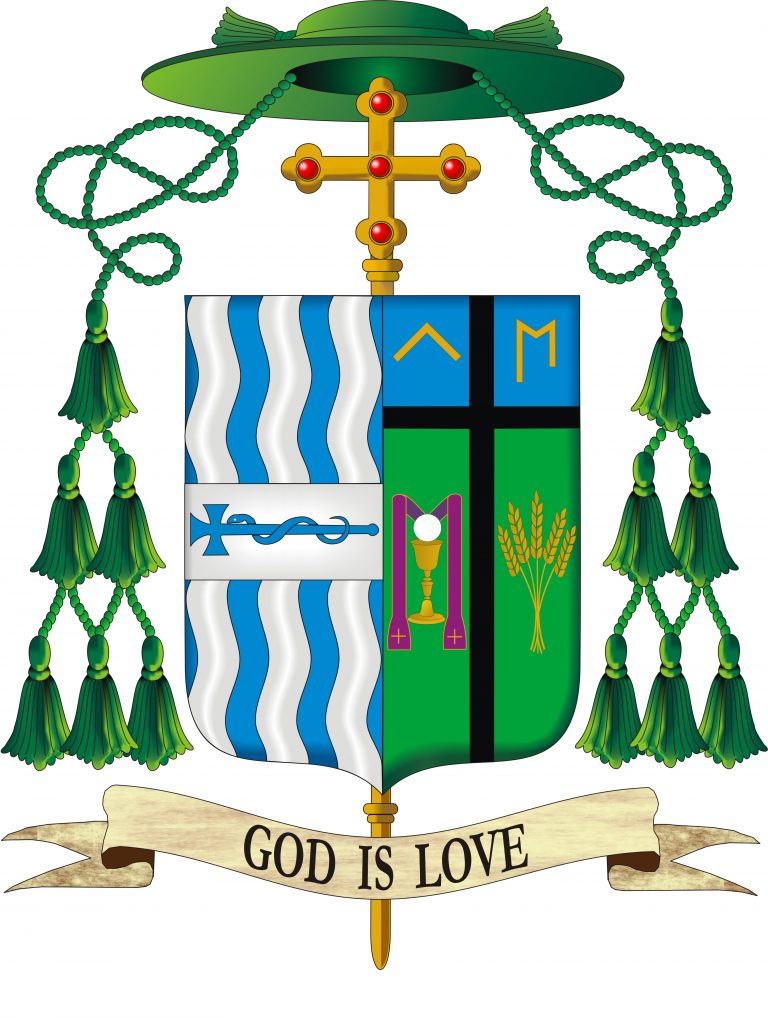
As for the personal arms he has, once again, tried to do too much. The tincture combinations are unfortunate and, actually, rather sad looking. The purple priest’s stole on a green field violates the so-called tincture “rule” which dictates that a metal on a metal and a color on another color should be avoided. The sheaf of wheat looks rather anemic (but, in fairness, that may simply be an issue involving this particular depiction of the arms). The charge of the gold letter “M” in the upper right is borrowed from the arms of St. John Paul II. There’s nothing wrong with that, per se. Many warn against using letters as charges but it is well known that John Paul II argued with Bruno Heim for maintaining the “M” in his arms which he has used as a bishop and cardinal. Certainly, that charge became widely known as John Paul’s coat of arms was used extensively during his historic 27-year-long pontificate.

However, in the official version of John Paul’s arms, painted by Bruno Heim himself, the letter “M” was depicted, correctly, as filling the whole space of the field on which it was depicted. So, the charge followed the contours of the shield shape upon which it appeared. This explains why one side of the “M” is longer than the other. However, depicting it this way, floating in the middle of the field, it is completely unnecessary, and also quite ridiculous to depict the “M” with one side shorter than the other. The “M” was not blazoned to be depicted that way, Rather, that was merely an artistic convention. There seems to be the erroneous and utterly stupid notion floating around out there that the “M” must be unevenly drawn to make it the “John Paul II M“. WRONG!

The black cross on a field that is blue and green is a bad choice of tinctures. Once again, it appears as though the new bishop consulted someone who was not very well acquainted with proper heraldic design.

These three represent a situation that is all too common in the Church in general and in the United States in particular. With all the competent assistance available, especially since the advent of the internet, it’s really rather sad that such amateurish and, in some cases, frankly ugly coats of arms continue to be created.

Bishop Austin Vetter of Helena

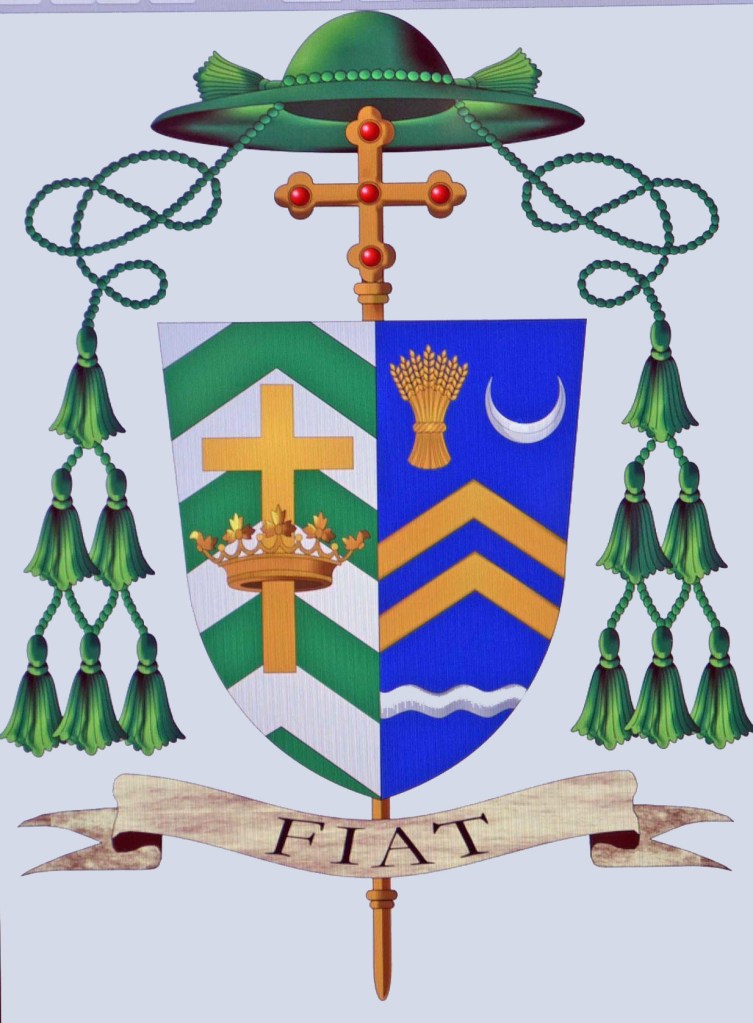
On Wednesday, November 20, the Most Rev. Austin Vetter (52), a priest of the Diocese of Bismarck, North Dakota, was ordained a bishop and installed as the 12th Bishop of Helena, Montana. He was formerly a Spiritual Director at the Pontifical North American College in Rome, the seminary which he himself attended. Like so many other American bishops coming from that source he decided to have his coat of arms designed and emblazoned by an amateur heraldist, a man with another profession, who has begun to work extensively in the field of ecclesiastical heraldry due to his many contacts in Rome. The results are usually somewhat disappointing – not bad; not incorrect; not poorly rendered – but just drab, unimaginative and a ceaseless repetition of the same things over and over again plugged into a basic template making all of them appear, essentially, the same.

From the program prepared for the Ordination we read the following description prepared by the person who designed the coat of arms: “Bishop Vetter’s personal coat of arms blends images representing his origins: the crescent moon is for the Blessed Mother, the Immaculate Conception, patroness of the United States, the Diocese of Bismarck, and the Pontifical North American College (Bishop Vetter’s alma mater where he also later served on faculty); the sheaves of wheat which combine the concept of the Eucharistic symbol and the principle product of the farm where Bishop Vetter grew up; a “wavy barrulet,” the water representing “the spring of water welling up to eternal life” (John 4:14) and the Missouri River which begins in Montana and flows through Bismarck, North Dakota; and a “gemel in chevronwise,” one of them recalling the rafter holding the roof of the church which is set upon the foundation of the apostles with Christ Jesus as the cornerstone (meaning protection) and the second representing the Rocky Mountains of Montana.

The color blue (Azure) symbolizes the separation from the worldly values and the ascent of the soul toward God, therefore the run of the Celestial Virtues which raise themselves from the things of the earth toward the sk y. It als o represents the Blessed Mother and the “Big Sky” of Montana. The silver (Argent) of the crescent symbolizes the transparency and the purity of the Virgin Mary. The garb, sheaves of wheat, is in gold (Or), the first among the noble metals, then the symbol of the first of the Virtues , the Faith which enables us to believe in the Eucharistic Host, fruit of wheat, real body of Christ.”

Yeah…blah.

The second paragraph which goes on and on about the symbolism of the colors betrays an error that many amateur heraldist make. Namely, assuming that there are definite meanings assigned to different colors in heraldry. There aren’t. Perhaps, the armiger has chosen to assign meanings to certain colors for himself personally but if that is the case the explanation should stipulate that, as in, “The bishop feels that the color blue means XYZ to him because…” Otherwise, it’s simply made up out of whole cloth.

Another interesting thing in the explanation which goes to my point about the repetition in this person’s designs is the explanation of the use of the “gemel”. In heraldry the word gemel means “twin”. It is a term taken from Scottish heraldry primarily and does not describe a particular charge or object. Rather, it is an adjective that describes certain ordinaries or subordinaries as being depicted twinned, or in a pair. So, it’s not an object, a gemel “chevron wise” (i.e. arranged in the shape of a chevron). Instead, it should be blazoned “Two chevronels gemel”, that is, two thinner chevrons paired.

What is also interesting is this explanation of the coat of arms of a bishop this same artist did several years ago, “The chevron is an heraldic device, best described as an inverted “V”; it signifies the rafter, which holds the roof of the church, and symbolizes the concept of protection.” Does that sound familiar? Perhaps it is supposed that every bishop must have a chevron of some kind in his coat of arms as a symbol of a church? Are there no other symbols of a church, or of the Church, or of protection?

This bishop’s last name – Vetter – comes from the German for “cousin” and yet there was no attempt to try and symbolize that. His first name, Austin, is derived from the name Augustine and yet none of the symbols associated with that saint were used. Why do I point this out? Because a coat of arms is first and foremost a mark of personal identification. As I have written here numerous times, it is not a CV in pictures! It’s not supposed to be about where you are from, where you lived, where you went to school, etc. It is, instead, supposed to identify you, personally. So, using charges that in some way alluded to his name or family name, while far from a necessity in any coat of arms, might have proven a better starting point and certainly would have made for a mark of identity that was more personal.

Instead, there is another cookie-cutter coat of arms. And yet the question persists of “Why are so many bishops’ coats of arms so poorly done?” It is, I believe, because too many bishops are content to copy what they have seen before for the sake of “getting it done” instead of consulting with someone who is well versed in heraldic science as well as someone who can provide real heraldic art instead of something using a computer generated template. This coat of arms, like others is not, as I wrote above, bad, incorrect or poorly rendered. But, it is rather disappointing.

Most Rev. Robert F. Christian, O.P. – RIP

The Most Rev. Robert Christian, a Dominican friar, who has been the Auxiliary Bishop of the Archdiocese of San Francisco passed away on July 11, 2019 at age 70.

His coat of arms was assumed by him at the time of his episcopal ordination.

Umm…no. Sorry, but “beige” isn’t a heraldic color and, no, you may not just simply make up new rules and use whatever color you wish in heraldry. The science of heraldry limits the tinctures to be used and beige isn’t one of them. The Dominican cross and the usual Franciscan conformities (the arms of Christ and St. Francis crossed with each other) made for a nice combination of symbols for his Religious Community and the Archdiocese.

May he rest in peace.