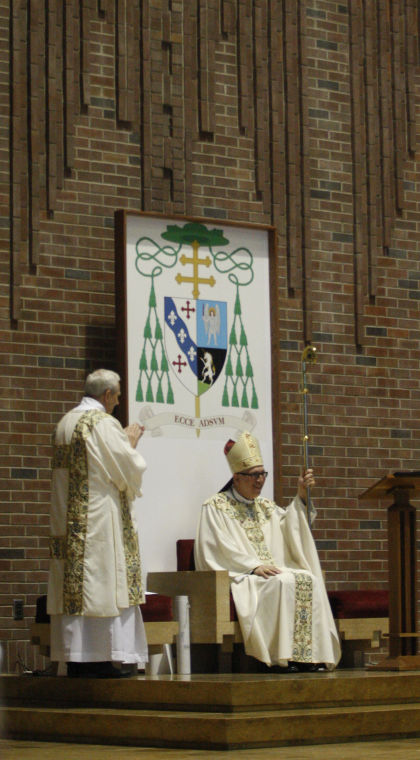
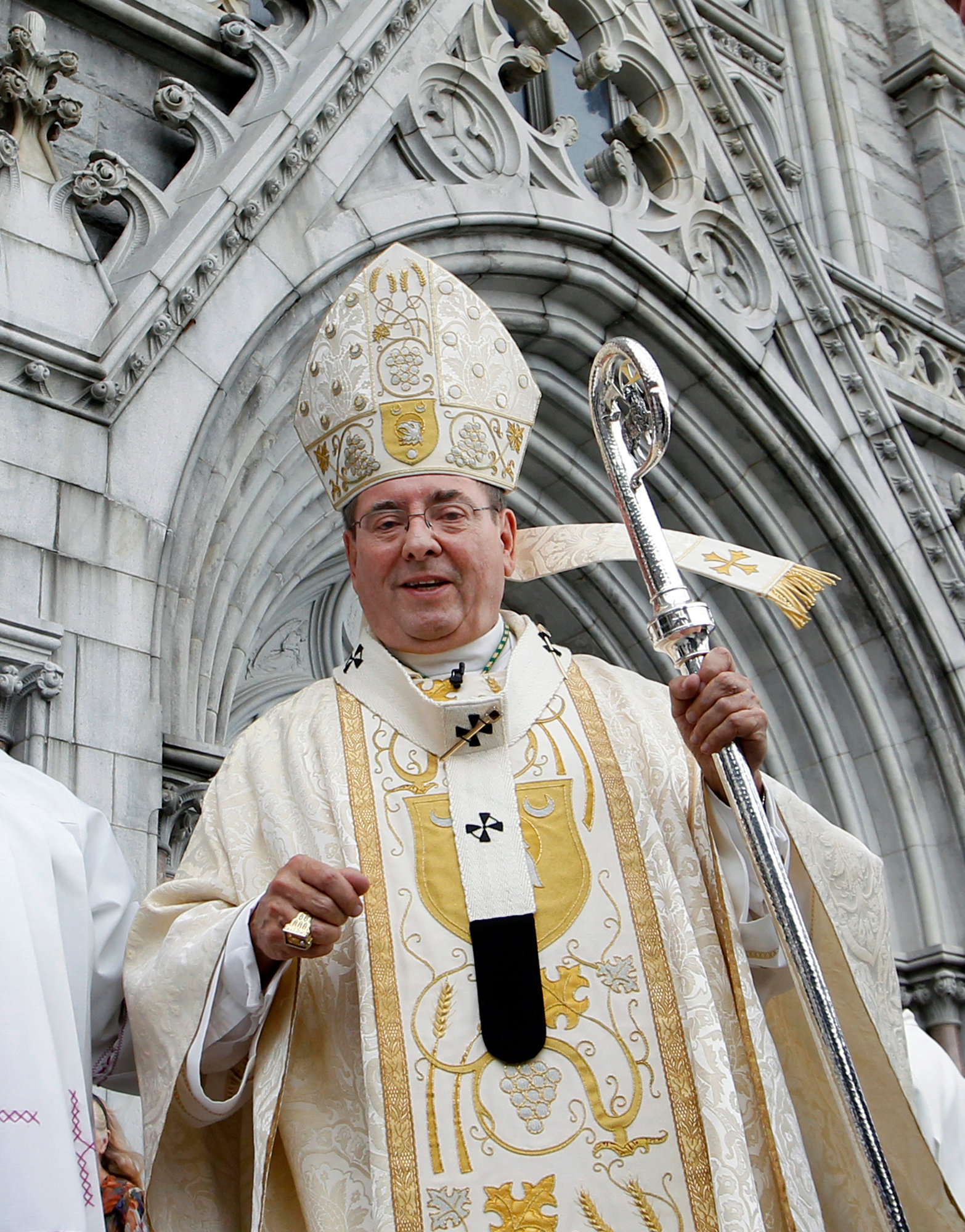
Usually, I am not a big fan of heraldry being used as a decorative motif on vestments and pontificalia. Every now and again, however, it can work. The example below shows the Most Rev. John J. Myers, Metropolitan Archbishop of Newark, NJ. The chasuble he wears is decorated with a shield (partially obscured by his pallium) bearing his personal coat of arms as is the base of the mitre he is wearing. I think this is a good example of how heraldry can be used to decorate vestments in a way that is neither overpowering nor inappropriate.
Category Archives: Archbishops
New Archbishop of Salzburg
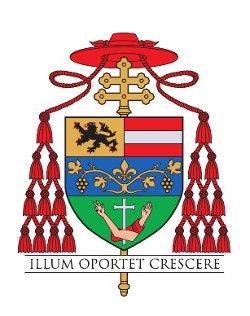
The new archbishop of Salzburg, Austria, Dr. Franz Lackner, OFM will be installed on January 12. His coat of arms employs the traditional red galero used by ancient custom by the archbishops of Salzburg (who hold the title “Primate of Germany”) because of their role as Papal Legate. This red galero with 20 tassels is used even if the archbishop is not a Cardinal. If he is promoted to Cardinal then another row of tassels is added to the galero. Similarly, the archbishops of Salzburg wear red, not purple, even if they are not Cardinals.
The arms also illustrate that the method of marshaling coats of arms preferred in many places, impalement, is far from the only option. The ancient arms of the See of Salzburg make up the upper third of the shield. The center section of blue with the gold grapevine is primarily emblematic of those referred to in Jn 15:1-5 the Lord’s vineyard and the strong connection between Christ and the believer (“I am the vine; you are the branches.”) . At the same time the vine but is also reference to the origin of Dr. Lackner from the wine area , namely that of Eastern Styria around Kapfenstein and St. Anna am Aigen. The golden heraldic lily is the actual symbol for Mary. The threefold division of the fleur-de-lis symbolizes the Holy Trinity of the Father, the Son and the Holy Spirit. The green base shows the “Franciscan Conformities” or the coat of arms of the Franciscan Order (without the clouds).
Archbishop Gagnon of Winnipeg, Canada
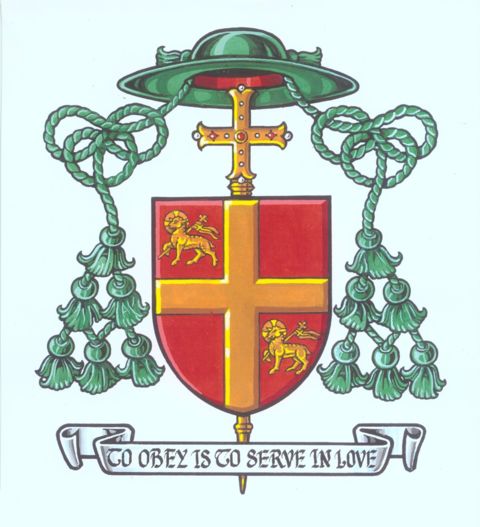
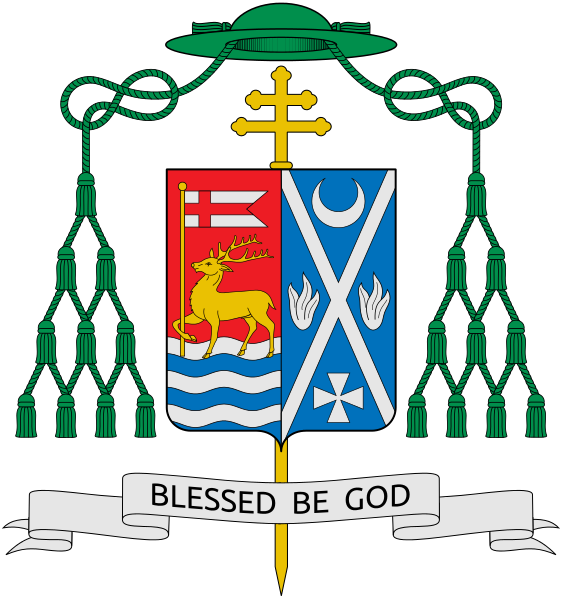
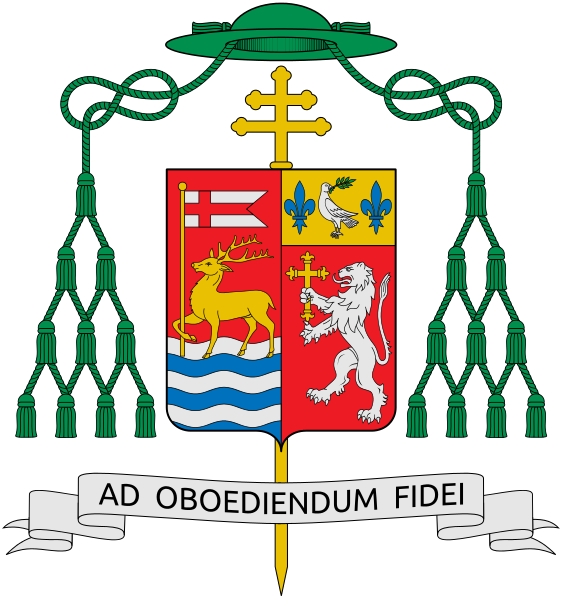
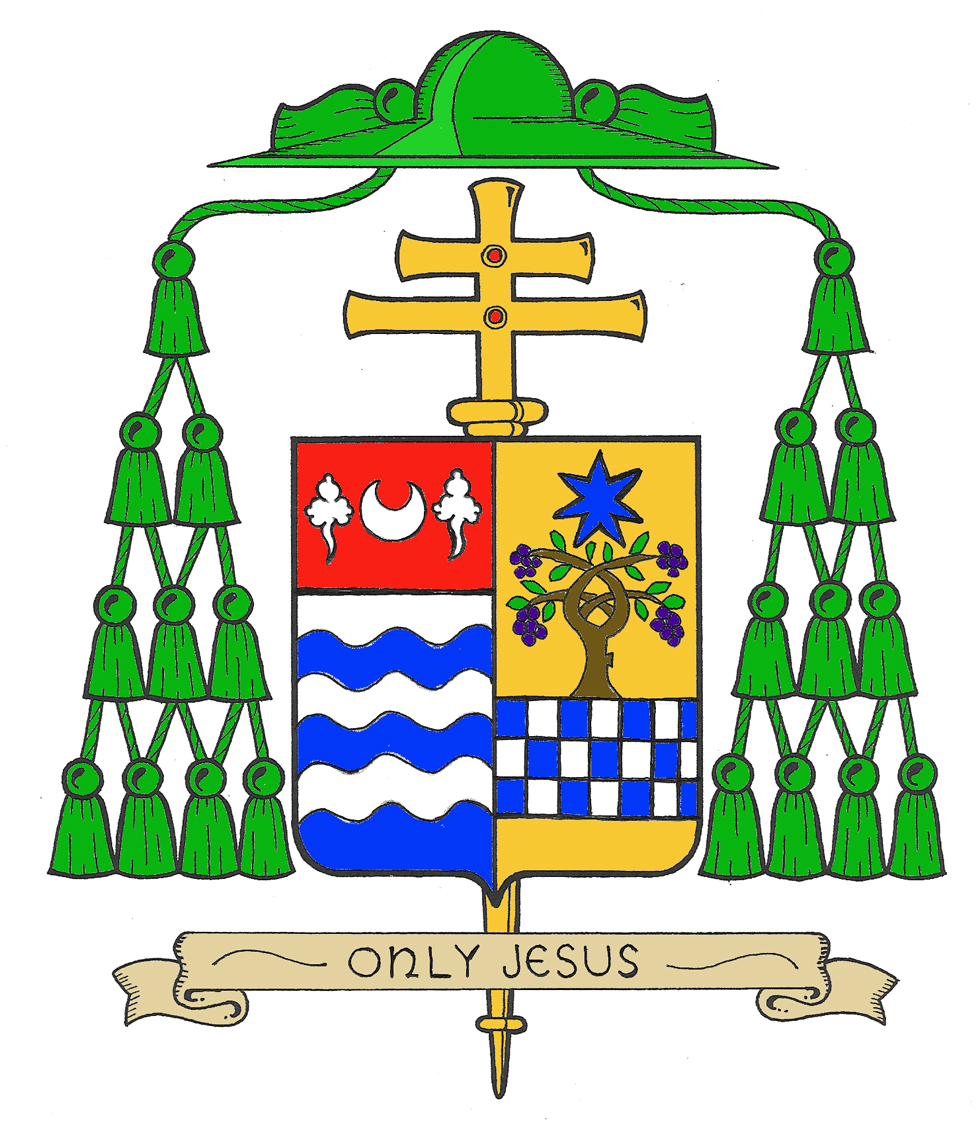
On January 3 Archbishop Richard Gagnon, formerly bishop of Victoria was installed as Archbishop of Winnipeg. The arms (above) which he assumed upon becoming a bishop are retained. The shield is partly inspired by the emblem of Bishop Gagnon’s predecessor, Modeste Demers (1809-1871), the first Bishop of Vancouver Island. Bishop Demers and Bishop Gagnon are closely related via a collateral branch of the Demers family. Bishop Demers’ emblem was red and gold and featured a gold Latin cross set on a mount with two figures praying at the base of the cross. These tinctures have been kept, as has the cross. Since Bishop Gagnon was ordained on June 24th, the feast day of St. John the Baptist, the two charges are gold Agnus Dei emblems, traditionally associated with St. John the Baptist. This is also a reference to Bishop Gagnon’s ancestral roots in Quebec.
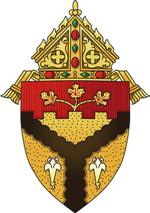
He may impale these arms with those of the archdiocese (below). In addition, the episcopal cross behind the shield will become an archiepiscopal cross with two horizontal bars and another row of green tassels will be added to the galero.
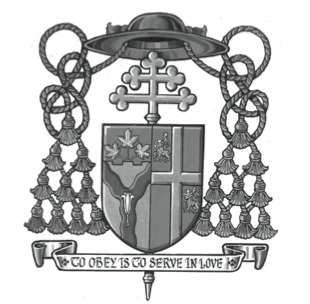
UPDATE: The only image I was able to obtain so far of the Archbishop’s arms impaled is in black and white. As one commenter on this post has already pointed out there have been slight changes made to the arms of the archdiocese.
Hartford
The arms of the newly installed (Dec. 16th) Archbishop Leonard Blair of Hartford, Connecticut. He is the former bishop of Toledo, Ohio and also formerly the auxiliary bishop of Detroit, Michigan. Below his arms are those of his two immediate predecessors, Abp. Henry Mansell and Abp. Daniel Cronin both of whom are still living. The arms of the archdiocese employ nice canting arms for “hart” and “ford”.
Archbishop Krajewski
Archbishop-Designate Hebda, Coadjutor of Newark
This morning the pope appointed Bernard Hebda, a Pittsburgh priest serving until now as bishop of Gaylord, Michigan to be the Coadjutor Archbishop of Newark, NJ. He will be serving in assistance to the current Archbishop, John Myers (age 72) and will immediately succeed him upon Myers’ resignation, whenever that comes sometime in the next three years. A coadjutor (arch)bishop shares in the governance of the diocese and, unlike an auxiliary bishop, automatically succeeds to the See upon the death or retirement of the previous diocesan (arch)bishop.
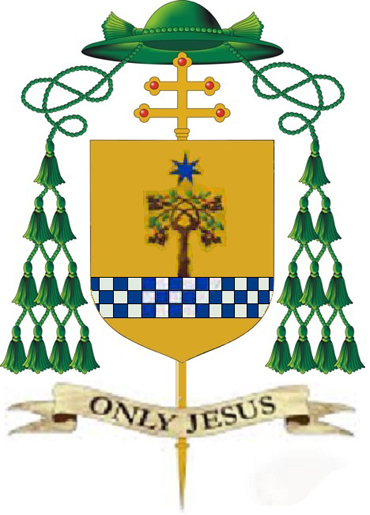
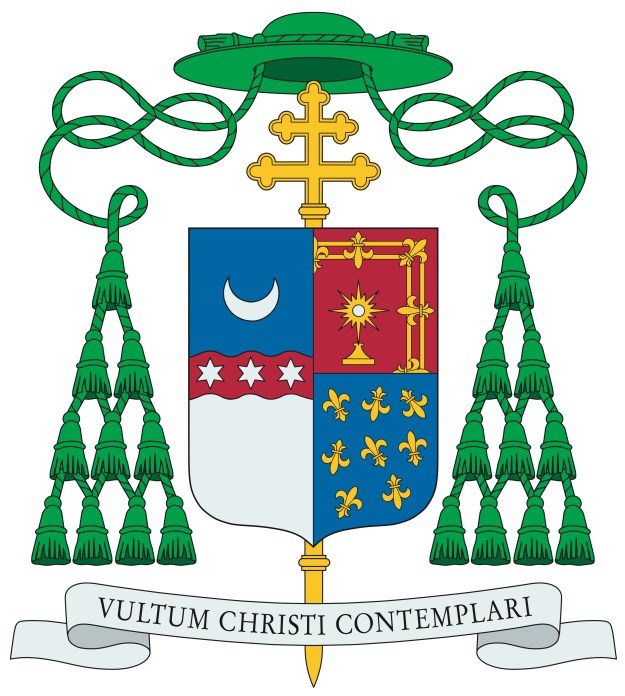
The coat of arms that Bishop Hebda will use during his time as coadjutor are pictured above. It is composed only of the personal arms he assumed at the time he became a bishop in 2009. It is not the custom for a coadjutor to combine his personal coat of arms with the coat of arms of the diocese on the same shield as a diocesan bishop does.
Archbishop Hebda’s personal arms use as the primary charge an elderberry tree which alludes to his surname, Hebda, itself similar to “ bez hebd ”, the Polish term for the type of elderberry tree that is widespread in the area of Southeastern Poland from which Bishop Hebda’s paternal grandparents emigrated. The tree thus also alludes to the Bishop’s parents and family. In addition, the berries of the tree are reminiscent of the beads of the Rosary, recalling that the Bishop, named to the episcopacy on October 7th, the feast of Our Lady of the Rosary, has entrusted his episcopal ministry to the Blessed Mother under that title. Over the elderberry tree appears a blue star, the shining symbol of Mary, to underline that Bishop Hebda has placed his new pastoral ministry under Her maternal protection.
The blue and white fess cheqy is taken from the coat of arms of the Diocese of Pittsburgh where they appear because they come from the arms of William Pitt. Placed as the foundation for the elderberry tree, the juxtaposition recalls that Bishop Hebda has his roots in the Diocese of Pittsburgh.
Archbishop Myers will continue to combine or impale his personal arms on the same shield as the arms of the archdiocese until such time as he steps down. It is at that time that archbishop Hebda, who will then succeed as Archbishop of Newark and Metropolitan of the Province of Newark (not the province of New Jersey as is often wrongly thought) will impale his own arms to those of the See of Newark (a preview of that below).
Archbishop Porteous of Hobart
The coat of arms of the Most Rev. Julian Porteous, up until now the auxiliary bishop of Sydney, Australia who has been promoted to be the (non Metropolitan) Archbishop of Hobart, Tasmania, Australia. He will be installed on September 17th. The Archbishop decided to re-design his current coat of arms, assumed at the time he was named auxiliary bishop, to bring them into better harmony when impaled with the arms of the See of Hobart. Archbishop Julian’s original arms were: “Quarterly, Vert and Or, a cross throughout Counterchanged; in dexter chief a dove rising surrounded by a golden effulgence and in sinister base an open book Argent, bound Or charged with the Greek letters Alpha and Omega Gules”.
In the redesign he has retained the dove representing the Holy Spirit and requested in be surrounded by rays suggesting the famous Bernini window above the Altar of the Chair in St. Peter’s Basilica. In addition the open book alluding to the Sacred Scriptures has been retained. Thus showing the heraldic equivalent of Spirit and Wisdom.
The new blazon is: “Arms impaled. In the dexter Azure the letter “M” Argent crowned with a celestial crown Or (Hobart); In the sinister per fess Gules and Argent, in chief a sun in splendor, the rays of light depicted as straight lines radiating to the edge of the field, within a ring all Or, charged overall with a dove displayed affronté Argent; in base an open book Argent, bound Gules and charged on the pages with the letters alpha and omega, Gules”.
The arms were designed by me and Mr. Richard d’Apice of Australia and depicted by Mr. Sandy Turnbull, also of Australia.
Archbishop Jackels of Dubuque, IA
As mentioned in an earlier post the coat of arms of the former bishop of Wichita, now the newly installed archbishop of Dubuque, Iowa, The Most Rev. Michael Jackels, presented a challenge to the heraldic artist insofar as they were already impaled arms. In order to impale his personal arms with those of the see of Dubuque (as is customary in N. America) the archbishop’s personal arms would have to be modified in some way. I opined that perhaps dividing the personal arms horizontally, or “per fess”, and placing the two charges in each half would provide the opportunity then to impale the arms of the see with them. Someone else was obviously thinking along the same lines. As you can see from the photo above taken at the archbishop’s May 30 installation this is precisely what was done. I’m glad to see the handsome arms of the see of Dubuque were able to be incorporated into the overall achievement.
An Extraordinary “Herald” (of sorts)
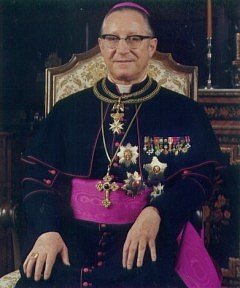
While certainly never holding the title of herald and not being appointed as an officer of arms in any way by anyone this man was, in his own way, the most extraordinary of contributors to the world, the science and the art of heraldry. It can be said that he was a kind of “herald of the Church” during his long career as a Churchman and Papal diplomat. A one-time assistant to the then Nuncio to France, Angelo Cardinal Roncalli (later Bl. Pope John XXIII), the first Pro-Nuncio to the United Kingdom and the first Papal diplomat above the rank of Apostolic Delegate in England in the modern era since the Reformation as well as the man who quite literally wrote the book on ecclesiastical heraldry in the Roman Catholic Church: Archbishop Bruno Bernard Heim. His original work, “Coutumes et Droits d’Heraldique de l’Eglise” was later expanded and republished with lavish illustrations as “Heraldry in the Catholic Church” (1978). This Swiss priest and diplomat designed the coats of arms for Popes John XXIII, Paul VI, John Paul I and John Paul II. One can only imagine what the outspoken Helvetian would have made of the arms of Pope Benedict XVI or, far worse, the arms of the present pope. He was, in my opinion, the most knowledgeable person in the XX Century on the subject of ecclesiastical heraldry. As far as I’m concerned one need only justify a particular point of heraldic design or art by saying, “Heim says so”. He was also tremendously knowledgeable about heraldry in general. His book is a must read for anyone interested in the topic in addition to the four other books on heraldry he authored. Sadly, his influence over the revival of good heraldic practices in the Church is beginning to wane since his death in 2003 at age 92.
Patriarch of Venice
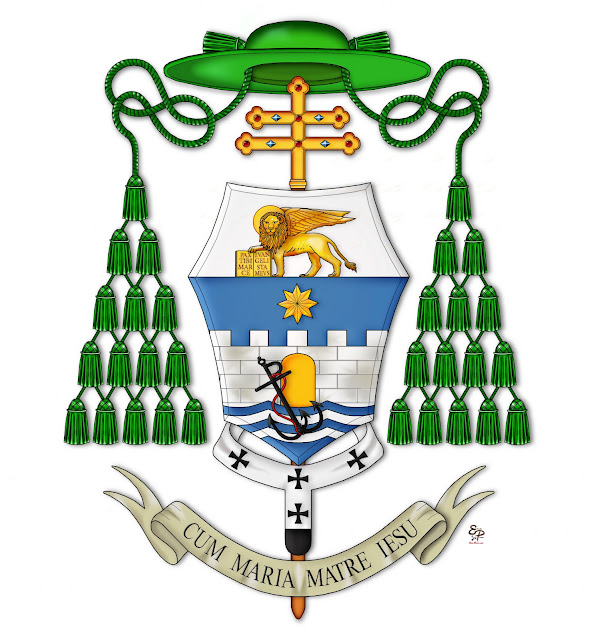
Since April 25 is the feast of St. Mark who is the patron saint of Venice I thought it would be nice to see the arms of that city’s patriarch, Archbishop Moraglia. Venice is one of the few (arch)dioceses in Italy that uses a kind of diocesan arms. The Patriarch’s arms always have a chief (upper third of the shield) which contains a gold winged lion of St. Mark on a silver (white) background.
Doesn’t that violate the “tincture rule” of no metal on metal? Yes, it does but sometimes you just say, “What the heck?” In the case of many ancient coats of arms the tincture “rule” which is merely a custom, doesn’t apply.
The winged lion is the symbol for the Apostle and Evangelist, St. Mark. This comes from the prophecy of Ezekial and is also reflected in the Book of Revelation. The winged lion is one of the four great creatures that pull the throne-chariot of God. These creatures came to be considered representative of the authors of the four gospels; Matthew, Mark, Luke and John. In his paws the lion holds an open book with the phrase, “Pax tibi Marce Evangelista meus” (Peace be to you, Mark, my Evangelist).
In addition to these arms of the See the Patriarch of Venice (an honorary title obtained during the days of the great Venetian Republic to add prestige to the city) uses the green galero with green cords and thirty green tassels (fifteen on either side of the shield). If the individual incumbent is created a cardinal he uses the regular scarlet galero of a cardinal. Some maintain that the galero of a Patriarch should have a skein of gold thread interwoven in the cords but this is not true. There were three popes in the 20th C. who had been Patriarch of Venice at the time of their election and all of them continues to use this chief of St. mark in their coat of arms as pope. They were: St. Pius X, Bl. John XXIII and Pope John Paul I.
Coat of Arms of Archbishop Gänswein
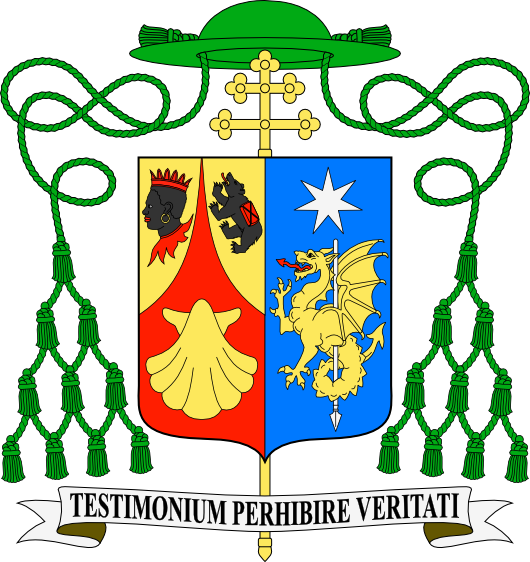
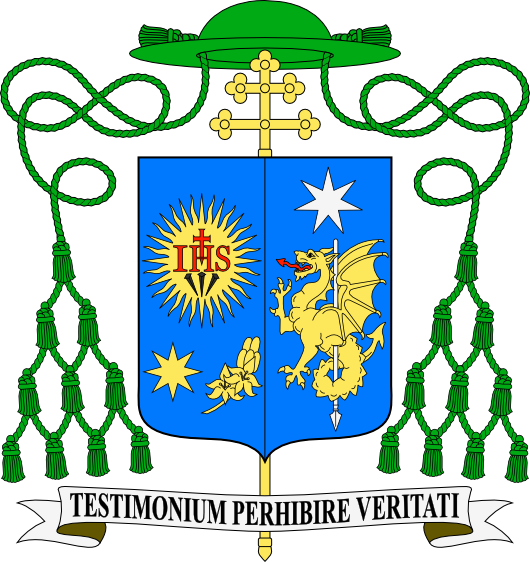
Having seen a Facebook post I wrote about this some time ago my friend and heraldic enthusiast and artist Xavi Garcia who writes the excellent blog Dibujo Heráldico posted recently about the coat of arms of the Prefect of the Pontifical Household (and former secretary to Pope Benedict XVI) Archbishop Georg Gänswein. It is the custom of the Prefect of the Pontifical Household to impale (combine on the same shield) his personal arms with those of the reigning pope. When Archbishop Gänswein was named an archbishop earlier this year he adopted personal arms that reflect St. George, his baptismal patron (the dragon being slain with a spear) and his devotion to Our Lady (the star). These were impaled with the arms of Pope Benedict (above). Now that Pope Francis has been elected and Archbishop Gänswein remains as Prefect of the Pontifical Household (at least for now) his arms are changed to be impaled with those of Pope Francis (below). Now there is a great deal of blue on one shield but that was not something that could have been forseen. Xavi has depicted the two coats of arms himself in his own style and I am happy to share them with you here. Check out his blog while you’re at it too!
(artwork: Xavi Garcia)
Coat of Arms of the New Archbishop of Dubuque, IA
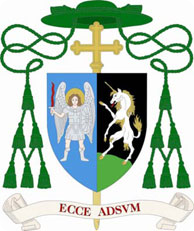
Bishop Michael Jackels of Wichita has been named as the new archbishop of Dubuque, Iowa by Pope Francis (it was really decided by Pope Benedict XVI but not announced until after Francis was elected). The current coat of arms of the good bishop will present some interesting problems when he goes to Dubuque. The arms as they currently are depict two distinct impalements. They both comprise the bishop’s personal arms. Neither is the impalement of the arms of the See of Wichita. In North America it has become customary, although far from mandatory, for bishops to depict their own personal arms side by side on the same shield with the coat of arms of their diocese. This does not make the arms of the diocese part of their own coat of arms. Rather, it is a method called impalement used to depict to separate coats of arms on the same shield together in the same achievement. This is done to illustrate that the bishop is “married” to his diocese. Indeed, impalement was first employed in heraldry as a means of depicting the coats of arms of two armigerous people who were married to each other. The impalement of the husband is depicted in the dexter side of the shield (which appears on the left-hand side as we view the shield) and those of the wife in the sinister side (right-hand side as we view it). In the coats of arms of (arch)bishops we therefore would see the arms of the diocese in the position of the husband’s arms and the arms of the individual incumbent bishop in the place of the wife’s arms. It is worth noting that this is only while he is in office as the diocesan bishop. Auxiliary bishops are not entitled to do this as they do not enjoy jurisdiction over the diocese and, similarly, retired bishops must relinquish impaling their arms with those of the diocese as they no longer have jurisdiction over it. As I said before, the arms of the See do not become part of the bishop’s coat of arms. Rather, two distinct coats of arms are being depicted on the shield side by side to denote the “marriage” of the two.
Impalement is far from the only method of marshaling arms together to illustrate jurisdiction. A bishop may quarter his arms with those of the See. An older, and really antiquated, system of marshaling called dimidiation can also be used. In that method the two coats of arms are divided in half and the dexter half of the arms of the see appear in the dexter half of the shield while the sinister half of the bishop’s arms appear in the sinister half of the shield. This method is hardly ever used for the obvious reason that parts of both coats of arms are obscured from view. It is worth repeating that a bishop is under no obligation, as is often erroneously thought, to marshal his personal coat of arms with those of his See. He may simply bear his own personal arms alone. Indeed, if he chooses he may opt not to adopt a coat of arms at all and simply use the diocesan coat of arms during his tenure as his own emblem.
Bishop Jackels has chosen, during his time as Bishop of Wichita, to use his personal arms alone. (illustrated above) This was probably a wise decision since his personal arms are already impaled and impaling them with the arms of the See would have been disastrous. Of course he could have quartered the arms and repeated the arms of the See in the 1st and 4th quarters (upper left & lower right respectively) while depicting the two impalements in the 2nd and 3rd quarters. Which leads us to the question: why does he have impaled arms in the first place?
I think it is a design flaw borne, most likely, out of ignorance as to what the meaning of impalement is, heraldically speaking. At first glance his personal arms look like the unicorn in the sinister impalement combined with the arms of a See that consist solely of a depiction of St. Michael the Archangel. Or, to see these impaled arms in their historically original context, it looks like a “Mr. St.-Michael” married a “Miss Unicorn”. The bishop would have been far better off if he had adopted arms that were divided per fess (horizontally in a straight line) that then depicted St. Michael in chief and the unicorn in base, or vice versa. Better yet, the unicorn could have been depicted and a symbol for St. Michael (like a cross botonee, or a flaming sword, or angels’ wings, etc.) placed on a chief (a separated upper third section of the shield). All this, then could be marshalled to the arms of his See.
As it is now it seems that the very handsome arms of the See of Dubuque will, once again, have to be left out of the achievement of Archbishop-elect Jackels’ coat of arms. That’s not the end of the world but it is a shame. In addition, it really is poor heraldic design to impale what appear to be two separate coats of arms and call it one unified coat of arms. There is no way to avoid the appearance of two marshaled coats which is why this design falls short. Simply put, there are other and better ways of doing it.
The very nicely designed and elegant coat of arms of Justin Portal Welby, 105th Archbishop of Canterbury. His personal arms impale the traditional arms of the See of Canterbury: Azure an episcopal cross palewise Or; overall a pall Proper. Rather ironic that the arms of the See of Canterbury display the archiepiscopal pall (or pallium) a vestment granted to Metropolitan Archbishops by the Pope to signify their communion with the See of Rome! Such a communion no longer exists and current Archbishops of Canterbury no longer wear the pallium. Nevertheless, history is history. Still a very fine coat of arms.

This is the coat of arms of the Most Rev. Alexander Sample, former Bishop of Marquette, MI who was installed on April 2 as Archbishop of Portland, OR. The left side of the shield (as we view it) depicts the arms of the archdiocese. They are impaled with the personal arms of the archbishop which he assumed at the time he became a bishop. In the upper section the border that is shown only partially employs a now-defunct method known as dimidiation. This manner of depicting charges fell out in favor of full impalement quite some time ago. It’s not that dimidiation is unheard of any longer. Rather, it is simply rarely used.