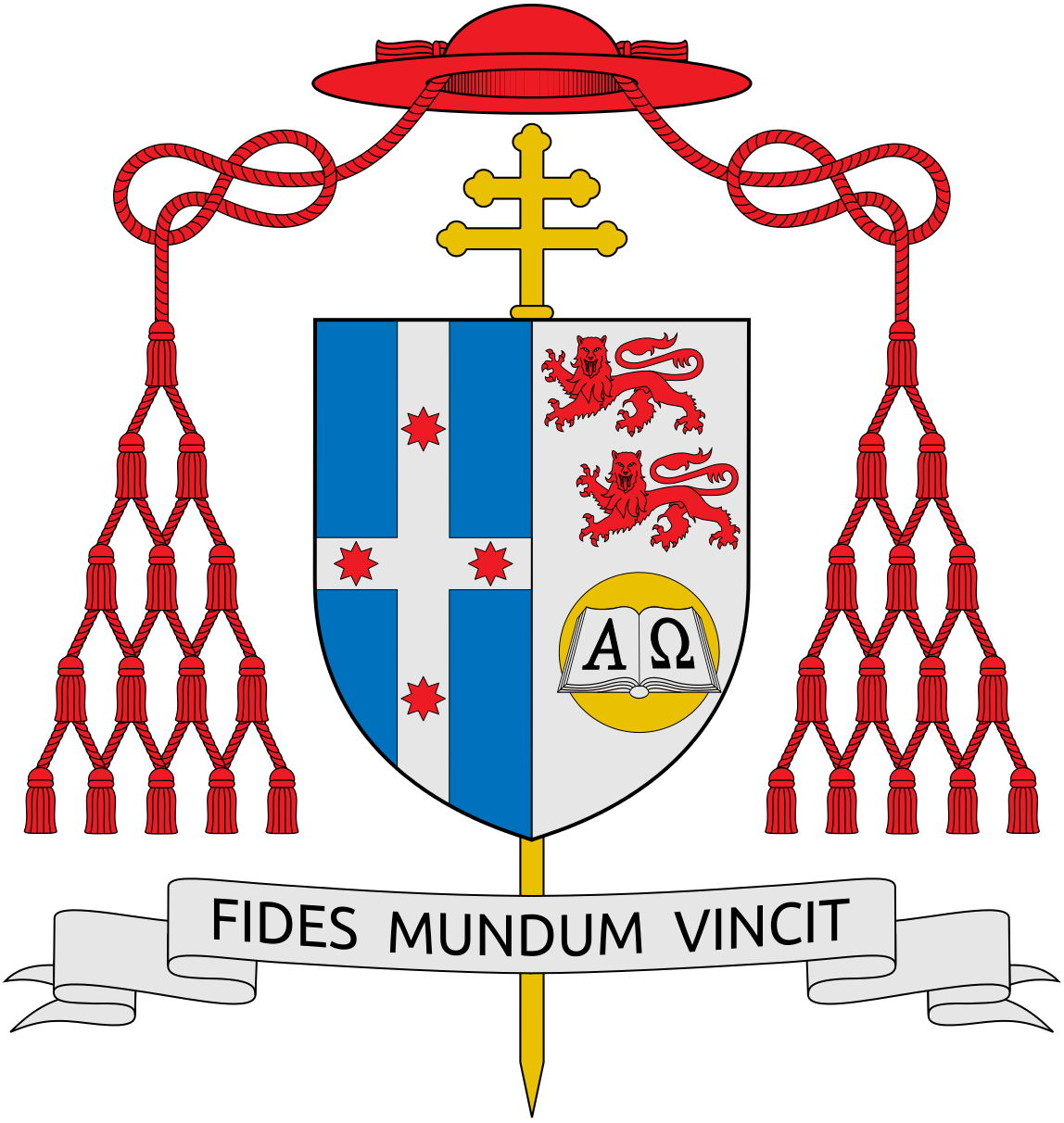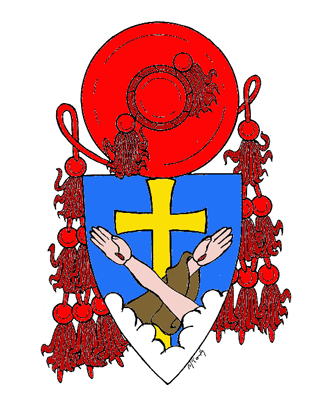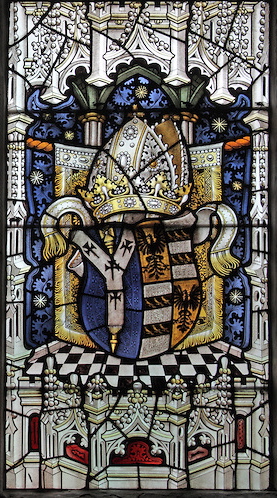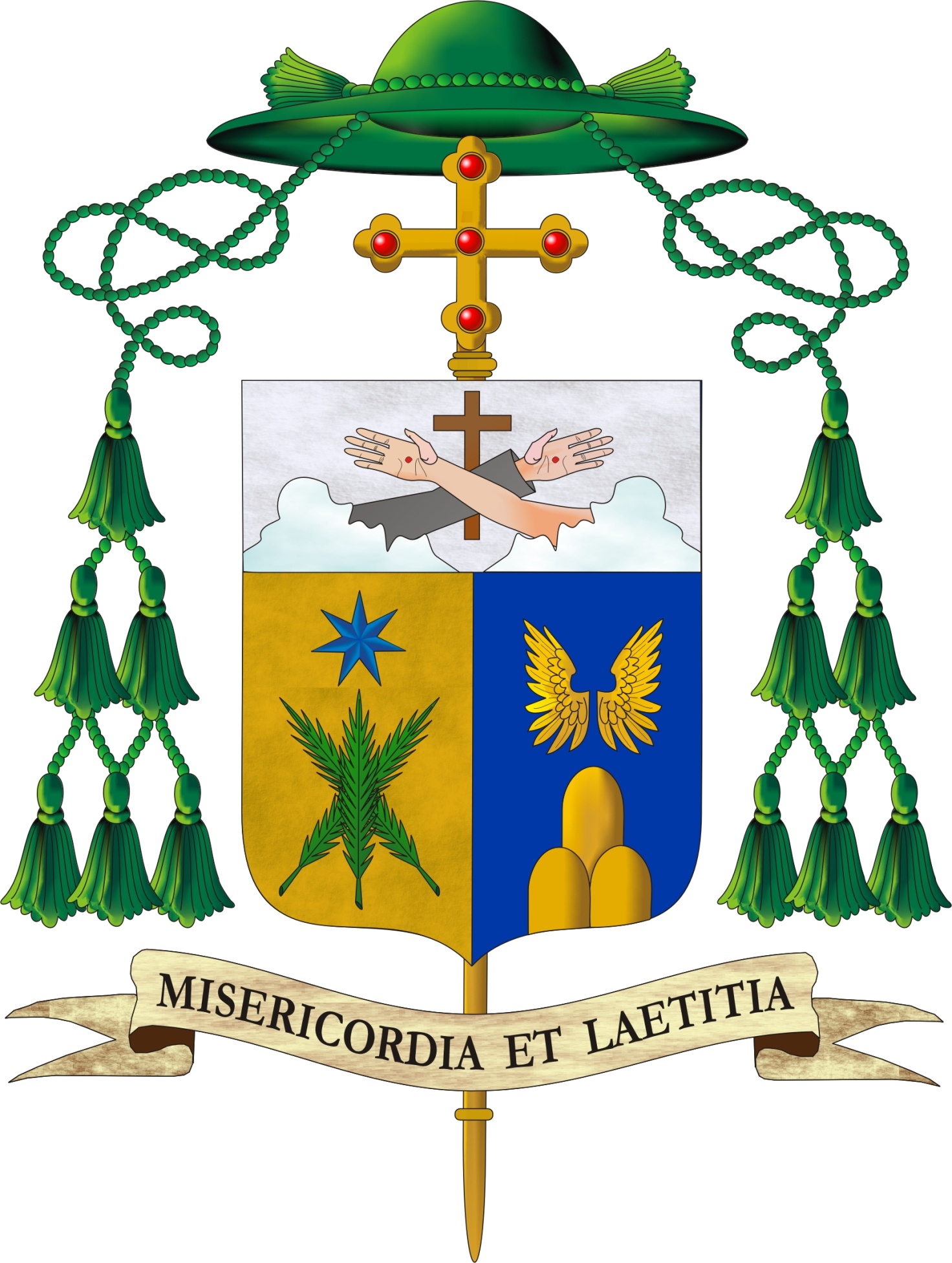
August 20th is the feast of St. Bernard of Clairvaux, considered by many to be a driving force behind the Cistercian Order even though he is not its founder. Like many medieval abbots St. Bernard bore a coat of arms illustrated in the lower corner of the image below.
The Other Auxiliaries of NY (follow up to Bp. Jenik)
Bishop Rozanski of Springfield
On August 12 Bishop Mitchell Rozanski, until now Auxiliary Bishop of Baltimore, will be installed as the IX Bishop of Springfield, Massachusetts. The coat of arms of the new bishop (above) combines his personal arms with those of the see of Springfield. (the four roundels with waves symbolize a field of springs and the cross is associated with St. Michael, patron of the cathedral.)
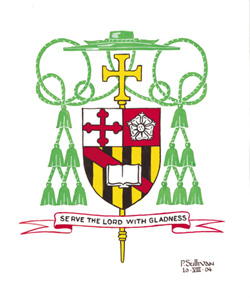
His personal arms (below) were assumed in 2004 at the time he became a bishop when he was appointed as Auxiliary in Baltimore.
The small cross is symbolic of St. Michael (a name from which Mitchell is derived); the red and white colors allude to the national colors of Poland; the flower alludes to his surname which, in Polish, means “rose flower”. The lower portion uses the colors derived from the arms of Calvert, Lord Baltimore. The red bend (vertical stripe) and open book are for preaching the Word. The motto is taken from Psalm 100.
(Artwork by Paul Sullivan)
Bishop Jenik
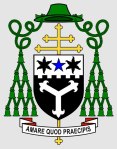
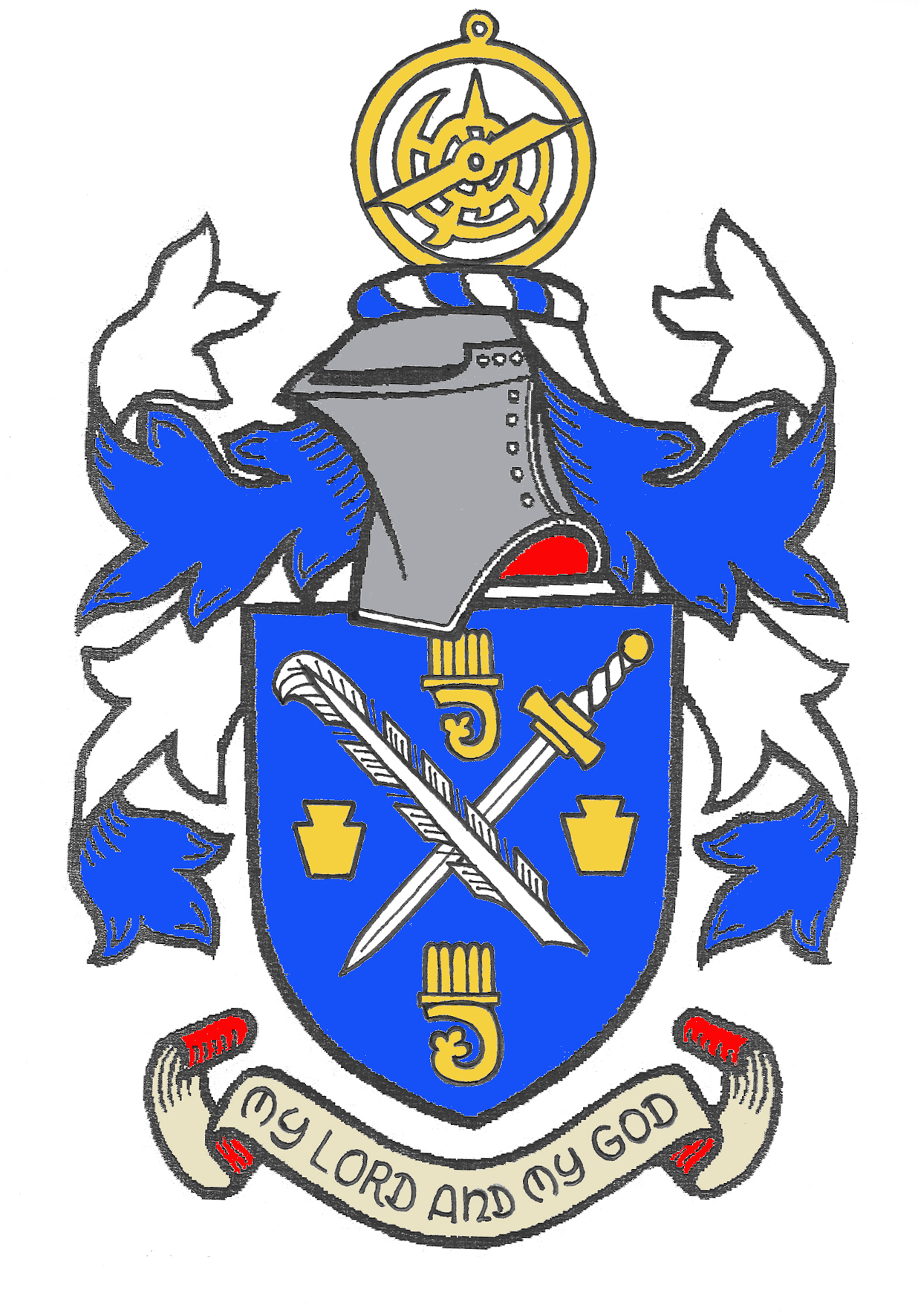
On August 4, 2014 Cardinal Dolan of New York ordained three Auxiliary Bishops for the Archdiocese. They are the Most Revs. Peter Byrne, John O’Hara and John Jenik. While I have not yet seen the coats of arms assumed by all three I did come across the interesting and distinctive coat of arms assumed by Bishop Jenik. He designed the coat of arms himself and I am not sure of the symbolism behind the design. Many might see this as strange because it does not follow the usual “lucky charms” notion of heraldry with an overloaded shield filled with charges meant to be a pictorial CV of the bearer. Good for him! Such heraldry is atrocious and all too common among the American Catholic hierarchy.
Rather, Bishop Jenik’s coat of arms is very simple. This is one of the earmarks of good heraldry. The use of black and white may make it stark but not knowing the meaning of the design there may very well be a good reason for the choice of these colors. In addition, since heraldry is, at its heart, about identification and nothing else, the design is clear to see and easily identifiable. Again, these are attributes of good heraldry. It reminds me of some of the most ancient heraldic designs that present clear images and use as few colors as possible.
I say hats off to Bishop Jenik for an excellent and unique design for his coat of arms!
(Artwork by Paul Sullivan)
Cardinal Clancy RIP
More Armigerous Saints
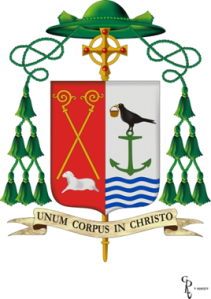
Bishop Doran of Elphin, Ireland
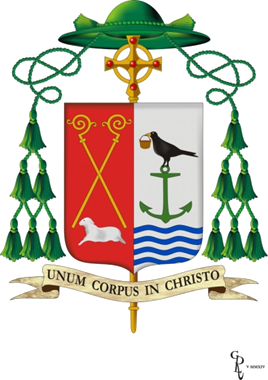
Father Kevin Doran is being ordained Bishop of Elphin, Ireland on July 13. The description of his coat of arms (above) taken from the website of the diocese:
In the right side of the shield (seen from the point of view of the one holding the shield) we find represented the Coat of Arms of the Diocese of Elphin; two golden crossed croziers surmounting a lamb as the central symbol reflecting Jesus, the Lamb of God who takes away the sins of the world. The red (gules) color is the color of love, of blood; the infinite love of the Father who sent the Son to shed His blood for us, the ultimate act of love.
The personal arms of Bishop Kevin occupy the left side. This part of the shield is in silver (argent). The anchor, symbol of hope, is taken from the Doran family motto, Spes Ancora Vitae (Hope is the Anchor of Life). The anchor is in green (vert), the symbolic colour of hope.
The blackbird references the legend of St. Kevin and the Blackbird, which is so well captured in the poem by Seamus Heaney. It reminds Bishop Kevin of the importance of fidelity to prayer and the relationship between prayer, compassion and service. The blackbird carries in his beak a copper pot, symbol of St Asicus, patron saint of the diocese of Elphin. St. Asicus was a coppersmith.
Fr. Kevin spent some years as parish priest of Glendalough, Co. Wicklow (The Valley of the Two Lakes). As he ministered to parishioners and pilgrims around the lakeshore, he was often reminded of the ministry of Jesus, much of which took place around the lake (or sea) of Galilee. As he undertakes his new mission in the Diocese of Elphin, (a diocese bounded on one end by the River Shannon and on the other by the Atlantic Ocean), he takes the ministry of Jesus as his model and inspiration. This is the symbolism of the wavelets in the lower part of the shield.
Archbishop Cushley of Edinburgh
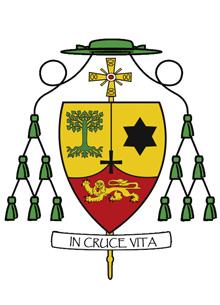
Below is the coat of arms of the Most Reverend Leo William Cushley, Metropolitan Archbishop of St. Andrews and Edinburgh, Scotland. He was installed in the position last year but just this past Sunday received his pallium from Pope Francis.
Archbishop Frederick Temple
Two Recent Commissions
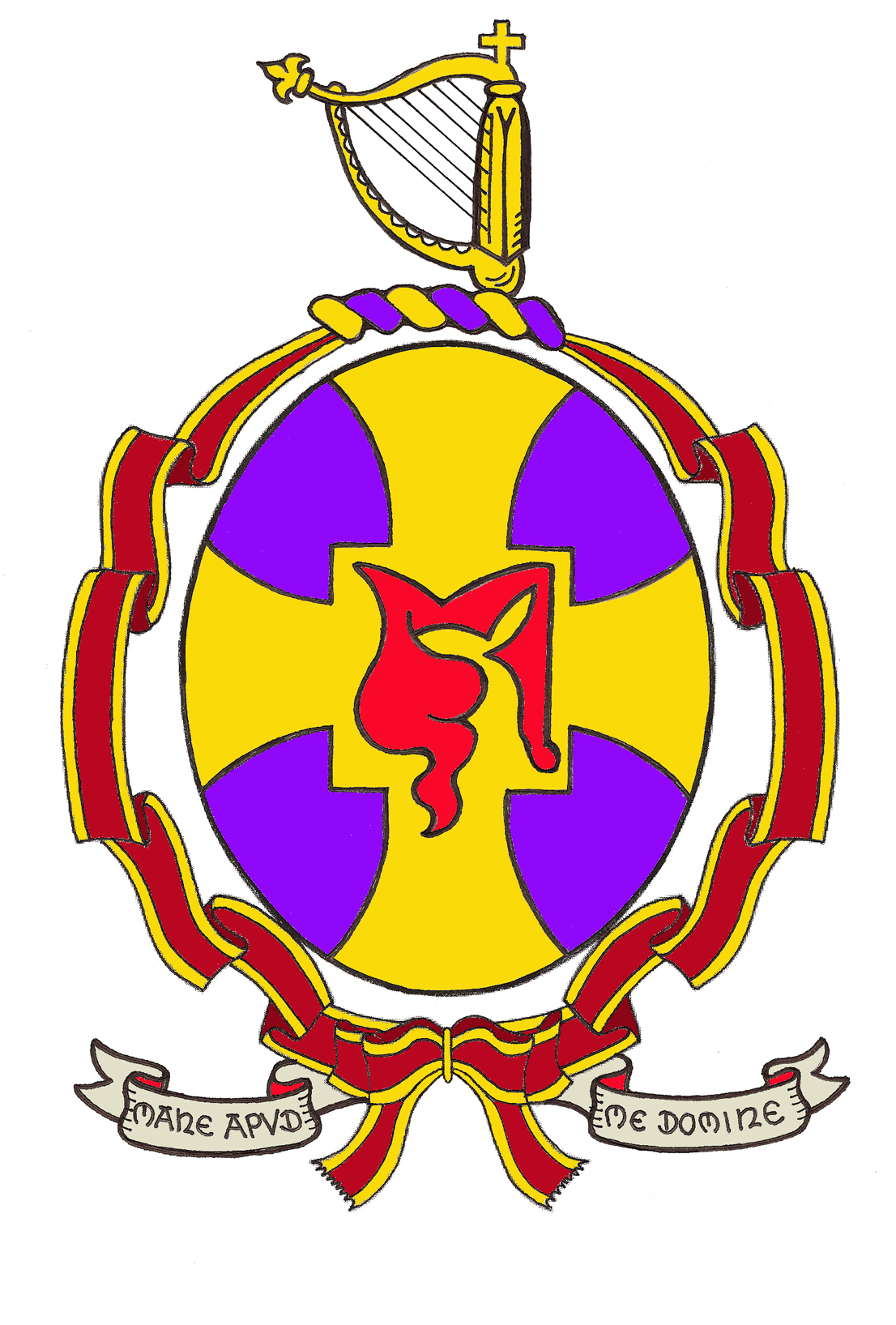
Below are two coats of arms, one for a man and the other for a woman, that I was recently commissioned to do. The ribbon surrounding the woman’s oval shield has personal meaning to her and is decorative. The common practice in heraldry is that women don’t use helm and mantling in their achievements which leaves them looking rather empty artistically. Decorative knots, ribbons and wreaths are often employed to surround the shield.
Bishop Zimmermann
Holyrood Week
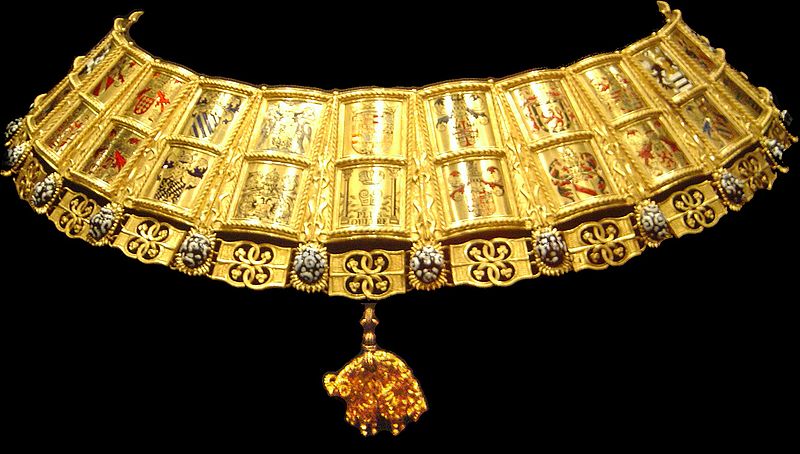
As Queen Elizabeth begins her annual week of engagements in Scotland and is in residence at Holyrood in Edinburgh we will be seeing a lot of the royal arms as used in Scotland. The Scottish quarter takes precedence as does the unicorn supporter. The crest and motto are also different as is the Order of the Thistle surrounding the shield as opposed to the Garter.
King Felipe VI of Spain
Primate of the Swedish Church
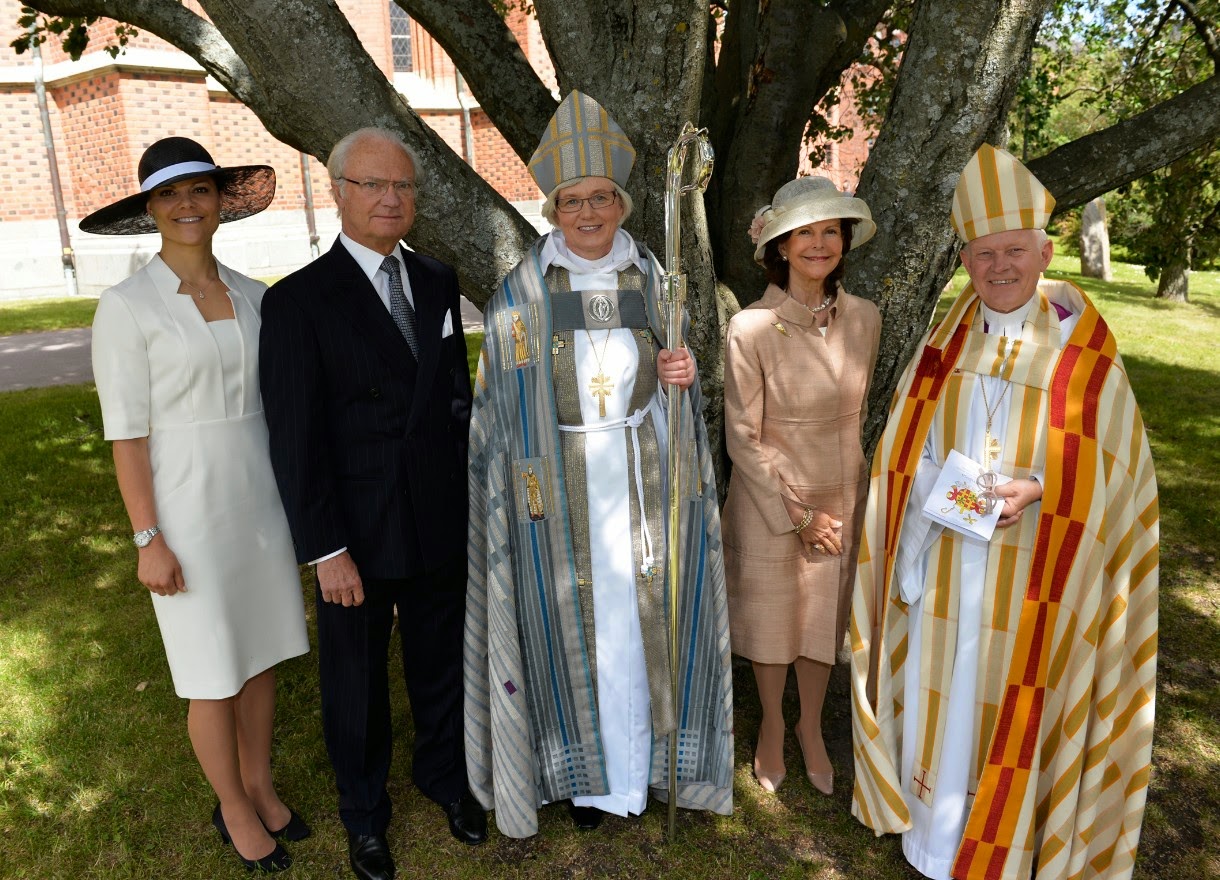
Above is the coat of arms of Archbishop Antje Jackelén, the Bishop of Lund in the Church of Sweden elected as the first woman to be Archbishop of Uppsala and Primate of the Church of Sweden. She was installed at Uppsala on June 15, 2014. Below is a photo of the new archbishop with (l.-r.) Crown Princess Victoria of Sweden, King Carl XVI Gustaf, Queen Silvia and Archbishop Anders Wejryd, her predecessor as archbishop. The coat of arms follows a typical pattern in Scandinavian countries of the personal arms (in the 2nd and 3rd quarters) being quartered with those of the (arch)diocese. The motto translates to, “God is Greater”.
artwork: Ronny Andersen
A Franciscan Bishop
Arms of Felipe VI
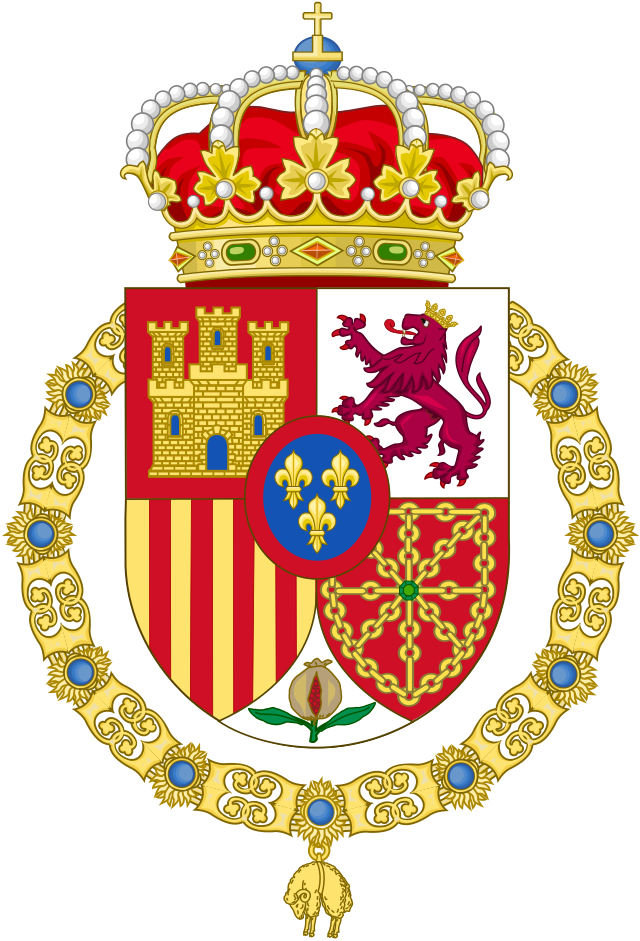
The coat of arms that will be used by King Felipe VI after his proclamation as king on June 19. The lion of Leon is correctly depicted as Purpure rather than Gules. In addition, the yoke and arrows used by Juan Carlos I as well as the Burgundian saltire behind the shield will not be used by Felipe VI.
Order of the Golden Fleece
Transition in Spain
Now that the Spanish Cortes has voted on and passed the law allowing for the abdication of King Juan Carlos I it has prepared the way for proclamation of the Prince of the Asturias as King Felipe VI on June 18. The arms borne by Felipe as Prince (left) will be replaced by the royal arms (right). It has not yet been determined what title Juan Carlos will hold or what arms he shall bear. Perhaps it will be something similar to the arms borne by his father, Don Juan? (below) Of course, Don Juan, however, had renounced his rights to the throne and, while having been for a time the Pretender to the Headship of the Royal House, was never King.