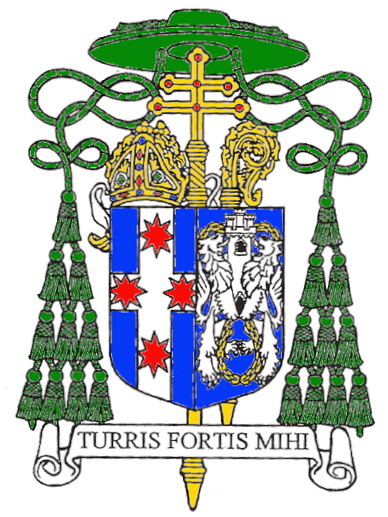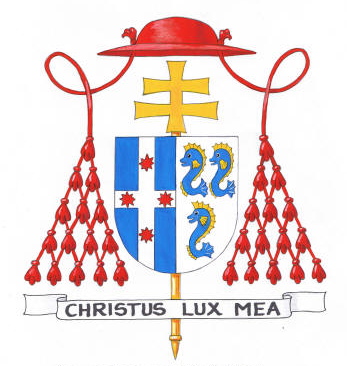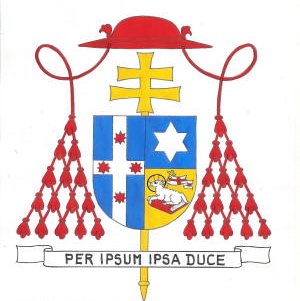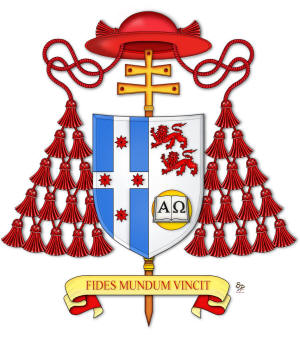
Commandant Gets The Boot

It has been revealed that, due to personality clashes and the pope’s opinion of too much militarism, the Commandant of the Papal Swiss Guard, Daniel Anrig, has been asked by Pope Francis to step down at the end of January. Appointed by Benedict XVI Anrig has served in his position since 2008. I’m not exactly sure how the head of a military corps is supposed to act other than militarily but there is a lot happening in the Vatican these days that no one seems to be able to explain, at least not easily. Anrig’s coat of arms as Commandant of the Papal Swiss Guard is below. It employs the type of charge known as a house marking that is characteristic of Swiss heraldry. The arms of the Commandant is always depicted at the center point of the flag of the Swiss guard.

2000px-Esc_Daniel_Rudolf_Anrig.svg

Another Example of What NOT To Do

herb_bp._jana_piotrowskiego.svg_

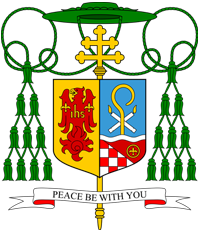
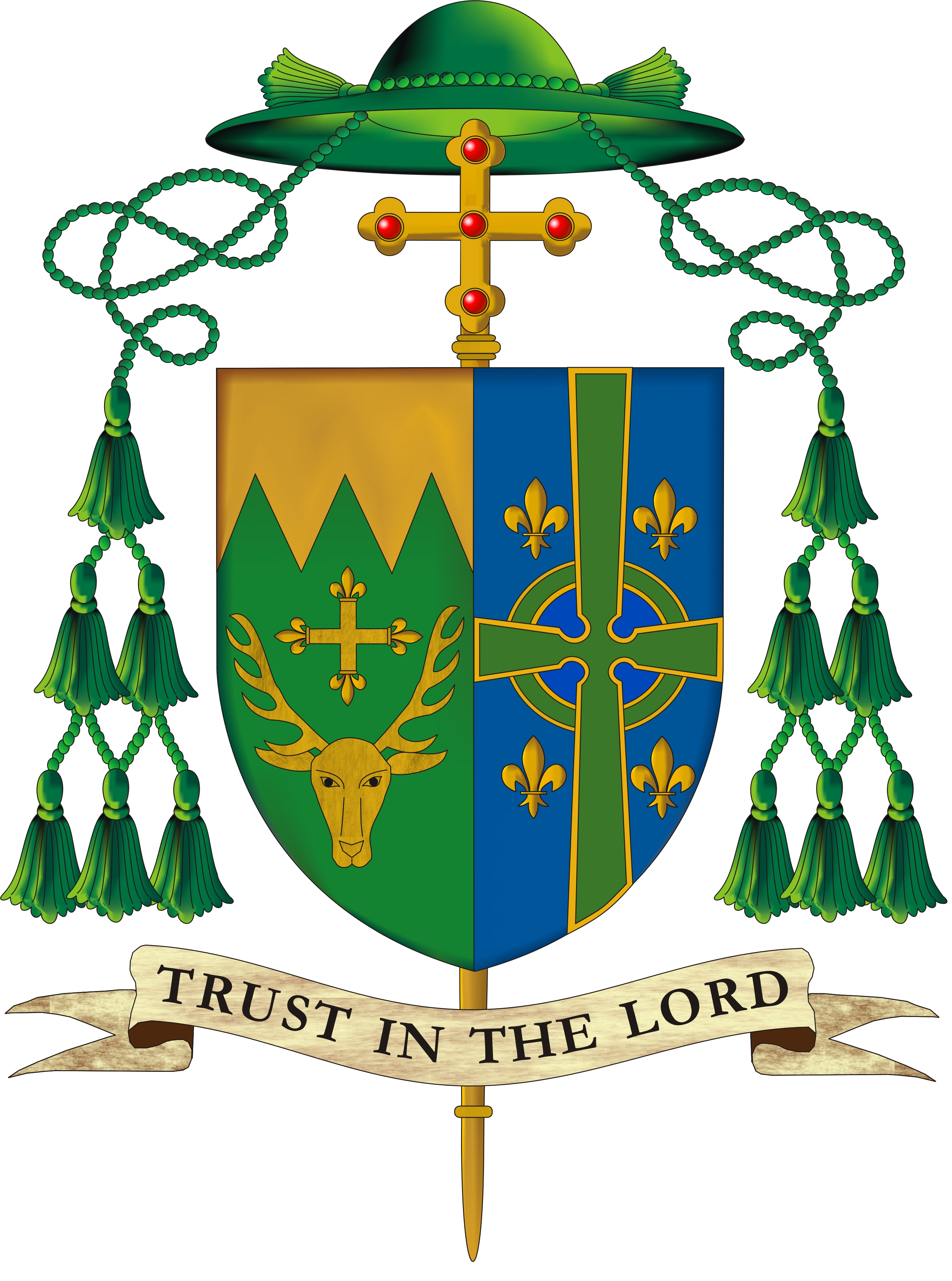
Above is the coat of arms of Jan Piotrowski who will be installed on November 29 as the Bishop of Kielce, Poland. The bishop’s arms contain perfectly good charges and are arranged nicely with good composition with one exception. The episcopal cross (often mistakenly thought of as a processional cross) which is the one external ornament that indicates the arms belong to a bishop, since other prelates may use the green galero with 12 tassels, is depicted as passing in front of the shield and piercing it with the bottom of the cross protruding from behind the shield. It is as if the cross is depicted as both a charge on the field and an external ornament at the same time. This is most incorrect. Charges must never extend beyond the edges of the shield; external ornaments should not be placed in a position to obscure any of the shield; objects cannot be depicted as piercing the shield; external ornaments are to be just that: external to the shield. I’m sure the person who designed this and/or depicted it thought he was being very clever and innovative. Instead, it’s just wrong. EPIC FAIL.

Reginald Cardinal Pole

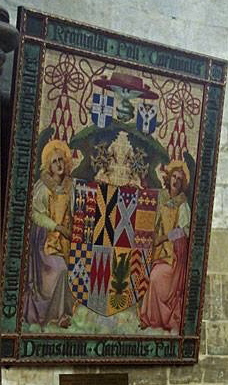
The other day I neglected to make note of the anniversary of the death of Reginald Cardinal Pole, Archbishop of Canterbury and a man with a better claim to the English throne than the illegitimate Elizabeth I. His impressive coat of arms depicts: Quarterly of eight: 1. Quarterly France (modern) and England with a label of three points each charged with a canton Gules (Clarence); 2. Per pale Or and Sable a saltire engrailed counterchanged (Pole); 3. Gules a saltire Argent with a label of three points gobony Argent and Azure (neville); 4. Gules a fess between six cross cross lets Or (Beauchamp); 5. Chequy Or and Azure a chevron ermine (Newburgh); 6. Argent three fusils in fess Gules (Montague); 7. Or an eagle displayed Vert armed and beaked Gules (Monthermer); 8. Quarterly i and iv Or three chevrons Gules (Clare); ii and iii Quarterly Argent and Gules, a fret Or, overall a bend Sable (Despencer). The two crosses indicate his archiepiscopal and legantine powers. On the small shields are the arms of the See of Canterbury and the Cathedral Chapter. The image is of the achievement of his arms hanging above his tomb.

Image 50_2

Archbishops of Sydney

With the recent installation of the IX archbishop of Sydney Australia, The Most Rev. Anthony Fisher, OP several have asked about the arms of the other archbishops, five of whom have also been cardinals. Here they are:

1. Bede (John) Polding, OSB

sc0070423d

2. Bede (Roger) Vaughan, OSB

sc007050b5b

3. Patrick Francis Cardinal Moran

MORAN  PATRIZIO FRANCESCO

4. Michael Kelly

sc0070641b

5. Norman Thomas Cardinal Gilroy, KBE

GILROY-3 My painting0001

6. James Darcy Cardinal Freeman, KBE

FREEMAN  JAMES DARCY

7. Edward Bede Cardinal Clancy

CLANCY

8. George Cardinal Pell, AC

sostituisciPellbis0001

9. Anthony Colin Fisher, OP

image-11

Archbishop Cupich (Third Time’s A Charm)

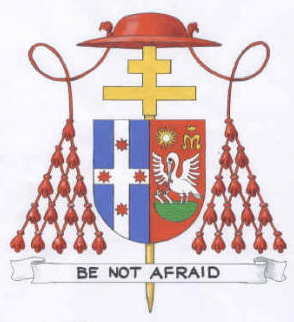
I have already written about the coat of arms of Archbishop Blase Cupich who will be installed today as the Archbishop of Chicago. Not only has the Archbishop modified his coat of arms when he moved from Rapid City to Spokane and again from Spokane to Chicago now he is also employing a new rendering of the coat of arms done by someone other than Paul Sullivan (below). May the Archbishop’s tenure in Chicago be a spiritually fruitful and successful one.

cupich_coa_200a

And Still More Noble Cardinals

Since these have been so well received I thought I would share some more of my favorites from among those Cardinals of the Holy Roman Church who were from well known armigerous and noble aristocratic families.

First we see the arms of Johann Theodor Cardinal Wittelsbach von Bayern, Cardinal Priest of S. Lorenzo in Panisperna. He was created cardinal “in pectore” in 1743 and proclaimed in 1746. He was also Prince-Bishop of Liège, Friesing & Regensburg. The arms are:

Quarterly of six; 1 (Friesing) Or a moor’s head Sable couped at the neck crowned and collared Gules, 2 (Regensburg) Gules a bend Argent, 3 to 6  (Liège) Gules a column Argent, Gules a fess Argent, Argent three lions rampant vert, Barry Or and Gules a point in point Or three hunting horns Azure; Overall on an escutcheon Bavaria (fussily in bend Argent and Azure) quartering Palatinate (Sable a lion rampant Or). The supporters are two lions Or.

sc01ad6190a

Next are the arms of Luis Antonio Jaime de Borbón y Farnesio, de Baviera y d’Este who was born the youngest son of King Philip V, King of Spain, and his second wife, Elizabeth Farnese. While barely eight years of age, Luis was created 699th Knight of the Order of the Golden Fleece in 1735 and ordained Archbishop of Toledo and Primate of Spain on 9 September 1735, and subsequently named Cardinal Deacon of the Title of the church of Santa Maria della Scala in Rome on 19 December. On 18 December 1754 he abandoned the ecclesiastical life for lack of vocation, renounced his ecclesiastical titles and dignities and assumed the title of 13th Conde de Chinchón granted by his brother Infante Felipe.

When his older half-brother King Ferdinand VI died without issue in 1759, Luis claimed the throne on the grounds that, he was the only surviving son of Philip V who was born in Spain, and the only one still residing in Spain (his older brothers were Charles, King of Naples and Sicily, and Philip, Duke of Parma, both reigning in Italy). However valid his claim, Luis lost the succession to his oldest brother Charles, while Charles’ third son became Ferdinand I of the Two Sicilies.

The arms are: Quarterly 1: (Castile) Gules a triple towered castle Or quartering (Leon) Argent a lion rampant Purpure; 2: (Argaon) Or five pallets Gules impaling (Sicily) Per saltire Aragon and Argent two eagles in fess displayed Sable; a point in point between the two quarters of (Granada) Argent a pomegranate Proper; 3: Per fess (Austria) Gules a fess Argent and (Burgundy  ancient) bendy Or and Azure, a border Gules; 4: Per fess (Burgundy modern) Azure, semeé de lis Or, a border compony Argent and Gules and (Brabant) Sable a lion rampant Or; two inescutcheon in pale the first (Bourbon) Azure three fleurs-de-lis Or, a bordure Gules; the second tierces in pale (Visconti) Argent a viper vorant Azure crowned Or and devouring a child Gules; (Flanders) Or a lion rampant Sable membered Gules, And (Tyrol) Argent, an eagle displayed Gules.

sc01ad84d4a

This cardinal, because of his failed claim to the throne, could also be numbered among the “royal” cardinals as well.

(artwork by the late Michael McCarthy)

More Royal Cardinals

Back in October of last year I posted about a Cardinal who was also the King of Portugal. He wasn’t alone in the College of Cardinals. In addition to numerous noblemen there have been other royal Cardinals as well. Below we see two more.

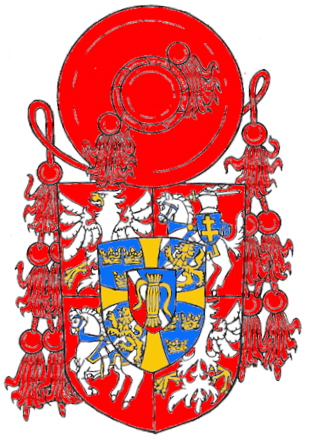
Casimir of Poland who was named a cardinal in 1646 but resigned from the College of Cardinals in 1648 to assume the throne as Jan II Casimir, King of Poland. His arms depict what was then the arms of Poland, namely:

Quarterly 1&4 Gules, an eagle displayed Argent membered and armed Or; 2&3 Gules a knight on horseback (Vytautas) Argent saddled Azure holding a shield Azure charged with a double-barred cross Or. Overall an escutcheon bearing Sweden: A cross patteé throughout Or between 1&4 Azure three crowns Or; 2&3 bendy sinister Argent an Azure overall a lion rampant Or; on an escutcheon in pretense per bend wise Azure, Argent, Gules all charged a Vasa Or.

sc01ad3a68a copy

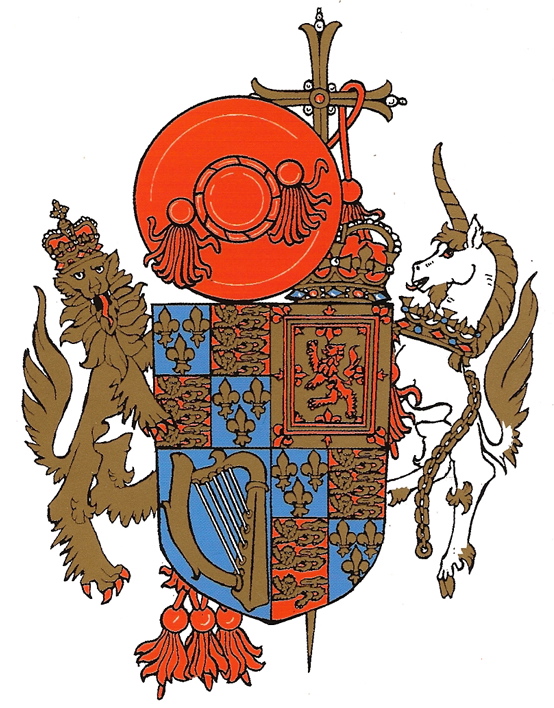
Next is the possibly familiar arms of Henry Cardinal Stuart, acknowledged by many to be the legitimate heir to the English crown as Henry IX. Henry Benedict Mary Clement Stuart was the Duke of York as well as the Cardinal Priest of S. Maria in Portico. He was later made Bishop of Frascati, Bishop of Ostia & Velletri in 1803. He died in 1807 never having taken his rightful place on the throne of Great Britain & Ireland. His arms were the royal arms of the Stuarts, namely:

Quarterly 1&4 Grand Quarters (England & France) 1&4 Azure three fleur-de-lis Or and 2&3 Gules three lions passant guardant Or; 2 (Scotland) Or a lion rampant Gules armed Azure within a double treasure flory counter flory Gules; 3 (Ireland) Azure a harp Or. The arms are supported by the lion of England and the unicorn of Scotland, royal supporters since the time of James I. The arms usually depicts the cadence mark of a silver crescent at the center but this was omitted after he assumed the title Henry IX as Pretender to the throne. This version also include the royal crown rather than a ducal coronet.

sc01ada403

(all artwork by the late Michael McCarthy)

The Nobility in The Clergy

Here we have two examples of the arms that became well known in Europe as being associated with territories or noble families being employed by members of the hierarchy, Cardinals to be exact, in their ecclesiastical achievements. The first is of Innio de Avalos de Aragon Cardinal Deacon of S. Lucia in Silice. He was Bishop of Sabina in 1586, Bishop of Frascati in 1589 and Bishop of Porto in 1591. The arms are:

Quarterly, 1&4 per pale Aragon, Hungary, Anjou (ancient) and Jerusalem; 2&3 Grand Quarterly 1&4 Azure, a triple towered castle Or, a bordure compony Argent & Gules; 2&3 Bendy Or and Gules quartering per fess Or and Gules a lion rampant Counterchanged.
sc0180689ca

The next one is the arms of Damian Hugo Philip von Schönborn, Cardinal Deacon of S. Nicolo in Carcere, Prince-Bishop of Speyer. The arms are:

Speyer (Quarterly 1&4 Azure a cross throughout Argent; 2&3 Gules a crozier in bend Or debruised by a two towered castle Or) overall on an escutcheon Gules on three piles issuant in base Argent a lion passant crowned Or (Schönborn) and below the shield on another shield Argent the cross of the Teutonic Order. Supporters: Two lions affronteé crowned Or, armed and langued Gules each supporting a banner, to dexter of the Empire and to sinister of Austria

sc0180c614a

(artwork for both is by the late Michael McCarthy)

New Eparch of Parma, Ohio

Coat_of_arms_of_Bohdan_Danylo

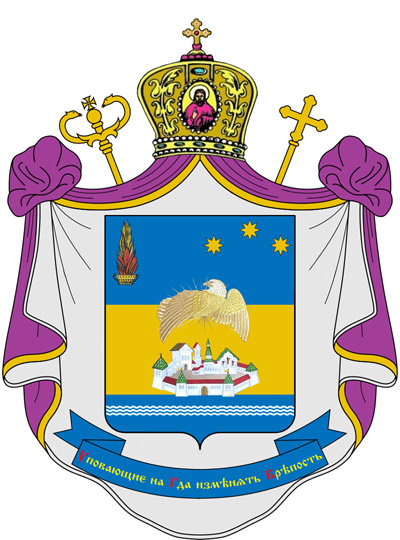
On November 4 , 2014 Bohdan J. Danylo will be ordained by His Beatitude Sviatoslav Shevchuck, Archbishop-Major of Lviv, and installed as the Second Eparch of the Ukrainian Eparchy of St. Josaphat in Parma, Ohio. The new Eparch, age 43, was born in Poland but ordained a priest here in the USA. He succeeds Eparch Robert Moskal who resigned for health reasons in 2009.


Something Old (For A Change)

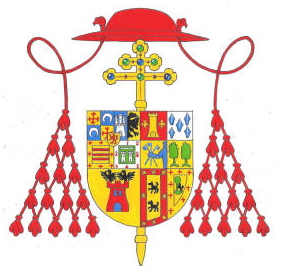
Lately I’ve been posting and commenting on the coats of arms newly assumed by bishops but I thought it would be nice to look back to an older coat of arms. I looked back to the XIX Century to Spain. Spanish bishops often have complex coats of arms because they come from armigerous families whose coats of arms are composed of several coats marshaled together on one shield. This one is no exception. The coat of arms of Juan de la Cruz Ignacio Cardinal Moreno y Maisonave, Archbishop of Toldeo (1875-1884) who was created Cardinal in 1868 while archbishop of Valladolid. He had also been bishop of Oviedo before that.
Here is a typical example of a complicated shield composed of several different coats of arms marshaled together. It may seem busy but it is also a feast for the eye!

MORENO Y MAISONAVE GIOVANNI DELLA CROCE IGNAZIO 1884

Bishop Daniel Thomas of Toldeo, OH

Thomas-Toledo-1-jpg

The Most Rev. Daniel Thomas, latterly auxiliary bishop of Philadelphia will be installed today as the IX bishop of Toldeo in Ohio. His arms (above) show the arms of the See impaled with his personal arms, assumed at the time he became a bishop. The lions are an allusion to the name Daniel and there are two of them as a heraldic representation of the name Thomas, which means “twin”.

Archbishop Anthony Fisher of Sydney

Image 11

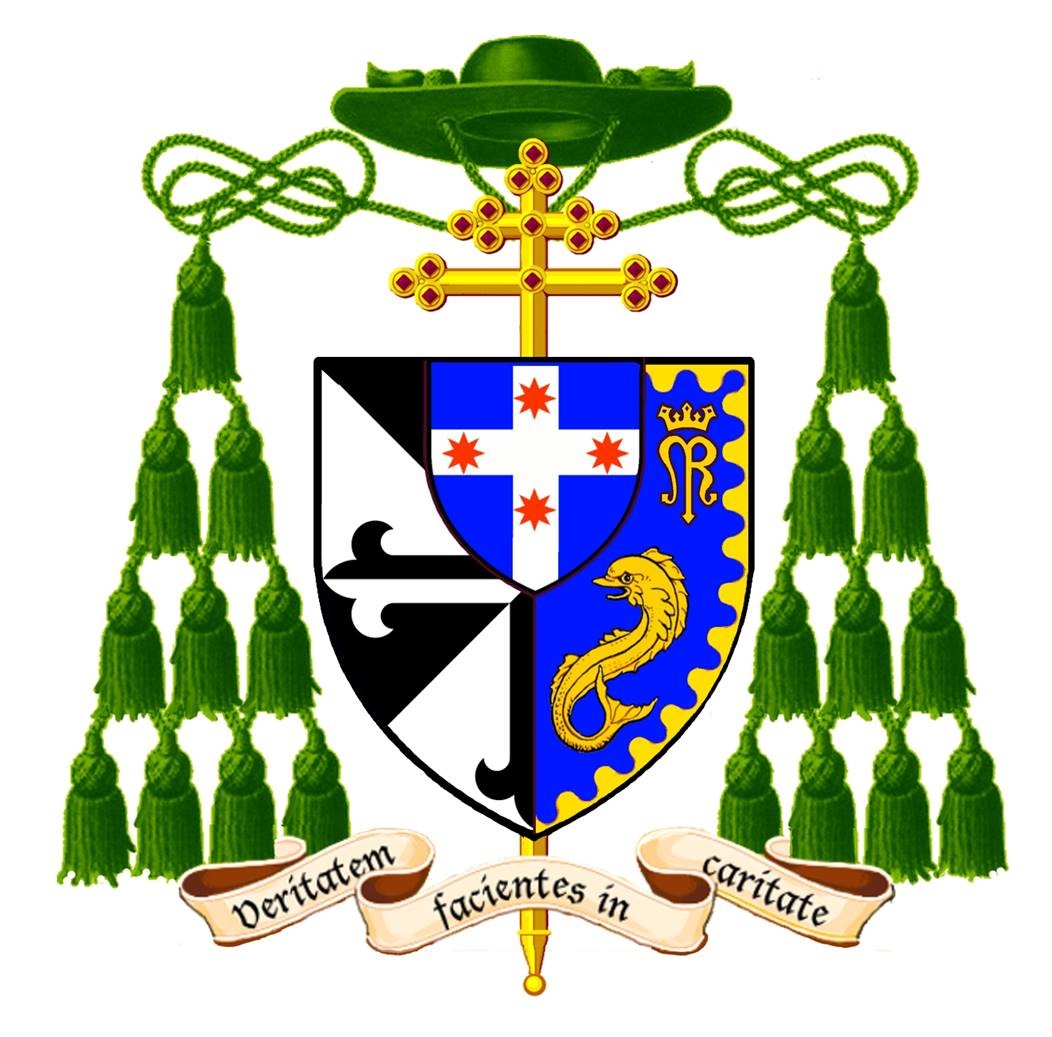
The Most Rev. Anthony Fisher, OP until now Bishop of Parramatta and previously auxiliary bishop of Sydney will be installed as the IX Archbishop of Sydney on November 12. His coat of arms (above) was prepared by Mr. Chris Wolter who had also done the work on the archbishop’s arms in Parramatta and as auxiliary bishop (below).

BishopAF-CoatArms

In the interest of full disclosure I, along with the President of the Australian Heraldry Society, Mr. Richard d’Apice, AM, were consulted on this coat of arms. As with any such consultation some of our advice was followed and some was not but the archbishop and Mr. Wolter were very open to hearing suggestions. Essentially, the archbishop retains the arms he first assumed when becoming auxiliary bishop of Sydney. Those arms combine the armorial bearings of the Order of Preachers (more commonly referred to as the Dominicans) of which he is a member impaled with arms that are based on the arms used by St. John Cardinal Fisher when bishop of Rochester, England with some minor alterations for difference (i.e. the inclusion of the Marian symbol). Over this on an inescutcheon (sometimes referred to as an escutcheon “in pretense” although that expression isn’t wholly appropriate in this case) is the arms of the See of Sydney.

John Andrew (1931-2014)

sc03653c15

The Reverend John Gerald Barton Andrew OBE, DD, who was born in Yorkshire, England, was a priest in the Church of England and served as domestic chaplain to Archbishop of Canterbury Michael Ramsey, a position from which he was called to Saint Thomas in NY. He had a distinguished tenure, in which his preaching, pastoral presence and leadership of the liturgy drew large congregations to the Church, an achievement especially notable during an era of general decline in the Episcopal Church. He was awarded honorary degrees from several Episcopal/Anglican seminaries in recognition of his work.

John Andrew was a friend and confidant of many church leaders both within and outside Anglicanism. He was a particular friend of Terence Cardinal Cooke and was a promoter of ecumenical relations between the Anglican and Roman Catholic churches.

Father Andrew’s ministry was remarkable for his ability in social conversation, humor, and joyousness – for which reasons many were eager to claim him as their friend. The secret of his influence was a gift he received and passed on from Archbishop Ramsey – namely, his transparent faith in Jesus and the miracles of the Gospel.

After a brief retirement to England, Father Andrew returned to New York in 1999 where he eventually returned to Saint Thomas at his successor’s invitation to be the “junior curate” as Rector Emeritus.

John Andrew, faithful priest and XI Rector of Saint Thomas Church Fifth Avenue, entered into glory at 5:20am (EDT) on Friday, 17th October 2014 at New York Presbyterian Hospital.

On Wednesday evening, Father Andrew had dinner with Bishop John O’Hara, of the Roman Catholic Archdiocese of New York. On his way home, Father Andrew suffered a massive cardiac episode and collapsed. He was taken to New York Presbyterian Hospital but never regained consciousness.

Himself an enthusiastic heraldist John designed so many coats of arms for people that were accepted by the College of Arms in London that he was given the unofficial nickname of “Manhattan Pursuivant”. Requiescat in Pace.

JAHistory_small

Pope Paul VI To Be Beatified

On October 19 Pope Francis will beatify Giovanni Battista Montini, also known as Pope Paul VI whose pontificate lasted from 1963-1978. He presided over three of the four session of Vatican II and is really the one responsible for most of the reform and simplification of the Church’s liturgy and ceremonial practices.

In his coat of arms the six hillocks in base are a play on his family name, Montini, which means “little mountains”.

Paul VI

Archbishop of Kuala Lumpur

unnamed

NO! HORRIBLE!

Cut and paste artwork (much of it STOLEN from someone else!), insipid charges, poor design. An example of the WORST kind of heraldry. It’s really not heraldry at all. Just a bunch of nonsense slapped onto a shield. This kind of heraldic device reveals an arrogance and conceit not befitting a bishop.

New Armigerous Saint (well…a Blessed really not a Saint)

The second most important figure in the Opus Dei order, Alvaro Del Portillo, was beatified on September 27 at an open air Mass attended by tens of thousands of Catholics. Del Portillo succeeded Opus founder,St. Josemaria Escriva de Balaguer, as Opus Dei’s leader. The miracle attributed for Del Portillo’s beatification was confirmed last year by Pope Francis.

NOTE: This post was updated when a reader pointed out I had used an image of the incorrect coat of arms.

1024px-Coat_of_arms_of_Álvaro_del_Portillo.svg