Bishop J. Gregory Kelly

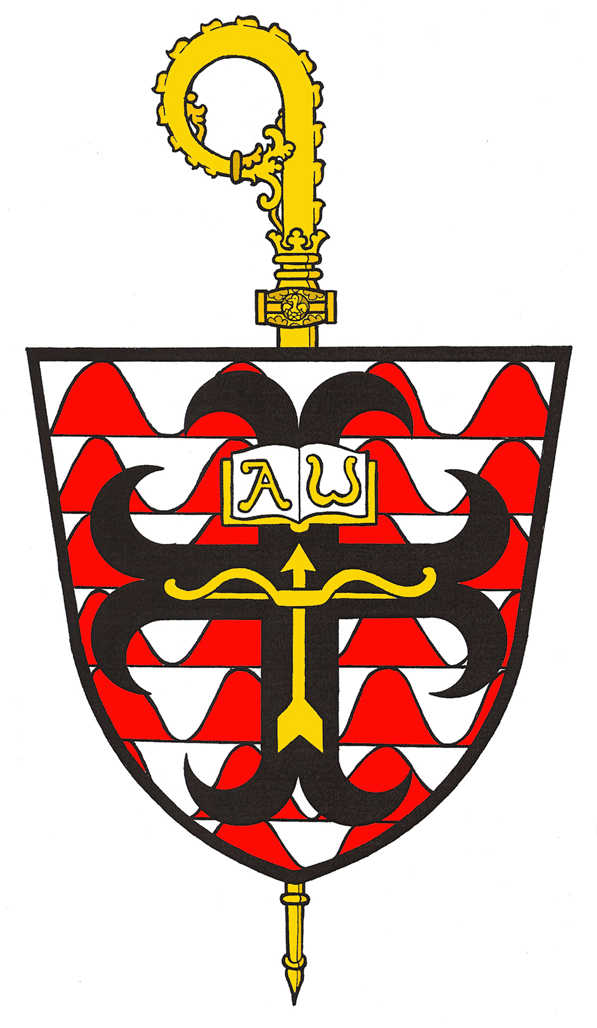
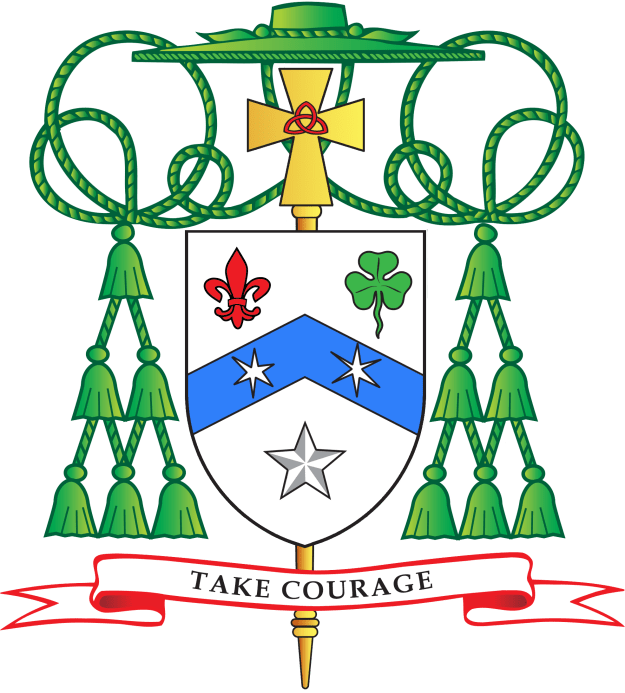
On February 11 the Most Rev. (John) Gregory Kelly was ordained as Auxiliary Bishop of Dallas. The description of the coat of arms (from the diocesan website):

“Bishop Kelly’s arms are based on the Kelly family design where the shield is silver (white) and the charges are black. For difference, and for his deep devotion to the Blessed Virgin Mary, the chevron is now blue. The chevron is reminiscent of the mountains of Colorado, so dear to His Excellency’s youth and the chevron is charged with two estoiles (special, six pointed stars) that are taken from the mantle of the image of Our Lady of Guadalupe to remind all of the profound Hispanic influence in Texas, the “Lone Star State“, represented by the single star below the chevron. Above the chevron are a fleur-de-lis and a trefoil (the heraldic representation of a shamrock) to honor the Bishop’s Irish and French-Canadian heritage.”

Once again we see here an example of the increasingly popular (and completely WRONG!) trend of personalizing one of the external ornaments, in this case, with the addition of the triquetra on the episcopal cross (erroneously referred to as a “processional” cross in the description) to represent the Holy Trinity because it was the name of the seminary the bishop attended.

It is necessary to repeat that the only thing subject to having charges particular to the bearer is the shield. The external ornaments may NOT be personalized in a heraldic achievement of this type and all those who advocate such a practice are both incorrect and foolish! The heraldic artist is completely free, in future, to depict this bishop’s coat of arms with an episcopal cross of any shape and manner he might wish. This is what happens when armigers turn to those who do not know what they are doing for the devisal of their coats of arms.

Kelly-COA

Artwork: P. Sullivan

Very Rev. Steven A. Peay, PhD

One year ago today the Very Rev. Steven A. Peay, PhD, an Episcopal priest of the Diocese of Albany and Honorary Canon Theologian for Evangelism at Christ Church Cathedral in Eau Claire, WI became the 20th Dean and President of Nashotah House Seminary in Nashotah, WI.

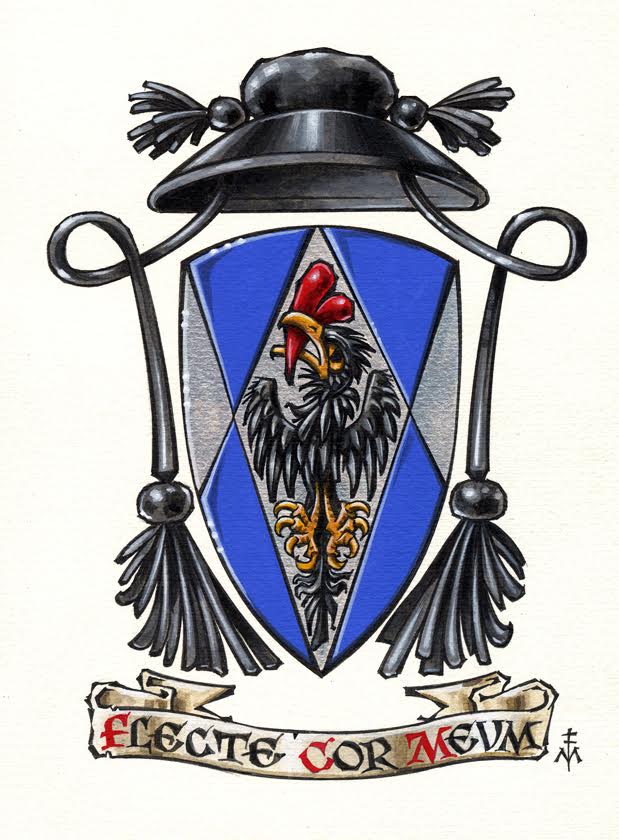
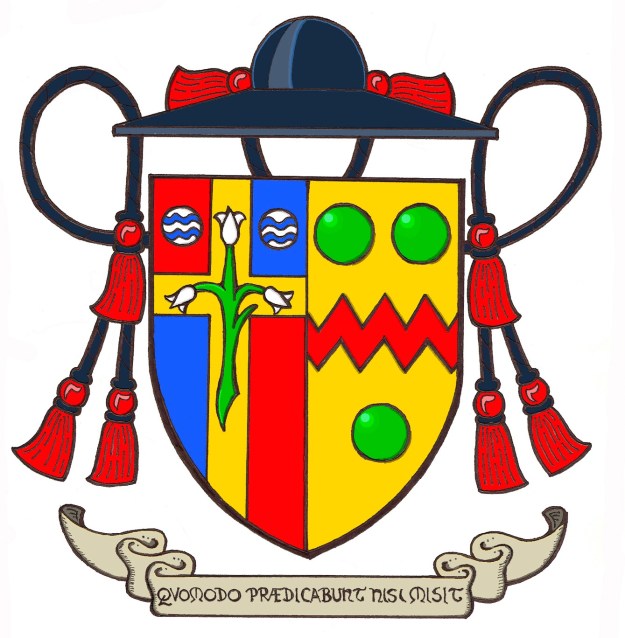
His coat of arms is pictured below. The blazon is:

Arms impaled; to dexter, quarterly Gules and Azure, overall on a Latin cross Or between two fountains in chief a triple blossom lily Proper; to sinister Or between three pommes a fess dancetty Gules. The shield is ensigned with the ecclesiastical hat of an Honorary Canon according to the Earl Marshal’s Warrant for the coats of arms of clergy in the Anglican Communion of 1976. Below the shield is a scroll with the motto, “Quomodo Prædicabunt Nisi Misit” (Romans 10:15)

In the arms of the seminary the lily represents both the Holy Trinity and the Blessed Virgin Mary, to whom the main chapel is dedicated. The two fountains allude to the seminary location between Upper and Lower Nashotah Lakes.

In the personal coat of arms of Fr. Peay the gold field and fess dancetty are taken from the coat of arms of Bl. John Henry Cardinal Newman. The bearer has long been an admirer of Newman’s work and writings. There is some irony in choosing this as Newman famously converted from the Church of England to Roman Catholicism and Fr. Peay, conversely, had been a Roman Catholic and was received into The Episcopal Church. Whereas Newman had three hearts surrounding the fess in his arms here, for difference, they have been changed to three pommes. In heraldry this term describes a green roundel. In this case they are chosen to resemble peas as an allusion to the bearer’s surname “Peay”.

The motto is a favorite scriptural quote that reflects the bearers long time teaching of historical theology and preaching to seminarians.

Peay2c

Heraldic Achievements of the “Junior Clergy” in the Catholic Tradition

A Presentation delivered to the NYG&B Heraldry Committee and the College of Arms Foundation

January 28, 2016

Many people know that I have been involved in the study and creation of both the science and art of heraldry for over thirty years. Not surprisingly, my particular area of interest is the heraldic customs of the Roman Catholic Church. In fact, in many ways I owe my abiding interest in heraldry to the Church.

I became interested in heraldry as a boy, as many do, because we were studying the Middle Ages in school. Then, it was much more tied up in a romantic interest in chivalry and, as a result, it seemed like something from long ago and far away. After all I was an American (pronounce that ‘Mur-can’) and we had thrown off the shackles of tyranny by abolishing the monarchy on this side of the pond and tossed onto the dustbin of history all the trappings and frummery of kings, aristocracy and the like.

However, one day in the children’s section of my public library I came across a biography of the then reigning pope, now Bl. Paul VI. The book contained a beautiful line drawing of his coat of arms. My eldest brother, some ten years my senior, who was a font of knowledge for me on all manner of things told me, when I remarked on it, that it was the usual practice for all popes to have coats of arms. In fact, he went on to explain that all bishops and dioceses had coats of arms and he even pointed out to me the examples from our own church and parochial school where heraldic images could be found.

It was as if someone had opened a door to a secret garden for me. Suddenly, heraldry no longer seemed long ago or far away. Even as a boy I had already felt a vocation and the Church was very much a part of my daily life. Now, thanks to that little book and my brother’s copious general knowledge I had discovered that heraldry was alive and well and living in the Church all over the world…including right here in the USA. Now two things which occupied a great deal of my thought and interest; my religion and coats of arms, found a happy marriage and from that point on (I was about eleven years old at the time) I was hooked on what would go on to be the enduring passion and avocation of a lifetime.

Jumping ahead to my high school years I began to be a little frustrated with learning more about Church heraldry because most of the source material was limited to secular heraldry and almost all of it either about English or Scottish heraldic customs. (not that there’s anything wrong with THAT!) In the majority of these books the mention of ecclesiastical heraldry at all was scant and, frequently, limited to a brief discussion of the heraldic practices of the Church of England. I kept wondering why no one had ever written a book about heraldry as used in the Catholic Church. This was several years before I had even heard of Woodward’s “Treatise” or Galbreath’s “Papal Heraldry”. Then in 1979 I came across, again in that same wonderful public library to which I will always be so grateful, a book entitled, “Heraldry in the Catholic Church: It’s Origins, Customs and Laws” by the late Archbishop Bruno Heim. I couldn’t believe my eyes! Here in one volume which I later discovered was the first English printing of an expanded version of his earlier work, “Coutumes et Droits Heraldiques de l’Eglise” (published in 1949). It was the book I had been hoping and wishing for. The extraordinary “Year of Three Popes” (1978) during which Heim had designed the coats of arms of John Paul I and St. John Paul II occasioned its publication. It went on to become my “bible” of sorts and Heim came to be held in very high esteem by me, as well as a host of others, not only because of this book for for other personal reasons.

It was because of Heim that I went on to discover the history and traditions of Roman Catholic Church heraldry in the Western and Eastern rites as well as a bit more about Anglican heraldry. This book revealed that it wasn’t only popes, bishops and dioceses that made use of armorial bearings but all the ranks and levels of clergy. It blew away the idea, comparable in secular heraldry, that coats of arms are only for the mighty and powerful; the upper echelon of society. Heim explained that it is not only those at the highest end of the elaborate hierarchy within the Church who are entitled to use heraldic ensigns but all the clergy. Wanting very much to be a priest but never presuming to aspire to the episcopate I had imagined that just as only knights, barons and princes used coats of arms in the secular realm so, too, the lower rank of clergy to which I aspired would not be permitted a coat of arms. Now, I had come to realize that I couldn’t be more wrong. I realized that as a priest I could have and use a coat of arms!

This was a big deal (to me anyway).

In 1987 I was living in Latrobe, PA in a Benedictine monastery and studying in the seminary for the priesthood. The diocese in which that monastery was located, Greensburg, PA, was receiving a new bishop. All the printed matter concerning his installation contained his new coat of arms which I immediately recognized had been emblazoned by Bruno Heim. The explanation went on to say the coat of arms had been designed by a Dr. Geza Grosschmid, Ph.D. of Duquesne University in Pittsburgh. I resolved to contact Dr. Grosschmid, a long-time friend and collaborator of Abp. Heim it turns out as I was later to discover, to see if he could teach me more. Thus began an sort of unofficial “apprenticeship” for me that lasted until his untimely death in 1992. He was the one who helped to direct and focus my studies, critique my designs (with an eye he gained from working with Heim) and expand the scope of my research. Through him I gained a connection, albeit a slight one, to Heim.

Heraldry with its origins in the XII C. we know began as something employed by those who engaged in battle as a means of identification. It entered the Church primarily via its use on armorial seals employed by the clergy in their capacity as magistrates. We shall not go into a lengthy explanation of either of those origins today as it has been treated extensively elsewhere and in several other talks given in this venue, including more than one by me! Canon Law regulates the use of seals in no less than fifteen separate Canons and, by extrapolation, that provides some regulation of armorial bearings as well. In addition, various Rules, Instructions and Regulations of the Roman Curia, as well as various official Instructions and Letters Motu Priorio of the Supreme Pontiffs have “regulated” heraldry in the Church.

However, two important points remain inescapably true: 1) The Catholic Church does not “grant” arms to the clergy of the Church (and respects the jurisdiction of those heraldic authorities in existence over the clerical as well as the lay people within their jurisdictions) and 2) there is NO heraldic authority (as a body) within the Roman Catholic Church. The various regulations concern themselves primarily with the external ornaments in a heraldic achievement as these indicate rank, office or special privilege. The Church does NOT concern itself with regulating the design on the shield (i.e. the blazon) which explains the appalling state of so much Catholic ecclesiastical heraldry.

For example, there is the decree of Innocent X in 1644 which forbade the use of secular marks of dignity (like crowns) in the arms of cardinals and the further decree of Benedict XV in 1915 extending that prohibition to all bishops (and by interpretation to all prelates…but not to all clergy, interestingly enough); the Motu Proprio of St. Pius X “Inter Multiplices Curas” of 1905 that regulates the insignia of many of the prelates and the confirmation of the validity of that document in 1934 by Pius XI in the Apostolic Constitution “Ad Incrementum Decoris” as well as the Instruction of the Secretariat of State under Bl. Paul VI on the vesture, titles and insignia proper to cardinals, Bishops and Prelates of the Minor Orders issued in 1969 (which discontinued the use of mitre and crozier in the arms of Cardinals and Bishops).

But what of all the so-called “Junior Clergy”, those below the rank of bishop? Some maintain that there is no heraldry proper to them and they couldn’t be more wrong. Let’s briefly examine what has evolved over time to indicate in heraldry the varying ranks of the lower clergy within the Catholic Church.

PRIEST: In his excellent book Heim states plainly, “Those who object to a simple priest using an ecclesiastical hat (on his coat of arms) hold this position arbitrarily, and without the support of any ecclesiastical decision, code or regulation. It must be remembered that all priests belong to the same ecclesiastical order and are thus possessed of equal sacerdotal and other privileges.” (p.125) So, the priest ensigns the shield with a simple black galero that has two tassels pendant from it.

DEANS & MINOR SUPERIORS: These are priests who do not necessarily hold any ecclesiastical rank higher than that of priest but whose functions (office) place them in a special category. They make use of a black galero with four tassels pendant from it. The tassels may be arranged one hanging below the other or they may hang side by side from a median knot. This true for secular offices (like Dean or Rector) and also for offices held by Professed Religious, such as Provincial Superior or Prior.

CANONS: Whether Religious (Canons Regular) or secular Canons attached to a Collegiate or Cathedral church, none of which exist in the USA, they make use of a black galero with six tassels pendant on either side. Some contend that Canons Regular may use a galero of whichever color corresponds to the color of their habit. For example Norbertine Canons wear a habit that is all white so the galero and tassels would all be white. As the heraldic privilege is attached to the rank of Canon and not to a particular Religious Community I don’t agree with such a custom. Nevertheless, it exists as a valid argument.

MAJOR SUPERIORS: Here we mean those clerics who exercise Ordinary Jurisdiction over persons in the internal and external forum, hence, canonically considered prelates. These would include Vicars General, Vicars Episcopal and Abbots. They all make use of a black galero from which hangs twelve black tassels from black cords. The same rule about the color of the habit determining the color of the galero, cords and tassels used for Canons Regular is also frequently applied to Abbots as well but I don’t agree for the same reason as above.

In addition, the Abbot employs the use of a veiled crozier placed vertically behind the shield. The veil or sudarium, dates from a time when abbots did not yet enjoy the privilege of all the pontificals, including pontifical gloves, and the veil served to protect the staff of the crozier from soil and perspiration. It remains now in heraldry only and marks one of the few exceptions to the use of the crozier in the coats of arms of persons.

There is also the office of Ordinary of a specific Ordinariate (such as the newly formed Anglican Ordinariates). Such Ordinaries, although not bishops, enjoy the use of pontifical insignia. Therefore, it was suggested by some, including myself, that they should make use of external ornaments that include the black galero with twelve black tassels and the crozier (to indicate their status as an Ordinary) but without the sudarium to differentiate it from the crozier of an Abbot.

It is worth noting that many who hold these offices, Abbots excepted, often are promoted to a rank of one of the three kinds of Roman Prelates and in such cases would make use of a galero proper to that rank.

MONSIGNORI: These are the clergy who have received Roman Honors from the Pope and, as such, are technically members of the Pontifical Household. There are three levels or ranks and all are addressed as “Reverend Monsignor”.

Prothonotaries Apostolic: They are further divided into Prothonotaries Apostolic “de numero” (participatium) and Prothonotaries Apostolic Supernumerary. The Former make up the College of Notaries of the Church and also serve as Canons of the Papal Basilicas in Rome; the latter are those prelates so honored around the world. They all make use of a purple galero from which twelve amaranth red tassels hang from amaranth red cords.

Prelates of Honor: This middle level makes use of a purple galero with twelve purple tassels hanging from purple cords.

Chaplains to His Holiness: This lowest level make use of a black galero from which hang twelve purple tassels from purple cords.

DEACONS: There is no officially sanctioned external heraldic ornament for Permanent Deacons in the Catholic Church. This is partly so because when heraldry first grew and flourished the office of Permanent Deacon did not exist in the Church. Rather, by that time it had receded to being the final step on the way to priesthood and, as such, only Transitional Deacons existed. It was not considered necessary to devise a heraldic emblem for an office held only temporarily. With the revival of the Permanent Diaconate in 1970 the matter should probably well have been addressed but has not been.

There are some authors who contend that on the authority of the Holy See Deacons are to make use of a crest of a ciborium surrounded by a humeral veil like mantling and include on the shield a chief with a bend to suggest a stole worn diagonally in the manner of Deacons. This is FALSE. Such a contention is made up out of whole cloth entirely and enjoys no sanction from the Church. It is ludicrous to suggest that after replacing the secular crest with the ecclesial galero the Church would then devise a crest specific to a particular rank of clergy, especially when a heraldic crest is specific to an individual. In addition, it makes no sense to think that the Church which, again, does not concern itself with the blazon on the shield, would now mandate a chief to be added to the armorial blazon of the arms of Deacons especially when one considers that married men may be ordained to the Diaconate and this could very well mean that such a chief would then be borne by their children, who may not be Deacons, when they inherit the arms from their father.

In the Church of England (and by extension the whole Anglican Communion) there is a provision for Deacons to ensign the shield with a black galero that has no tassels or cords. This was determined by a 1976 Earl Marshal’s Warrant. There are those who contend that such an ensign should be adopted for use by Deacons in the Roman Catholic Church as well. I have not yet fully made up my mind. I don’t oppose the idea from a heraldic or artistic standpoint. As an external ornament it would not be “inheritable” by a Deacon’s heirs but I would rather the Holy See issue an Instruction to clarify the matter or otherwise it remains simply borrowing from another heraldic tradition.

When asked I recommend that armigerous Deacons do one of the following: a) Make use of the shield and motto alone. There is no hard and fast rule that one MUST employ helm, mantle and crest in a heraldic achievement. Indeed the only thing “necessary” is the shield. b) Make use of a “secular” manner of a coat of arms with helm, mantle and crest, especially if the arms are destined to be inherited. c) Compromise by making use of both an ecclesiastical and a secular version of the coat of arms. d) Employ some kind of heraldic augmentation to the shield which would be removed when the arms are inherited (such as an escutcheon in pretense or a canton) or incorporate a charge into the design of the arms that alludes to Diaconal ministry but would not seem inappropriate or offensive when the arms are used by later generations not unlike charges that allude to the occupation of the original bearer but do not indicate the occupation of subsequent generations who inherit the coat of arms.
New Bishop of Cremona

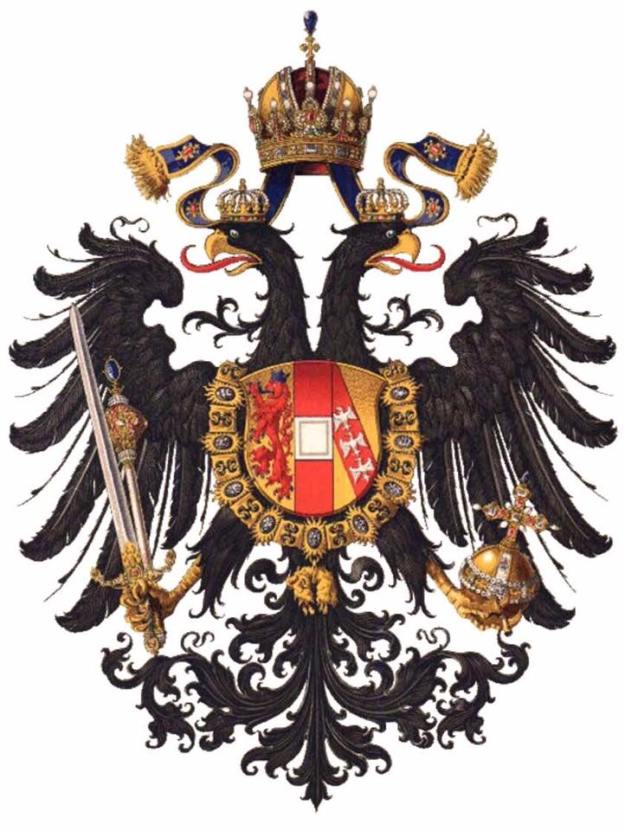
On January 30 the Most Rev. Antonio Napolioni will be ordained as the new Bishop of Cremona. His newly-adopted coat of arms (below) combines symbols of two popes he admires (the sun from the arms of Pope Francis and the fleur-de-lis from the arms of Bl. Paul VI), the rivers of Cremona and the mountains as a symbol of the journey of faith and, in particular, the Transfiguration. The motto, “Serve the Lord With Gladness” is from Psalm 99.

Stemma-vescovo-Antonio-Napolioni

Archbishop Zuppi of Bologna

zuppi-matteo-maria-stemma-arcivescovo-bologna

The coat of arms of the new Archbishop of Bologna, the Most Rev. Matteo Zuppi.

The shield depicts the Book of the Gospels, a river and the cross of Constantine. The book is open to John 4:34-35.  Jesus at Jacob’s well with the Samaritan woman said , “My food is to do the will of him who sent me and to finish his work. Do you not say perhaps four more months and then the harvest? Behold, I say to you, lift up your eyes and look at the fields! They are ripe for harvest.” The river evokes the Tiber and Rome. The sign of water and the river runs through the Scriptures from Genesis to Revelation. The Cross with Alpha and Omega is a sign evoking Christ crucified and risen, the beginning and end of all things. This cross is above the triumphal arch of Santa Maria in Trastevere in Rome where Archbishop Zuppi has lived for most of his priestly ministry.

The scroll below shows the motto chosen by Archbishop Zuppi “Gaudium Domini Fortitudo Vestra.” The joy of the Lord is your strength. (Neh 8:10)

The pallium is both unnecessary and very ill-placed.

Prefect of the Pontifical Household

Georg_G_nswein_Benedict_XVI

Gänsewein (former)

Since the pontificate of Pope Benedict XVI (2005-2013) the Prefect of the Pontifical Household (formerly called the Majordomo of His Holiness) has been the Most Rev. Georg Gänswein, who also served Pope Benedict as his personal secretary. At the time Gänswein was ordained to the episcopacy he assumed a coat of arms that impaled (that is, combined side by side on the same shield) his own personal emblems with the coat of arms of the pope he served, Benedict XVI. Upon the abdication of of Pope Benedict and the election of Pope Francis Gänswein’s coat of arms changed to reflect the new pope he continued to serve as Prefect of the Pontifical Household. This is an old custom. Below are the coats of arms of several of these Prefects with their arms impaled with the various popes under whom they served.

Georg_G_nswein_Francis

Gänswein (current)

Mag 014 Harvey

Harvey

unnamed

Monduzzi

Mag 011 martin3

Mag 010 martin2

Mag 009 martin1

Martin

Mag 007 Nasalli a copy

Nasalli Rocca di Corneliano

Mag 008 Callori

Callori di Vignale

unnamed (1)

Mag 004 Patrizi Costantino

Mag 002 Gallarati Scotti Giovanni

unnamed (3)

Paris

All the world is praying for Paris and Parisians. Their shepherd will need our prayers as well as he tries to comfort the afflicted and the grieving as well as bring aid to the wounded and the frightened. Andre Cardinal Vingt-Trois’ coat of arms is really not a coat of arms (although at least he has SOMEthing…unlike so many of his brother bishops in France) but I point it out because he, a spiritual leader and guide, needs our support and prayers. The arms themselves, rather than a motto, remind us of an important thing, especially in the face of such bald hatred and aggression: “For God so loved the world…” (that He sent His only Son to be our Redeemer) John 3:16

fm vingt-trois013

Bishop Meier, OSB

On September 27, 2015 The Most Rev. Dominic Meier, OSB, a Benedictine monk of Königsmünster Abbey was ordained Auxiliary Bishop of Paderborn, Germany.

His coat of arms is depicted below with the description from the archdiocesan website.

wappen-wbDominicus-web

Das Wappen von Weihbischof Dr. Dominicus Meier OSB ist geteilt und halb gespalten. Das obere Feld bildet ein goldenes Kreuz auf rotem Grund, das Wappen des Erzbistums Paderborn.

Das kurkölnische Kreuz auf silbernem Grund und die Christuskrone aus dem Wappen der Abtei Königsmünster in Meschede sind im heraldisch rechten Feld dargestellt. Der Wappenträger stammt aus Lennestadt-Grevenbrück, einem Ort, der zum kurkölnischen Sauerland gehörte. Weihbischof Dr. Dominicus Meier OSB trat 1982 dem Benediktinerorden bei und war von 2001 bis 2013 dritter Abt der Benediktinerabtei Königsmünster in Meschede, aus deren Wappen die Krone entnommen ist.

Die heimische Heckenrose mit ihren fünf weißen Herzblättern und der goldenen Mitte auf blauem Grund im heraldisch linken Feld symbolisiert als Gabe und Aufgabe die Verbundenheit der Menschen mit Gott. Als „Weiße Rose“ ist sie eine herausfordernde Erinnerung an das mutige Eintreten von Studenten im nationalsozialistischen Deutschland für das Recht und die Würde des Menschen. Auch mit der Rose mit ihren fünf weißen Herzblättern in seinem neuen Wappen knüpft Weihbischof Dr. Dominicus Meier OSB an sein Wappen als Abt der Benediktinerabtei Königsmünster an.

Die Wappenzier besteht bei einem Bischof aus einem Kreuz und dem niedrigen geistlichen Hut mit breiter, flacher Krempe, aus dem an zwei verschlungenen Kordeln reihenweise, symmetrisch geordnet 1 + 2 + 3 Quasten hängen. Die Farbe des Hutes, der Kordeln und der Quasten ist grün.

Der Wahlspruch von Weihbischof Dr. Dominicus Meier OSB „PER CHRISTUM CONGREGAMUR“ lautet übersetzt: „Durch Christus werden wir zusammengeführt“. Er lehnt sich an den Hymnus „Ubi caritas“ der Liturgie des Gründonnerstags an. Diesen Wahlspruch hatte der neue Weihbischof bereits als dritter Abt der Abtei Königsmünster.

Three Los Angeles Auxiliaries

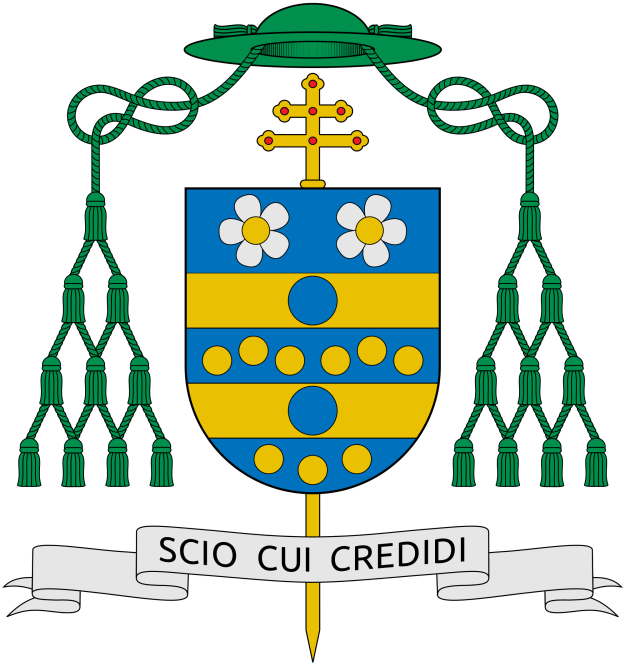
On Tuesday, September 8, 2015 the archdiocese of Los Angeles (largest in the USA with some 5 million Catholics in 280 parishes) received three new auxiliary bishops. The Most Rev. Joseph Brennan, The Most Rev. David O’Connell both priests of the archdiocese and The Most Rev. Robert Barron, a priest of the archdiocese of Chicago were ordained by The Most Rev. José Gomez, archbishop of Los Angeles. The coats of arms of Bishops Brennan, O’Connell and Barron are below. All three were designed by James Noonan and depicted by Linda Nicholson.

Brennan-COA Oconnell-COA Barron-COA

External Ornaments in Heraldry

The last post on the arms of the new Territorial Abbot of St. Maurice started an interesting conversation in the comments section. Namely, about the fact that the Abbot’s arms are ensigned with only the crozier that indicates the coat of arms belongs to an abbot. Many dislike it when the arms of a cleric do not employ the use of the distinctive galero, or broad-brimmed hat, which usually replaces both the helm and crest (with their accompanying torse and mantling) found in the heraldic achievements of lay people. This ecclesiastical hat is depicted in varying colors and with varying numbers of tassels to indicate the rank of the armiger. Both the Roman Catholic Church and the Church of England have developed elaborate systems for the use of the galero. Many other constituent churches of the Anglican Communion employ the system devised for the Church of England and approved by Earl Marshal’s Warrant in the 1960s.

However, while it is true that the galero certainly makes the coat of arms of a clergyman instantly recognizable as such it is not true that the galero is always and everywhere mandatory for clergy. In fact, there are no external ornaments that are mandatory in heraldry. A coat of arms, simply put, may consist of the shield alone. The motto, which many clerics spend way too much time on devising, is not a necessary component to a coat of arms for example.

In the case of a bishop the one single external ornament that marks the coat of arms as that of a bishop is the episcopal cross placed behind the shield. Full stop. There is no other external ornament necessary and quite a few bishops have chosen to display the episcopal cross (which is not to be confused, as it often is, with the liturgical processional cross) alone in their heraldic achievement. The green galero with twelve tassels is not exclusive to them so it is not the necessary element to indicate the arms of a bishop. Similarly, archbishops use the archiepiscopal cross which has two horizontal bars and is sometimes somewhat misleadingly referred to as the patriarchal cross, in their coats of arms. The green galero with twenty tassels is used almost exclusively by archbishops but it, too, is not a necessary or mandatory external ornament.

When it comes to cardinals the situation changes somewhat in that the red galero with its thirty tassels is, pretty much, the only external ornament that indicates the armiger is a member of the College of Cardinals.

For other clergy, again, the situation remains that the galero is usually employed and certainly makes it clear that the coat of arms belongs to a cleric rather than a laic but the privilege of ensigning the shield with various ornaments isn’t always absolutely necessary. In the case of an abbot it is the (usually veiled) crozier that indicates the arms of an abbot or abbess, the latter being easily distinguished by the lozenge or oval shape of the shield. If a coat of arms is ensigned with a veiled crozier then it is indicating the armiger is a cleric with the rank of abbot whether the black galero with twelve tassels is displayed or not. This is so because the black galero with twelve tassels may also be used by Vicars General; Vicars Episcopal; Non-Episcopal Ordinaries, Moderators of the Curia, Titular Abbots, Prelates of Chivalric Orders as well as Superiors General of Religious Orders and Clerical Religious Congregations. However, only an abbot may also employ a veiled crozier*. Thus it is the crozier that indicates the coat of arms belongs to an abbot, not the galero.

Similarly, the green galero with twelve tassels may be used by Territorial Abbots, Permanent Apostolic Administrators and Vicars or Prefects Apostolic who lack the episcopal character. However, only a bishop or archbishop may also ensign the shield with the episcopal or archiepiscopal cross.

It is worth mentioning that in some places bishops and abbots still use the mitre as well as the cross or crozier in ensigning their shields rather than the galero despite the preference as indicated by Papal Instruction for the use of the galero.

As I said jokingly to one of my sympathetic correspondents, “You don’t have to have all the doo-dads on your coat of arms when, frequently, there is only a single ornament that is the true indication of rank”.

*NOTE: Recently, the Church has established Ordinariates for former Anglicans who wish to come into the Roman Catholic Church. These are headed by Ordinaries who, while exercising Ordinary jurisdiction over the churches under their charge, do not possess the episcopal office. In some cases they were formerly bishops in some branch of the Anglican Communion. Of the three existing today they, too, ensign their shields with the proper galero of rank (usually that of a Prothonotary Apostolic, the highest rank of “monsignor” which is a purple hat with twelve red tassels) as well as a purposely UN-veiled crozier to distinguish it from the crozier of an abbot. This is because they exercise Ordinary jurisdiction of which the crozier is a symbol and they are entitled to use the pontificals liturgically so they actually carry a crozier at Mass but the veil on the crozier is particular to monastics which these Ordinaries are not.

New Territorial Abbot of St. Maurice (UPDATED)

image

The Rt. Rev. Jean Scarcella was born Dec. 28, 1951 in Montreux. After his novitiate, he took his vows at the Abbey of Saint-Maurice 5 October 1985. A graduate of music, he was ordained a priest March 31, 1990.

He became pastor of Bex in 1992. In 2006 he was appointed liturgical animator then rector of the Basilica of Saint-Maurice, in addition to his work in Bex before becoming Prior on July 25,2009. As prior he was the first assistant of the Abbot in governing the Abbey as well as the Congregation of Canons Regular.

Following the election of Chapter of the Abbey on April 10, 2015, Pope Francis confirmed this choice and appointed him 95th Territorial  Abbot of Saint-Maurice Agaune on May 22, 2015.
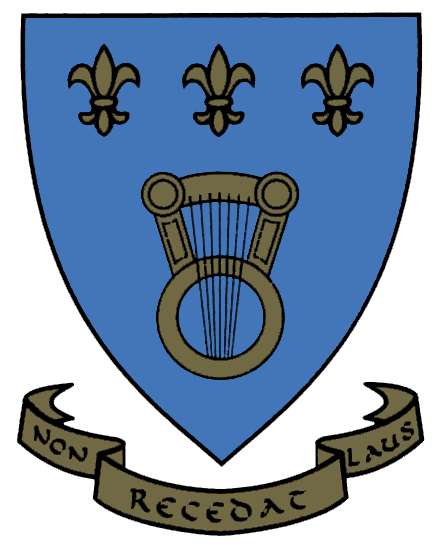
He has chosen to make use of a very simple coat of arms and not to use the external ornament of a green galero with 12 tassels.

St. Joseph Parish, Washington, NJ

sc00016f9d

The newly assumed coat of arms of St. Joseph Catholic Church (above) incorporates elements alluding to the location of the parish and the parish’s titular patron saint. The blazon is: Gules, two bars Argent and in chief three fleur-de-lis Argent. That is: on a red background there are two horizontal silver (white) stripes and above that three fleur-de-lis also silver (white).
The new coat of arms is based closely on the coat of arms of George Washington (pictured below) The blazon of that coat of arms is: Argent, two bars Gules and in chief three mullets of five points also Gules. The Borough of Washington and Washington Township in Warren County in Northwest New Jersey is named for Washington.

Wash-mid
In the arms of the parish the colors have been reversed for difference and the three mullets or stars have been replaced with three fleur-de-lis, a symbol in heraldry used most often to represent Our Lady but one which is also used to allude to St. Joseph, her husband. For some time now the parish already employed the fleur-de-lis as a kind of logo or parish symbol.
The new coat of arms was designed and rendered by me as I am serving as the Administrator of the parish.

Bishop Massa & Bishop Mroziewski

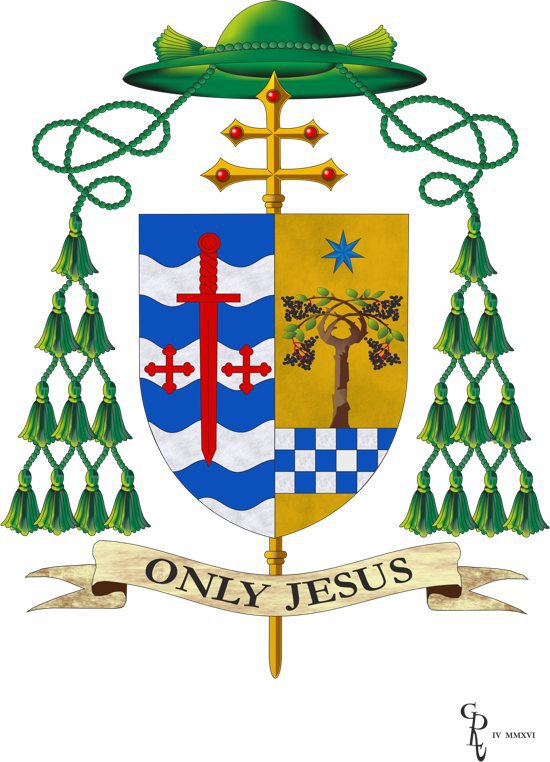
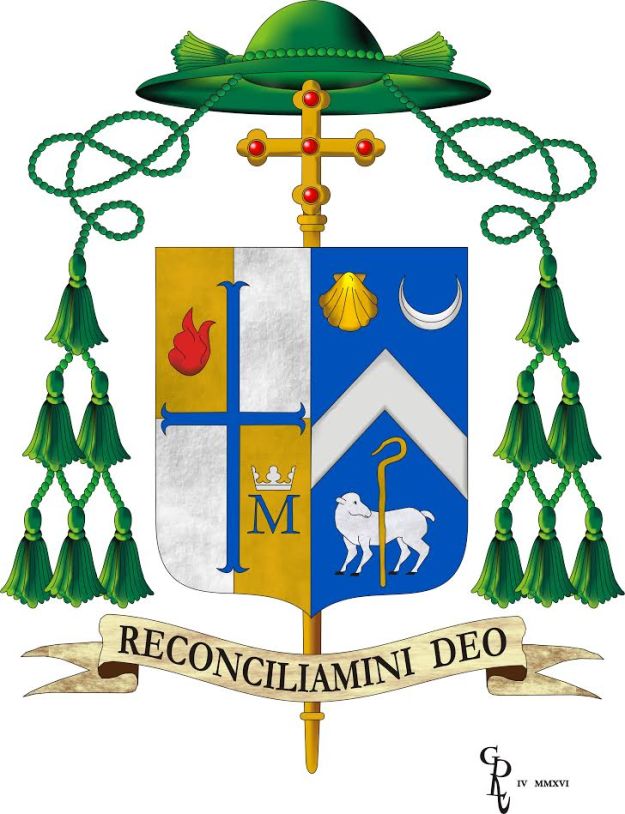
On July 20 the Most Rev. Nicholas DiMarzio will ordain the Most Rev. James Massa and the Most Rev. Witold Mroziewski as auxiliary bishops of Brooklyn. Their newly-assumed coats of arms are pictured below without comment. I am personally acquainted with Bishop Massa and he had wanted me to design his coat of arms but others took that matter out of his hands. Therefore, I will refrain from expressing an opinion on the design of the arms.

imageimage