Category Archives: Fr. Guy’s designs

Archabbots of St. Vincent

St. Vincent Archabbey in Latrobe, Pennsylvania, the oldest monastery in the United States, was founded in 1846 by monks from St. Michael’s Abbey in Metten, Bavaria under the leadership of Fr. Boniface Wimmer. They came to Pennsylvania funded by the Ludwigs-Missionverein, an organization started by the King Ludwig I of Bavaria to minister to German immigrants throughout the world.

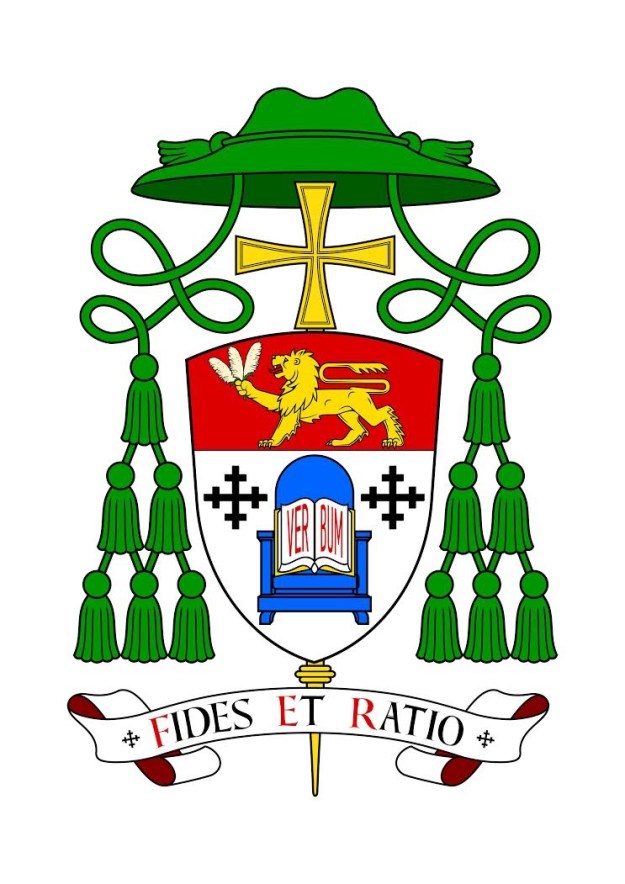
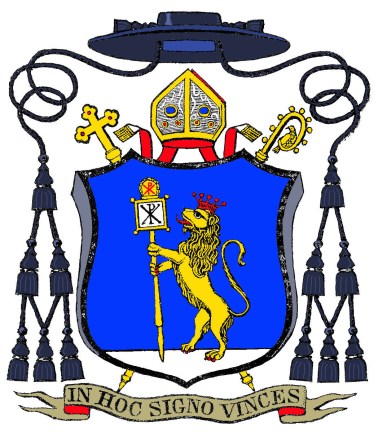
When the community had grown large enough to be elevated to the status of an independent abbey in 1855 it was decided to designate it an archabbey and Father Boniface was named Archabbot for life by Bl. Pius IX. His coat of arms (below) looks to be based in a quartering of the arms of the royal family of Bavaria, the House of Wittelsbach. The lion holding the banner of Christ was used not only by Archabbot Boniface as his coat of arms but also by the community as the heraldic symbol of the archabbey. It seems as though Wimmer’s first three successors, Archabbot Andrew Hintenach (1888-1892), Archabbot Leander Schnerr (1892-1918) and Archabbot Aurelius Stehle (1918-1930) also used this coat of arms. I have not been able to locate any other coats of arms for them.

Coat_of_Arms_of_Archabbot_Boniface_Wimmer2a

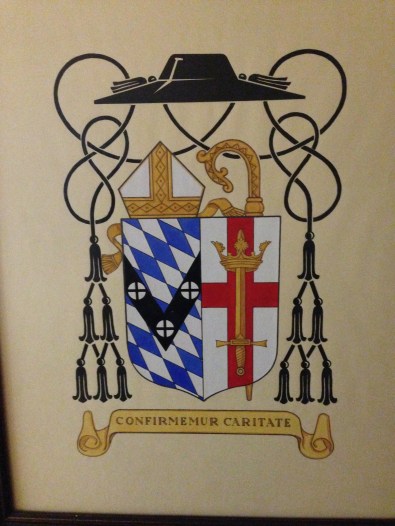
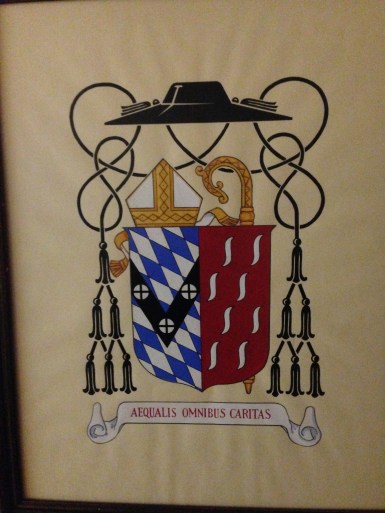
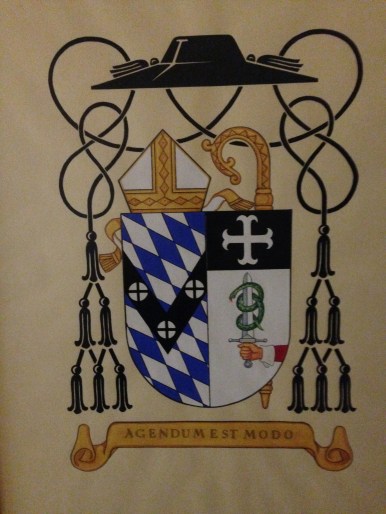
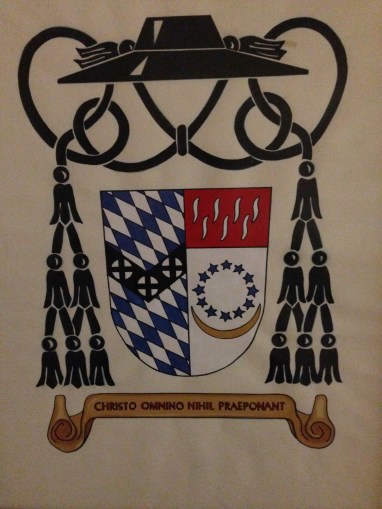
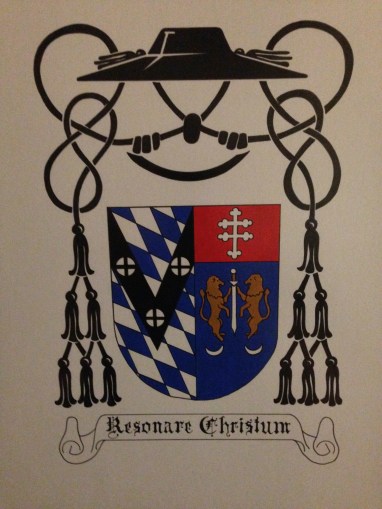
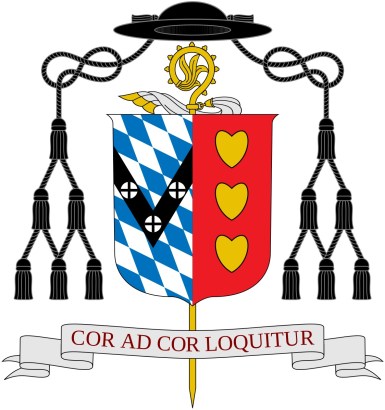
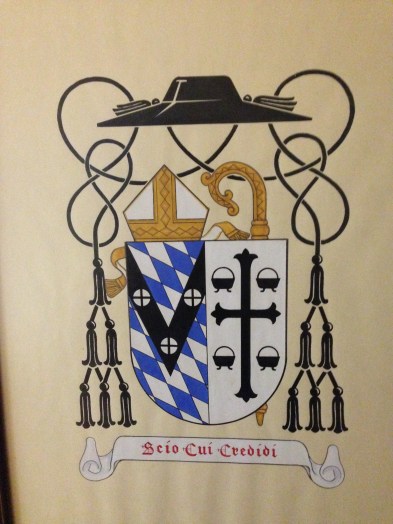
In 1930 with the election of St. Vincent’s fifth Archabbot, Alfred Koch (1930-1949), things changed. At that time the community decided to adopt a corporate coat of arms, which borrowed the blue and white fusils in bend from another Wittelsbach quartering and took the three plates on a black fess from the arms of William Penn, turned the fess into an inverted chevron (to create the letter “V” for “Vincent”) and charged the three plates with Benedictine crosses. Archabbot Alfred impaled this with a personal coat of arms. Thereafter, his successors did likewise.

Image 26

Archabbot Dennis Strittmatter (1949-1963)

Image 33

Coadjutor Archabbot Rembert Weakland (1963-1967) later Abbot-Primate and Archbishop of Milwaukee

Image 31

Archabbot Egbert Donavan (1967-1979)

Image 29

Archabbot Leopold Krul (1979-1983)

Image 37

Archabbot Paul Maher (1983-1990)

Image 35

Archabbot Douglas Nowicki (1991-present)

Image 5

During the tenure of Archabbot Egbert Bl. Paul VI changed the customary rules governing the external ornaments of prelates indicating that the mitre was no longer to be used in coats of arms. In addition, he called for the discontinuation of the crozier in arms of bishops. The crozier used to be included in the achievements of bishops in addition to the episcopal cross. Paul VI indicated in was the cross alone that would continue to be used in the arms of bishops and that the crozier should be excluded. This was interpreted by some, wrongly, to mean the crozier should no longer be used in the arms of abbots as well. However, it is the veiled crozier, not the galero, which indicates the rank of abbot in heraldry. Archabbots Leopold and Paul were advised incorrectly to leave the crozier out of their achievements. It was, however, restored to use in the coat of arms of Archabbot Douglas which was designed by me.

20 Years Armigerous!

On September 27, 1997 I was ordained a priest. This year marks the 20th anniversary not only of my sacerdotal ordination but also of that moment when, being a priest, I assumed a coat of arms. I had been designing, tweaking and modifying a design of my own coat of arms since i first began to settle on a design of my own in 1984. But, the various versions of a coat of arms that I had, which consisted of simply a shield and motto with no other external ornaments, was never really “used” by me. In other words, I hadn’t put it on anything or made any kind of public use of it.

This was for two reasons. First, I knew it was still a work in progress. It would take me from 1984 and that initial, rather poor, design all the way until 1992 until I was truly satisfied with the design of my coat of arms. Second, I didn’t want to adopt the arms with the usual external ornaments of helm, mantling and crest only to exchange them for a priest’s galero when the day came. I preferred to wait until I was entitled to use the galero, so I waited until ordination.

Padre don Guy Selvester

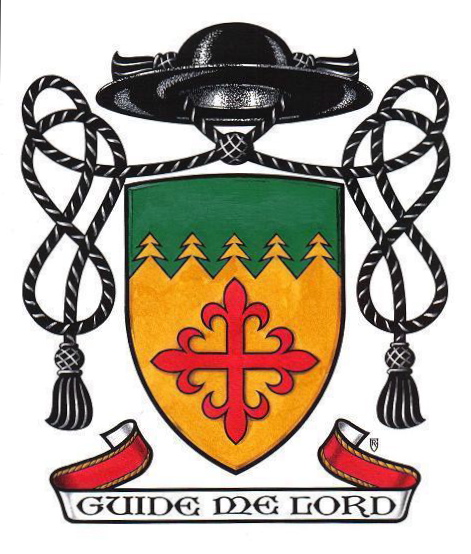
Shortly after my bishop called me in to tell me that my ordination had been decided for certain (8 months earlier than anticipated , as it turns out) I contacted the late Richard Crossett, an American heraldic artist of great talent. He got to work right away in late July, 1997 and I had the finished artwork by late August in plenty of time for my Sept. 27th ordination. His artwork was used for the program cover at my First Mass and I also registered the arms with the American College of Heraldry on whose Board I now happily serve. The blazon is: “Or, a Greek cross fleury Gules; a chief sapiné Vert“.

I always liked Mr. crossest’s interpretation of my coat of arms. I’ve been fortunate to have a couple of dozen renderings of my coat of arms done over the years but I’ve always considered this one to be special. I don’t have an “official” version of my arms since they are assumed, not granted as is perfectly acceptable and is, indeed, the norm in the context of being an American. Nevertheless, this is what I consider to be the closest thing to an official version of my personal arms, primarily because it was the first time I had them rendered by someone other than myself and because it was done in conjunction with my ordination. This coat of arms was one of the ways I marked becoming a priest.

Twenty years later that motto is still my daily prayer: “Guide Me, Lord”.

Heraldry For Parish History

Among the various ways that a parish community can record and mark its history is through the use of heraldry. Many are familiar with the custom of churches having incorporated into the architecture of the building, or in a church building’s decoration, the coat of arms of the reigning pope and the bishop at the time the church was constructed or consecrated. The use of the coats of arms of the pastors who have served the parish can be similarly used.

In a previous assignment where I served as Rector of a Shrine Church I entered into a project to devise what would be considered attributed arms for all of my predecessors so that the tenure of each Rector could be remembered by means of a coat of arms for each displayed in the Rectory Office. I was even able to devise a coat of arms for my successor as well!

I arrived at my current parish assignment as Parish Administrator, a common practice in many dioceses including my own. The idea is to have a new priest serve as Administrator (a temporary appointment) for a time until it is determined if the man is a “good fit” for the parish at which time, usually one year, he would be appointed Pastor with a six-year renewable term. In my case I served as Administrator for two years because as the end of my first year was approaching our bishop resigned and a new bishop arrived who wanted to take some time himself to settle in to the diocese before making any major decisions.

At the time my tenure as Administrator began I devised a coat of arms for the parish community. In June of this year I was appointed Pastor of the parish and my official Installation takes place later this month. To mark this start of a new chapter I decided to undertake a similar project of devising coats of arms for my predecessors to be displayed in a suitable place somewhere in one of the parish buildings.

There have been 23 priests in charge of St. Joseph Church, Washington, New Jersey since its establishment as an independent parish in 1871. Of those 23 one of them, Rev. John Eagan, served here for only 11 months in 1943 as Administrator. In addition, one of the priests, Rev. John Auchter, actually served here for six years but was never an incardinated priest of the Metuchen Diocese. Rather, he was and always remained, a priest of the neighboring diocese of Allentown, Pennsylvania on loan to the Metuchen Diocese. Consequently, he only had the title “Administrator” but was, for all intents and purposes, the Pastor of this parish as much as any of the others. So, while Fr. Eagan is not counted among the Pastors of St. Joseph Fr. Auchter is counted among their number. As a result I find myself now as the 22nd Pastor of St. Joseph.

For the purposes of this project I found it rather daunting to face the prospect of devising 21 attributed coats of arms. Therefore, I decided to try and pare down the list. But, what criteria should I use to do so. I decided to look at the entire history of the parish in stages. At its foundation in 1871, by Bishop James Roosevelt Bayley, the nephew of St. Elizabeth Ann (Bayley) Seton, the parish was part of the then Diocese of Newark which, at that time, covered the entire state of New Jersey. Just ten years later, in 1881, the parish became part of the newly established Diocese of Trenton encompassing eight counties in the central part of New Jersey. A century later St. John Paul II decided to separate the four northern counties of Trenton and erect the Diocese of Metuchen in November of 1981. Once again, the parish of St. Joseph found itself in a new diocese. It was this last separation, becoming part of the diocese in which it currently finds itself, that I decided to use as my dividing line. At least for the time being this project encompasses the coats of arms of the seven Pastors the parish has had since the erection of the Diocese of Metuchen. At some point in the future other coats of arms can be added until all the Pastors are represented.

Creating attributed arms is both a challenge and a lot of fun. All but two of my predecessors are deceased and the living ones could not be easily consulted. In addition, two of the seven who served here since 1981 are non-armigerous because, sadly, they both were convicted of crimes and sentenced to prison. As such, it is not appropriate to devise coats of arms for them and had they been armigerous the privilege of having a coat of arms would have been lost to them.

In each case the attributed arms contains charges that allude to their names or to some other strong association with them. That way, each is somewhat easily associated with the priest it represents. In all cases their personal arms are emblazoned impaled with the arms assumed for the parish itself and the shield is ensigned with a simple priest’s galero. No mottoes were used in the depiction of these achievements.
sc00016f9e

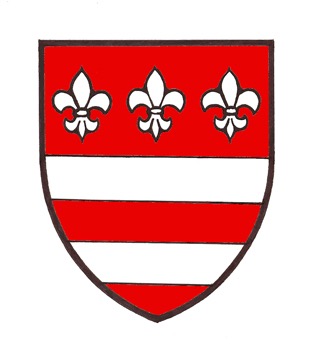
The Arms of St. Joseph Parish, Washington, New Jersey (est. 1871)

The arms are based on those of George Washington for whom the Borough and Township where the parish is located are named. His arms showed two red bars on a silver (white) field with three red stars above. Here the colors have been reversed and the stars changed to three fleurs-de-lis, a symbol of St. Joseph.
Scanned ImageRoos2Good

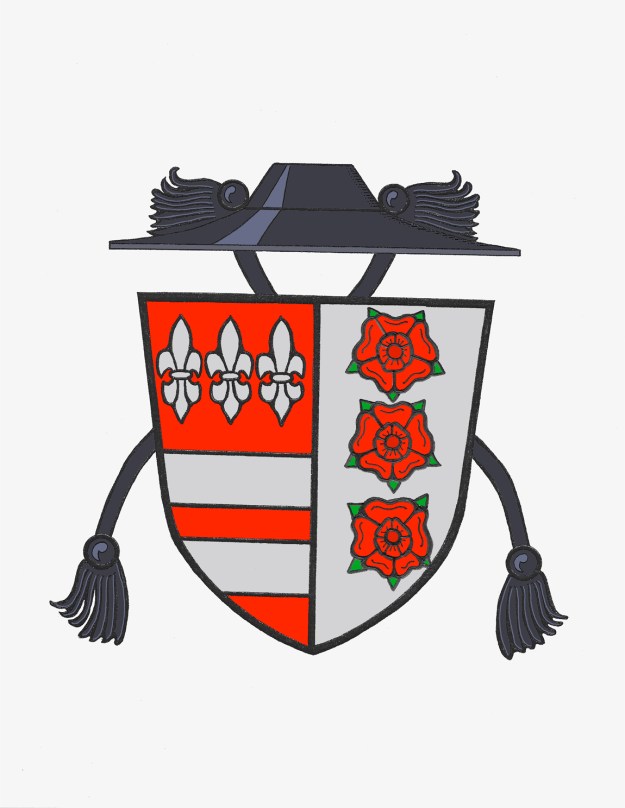
Rev. William Roos 16th Pastor 1979-1983

The name “Roos” alludes to a rose in Dutch, hence the three roses.
Scanned ImageAuchter2Good

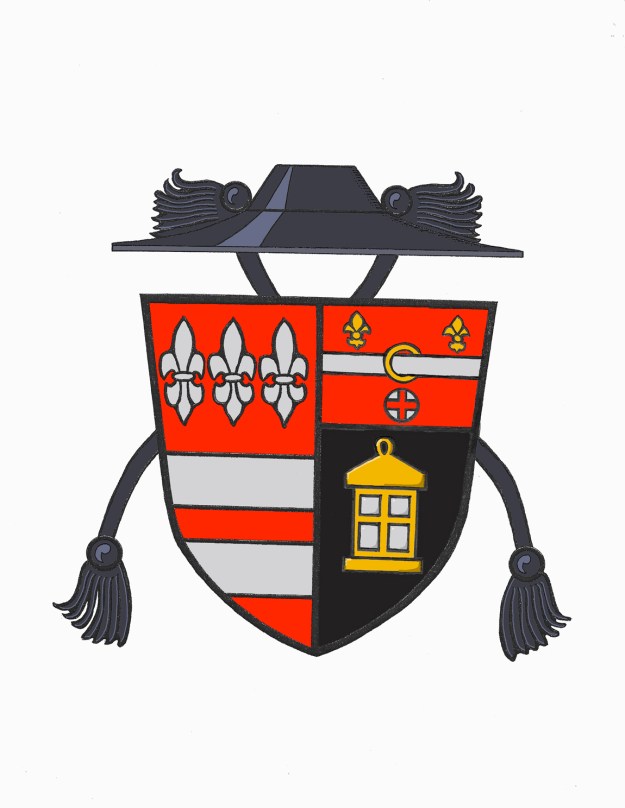
Rev. (later Monsignor) John A. Auchter (Administrator) 1983-1989

The lamp is from a German coat of arms associated with the family name. The chief contains the arms of the Diocese of Allentown, PA of which Fr. Auchter was an incardinated priest. After his time in New Jersey he returned to his own diocese and was later promoted to Prelate of Honor with the title “Rev. Monsignor”. However, when serving here he was still simply a priest.
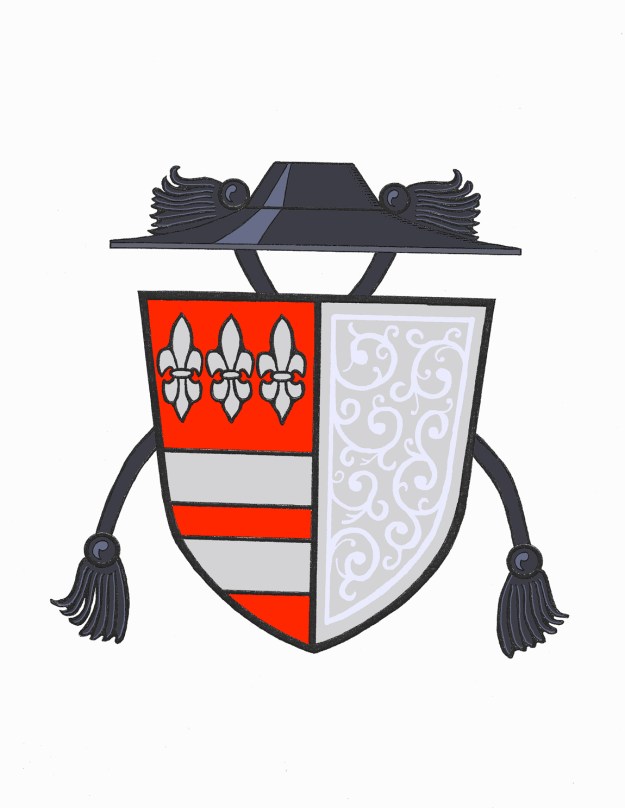
Scanned ImageSantillo3Good

Rev. Michael Santillo 18th Pastor 1989-1992

He does not have a personal coat of arms so the parish arms are impaled with a blank shield. The design on that half of the shield is a technique to fill empty space in heraldry called “diapering” and it is merely decorative.
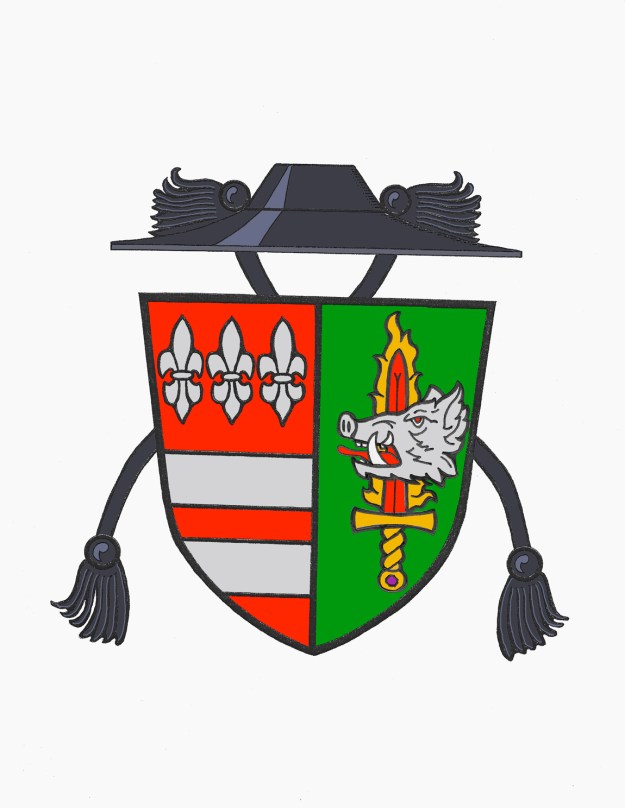
Scanned ImageKochon2Good

Rev. Michael A. Kochon 19th Pastor 1992-1999

Father Kochon’s arms consist of a flaming sword which is symbolic of his patron, St. Michael the Archangel and a wild hog’s head erased. In French the word cochon, similar to his surname Kochon, means pig so his personal arms allude to his given and family names.
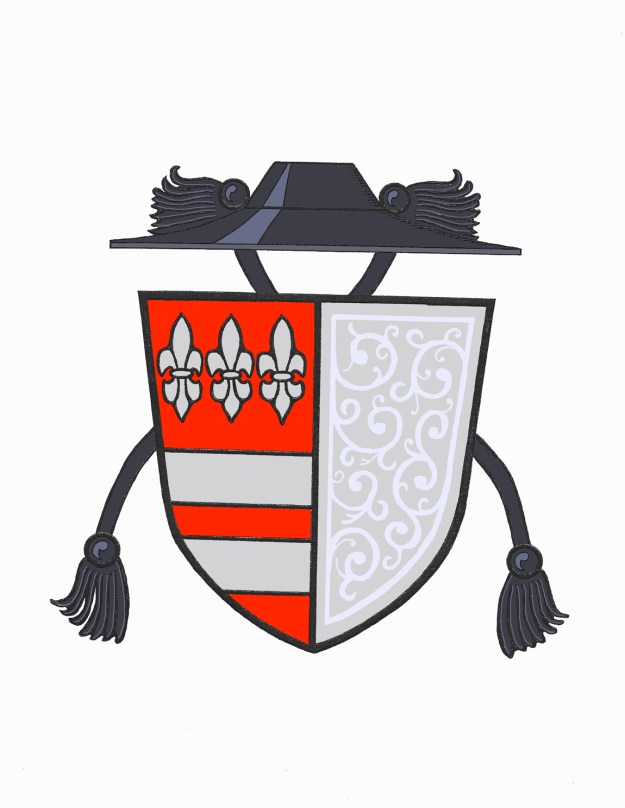
Scanned ImageAscolese3Good

Rev. (later Mr.) Robert J. Ascolese 20th Pastor 1999-2006

He does not have a personal coat of arms so the parish arms are impaled with a blank shield. The design on that half of the shield is a technique to fill empty space in heraldry called “diapering” and it is merely decorative.
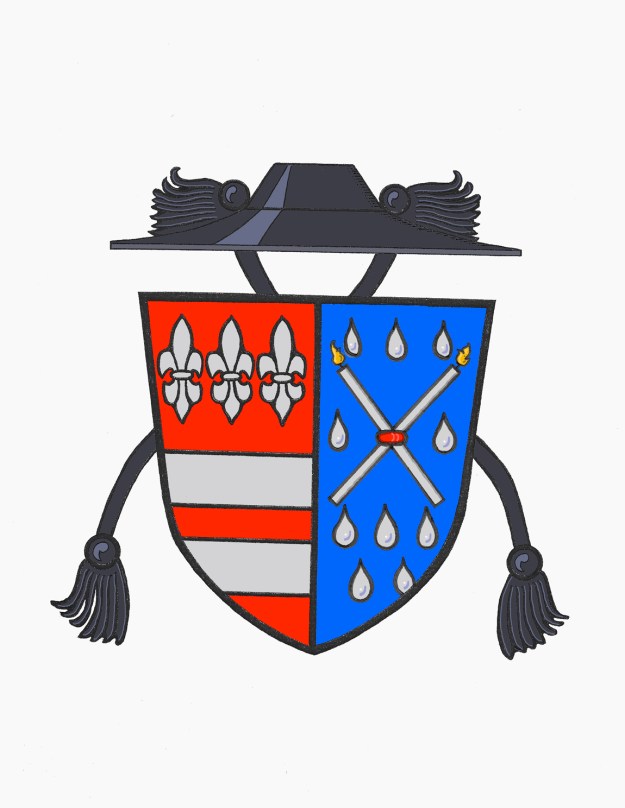
Scanned ImageBaran2Good

Rev. Blaise R. Baran 21st Pastor 2006-2015

Father Baran’s name means “rain” in Persian, hence the raindrops. His patron, St. Blaise, is alluded to by the two candles crossed in saltire which are used to give the Blessing of Throats on the feast day of St. Blaise.
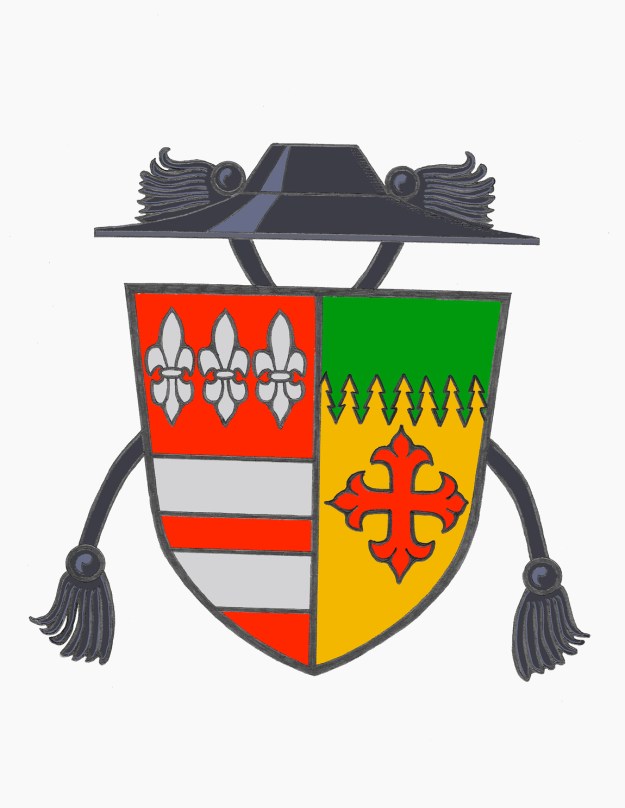
Scanned ImageSelvesterGood

Rev. Guy W. Selvester (Administrator 2015-2017) 22nd Pastor 2017 – 

Readers of this blog should know the symbolism of my arms by now but the division line sapiné (shaped like fir trees) alludes to my family name which was originally Silvestri (later anglicized to Selvester) which means a forest dweller or woodsman. The green and gold (yellow) tinctures are for my Irish ancestry and the cross for the centrality of my faith in my life. It is a cross fleury so that the fleurs-de-lis are references to both the Holy Trinity and Our Lady.
Coat of Arms of a Priest

Tveit2

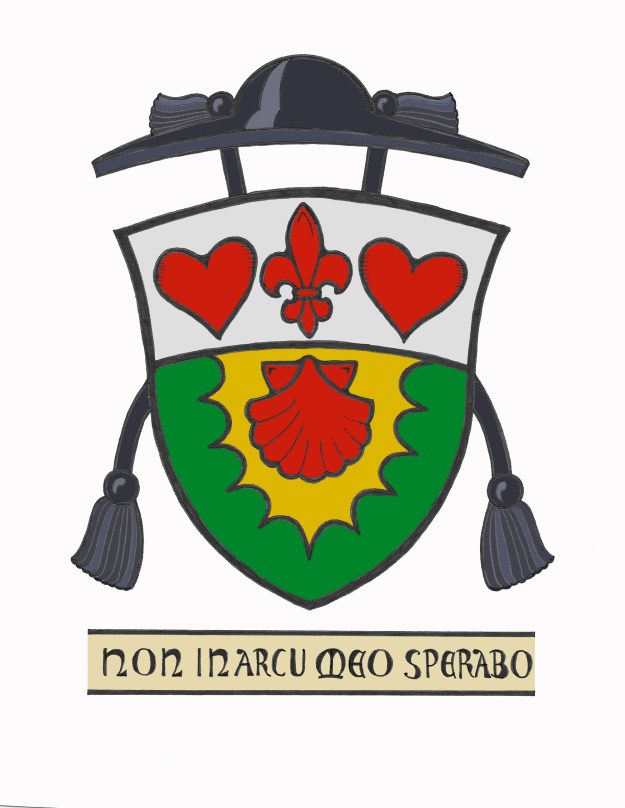
The newly-assumed armorial bearings of the Rev. Jon Tveit of the Archdiocese of New York (above).

The main portion of the shield depicts a gold (yellow) field surrounded by a green border the edge of which is scalloped with convex semicircles. This is done to suggest a clearing in a forested area, the trees represented by the green border and the clearing by the gold field. The armiger’s surname, Tveit, is from the Old Norse that translates to, “a field cleared from a forest” or a person who dwells in such a place. (A similar name in English would be Thwaite). In the middle of this “clearing” is a red scallop shell. This is primarily a symbol of the armiger’s principal baptismal patron, St. John the Baptist. In addition, the shell is a charge in the coat of arms of Benedict XVI, the Pope-Emeritus, whom the armiger greatly admires. It was during the pontificate of Benedict XVI that Fr. Jon came to a deeper understanding of his faith, discerned his priestly vocation and entered the seminary to begin his preparation for priesthood.

The upper third of the shield, called a “chief” is silver (white) and on it are two red hearts with a red fleur-de-lis between them. The colors red and white are taken from the coat of arms of the Archdiocese of New York for which the armiger was ordained and in which he engages in his priestly ministry. In addition, the white background is a color often associated with the virtue of Purity to which the armiger always aspires and tries to cultivate in his own life. He has a great devotion to the Sacred Heart of Jesus and the Immaculate Heart of Mary in his personal devotional life so the hearts symbolize that. The fleur-de-lis has long been used heraldically as a symbol of both Our Lady and her spouse, St. Joseph. Fr. Tveit attended St. Joseph seminary in Dunwoodie, NY.

The only external ornament is the black, broad-brimmed pilgrim hat called a “galero”. In heraldry this is used in place of the traditional helmet, mantling and crest to indicate that the bearer of the coat of arms is a cleric. The color of the hat, the cords and the tassels as well as the number of tassels developed over the centuries to differ depending on the rank of the bearer. A black hat with black cords and one black tassel suspended on either side of the shield indicate the armiger is a priest.

The motto, “Non in Arcu Meo Sperabo” below the shield is taken from Psalm 43:7 and translates to, “For I will not trust in my bow”.

Bishop Dolan

On June 8 the Most Rev. John Patrick Dolan (55), a priest of the Diocese of San Diego, California will be ordained the Titular Bishop of Uchi Maius and the Auxiliary Bishop of San Diego. He contacted me shortly after his appointment and asked me to design a very simple coat of arms for him. The result is:

Dolan5

The blazon and description is as follows:

BLAZON: Or an image of the Sacred Heart Gules; on a chief Azure two crescents Or. The shield is ensigned with an episcopal cross Or in pale behind the shield and surmounted by a galero with cords and six tassels on either side in three rows of one, two and three all Vert. On a scroll below the shield is the motto: “Abide in My Love”.

EXPLANATION: The bishop’s coat of arms, is composed of a shield upon which there are symbolic charges, a motto and the external ornaments of rank. The shield which is the most important feature of any heraldic device is blazoned (i.e. described) in heraldic language from the point of view of the bearer with the shield being held on his arm. For his personal arms Bishop Dolan has adopted a design to reflect his religious devotion, priestly ministry and family. The arms are composed of a gold (yellow) field on which there is a single charge of the Sacred Heart of Jesus depicted wounded, surrounded by a crown of thorns and enflamed all colored red. This reflects the bishop’s devotion to the Sacred Heart which is also symbolic of the mercy of God which he tries to reflect in his priestly ministry. All priests are exhorted to conform themselves more closely to Christ and strive to be shepherds after His own heart. The gold field is borrowed from the coat of arms of the diocese of San Diego to recall the local church he has served as a priest and will continue to serve as a bishop. The chief (upper third of the shield) replicates the blue field and crescents traditionally associated with the arms of Dolan in Irish heraldry. Here the usually silver crescents have been colored gold (yellow) and reduced in number from three to two for differencing. These charges are merely borrowed to act as an allusion to the bishop’s family name.

For his motto, Bishop Dolan has selected the phrase “ABIDE IN MY LOVE”.

HRH The Duke of Edinburgh

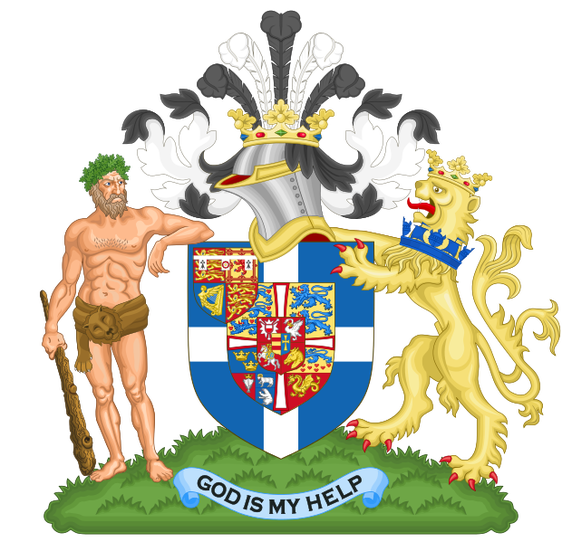
This past week it was announced from Buckingham Palace that HRH the Prince Philip, Duke of Edinburgh would be withdrawing from public engagements due to his advanced age. This led not a few of my friends, the the real kind and the Facebook kind, to write or comment on the Duke’s well-known coat of arms (below).

3585304


In addition, as seems to be the case all the time now, there ensued a discussion about how the coat of arms presently used by HRH, and used by him since 1949, was not the original design.

In 1947 the arms devised for him were these:

9459105

This coat of arms combined the coat of arms of the royal house of Greece, into which Prince Philip was born, those being Greece with an inescutcheon of the royal arms of Denmark because that family, Oldenburg-Glücksburg, was also the royal family of Greece. When the Greek monarchy was established they solicited a Danish prince to become King George I of the Hellenes rather than any Greek citizen. In addition to the Greek royal arms a small inescutcheon of the arms of Princess Alice, a granddaughter of Queen Victoria, was included in dexter chief.

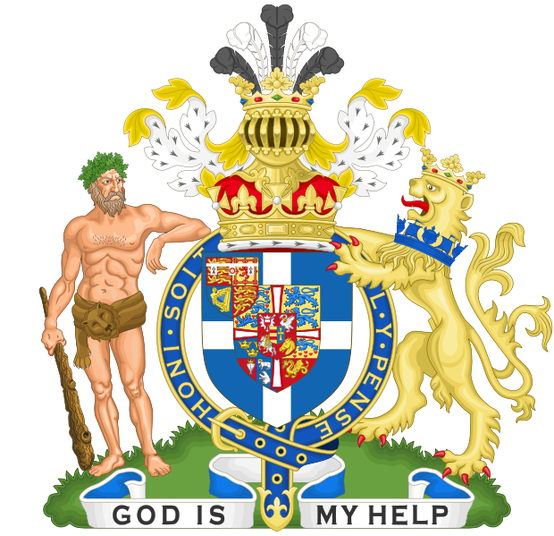
This coat of arms was used by him at the time he married Princess Elizabeth of York and was created Duke of Edinburgh.

9376145

However, in 1949 the College of Arms revised the design of the Duke’s coat of arms as the earlier design was deemed too busy. They came up with the design currently in use which combines quarters for Denmark, Greece, Battenberg (because his mother, Princess Alice, was also a Battenberg, a name later changed to Mountbatten which is the family name used by Prince Philip and assumed by him when he became a naturalized British citizen and renounced any claim to his Greek and Danish titles) and the arms of the city of Edinburgh for his title.

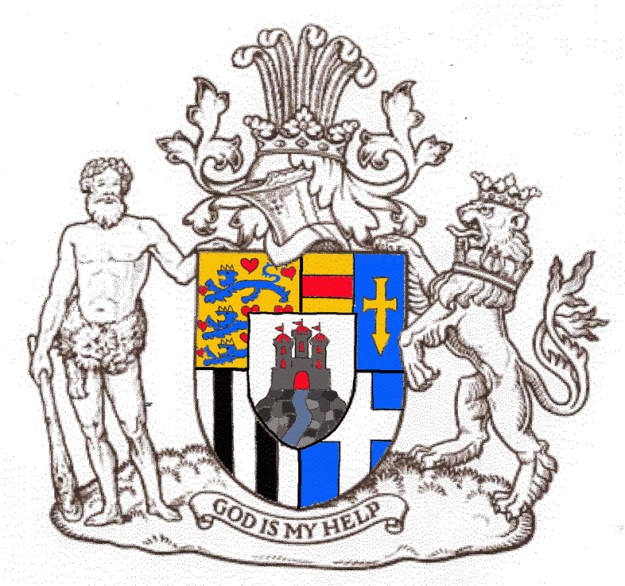
However, just for fun, because this is how heraldists have fun, I drew up a rough little sketch and cut-and-pasted it together with a black and white drawing of the Duke’s original arms to depict something of what I might have proposed for the design of the arms of HRH in 1949 when it was decided to try and simplify the achievement.

DoEc

Here I have combined quarters for Denmark (1) and Greece (4) reflecting that he was born a Prince of Greece with Danish ancestry. There is also a quarter (2) depicting what is usually on the smallest inescutcheon of the Danish royal arms, namely, the dynastic arms of Oldenburg-Glücksburg, the cadet branch of Oldenburg which succeeded to the Danish throne and the paternal family of Prince Philip. I have included a quarter for Battenberg for his maternal family. Finally, the allusion to his title of Edinburgh is placed on an inescutcheon overall. It’s not as simple as the Duke’s current arms but it is still a simplification over the arms he originally bore and it displays connections to the countries of his origin as well as the family arms of both sides of his family while including a mention of his title. It was just a bit of fun.


Bishop-Elect Kenneth Howell

The Rev. Kenneth Howell, 59, a priest of the Archdiocese of Brisbane has been appointed Titular Bishop of Thamugadi and Auxiliary Bishop of Brisbane by Pope Francis. He will be ordained on June 14.

His coat of arms (below), designed by me in collaboration with Mr. Richard d’Apice, AM, KCHS of the Australian Heraldry Society, employs a field borrowed from arms associated with “Howell” and also pick up on the theme of light and darkness in association with the cross of Christ. The escallop shell is a symbol of St. John the Baptist because the bishop-elect was ordained a priest on the eve of the Nativity of St. John.

The motto translates to, “Prepare the Way For Him”. The arms were rendered by Mr. Sandy Turnbull, also of the Australian Heraldry Society.

unnamed


Bishop Timothy Harris

On May 3, the Feast of Ss. Philip & James, the Most Rev. Timothy Harris (54), a priest of the Archdiocese of Brisbane, was ordained a bishop in the Church and installed as the 6th Bishop of Townsville, Australia.

His personal arms, impaled with those of the diocese, make allusions to his family name (the crescent), his baptismal patron (the plates representing stones as a symbol of St. Timothy) and Pope Francis who appointed him a bishop and whose emphasis on mercy the bishop wishes to incorporate into his own ministry (the sprig of spikenard).

His arms were designed by me in close collaboration with Mr. Richard d’Apice, AM, KCHS and rendered by Mr. Sandy Turnbull, both members of the Australian Heraldry Society.

HarrisTownsville

Bishop Gregory Homeming, OCD

On February 22, the Feast of the Chair of St. Peter, the Most Rev. Gregory Homeming, of the Order of Discalced Carmelites (58) was ordained a bishop in the Church and installed as the 6th Bishop of Lismore, Australia.

His arms (below) reflect his membership in the Carmelite Order as also employ a symbol of St. Gregory the Great, a crane in its vigilance.

The bishop’s personal coat of arms were designed by me in collaboration with Mr. Richard d’Apice, AM, KCHS and rendered by Mr. Sandy Turnbull, both members of the Australian Heraldry Society.

unnamed (1)

Cathedral Dean

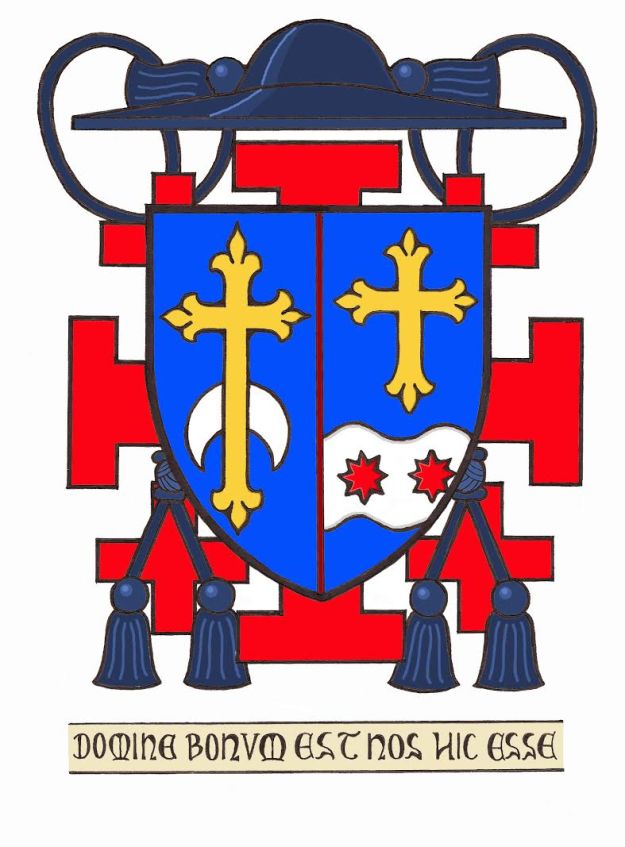
Here is the coat of arms of the Very Rev. Fr. Donald Richardson, BTh, STB, MA, KCHS who is presently the Dean of the Cathedral and Basilican Church of the Immaculate Mother of God, Help of Christians  more commonly known as St. Mary’s Cathedral in Sydney, Australia. He has long been armigerous being a heraldry enthusiast himself and the cathedral church has made use of a corporate coat of arms different from that of the Archdiocese for a long time. When he was appointed Dean I told him I would prepare a nice emblazonment with his own arms impaled with the cathedral arms.

dr

Because his personal arms are so similar to the arms of the cathedral I chose to use a line of separation in a color other than black since black wouldn’t provide a clear enough separation. There’s nothing wrong with this. many other artists and authors have advocated it as well. (See: Carl Alexander Vov Volborth’s works, Heraldry: Customs, Rules and Styles and The Art of Heraldry)

In addition, while Fr. Richardson does not possess a Roman Honor his arms are ensigned with the galero used for what is collectively known as “Minor Officials” which would include cathedral deans and/or rectors, rectors of shrine churches or seminaries, basilica rectors, Vicars Forane, Religious Superiors, etc. This galero has two tassels pendant on either side of the shield and they may be shown hanging one below the other or, as here, side by side from a median knot. Father will bear these arms “pro hac vice”, that is to say, during his tenure as Dean of the Cathedral only.

The cross of Jerusalem is included in the achievement to note that he is a Knight Commander in the Equestrian Order of the Holy Sepulchre. The motto means, “Lord, It Is Good For Us to Be Here” (Matt. 17:4)

An American in Poland

lynam3

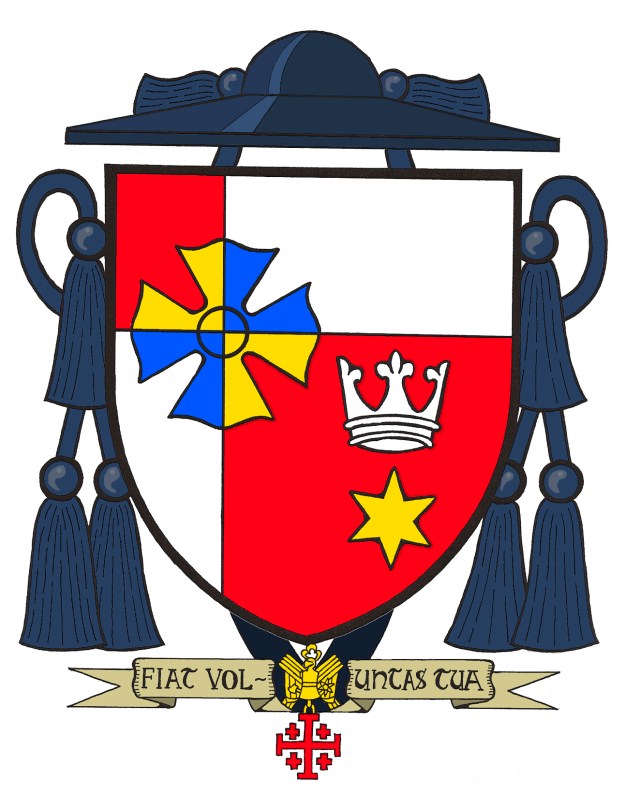
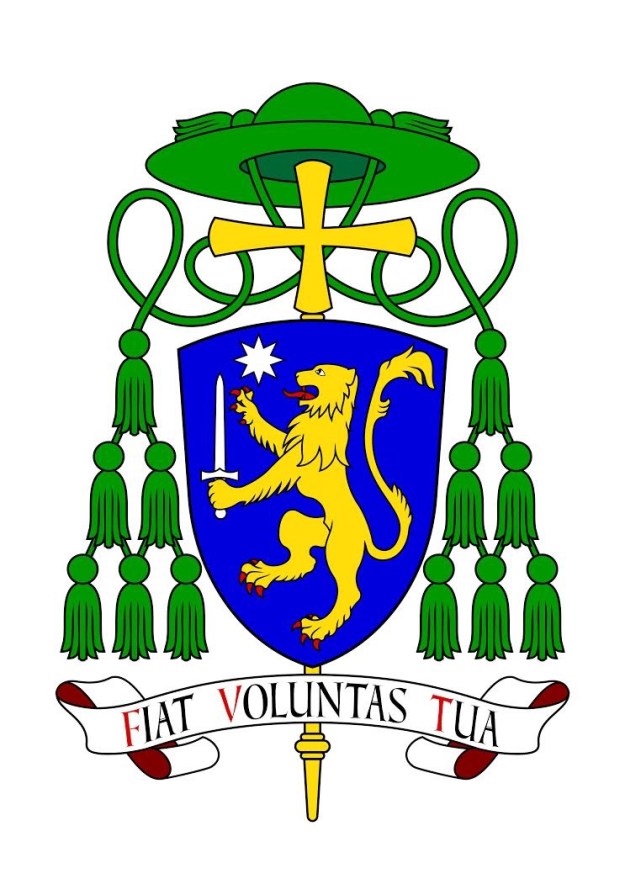
The arms (above) I recently devised for an American priest who lives and works in the USA but who, in addition to his pastoral responsibilities at home, was honored by being named an Honorary Canon of the Collegiate Chapter of the Basilica of St. Florian in Krakow.

The arms are:

Quarterly skewed to the dexter Gules and Argent; at the cross point a cross of St. Florian counterchanged Or and Azure; in sinister base above a mullet of six points Or an open crown Argent. Suspended below the shield is the badge of the Equestrian Order of the Holy Sepulcher. The shield is ensigned by the galero of a Canon Sable with cords and six tassels in two rows of one and two respectively Sable. On a scroll below the shield is the motto, “Fiat Voluntas Tua” (Let it Be Done According to Your Will).

The principal colors of the field are the Polish national colors and the division of the field alludes to the off-center cross found in the arms of St. John Paul II (who raised St. Florian Church, his own first priestly assignment, to the rank of a basilica). the cross associated with St. Florian himself is superimposed over the cross point and is colored in blue and gold counterchanged to avoid the tincture violations. These colors are also found in the arms of St. John Paul II.

In the lower right there is a six pointed star to symbolize Our Lady and it is crowned with an open crown alluding to Mary’s Queenship, the patroness of the armiger’s home diocese.

The black galero  with black cords and six black tassels indicates the bearer is a cleric with the rank of Canon, in this case, a Collegiate Canon. Being a Knight of the Holy Sepulcher he also chose to display the badge of that Order pendant below the shield from a black ribbon.

Monsignor Francis Kelly, P.A., K.H.S.

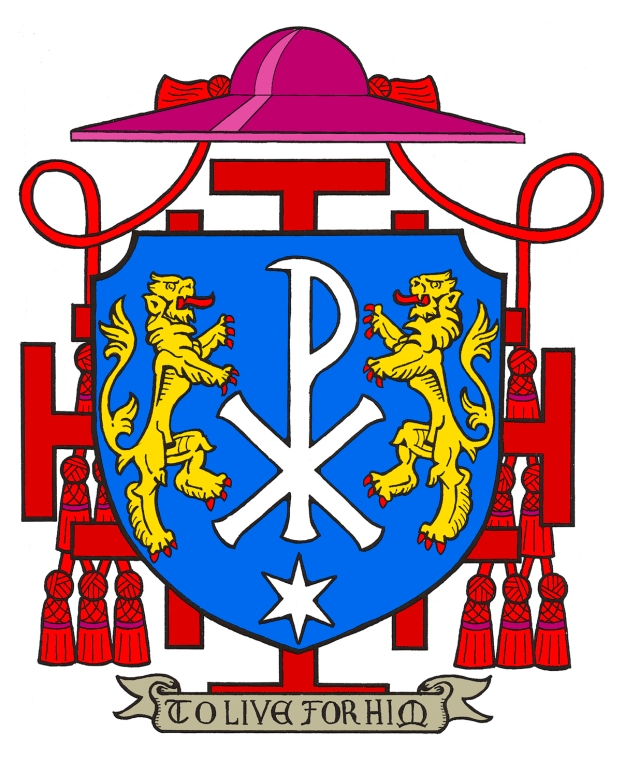
kelly3

The arms (above) I recently completed for Monsignor Francis Kelly, PA a Canon of St. Peter’s Basilica in Rome. Msgr. Kelly is a priest of the Diocese of Worcester, Massachusetts who, prior to his current service worked for many years in Washington, DC for the NCEA and was also on the faculty and later became rector of Pope St. John XXIII National Seminary in Weston, Massachusetts. After his time there he spect eight years as the Superior at the Casa Santa Maria in Rome which is the graduate division of the Pontifical North American College. In 2013 he was named Prothonotary Apostolic and a Canon of St. Peter’s Basilica by Pope Benedict XVI. I met Msgr. Kelly in 1996 when I was sent for one year of studies at Pope John Seminary. We have been friends since then.

The blazon is:

Azure, between two lions rampant respectant Or, armed and langued Gules the Greek letters Chi and Rho Argent; in base a star of six points Argent. The shield is placed on the cross of the Equestrian Order of the Holy Sepulchre and is ensigned by the galero of a Prothonotary Apostolic Purpure with cords and twelve tassels disposed in three rows of one, two and three pendant on either side of the shield Gules. On a scroll below the shield is the motto: “To Live For Him”.

The blue field and gold lions are taken from the coat of arms traditionally associated with the name “Kelly”. In that coat of arms the lions are chained and they face a tower. For differencing the chains have been omitted and the tower has been replaced with the Greek letters that are a monogram for the name Christ and a star of six points. These indicate the armiger’s devotion to Christ and Our Lady.
The armiger is a Knight of the Order of the Holy Sepulcher and its cross is placed behind the shield. The purple galero with red cords and tassels indicates a Roman prelate with the rank of Prothonotary Apostolic, the highest of the three grades of prelates addressed as “Monsignor”. The members of the Chapter of the Papal Basilica of the Vatican hold this rank.

The motto expresses a sentiment the armiger has endeavored to embody throughout his entire priesthood.

Sacerdotal Coat of Arms

skoblow3

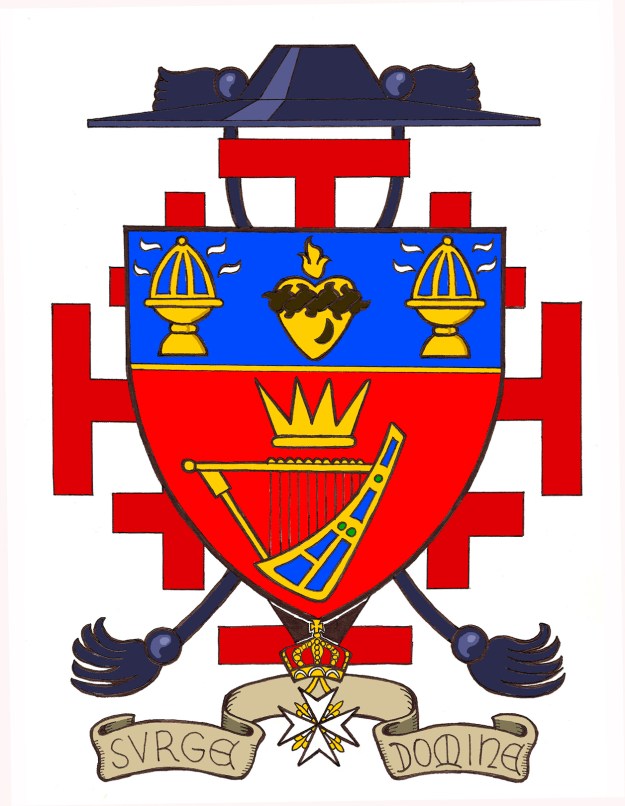
The coat of arms recently completed for a very patient priest in the USA who was ordained in May of 2015. The blazon is:

Gules, an ancient harp below an ancient crown all Or; on a chief Azure fimbriated Or between two thuribles Or with two wisps of smoke rising on either side Argent, the Sacred Heart of Jesus Or, enflamed Or wounded and enfiled by a crown of thorns Sable. The shield is displayed on the cross of the EOHS and suspended below the shield is a badge of a Chaplain of Magistral Grace of the SMOM. Ensigning the shield is a priest’s galero with cords and two tassels pendant on either side all Sable. On a scroll below the shield is the motto, “Surge Domine“.

The field is composed of two colors: a red field with a blue chief so the chief is separated from the field by a gold (yellow) fimbriation to avoid violating the tincture “rule” (which, as Heim proved in his book, Or and Argent isn’t so much a rule as a custom).

The principal charge, a crowned ancient harp, alludes to the patron of the bearer, David, the King who by tradition is considered the composer of many of the Psalms. The charges on the chief allude to the bearer’s devotion to the Most Sacred Heart of Jesus and the sacred liturgy. The two thuribles with smoke rising from them represent the liturgy itself. There are references in both Scripture and Tradition of the rising incense being like our prayers in worship ascending to the Lord. In addition, incense represents a sacrificial offering such as one finds in the Holy Sacrifice of the Mass.

The shield is ensigned with a black priest’s galero. In addition, the shield is placed on the cross of the Equestrian Order of the Holy Sepulcher in which the bearer received the rank of Knight Grand Cross prior to his ordination. The badge of the Sovereign Military and Hospitaller Order of St. John of Jerusalem, Rhodes and Malta is suspended below the shield as the bearer was a Knight in that order prior to ordination as well. Upon being ordained a priest the armiger was “translated” from being a lay knight to being a Chaplain of Magistral Grace.

On a scroll below the shield is the motto, “Surge Domine”.

Coat of Arms for a Priest

strouse4

The arms (above) were recently designed and emblazoned by me for an American priest who is also a member of the Equestrian Order of the Holy Sepulchre.

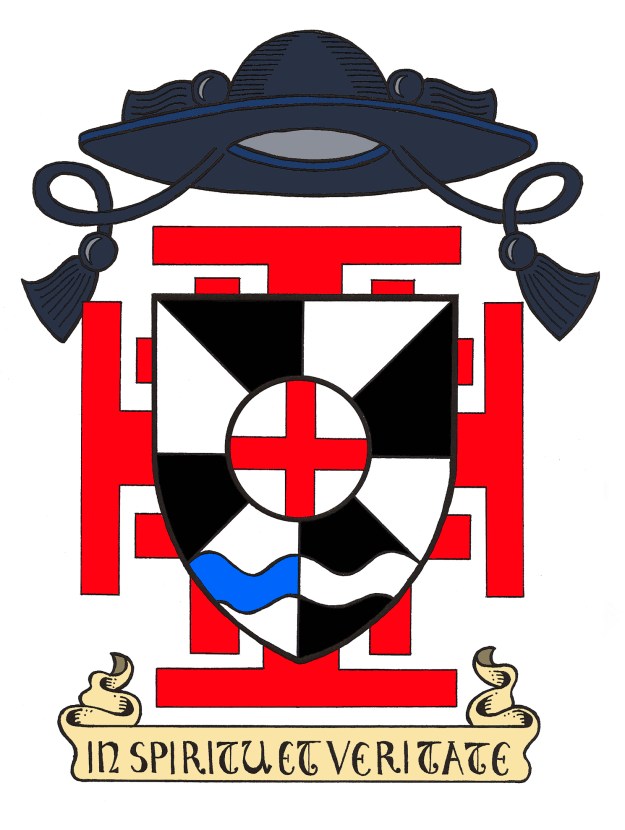
The priest has a devotion to St. Anthony, his baptismal patron, and is a Third Order Dominican. The gyronny of eight that makes up the field is taken from the arms of the Order of Preachers. In addition, the black and white recalls the arms of the city of Lisbon where St. Anthony was born. The plate charged with a red cross at the center alludes to the arms of the city of Padua, where St. Anthony died and is buried. In addition, this charge represents the sacred Host used at Mass because the armiger has advanced studies in the sacred liturgy. Finally, the counterchanged wavy bar in base alludes to three things: the lake at Mundelein where the liturgical studies were undertaken at the Liturgical Institute there; his home state, Michigan, which is situated in the Great Lakes; a charge in the arms of the diocese in which he serves.

The shield is ensigned with the motto meaning “In Spirit and in Truth”, the priest’s galero and the cross of the Equestrian Order of the Holy Sepulchre.

Bishop Rodríguez

Today, November 4, in Denver, CO the Most Rev. Jorge Humberto Rodríguez-Novelo is to be ordained Titular Bishop of Azura and Auxiliary Bishop of Denver.

His coat of arms was designed by the Vicar General of the Archdiocese. However, early on in the process, very shortly after the bishop’s appointment was announced, the director of the Office of Worship of the Archdiocese contacted me to ask if I might be willing to act as a consultant during the design phase of the project which I was happy to do. In fact, I explained, this is really and truly the area of heraldry where I am most at home. I am far from a great artist but my real expertise is in the designing of a good coat of arms. I can tell you all the “whys and wherefores” about what goes into a good design. Once again, we see that heraldry is both an art and a science. It is not primarily the realm of the heraldic artist. Rather, first and foremost the whole thing must start with someone who is knowledgeable about the rules, customs and history of heraldry as well as have a good eye for composition, balance and proportion. I am far more at ease with the work of the herald than that of the heraldic artist.

Since its beginnings, and right down to our own day, the work of heralds has involved the devising, granting and recording of coats of arms. However, it has also included expertise in genealogy and family history, protocol and ceremony. In addition, it is rare that the herald actually renders the artistic depictions of the arms he designs. That task is left to those with expertise in drafting and art who are usually contracted independently by the herald or by the armiger to create beautiful emblazonments.

I have always been one of those who comes down firmly in this debate on the side of the herald, not the artist, as the person who does the “real work” of heraldry. This is not to disparage heraldic artist, whose work is not only painstaking and highly detailed but requires tremendous skill as well as training. But, the simple truth is that one can still paint a coat of arms while at the same time knowing absolutely nothing about the science of heraldry whereas one cannot claim to be competent at designing a coat of arms simply because one can paint or draw well. The heraldic world is best served when both act together in tandem to produce beautiful and correct heraldry.

Over the last thirty-three years my focus has been on learning as much as I can about the science of heraldry and only dabbling as an amateur in producing heraldic artwork. I do not now, nor have I ever, claimed otherwise. So, when a person contacts me to ask me to paint their coat of arms I usually balk but when they ask me to consult on a design I’m right in my comfort zone, as well as my “competency zone”.

In the case of the coat of arms of Bishop Rodríguez there were several elements of his life and ministry he wished to represent in his coat of arms. In Denver they came up with an initial design, very much a work in progress and then asked for my in put. The bishop wanted to represent Christ the King, priestly ministry, the local church in Colorado and Our Lady of Guadalupe. This is the first draft:

rod1

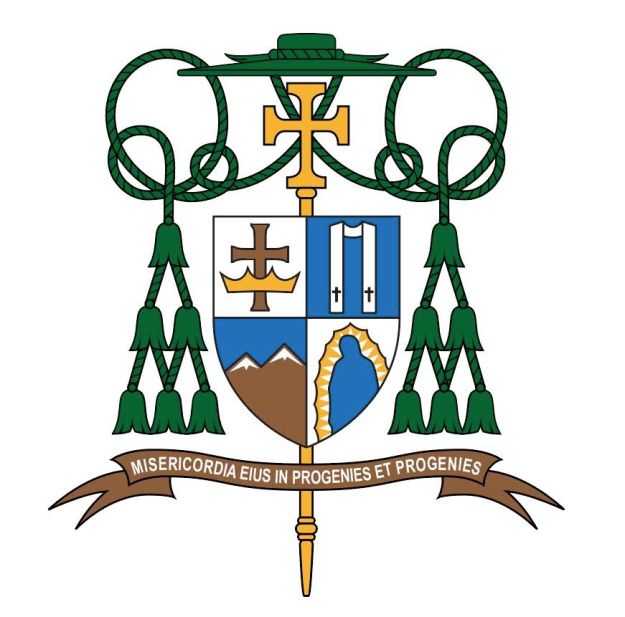
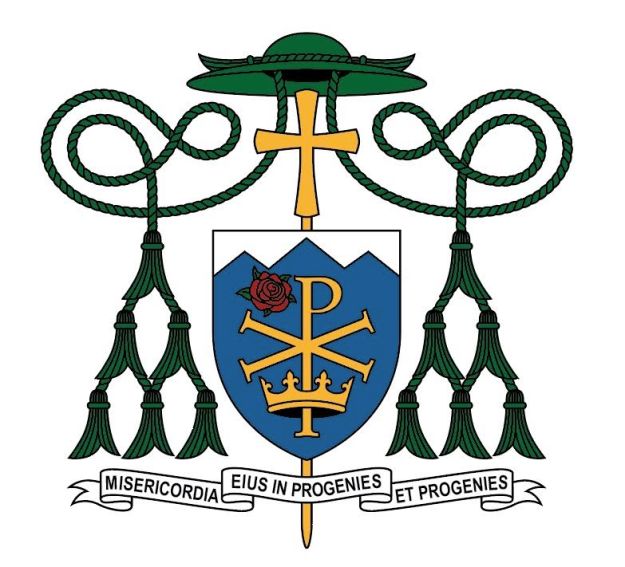
After some discussion back and forth I made several proposals that sought to unify the imagery and create a single, more simple, more bold design. The first thing to be avoided was falling into the trap of quartering the field and then filling each quarter with things. It was also important to avoid the use of the color brown as this is not one of the tinctures used in heraldry. Since the symbol for Christ the King occupied the first quarter and was, in a sense, the principal element to be represented we first moved to create a large compound charge of the crowned Chi-Rho. This, then alludes to Christ, the King as well as to priestly service as all priests share in the High Priesthood of Jesus. Then it was a simple matter to allude to the Rocky Mountains of Colorado by a division line in the field and to add the rose as a fitting heraldic charge that is frequently used as a reference not only to Our Lady in general but to Guadalupe in particular. This is because of the roses that bloomed in December which were brought by Juan Diego to his bishop who asked for “proof” of the apparitions. I originally proposed placing the red rose on the silver chief or changing it to a golden rose. However, the bishop really wanted the rose depicted in the traditional red so we cheated a little on the tincture rule (avoiding a color on a color or a metal on a metal) by blazoning the rose as “Proper” which does permit such violations in the case of charges that are depicted Proper. After some of my suggestions were considered a second draft was prepared in Denver which also changed the general shape of the episcopal cross behind the shield and the galero and tassels in order to give the whole achievement a look that was unique. This draft met with the new bishop’s approval. So, the arms he has assumed today are:

rod2

These arms were designed and emblazoned by Fr. Randy Dollins with me acting as design consultant.


Abbot Elias Lorenzo, OSB

The delegates to the general chapter of the American-Cassinese Congregation, from June 19-24, 2016 elected Father Elias Lorenzo OSB, monk of St. Mary’s Abbey, Morristown, NJ as their new Abbot-President (Abbot-Praeses). For seven years Abbot President Elias had been Prior at Collegio Sant’Anselmo, Rome. Thursday, June 23, 2016, the Rt. Rev. Douglas R. Nowicki OSB, Archabbot of St. Vincent Archabbey, Latrobe, PA, motherhouse of the congregation, conferred the abbatial blessing during the chapter. Abbot Elias returned to Sant’Anselmo for the Congress of Abbots, September 2016 and thereafter he will reside in Morristown.

elias3m


Shortly after his election, Abbot Elias contacted me to ask that I assist him in designing his coat of arms. The explanation I also provided for him is:

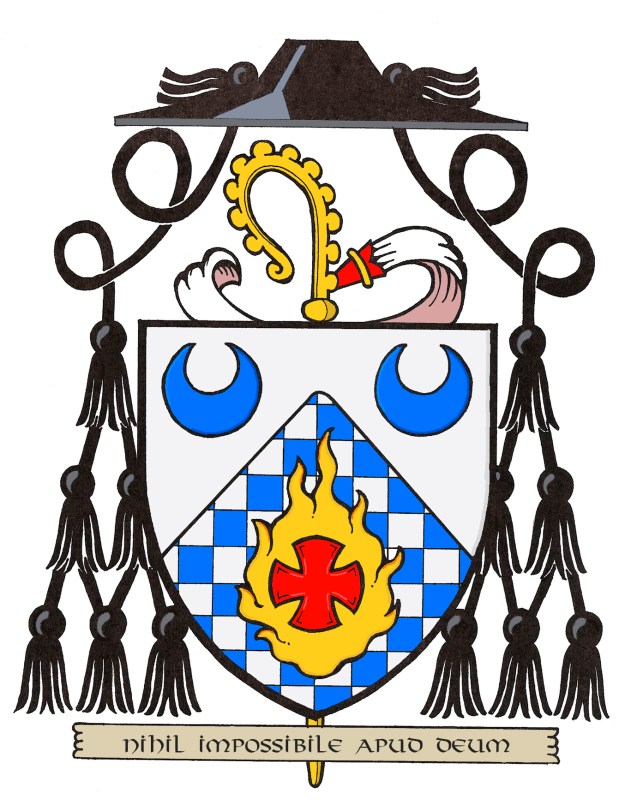
The shield is divided by a line shaped like a chevron. This creates the general shape alluding to a mountain, in this case Mount Carmel, the mountain associated with the prophet Elijah from whom the name Elias is derived. The large tongue of fire in the center of the lower portion of the shield (referred to as “in base”) combined with the mountain allude to St. Elias.

In addition, the blue and silver (white) checked pattern also has a multi-layered meaning. The American-Cassinese Congregation was founded by Benedictines from St. Michael’s Abbey in Bavaria. The motherhouse of the Congregation, St. Vincent Archabbey in Pennsylvania, makes use of the blue and silver fusils (a kind of elongated diamond pattern) from the coat of arms of Bavaria in its own coat of arms. Several other monasteries in the Congregation which are daughter houses or grand-daughter houses of St. Vincent also make use of this pattern. One such abbey is St. Mary’s in Morristown, New Jersey. At this monastery Abbot Elias entered monastic life, made his profession of vows and was ordained. In his coat of arms the blue and silver (white) fusils have been turned sideways forming a grid of blue and white squares or checks. The grid pattern suggests the gridiron on which St. Lawrence was roasted alive as the means of his martyrdom. This is an allusion to the Abbot’s surname, “Lorenzo” which in Italian means “Lawrence”. The grid of blue and white squares combined with the fire represents St. Lawrence while at the same time the blue and white squares are a slightly differenced reference to the coat of arms of St. Mary’s Abbey as well as Bavaria in general as the homeland of the Congregation’s founders.

At the center of the flame there is a red rounded cross. This cross is taken from the coat of arms of Sant’Anselmo in Rome where, for seven years before his election as Abbot-President, the armiger was serving as Prior of the monastic community.

Above the chevron in the upper portion of the shield (referred to as “in chief”) there are two blue crescents. The crescent has long been associated with Our Lady in particular under her title of the Immaculate Conception. That title is also the one by which Mary is the Patroness of the United States of America. While the Congregation is made up of American monasteries as well as some communities outside the U.S. it was, nevertheless, founded in the U.S. so the reference to the patroness of that country is fitting. In addition, crescents appear in the coat of arms of St. Mary’s Abbey and the coat of arms of the Delbarton School, the Abbey’s principal apostolate, both of with which Abbot Elias is closely associated.

The motto below the shield is taken from Luke 1:37 and is translated as, “Nothing is impossible with God”.

The shield is also ensigned with those external ornaments that indicate the bearer is an abbot. The gold (yellow) crozier is placed vertically behind and extending above and below the shield. Attached to the crozier is a veil or sudarium. Widely used in the Middle Ages it is rarely seen in actual use today. It dates from a time when abbots were already making use of the crozier as a sign of their authority but had not been granted the privilege of full pontificals which would have included liturgical gloves. The purpose of the sudarium was originally practical; it shielded the metal of the crozier from dirt and perspiration from the hands. Later, it became merely symbolic and has been retained in heraldry as distinguishing the crozier of an abbot. The use of pontificals by an abbot is regulated in the Motu Proprio, “Pontificalia Insignia” of June 21, 1968 (Acta Apostolicae Sedis 60 (1968) 374-377 Not 4 (1968) 224-226). Because abbots make use of the crozier they may use it as an external ornament in their coats of arms. The prohibition against the use of croziers in heraldry found in the Instruction of the Secretariat of State of the Holy See, “Ut Sive” of 31 March, 1969 (Acta Apostolicae Sedis 61 (1969) 334-40) does not apply to abbatial heraldry. Above the shield is the ecclesiastical hat, called a galero which, in heraldry, replaces the martial helmet, mantling and crest. The galero is black with black cords pendant from it and twelve black tassels arranged in a pyramid shape on either side of the shield. “The hat with six pendant tassels (green, purple or black) on each side is universally considered in heraldry as the sign of prelacy. It, therefore, pertains to all who are actually prelates…Prelates who are regulars do not, as a rule, wear purple. (Abbots’) ceremonial garb is normally black and, in consequence, their heraldic hats are also black.” (Heim, Bruno B., Heraldry in the Catholic Church, 1978, page 114).

Two New Auxiliaries for Sydney

On August 24 two new auxiliary bishops to the archbishop of Sydney will be ordained. I had a hand in designing both of their coats of arms along with Mr. Richard d’Apice and they were rendered by Mr. Sandy Turnbull. Both of these men are members of the Australian Heraldry Society. The two bishop are The Most Rev. Anthony Randazzo (49) a Sydneysider who is a priest of the Archdiocese of Brisbane. He will be Titular Bishop of Quiza. (arms below)

unnamed

And the Most Rev. Richard Umbers (45) born in New Zealand, a priest of the Personal Prelature Opus Dei who will be Titular Bishop of Thala. (arms below)

unnamed (1)