A Philly Trifecta

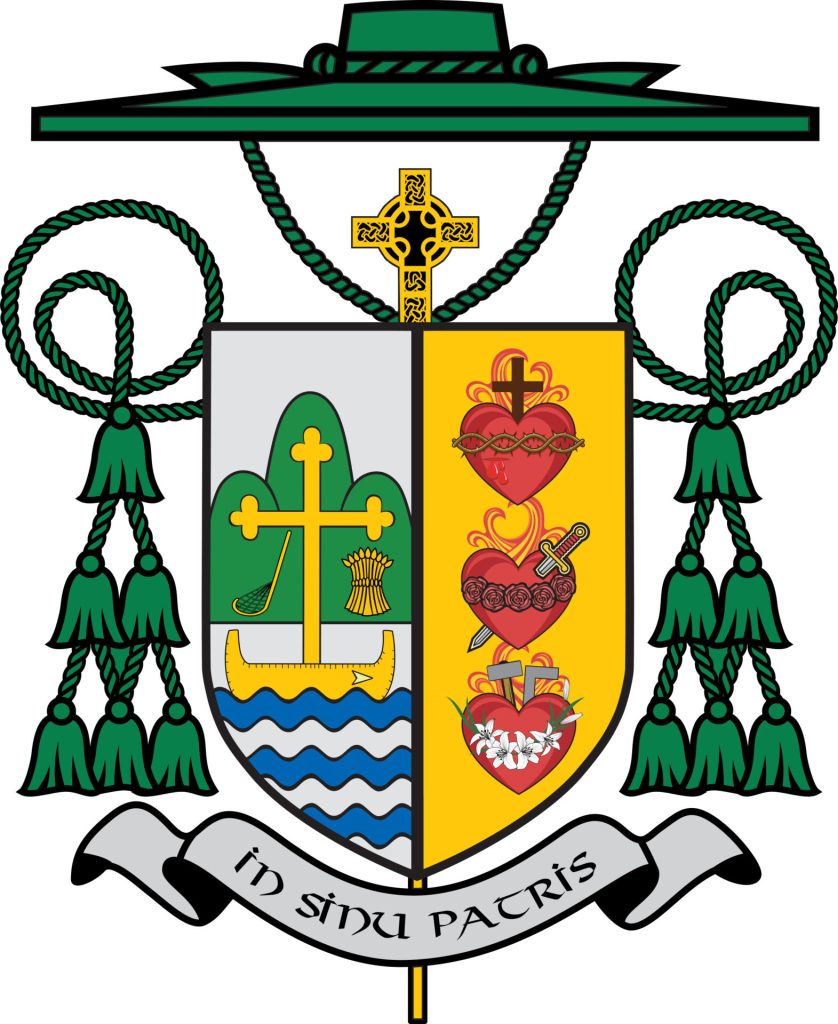
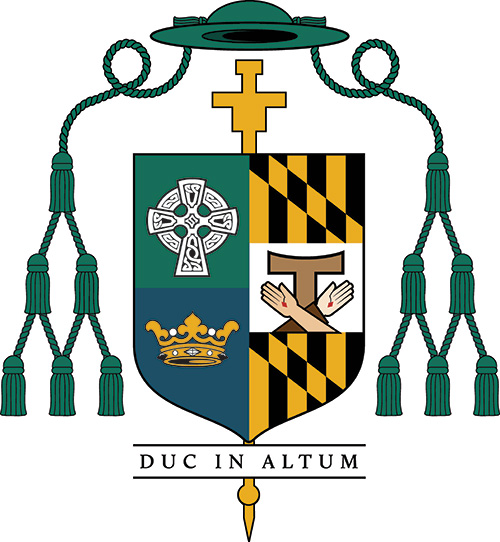
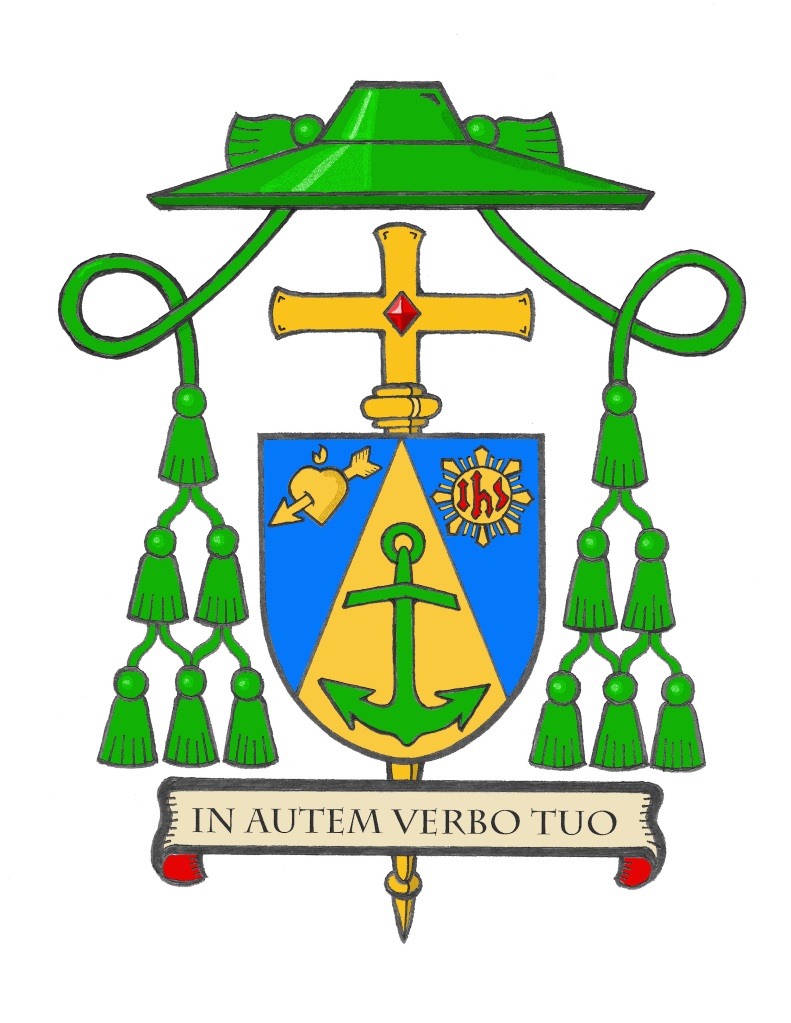
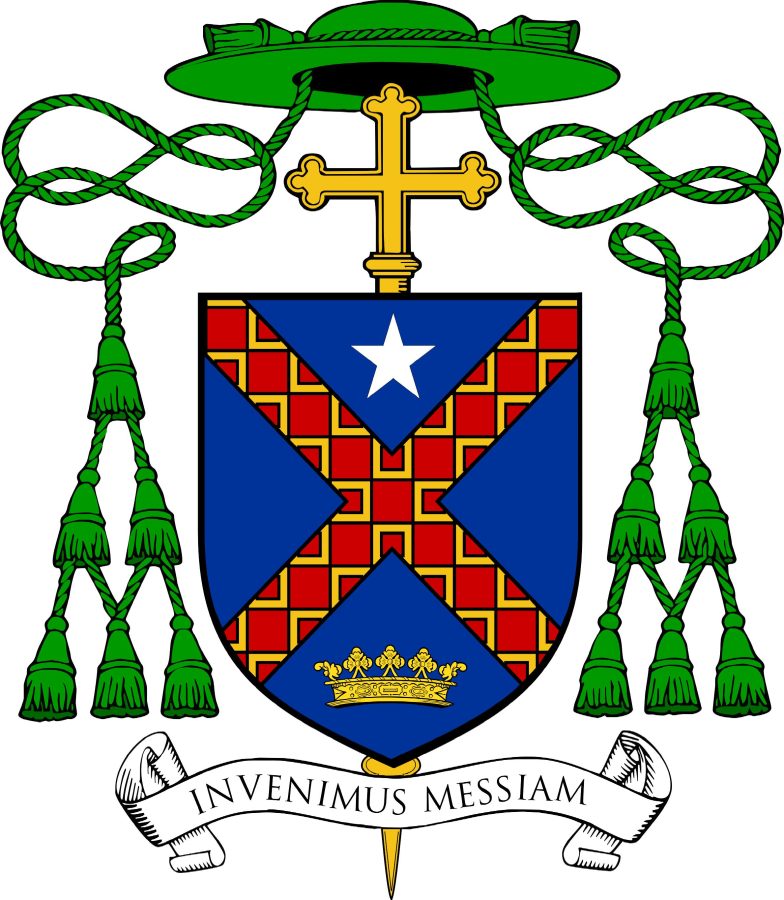
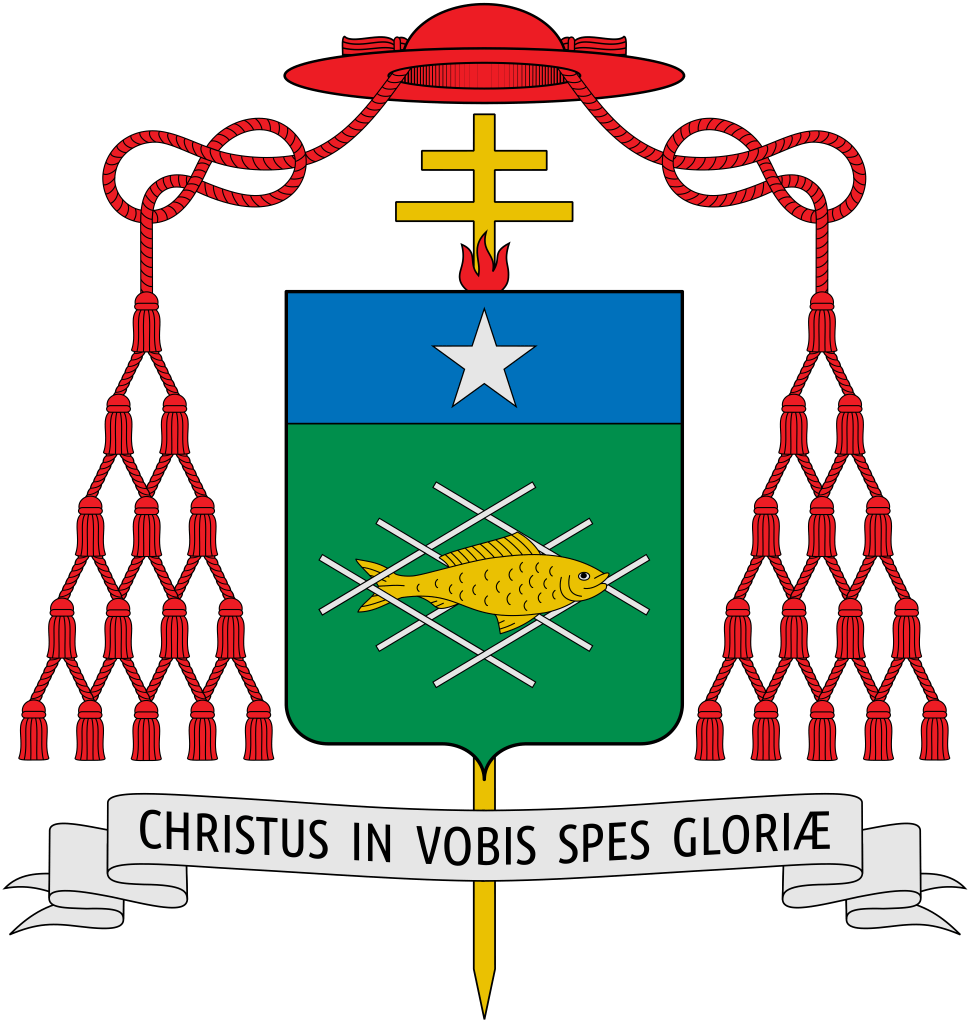
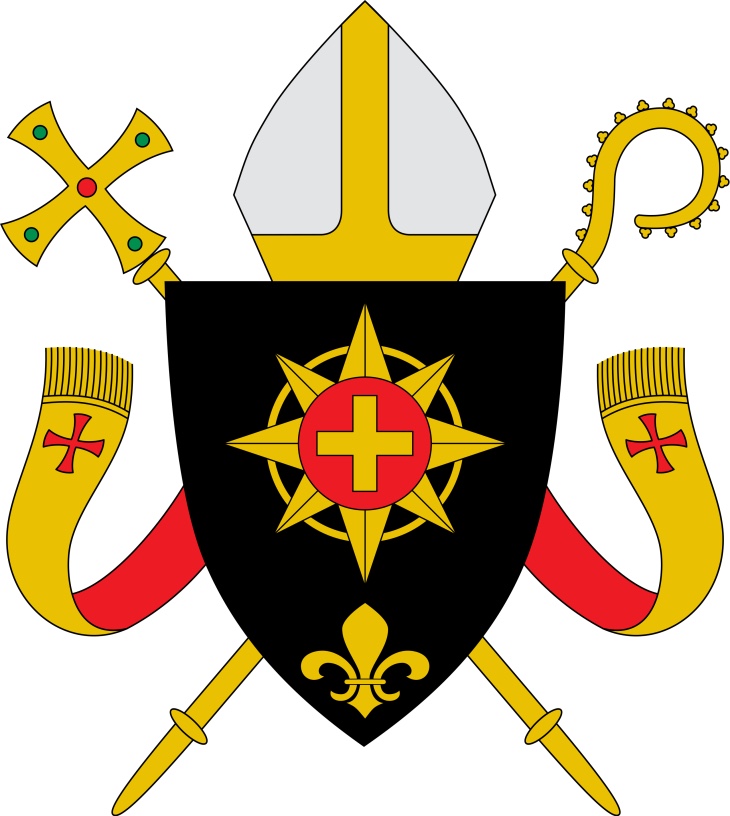
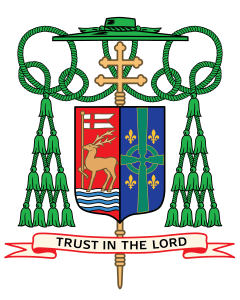
On Friday, March 7 the Most Revs. Keith J. Chylinski (52), Christopher R. Cooke (50) and Efren V. Esmilla (61), all three priests of the Archdiocese of Philadelphia, were ordained bishops in the Church and appointed as Titular Bishop of Gunela, Titular Bishop of Malliana, and Titular Bishop of Ottana respectively, as well as Auxiliary Bishops of Philadelphia. Bishop Chylinski was fortunate to receive the Titular See of Gunela which had belonged most recently to Christophe Cardinal Pierre, the Apostolic Nuncio to the United States who was present at the liturgy of ordination. That’s rather unusual. He, of course, relinquished his episcopal titular see when he was created a Cardinal-Deacon.

The coats of arms of the three new Auxiliaries are:

There are two curious things about Bishop Chylinski’s coat of arms. The blazon and explanation say that the crosses are, “…crosses pattée, sometimes referred to as Maltese crosses…”

Indeed those depicted are Maltese crosses but that is definitely not the same thing as crosses pattée. Those are two different charges. The blazon should called them crosses of Malta. Pattée crosses have straight edges on them. In addition, it depicts and explains that the episcopal cross (which is incorrectly described as a “processional” cross, which it is not) has a blue gem at the center to honor Our Lady and also an escallop shell on the node to allude to St. James. Those two additions are heraldically unsupportable. The external ornaments indicate the rank of a bearer and are not subject to personalization in this manner. They are depicted generally in a conventionally accepted form and individual artists are free to depict them in their own style.

The blazon, which is not only an official description of a coat of arms but, truly, where the design of the coat of arms “lives” (as opposed to any one artistic rendering), may not stipulate the appearance and depiction of any of the external ornaments. It may indicate that they are part of the achievement but not how they are to be depicted. In ecclesiastical heraldry the Church regulates the use of the external ornaments. The blazon of the arms must be limited to the charges on the shield.

Bishop Barbosa

On Saturday, February 3, the Most Rev. Christiano Barbosa (47) a priest of the Archdiocese of Boston, was ordained as the Titular Bishop of Membressa and Auxiliary Bishop of Boston by His Eminence Sean Cardinal O’Malley, OFM Cap.

The anchor is a fitting charge and placing it overall is also fine heraldically but having it right up against the rather unnecessary “diminished” bordure when they are both gold is heraldically questionable and artistically awkward. The use of the constellation of the Southern Cross as a symbol for Brazil is also a bit odd since it’s usually associated with Australia or New Zealand owing to its inclusion on the flag of those nations.

Other than that the rest of the achievement is fine.

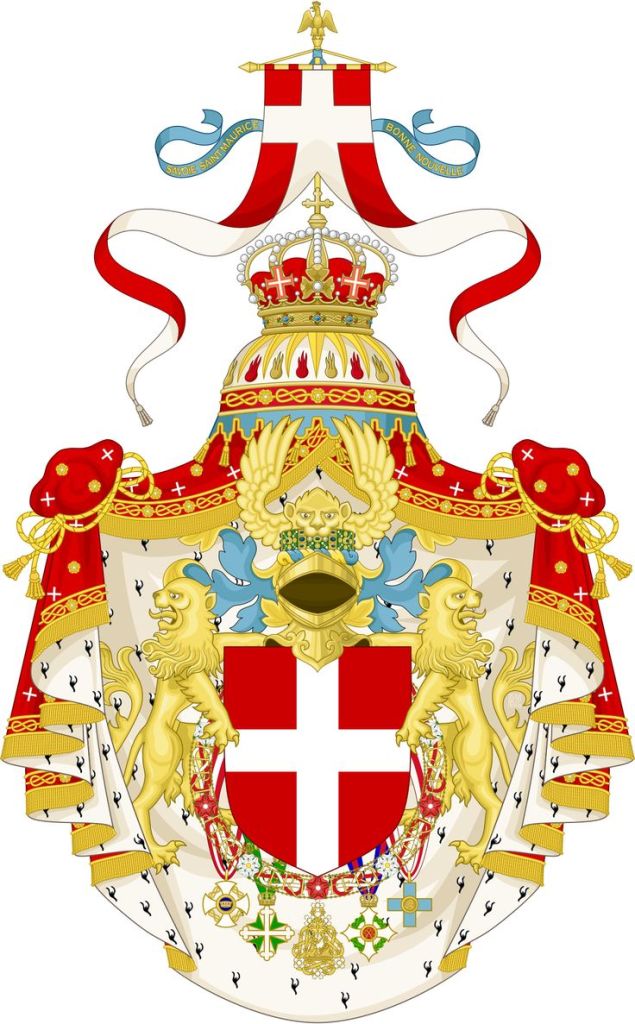
Vittorio Emmanuele di Savoia RIP

This morning it was announced the Head of the Royal House of Savoy, the son of the last King of Italy, Prince Vittorio Emmanuele, Duke of Savoy passed away at age 86 in Geneva, Switzerland.

He is succeeded as Head of the House of Savoy by his son and heir, Prince Emmanuele Filiberto, aged 51. In June 2023, Emanuele Filberto announced his intention to abdicate his claim to the throne in favor of his daughter, Princess Vittoria of Savoy, when he felt she was ready to succeed. This will cause a dynastic problem since the House of Savoy never allowed for female succession. In such a case the succession, already in dispute, could pass to another branch of the family, the House of Savoy-Aosta.

Bishop Dorsonville RIP

The Most Rev. Mario Dorsonville (63) a native of Bogotá, Colombia who incardinated as a priest of the Archdiocese of Washington, DC in 1999, and who also served as Auxiliary bishop of that same archdiocese from 2015-2023 before being appointed as the 5th Bishop of Houma-Thibodaux on February 1, 2023, sadly passed away on January 19, 2024. His funeral will take place on February 1 exactly one year after the announcement of his appointment as bishop of the diocese. May he rest in peace.

EPIPHANY: Attributed Arms of the Magi

In accord with the longstanding custom of attributing armorial bearings to individuals who lived before heraldry existed it was/is commonplace to attribute armorial bearings even to individuals whose very existence can be questioned and cannot be proven. Such is the case with Kaspar, Melchior and Balthazar, collectively known as the Three Wise Men. Even as attributed arms they have a simplicity and clarity that is in keeping with the typical form of more ancient coats of arms. Have a great celebration of the “Little Christmas” known as Epiphany.

Danish Royal Arms Elsewhere

In continuing my exploration of the royal arms of Denmark, leading up to the Abdication of Margrethe II and the Accession of Frederik X on January 14 I note with interest (not necessarily with any great significance, but merely with interest) that the Danish royal arms, the version used by the House of Oldenburg-Glückburg, occasionally turns up in other royal houses as well.

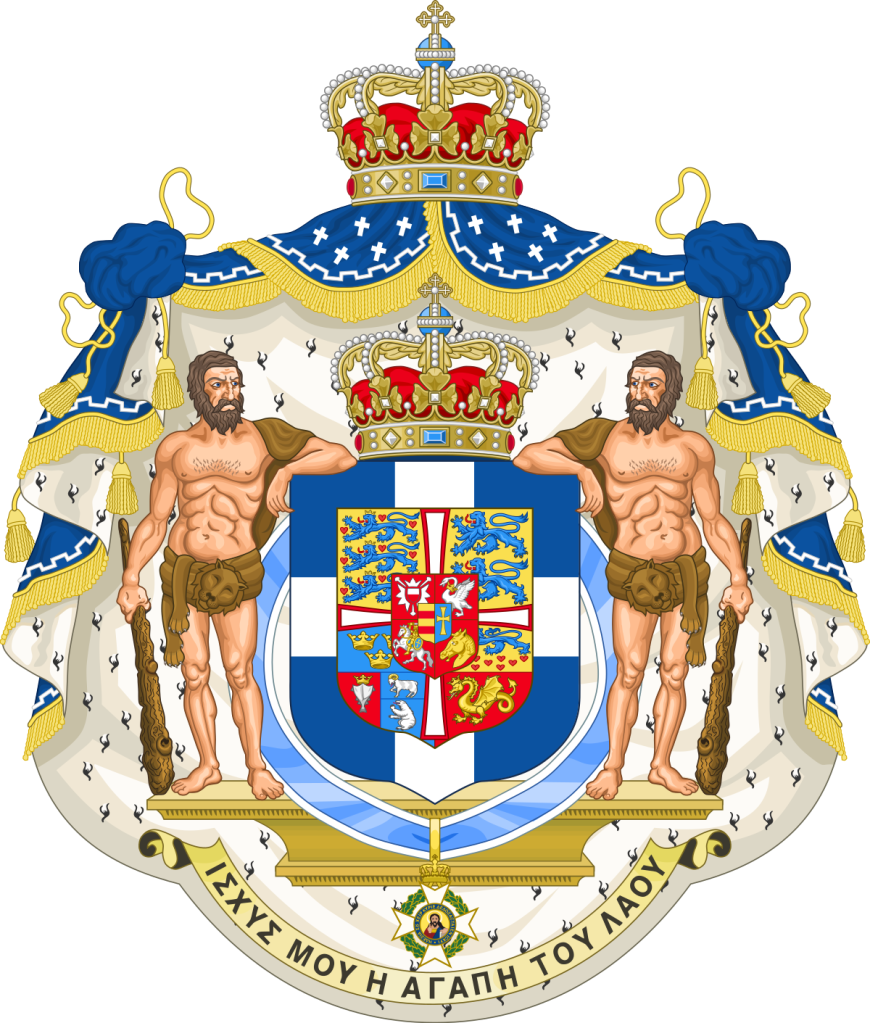
In particular, when the Greek monarchy was established in 1832 and offered to the Bavarian prince, Otto, whose reign lasted until his ouster in 1862, the Hellenic throne was then offered to Prince William of Denmark who ruled as George I of the Hellenes. The Wittlesbach arms placed at the center of the coat of arms of the Greek kingdom was replaced with a shield bearing the dynastic arms of the House of Glücksburg, a cadet branch of the House of Oldenburg. That was used during the next several reigns until the monarchy was abolished in 1924. Then, in 1935 when the monarchy was restored and King George II returned to the throne the coat of arms was modified again.

Now the center of the shield bore the greater coat of arms of the Danish royal house as used by his ancestor and King of Denmark, Christian IX from 1863-1903 before a modification of its own. In addition, the Greek coat of arms changed the two Woodwose supporters to depictions of Heracles as supporters. This coat of arms was then subsequently used by the remaining Greek kings until the monarchy was finally abolished in the 1973 referendum.

However, the last King of the Hellenes, Constantine II, had married Anne-Marie of Denmark, the daughter of King Frederik IX of Denmark and the sister of Queen Margrethe II. She bore the royal arms of Denmark as she inherited them from her father and the Danish royal arms made a double appearance in the reign of King Constantine II.

Through the Greek branch of the House of Oldenburg-Glücksburg the Danish royal arms also made their way to the UK. The late Prince Philip, husband of Elizabeth II, used the surname Mountbatten which he got from his mother, Princess Alice of Battenberg, later changed to Mountbatten, but he was born a prince of Greece (and Denmark). His father was Prince Andrew, the son King George I of the Hellenes and, himself, the son of King Christian IX of Denmark. So, the very first coat of arms devised for Philip Mountbatten, and used by him for only two years before adopting a different coat of arms, reflected his Greek and Danish heritage, as well as his mother’s British ancestry.

The Danish royal arms–as used by Christian IX– are on the dynastic shield in the center. In the dexter chief quarter the coat of arms of his grandmother, Princess Alice, Grand Duchess of Hesse and by Rhine, and the daughter of Queen Victoria, (but with the escutcheon in pretense of Saxony inherited from her father, Prince Albert of Saxe-Coburg and Gotha diplomatically removed) have been unusually and awkwardly added as a nod to his British ancestry, perhaps to quell any fears of the heiress presumptive, Elizabeth, marrying “a foreigner”. These were deemed unacceptable and in 1949 new arms were granted to him which he had a hand in designing.

This coat of arms includes quarters for Greece and Denmark (as well as Mountbatten and Edinburgh, his Dukedom) and make use of the Mountbatten lion supporter and crest, as well as the Greek Heracles supporter rather than the Danish Woodwose. You can tell because of the lion-skin loin cloth.

Another Greek Oldenburg-Glücksburg connection can be seen in the coat of arms of the Queen-Emerita of Spain, Sofia. She was born a princess of Greece (and Denmark), the eldest daughter of King Paul and Queen Frederika. Her coat of arms as Queen of Spain, wife of King Juan Carlos I is

Impaled with her husband’s coat of arms, Queen Sofia’s arms are those of the Greek royal house which she inherited from her father bearing the inescutcheon of the Danish royal arms as used by Christian IX. This shows the dynastic link to the Schleswig-Holstein-Sonderburg-Glücksburg dynasty; a shield containing the Dannebrog, a cross from the Danish flag, and quarterings representing Denmark, Schleswig, the former Kalmar Union, Iceland, the Faroe Islands, Greenland, Holstein, Stormarn, Dithmarschen, Lauenburg, Oldenburg, Delmenhorst, and the former Danish royal titles of King of the Wends and Goths.

Of course there is also the coats of arms of two sisters, both princesses of Denmark and daughters of Christian IX. Alexandra married the Prince of Wales and went on to become Queen of the UK as the spouse and consort of King Edward VII.

The other was Princess Dagmar who married Czar Alexander III and became Empress of Russia as Maria Feodorovna.

The Danish royal family has many connections to the other royal houses of Europe and the Danish Royal Arms, simplified once again by Queen Margrethe in 1972 to its present form, crops up in several different places which I simply find interesting.

Danish Royal Coat of Arms

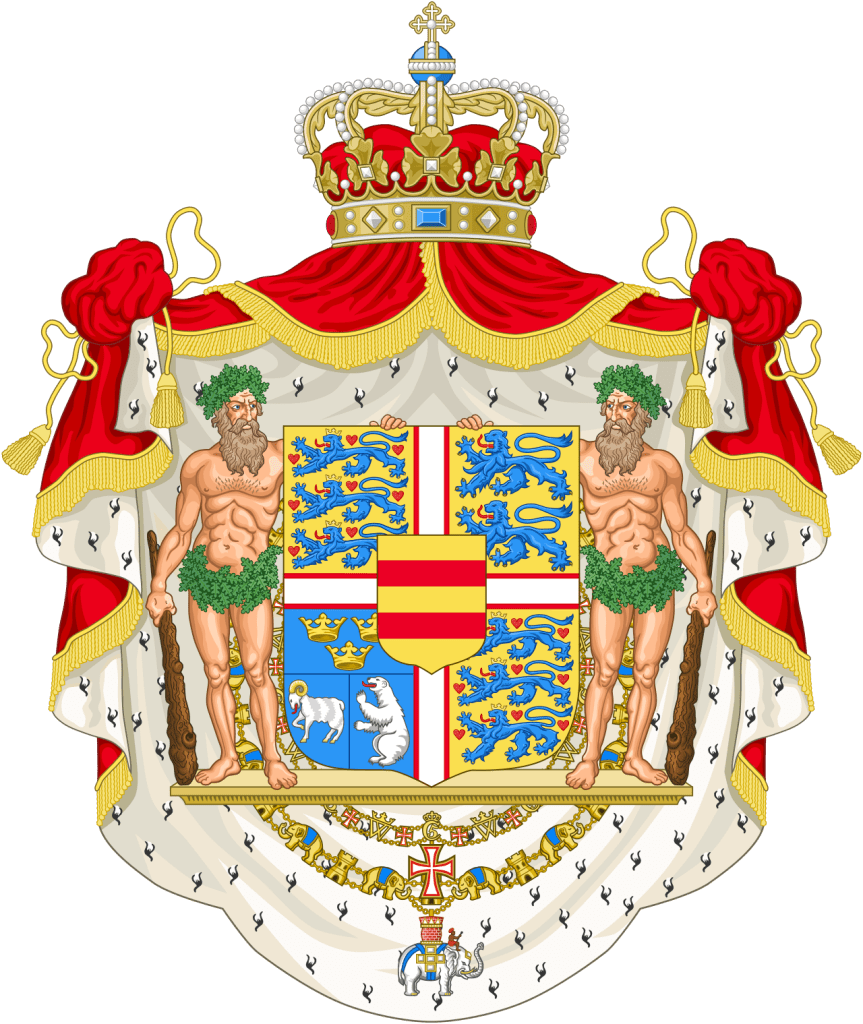
I have already discussed the state coat of arms of Denmark in a previous post. Now I’d like to look at the Royal Coat of Arms which is much more complex. The current version was established by royal decree July 5, 1972. It is simpler than previous versions.

The blazon is: A shield quartered by a cross throughout Argent fimbriated Gules; first and fourth quarter Or, three lions passant in pale Azure crowned and armed Or langued Gules, nine hearts Gules (for Denmark); second quarter Or, two lions passant in pale Azure armed Or langued Gules (for Schleswig); third quarter Azure, party per fess, in base per pale; in chief three crowns Or (for the Kalmar Union), in dexter base a ram passant Argent armed and unguled Or (for the Faroe Islands), in sinister base a polar bear rampant Argent (for Greenland). Overall an escutcheon Or two bars Gules (for Oldenburg) the whole surrounded by the Collars of the Order of the Dannebrog and the Order of the Elephant. Supporters two woodwoses armed with clubs Proper standing on a pedestal. All surrounded by a mantle Gules doubled Ermine crowned with a royal crown and tied up with tasseled strings Or.

Since approximately 1960 the royal coat of arms has been reserved exclusively for use by the sovereign, the royal family, the royal guards and the royal court.

Among the simplifications from former versions was a reduction in quarterings for other territories and a much greater simplified inescutcheon overall.

Danish Coat of Arms

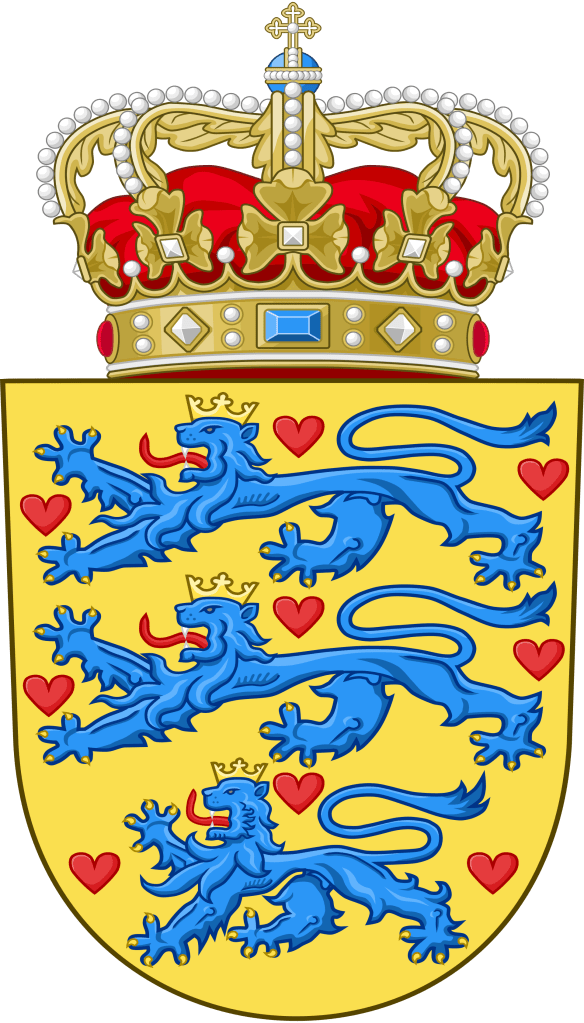
With the approaching abdication of Queen Margrethe II and the accession of King Frederik X of Denmark I’ve been reading up on the heraldry used by the country and the royal house. The state coat of arms consists of three pale blue lions passant wearing crowns accompanied by nine red lilypads (normally represented as heraldic hearts), all in a golden shield with the royal crown on top. The national coat of arms of Denmark is similar to the state coat of arms, but without the royal crown above the shield.

It is historically the coat of arms of the House of Estridsen, the dynasty which provided the kings of Denmark between 1047 and 1412. The current design was introduced in 1819, under Frederik VI. Previously, there had been no distinction between the “national” and the “royal” coat of arms. Since 1819, there has been a more complex royal coat of arms of Denmark separate from the national coat of arms. I’ll take a look at that in another post.

Historically, the lions faced the viewer rather than forward and the number of hearts was not regulated and could be much higher. The “heart” shapes originally represented waterlily pads; a royal decree of 1972 still specifies these figures as søblade (“lake leaves”). Frederik VI also fixed the number of hearts to nine and decreed that the heraldic beasts were lions, as opposed to leopards, and consequently facing forward in 1819. The blazon is: Or, three lions passant in pale azure crowned and armed Or langued gules, nine hearts Gules.

ABDICATION!

In her annual New Year message Queen Margrethe II of Denmark announced her intention to abdicate the throne on January 14, 2024 exactly 52 years to the day that she succeeded her father and became queen. She will be succeeded by her son, Crown Prince Frederik, who will reign as King Frederik X.

God bless Queen Margrethe, the last reigning queen in the world at the present time, and long live King Frederik!

Worth Repeating

Last year I shared this idea as we approached the Christmas season. I thought I was worth seeing again.

At this festive time of year it is a bit of fun to wonder if there is a bishop in the Church who can claim to have jurisdiction over the North Pole and, thus, be Santa Claus’ pastor. I think such a claim might be made by the Territorial Prelature of Tromsø which is in the northernmost part of Norway. A portion of the territory of the prelature is above the arctic circle.

The Prelature is currently served by an Administrator

Bishop Strickland

The Most Rev. Joseph E. Strickland (65), originally a priest of Dallas, Texas, later incarnated to Tyler, Texas and since 2012 Bishop of Tyler was removed from that office on November 11, 2023 by the Roman Pontiff.

Back in 2012 when he was appointed as Fourth Bishop of Tyler I had the happy task of designing his coat of arms. Now that he has ceased to be the Bishop of Tyler his coat of arms will be modified to reflect that reality. He remains a bishop in the Church and, as such, retains the use of his armorial bearings. His coat of arms at the time of his ordination and installation was:

Now that he has been removed as Ordinary of Tyler, his armorial bearings will appear as this:

The Scarlet Nuncio

On September 30 Pope Francis held a Consistory in order to create new cardinals of the Holy Roman Church. Among those was the Frenchman from the Archdiocese of Rennes, Christophe Cardinal Pierre (77), who since 2016 has served as Apostolic Nuncio to the United States of America. He was named Cardinal Deacon of San Benedetto fuori Porta San Paolo. The arms he assumed on becoming a bishop in 1995 are now ensigned with the scarlet galero of a cardinal.

Bishop Maekawa, OP

On October 12, the Most Rev. Stephen Maekawa, OP (55) a priest of the Order of Preachers (i.e. the Dominicans) living and working in Alaska was ordained a bishop and installed as the 10th Bishop of Fairbanks, Alaska.

His coat of arms is:

According to the diocesan website:

In the right side of the shield (to the observer’s left), we find represented the coat of arms of the Diocese of Fairbanks. At the base, the North Star is suspended on a blue field over the mountains of Alaska, which appear in white. In the upper section, between two red roses on a field of gold, is the Sacred Heart of Jesus, titular symbol of the Cathedral of the diocese. The roses, representing St. Therese of Lisieux, patroness of the Alaska Missions, recall her promise, “After my death I will let fall a shower of roses.

In the left side of the shield (to the observer’s right) is the personal coat of arms of Bishop Maekawa. The black and white cross is the from the coat of arms of the Order of Preachers founded by St. Dominic in 1216. The waves represent the waters of baptism and the family name Maekawa which means “before the river.” The episcopal motto “Duc in Altum” is Jesus’ command to the Apostle Peter, “Put out into the Deep” which reminds us to trust in the Lord Jesus believing that all creation belongs to God: “The earth is the Lord’s and all it holds, the world and those who dwell in it.” (Ps 24:1)

I think, unsurprisingly, the bishop has chosen a simple coat of arms reflecting his Religious community. It harmonizes well with the diocesan arms with which it is impaled. A nice design that doesn’t try to do too much–perhaps the single biggest error made by most new American bishops.

Passing of Bishop Birmingham

I heard the sad news today of the sudden and unexpected passing of the Most Rev. Kevin Birmingham, Titular Bishop of Dolia and Auxiliary Bishop of Chicago. He passed from this life on October 1, 2023. he was 51. May he rest in peace.

I was privileged to design the bishop’s coat of arms when he became a bishop in 2020.

The L.A. “Quad”

On September 26, in an unprecedented liturgy, the Archdiocese of Los Angeles received four new Auxiliary Bishops at the same time. While it is unusual for any diocese to receive so many new bishops at once it seems almost fitting for the U.S.’s largest archdiocese of well over 4 million Catholics to receive the needed assistance in episcopal ministry in order to serve the people of southern California adequately. Bishops Albert Bahhuth (66), Matthew Elshoff, OFM. Cap.(68), Brian Nunes (58) and Slawomir Szkredka (49) were all ordained to the episcopate by the Most Rev. José Gomez, Archbishop of Los Angeles.

Their armorial bearings were all designed by James-Charles Noonan. As he usually does he makes a great deal about the shape of the episcopal cross in each achievement as well as the “significance” of the shape and color of the gemstone in each one. None of that is heraldically supportable. It may be his favorite idea but, as I have written about extensively in the past, the external ornaments in a coat of arms are not personalized not do they contain unique and special symbols particular to the armiger. That would require they be blazoned as such and would then have to be copied by any artist rendering the coat of arms. Only the charges on the shield are unique to the armiger.

Even there, Mr. Noonan has placed his own stamp on these four coats of arms. Acknowledging the unusual nature of four bishops being ordained at once he has included a similar chief in all four coats of arms as a means of tying them all together by the use of this similar charge. The idea in and of itself has some merit. The occasion was unique; something unique to mark it is a nice idea.

However, the coats of arms of auxiliary bishops do not contain charges that represent the jurisdiction in which they will serve as auxiliary bishop. A heraldic representation of possessing jurisdiction over a diocese belongs to the Ordinary of the diocese alone. In addition, a reference to the diocese (by borrowing a charge from the diocesan coat of arms) is quite common in heraldry. But, that isn’t what has occurred here. Instead of each coat of arms borrowing some charge from the arms of Los Angeles the four new bishop’s arms all bear an almost identical chief–an ordinary charge–in a manner not unlike those used to signify membership in a Religious Order or an Order of Chivalry.

Don’t misunderstand me: my criticism is not of the idea of heraldically marking the unusual circumstance of four bishops being ordained all at the same time. Rather, it is of the use of a near-identical charge, and one that sort of implies a kind of jurisdiction, that I am criticizing. It’s a clever devise. But, perhaps a bit “too clever” for its own good. In addition, one has to consider that all four of these bishops may not–indeed very likely will not–remain as auxiliaries of Los Angeles permanently. Once one of them is translated to another diocese the whole unifying symbolism uniting all four coats of arms begins to fall apart. Perhaps the use of a single similar charge employed differently in each of the coats of arms would have been a better solution?

The design of each of the rest of the four coats of arms is quite correct and very nice. As usual, Mr. Noonan’s regular collaborator in producing the artwork has shown herself capable of creating very fine work.

The following are the coats of arms of Bishops Bahhuth, Elshoff, Nunes and Szkredka: