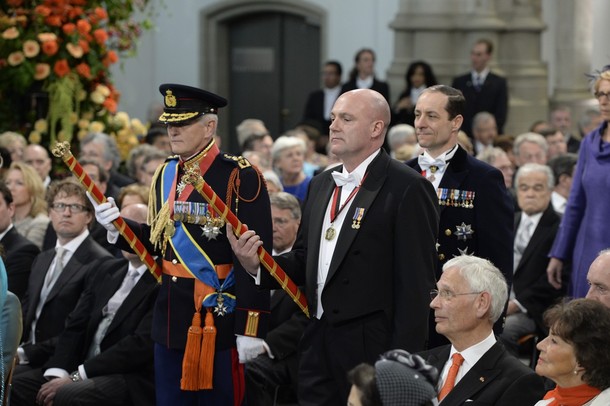
Two Kings-of-Arms, appointed for the occasion, during the recent Investiture of King Willem-Alexander.
Two Kings-of-Arms, appointed for the occasion, during the recent Investiture of King Willem-Alexander.
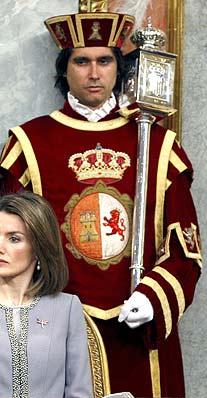
A heraldic officer in tabard with the arms of Castile and Lèon and bearing a mace during a ceremony with HRH Laetizia, Princess of the Asturias.
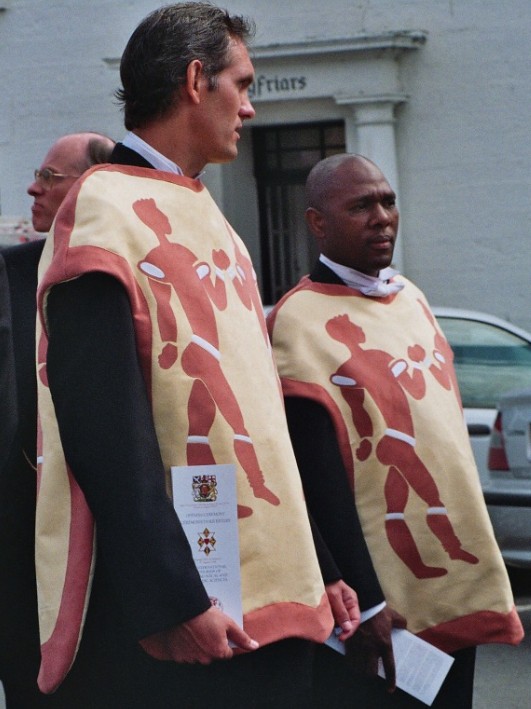
The two heralds from South Africa (wearing tabards made for the occasion) attending the XXVII International Congress of Genealogical & Heraldic Sciences which was held in 2006 in St. Andrews, Scotland. Marcel van Rossum, the Assistant National Herald of South Africa is on the left and the National Herald of South Africa, Themba Mabaso, is on the right.
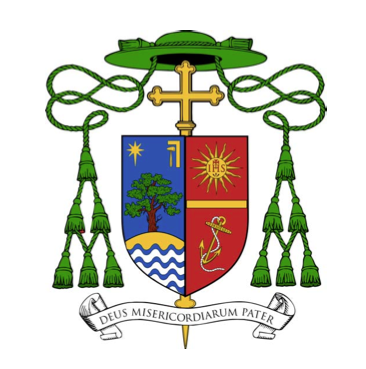
The coat of arms of newly ordained and installed Bishop Michael Barber, SJ of Oakland who was ordained a bishop and installed at the Cathedral of Christ the Light in Oakland today. The charge in chief of the personal arms is the insignia of the Society of Jesus to which the bishop belongs and which also features prominently in the arms of the pope who appointed him. The bishop also served as a US Navy chaplain. Hence, the anchor.
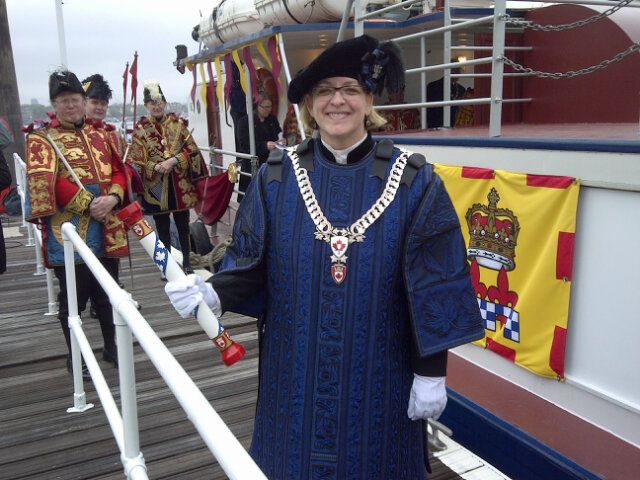
Pictured above is Claire Boudreau, the Chief Herald of Canada sporting the brand new tabard which depicts Canadian symbols on front and back and has the royal arms of the Queen of Canada on the sleeves. She also holds her ceremonial wand of office. This photo was taken during the river pageant for the Diamond Jubilee of Queen Elizabeth II.
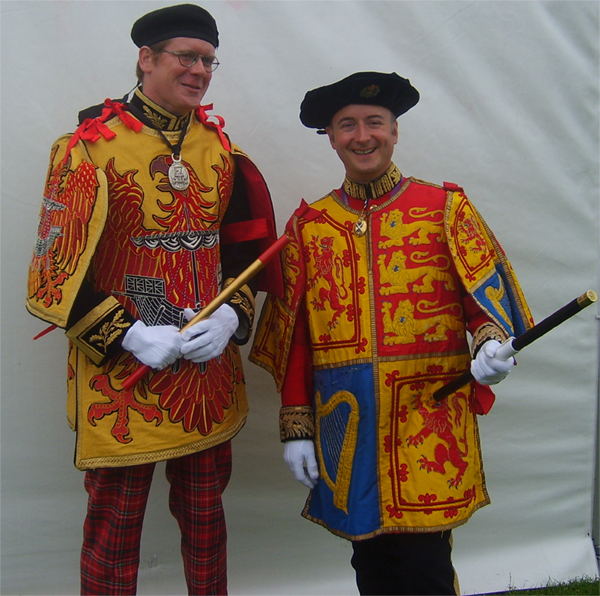
Here we see Finlaggen Pursuivant (one of the three private officers of arms maintained by the heads of different clans) Thomas Miers the officer of arms to the head of Clan Donald standing next to his predecessor, Adam Bruce, currently Unicorn Pursuivant to the Court of Lord Lyon wearing his tabard with the royal arms as used in Scotland where the quarter bearing the Scottish lion is repeated twice in the first and fourth quarters and the three lions of England take the secondary place.
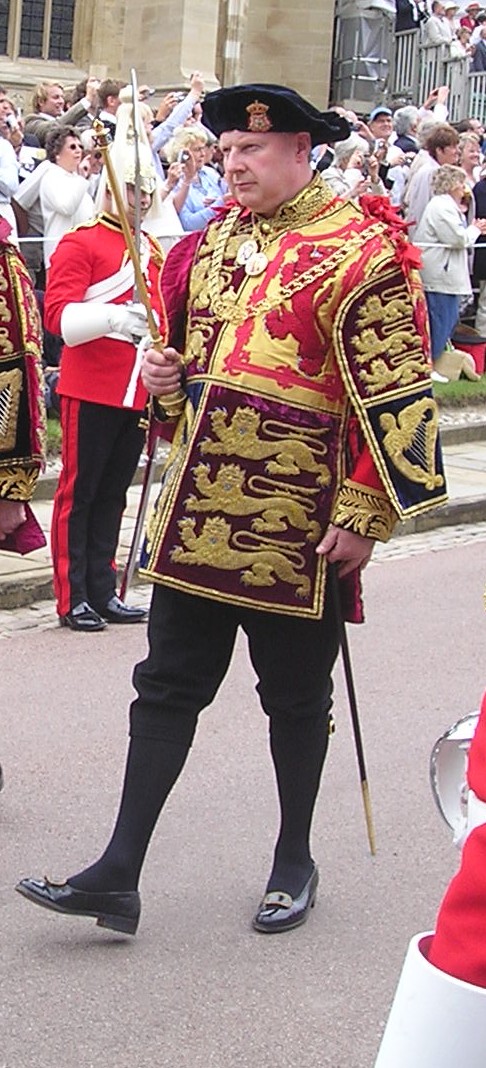
Here we see Thomas Woodcock, CVO, DL, FSA who is Garter Principal King-of-Arms of the English College of Arms in the traditional tabard bearing the royal arms as used in England and holding his wand of office.
Four more today including one I missed out on purchasing from the now defunct Heraldry Today.
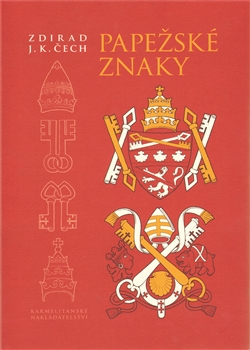
Papežské Znaky by Zdirad J.K. Čech published in 2009. The book is in Czech but is lavishly illustrated throughout and includes all the papal arms from the dawn of heraldry up to Pope Benedict XVI. (pictured above)
Also, Wappen und Flaggen des Deutschen Reichtes und seiner Bundesstaaten (1871-1918) published in 1979.
Wappen: Ein Spiegel von Geschicte und Politik by Harald Huber published in 1990.
Handbüchlein der Heraldik by D.L. Galbreath published in 1930.
My German is very rusty but these were very nice acquisitions for my little personal library.
Some more today: Heraldry For The Designer by William Metzig, published in 1970. (thanks to the recommendation of a fellow heraldist) It’s an interesting book. His style is unique but some of his ideas about heraldry border on the bizarre.
Also Royal Ceremonies of State by J.P. Brooke-Little (quondam Clarenceux King of Arms) published in 1980. As the title states its a book mostly about British royal ceremonies. However, the author being who he is there is a chapter on the Heralds and a good bit of heraldry throughout especially in the chapters on funerals and orders of chivalry. It’s also a book that illustrates well that the function of a herald isn’t limited to genealogy and the devisal of coats of arms. There are an extensive amount of ceremonial duties involved with being a herald.

The coat of arms of the well-known liturgical author and priest, Adrian Fortescue. An excellent motto that perfectly plays on his name.
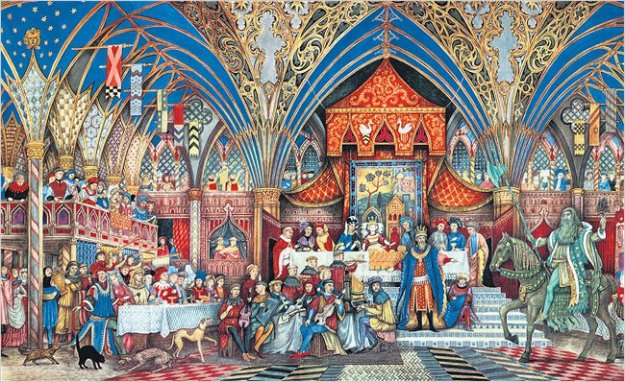
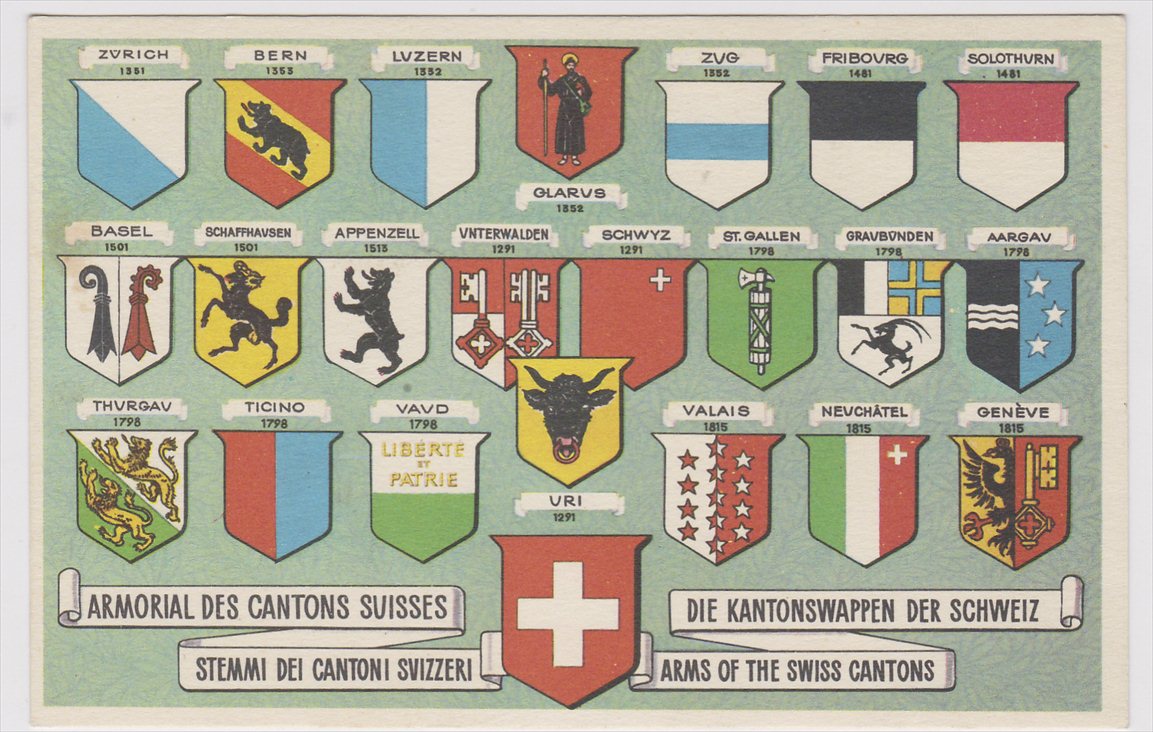
I recently came back from a vacation in France during which I also spent a little time in the Confœderatio Helvetica, more commonly known as Switzerland (derived from Schwyz, the leading of the three founding cantons at the time of the confederation in 1291). It is a country that does not have a monarchy and yet where heraldry runs rampant (pardon the pun) thus giving the lie to the notion that heraldry is an antiquated idea associated with outmoded forms of government, like elitist monarchies. Elitism and monarchy do not necessarily go hand in hand. The Swiss have survived for centuries without a monarch and yet have managed, nonetheless, to become quite elitist!
Today I got a copy of Heraldic Cadency: The Development of Differencing of Coats of Arms for Kinsmen and Other Purposes by Lt.-Col. Robert Gayre, published in 1956. Also arrived: The Nature of Arms: An Exposition of the Meaning and Significance of Heraldry with Special Reference to its Nobiliary Aspects also by Robert Gayre. Published in 1961. As you can see, Gayre was fond of lengthy subtitles for his works. I suppose that was part of his multi-faceted neuroses. He was bonkers but the books are lovely. Look ’em up. They can be obtained inexpensively from one of the usual suspects.

He will tour areas hit hardest by Hurricane Sandy with the Governor, The Hon. Chris Christie, and see the efforts and recovery and rebuilding. I’ve never liked the custom of the British royals of having everyone use the royal arms differenced only by various forms of a label. In addition, the royal arms really should have had an escutcheon in pretense of the Duchy of Saxony added but the heralds decided against that.
Montezemolo Wants To Redesign Benedict XVI’s Coat Of Arms
(click on the title to read the article)
This is the biggest load of bull I’ve ever read in my life!

Above you see what I like to call my “heraldic curriculum vitae”. (click on the image for a larger view) Essentially, it is a record of the various things I have done in my life illustrated by using heraldry. I commissioned the very talented architect, designer and graphic artist, Matthew Alderman to create this artwork. I conceived of the idea for this a few years ago when I received a friend’s bookplate that had not only his own coat of arms on it but the coats of arms of the various universities he attended and the dioceses in which he had served. A few months back Matt asked me to help him with some heraldic research for another commission on which he was working and when he showed me the sketches for it I knew he was the man to produce this heraldic CV.
My own coat of arms is at the center flanked by the coats of arms of the diocese in which I serve and the diocese in which I was born and grew up. Below that we see two other versions of my arms reflecting other capacities in which I serve with the coat of arms of the Roman Catholic Church between them. The bottom consists of the coats of arms of various schools I’ve attended and the sides are comprised of the coats of arms or other insignia for a variety of organizations to which I belong and/or serve as an officer or chaplain.
The image doesn’t really do it justice. In person it is stunning!
Fr. Guy Selvester's blog of Ecclesiastical Heraldry
Fr. Guy Selvester's blog of Ecclesiastical Heraldry
Fr. Guy Selvester's blog of Ecclesiastical Heraldry
Fr. Guy Selvester's blog of Ecclesiastical Heraldry
Fr. Guy Selvester's blog of Ecclesiastical Heraldry
Fr. Guy Selvester's blog of Ecclesiastical Heraldry
Fr. Guy Selvester's blog of Ecclesiastical Heraldry
Fr. Guy Selvester's blog of Ecclesiastical Heraldry
Fr. Guy Selvester's blog of Ecclesiastical Heraldry
Fr. Guy Selvester's blog of Ecclesiastical Heraldry
Fr. Guy Selvester's blog of Ecclesiastical Heraldry
Fr. Guy Selvester's blog of Ecclesiastical Heraldry
 EXARANDORUM