External Ornaments in Heraldry

The last post on the arms of the new Territorial Abbot of St. Maurice started an interesting conversation in the comments section. Namely, about the fact that the Abbot’s arms are ensigned with only the crozier that indicates the coat of arms belongs to an abbot. Many dislike it when the arms of a cleric do not employ the use of the distinctive galero, or broad-brimmed hat, which usually replaces both the helm and crest (with their accompanying torse and mantling) found in the heraldic achievements of lay people. This ecclesiastical hat is depicted in varying colors and with varying numbers of tassels to indicate the rank of the armiger. Both the Roman Catholic Church and the Church of England have developed elaborate systems for the use of the galero. Many other constituent churches of the Anglican Communion employ the system devised for the Church of England and approved by Earl Marshal’s Warrant in the 1960s.

However, while it is true that the galero certainly makes the coat of arms of a clergyman instantly recognizable as such it is not true that the galero is always and everywhere mandatory for clergy. In fact, there are no external ornaments that are mandatory in heraldry. A coat of arms, simply put, may consist of the shield alone. The motto, which many clerics spend way too much time on devising, is not a necessary component to a coat of arms for example.

In the case of a bishop the one single external ornament that marks the coat of arms as that of a bishop is the episcopal cross placed behind the shield. Full stop. There is no other external ornament necessary and quite a few bishops have chosen to display the episcopal cross (which is not to be confused, as it often is, with the liturgical processional cross) alone in their heraldic achievement. The green galero with twelve tassels is not exclusive to them so it is not the necessary element to indicate the arms of a bishop. Similarly, archbishops use the archiepiscopal cross which has two horizontal bars and is sometimes somewhat misleadingly referred to as the patriarchal cross, in their coats of arms. The green galero with twenty tassels is used almost exclusively by archbishops but it, too, is not a necessary or mandatory external ornament.

When it comes to cardinals the situation changes somewhat in that the red galero with its thirty tassels is, pretty much, the only external ornament that indicates the armiger is a member of the College of Cardinals.

For other clergy, again, the situation remains that the galero is usually employed and certainly makes it clear that the coat of arms belongs to a cleric rather than a laic but the privilege of ensigning the shield with various ornaments isn’t always absolutely necessary. In the case of an abbot it is the (usually veiled) crozier that indicates the arms of an abbot or abbess, the latter being easily distinguished by the lozenge or oval shape of the shield. If a coat of arms is ensigned with a veiled crozier then it is indicating the armiger is a cleric with the rank of abbot whether the black galero with twelve tassels is displayed or not. This is so because the black galero with twelve tassels may also be used by Vicars General; Vicars Episcopal; Non-Episcopal Ordinaries, Moderators of the Curia, Titular Abbots, Prelates of Chivalric Orders as well as Superiors General of Religious Orders and Clerical Religious Congregations. However, only an abbot may also employ a veiled crozier*. Thus it is the crozier that indicates the coat of arms belongs to an abbot, not the galero.

Similarly, the green galero with twelve tassels may be used by Territorial Abbots, Permanent Apostolic Administrators and Vicars or Prefects Apostolic who lack the episcopal character. However, only a bishop or archbishop may also ensign the shield with the episcopal or archiepiscopal cross.

It is worth mentioning that in some places bishops and abbots still use the mitre as well as the cross or crozier in ensigning their shields rather than the galero despite the preference as indicated by Papal Instruction for the use of the galero.

As I said jokingly to one of my sympathetic correspondents, “You don’t have to have all the doo-dads on your coat of arms when, frequently, there is only a single ornament that is the true indication of rank”.

*NOTE: Recently, the Church has established Ordinariates for former Anglicans who wish to come into the Roman Catholic Church. These are headed by Ordinaries who, while exercising Ordinary jurisdiction over the churches under their charge, do not possess the episcopal office. In some cases they were formerly bishops in some branch of the Anglican Communion. Of the three existing today they, too, ensign their shields with the proper galero of rank (usually that of a Prothonotary Apostolic, the highest rank of “monsignor” which is a purple hat with twelve red tassels) as well as a purposely UN-veiled crozier to distinguish it from the crozier of an abbot. This is because they exercise Ordinary jurisdiction of which the crozier is a symbol and they are entitled to use the pontificals liturgically so they actually carry a crozier at Mass but the veil on the crozier is particular to monastics which these Ordinaries are not.
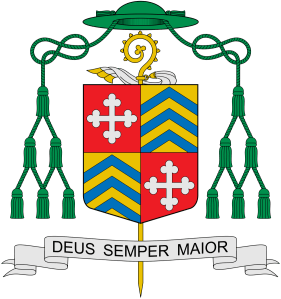
New Territorial Abbot of St. Maurice (UPDATED)

image

The Rt. Rev. Jean Scarcella was born Dec. 28, 1951 in Montreux. After his novitiate, he took his vows at the Abbey of Saint-Maurice 5 October 1985. A graduate of music, he was ordained a priest March 31, 1990.

He became pastor of Bex in 1992. In 2006 he was appointed liturgical animator then rector of the Basilica of Saint-Maurice, in addition to his work in Bex before becoming Prior on July 25,2009. As prior he was the first assistant of the Abbot in governing the Abbey as well as the Congregation of Canons Regular.

Following the election of Chapter of the Abbey on April 10, 2015, Pope Francis confirmed this choice and appointed him 95th Territorial  Abbot of Saint-Maurice Agaune on May 22, 2015.

He has chosen to make use of a very simple coat of arms and not to use the external ornament of a green galero with 12 tassels.

St. Joseph Parish, Washington, NJ

sc00016f9d

The newly assumed coat of arms of St. Joseph Catholic Church (above) incorporates elements alluding to the location of the parish and the parish’s titular patron saint. The blazon is: Gules, two bars Argent and in chief three fleur-de-lis Argent. That is: on a red background there are two horizontal silver (white) stripes and above that three fleur-de-lis also silver (white).
The new coat of arms is based closely on the coat of arms of George Washington (pictured below) The blazon of that coat of arms is: Argent, two bars Gules and in chief three mullets of five points also Gules. The Borough of Washington and Washington Township in Warren County in Northwest New Jersey is named for Washington.

Wash-mid
In the arms of the parish the colors have been reversed for difference and the three mullets or stars have been replaced with three fleur-de-lis, a symbol in heraldry used most often to represent Our Lady but one which is also used to allude to St. Joseph, her husband. For some time now the parish already employed the fleur-de-lis as a kind of logo or parish symbol.
The new coat of arms was designed and rendered by me as I am serving as the Administrator of the parish.

Bishop Massa & Bishop Mroziewski

On July 20 the Most Rev. Nicholas DiMarzio will ordain the Most Rev. James Massa and the Most Rev. Witold Mroziewski as auxiliary bishops of Brooklyn. Their newly-assumed coats of arms are pictured below without comment. I am personally acquainted with Bishop Massa and he had wanted me to design his coat of arms but others took that matter out of his hands. Therefore, I will refrain from expressing an opinion on the design of the arms.

imageimage

Bishop Malesic of Greensburg, PA

On July 13 the Most Rev. Edward Malesic, a priest of the Harrisburg, PA diocese will be ordained and installed as the fifth bishop of Greensburg, Pennsylvania at Blessed Sacrament Cathedral in Greensburg.

his newly assumed coat of arms is:

image

The explanation of the arms (provided by the diocese) is:

“The color of the field is BLUE (azure), the color of the sky, which symbolizes the direction of the soul’s ascent toward God and away from worldly values, therefore, the color represents the path set by the spiritual virtues, raising a person from the things of the earth toward the incorruptibility of heaven.

The CHEVRON is a heraldic device best described as an inverted “V” and is one of the most ancient figures in heraldry. Frequently, in Roman Catholic Church heraldry, it signifies the rafter which supports the roof of the church as a source of protection for the community of faith gathered under it. The THREE SHAMROCKS represent the Cathedral in Harrisburg, dedicated to St. Patrick, where Bishop Malesic was ordained to the priesthood by the imposition of the hands of Cardinal William H. Keeler, at that time Bishop of Harrisburg. The CHEVRON is in SILVER (argent), the color of transparency, also of truth and justice, fundamental requirements of the Bishop’s pastoral service.

The CROWN above the chevron is the symbol of Bishop Malesic’s given name, after St. Edward “The Confessor” (d.1066), King of England who gave witness to his Catholic faith through his life. The crown also recalls Mary, Queen of the Apostles, upon whose intercession Bishop Malesic relies.

The LINDEN TREE below the chevron expresses the Slovenian heritage of Bishop Malesic’s father. The linden tree is considered the national tree of Slovenia and is also a symbol of joy and safety. The community often gathered under the shade of the linden tree for fellowship and community discussions.”

The bishops of Greensburg have a pretty good tradition of having simple, well-designed coats of arms. Bishop Malesic is no exception. While he has still given in slightly to the “coat of arms as pictorial CV” school of heraldry it isn’t too bad and he’s far from the only American bishop to do so. I think that overall the design is clear, well done and blends well with the arms of the diocese. My only criticism, and it is a small one, is that the two crosses in chief in the arms of the diocese are incorrect. They should be patteé formeé, that is to say they should look like two round gold balls formed into crosses. This is because they are taken from the two identical crosses in the arms of the see of Pittsburgh, from which Greensburg was separated, where, in turn, they were derived from the gold bezants in the arms of William Pitt but turned into crosses to difference them. These crosses do not in any way resemble gold balls.

The personal arms of of Bishop Malesic were designed and rendered impaled with those of the diocese by Renato Poletti.

Archbishop Wester of Santa Fe

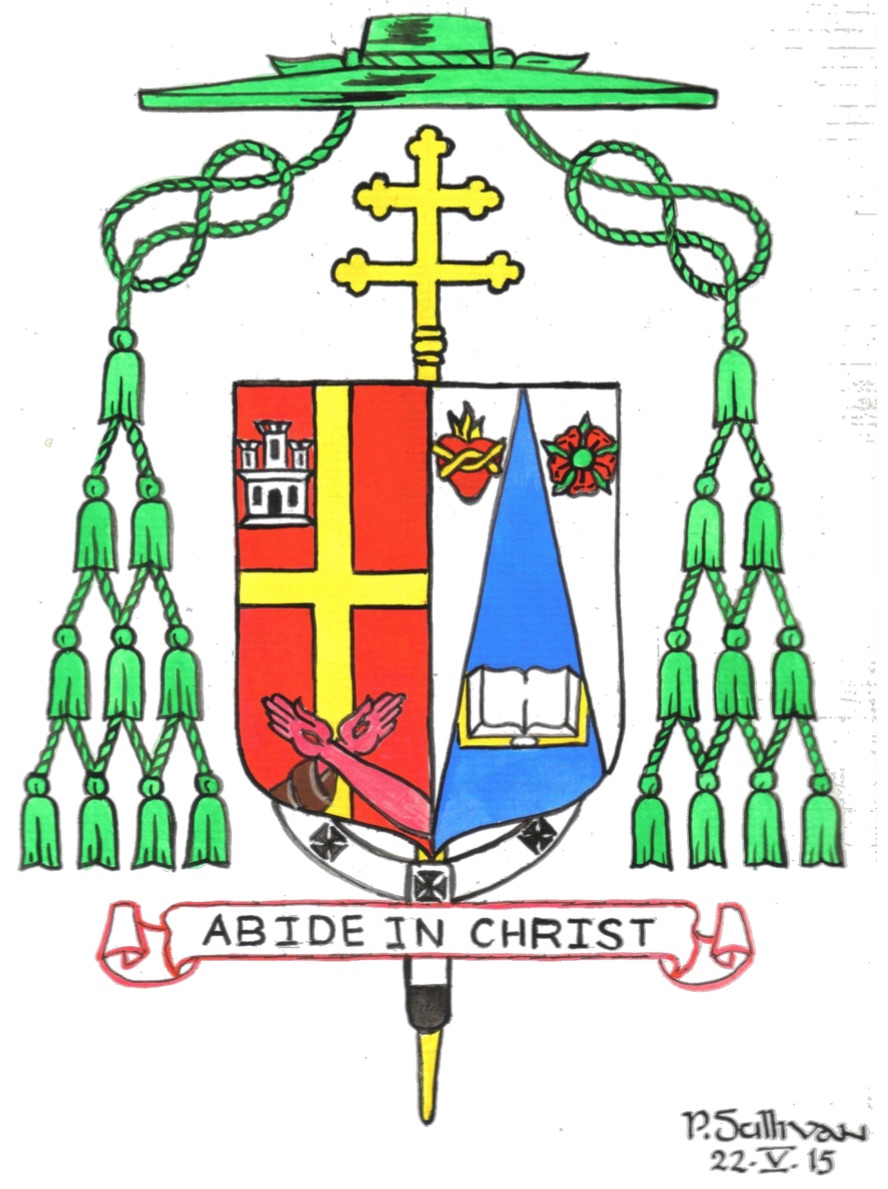
On Thursday, June 4, the Most Rev. John C. Wester, formerly Bishop of Salt Lake City, Utah and prior to that Auxiliary Bishop of San Francisco, will be installed as the Twelfth Archbishop of Santa Fe, New Mexico. His personal arms, assumed at the time of his episcopal ordination in San Francisco, are now marshaled to those of the venerable Archdiocese of Santa Fe the arms of which allude to both Spain and to the titular patron of its cathedral church: St. Francis of Assisi.

The artwork for the coat of arms (below) is by Deacon Paul Sullivan.

wester_santa fe arms

Bishop Moth of Arundel & Brighton

bhp-richard-coatofarms

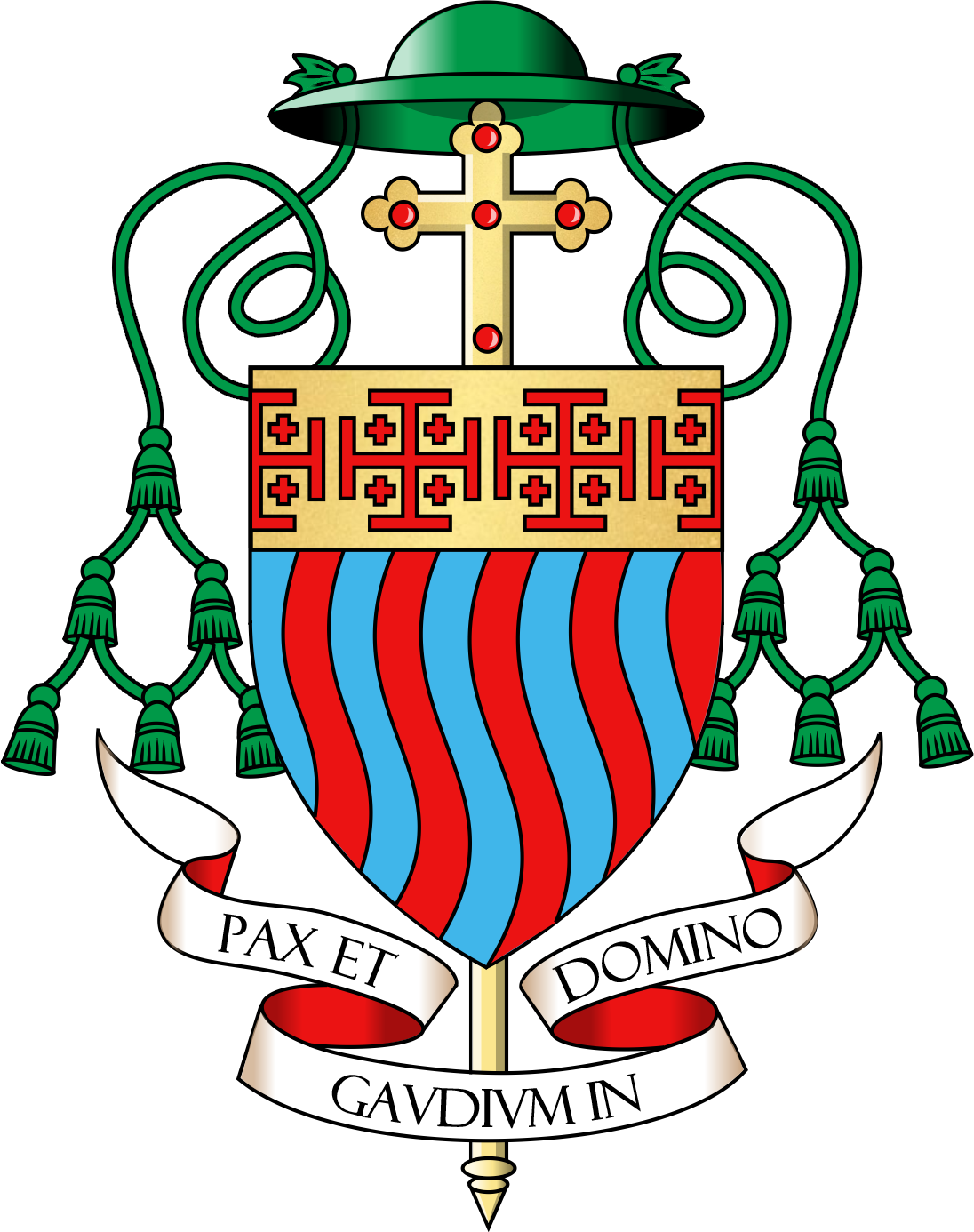
Today, May 28, the Most Rev. Richard Moth was installed in the beautiful Arundel Cathedral as the 5th Bishop of Arundel and Brighton. His coat of arms (above) is described as follows on the diocesan website:

The Grant of Arms contains the following description:
Paly-wavy of ten Bleu-celeste and Gules on a Chief Or four Crosses of Jerusalem the outer pair issuant Gules

Which might be expressed in modern English:
Ten wavy stripes in sky blue and red, with a gold field above containing four red Jerusalem Crosses, the outer pair appearing from the side

The wavy stripes hark back to Bishop Richard’s place of birth (the Zambian Arms consisting of similar stripes in black and silver), blue a reminder of Our Lady and the red a reminder of the English Martyrs. The Crosses of Jerusalem are a reference to Bishop Richard’s membership of the Equestrian Order of the Holy Sepulchre of Jerusalem.

Bishop Richard’s motto is Pax et Gaudium in Domino – Peace and Joy in the Lord.

Romero: Another Armigerous Saint (…well, Blessed anyway)

sc0239cd07a

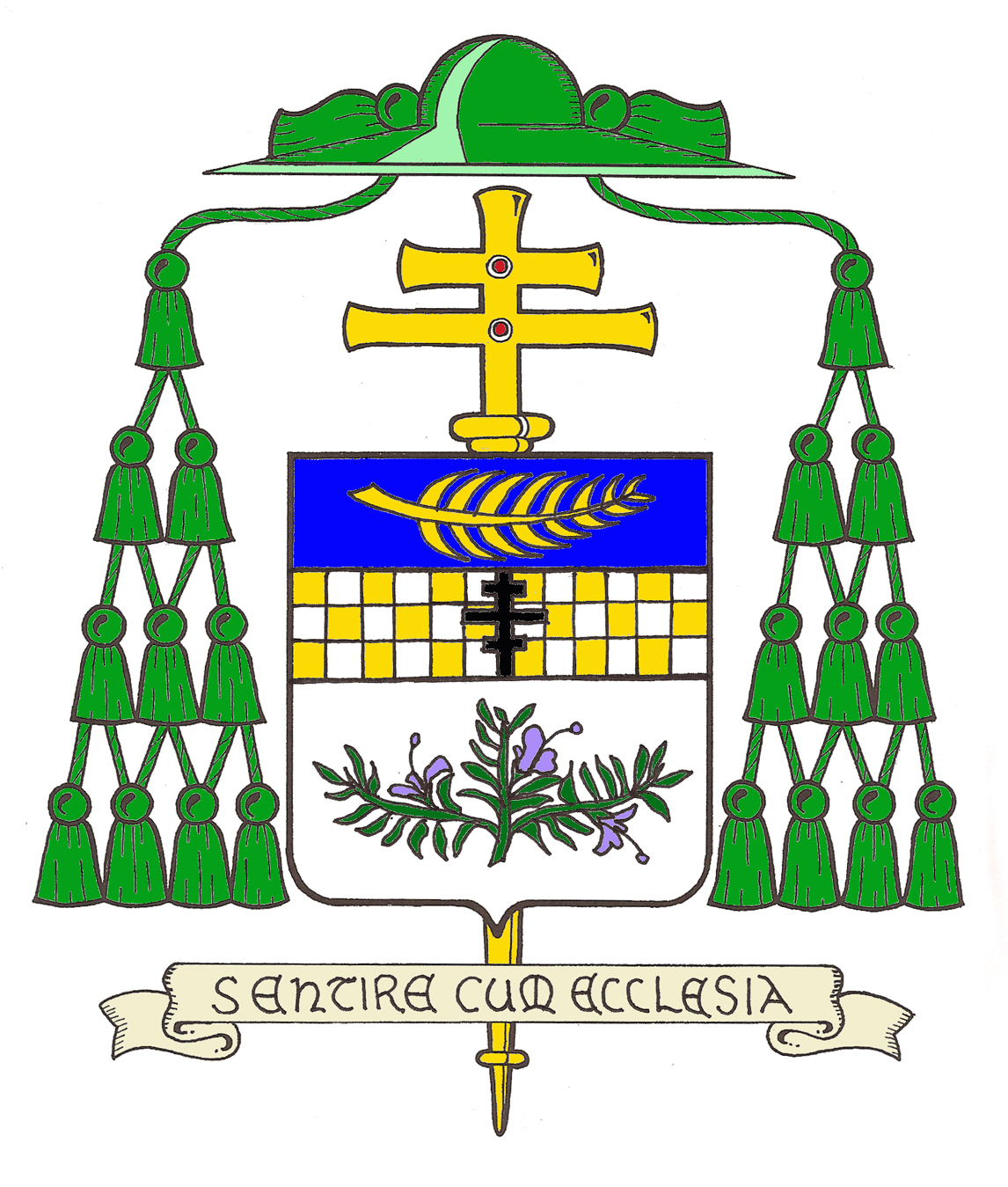
After posting about the use of the coat of arms of the martyr, Blessed Oscar Romero, on the vestments used at the ceremony of his beatification last Saturday some noted how there really is no good image of his coat of arms available on the internet. So, I have undertaken to prepare something (above) which at least more clearly depicts the coat of arms as it seems to appear.

The coat of arms can be blazoned as follows: Per fess in chief per fess again the chief Azure a palm branch Or and below that chequy Or and Argent a triple-barred cross Sable; in base Argent a triple sprig of rosemary Proper. The shield is ensigned with a patriarchal cross pale wise behind the shield and a galero with cords and twenty tassels arranged on both sides in four rows of one, two, three and four all Vert. On a scroll below the shield the motto reads, “Sentire Cum Ecclesia”.

Blessed Oscar Romero

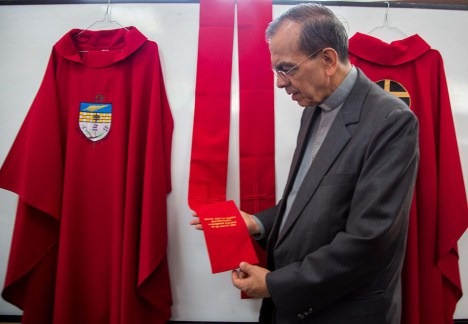
I noted with interest that the vestments worn by the bishops for the May 23 beatification ceremony for martyred Archbishop Oscar Romero were martyr’s red and emblazoned with the coat of arms of the slain archbishop. I’m not usually a big fan of heraldry on vestments but in this case I think it was a nice touch.

Image 8

Bishop Stowe of Lexington

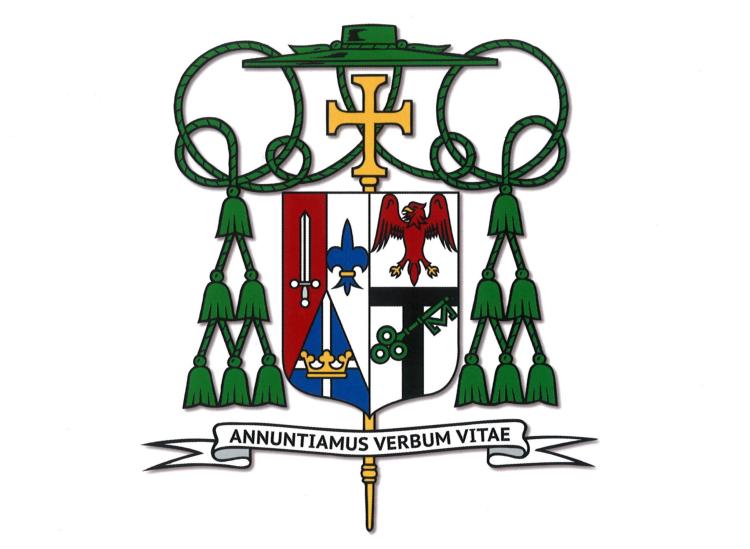
On May 5 the Most Rev. John Stowe, OFMConv was ordained and installed as the third bishop of Lexington, Kentucky. His coat of arms is:

stowe_coat_of_arms

The explanation of his personal arms and motto (from the diocesan website):

On the right side are the personal arms of Bishop John. These are composed of a white field on which is seen a red eagle, the symbol of Saint John, Bishop John’s baptismal and religious patron. Below the eagle is a black Tau cross, emblematic of Saint Francis of Assisi, founder of Bishop John’s religious order. The color black represents the dominant color of the Franciscan habit. Upon the tau is a green “Mary’s Key,” seen hanging from the belt of the Blessed Virgin Mary as Our Lady of Consolation, the national shrine of which Bishop John was rector.

For his motto, Bishop John has adopted the Latin phrase, “ANNUNTIAMUS VERBUM VITAE”, translated as, “We announce the Word of life.”

New Arms for a New Priest

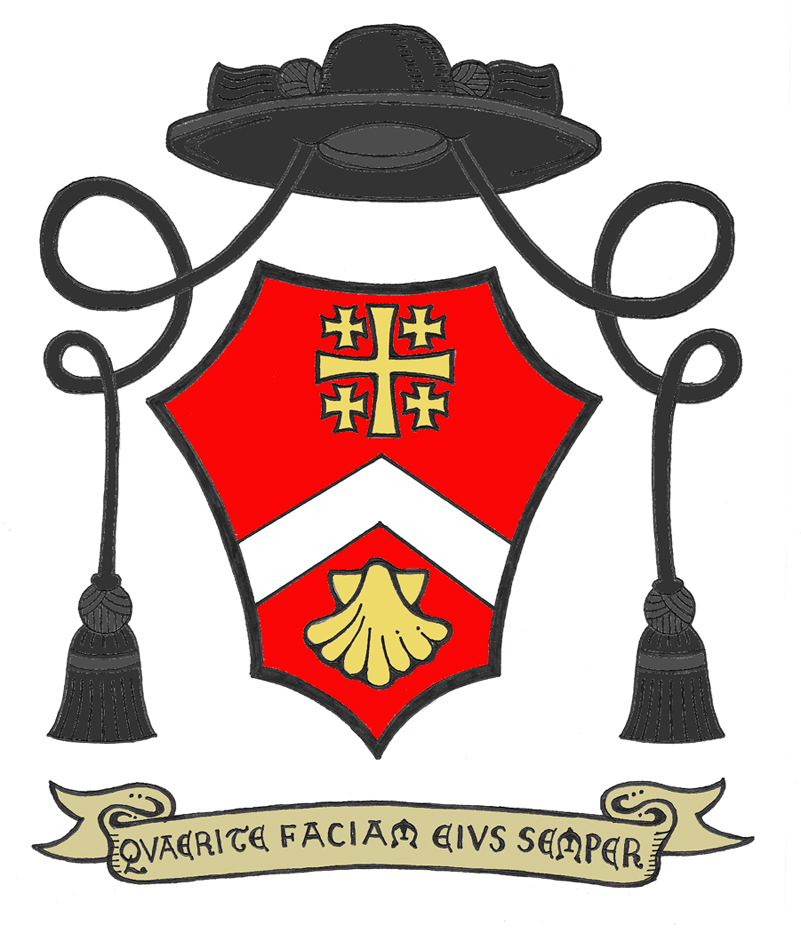
This coat of arms was designed for a man about to be ordained to the priesthood. He chose mostly red and gold to allude to the arms of Pope Benedict XVI who inspired him to pursue the priesthood. The Jerusalem cross is for his travels in the Holy Land and his care and concern for the Church in the Middle East. The escallop shell is from his family arms and also represents both baptism and pilgrimage. The chevron is a stylized carpenter’s square for St. Joseph, to whom there is a particular devotion, and is silver (white) to allude to Our Lady. The motto, from Psalm 104, says “Always Seek His Face”.

sc00053b16c

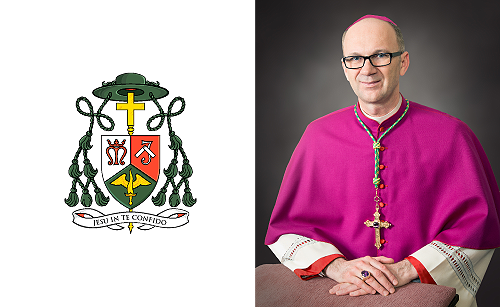
Bishop Dabrowski

On April 14 Fr. Jozéf Andrzej Dabrowski, C.S.M.A. will be ordained Auxiliary Bishop of London, Ontario, Canada which is one of the largest English-speaking dioceses in Canada. The new bishop, a member of the Congregation of St. Michael the Archangel was born in Poland in 1964.

15JAD