Trenton Co-Cathedral

Uh-Oh!

Not quite, Trenton. On February 19 the church of St. Robert Bellarmine in Freehold, NJ was designated the Co-Cathedral of the venerable diocese of Trenton. The reasons for Bishop O’Connell requesting the designation of a co-cathedral, something usually reserved for diocese with a dual or twin seat of the bishop (such as Altoona-Johnstown, PA or Springfield-Cape Girardeau, MO) are of no concern here. The bishop desired it, his consulters concurred and the Holy See gave its permission.

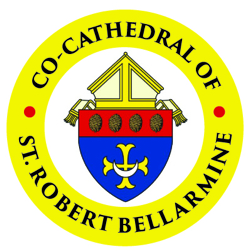
However, during the ceremony elevating the 1,000 seat suburban parish church to co-cathedral one of the elements of the ritual, including the blessing of a new cathedra for the bishop, was the handing over of a new coat of arms for the co-cathedral (below).

Print

The design uses the arms of the See of Trenton which, as I have always said, is probably one of the nicest and most heraldically correct coats of arms of any diocese in the USA. The only addition was to add a chief with the pine cones taken directly from the arms of St. Robert Bellarmine himself.

Some might wonder why a church would need a coat of arms? Actually, it is quite common for churches, both parish churches and cathedral churches, to make use of corporate arms of their own. In fact, in many places the cathedral church incorrectly assumes that it has the right to employ the arms of the diocese as its own since it serves as the seat of the bishop of that diocese. Such an assumption is actually incorrect. The arms of the diocese cannot be used by the cathedral church, chapter or parish as also “theirs”. So, the idea of a separate coat of arms for the co-cathedral parish is a perfectly good one.

I note that the mother church of the diocese of Trenton, the cathedral of St. Mary of the Assumption, does not seem to make the mistake of employing the arms of the See of Trenton as their own. Indeed, it does not seem to make use of any coat of arms. So, this begs the question, “Why does the co-cathedral need its own coat of arms when the actual cathedral does not use one?”

I think the design of the new arms is a good one. It still maintains a sense of clarity and simplicity, clearly identifies with the diocese, and makes good use of charges from the armigerous patron saint of the place.

However, the problem is in the external ornament. The shield is surmounted by a mitre. Here, a similar mistake to a cathedral simply stealing the arms of the diocese has occurred. Someone involved in the design of this coat of arms just assumed that as a cathedral church the mitre is the most appropriate external ornament to adorn the shield. In heraldry the mitre is used, in some places still, to denote the arms of a bishop and in most places the arms of a diocese…not a cathedral. Just as a cathedral cannot simply make use of a diocesan coat of arms, similarly, a co-cathedral cannot usurp the ornaments proper to the corporate arms of a diocese. Quite unintentionally the person who designed this has created arms for a new diocese!

As is the case with the corporate arms of any church it should make use of the shield alone and, possibly, a motto if desired. There is no crest, no mitre, no crozier or cross, indeed, no external ornament to denote the arms of a cathedral or co-cathedral. Once again, rather than consulting with someone knowledgeable a person, or persons, just struck out on their own, extrapolated from what they had seen elsewhere…and got it WRONG!

I find this kind of ignorance annoying, appalling and fairly commonplace, especially when it comes to the Catholic Church in the United States.


Bishop of London To Retire (UPDATED)

The Right Reverend and Right Honorable Richard Chartres, KCVO, ChStJ, PC, FSA will be stepping down this month after twenty-two years as Bishop of London, the third most senior position in the hierarchy of the Church of England.

london2

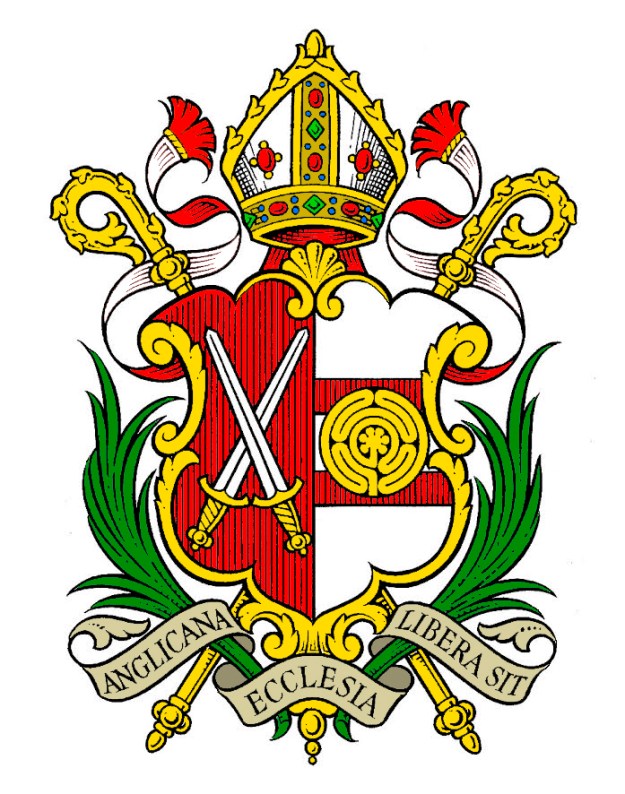
His coat of arms (above) depicts the arms of the See of London with its two crossed swords as an allusion to its patron, St. Paul impaled with his personal arms which depict a charge of a labyrinth. This, in my opinion, is a clever way to do a kind of canting arms the medieval labyrinth being a famous feature on the floor of Chartres cathedral.

Thanks to one of my regular correspondents for this fine image of the Bishop’s coat of arms.

Bishop Barres

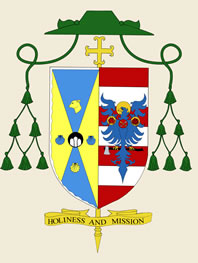
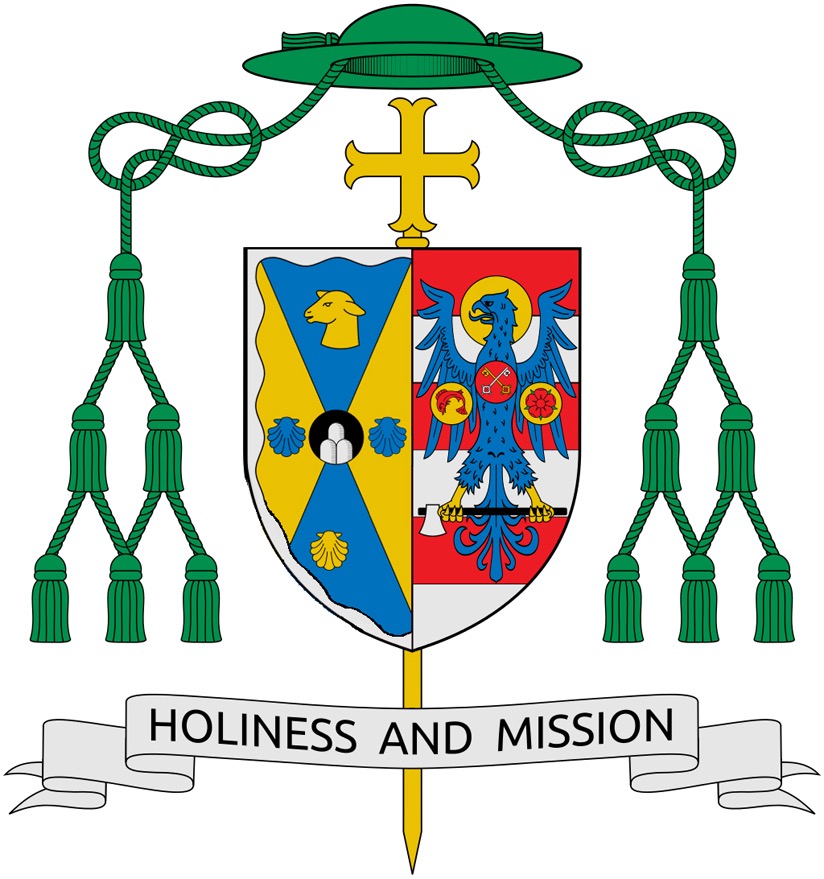
Here is the version of the coat of arms of Bp. John O. Barres of Rockville Centre, NY published by the diocese.

coatofarms-barres

Hmmmmm…as one correspondent has already pointed out the blazon says that the bishop’s personal arms have a field that is “barry of six” yet seven are depicted here. In addition, the arms of the See are blazoned as having a bordure wavy but that is barely discernible.

Archbishop Stack of Cardiff

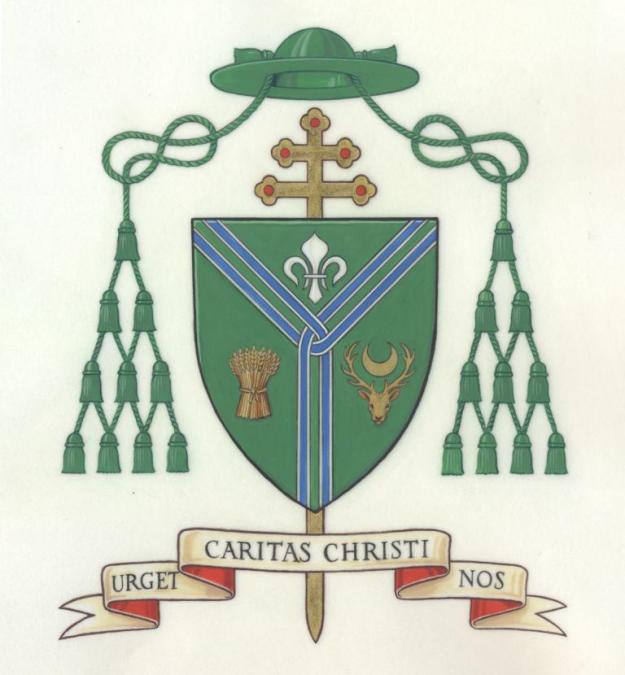
From the most recent College of Arms Newsletter: A grant of Arms was made by Letters Patent of Garter and Clarenceux Kings of Arms dated 14 October 2016 to George STACK, Archbishop of the Roman Catholic Archdiocese of Cardiff.

College reference: Grants 179/343. The blazon reads:

“Arms (illustrated below): Vert a Pall parted and fretted each piece Argent voided Azure between in chief a Fleur-de-lys Argent in the dexter a Garb and in the sinister a Stag’s Head caboshed a Crescent between the attires Or.”

stack_patent_compressed

Abbot of Conception, Missouri

On January 15 the Most Rev. James Johnston of Kansas City-St. Joseph, Missouri bestowed the abbatial blessing on the Rt. Rev. Benedict Neenan, OSB, the tenth abbot of Conception Abbey who was elected by the members of his community in November, 2016 to succeed Abbot Gregory Polan who had been elected as the Abbot Primate of the Benedictine Confederation.

0120coatofarms-abbotneemanosb

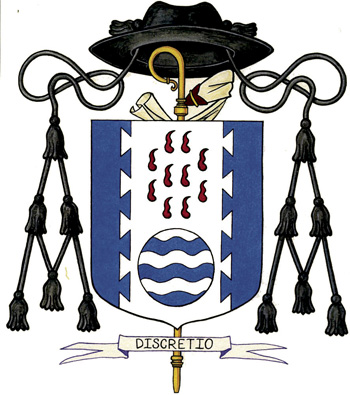
Abbot Benedict’s coat of arms, assumed upon election, are blazoned and explained as:

“Blazon: A field azure, a Canadian pale argent dovetailed, in chief ten goutte de sang (gules) (palewise two, three, three, two), in base a fountain (a roundle barry wavy argent and azure).”

The main charges of the shield (escutcheon) have particular significance for Abbot Benedict and his ministry to the monastic community. The circle with blue and white waves is called a fountain, and symbolizes the abbot’s hometown, Kansas City, the City of Fountains. The 10 blood droplets (goutte de sang) above it represent the self-sacrificial office of the abbot for the community. Ten droplets signify that he is the tenth abbot of Conception Abbey, which was founded in 1873. Abbot Benedict holds a doctorate in Church history and the two main charges —the fountain and the blood droplets — taken together evoke the Paschal Mystery that birthed the Church and which is the center of all human history, for “This is the one who came through water and blood, Jesus Christ, not by water alone, but by water and blood.” (1 John 5:6) Again, both the fountain and blood drops suggest baptism; the monastic life is often called a “second baptism” due to its deepening of the commitment to baptismal vows.

The white (argent or silver) division of the shield vertically is bordered in a dovetail pattern, calling to mind furniture joints. This alludes to the abbot’s training as a woodworker in Bavaria. The blue (azure) on either side of the central white composition represents the Blessed Virgin Mary. A traditional devotional image of the Virgin is the Madonna of Mercy, in which she spreads her mantle as protection over a group of the faithful. This symbolizes the patroness of the abbey’s protection over its monks.

-from the website of “The Catholic Key“.

An American in Poland

lynam3

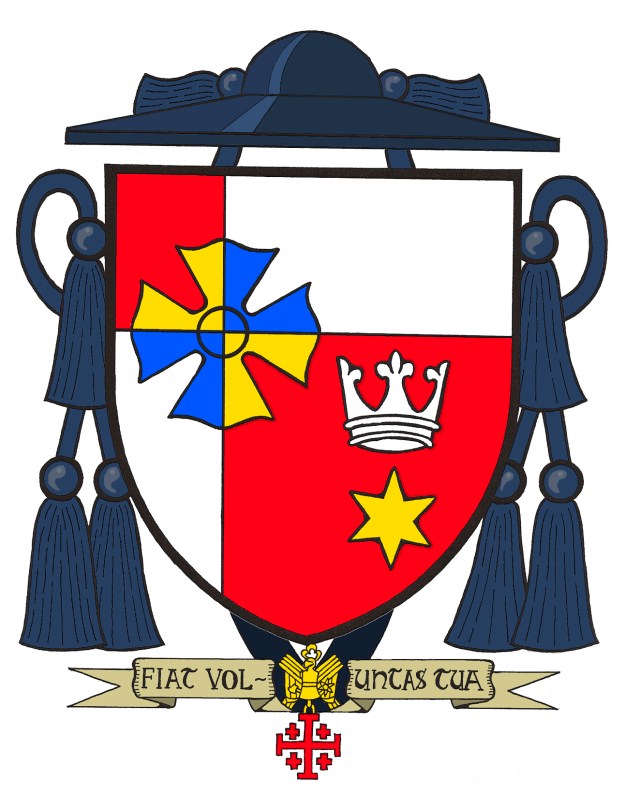
The arms (above) I recently devised for an American priest who lives and works in the USA but who, in addition to his pastoral responsibilities at home, was honored by being named an Honorary Canon of the Collegiate Chapter of the Basilica of St. Florian in Krakow.

The arms are:

Quarterly skewed to the dexter Gules and Argent; at the cross point a cross of St. Florian counterchanged Or and Azure; in sinister base above a mullet of six points Or an open crown Argent. Suspended below the shield is the badge of the Equestrian Order of the Holy Sepulcher. The shield is ensigned by the galero of a Canon Sable with cords and six tassels in two rows of one and two respectively Sable. On a scroll below the shield is the motto, “Fiat Voluntas Tua” (Let it Be Done According to Your Will).

The principal colors of the field are the Polish national colors and the division of the field alludes to the off-center cross found in the arms of St. John Paul II (who raised St. Florian Church, his own first priestly assignment, to the rank of a basilica). the cross associated with St. Florian himself is superimposed over the cross point and is colored in blue and gold counterchanged to avoid the tincture violations. These colors are also found in the arms of St. John Paul II.

In the lower right there is a six pointed star to symbolize Our Lady and it is crowned with an open crown alluding to Mary’s Queenship, the patroness of the armiger’s home diocese.

The black galero  with black cords and six black tassels indicates the bearer is a cleric with the rank of Canon, in this case, a Collegiate Canon. Being a Knight of the Holy Sepulcher he also chose to display the badge of that Order pendant below the shield from a black ribbon.

Monsignor Francis Kelly, P.A., K.H.S.

kelly3

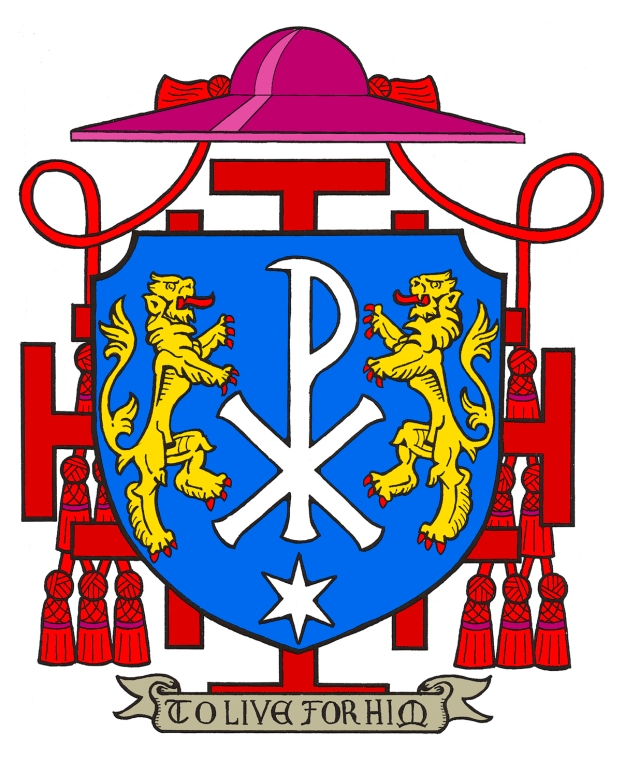
The arms (above) I recently completed for Monsignor Francis Kelly, PA a Canon of St. Peter’s Basilica in Rome. Msgr. Kelly is a priest of the Diocese of Worcester, Massachusetts who, prior to his current service worked for many years in Washington, DC for the NCEA and was also on the faculty and later became rector of Pope St. John XXIII National Seminary in Weston, Massachusetts. After his time there he spect eight years as the Superior at the Casa Santa Maria in Rome which is the graduate division of the Pontifical North American College. In 2013 he was named Prothonotary Apostolic and a Canon of St. Peter’s Basilica by Pope Benedict XVI. I met Msgr. Kelly in 1996 when I was sent for one year of studies at Pope John Seminary. We have been friends since then.

The blazon is:

Azure, between two lions rampant respectant Or, armed and langued Gules the Greek letters Chi and Rho Argent; in base a star of six points Argent. The shield is placed on the cross of the Equestrian Order of the Holy Sepulchre and is ensigned by the galero of a Prothonotary Apostolic Purpure with cords and twelve tassels disposed in three rows of one, two and three pendant on either side of the shield Gules. On a scroll below the shield is the motto: “To Live For Him”.

The blue field and gold lions are taken from the coat of arms traditionally associated with the name “Kelly”. In that coat of arms the lions are chained and they face a tower. For differencing the chains have been omitted and the tower has been replaced with the Greek letters that are a monogram for the name Christ and a star of six points. These indicate the armiger’s devotion to Christ and Our Lady.

The armiger is a Knight of the Order of the Holy Sepulcher and its cross is placed behind the shield. The purple galero with red cords and tassels indicates a Roman prelate with the rank of Prothonotary Apostolic, the highest of the three grades of prelates addressed as “Monsignor”. The members of the Chapter of the Papal Basilica of the Vatican hold this rank.

The motto expresses a sentiment the armiger has endeavored to embody throughout his entire priesthood.

Sacerdotal Coat of Arms

skoblow3

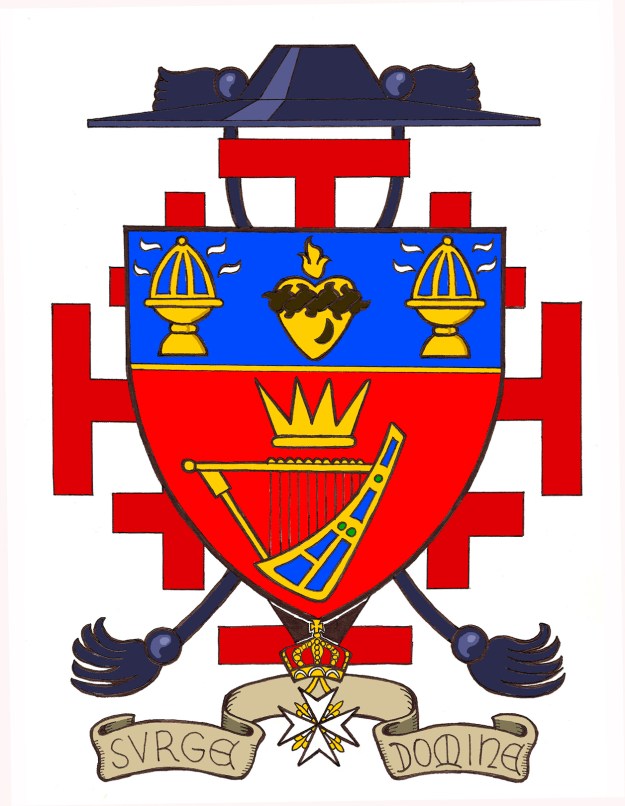
The coat of arms recently completed for a very patient priest in the USA who was ordained in May of 2015. The blazon is:

Gules, an ancient harp below an ancient crown all Or; on a chief Azure fimbriated Or between two thuribles Or with two wisps of smoke rising on either side Argent, the Sacred Heart of Jesus Or, enflamed Or wounded and enfiled by a crown of thorns Sable. The shield is displayed on the cross of the EOHS and suspended below the shield is a badge of a Chaplain of Magistral Grace of the SMOM. Ensigning the shield is a priest’s galero with cords and two tassels pendant on either side all Sable. On a scroll below the shield is the motto, “Surge Domine“.

The field is composed of two colors: a red field with a blue chief so the chief is separated from the field by a gold (yellow) fimbriation to avoid violating the tincture “rule” (which, as Heim proved in his book, Or and Argent isn’t so much a rule as a custom).

The principal charge, a crowned ancient harp, alludes to the patron of the bearer, David, the King who by tradition is considered the composer of many of the Psalms. The charges on the chief allude to the bearer’s devotion to the Most Sacred Heart of Jesus and the sacred liturgy. The two thuribles with smoke rising from them represent the liturgy itself. There are references in both Scripture and Tradition of the rising incense being like our prayers in worship ascending to the Lord. In addition, incense represents a sacrificial offering such as one finds in the Holy Sacrifice of the Mass.

The shield is ensigned with a black priest’s galero. In addition, the shield is placed on the cross of the Equestrian Order of the Holy Sepulcher in which the bearer received the rank of Knight Grand Cross prior to his ordination. The badge of the Sovereign Military and Hospitaller Order of St. John of Jerusalem, Rhodes and Malta is suspended below the shield as the bearer was a Knight in that order prior to ordination as well. Upon being ordained a priest the armiger was “translated” from being a lay knight to being a Chaplain of Magistral Grace.

On a scroll below the shield is the motto, “Surge Domine”.

Bishop Parkes of St. Petersburg

On Wednesday, January 4, 2017 the Most Rev. Gregory Parkes a 52-year-old Long Island native who has, since 2012 served as Bishop of Pensacola-Tallahassee, Florida will be installed as the fifth bishop of St. Petersburg, Florida.

At the time he was ordained a bishop and installed as the fifth bishop of Pensacola-Tallahassee he assumed a coat of arms (below) designed for him by the well-known Italian heraldic artist, Marco Foppoli:

344

Since the arms of the See of Pensacola-Tallahassee, a dual diocese with co-cathedrals, is divided per fess with each of the See’s two cities occupying, as it were, a quartering of the shield the bishop assumed personal arms that were similarly divided per fess so that when impaled on the same shield the overall effect suggests a quartered shield with a rather pleasing effect.

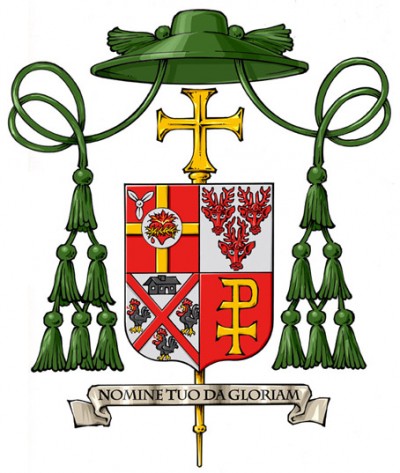
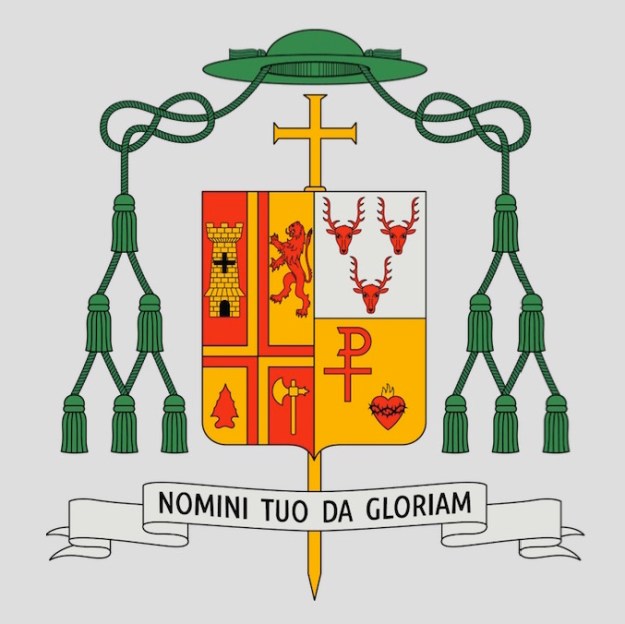
Upon his translation to the See of St. Petersburg the bishop had his arms rendered by a different artist and, according to the usual North American custom, impaled his arms with those of the very nicely designed and handsome arms of the See:

parkes2

However, we can now see that the bishop has decided to change his personal arms. Firstly, he has decided to add the charge of the Sacred Heart of Jesus in base as an allusion to the coat of arms of his former diocese, Pensacola-Tallahassee. This is not wholly a horrible idea. Rather, it serves almost as a kind of augmentation. However, having said that it also feeds into a very bad habit also present among many of the American bishops today who end up serving in more than one diocese over the course of their episcopal ministry. That is, deciding to add a charge from each place where they have served as though collecting charms for a charm bracelet throughout their lives. This, too, also gets back to the poor idea of having one’s coat of arms serve as a pictorial CV…which it decidedly is not.

I don’t know for certain but the desire to include the Sacred Heart charge which is usually emblazoned as “Proper” (shown in its natural color of red) could perhaps explain the otherwise inexplicable decision to change the tinctures of the section of the bishop’s personal arms in base from “Gules a chi-rho Or” to “Or a chi-rho Gules and the Sacred Heart Proper in bend“.

I think the bishop would have ended up with something better if he had augmented his arms by placing the Sacred Heart on an escutcheon or a bezant or plate imposed over the crossing of the chi-rho or possibly by simply placing it on a canton as a genuine augmentation. In that way he could have left the original tinctures intact and avoided what he essentially has now: an entirely new coat of arms!

Again, the translation to a new diocese is not sufficient justification for redesigning and changing a coat of arms in use for four years.

It’s sad that the age of the internet has created all sorts of new opportunities for the heraldic enthusiast as well as contributed to the proliferation of newly proclaimed heraldic “experts” and yet has, ironically and somewhat paradoxically, also led to the degradation of the quality of heraldic knowledge that is prevalent among those assisting with the preparation of coats of arms, in particular in ecclesiastical circles.

Archbishop Etienne’s Mistake

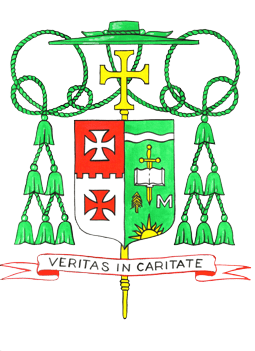
On November 9, 2016 the Most Reverend Paul D. Etienne was installed as the fourth Metropolitan Archbishop of Anchorage, Alaska. Since December of 2009, the 57-year-old Indiana native had been serving as the Bishop of Cheyenne, Wyoming. At the time of his election as a bishop he assumed a coat of arms which he bore during his tenure as Bishop of Cheyenne:
anc

The design was, in my opinion, a bit crowded and fell victim to the usual problem with most of the heraldry of the American hierarchy. Namely, he tried to include too much. Time and time again I warn on this blog and elsewhere against the practice of trying to have a coat of arms be a “CV in pictures”. Sadly, that advice seems to frequently go unheeded.

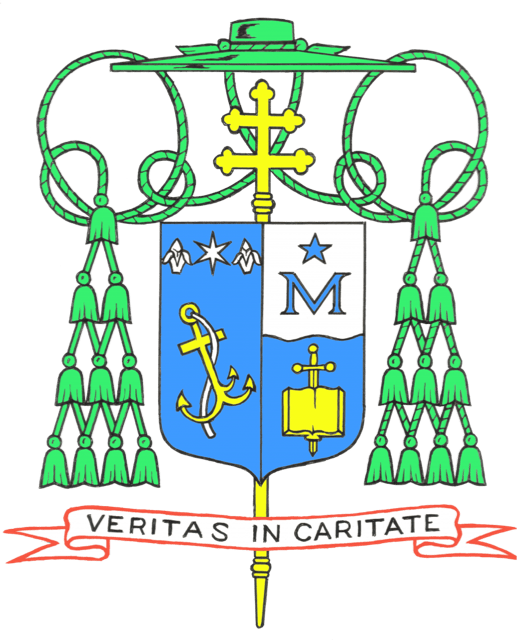
I noticed that when His Excellency was translated and promoted to Anchorage that he has assumed a new personal coat of arms:
anc2

I must say that the overall design is surely more simple and more clear. In addition, it seems apparent that upon further reflection he realized that he had included too many charges and decided that there were, indeed, some he could live without. I think its unfortunate that he decided to discard the green field because just as it contrasted so nicely with the red-dominated arms of the See of Cheyenne, similarly, the contrast with the predominantly blue arms of the See of Anchorage would have been more striking.

The overall appearance of the coat of arms as it is now is most definitely better. However, the “mistake” I believe the archbishop has made is in entirely changing the original design. He has, in fact, assumed a second new coat of arms. Many prelates feel that when they change assignments that this is a perfectly acceptable practice. It’s as if “a new coat of arms for the new job” is their thought. In addition, after having assumed arms originally, often hastily because of the unfortunate expectation that a bishop in the USA will have his coat of arms prepared and ready to be displayed at the time of his ordination and/or installation, which is an unreasonable and unnecessary expectation, the armiger has had a chance for second thoughts and wishes to make modifications. But there is a problem.

You CANNOT.

That is to say, you really REALLY shouldn’t. A coat of arms isn’t a “logo” which companies often feel free to update, modify or even discard in favor of a new one. A coat of arms is a personal mark of identification and it becomes identified with the particular armiger to whom it belongs. In places like the USA where arms are not granted by a heraldic authority but are legally and quite appropriately assumed (i.e. adopted) great care must be taken to design a coat of arms with which the armiger is happy at the time they are assumed and made public.

In the case of a bishop the personal arms should not be designed to harmonize with the arms of the See with which they will be impaled for the simple reason that bishops sometimes move and re-designing the personal arms to “go better” with the arms of the See is ill-advised. (see the three different versions of the personal arms borne by Cardinal Cupich of Chicago or Bishop Libasci of Manchester, NH. Cardinal O’Brien, the Grandmaster of the Order of the Holy Sepulcher has changed his coat of arms no less than four times!). Part of the problem is the truncated timeline with which so many bishops have to contend when the design process begins. It is not unheard of for there to be as little as six weeks in between the announcement of his appointment and the ordination/installation. The poor heraldic designer must then contend with constant pressure from diocesan officials and committee members demanding the finished artwork for use on things like invitations, programs and in press packets.

But, designing a good coat of arms takes time. Frequently the designer and the armiger will go through three or four sketches (or more) before settling on a proper design. More frequently because of the time constraint (and occasionally because of a complete lack of interest in the subject on the part of the new bishop) something deemed to be “good enough” is cobbled together in a slap-dash manner and the result is, at best, a less-than-perfect design and, at worst, downright ugly and/or ridiculous!

When designing a coat of arms for someone who is not on a three week deadline I often encourage them to use what is jokingly referred to as “the refrigerator test”. That is, they are asked to take a sketch of the coat of arms and put it somewhere, like their refrigerator, where they will see it everyday. The idea is to live with it for a time and keep seeing it over and over to see if the initial ideas have staying power. In the case of Archbishop Etienne such a test might have enabled him to see that the original design was cluttered and that those things he wanted to represent in his coat of arms could have been done with a simpler design. Part of the solution here is to abandon the idea that a new bishop’s coat of arms must be available immediately, in a manner of weeks, and in time for his ordination/installation. I can assure you that in places where arms are granted by a heraldic authority such an authority feels no obligation to do their work with such a ridiculous deadline. There is absolutely nothing that requires a bishop’s coat of arms to be finished and ready by the day of his ordination/installation. A few more weeks to get it right won’t kill anybody.

Part of this problem could be solved by bishops seeking the advice of those competent and well-versed in the principles, customs and traditions of good heraldic practice. More often than not they don’t. They need to stop turning to the myriad of lawyers, engineers, seminarians and other enthusiasts who have read “a whole book” on heraldry and have declared themselves to be “expert” in heraldic design. In addition, the computer age has also led to the advent of a plethora of the heraldic equivalent of the singer/songwriter: those people who are competent artists but who don’t really know the first thing about heraldry or its rules. They can create really nice artistic renderings but should be collaborating with a competent designer instead of trying to do it all. Expertise in DESIGNING a coat of arms and in DEPICTING that design are two very different things.

Finally, it has to be said that, in the Church anyway, it is unfortunate that those who make the most use of heraldry, prelates, are frequently the ones who both know the least about it and also frequently have little interest in learning about its proper use and application. (You know, once they make you a bishop they take the bone out of your head that allows you to remember you can occasionally still be taught something). As mentioned above, a coat of arms can’t simply be changed after several years because one feels like it. Despite the fact that it belongs to the armiger and, in many cases, was devised by him as well as adopted by him he is not free capriciously to change the design on a whim especially not after having borne a particular coat of arms for years. It is akin to deciding to use an alias after years of being known as something else. While there is no “heraldry police” in the Church to stop you it is, nevertheless, wrong to change the design of a personal coat of arms even when such changes result in the general improvement of the design.

Rather, the task is to have a well-designed and pleasing coat of arms the first time around and to use that same coat of arms no matter how often a bishop might be transferred to a new diocese. It is important to remember that impaling the personal arms with the arms of the See is a custom, not a requirement, and not even a universal one at that. It predominates in N. America but it is far from the usual custom throughout the world. When impalement is employed bishops need to remember that the dexter impalement (the arms of the See) does not become part of their coat of arms. Instead, by impaling there are two distinct coats of arms being displayed on one shield. It is a form of marshaling two or more coats of arms and even at that it lasts only for their tenure in that office. A bishop-emeritus of a given diocese has no right whatsoever to continue impaling his personal arms with the arms of the See once he has resigned that See.

The best process to use is the same one which circumstance forces onto those bishops who first become Auxiliary Bishops. Namely, they design and assume a personal coat of arms alone which fills the entire shield. Later, if they are promoted to be a Diocesan Bishop then they may choose to impale their personal arms with the arms of their diocese. If, by chance, such an impalement makes for an aesthetically unpleasing combination then the solution is NOT to change their personal arms (or the diocesan one for that matter). The better option would be for the bishop in question simply to bear his personal arms alone and not impale them at all. It is important, however, for the armiger to maintain that coat of arms which he first assumed and which has become identified with him as much as his signature or the appearance of his face. As already stated above even when the temptation is strong to re-design the coat of arms for the purpose of improving the design after further reflection such an impulse must be stifled and ignored. Once the arms have been assumed it is, frankly, too late. That’s why its better to be sure of what is being assumed in the first place; it cannot, and should not be changed later.

I have written in these pages extensively about the idea of employing various versions of a coat of arms to suit the occasion and/or office held. Sometimes, coats of arms receive legitimate augmentations to reflect some event or change in status. Frequently, the external ornaments in a heraldic achievement, even of a bishop, change or are added to in order to reflect an honor received. All of these are legitimate modifications. However, for a bishop who has assumed a coat of arms and several years later is then moved to a different diocese or some other such position within the Church simply to say to himself, “You know, I’ve had second thoughts about including thus-and-such in my coat of arms. If I had to do it over again I’d use something different. Let me take advantage of this change and the fact that new artwork has to be prepared to redesign the whole thing” is egregiously wrong and is, realistically, a gigantic abuse of his authority. After all, in the Church what a bishop wants is rarely questioned and even more rarely denied.

Nevertheless, it is of utmost importance to get it right the first time, that is, at the time of assuming the coat of arms. Changing it later ISN’T an option and bishops who ignore that are making a mistake.

(The artwork for Archbishop Etienne’s coats of arms is by Deacon Paul Sullivan)


Cardinal Tobin of Newark

On Friday, January 6, 2017 His Eminence, Joseph Cardinal Tobin,  CSsR the Cardinal Priest of Santa Maria delle Grazie a Via Trionfale and former metropolitan archbishop of Indianapolis, age 64, will be installed as the tenth bishop and sixth metropolitan archbishop of Newark, New Jersey.

A Redemptorist by Religious Profession he makes the same, long-standing error of including the arms of his Religious Order in his personal arms implying jurisdiction over it. At one time he did actually serve as General Superior of his Order and could have arguably impaled a personal coat of arms with the Order’s arms. However, he did not become a bishop, and assume a coat of arms, until after his tenure as General. As I say, it is a common error for Religious prelates but it is, nevertheless, most definitely an error.

tobin

Coat of Arms for a Priest

strouse4

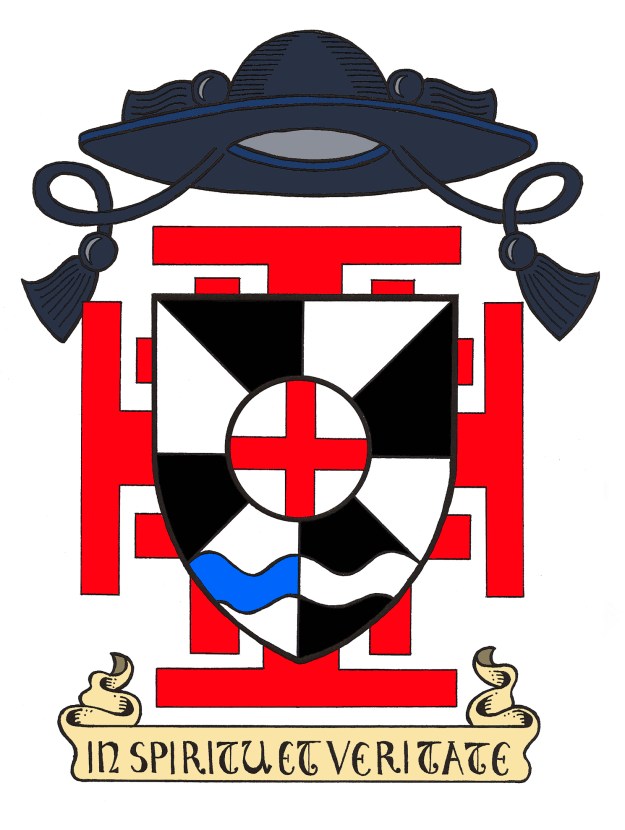
The arms (above) were recently designed and emblazoned by me for an American priest who is also a member of the Equestrian Order of the Holy Sepulchre.

The priest has a devotion to St. Anthony, his baptismal patron, and is a Third Order Dominican. The gyronny of eight that makes up the field is taken from the arms of the Order of Preachers. In addition, the black and white recalls the arms of the city of Lisbon where St. Anthony was born. The plate charged with a red cross at the center alludes to the arms of the city of Padua, where St. Anthony died and is buried. In addition, this charge represents the sacred Host used at Mass because the armiger has advanced studies in the sacred liturgy. Finally, the counterchanged wavy bar in base alludes to three things: the lake at Mundelein where the liturgical studies were undertaken at the Liturgical Institute there; his home state, Michigan, which is situated in the Great Lakes; a charge in the arms of the diocese in which he serves.

The shield is ensigned with the motto meaning “In Spirit and in Truth”, the priest’s galero and the cross of the Equestrian Order of the Holy Sepulchre.

Bishop Barres Appointed to Rockville Centre, NY

On December 9 it was announced that Pope Francis appointed the Most Rev. John O. Barres, since 2009 the Fourth Bishop of Allentown, PA, as the Fifth Bishop of Rockville Centre, NY. (the diocese on Long Island in which I was born and raised)

His coat of arms will be:


The personal arms depict red and silver bars as a canting device recalling the Bishop’s family surname “Barres.” The Bishop’s immigrant ancestor, Jacob Barres came from Prussia and first settled in Lehigh County in 1852.

The blue eagle with the halo is the symbol of St. John the Evangelist, honoring the Bishop’s baptismal name patron. The cross keys symbolically express the Bishop’s dedication and fidelity to the See of Peter and to the Pope. The dolphin is taken from the arms of St. John Fisher, and the rose represents St. Thomas More, particularly his chain of office as Lord Chancellor of England. Pope John Paul II, by motu proprio in 2000, declared Saint Thomas More the Patron of Statesmen, Politicians, and Lawyers. Both of these saints, one a prelate and one a layman, were martyrs for the Faith and remained loyal to the Church and the Holy See. Their symbols are depicted in red to indicate their martyrdom. The axe represents President Abraham Lincoln of whom the Bishop is a great admirer.
They are impaled with the arms of the See of Rockville Centre adopted in 1957. These arms are based on the history of Long Island and the etymology of the name Rockville Centre. The colors of the field within the bordure, gold and blue, appears on the coat of arms of King William III of the House of Nassau and on the arms which the county of Suffolk in England has used at times, these arms being those of Ipswich. Although there are more than 12 names for Long Island, the name generally preferred by the Indians of the mainland was Seawanhacky or “Island of Shells.” The scallop shell is also truly heraldic, and a symbol which is often used to signify the flowing of water in the Sacrament of Baptism.

The wavy silver bordure is the heraldic equivalent of water and surrounding, as it does, the other charges, signifies the insular nature of the diocese. The lamb’s head is the symbol of St. Agnes, virgin and martyr, the titular of the Cathedral of the Diocese of Rockville Centre. St. Agnes has been represented with a lamb, the symbol of her virginal innocence, since the Middle Ages.

The black roundel in the center of the shield with the three stones or rocks affords canting arms for Rockville Centre. The black roundel is in the exact center of the shield. The three rocks or stones are derived from the coat of arms of Pope Pius XII, who established the new Diocese of Rockville Centre in April, 1957. The roundel is tinctured in black to represent the seventeenth century name of Brooklyn, from the diocese from which the See of Rockville Centre was separated. The black tincture represents the marshes, which recalled to the Dutch their homeland in Breuckelen in the Province of Utrecht. The Dutch who first settled Brooklyn called it “Breuck-Landt’” meaning “broken land,’ or “marshland,” inasmuch as a great deal of the land was broken up by patches of water.

Barres will be installed in Rockville Centre on January 31, 2017.

Bishop of Aachen

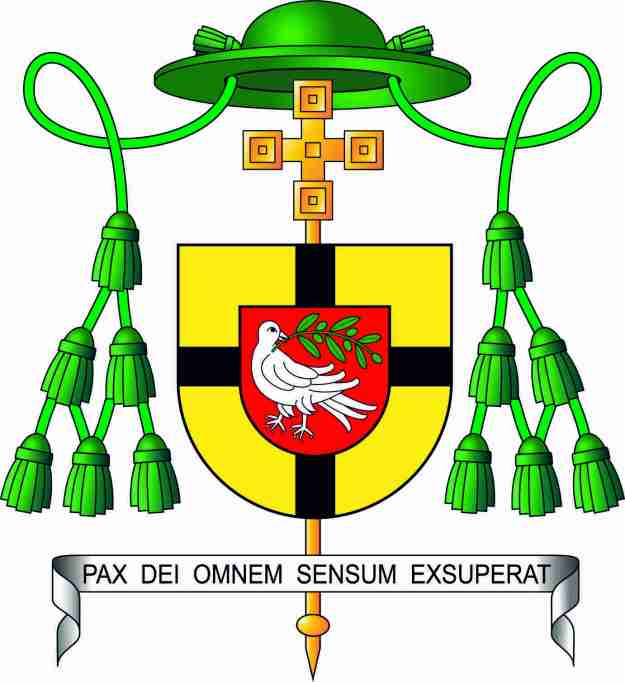
On November 12 the Most Rev. Helmut Dieser was installed as the VI Bishop of Aachen, Germany. His coat of arms is:

wappen-bischof-dieser-gr.jpg

The description (translated from the diocesan website) is:

The coat of arms of the new bishop of Aachen shows two motifs in the shield: the one stands for the diocese of Aachen, and the other identifies the person of the bishop.The Diocese of Aachen has a black cross on a golden ground in the shield. In the smaller Mittelschild, the person of Bishop Dr. Helmut is designated.

The middle shield shows a silver dove against a red background with a green olive branch in its beak. The new bishop accepted this motif from his former coat of arms as an auxiliary bishop in Trier. It symbolizes his episcopal motto from the Philippine letter: “The peace of God exceeds all understanding“. The two colors red and silver also recall his origin from the diocese of Trier, which is a red cross in front of a silver ground in the shield. The dove with the olive branch is used in Christian art as a symbol of the new peace that God wants to bring to all his creation. This goes back to the biblical narrative of Noah and the great flood in the Book of Genesis. When finally the water no longer rises and gradually begins to flow away, Noach lets a dove fly from the ark several times. The second time she comes back with a fresh olive branch in the beak (Gen 8, 9-11). Noah understands: God does not want to spoil the earth, but makes it back to the homeland for life. God creates a new peace, which Noah and his own may accept in faith.

Peace, which surpasses all understanding, and which the whole of creation longingly waits for (see Romans 8: 21-22), arises from the greatest love of God, in which he gives his Son, so that all may come to the new life. The embellishments surrounding the coat-of-arms signify its bearer as a bishop: the green hat with six green tassels on each side, and the gold episcopal cross.

Armigerous Candidates for US President

This is one of those posts that has absolutely nothing to do with the heraldry of the Church. Those do come up occasionally on this blog but I try to keep them to a minimum. I couldn’t let this opportunity pass, however, to discuss how, for what must be the first time in a quite a while (although its not unprecedented) both of this country’s major party candidates are heraldically connected, so to speak.

The Republican candidate, Donald Trump, is well known as a business man with hotels and resorts around the world. One such property is the golf course he built and owns in Scotland. To make it “look good” a logo for the place in the form of a coat of arms (not a particularly good one, in my opinion) was devised and used on their promotional materials. The problem is that Scotland happens to be one of the few countries where they take heraldry and the public use of heraldry very seriously.

The body that regulates heraldry in Scotland is the Court of Lord Lyon and indeed it is a standing civil and criminal court under the Scottish legal system. The incumbent of the office of Lord Lyon King of Arms is usually a lawyer well versed in the laws affecting genealogy and heraldry and he sits as judge over cases of dispute. By contrast the English Heralds are incorporated into a College and while there is Her Majesty’s High Court of Chivalry which has existed since the 14th C. and sits as a civil court to regulate all matters of English and Welsh heraldry it rarely sits. The last time was in 1954 for the case of Manchester Corp. v. Manchester Palace of Varieties, Ltd. Prior to that the court hadn’t sat for 200 years!

djt

Trump’s self-designed and adopted coat of arms (above) ran afoul of the Scottish legal system in 2008 when it was asserted that he had no right to use the coat of arms. In 2012 the Court of Lord Lyon ruled in Trump’s favor and now he may make use of the coat of arms originally designed for his Aberdeen golf course. Trump’s mother is of Scottish origin and Lord Lyon claims jurisdiction worldwide over any Scot, even expats, or anyone with Scottish ancestry. Unfortunately, I do not have an image of the coat of arms in full color. I wonder if anyone in the Trump organization even bothered to have one made in full color since this is primarily used as a logo.

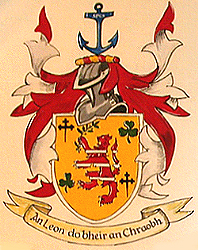
The Democrat Party candidate, Hillary Clinton, does not, as far as I know, have a coat of arms in her own right, but her husband does. In 1995, at the request of the Taoiseach (the Irish Prime Minister), Mr. John Bruton, the Chief Herald of Ireland devised and granted a coat of arms to Mr. Clinton whose mother was of Irish ancestry (below). It was presented to him as a gift on his state visit to Ireland. As I say, Mrs. Clinton does not have a coat of arms in her own right, at least not yet. Who knows? It is possible that another head of state may be asking another heraldic authority to grant her a coat of arms at some point in the future. Only time will tell.

clint-bk

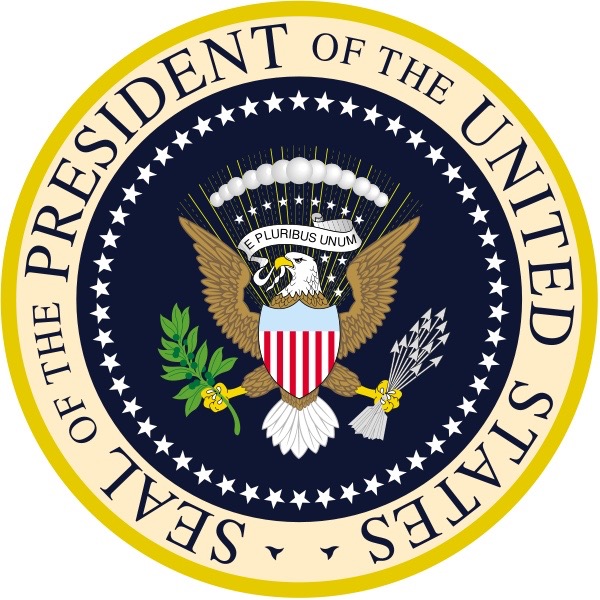
Of course the way the election on November 8 will turn out remains to be seen and there is a great deal of speculation on both sides. It does seem to be far from certain even at this very late stage in the campaign. But, one thing is, nevertheless, absolutely certain. Regardless of the result of the voting that will take place across the United States next Tuesday one of the two people mentioned above, Trump or Clinton, come next January 20th will be able to make use of yet another old and venerable means of identification that employs the ancient and respected use of heraldry as a large part of its symbolism. It’s an armorial seal…

600px-seal_of_the_president_of_the_unites_states_of_america-svg

Bishop Rodríguez

Today, November 4, in Denver, CO the Most Rev. Jorge Humberto Rodríguez-Novelo is to be ordained Titular Bishop of Azura and Auxiliary Bishop of Denver.

His coat of arms was designed by the Vicar General of the Archdiocese. However, early on in the process, very shortly after the bishop’s appointment was announced, the director of the Office of Worship of the Archdiocese contacted me to ask if I might be willing to act as a consultant during the design phase of the project which I was happy to do. In fact, I explained, this is really and truly the area of heraldry where I am most at home. I am far from a great artist but my real expertise is in the designing of a good coat of arms. I can tell you all the “whys and wherefores” about what goes into a good design. Once again, we see that heraldry is both an art and a science. It is not primarily the realm of the heraldic artist. Rather, first and foremost the whole thing must start with someone who is knowledgeable about the rules, customs and history of heraldry as well as have a good eye for composition, balance and proportion. I am far more at ease with the work of the herald than that of the heraldic artist.

Since its beginnings, and right down to our own day, the work of heralds has involved the devising, granting and recording of coats of arms. However, it has also included expertise in genealogy and family history, protocol and ceremony. In addition, it is rare that the herald actually renders the artistic depictions of the arms he designs. That task is left to those with expertise in drafting and art who are usually contracted independently by the herald or by the armiger to create beautiful emblazonments.

I have always been one of those who comes down firmly in this debate on the side of the herald, not the artist, as the person who does the “real work” of heraldry. This is not to disparage heraldic artist, whose work is not only painstaking and highly detailed but requires tremendous skill as well as training. But, the simple truth is that one can still paint a coat of arms while at the same time knowing absolutely nothing about the science of heraldry whereas one cannot claim to be competent at designing a coat of arms simply because one can paint or draw well. The heraldic world is best served when both act together in tandem to produce beautiful and correct heraldry.

Over the last thirty-three years my focus has been on learning as much as I can about the science of heraldry and only dabbling as an amateur in producing heraldic artwork. I do not now, nor have I ever, claimed otherwise. So, when a person contacts me to ask me to paint their coat of arms I usually balk but when they ask me to consult on a design I’m right in my comfort zone, as well as my “competency zone”.

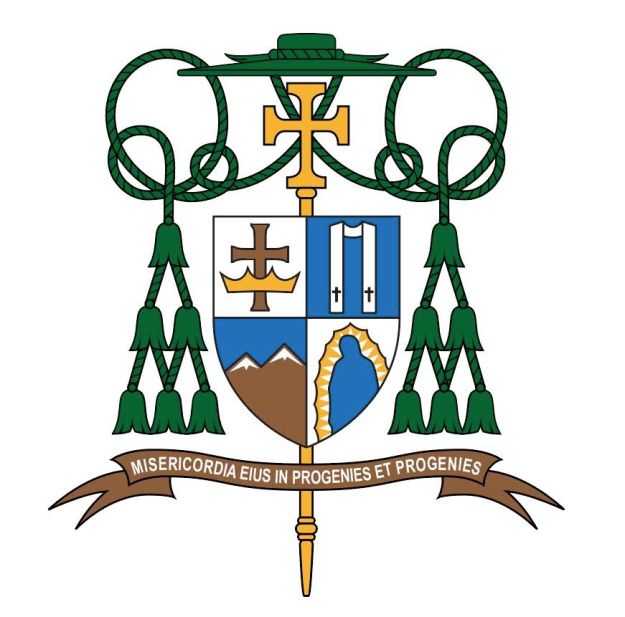
In the case of the coat of arms of Bishop Rodríguez there were several elements of his life and ministry he wished to represent in his coat of arms. In Denver they came up with an initial design, very much a work in progress and then asked for my in put. The bishop wanted to represent Christ the King, priestly ministry, the local church in Colorado and Our Lady of Guadalupe. This is the first draft:

rod1

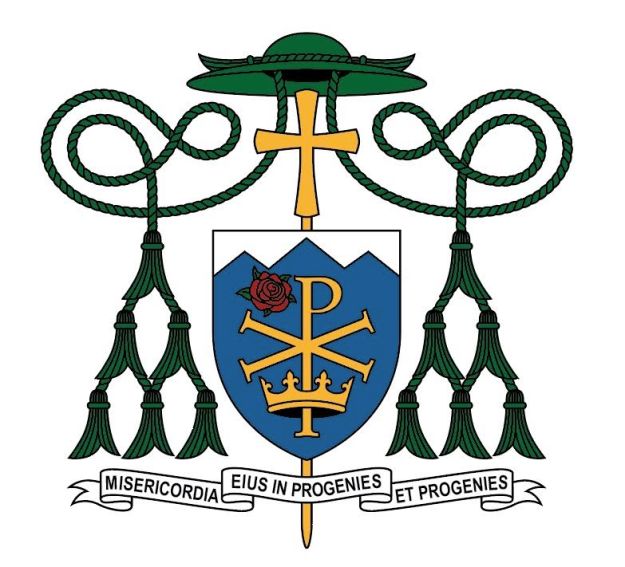
After some discussion back and forth I made several proposals that sought to unify the imagery and create a single, more simple, more bold design. The first thing to be avoided was falling into the trap of quartering the field and then filling each quarter with things. It was also important to avoid the use of the color brown as this is not one of the tinctures used in heraldry. Since the symbol for Christ the King occupied the first quarter and was, in a sense, the principal element to be represented we first moved to create a large compound charge of the crowned Chi-Rho. This, then alludes to Christ, the King as well as to priestly service as all priests share in the High Priesthood of Jesus. Then it was a simple matter to allude to the Rocky Mountains of Colorado by a division line in the field and to add the rose as a fitting heraldic charge that is frequently used as a reference not only to Our Lady in general but to Guadalupe in particular. This is because of the roses that bloomed in December which were brought by Juan Diego to his bishop who asked for “proof” of the apparitions. I originally proposed placing the red rose on the silver chief or changing it to a golden rose. However, the bishop really wanted the rose depicted in the traditional red so we cheated a little on the tincture rule (avoiding a color on a color or a metal on a metal) by blazoning the rose as “Proper” which does permit such violations in the case of charges that are depicted Proper. After some of my suggestions were considered a second draft was prepared in Denver which also changed the general shape of the episcopal cross behind the shield and the galero and tassels in order to give the whole achievement a look that was unique. This draft met with the new bishop’s approval. So, the arms he has assumed today are:

rod2

These arms were designed and emblazoned by Fr. Randy Dollins with me acting as design consultant.


John Cardinal Ribat, MSC, KBE

(Sir) John Ribat, MSC, KBE currently the Archbishop of Port Moresby, Papua New Guinea, will be elevated to the Sacred Purple and created Cardinal of the Holy Roman Church on November 19, 2016. We’re not concerned with his coat of arms as they would have appeared upon his ordination to the episcopacy as Auxiliary Bishop of Bereina, PNG in 2001. Rather, since 2008 when he succeeded as Archbishop of Port Moresby he has born the arms:

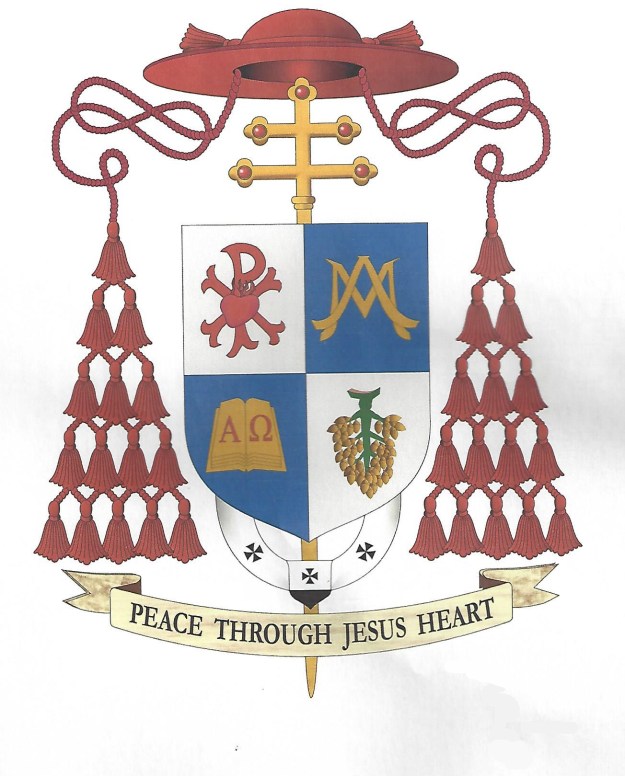
Quartered; 1) Argent, the Sacred Heart of Jesus enflamed superimposed on the Greek letters Chi and Rho all Gules, 2) Azure, the monogram of Our Lady Or, 3) Azure an open book Or the pages charged with the Greek letters Alpha and Omega Gules, 4) Argent, a branch of betel nut Proper.

0

These arms had been rendered for him by Renato Poletti, a Roman lawyer who, like many amateur heraldic enthusiasts, dabbles in heraldic design and produces his artwork on computer. He took it upon himself, unsolicited, to produce a new rendering of the Cardinal-designate’s coat of arms with the external ornaments of a Cardinal (above). However, Archbishop Ribat had already been contacted by Mr. Richard d’Apice of the Australian Heraldry Society to discuss a re-working of the emblazonment of his arms to reflect his new honor. Such projects have frequently been undertaken by Mr. d’Apice before as well as the designs of new coats of arms for many prelates and laypeople in his own Australia. Mr. d’Apice, as he often does, consulted with me to seek some advice and input.

While I do not particularly like the design of the arms I advised that it would be best at this point for a man who has been a bishop for fifteen years and an archbishop for eight to retain the arms he has been using. The deplorable habit so many bishops have today of completely redesigning their coats of arms every time they move or are promoted is to be avoided at all costs, even at the cost of maintaining a coat of arms of an inferior design. Simply to change one’s personal arms because there has been a change in office or rank goes against the whole point of heraldry as a mark of personal identification. While external ornaments correctly change to indicate a change in rank and personal arms may be marshaled with other coats of arms simply deciding after several years that one would like to adopt a different coat of arms is, in a word, wrong.

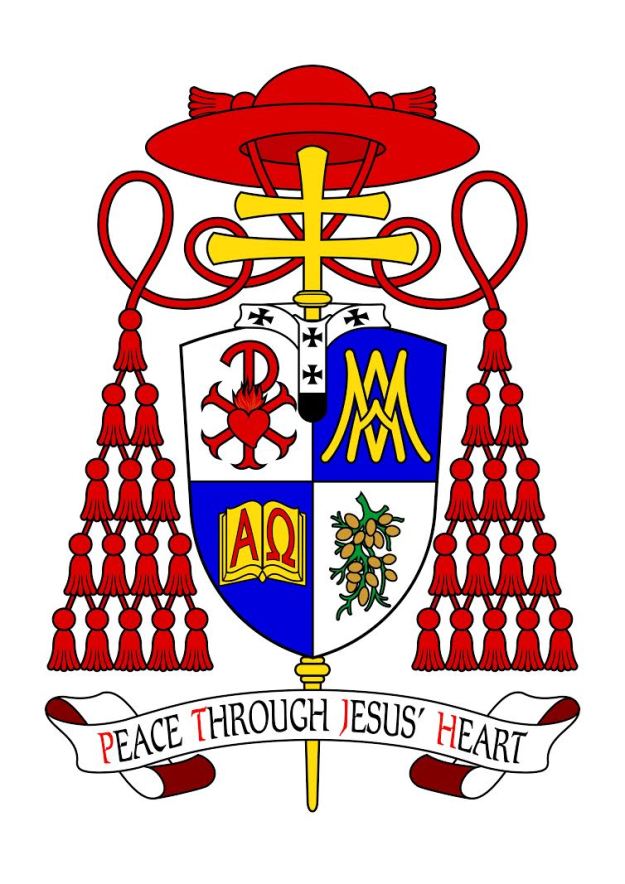
However, it is often the case that a different artist can emblazon a coat of arms in a manner that will make it both aesthetically more pleasing as well as heraldically more bearable (pun intended). This is the case with the arms of Cardinal Ribat. Mr. d’Apice and I agreed that perhaps the best thing we could do was to advise His soon-to-be Eminence to have the arms rendered by the artist with whom we usually work, Mr. Sandy Turnbull, also a member of the Australian Heraldry Society who also works in computer generated artwork. The result of Mr. Turnbull’s efforts may be seen below.

ribat

The overall shape of the achievement and the rendering of the charges, in particular the fact that they fill the field in each quarter better, as well as the depiction of the branch of betel nut are definitely an improvement. The placement of the pallium (which, for the record, I oppose in any heraldic achievement) is also better. In addition, the color palette and vibrancy of the colors is, in my opinion, also superior. The Cardinal-designate was so pleased that he communicated to Mr. d’Apice through his Vicar General that Mr. Turnbull’s rendering will be used, in particular, on his letterhead and official documents. It is indeed difficult to make a silk purse out of a sow’s ear but, on occasion, the solution to what to do about a less than happy heraldic design is simply to emblazon the arms in a better fashion.