Bishop Siegel of Evansville

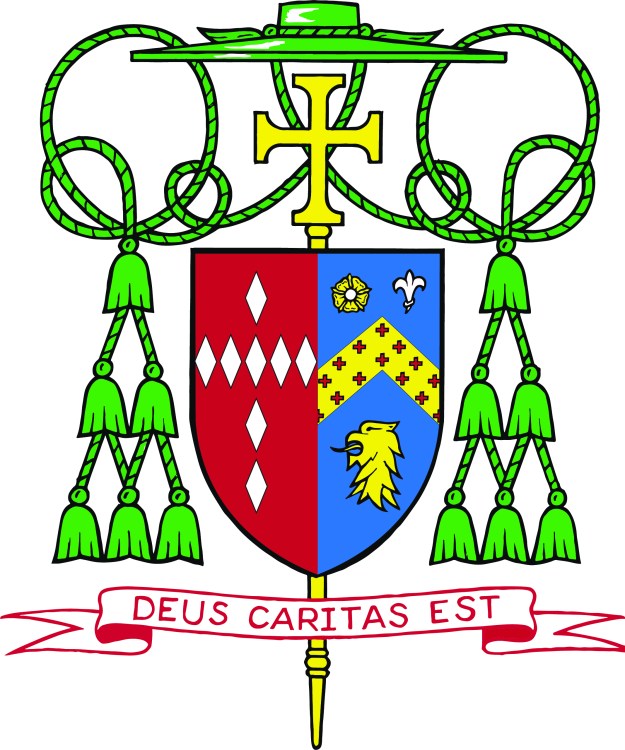
On December 15, 2017 the Most Rev. Joseph M. Siegel (54), Auxiliary Bishop of Joliet, Illinois will be installed as the sixth Bishop of Evansville, Indiana. His coat of arms is:

p01__coat_of_arms__bishop_joseph_m._sigel__diocese_of_evansvillepage0011

Bishop Siegel of Evansville has correctly impaled his own personal arms, assumed when he was first made a bishop, with those of the See of Evansville. His is a pretty standard type of arms assumed by many American bishops. There’s nothing particularly bad about the design, except for that tendency, in which he is hardly alone among American bishops, to use what is often jokingly referred to as the “lucky charms” style of heraldry. That is, it includes too many charges attempting to represent too many things. Time and again I remind bishops that their coat of arms is not their CV in pictures. Time and again they adopt designs that attempt to do just that. Bishop Siegel’s coat of arms isn’t bad; it just isn’t very good either. There is a lack of coherency to the design.

Bravo to him, however, that in being translated from Auxiliary of one diocese to Ordinary of another the only change is to impale his personal arms with those of the See. He made no changes to his personal arms and did not see his translation to a new See as an opportunity to change his personal arms. This is, as readers of this blog will know by now, a pet peeve of mine and a problem which is occurring with increasing frequency. Too many bishops, advised by self-proclaimed “experts”, are tweaking, slightly changing or even entirely redesigning their coats of arms when they move from one diocese to another. This is why it is important to settle on a good design at the time arms are assumed. You CANNOT change them later on a whim! Your coat of arms identifies you. Moving to a new assignment doesn’t change your identity.

I also find it unfortunate that the arms of the See of Evansville continues to be depicted with a chief that is too narrow. The standard in heraldry is that a chief should occupy the upper one third of the field.

Bishop Thanh Thai Nguyen

On December 19 the Most Rev. Thanh Thai Nguyen, 64, a priest of the Diocese of St. Augustine, Florida will be ordained the Titular Bishop of Acalissus and Auxiliary Bishop of Orange, California.

His coat of arms, designed by J.C. Noonan is:

Coat-of-Arms-Color-and-trans-background-768x1077

This is a pretty typical design from what we have come to see from Mr. Noonan. As usual, he insists on personalizing the external ornaments by added symbols to the episcopal cross which, strictly speaking, should not and may not be done. The blazon of a coat of arms (its written description which describes the elements unique to that coat of arms and so, contains the essence of that particular coat of arms) concerns only that which appears on the shield. The external ornaments are enumerated in Roman Catholic heraldic custom but they are generic, not specific. In addition, for some reason the ribbon for the neck badge of the Equestrian Order of the Holy Sepulchre has been depicted here as brown. It should be black.

The wavy lines, lambs and lily in chief are a reference to the importance of waters in the bishop-elect’s personal journey, the 23rd Psalm and St. Joseph. The pelican in her piety is symbolic of the Eucharist and the arch of stars a reference to Our Lady under the title of Our Lady of La Vang.


Cardinal Montezemolo R.I.P.

Andrea Cardinal Cordero Lanza di Montezemolo has died. He was a great diplomat for the Holy See and contributed much to the field of heraldry. But, with respect, I disagreed entirely with his ideas about papal heraldry. His encouragement of Pope Benedict to discontinue the use of the triregno heraldically was a mistake. Still, the large part of his service to the Church was outside the field of heraldry and he served the Lord and the Church well. Requiescat in Pace.

Bishop Flesey Retires

On October 16, 2017 the Holy Father accepted the resignation of Bishop John W. Flesey, Titular Bishop of Allegheny and the Auxiliary Bishop of Newark, New Jersey.

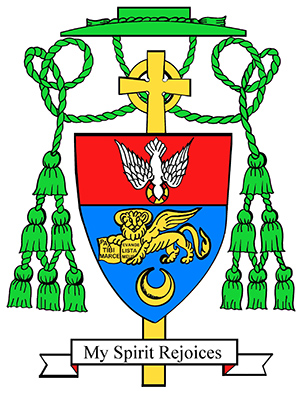
Auxiliary Bishop-Emeritus’ Flesey’s arms are:

flesey-coatofarms

The shield bearing the personal arms of Bishop Flesey has been designed to reflect his personal history and ministry.  The principal colours are blue and red, which when combined with the charges upon the shield in white, recall the colours of the shield of the Archdiocese of Newark.  A further connection with the Archdiocese is made by the insertion of the crescent at the base of the shield which represents Our Lady of the Immaculate Conception, the principal patroness of the Archdiocese and Immaculate Conception Seminary where Bishop Flesey studied and taught for many years.  In the centre of the shield is the Lion of St. Mark, one of the four living creatures of the Book of Revelation (Revelation 4:7), which from earliest times has been associated with St. Mark, the author of the oldest Gospel.  In this context, the Lion is drawn to recall the Lion on the coat-of-arms of Blessed Pope John XXIII who borrowed it from the City of Venice where he served as Patriarch (Archbishop).  It was Pope John who summoned the bishops of the world to the Second Vatican Council; the changes in the Church (aggiornamento) brought about by the Council have established the context in which Bishop Flesey has exercised his priestly ministry.  The Lion also recalls Bishop Flesey’s home parish, St. Aedan in Jersey City where the symbols of the Evangelists are carved on the façade (but he did  develop a fondness for Venice during the years he spent in Rome).  At the top of the shield is a chief, a heraldic device often used as an augmentation to personal arms denoting an honour or membership in a group.  In this case, the chief refers to Bishop Flesey’s doctorate in spirituality.  It depicts the Holy Spirit descending with Wisdom and Grace fulfilling the promise of Jesus given to the Apostles that he would send the Spirit to instruct them in all Truth (John 16:13).

(from the Archdiocesan website)

20 Years Armigerous!

On September 27, 1997 I was ordained a priest. This year marks the 20th anniversary not only of my sacerdotal ordination but also of that moment when, being a priest, I assumed a coat of arms. I had been designing, tweaking and modifying a design of my own coat of arms since i first began to settle on a design of my own in 1984. But, the various versions of a coat of arms that I had, which consisted of simply a shield and motto with no other external ornaments, was never really “used” by me. In other words, I hadn’t put it on anything or made any kind of public use of it.

This was for two reasons. First, I knew it was still a work in progress. It would take me from 1984 and that initial, rather poor, design all the way until 1992 until I was truly satisfied with the design of my coat of arms. Second, I didn’t want to adopt the arms with the usual external ornaments of helm, mantling and crest only to exchange them for a priest’s galero when the day came. I preferred to wait until I was entitled to use the galero, so I waited until ordination.

Padre don Guy Selvester

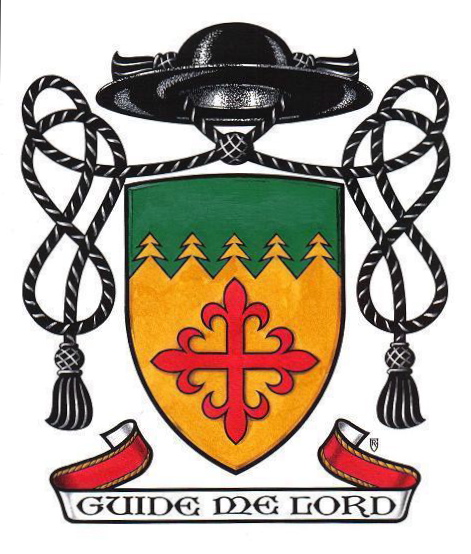
Shortly after my bishop called me in to tell me that my ordination had been decided for certain (8 months earlier than anticipated , as it turns out) I contacted the late Richard Crossett, an American heraldic artist of great talent. He got to work right away in late July, 1997 and I had the finished artwork by late August in plenty of time for my Sept. 27th ordination. His artwork was used for the program cover at my First Mass and I also registered the arms with the American College of Heraldry on whose Board I now happily serve. The blazon is: “Or, a Greek cross fleury Gules; a chief sapiné Vert“.

I always liked Mr. crossest’s interpretation of my coat of arms. I’ve been fortunate to have a couple of dozen renderings of my coat of arms done over the years but I’ve always considered this one to be special. I don’t have an “official” version of my arms since they are assumed, not granted as is perfectly acceptable and is, indeed, the norm in the context of being an American. Nevertheless, this is what I consider to be the closest thing to an official version of my personal arms, primarily because it was the first time I had them rendered by someone other than myself and because it was done in conjunction with my ordination. This coat of arms was one of the ways I marked becoming a priest.

Twenty years later that motto is still my daily prayer: “Guide Me, Lord”.

Archbishop Pierre, Nuncio to the USA

The coat of arms of the Most Rev. Christophe Pierre, Titular Archbishop of Gunela, a Frenchman from Rennes who currently serves as Apostolic Nuncio to the United States of America, can be seen below:

614312-CoatOfArms

The motto chosen for the Coat of Arms is Si Scires Donum Dei (“If you knew the gift of God” – John 4:10). A woman of Samaria was sitting by the well when Jesus asked her for a drink of water … “Jesus answered her, if you knew the gift of God and who it is that is saying to you, ‘Give me a drink,’ you would have asked Him, and He would have given you living water.” John 4:10
The white animal is an ermine “passant argent gorged or and lampassed gules” as represented in the Coat of Arms of Saint-Malo, the Archbishop’s home town. The legend says that the ermine would rather die than to have her white fur stained.
The rock represents the granite rocks of Brittany. It is strong enough to resist the constant assaults of the sea. It is therefore a symbol of solidity. The surname of the Archbishop, “Pierre”, is the French translation of rock or stone. The Archbishop has also received the mission to represent the Successor of the first Pope, named by Jesus as Cephas (rock or stone).
The river crossing the shield represents the water the woman of Samaria was looking at (the well of Jacob) when Jesus offered to give her living water. It represents also the river which St. Christopher (“Christ-bearer”) was helping people to cross over. Once, a child on his shoulders became suddenly heavy and was revealed to him as being Jesus himself.
The Coat of Arms was designed by Xavier Pierre, a younger brother of the Archbishop. He passed away in 1999.

Cardinal Murphy-O’Connor: RIP

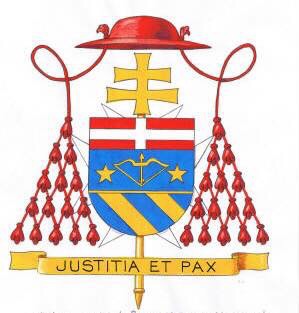
His Eminence, Cormac Cardinal Murphy-O’Connor, 10th Archbishop of Westminster died today in the UK after a battle with cancer. He was 85.

Brasão_Card._Murphy_O'Connor

He became the 10th Archbishop of Westminster in March 2000 and “de facto” the leader of the Roman Catholic Church in England and Wales. Cardinal Murphy-O’Connor retired from the role in 2009 and was the first archbishop to do so. Born on 24 August 1932 in Reading, Berkshire, Cardinal Murphy-O’Connor was one of six children. Two of his brothers became priests while another played rugby for Ireland. He was ordained priest in Rome in October 1956 and was made Cardinal-Priest in the title of Santa Maria Sopra Minerva in 2001 by Pope John Paul II.

His coat of arms (above) was originally designed by the late Bruno Heim when Murphy-O’Connor was named Bishop of Arundel & Brighton in 1977. Later they were impaled with a modified version of the arms of the See of Westminster as recorded at HM College of Arms in London.

May he rest in peace.

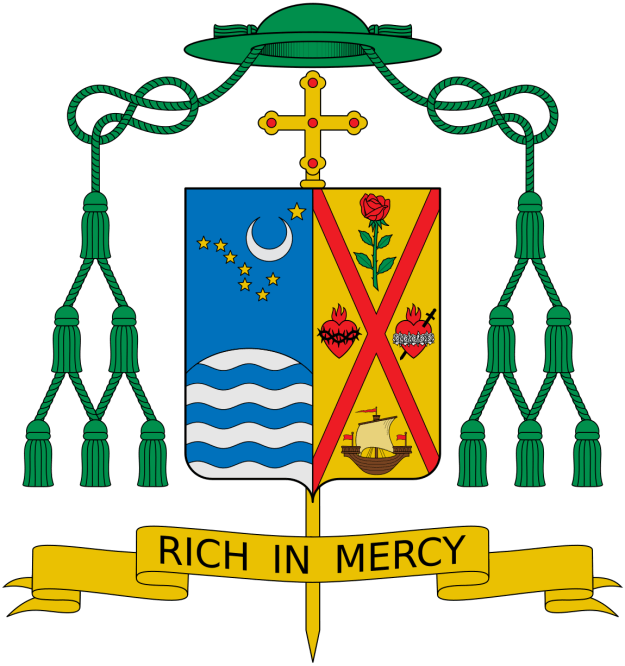
Bishop Zarama of Raleigh

On August 29, the Most Rev. Luis Rafael Zarama, until now the Auxiliary Bishop of Atlanta, will be installed in the brand new cathedral as the Sixth Bishop of Raleigh, North Carolina. His coat of arms (below) is explained on the diocesan website:

ZaramaCrest_final

On a blue field is displayed an extra wide chevron of Gold (yellow). This device gives the illusion of two mountains; a gold one and a blue one. The gold mountain (the chevron) is charged with a scattering (semé) of red crosses to represent the bishop’s home city of Pasto, in southwestern Colombia, which is known as “The Theological City.” The lower mountain (part of the blue field) has a golden lion’s head to represent the Evangelist, Saint Mark, who is the titular patron of the parish in Clarkesville, Georgia, on a mountain, where Bishop Zarama served as pastor.

Above the chevron are a gold rose for Saint Theresa of the Child Jesus, also known as “The Little Flower,” and a silver (white) lily for Saint Joseph, the Foster Father of Jesus, who have served as Bishop Zarama’s particular patrons throughout his life as a priest and now as a bishop.

(Paul Sullivan is the artist)

Heraldry For Parish History

Among the various ways that a parish community can record and mark its history is through the use of heraldry. Many are familiar with the custom of churches having incorporated into the architecture of the building, or in a church building’s decoration, the coat of arms of the reigning pope and the bishop at the time the church was constructed or consecrated. The use of the coats of arms of the pastors who have served the parish can be similarly used.

In a previous assignment where I served as Rector of a Shrine Church I entered into a project to devise what would be considered attributed arms for all of my predecessors so that the tenure of each Rector could be remembered by means of a coat of arms for each displayed in the Rectory Office. I was even able to devise a coat of arms for my successor as well!

I arrived at my current parish assignment as Parish Administrator, a common practice in many dioceses including my own. The idea is to have a new priest serve as Administrator (a temporary appointment) for a time until it is determined if the man is a “good fit” for the parish at which time, usually one year, he would be appointed Pastor with a six-year renewable term. In my case I served as Administrator for two years because as the end of my first year was approaching our bishop resigned and a new bishop arrived who wanted to take some time himself to settle in to the diocese before making any major decisions.

At the time my tenure as Administrator began I devised a coat of arms for the parish community. In June of this year I was appointed Pastor of the parish and my official Installation takes place later this month. To mark this start of a new chapter I decided to undertake a similar project of devising coats of arms for my predecessors to be displayed in a suitable place somewhere in one of the parish buildings.

There have been 23 priests in charge of St. Joseph Church, Washington, New Jersey since its establishment as an independent parish in 1871. Of those 23 one of them, Rev. John Eagan, served here for only 11 months in 1943 as Administrator. In addition, one of the priests, Rev. John Auchter, actually served here for six years but was never an incardinated priest of the Metuchen Diocese. Rather, he was and always remained, a priest of the neighboring diocese of Allentown, Pennsylvania on loan to the Metuchen Diocese. Consequently, he only had the title “Administrator” but was, for all intents and purposes, the Pastor of this parish as much as any of the others. So, while Fr. Eagan is not counted among the Pastors of St. Joseph Fr. Auchter is counted among their number. As a result I find myself now as the 22nd Pastor of St. Joseph.

For the purposes of this project I found it rather daunting to face the prospect of devising 21 attributed coats of arms. Therefore, I decided to try and pare down the list. But, what criteria should I use to do so. I decided to look at the entire history of the parish in stages. At its foundation in 1871, by Bishop James Roosevelt Bayley, the nephew of St. Elizabeth Ann (Bayley) Seton, the parish was part of the then Diocese of Newark which, at that time, covered the entire state of New Jersey. Just ten years later, in 1881, the parish became part of the newly established Diocese of Trenton encompassing eight counties in the central part of New Jersey. A century later St. John Paul II decided to separate the four northern counties of Trenton and erect the Diocese of Metuchen in November of 1981. Once again, the parish of St. Joseph found itself in a new diocese. It was this last separation, becoming part of the diocese in which it currently finds itself, that I decided to use as my dividing line. At least for the time being this project encompasses the coats of arms of the seven Pastors the parish has had since the erection of the Diocese of Metuchen. At some point in the future other coats of arms can be added until all the Pastors are represented.

Creating attributed arms is both a challenge and a lot of fun. All but two of my predecessors are deceased and the living ones could not be easily consulted. In addition, two of the seven who served here since 1981 are non-armigerous because, sadly, they both were convicted of crimes and sentenced to prison. As such, it is not appropriate to devise coats of arms for them and had they been armigerous the privilege of having a coat of arms would have been lost to them.

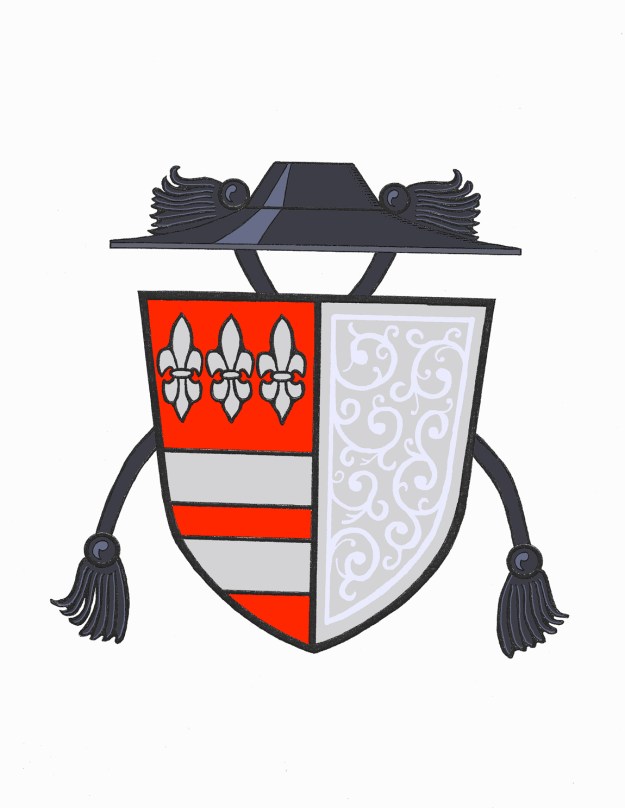
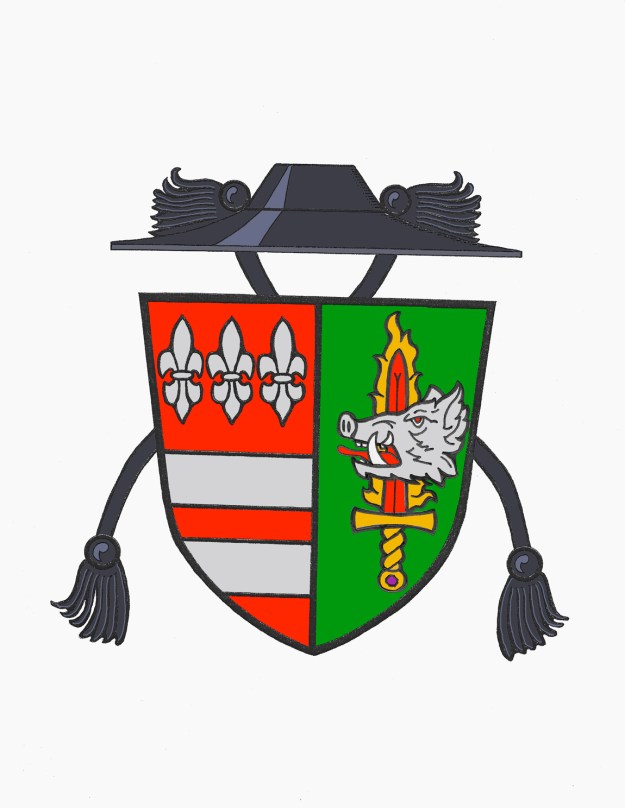
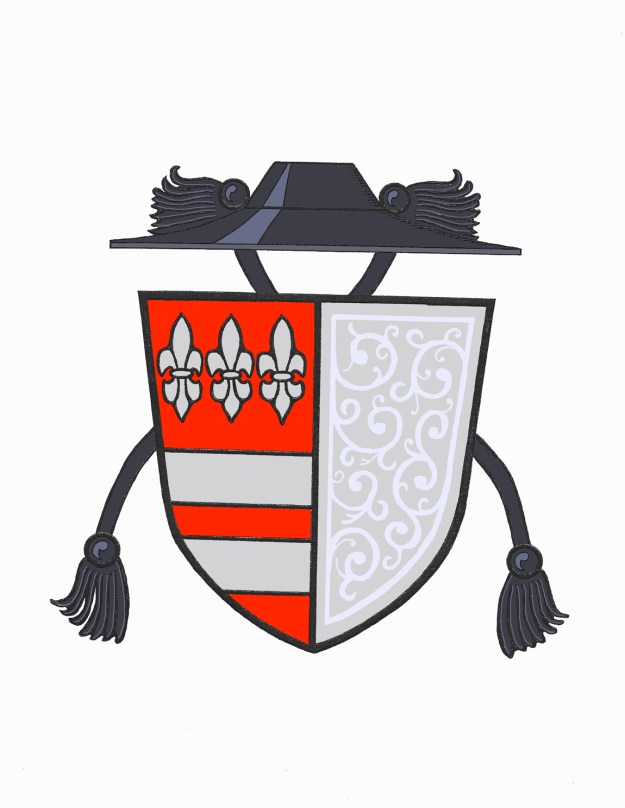
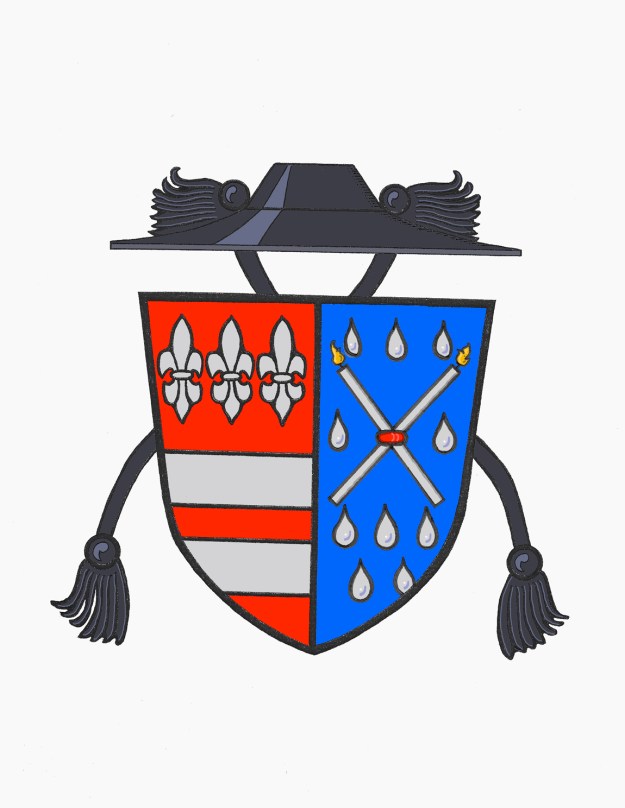
In each case the attributed arms contains charges that allude to their names or to some other strong association with them. That way, each is somewhat easily associated with the priest it represents. In all cases their personal arms are emblazoned impaled with the arms assumed for the parish itself and the shield is ensigned with a simple priest’s galero. No mottoes were used in the depiction of these achievements.

sc00016f9e

The Arms of St. Joseph Parish, Washington, New Jersey (est. 1871)

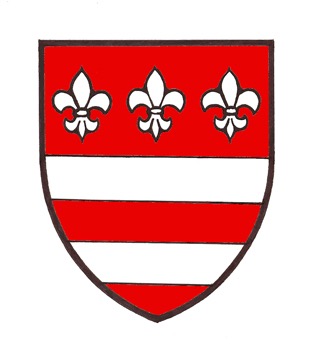
The arms are based on those of George Washington for whom the Borough and Township where the parish is located are named. His arms showed two red bars on a silver (white) field with three red stars above. Here the colors have been reversed and the stars changed to three fleurs-de-lis, a symbol of St. Joseph.

Scanned ImageRoos2Good

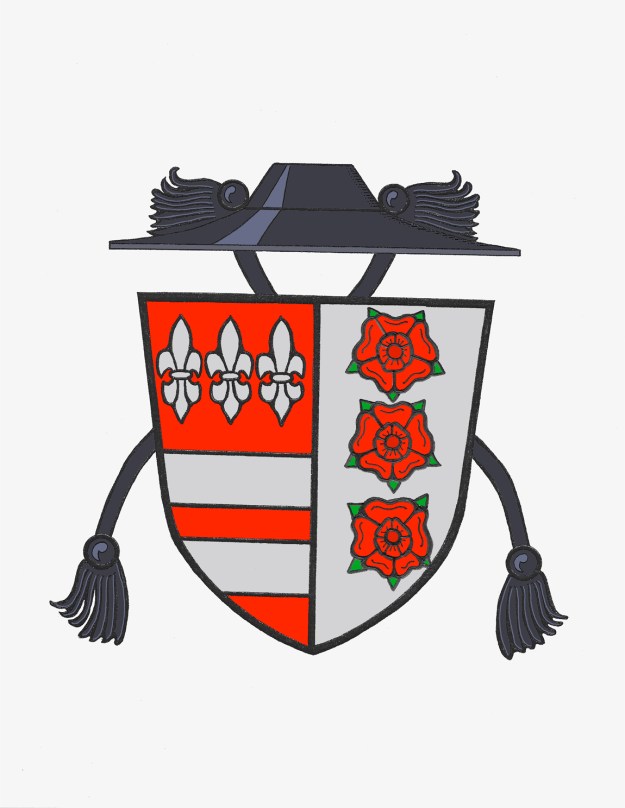
Rev. William Roos 16th Pastor 1979-1983

The name “Roos” alludes to a rose in Dutch, hence the three roses.

Scanned ImageAuchter2Good

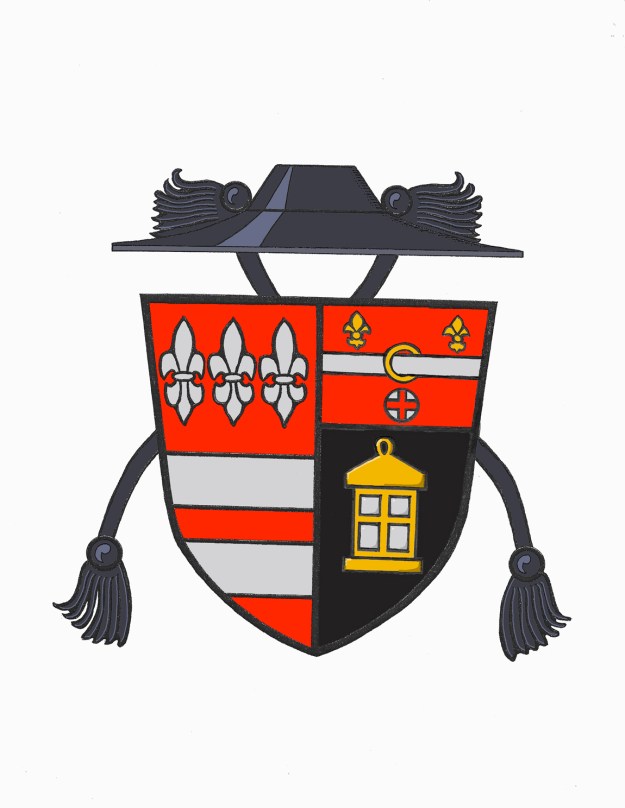
Rev. (later Monsignor) John A. Auchter (Administrator) 1983-1989

The lamp is from a German coat of arms associated with the family name. The chief contains the arms of the Diocese of Allentown, PA of which Fr. Auchter was an incardinated priest. After his time in New Jersey he returned to his own diocese and was later promoted to Prelate of Honor with the title “Rev. Monsignor”. However, when serving here he was still simply a priest.

Scanned ImageSantillo3Good

Rev. Michael Santillo 18th Pastor 1989-1992

He does not have a personal coat of arms so the parish arms are impaled with a blank shield. The design on that half of the shield is a technique to fill empty space in heraldry called “diapering” and it is merely decorative.

Scanned ImageKochon2Good

Rev. Michael A. Kochon 19th Pastor 1992-1999

Father Kochon’s arms consist of a flaming sword which is symbolic of his patron, St. Michael the Archangel and a wild hog’s head erased. In French the word cochon, similar to his surname Kochon, means pig so his personal arms allude to his given and family names.

Scanned ImageAscolese3Good

Rev. (later Mr.) Robert J. Ascolese 20th Pastor 1999-2006

He does not have a personal coat of arms so the parish arms are impaled with a blank shield. The design on that half of the shield is a technique to fill empty space in heraldry called “diapering” and it is merely decorative.

Scanned ImageBaran2Good

Rev. Blaise R. Baran 21st Pastor 2006-2015

Father Baran’s name means “rain” in Persian, hence the raindrops. His patron, St. Blaise, is alluded to by the two candles crossed in saltire which are used to give the Blessing of Throats on the feast day of St. Blaise.

Scanned ImageSelvesterGood

Rev. Guy W. Selvester (Administrator 2015-2017) 22nd Pastor 2017 – 

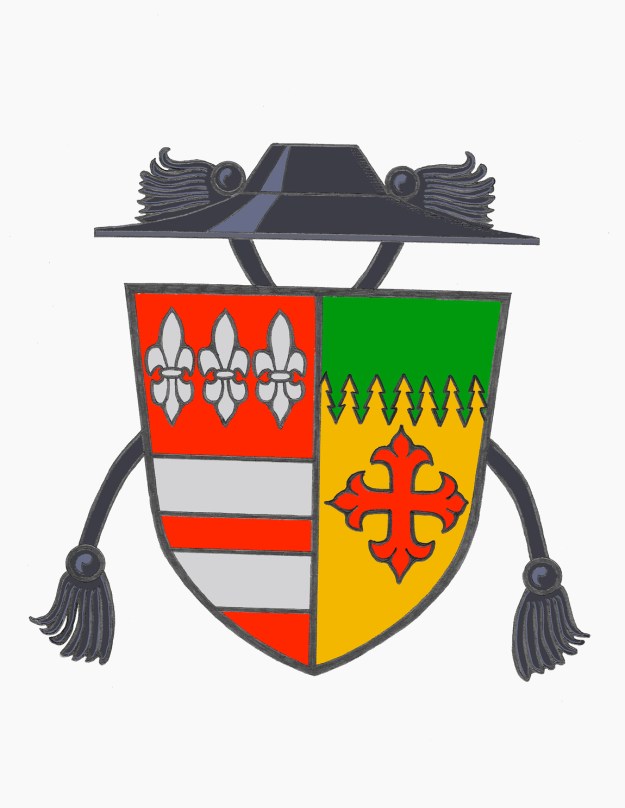
Readers of this blog should know the symbolism of my arms by now but the division line sapiné (shaped like fir trees) alludes to my family name which was originally Silvestri (later anglicized to Selvester) which means a forest dweller or woodsman. The green and gold (yellow) tinctures are for my Irish ancestry and the cross for the centrality of my faith in my life. It is a cross fleury so that the fleurs-de-lis are references to both the Holy Trinity and Our Lady.

Coat of Arms of a Priest

Tveit2

The newly-assumed armorial bearings of the Rev. Jon Tveit of the Archdiocese of New York (above).

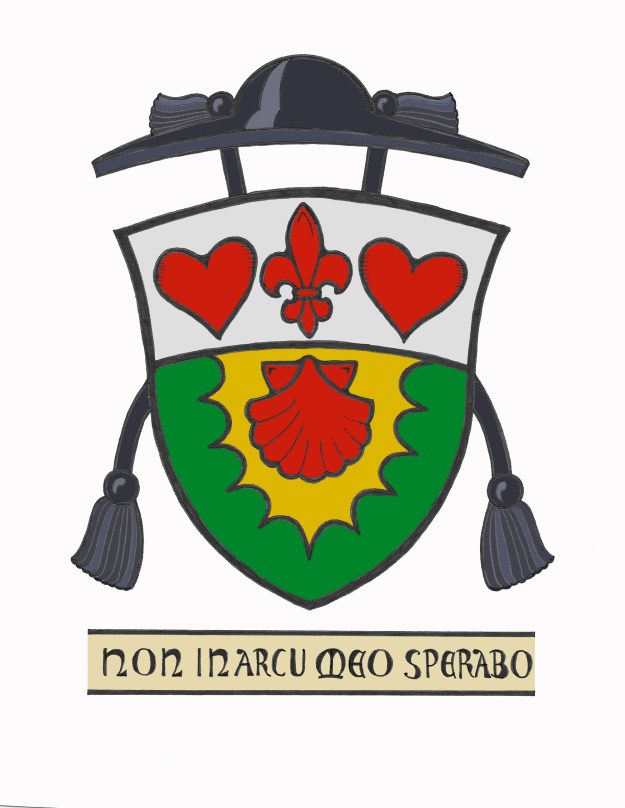
The main portion of the shield depicts a gold (yellow) field surrounded by a green border the edge of which is scalloped with convex semicircles. This is done to suggest a clearing in a forested area, the trees represented by the green border and the clearing by the gold field. The armiger’s surname, Tveit, is from the Old Norse that translates to, “a field cleared from a forest” or a person who dwells in such a place. (A similar name in English would be Thwaite). In the middle of this “clearing” is a red scallop shell. This is primarily a symbol of the armiger’s principal baptismal patron, St. John the Baptist. In addition, the shell is a charge in the coat of arms of Benedict XVI, the Pope-Emeritus, whom the armiger greatly admires. It was during the pontificate of Benedict XVI that Fr. Jon came to a deeper understanding of his faith, discerned his priestly vocation and entered the seminary to begin his preparation for priesthood.

The upper third of the shield, called a “chief” is silver (white) and on it are two red hearts with a red fleur-de-lis between them. The colors red and white are taken from the coat of arms of the Archdiocese of New York for which the armiger was ordained and in which he engages in his priestly ministry. In addition, the white background is a color often associated with the virtue of Purity to which the armiger always aspires and tries to cultivate in his own life. He has a great devotion to the Sacred Heart of Jesus and the Immaculate Heart of Mary in his personal devotional life so the hearts symbolize that. The fleur-de-lis has long been used heraldically as a symbol of both Our Lady and her spouse, St. Joseph. Fr. Tveit attended St. Joseph seminary in Dunwoodie, NY.

The only external ornament is the black, broad-brimmed pilgrim hat called a “galero”. In heraldry this is used in place of the traditional helmet, mantling and crest to indicate that the bearer of the coat of arms is a cleric. The color of the hat, the cords and the tassels as well as the number of tassels developed over the centuries to differ depending on the rank of the bearer. A black hat with black cords and one black tassel suspended on either side of the shield indicate the armiger is a priest.

The motto, “Non in Arcu Meo Sperabo” below the shield is taken from Psalm 43:7 and translates to, “For I will not trust in my bow”.

+Rt. Rev. Paul Maher, OSB: RIP

SVAA006

Archabbot Paul R. Maher, O.S.B., the tenth Archabbot of Saint Vincent Archabbey, Latrobe, Pennsylvania died Thursday, June 29, 2017, the Solemnity of Ss. Peter & Paul. He was 91 years old. A native of Latrobe, Pennsylvania, he served as Archabbot from 1983 until 1990.

Archabbot Paul received his early schooling in Latrobe, where he attended Holy Family School and was an altar server in Holy Family Parish. Having completed elementary school, he went to Saint Vincent Preparatory School for his secondary education. He graduated from Saint Vincent Prep in 1943, in the middle of the Second World War. Just turned 18 years old, he joined the U.S. Army Air Corps. For the next two years he served in the European Theater as tail gunner on a B-24 bomber. He flew 21 combat missions over southern Germany and Austria and was honorably discharged at the end of the war.

The influence of his older brother William, who had become a diocesan priest, and his older sister Rita, who became a Religious Sister of Mercy nun, helped him reach the decision to study for the Benedictine priesthood. In 1945 he returned to Saint Vincent and began his studies at Saint Vincent College as a candidate for the Benedictine Order. In 1947 he was admitted to the Order as a novice and made his simple profession of monastic vows on July 2, 1948. He professed solemn vows three years later, on July 11, 1951.

Archabbot Paul received his A.B. Degree from Saint Vincent College in 1950 and immediately began his studies of theology in Saint Vincent Seminary. In 1951 Archabbot Denis Strittmatter, O.S.B. sent the young Benedictine brother to Rome to complete his theological studies at the Pontifical Atheneum of Sant’ Anselmo. Two years later, he was ordained to the priesthood by Bishop Placido Nicolini, O.S.B., at the Basilica of Saint Francis in Assisi on June 21, 1953. After ordination, he continued graduate studies at Sant’ Anselmo for another four years, earning a Ph.D. in philosophy in 1957.

Upon completion of his doctorate, Father Paul returned to Saint Vincent, where he taught philosophy in the College and Seminary from 1957 to 1966, serving as chairman of the College’s Department of Philosophy from 1961 to 1966. During his years of teaching at Saint Vincent, he also served as moderator of one of the College’s residence halls (1958 to 1960), socius (superior) of the monastery’s junior monks (1960 to 1963), and vice rector of Saint Vincent Seminary (1963 to 1966).

In 1966, Archabbot Paul was named prior (superior) of Saint Vincent’s mission to China and a member of the faculty of Fu Jen Catholic University, Taiwan. He remained in Taiwan as monastic superior and university professor for seventeen years.

He was elected Archabbot on June 7, 1983, and on June 30, 1983, received the abbatial blessing in the Archabbey Basilica from Bishop William G. Connare of Greensburg, Pennsylvania. Among those present at his blessing were Archbishop Rembert Weakland of Milwaukee; Bishop Norbert Gaughan, auxiliary bishop of Greensburg; Bishop Rene Gracida of Corpus Christi, Texas; and the two retired Archabbots of Saint Vincent, Archabbot Egbert Donovan and Archabbot Leopold Krul.

Mark W. McGinnis, author of the book The Wisdom of the Benedictine Elders, described Archabbot Paul as a “very intelligent, highly experienced abbot who has the demeanor, gentleness, and openness of an ideal priest.” His brother monks would agree with this and add that he was an ideal monk: humble, generous, thoughtful of others, and devoted to the Benedictine life of prayer and work.

Following his retirement in 1990, Archabbot Paul became a parish assistant at Saint Benedict Church, Carrolltown, Pennsylvania, where he resided until 1996. He returned to the Archabbey that year to serve as guestmaster and archivist until 2009. Archabbot Paul was the son of the late William A. Maher and Edna G. (Hunt) Maher. He was one of twelve children, two of whom are currently residing in Latrobe.

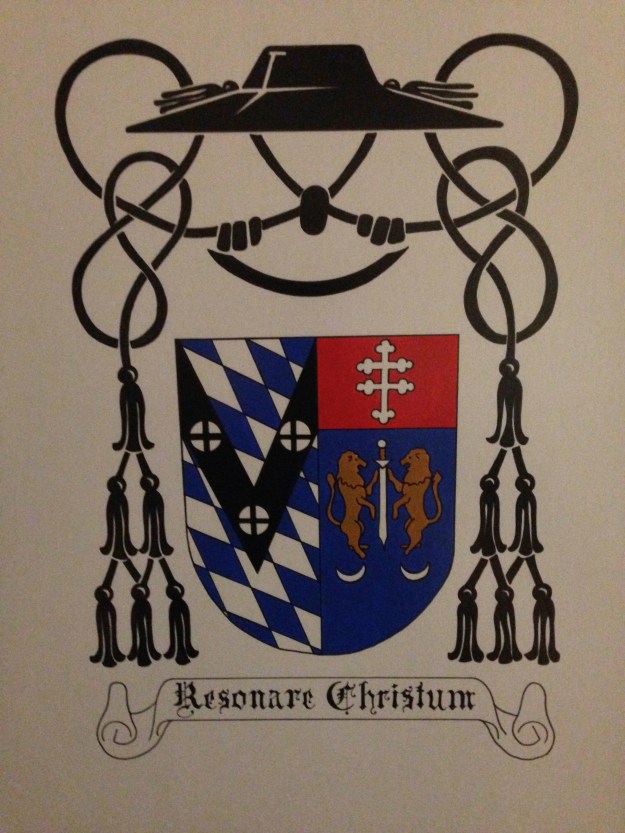
He was a very humble man eschewing the use of pontificalia as he was entitled by his office. He only grudgingly agreed to have a coat of arms at the behest of the archivist of the community, the late Fr. Omer U. Kline, OSB. His coat of arms was designed in consultation with the late Br. Nathan Cochran, OSB of St. Vincent and alludes to the traditional Irish arms associated with the name Maher; his baptismal and monastic patron, St. Paul (the sword) and his missionary work via the double-barred Scheyern cross being used at St. Vincent as the “mission cross” given to those monks sent out into the mission fields. From a lack of correct heraldic custom the crozier (veiled or otherwise) was omitted from the achievement and the extra knots and loop of cords below the galero was a bit of license by the artist who wished to fill the space left by the lack of a crozier. The motto, “Resonare Christum” (Echo Christ) was also used by the late John Cardinal Wright of Pittsburgh.

May he rest in peace.


Benedictine Abbot Primate

Polan copy

Last September the Benedictine Confederation, more commonly referred to as the Order of St. Benedict, elected its 10th Abbot Primate since the institution of that office by Pope Leo XIII in 1893. They elected the fourth American monk to hold that office by choosing the Abbot of Conception Abbey in Missouri, Rt. Rev. Gregory J. Polan, OSB (67). He succeeded Notker Wolf and became Abbot of Sant’Anselmo and the Most Rev. Abbot Primate on September 10, 2016.

Seven of his eight predecessors bore a coat of arms as abbots and as Abbots Primate. Two of the Americans, Jerome Theisen, OSB a monk of St. John’s in Collegeville and Marcel Rooney, OSB also a monk of Conception chose not to be armigerous either as abbot or as Abbot Primate. (the fourth American was Rembert Weakland, OSB a monk of St. Vincent Archabbey in Pennsylvania and the Archbishop-Emeritus of Milwaukee)

At the time he became Abbot of Conception in 1996 Abbot Gregory wasn’t particularly interested in a coat of arms. But the community had a heraldic tradition and one of the monks there devised arms for him to assume keeping it very simple. The plain gold field with the single charge of a black bull’s head is a symbol associated with the abbot’s family. This was then quartered with the arms of the abbey.

Upon his election as Abbot Primate the same monk who originally designed the arms decided to prepare something the abbot could use as Abbot Primate. The personal arms are “Or, a bull’s head erased Sable; on a canton Azure a fleur-de-lis Argent”. The addition of the small augmentation of the blue canton charged with a silver fleur-de-lis, borrowed from the arms of Conception Abbey, are employed as a way of paying homage to the abbot’s Motherhouse by augmenting his personal arms rather than changing the design entirely. These personal arms are then impaled with the arms used by the Order of St. Benedict, “Azure, issuing from a trimount a patriarchal cross, overall the word “PAX” all Or“. Note that sometimes the trimount is depicted as Vert (green) rather than Or (gold).

The shield is ensigned with the usual ornaments of an abbot: black galero with twelve black tassels and a veiled crozier. The previous Abbot Primate, Notker Wolf, commissioned an artist who depicted his arms with twenty black tassels. The thinking was that, as the head of the Order the Abbot Primate should have an ornament that indicated a higher rank like an archbishop’s hat having twenty tassels instead of the twelve used by other bishops. The problem with that line of reasoning is that the Abbot Primate is not the Abbot General of the Order of St. Benedict. He is merely a figurehead; a nominal “head” but really just a visible figure to promote communication within the Order and to act as a liaison between the Order as a whole and the Holy See. Leo XIII didn’t like the decentralized nature of the Benedictines. In reality each house under its own abbot is autonomous. What binds Benedictines together is that they follow the Holy Rule of St. Benedict. Eventually, houses began to band together into federations, now called Congregations, and each of those Congregations, some of which are international but many of which are structured along national lines, adopts Constitutions and a customary observed by all the houses within the Congregation. In addition, they elect a Praeses, or Abbot President, who acts as their canonical superior with jurisdiction. The Abbot Primate, however, does not have jurisdiction over the whole Order the way a Superior General does in other Religious Orders. So, he is merely a figurehead elected by the Abbots gathered in Congress.

Not possessing a higher rank, or greater authority, or jurisdiction over all Benedictines it makes no sense for the Abbot Primate’s galero to suggest so. The Abbot Primate remains an abbot like any other, indeed during his tenure (which is a four year term renewable by re-election) he is the abbot of the Abbey of Sant’Anselmo on the Aventine Hill housing the Anselmianum where students study about the sacred liturgy. Outside of heraldry the Abbot Primate is accorded certain honors to mark his position as the Primate, namely, he is permitted to wear the purple zucchetto instead of a black one and he is addressed as “Most Reverend” instead of the usual “Right Reverend” used by other abbots.

Bruno Heim mentions in his book, Heraldry In The Catholic Church that the Church never made provisions for Archabbots, Abbots General or Abbots Primate to use a galero different from other abbots. However, some authors argue that it is Archabbots (a title of honor that confers no greater jurisdiction or powers) should use a galero with twenty tassels like archbishops. The point is open to debate. I have always believed archabbots should use the galero with twenty tassels but I know of no instances where one actually does so. Therefore, despite the compliment paid to him by the artist who depicted Abbot Primate Notker’s coat of arms Abbot Primate Gregory’s arms use the traditional galero of an abbot with twelve tassels.

Both the design and the very nice artwork were done by Dom Pachomius Meade, OSB of Conception Abbey in Missouri.

Detroit Coat of Arms Redesign: EPIC FAIL

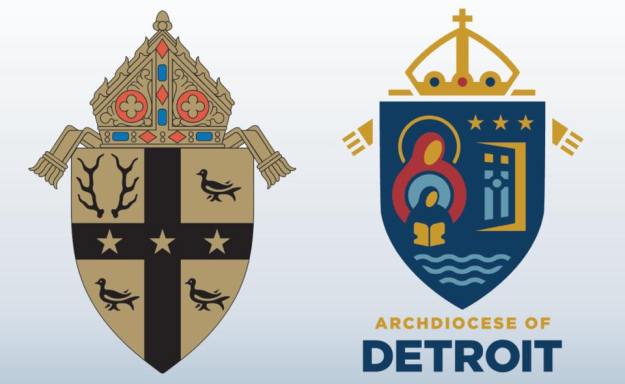
By now so many people have seen the redesign of the archdiocesan coat of arms undertaken by the Archdiocese of Detroit and unveiled last Saturday (below, right).
Detroit

Where does one even begin? Perhaps a good place to start is by saying that this was done in conjunction with the release of Archbishop Vigneron’s post-synodal pastoral letter entitled, “Unleash the Gospel”. This letter addresses issues that arose during the archdiocesan synod and outlines the pastoral approaches to be implemented by the archdiocese as it faces the future. As a part of this entire effort someone had the idea that redesigning the coat of arms to reflect the current “realities” of the archdiocese and certain aspects of the archdiocese’s identity would be a good idea. I suppose the thinking was that with a new approach should come a new symbol. The archdiocese’s Moderator of the Curia, Msgr. Robert McClory, who was in charge of the redesign, said, “Initially, we thought about, ‘What is the identity of the archdiocese?’ When people think of the Archdiocese of Detroit, what do they think of, and what visuals are connected to that?”

So, it seems clear that this jettisoning of the former coat of arms and redesigning an entirely new one was done with all the very best of intentions. That seems abundantly clear and, I think, it’s worth pointing out and keeping in mind. There was no malicious iconoclasm motivating a desire to discard outmoded symbolism. Rather, there seems to have been a sincere effort to look to the future in a positive manner with a symbol for the local church that would be more evocative to both members of that local community and those outside of it as well. They were trying to do something good, and new, and fresh.

More is the pity. It is precisely all these good intentions that underscores the appalling ignorance with which this process, in the works for more than a year, proceeded. An article in the archdiocese’s publication, “The Michigan Catholic” indicates the following:

“Archbishop Vigneron consulted with a wide range of people, including laity and the archdiocesan Presbyteral Council, before deciding to go ahead with the changes, Msgr. McClory said. While the archdiocese enlisted the help of a Cleveland-based design firm for the project, the process also benefited from Archbishop Vigneron’s experience redesigning the coat of arms of the Diocese of Oakland, Calif., where he served as bishop from 2003-09.”

Apparently, the Archbishop’s previous experience left him feeling confident in doing a wide and varied consultation with just about everyone, except someone well versed in the customs, rules and traditions of good heraldic design. That really baffles me. In these days even a simple Google search will easily yield at least some possibilities of contacting a group or individual who has some knowledge or expertise in designing a coat of arms. Consulting such a person or group really wouldn’t be so difficult. I have to ask why it was deemed important to solicit the opinions of laity and the Presbyteral Council? What experience or learning do they possess that would enable them to determine a good heraldic design? I can appreciate the Archbishop’s desire to avoid making such a change by episcopal fiat and to seek the input of various people in his archdiocese. Nevertheless, the way to design or redesign a coat of arms is not by committee. I think the end result is clear evidence of that.

What they have come up with is, simply put, bad. The artwork is cartoonish and dated. The overall composition bears little to no resemblance to anything remotely like a coat of arms. The mitre on top has the appearance more of a royal crown than an episcopal mitre. The confusing miss-mash of charges float all over the place on the field. You cannot simply take a bunch of logo-like symbols, slap them onto a shield and call it “heraldry”!

Most of all, however, I think the epic fail has its origins in a basic misunderstanding of the nature and purpose of a coat of arms in the first place. Monsignor McClory goes on to say:

“A major difference between the old coat of arms and the new, Msgr. McClory said, is one’s ability to tell the story of faith using its symbols: Starting with the Old Testament in St. Anne and continuing through the revelation of the New Testament through her daughter, Mary, one comes to Christ through the waters of baptism and is invited through the open doors of the Church to bring others with them to their ultimate fulfillment with the Father, Son and Holy Spirit in heaven. I think you can really tell a story with this. You can’t do it with the old coat of arms.”

And there you have it. Once again, because something is connected to the Church it becomes about “telling a story”, or “tracing a history”. Not everything connected to the Church has to be a catechetical tool; not everything is a means of evangelization. Just as a personal coat of arms is not supposed to be one’s pictorial C.V.  so, too, a corporate coat of arms is not supposed to be a visual mission statement or pictorial history.

Heraldry was developed as a means of creating a unique identifying mark. Full stop.

In addition, because even modern heraldry still hearkens back to the medieval period in which heraldry has its origins there is supposed to be both a timelessness and a sense of permanence to heraldry. It’s quite wrong to change a coat of arms simply because it was designed and adopted in a different time and because the thinking has changed about what should be on it. A coat of arms doesn’t have to “tell a story”; it doesn’t have to “reflect present realities”; it is supposed to be immutable. Since it becomes the identifying mark of the individual or corporate body that uses it the permanent character of it must be respected.

That is not to say that there are no instances of changes being made to a coat of arms. Even within the science of heraldry itself techniques such as marshaling (combining two or more coats of arms on the same shield), augmentation (adding a new element to an existing coat of arms to reflect an honor, event or accomplishment) and differencing (slightly changing an initial design to indicate its use by a relative, descendant, or protégé) exist to make changes within the accepted framework of heraldic custom and practice. But, simply throwing out the former coat of arms and redesigning the thing from scratch is foreign to the nature of heraldry. Let me be clear: it is sometimes done and whenever it is, it is always wrong.

Rather, the archdiocese has fallen victim to a not uncommon phenomenon present today. That is, equating heraldry with a logo. Corporate logos frequently change. Whether it’s to mark the takeover of the corporate body by another, or simply to refresh and renew the artwork, or to indicate the corporate body embarking on a new phase or vision the transitory nature of corporate logos almost necessitates their periodic updating or full-scale redesign. I note that the archdiocese consulted with a Cleveland based design firm. But, what does this firm know of heraldry? How much experience do they have designing a heraldic achievement? I would hazard a guess that its very little compared with their experience of coming up with a first time logo or doing a redesign for a group interested in “re-branding”. But, a coat of arms is neither a logo nor a brand.

The simplest solution to their present situation would have been to leave their diocesan coat of arms alone and design a logo which would be used not only for the roll out of this most recent pastoral letter and the ensuing archdiocesan efforts at implementing it but could have also become the favored symbol used by the archdiocese in place of the coat of arms. Things like letterhead, signage, etc. could easily have borne this newer logo and simply ignored the coat of arms. Its not the solution that those of us who prefer heraldry might like but it certainly is far from unprecedented. Numerous ecclesiastical institutions have desired a symbol that was considered more in keeping with the times. They have chosen to respect the existence of a previously adopted coat of arms and merely make minimal use of it in favor of the newer logo they have adopted as more fitting to their situation.

The Archdiocese of Detroit could have done the same. They could have tried, with the help of a competent heraldic designer, to truly re-design the present coat of arms. They could have, for example retained the gold field, the black cross and three gold stars on the cross and removed the antlers and martlets. Then in those now empty quadrants they could have placed charges symbolic of what they desired. They could have augmented the current coat of arms by means of placing a smaller shield at the center of the design bearing whatever symbols they wanted. They could have adopted a kind of heraldic badge (a symbol composed of heraldic charges but separate from a shield) and used that in conjunction with the archdiocesan coat of arms as well as had new artwork prepared for both. They could have decided to adopt an archdiocesan logo to be used instead of the coat of arms while leaving the former alone.

Instead, they chose the ill-advised path of completely throwing out the coat of arms first adopted 80 years ago and used regularly throughout the archdiocese in many ways and in many places, and coming up with an entirely new design, poorly executed, which bears little to no resemblance to the original and destroys any visual continuity with what had been used.

It has been announced that over time the former coat of arms will slowly but systematically be expunged and the Archbishop plans to have a new rendering of his own coat of arms impaled with this mess. I think that’s a very bad idea. Rather, if he wishes no longer to use the older archdiocesan arms the Archbishop should simply use his personal arms on the shield alone. That way, if his successor wishes to correct this error and revert to the former coat of arms he can do so easily.

I suppose that it shouldn’t really come as a surprise that this kind of thing happened considering what the archdiocese did to redesign what had been its beautiful cathedral of the Most Blessed Sacrament. Much of that renovation is quite nice (I’m thinking in particular of the floor of the sanctuary) but most of it doesn’t fit at all with the style of a neo-gothic structure. Once again in the interest of “updating” the archdiocese has an epic fail on its hands. What I find particularly sad is the failure isn’t because of a difference of opinion regarding taste. Rather, the fail occurred because of inexcusable ignorance of the subject at hand. They simply don’t get what a coat of arms is supposed to be. What they’ve ended up with is unheraldic and ugly.

Bishop Dolan

On June 8 the Most Rev. John Patrick Dolan (55), a priest of the Diocese of San Diego, California will be ordained the Titular Bishop of Uchi Maius and the Auxiliary Bishop of San Diego. He contacted me shortly after his appointment and asked me to design a very simple coat of arms for him. The result is:

Dolan5

The blazon and description is as follows:

BLAZON: Or an image of the Sacred Heart Gules; on a chief Azure two crescents Or. The shield is ensigned with an episcopal cross Or in pale behind the shield and surmounted by a galero with cords and six tassels on either side in three rows of one, two and three all Vert. On a scroll below the shield is the motto: “Abide in My Love”.

EXPLANATION: The bishop’s coat of arms, is composed of a shield upon which there are symbolic charges, a motto and the external ornaments of rank. The shield which is the most important feature of any heraldic device is blazoned (i.e. described) in heraldic language from the point of view of the bearer with the shield being held on his arm. For his personal arms Bishop Dolan has adopted a design to reflect his religious devotion, priestly ministry and family. The arms are composed of a gold (yellow) field on which there is a single charge of the Sacred Heart of Jesus depicted wounded, surrounded by a crown of thorns and enflamed all colored red. This reflects the bishop’s devotion to the Sacred Heart which is also symbolic of the mercy of God which he tries to reflect in his priestly ministry. All priests are exhorted to conform themselves more closely to Christ and strive to be shepherds after His own heart. The gold field is borrowed from the coat of arms of the diocese of San Diego to recall the local church he has served as a priest and will continue to serve as a bishop. The chief (upper third of the shield) replicates the blue field and crescents traditionally associated with the arms of Dolan in Irish heraldry. Here the usually silver crescents have been colored gold (yellow) and reduced in number from three to two for differencing. These charges are merely borrowed to act as an allusion to the bishop’s family name.

For his motto, Bishop Dolan has selected the phrase “ABIDE IN MY LOVE”.