Archabbots of St. Vincent

St. Vincent Archabbey in Latrobe, Pennsylvania, the oldest monastery in the United States, was founded in 1846 by monks from St. Michael’s Abbey in Metten, Bavaria under the leadership of Fr. Boniface Wimmer. They came to Pennsylvania funded by the Ludwigs-Missionverein, an organization started by the King Ludwig I of Bavaria to minister to German immigrants throughout the world.

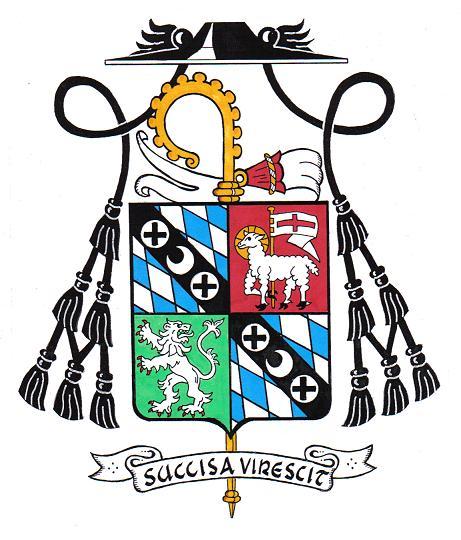
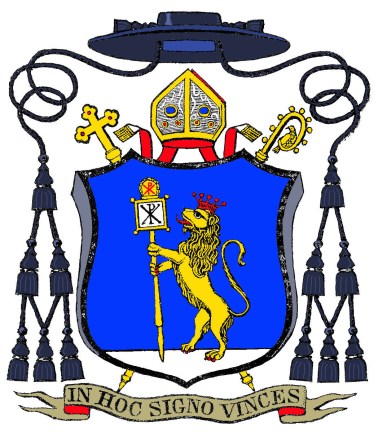
When the community had grown large enough to be elevated to the status of an independent abbey in 1855 it was decided to designate it an archabbey and Father Boniface was named Archabbot for life by Bl. Pius IX. His coat of arms (below) looks to be based in a quartering of the arms of the royal family of Bavaria, the House of Wittelsbach. The lion holding the banner of Christ was used not only by Archabbot Boniface as his coat of arms but also by the community as the heraldic symbol of the archabbey. It seems as though Wimmer’s first three successors, Archabbot Andrew Hintenach (1888-1892), Archabbot Leander Schnerr (1892-1918) and Archabbot Aurelius Stehle (1918-1930) also used this coat of arms. I have not been able to locate any other coats of arms for them.

Coat_of_Arms_of_Archabbot_Boniface_Wimmer2a

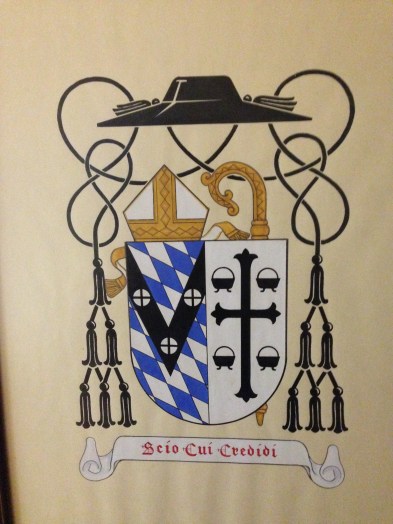
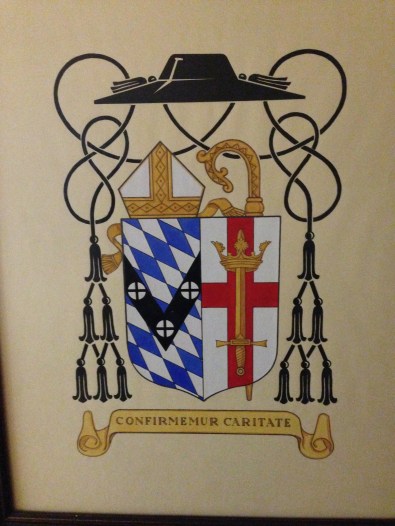
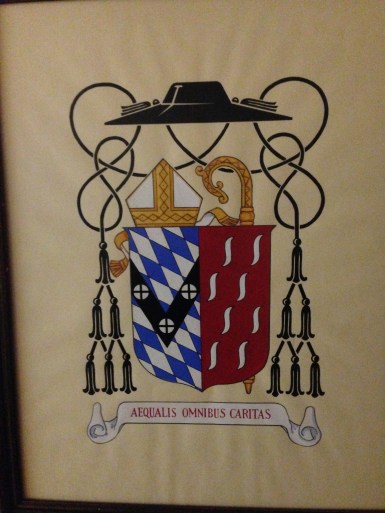
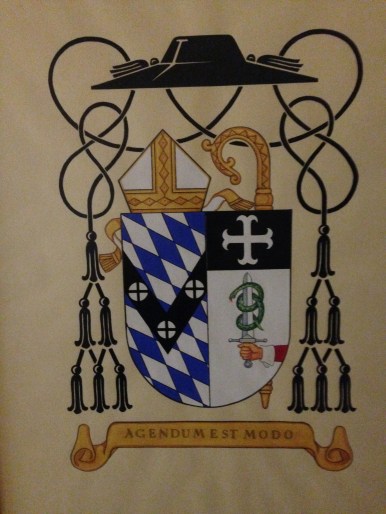
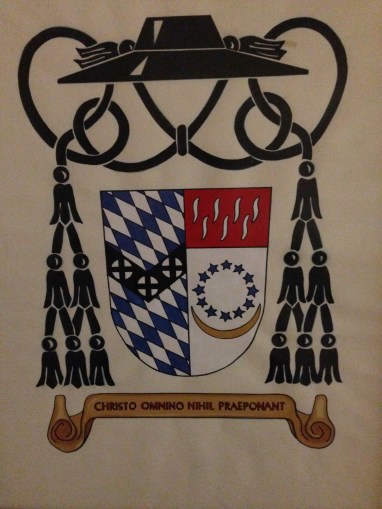
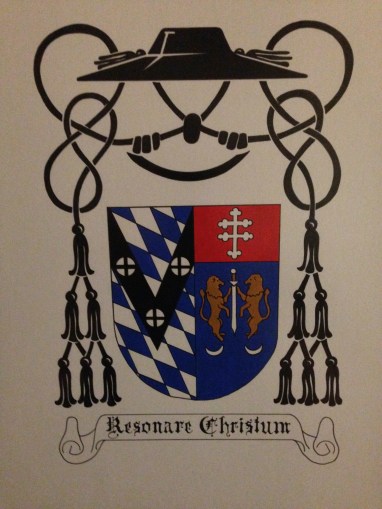
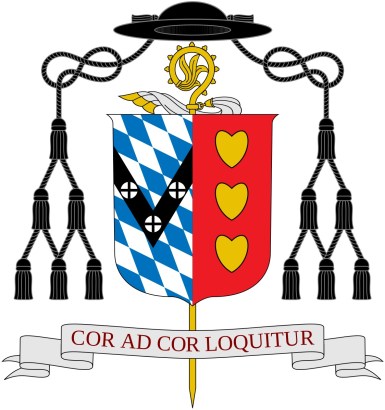
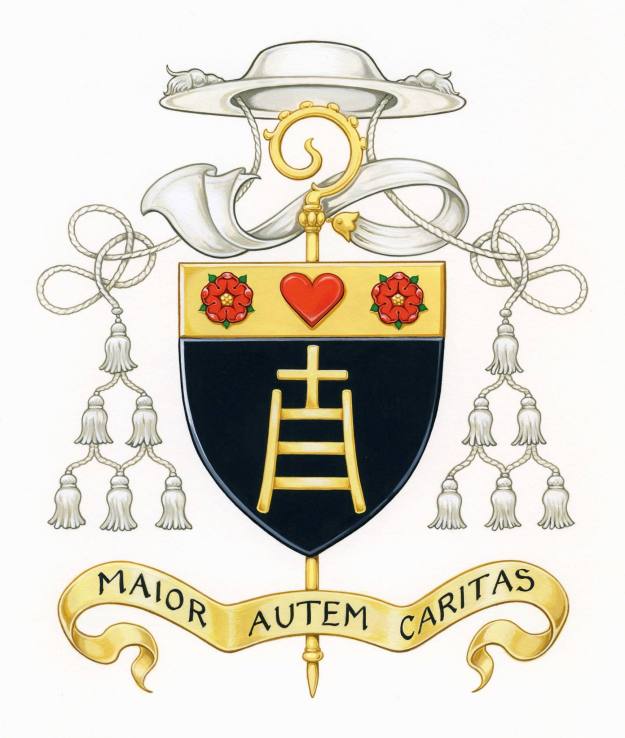
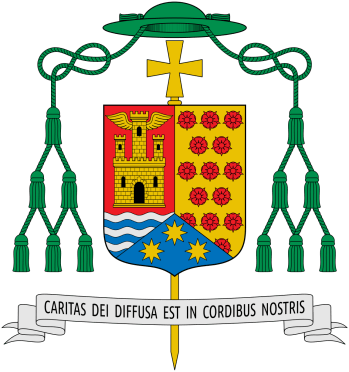
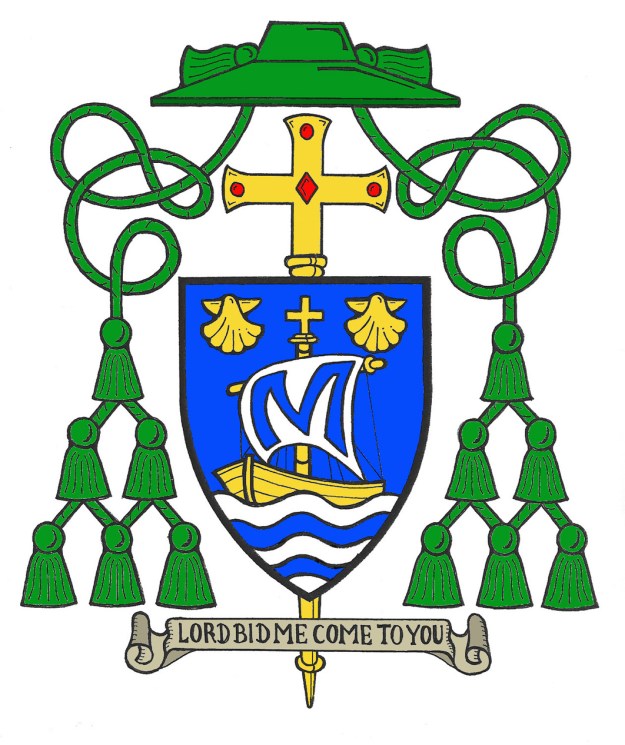
In 1930 with the election of St. Vincent’s fifth Archabbot, Alfred Koch (1930-1949), things changed. At that time the community decided to adopt a corporate coat of arms, which borrowed the blue and white fusils in bend from another Wittelsbach quartering and took the three plates on a black fess from the arms of William Penn, turned the fess into an inverted chevron (to create the letter “V” for “Vincent”) and charged the three plates with Benedictine crosses. Archabbot Alfred impaled this with a personal coat of arms. Thereafter, his successors did likewise.

Image 26

Archabbot Dennis Strittmatter (1949-1963)

Image 33

Coadjutor Archabbot Rembert Weakland (1963-1967) later Abbot-Primate and Archbishop of Milwaukee

Image 31

Archabbot Egbert Donavan (1967-1979)

Image 29

Archabbot Leopold Krul (1979-1983)

Image 37

Archabbot Paul Maher (1983-1990)

Image 35

Archabbot Douglas Nowicki (1991-present)

Image 5

During the tenure of Archabbot Egbert Bl. Paul VI changed the customary rules governing the external ornaments of prelates indicating that the mitre was no longer to be used in coats of arms. In addition, he called for the discontinuation of the crozier in arms of bishops. The crozier used to be included in the achievements of bishops in addition to the episcopal cross. Paul VI indicated in was the cross alone that would continue to be used in the arms of bishops and that the crozier should be excluded. This was interpreted by some, wrongly, to mean the crozier should no longer be used in the arms of abbots as well. However, it is the veiled crozier, not the galero, which indicates the rank of abbot in heraldry. Archabbots Leopold and Paul were advised incorrectly to leave the crozier out of their achievements. It was, however, restored to use in the coat of arms of Archabbot Douglas which was designed by me.

Abbot of Averbode

The Right Reverend Marc Fierens O.Praem. will be blessed and installed as the 53rd Abbot of Averbode, Belgium on March 11. This design was devised by the Abbot in consultation with with someone very well versed in heraldry. The drawing is by Prisca Van Dessel.

Averbode

It has long been customary for the Abbots of Religious Orders that wear a white or mostly white habit to use an abbatial galero that corresponds to the color of their habit. Since the Praemonstratensians wear a habit which is entirely white their abbots have traditionally used a white galero.

Personally, I have never agreed with this tradition. The color of the galero does not have to correspond with what is actually worn. Rather, in heraldry, color as well as number of tassels is an indication of rank. For example, bishops and archbishops use a green galero. This has its origin in the belief that the original color worn by bishops was green. However, when Roman purple was later adopted by bishops for their manner of dress the galero, which is after all symbolic, remained green for bishops and archbishops in heraldry.

Indeed, abbots do not, nor have they ever, wear a galero! It’s use in their heraldic achievements is purely symbolic. This is a further reason that it need not correspond to the color of their habit. The black galero with 12 tassels indicates the bearer is a Religious Superior, in this case an abbot, regardless of what we wears. The galero need not indicate the Order to which he belongs, just his rank. In abbatial heraldry it is the veiled crozier which indicates the arms are those of an abbot because the black galero with 12 tassels may be used by any Major Religious Superior of any Order, Institute or Congregation, as well as by secular Vicars General and Vicars Episcopal. Similarly, the galero that indicates the armiger is a priest is black with 2 black tassels regardless of whether the bearer is a secular clergyman or a member of a Religious Community. Franciscan priests do not use a brown galero, Sylvestrine priests do not use a blue galero,  Dominican priests do not use a white galero, etc. Nevertheless, among the Canons Regular of Premontré the canons, like their abbots, do indeed make use of a white galero.

I may not be in favor of it but it is, regardless of my personal opinion, a long-standing tradition in heraldry and done on a regular basis. The length of time this custom has been observed has made it into the commonly accepted practice. My contrary opinion is but wishful thinking on my part. I wish it otherwise and I have good reasons to support that opinion. Alas, it is not and I have to live with disappointment.

Bishop Aviles

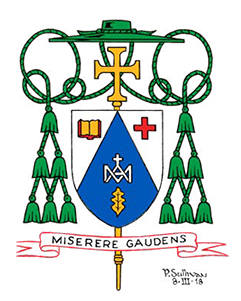
The Most Rev. Mario Aviles, C.O. (48) former Procurator General of the Confederation of Oratorians of St. Philip Neri, was ordained Titular Bishop of Cataquas and will serve as the first Auxiliary Bishop of Brownsville, Texas on February 22, 2018.

Aviles

The Armorial Bearings of Roman Catholic Deacons

I’ve have once again come across several images of the coats of arms of Deacons in the Roman Catholic Church on the internet which moves me to write, yet again, that:

THERE IS NO OFFICIALLY SANCTIONED EXTERNAL HERALDIC ORNAMENT TO ENSIGN THE ARMORIAL BEARINGS OF DEACONS IN THE LATIN RITE ROMAN CATHOLIC CHURCH.

One simply does NOT exist. None, nada, zilch, zip, bupkus. Anyone who asserts otherwise is a liar and should be horse whipped (with a horse whip).

In the Roman Catholic Church there are two types of Deacons. Transitional Deacons are ordained to that lowest rank in Holy Orders as a final step prior to their Presbyteral ordination. There are also those who are called to enter into ordained ministry as Deacons with the intent of remaining so permanently. For neither type is there an external heraldic ornament sanctioned by the Holy See, which is the only authority within the Catholic Church capable of making such a determination and assigning such an ornament.

Some of you are perhaps saying to yourselves, “No, hang on, Father, that’s not so. Deacons use a black galero that has no tassels on it.” Now, I want you to read the next sentence carefully.

NO, THEY DON’T.

In the Christian churches of the West, especially among those with a sacramental/liturgical style of worship such a heraldic ornament does exist in the Church of England. An entire system of hats for the use of the clergy of the Church of England was devised and adopted by the English College of Arms by an Earl Marshal’s Warrant of 1976. By extension, what is done in the Church of England is frequently, though not universally, done throughout the Anglican Communion. So, a black galero with no tassels is used heraldically by Deacons in the Anglican Tradition.

That has no effect on Roman Catholic Church heraldry.

Again, there is NO approved external ornament for Deacons in the Roman Catholic Church. Those who adopt the galero with no tassels are incorrect because it is an Anglican custom. Those who simply decide to make up out of whole cloth some other external ornament to function as a “Deacon’s crest” or to add a special augmentation to the shield of the arms of a Deacon like a chief indicating diaconal ministry are also quite wrong to do so. Those who claim such things are sanctioned by the Holy See are lying. Full stop.

So, what option is there for a Deacon? Well, for Transitional Deacons (a state which usually last no more than 12 months) they should wait until they are ordained Priest and ensign their arms with a Priest’s galero. For Permanent Deacons they have the option of using arms ensigned with helm, mantle and crest as laymen do (which is appropriate if they have descendants who will inherit the arms some day) or they may bear arms consisting of the shield and motto alone without any other ornament.

A coat of arms is a mark of identification not a perk to indicate your job or function. The Church has said very little on heraldry for clergy below the rank of Bishop and most of what we have by way of “rules” for the lower clergy comes from immemorial custom. Because the Permanent Diaconate was dormant for several centuries, including those centuries when heraldry developed, there are no customs for the arms of Permanent Deacons. It is hoped that the Holy See will address this at some point but until it does

DEACONS HAVE NO EXTERNAL ORNAMENT PROPER TO THEM IN ROMAN CATHOLIC HERALDRY!!!!

New Ordinaries in USA

The Most Rev. J. Mark Spalding (53) was ordained a bishop and installed as twelfth Bishop of Nashville on February 2, 2018.

Print

The Most Rev. William Shawn McKnight (49) was ordained a bishop and installed on February 6, 2018 as the fourth Bishop of Jefferson City, Missouri.

1200px-Coat_of_arms_of_Shawn_McKnight.svg

Well…at least it IS uncomplicated and clear.

Bishop Knestout

Knestout

The coat of arms (above) of the Most Rev. Barry C. Knestout, since 2008 Titular Bishop of Leavenworth and Auxiliary Bishop of Washington, D.C., his native diocese, appointed as the 13th Bishop of Richmond, Virginia last December. He will be installed in Richmond on January 12.

His coat of arms, expertly rendered by Marco Foppoli, impale the arms of the See of Richmond with the personal arms of the bishop assumed finally, after two other previous iterations, shortly after he was ordained a bishop.

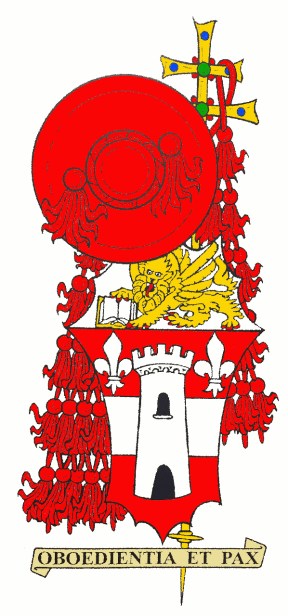
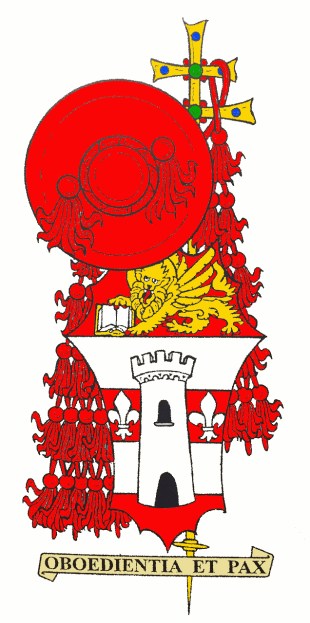
While Bishop Knestout was always rather clear on what charges (individual elements) he wished to employ on his coat of arms the composition of the design went through various changes until he finally settled on the arms he bears today. He always intended to pay homage to the Ordinary he would serve under as Auxiliary Bishop, HE Donald Cardinal Wuerl, by using the single charge in the cardinal’s own arms; a tower. In addition, Bishop Knestout wanted very much to honor the previous Archbishops of Washington whom he served for many years as private secretary, HE James Cardinal Hickey, and HE Theodore Cardinal McCarrick. From their respective arms he borrowed a lion. In addition, the bishop wished to include symbols alluding to his ancestry and his native state of Maryland. This was accomplished with the other charges and the choice of tinctures and metals to be employed.

At first the arms were to look like this:

Snapshot 2008-11-24 17-20-52

However, on further reflection it was decided to try and incorporate the charges symbolic of the Archbishops together on the field and to bring greater uniformity to the other charges and keep them separated on the chief. In addition, he decided to render the motto in english rather than latin. The design then looked like this:

scan0002_2

In fairness, it was probably not in the bishop’s mind that he would be made a diocesan bishop himself one day so he probably wasn’t thinking along the lines of how his coat of arms would look if impaled with the arms of a diocese. If he had he might have stopped here because this design would, indeed, have more easily impaled with another coat of arms and not suffered too much from being squeezed into one half of a shield. Finally, another decision was made to surround the field with a bordure (border) rather than use a chief and we arrived at the arms Bp. Knestout has used for almost ten years:

KnestoutCoat copy

While it is not mandatory but merely customary for in North America for bishops to impale their arms with those of their See (i.e. depict their own personal coat of arms marshaled together side by side with the arms of their diocese on the same shield in the manner of two coats of arms of people married to each other) the decision to do just that has been made. It is the usual custom in the USA but it presents a problem.

The usual practice in heraldry when arms with a bordure are impaled is not to continue the bordure all the way around the field. Rather, along the line of impalement the bordure is not depicted. This is known as dimidiation. It applies not only to bordures but also to any kind of orle or tressure. If it were a plain bordure this wouldn’t matter so much. But, in the case of Bishop Knestout’s arms the bordure contains charges. Dimidiating the bordure leaves those charges out and/or cuts them in half.

Dimidiation would be most correct not only for the bordure around the field of the bishop’s personal arms but also the red tressure on the arms of the See of Richmond. As you can see in the coat of arms of the last bishop, the late Francis X. DiLorenzo:
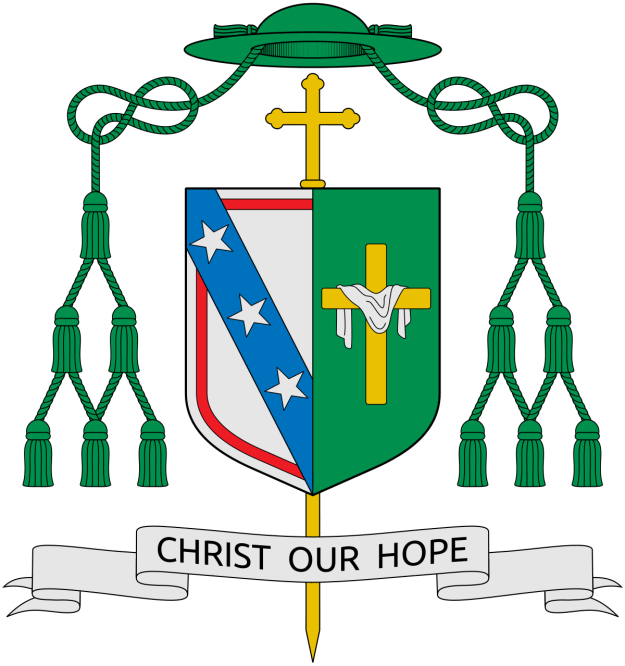
Coat_of_arms_of_Francis_Xavier_DiLorenzo.svg

Plainly one can see that the red orle, or tressure, that surrounds the silver field is not entirely depicted. This has been the custom for previous bishops of Richmond as well. However, as I have already noted, this doesn’t have as big an impact as the dimidiation of the bordure in Bishop Knestout’s personal arms which would, of necessity, require one of the fish to be omitted and two of the crosses to be cut in half.

In addition, the space required to (incorrectly) depict the entire bordure forces the lion to be shown as “spilling over” the field and onto the bordure as well in order to be clearly seen and not reduced to the point of being difficult to discern. Again, this is problematic. I will simply quote the great Bruno Heim, “In heraldry the charges should never overlap.” The bordure is an ordinary charge that should entirely surround the field and contain those charges depicted thereon.

These criticisms I offer hesitantly because of the well deserved reputation of Marco Foppoli, the artist who depicted this rendering of the bishop’s impaled arms. Marco is an internationally known and respected heraldic artist of the highest calibre. However, he did not design the armorial bearings of Bishop Knestout or of the See of Richmond. Perhaps he was simply complying with the wish of his client to have his arms both impaled with the See of Richmond and depicted fully without the dimidiation?

So, what is the better, more “heraldically correct” solution to the problem? There are two options. The first is to respect the usual conventions of heraldic marshaling and dimidiate both the bordure in the bishop’s personal arms as well as the orle in the arms of the See. It is sometimes the case when two or more coats of arms are marshaled together on the same shield that such circumstances occur. Again, I will remind the reader that an individual does not assume a coat of arms by designing them to harmonize well with some yet unforeseen coat of arms with which they may be impaled or quartered. Anyone who does that would be, to put it mildly, slightly presumptuous! The second solution is the easier, albeit less conventional. Namely, in this instance the bishop could have chosen simply to bear his own arms and not impale them with the See of Richmond. As I indicated above impaling the arms is customary not mandatory. In addition, it just so happens there is adequate precedent for such a course of action in the history of the Diocese of Richmond. Bishop Knestout’s predecessor, Bishop DiLorenzo was himself preceded by Bishop Walter Sullivan who served from 1974-2003 and was also an Auxiliary Bishop of Washington prior to that from 1970-1974. Bishop Sullivan for all of his twenty-nine years as Bishop of Richmond bore his personal arms alone, the arms he assumed on becoming a bishop, and did not impale them with the arms of the See of Richmond.

My compliments to Marco Foppoli for another very nice artistic rendering. However, to whomever made the decision to impale the arms without the necessary dimidiations I would suggest that was an ill-conceived idea that flies in the face of accepted heraldic practices and was, furthermore, completely unnecessary given the precedents.

Heraldry has rules and you can’t just do whatever you wish!


Cardinal Law R.I.P.

Bernard Francis Cardinal Law (1931-2017), Cardinal Priest of Santa Susanna, former Archpriest of St. Mary Major (2004-2011), former Archbishop of Boston (1984-2002), former Bishop of Springfield-Cape Girardeau (1973-1984) has died in Rome where he went to live two years after resigning his post in Boston.

His coat of arms as Archbishop of Boston (above)

Bishop Weisenburger of Tucson

On November 29 the Most Rev. Edward Weisenburger (56), since 2012 the Bishop of Salina, Kansas, was installed as the Eighth Bishop of Tuscon, Arizona. When he was ordained a bishop in 2012 he assumed a coat of arms that was designed by J.C. Noonan and marshaled to the See of Salina. Once again Mr. Noonan has worked on Bishop Weisenburger’s current coat of arms:

coat-of-arms-for-web

Overall, a very pleasing design and nicely rendered by the artist who is Mr. Noonan’s regular collaborator.

However, the bishop, whether on his own or advised by Mr. Noonan has made the classic mistake of thinking that he is free simply to change the design of his arms on a whim simply because he is taking up a new position. Worse, the changes in the design are justified as harmonizing better with the arms of the See. That is a very poor justification for large scale changes to the design of personal arms, especially when one considers that while it is a long standing custom in the Church in the United States for diocesan bishops to impale their personal arms with those of the See it is not, by any means, a requirement. A good heraldic designer would know that if a man’s personal arms do not harmonize well with the arms of a See then it is, perhaps, a better design decision and a better heraldic decision for the bishop to refrain from marshaling his own arms with the diocesan arms.

As I said in my previous post about the arms of Bishop Siegel of Evansville, this is why it is important to settle on a good design at the time arms are assumed. You CANNOT change them later on a whim! Your coat of arms identifies you. Moving to a new assignment doesn’t change your identity.

The coat of arms originally assumed by Bishop Weisenburger was:

weisenburger_arms_color_400

The charge of the Lamb of God is still prominent but has been moved from the main charge to being in a secondary position on the chief. For some reason the garbs have been eliminated. In the description provided of the arms in 2012 it said they represented the Eucharist and also, “Kansas wheat”. I suppose the thinking was to eliminate them since he no longer would be living in Kansas. But, as symbols of the Eucharist they are still justified in the design. Not to mention that as a part of his coat of arms for five years already they are part of his personal identifying mark.

Now the arrowhead has become the main charge and a star has been introduced. This effectively makes this an entirely new coat of arms.

The new description justifies all this in the following manner:

“The base of the bishop’s personal shield is worked entirely in gold—the color in Catholic heraldry representing the purity of the Triune God, Divinity and truth.  Upon this gold field appears a large stone arrowhead, depicted here as those that may be found in archeological dig sites within the Tucson diocese’s borders. An arrowhead presented in the downward position is a heraldic sign of peace. Moreover, the arrowhead is worked in red, borrowing this color from the Tucson diocesan arms as a particular tribute to his new see. Red also represents the blood of the pierced heart of Saint Augustine, an homage to the patron saint of Tucson’s Cathedral.  The arrowhead serves as a secondary homage to Oklahoma, the bishop’s home state and home archdiocese. Upon the arrowhead sits the six-pointed star of the Blessed Virgin Mary in her title of Our Lady of Perpetual Help, a secondary homage to the Diocese of Salina, which honors the Blessed Mother as their patron saint under this particular title.”

Now, all that sounds very nice and is probably appealing to many people. The problem is that it expresses very well everything that is wrong with this bishop’s new coat of arms. It falls right into the trap of thinking that his arms is his pictorial CV with it’s introduction of a new charge as an homage to his former diocese and the references to tincture changes to allude to the diocese of Tucson. Instead, the bishop’s original arms (with the blue field) “says” Edward Weisenburger. That gets “married” to Tucson since he is its new bishop and the arms are impaled to represent that “marriage”. That’s it; full stop. There is nothing more to be said, or done or, worse yet, re-done.

It is genuinely a shame that, with all of the best of intentions as well as what is, I’m sure, a real desire to create something unique, so many bishops get it so very, very WRONG!

Bishop Siegel of Evansville

On December 15, 2017 the Most Rev. Joseph M. Siegel (54), Auxiliary Bishop of Joliet, Illinois will be installed as the sixth Bishop of Evansville, Indiana. His coat of arms is:

p01__coat_of_arms__bishop_joseph_m._sigel__diocese_of_evansvillepage0011

Bishop Siegel of Evansville has correctly impaled his own personal arms, assumed when he was first made a bishop, with those of the See of Evansville. His is a pretty standard type of arms assumed by many American bishops. There’s nothing particularly bad about the design, except for that tendency, in which he is hardly alone among American bishops, to use what is often jokingly referred to as the “lucky charms” style of heraldry. That is, it includes too many charges attempting to represent too many things. Time and again I remind bishops that their coat of arms is not their CV in pictures. Time and again they adopt designs that attempt to do just that. Bishop Siegel’s coat of arms isn’t bad; it just isn’t very good either. There is a lack of coherency to the design.

Bravo to him, however, that in being translated from Auxiliary of one diocese to Ordinary of another the only change is to impale his personal arms with those of the See. He made no changes to his personal arms and did not see his translation to a new See as an opportunity to change his personal arms. This is, as readers of this blog will know by now, a pet peeve of mine and a problem which is occurring with increasing frequency. Too many bishops, advised by self-proclaimed “experts”, are tweaking, slightly changing or even entirely redesigning their coats of arms when they move from one diocese to another. This is why it is important to settle on a good design at the time arms are assumed. You CANNOT change them later on a whim! Your coat of arms identifies you. Moving to a new assignment doesn’t change your identity.

I also find it unfortunate that the arms of the See of Evansville continues to be depicted with a chief that is too narrow. The standard in heraldry is that a chief should occupy the upper one third of the field.

Bishop Thanh Thai Nguyen

On December 19 the Most Rev. Thanh Thai Nguyen, 64, a priest of the Diocese of St. Augustine, Florida will be ordained the Titular Bishop of Acalissus and Auxiliary Bishop of Orange, California.

His coat of arms, designed by J.C. Noonan is:

Coat-of-Arms-Color-and-trans-background-768x1077

This is a pretty typical design from what we have come to see from Mr. Noonan. As usual, he insists on personalizing the external ornaments by added symbols to the episcopal cross which, strictly speaking, should not and may not be done. The blazon of a coat of arms (its written description which describes the elements unique to that coat of arms and so, contains the essence of that particular coat of arms) concerns only that which appears on the shield. The external ornaments are enumerated in Roman Catholic heraldic custom but they are generic, not specific. In addition, for some reason the ribbon for the neck badge of the Equestrian Order of the Holy Sepulchre has been depicted here as brown. It should be black.

The wavy lines, lambs and lily in chief are a reference to the importance of waters in the bishop-elect’s personal journey, the 23rd Psalm and St. Joseph. The pelican in her piety is symbolic of the Eucharist and the arch of stars a reference to Our Lady under the title of Our Lady of La Vang.


Cardinal Montezemolo R.I.P.

Andrea Cardinal Cordero Lanza di Montezemolo has died. He was a great diplomat for the Holy See and contributed much to the field of heraldry. But, with respect, I disagreed entirely with his ideas about papal heraldry. His encouragement of Pope Benedict to discontinue the use of the triregno heraldically was a mistake. Still, the large part of his service to the Church was outside the field of heraldry and he served the Lord and the Church well. Requiescat in Pace.

Bishop Flesey Retires

On October 16, 2017 the Holy Father accepted the resignation of Bishop John W. Flesey, Titular Bishop of Allegheny and the Auxiliary Bishop of Newark, New Jersey.

Auxiliary Bishop-Emeritus’ Flesey’s arms are:

flesey-coatofarms

The shield bearing the personal arms of Bishop Flesey has been designed to reflect his personal history and ministry.  The principal colours are blue and red, which when combined with the charges upon the shield in white, recall the colours of the shield of the Archdiocese of Newark.  A further connection with the Archdiocese is made by the insertion of the crescent at the base of the shield which represents Our Lady of the Immaculate Conception, the principal patroness of the Archdiocese and Immaculate Conception Seminary where Bishop Flesey studied and taught for many years.  In the centre of the shield is the Lion of St. Mark, one of the four living creatures of the Book of Revelation (Revelation 4:7), which from earliest times has been associated with St. Mark, the author of the oldest Gospel.  In this context, the Lion is drawn to recall the Lion on the coat-of-arms of Blessed Pope John XXIII who borrowed it from the City of Venice where he served as Patriarch (Archbishop).  It was Pope John who summoned the bishops of the world to the Second Vatican Council; the changes in the Church (aggiornamento) brought about by the Council have established the context in which Bishop Flesey has exercised his priestly ministry.  The Lion also recalls Bishop Flesey’s home parish, St. Aedan in Jersey City where the symbols of the Evangelists are carved on the façade (but he did  develop a fondness for Venice during the years he spent in Rome).  At the top of the shield is a chief, a heraldic device often used as an augmentation to personal arms denoting an honour or membership in a group.  In this case, the chief refers to Bishop Flesey’s doctorate in spirituality.  It depicts the Holy Spirit descending with Wisdom and Grace fulfilling the promise of Jesus given to the Apostles that he would send the Spirit to instruct them in all Truth (John 16:13).

(from the Archdiocesan website)

20 Years Armigerous!

On September 27, 1997 I was ordained a priest. This year marks the 20th anniversary not only of my sacerdotal ordination but also of that moment when, being a priest, I assumed a coat of arms. I had been designing, tweaking and modifying a design of my own coat of arms since i first began to settle on a design of my own in 1984. But, the various versions of a coat of arms that I had, which consisted of simply a shield and motto with no other external ornaments, was never really “used” by me. In other words, I hadn’t put it on anything or made any kind of public use of it.

This was for two reasons. First, I knew it was still a work in progress. It would take me from 1984 and that initial, rather poor, design all the way until 1992 until I was truly satisfied with the design of my coat of arms. Second, I didn’t want to adopt the arms with the usual external ornaments of helm, mantling and crest only to exchange them for a priest’s galero when the day came. I preferred to wait until I was entitled to use the galero, so I waited until ordination.

Padre don Guy Selvester

Shortly after my bishop called me in to tell me that my ordination had been decided for certain (8 months earlier than anticipated , as it turns out) I contacted the late Richard Crossett, an American heraldic artist of great talent. He got to work right away in late July, 1997 and I had the finished artwork by late August in plenty of time for my Sept. 27th ordination. His artwork was used for the program cover at my First Mass and I also registered the arms with the American College of Heraldry on whose Board I now happily serve. The blazon is: “Or, a Greek cross fleury Gules; a chief sapiné Vert“.

I always liked Mr. crossest’s interpretation of my coat of arms. I’ve been fortunate to have a couple of dozen renderings of my coat of arms done over the years but I’ve always considered this one to be special. I don’t have an “official” version of my arms since they are assumed, not granted as is perfectly acceptable and is, indeed, the norm in the context of being an American. Nevertheless, this is what I consider to be the closest thing to an official version of my personal arms, primarily because it was the first time I had them rendered by someone other than myself and because it was done in conjunction with my ordination. This coat of arms was one of the ways I marked becoming a priest.

Twenty years later that motto is still my daily prayer: “Guide Me, Lord”.

Archbishop Pierre, Nuncio to the USA

The coat of arms of the Most Rev. Christophe Pierre, Titular Archbishop of Gunela, a Frenchman from Rennes who currently serves as Apostolic Nuncio to the United States of America, can be seen below:

614312-CoatOfArms

The motto chosen for the Coat of Arms is Si Scires Donum Dei (“If you knew the gift of God” – John 4:10). A woman of Samaria was sitting by the well when Jesus asked her for a drink of water … “Jesus answered her, if you knew the gift of God and who it is that is saying to you, ‘Give me a drink,’ you would have asked Him, and He would have given you living water.” John 4:10
The white animal is an ermine “passant argent gorged or and lampassed gules” as represented in the Coat of Arms of Saint-Malo, the Archbishop’s home town. The legend says that the ermine would rather die than to have her white fur stained.
The rock represents the granite rocks of Brittany. It is strong enough to resist the constant assaults of the sea. It is therefore a symbol of solidity. The surname of the Archbishop, “Pierre”, is the French translation of rock or stone. The Archbishop has also received the mission to represent the Successor of the first Pope, named by Jesus as Cephas (rock or stone).
The river crossing the shield represents the water the woman of Samaria was looking at (the well of Jacob) when Jesus offered to give her living water. It represents also the river which St. Christopher (“Christ-bearer”) was helping people to cross over. Once, a child on his shoulders became suddenly heavy and was revealed to him as being Jesus himself.
The Coat of Arms was designed by Xavier Pierre, a younger brother of the Archbishop. He passed away in 1999.