Category Archives: Fr. Guy’s designs

Archbishop Porteous of Hobart

Image

The coat of arms of the Most Rev. Julian Porteous, up until now the auxiliary bishop of Sydney, Australia who has been promoted to be the (non Metropolitan) Archbishop of Hobart, Tasmania, Australia. He will be installed on September 17th. The Archbishop decided to re-design his current coat of arms, assumed at the time he was named auxiliary bishop, to bring them into better harmony when impaled with the arms of the See of Hobart. Archbishop Julian’s original arms were: “Quarterly, Vert and Or, a cross throughout Counterchanged; in dexter chief a dove rising surrounded by a golden effulgence and in sinister base an open book Argent, bound Or charged with the Greek letters Alpha and Omega Gules”.

In the redesign he has retained the dove representing the Holy Spirit and requested in be surrounded by rays suggesting the famous Bernini window above the Altar of the Chair in St. Peter’s Basilica. In addition the open book alluding to the Sacred Scriptures has been retained. Thus showing the heraldic equivalent of Spirit and Wisdom.

The new blazon is: “Arms impaled. In the dexter Azure the letter “M” Argent crowned with a celestial crown Or (Hobart); In the sinister per fess Gules and Argent, in chief a sun in splendor, the rays of light depicted as straight lines radiating to the edge of the field, within a ring all Or, charged overall with a dove displayed affronté Argent; in base an open book Argent, bound Gules and charged on the pages with the letters alpha and omega, Gules”.

The arms were designed by me and Mr. Richard d’Apice of Australia and depicted by Mr. Sandy Turnbull, also of Australia.

Bishop Peter Brown, CSsR of Samoa-Pago Pago

Image

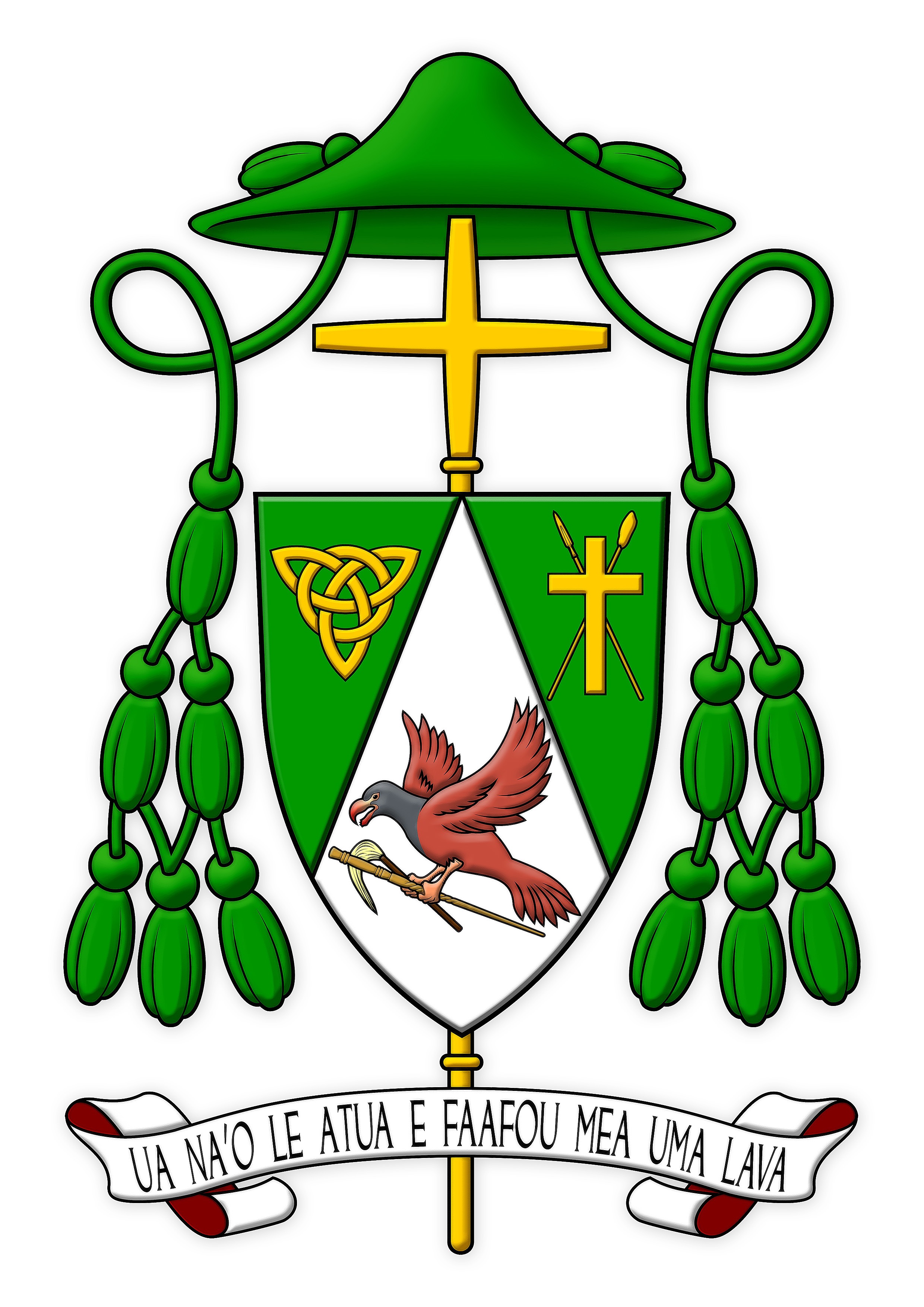
The coat of arms of the Most Rev. Peter Brown, CSsR who will be ordained a bishop and installed as the Bishop of Samoa-Pago Pago in American Samoa on August 22, the Feast of the Queenship of Mary.

The arms are loosely based on the flag of American Samoa and also contain symbols of the bishop’s native place in New Zealand, the Holy Family, his Religious Community and the Pacific Islands where he will serve as bishop.

The coat of arms was designed by me and Mr. Richard d’Apice and here rendered by Mr. Sandy Turnbull.

An Heraldic “CV”

Hcv1

Above you see what I like to call my “heraldic curriculum vitae”. (click on the image for a larger view) Essentially, it is a record of the various things I have done in my life illustrated by using heraldry. I commissioned the very talented architect, designer and graphic artist, Matthew Alderman to create this artwork. I conceived of the idea for this a few years ago when I received a friend’s bookplate that had not only his own coat of arms on it but the coats of arms of the various universities he attended and the dioceses in which he had served. A few months back Matt asked me to help him with some heraldic research for another commission on which he was working and when he showed me the sketches for it I knew he was the man to produce this heraldic CV.

My own coat of arms is at the center flanked by the coats of arms of the diocese in which I serve and the diocese in which I was born and grew up. Below that we see two other versions of my arms reflecting other capacities in which I serve with the coat of arms of the Roman Catholic Church between them. The bottom consists of the coats of arms of various schools I’ve attended and the sides are comprised of the coats of arms or other insignia for a variety of organizations to which I belong and/or serve as an officer or chaplain.

The image doesn’t really do it justice. In person it is stunning!

Sudarium

sc0247f42ea

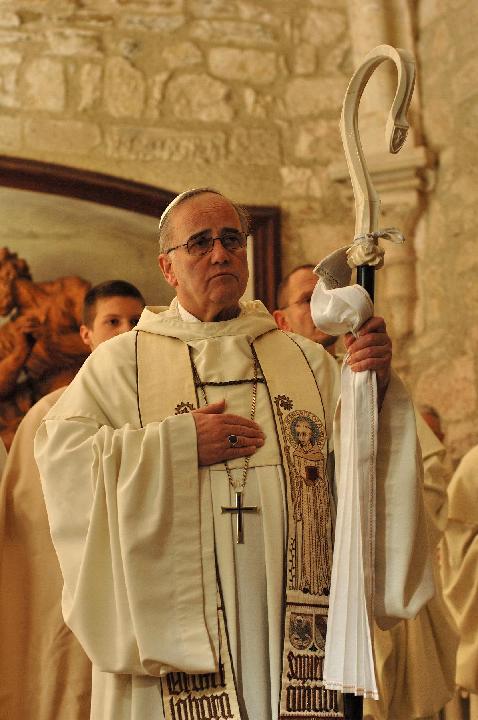
The word “sudarium” means “veil” in Latin. This veil makes an appearance in ecclesiastical heraldry in the coats of arms for abbots (see the arms of Abbot Gregory Duerr, OSB of Mt. Angel Abbey above). Since 1969 and the Papal Instruction, “Ut Sive” the use of the mitre and crozier in the coats of arms of Cardinals, Archbishops and Bishops has been discontinued. However, the mitre is still used in corporate arms for abbeys and dioceses. Similarly, the crozier is frequently used as an ornament to ensign the shield of an abbey. In some countries the mitre is still erroneously used by bishops to ensign their arms alone. While that was commonplace in the Middle Ages it is really incorrect (mind you not “unallowed” but merely “incorrect”) in modern heraldry.

While Pope Paul’s Instruction asked that the mitre and crozier be omitted from the arms of Cardinals, Archbishops and Bishops as unnecessary due to the fact that the galero with its colors and tassels and the (arch)episcopal cross are sufficient emblems for those prelates the crozier has been maintained as the external emblem particular to the arms of abbots, along with the sudarium, and of abbesses. However, to mark the crozier as the emblem of a monastic prelate it must have the sudarium attached to it.

The reason for the sudarium started out as a practical one and has, like so many other heraldic emblems, evolved into something merely symbolic. At the time when abbots were conceded the privilege of using pontifical insignia (i.e. mitre, crozier, ring) they were not originally allowed to wear pontifical gloves. The veil was attached to the crozier in order to protect the staff of the crozier from dirt and perspiration on the hands of the one holding it. Later, pontifical gloves were also conceded to abbots (and abbesses) so the sudarium became more symbolic than practical. It is also possible to find frequent examples of abbatial arms that have a crozier without the sudarium or, even, to omit the crozier entirely. This is quite incorrect.

The external ornaments proper to an prelate with the rank of abbot are the black galero with twelve tassels and the crozier placed behind the shield with the sudarium attached. Occasionally, it is possible to find the sudarium still actually used by some abbots, such as those at Heiligenkreuz in Austria. (below)

Image

Coat of Arms of Bishop-Elect Robert Coyle

sc003a692e5

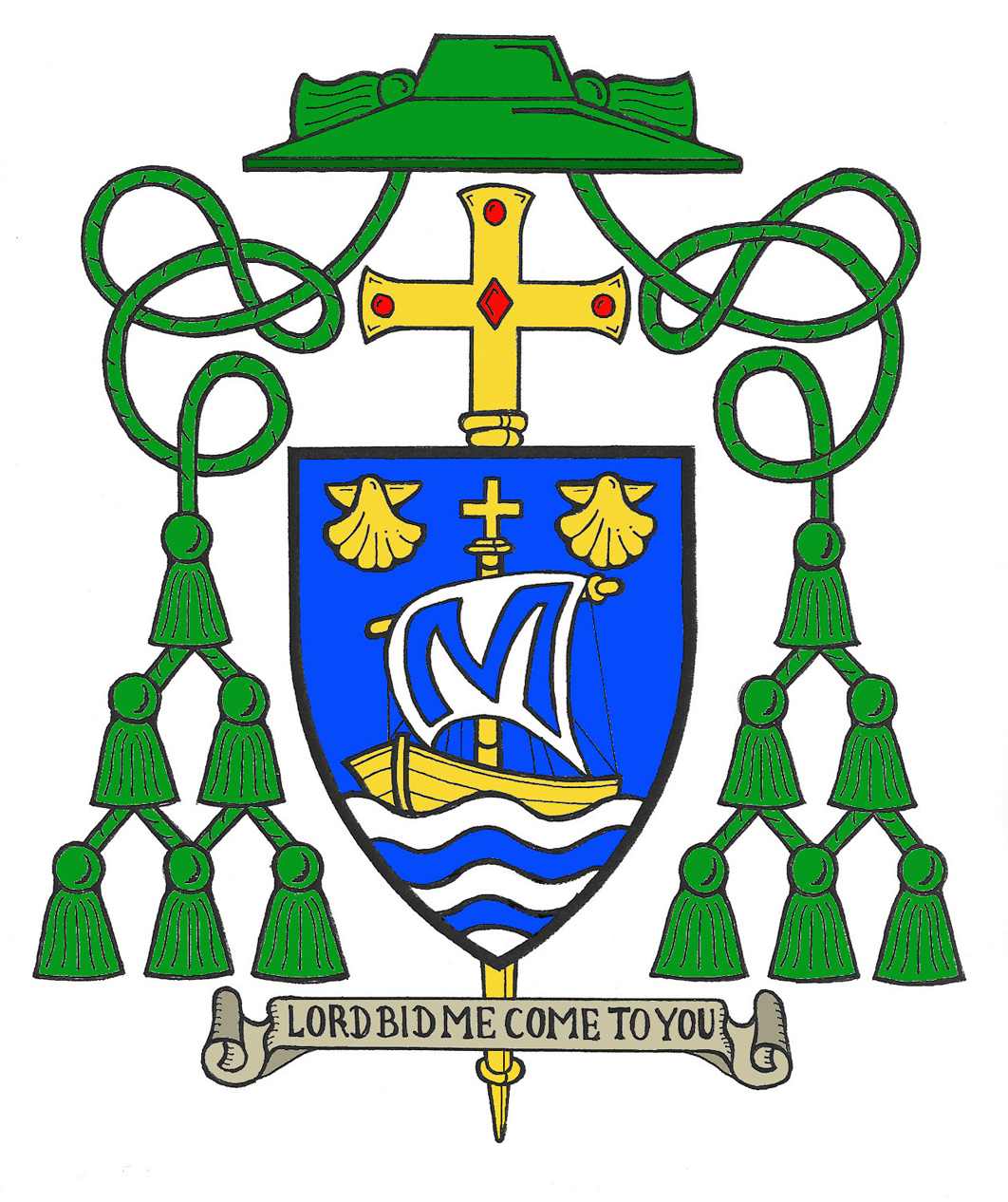
The Most Rev. Robert Coyle, who will be ordained the titular bishop of Zabi and auxiliary bishop for the Archdiocese of the Military Services, USA on April 25 has adopted the coat of arms above. They are based on a coat of arms he adopted at the time he was named a Chaplain to His Holiness.

BLAZON: Azure, on three barrulets wavy Argent in base a ship under full sail Or, masted of the same; on the sail Argent the letter “M” Azure; in chief to dexter and sinister two escallop shells Or. Ensigned with an Episcopal cross Or placed palewise behind the shield and surmounted by a galero with cords and twelve tassels disposed in three rows on one, two and three all Vert. On a scroll below the shield the motto: “Lord Bid Me Come To You”.

EXPLANATION: When describing things in heraldic terms the coat of arms is described from the perspective of one standing behind the shield and holding it in front of them. So the terms “dexter” (right) and “sinister” (left) are then reversed from the point of view of someone observing the coat of arms from the front.

The shield depicts the personal coat of arms of Bishop Coyle containing symbols having to do with his personal devotion, his service to his country, his home and his priestly ministry. The blue background and large letter “M” on the sail of the ship recall his devotion to Our Lady who is the patroness of the United States. The “M” is also a reference to the coat of arms of Bl. John Paul II during whose pontificate Bishop Coyle was ordained to the sacred priesthood. The ship at full sail is an obvious allusion to the more than 24 years Bishop Coyle has spent in the United States Navy. The ship is also an ancient symbol of the Church; the barque of Peter. It is a fitting symbol for anyone in God’s service to use and somewhat poignant that Bishop Coyle’s appointment as a bishop was announced by Pope Benedict XVI on the very same day he announced his abdication as pope initiating historic days of change in the Church which, nevertheless, did not swamp the barque of Peter which remains on course. In the upper portion of the field to the left and right are depicted two gold escallop shells. These shells appear in the coat of arms of the Diocese of Rockville Centre, Bishop Coyle’s native diocese for which he was ordained to the priesthood and also in the coat of arms of Pope Benedict XVI who called him to service as a bishop.

The external ornaments surrounding the shield indicate the rank of the armiger. In place of the martial helmet, mantling and crest ecclesiastics use a pilgrim’s hat called a “galero”. This broad-brimmed hat was, at one time in history, worn by all prelates. It exists now as a heraldic symbol. The Church has devised a system of various colors and numbers of tassels suspended from the hat to indicate various ranks of prelates. Since the original color worn by bishops was bright green this color has been retained in heraldry as the episcopal color. The galero therefore has twelve tassels suspended from cords and falling on either side of the shield. In addition a gold-colored episcopal cross is placed vertically behind the shield and extending above and below it. This cross, not to be confused with the processional cross used in the liturgy of the Church, is a heraldic symbol which has its origins in an actual cross, rather like a processional cross, which used to be carried immediately in front of any bishop whenever he was exercising his office. Throughout the Middle Ages such crosses were used in addition to the processional cross at the head of a liturgical procession. Eventually they fell into disuse but remain as a heraldic symbol of the office of bishop. These external ornaments conform with the Instruction of the Holy See, “Ut Sive Sollicite” of 1969 for the ornaments proper to a coat of arms for a prelate with the rank of bishop.

Below the shield on a decorative scroll we see the bishop’s chosen motto, “Lord Bid Me Come to You” from Gospel according to St. Matthew, chapter 14.