Category Archives: Fr. Guy’s designs

Very Rev. Steven A. Peay, PhD

One year ago today the Very Rev. Steven A. Peay, PhD, an Episcopal priest of the Diocese of Albany and Honorary Canon Theologian for Evangelism at Christ Church Cathedral in Eau Claire, WI became the 20th Dean and President of Nashotah House Seminary in Nashotah, WI.

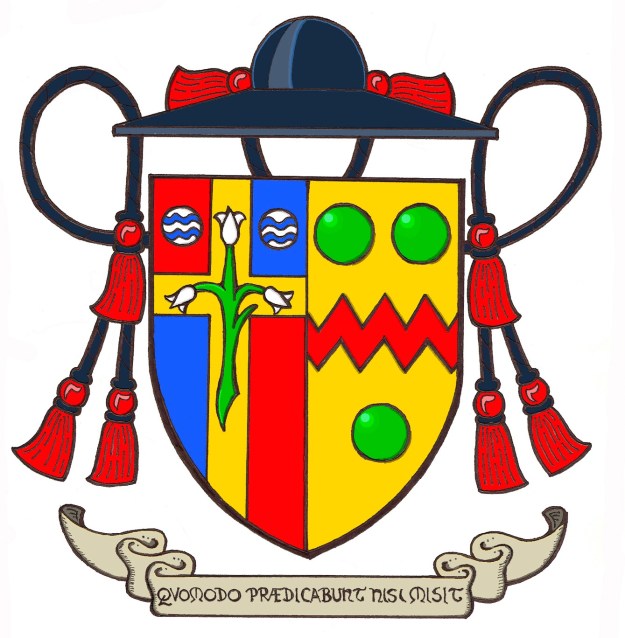
His coat of arms is pictured below. The blazon is:

Arms impaled; to dexter, quarterly Gules and Azure, overall on a Latin cross Or between two fountains in chief a triple blossom lily Proper; to sinister Or between three pommes a fess dancetty Gules. The shield is ensigned with the ecclesiastical hat of an Honorary Canon according to the Earl Marshal’s Warrant for the coats of arms of clergy in the Anglican Communion of 1976. Below the shield is a scroll with the motto, “Quomodo Prædicabunt Nisi Misit” (Romans 10:15)

In the arms of the seminary the lily represents both the Holy Trinity and the Blessed Virgin Mary, to whom the main chapel is dedicated. The two fountains allude to the seminary location between Upper and Lower Nashotah Lakes.

In the personal coat of arms of Fr. Peay the gold field and fess dancetty are taken from the coat of arms of Bl. John Henry Cardinal Newman. The bearer has long been an admirer of Newman’s work and writings. There is some irony in choosing this as Newman famously converted from the Church of England to Roman Catholicism and Fr. Peay, conversely, had been a Roman Catholic and was received into The Episcopal Church. Whereas Newman had three hearts surrounding the fess in his arms here, for difference, they have been changed to three pommes. In heraldry this term describes a green roundel. In this case they are chosen to resemble peas as an allusion to the bearer’s surname “Peay”.

The motto is a favorite scriptural quote that reflects the bearers long time teaching of historical theology and preaching to seminarians.

Peay2c

St. Joseph Parish, Washington, NJ

sc00016f9d

The newly assumed coat of arms of St. Joseph Catholic Church (above) incorporates elements alluding to the location of the parish and the parish’s titular patron saint. The blazon is: Gules, two bars Argent and in chief three fleur-de-lis Argent. That is: on a red background there are two horizontal silver (white) stripes and above that three fleur-de-lis also silver (white).
The new coat of arms is based closely on the coat of arms of George Washington (pictured below) The blazon of that coat of arms is: Argent, two bars Gules and in chief three mullets of five points also Gules. The Borough of Washington and Washington Township in Warren County in Northwest New Jersey is named for Washington.

Wash-mid
In the arms of the parish the colors have been reversed for difference and the three mullets or stars have been replaced with three fleur-de-lis, a symbol in heraldry used most often to represent Our Lady but one which is also used to allude to St. Joseph, her husband. For some time now the parish already employed the fleur-de-lis as a kind of logo or parish symbol.
The new coat of arms was designed and rendered by me as I am serving as the Administrator of the parish.

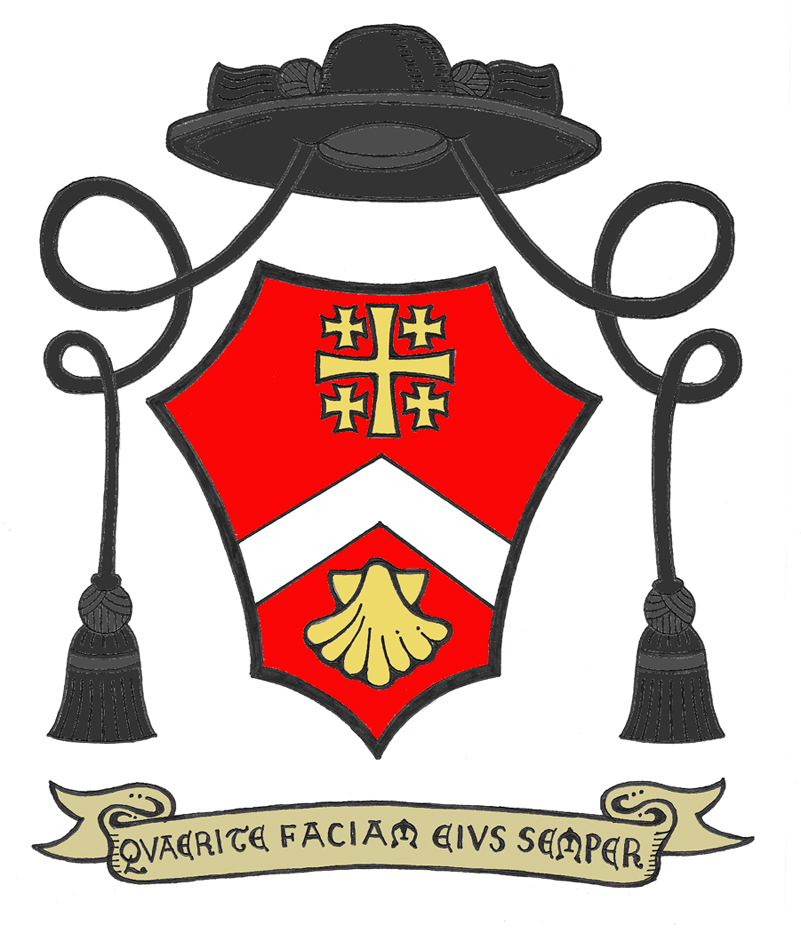
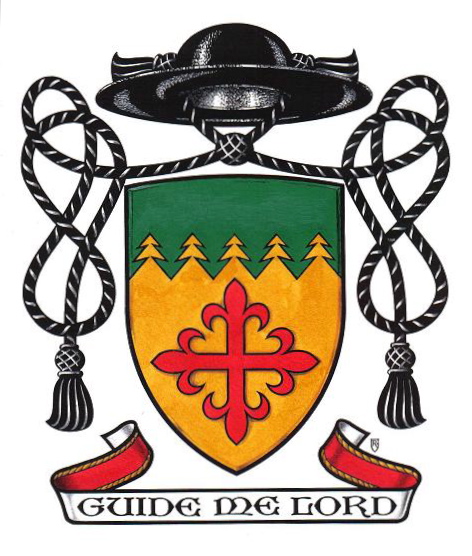
New Arms for a New Priest

This coat of arms was designed for a man about to be ordained to the priesthood. He chose mostly red and gold to allude to the arms of Pope Benedict XVI who inspired him to pursue the priesthood. The Jerusalem cross is for his travels in the Holy Land and his care and concern for the Church in the Middle East. The escallop shell is from his family arms and also represents both baptism and pilgrimage. The chevron is a stylized carpenter’s square for St. Joseph, to whom there is a particular devotion, and is silver (white) to allude to Our Lady. The motto, from Psalm 104, says “Always Seek His Face”.

sc00053b16c

Bishop O’Regan of Sale, Australia

On February 26 Patrick M. O’Regan will be ordained and installed as the IX bishop of Sale, Victoria, Australia. The ship at sea is a reference to the diocese of Bathurst where the bishop previously served as a priest. In chief are charges that allude to St. patrick and to the arms traditionally associated with families of the name O’Regan or Regan. The arms were designed by me and Mr. Richard d’Apice and rendered by Mr. Sandy Turnbull.

Image 1

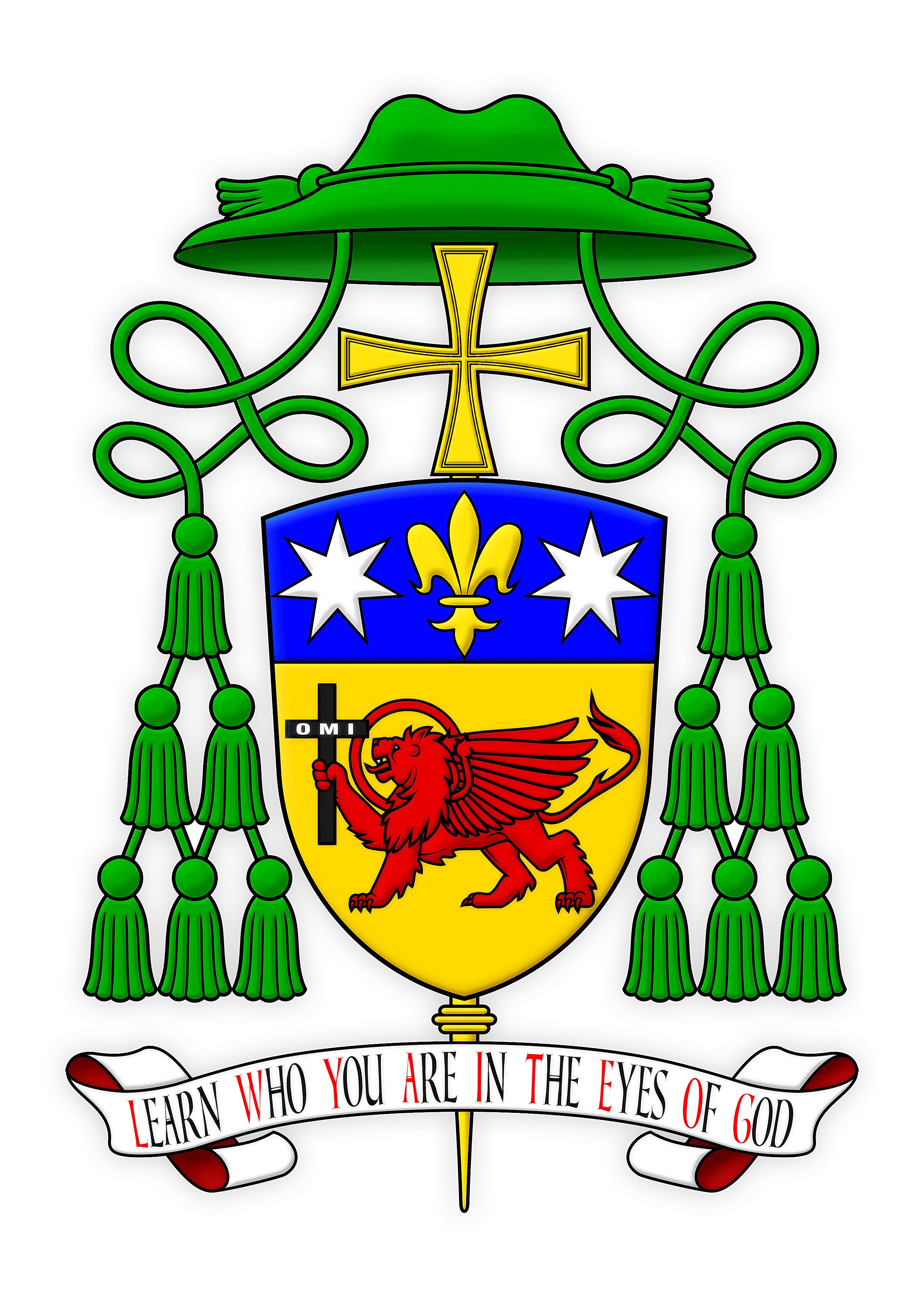
Bishop Mark Edwards, OMI

Image 1

On December 17 Mark Stuart edwards, OMI will be ordained (along with Terence Curtin) as auxiliary bishop of Melbourne, Australia. Bishop Edwards is also the Titular Bishop of Garba.

His newly assumed arms (above) reflect his baptismal patron, St. Mark, as well as the Oblates of Mary Immaculate, the Religious community to which he belongs. In addition, Our Lady and Australia are alluded to on the chief.

These arms were designed by me and Mr. Richard d’Apice of the Australian Heraldry Society and emblazoned by Sandy Turnbull also of the Australian Heraldry Society.

Bishop Comensoli of Broken Bay, Australia

Image 11

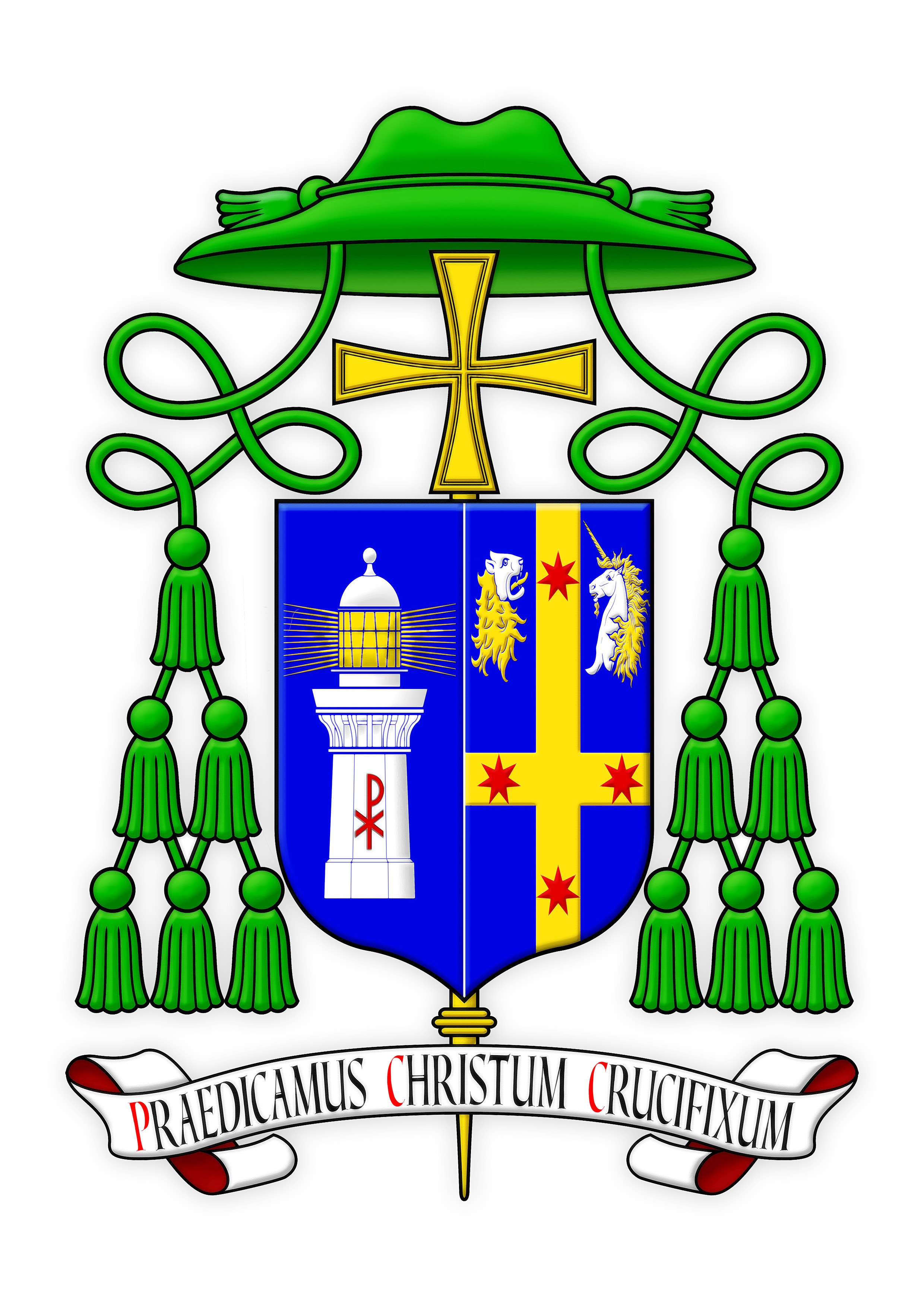
The Broken Bay diocesan Arms display a lighthouse spreading the light of the gospel over the diocese. The detail echoes the detail of the Barrenjoey lighthouse which unites the two main land masses that comprise the regions of the diocese.

The arms and motto which Bishop Comensoli adopted at the time he was named Auxiliary Bishop of Sydney in 2011 are of a personal character and are blazoned: Azure, on a Latin cross inverted Or four seven-pointed mullets (or Commonwealth stars) Gules, in the first quarter a lion’s head erased Argent crined and langued Or and in the second a unicorn’s head erased Argent crined and armed Or respectant.

In layman’s terms, the arms may be described as: On a blue field, a gold cross inverted with a red seven-pointed (or Commonwealth) star at each extremity, in the upper left quarter, a silver lion’s head erased at the neck with gold mane and tongue and in the upper right quarter a silver unicorn’s head erased at the neck with gold mane and horn. The motto ‘Praedicamus Christum Crucifixum’ is a quotation from the Apostle Paul’s first epistle to the Corinthians (1Cor1.23), and can be translated as ‘We preach Christ crucified’.

The inverted Latin Cross symbolises the Bishop’s nominal patron, the Apostle Peter and the stars reflect the Southern Cross, which shines out over the Great South Land of the Holy Spirit. The lion and the unicorn respectively symbolise the mind and the heart of love. The meaning of these symbols, while of medieval provenance, is especially associated with the seminal work on Christian love by the English Jesuit, Martin C D’Arcy SJ, “The Mind and Heart of Love: Lion and Unicorn: A Study in Eros and Agape”. Bishop Comensoli will be installed as the Third Bishop of Broken Bay on Dec. 12.

The personal arms were designed by me and Mr. Richard d’Apice of the Australian Heraldry Society and originally emblazoned as well as marshaled with the arms of the diocese and emblazoned again by Mr. Sandy Turnbull also of the Australian Heraldry Society.

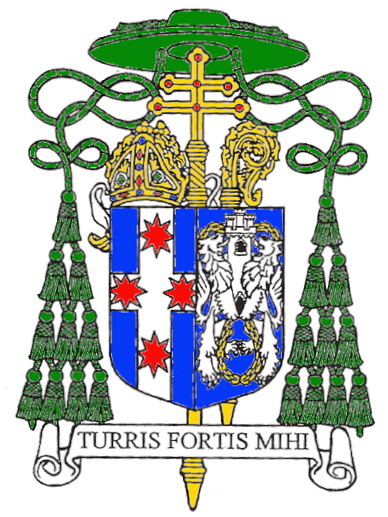
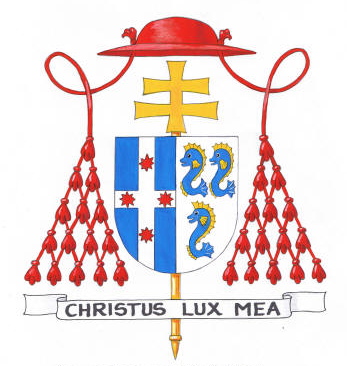
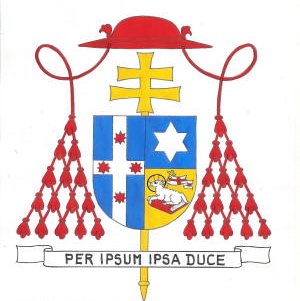
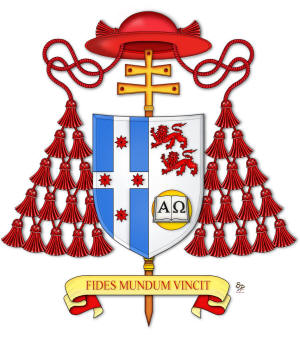
Archbishops of Sydney

With the recent installation of the IX archbishop of Sydney Australia, The Most Rev. Anthony Fisher, OP several have asked about the arms of the other archbishops, five of whom have also been cardinals. Here they are:

1. Bede (John) Polding, OSB

sc0070423d

2. Bede (Roger) Vaughan, OSB

sc007050b5b

3. Patrick Francis Cardinal Moran

MORAN  PATRIZIO FRANCESCO

4. Michael Kelly

sc0070641b

5. Norman Thomas Cardinal Gilroy, KBE

GILROY-3 My painting0001

6. James Darcy Cardinal Freeman, KBE

FREEMAN  JAMES DARCY

7. Edward Bede Cardinal Clancy

CLANCY

8. George Cardinal Pell, AC

sostituisciPellbis0001

9. Anthony Colin Fisher, OP

image-11

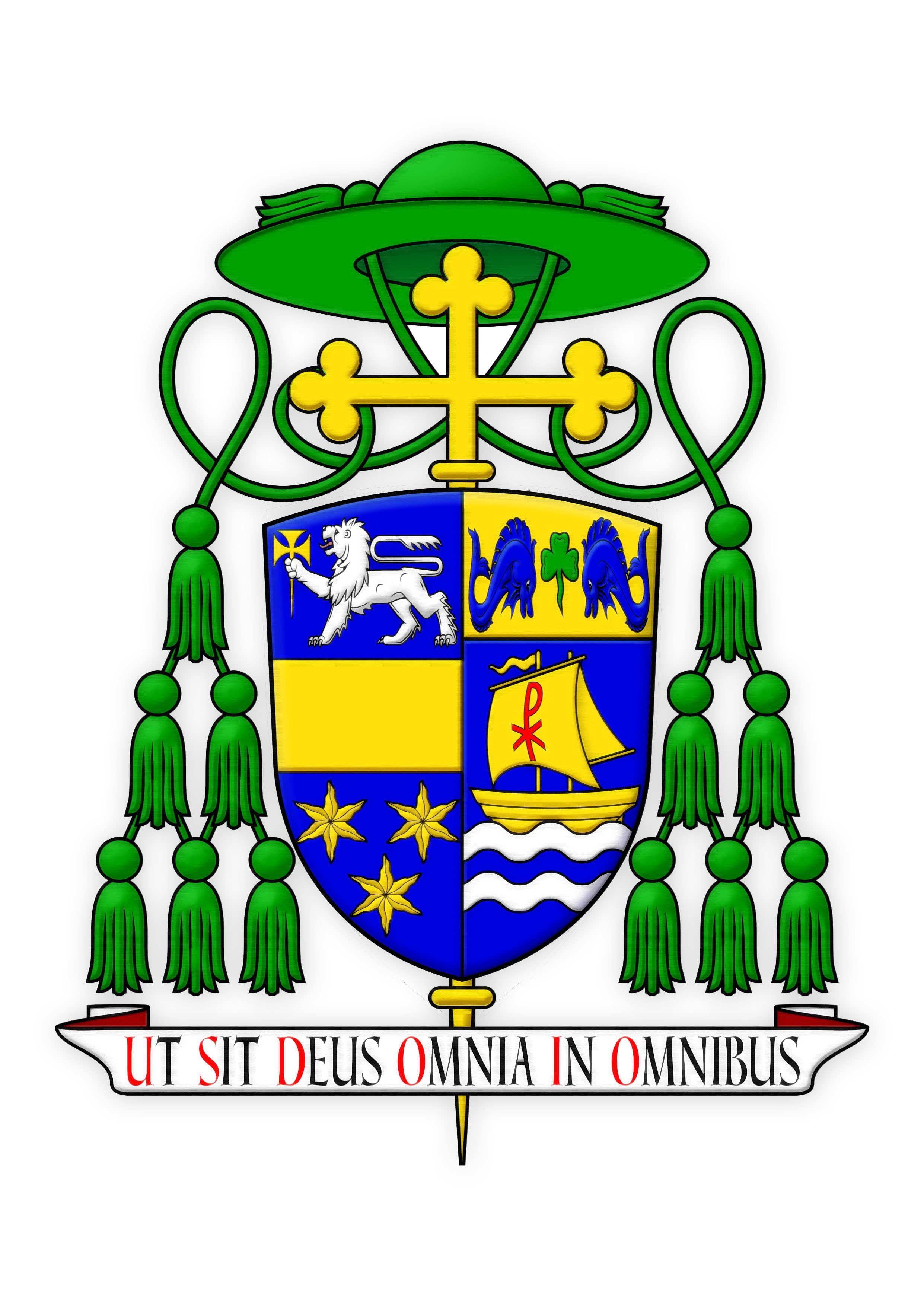
Archbishop Anthony Fisher of Sydney

Image 11

The Most Rev. Anthony Fisher, OP until now Bishop of Parramatta and previously auxiliary bishop of Sydney will be installed as the IX Archbishop of Sydney on November 12. His coat of arms (above) was prepared by Mr. Chris Wolter who had also done the work on the archbishop’s arms in Parramatta and as auxiliary bishop (below).

BishopAF-CoatArms

In the interest of full disclosure I, along with the President of the Australian Heraldry Society, Mr. Richard d’Apice, AM, were consulted on this coat of arms. As with any such consultation some of our advice was followed and some was not but the archbishop and Mr. Wolter were very open to hearing suggestions. Essentially, the archbishop retains the arms he first assumed when becoming auxiliary bishop of Sydney. Those arms combine the armorial bearings of the Order of Preachers (more commonly referred to as the Dominicans) of which he is a member impaled with arms that are based on the arms used by St. John Cardinal Fisher when bishop of Rochester, England with some minor alterations for difference (i.e. the inclusion of the Marian symbol). Over this on an inescutcheon (sometimes referred to as an escutcheon “in pretense” although that expression isn’t wholly appropriate in this case) is the arms of the See of Sydney.

Two Recent Commissions

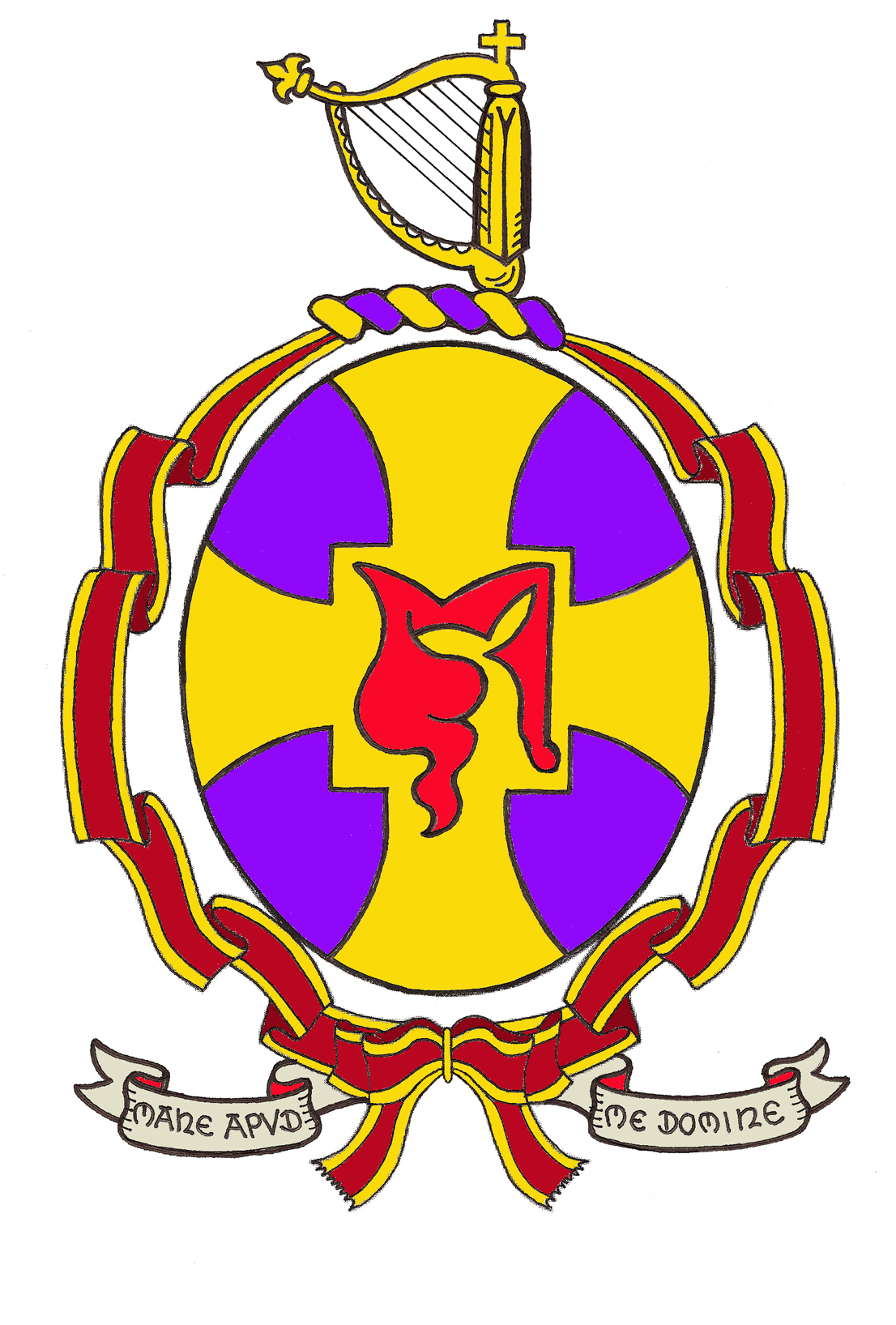
Below are two coats of arms, one for a man and the other for a woman, that I was recently commissioned to do. The ribbon surrounding the woman’s oval shield has personal meaning to her and is decorative. The common practice in heraldry is that women don’t use helm and mantling in their achievements which leaves them looking rather empty artistically. Decorative knots, ribbons and wreaths are often employed to surround the shield.

Image

Image

Another Coat of Arms of a Priest

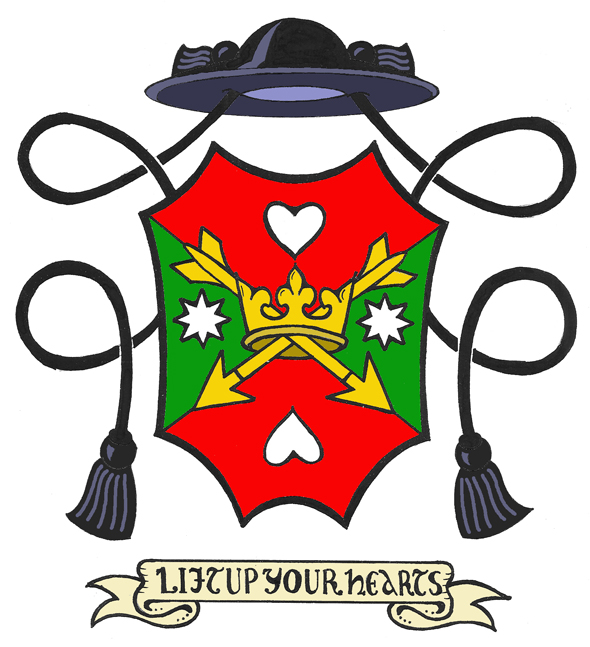
Below is the recently designed coat of arms for a priest. The shield is divided per saltire, the upper and lower quarters being red and the other two being green. These colors, along with the silver (white) are the national colors of Italy, the country of the bearer’s ancestry. In the center there is an open royal crown with two arrows, points downward, passing through it crossed in saltire and the crown and arrows are gold (yellow). This is the heraldic device used to symbolize the armiger’s patron saint. The two silver (white) stars on either side evoke the armiger’s last name which, translated into English, means a bringer of light. The stars are the firmaments fixed lights. Above and below the main charge are two hearts. This is an allusion to the Sacred and Immaculate Hearts as well as to the fact that the armiger has had a heart transplant and so has also had two hearts. The motto “Lift Up Your Hearts” is taken from the opening dialogue of the Preface of the Mass.

We had been in discussion about a coat of arms for some time but couldn’t seem to settle on a design that satisfied us both or, for that matter, even come up with a good starting point. This design, somewhat oddly, simply came to me in my minds eye all at once one afternoon and was accepted immediately by the armiger.

Image

New Arms of a Priest

Image

Here is a coat of arms I just completed for a Roman Catholic priest. He has a devotion to St. Michael the Archangel and wanted to incorporate a charge that suggested St. Michael defeating the Evil One. In addition, he was rather inspired by the personal arms of Archbishop Georg Gänswein, The Prefect of the Pontifical Household, whose arms depict a dragon slain by a spear as an allusion to St. George. In this coat of arms the dragon is once again used this time to allude to Satan and he is depicted pierced by a flaming sword, a heraldic symbol of St. Michael. The three stars represent both Our Lady and the Blessed Trinity. The motto is a translation of the name Michael. The phrase, “Quis Ut Deus” means “Who Is Like God”. The shield is ensigned with the simple black galero of a priest. The similarity to the arms of Abp. Gänswein can be seen but there is enough of a difference in the design to make these arms unique.

A Chaplain to His Holiness

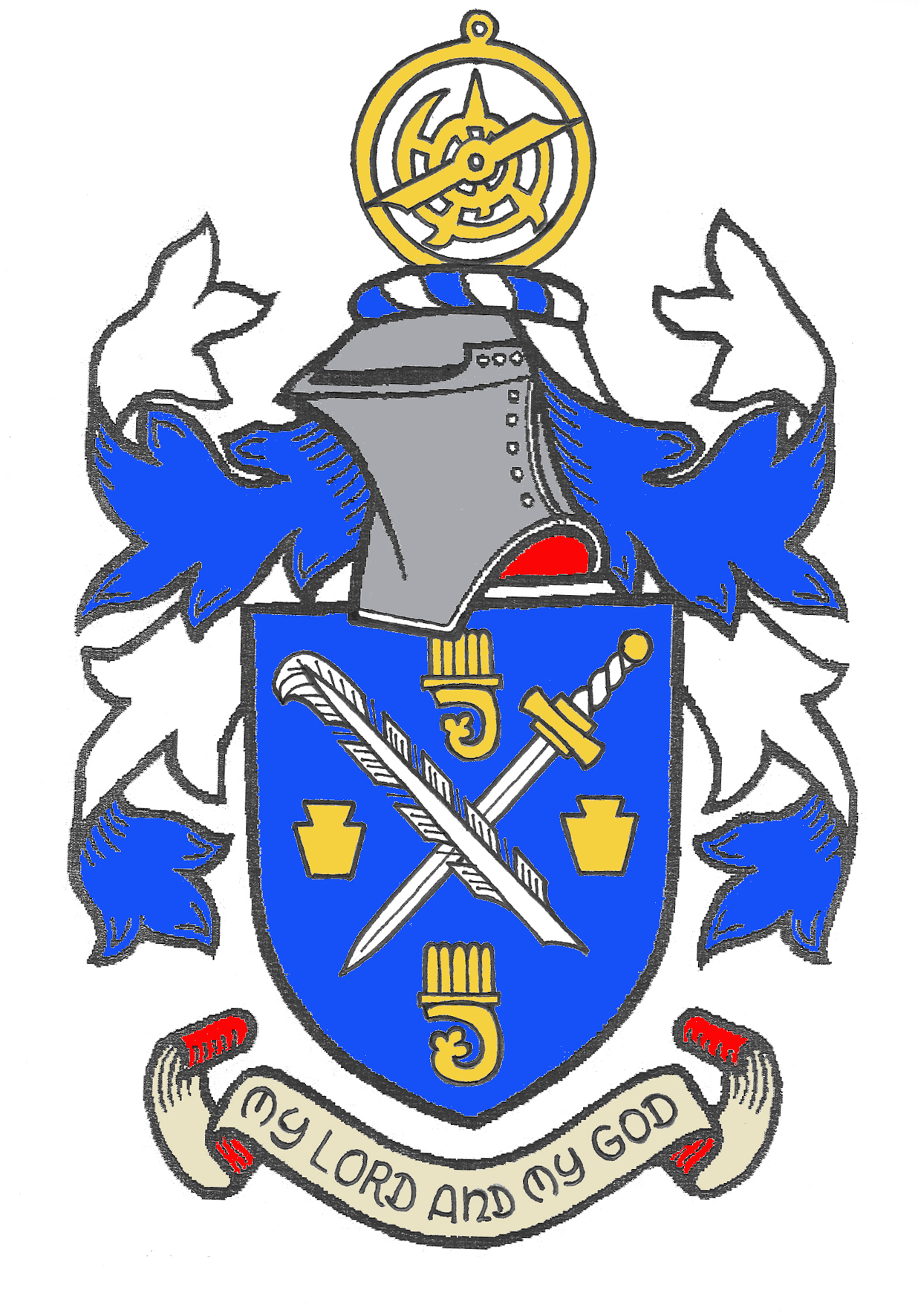
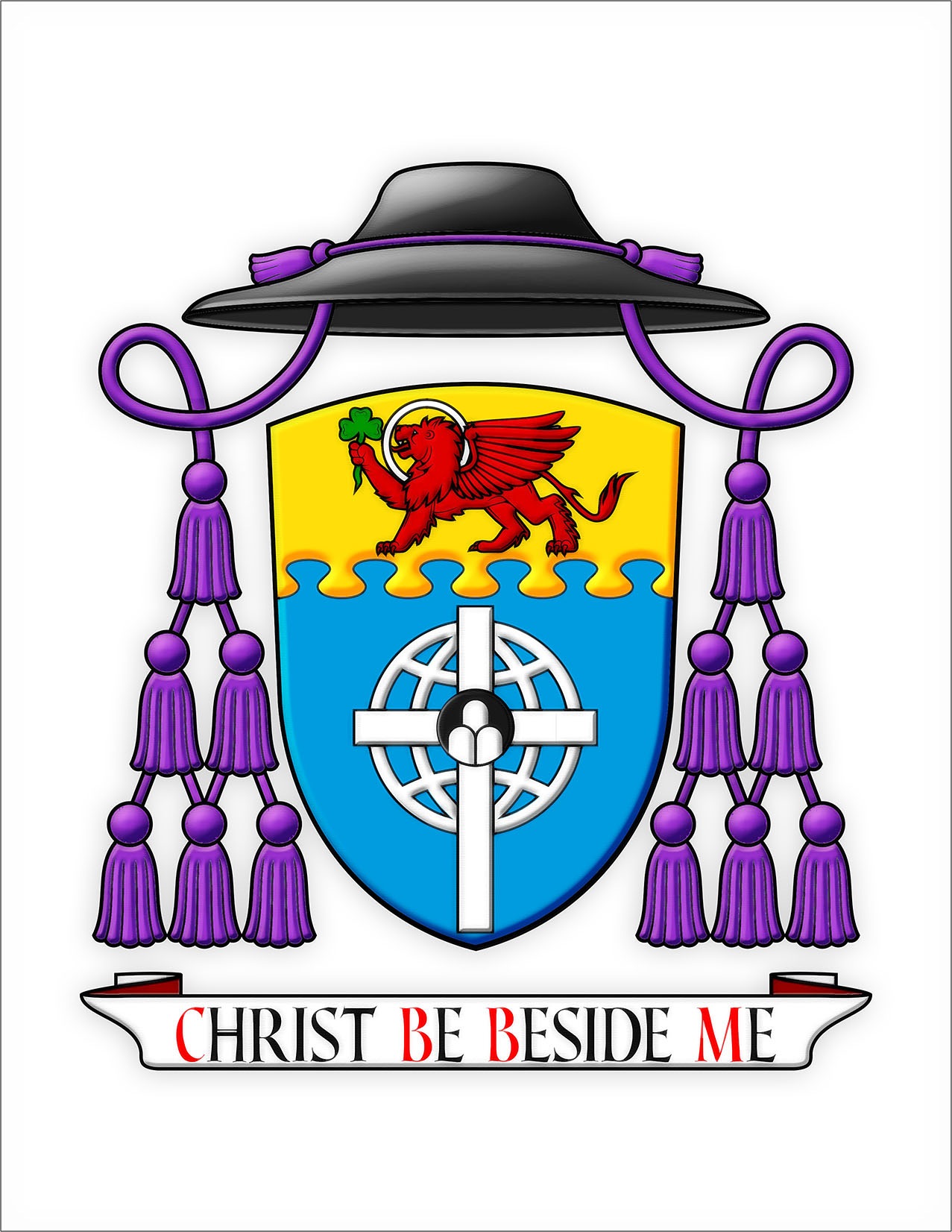
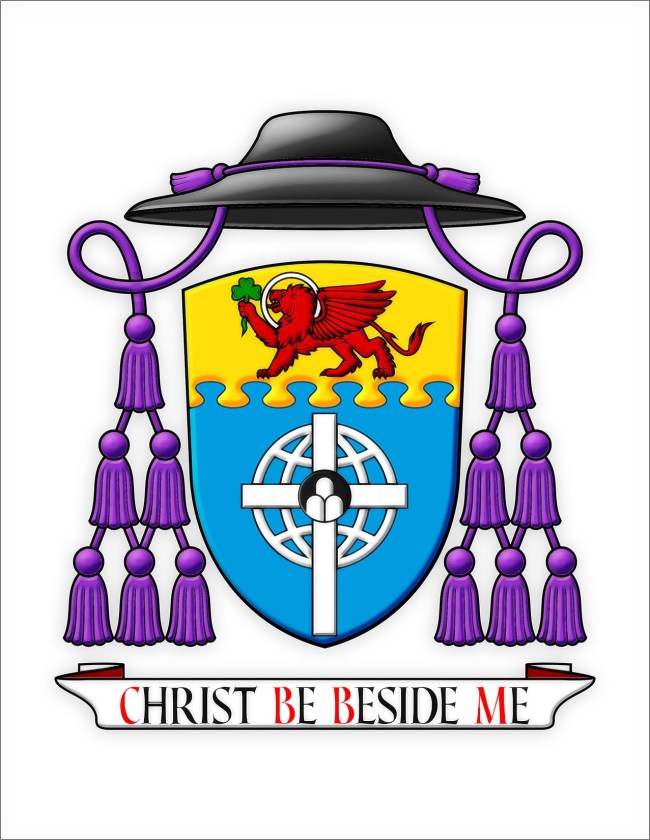
Back in 2012 a priest who, like me, grew up on Long Island and who, unlike me served as a priest of the diocese of Rockville Centre and also went on to serve the U.S. Air Force as a chaplain rising to the rank of Colonel, was honored by the then Pope, Benedict XVI, with the rank of Chaplain to His Holiness. This is the lowest of the three grades of prelates in the papal household who are collectively addressed as “Monsignor” (Italian for “My Lord”). Fr. Mark Rowan contacted me and asked if I could assist him with the design of a coat of arms. I jumped at the chance to help out a fellow Long Islander as well as a chance to assist someone who was serving not only the Lord but our country. Below is the end result:
Image

The main background of the field is a shade of blue called, in heraldry, Bleu Celeste. It is borrowed from the coat of arms of the U.S. Air Force. Obviously, it alludes to the blue of the sky. On this is the single charge of the open globe combined with a Latin cross (one where the lower arm is longer than the other three) in silver. This charge is taken from the arms of the Archdiocese for the Military Services, USA. Superimposed over this is a small black roundel, called a “pellet”. This, in turn, has three small silver hills. It is borrowed from the coat of arms of the diocese of Rockville Centre, NY. The three small hills are, in turn, taken from the arms of Pope Pius XII who founded the diocese of Rockville Centre in 1957. That diocese is composed of territory taken from the diocese of Brooklyn so the black tincture represents the marshes, which recalled to the Dutch their homeland in Breuckelen on the Vecht in the Province of Utrecht. The Dutch who settled Brooklyn at first called it “Breuck-Landt,” meaning “broken land,” or “marshland,” inasmuch as a great deal of land was broken up by patches of water.

The upper third of the shield (called the “chief”) is separated from the rest of the background by a line whose shape is referred to as “nebuly”. This type of line in heraldry is used to suggest clouds. This same dividing line is also used in the coat of arms of the U.S. Air Force. Here, along with the bleu celeste, it alludes to Msgr. Rowan’s service as a Chaplain. The bumps or nebuli are six in number. This is a reference to the fact that Msgr. Rowan has served or provided support on six different continents in the course of his service as a Chaplain and has also administered six of the seven sacraments. (The seventh sacrament, holy orders, is reserved to bishops). On the gold (or yellow) colored chief stands a red winged lion that is the symbol of his patron saint, St. Mark, the Evangelist. The lion holds, in his right front paw a green trefoil, more commonly known as a shamrock, which is the symbol of Msgr. Rowan’s Irish ancestry.

The galero, or ecclesiastical hat, is used in Church heraldry in place of the more martial helmet, mantling and crest. Originally a pilgrim’s hat it was worn and used in heraldry by Cardinals. Later, it was adopted by the lesser prelates. Eventually a system of both colors and number of tassels was devised to indicate the various ranks within the hierarchy. Msgr. Rowan’s arms use a black galero like any priest but the cords and tassels are purple indicating he is a member of the papal household. This galero indicates the bearer is a Chaplain to His Holiness according to the Motu Proprio, “Inter Multiplices” of Pope St. Pius X in 1905.

On a scroll below the shield Msgr. Rowan has chosen the motto, “Christ Be Beside Me” which is taken from the prayer known as “St. Patrick’s Breastplate”. After I completed this design and Msgr. Rowan approved the artwork was quickly and expertly executed by Mr. Sandy Turnbull of Australia. Mr. Turnbull is a member of the Australian Heraldry Society.
Assumption Anniversary

Image

Sixteen years ago today, on the feast of St. Vincent dePaul, I was ordained a priest by the late Bishop Vincent (dePaul) Breen. On that day as well I assumed my coat of arms since I was now able to ensign the shield with the galero of a priest. The rendering used at that time (above) was done by the late Richard Crossett, an American heraldic artist of great talent. So, in addition to celebrating sixteen years as a priest today I celebrate sixteen years being armigerous. (for those of you who don’t know…go look it up!)

Archbishop Porteous of Hobart

Image

The coat of arms of the Most Rev. Julian Porteous, up until now the auxiliary bishop of Sydney, Australia who has been promoted to be the (non Metropolitan) Archbishop of Hobart, Tasmania, Australia. He will be installed on September 17th. The Archbishop decided to re-design his current coat of arms, assumed at the time he was named auxiliary bishop, to bring them into better harmony when impaled with the arms of the See of Hobart. Archbishop Julian’s original arms were: “Quarterly, Vert and Or, a cross throughout Counterchanged; in dexter chief a dove rising surrounded by a golden effulgence and in sinister base an open book Argent, bound Or charged with the Greek letters Alpha and Omega Gules”.

In the redesign he has retained the dove representing the Holy Spirit and requested in be surrounded by rays suggesting the famous Bernini window above the Altar of the Chair in St. Peter’s Basilica. In addition the open book alluding to the Sacred Scriptures has been retained. Thus showing the heraldic equivalent of Spirit and Wisdom.

The new blazon is: “Arms impaled. In the dexter Azure the letter “M” Argent crowned with a celestial crown Or (Hobart); In the sinister per fess Gules and Argent, in chief a sun in splendor, the rays of light depicted as straight lines radiating to the edge of the field, within a ring all Or, charged overall with a dove displayed affronté Argent; in base an open book Argent, bound Gules and charged on the pages with the letters alpha and omega, Gules”.

The arms were designed by me and Mr. Richard d’Apice of Australia and depicted by Mr. Sandy Turnbull, also of Australia.

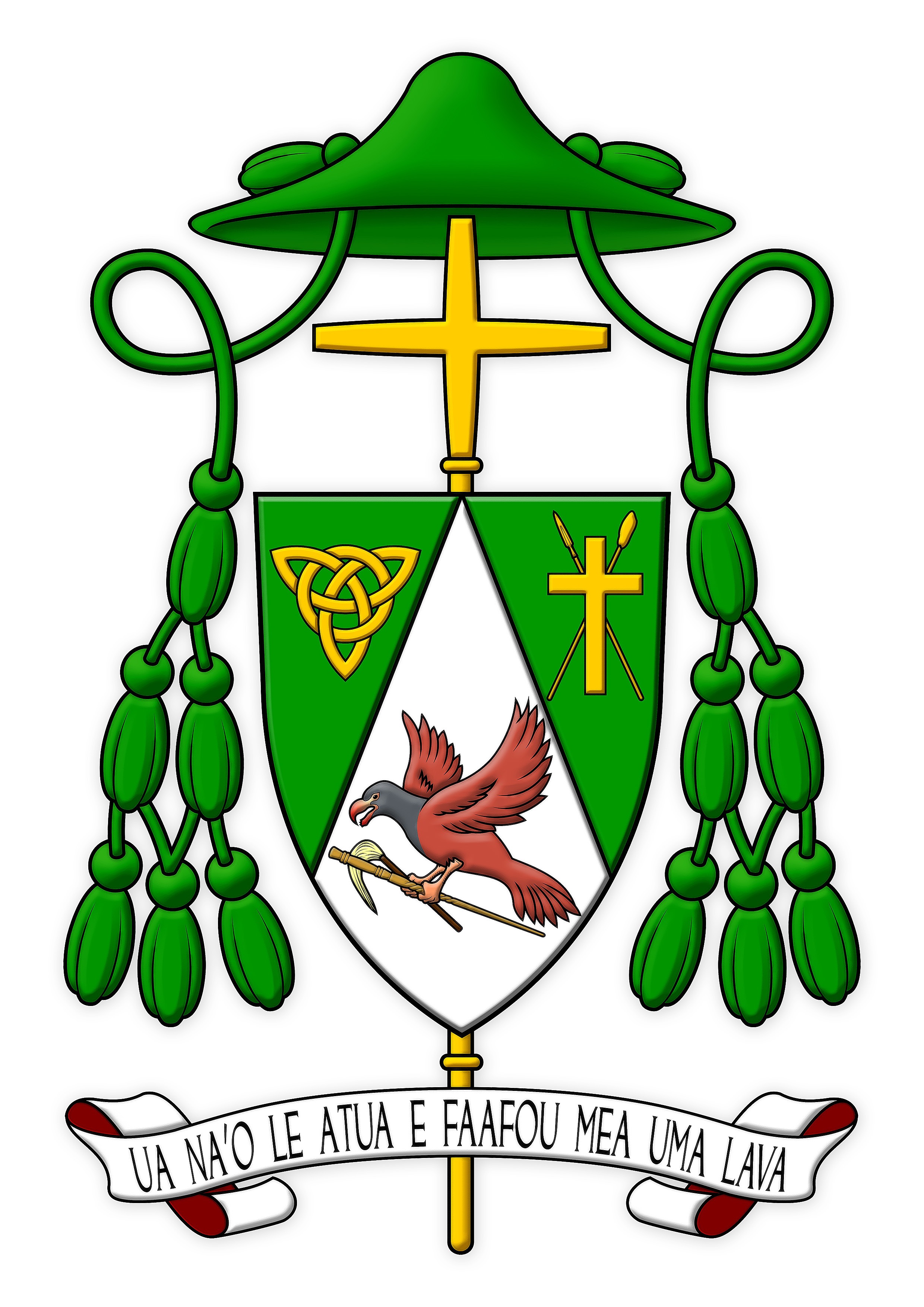
Bishop Peter Brown, CSsR of Samoa-Pago Pago

Image

The coat of arms of the Most Rev. Peter Brown, CSsR who will be ordained a bishop and installed as the Bishop of Samoa-Pago Pago in American Samoa on August 22, the Feast of the Queenship of Mary.

The arms are loosely based on the flag of American Samoa and also contain symbols of the bishop’s native place in New Zealand, the Holy Family, his Religious Community and the Pacific Islands where he will serve as bishop.

The coat of arms was designed by me and Mr. Richard d’Apice and here rendered by Mr. Sandy Turnbull.

An Heraldic “CV”

Hcv1

Above you see what I like to call my “heraldic curriculum vitae”. (click on the image for a larger view) Essentially, it is a record of the various things I have done in my life illustrated by using heraldry. I commissioned the very talented architect, designer and graphic artist, Matthew Alderman to create this artwork. I conceived of the idea for this a few years ago when I received a friend’s bookplate that had not only his own coat of arms on it but the coats of arms of the various universities he attended and the dioceses in which he had served. A few months back Matt asked me to help him with some heraldic research for another commission on which he was working and when he showed me the sketches for it I knew he was the man to produce this heraldic CV.

My own coat of arms is at the center flanked by the coats of arms of the diocese in which I serve and the diocese in which I was born and grew up. Below that we see two other versions of my arms reflecting other capacities in which I serve with the coat of arms of the Roman Catholic Church between them. The bottom consists of the coats of arms of various schools I’ve attended and the sides are comprised of the coats of arms or other insignia for a variety of organizations to which I belong and/or serve as an officer or chaplain.

The image doesn’t really do it justice. In person it is stunning!

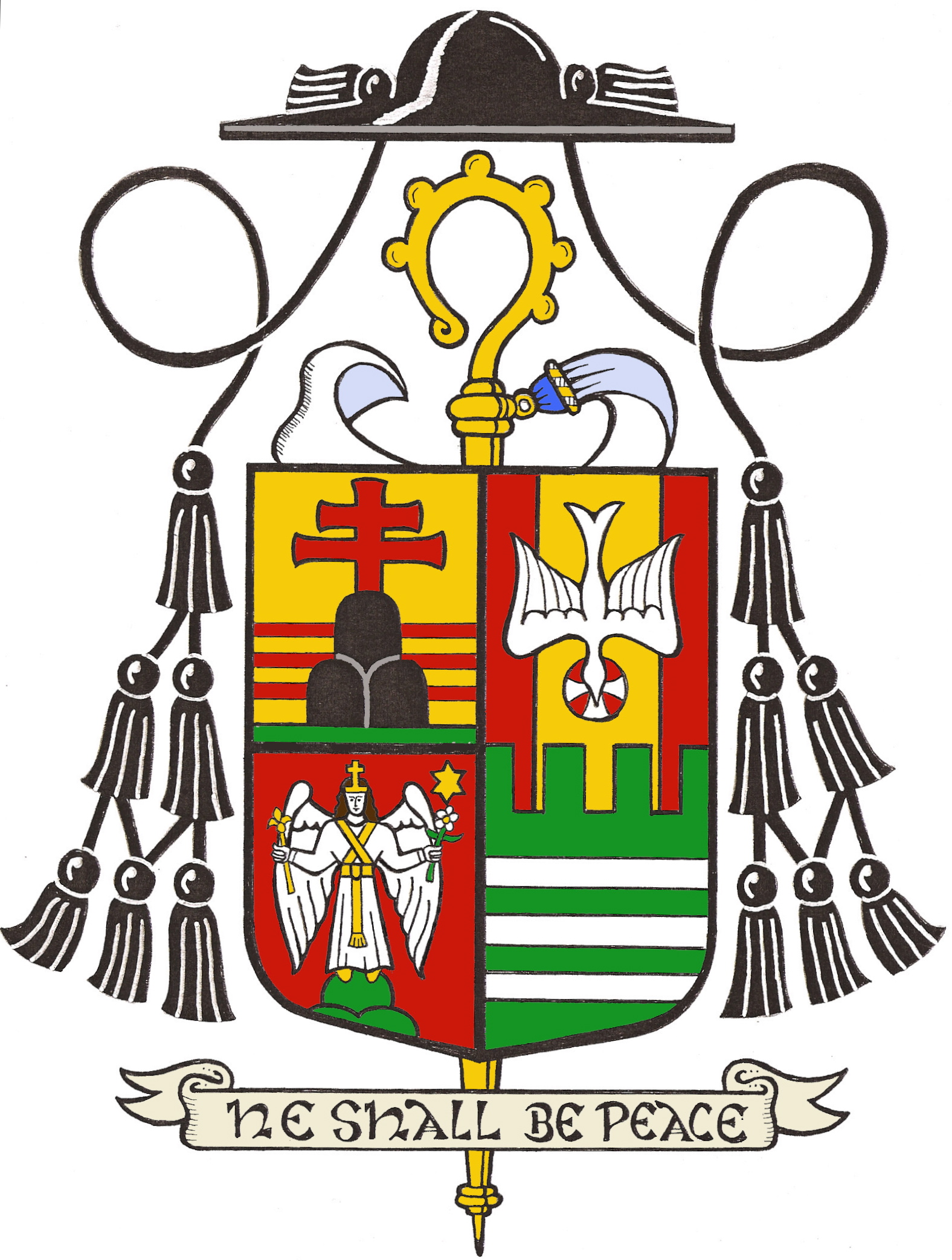
Sudarium

sc0247f42ea

The word “sudarium” means “veil” in Latin. This veil makes an appearance in ecclesiastical heraldry in the coats of arms for abbots (see the arms of Abbot Gregory Duerr, OSB of Mt. Angel Abbey above). Since 1969 and the Papal Instruction, “Ut Sive” the use of the mitre and crozier in the coats of arms of Cardinals, Archbishops and Bishops has been discontinued. However, the mitre is still used in corporate arms for abbeys and dioceses. Similarly, the crozier is frequently used as an ornament to ensign the shield of an abbey. In some countries the mitre is still erroneously used by bishops to ensign their arms alone. While that was commonplace in the Middle Ages it is really incorrect (mind you not “unallowed” but merely “incorrect”) in modern heraldry.

While Pope Paul’s Instruction asked that the mitre and crozier be omitted from the arms of Cardinals, Archbishops and Bishops as unnecessary due to the fact that the galero with its colors and tassels and the (arch)episcopal cross are sufficient emblems for those prelates the crozier has been maintained as the external emblem particular to the arms of abbots, along with the sudarium, and of abbesses. However, to mark the crozier as the emblem of a monastic prelate it must have the sudarium attached to it.

The reason for the sudarium started out as a practical one and has, like so many other heraldic emblems, evolved into something merely symbolic. At the time when abbots were conceded the privilege of using pontifical insignia (i.e. mitre, crozier, ring) they were not originally allowed to wear pontifical gloves. The veil was attached to the crozier in order to protect the staff of the crozier from dirt and perspiration on the hands of the one holding it. Later, pontifical gloves were also conceded to abbots (and abbesses) so the sudarium became more symbolic than practical. It is also possible to find frequent examples of abbatial arms that have a crozier without the sudarium or, even, to omit the crozier entirely. This is quite incorrect.

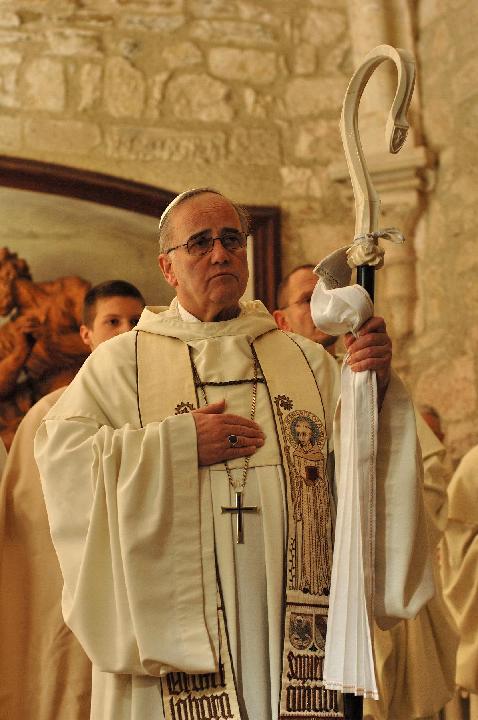
The external ornaments proper to an prelate with the rank of abbot are the black galero with twelve tassels and the crozier placed behind the shield with the sudarium attached. Occasionally, it is possible to find the sudarium still actually used by some abbots, such as those at Heiligenkreuz in Austria. (below)

Image