Category Archives: Fr. Guy’s designs

Archabbot Douglas Nowicki, OSB

Retired Archabbot of Saint Vincent Archabbey, Latrobe, Pennsylvania, Douglas R. Nowicki, O.S.B., (79), died Tuesday, July 23, in Allegheny General Hospital, Pittsburgh, following a brief illness. The eleventh Archabbot of Saint Vincent, he served from 1991 until he reached the retirement age of 75 in May of 2020, when he retired. He was the second longest-serving Archabbot in the 178-year history of Saint Vincent. With more than 150 monks, St. Vincent was the first Benedictine monastery in the United States, and is one of the largest monasteries in the world. He will be buried on July 29, 2024.

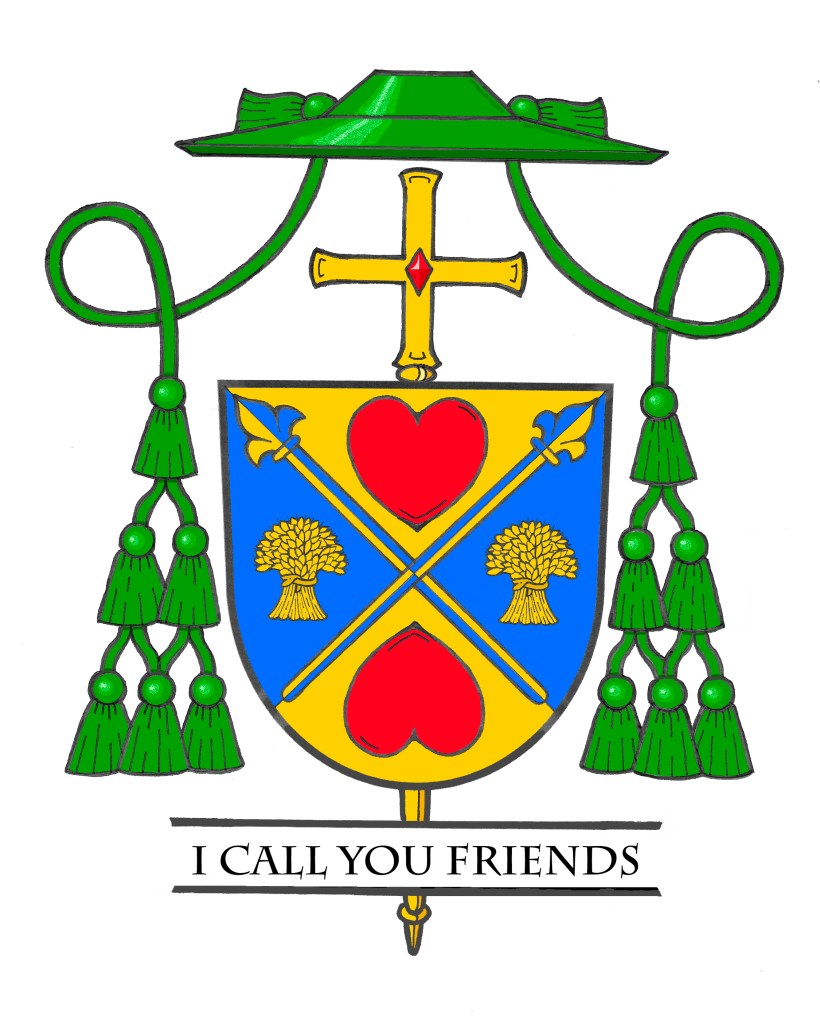
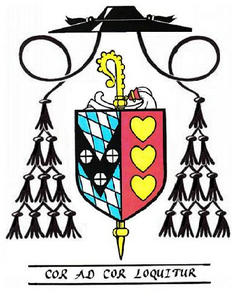
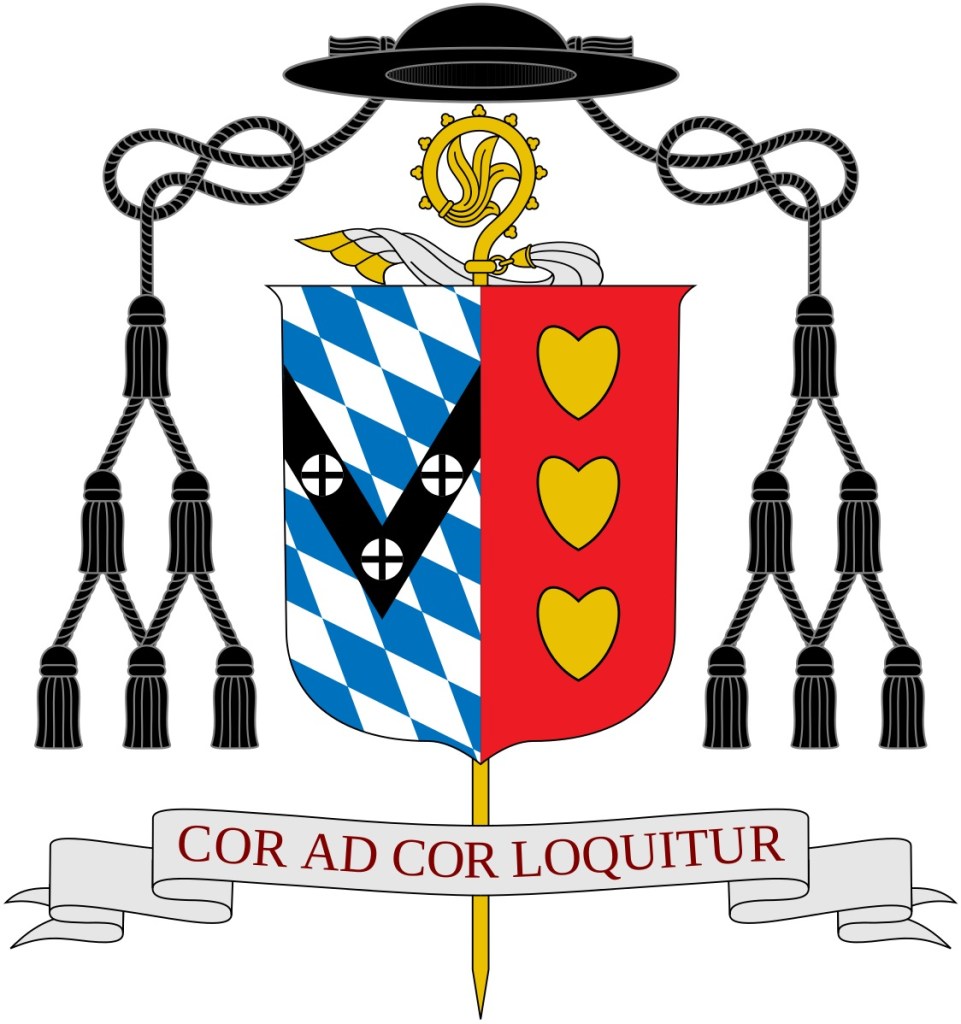
When he was elected in 1991 I was still a member of the monastic Community in Latrobe. My mentor—the late Géza Grosschmid, Ph.D.—and I were given the job of devising a coat of arms for the new Archabbot. Ultimately, Archabbot Douglas rejected the design Dr. Grosschmid suggested and went with a modified version of it devised by me. Essentially, it illustrated the motto, taken from St. John Henry Newman, “Cor Ad Cor Loquitur” which means “Heart Speaks To Heart”.

Above we see my original drawing of the coat of arms without the motto added. The dexter impalement depicts the coat of arms adopted by St. Vincent Archabbey in the early 20th Century under the abbatial term of the Rt. Rev. Alfred Koch, OSB, the 5th Archabbot of St. Vincent. It depicts the blue and silver elongated diamond-shaped fusils taken from the arms of the Royal House of Wittelsbach, the Kings of Bavaria. This alluded to the origin of the founding monk and first Archabbot of St. Vincent, Boniface Wimmer, OSB who was from St. Michael’s Abbey in Bavaria, as well as to the patronage and financial assistance given to the fledgling community through the Ludwigs-Missionverein, an organization established by King Ludwig I of Bavaria to support missionary efforts in the new world.

The black horizontal fess with three plates (white roundels) seen on the arms of William Penn is reshaped as an inverted chevron to form the letter “V” for Vincent and the three plates are charged with three crosses. The arms of the Archabbey are impaled—joined on the same shield—with the Archabbot’s personal arms. This marshaling of two separate coats of arms on the same shield employs the same method used for the coat of arms of two armigerous people who are married. It indicates the “marriage” of the armiger with the place of his jurisdiction with the arms of the jurisdiction occupying the place of the groom and the personal arms occupying the place of the bride.

The Archabbot’s personal arms, as I said, illustrate the motto.

I had also presented Archabbot Douglas with the option of displaying his arms ensigned by a galero with twenty tassels rather than merely twelve. In a manner similar to that of an archbishop using twenty tassels to a bishop’s twelve tassels, I proposed that as an Archabbot he also make use of this distinctive galero indicating his rank. Archabbots don’t actually have any greater jurisdiction or privileges over other Abbots (the one exception being that he may occupy a senior place in the procession whenever attending a gathering of several Abbots). In addition, none of the other previous ten Archabbots of St. Vincent made use of such a galero so, ultimately, he decided to honor that precedent and rejected the idea.

Although his two immediate predecessors had armorial achievements that did not display the usual veiled abbatial crozier Archabbot Douglas agreed with my suggestion he do so. When St. Paul VI reformed many things concerning the dress and externals of the hierarchy in 1969 one of his decisions included removing the mitre and crozier from the coats of arms of Cardinals, Archbishops and Bishops. They were seen as superfluous since episcopal coats of arms make use of the episcopal cross as the sign of the armiger holding the rank of (arch)bishop. However, it was not the intention to remove the use of the veiled crozier—a peculiarly abbatial heraldic symbol—from the coats of arms of Abbots. The veil became a symbol of abbatial croziers in a time before Abbots would have worn pontifical gloves when pontificating. The veil served the useful function of protecting the shaft of the crozier from dirt and oils from the hand. Later, even after pontifical gloves were used by Abbots, the veil, or sudarium, remained attached to the crozier to distinguish such a heraldic emblem from that of a bishop. Despite the reforms of St. Paul VI which referred to the coats of arms specifically of Cardinals, Archbishops and Bishops, the veiled crozier remains to this day as the heraldic emblem of Abbots and Abbesses.

As I said, Archabbot Douglas was happy to follow my advice in this regard. I noted on one of my subsequent visits to the Archabbey that the display of archabbatial coats of arms in the Archabbot’s outer office included a new rendering of Archabbot Douglas’ coat of arms with the veiled crozier omitted. It could be that there was simply an effort to have his coat of arms artistically conform to the pattern followed by his two immediate predecessors. One also is moved to wonder, however, if the person responsible was simply acting in ignorance? It would be hoped that the move was not a deliberate one. If it were, it would constitute an action displaying the most blatant ignorance of commonly accepted heraldic practices in the Church as laid out in the excellent and scholarly work of the late Bruno B. Heim, Heraldry in the Catholic Church, as well as in several other similar publications. In other words, don’t take my word for it! It’s verifiable independently of my opinion. In fact, my collaborator on this project for Archabbot Douglas, Dr. Grosschmid, was a close friend and collaborator of Archbishop Heim who was widely accepted as the foremost expert in Catholic ecclesiastical heraldry of his day. Dr. Grosschmid concurred with my assertion that the Archabbot’s coat of arms should employ the veiled crozier which is why I felt so comfortable advising the Archabbot in that way.

Nevertheless, in this later rendering it was omitted. I note, too, that Archabbot Douglas’ successor, Archabbot Martin de Porres Bartel, OSB, the twelfth Archabbot, similarly omits the veiled crozier from his armorial achievement, no doubt advised in the same manner that was (accidentally or deliberately) ignorant of the appropriate practices. I note, too, with some satisfaction that the Wikipedia article about Archabbot Douglas correctly displays his coat of arms according to the manner in which I designed it. (below)

May he Rest in Peace.

Same Tune; Different Arrangement

For quite a few years now I have collaborated with Messrs. Richard d’Apice, AM, KCSG, AIH and Sandy Turnbull on a small committee called the “Ecclesiastical Working Party” under the auspices of the Australian Heraldry Society. Together, we have created coats of arms for dioceses and bishops in Australia, and also in some other countries in the Pacific region, since some time around 2011.

Mr. d’Apice acts as the corresponding secretary, as it were, for the group. He is the point of contact and communication for the client with the group. In addition, an enthusiastic heraldist for much of his life, he has input into the designs we propose. That’s where I come in. Frequently I act as the consultant on the design either by proposing a different alternative to that of Mr. d’Apice; or by making suggestions to enhance or “tweak” his proposal. Together, we are able to reach consensus and present a single proposed design to the client. This, in turn, is still often modified further as the process continues. I also assist with the composition of the blazon.

For the artwork, we hand off to the talents of Mr. Turnbull. Occasionally, I might provide a sketch merely to illustrate the proposal or one of my suggestions. But, the initial draft as well as the final artwork is provided by Sandy.

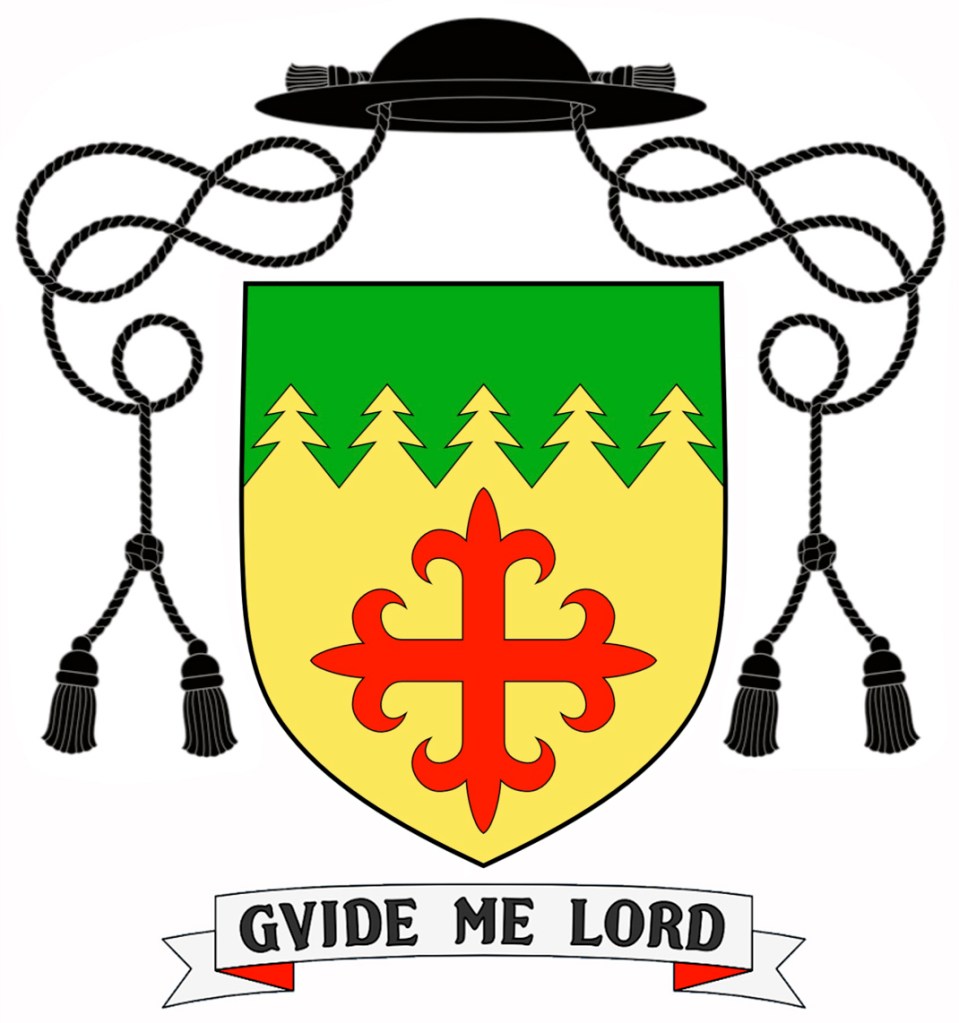
He surprised me not long ago. After years of collaboration on numerous coats of arms he created a rendering in his own style of my armorial bearings and presented it to me. I’m very pleased with it and I’m happy to share it with you now.

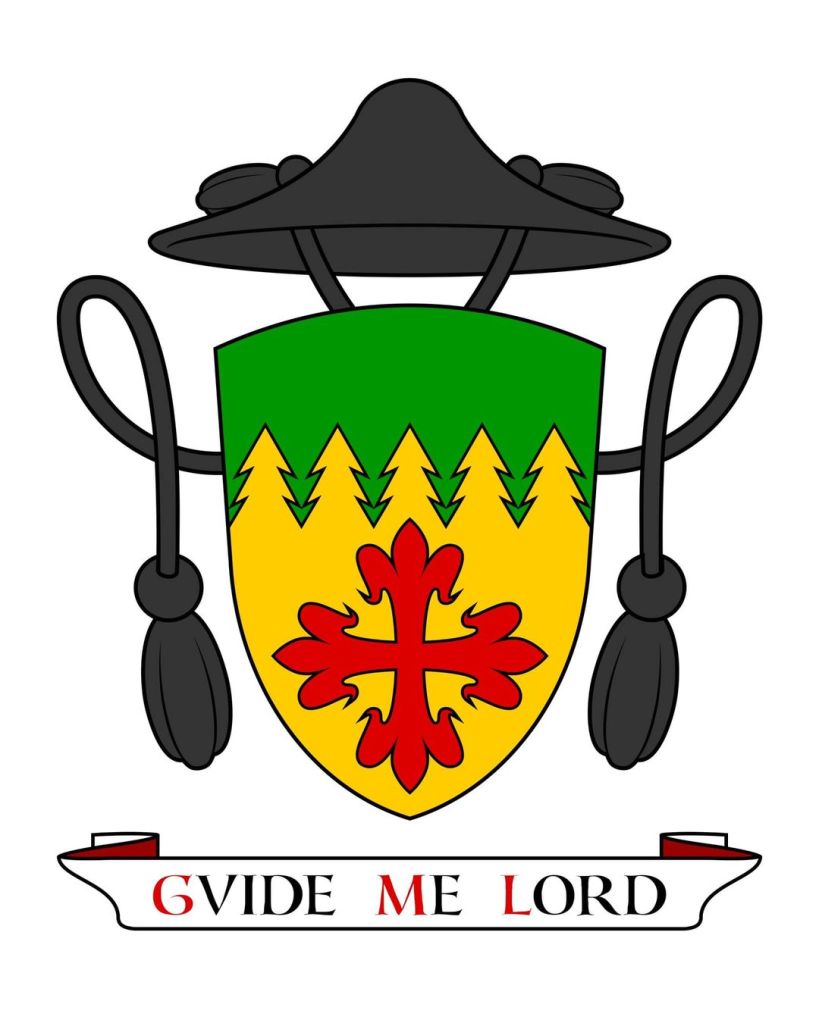
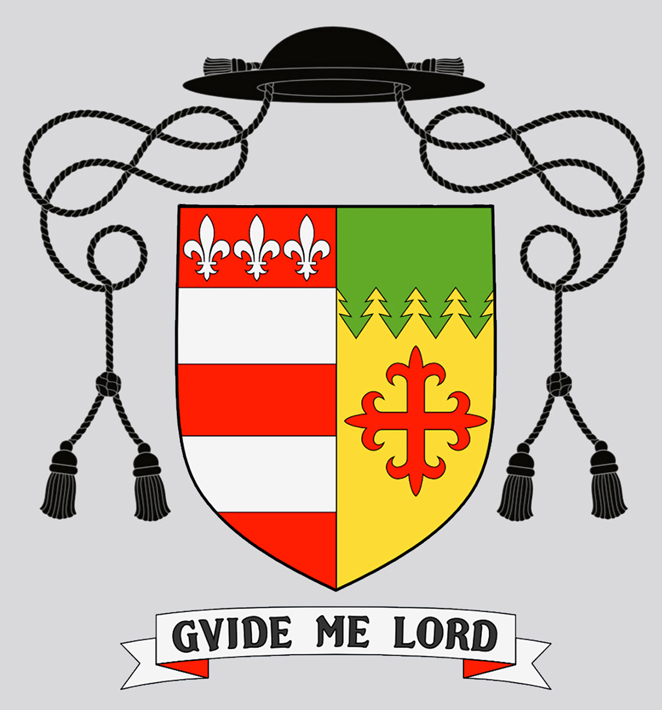
For those not already familiar with it the blazon is:

Or, a Greek cross fleury; a chief sapiné Vert.

The line of fir trees suggests my surname, Selvester (originally Silvestri and later anglicized after emigrating to the U.S.) which means a forest dweller, or woodsman. It represents my paternal Italian heritage. The colors green and gold allude to my maternal Irish ancestry. The red cross of faith is the single charge but its arms terminate in fleurs-de-lis as symbolic of both Our Lady and the Blessed Trinity. The motto is a pun on my given name, Guy, which means “a guide”. The shield is ensigned with the galero of a priest.

It’s always nice to have one’s coat of arms rendered by different artists in their own distinctive style. I am especially pleased with this one.

Caddy to Cairns (UPDATED!)

The Rev. Joseph Caddy (64) a priest of the Archdiocese of Melbourne in Australia will be ordained a bishop on August 15 and installed as the 10th Bishop of Cairns, Australia.

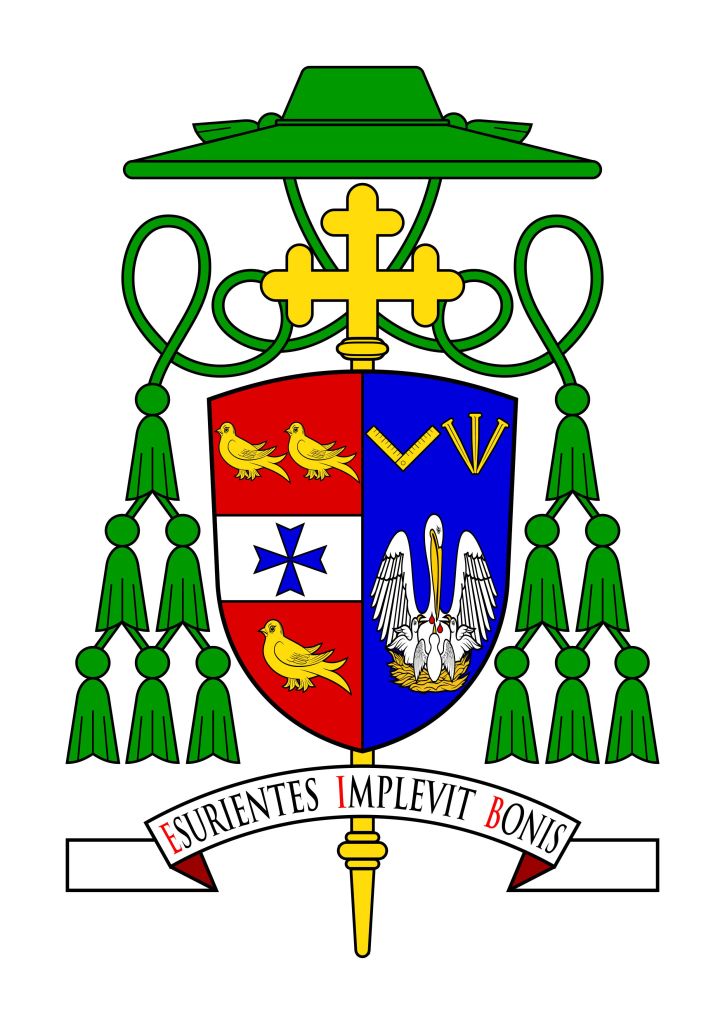
His armorial achievement, to be assumed upon episcopal ordination, is as follows:

The existing arms of the diocese occupy the dexter impalement. The personal arms consist of the pelican in its piety. This is borrowed from the coat of arms of Corpus Christi College which was the seminary attended by the armiger. Its eucharistic imagery is also reflected in the motto which translates to, “He fills the hungry with good things”. The carpenter’s square in chief is a reference to his Baptismal patron, Joseph and because his father, grandfather, and one brother are/were all carpenters.

The three Passion nails meeting in base allude to the coat of arms traditionally used by the English Caddy family which depict three piles engrailed meeting in base. The square and the nails, then, are a reference to his given and family names.

I was happy to act as a consultant on the design of the bishop’s personal arms in conjunction with Mr. Richard d’Apice, AM, KCSG. The artwork was very nicely done by Mr. Sandy Turnbull of Australia. Both are members of the Australian Heraldry Society.

UPDATE: Thanks to a comment from a regular reader asking about the diocesan arms we made a change. His question prompted me to refer back to my collaborators. In turn, the Diocese of Cairns was contacted and I, myself, delved into the pretty good small library of my own which I have amassed over the last thirty years. It turns out that our original depiction showed an fimbriation that really shouldn’t have been there! So, it was back to the drawing board for Mr. Turnbull who promptly made the correction. The end result is the corrected , and I think improved, coat of arms for Bishop Caddy, well in time for his ordination & installation.

And all thanks to a reader of this blog!

Bishop Bersabal, Auxiliary of Sacramento

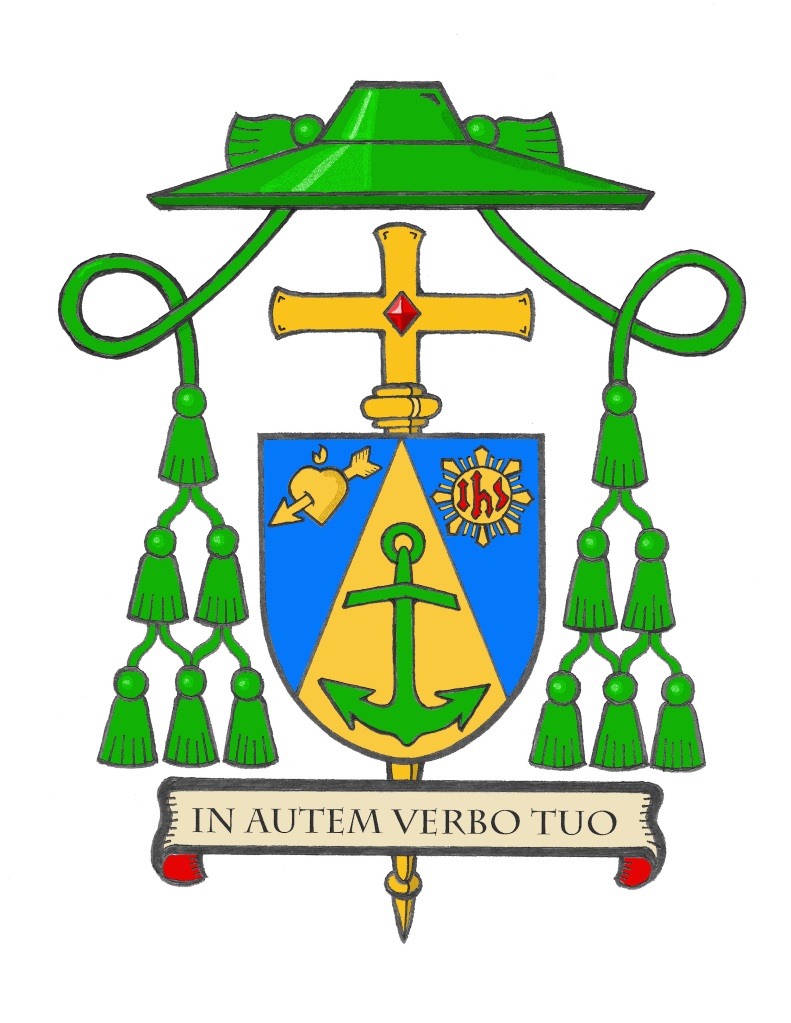
Father Reynaldo Bersabal (59) who was originally a priest of the Diocese of Cagayan de Oro in his native Philippines and who later incardinated as a priest of the Diocese of Sacramento in California has been named the Titular Bishop of Balecium and Auxiliary Bishop of Sacramento. His episcopal ordination will take place on May 31.

The main part of the shield shows a similar background to the coat of arms of the Diocese of Sacramento with the colors reversed. The field is blue with a large gold (yellow) triangular shape called a “pile”. In this case it is a pile reversed issuant in base. On this pile is a green anchor which is a symbol of the theological virtue of Hope. The anchor has long been a symbol associated with hope and green is the liturgical color used in Ordinary Time because it is also a symbol of hope and growth.

At the top of the shield to the left is a symbol for St. Teresa of Avila, to whom the bishop has a great devotion. The saint herself described her heart as having been pierced by God’s love with a spear, or arrow that was aflame. On the right is a  gold (yellow) sun on which appears the three letters “IHS” in red. This sunburst charged with the monogram is used as a symbol for three things. It is a depiction of the Holy Name of Jesus using the first three letters of His name in Greek. This is borrowed from the coat of arms of Pope Francis who appointed the bishop. The shape of the sunburst is borrowed from the flag and coat of arms of the Philippines where it is seen prominently. So, it is a symbol of his native place. It also has the appearance of the monstrance containing the Sacred Host and so it is thirdly symbolic of the Eucharist since he has been appointed a bishop during the national Eucharistic revival. As a symbol of the Blessed Sacrament it is also another allusion to the Diocese of Sacramento.

The motto below the shield is, “In Autem Verbo Tuo” from Luke 5:5.

I was pleased to be able to assist the bishop with the creation of his coat of arms.

Bishop Strickland

The Most Rev. Joseph E. Strickland (65), originally a priest of Dallas, Texas, later incarnated to Tyler, Texas and since 2012 Bishop of Tyler was removed from that office on November 11, 2023 by the Roman Pontiff.

Back in 2012 when he was appointed as Fourth Bishop of Tyler I had the happy task of designing his coat of arms. Now that he has ceased to be the Bishop of Tyler his coat of arms will be modified to reflect that reality. He remains a bishop in the Church and, as such, retains the use of his armorial bearings. His coat of arms at the time of his ordination and installation was:

Now that he has been removed as Ordinary of Tyler, his armorial bearings will appear as this:

Two for San Diego

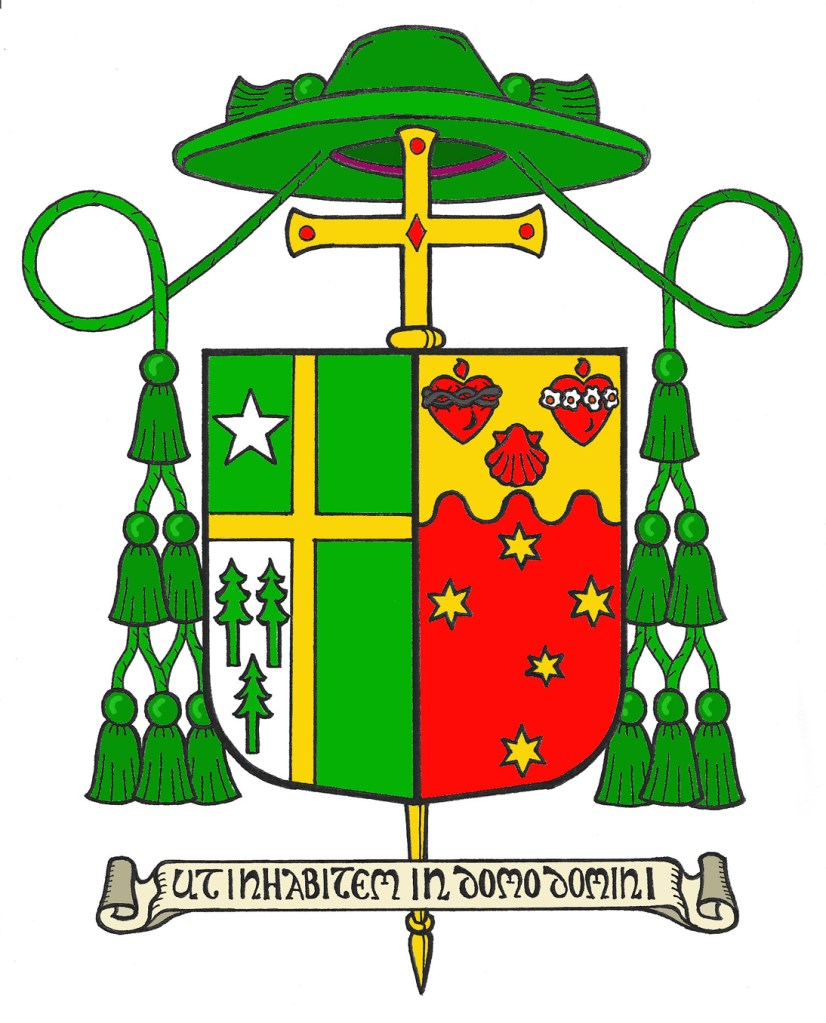
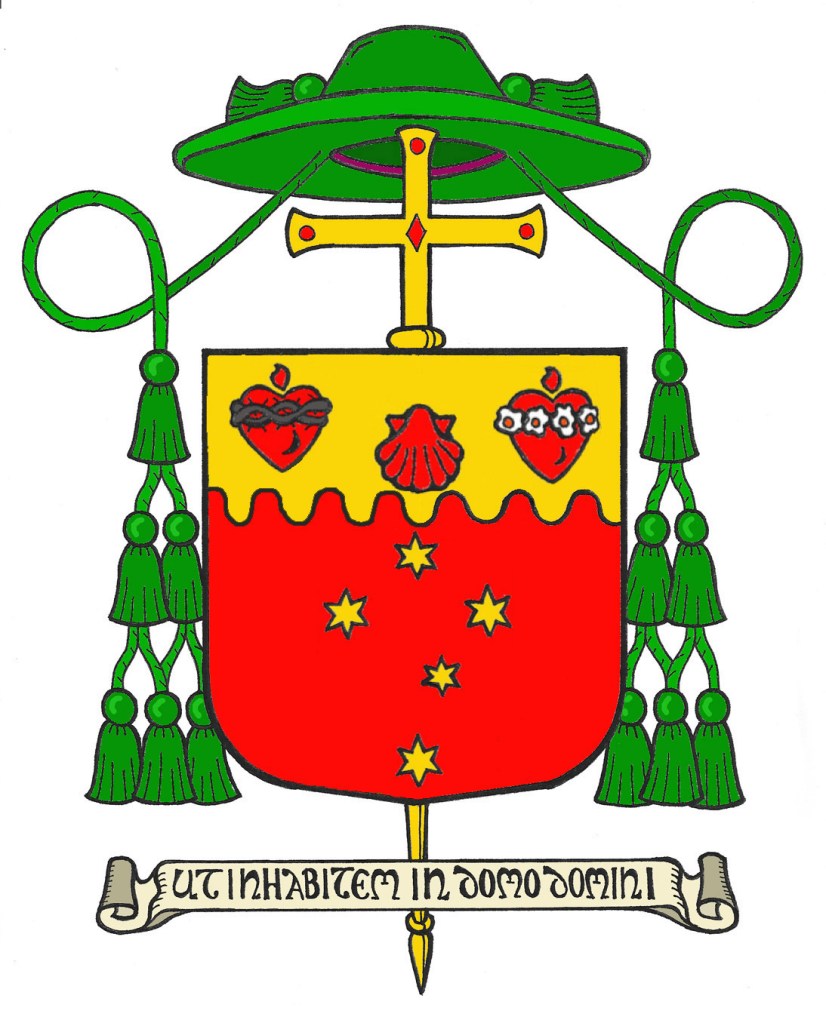
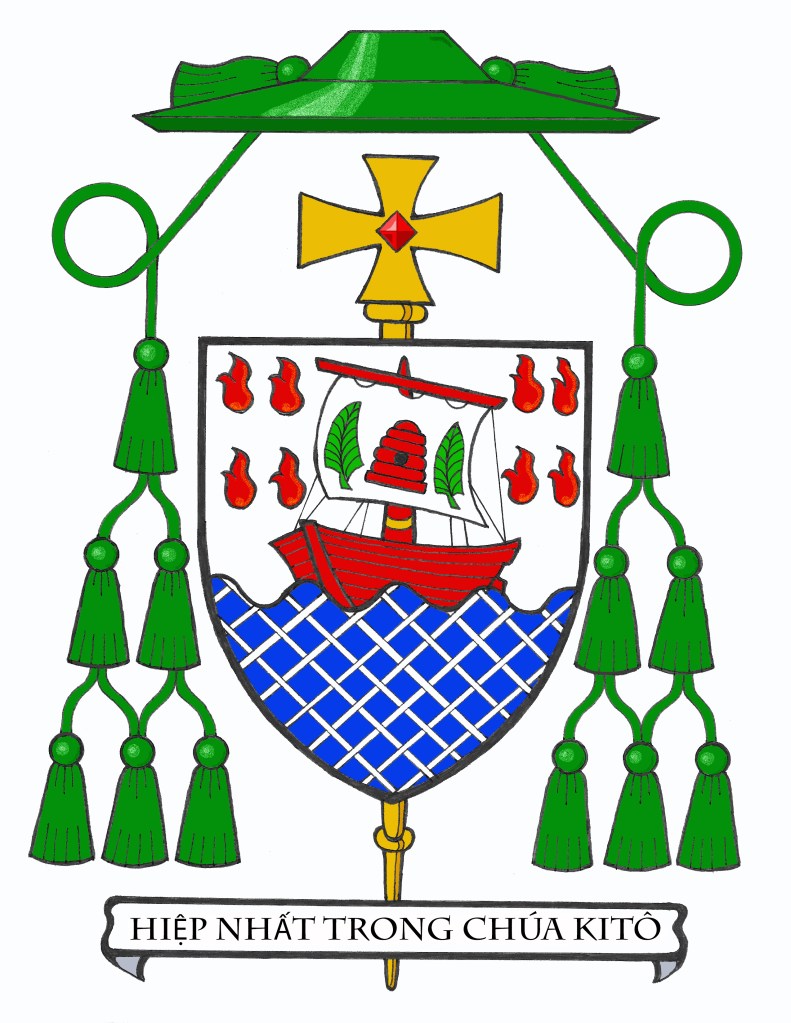
On September 28 of this year the Most Rev. Michael Pham (56), a priest of the Diocese of San Diego, CA will be ordained a bishop and will serve as Titular Bishop of Cercina and Auxiliary Bishop of San Diego. On the same day, the Most Rev. Felipe Pulido (53), a priest of the Diocese of Yakima, WA will be ordained the Titular Bishop of Buffada and also serve as Auxiliary Bishop of San Diego.

I was happy to assist both of these new bishops with the creation of their respective coats of arms. The armorial bearings of Bishop Pham are:

The shield is divided horizontally to depict a silver (white) sky above a blue wavy ocean. The ocean is criss-crossed by diagonal lines in order to create a pattern suggestive of a fisherman’s net. This has more than one meaning. First, it represents that after 1975 while still living in Vietnam the bishop’s father became a fisherman to provide for his family. In addition, the net indicates not only the task of an apostle (or a successor to an apostle) of being a “fisher of men” but it also alludes to the New Evangelization where we are exhorted to put out into the deep (Duc in Altum). This symbolizes both the bishop’s priestly and episcopal ministry. 

In the upper part of the shield the main charge is a boat on the waves under full sail. The boat also alludes to the work of a fisherman. In addition, a boat, in heraldry, is often used as a symbol of the Church itself, often referred to as the barque of Peter, who was a fisherman himself. On the sail of the boat in the center is a red beehive surrounded by two green palm branches. The beehive is a symbol of St. John Chrysostom, the bishop’s baptismal patron saint. Chrysostom was the archbishop of Constantinople and renowned for his inspiring preaching. So, he was known as a “honey-tongued” preacher, hence the beehive as his symbol. The palm branches are an ancient symbol of martyrdom. The bishop’s family comes from the first diocese in the north of Vietnam where his ancestors were among the first martyrs for the faith in that part of the world.

On either side of the boat are eight red tongues of fire which also have more than one meaning. First, they are symbols of the Holy Spirit which, the Sacred Scriptures remind us, descended on the Apostles as tongues of fire at Pentecost. This was the beginning of their ministry to go out into the world to preach the Gospel so it is another symbol of Evangelization. Throughout his priestly ministry the bishop has worked with various groups of different ethnic and cultural backgrounds. Many flames represent a diversity of communities. Bishop Pham strengthened the cultural communities found in the diocese and shared them with the larger Catholic community. He has served as Episcopal Vicar of the Office of Ethnic & Intercultural Communities. Six years ago, he launched the first-ever Pentecost Mass for All Peoples, which has come to attract more than 2,000 faithful annually. So, symbols of the Holy Spirit were seen to appropriately reflect this ministry. It also reflects how, on Pentecost, when the Holy Spirit descended, people from many different and various places, languages and cultures heard the Apostles speaking in their own languages. The red of the boat, the beehive and the tongues of fire is a further allusion to the blood of the martyrs.

The motto below the shield is, “Hiệp Nhất trong Chúa Kitô” which means “One in Christ” or “United in Christ” in Vietnamese. This motto reflects the work the bishop has done throughout his priesthood to help various communities and to work towards the unity of diverse cultures and groups within the People of God.

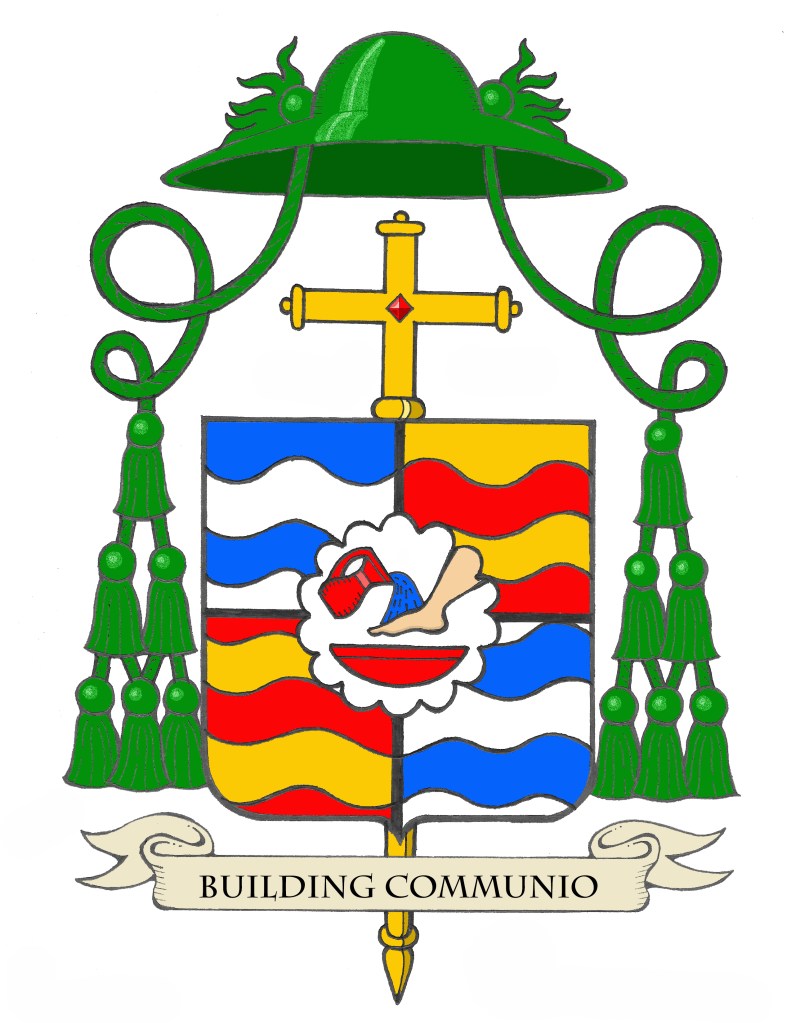
The armorial bearings of Bishop Pulido are:

The shield is divided into four quarters with wavy horizontal lines from top to bottom. In the first and fourth quarters the lines alternate blue and silver (white) while in the other two quarters they alternate red and gold (yellow).

The blue and white lines represent the Blessed Virgin Mary. In addition, they suggest water which also alludes to Jesus washing the feet of His disciples. In addition, they can be seen as referring to the waters of Baptism. The red and gold (yellow) lines represent the Holy Spirit and fire. In addition, the colors can be seen as referring to the Blood (as well as water) that poured from the side of the Lord at His crucifixion. They are also seen as referring to bread (gold/yellow) and wine (red) as a reference to the Eucharist. In this way these lines also refer back to the foot washing because Jesus was showing His disciples the kind of self-sacrificing service they were called to which was about to be played out in His sacrifice on the cross and would be experienced for them in the future whenever they came together to share the Eucharist.

At the center of the shield is a silver (white) roundel called a plate. On this plate is a simple symbolic representation of the Mandatum (washing of the feet). The outer edge of this roundel, or plate is a line composed of small humps. Such a line is called “invected” in heraldry. It is borrowed from the coat of arms of the Diocese of Yakima, WA where Bishop Pulido served as a priest before being named a bishop.

The motto below the shield is, “Building Communio” which is what the bishop sees as the purpose and goal of his episcopal ministry.

Marshaling Various Coats of Arms During A Lifetime

Throughout the course of my priesthood, after my time as a Parochial Vicar concluded and I began to be placed in charge of my assignments I also began the practice of 1) devising armorial bearings for the different places in which I have served and 2) marshaling those newly-devised coats of arms with my own. Having jurisdiction over the church or parish was then illustrated heraldically.

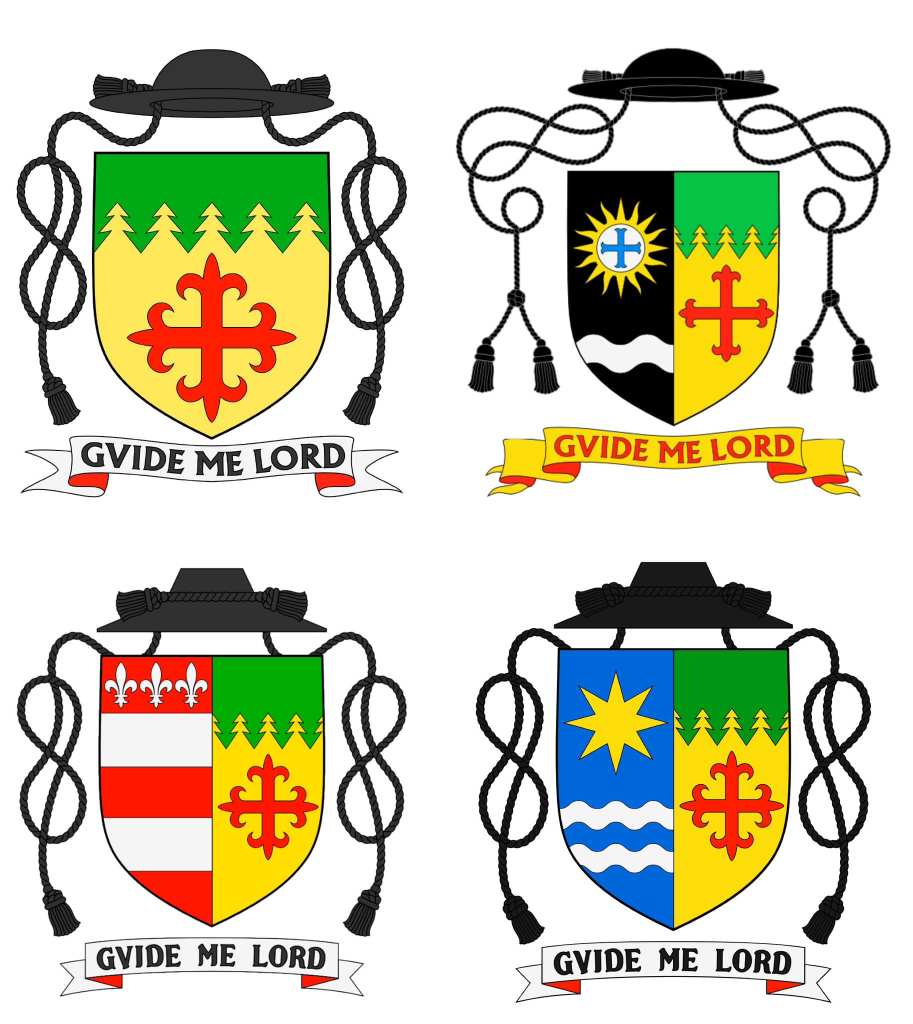
In the image above the first coat of arms (upper left) is my personal coat of arms assumed at ordination in 1997. The next image (upper right) shows my arms impaled with those of the Shrine of the Blessed Sacrament in Raritan, NJ where I served as the Sixth Rector (hence the four tassels instead of only two) from 2009-2015. The image at lower left shows my arms impaled with those of St. Joseph Church in Washington, NJ where I served as Administrator and then as the Twenty-Second Pastor from 2015-2023. During the last part of that time I was also Dean of the Morris Canal Deanery. The final image (lower right) shows my coat of arms impaled to the newly-devised parish coat of arms of St. Mary, Star of the Sea in South Amboy, NJ where I will serve as the Ninth Pastor from 2023 onwards.

(Artwork: Xavier Garcia)

A New Parish; A New Parish Coat of Arms


Next week I’m moving to a new assignment as Pastor of St. Mary Church in South Amboy, NJ. The parish was established in 1851 dedicated to St. Mary, Star of the Sea. In 1853 property for the present church was purchased and in 1854 the appointment of its first resident pastor occurred.
 
While the parish still is, and always has been, dedicated to Our Lady under the title of “Star of the Sea” it has always been known simply as St. Mary’s. That’s actually rather common. People like short hand and nicknames and many churches dedicated to various titles of Mary are known by their parishioners simply as St. Mary’s.
 
As I prepare to begin my tenure as Pastor I looked to designing armorial bearings as a symbol for the parish. This has been my custom for years. So, naturally I took as a starting point the canonical patronal title of the parish—St. Mary, Star of the Sea—to devise the coat of arms. That title lends itself very well to a clear and simple design evoking the parish’s patroness.
 
I know the parish will always be known with great affection as St. Mary’s. I hope we can also foster the occasional use of the beautiful name of its patroness, Star of the Sea (in Latin: Stella Maris).
 
As Pastor of the parish I will impale my own armorial bearings with those of the parish. 
 
(The heraldic art is the work of Xavier Garcia)

Easy Come; Easy Go.

Last November, my Bishop appointed me to serve as the Dean of the Deanery in which my parish is located. That meant there was going to be a modification of my coat of arms. The addition of a second tassel to the galero in my armorial bearings was for the duration of the office of Dean only.

Just yesterday, my Bishop announced the appointment of three new Deans. Two of them are appointed to fill vacancies created by the retirement of two priests. The third is in my own Deanery where a vacancy is about to occur when I am transferred to a new assignment later this month. Since the extra tassel was only “pro hac vice” I must now reliquish it and revert to using the galero of a simple priest, with one tassel pendant on either side of the shield.

As it turns out, I served as a Dean for only nine months. At the time of my appointment last November, my bishop and I had no way of knowing that I would be transferred only the following summer.

Bishop Henning of Providence

In 2018, the Most Rev. Richard Henning, a native and a priest of Long Island’s Diocese of Rockville Centre, NY (and a high school classmate of mine) became Auxiliary Bishop of that diocese. I was pleased and honored to assist him with the design of his personal coat of arms to be adopted upon ordination to the episcopate.

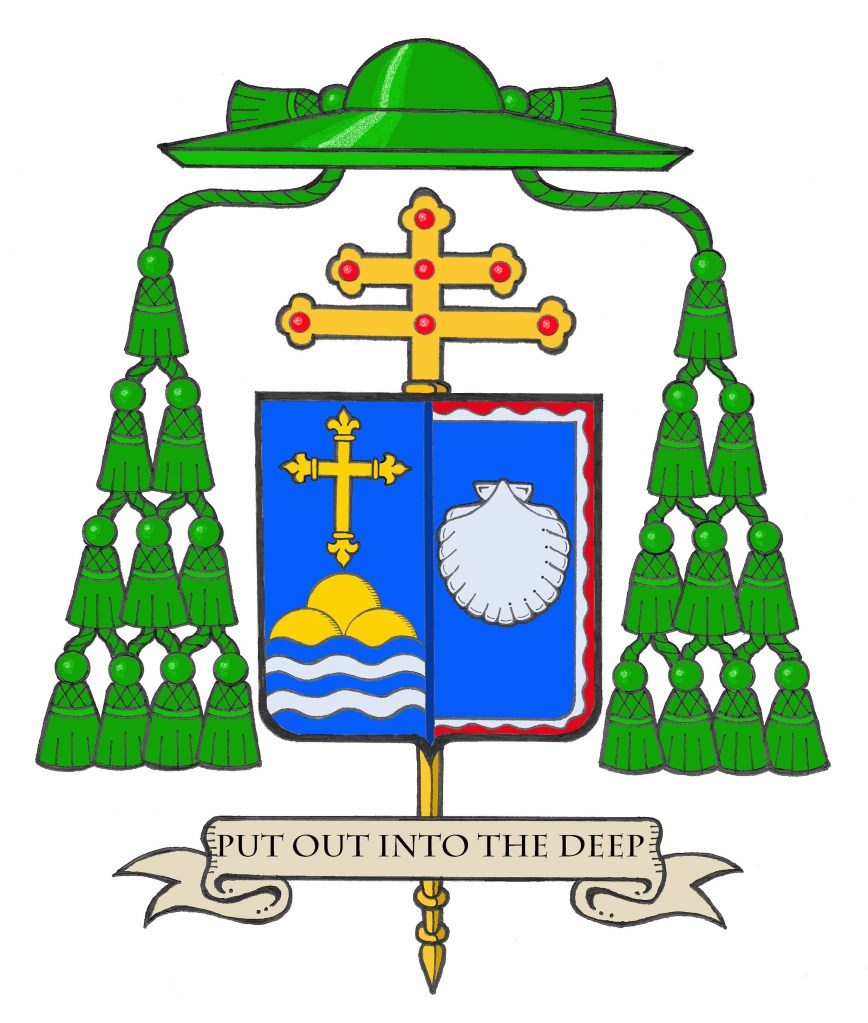
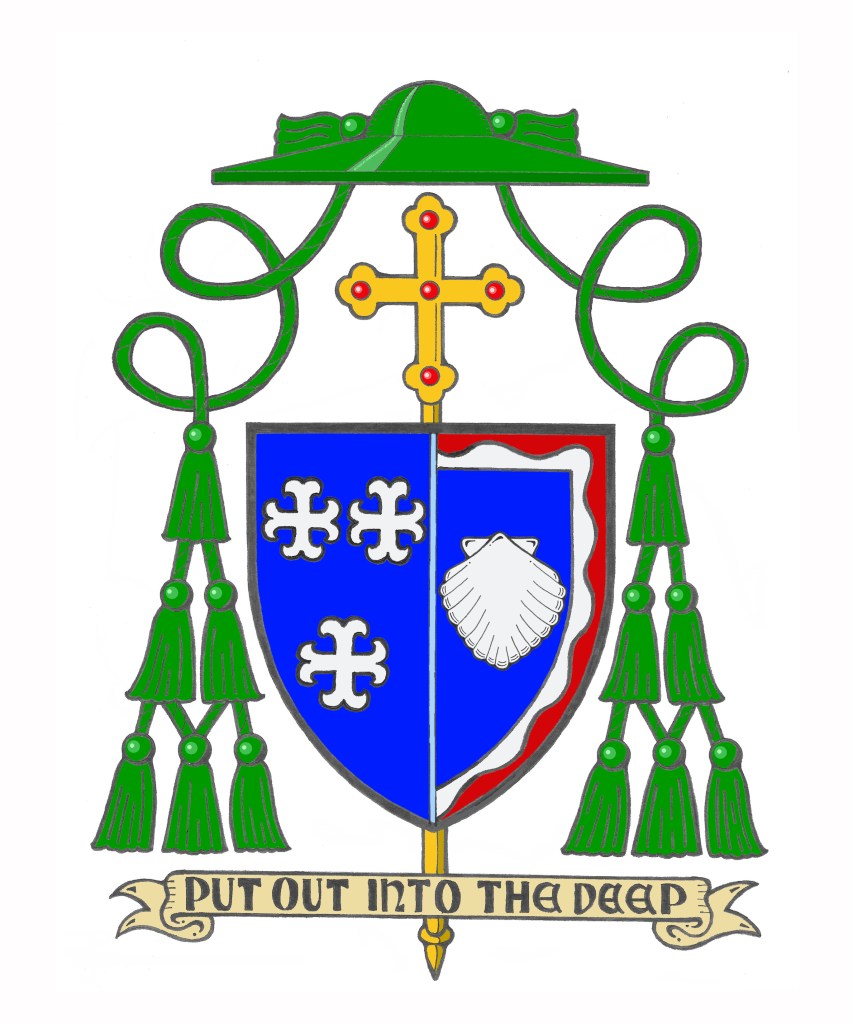
Last year, the Holy Father appointed him to be the Coadjutor Bishop of Providence, Rhode Island, just across Long Island Sound from his former diocese. A coadjutor bishop is appointed to share in the authority of the diocesan bishop in running the diocese and has the right of automatic succession to the See when the previous bishop dies or retires. (NOTE: there used to be such a thing as coadjutor without the right of succession, but such appointments are no longer made). Bishop Henning succeeded to the See of Providence on the first of May of this year upon the retirement of Bishop Thomas Tobin becoming the IX Bishop of Providence. So his armorial bearings have been altered to impale his personal arms with those of the See:

The arms of the Diocese of Providence are composed of a blue field on which are placed three silver (white) crosses with arms that appear to terminate in anchors. These crosses, heraldically known as “moline crosses,” are used to suggest an anchor. By employing the symbol of the State of Rhode Island this signifies that the Diocese of Providence encompasses all of the state it was established to serve. The crosses, three in number to signify The Trinity, are rendered in the traditional colors of water, blue and silver (white), because of the importance that water plays in the life of “The Ocean State.” These colors are also the traditional colors for the representation of the Blessed Virgin Mary, who, in her title of Our Lady of Providence, is Patroness of the Diocese and of the See City.

Bishop Henning’s personal coat of arms is composed of a design depicted in red (Gules), white (Argent) and blue (Azure) which are the national colors of the United States.

Both the blue background and the single escallop shell allude to the sea as evoking the Bishop’s own background and the shell is also borrowed from the coat of arms of the See of Rockville Centre, the diocese in which he was born and raised and which he served as a priest and auxiliary bishop. The shell image also recalls the Bishop’s heritage in the Diocese of Brooklyn, dedicated to its patron, St. James. The episcopal ordination of Bishop Henning took place on the eve of the Feast of St. James. In concert with the Bishop’s motto, the shell is a traditional symbol of baptism and pilgrimage. It is in the depths of these waters that Christians find their salvation in Jesus Christ.

The white wavy line surrounding the blue field is similarly taken from the arms of Rockville Centre and it alludes to the diocese’s location on Long Island, NY. Furthermore, it indicates the sea as the place where the barque of St. Peter, an image used to evoke the Church, is located.

The blue background also evokes the Bishop’s devotion to the Blessed Virgin Mary and his years of service as a Professor and Rector at the Seminary of the Immaculate Conception in Huntington, NY. The red wavy portion of the border evokes the Bishop’s devotion to the Most Sacred Heart of Jesus and his former service as the Director of the Sacred Heart Institute for the Ongoing Formation of the Catholic Clergy.

This situation was one of those times that chance presented a challenge. The bishop wanted to impale his arms with those of the See as is customary in N. America. In addition, he had no good reason to change the diocesan arms and no desire–correctly–to change his personal arms. Impaling them side-by-side presented an aesthetic challenge because they both employ blue fields. In addition, it is customary not to continue a bordure all the way around the field when the arms are impaled. Rather, there is a kind of dimidiation employed whereby the bordure is discontinued along the impalement line. In order to make the division between the two coats of arms more visible, and slightly less confusing a division line of very light blue (blue celeste, if you will) was employed for aesthetic reasons. This is really more of an artistic style choice rather than a heraldic one. Once again, it was my pleasure to assist him with this project.

Bishop Celino, New Auxiliary of El Paso

The Most Rev. Anthony Cerdan Celino, (50) a priest of the Diocese of El Paso, Texas will be ordained the Titular Bishop of Maronana and Auxiliary of El Paso on March 31.

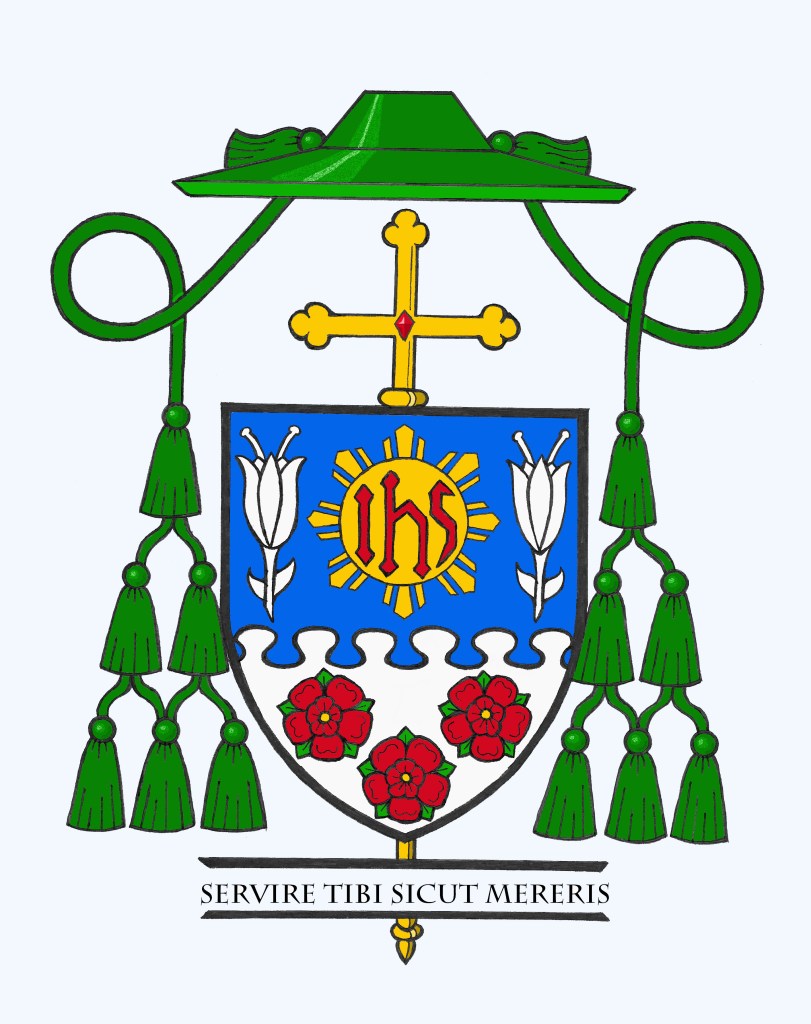
Bishop Celino’s armorial bearings represent his family name and symbols of his origins and his own devotional life. The main part of the shield is composed of a blue field and a silver (white) base with a distinctive division line called “nebuly” that is used in heraldic art to represent clouds. Together these elements suggest the sky as an allusion to the Bishop’s family name—Celino—which means a little sky.

The largest object in the daytime sky is, of course the sun. The main charge on the upper part of the shield is a gold (yellow) sun on which appears the three letters “IHS” in red. This sunburst charged with the monogram for the Holy Name of Jesus is used as a symbol for St. Ignatius Loyola, the founder of the Society of Jesus. The Bishop has had a particular devotion to St. Ignatius since his own confirmation. In addition, the particular way the sun is drawn is taken from the image of the sun on the coat of arms and the flag of the Philippines, the country where the Bishop was born.

On either side of the sun are two silver (white) lilies. The lily is traditionally used in heraldry to represent St. Anthony of Padua, the Bishop’s baptismal patron. In addition, having been born on the feast of St. Catherine of Siena (April 29) the Bishop has always had a devotion to her as well. Coincidentally, the heraldic symbol for St. Catherine is also a lily. So, the two lilies represent the Bishop’s patron saints.

The lower half shows three red roses on a silver (white) background which represents a cloud. The roses are symbols of Our Lady of Guadalupe, patroness of the Americas. In connection with the appearance of Our Lady to Juan Diego the miraculous blooming of roses in December occurred. Throughout his priesthood he has had a strong devotion to Mary specifically under this title.

The motto below the shield is “Servire Tibi Sicut Mereris” (To Serve You as You deserve) from the Prayer of Generosity attributed to St. Ignatius Loyola, as a further allusion to the Bishop’s great devotion to and inspiration from that saint..

The shield is ensigned with those external ornaments that indicate the bearer is a bishop. The gold (yellow) episcopal cross, not to be confused with a processional cross, is placed vertically behind and extending above and below the shield. In former times archbishops, and later all bishops, had a cross mounted on a staff carried immediately in front of them while in procession or on solemn occasions. This cross was a symbol of their rank as bishop. While such an episcopal cross is no longer used practically it has been retained heraldically. In fact, there are other clerics who make use of the ecclesiastical hat with its many tassels but the one true heraldic emblem of a bishop, and the only essential one, is the episcopal cross placed behind the shield.

Above the shield is the ecclesiastical hat, called a galero which, in heraldry, replaces the martial helmet, mantling and crest. “The hat with six pendant tassels (green, purple or black) on each side is universally considered in heraldry as the sign of prelacy. It, therefore, pertains to all who are actually prelates.” (Heim, Bruno B., Heraldry in the Catholic Church 1978, page 114) The galero is green with green cords pendant from it and twelve green tassels arranged in a pyramid shape on either side of the shield. At one time in history bishops and archbishops wore green before adopting the Roman purple we see today. In heraldry the green hat and tassels was retained for prelates with the rank of bishop according to the Instruction of the Secretariat of State, “Ut Sive” of March, 1969.

I was privileged to assist Bishop Celino with the design and execution of his coat of arms.

Another Tassel on the Hat

At the conclusion of the Mass celebrating my Parish’s 150th Anniversary on Sunday, November 6, the Bishop of Metuchen announced that he has appointed me as the Dean of the Morris Canal Deanery. This covers all of Warren County, NJ and consists of 10 churches in 9 parishes: St. Jude, Blairstown; Ss. Peter & Paul, Great Meadows; St. Theodore, Port Murray; Assumption of the Blessed Virgin Mary, Hackettstown; St. Patricks, Belvidere which is combined with St. Rose, Oxford; St. Philip & St. James, Phillipsburg; St. Mary, Alpha and St. Joseph, Washington.
 
I will continue on in my current assignment as Pastor of St. Joseph and also continue as the Diocesan Director of Ecumenical & Interfaith Affairs. There is no salary increase but I do get a title bump from “Reverend” to “Very Reverend Guy Selvester, V.F.” (which stands for Vicar Forane).
 
Of perhaps even more interest to me is the fact that I get to add another tassel to the galero in my coat of arms.
 
(artwork by Xavier Garcia)

Abbot President of the American Cassinese Congregation of Benedictine Monasteries

The Right Reverend Jonathan Licari, OSB who was ordained a priest of the Diocese of Duluth in 1976 and has been a monk of St. John’s Abbey in Collegeville, Minnesota since 1982 was elected as the 18th Præses or Abbot-President of the American-Cassinese Congregation on June 23, 2022 during a meeting of the General Chapter of the Congregation taking place at St. Benedict’s Abbey in Kansas. At the time of his election Abbot Jonathan did not yet possess the abbatial dignity. He received the solemn abbatial blessing the same evening as his election from the Most Rev. Elias Lorenzo, OSB who had himself served as the 17th Abbot-President of the Congregation prior to being appointed Auxiliary Bishop of Newark, NJ.

Abbot Jonathan had recently completed a term as Administrator of Mary, Mother of the Church Abbey in Richmond, Virginia and had also just been appointed by his predecessor as Abbot-President, Abbot John Klassen, OSB of St. John’s Abbey as the Administrator of St. Mary’s Abbey in Morristown, NJ (which also happens to be the monastery to which Bishop Elias belongs as a monk. Are you keeping up?)

Abbot Jonathan decided to assume a coat of arms and I was very pleased and honored to assist him in the design and execution of his armorial bearings.

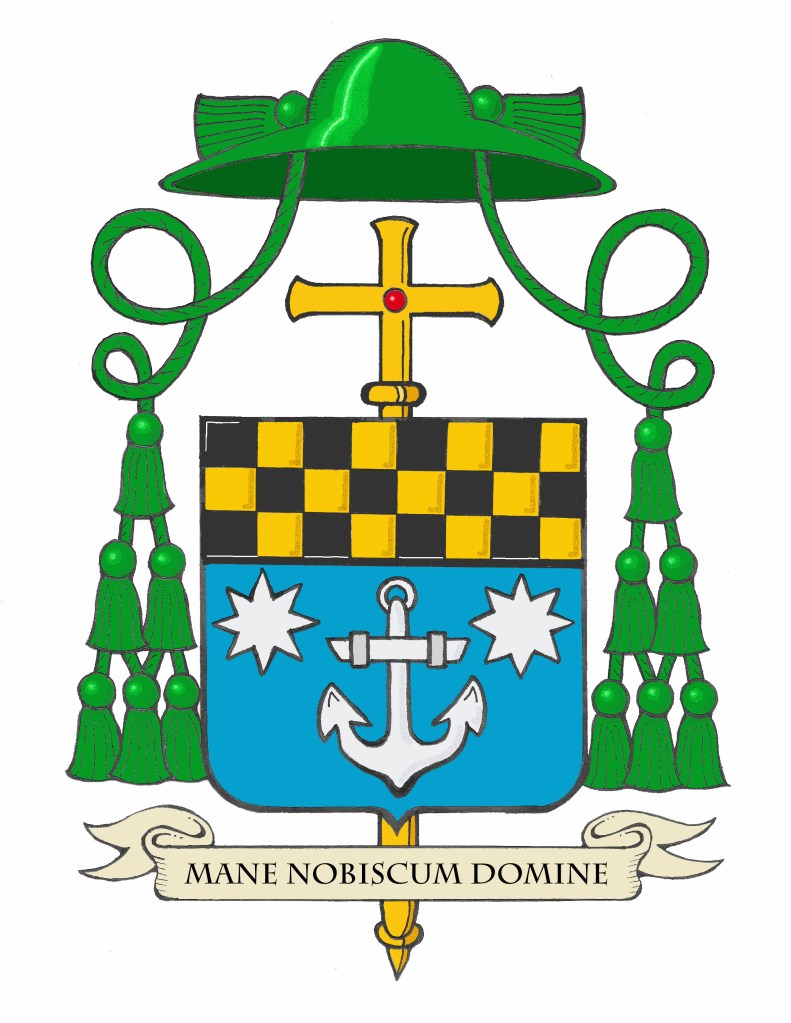
The blazon is: “Sable, a quill pen, point downward Or between two arrows, points downward Argent; a chief wavy, fusily in bend Azure and Argent. Shield ensigned with an abbot’s crozier Or behind the shield with the sudarium attached and an abbot’s galero Sable cords and twelve tassels disposed in three rows of one, two and three all Sable. On a scroll below the shield the motto: “Servire”.”

The field is colored black to allude to the black Benedictine habit. In addition, the area of Minnesota where he was born and raised is known as an area for mining iron ore. The black also alludes to the iron. The gold (yellow) pen in the center is a symbol of administration which is the kind of work the Abbot has been assigned to do during most of his monastic life. The two arrows are a symbol of the Biblical figure, Jonathan, his monastic patron. They allude to the story of Jonathan shooting arrows as a signal to David about whether or not he was safe in the First Book of Samuel, chapter 20.

The shield is divided by a wavy line of division. This is symbolic, once again, of the part of Minnesota where the Abbot grew up known for its many lakes. The upper third of the shield, called a “chief” depicts the familiar blue and silver (white) pattern of fusils (elongated diamond shapes) placed in a repeating pattern along diagonal lines. This is the background of the coat of arms of the Bavarian Royal House (Wittelsbach) and of the State of Bavaria in Germany today. The motherhouse of the Congregation was founded by Boniface Wimmer who was a monk of St. Michael’s Abbey in Metten and the Ludwigsmissionverein was heavily subsidized by the Bavarian Royal Family. So, the coat of arms of St. Vincent Archabbey uses this background in its own arms. In addition, the coat of arms of the Abbot’s own Community at St. John in Collegeville makes use of this background in two of the four quarters on its coat of arms. In fact, of the 18 existing independent houses of the American Cassinese Congregation there are 8 which were directly founded from St. Vincent as daughter-houses and 2 which were founded as granddaughter-houses from St. Vincent. Of those houses 5 of them make use of this Bavarian pattern and/or of its color scheme as an allusion to the Bavarian origins of the Congregation. So, the chief is used to symbolize St. Vincent and Bavaria as the origins of the American-Cassinese Congregation as well as St. John’s Abbey, the Abbot’s own community of origin. It is also an allusion to St. Mary’s Abbey where the Abbot is serving as Administrator for several years.

The motto below the shield is the single Latin word, “Servire” which means to serve.

The shield is also ensigned with those external ornaments that indicate the bearer is an abbot. The gold (yellow) crozier, no longer used in the coats of arms of bishops but retained in the arms of abbots is placed vertically behind and extending above and below the shield. Attached to the crozier is a veil or sudarium. Widely used in the Middle Ages it is rarely seen in actual use today. It dates from a time when abbots were already making use of the crozier as a sign of their authority but had not been granted the privilege of full pontificals which, prior to the reforms of the 1970s, would have included liturgical gloves. The purpose of the sudarium was originally practical; it shielded the metal of the crozier from dirt and perspiration from the hands. Later, it became merely symbolic and has been retained in heraldry to distinguish the crozier of an abbot.

Above the shield is the ecclesiastical hat, called a galero which, in heraldry, replaces the martial helmet, mantling and crest. The galero is black with black cords pendant from it and twelve black tassels arranged in a pyramid shape on either side of the shield. This is the hat assigned to a prelate with the rank of abbot according to the Instruction of the Secretariat of State of the Holy See, “Ut Sive” of 31 March, 1969 (Acta Apostolicae Sedis 61 (1969) 334-40).

Abbot Augustine Curley of Newark Abbey

On May 12, 2022 the monks of Newark Abbey in Newark, New Jersey elected the Right Reverend Augustine Curley, OSB as the third Abbot of their community. He is still yet to receive the abbatial blessing. The arms he has assumed are shown above.

The armorial achievement, or coat of arms, of Abbot Augustine is composed of the shield with its various charges, the external ornaments of an abbot and the motto. The shield contains the coat of arms of the abbey impaled (combined side-by-side on the same shield) with the personal arms. Such impalement illustrates that the abbot is, in a sense, “married” to the community and exercises jurisdiction over it during his tenure in office. 

In the armorial bearings of Newark Abbey the field is primarily silver (white) with six white and blue wavy lines representing waves below. Out of this sticks a gold (yellow) rocky formation on top of which is the ark, also gold (yellow). This is a representation of the ark and the rock upon which the ark came to rest after the great flood of Noah’s time surrounded by receding waters of the flood. Above the ark is a stylized rainbow in blue and gold (yellow) representing the the new beginning of Newark Abbey after the tumultuous period preceding its re-elevation to Abbatial status. 

The chief (upper third) of the shield is a field of the blue and silver (white) elongated diamond-shaped fusils in a diagonal pattern taken from the Bavarian royal arms. Newark Abbey traces its monastic origins back through St. Mary’s Abbey which was a daughter house of St. Vincent Archabbey in Pennsylvania. St. Vincent was founded by Boniface Wimmer, a monk of St. Michael’s Abbey in Metten, Bavaria. 

The personal armorial bearings which Abbot Augustine has assumed recall his Irish heritage, his patron saint and his Benedictine life. The green field with a gold (yellow) harp is a symbol of his Irish ethnic background as well as an allusion to the singing of the psalms, composed by King David, which are traditionally accompanied on the harp. This is the principal work of a Benedictine monk —the ora in “Ora et Labora”— as it were. The upper portion of the shield is divided using a line representing trefoils, more commonly known as shamrocks, a further symbol of Ireland and, in particular, the Irish rebels Abbot Augustine counts among his ancestors. Those facing upward are three in number as an oblique reference to the fact that Abbot Augustine is the third Abbot of Newark Abbey. On the upper portion of the shield is a single red heart. The heart is used as a symbol of St. Augustine, the abbot’s monastic patron saint but also represents the exhortation to “Listen…inclining the ear of one’s heart” that makes up part of the Prologue of the Holy Rule of St. Benedict.

The shield is ensigned with the black pilgrim’s hat, called a galero, used in heraldry for clerics in place of the traditional helmet, mantling and crest. The hat has black cords terminating in twelve black tassels. Behind the shield and extending above and below it is a gold (yellow) abbot’s crozier with the sudarium (veil) attached. This veil was used in former times to protect the shaft of the crozier from dirt and perspiration before the time when abbots would have worn liturgical gloves. While the veil is no longer used it remains as a heraldic emblem to distinguish the crozier of an abbot. These are the ornaments proper to a prelate with the rank of abbot according to the Instruction of the Holy See, “Ut Sive” of March 1969.

On a scroll below the shield we see Abbot Augustine’s chosen motto, “Blessed Be The Name of The Lord” which is from the Book of Job.

I was pleased and privileged to design his personal arms and marshal them to those of the Abbey.

An Unexpected Honor

The Board of Governors of the American Heraldry Society voted unanimously at its July meeting to elect Father Guy Selvester as the first Fellow of the American Heraldry Society!

Father Guy has spent decades as a student and practitioner of heraldry and has become a respected expert in the field of ecclesiastical armory specifically. Many Bishops and Priests around the country bear arms designed by Father Guy and his writings on the subject are held in very high regard.

“The Board hopes this is a welcome recognition of the fine work that Father Guy continues to do promoting and improving heraldry in the United States and around the world! Congratulations!” said David Boven, president and founding member of the American Heraldry Society.

The honor of Fellow is awarded to any member of the Society who has compiled a distinguished record of scholarship and experience marked by significant contributions to the advancement of heraldry or an auxiliary science of heraldry. Since the inception of the award in 2013, no individual has been nominated or elected as Fellow by the Society until now.

Cardinal McElroy

On August 27, in Rome, Pope Francis will create twenty-one new Cardinals of the Holy Roman Church. Among these, the Most Rev. Robert W. McElroy (68) a priest and Auxiliary Bishop in San Francisco who has, since 2015, served as the 6th Bishop of San Diego, California will receive the red hat. He assumed arms when he was made Auxiliary of San Francisco in 2010 and he later modified his coat of arms after he was translated to San Diego. He has decided to make two minor adjustments to his existing coat of arms by changing the episcopal cross which had previously been of a specific shape to a more general form and to change the oak leaf in the base of his shield from green on green to a contrasting color to make it easier to see.

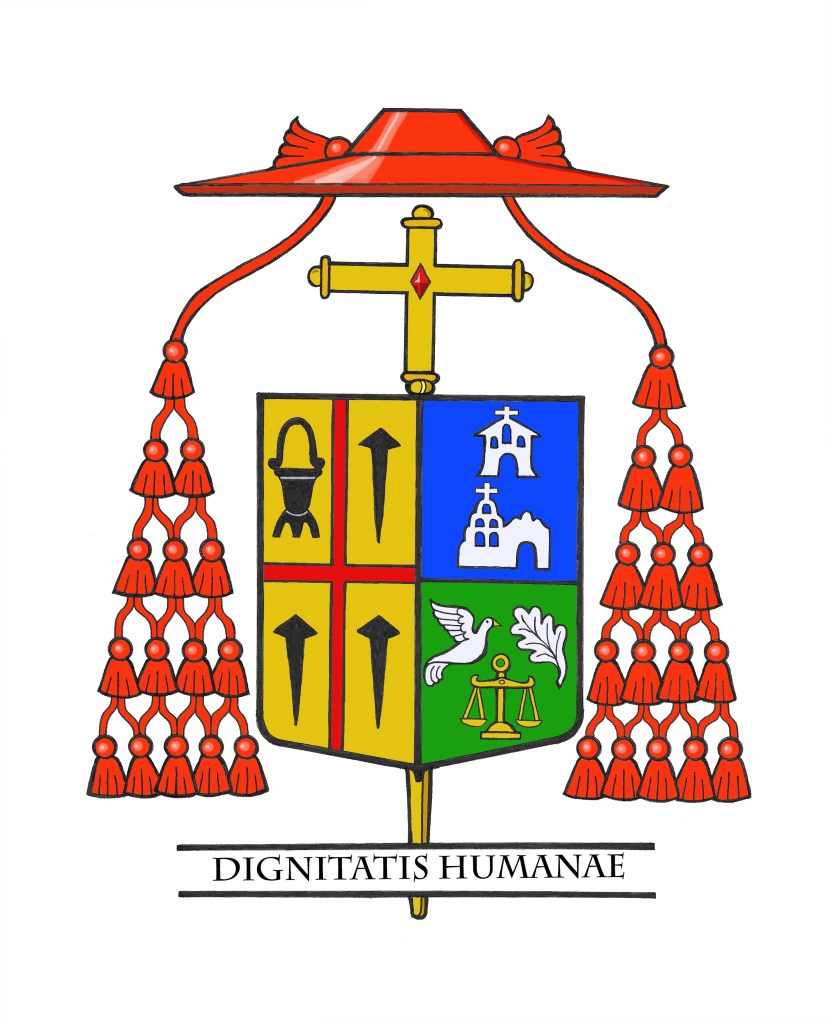
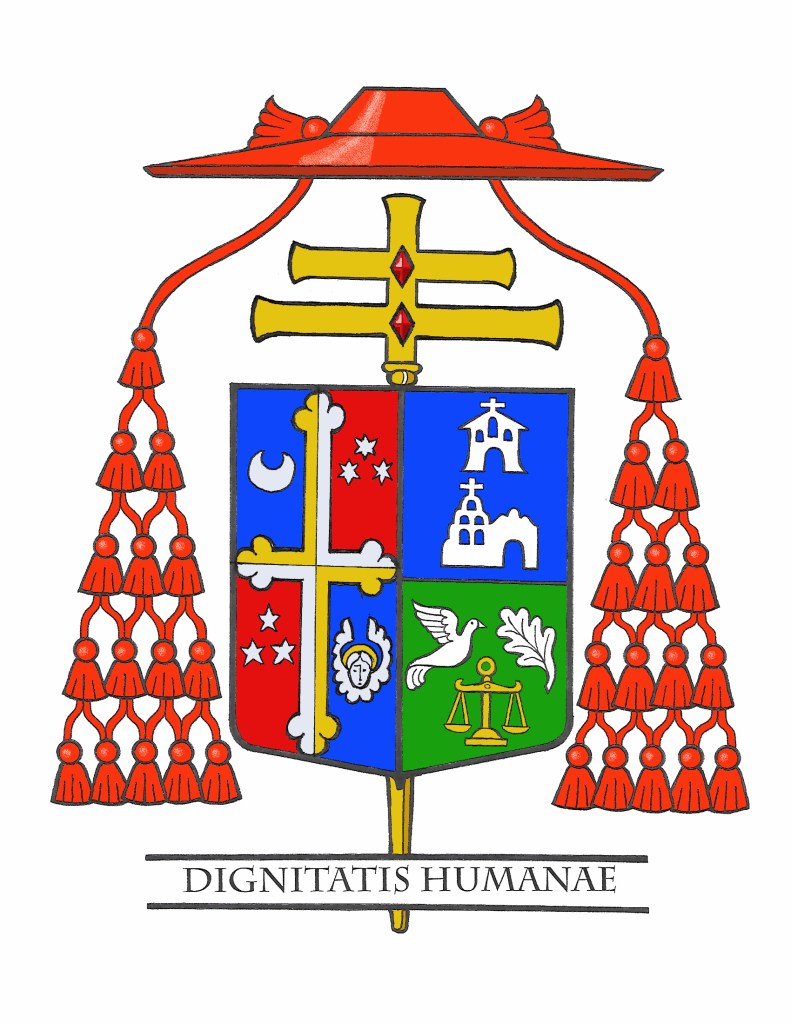
His coat of arms as a Cardinal Priest are:

By heraldic custom observed in North America, the arms of a diocesan bishop are “impaled” side by side on the same shield to the arms of his jurisdiction, in this case, the Diocese of San Diego. This signifies that the diocesan bishop, in this case, the cardinal, is “married” to the See. The same method of impalement is employed in the coat of arms of two married people who are armigerous.

The coat of arms of the See of San Diego is composed of a gold (yellow) field and symbols of San Diego (St. Didacus in Latin), the diocesan patron saint. Diego was born to poor Spanish parents shortly before the year 1400. His love of poverty never left him. As a Franciscan brother he was a selfless servant of the poor and was known to heal the sick with the Sign of the Cross, the central charge of the diocesan coat of arms. The Spanish stew pot in the upper left quadrant indicates Diego’s boundless charity and tireless efforts to feed the hungry. San Diego had a special devotion to the Lord in his Passion, symbolized by the three nails in the other three quadrants. Diego died on Nov. 12, 1463, at the Franciscan monastery in Alcalá, Spain, pressing a crucifix to his heart and repeating the words of the Good Friday chant: “Dulce lignum, dulce ferrum, dulce pondus sustinet” (Precious the wood, precious the nails, precious the weight they bear.)

For his personal arms Cardinal McElroy uses the design he assumed in 2015 upon becoming Bishop of San Diego reflecting his priestly ministry and interests. The arms are composed of two sections of the field. In the upper portion, on a blue background, are stylized depictions of two California Missions. The upper is Mission San Francisco and the lower is Mission San Diego. Prior to becoming Bishop of San Diego the cardinal served as Auxiliary Bishop of San Francisco. The lower part of the field shows a green background. On this field we see a silver (white) dove in flight which symbolizes peace; a silver (white) oak leaf used as a symbol of life and the gold (yellow) scales symbolizing justice. These three virtues are important to the life, work and ministry of the cardinal.

For his motto, Cardinal McElroy has selected the phrase “DIGNITATIS HUMANAE”  (Of the Dignity of the Human Person) which is also the title of the Second Vatican Council’s “Declaration on Religious Freedom”. 

The shield is ensigned with a gold (yellow) episcopal cross. Such crosses resemble  contemporary processional crosses but they are, in fact, different. In the Middle Ages such a cross, without a corpus, was carried directly in front of all metropolitan archbishops and Papal Legates as a symbol of their authority. Eventually all bishops began using this emblem and adopted it in their coats of arms as well. The episcopal cross ceased to be used in the late XIX Century but the cross behind the shield continues to be used by bishops in ecclesiastical heraldry. The cardinal retains the use of an episcopal cross, with a single horizontal bar, because while the Holy Father has promoted him to the dignity of the Sacred College of Cardinals he retains his office as Bishop of San Diego. In the armorial bearings of a Cardinal of the Holy Roman Church the external ornaments around the shield reflect the office exercised by the individual cardinal. Those cardinals who are also archbishops use a cross with two horizontal bars; those who are bishops use one with a single horizontal bar. In the rare case of a cardinal who does not possess the episcopal office no cross at all appears in his coat of arms.

In addition, above the shield is the red ecclesiastical hat called a “galero” with fifteen tassels pendant on either side. This is the singular heraldic emblem that distinguishes the coat of arms of a cardinal. This broad brimmed hat, once worn in cavalcades, is no longer used but remains as a heraldic emblem. The galero was first bestowed on the Cardinals of the Roman Church by Pope Innocent IV at the First Council of Lyon in 1245. It was the first hat to be distinguished by the use of a specific color (scarlet) and it was also to be adorned with tassels. However, originally the number of tassels was not fixed. There are various examples of cardinals’ coats of arms that show as few as two tassels suspended from the galero and as many as seventy-two! What marked these coats of arms as those belonging to cardinals was that the galero, cords and tassels were red and nothing else. No one else could use such a red hat except a cardinal regardless of how many tassels were suspended from it. The number eventually was fixed at thirty (usually depicted as fifteen suspended on either side of the shield in a pyramidal pattern) only in 1832. A system for distinguishing the ranks of other clergy based on the color of the hat, of the cords and the number of the tassels did not come into existence until the Instruction of Pope St. Pius X “Inter Multiplices” in 1905. 

These external ornaments are those used for a prelate with the rank of cardinal who is a diocesan bishop while not being a metropolitan archbishop according to the Instruction of the Holy See, “Ut Sive“, of March, 1969.

It was my great pleasure to advise the Cardinal on his armorial achievement and to assist him in preparing this version upon his elevation to the Sacred Purple.

Bishop Dolan Translated To Phoenix

On August 2 the Most Reverend John Patrick Dolan (60), originally a priest of San Diego and, since 2017 Auxiliary Bishop of that same diocese, will be installed as the fifth Bishop of Phoenix, Arizona. His armorial bearings are:

The bishop’s coat of arms, is composed of a shield upon which there are symbolic charges, a motto and the external ornaments of rank. By heraldic custom observed in North America, the arms of the diocesan bishop are “impaled” side by side on the same shield to the arms of his jurisdiction, in this case, the Diocese of Phoenix. This signifies that the bishop is “married” to the See. The same method of impalement is employed in the coat of arms of two married people who are armigerous.

The coat of arms of the See of Phoenix is composed of a blue field on which is placed a silver (white) mountain to represent Camelback Mountain, a significant aspect of the backdrop of the See City. Arising from the mountain is a gold (yellow) bird that is coming forth from red flames to represent the mythological phoenix, that arose from the ashes, and for which the See city is named. Above the phoenix is a gold cross formy fitchée (three arms of a cross and one resembling a spike), which is taken from the arms of the Diocese of Tucson to signify that it was from the territory of Tucson that the Diocese of Phoenix was created in 1969.

For his personal arms Bishop Dolan has adopted a design to reflect his religious devotion, priestly ministry and family. The arms are composed of a gold (yellow) field on which there is a single charge of the Sacred Heart of Jesus depicted wounded, surrounded by a crown of thorns and enflamed all colored red. This reflects the bishop’s devotion to the Sacred Heart which is also symbolic of the mercy of God which he tries to reflect in his priestly ministry. All priests are exhorted to conform themselves more closely to Christ and strive to be shepherds after His own heart. The gold field is borrowed from the coat of arms of the diocese of San Diego to recall the local church he had served as a priest and auxiliary bishop. The chief (upper third of the shield) replicates the blue field and crescents traditionally associated with the arms of Dolan in Irish heraldry. Here the usually silver crescents have been colored gold (yellow) and reduced in number from three to two for differencing. These charges are merely borrowed to act as an allusion to the bishop’s family name.

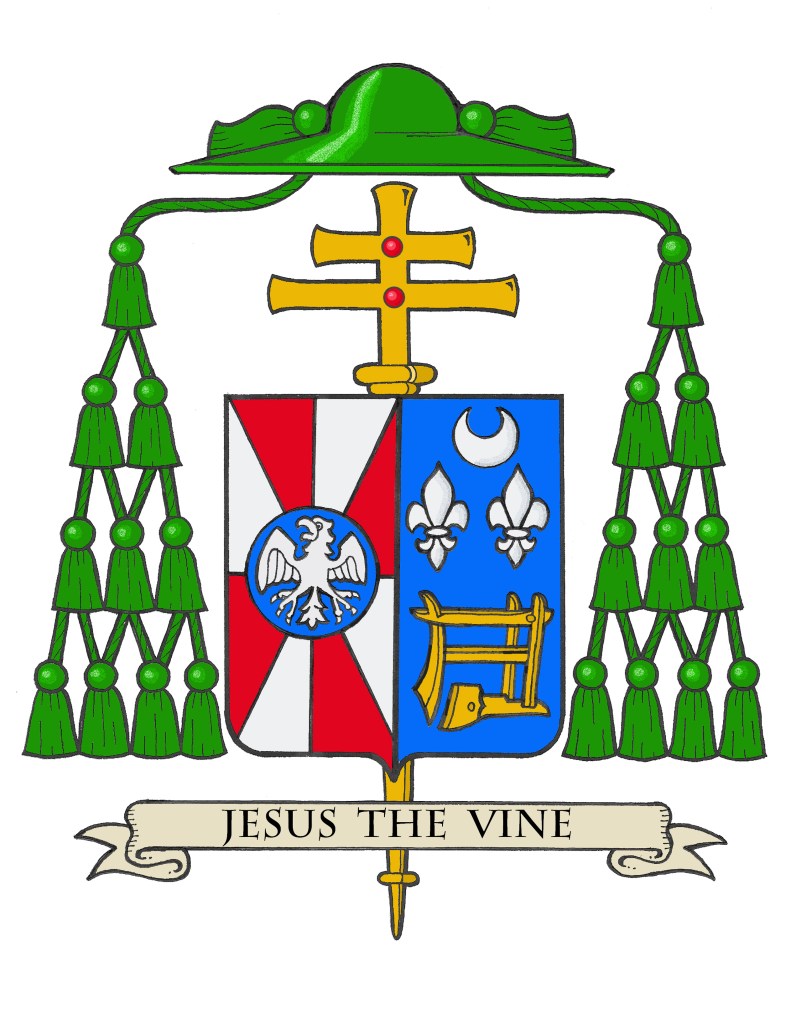
For his motto, Bishop Dolan has selected the phrase “ABIDE IN MY LOVE”.

The shield is ensigned with a gold (yellow) episcopal cross. Such crosses resemble  contemporary processional crosses but they are, in fact, different. In the Middle Ages such a cross, without a corpus, was carried directly in front of all metropolitan archbishops and Papal Legates as a symbol of their authority. Eventually all bishops began using this emblem and adopted it in their coats of arms as well. The episcopal cross ceased to be used in the late XIX Century but the cross behind the shield is the true emblem of episcopal heraldry. In addition, above the shield is the green ecclesiastical hat called a “galero” with six tassels pendant on either side. This broad brimmed hat, once worn in cavalcades, is no longer used but remains as a heraldic emblem. The original color worn by bishops and archbishops was green, not purple. This “episcopal color” is retained in heraldry. These external ornaments are those used for a prelate with the rank of bishop according to the Instruction of the Holy See, “Ut Sive”, of March, 1969.

I was pleased to design the bishop’s personal arms in 2017 when he became a bishop and was also happy to marshal them to those of his new diocese shortly after his appointment to Phoenix.

Abbot Michael Brunner, OSB

On May 7 the Rt. Rev. Michael Brunner, OSB, elected Abbot on January 17, 2022, will receive the abbatial blessing as the fourth Abbot of the Abbey of St. Gregory the Great in Portsmouth, Rhode Island.

The armorial achievement, or coat of arms, of Abbot Michael is composed of the shield with its various charges, the external ornaments of an abbot and the motto. The shield contains only the personal arms assumed by Abbot Michael. While it is often customary to impale (combine side-by-side on the same shield) the personal arms with those of the abbey that is not mandatory and it is up to the personal choice of the armiger. 

The coat of arms has a red field or background. This color is used liturgically in the Church on feasts connected with the Holy Spirit. Prominent in the upper portion is the descending silver (white) dove with a halo containing a red cross indicative of Divinity. This, of course, alludes to the Divine guidance and light of the Holy Spirit. The Abbot’s motto is taken from the great hymn, “Veni, Sancte Spiritus” so, the dove is a tie-in with the Abbot’s motto. The dove is also an allusion to the Abbey’s patron saint, Pope St. Gregory the Great who, in art, is often seen with the dove that symbolizes the inspiration of the Holy Spirit.

Issuing from the dove is a golden (yellow) beam of light and on this beam is a black cross pattee charged at the center with a gold (yellow) crescent. This black cross is combined with a red cross bottony turned in an “X” shape and placed behind the black cross.

The black cross pattee is a symbol of the Abbot’s Christian faith as well as his German ethnic background. The red cross turned in saltire (and X-shape) behind it is used in heraldry to symbolize St. Michael, the Abbot’s patron saint. The crescent on the cross is symbolic of Our Lady under the title of The Immaculate Conception and is there as a symbol of the Abbot’s Marian devotion.

The shield is ensigned with the black pilgrim’s hat, called a galero, used in heraldry for clerics in place of the traditional helmet, mantling and crest. The hat has black cords terminating in twelve black tassels. Behind the shield and extending above and below it is a gold (yellow) abbot’s crozier with the sudarium (veil) attached. This veil was used in former times to protect the shaft of the crozier from dirt and perspiration before the time when abbots would have worn liturgical gloves. While the veil is no longer used it remains as a heraldic emblem to distinguish the crozier of an abbot. These are the ornaments proper to a prelate with the rank of abbot according to the Instruction of the Holy See, “Ut Sive” of March 1969.

On a scroll below the shield we see Abbot Michael’s chosen motto, “Veni Pater Pauperum” which is from the Pentecost Sequence, “Veni, Sancte Spiritus”.

It was both my privilege and my pleasure to devise and depict the armorial bearings of Abbot Michael.