Category Archives: External Ornaments

Easy Come; Easy Go.

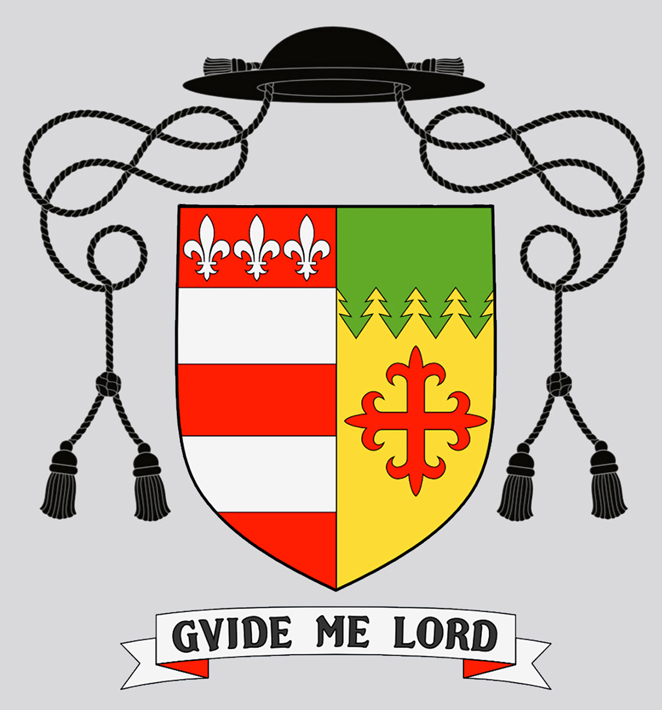
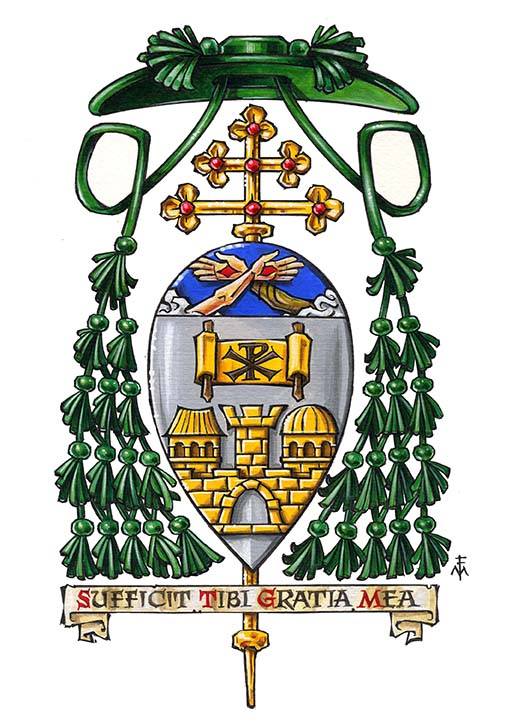
Last November, my Bishop appointed me to serve as the Dean of the Deanery in which my parish is located. That meant there was going to be a modification of my coat of arms. The addition of a second tassel to the galero in my armorial bearings was for the duration of the office of Dean only.

Just yesterday, my Bishop announced the appointment of three new Deans. Two of them are appointed to fill vacancies created by the retirement of two priests. The third is in my own Deanery where a vacancy is about to occur when I am transferred to a new assignment later this month. Since the extra tassel was only “pro hac vice” I must now reliquish it and revert to using the galero of a simple priest, with one tassel pendant on either side of the shield.

As it turns out, I served as a Dean for only nine months. At the time of my appointment last November, my bishop and I had no way of knowing that I would be transferred only the following summer.

Justin Trudeau Meddles in Heraldry

Today, the Canadian Government of Justin Trudeau unveiled a new heraldic Canadian Crown replacing the traditional St. Edward’s Crown used on Canada’s coat of arms, police & military badges. The design replaces what the government termed “religious symbols” (crosses & fleur-de-lis) with maple leaves & a snowflake.

The Canadian Heraldic Authority was apparently consulted in this process. Reactions so far have been mixed but mostly disapproving.

Crown of Lord Lyon

It was very interesting to read in the Times that Lord Lyon King-of-Arms, the senior heraldic officer in Scotland will not only take part in King Charles’ coronation on May 6 but will do so wearing the crown that had been commissioned and obtained by the Heraldry Society of Scotland back in the early 2000s. The arches on the crown, which are removable, will be removed for the coronation so it won’t too closely resemble the crown with which the King shall be crowned.

The expensive item and the trouble that went into commissioning and fabricating it was one of the reasons that, despite the Peers not being allowed to wear their coronets at the upcoming, more modernized, ceremony Lord Lyon–and indeed the other three English Kings-of-Arms–will be wearing their crowns. The coronation of the Sovereign is one of the only occasions on which these crowns are traditionally worn.

Queen Camilla Gets a New Coat of Arms

On February 21, HM King Charles III granted new arms to Her Majesty Queen Camilla. This is the first grant of arms made by the King and they replace the arms previously granted buy the late Queen Elizabeth on July 14, 2005. The arms granted are:

Within the Garter Our Royal Arms impaling the Arms of Shand surmounted by Our Crown.”

The Supporters are a Lion Guardant Or Crowned proper (dexter) and to the sinister a Boar Azure armed and unguled Or langued Gules and gorged with a Coronet composed of Crosses formy and Fleurs-de-lys attached thereto a Chain reflexed over the back and ending in a Ring all Or (sinister).

Unique Arms for a Unique Office

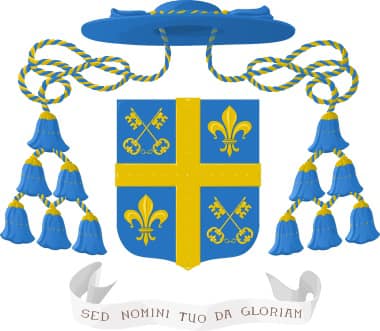
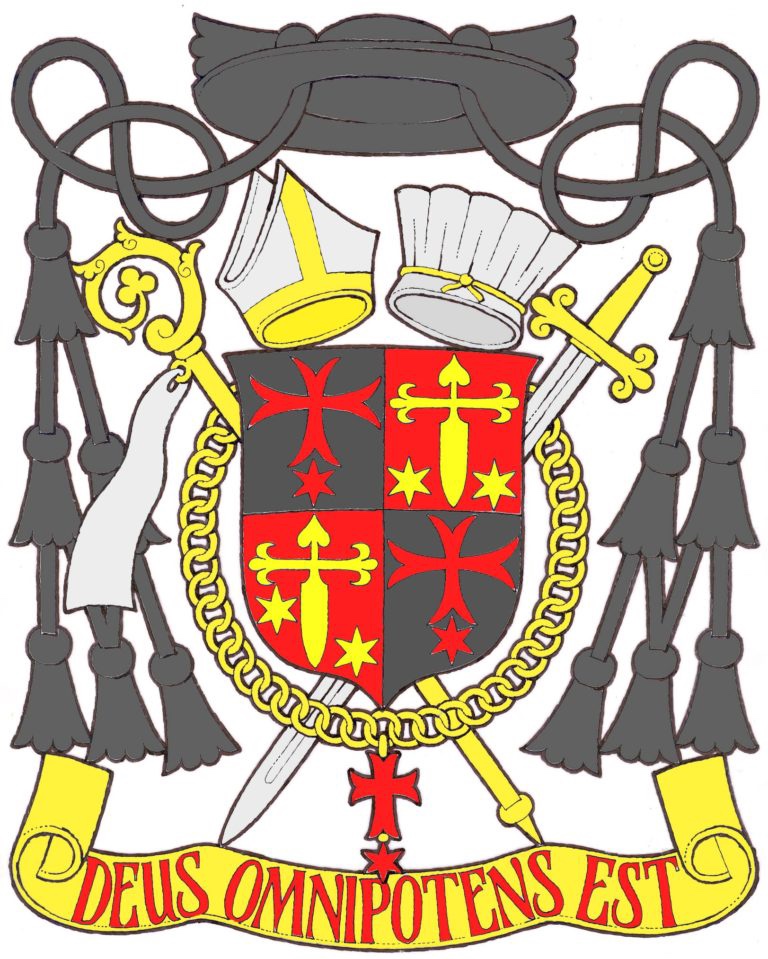
This is the armorial bearings of Monseigneur Gilles Wach who is the Founder (one of two) and Prior-General of the Institute of Christ the King, Sovereign Priest. This is a community of Pontifical Right founded specifically to keep alive the traditional liturgy that was in use prior to the reforms of 1963-1970. The habit that the clerics in the community wear is composed of a mozzetta and mantellone over the cassock and surplice. In addition, there are accents on the garb (such as buttons, piping and the pom on the biretta) in a distinctive shade of blue.

The Superiors of the Community wear a mozzetta that is entirely made of this blue color. As the Prior-General–the Major Superior of the Community–Mons. Wach wears an entirely blue cassock and also uses and entirely blue biretta.

The arms above are clear and simple. As the major Superior General of an Institute of Clerics it is perfectly in keeping with the heraldic traditions and customs of the Church for him to employ a galero with 12 tassels pendant from the hat. In addition, there is a long-standing tradition in the Church (one which I have never particularly liked and have said so publicly) that the color of the galero and the tassels is sometimes determined by the color of the garb worn by the armiger. Fore example, Abbots in the Praemonstratensian Order and those in the Cistercian Order often use a galero that is white and had white tassels pendant from it. This is because the habit they wear is white.

I have argued against this because the color of the galero (and the tassels) is not a mirror of what one wears. The galero used by bishops and archbishops is green but they do not wear that color. The color and the number and color of the tassels is supposed to indicate a rank, not membership in a particular order or community. So, I continue to argue that for Abbots the hat should be black and the tassels black regardless of the color of the habit. But, that’s not up to me. I don’t get to make that determination and the custom is a long-standing one that would be difficult to overturn except by Papal Decree (which I would neither hope for or desire).

Consequently, this coat of arms is perfectly in keeping with the accepted heraldic practices of our time. A Superior General is entitled to use 12 tassels and since the use of different colors depending on the habit has become the norm it makes perfect sense to use a galero and tassels in the distinctive blue worn by the Community. I might be inclined to question why the tassels are topped in gold and also why there is a skein of gold intertwined in the cords but, not having any definitive answer at my fingertips, I must admit that this may simply have been artistic license. It is, perhaps, worth noting as well, that different Communities within the Church (i.e. Order of Chivalry, Religious Orders, Institutes and Lay Communities) can and do make determinations for themselves about heraldic emblems used by their members. That, too, is well in keeping with the established customs, traditions and practices in ecclesiastical heraldry.

Another Tassel on the Hat

At the conclusion of the Mass celebrating my Parish’s 150th Anniversary on Sunday, November 6, the Bishop of Metuchen announced that he has appointed me as the Dean of the Morris Canal Deanery. This covers all of Warren County, NJ and consists of 10 churches in 9 parishes: St. Jude, Blairstown; Ss. Peter & Paul, Great Meadows; St. Theodore, Port Murray; Assumption of the Blessed Virgin Mary, Hackettstown; St. Patricks, Belvidere which is combined with St. Rose, Oxford; St. Philip & St. James, Phillipsburg; St. Mary, Alpha and St. Joseph, Washington.
 
I will continue on in my current assignment as Pastor of St. Joseph and also continue as the Diocesan Director of Ecumenical & Interfaith Affairs. There is no salary increase but I do get a title bump from “Reverend” to “Very Reverend Guy Selvester, V.F.” (which stands for Vicar Forane).
 
Of perhaps even more interest to me is the fact that I get to add another tassel to the galero in my coat of arms.
 
(artwork by Xavier Garcia)

Charles III Royal Cypher

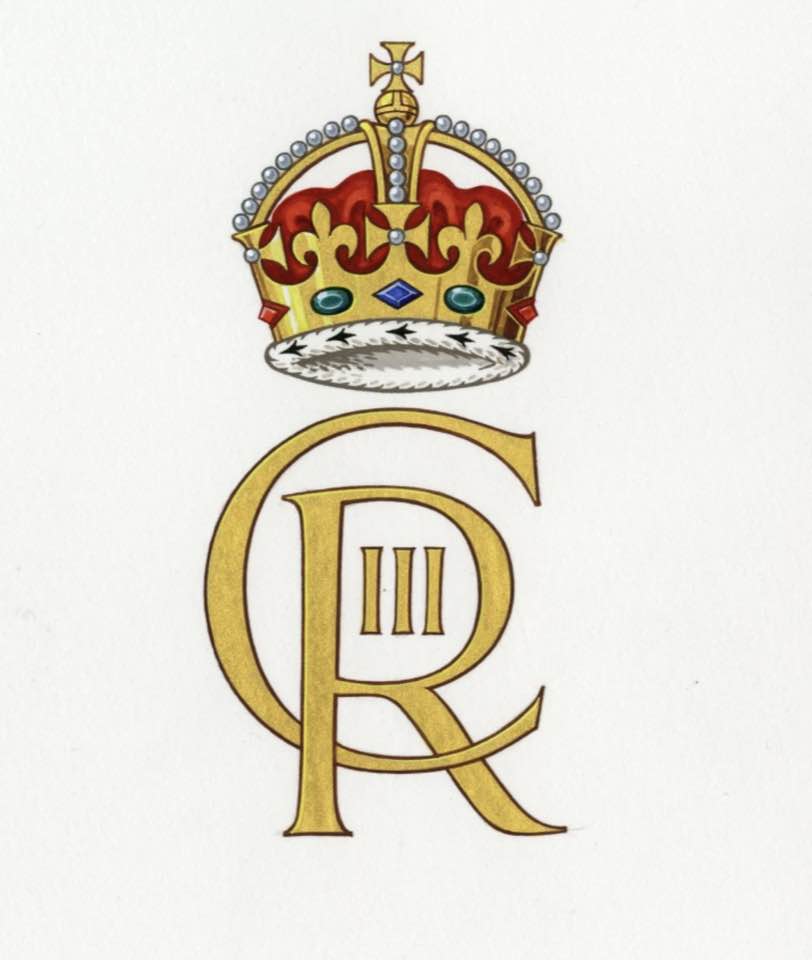
Buckingham Palace released the royal cypher to be used by King Charles III. It employs the “Tudor” crown rather than the stylized version of the St. Edward’s Crown favored by his late mother, Elizabeth II. Her four predecessors used this Tudor style crown in their cyphers as well as on their coats of arms. This has led to the erroneous belief that there is a “Queen’s crown” and a “King’s crown” used heraldically in British royal heraldry. That is not the case. It is simply a matter of each sovereign’s personal preference.

Two for One

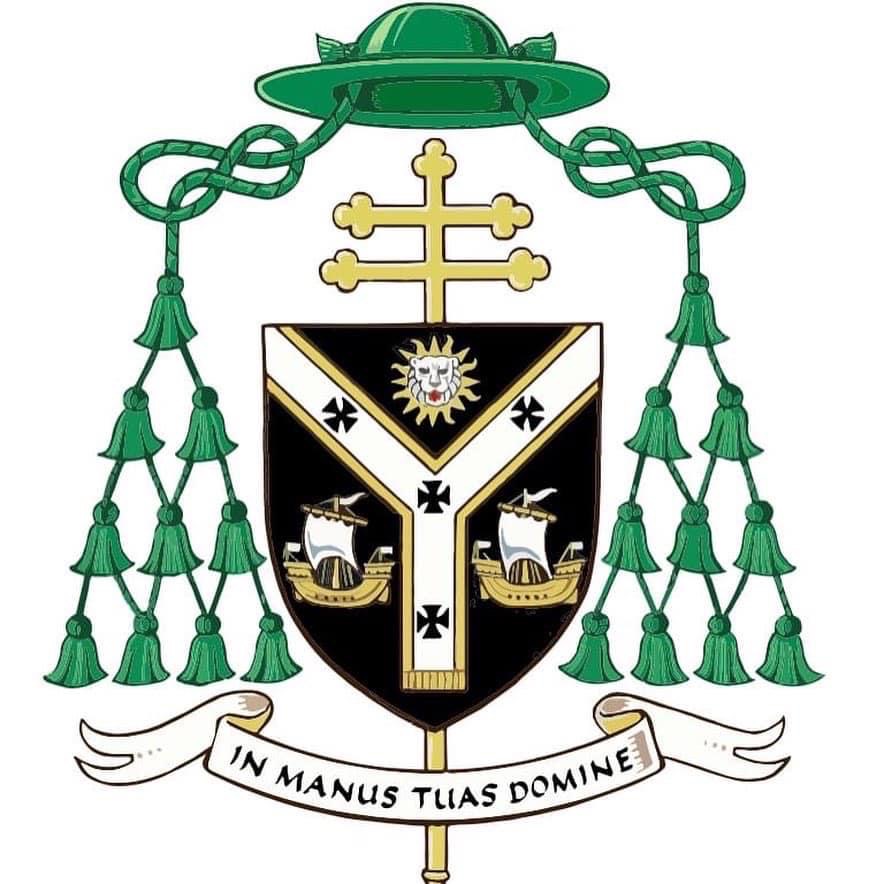
On June 20 the Most Rev. Mark A, O’Toole (59) a priest of the Archdiocese of Westminster and formerly the Bishop of Plymouth was installed as the 10th Metropolitan Archbishop of Cardiff in Wales. On June 23 this same prelate was also installed as the Bishop of Menevia in Wales. The two dioceses remain separate for the present but are joined in a personal union through having a single bishop.

The arms he has now assumed since his move to Wales, which are different from those he bore as Bishop of Plymouth incorporate the pall (pallium) as a charge on the shield rather than the less-than-ideal attempt to include it in the achievement as an external ornament. The latter has become popular in recent years but is really a poor design decision that never quite works.

For reasons I do not know the Archbishop has chosen not to impale his personal arms with those of the Sees. Perhaps it is because there are two different Sees. Quartering would have solved that issue, however.

Archbishop Boland’s Excellent Example

One of the better coats of arms borne by an American prelate in the 20th Century belonged to the Most Rev. Thomas Aloysius Boland, the 6th Bishop and 2nd Archbishop of Newark, New Jersey from 1952-1974. Boland had been a priest of Newark and served as Auxiliary Bishop there from 1940-1947 and then was translated to the Diocese of Paterson, New Jersey as its 2nd Bishop from 1947-1952. Archbishop Boland retired from office in 1974 and died in 1979.

His very nice, simple and stylish coat of arms impaled very well with the equally simple and well-designed armorial bearings of the See of Newark. The contrast in tinctures and the composition of the charges made for an excellent overall appearance. Of course, in the time when he became a bishop and assumed these arms it was still the custom to include the mitre and crozier in the achievement of a bishop.

Advent in Heraldry

It’s not all that easy to find heraldic references to Advent. Nevertheless, one which I came across many years ago and of which I always think at this time of the year is the very fine coat of arms of the Cathedral Church of the Advent in Birmingham, Alabama. This is the cathedral church for the Episcopalian Diocese. They had a devisal of arms produced for them by HM College of Arms in London. It is, overall, a most pleasing design and I particularly like how an Advent wreath was incorporated.

The Church enters into the final week Advent this week and I wanted to be sure to point out this excellently done coat of arms before the season had left us again.

Happy Advent (and a Merry Christmas) to you all.

Grosseto

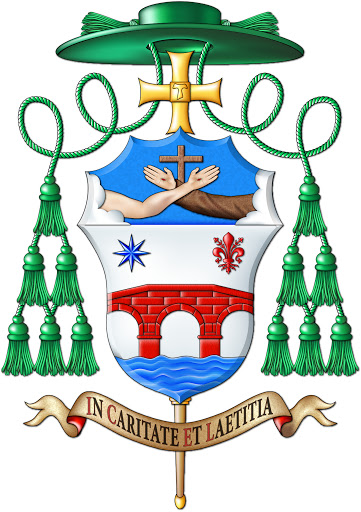
On August 9 the Most Rev. Giovanni Roncari, OFM. Cap. (71) Bishop of Pitigliano-Sovano-Obrbetello Italy was additionally installed as the Bishop of Grosetto, Italy. Henceforth, Grosseto is united to Pitigliano-Sovana-Orbetello in persona episcopi. His coat of arms, designed by Giuseppe Quattrociocchi is below:

The chief (upper third of the shield) contains the traditional symbol of all the various types of Franciscans, namely the crossed arms of Christ and Francis with a cross. The bridge recalls the place where the bishop hails from (San Piero a Ponti) and the star is for Our Lady. The inclusion of the Florentine fleur-de-lis is to recall the city of Florence where the bishop exercised a great deal of his priestly ministry.

The coat of arms is well done, despite the asymmetry of the star and fleur-de-lis. That bothers some people but can also work very well depending on the overall design and I think it does so here.

My only criticism is the inclusion of the small Tau Cross at the center of the episcopal cross standing behind the shield. As I have frequently written about on this blog I am of the opinion that the external ornaments in a heraldic achievement, which indicate rank, not identity, should not be seen as open to personalization. But, in the grand scheme of things that is a minor criticism at best. I particularly like the shape of the shield chosen as I think it works very well with what is depicted upon it.

Great Use of a Wonderful Coat of Arms

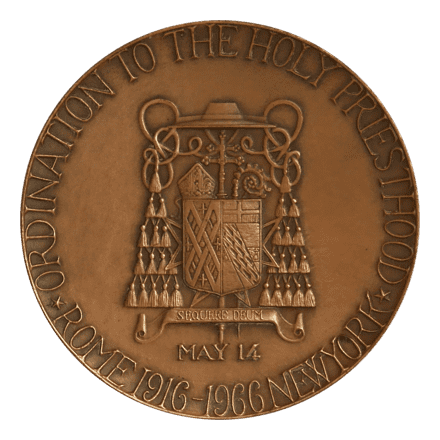
In 1966 Francis Cardinal Spellman, Archbishop of New York celebrated the golden jubilee of his ordination to the priesthood. A special commemorative medal was struck to mark the occasion. The obverse depicted a portrait in profile of the cardinal. The reverse (pictured) depicted his very nicely designed coat of arms. These arms are actually not those he assumed upon becoming a bishop. When he moved to New York he adopted an entirely different coat of arms which he used for the rest of his life. Those are on the medal.

The personal coat of arms containing a chief “of Religion” is shown, as is tradition, impaled with he arms of the See of New York. In addition, as was the older usual custom in addition to the cardinal’s galero and archiepiscopal cross there are both a mitre and a crozier (turned “outward”) depicted as well as the cross of the Order of Malta placed behind the shield.

Monk & Priest

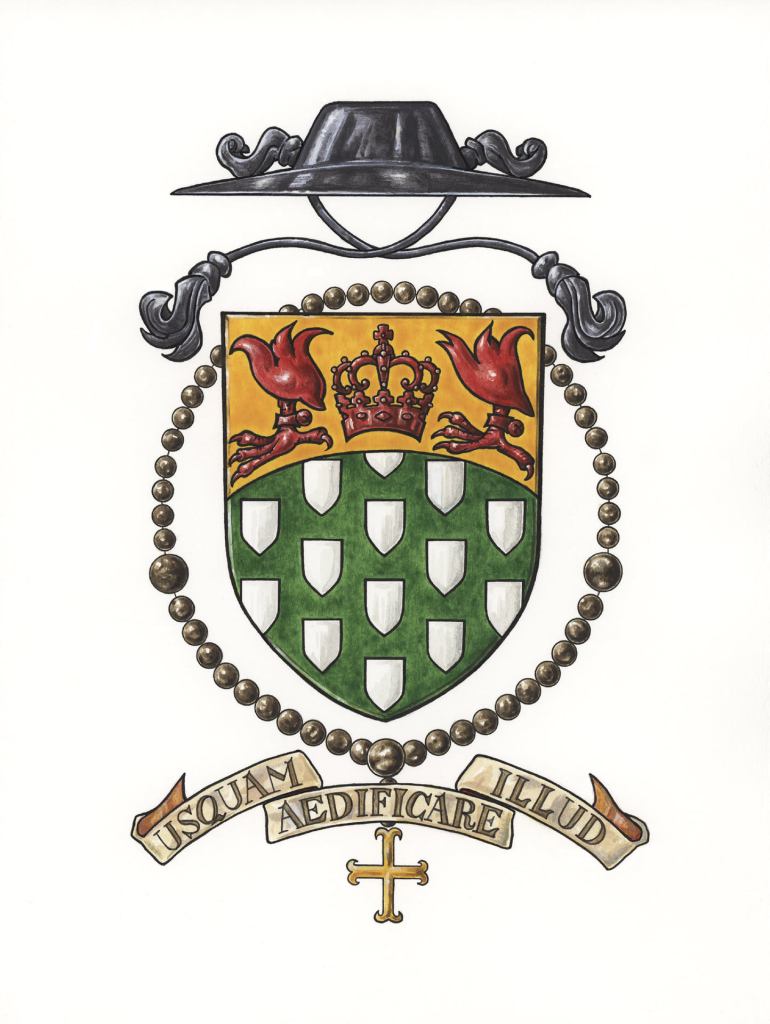
Fr. Pachomius Meade, OSB a monk and priest of Conception Abbey in Missouri is an artist by avocation. He is very interested in heraldry as well and has had occasion to design some very nice coats of arms. But, up until now, he had not adopted armorial bearings for himself. With my encouragement he eventually set about doing so and, in my opinion, took the right path which was to take his time and go through many draft ideas. He has finally settled on a design which I also told him was a striking and good one.

The explanation of the charges chosen for this design are in his own words:

The top third of the shield (chief) is made up of two charges (one repeated). It depicts a royal crown between two birds’ claws erased. The talons are designed so as to be obviously those of falcons. Heraldry often places leather straps (jess) and bells on falcon legs. I took the artistic license to show the feathers around the talon in a diagonal conical form, as several species of falcons display around their legs. The talons plus the crown together are a rebus for my religious name Pachomius, which in the Coptic language means “king’s falcon.” These charges on a chief make them, therefore, canting arms, which is to say the arms “speak” the name of the armiger. Additionally, the base of the chief – which is usually a straight line – is enarched, a very simple variation on the line. I liked the idea of an elegant variant such as this.  Other than the stylistic choice, on a personal level I like that it is Romanesque, which is the style of my abbey’s basilica and is a subtle nod to the structure of a church.  

The lower two thirds of the shield depict smaller white shields (escutcheons) on a green field. The repeated charge spread evenly on a field in heraldry is called semy or semé, meaning “seeded.” This is a feature of heraldry that I particularly love and what was lacking in some of my original ideas for a coat of arms. The charge of a white shield without a charge of its own is a traditional symbol for a painter or heraldist. Probably my most obvious talent since I was a child has been art and it seemed like a no-brainer to have this charge. Again, there’s nothing more to it than that, but my own theological reflection on this part of the shield can also be that monastic life is called a white martyrdom – to distinguish from red martyrdom – and the spiritual combat of this charism. My surname is Meade, which is a meadow, and a green field makes sense (although, I believe my last name is really an Anglicized Gaelic word that had a completely unrelated definition).”  

I think he has come up with a clear bold design. The symbolism of the charges makes sense. He kept the overall design somewhat simple. The choice of tinctures is not only good from the point of view of symbolism they are aesthetically pleasing. The priest’s galero above the shield symbolizes his priesthood while the chaplet (rosary) encircling the shield is the accepted heraldic external ornament indicative of the armiger being a Consecrated Religious, in this case, a professed monk.

I say, “Well done!”. Incidentally, the artwork is by Fr. Pachomius as well.

Third Priestly Arms

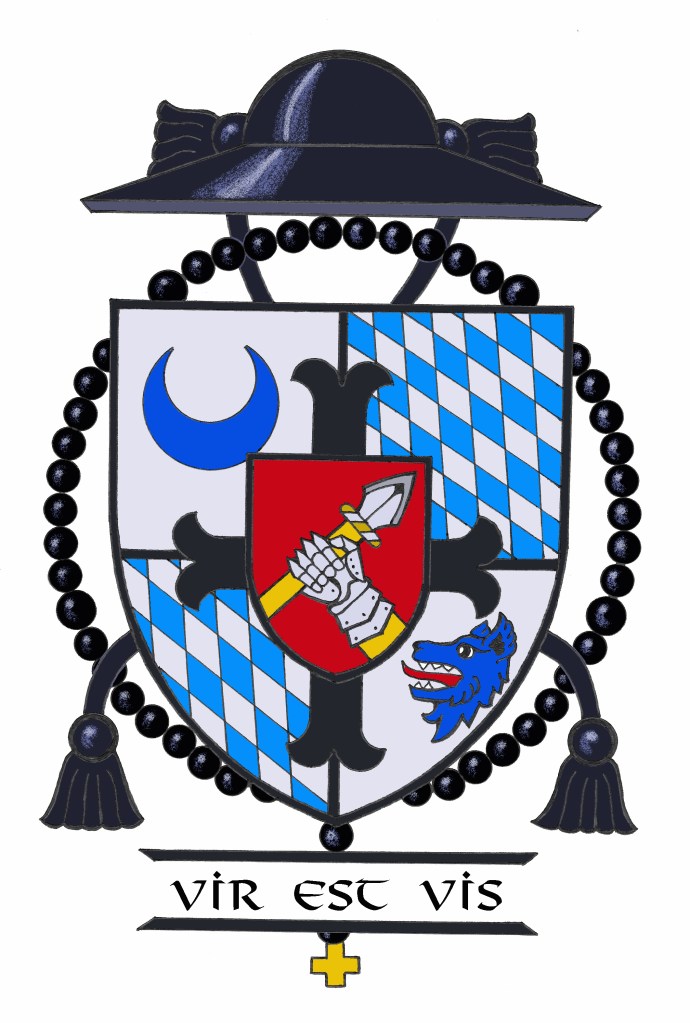
Recent days have been busy and I have now completed a trifecta of sacerdotal arms all, as it happens, for priests who are also Benedictine monks. They’re from different communities and made their requests independently of each other. In addition, they have all proven to be men of exceeding patience because their projects kept getting sidelined by commissions I’d received to prepare a coat of arms for a new bishop. Those commissions are always time sensitive so all other considerations would have to go by the way side whenever I’d receive one.

Finding a window in the calendar I decided to make the extra effort to complete this three long-standing commissions. This is the last of the three.

These arms reflect the armiger’s community, apostolate, family history and monastic name. The inclusion of the chaplet encircling the shield indicates that he is a Professed Religious in vows and the galero indicates he is ordained to the priesthood. Not all Religious armigers choose to use the chaplet, especially if they are also ordained priests. It is a matter of choice.

In fact, it is worth pointing out that while there are specific external ornaments which may be used by an armiger to indicate what rank they hold, or honors they have received, none of these are required to be used. If an armiger should so desire, he/she may simply bear a shield and motto, or indeed even just the shield alone. I mention that last part because everyone in ecclesiastical circles seems to make such a big deal out of the motto. (Bishops especially). Mottoes are, strictly speaking, not really part of the coat of arms. It has become customary to display one’s motto in the achievement of arms but that, too, is not necessary.

Armorial Bearings of a Priest

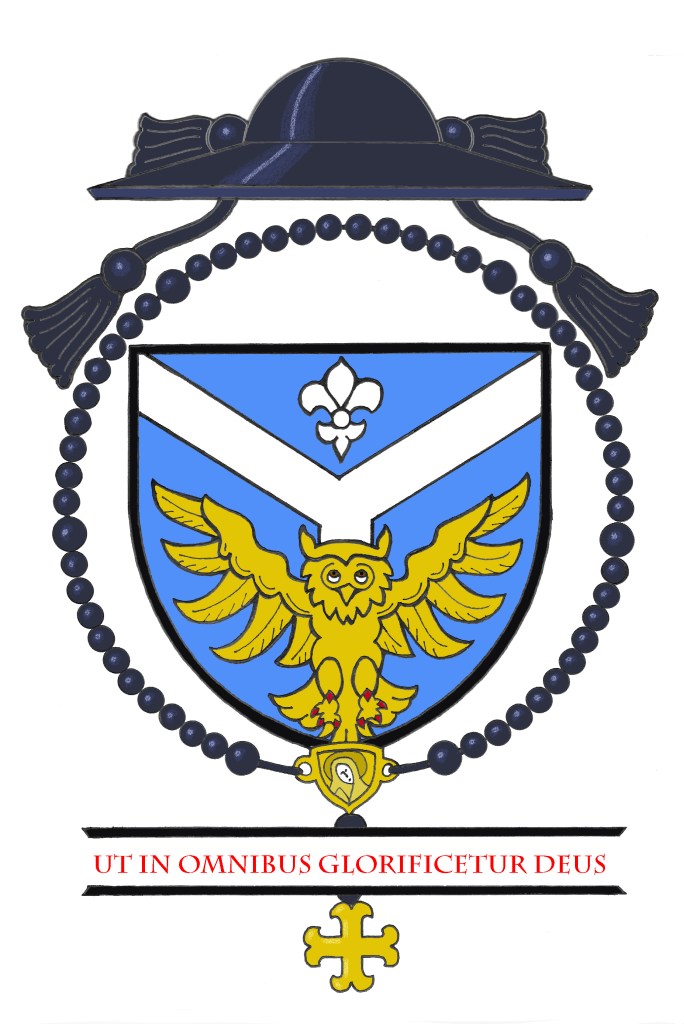
Here is one of my more recent commissions. It is the armorial bearings of a priest who is also a Professed Religious in vows. The black galero at the top of the achievement indicates his status as a priest. The chaplet – not often seen these days in heraldry – is used in the achievement as an external ornament indicating a person in Religious Vows. It is often seen in the arms of an Abbess (along with the veiled crozier) who, unlike an Abbot, does not make use of the galero. It is also seen in the armorial achievements of Professed Knights of Malta, whose Knights of Justice are Professed Religious in the Roman Catholic Church.

This armiger is both a monk and a priest. The motto is taken from the Holy Rule of St. Benedict.

A Priest Among the Cardinals

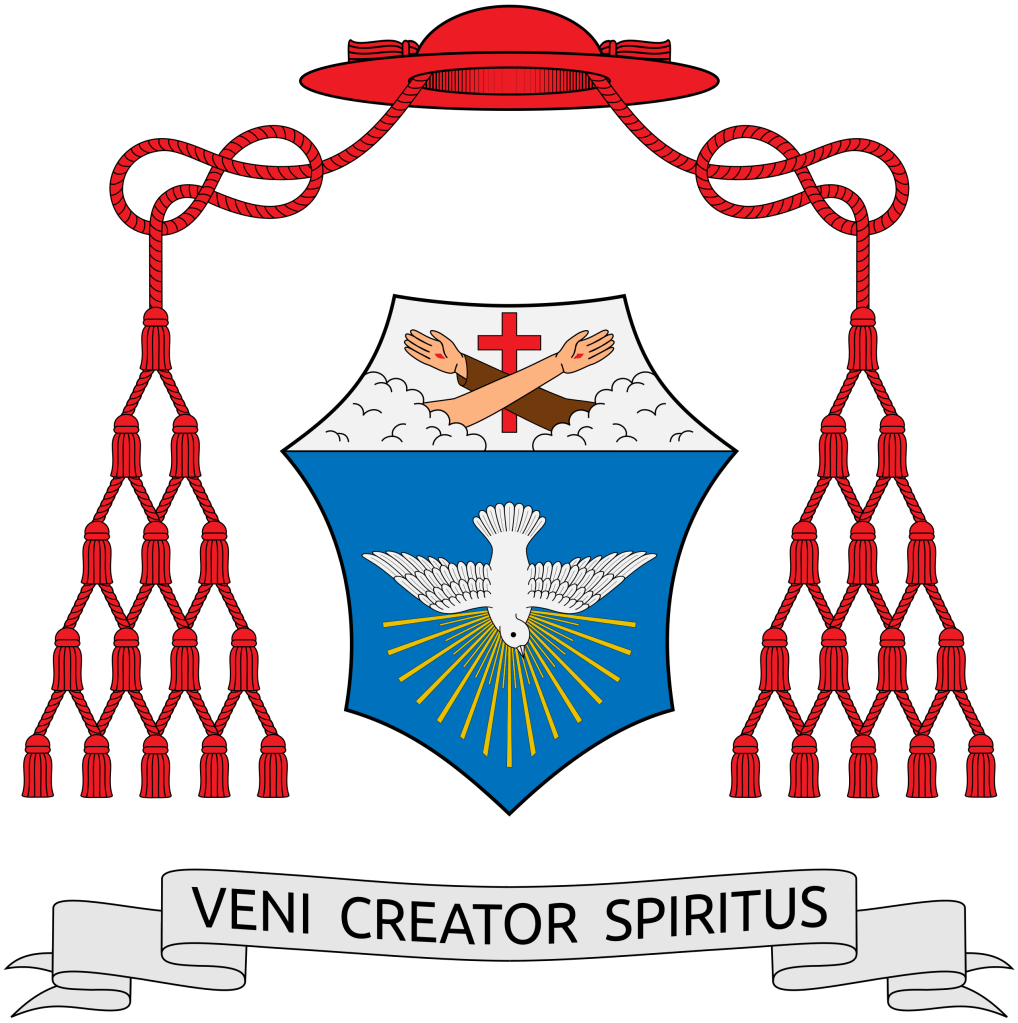
On November 28, 2020 Pope Francis created new cardinals. Among them was Fr. Raniero Cantalamessa, OFM Cap (86) who, for the past forty years, has served as the Preacher of the Pontifical Household. Given his advanced age Cardinal Cantalamessa requested to be dispensed from the requirement of receiving episcopal ordination prior to receiving his red hat. While it is not unprecedented it is still rather rare for a Cardinal of the Roman Church not to be a bishop as well. (Contrary to an erroneous idea that never seems to die there were no “lay cardinals” in the Church. All the cardinals who were members of the College of Cardinals previously but had not received ordination were, nevertheless, tonsured clerics and, therefore, NOT members of the laity).

Following the correct customs which are sometimes ignored by the foolish or the ignorant (see: the coat of arms of the late Avery Cardinal Dulles, SJ), Cardinal Cantalamessa ensigns his coat of arms with the scarlet cardinal’s galero but does not make use of the episcopal cross behind the shield because he lacks the episcopal character. As a cardinal, he may make use of pontifical insignia when celebrating Mass solemnly (the mitre, the ring and the crozier) and he may wear a pectoral cross. He also has the option of wearing scarlet cardinal’s robes or his own Religious Habit. It was interesting to note that at the Public Consistory at which he was created a cardinal he wore his habit with a surplice and did not wear the scarlet choir dress of a cardinal.

Ad Multos Annos!

Latin Patriarch of Jerusalem

On October 24 it was announced that the Apostolic Administrator of the Latin Patriarchate of Jerusalem for the last four years, Archbishop Pierbattista Pizzaballa, OFM, the former Custos of the Holy Land had been named by the Pope as the Patriarch of Jerusalem for the Latins. Accordingly, His Beatitude’s armorial bearings were updated to include another row of green tassels for a total of thirty tassels suspended from the galero. This rendering, as also the original rendering, was done by Marco Foppoli.