Category Archives: Cardinals

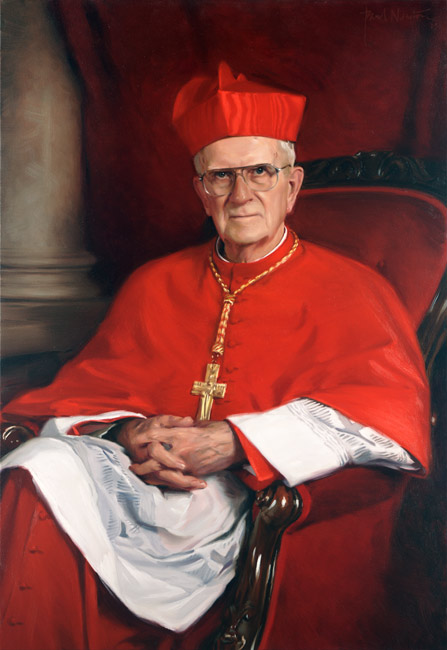
Reginald Cardinal Pole

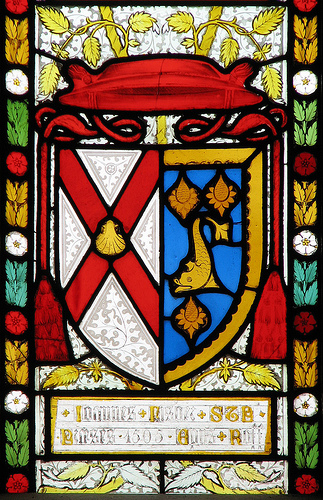
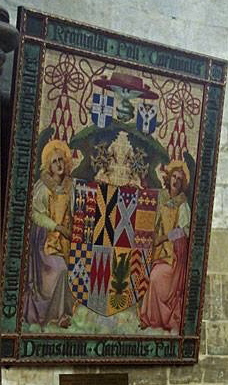
The other day I neglected to make note of the anniversary of the death of Reginald Cardinal Pole, Archbishop of Canterbury and a man with a better claim to the English throne than the illegitimate Elizabeth I. His impressive coat of arms depicts: Quarterly of eight: 1. Quarterly France (modern) and England with a label of three points each charged with a canton Gules (Clarence); 2. Per pale Or and Sable a saltire engrailed counterchanged (Pole); 3. Gules a saltire Argent with a label of three points gobony Argent and Azure (neville); 4. Gules a fess between six cross cross lets Or (Beauchamp); 5. Chequy Or and Azure a chevron ermine (Newburgh); 6. Argent three fusils in fess Gules (Montague); 7. Or an eagle displayed Vert armed and beaked Gules (Monthermer); 8. Quarterly i and iv Or three chevrons Gules (Clare); ii and iii Quarterly Argent and Gules, a fret Or, overall a bend Sable (Despencer). The two crosses indicate his archiepiscopal and legantine powers. On the small shields are the arms of the See of Canterbury and the Cathedral Chapter. The image is of the achievement of his arms hanging above his tomb.

Image 50_2

Archbishops of Sydney

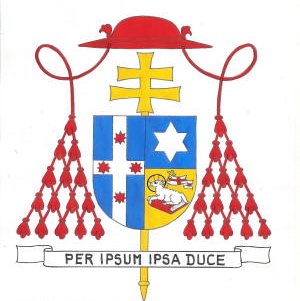
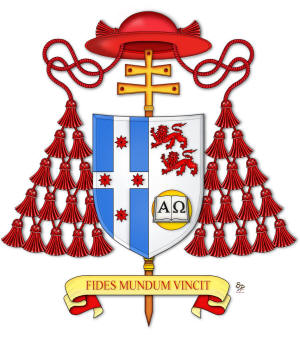
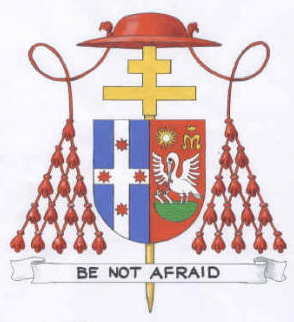
With the recent installation of the IX archbishop of Sydney Australia, The Most Rev. Anthony Fisher, OP several have asked about the arms of the other archbishops, five of whom have also been cardinals. Here they are:

1. Bede (John) Polding, OSB

sc0070423d

2. Bede (Roger) Vaughan, OSB

sc007050b5b

3. Patrick Francis Cardinal Moran

MORAN  PATRIZIO FRANCESCO

4. Michael Kelly

sc0070641b

5. Norman Thomas Cardinal Gilroy, KBE

GILROY-3 My painting0001

6. James Darcy Cardinal Freeman, KBE

FREEMAN  JAMES DARCY

7. Edward Bede Cardinal Clancy

CLANCY

8. George Cardinal Pell, AC

sostituisciPellbis0001

9. Anthony Colin Fisher, OP

image-11

And Still More Noble Cardinals

Since these have been so well received I thought I would share some more of my favorites from among those Cardinals of the Holy Roman Church who were from well known armigerous and noble aristocratic families.

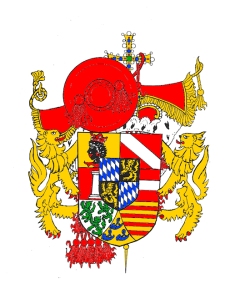
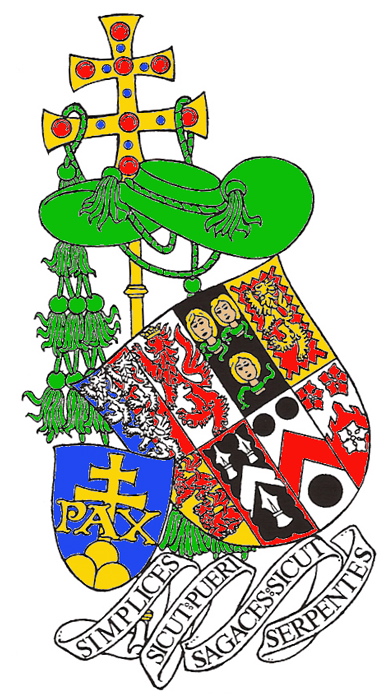
First we see the arms of Johann Theodor Cardinal Wittelsbach von Bayern, Cardinal Priest of S. Lorenzo in Panisperna. He was created cardinal “in pectore” in 1743 and proclaimed in 1746. He was also Prince-Bishop of Liège, Friesing & Regensburg. The arms are:

Quarterly of six; 1 (Friesing) Or a moor’s head Sable couped at the neck crowned and collared Gules, 2 (Regensburg) Gules a bend Argent, 3 to 6  (Liège) Gules a column Argent, Gules a fess Argent, Argent three lions rampant vert, Barry Or and Gules a point in point Or three hunting horns Azure; Overall on an escutcheon Bavaria (fussily in bend Argent and Azure) quartering Palatinate (Sable a lion rampant Or). The supporters are two lions Or.
sc01ad6190a

Next are the arms of Luis Antonio Jaime de Borbón y Farnesio, de Baviera y d’Este who was born the youngest son of King Philip V, King of Spain, and his second wife, Elizabeth Farnese. While barely eight years of age, Luis was created 699th Knight of the Order of the Golden Fleece in 1735 and ordained Archbishop of Toledo and Primate of Spain on 9 September 1735, and subsequently named Cardinal Deacon of the Title of the church of Santa Maria della Scala in Rome on 19 December. On 18 December 1754 he abandoned the ecclesiastical life for lack of vocation, renounced his ecclesiastical titles and dignities and assumed the title of 13th Conde de Chinchón granted by his brother Infante Felipe.

When his older half-brother King Ferdinand VI died without issue in 1759, Luis claimed the throne on the grounds that, he was the only surviving son of Philip V who was born in Spain, and the only one still residing in Spain (his older brothers were Charles, King of Naples and Sicily, and Philip, Duke of Parma, both reigning in Italy). However valid his claim, Luis lost the succession to his oldest brother Charles, while Charles’ third son became Ferdinand I of the Two Sicilies.

The arms are: Quarterly 1: (Castile) Gules a triple towered castle Or quartering (Leon) Argent a lion rampant Purpure; 2: (Argaon) Or five pallets Gules impaling (Sicily) Per saltire Aragon and Argent two eagles in fess displayed Sable; a point in point between the two quarters of (Granada) Argent a pomegranate Proper; 3: Per fess (Austria) Gules a fess Argent and (Burgundy  ancient) bendy Or and Azure, a border Gules; 4: Per fess (Burgundy modern) Azure, semeé de lis Or, a border compony Argent and Gules and (Brabant) Sable a lion rampant Or; two inescutcheon in pale the first (Bourbon) Azure three fleurs-de-lis Or, a bordure Gules; the second tierces in pale (Visconti) Argent a viper vorant Azure crowned Or and devouring a child Gules; (Flanders) Or a lion rampant Sable membered Gules, And (Tyrol) Argent, an eagle displayed Gules.
sc01ad84d4a

This cardinal, because of his failed claim to the throne, could also be numbered among the “royal” cardinals as well.

(artwork by the late Michael McCarthy)
More Royal Cardinals

Back in October of last year I posted about a Cardinal who was also the King of Portugal. He wasn’t alone in the College of Cardinals. In addition to numerous noblemen there have been other royal Cardinals as well. Below we see two more.

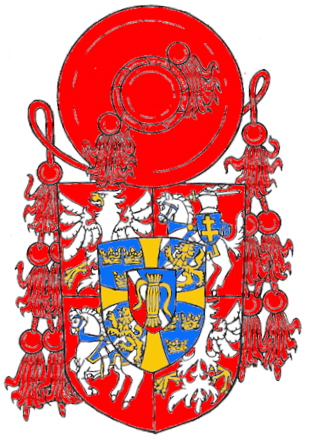
Casimir of Poland who was named a cardinal in 1646 but resigned from the College of Cardinals in 1648 to assume the throne as Jan II Casimir, King of Poland. His arms depict what was then the arms of Poland, namely:

Quarterly 1&4 Gules, an eagle displayed Argent membered and armed Or; 2&3 Gules a knight on horseback (Vytautas) Argent saddled Azure holding a shield Azure charged with a double-barred cross Or. Overall an escutcheon bearing Sweden: A cross patteé throughout Or between 1&4 Azure three crowns Or; 2&3 bendy sinister Argent an Azure overall a lion rampant Or; on an escutcheon in pretense per bend wise Azure, Argent, Gules all charged a Vasa Or.

sc01ad3a68a copy

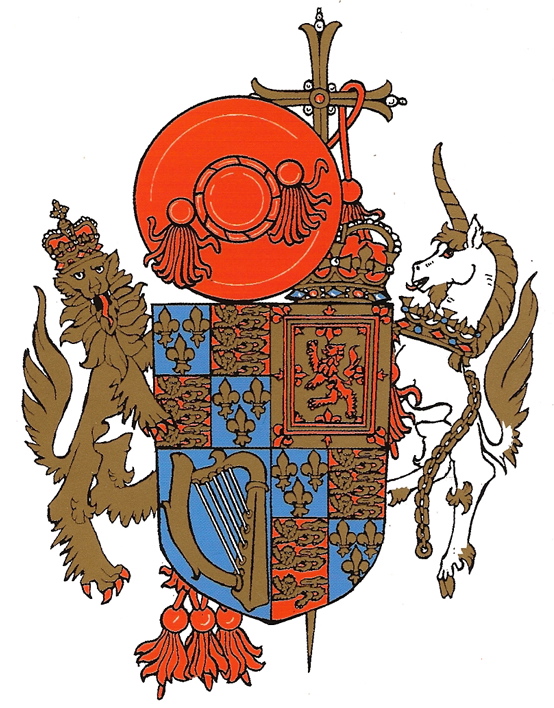
Next is the possibly familiar arms of Henry Cardinal Stuart, acknowledged by many to be the legitimate heir to the English crown as Henry IX. Henry Benedict Mary Clement Stuart was the Duke of York as well as the Cardinal Priest of S. Maria in Portico. He was later made Bishop of Frascati, Bishop of Ostia & Velletri in 1803. He died in 1807 never having taken his rightful place on the throne of Great Britain & Ireland. His arms were the royal arms of the Stuarts, namely:

Quarterly 1&4 Grand Quarters (England & France) 1&4 Azure three fleur-de-lis Or and 2&3 Gules three lions passant guardant Or; 2 (Scotland) Or a lion rampant Gules armed Azure within a double treasure flory counter flory Gules; 3 (Ireland) Azure a harp Or. The arms are supported by the lion of England and the unicorn of Scotland, royal supporters since the time of James I. The arms usually depicts the cadence mark of a silver crescent at the center but this was omitted after he assumed the title Henry IX as Pretender to the throne. This version also include the royal crown rather than a ducal coronet.

sc01ada403

(all artwork by the late Michael McCarthy)
The Nobility in The Clergy

Here we have two examples of the arms that became well known in Europe as being associated with territories or noble families being employed by members of the hierarchy, Cardinals to be exact, in their ecclesiastical achievements. The first is of Innio de Avalos de Aragon Cardinal Deacon of S. Lucia in Silice. He was Bishop of Sabina in 1586, Bishop of Frascati in 1589 and Bishop of Porto in 1591. The arms are:

Quarterly, 1&4 per pale Aragon, Hungary, Anjou (ancient) and Jerusalem; 2&3 Grand Quarterly 1&4 Azure, a triple towered castle Or, a bordure compony Argent & Gules; 2&3 Bendy Or and Gules quartering per fess Or and Gules a lion rampant Counterchanged.

sc0180689ca

The next one is the arms of Damian Hugo Philip von Schönborn, Cardinal Deacon of S. Nicolo in Carcere, Prince-Bishop of Speyer. The arms are:

Speyer (Quarterly 1&4 Azure a cross throughout Argent; 2&3 Gules a crozier in bend Or debruised by a two towered castle Or) overall on an escutcheon Gules on three piles issuant in base Argent a lion passant crowned Or (Schönborn) and below the shield on another shield Argent the cross of the Teutonic Order. Supporters: Two lions affronteé crowned Or, armed and langued Gules each supporting a banner, to dexter of the Empire and to sinister of Austria

sc0180c614a

(artwork for both is by the late Michael McCarthy)
Something Old (For A Change)

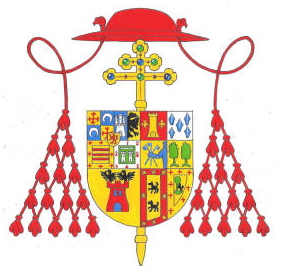
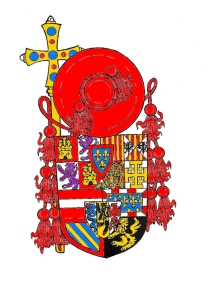
Lately I’ve been posting and commenting on the coats of arms newly assumed by bishops but I thought it would be nice to look back to an older coat of arms. I looked back to the XIX Century to Spain. Spanish bishops often have complex coats of arms because they come from armigerous families whose coats of arms are composed of several coats marshaled together on one shield. This one is no exception. The coat of arms of Juan de la Cruz Ignacio Cardinal Moreno y Maisonave, Archbishop of Toldeo (1875-1884) who was created Cardinal in 1868 while archbishop of Valladolid. He had also been bishop of Oviedo before that.

Here is a typical example of a complicated shield composed of several different coats of arms marshaled together. It may seem busy but it is also a feast for the eye!

MORENO Y MAISONAVE GIOVANNI DELLA CROCE IGNAZIO 1884

Cardinal Woelki of Cologne

Wappen_Erzbischof_Koxln_Woelki

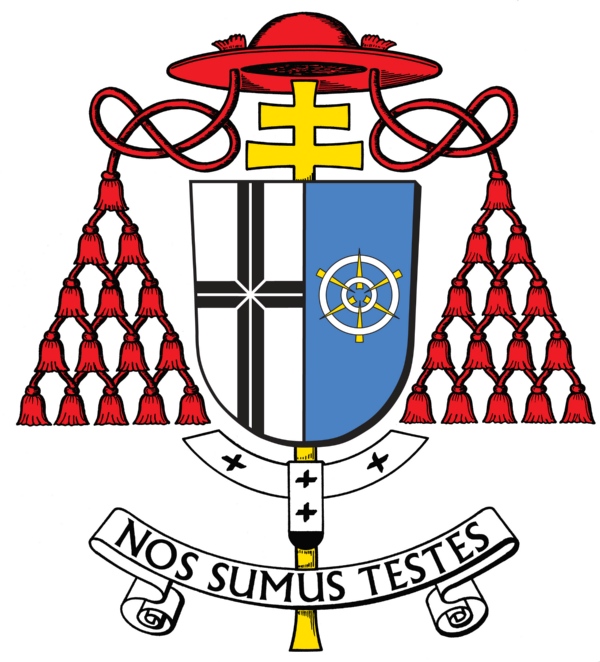
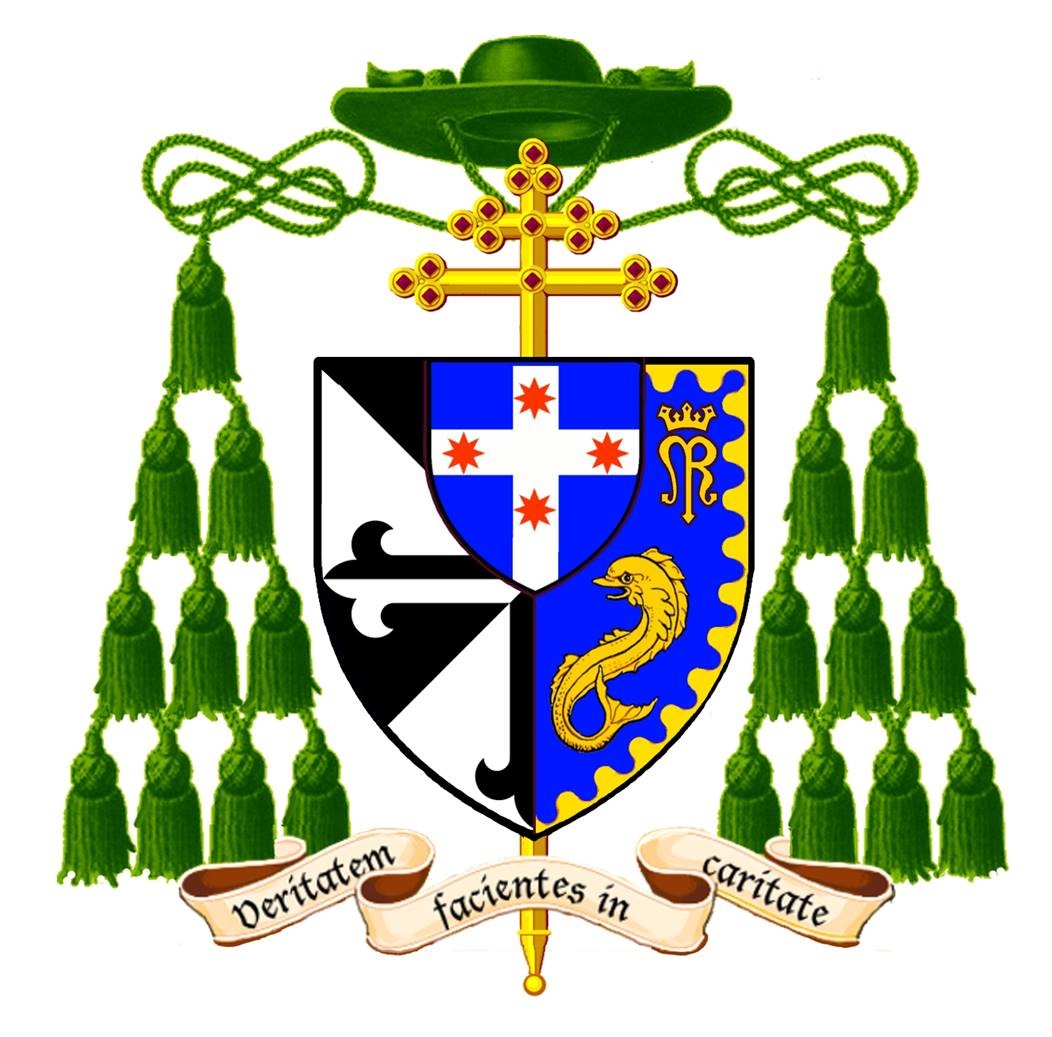
On September 20 Rainer Maria Cardinal Woelki of Berlin will be installed as the 32nd Archbishop of Cologne, Germany. The very simple arms of the see (Argent a cross throughout Sable) are impaled with the cardinal’s equally simple personal arms.

A blue field with a silver wheel with 6 golden wedges as spokes alternately directed outward or inward. This is the so-called Radbild of Brother Klaus, Niklaus von Flue (1417-1487), which refers to the cardinal’s home parish of St. Bruder Klaus in the Bruder Klaus settlement in Cologne-Mülheim. This circular pattern with the aufzufassenden as golden wedges combines theological, philosophical and mathematical elements. Three rays emanate from the center, just as God does not want to remain in Himself but in turn loves man . Three beams have the opposite disposition and lead to God, the response of those desires which are filled with His love.

The motto, from Acts 5:32, translates as, “We are Witnesses”.

Cardinal Clancy RIP

cardinal_clancy_lge

Edward Bede Cardinal Clancy, Archbishop-Emeritus of Sydney, Australia and Cardinal-Priest of Santa Maria in Valicella (aka the Chiesa Nuova) has passed away. He was born December 13, 1923 and died on August 3, 2014. Requiescat in Pace.

1148px-Coat_of_arms_of_Edward_Bede_Clancy.svg

Royal Cardinal

Image

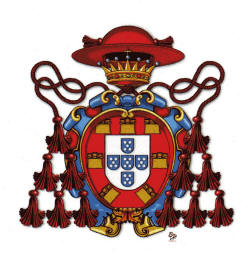
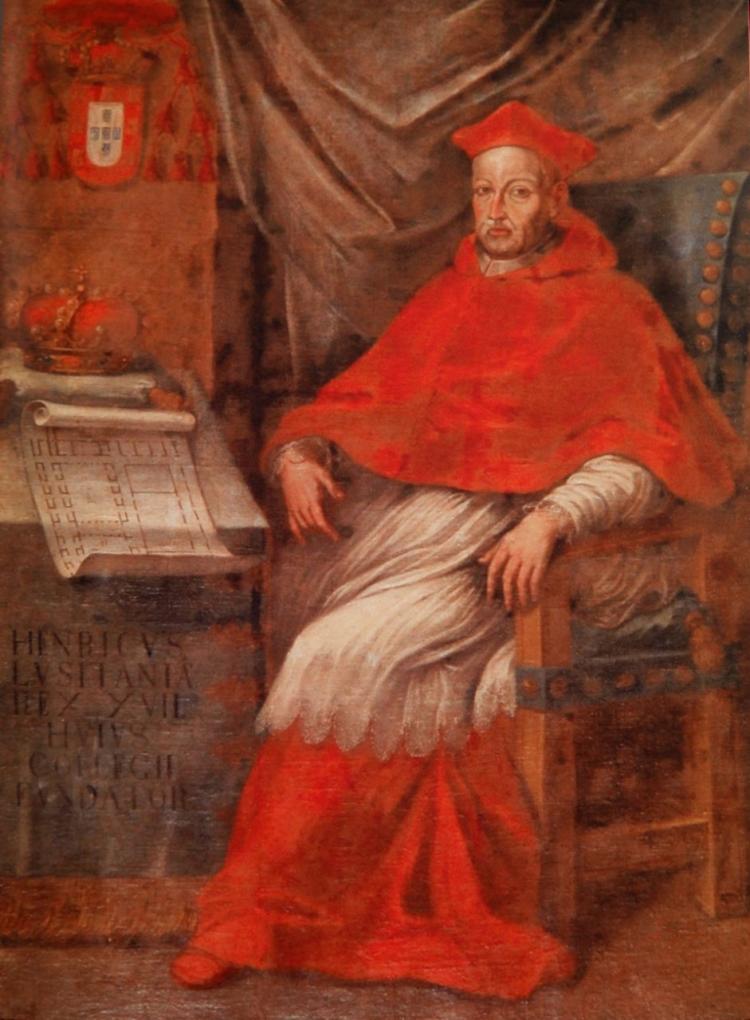
Henry (or Henrique) born on January 31, 1512 and died on January 31, 1580 reigned as King of Portugal and the Algarves and at the same time was a Cardinal of the Church. He ruled in Portugal between 1578 and 1580 and was known, for obvious reasons,  as “Henry the Chaste”.

Henry was the fifth son of King Manuel I of Portugal and Maria of Aragon and the younger brother of King John III. He was not expected to succeed to the Portuguese throne since he was a younger son. Ordained as a priest in order to promote Portuguese interests within the Church then dominated by the Spanish he, not surprisingly as the son of a king, rose fast through the hierarchy, becoming in quick succession Archbishop Braga, then Archbishop of Évora and eventually of Lisbon before receiving the red hat in 1545, along with the Titular Roman church of Quattro Coronati.

Henry served as regent for his grandnephew, Sebastian, after 1557, and then succeeded him as king after Sebastian was killed at the Battle of Alcázarquibir. Henry renounced his clerical offices on his own volition and sought to marry for the continuation of the House of Avis, but Pope Gregory XIII, closely tied to the Habsburgs who controlled Spain, did not release him from his vows. The Cardinal-King died in Almeirim without having appointed a Council of Regency to choose a successor.  Philip II of Spain who had a strong dynastic claim was elected King of Portugal at the Portuguese Cortes of Tomar in 1581.

For his arms he bore the royal arms of Portugal ensigned with a crown and a cardinal’s hat. (NOTE: the number of tassels was not fixed at 30 until the late 19th Century and prior to that cardinals often employed varying numbers of tassels on their galeri)

Image

Canting Arms

Image

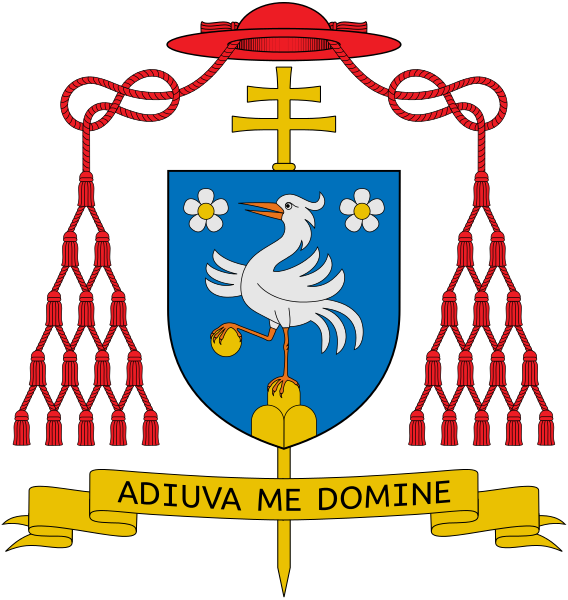
There is a tradition in heraldry of so-called “canting arms” or armes parlantes where the design of the coat of arms literally depicts the meaning of the name of the armiger and, so, ‘says” his name. One that I came across recently which illustrates this well is the coat of arms of Cardinal Vegliò who was created cardinal by Pope Benedict XVI in 2012. The main charge on the shield is a crane standing with one foot off the ground and holding a stone. This is usually referred to as a crane “in its vigilance”. This comes from Pliny the Elder wrote that cranes would appoint one of their number to stand guard while they slept. The sentry would hold a stone in its claw, so that if it fell asleep it would drop the stone and waken. The cardinal’s name means “watchful”.

Saint John Cardinal Fisher (Feast day: June 22)

Image

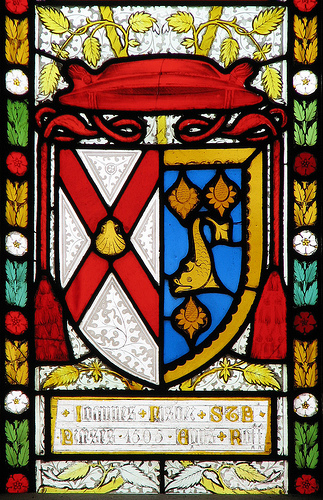
Saturday, June 22 is the Feast day of St. John Fisher (along with his fellow martyr to conscience, St. Thomas More) who was brutally murdered by the heretic-adulterer, Henry VIII for defending the Catholic faith. He was the Bishop of Rochester in southern England and was created a cardinal while under harsh imprisonment by his cruel tyrant of a king.

One of the Best…Ever

Image

The coat of arms of His Eminence, Francis Cardinal Spellman, Archbishop of New York from 1939-1967. The blazon is: Arms impaled; in the dexter Argent on a saltire Gules between four  Greek crosses Gules the sails of a windmill in saltire Argent (New York Archdiocese). In sinister Sable, on a fess Argent four ermine spots Sable; overall a bend Or goutee de sang; a chief of the Religion (Spellman).

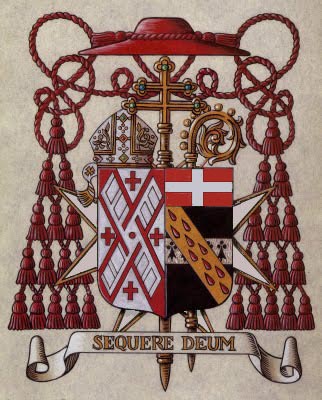
The arms of the archdiocese employ a red X-shaped cross of St. Patrick, the patron of the archdiocese. On this is superimposed the sails of a windmill to recall the Dutch who first settled the city of New Amsterdam, later called New York. The four red crosses represent the four Gospels. Spellman’s own arms were not the first that he adopted when he was made a bishop. His original coat of arms depicted the Santa Maria, flagship of Christopher Columbus, under full sail. He used these when he was Auxiliary Bishop of Boston. After he was translated to New York Spellman adopted the arms we see here. Unfortunately, I do not know the meaning behind the ermine spots or the gold bend. I know the drops of blood were an allusion to the Precious Blood of Christ. As a Bailiff of the Order of Malta he includes both the chief of that order (Gules a cross throughout Argent) and places the shield on the cross of the order.

The external ornaments include the galero and the mitre as well as the archiepiscopal cross and the crozier. These arms were designed long before the 1969 Instruction of Pope Paul VI forbidding the use of mitre and crozier in the arms of bishops, archbishops and cardinals.

I have always like this particular coat of arms. It is an exmaple of good heraldry which is a rare find among the coats of arms of American prelates…of any era!

How Many Tassels Does a Cardinal Get?

ximenesarms

The external ornament used in heraldry that distinguishes the coat of arms of a Churchman from those of a layman more than any other is the galero. This broad-brimmed and low-crowned hat was originally a pilgrim’s hat and worn primarily when traveling in a cavalcade to shade one’s head from the sun. In heraldry it was seen as a fitting substitute for helm, mantling and crest which were considered too martial for non-combattants like clergy.

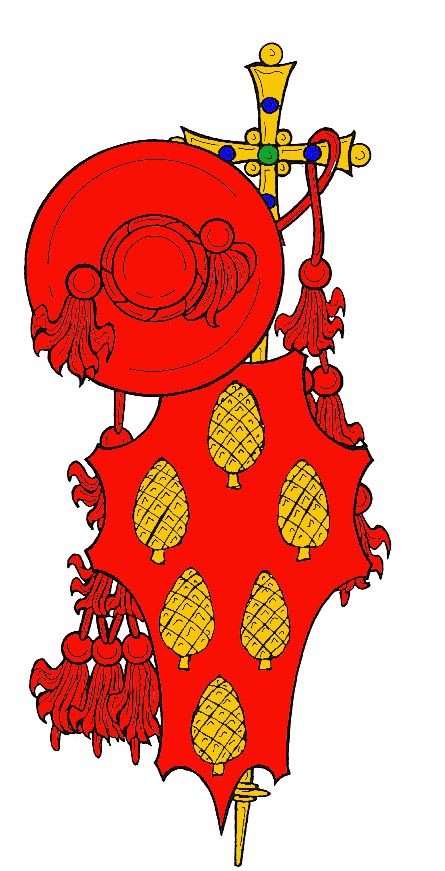
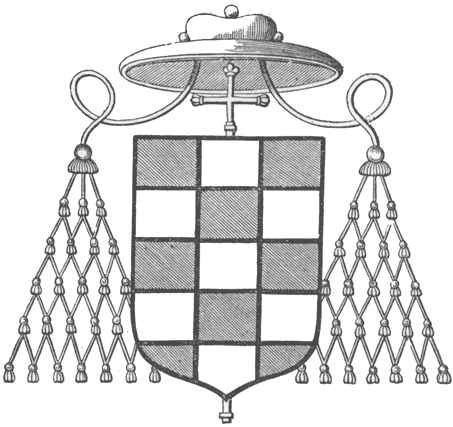
A hat originally used only in Roman heraldry and not really catching on in the rest of Europe eventually the galero came to replace the mitre in the arms of prelates since the former was seen as the more “Roman” option. The galero was first bestowed on the Cardinals of the Roman Church by Pope Innocent IV at the First Council of Lyon in 1245. It was the first hat to be distinguished by the use of a specific color (scarlet) and it was also to be adorned with tassels. However, originally the number of tassels was not fixed. There are various examples of cardinals’ coats of arms that show as few as two tassels suspended from the galero (see the arms of St. John Fisher in color below) and as many as seventy-two! (the arms in black and white above are those of Cardinal Ximenes) What marked these coats of arms as those belonging to cardinals was that the galero, cords and tassels were red and nothing else. No one else could use such a red hat except a cardinal regardless of how many tassels were suspended from it.

Image

The number eventually was fixed at thirty (usually depicted as fifteen suspended on either side of the shield in a pyramidal pattern) only in 1832. A system for distinguishing the ranks of other clergy based on the color of the hat, of the cords and the number of the tassels did not come into existence until the Instruction of Pope St. Pius X “Inter Multiplices” in 1905.

So, all these different colored hats, cords and tassels are really a relatively recent innovation in Catholic heraldry.