Category Archives: Cardinals

O’Brien: Grand Master Emeritus (UPDATED)

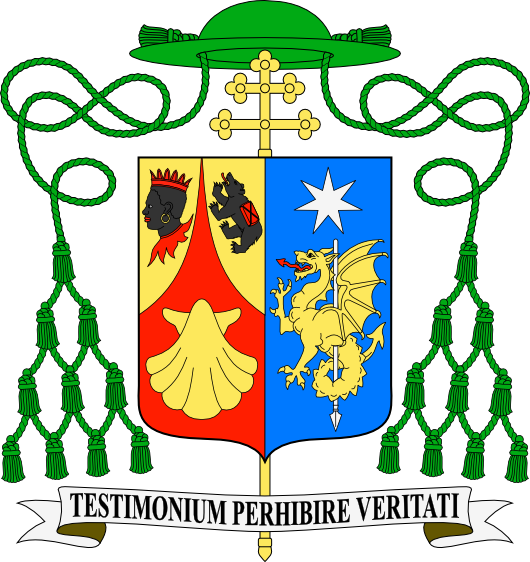
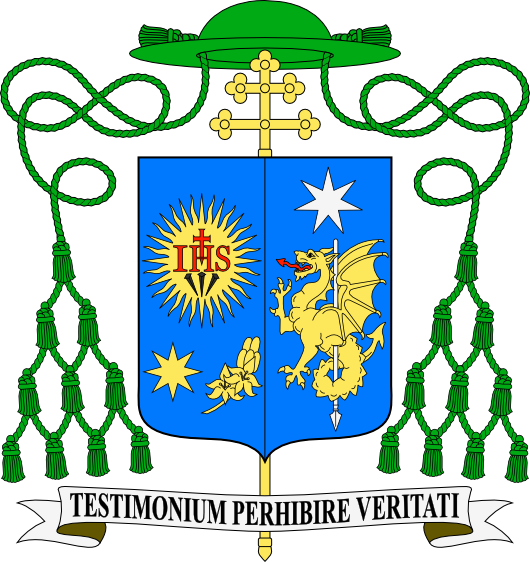
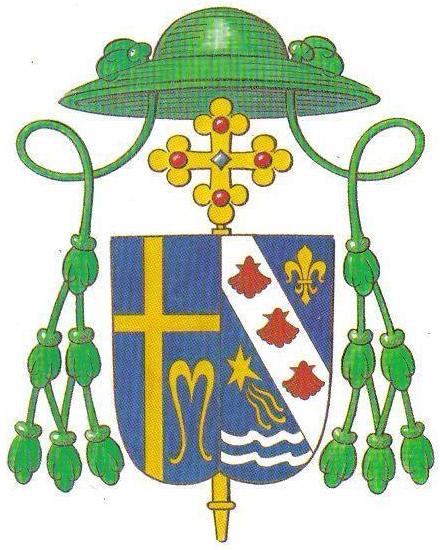
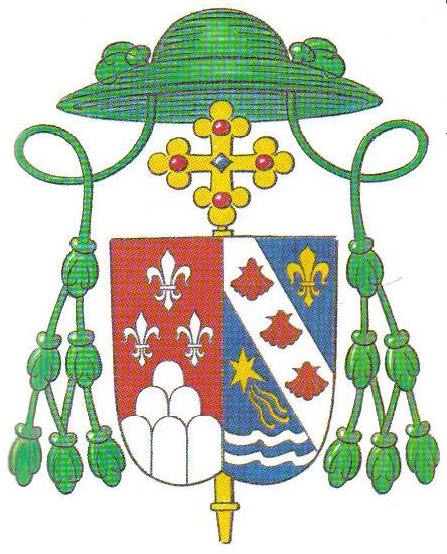
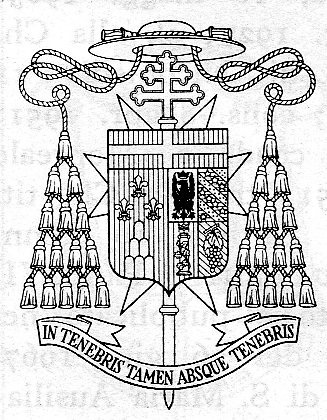
On December 8, 2019 His Holiness Pope Francis appointed Fernando Cardinal Filoni as the VIII Grand Master of the Equestrian Order of the Holy Sepulchre of Jerusalem. With that his predecessor, Edwin Cardinal O’Brien became Grand Master Emeritus of the Order.

Heraldic use in the EOHS is somewhat unclear. There are various sources all claiming to be definitive accounts of the heraldic privileges of the Order but, in fact, since most only exist online none can truly be said to be definitive.

Since 1949 when Cardinals of the Holy Roman Church have been appointed by the Pope as Grand Masters they have observed the heraldic convention, like other orders, of marshaling their personal arms to those of the Order by means of quartering them. No one has disputed their right to do so or that this has been the usual manner. There remains a question, however, of whether or not to marshal the armorial bearings of Grand Masters Emeriti in the same way, or, as the usual heraldic custom would suggest, to have them revert to using their personal arms alone.

Cardinal O’Brien’s coat of arms is of particular interest in this question because of his unfortunate and erroneous habit of retaining armorial elements from his previous postings in his coat of arms each time he has been assigned to undertake a new position. So, the arms he assumed when first ordained Auxiliary Bishop of New York have long ago been abandoned. After he concluded his tenure as Archbishop of of the Military Archdiocese, USA he kept the open globe from the archdiocesan achievement of the US Military and incorporated it as a base into his personal arms when he moved to Baltimore. In an even worse move, when he left Baltimore as its archbishop to go to Rome as Pro-Grand Master and later Grand Master of the EOHS he kept his coat of arms entirely as they had been in Baltimore, impaled with the arms of the See of Baltimore, for which he had absolutely no right whatsoever as he was no longer the Ordinary of that archdiocese. It is important to remember that the custom of bishops impaling their personal arms with those of their See does not mean that the arms of the jurisdiction becomes a part of their own coat of arms. Rather, it is a means of marshaling, that is to say, depicting two separate coats of arms on the same shield to illustrate a relationship between the two, in the case of bishops to indicate that they are “married” to their diocese and exercise jurisdiction over it. If they should leave that diocese they no longer enjoy that right.
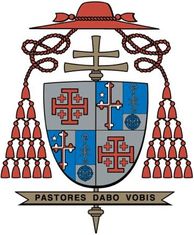
So, we see that the arms of the See of Baltimore never should have been included in Cardinal O’Brien’s arms as Grand Master of the EOHS. In the case of the globe from the arms of the US Military Archdiocese at least it can be said that rather than marshaling his arms to those of the Military Archdiocese what O’Brien did was to borrow a charge and incorporate it into his own personal arms which is arguably a better practice and, thus, acceptable.

There are probably those who assume it is acceptable for the cardinal simply to continue using the same achievement he used as Grand Master. They would be wrong. No one in an emeritus position is entitled to heraldically represent jurisdiction they no longer exercise. I have seen some sources that would claim a Grand Master Emeritus, indeed any cleric, may quarter his personal arms with those of the Order. I believe this is false. The convention has always been that quartering the personal arms with those of the Order is the prerogative of the Grand Master alone. I have seen no definitive official source that allows for any cleric to quarter their arms with the arms of the Order.

Accordingly, and logically, the only other recourse would be for Cardinal O’Brien to bear his personal arms alone like other members of the College of Cardinals who have retired; to exclude the arms of the See of Baltimore over which he ceased to have any jurisdiction long ago; to retain the globe from the arms of the See of the US Military as it is now a charge incorporated into his personal arms; to indicate his continued membership in the EOHS by means of placing the cross of the Order (the Jerusalem cross) behind the shield. This, unfortunately, leaves him with a rather unfortunate personal armorial achievement. (below)
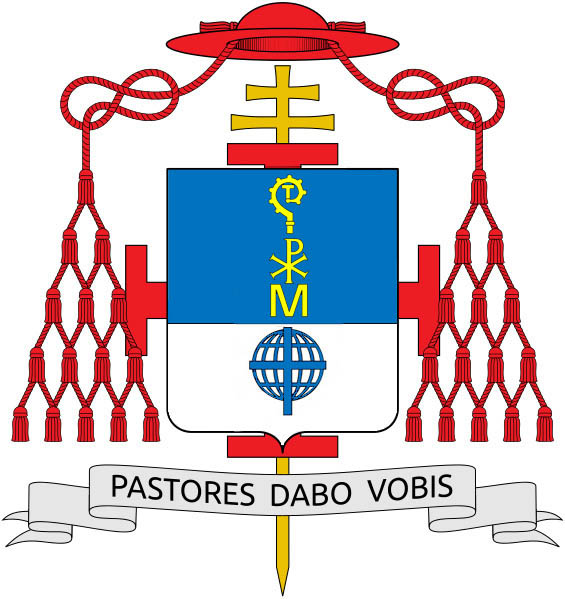
There is a good argument to be made for one other possibility. Certain officials of the Order and members of a particular rank within the Order, namely Knights & Dames of the Collar; Lieutenants; Members of the Grand Magistry and Grand Priors, impale their arms with the arms of the Order. It can be argued that the Grand Master Emeritus is both a Knight of the Collar and, honorarily at least, still considered a Member of the Grand Magistry. By that logic a Grand Master Emeritus might impale his personal arms with those of the Order rather than quarter them and this would leave Cardinal O’Brien with an achievement that looks a bit less empty. (below)
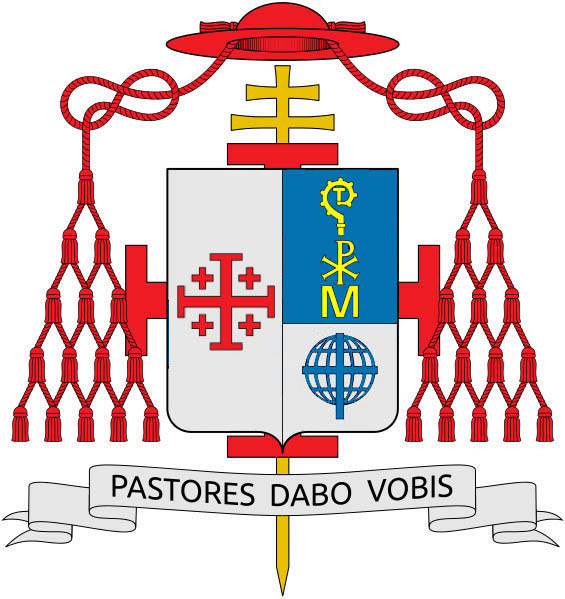
Grand Master of the Equestrian Order of the Holy Sepulchre

Pope Francis has appointed 73 year-old Cardinal Fernando Filoni, Prefect of Propaganda Fide from 2011 to the present, who now becomes Prefect Emeritus of the same Dicastery, as the new Grand Master of the Equestrian Order of the Holy Sepulchre. Cardinal Filoni was a priest of the Diocese of Nardó, Italy and was ordained in 1970. In 2001 he was ordained a titular archbishop by St. John Paul II and was Apostolic Nuncio to Iraq from 2001 to 2006 and lived in Baghdad during the war of 2003. For a year, he was the Pope’s ambassador to the Philippines before being called to the Secretariat of State as Substitute, a post he held until 2011. In 2012 he was created a Cardinal by Pope Benedict XVI.

His experience in the Middle East will be valuable in his new role, as the Order of the Holy Sepulchre cooperates particularly with the Middle Eastern Christian communities and supports them with many projects.

In a statement, Cardinal O’Brien expressed his great appreciation for the Pope’s decision, and said he is particularly happy that Cardinal Filoni has been chosen as his successor: “His long and extensive partoral and administrative service in our Universal Church”, Cardinal O’Brien said, “will be precious in guiding the Order on its future path”. 

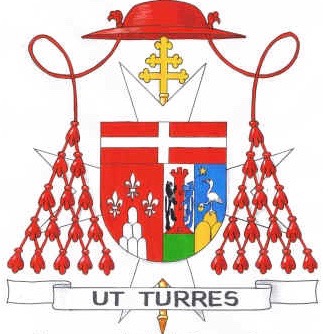
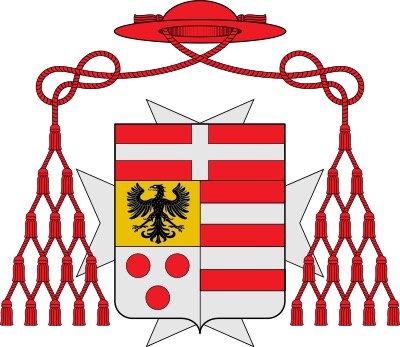
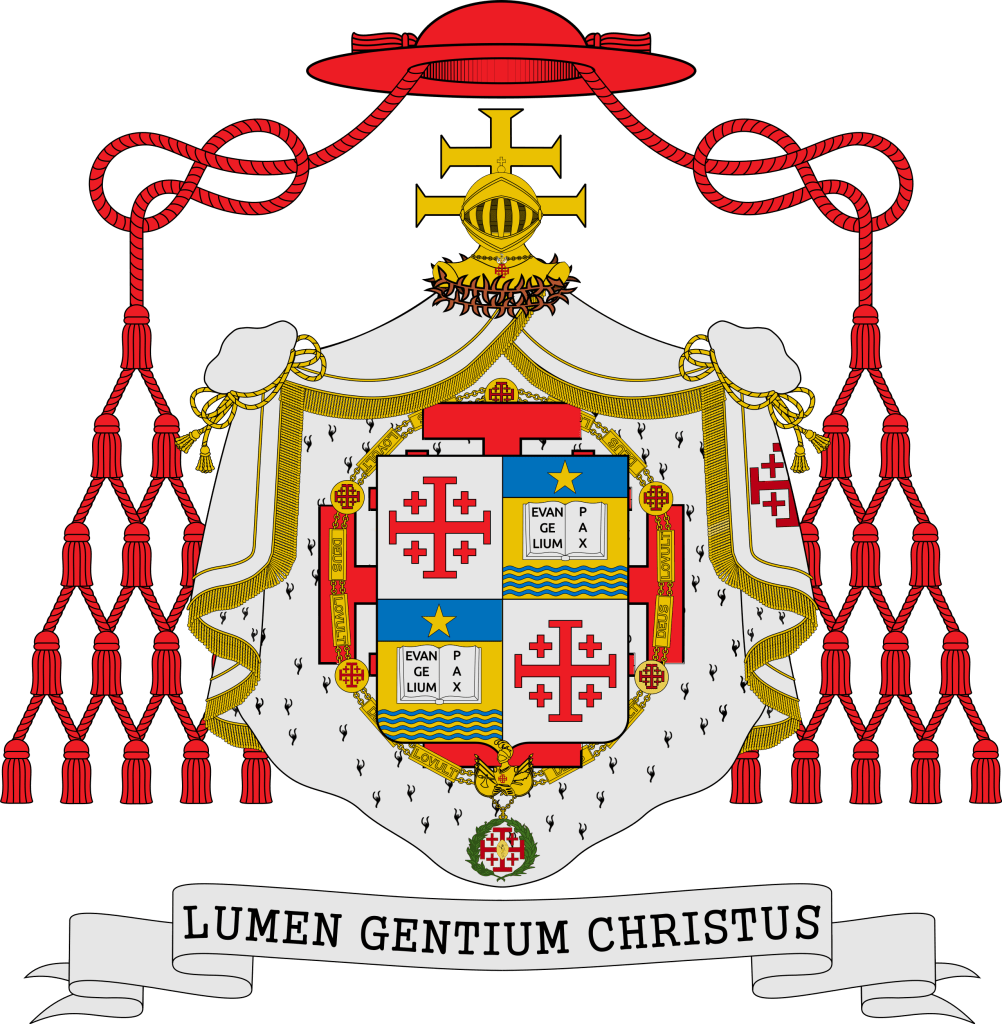
The custom of the EOHSJ is that the Grand Master quarters his personal arms with the Jerusalem cross of the Order, red on a silver field, which is used as the armorial bearings of the Order itself. The shield is surrounded by the Grand master’s collar and placed on the cross of the Order. The white mantle of the Order also ensigns the shield and the patriarchal cross of an archbishop is included as well as the cardinal’s galero. In addition, the usually secular helm is also included sitting not on a torse but on a crown of thorns recalling the Passion of the Lord.

Cardinal Filoni’s arms are those he assumed when he was promoted to titular archbishop in 2001. The are much simpler and also a marked improvement over the personal arms of his immediate predecessor whose achievement was horribly ill-advised and included elements from offices he had formerly held including the entire coat of arms of the Archdiocese of Baltimore …which he no longer held! Cardinal Grand master Filoni’s arms make a welcome change.

Norbertine Cardinals

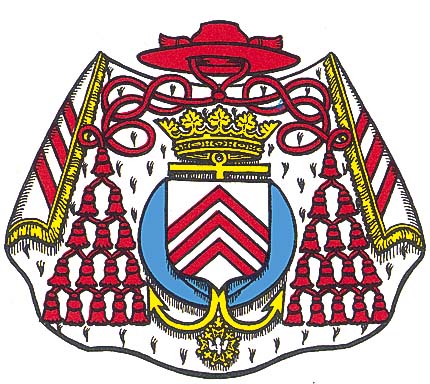
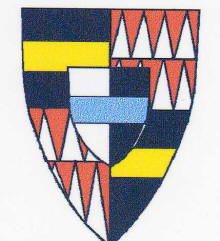
There have been fewer cardinals in the Church from the Order of Canons Regular of Prémontré (aka Norbertines) than there have been of other orders and, as far as I can tell, two of those known to be associated with that Order were Abbots in Commendam only. The Premonstratensian Cardinals are:
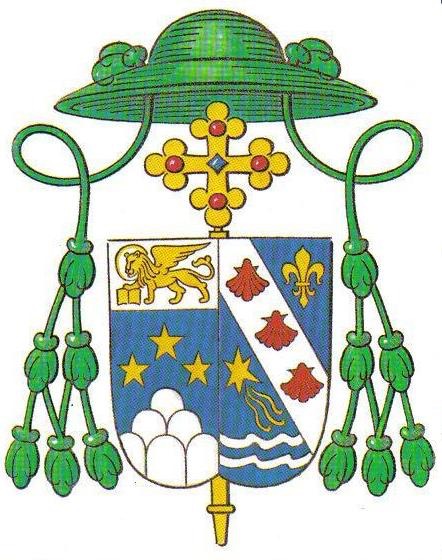
riche

Armand Jean du Plessis, Duke de Richelieu, Bishop of Luçon, Commendatory Abbot of Prémontré, (also Territorial Abbot of Cluny and Abbot in Commendam of Citeaux)

mc BUCCA GIOVANNI 437

Johannes von Bucka, O.Praem. Archbishop of Olomouc

este2

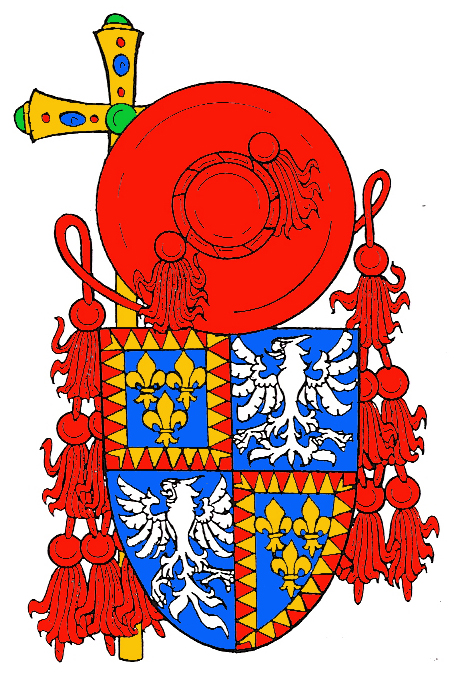
Ippolito II d’Este, Archbishop of Auch, Archbishop of Arles, Commendatory Abbot of Prémontré

Benedictine Cardinals

Throughout the Church’s history there have been many members of the hierarchy who were members of Religious Communities. The present pope is a member of the Society of Jesus (Jesuits) and the first from that Order elected to the papacy. One of the oldest Orders in the Western Church is the Order of St. Benedict. Many monks have been made bishops and quite a few have been raised to the Sacred Purple as Cardinals. The following is by no means exhaustive but gives a sampling of some of the Benedictine Cardinals in recent history. (My gratitude to the fine website called Araldica Vaticana for many of these examples.

Enjoy!

Chiaramonti CORRECTION Chiaramonti Pius VII0001

Gregory Cardinal Chiaramonte, OSB (later Pope Pius VII)

pitra_stemma2a

Jean Cardinal Pitra, OSB

Maria Nova card Schiaffino stemma

Placido Cardinal Schiaffino, OSB Oliv

Ganglbauer manteled0001

Celestine Cardinal Ganglbauer, OSB (Archbishop of Vienna)

SEP28 Gasquet

Aidan Cardinal Gasquet, OSB (Vatican Archivist)

DUSMET GIUSEPPE BENEDETTO

Bl. Giuseppe Cardinal Dusmet, OSB (Archbishop of Catania)

COA_cardinal_HU_Vaszary_Ferenc_Kolos2

Kolos Cardinal Vaszary, OSB (Primate of Hungary)

2015 Saraiva 07051845

Francisco de S. Luiz Cardinal Soraiva, OSB (Patriarch of Lisbon)

NOTE: Cardinal Soraiva also had a version of his arms with a galero but also used the triple tiara as was customary for the Patriarchs of Lisbon until very recently.

SERAFINI DOMENICO 05031918

Domenico Cardinal Serafini, OSB

Schuster design0001CCC

Ildephonse Cardinal Schuster, OSB (Abbot of St. Paul Outside-the-Walls and later Archbishop of Milan)

BB-05 SEREDI0001

Justinian Cardinal Seredi, OSB (Primate of Hungary)

Coat_of_arms_of_Joaquín_Anselmo_María_Albareda_y_Ramoneda.svg

Joachim Cardinal Albareda y Ramoneda, OSB (Vatican Librarian)

51CS) Stemma Card. Gut Benno Walter (1897-1970)

Benno Cardinal Gut, OSB

Image 3

Basil Cardinal Hume, OSB (Archbishop of Westminster)

archbishop-hans-hermann-cardinal-groer-of-vienna-1986-1995

Hans Herman Cardinal Groer, OSB (Archbishop of Vienna)

88155b

Paul Augustine Cardinal Mayer, OSB

Archbishop McCarrick

Here is a heraldic oddity. It involves the reduction in rank or demotion of a prelate. Now that Theodore McCarrick has resigned from the College of Cardinals he will no longer enjoy the privileges associated with it. For the time being he retains a coat of arms, although, I suppose that remains to be seen as well, and it bears the personal arms he assumed when he first became a bishop as Auxiliary Bishop of NY. He retains the double-barred cross and galero with 20 tassels of an archbishop because he is the Archbishop-emeritus of Washington, DC. The arms of theSee of Washington are not impaled with his personal arms because he is no longer the incumbent of that See. Having laid aside the dignity of a Cardinal he reverts to being Archbishop McCarrick.


TMAC3

Almost Identical

Sometimes, especially in the world of ecclesiastical heraldry, prelates aren’t always so creative and frequently they adopt arms that are very similar to each other’s. On occasion this may indicate a kind of patronage of one prelate over another. For example, St. John XXIII’s longtime secretary, Loris Capovilla, was later made an Archbishop and eventually a Cardinal. At the time of his episcopal ordination he adopted John XXIII’s coat of arms entirely with one tiny exception; he removed one of the fleur-de-lis in order to “difference” his arms from his patron.

Differencing is an old custom in heraldry and often misunderstood. Two different coats of arms might seem identical at first glance. Yet, as long as one element is changed, or “differenced” it makes for a sufficient differentiation between the two in order to avoid two armigers bearing identical coats of arms. Sometimes this could be the changing of a particular charge, the addition of a label or a mark of cadence or even simply changing the tinctures.

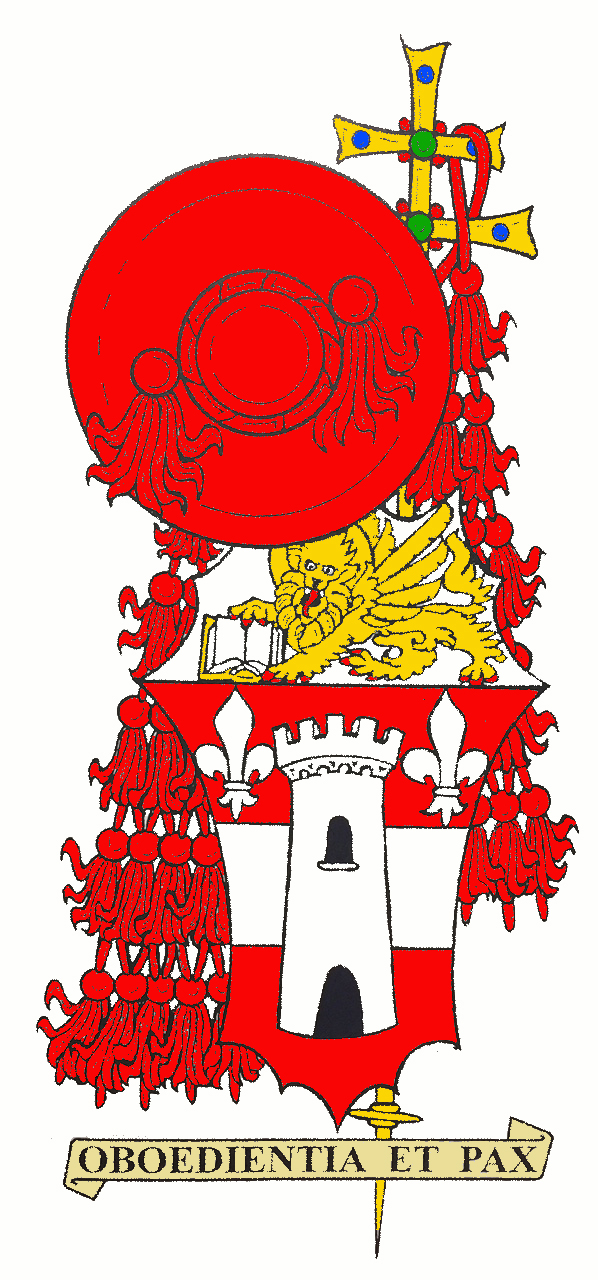
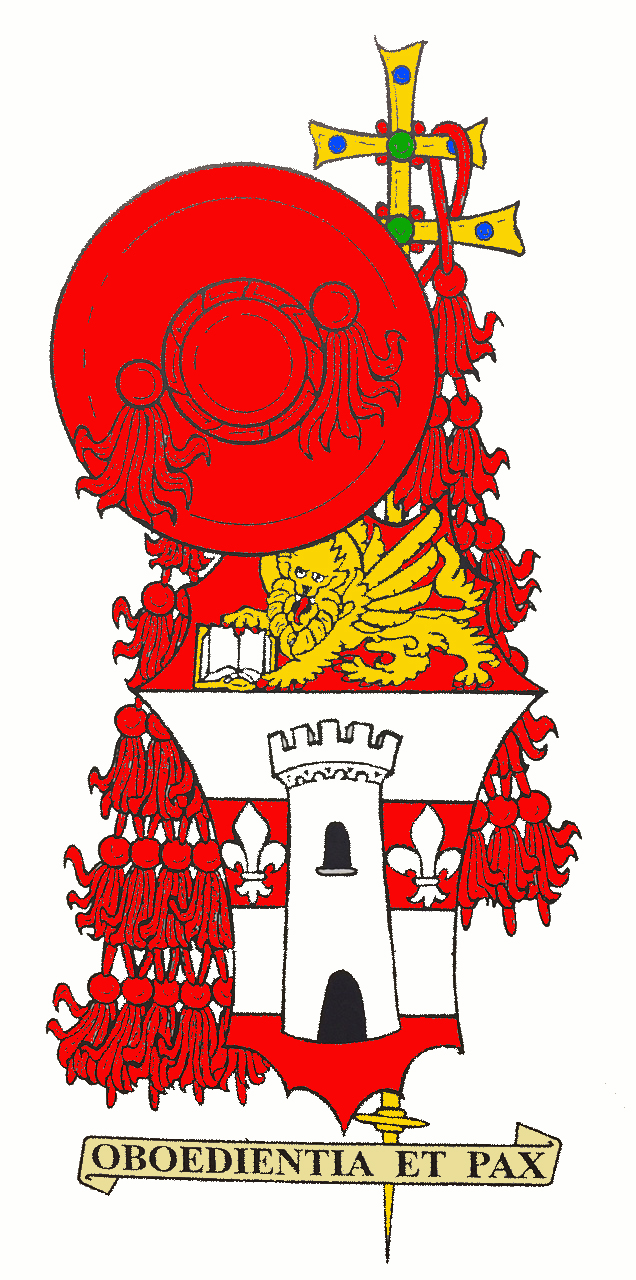
Here we see an interesting pair. Both Angelo Giuseppe Roncalli, Patriarch of Venice (later Pope St. John XXIII) and Carlos Maria Della Torre, Archbishop of Quito & Primate of Ecuador were created Cardinals by Pope Pius XII in 1953. The arms they each bore were almost identical showing a tower flanked by two fleur-de-lis on a red and white field.

J23  Torre

However, Roncalli’s arms showed a field “Gules, a fess Argent” and Della Torre’s showed a field, “Barry of four Argent and Gules”. These arms allude to his name, “Of the Tower”. In addition, Roncalli added the chief of Venice (depicting the gold lion of St. Mark on a silver (white) field) at the time he was promoted to Patriarch there as is usually the custom for the incumbents in that position. That provided a great visual difference between their arms. However, after Roncalli’s election as Pope in 1958 Della Torre once again made their arms very similar by adopting a chief with the gold lion of St. Mark on a red field; differenced from the Pope’s but only slightly. I suppose given the relative similarity of their coats of arms in the first place he wished to honor his “classmate” as a Cardinal who was also now his Pope.

What is more it is interesting to note that both men bore the same motto despite there being no particular relationship between the two.

These arms seem almost identical, but note quite.

Artwork: The late Michael McCarthy

Cardinal Law R.I.P.

Bernard Francis Cardinal Law (1931-2017), Cardinal Priest of Santa Susanna, former Archpriest of St. Mary Major (2004-2011), former Archbishop of Boston (1984-2002), former Bishop of Springfield-Cape Girardeau (1973-1984) has died in Rome where he went to live two years after resigning his post in Boston.

His coat of arms as Archbishop of Boston (above)

Cardinal Montezemolo R.I.P.

Andrea Cardinal Cordero Lanza di Montezemolo has died. He was a great diplomat for the Holy See and contributed much to the field of heraldry. But, with respect, I disagreed entirely with his ideas about papal heraldry. His encouragement of Pope Benedict to discontinue the use of the triregno heraldically was a mistake. Still, the large part of his service to the Church was outside the field of heraldry and he served the Lord and the Church well. Requiescat in Pace.

Cardinal Murphy-O’Connor: RIP

His Eminence, Cormac Cardinal Murphy-O’Connor, 10th Archbishop of Westminster died today in the UK after a battle with cancer. He was 85.

Brasão_Card._Murphy_O'Connor

He became the 10th Archbishop of Westminster in March 2000 and “de facto” the leader of the Roman Catholic Church in England and Wales. Cardinal Murphy-O’Connor retired from the role in 2009 and was the first archbishop to do so. Born on 24 August 1932 in Reading, Berkshire, Cardinal Murphy-O’Connor was one of six children. Two of his brothers became priests while another played rugby for Ireland. He was ordained priest in Rome in October 1956 and was made Cardinal-Priest in the title of Santa Maria Sopra Minerva in 2001 by Pope John Paul II.

His coat of arms (above) was originally designed by the late Bruno Heim when Murphy-O’Connor was named Bishop of Arundel & Brighton in 1977. Later they were impaled with a modified version of the arms of the See of Westminster as recorded at HM College of Arms in London.

May he rest in peace.

Cardinal Tobin of Newark

On Friday, January 6, 2017 His Eminence, Joseph Cardinal Tobin,  CSsR the Cardinal Priest of Santa Maria delle Grazie a Via Trionfale and former metropolitan archbishop of Indianapolis, age 64, will be installed as the tenth bishop and sixth metropolitan archbishop of Newark, New Jersey.

A Redemptorist by Religious Profession he makes the same, long-standing error of including the arms of his Religious Order in his personal arms implying jurisdiction over it. At one time he did actually serve as General Superior of his Order and could have arguably impaled a personal coat of arms with the Order’s arms. However, he did not become a bishop, and assume a coat of arms, until after his tenure as General. As I say, it is a common error for Religious prelates but it is, nevertheless, most definitely an error.

tobin

John Cardinal Ribat, MSC, KBE

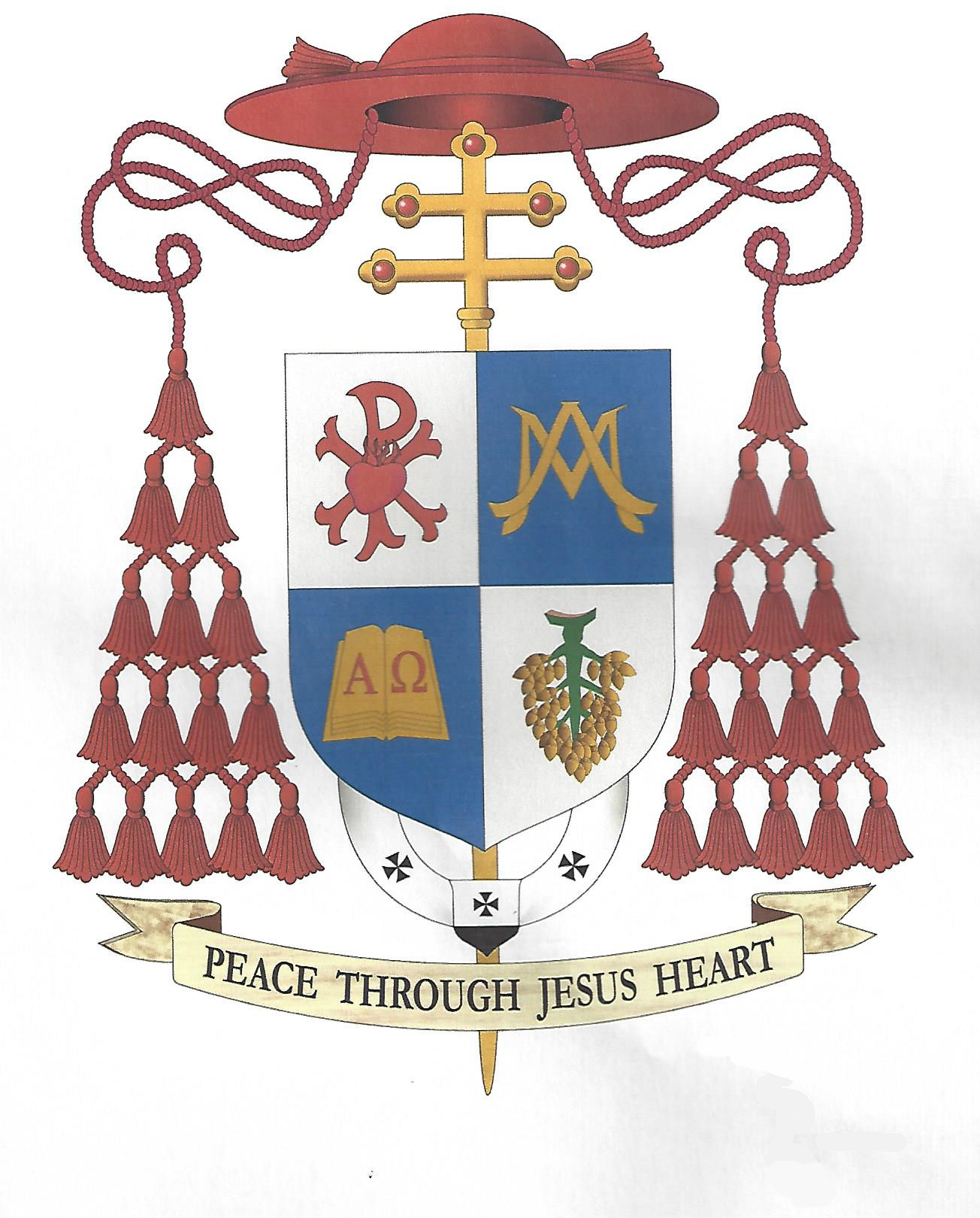
(Sir) John Ribat, MSC, KBE currently the Archbishop of Port Moresby, Papua New Guinea, will be elevated to the Sacred Purple and created Cardinal of the Holy Roman Church on November 19, 2016. We’re not concerned with his coat of arms as they would have appeared upon his ordination to the episcopacy as Auxiliary Bishop of Bereina, PNG in 2001. Rather, since 2008 when he succeeded as Archbishop of Port Moresby he has born the arms:

Quartered; 1) Argent, the Sacred Heart of Jesus enflamed superimposed on the Greek letters Chi and Rho all Gules, 2) Azure, the monogram of Our Lady Or, 3) Azure an open book Or the pages charged with the Greek letters Alpha and Omega Gules, 4) Argent, a branch of betel nut Proper.

0

These arms had been rendered for him by Renato Poletti, a Roman lawyer who, like many amateur heraldic enthusiasts, dabbles in heraldic design and produces his artwork on computer. He took it upon himself, unsolicited, to produce a new rendering of the Cardinal-designate’s coat of arms with the external ornaments of a Cardinal (above). However, Archbishop Ribat had already been contacted by Mr. Richard d’Apice of the Australian Heraldry Society to discuss a re-working of the emblazonment of his arms to reflect his new honor. Such projects have frequently been undertaken by Mr. d’Apice before as well as the designs of new coats of arms for many prelates and laypeople in his own Australia. Mr. d’Apice, as he often does, consulted with me to seek some advice and input.

While I do not particularly like the design of the arms I advised that it would be best at this point for a man who has been a bishop for fifteen years and an archbishop for eight to retain the arms he has been using. The deplorable habit so many bishops have today of completely redesigning their coats of arms every time they move or are promoted is to be avoided at all costs, even at the cost of maintaining a coat of arms of an inferior design. Simply to change one’s personal arms because there has been a change in office or rank goes against the whole point of heraldry as a mark of personal identification. While external ornaments correctly change to indicate a change in rank and personal arms may be marshaled with other coats of arms simply deciding after several years that one would like to adopt a different coat of arms is, in a word, wrong.

However, it is often the case that a different artist can emblazon a coat of arms in a manner that will make it both aesthetically more pleasing as well as heraldically more bearable (pun intended). This is the case with the arms of Cardinal Ribat. Mr. d’Apice and I agreed that perhaps the best thing we could do was to advise His soon-to-be Eminence to have the arms rendered by the artist with whom we usually work, Mr. Sandy Turnbull, also a member of the Australian Heraldry Society who also works in computer generated artwork. The result of Mr. Turnbull’s efforts may be seen below.

ribat

The overall shape of the achievement and the rendering of the charges, in particular the fact that they fill the field in each quarter better, as well as the depiction of the branch of betel nut are definitely an improvement. The placement of the pallium (which, for the record, I oppose in any heraldic achievement) is also better. In addition, the color palette and vibrancy of the colors is, in my opinion, also superior. The Cardinal-designate was so pleased that he communicated to Mr. d’Apice through his Vicar General that Mr. Turnbull’s rendering will be used, in particular, on his letterhead and official documents. It is indeed difficult to make a silk purse out of a sow’s ear but, on occasion, the solution to what to do about a less than happy heraldic design is simply to emblazon the arms in a better fashion.

Cardinals from Noble Families (a continuation)

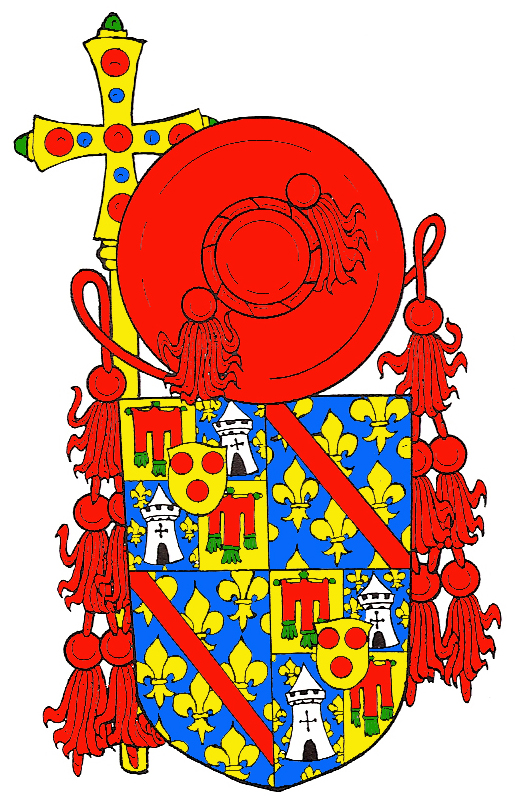
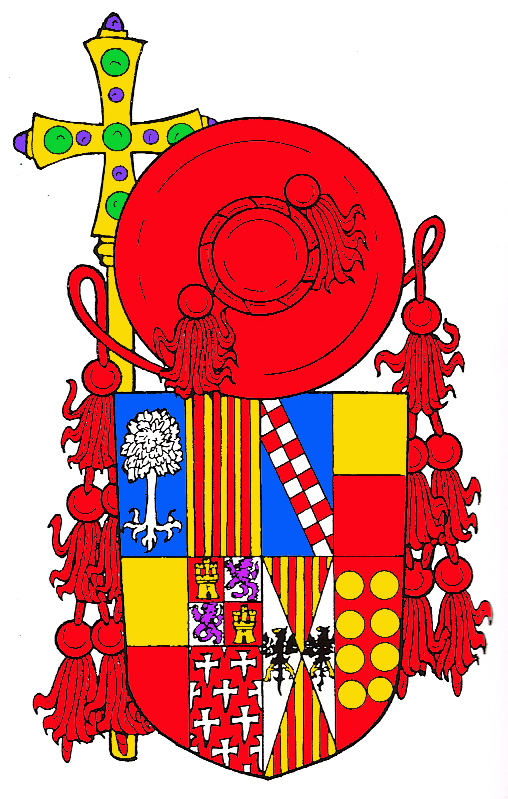
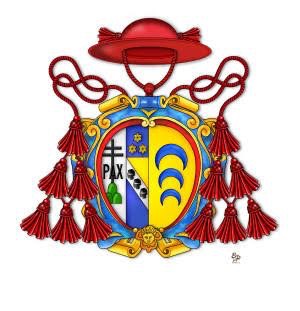
In the past I have highlighted some of the coats of arms of members of the College of Cardinals who had come from some of the great noble families of Europe. Unlike the Cardinals of today, almost all of whom simply assume a coat of arms on becoming a bishop, many Cardinals from an earlier time came from armigerous families and the arms they bore as Cardinals were composed of coats of arms they had inherited. Here are just a few (all rendered by the late Michael McCarthy).

este2

Ippolito d’Este, created Cardinal-Deacon of S. Lucia in Silice in 1493 (later Archbishop of Capua)

chambre2

Philipe de la Chambre, OSB, created Cardinal-Priest of S. Martino ai Monte in 1533 (later made Bishop of Frascati)

t-aragon2

Simone Tagliavia de Aragon, created Cardinal-Deacon of S. Maria degli Angeli in 1583 (later Bishop of Albano, and Bishop of Sabina)

Prefect of the Pontifical Household

Georg_G_nswein_Benedict_XVI

Gänsewein (former)

Since the pontificate of Pope Benedict XVI (2005-2013) the Prefect of the Pontifical Household (formerly called the Majordomo of His Holiness) has been the Most Rev. Georg Gänswein, who also served Pope Benedict as his personal secretary. At the time Gänswein was ordained to the episcopacy he assumed a coat of arms that impaled (that is, combined side by side on the same shield) his own personal emblems with the coat of arms of the pope he served, Benedict XVI. Upon the abdication of of Pope Benedict and the election of Pope Francis Gänswein’s coat of arms changed to reflect the new pope he continued to serve as Prefect of the Pontifical Household. This is an old custom. Below are the coats of arms of several of these Prefects with their arms impaled with the various popes under whom they served.

Georg_G_nswein_Francis

Gänswein (current)

Mag 014 Harvey

Harvey

unnamed

Monduzzi

Mag 011 martin3

Mag 010 martin2

Mag 009 martin1

Martin

Mag 007 Nasalli a copy

Nasalli Rocca di Corneliano

Mag 008 Callori

Callori di Vignale

unnamed (1)

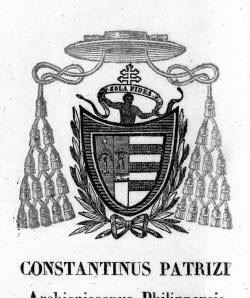
Mag 004 Patrizi Costantino

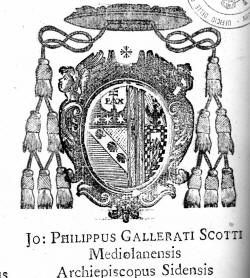
Mag 002 Gallarati Scotti Giovanni

unnamed (3)

Paris

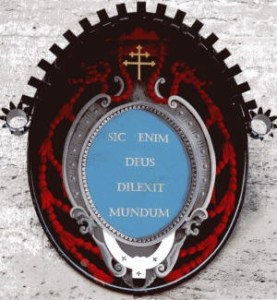
All the world is praying for Paris and Parisians. Their shepherd will need our prayers as well as he tries to comfort the afflicted and the grieving as well as bring aid to the wounded and the frightened. Andre Cardinal Vingt-Trois’ coat of arms is really not a coat of arms (although at least he has SOMEthing…unlike so many of his brother bishops in France) but I point it out because he, a spiritual leader and guide, needs our support and prayers. The arms themselves, rather than a motto, remind us of an important thing, especially in the face of such bald hatred and aggression: “For God so loved the world…” (that He sent His only Son to be our Redeemer) John 3:16

fm vingt-trois013

External Ornaments in Heraldry

The last post on the arms of the new Territorial Abbot of St. Maurice started an interesting conversation in the comments section. Namely, about the fact that the Abbot’s arms are ensigned with only the crozier that indicates the coat of arms belongs to an abbot. Many dislike it when the arms of a cleric do not employ the use of the distinctive galero, or broad-brimmed hat, which usually replaces both the helm and crest (with their accompanying torse and mantling) found in the heraldic achievements of lay people. This ecclesiastical hat is depicted in varying colors and with varying numbers of tassels to indicate the rank of the armiger. Both the Roman Catholic Church and the Church of England have developed elaborate systems for the use of the galero. Many other constituent churches of the Anglican Communion employ the system devised for the Church of England and approved by Earl Marshal’s Warrant in the 1960s.

However, while it is true that the galero certainly makes the coat of arms of a clergyman instantly recognizable as such it is not true that the galero is always and everywhere mandatory for clergy. In fact, there are no external ornaments that are mandatory in heraldry. A coat of arms, simply put, may consist of the shield alone. The motto, which many clerics spend way too much time on devising, is not a necessary component to a coat of arms for example.

In the case of a bishop the one single external ornament that marks the coat of arms as that of a bishop is the episcopal cross placed behind the shield. Full stop. There is no other external ornament necessary and quite a few bishops have chosen to display the episcopal cross (which is not to be confused, as it often is, with the liturgical processional cross) alone in their heraldic achievement. The green galero with twelve tassels is not exclusive to them so it is not the necessary element to indicate the arms of a bishop. Similarly, archbishops use the archiepiscopal cross which has two horizontal bars and is sometimes somewhat misleadingly referred to as the patriarchal cross, in their coats of arms. The green galero with twenty tassels is used almost exclusively by archbishops but it, too, is not a necessary or mandatory external ornament.

When it comes to cardinals the situation changes somewhat in that the red galero with its thirty tassels is, pretty much, the only external ornament that indicates the armiger is a member of the College of Cardinals.

For other clergy, again, the situation remains that the galero is usually employed and certainly makes it clear that the coat of arms belongs to a cleric rather than a laic but the privilege of ensigning the shield with various ornaments isn’t always absolutely necessary. In the case of an abbot it is the (usually veiled) crozier that indicates the arms of an abbot or abbess, the latter being easily distinguished by the lozenge or oval shape of the shield. If a coat of arms is ensigned with a veiled crozier then it is indicating the armiger is a cleric with the rank of abbot whether the black galero with twelve tassels is displayed or not. This is so because the black galero with twelve tassels may also be used by Vicars General; Vicars Episcopal; Non-Episcopal Ordinaries, Moderators of the Curia, Titular Abbots, Prelates of Chivalric Orders as well as Superiors General of Religious Orders and Clerical Religious Congregations. However, only an abbot may also employ a veiled crozier*. Thus it is the crozier that indicates the coat of arms belongs to an abbot, not the galero.

Similarly, the green galero with twelve tassels may be used by Territorial Abbots, Permanent Apostolic Administrators and Vicars or Prefects Apostolic who lack the episcopal character. However, only a bishop or archbishop may also ensign the shield with the episcopal or archiepiscopal cross.

It is worth mentioning that in some places bishops and abbots still use the mitre as well as the cross or crozier in ensigning their shields rather than the galero despite the preference as indicated by Papal Instruction for the use of the galero.

As I said jokingly to one of my sympathetic correspondents, “You don’t have to have all the doo-dads on your coat of arms when, frequently, there is only a single ornament that is the true indication of rank”.

*NOTE: Recently, the Church has established Ordinariates for former Anglicans who wish to come into the Roman Catholic Church. These are headed by Ordinaries who, while exercising Ordinary jurisdiction over the churches under their charge, do not possess the episcopal office. In some cases they were formerly bishops in some branch of the Anglican Communion. Of the three existing today they, too, ensign their shields with the proper galero of rank (usually that of a Prothonotary Apostolic, the highest rank of “monsignor” which is a purple hat with twelve red tassels) as well as a purposely UN-veiled crozier to distinguish it from the crozier of an abbot. This is because they exercise Ordinary jurisdiction of which the crozier is a symbol and they are entitled to use the pontificals liturgically so they actually carry a crozier at Mass but the veil on the crozier is particular to monastics which these Ordinaries are not.

Coat of Arms of Pope Pius XII (Before and After)

Much has been written in recent years about the practice of a prelate modifying the design of his coat of arms when he moves from one position to another in the Church. Generally speaking I am against the practice. A coat of arms, even an assumed one, becomes a unique personal symbol and is associated with the person who bears the arms. To change the original design simply because one is taking up a new position or ministry is ill advised.

I am, of course, not referring to marshaling the personal arms with those of a jurisdiction (see, abbey, or even a parish). When a cleric is translated from one jurisdiction to another of course he will then marshal his personal arms to those of the new jurisdiction because, after all, impaling or quartering the personal arms with those of a jurisdiction is a means of displaying two or more separate coats of arms together on one shield. The arms of a diocese do not “become” part of the bishops personal coat of arms. They are displayed along with the personal arms of the incumbent during the tenure of his office as part of the overall achievement but that is all.

Rather, I am speaking of a cleric slightly modifying or even changing entirely the design on the shield of his personal coat of arms. In some cases the change is a result of unhappiness with the design originally adopted. Sometimes it is the case that a cleric is appointed to be a bishop and wishes to make use of his new coat of arms at his episcopal ordination which may be as soon as only six weeks away. So, a design is hastily adopted. later, when being translated to a new see the bishop has had time to second guess his original arms and wishes to tweak the design or even change it altogether. While this is understandable it still should be frowned upon. His new position doesn’t mean he is becoming an entirely new person.

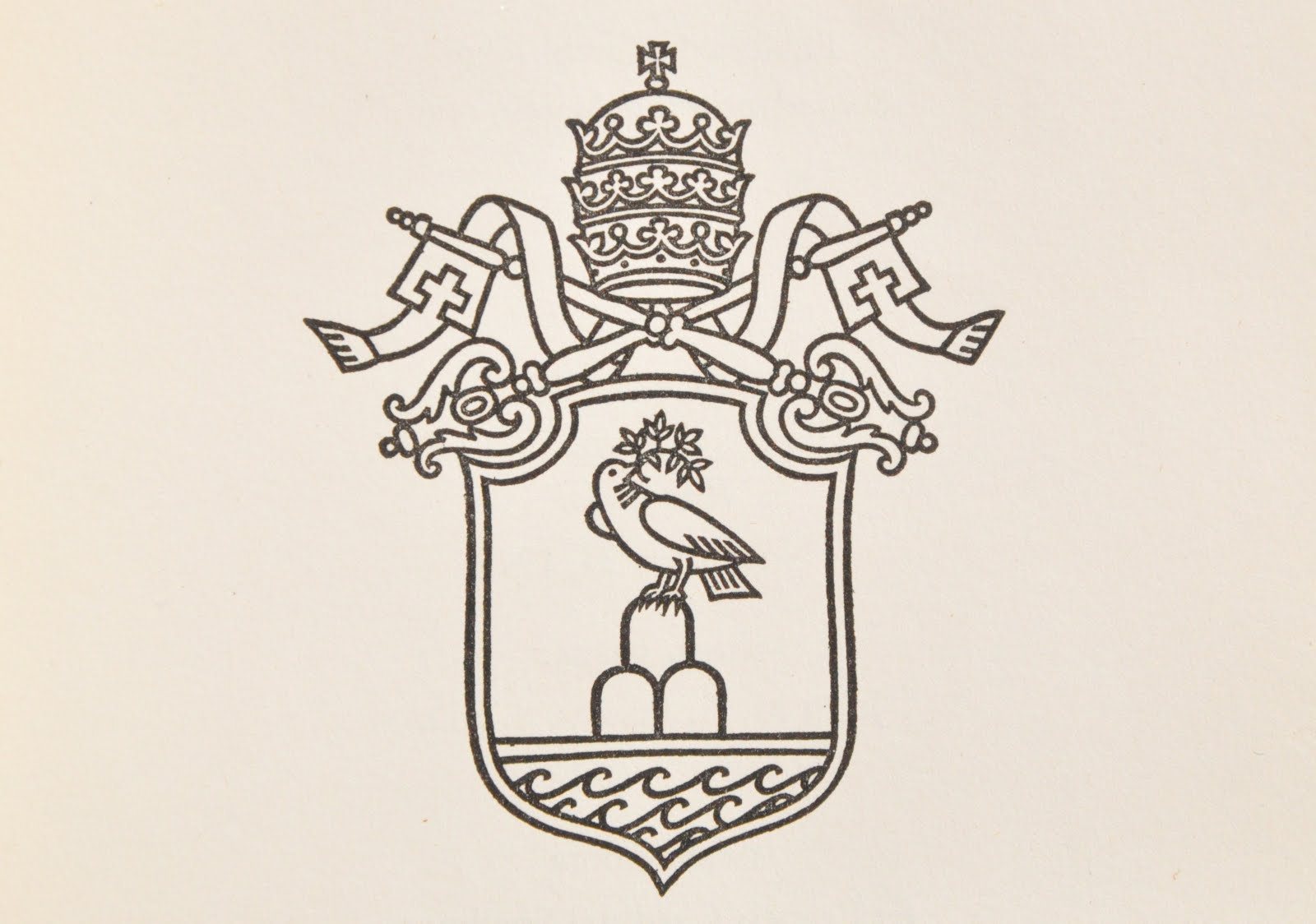
Yet we see that this has and continues to happen. Even no less than Pope Pius XII (Eugenio Pacelli 1939-1958) bore arms that were slightly different before and after he became pope. When a bishop and cardinal his arms depicted a dove displayed (i.e. with its wings spread) holding an olive branch in its beak. This is a reference to the name Pacelli which means “peace”. The dove was perched on a trimount and sitting below the arc of a rainbow, an allusion to the story of Noah from the Scriptures.

Danesi20

However, after his election to the papacy there are some differences. The dove now has folded wings and sits perched on the trimount which is depicted on field and above waves of water. In addition, the rainbow is now gone. Perhaps Pius XII felt the reference to the story of Noah was redundant or superfluous? Perhaps he wished to express a global desire for peace since he was elected at a time when the world was on the brink of World War II? Perhaps he simply liked this newer design more? We shall never know yet here is a good example of arms modified when going from one position in the Church to another.

piua xii arms in pen and ink