On December 29, 2020 His Holiness Pope Francis appointed the Most Rev. Dermot Farrell (66), a priest of the Diocese of Meath and since 2018 Bishop of Ossory, Ireland to be the 51st Metropolitan Archbishop of Dublin. He succeeds Abp. Diarmuid Martin.
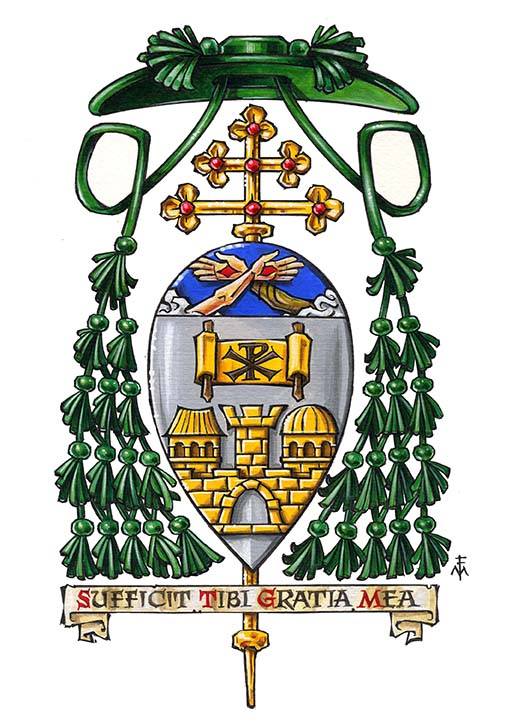
He had already assumed a coat of arms as Bishop of Ossory. The image below is not official but was a cut and paste job by me to see what his arms as archbishop will look like. In Ireland the archbishops of Armagh (who is the Primate of All Ireland) and of Dublin (who is the Primate of Ireland) use arms of the See that appear identical because this stems from a time when all archbishops tended to use arms depicting a pall (pallium) and a cross as symbols of being an archbishop. The archiepiscopal insignia then later became associated with certain metropolitical & archiepiscopal sees and it remains so to this day, including some (like the Church of Ireland Diocese of Dublin, or the Anglican Archbishop of Canterbury) where it seems particularly incongruous. This is because the pallium is worn by Roman Catholic Metropolitan Archbishops as a symbol of sharing in the ministry of the Bishop of Rome (the Pope) and, as such, they receive it from him as a sign of their office.
Below we see what Archbishop Farrell’s coat of arms may well look like (or something close to this). I note that his predecessor, App. Martin, did not use a coat of arms.
St. Thomas Becket, Archbishop of Canterbury, was assassinated by nobles who served King Henry II of England in 1170. They entered the cathedral and killed him. His conflict with the king centered around the Constitutions of Clarendon, a series of laws Henry wished to impose to check the increase in power the Church gained under the rather chaotic reign of his predecessor King Stephan. Becket opposed these laws as the state over reaching into the internal affairs of the Church. Their conflict became more heated until Henry supposedly (though not definitely) was to have said to his barons, “Will no one rid me of this meddling clerk?”. It’s doubtful he actually said that and if he did it certainly would have been in French since Henry II didn’t speak English. This was taken to mean he desired to see Becket gone, so they went to the cathedral on December 29th and killed him.
This all happened before the advent of systematized heraldry as we know it. becket certainly did not have a coat of arms. But, according to the long-standing traditional custom of attributing coats of arms to great persons after the fact a coat of arms was devised for him. It appears in many places erroneously as the coat of arms of St. Thomas Becket of Canterbury. While it certainly was not his actual armorial bearings it is, nevertheless, a very handsome achievement especially impaled with those of the See of Canterbury.
Here are the armorial bearings of the Archbishops of Washington, DC almost all of whom have been elevated to Cardinal with the notable exception of the first one, Archbishop Michael Curley who was also the Archbishop of Baltimore. At first the Archdiocese of Washington was part of the Archdiocese of Baltimore. Later, a dual archdiocese of Baltimore-Washington was created with Curley leading it. Eventually, Washington became a separate archdiocese but Curley was still appointed its archbishop making him, simultaneously, the archbishop of the oldest American diocese (Baltimore) and the newest at that time (Washington). A short time later Washington, DC received its own residential archbishop with the appointment of Patrick O’Boyle.
There is no coat of arms for Theodore McCarrick who is no longer a cardinal or even a cleric. A blank shield is used in place of his armorial bearings but his time in Washington in still noted because under Mr. McCarrick’s tenure the armorial bearings of the archdiocese were changed and that change, despite McCarrick’s disgrace, has been employed by his two successors as well. One can only hope that at some point in the future the original coat of arms of the archdiocese will be adopted again.
Archbishop Michael Curley (the archdiocesan arms hadn’t been adopted yet and Curley impaled his arms with those of Baltimore)Patrick Cardinal O’BoyleWilliam Cardinal BaumJames Cardinal HickeyArchdiocesan arms changed by Mr. Theodore McCarrickDonald Cardinal WuerlCardinal-Designate Wilton Gregory
On October 24 it was announced that the Apostolic Administrator of the Latin Patriarchate of Jerusalem for the last four years, Archbishop Pierbattista Pizzaballa, OFM, the former Custos of the Holy Land had been named by the Pope as the Patriarch of Jerusalem for the Latins. Accordingly, His Beatitude’s armorial bearings were updated to include another row of green tassels for a total of thirty tassels suspended from the galero. This rendering, as also the original rendering, was done by Marco Foppoli.
On October 25 it was announced from the Holy See that Pope Francis is naming new cardinals to be created on November 28 and among them is the Archbishop of Washington, DC, Wilton Gregory. He will become the first black American cardinal.
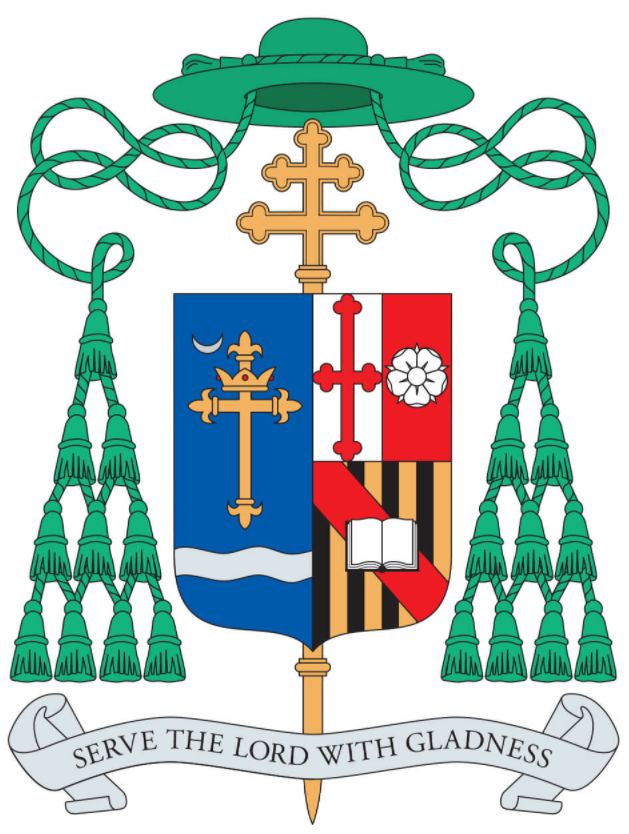
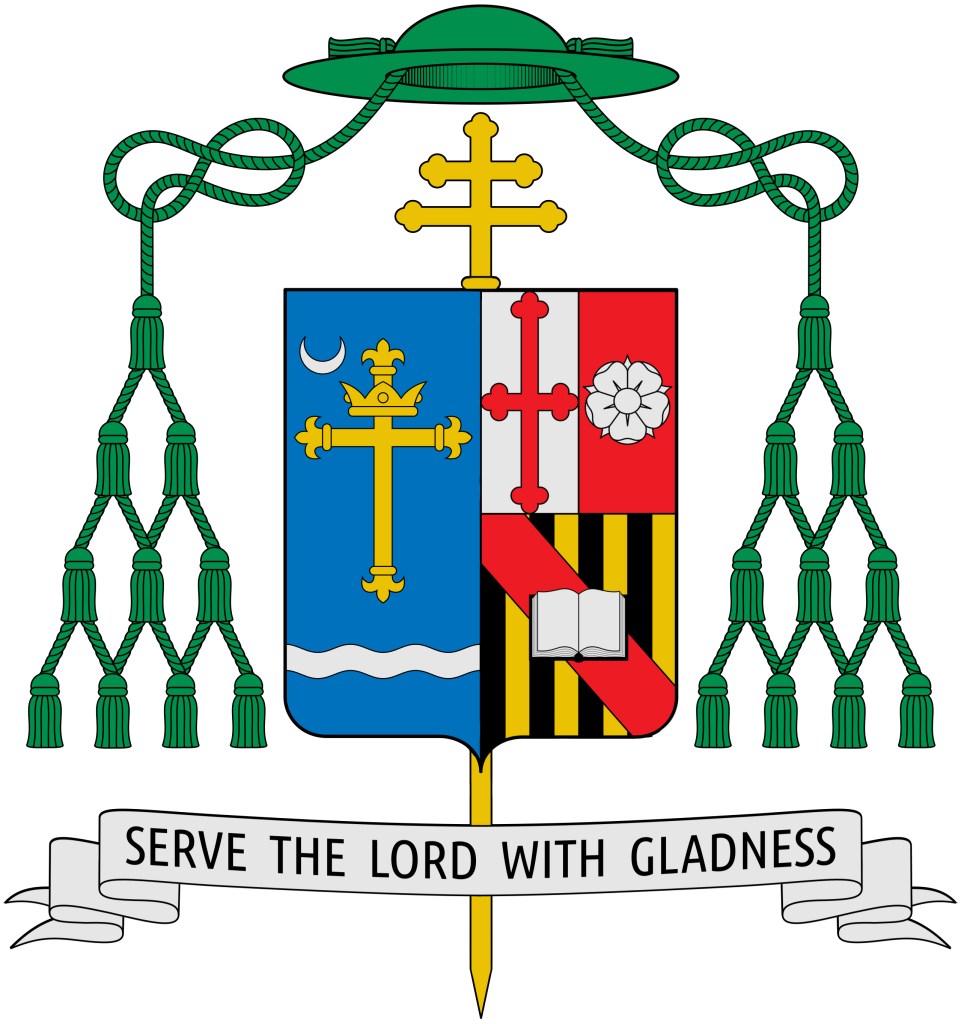
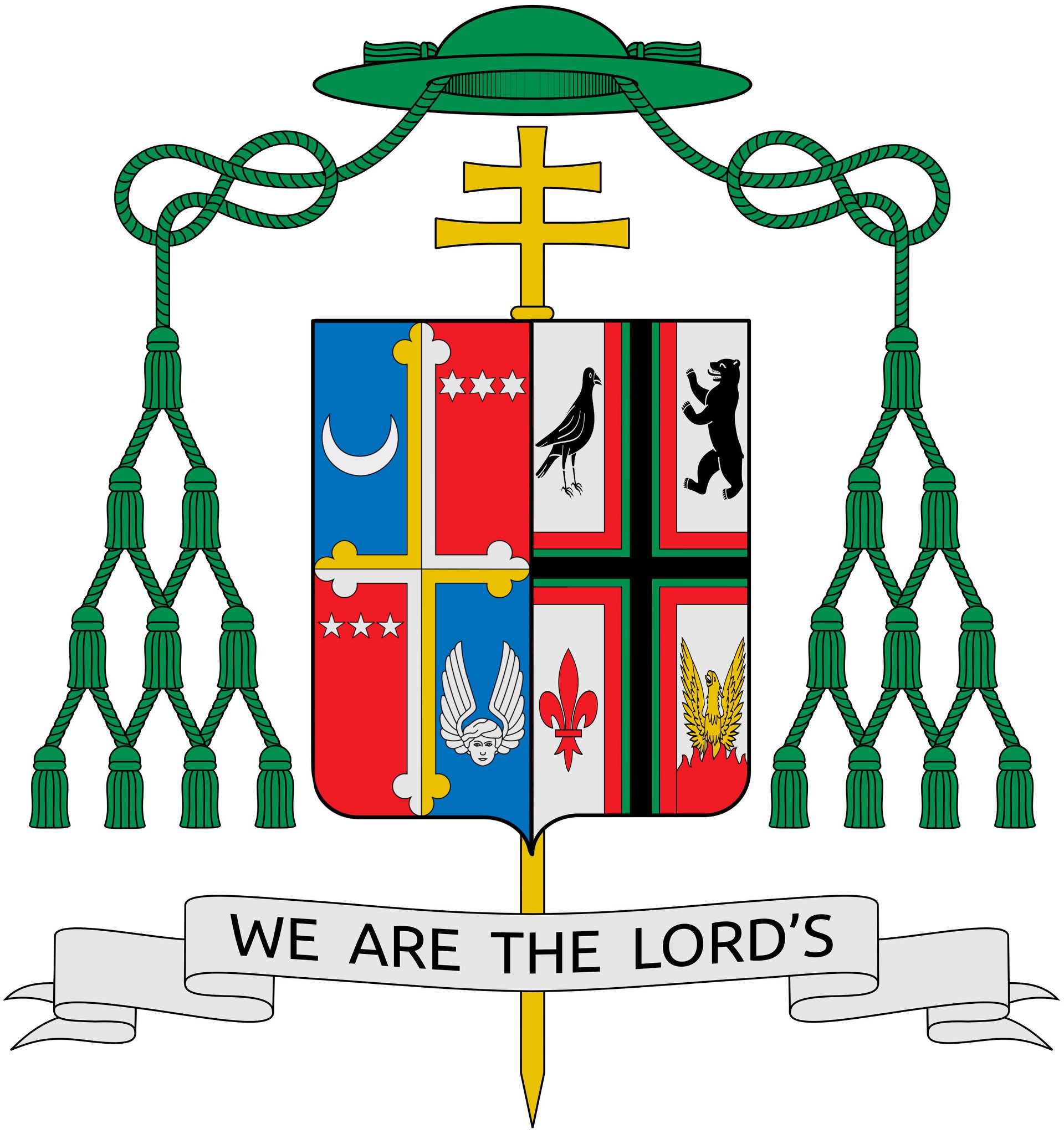
On August 25th the Most Rev. Mitchell Rozanski (62), a Baltimore priest who most recently served as Bishop of Springfield, Massachusetts, will be installed as the 11th Archbishop of St. Louis, Missouri.As mentioned earlier in the blog his coat of arms will be:
The explanation from the archdiocesan website is as follows: The armorial bearings of the Archdiocese of St. Louis (left side) is a blue field with a gold crusader’s cross, and a crown representing Saint Louis IX, King of France, and patron of both the Archdiocese of St. Louis and City of St. Louis. On the extremes of the cross are found the fleur-de-lis flower that recalls the French foundation of the city.
For his personal arms, His Excellency Archbishop Rozanski has selected a design that is based on two major themes; his Polish heritage and his service to the Archdiocese of Baltimore. In the upper portion of the design, in red and silver (white), the colors of the Polish national flag, are a cross bottony (each arm terminates in a triple ball), which represented in red on silver, is a variant on the symbolism known as a “cross of St. Michael,” the Archbishop’s baptismal patron. To the right of the cross is a silver rose on a red field, drawing upon the significance that His Excellency’s family name refers to “Rose flower” in Polish.
In base, on the alternating vertical bars of black and gold (yellow) with a red diagonal bar called a “bend,” is an open book of the Most Holy Scriptures. These charges, drawn from the arms of the Archdiocese of Baltimore, signify that His Excellency’s ministry as a deacon, priest, and now as an archbishop is to spread God’s Holy Word to the faithful of the Archdiocese. This symbolism joins well with the Archbishop’s motto, that is taken from the 100th Psalm, that in all that Archbishop Rozanski is to do for The Lord, he is called to “SERVE THE LORD WITH GLADNESS.”
I think it makes for a handsome combination. Ad Multos Annos!
Today Pope Francis appointed the Most Rev. Mitchell T. Rozanski (61), since 2014 the Bishop of Springfield, Massachusetts, and prior to that a priest and Auxiliary Bishop of Baltimore, Maryland, as the 11th Bishop and 10th Archbishop of St. Louis, Missori.
The coat of arms which he assumed on becoming a bishop in 2004 which reflect his Maryland roots will impale nicely with those of the venerable See of St. Louis.
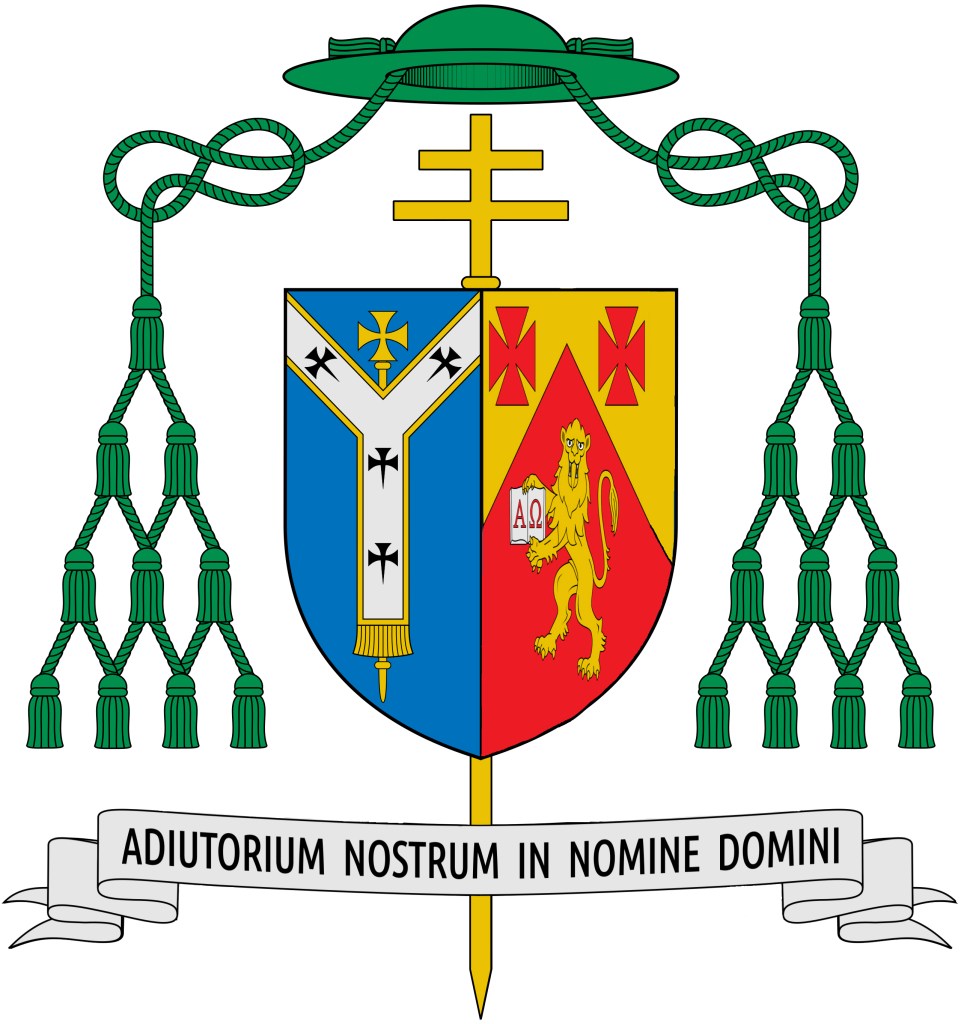
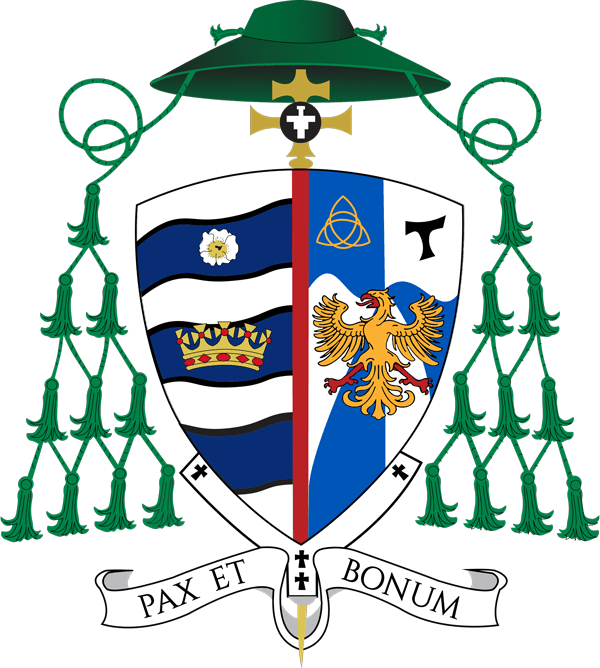
The Most Rev. Gregory Hartmayer, OFM.Conv., (68) Bishop of Savannah, Georgia since 2011, was installed as the 8th Archbishop of Atlanta on May 6. The arms he assumed when he became Bishop of Savannah he has retained and impaled with those of the See of Atlanta.
OK. This isn’t a bad coat of arms. It also isn’t the very best I’ve ever seen. I have no comment on the arms of the See of Atlanta. The archbishop’s personal arms employ a very complex field and then sort of ruin that effect by pasting several charges onto it. I have no issue with the idea of a dividing line of a color other than black between two impaled coats of arms but for reasons passing understanding this seems to be more than just an artistic decision because it is included in the blazon.
I do have a problem with the fact that there are two different shades of blue used in the same achievement but both are blazoned simply as “Azure”. The archiepiscopal cross (which is quite wrongly described as a “processional” cross…which it is not) with the roundel containing silhouette of the San Damiano cross (a particularly Franciscan symbol) is heraldically unsupportable. I have written on this blog numerous times that the external ornaments should not be personalized by unique additions. Finally, while it has certainly become something that is done frequently I do not approve of the inclusion of the pallium in the achievement of a metropolitan archbishop. I agree with Bruno Heim’s assessment that the pallium as a heraldic charge is best depicted on the shield and not included as as external ornament.
Many will say, “Oh! But as an archbishop he’s entitled to it!” Well, first of all the extra row of tassels on the galero and the two horizontal bars on the archiepiscopal cross clearly indicate the armiger is an archbishop. Second, to those who raise the objection that those are also ornaments used by archbishops who are not also metropolitans and the pallium is the only symbol of being a metropolitan, I say, “Tough”. That’s not a good enough reason to destroy the aesthetics of a good heraldic achievement by trying to stuff yet another ornament into it. There are other external ornaments used by bishops no longer included in their coats of arms, like mitres and croziers. The coat of arms does not have to include every single thing a prelate is entitled to wear or use.
As I have said, this is a debatable point and many favor the use of the pallium in the achievement of a metropolitan archbishop. I do not. Neither did Heim. I trust his opinion more than the opinions of 100 other people. So, I think the inclusion of the pallium here detracts from the rest of the coat of arms especially as, placed where it is, it looks more like an afterthought.
The archbishop’s arms were first prepared when he became a bishop by an old friend and former student of his. The same person worked on this project for his arms as Archbishop of Atlanta.
The blazon is: “Impaled fimbriated gules, (????) at dexter (for Atlanta), Bary wavy of seven Argent and Azure; at the centre point overall an open crown Or and at the honour point a rose of the first with a center of the last, and at sinister (for Archbishop Hartmayer), per pale argent and azure a chief wavy of one crest depressed in the center of one point and issuant in base throughout a pile reversed enarched all counterchanged, overall an eagle or and in chief at dexter a triquetra interlaced with circle of the last and at sinister a tau cross sable.“
The explanation (from the archdiocesan website) is: “The personal Coat of Arms of Bishop Hartmayer is intended to symbolically represent the Bishop’s heritage and vocation as a Conventual Franciscan Friar. The background of wavy blue and white is a heraldic symbol for water. The Bishop is a native of Buffalo, NY – the Queen City of the Great Lakes. Water is also the key symbol of Baptism – the first Sacrament of Initiation as a Christian. This helps recall the Bishop’s ministry as the primary sacramental minister of his diocese. The eagle serves as a two-fold symbol of both the Bishop’s German heritage and of St. John the Evangelist. The Bishop’s father was named John and this is the Bishop’s middle name. The Celtic Knot, known as a Triquetra, represents the Bishop’s Irish heritage on his maternal side. And finally, the Tau is a reference to Bishop Hartmayer’s vocation as a Conventual Franciscan Friar. St. Francis would sign his writing with a Tau, often painted it on the walls and doors of places and he stayed, and would remind his friars that their habit was in the shape of a Tau cross illustrating to them that they must go into the world wearing this cross like an incarnation of Christ.“
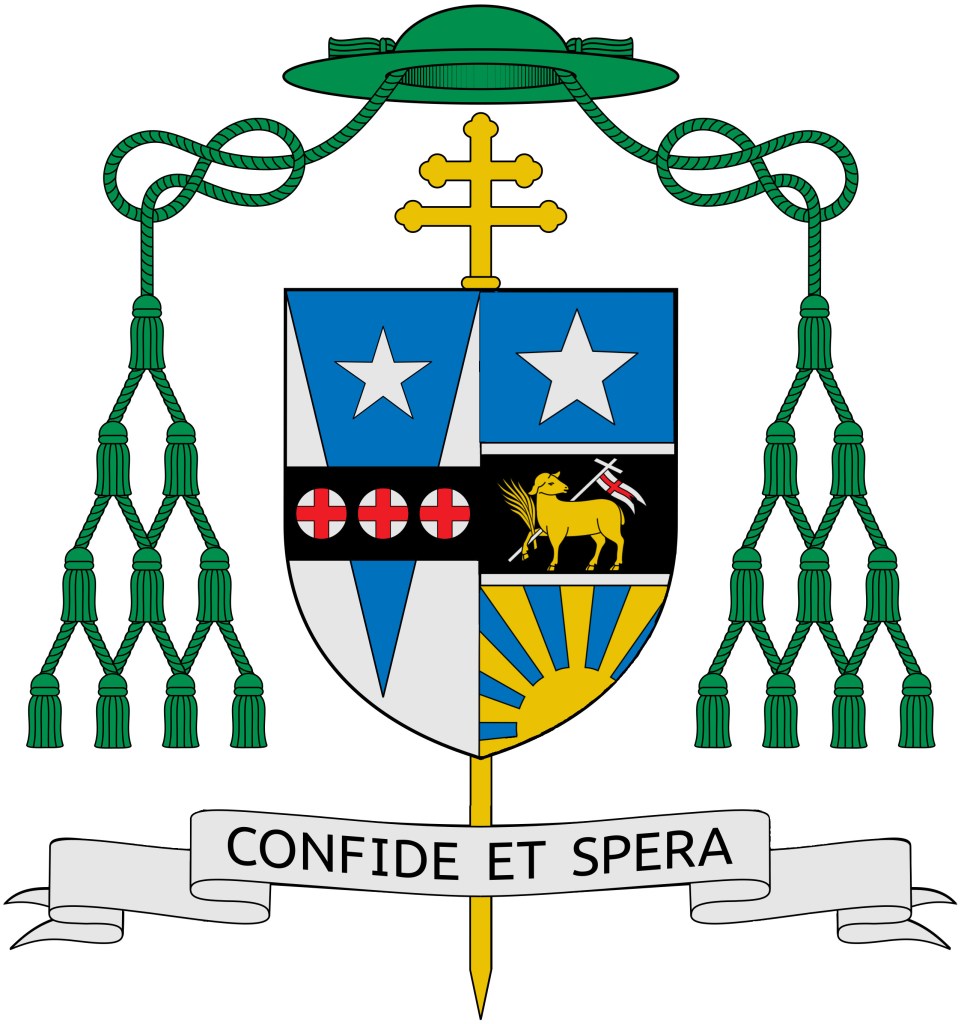
Archbishop elect Nelson Perez will be installed as the 16th Archbishop of Philadelphia on February 18. His coat of arms will appear as below. He has not really changed his arms but rather has decided to have the star in chief on his personal arms depicted differently that the five pointed star in the arms of the archdiocese. Originally, he had a five pointed star, borrowed from the arms of the See of Philadelphia, to commemorate his time as a priest there. Now that he will be serving as the archbishop there, the need for that is lessened. So, his arms remain the same with a slight tweak in the style of the star in chief.
This morning the Holy See announced that the Pope has appointed 58-year-old Bishop Nelson J. Perez as the 10th Archbishop of Philadelphia succeeding Archbishop Charles Chaput, OFM, Cap. who has served as the 9th Archbishop since 2011 and who turned 75 last September. The Archbishop-elect was born in Cuba, emigrated with his family to Miami when he was a child and was raised in Northern New Jersey.
He was ordained a priest for the Archdiocese of Philadelphia in 1989. In 2012 Pope Benedict appointed him as Titular Bishop of Catrum and Auxiliary Bishop of Rockville Centre, New York. Pope Francis translated him to the Diocese of Cleveland in July, 2017.
His personal arms were assumed at the time he was ordained a bishop on Long Island. The reflect his Cuban heritage (the sun), his home diocese of Philadelphia (the star) and his vision of priestly and episcopal ministry (the lamb).
Philadelphia hasn’t had a priest of their own diocese serve as archbishop there since Archbishop Prendergast (1911-1918) so this is a momentous appointment for the archdiocese to have, if not a native son, a priest from their own presbyterate as their new shepherd. That’s relatively rare in the U.S. these days. I grew up in the Diocese of Rockville Centre and I still have many friends and some family there. I know the people there appreciated Archbishop-elect Nelson’s personality, style and his ministry with them.
On December 8, 2019 His Holiness Pope Francis appointed Fernando Cardinal Filoni as the VIII Grand Master of the Equestrian Order of the Holy Sepulchre of Jerusalem. With that his predecessor, Edwin Cardinal O’Brien became Grand Master Emeritus of the Order.
Heraldic use in the EOHS is somewhat unclear. There are various sources all claiming to be definitive accounts of the heraldic privileges of the Order but, in fact, since most only exist online none can truly be said to be definitive.
Since 1949 when Cardinals of the Holy Roman Church have been appointed by the Pope as Grand Masters they have observed the heraldic convention, like other orders, of marshaling their personal arms to those of the Order by means of quartering them. No one has disputed their right to do so or that this has been the usual manner. There remains a question, however, of whether or not to marshal the armorial bearings of Grand Masters Emeriti in the same way, or, as the usual heraldic custom would suggest, to have them revert to using their personal arms alone.
Cardinal O’Brien’s coat of arms is of particular interest in this question because of his unfortunate and erroneous habit of retaining armorial elements from his previous postings in his coat of arms each time he has been assigned to undertake a new position. So, the arms he assumed when first ordained Auxiliary Bishop of New York have long ago been abandoned. After he concluded his tenure as Archbishop of of the Military Archdiocese, USA he kept the open globe from the archdiocesan achievement of the US Military and incorporated it as a base into his personal arms when he moved to Baltimore. In an even worse move, when he left Baltimore as its archbishop to go to Rome as Pro-Grand Master and later Grand Master of the EOHS he kept his coat of arms entirely as they had been in Baltimore, impaled with the arms of the See of Baltimore, for which he had absolutely no right whatsoever as he was no longer the Ordinary of that archdiocese. It is important to remember that the custom of bishops impaling their personal arms with those of their See does not mean that the arms of the jurisdiction becomes a part of their own coat of arms. Rather, it is a means of marshaling, that is to say, depicting two separate coats of arms on the same shield to illustrate a relationship between the two, in the case of bishops to indicate that they are “married” to their diocese and exercise jurisdiction over it. If they should leave that diocese they no longer enjoy that right.
So, we see that the arms of the See of Baltimore never should have been included in Cardinal O’Brien’s arms as Grand Master of the EOHS. In the case of the globe from the arms of the US Military Archdiocese at least it can be said that rather than marshaling his arms to those of the Military Archdiocese what O’Brien did was to borrow a charge and incorporate it into his own personal arms which is arguably a better practice and, thus, acceptable.
There are probably those who assume it is acceptable for the cardinal simply to continue using the same achievement he used as Grand Master. They would be wrong. No one in an emeritus position is entitled to heraldically represent jurisdiction they no longer exercise. I have seen some sources that would claim a Grand Master Emeritus, indeed any cleric, may quarter his personal arms with those of the Order. I believe this is false. The convention has always been that quartering the personal arms with those of the Order is the prerogative of the Grand Master alone. I have seen no definitive official source that allows for any cleric to quarter their arms with the arms of the Order.
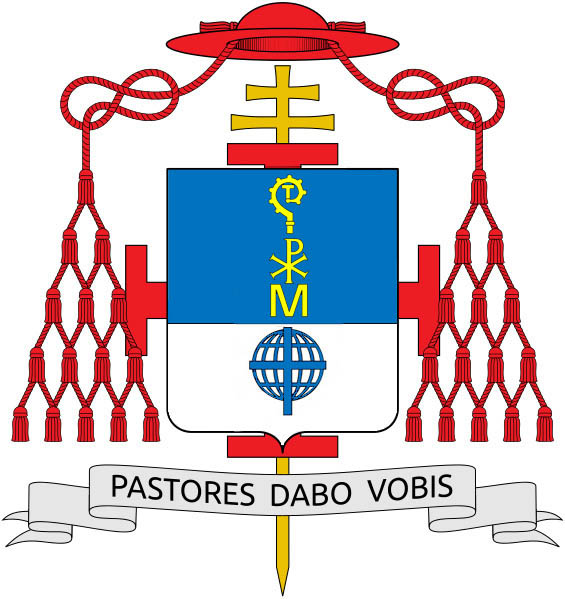
Accordingly, and logically, the only other recourse would be for Cardinal O’Brien to bear his personal arms alone like other members of the College of Cardinals who have retired; to exclude the arms of the See of Baltimore over which he ceased to have any jurisdiction long ago; to retain the globe from the arms of the See of the US Military as it is now a charge incorporated into his personal arms; to indicate his continued membership in the EOHS by means of placing the cross of the Order (the Jerusalem cross) behind the shield. This, unfortunately, leaves him with a rather unfortunate personal armorial achievement. (below)
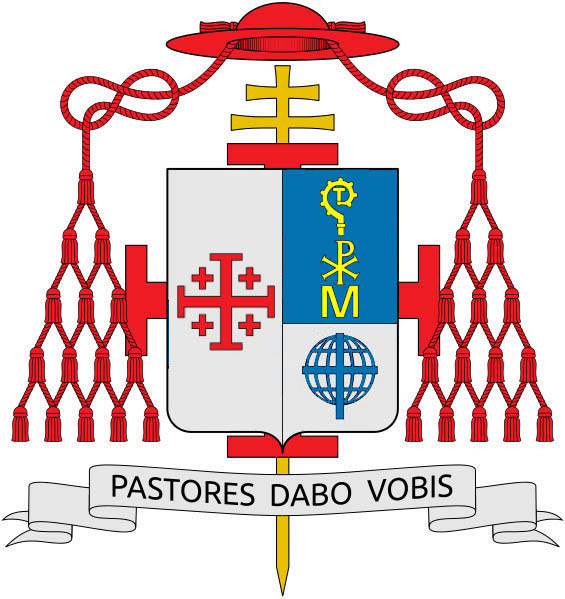
There is a good argument to be made for one other possibility. Certain officials of the Order and members of a particular rank within the Order, namely Knights & Dames of the Collar; Lieutenants; Members of the Grand Magistry and Grand Priors, impale their arms with the arms of the Order. It can be argued that the Grand Master Emeritus is both a Knight of the Collar and, honorarily at least, still considered a Member of the Grand Magistry. By that logic a Grand Master Emeritus might impale his personal arms with those of the Order rather than quarter them and this would leave Cardinal O’Brien with an achievement that looks a bit less empty. (below)
On January 5 Msgr. Vincent Jordy (58) from Perpignan, France, a priest and Auxiliary Bishop of Strasbourg and from 2011-2019 Bishop of Saint Claude will be installed as the 66th Archbishop of Tours.
Unlike so many of his confreres in the French episcopate he actually bears a coat of arms:
Of course as an archbishop, the cross will now be a patriarchal cross with two horizontal bars. The fact that he doesn’t use a galero is his personal choice. As has been mentioned on this blog before, the galero is not an essential part of a bishop’s coat of arms and may be omitted if desired. The one and only distinguishing external ornament essential for a bishop’s coat of arms is the episcopal or archiepiscopal cross placed behind the shield.
The Most Reverend Paul D. Etienne (60) who had been translated from Archbishop of Anchorage to Coadjutor of Seattle last April has now succeeded to the See of Seattle as of September 3, 2019. On that date Pope Francis accepted the resignation of Archbishop Peter Sartain for health reasons and Etienne becomes the 10th Metropolitan Archbishop of Seattle.
His coat of arms (above) combines the arms of the See of Seattle with his personal arms. It’s nice to see he didn’t once again change them as he did when going from Cheyenne (where he originally served as a bishop) to Anchorage. At that time I was very outspoken in my criticism of that decision. There is no such criticism this time around.
On April 29 Pope Francis appointed Archbishop Paul Etienne (59) to be the Coadjutor Archbishop of Seattle. The archbishop was a priest of Indianapolis and also served from 2009-2016 as the Bishop of Cheyenne, Wyoming before becoming Archbishop of Anchorage, Alaska where he has served for just three years.
He will take up his new duties in Seattle in early June and then he and Archbishop Peter Sartain, who requested the coadjutor due to ill health, will determine when Archbishop Etienne (pronounced AY-chin) will succeed to the See as the ninth archbishop.
The archbishop famously redesigned his personal coat of arms when he moved from Cheyenne to Anchorage, a move that was highly criticized by me. Let’s hope he leaves well enough alone this time. Ironically, his original coat of arms would have ended up looking better marshaled to those of Seattle than his current design. This, then, is why one shouldn’t redesign personal arms to harmonize better with (arch)diocesan arms. It is impossible to know if you might be moving on.
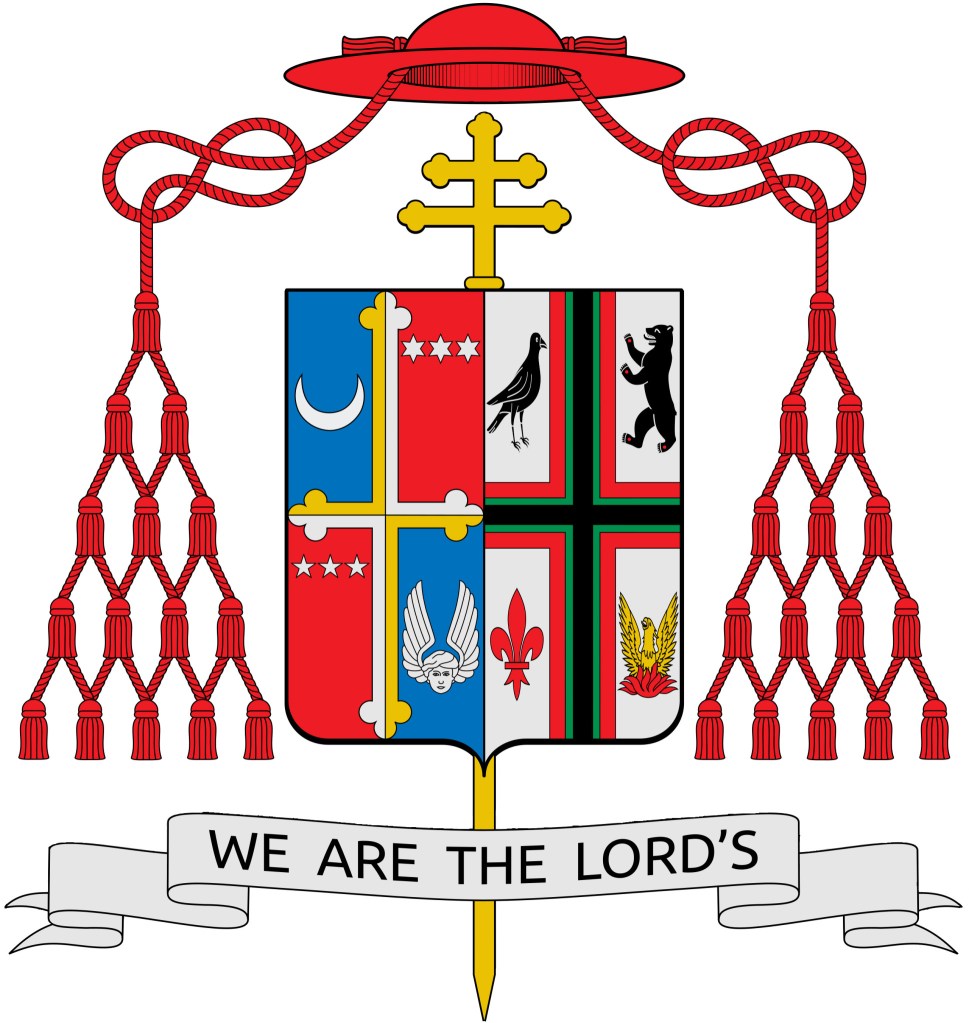
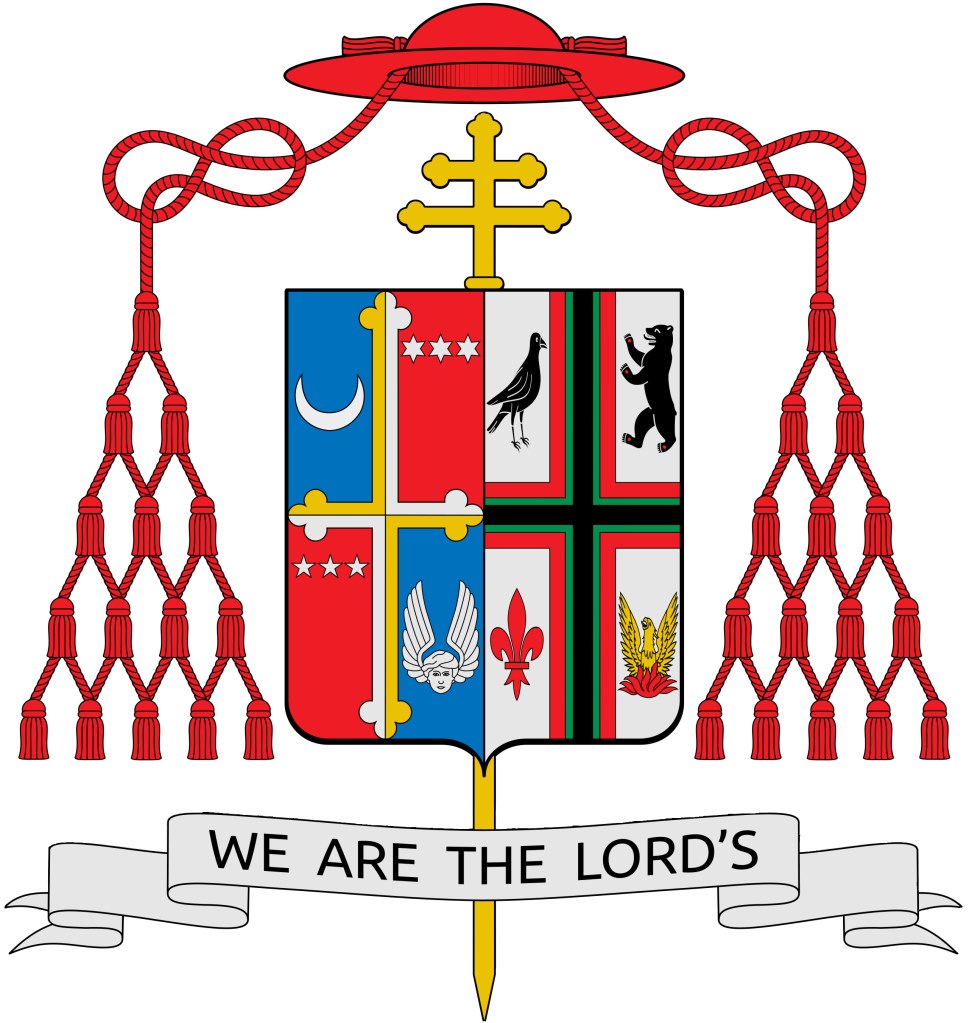
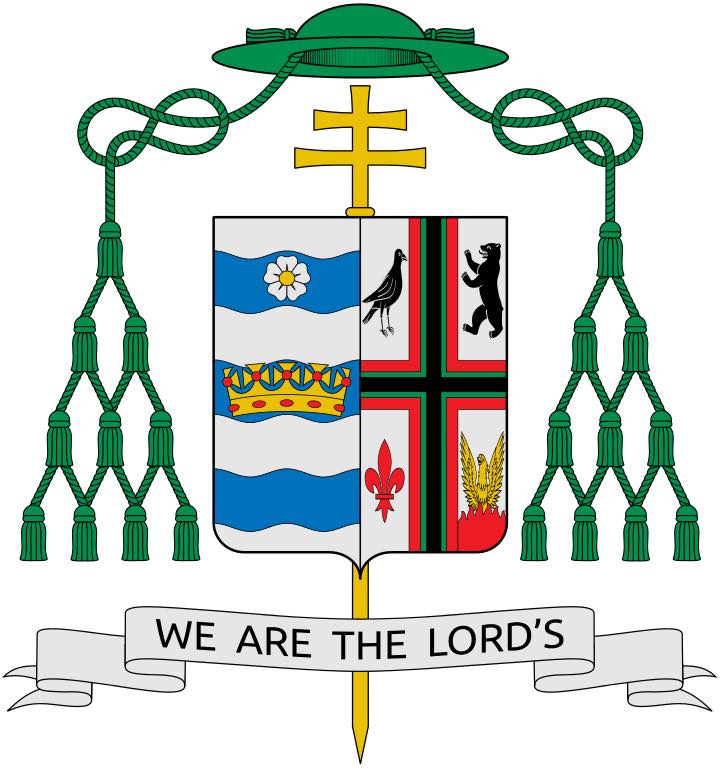
It was announced this morning that Pope Francis has appointed the Most Rev. Wilton Gregory, Archbishop of Atlanta to be the next Archbishop of Washington, DC. Archbishop Gregory was ordained a priest for the Archdiocese of Chicago originally and served as Auxiliary Bishop there before becoming the Bishop of Belleville, Illinois and eventually promoted to Archbishop of Atlanta. He also served at one time as President of the United States Conference of Catholic Bishops. He will be installed in Washington, DC on May 21.
The coat of arms he has used since becoming a bishop 36 years ago will now be marshaled to those of the Archdiocese of Washington, DC.
On a silver (white) field a cross composed of three colors; black on green on red. These colors are referred to as the African-American colors and by their use Archbishop Gregory honors the religious and racial heritage that has come to him from his parents, Wilton and Ethel ( Duncan ) Gregory. Within the quarters that are formed by the cross are a raven, to honor the Archbishop’s Benedictine education at Sant’ Anselmo (in Rome), and a black bear taken from the arms of His Eminence, Joseph Cardinal Bernardin, His Excellency’s principal Episcopal consecrator. Also within the quarters are a red fleur-de-lis taken from the arms of the Mundelein Seminary in Chicago , where Archbishop Gregory was a student and faculty member, and a golden phoenix, coming forth from red flames, to honor Chicago , the city reborn after the famous Chicago fire.
There have been fewer cardinals in the Church from the Order of Canons Regular of Prémontré (aka Norbertines) than there have been of other orders and, as far as I can tell, two of those known to be associated with that Order were Abbots in Commendam only. The Premonstratensian Cardinals are:
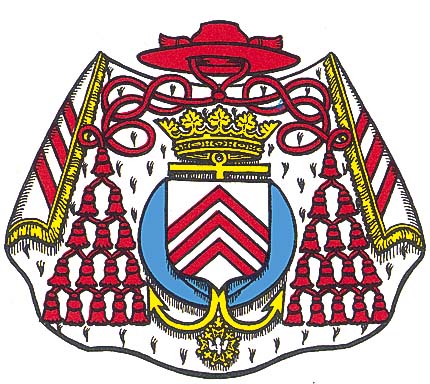
Armand Jean du Plessis, Duke de Richelieu, Bishop of Luçon, Commendatory Abbot of Prémontré, (also Territorial Abbot of Cluny and Abbot in Commendam of Citeaux)
Johannes von Bucka, O.Praem. Archbishop of Olomouc
Ippolito II d’Este, Archbishop of Auch, Archbishop of Arles, Commendatory Abbot of Prémontré
Throughout the Church’s history there have been many members of the hierarchy who were members of Religious Communities. The present pope is a member of the Society of Jesus (Jesuits) and the first from that Order elected to the papacy. One of the oldest Orders in the Western Church is the Order of St. Benedict. Many monks have been made bishops and quite a few have been raised to the Sacred Purple as Cardinals. The following is by no means exhaustive but gives a sampling of some of the Benedictine Cardinals in recent history. (My gratitude to the fine website called Araldica Vaticana for many of these examples.
Enjoy!
Gregory Cardinal Chiaramonte, OSB (later Pope Pius VII)
Jean Cardinal Pitra, OSB
Placido Cardinal Schiaffino, OSB Oliv
Celestine Cardinal Ganglbauer, OSB (Archbishop of Vienna)
Aidan Cardinal Gasquet, OSB (Vatican Archivist)
Bl. Giuseppe Cardinal Dusmet, OSB (Archbishop of Catania)
Kolos Cardinal Vaszary, OSB (Primate of Hungary)
Francisco de S. Luiz Cardinal Soraiva, OSB (Patriarch of Lisbon)
NOTE: Cardinal Soraiva also had a version of his arms with a galero but also used the triple tiara as was customary for the Patriarchs of Lisbon until very recently.
Domenico Cardinal Serafini, OSB
Ildephonse Cardinal Schuster, OSB (Abbot of St. Paul Outside-the-Walls and later Archbishop of Milan)
Justinian Cardinal Seredi, OSB (Primate of Hungary)
Joachim Cardinal Albareda y Ramoneda, OSB (Vatican Librarian)
Benno Cardinal Gut, OSB
Basil Cardinal Hume, OSB (Archbishop of Westminster)
Hans Herman Cardinal Groer, OSB (Archbishop of Vienna)
On August 1, the Most Rev. Peter Comensoli (54) was installed as the Archbishop of Melbourne, Australia.
The personal Arms of Archbishop Peter Comensoli were assumed in 2011 on his ordination as titular Bishop of Tigisi in Numidia and borne by him as Auxiliary of the Archdiocese of Sydney (2011-2014). He bore them impaled with the Arms of the Diocese of Broken Bay as its third Bishop (2014-2018). According to the usual custom in Melbourne he has chosen to use his personal arms alone.
The arms and motto are blazoned as follows: Azure, on a Latin cross inverted Or four seven-pointed mullets (or Commonwealth stars) Gules, in the first quarter a lion’s head erased Argent crined and langued Or and in the second a unicorn’s head erased Argent crined and armed Or respectant.
The motto ‘Praedicamus Christum Crucifixum’ is a quotation from the Apostle Paul’s first epistle to the Corinthians (1Cor1.23), and can be translated as ‘We preach Christ crucified.’
The inverted Latin Cross symbolises the Bishop’s nominal patron, the Apostle Peter and the stars reflect the Southern Cross, which shines out over the Great South Land of the Holy Spirit. The lion and the unicorn respectively symbolise the mind and the heart of love.
I was privileged to help design these arms back in 2011 along with Richard d’Apice. They are emblazoned by Sandy Turnbull.












 EXARANDORUM