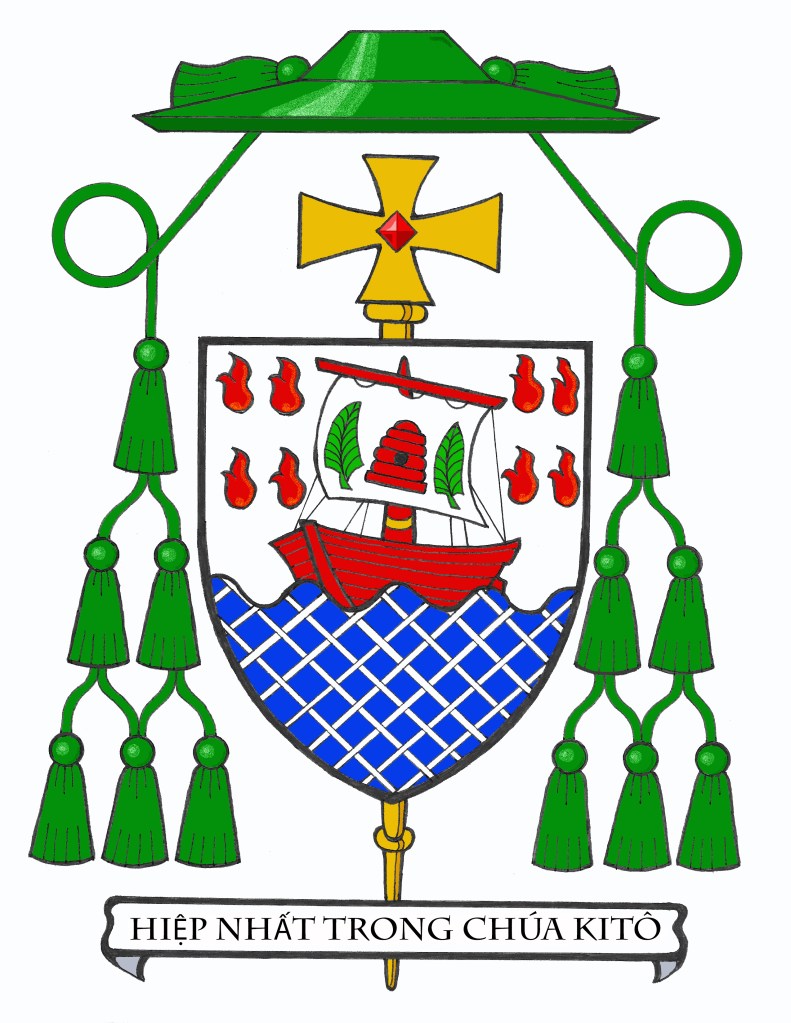
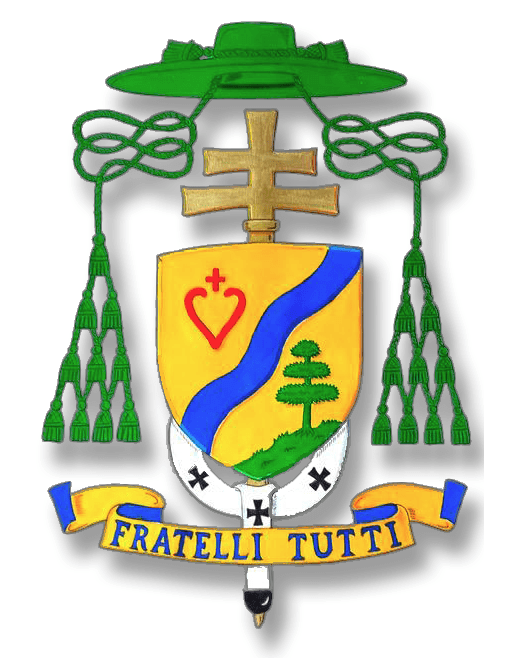
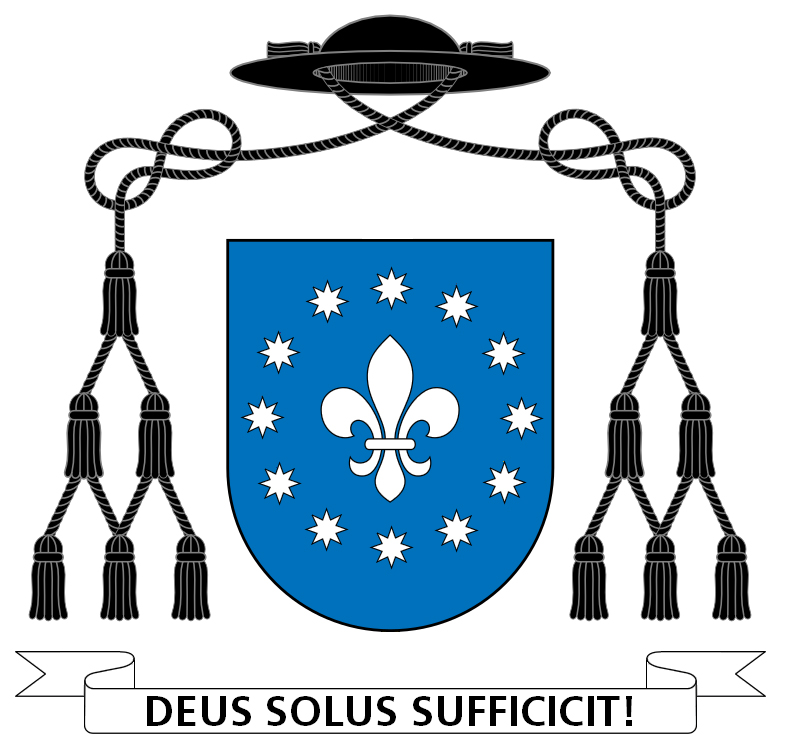
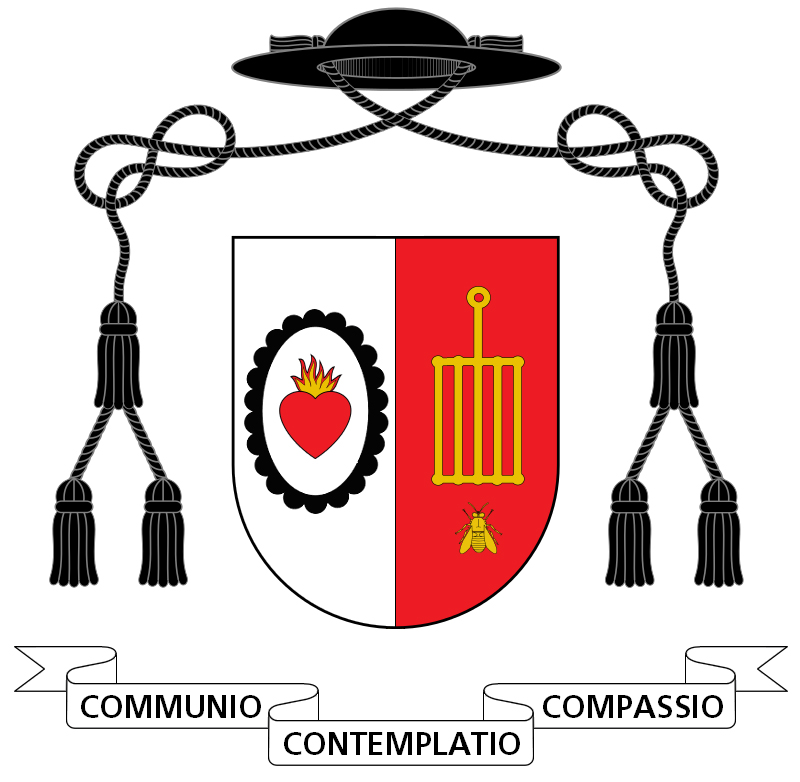
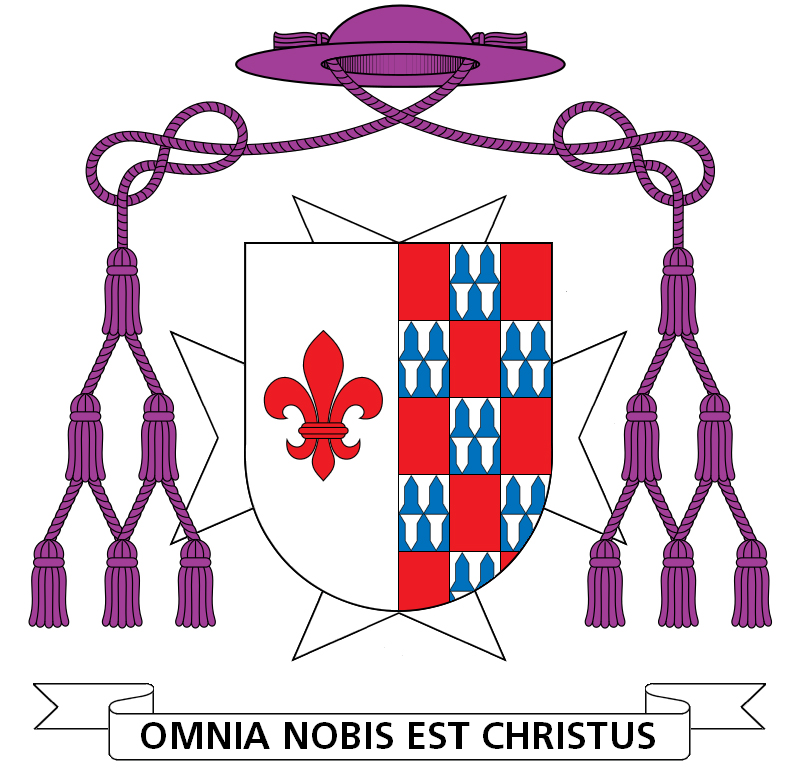
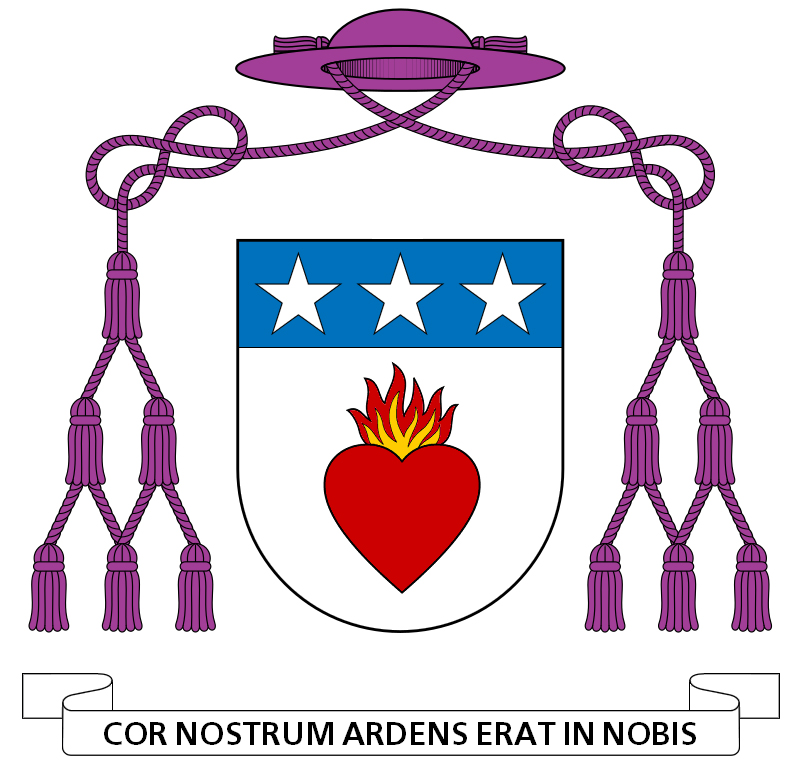
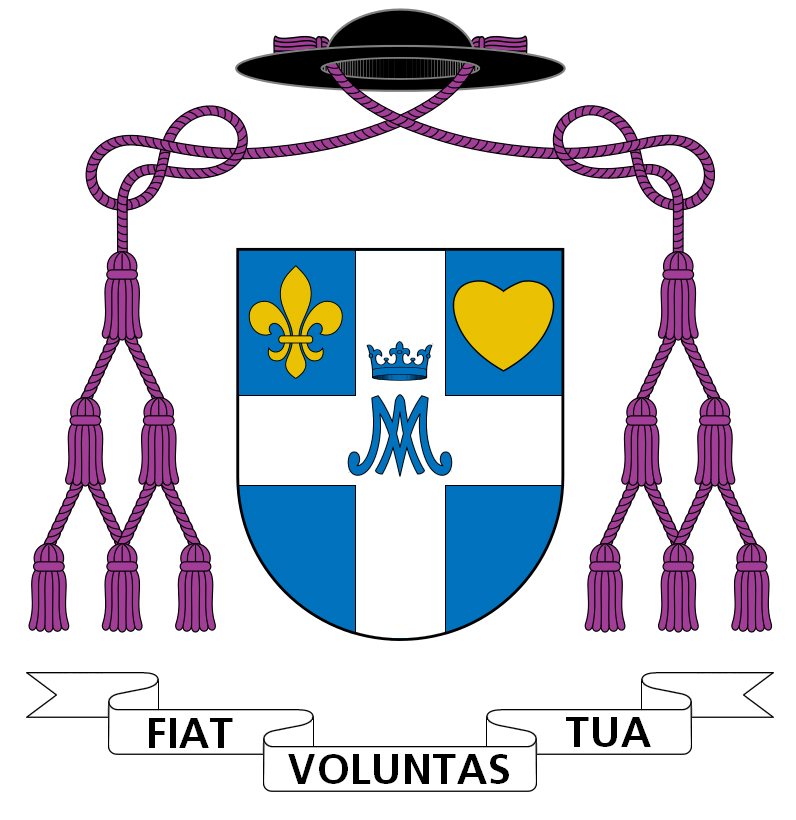
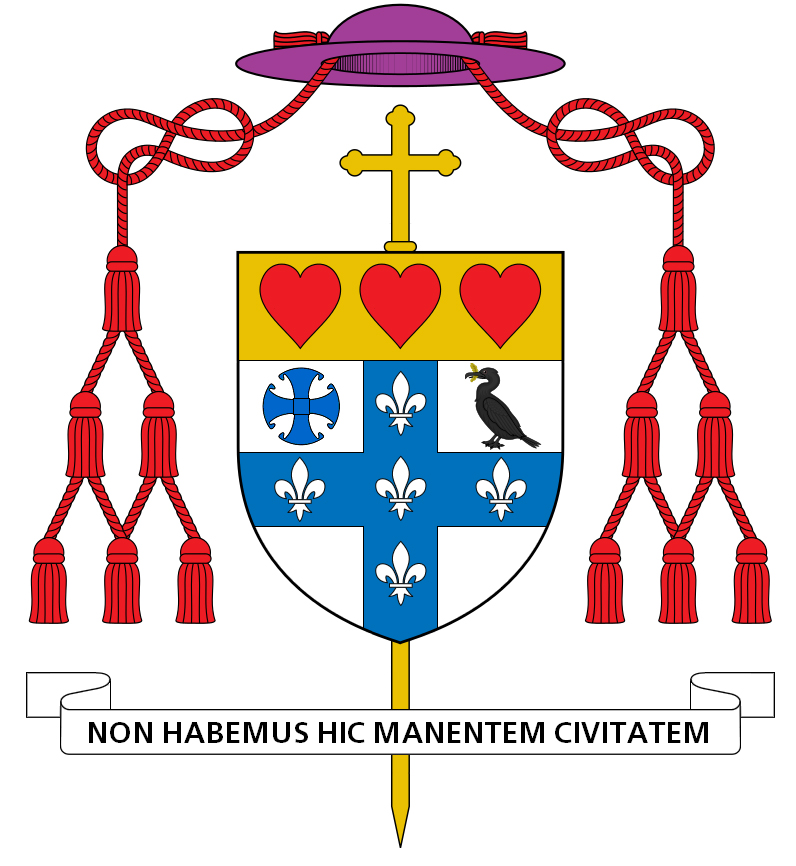
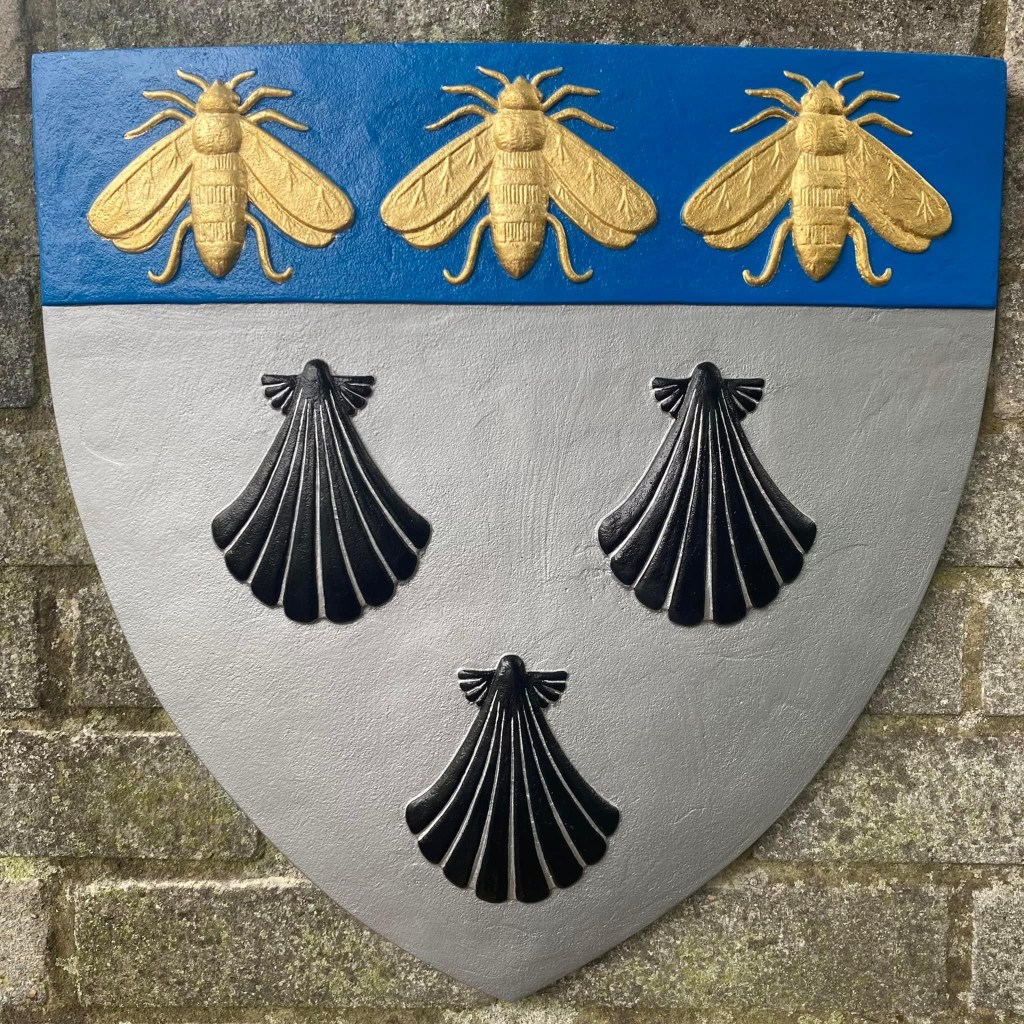
One of my readers, Jorge Hernández Sánchez, from Seville who is also a heraldist has completed some 100 coats of arms specifically for ecclesiastical clients. He sent me quite a few of his creations. Many of them are wonderful examples of the coats of arms of prelates of various types below the rank of bishop. We see a preponderance of episcopal and archiepiscopal heraldry. It’s nice to see the armorial bearings of other ranks in the Church. The following are just a sampling of Jorge’s work…


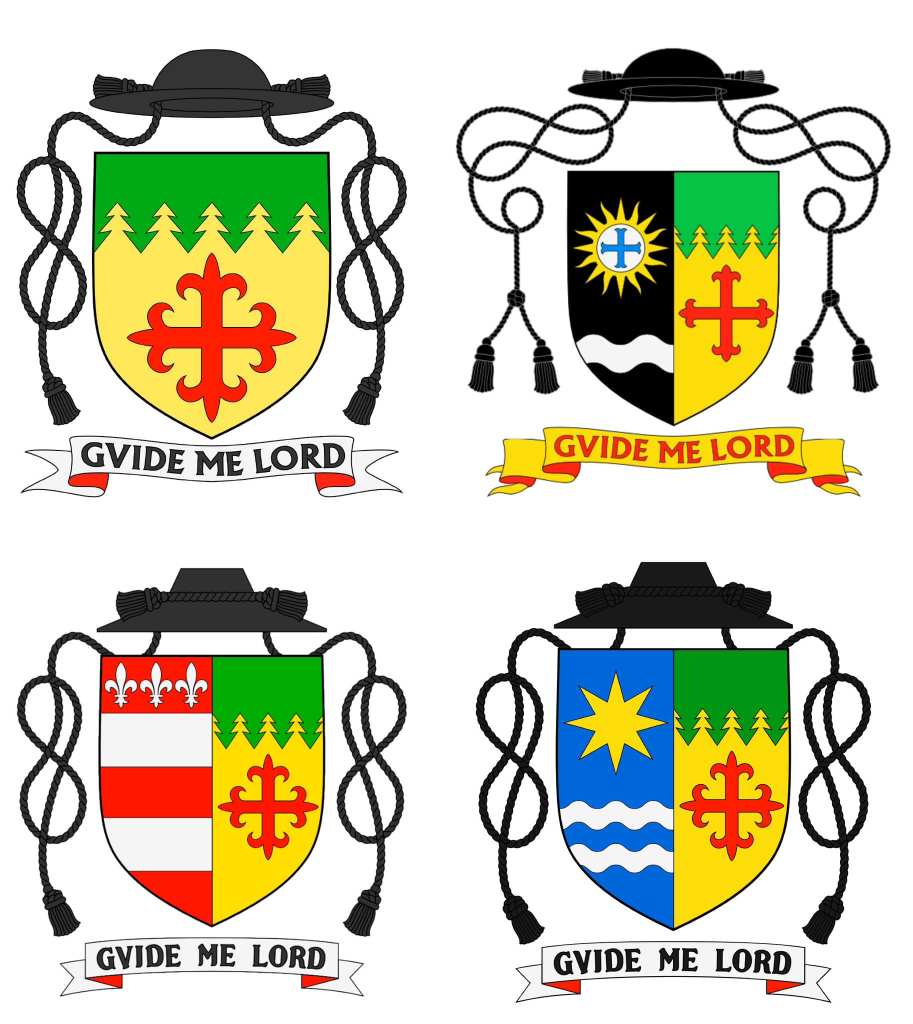
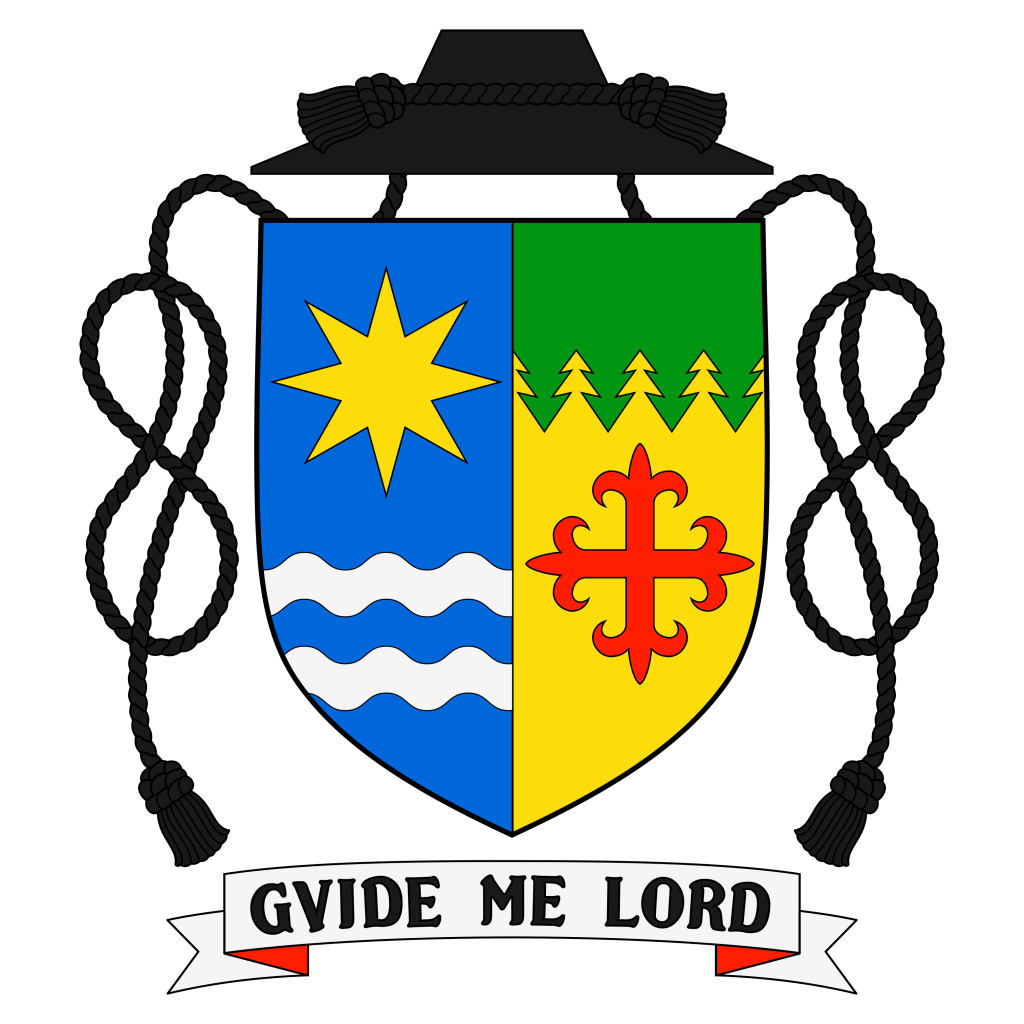
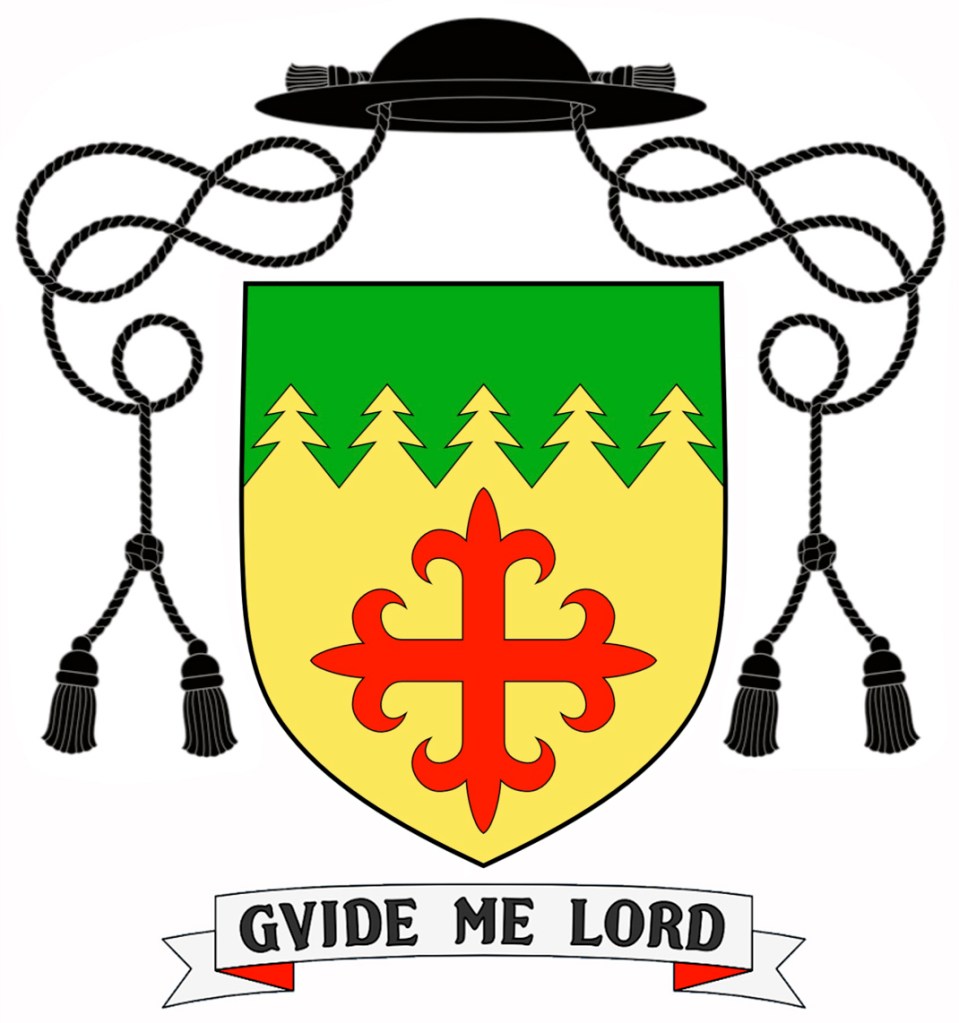
Last November, my Bishop appointed me to serve as the Dean of the Deanery in which my parish is located. That meant there was going to be a modification of my coat of arms. The addition of a second tassel to the galero in my armorial bearings was for the duration of the office of Dean only.

Just yesterday, my Bishop announced the appointment of three new Deans. Two of them are appointed to fill vacancies created by the retirement of two priests. The third is in my own Deanery where a vacancy is about to occur when I am transferred to a new assignment later this month. Since the extra tassel was only “pro hac vice” I must now reliquish it and revert to using the galero of a simple priest, with one tassel pendant on either side of the shield.

As it turns out, I served as a Dean for only nine months. At the time of my appointment last November, my bishop and I had no way of knowing that I would be transferred only the following summer.

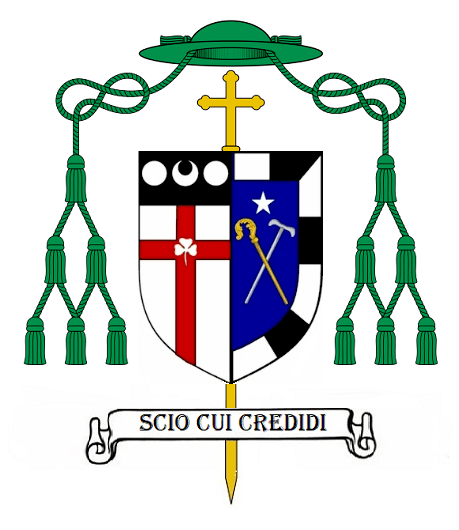
On July 25, the Feast of St. James, Rev. Mons. Edward M. Lohse (61) a priest of the Diocese of Erie, PA since 1989 (and a man who was two years ahead of me at St. Vincent Seminary) is being ordained and installed as the Fifth Bishop of Kalamazoo, Michigan.
The cross in chief is from the attributed arms of St. Edward the Confessor. The division line wavy is from the arms of the See of Erie and it represents the lakeshore where Erie lies. On the fess are symbols of the Jesuit Order and the Benedictine Order both of which profoundly influenced the bishop’s formation and spirituality. The base uses the blue and silver fusils from the arms of Wittelsbach and, by extension, of Bavaria to symbolize his family and faith, both of which have their origins in Bavaria.
The arms are simple, clear and contrast nicely with the somewhat unfortunate arms of the See of Kalamazoo. I think a better composition of the arms would have been to place the Bavarian fusils in chief with the wavy division line beneath them and then have blue field with the cross throughout and the two symbols of the orders in the first and fourth quarters. That’s merely an opinion, mind you, and in matters of taste there can be no real dispute. However, the pattern of fusils in bend looks better at the top of the shield where the eye is first naturally drawn. A solid chief with a patterned base makes a weak composition, in my opinion, because it looks top-heavy.
In addition, the essentially silver (white) backgrounds of both of the roundels placed on a silver fess looks washed out and weak. They would have contrasted better being on a blue field and “popped” a bit more. Also, the cross and lettering on the medal of St. Benedict should be black, rather than blue. I suppose the same could be asserted for the letters on the Jesuit symbol as well.
Overall, it is still a good design and Bishop Lohse certainly has a coat of arms that is better than many other US bishops. That’s not saying much, however, given the appallingly bad heraldry employed by most US bishops. Nevertheless, I think this is a decent coat of arms. My criticism is intended to convey only that it could have been a little better without changing any of the symbolism, but just arranging it better.
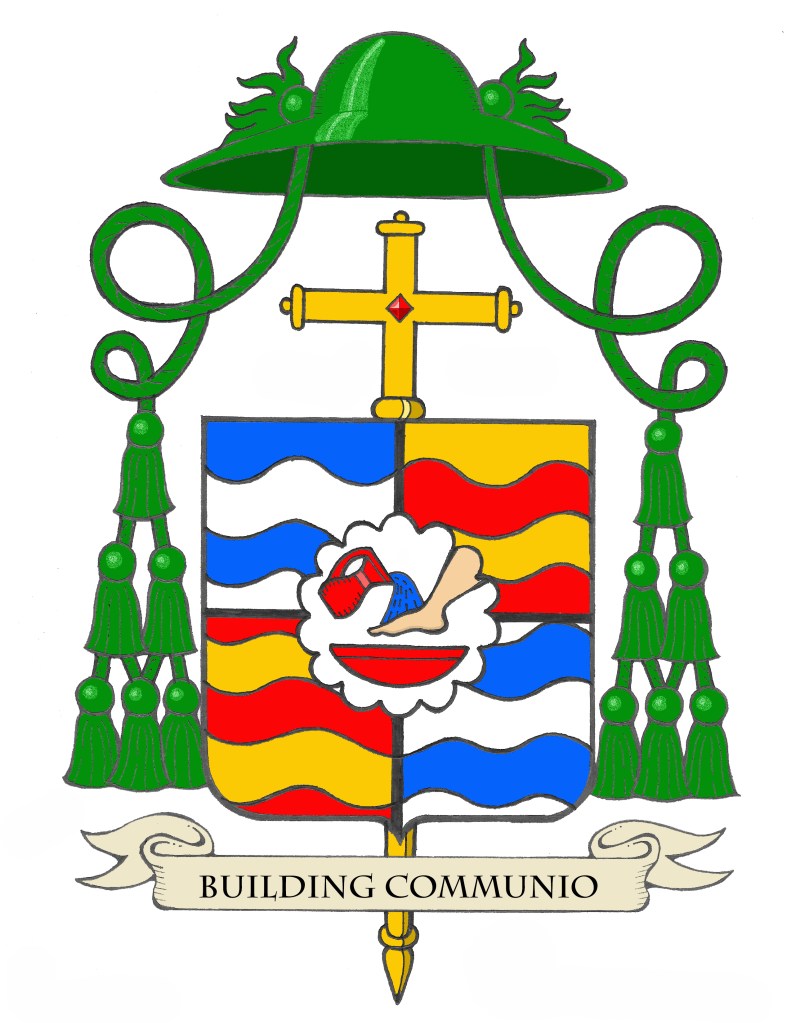
In 2018, the Most Rev. Richard Henning, a native and a priest of Long Island’s Diocese of Rockville Centre, NY (and a high school classmate of mine) became Auxiliary Bishop of that diocese. I was pleased and honored to assist him with the design of his personal coat of arms to be adopted upon ordination to the episcopate.
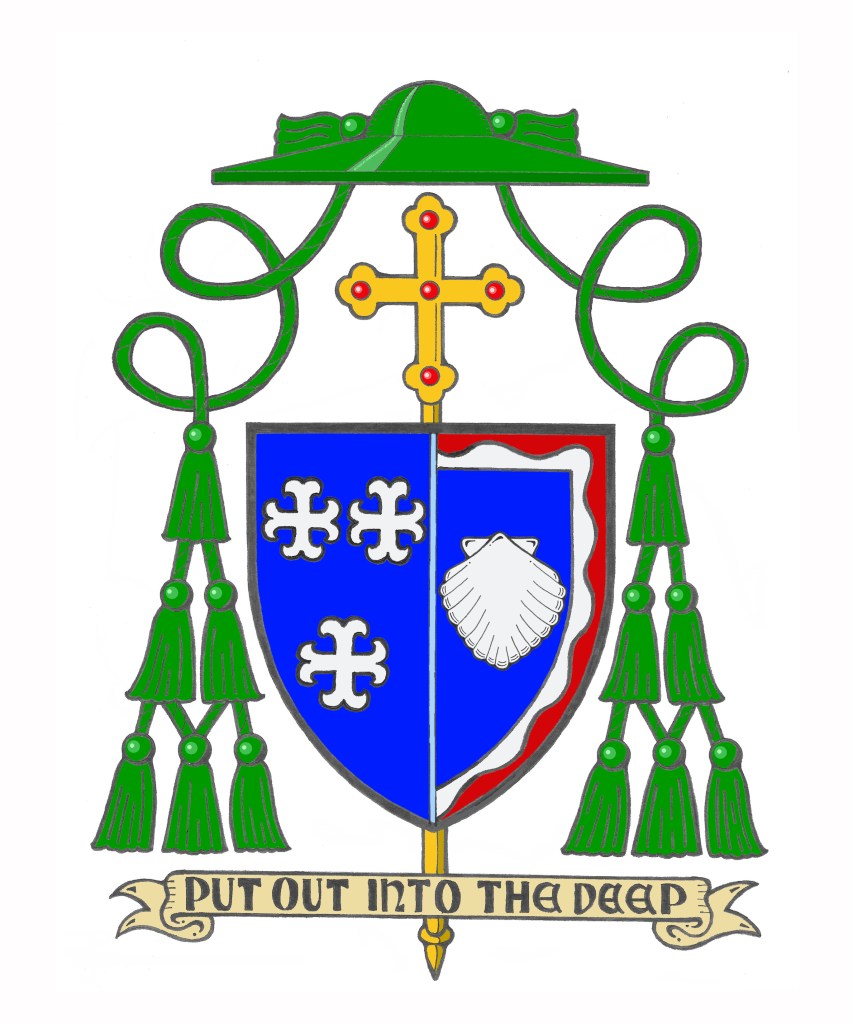
Last year, the Holy Father appointed him to be the Coadjutor Bishop of Providence, Rhode Island, just across Long Island Sound from his former diocese. A coadjutor bishop is appointed to share in the authority of the diocesan bishop in running the diocese and has the right of automatic succession to the See when the previous bishop dies or retires. (NOTE: there used to be such a thing as coadjutor without the right of succession, but such appointments are no longer made). Bishop Henning succeeded to the See of Providence on the first of May of this year upon the retirement of Bishop Thomas Tobin becoming the IX Bishop of Providence. So his armorial bearings have been altered to impale his personal arms with those of the See:

The arms of the Diocese of Providence are composed of a blue field on which are placed three silver (white) crosses with arms that appear to terminate in anchors. These crosses, heraldically known as “moline crosses,” are used to suggest an anchor. By employing the symbol of the State of Rhode Island this signifies that the Diocese of Providence encompasses all of the state it was established to serve. The crosses, three in number to signify The Trinity, are rendered in the traditional colors of water, blue and silver (white), because of the importance that water plays in the life of “The Ocean State.” These colors are also the traditional colors for the representation of the Blessed Virgin Mary, who, in her title of Our Lady of Providence, is Patroness of the Diocese and of the See City.
Bishop Henning’s personal coat of arms is composed of a design depicted in red (Gules), white (Argent) and blue (Azure) which are the national colors of the United States.
Both the blue background and the single escallop shell allude to the sea as evoking the Bishop’s own background and the shell is also borrowed from the coat of arms of the See of Rockville Centre, the diocese in which he was born and raised and which he served as a priest and auxiliary bishop. The shell image also recalls the Bishop’s heritage in the Diocese of Brooklyn, dedicated to its patron, St. James. The episcopal ordination of Bishop Henning took place on the eve of the Feast of St. James. In concert with the Bishop’s motto, the shell is a traditional symbol of baptism and pilgrimage. It is in the depths of these waters that Christians find their salvation in Jesus Christ.
The white wavy line surrounding the blue field is similarly taken from the arms of Rockville Centre and it alludes to the diocese’s location on Long Island, NY. Furthermore, it indicates the sea as the place where the barque of St. Peter, an image used to evoke the Church, is located.
The blue background also evokes the Bishop’s devotion to the Blessed Virgin Mary and his years of service as a Professor and Rector at the Seminary of the Immaculate Conception in Huntington, NY. The red wavy portion of the border evokes the Bishop’s devotion to the Most Sacred Heart of Jesus and his former service as the Director of the Sacred Heart Institute for the Ongoing Formation of the Catholic Clergy.
This situation was one of those times that chance presented a challenge. The bishop wanted to impale his arms with those of the See as is customary in N. America. In addition, he had no good reason to change the diocesan arms and no desire–correctly–to change his personal arms. Impaling them side-by-side presented an aesthetic challenge because they both employ blue fields. In addition, it is customary not to continue a bordure all the way around the field when the arms are impaled. Rather, there is a kind of dimidiation employed whereby the bordure is discontinued along the impalement line. In order to make the division between the two coats of arms more visible, and slightly less confusing a division line of very light blue (blue celeste, if you will) was employed for aesthetic reasons. This is really more of an artistic style choice rather than a heraldic one. Once again, it was my pleasure to assist him with this project.
The Right Reverend Dom Cuthbert Brogan, OSB who first became Prior-Administrator of St. Michael’s Abbey at Farnborough in England in 1996 and was elected as its Abbot in 2006 has–at long last–finally become armigerous! Four years ago he was elected Abbot Visitor of the English-speaking Province of the Subiaco Congregation, to which his monastery belongs. At that time he finally decided to begin the process of applying for a grant of arms from HM College of Arms in London.
This is neither a quick (nor, I must admit an inexpensive) proposition. Nevertheless, those who live in countries where there is an official heraldic authority, such as the College of Arms, are subject to its jurisdiction and are not simply free to assume a coat of arms like those who live in places without a heraldic authority, like the USA for example. Here in the US an abbot may simply assume arms. In those places where there is a state-sponsored heraldic authority it may be illegal to do so, depending on the country.
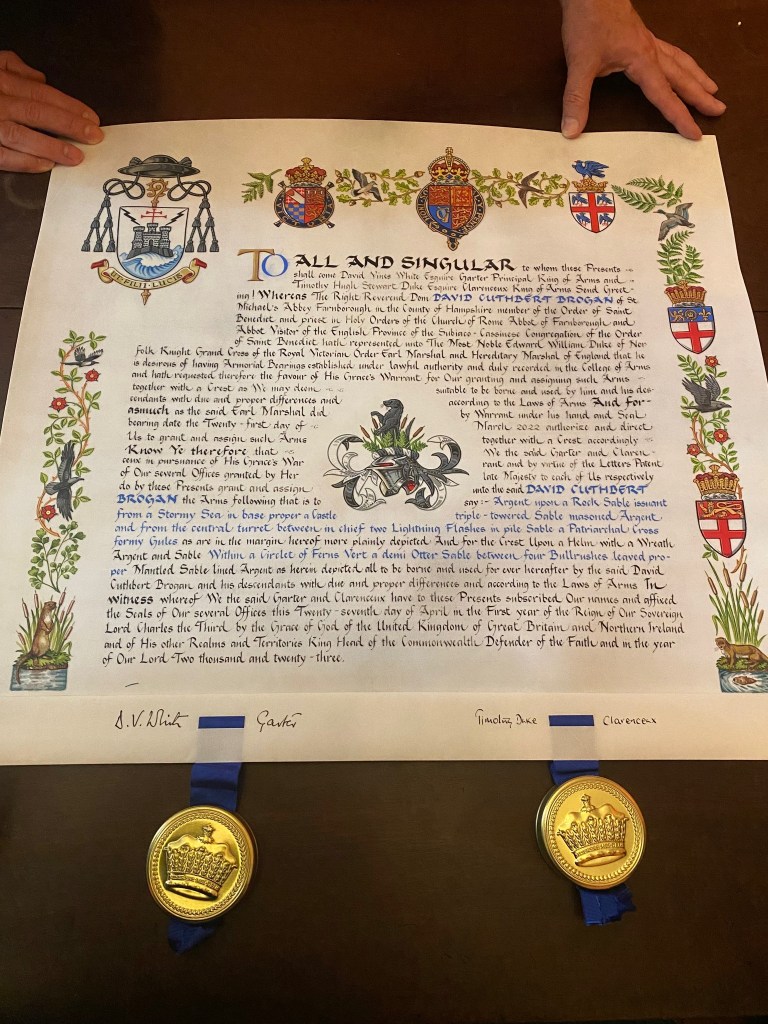
Last week, Dom Cuthbert received his grant of arms and it is magnificent!

As is usually the custom (though not a necessity) a beautiful custom-made, illuminated document for the Letters Patent of the grant was produced. This one bears the royal arms at the top using the “Tudor style” crown preferred by His Majesty between the arms of the Earl marshal, the Duke of Norfolk and the College itself. The margins are decorated with the arms of office of Garter Principal King-of-Arms as well as Clarenceux King-of-Arms who also signed the Letters Patent. The margins also contain bullrushes and otters. The otters are symbolic of St. Cuthbert, the Abbot’s patron. He was born on the feast of St. Cuthbert. Otters warmed the saint’s feet with their breath when he emerged from the North Sea after a night of singing psalms. The bullrushes are for Rushmoor Borough, in which Farnborough Abbey is located. In addition, the raven is a symbol of St. Benedict, the roses are for England and the ducks are another animal alluding to St. Cuthbert.
The College of Arms is in the habit of also providing a crest even for their ecclesiastical clients despite the fact that the galero replaces helm, mantling and crest in the achievement of a cleric. Here the crest is also composed of a demi-otter and ferns and bullrushes (already explained). While it is not used in the achievement, the Abbot is free to use his crest as a stand alone symbol, or even adapt it and use it as a heraldic badge.
It is a nice touch, too, that the grant was dated March 21, 2022 which is the feast day commemorating the Death of St. Benedict.
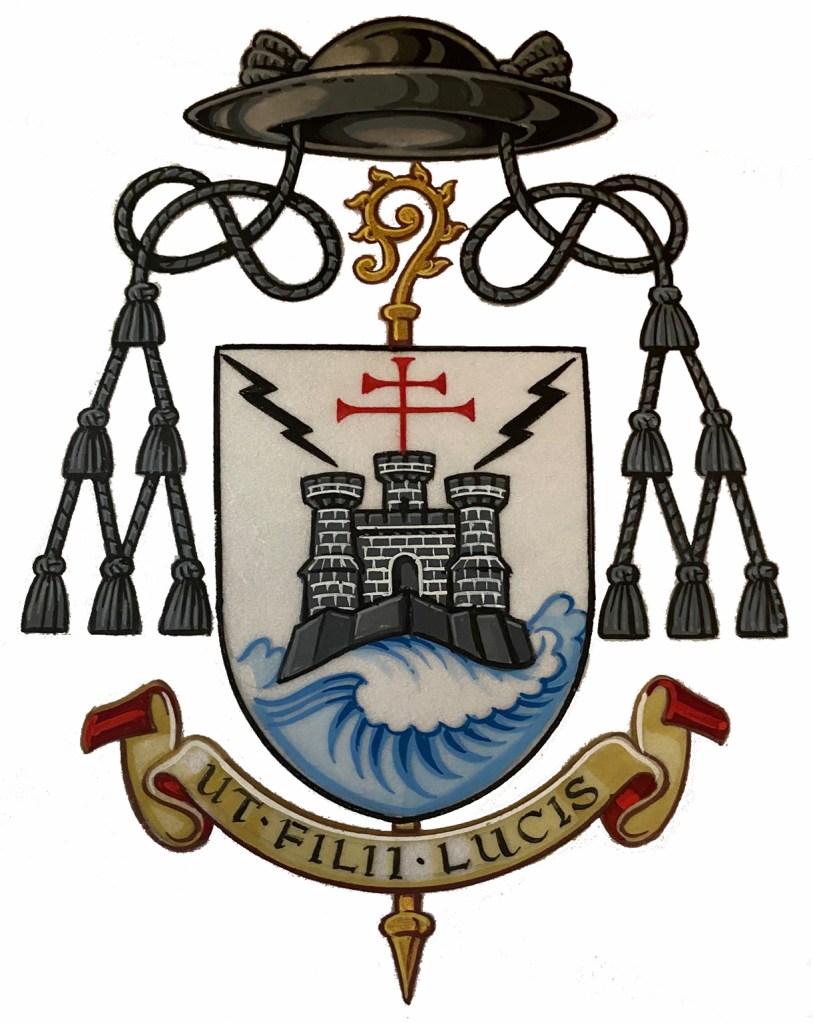
The arms themselves are explained by Abbot Cuthbert thusly: “The fortress is the monastic life – the house built on rock of the gospels. This keeps in certain values and excludes others. The island represents a number of islands – England, Lindisfarne, Mont St Michel, and Caldey – all associated with me or our monastery. The island also represented the fuga mundi – separation from the world which marks the monastic life. The patriarchal cross is from the arms of the Subiaco Cassinese Congregation. The stormy sea expresses how the monastery stands unchanging amongst the vicissitudes of church and world. The two bolts of lightning recall assaults on my monastery from two sources in the past. But the house stood firm“.

The motto below the shield translates as “The Children of Light”.
I am very pleased to say that I was one of the people encouraging Abbot Cuthbert over the years to apply for a grant of arms. It pleases me to no end that after quite a few years he did, indeed, follow my advice. I think the final result was worth the wait. The design is good; clear and simple. In addition, rather than falling prey to the temptation into which so many prelates fall by making their coat of arms a CV in pictures, this coat of arms is filled with significance while using simple imagery. The Abbot chose to symbolize concepts and events of significance to his life rather than his name, or his family name, or the many jobs and/or accomplishments or associations he has had. That’s where so many prelates fail. They insist on symbols of everything and everyone with whom they have been associated throughout theirs lives no matter how slight the association has been.
Abbot Cuthbert has avoided that pitfall and ended up with a bold, clear and very good coat of arms. His abbey also makes use of a fine coat of arms for the abbey itself (see below). Now I’ll have to start needling him to have a rendering done of his arms impaled with those of his abbey!

The Most Rev. Timothy C. Senior (63) a priest of Philadelphia who has served as Auxiliary Bishop there since 2009 was installed as the 12th Bishop of Harrisburg, Pennsylvania. His arms, assumed in 2009, are now impaled with those of his See. The black and white bordure in his personal arms are an interesting allusion to his love of playing the piano.

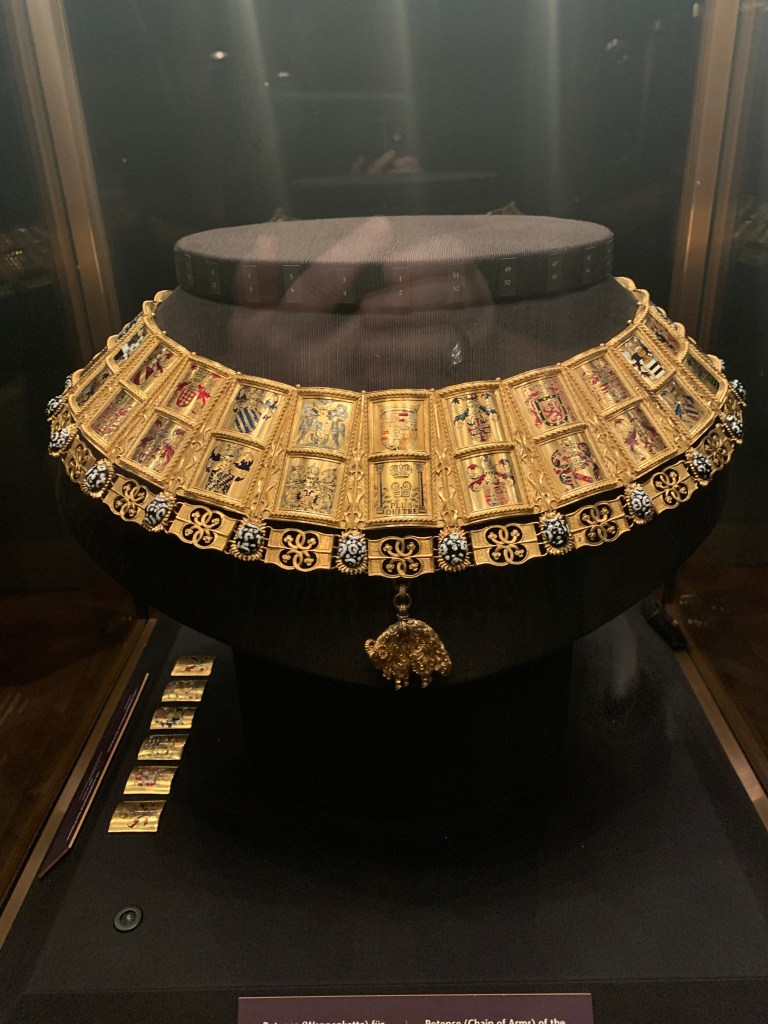
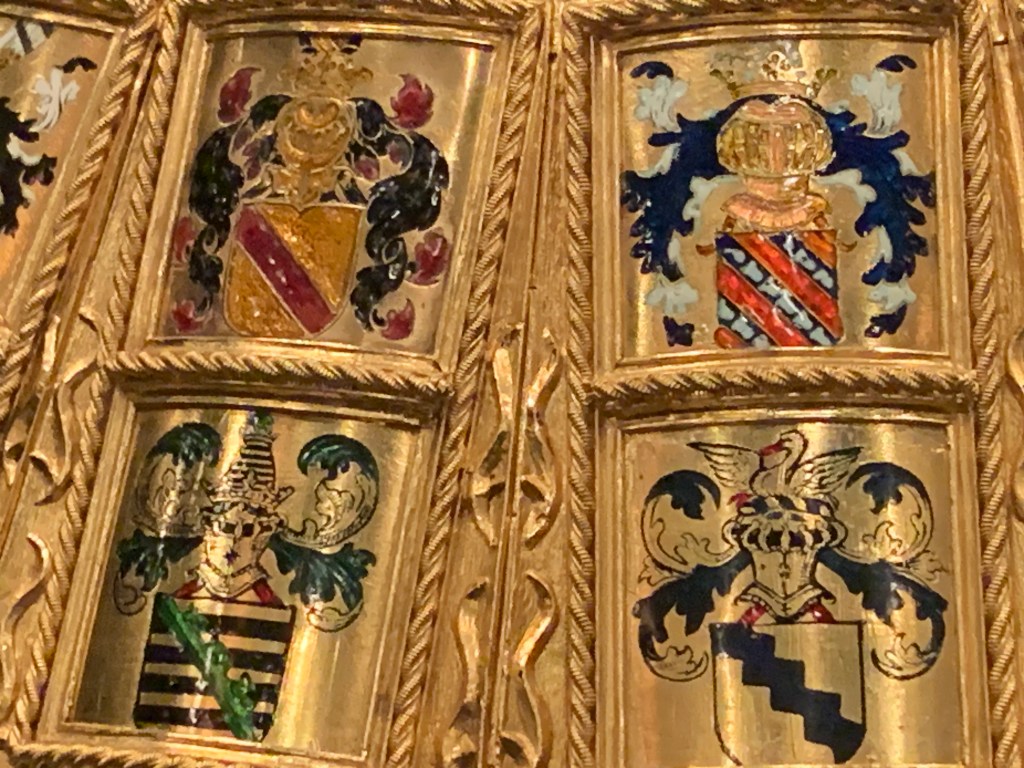
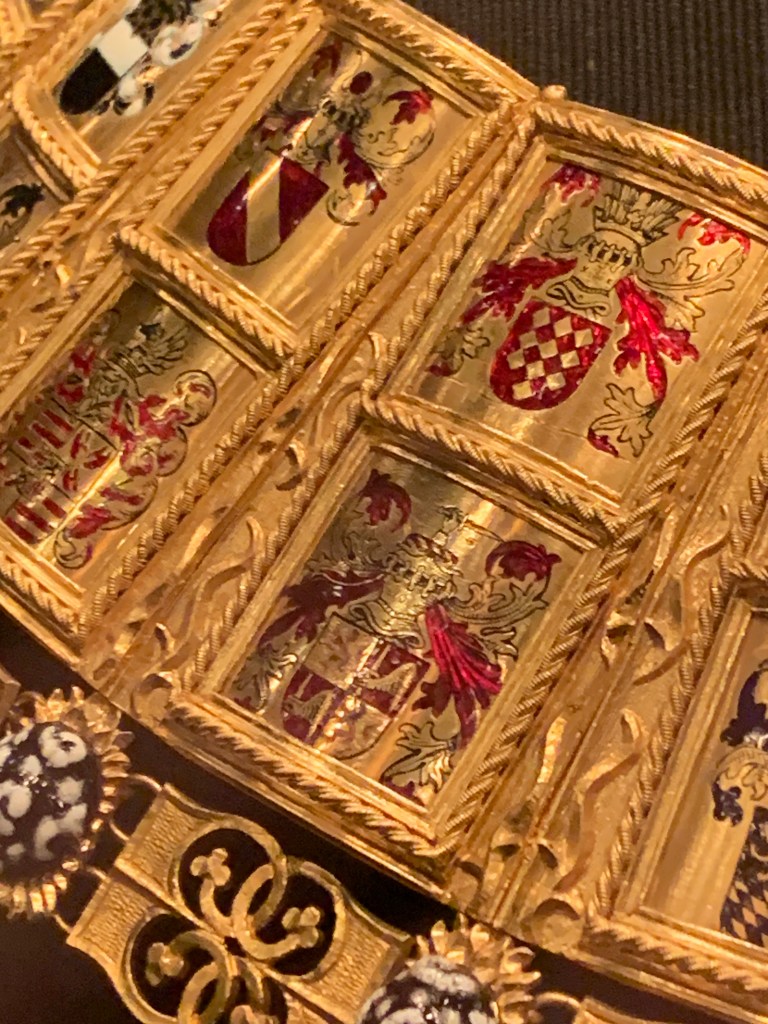
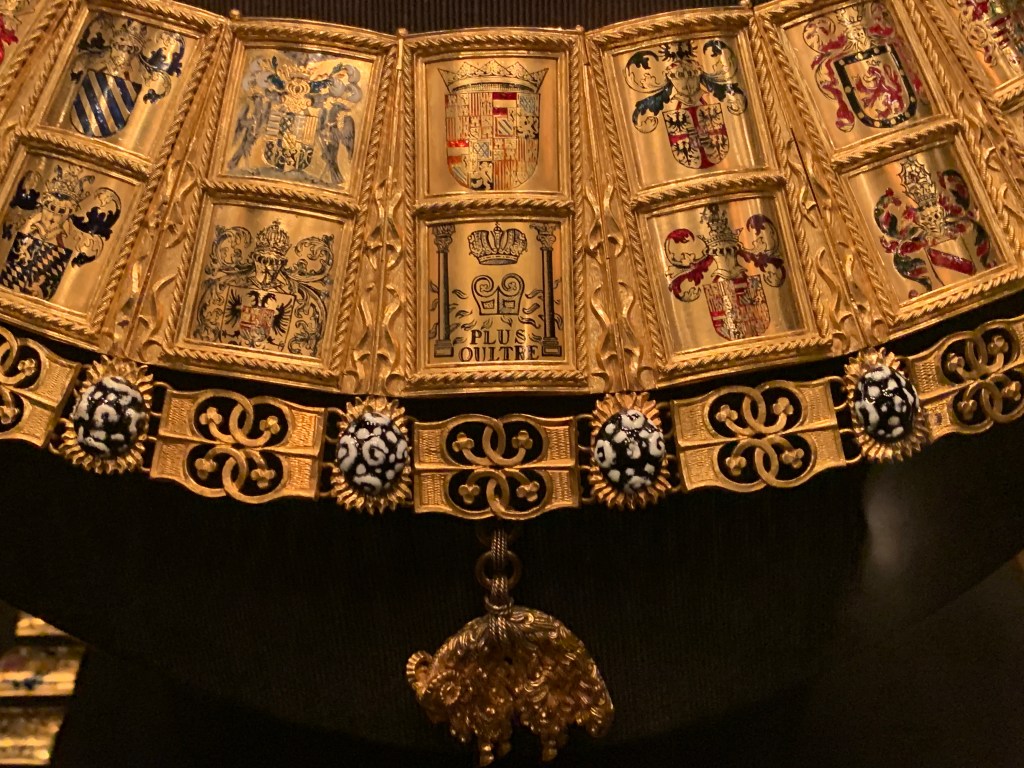
On a recent visit to the Schatzkammer (treasury) of the Hofburg Palace in Vienna I had the chance to reacquaint myself with a real treasure: the heraldic collar, called a potence, of the King-of-Arms of the Distinguished Order of the Golden Fleece. It’s truly amazing and covered in the armorial bearings of the knights of the Order. A feast for the eyes…but it must have been awfully hard on the collar bone and shoulders!


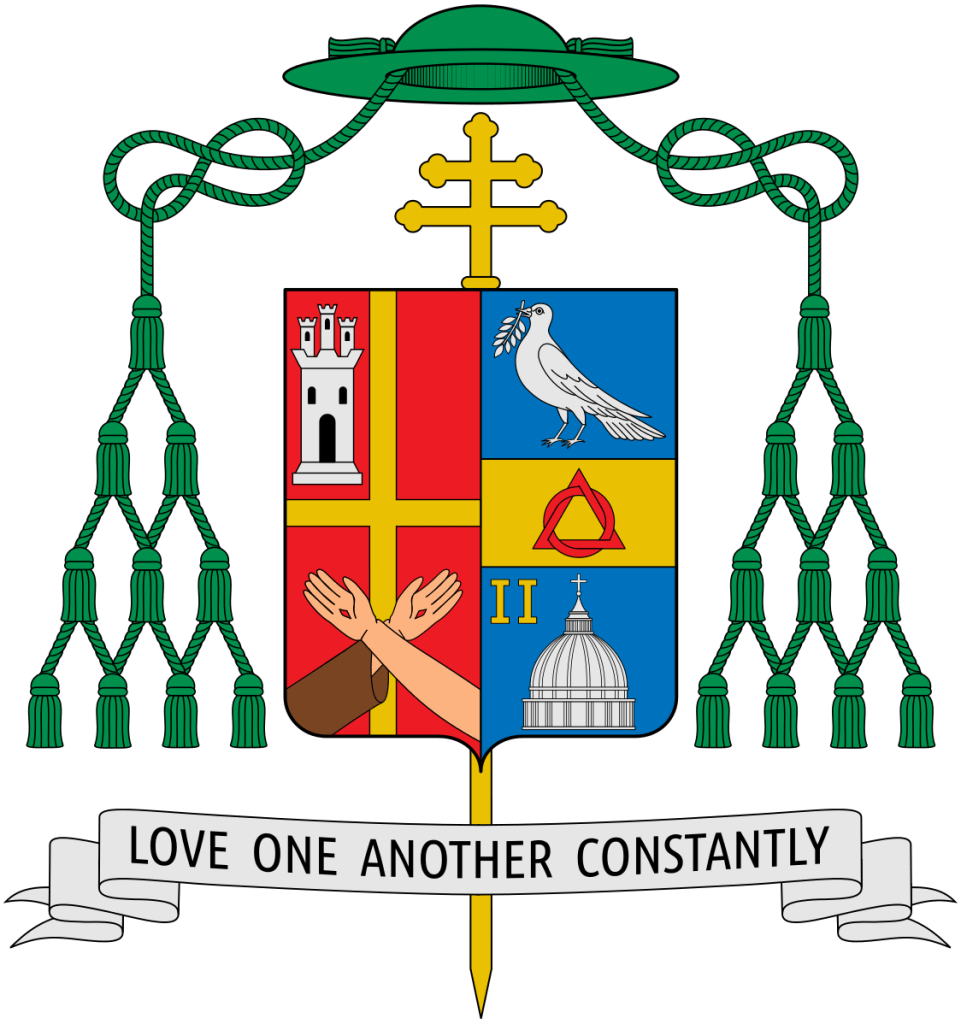
On June 3 the Most Rev. Michael Sheehan, Archbishop Emeritus of Santa Fe where he served from 1993-2015, passed away. He was 84.
His armorial bearings had a rather unusual charge. “Issuing from the bottom of the Archbishop’s arms is the silver (white) dome of St. Peter’s Basilica, in Rome, which is placed below a gold (yellow) Roman Numeral two (II) to signify that Archbishop Sheehan was in St. Peter’s on the day that Vatican Council II opened.”
Uh-huh.
All I can say, while meaning no personal disrespect to the deceased archbishop, is: nice try.

Sincere good wishes to the Canadian Heraldic Authority (Autorité Héraldique du Canada) as they celebrate their 35th anniversary!
In 1988 the Queen of Canada issued letters patent granting permission for the Governor General “to exercise or provide for the exercise of all powers and authorities lawfully belonging to Us as Queen of Canada in respect of the granting of armorial bearings in Canada”. On June 4, 1988 Governor General Jeanne Sauvé authorized the creation of the CHA.

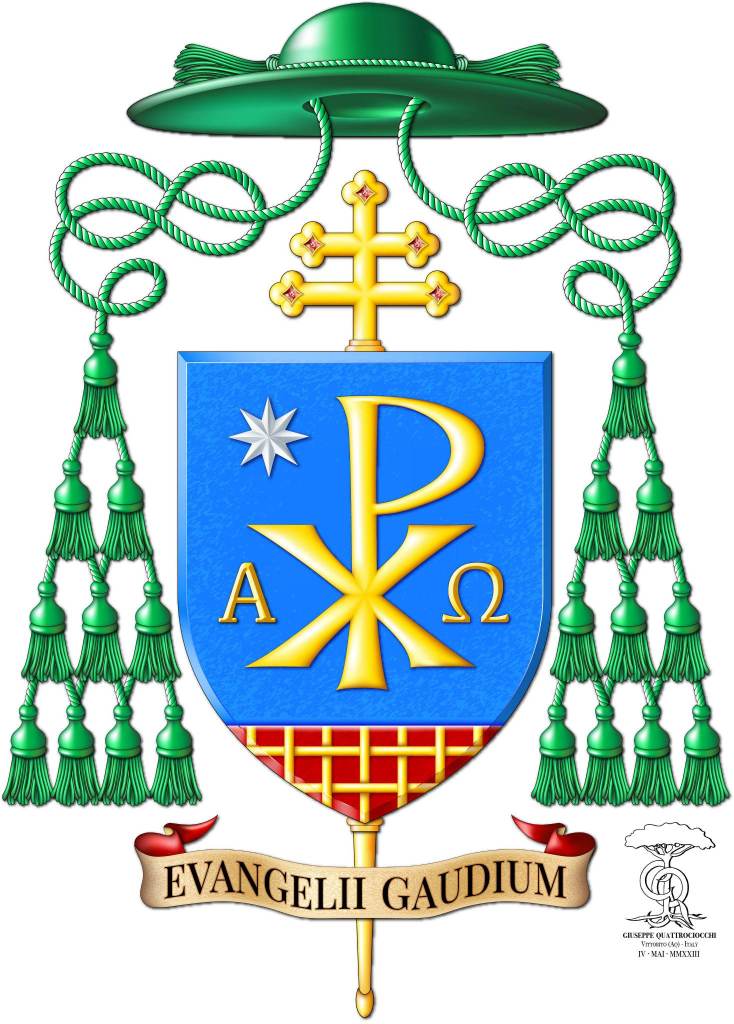
Father Diego Giovanni Ravelli (57) a priest of the Suburbican Diocese of Velletri-Segni who currently serves as the Master of Pontifical Liturgical Celebrations of the Office of Liturgical Celebrations of the Supreme Pontiff, in other words, the Pope’s Master of Ceremonies, will be ordained as the Titular Archbishop of Recanati, a new Titular See established in 2022 on June 3 at St. Peter’s basilica in the Vatican by Pietro Cardinal Parolin, papal Secretary of State.
The armorial bearings he is assuming were prepared by Giuseppe Quattrociocchi. The make use of simple and bold symbolism. The grid in base is a reference to St. Lawrence the Martyr.

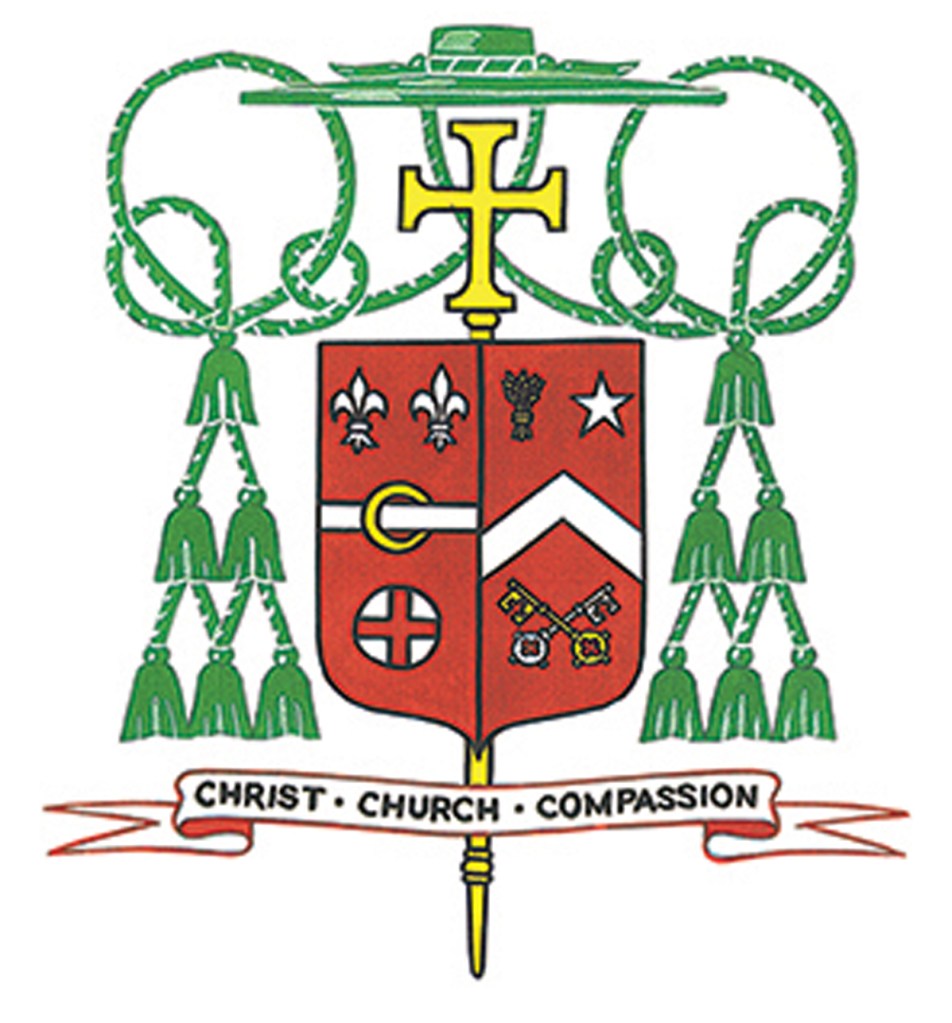
The Most Rev. Edward Cullen, a priest of Philadelphia who served as Auxiliary Bishop there from 1994-1997 and who went on to become the Third Bishop of Allentown, PA from 1997-2009, passed away on May 9, 2023 at age 90. RIP.

The coat of arms he assumed upon becoming a bishop in 1994 is simple enough. Because so many bishops want to include as much symbolism as they can he decided against symmetry by having the garb and the star next to each other. The problem is that symmetry is an important aspect of heraldic art. It might have been better to place the star in the center between two garbs. Even though that increases the number of charges it provides for a more symmetrical look and avoids the appearance of a bunch of charges merely splayed across a shield. The garb may only represent one thing but having two of them would still have looked better.
Some might say, “But then it is as if they represent two separate things.” Only if you are being tiresomely literal. Solely for the sake of symmetry and a better composition and appearance, two garbs with a star between them would have been a better choice.
It is unfortunate that the personal arms and the diocesan arms both had fields Gules. But, sometimes that kind of thing happens. It would not have been a good idea to change the field in the personal arms to something else. Occasionally, the luck of the draw created some unfortunate combinations when marshaling arms together. That’s just the way it is. In such situations a bishop could consider not impaling his arms with those of the See or the artist could get creative with the depiction of the coat of arms by doing something like employing a division line of a color other than merely black to separate the two impalements.
Overall he had a nice coat of arms but with a little bit of help it could have been even better.

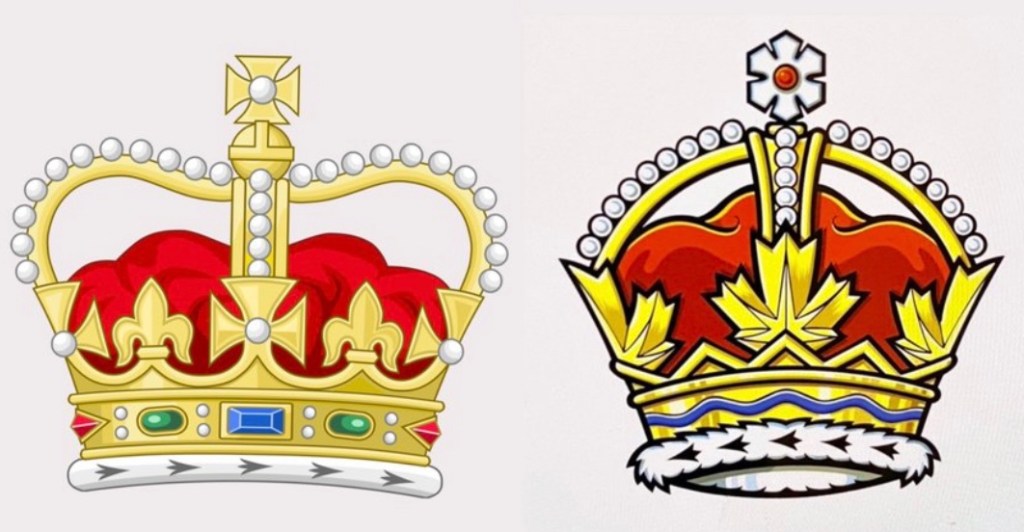
Today, the Canadian Government of Justin Trudeau unveiled a new heraldic Canadian Crown replacing the traditional St. Edward’s Crown used on Canada’s coat of arms, police & military badges. The design replaces what the government termed “religious symbols” (crosses & fleur-de-lis) with maple leaves & a snowflake.
The Canadian Heraldic Authority was apparently consulted in this process. Reactions so far have been mixed but mostly disapproving.

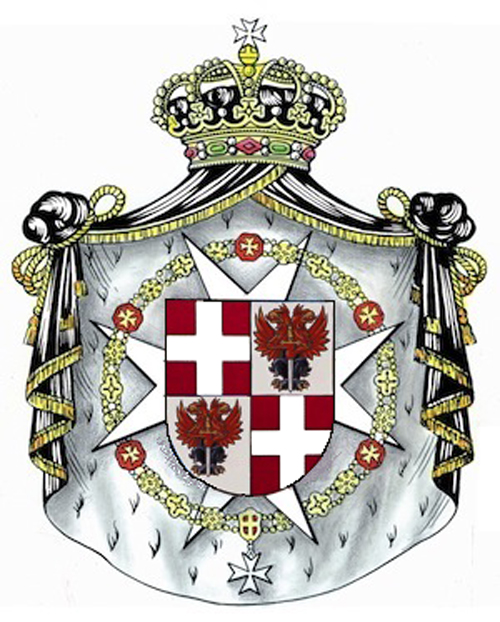
On May 3, 2023 Fra’ John Dunlap the Lieutenant of the Order of Malta since 2022, was elected as Prince and 81st Grand Master of the Sovereign Military Hospitaller Order of St. John of Jerusalem, Rhodes and Malta. He is a 66-year-old Canadian and the first Professed Knight from the Americas to be elected as head of the Order. In accordance with the current Constitutions of the Order he will serve for a term of 10 years. Ad Multos Annos!

It was very interesting to read in the Times that Lord Lyon King-of-Arms, the senior heraldic officer in Scotland will not only take part in King Charles’ coronation on May 6 but will do so wearing the crown that had been commissioned and obtained by the Heraldry Society of Scotland back in the early 2000s. The arches on the crown, which are removable, will be removed for the coronation so it won’t too closely resemble the crown with which the King shall be crowned.
The expensive item and the trouble that went into commissioning and fabricating it was one of the reasons that, despite the Peers not being allowed to wear their coronets at the upcoming, more modernized, ceremony Lord Lyon–and indeed the other three English Kings-of-Arms–will be wearing their crowns. The coronation of the Sovereign is one of the only occasions on which these crowns are traditionally worn.

On February 21, HM King Charles III granted new arms to Her Majesty Queen Camilla. This is the first grant of arms made by the King and they replace the arms previously granted buy the late Queen Elizabeth on July 14, 2005. The arms granted are:
“Within the Garter Our Royal Arms impaling the Arms of Shand surmounted by Our Crown.”
The Supporters are a Lion Guardant Or Crowned proper (dexter) and to the sinister a Boar Azure armed and unguled Or langued Gules and gorged with a Coronet composed of Crosses formy and Fleurs-de-lys attached thereto a Chain reflexed over the back and ending in a Ring all Or (sinister).
This month marks the 80th anniversary of the office of Norroy and Ulster King of Arms. The office of Ulster King of Arms was created by King Edward VI on February 2, 1552, and for its first 36 years, appears to have been regarded as attached to the College of Arms; the two Ulsters in this period, Bartholomew Butler and Nicholas Narboon, had both been English Heralds before their appointment as Ulster. After the resignation of Narboon in 1588, subsequent Ulsters acted independently from the English College. On January 30, 1908, King Edward VII appointed Captain Nevile Rodwell Wilkinson King of Arms and Principal Herald of all that part of the United Kingdom of Great Britain and Ireland called Ireland, with the title of Ulster. Wilkinson exercised this office, based in Dublin Castle, through a period of great political turmoil in Ireland until his death on December 22, 1940. The political circumstances in Ireland at this time led to the decision to return the office of Ulster to the College of Arms in London, with responsibility for Northern Ireland alone, and united with the office of Norroy.
On January 29, 1931, King George V had appointed Algar Henry Stafford Howard, M.C., as King of Arms and Principal Herald of the North Part of England, with the title of Norroy. Howard still held this office on April 1, 1943, when King George VI additionally appointed him King of Arms and Principal Herald of that part of the United Kingdom of Great Britain and Northern Ireland called Northern Ireland, without prejudice to his existing appointment as Norroy and with the title of Ulster to be borne after that of Norroy. Howard held these joint offices until his promotion to Garter the next year, and on June 2, 1944, King George VI appointed Sir Gerald Woods Wollaston, K.C.B, K.C.V.O., King of Arms and Principal Herald of the North Part of England and of Northern Ireland, with the title of Norroy and Ulster, which has remained the form of the office to this day. The present Norroy and Ulster, Robert John Baptist Noel, was appointed by Queen Elizabeth II on April 6, 2021. He proclaimed the accession of His Majesty The King at Hillsborough Castle in Northern Ireland on September 10, 2022, the first time Ulster had performed such a duty in Ireland since the proclamation of King George V in Dublin on May 9, 1910.
Between 1943 and 1980, holders of the office of Norroy and Ulster used the arms of office of one of the two offices, or both arms impaled on one shield. In 1980, Queen Elizabeth II approved new arms for the joint office. These are: Quarterly Argent and Or a Cross Gules on a Chief per pale Azure and Gules a Lion passant guardant crowned between a Fleur-de-lis and a Harp Or. Norroy and Ulster King of Arms is also ex officio King of Arms, Knight Attendant, Registrar, and Keeper of the Records of the Most Illustrious Order of Saint Patrick, offices which are purely nominal since the death of the last Knight of the order.

Text taken from the College of Arms Newsletter, No. 71 April, 2023
Fr. Guy Selvester's blog of Ecclesiastical Heraldry