Archbishop Cupich of Chicago (UPDATED)

sc00c0d1d7c

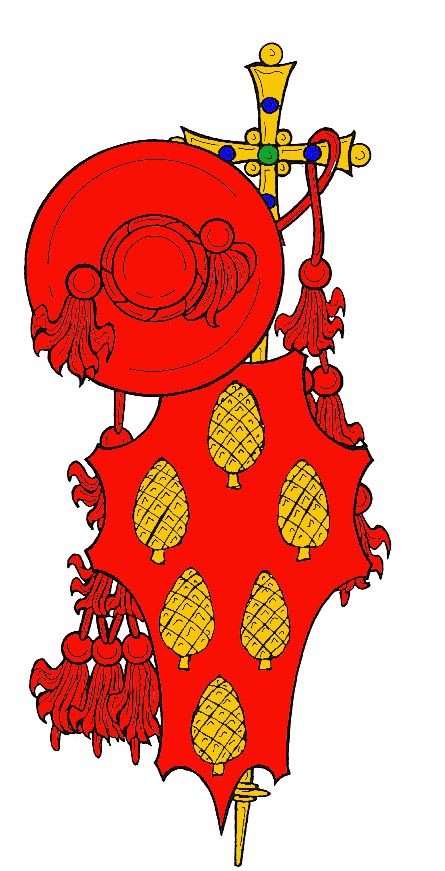
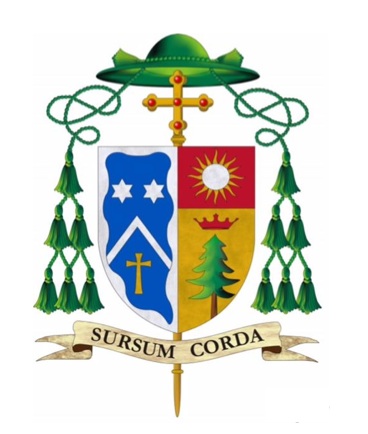
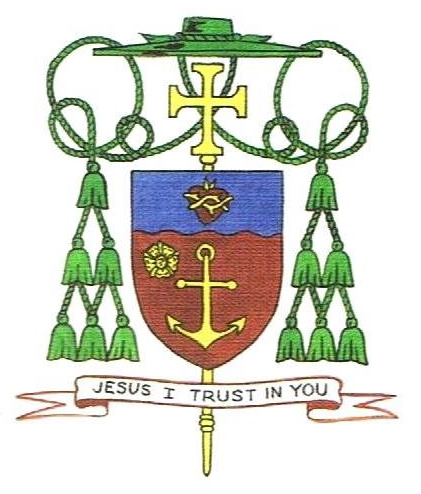
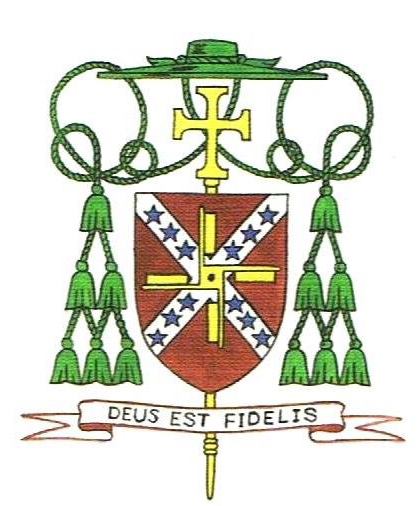
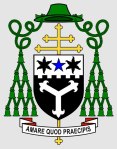
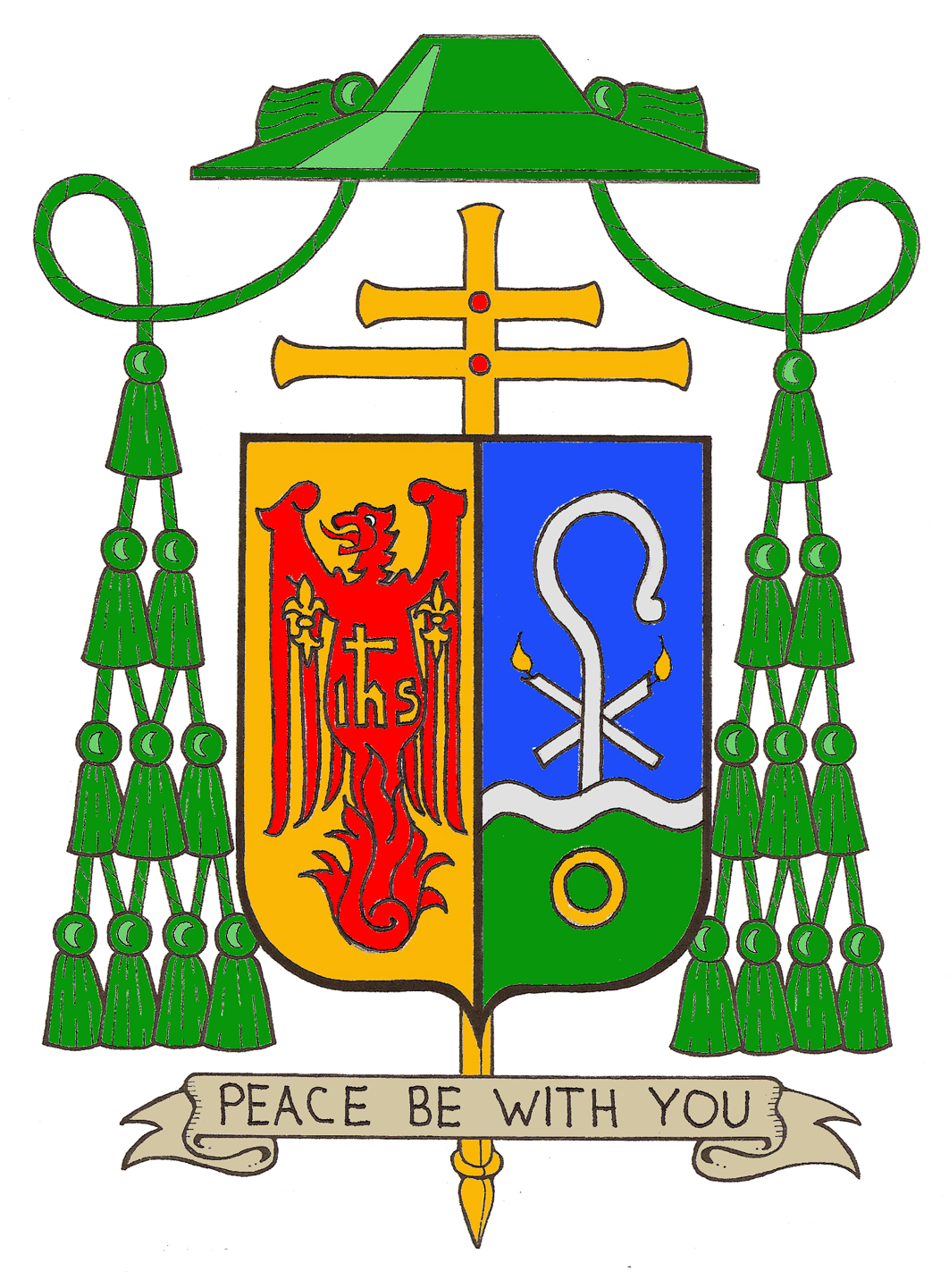
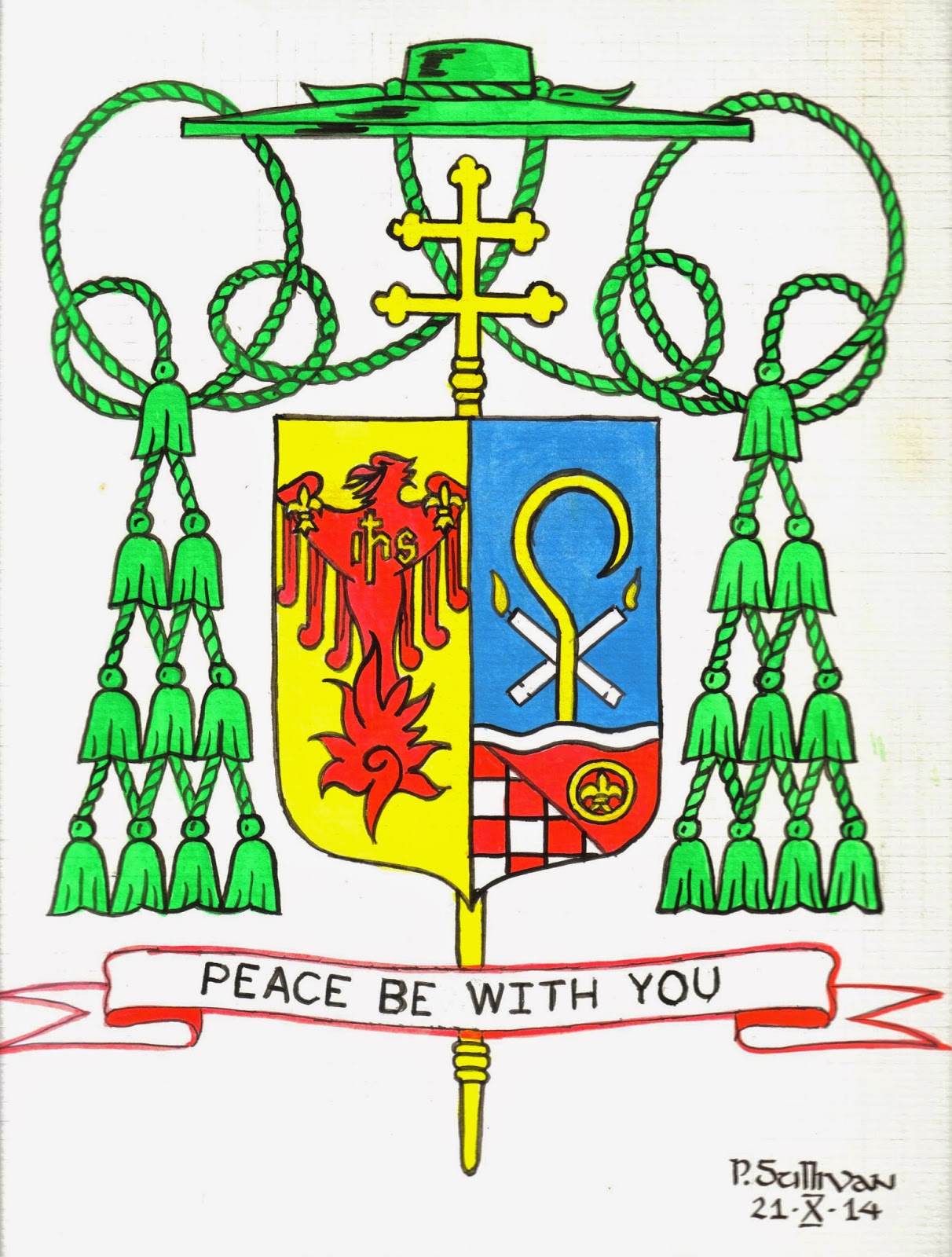
This morning Pope Francis appointed The Most Rev. Blase Cupich up until now Bishop of Spokane, Washington to be the 13th Archbishop of Chicago, Illinois. The arms of Archbishop-Designate Cupich allude to his baptismal patron, St. Blase. Traditionally, on the feast of that saint, the patron of those with diseases of the throat, two candles are used in the blessing of throats by placing them on either side of the throat and reciting the blessing. The arms of the venerable See of Chicago depict a phoenix rising from the ashes as an allusion to the famous Chicago fire and also include symbols of the French settlers in that area and the titular of the cathedral: The Most Holy Name. Cupich will be installed in Chicago on November 18.

UPDATE: The archbishop has decided slightly to modify his coat of arms (below)

bjcccoa2

Very Nice Diocesan Arms

On Sept. 24th Edgar da Cunha will be installed as the new bishop of Fall River, MA. The diocese possesses a very nicely designed coat of arms that even includes a nice “can’t” or heraldic pun based on the name of the See. The wavy line that crosses the shield from the upper left to the lower right depicts a river that falls as one looks at it from left to right. Thus, it “says” the name of the diocese. In addition, the overall design is simple and uncluttered. The cross is a sign of the faith and the grace of God and the star is a symbol of the titular of the cathedral: St. Mary. The arms were designed by Pierre Chaignon la Rose.

640px-Roman_Catholic_Diocese_of_Fall_River.svg

Cardinal Woelki of Cologne

Wappen_Erzbischof_Koxln_Woelki

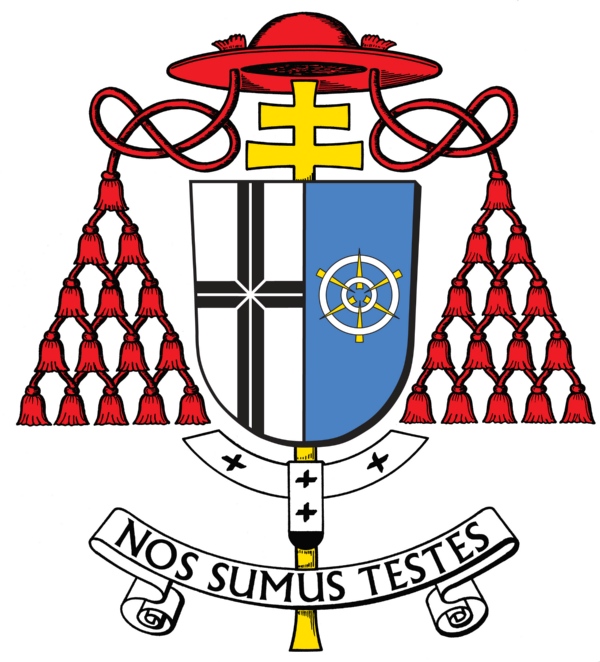
On September 20 Rainer Maria Cardinal Woelki of Berlin will be installed as the 32nd Archbishop of Cologne, Germany. The very simple arms of the see (Argent a cross throughout Sable) are impaled with the cardinal’s equally simple personal arms.

A blue field with a silver wheel with 6 golden wedges as spokes alternately directed outward or inward. This is the so-called Radbild of Brother Klaus, Niklaus von Flue (1417-1487), which refers to the cardinal’s home parish of St. Bruder Klaus in the Bruder Klaus settlement in Cologne-Mülheim. This circular pattern with the aufzufassenden as golden wedges combines theological, philosophical and mathematical elements. Three rays emanate from the center, just as God does not want to remain in Himself but in turn loves man . Three beams have the opposite disposition and lead to God, the response of those desires which are filled with His love.

The motto, from Acts 5:32, translates as, “We are Witnesses”.

A Possibility if Scotland Votes For Independence (UPDATED)

Just today the news has been spreading that, for the first time, the polls are showing that those who seem to favor voting for Scottish independence are in the majority, albeit an ever so slight one (within the margin of error, in fact). The vote is less than two weeks away and what once seemed like a proposition that was surely not going to pass now looks like it may have a fighting chance. It will be interesting to see the result of the vote. Polls can be deceiving and in the time remaining it may swing the other way agin. I’m not interested in discussing the politics involved. However, there is a possibility, and it is just that: merely a possibility, that there could be some heraldic ramifications for the Queen if Scotland becomes independent.

At present, the plan is that even if Scotland votes for independence it would remain a constitutional monarchy. Scottish First Minister, Alex Salmond, has indicated that there is no plan to declare a republic, at least not immediately. Rather, Her Majesty would still be Queen of Scotland and act as the Scottish Head of State in an independent Scotland. However, such a scenario could remove Scotland from the United Kingdom. So, as the Queen is in some sixteen countries already she would be the sovereign of Scotland and she would continue to be the sovereign of the U.K. with the difference that the U.K. would no longer include Scotland. This would not be unique. The Queen is Queen of Canada, Queen of Australia and Queen of New Zealand, for example. None of those countries is in the U.K but she is, nonetheless, sovereign of those nations.

With an independent Scotland the United Kingdom would consist of England (including Wales) and Northern Ireland. Currently the U.K is described as a united kingdom of “Great Britain and Northern Ireland” meaning all of the territory on the island of Britain as well as the northern part of the the separate island where Ireland is located. (NOTE: the Channel Islands are possessions of the Queen but not part of the U.K.) I suppose it could be argued that if she remains the Queen of Scotland then she could still be said to be Queen of Great Britain. However, the point of this referendum is that now Great Britain and N. Ireland is all one country and the Scottish people will be voting on whether or not they want Scotland to be a separate country. This would make it a separate country with its own monarch who happens to be the same person as the monarch of the U.K. as is the case with Canada, Australia, etc. While those working for an independent Scotland have assured the voters that there is no plan at present to dump the monarchy that does not mean it might not be considered at some future time, such as after the passing of the present Queen. In fairness, it should be pointed out that it would also be possible to have a politically independent Scotland while maintaining a monarchial union, that is to say, that Scotland would continue to be part of a United Kingdom with its own separate government.

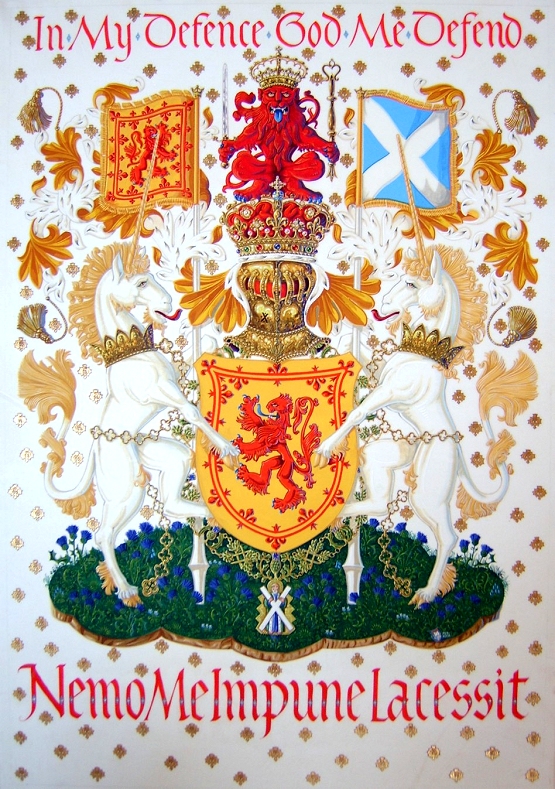
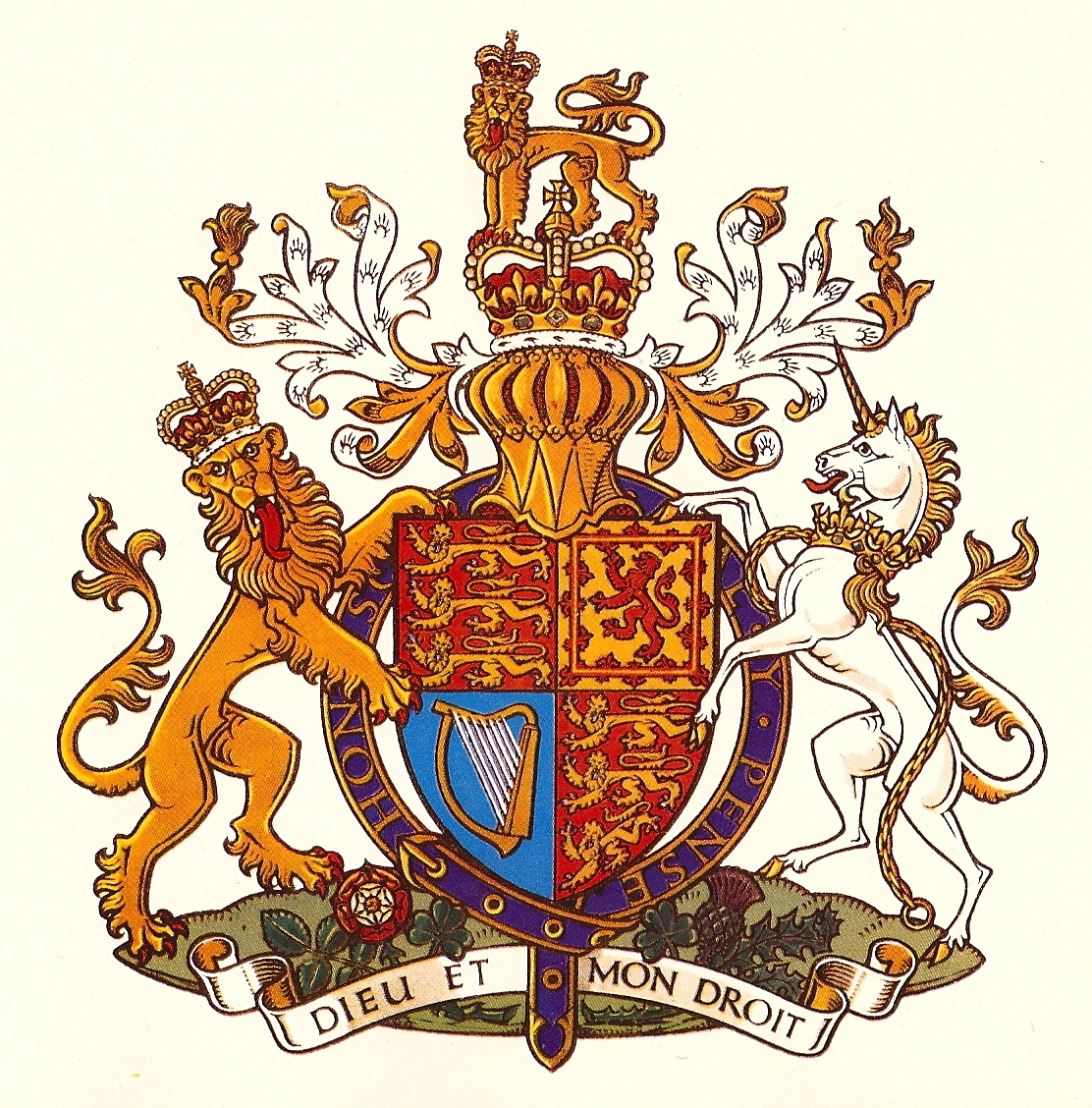
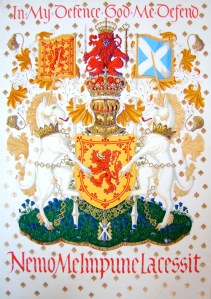
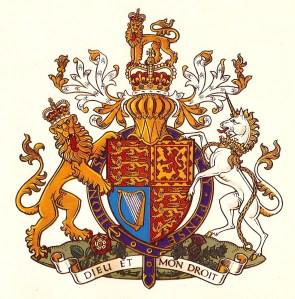
So, all of this could, I say could, potentially have heraldic ramifications. The current coat of arms used by HM reflects, in its quarterings, the various lands that make up the United Kingdom: England, Scotland and Northern Ireland. Wales does not have a separate quartering because it is considered to be part of England, although, in fairness, perhaps not by all the Welsh! Many are probably familiar with the fact that the Queen uses a slightly different coat of arms when in Scotland. In that version the Scottish quarter receives pride of place, as does the Scottish supporter (the unicorn), the crest is different and the collar encircling the shield is that of the Order of the Thistle instead of the Garter. Nevertheless, this is a different version of the arms of the United Kingdom. The quarters for England and N. Ireland are still included. However, the Queen also has a separate coat of arms in right of Canada and also makes use of badges and other heraldic insignia in her other realms.

This begs the question of what may, again I say may, happen to the royal arms if Scotland becomes an independent country and is no longer part of the United Kingdom. Officials at Buckingham Palace have indicated that the Queen may find it better to appoint a Governor-General to represent her in Scotland as there is in places like Canada, Australia and New Zealand. In such a case then perhaps HM will make use of the Scottish royal arms all alone as would be her lawful right as sovereign of an independent Scotland?
Scots-panel-ASJ

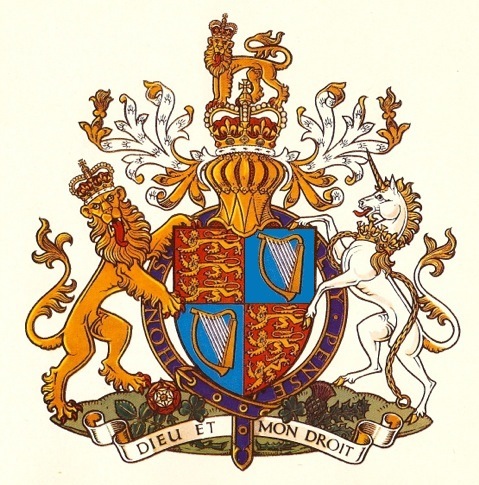
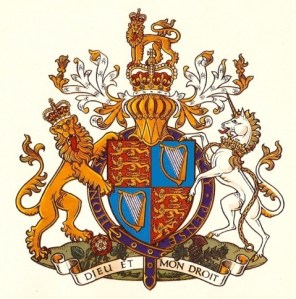
In addition, modifications would need to be made to the royal arms as used in the U.K. This would mark the first major change in the royal arms since the accession of Queen Victoria in 1837 at which time the inescutcheon of Hanover was removed from the royal arms because the Salic Law prevented a woman from succeeding to the throne of Hanover. It would also mark the first time there was a significant change in the four quarterings of the arms since 1801 when the quarter for France was removed from the arms of George III. The quarter for Scotland would be removed from the royal arms as it would no longer be part of the U.K. and, very likely the thistle would be removed from the compartment at the base of the achievement. It might also be possible that the unicorn supporter might be replaced. So instead of the current royal arms (below left) we could conceivably end up with something more like (below right)
sc00109f8e      Image

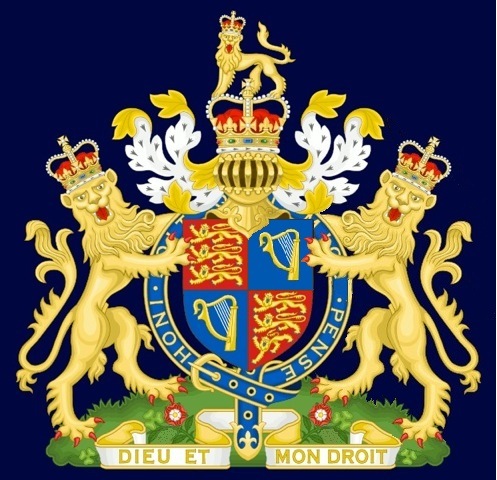
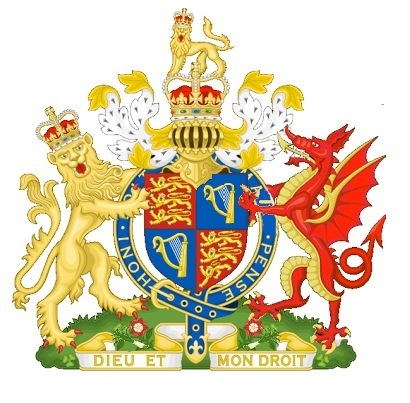
Again, it is worth noting that in this hastily prepared image I did not take the time to remove the thistle from the compartment or to replace the unicorn supporter. While the former would almost certainly be done it is really uncertain that the supporter would be changed so that there would be two lion supporters. The last time one of the supporters in the royal arms was changed was 1603 when James I succeeded Elizabeth I and replaced the dragon with a unicorn. It could be argued that leaving the unicorn supporter in the royal arms even if Scotland becomes independent is acceptable. It would also not be unthinkable simply to have two lion supporters as in the image below (left). Personally, I’d like to see the reintroduction of the Welsh dragon supporter especially as Wales doesn’t get a quarter of its own on the shield. (Image below right). But, I am getting waaaaaaay ahead of things. All of this would have to be discussed and worked out properly in consultation with the Earl Marshal and HM College of Arms in London as well as the Court of Lord Lyon in Edinburgh. It seems, however, that there would be little reason to include a quarter for Scotland in royal arms of the sovereign of the U.K. if Scotland is no longer in that same U.K. Otherwise, quarterings for all of HM realms and territories would already be included in the royal arms and, of course, such is not the case.
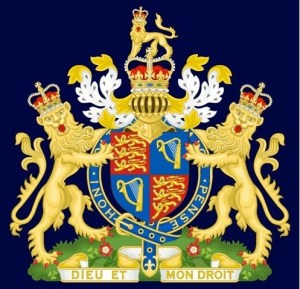
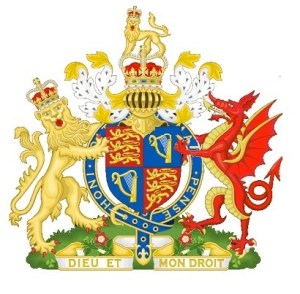
Image 4     Image 6

Indeed, it will be interesting and, by all recent accounts, now much more exciting to see the outcome of the September 18 referendum. Most people will, rightly, be concerned with the political, the economic, and the social aspects of an independent Scotland. It will also be interesting to see if and how the admittedly minor heraldic aspect of it all is resolved as well.
Fulton Sheen

846px-Archbishop_Sheen_COA.svg

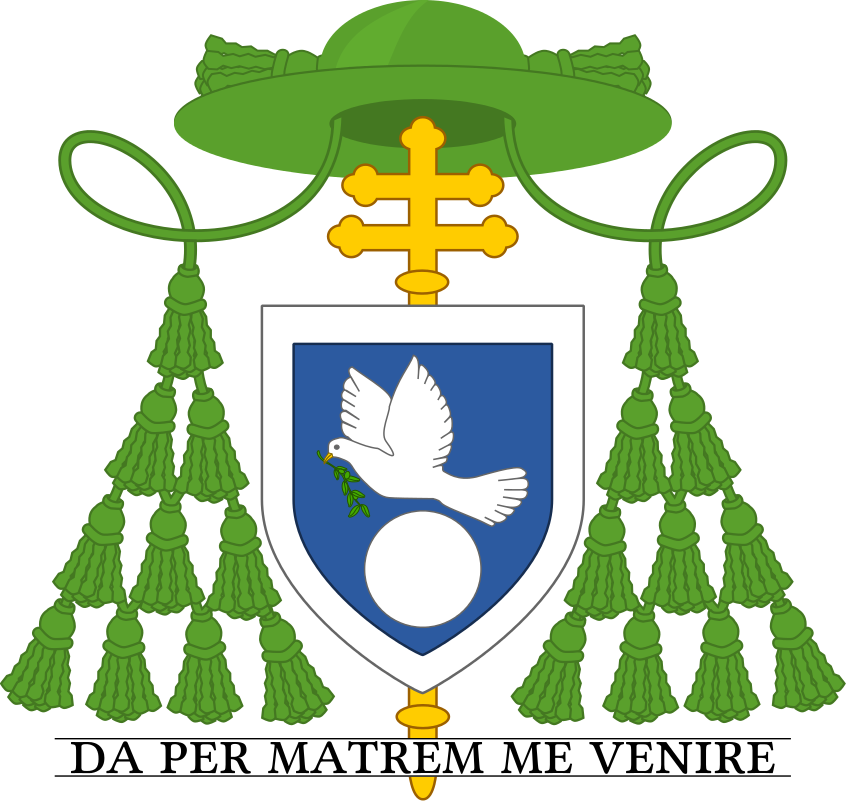
Because of the indefinite, and very likely merely temporary, suspension of the Cause for the Canonization of the Venerable Archbishop Fulton J. Sheen I thought some might be curious to see what the archbishop’s coat of arms looked like. It was a simple design playing on the name “Sheen” which is similar to “Shehan” in Gaelic and means “peace”. Hence, the dove. Sheen was Titular Archbishop of Newport, Wales a diocese that no longer exists as such but when it did had as its cathedral the abbey church at Belmont Abbey, a Benedictine monastery in the UK which still does exist to this day.

Bishop Raica of Gaylord

Today the Most Rev. Steven Raica was ordained and installed as the fifth bishop of Gaylord, Michigan. the tree and sun allude to the places from which his family came and the red crown is symbolic of his patron, the martyr, St. Stephen.

Raica


Edmund Cardinal Szoka, RIP

cardinal-szoka

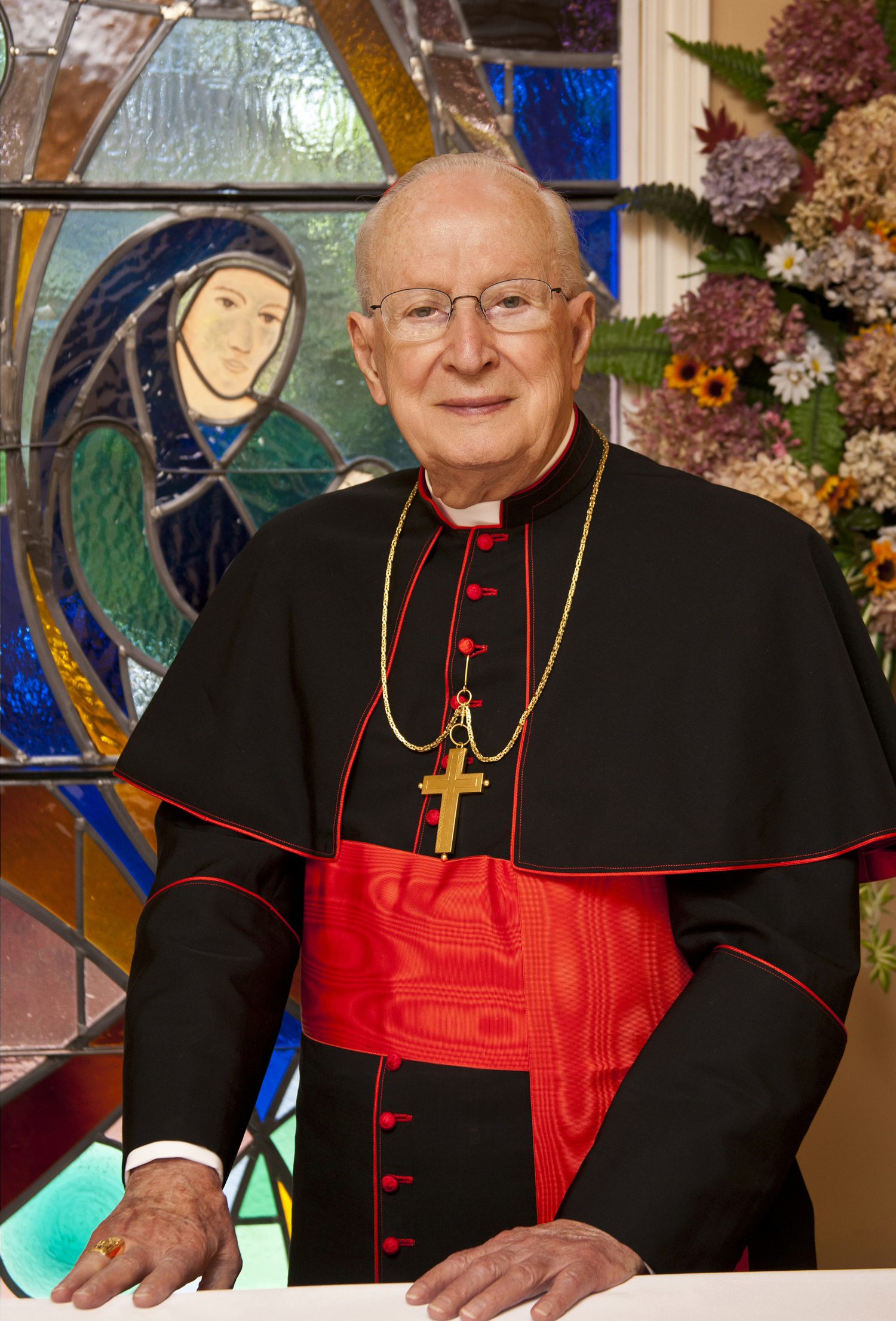
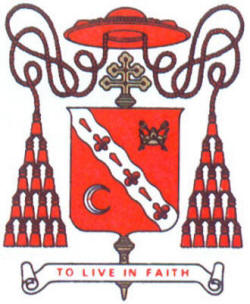
His Eminence Edmund Cardinal Szoka, a priest of Marquette Michigan, Former Bishop of Gaylord, Michigan, Former Archbishop of Detroit, Michigan, Cardinal Priest of Sant’Andrea e Gregorio al Monte Celio, Former President of the Prefecture for the Economic Affairs of the Holy See, Former President of the Pontifical Commission for the Vatican City-State and President-Emeritus of the Governorate of the Vatican City-State has passed away. His coat of arms underwent several changes as he moved from Gaylord, to Detroit to the Holy See. The last version of his arms is below. May he rest in peace.

Watykan_kard._Edmund_Kazimierz_Szkoka

Pope Saint Pius X

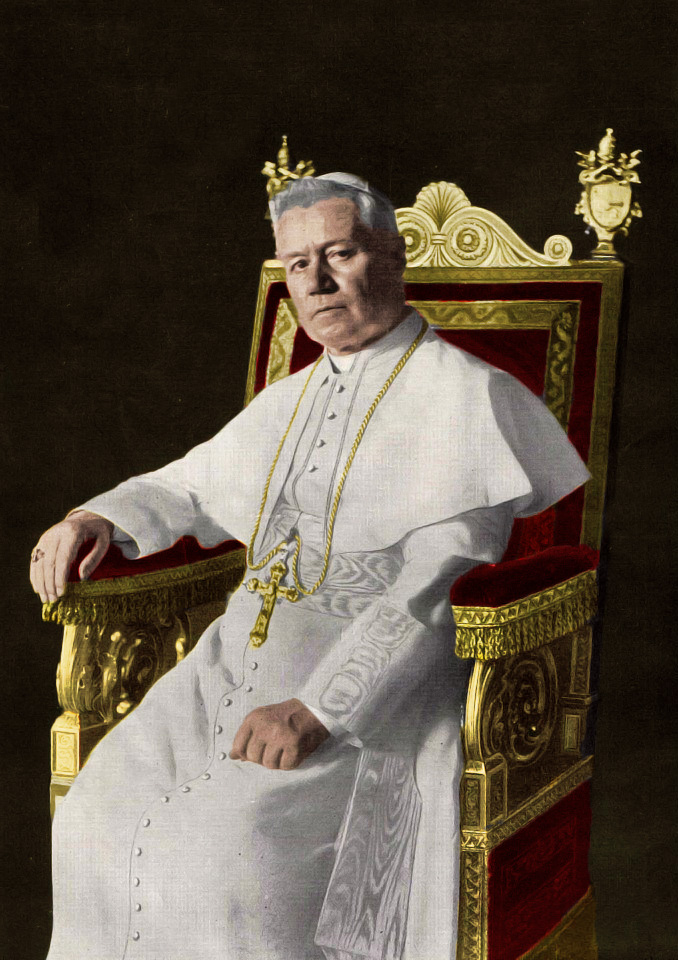
August 20, 2014 marks the centenary of the death of Pope St. Pius X (Giuseppe Sarto) who was pope from 1903-1914.

Portrait_of_Pope_St._Pius_X_(Colored)

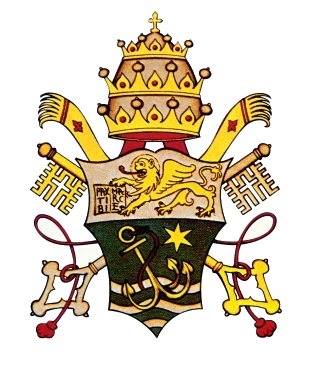
His coat of arms (below) depicts a chief with the lion of St. Mark, a symbol used by the Patriarchs of Venice. St. Pius served as Patriarch of Venice prior to becoming pope and retained this chief (added to the arms he assumed previously as Bishop of Mantua) upon his election. This started a trend for other Patriarchs who were later elected pope like St. John XXIII (1958-1963) and Pope John Paul I (August-September, 1978)

10590497_308522315993364_5350824324652784687_n


Bishop Rozanski of Springfield

15583692-large

On August 12 Bishop Mitchell Rozanski, until now Auxiliary Bishop of Baltimore, will be installed as the IX Bishop of Springfield, Massachusetts. The coat of arms of the new bishop (above) combines his personal arms with those of the see of Springfield. (the four roundels with waves symbolize a field of springs and the cross is associated with St. Michael, patron of the cathedral.)

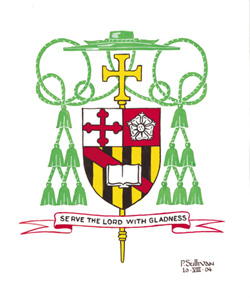
His personal arms (below) were assumed in 2004 at the time he became a bishop when he was appointed as Auxiliary in Baltimore.

RozanskiCrest

The small cross is symbolic of St. Michael (a name from which Mitchell is derived); the red and white colors allude to the national colors of Poland; the flower alludes to his surname which, in Polish, means “rose flower”. The lower portion uses the colors derived from the arms of Calvert, Lord Baltimore. The red bend (vertical stripe) and open book are for preaching the Word. The motto is taken from Psalm 100.

(Artwork by Paul Sullivan)

Bishop Jenik

Bishop_Jenik_Coat_of_Arms_2014

On August 4, 2014 Cardinal Dolan of New York ordained three Auxiliary Bishops for the Archdiocese. They are the Most Revs. Peter Byrne, John O’Hara and John Jenik. While I have not yet seen the coats of arms assumed by all three I did come across the interesting and distinctive coat of arms assumed by Bishop Jenik. He designed the coat of arms himself and I am not sure of the symbolism behind the design. Many might see this as strange because it does not follow the usual “lucky charms” notion of heraldry with an overloaded shield filled with charges meant to be a pictorial CV of the bearer. Good for him! Such heraldry is atrocious and all too common among the American Catholic hierarchy.

Rather, Bishop Jenik’s coat of arms is very simple. This is one of the earmarks of good heraldry. The use of black and white may make it stark but not knowing the meaning of the design there may very well be a good reason for the choice of these colors. In addition, since heraldry is, at its heart, about identification and nothing else, the design is clear to see and easily identifiable. Again, these are attributes of good heraldry. It reminds me of some of the most ancient heraldic designs that present clear images and use as few colors as possible.

I say hats off to Bishop Jenik for an excellent and unique design for his coat of arms!

(Artwork by Paul Sullivan)

Cardinal Clancy RIP

cardinal_clancy_lge

Edward Bede Cardinal Clancy, Archbishop-Emeritus of Sydney, Australia and Cardinal-Priest of Santa Maria in Valicella (aka the Chiesa Nuova) has passed away. He was born December 13, 1923 and died on August 3, 2014. Requiescat in Pace.

1148px-Coat_of_arms_of_Edward_Bede_Clancy.svg

Bishop Doran of Elphin, Ireland

crest of bishop kevin doran

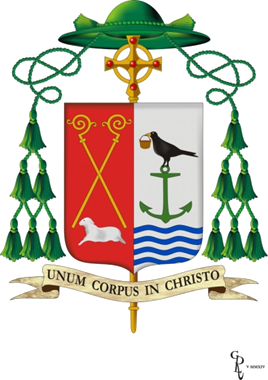
Father Kevin Doran is being ordained Bishop of Elphin, Ireland on July 13. The description of his coat of arms (above) taken from the website of the diocese:

In the right side of the shield (seen from the point of view of the one holding the shield) we find represented the Coat of Arms of the Diocese of Elphin; two golden crossed croziers surmounting a lamb as the central symbol reflecting Jesus, the Lamb of God who takes away the sins of the world.  The red (gules) color is the color of love, of blood; the infinite love of the Father who sent the Son to shed His blood for us, the ultimate act of love.

The personal arms of Bishop Kevin occupy the left side. This part of the shield is in silver (argent). The anchor, symbol of hope, is taken from the Doran family motto, Spes Ancora Vitae (Hope is the Anchor of Life).  The anchor is in green (vert), the symbolic colour of hope.

The blackbird references the legend of St. Kevin and the Blackbird, which is so well captured in the poem by Seamus Heaney. It reminds Bishop Kevin of the importance of fidelity to prayer and the relationship between prayer, compassion and service. The blackbird carries in his beak a copper pot, symbol of St Asicus, patron saint of the diocese of Elphin. St. Asicus was a coppersmith.

Fr. Kevin spent some years as parish priest of Glendalough, Co. Wicklow (The Valley of the Two Lakes). As he ministered to parishioners and pilgrims around the lakeshore, he was often reminded of the ministry of Jesus, much of which took place around the lake (or sea) of Galilee.  As he undertakes his new mission in the Diocese of Elphin, (a diocese bounded on one end by the River Shannon and on the other by the Atlantic Ocean), he takes the ministry of Jesus as his model and inspiration. This is the symbolism of the wavelets in the lower part of the shield.

Archbishop Cushley of Edinburgh

Below is the coat of arms of the Most Reverend Leo William Cushley, Metropolitan Archbishop of St. Andrews and Edinburgh, Scotland. He was installed in the position last year but just this past Sunday received his pallium from Pope Francis.