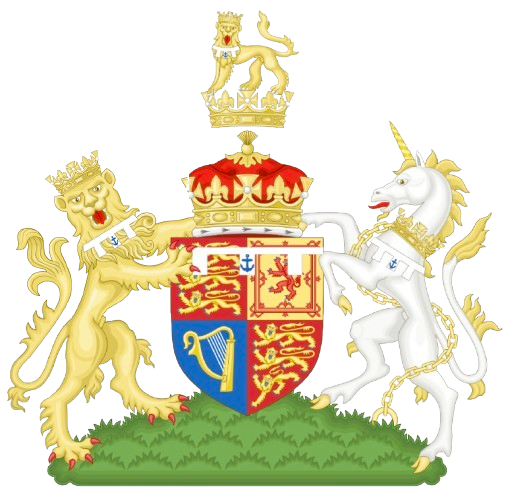
After renouncing the use of and later experiencing the further removal of any titles, honors and military ranks, Andrew Mountbatten-Windsor’s armorial bearings revert to those granted to him originally before any other honors or titles were bestowed upon him.
That is, the royal arms differenced by a label of three points (for the son of a Sovereign) the center point of the label charged with a blue anchor. The Royal arms, suitably differenced, are allowed to be used by him as the son of the Sovereign at the time of his birth regardless of any removal of his titles and honors.
I had wondered if he would be allowed to continue to use the supporters and the crest but apparently he is.
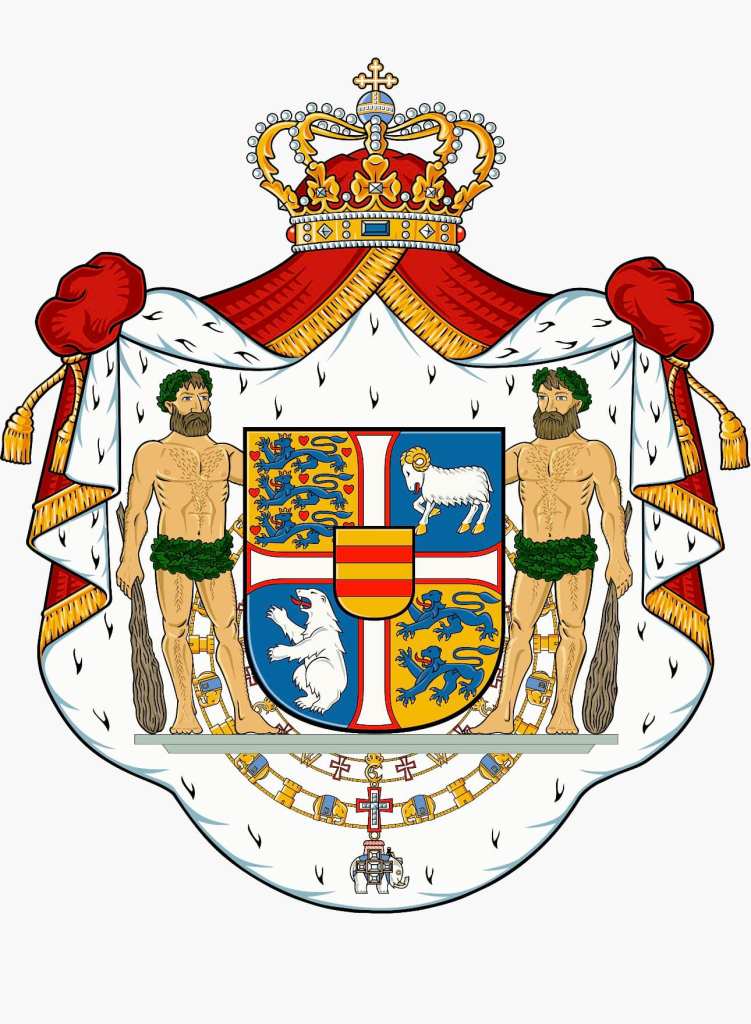
HM, King Frederik X has undertaken to issue a new, updated version of the Danish royal coat of arms dated December 20, 2024. The new version, prepared by Ronny Skov Andersen, simplifies the overall design.
It removes the three crowns of the Kalmar union and gives the arms of the Faeroe Islands and Greenland their own quarterings. It also places the arms of Denmark, originally the arms of the House of Estridsen, in the first quarter and instead of repeating it in the fourth quarter the arms of Schleswig are placed there. In addition, the Dannebrog, the cross that divides the shield into four quarters, has been returned to a more traditional form with the ends of the arms slightly flared. Overall, there remains the dynastic inescutcheon for the arms of the House of Oldenburg. The new version is:
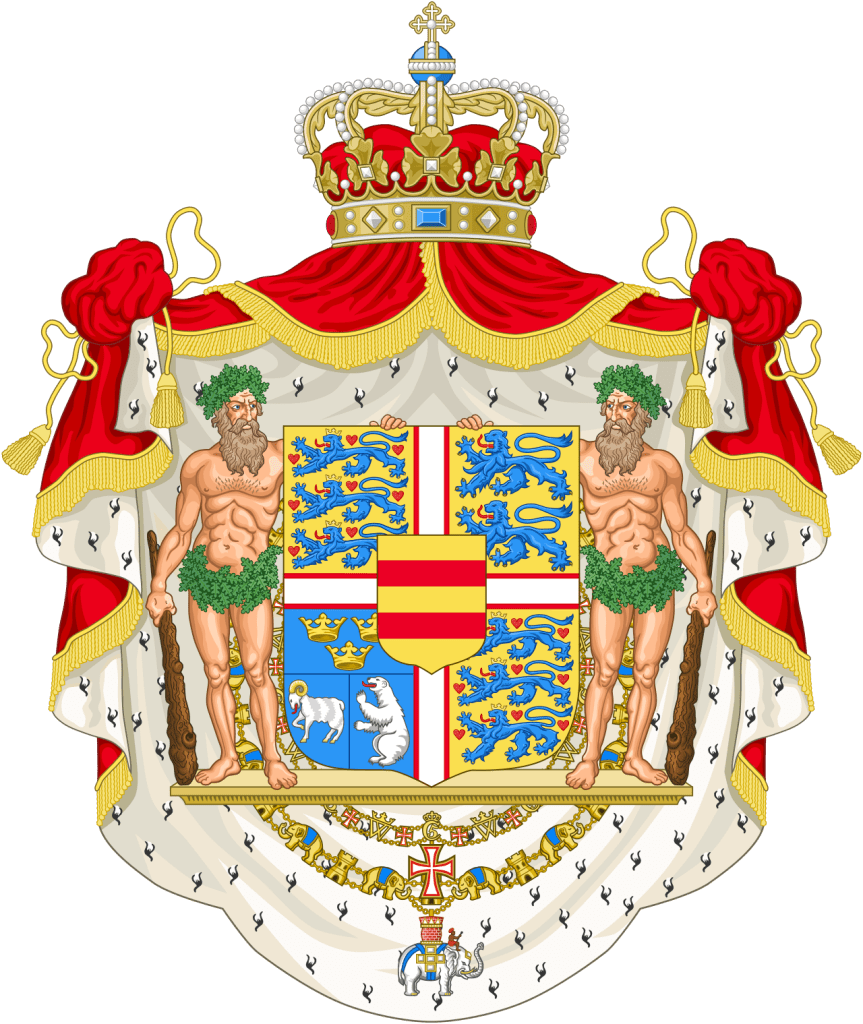
The blason could be written as: A shield quartered by a cross pattée throughout Argent fimbriated Gules; first quarter Or, three lions passant in pale Azure crowned and armed Or langued Gules, nine hearts Gules (for Denmark); second quarter Azure a ram passant Argent armed and unguled Or (for the Faroe Islands); third quarter, Azure a polar bear rampant Argent (for Greenland); fourth quarter, Or two lions passant in pale Azure armed Or langued Gules (for Schleswig). Overall an escutcheon Or two bars Gules (for Oldenburg) the whole surrounded by the Collars of the Order of the Dannebrog and the Order of the Elephant. Supporters two woodwoses armed with clubs Proper standing on a pedestal. All surrounded by a mantle Gules doubled Ermine crowned with a royal crown and tied up with tasseled strings Or.
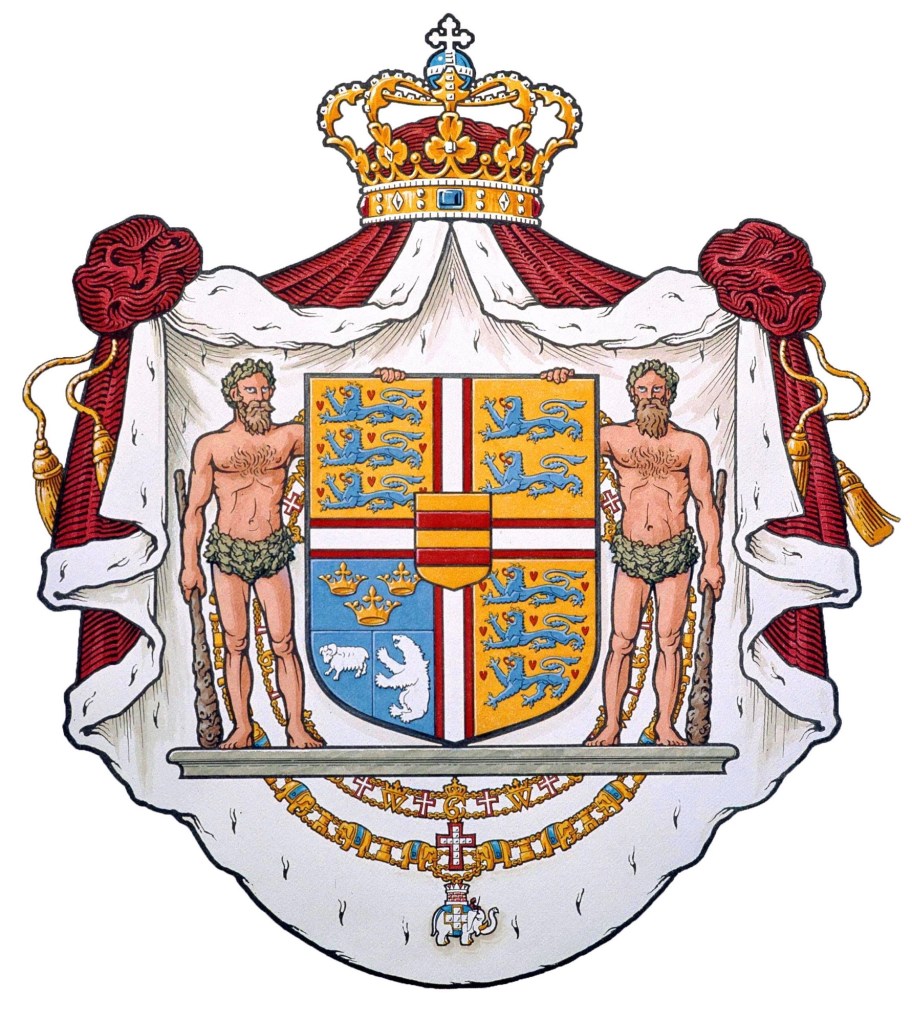
This replaces the version of the coat of arms that had been modified after the reign of King Frederik IX by Queen Margrethe which had been in use since 1972. (below)
I think this updated version is aesthetically more pleasing. It is a slightly less busy composition and the juxtaposition of the arms of Denmark and those of Schleswig provide a more pleasing visual. There is no longer the multiplication of lions and the two quarters with fields Or look better on a diagonal from each other, as do the two quarters with fields Azure. It all seems less imbalanced. I also happen to think the style of the cross looks better that the simple cross throughout.
It is exciting to see heraldry—long erroneously thought by the ignorant to be stagnant and encrusted with the weight of history and therefore irrelevant to today’s society—being updated and dynamic. The current situation calls for an updated symbol of the monarchy. This was true in 1972 and it is just as true some 52 years later. I applaud the efforts of His Majesty and also Ronny Andersen and those who worked with him to devise this updated coat of arms.
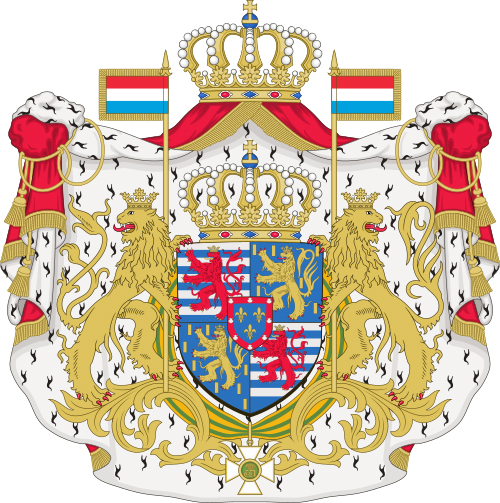
In his annual Christmas greeting, His Royal Highness the Grand Duke Henri of Luxembourg announced he will abdicate in favor of his son and heir, Hereditary Grand Duke, Guillaume.
The royal coat of arms consists of the arms of Luxembourg, (Barry of ten Argent and Azure, a Lion rampant queue forchée Gules crowned, armed and langued Or), quartered with the arms of the House of Nassau, (Azure billetty Or, a lion or armed and langued Gules). In the greater version of the coat of arms there is an inescutcheon overall of the arms of the dynastic house of Bourbon-Parma (Azure three fleurs-de-lis Or within a bordure Gules charged with eight escallops Argent). The dynastic arms of Bourbon-Parma are not usually included in the middle and lesser versions of the Grand Ducal coat of arms.
The Grand Duke of Luxembourg is the head of state of Luxembourg. Luxembourg has been a grand duchy since March 15,1815, when it was created from territory of the former Duchy of Luxembourg. It was in personal union with the Kingdom of the Netherlands until 1890 under the House of Orange-Nassau. Luxembourg is the world’s only sovereign grand duchy and since 1815, there have been nine monarchs.
The grand ducal family consists of heirs and descendants of the House of Nassau-Weilburg, whose sovereign territories passed cognatically from the House of Nassau to the House of Bourbon-Parma, itself a branch of the Spanish royal house which is agnatically a cadet branch of the House of Capet which originated in France.
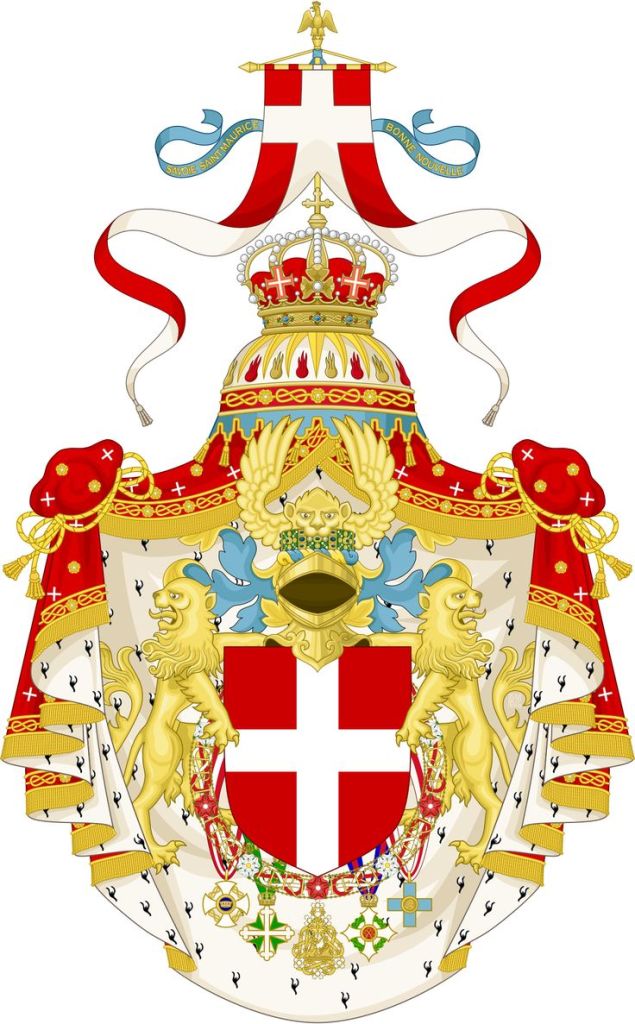
This morning it was announced the Head of the Royal House of Savoy, the son of the last King of Italy, Prince Vittorio Emmanuele, Duke of Savoy passed away at age 86 in Geneva, Switzerland.
He is succeeded as Head of the House of Savoy by his son and heir, Prince Emmanuele Filiberto, aged 51. In June 2023, Emanuele Filberto announced his intention to abdicate his claim to the throne in favor of his daughter, Princess Vittoria of Savoy, when he felt she was ready to succeed. This will cause a dynastic problem since the House of Savoy never allowed for female succession. In such a case the succession, already in dispute, could pass to another branch of the family, the House of Savoy-Aosta.
In continuing my exploration of the royal arms of Denmark, leading up to the Abdication of Margrethe II and the Accession of Frederik X on January 14 I note with interest (not necessarily with any great significance, but merely with interest) that the Danish royal arms, the version used by the House of Oldenburg-Glückburg, occasionally turns up in other royal houses as well.
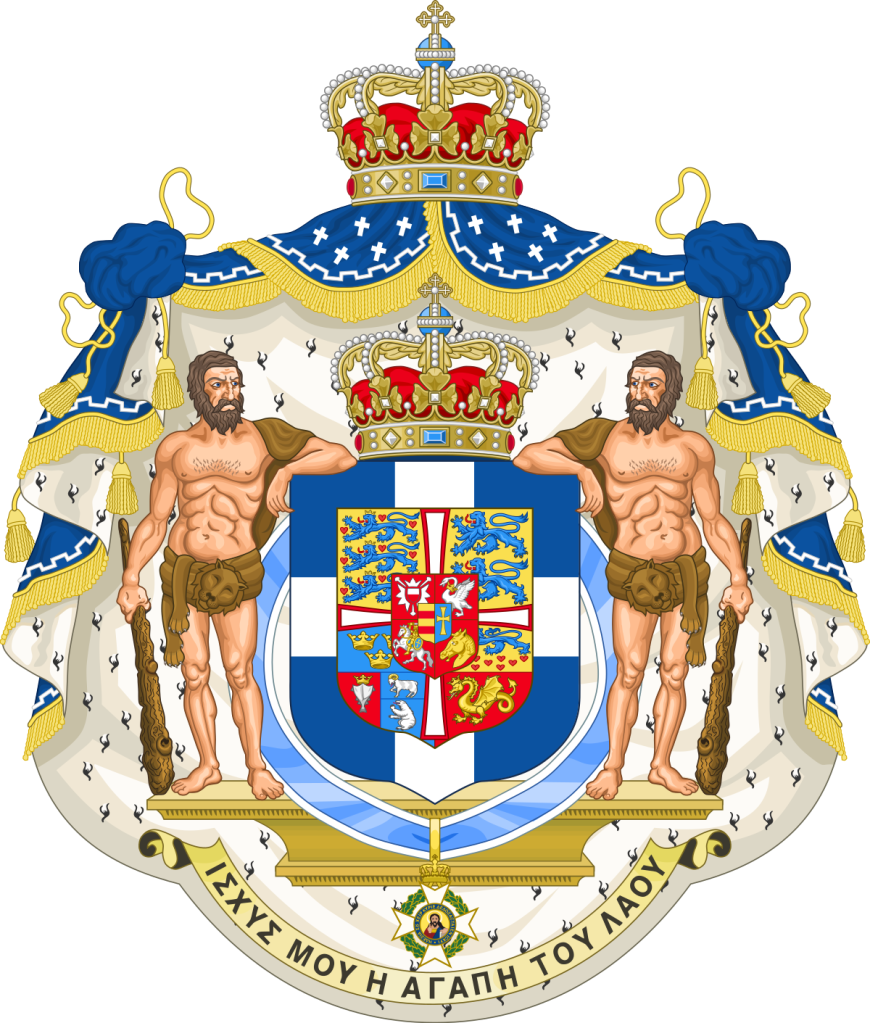
In particular, when the Greek monarchy was established in 1832 and offered to the Bavarian prince, Otto, whose reign lasted until his ouster in 1862, the Hellenic throne was then offered to Prince William of Denmark who ruled as George I of the Hellenes. The Wittlesbach arms placed at the center of the coat of arms of the Greek kingdom was replaced with a shield bearing the dynastic arms of the House of Glücksburg, a cadet branch of the House of Oldenburg. That was used during the next several reigns until the monarchy was abolished in 1924. Then, in 1935 when the monarchy was restored and King George II returned to the throne the coat of arms was modified again.
Now the center of the shield bore the greater coat of arms of the Danish royal house as used by his ancestor and King of Denmark, Christian IX from 1863-1903 before a modification of its own. In addition, the Greek coat of arms changed the two Woodwose supporters to depictions of Heracles as supporters. This coat of arms was then subsequently used by the remaining Greek kings until the monarchy was finally abolished in the 1973 referendum.
However, the last King of the Hellenes, Constantine II, had married Anne-Marie of Denmark, the daughter of King Frederik IX of Denmark and the sister of Queen Margrethe II. She bore the royal arms of Denmark as she inherited them from her father and the Danish royal arms made a double appearance in the reign of King Constantine II.
Through the Greek branch of the House of Oldenburg-Glücksburg the Danish royal arms also made their way to the UK. The late Prince Philip, husband of Elizabeth II, used the surname Mountbatten which he got from his mother, Princess Alice of Battenberg, later changed to Mountbatten, but he was born a prince of Greece (and Denmark). His father was Prince Andrew, the son King George I of the Hellenes and, himself, the son of King Christian IX of Denmark. So, the very first coat of arms devised for Philip Mountbatten, and used by him for only two years before adopting a different coat of arms, reflected his Greek and Danish heritage, as well as his mother’s British ancestry.
The Danish royal arms–as used by Christian IX– are on the dynastic shield in the center. In the dexter chief quarter the coat of arms of his grandmother, Princess Alice, Grand Duchess of Hesse and by Rhine, and the daughter of Queen Victoria, (but with the escutcheon in pretense of Saxony inherited from her father, Prince Albert of Saxe-Coburg and Gotha diplomatically removed) have been unusually and awkwardly added as a nod to his British ancestry, perhaps to quell any fears of the heiress presumptive, Elizabeth, marrying “a foreigner”. These were deemed unacceptable and in 1949 new arms were granted to him which he had a hand in designing.
This coat of arms includes quarters for Greece and Denmark (as well as Mountbatten and Edinburgh, his Dukedom) and make use of the Mountbatten lion supporter and crest, as well as the Greek Heracles supporter rather than the Danish Woodwose. You can tell because of the lion-skin loin cloth.
Another Greek Oldenburg-Glücksburg connection can be seen in the coat of arms of the Queen-Emerita of Spain, Sofia. She was born a princess of Greece (and Denmark), the eldest daughter of King Paul and Queen Frederika. Her coat of arms as Queen of Spain, wife of King Juan Carlos I is
Impaled with her husband’s coat of arms, Queen Sofia’s arms are those of the Greek royal house which she inherited from her father bearing the inescutcheon of the Danish royal arms as used by Christian IX. This shows the dynastic link to the Schleswig-Holstein-Sonderburg-Glücksburg dynasty; a shield containing the Dannebrog, a cross from the Danish flag, and quarterings representing Denmark, Schleswig, the former Kalmar Union, Iceland, the Faroe Islands, Greenland, Holstein, Stormarn, Dithmarschen, Lauenburg, Oldenburg, Delmenhorst, and the former Danish royal titles of King of the Wends and Goths.
Of course there is also the coats of arms of two sisters, both princesses of Denmark and daughters of Christian IX. Alexandra married the Prince of Wales and went on to become Queen of the UK as the spouse and consort of King Edward VII.
The other was Princess Dagmar who married Czar Alexander III and became Empress of Russia as Maria Feodorovna.
The Danish royal family has many connections to the other royal houses of Europe and the Danish Royal Arms, simplified once again by Queen Margrethe in 1972 to its present form, crops up in several different places which I simply find interesting.
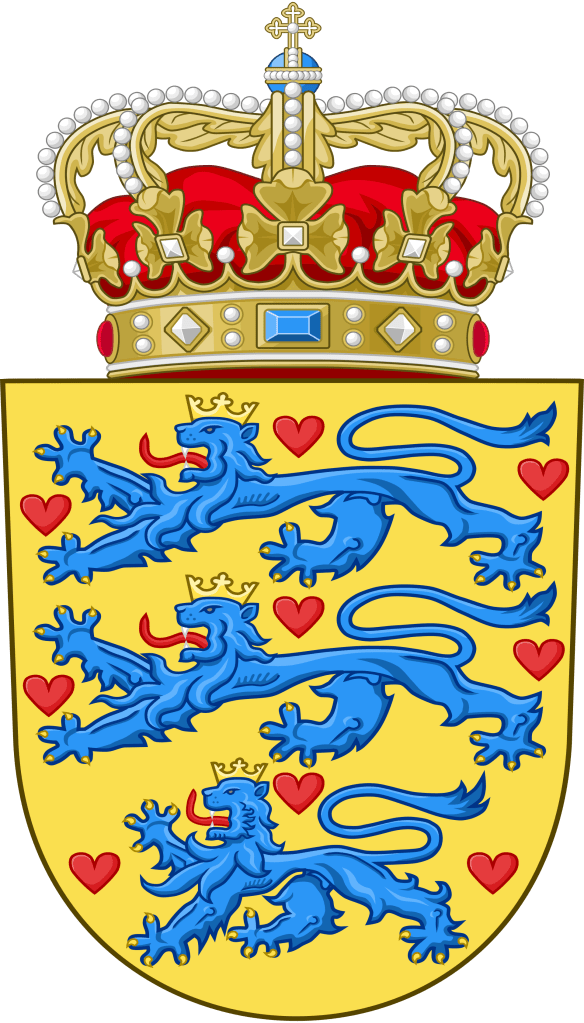
With the approaching abdication of Queen Margrethe II and the accession of King Frederik X of Denmark I’ve been reading up on the heraldry used by the country and the royal house. The state coat of arms consists of three pale blue lions passant wearing crowns accompanied by nine red lilypads (normally represented as heraldic hearts), all in a golden shield with the royal crown on top. The national coat of arms of Denmark is similar to the state coat of arms, but without the royal crown above the shield.
It is historically the coat of arms of the House of Estridsen, the dynasty which provided the kings of Denmark between 1047 and 1412. The current design was introduced in 1819, under Frederik VI. Previously, there had been no distinction between the “national” and the “royal” coat of arms. Since 1819, there has been a more complex royal coat of arms of Denmark separate from the national coat of arms. I’ll take a look at that in another post.
Historically, the lions faced the viewer rather than forward and the number of hearts was not regulated and could be much higher. The “heart” shapes originally represented waterlily pads; a royal decree of 1972 still specifies these figures as søblade (“lake leaves”). Frederik VI also fixed the number of hearts to nine and decreed that the heraldic beasts were lions, as opposed to leopards, and consequently facing forward in 1819. The blazon is: Or, three lions passant in pale azure crowned and armed Or langued gules, nine hearts Gules.
In her annual New Year message Queen Margrethe II of Denmark announced her intention to abdicate the throne on January 14, 2024 exactly 52 years to the day that she succeeded her father and became queen. She will be succeeded by her son, Crown Prince Frederik, who will reign as King Frederik X.
God bless Queen Margrethe, the last reigning queen in the world at the present time, and long live King Frederik!
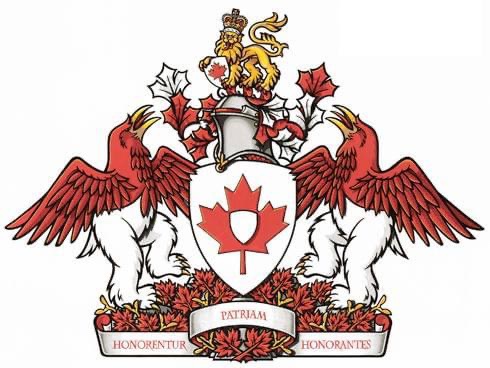
Sincere good wishes to the Canadian Heraldic Authority (Autorité Héraldique du Canada) as they celebrate their 35th anniversary!
In 1988 the Queen of Canada issued letters patent granting permission for the Governor General “to exercise or provide for the exercise of all powers and authorities lawfully belonging to Us as Queen of Canada in respect of the granting of armorial bearings in Canada”. On June 4, 1988 Governor General Jeanne Sauvé authorized the creation of the CHA.
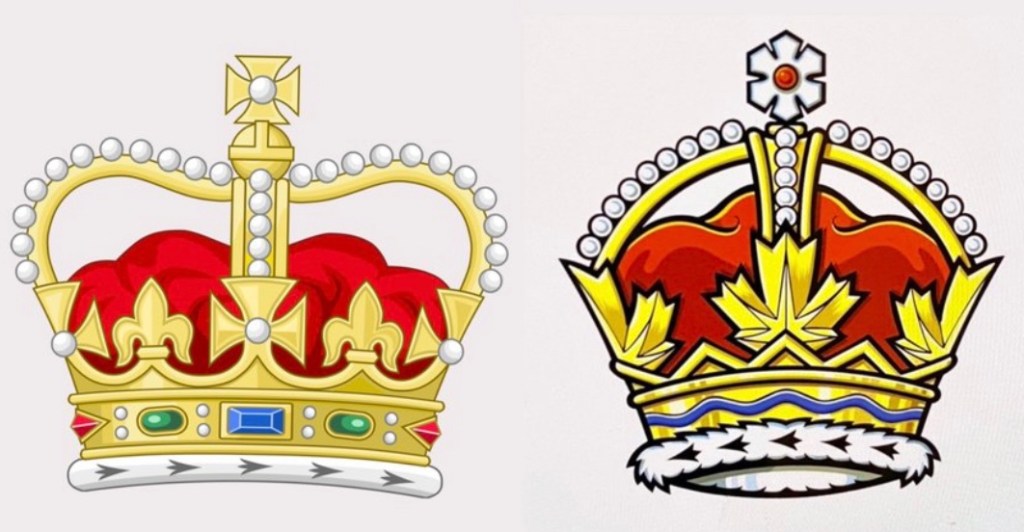
Today, the Canadian Government of Justin Trudeau unveiled a new heraldic Canadian Crown replacing the traditional St. Edward’s Crown used on Canada’s coat of arms, police & military badges. The design replaces what the government termed “religious symbols” (crosses & fleur-de-lis) with maple leaves & a snowflake.
The Canadian Heraldic Authority was apparently consulted in this process. Reactions so far have been mixed but mostly disapproving.
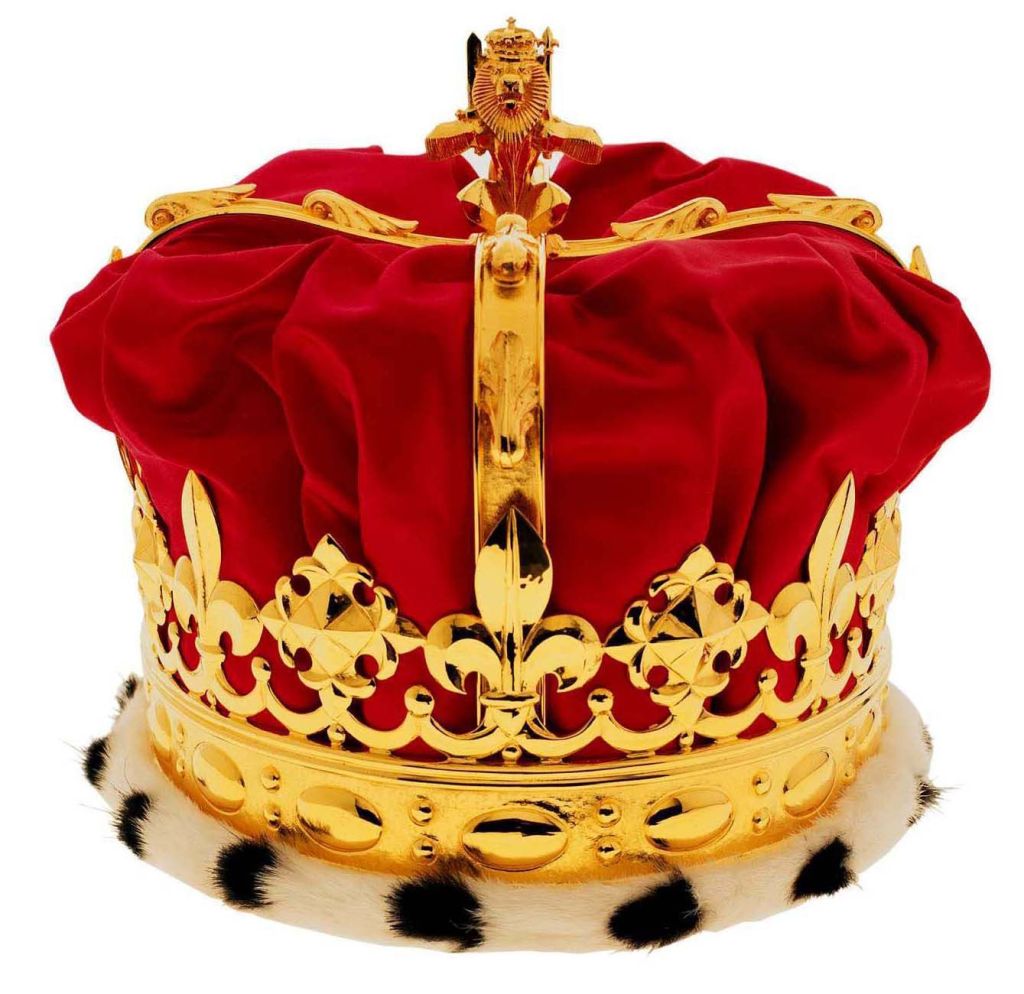
It was very interesting to read in the Times that Lord Lyon King-of-Arms, the senior heraldic officer in Scotland will not only take part in King Charles’ coronation on May 6 but will do so wearing the crown that had been commissioned and obtained by the Heraldry Society of Scotland back in the early 2000s. The arches on the crown, which are removable, will be removed for the coronation so it won’t too closely resemble the crown with which the King shall be crowned.
The expensive item and the trouble that went into commissioning and fabricating it was one of the reasons that, despite the Peers not being allowed to wear their coronets at the upcoming, more modernized, ceremony Lord Lyon–and indeed the other three English Kings-of-Arms–will be wearing their crowns. The coronation of the Sovereign is one of the only occasions on which these crowns are traditionally worn.
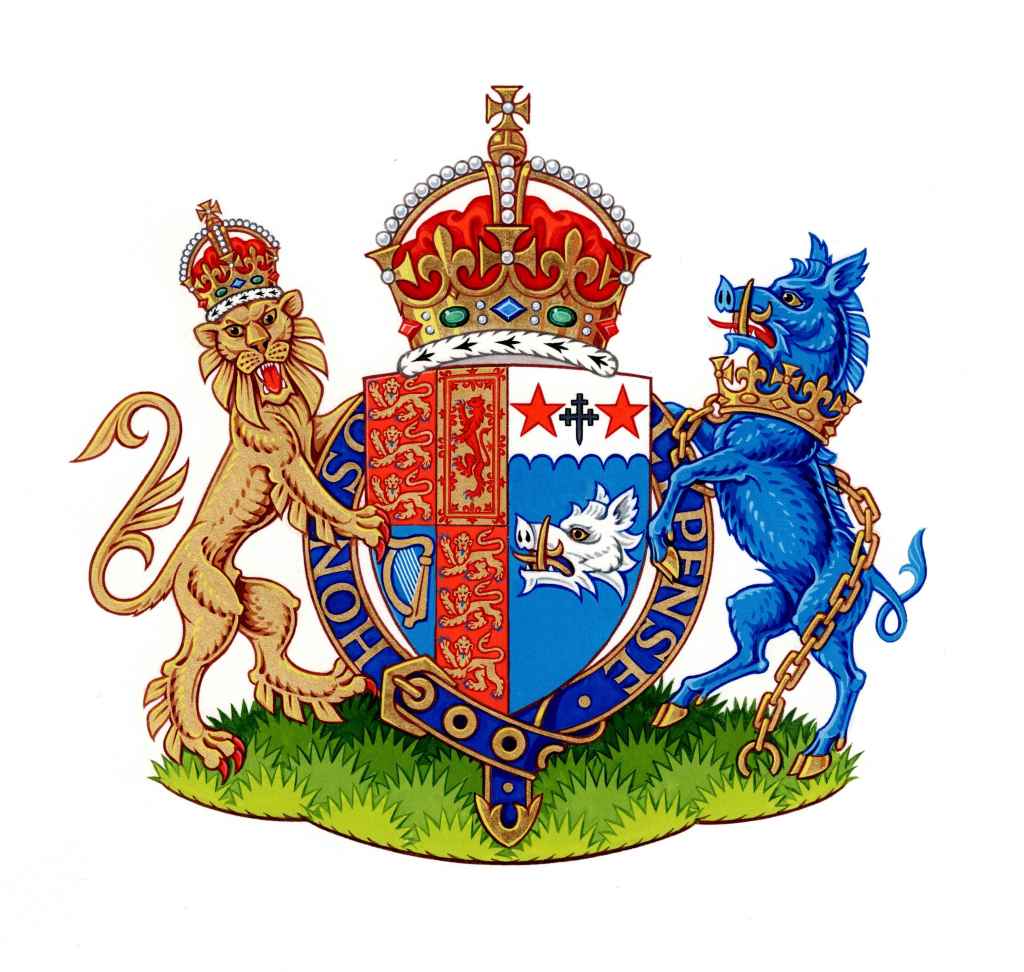
On February 21, HM King Charles III granted new arms to Her Majesty Queen Camilla. This is the first grant of arms made by the King and they replace the arms previously granted buy the late Queen Elizabeth on July 14, 2005. The arms granted are:
“Within the Garter Our Royal Arms impaling the Arms of Shand surmounted by Our Crown.”
The Supporters are a Lion Guardant Or Crowned proper (dexter) and to the sinister a Boar Azure armed and unguled Or langued Gules and gorged with a Coronet composed of Crosses formy and Fleurs-de-lys attached thereto a Chain reflexed over the back and ending in a Ring all Or (sinister).
This month marks the 80th anniversary of the office of Norroy and Ulster King of Arms. The office of Ulster King of Arms was created by King Edward VI on February 2, 1552, and for its first 36 years, appears to have been regarded as attached to the College of Arms; the two Ulsters in this period, Bartholomew Butler and Nicholas Narboon, had both been English Heralds before their appointment as Ulster. After the resignation of Narboon in 1588, subsequent Ulsters acted independently from the English College. On January 30, 1908, King Edward VII appointed Captain Nevile Rodwell Wilkinson King of Arms and Principal Herald of all that part of the United Kingdom of Great Britain and Ireland called Ireland, with the title of Ulster. Wilkinson exercised this office, based in Dublin Castle, through a period of great political turmoil in Ireland until his death on December 22, 1940. The political circumstances in Ireland at this time led to the decision to return the office of Ulster to the College of Arms in London, with responsibility for Northern Ireland alone, and united with the office of Norroy.
On January 29, 1931, King George V had appointed Algar Henry Stafford Howard, M.C., as King of Arms and Principal Herald of the North Part of England, with the title of Norroy. Howard still held this office on April 1, 1943, when King George VI additionally appointed him King of Arms and Principal Herald of that part of the United Kingdom of Great Britain and Northern Ireland called Northern Ireland, without prejudice to his existing appointment as Norroy and with the title of Ulster to be borne after that of Norroy. Howard held these joint offices until his promotion to Garter the next year, and on June 2, 1944, King George VI appointed Sir Gerald Woods Wollaston, K.C.B, K.C.V.O., King of Arms and Principal Herald of the North Part of England and of Northern Ireland, with the title of Norroy and Ulster, which has remained the form of the office to this day. The present Norroy and Ulster, Robert John Baptist Noel, was appointed by Queen Elizabeth II on April 6, 2021. He proclaimed the accession of His Majesty The King at Hillsborough Castle in Northern Ireland on September 10, 2022, the first time Ulster had performed such a duty in Ireland since the proclamation of King George V in Dublin on May 9, 1910.
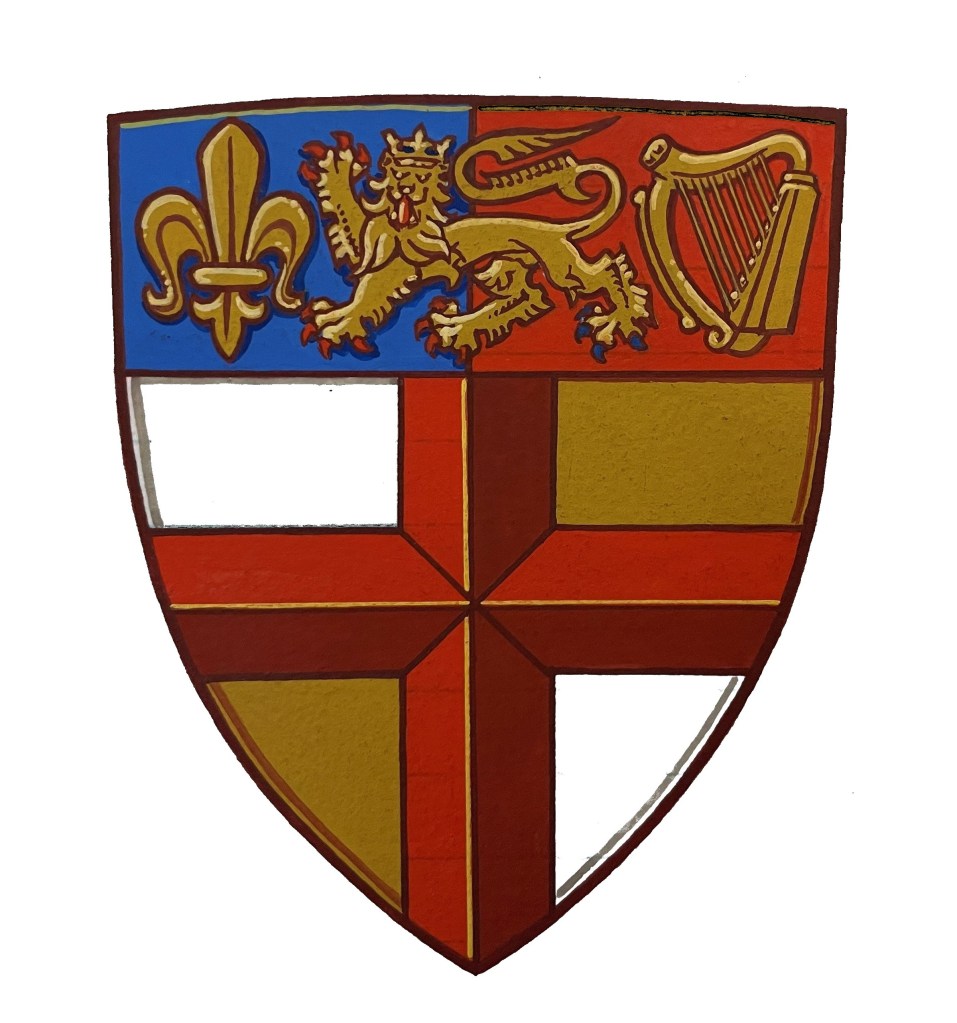
Between 1943 and 1980, holders of the office of Norroy and Ulster used the arms of office of one of the two offices, or both arms impaled on one shield. In 1980, Queen Elizabeth II approved new arms for the joint office. These are: Quarterly Argent and Or a Cross Gules on a Chief per pale Azure and Gules a Lion passant guardant crowned between a Fleur-de-lis and a Harp Or. Norroy and Ulster King of Arms is also ex officio King of Arms, Knight Attendant, Registrar, and Keeper of the Records of the Most Illustrious Order of Saint Patrick, offices which are purely nominal since the death of the last Knight of the order.
Text taken from the College of Arms Newsletter, No. 71 April, 2023
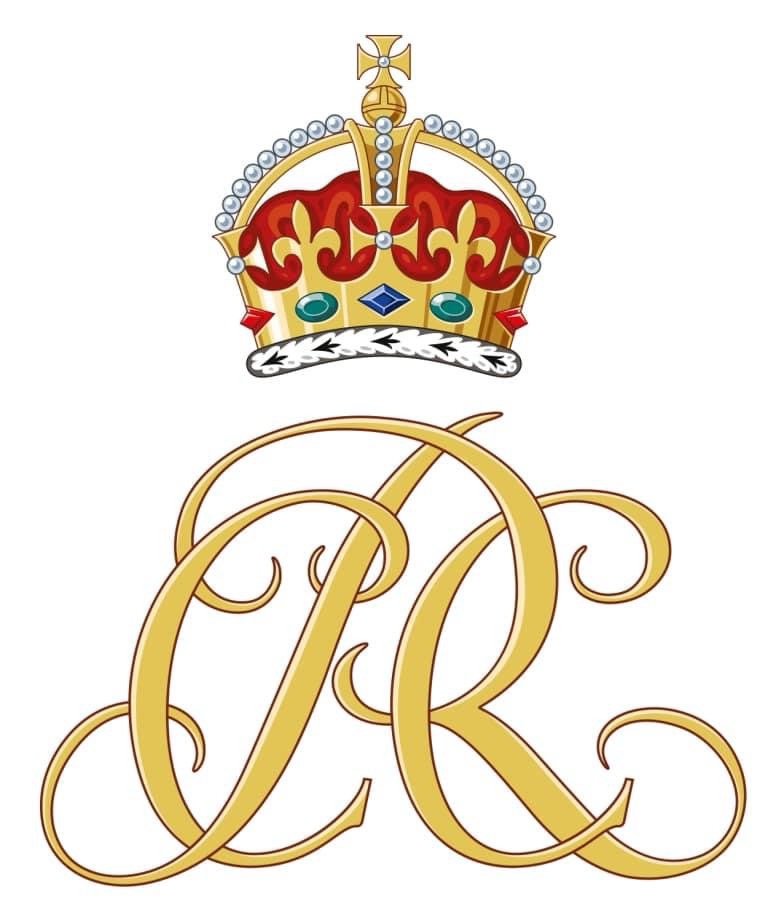
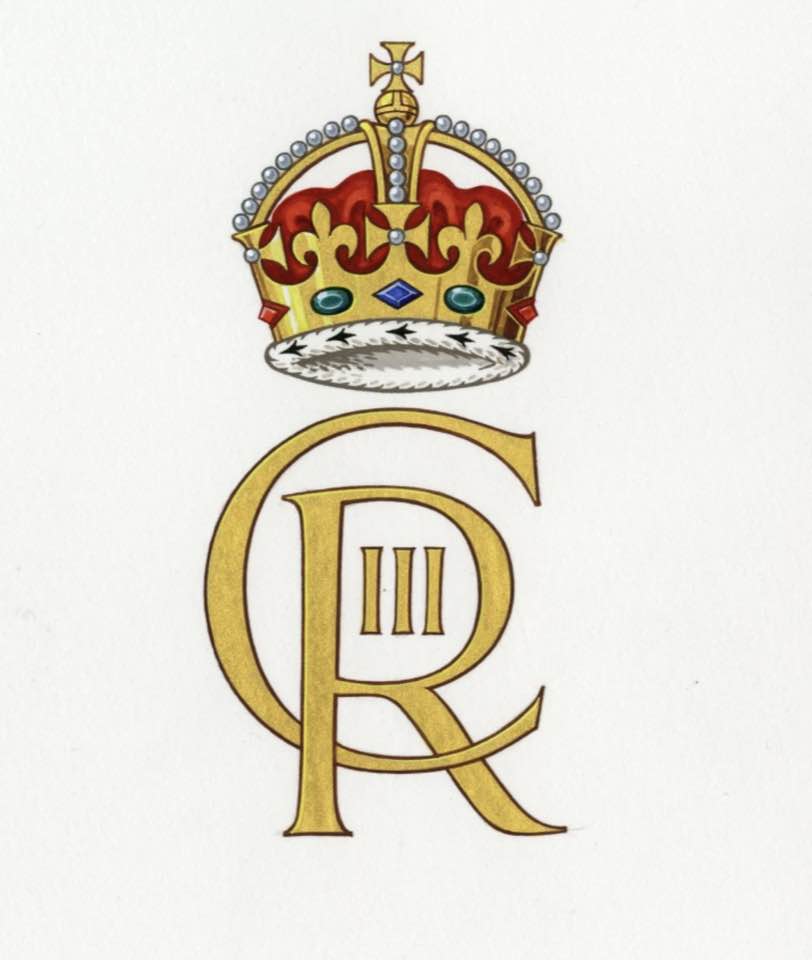
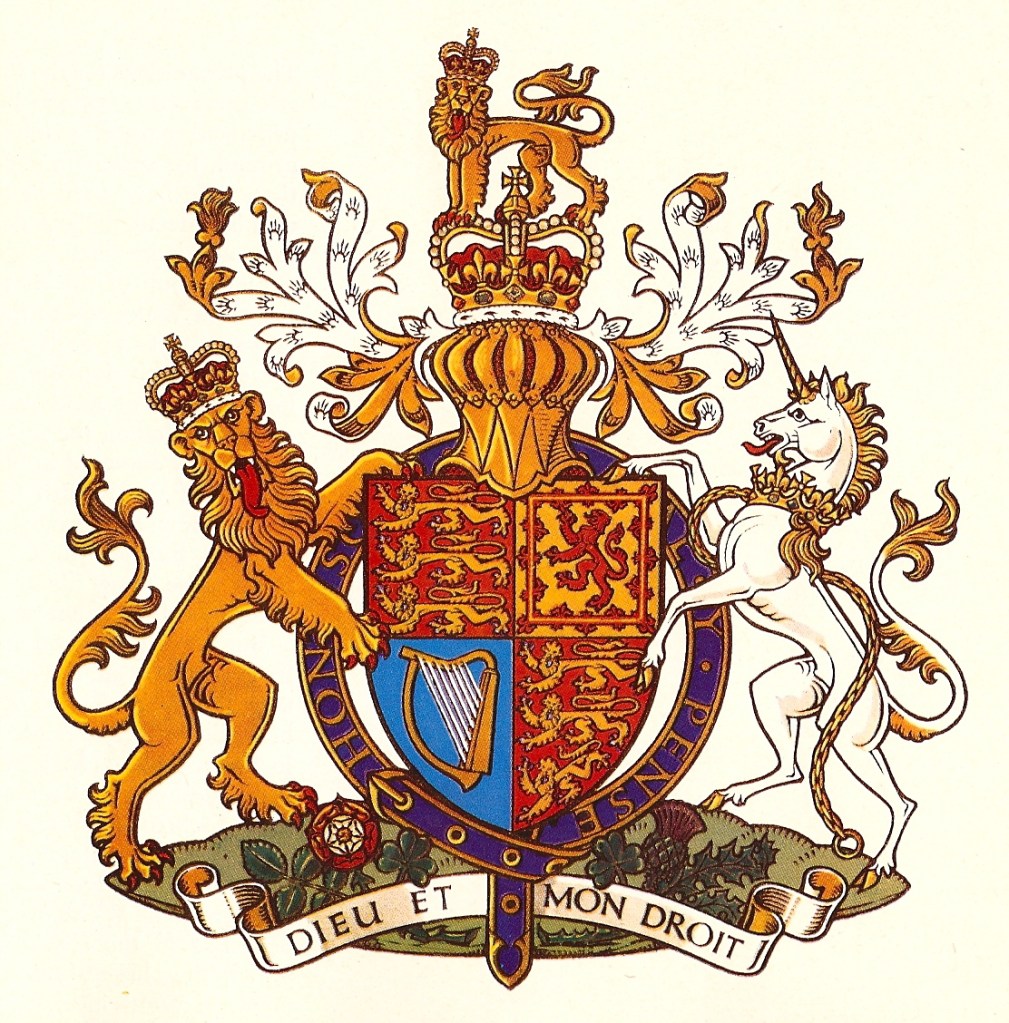
Buckingham Palace released the royal cypher to be used by King Charles III. It employs the “Tudor” crown rather than the stylized version of the St. Edward’s Crown favored by his late mother, Elizabeth II. Her four predecessors used this Tudor style crown in their cyphers as well as on their coats of arms. This has led to the erroneous belief that there is a “Queen’s crown” and a “King’s crown” used heraldically in British royal heraldry. That is not the case. It is simply a matter of each sovereign’s personal preference.
Today, HM Queen Elizabeth II died peacefully at Balmoral. Her eldest son immediately succeeded her becoming King Charles III. His son inherits his titles as heir to the throne and will now be Duke of Cornwall and Cambridge (among several other titles). King Charles will now relinquish the coat of arms he has borne since 1958 and the royal arms which had been used by his late mother since 1952, immediately becomes his coat of arms.
In light of the recent announcement that the Duke and Duchess of Sussex (aka Prince Harry & Meghan) will be stepping back from duties as senior royals and, consequently no longer styling themselves as “royal highness” not a few people have contacted me to ask out of curiosity if this in any way will have an impact on the coats of arms they both use.
The simple answer is, “No”.
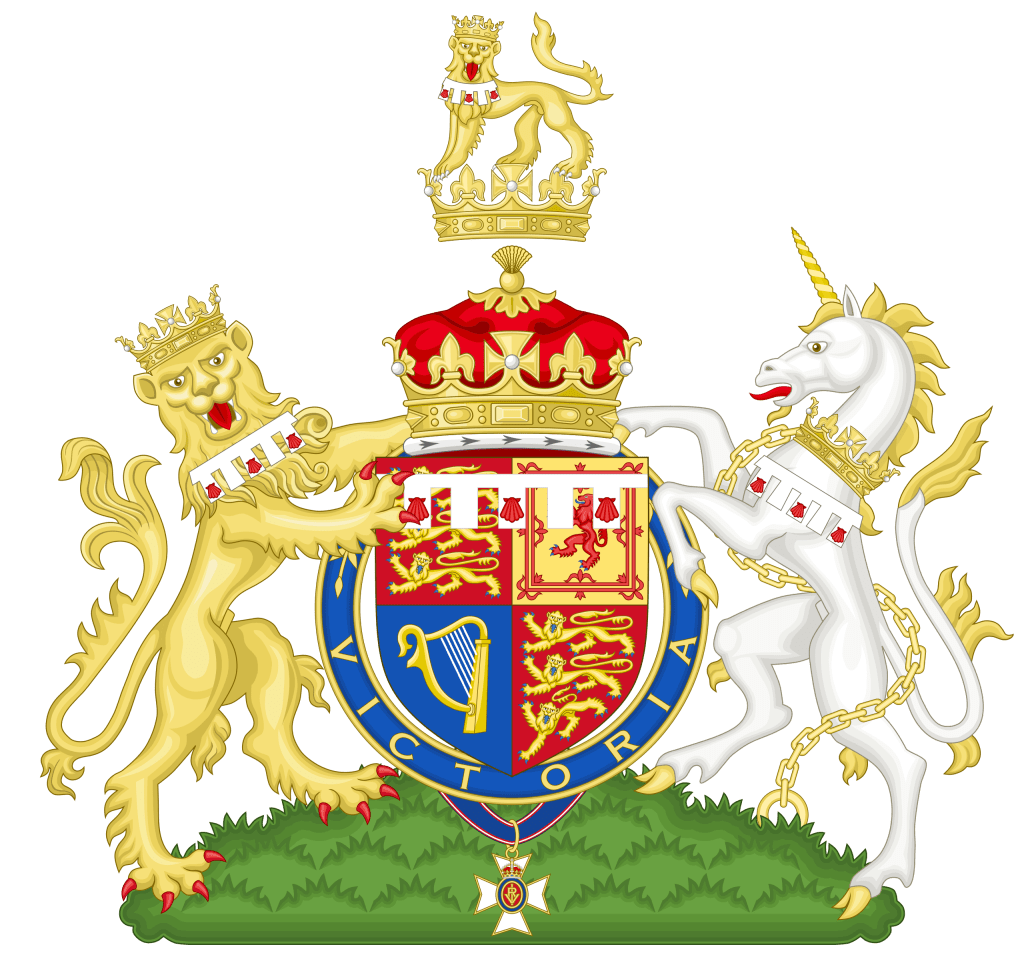
As the grandson of the sovereign Prince Harry employs a coat of arms that indicates he was born a grandson of the sovereign. British royal heraldry is different than many other countries in that the sovereigns children and grandchildren generally bear the royal arms differenced by a variety of labels of either three or five points and the points are charged with marks of difference. That’s really rather boring if you asked me but that’s what they do and they haven’t asked me!
So, when he turned 18 Harry was granted his own arms depicting the royal arms difference by a label of five points the first, third and fifth of which are charged with a red escallop shell. The shell is a charge borrowed from the coat of arms of his late mother, Diana (neé Spencer).
His supporters were also charged with the label for difference and the arms are surmounted by a special coronet used by the children of the heir to the throne. In addition, the royal crest is also charged with the label for difference.
Upon marrying his wife Harry was created Duke of Sussex. Nothing in his coat of arms was modified to reflect this title. Consequently, there is nothing to change in his coat of arms to reflect his new status of stepping down from a senior position in the royal family. He is still a grandson of the sovereign and son of the heir to the throne; he is still the Duke of Sussex; he is still actually an “HRH” but will choose not to style himself as such.
In fact, even after his grandmother passes away and he is the son of the sovereign and, indeed, even after his father passes away and he is the brother of the sovereign the crown used on his arms will remain unchanged as the crown for the child of the heir is identical to the crown used by children of the sovereign and siblings of the sovereign.
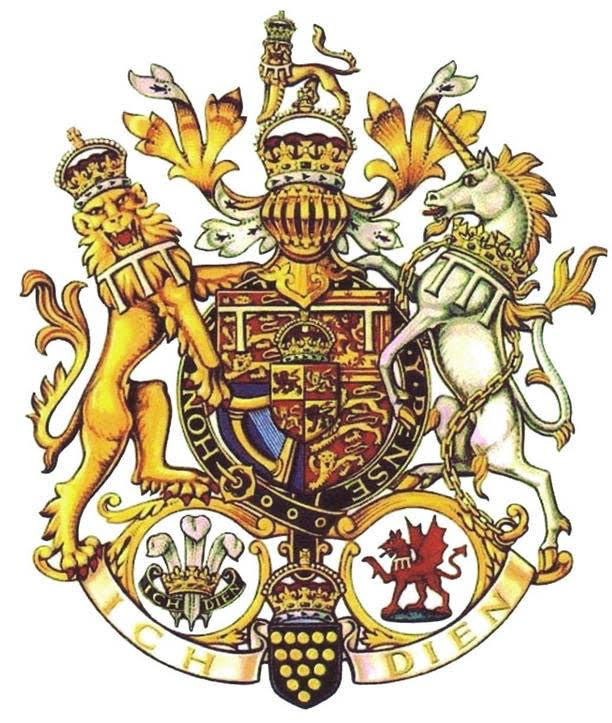
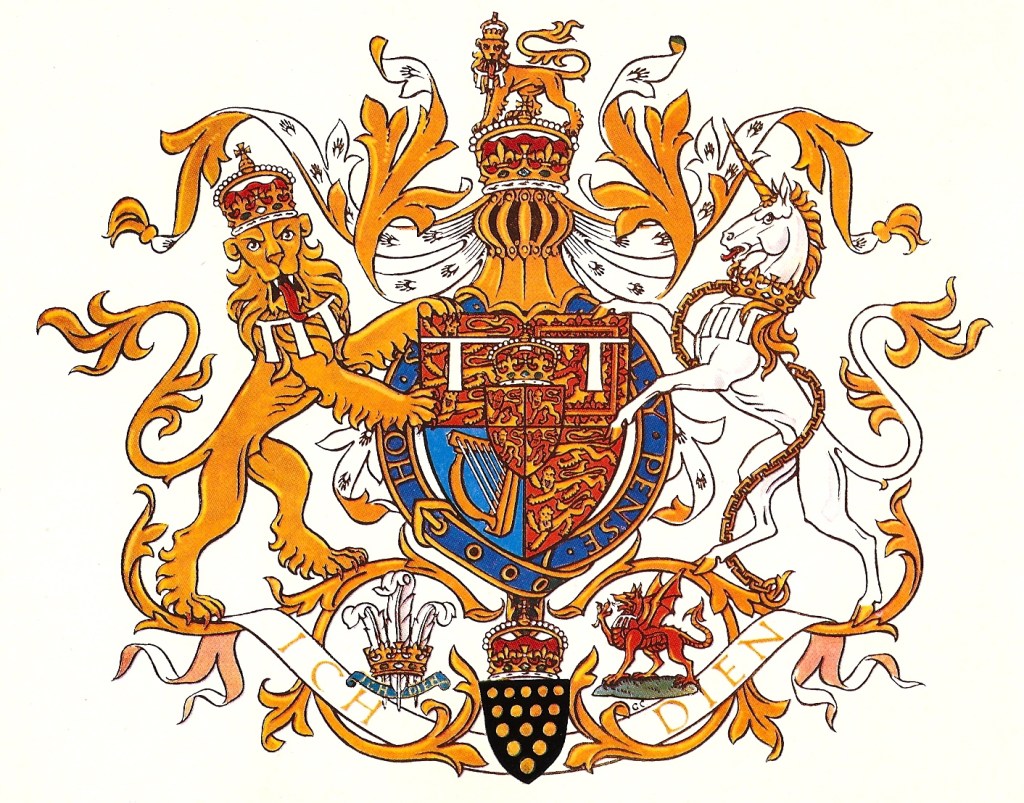
On July 1, 1969 Prince Charles was formally invested as Prince of Wales and Earl of Chester. He had been given these titles in 1958 and had, from the time of his mother’s accession to the throne been the Duke of Cornwall, the title traditionally held by the heir apparent to the British throne. This year marks the 50th anniversary of the event.
In 2017 Prince Charles surpassed the record set by his illustrious ancestor, King Edward VII, by becoming the longest-serving Prince of Wales in history.
His arms (above) appear very much like those of his mother except that his are differenced by a white label (repeated on both supporters and the badge for Wales as well); in place of the compartment there is a device intertwining his motto and his badges as well as a small shield with the arms of Cornwall; there is an inescutcheon for Wales; and the crowns on the helm, the two small shields and the lion supporter all have a single arch as befits a Princely crown rather than a royal one which has two arches.



 EXARANDORUM