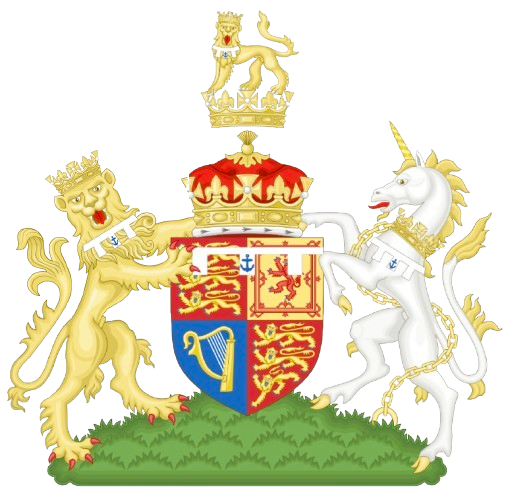
After renouncing the use of and later experiencing the further removal of any titles, honors and military ranks, Andrew Mountbatten-Windsor’s armorial bearings revert to those granted to him originally before any other honors or titles were bestowed upon him.
That is, the royal arms differenced by a label of three points (for the son of a Sovereign) the center point of the label charged with a blue anchor. The Royal arms, suitably differenced, are allowed to be used by him as the son of the Sovereign at the time of his birth regardless of any removal of his titles and honors.
I had wondered if he would be allowed to continue to use the supporters and the crest but apparently he is.
In January of 2019 I posted about the very nice arms granted to a clergyman in the UK. Fr. Adam Gaunt had received beautiful Letters Patent for his fine coat of arms and was eager to share them with me.
I recently saw online that he posted about some modifications to the ornamentation of his arms reflecting the fact that he has recently been named a Canon of York in the Church of England. So the galero now has six red tassels pendant on either side.
International Heraldry Day was established in 2013 by the International Association of Amateur Heralds (IAAH). The date, June 10, was chosen to commemorate a significant event in heraldic history: on this day in 1128, Geoffrey Plantagenet, Count of Anjou, was knighted by King Henry I of England. During the ceremony, Geoffrey received a blue shield adorned with six golden lions, which is considered one of the earliest known examples of a fully formed coat of arms.
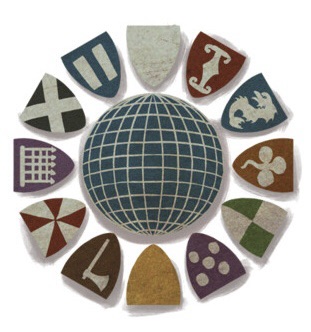
A few months ago I was approached about providing assistance to the Episcopal Diocese of Wisconsin on a redesign of their coat of arms. The diocese encompasses the entire state of Wisconsin and is composed of a reunification of three dioceses in the state—Milwaukee, Eau Claire, and Fond Du Lac— into one jurisdiction. Each of the former dioceses had its own armorial bearings and the task at hand was to come up with an entirely new design that could please everyone and borrow some design elements from all three. Not an easy task.
A commission was put together of people from within the state who had some background in various fields like art, communications, web design, or Episcopal Church history, and the bishop (the former bishop of Fond Du Lac). I was asked to be the heraldic consultant and we gathered via zoom for several meetings and exchanged numerous pieces of correspondence with quite a few sketches going back and forth. After identifying themes, common characteristics and ideas for what the new arms should express we began to hone it down to just a few, which quickly became two and then we made final tweaks until we got to the result. I didn’t provide the artwork this time but simply guided the process of designing the coat of arms.
The end result is:
The use of blue was common in all three existing arms, as was images of water. So, the blue field contains two wavy lines as symbolic of the lakes and rivers of Wisconsin as well as a reference to the waters of Baptism. The two crosses fleury in chief are for the Christian faith that undergirds every effort of the people in the diocese and has a subtle nod to the French influence on the region. The fret of three fish is an obvious Trinitarian symbol and also alludes to the three former jurisdictions being united into one. The fish is, of course, an early Christian symbol and is, therefore, a fitting element to use to symbolize three Christian communities now united as one.
I would blazon this: Azure, two barrulets wavy Argent; in chief between two crosses fleury Argent a fret of three fishes Or. The shield is ensigned with a bishop’s miter and a crozier and key in saltire behind the shield all Or.
My favorite little “cheeky” thing that was snuck in are the two crosses on the ends of the fanons that hang from the bishop’s mitre. They are composed of four triangles conjoined at the center…looking slightly like four wedges of cheese since Wisconsin is known as a very large dairy-producing state. The nickname of someone from Wisconsin is the affectionate term: “Cheese-Head”.
This was a long process but one that undertaken seriously by people dedicated to their task. My gratitude to Fr. Chris Corbin for shepherding the commission along as its chair and for providing the final artwork as well! The arms is also used by the diocese on its diocesan seal.
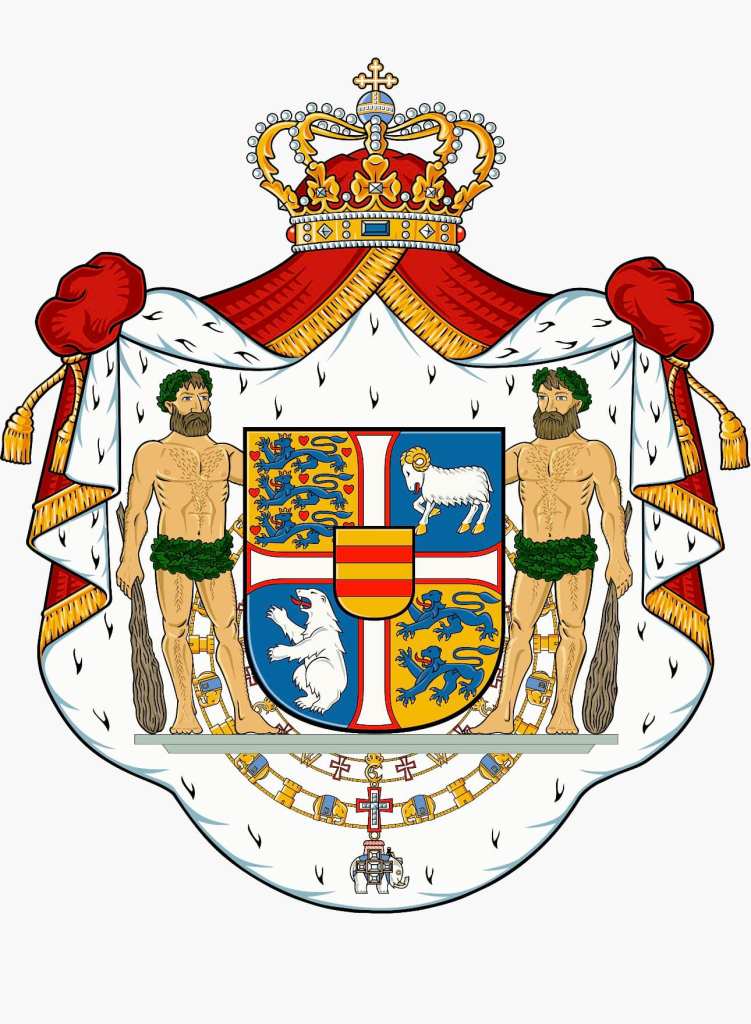
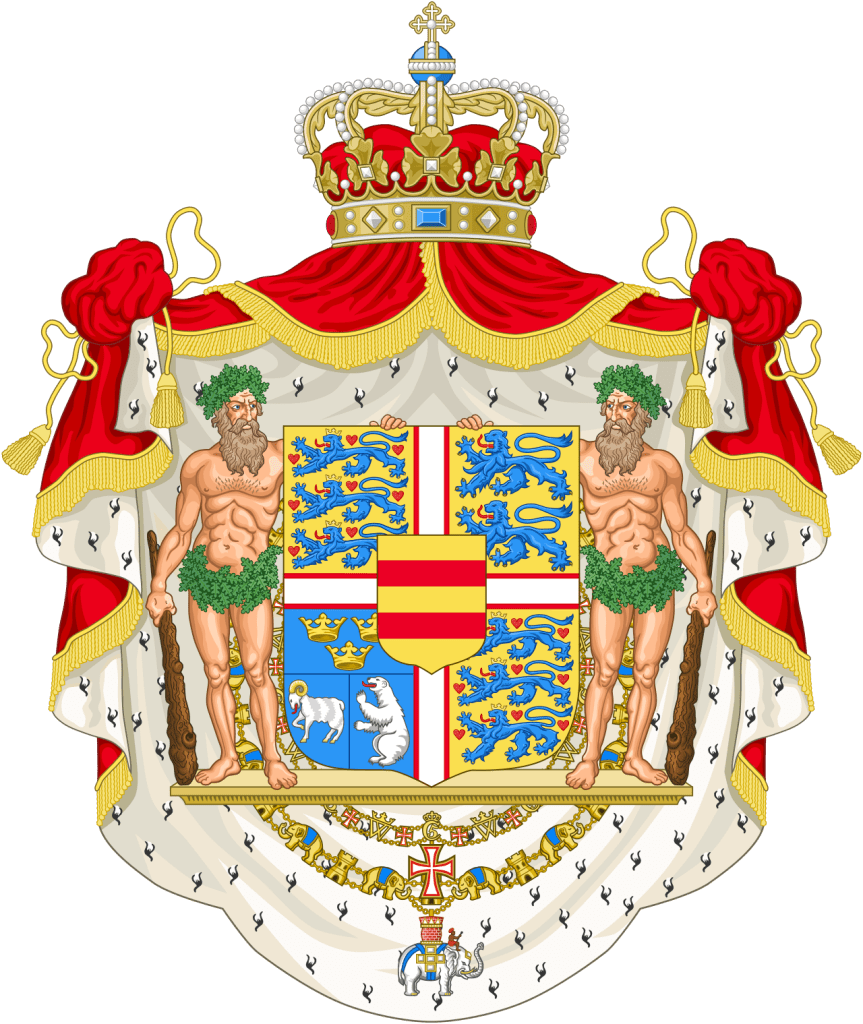
HM, King Frederik X has undertaken to issue a new, updated version of the Danish royal coat of arms dated December 20, 2024. The new version, prepared by Ronny Skov Andersen, simplifies the overall design.
It removes the three crowns of the Kalmar union and gives the arms of the Faeroe Islands and Greenland their own quarterings. It also places the arms of Denmark, originally the arms of the House of Estridsen, in the first quarter and instead of repeating it in the fourth quarter the arms of Schleswig are placed there. In addition, the Dannebrog, the cross that divides the shield into four quarters, has been returned to a more traditional form with the ends of the arms slightly flared. Overall, there remains the dynastic inescutcheon for the arms of the House of Oldenburg. The new version is:
The blason could be written as: A shield quartered by a cross pattée throughout Argent fimbriated Gules; first quarter Or, three lions passant in pale Azure crowned and armed Or langued Gules, nine hearts Gules (for Denmark); second quarter Azure a ram passant Argent armed and unguled Or (for the Faroe Islands); third quarter, Azure a polar bear rampant Argent (for Greenland); fourth quarter, Or two lions passant in pale Azure armed Or langued Gules (for Schleswig). Overall an escutcheon Or two bars Gules (for Oldenburg) the whole surrounded by the Collars of the Order of the Dannebrog and the Order of the Elephant. Supporters two woodwoses armed with clubs Proper standing on a pedestal. All surrounded by a mantle Gules doubled Ermine crowned with a royal crown and tied up with tasseled strings Or.
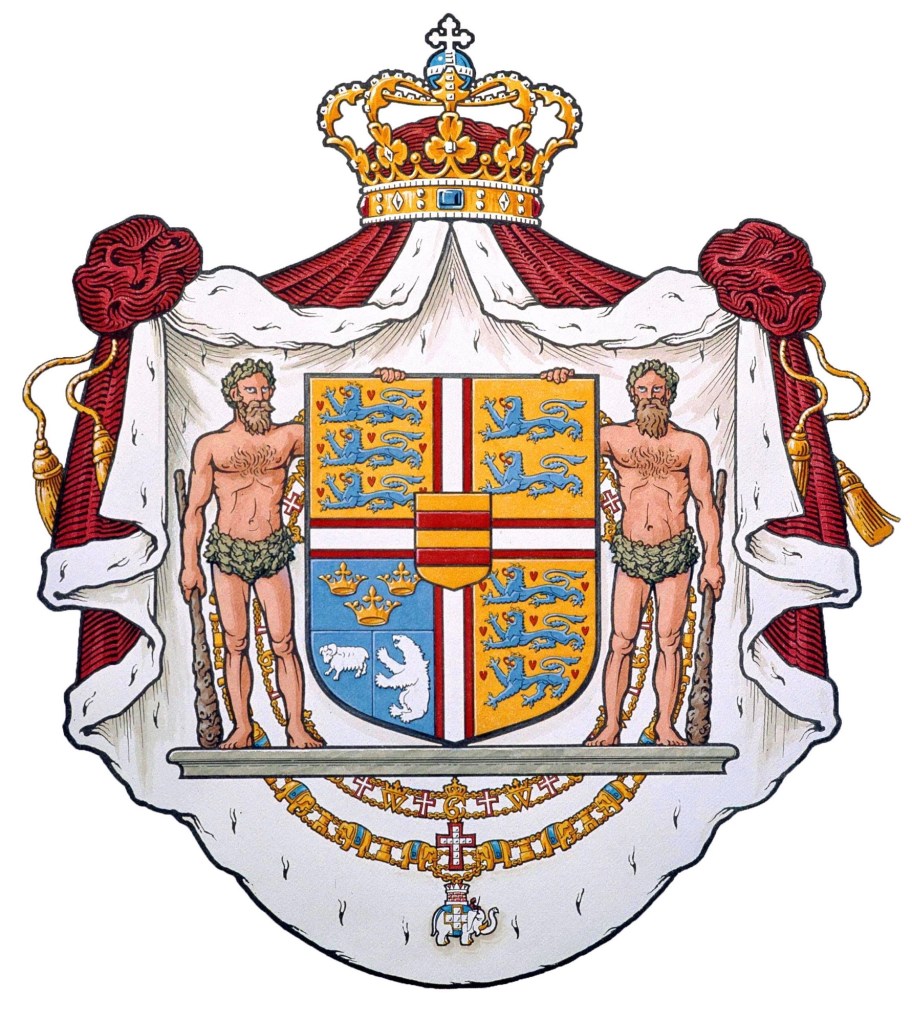
This replaces the version of the coat of arms that had been modified after the reign of King Frederik IX by Queen Margrethe which had been in use since 1972. (below)
I think this updated version is aesthetically more pleasing. It is a slightly less busy composition and the juxtaposition of the arms of Denmark and those of Schleswig provide a more pleasing visual. There is no longer the multiplication of lions and the two quarters with fields Or look better on a diagonal from each other, as do the two quarters with fields Azure. It all seems less imbalanced. I also happen to think the style of the cross looks better that the simple cross throughout.
It is exciting to see heraldry—long erroneously thought by the ignorant to be stagnant and encrusted with the weight of history and therefore irrelevant to today’s society—being updated and dynamic. The current situation calls for an updated symbol of the monarchy. This was true in 1972 and it is just as true some 52 years later. I applaud the efforts of His Majesty and also Ronny Andersen and those who worked with him to devise this updated coat of arms.
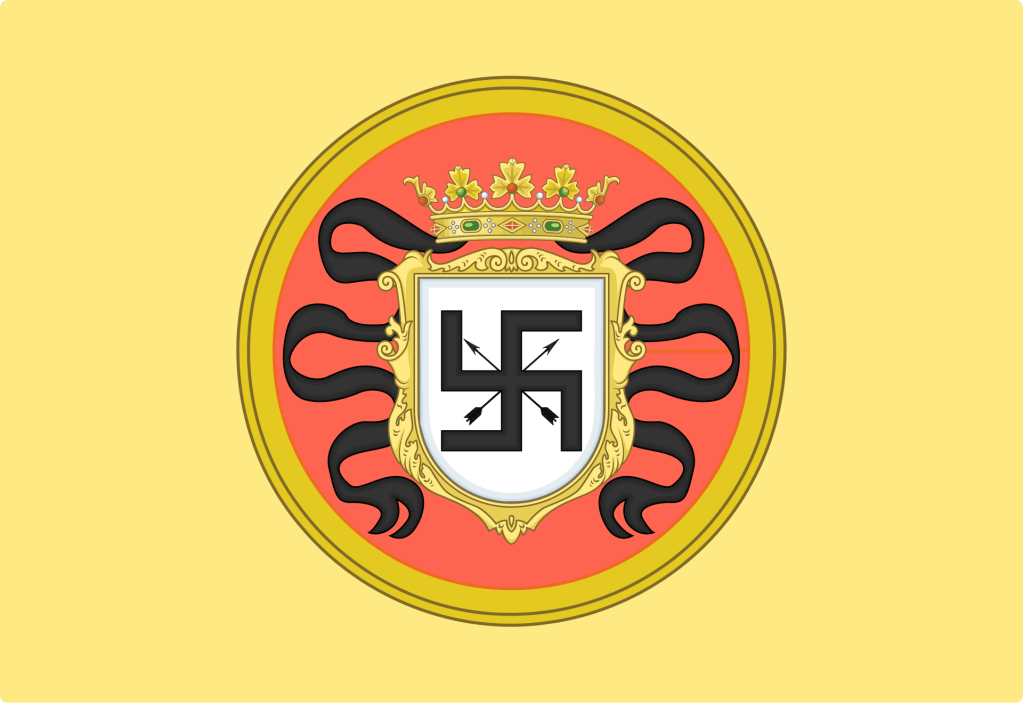
Not long ago, in my capacity as my bishop’s ecumenical & interfaith officer, I attended a meeting with representatives of the Hindu community here in central New Jersey in an ongoing effort to increase contacts with the Catholic community and people of other faiths. A small part of our conversation touched on general misunderstandings between faith communities and the swastika was used as an example. In the Hindu, Jain and Buddhist faiths the symbol is a positive one. For all time, it was ruined by its adoption by the nazi party in Germany. There it wasn’t actually a “swastika”. Rather, it was a hooked cross (hakenkreuz in German) which was not an uncommon form of the cross used in Europe until its association with the nazis ruined its connotation.
It is, I think, always important to absolutely repudiate the ideas of national socialism or its bizarre stepchild, neo-nazism, which, tragically, still exists. My intention by this post is not to offend, but to educate.
While its association with the horrors of WWII and the Holocaust will forever be with us the swastika (not the hakenkreuz), nevertheless, remains a religious symbol—and one without ANY nazi-related connotations—to other faiths. As such, it often has made its way into coats of arms in the past.
The image below depicts a banner with the armorial bearings of Hasekura Tsunenaga, also known as Don Felipe Francisco Hasekura after his conversion. He was a Japanese Samurai and emissary who traveled through the American continent and Europe in the 1600s. The arms and banner was granted to him after his conversion to Catholicism during his visit to Mexico City in 1614. An interesting blend of Japanese and European styles.
These days people would look upon this and THINK they know what it means…and be quite wrong. Such is the power of symbols. An positive religious symbol has been—in the West anyway—ruined forever because we cannot disconnect it from its terrible adoption by hateful people.
I’m looking forward to attending the 36th International Congress of Genealogical & Heraldic Sciences (ICGHS) in Boston this week. The event is hosted by American Ancestors, a national center for family history, heritage & culture (specifically their Heraldry Committee) and FamilySearch, the world’s largest genealogy organization. This year’s Congress theme is: “Origins, Journeys, Destinations”. This will be the first time the ICGHS is held in the United States.
In continuing my exploration of the royal arms of Denmark, leading up to the Abdication of Margrethe II and the Accession of Frederik X on January 14 I note with interest (not necessarily with any great significance, but merely with interest) that the Danish royal arms, the version used by the House of Oldenburg-Glückburg, occasionally turns up in other royal houses as well.
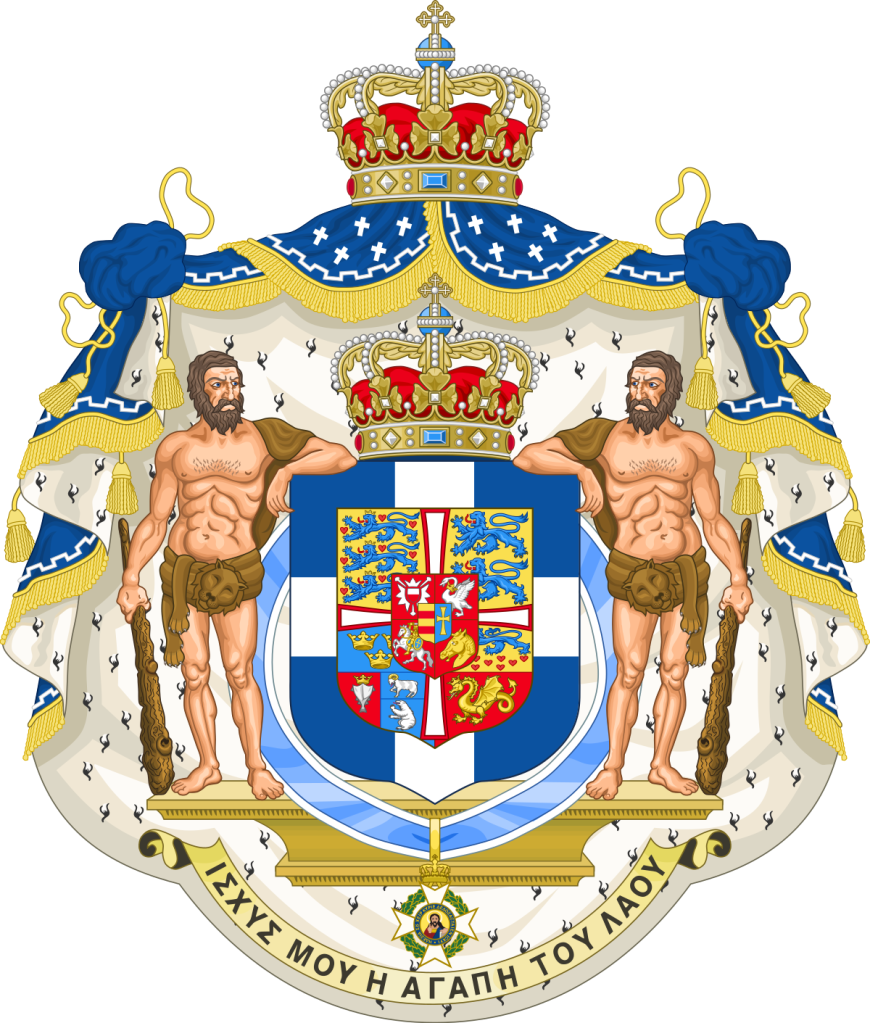
In particular, when the Greek monarchy was established in 1832 and offered to the Bavarian prince, Otto, whose reign lasted until his ouster in 1862, the Hellenic throne was then offered to Prince William of Denmark who ruled as George I of the Hellenes. The Wittlesbach arms placed at the center of the coat of arms of the Greek kingdom was replaced with a shield bearing the dynastic arms of the House of Glücksburg, a cadet branch of the House of Oldenburg. That was used during the next several reigns until the monarchy was abolished in 1924. Then, in 1935 when the monarchy was restored and King George II returned to the throne the coat of arms was modified again.
Now the center of the shield bore the greater coat of arms of the Danish royal house as used by his ancestor and King of Denmark, Christian IX from 1863-1903 before a modification of its own. In addition, the Greek coat of arms changed the two Woodwose supporters to depictions of Heracles as supporters. This coat of arms was then subsequently used by the remaining Greek kings until the monarchy was finally abolished in the 1973 referendum.
However, the last King of the Hellenes, Constantine II, had married Anne-Marie of Denmark, the daughter of King Frederik IX of Denmark and the sister of Queen Margrethe II. She bore the royal arms of Denmark as she inherited them from her father and the Danish royal arms made a double appearance in the reign of King Constantine II.
Through the Greek branch of the House of Oldenburg-Glücksburg the Danish royal arms also made their way to the UK. The late Prince Philip, husband of Elizabeth II, used the surname Mountbatten which he got from his mother, Princess Alice of Battenberg, later changed to Mountbatten, but he was born a prince of Greece (and Denmark). His father was Prince Andrew, the son King George I of the Hellenes and, himself, the son of King Christian IX of Denmark. So, the very first coat of arms devised for Philip Mountbatten, and used by him for only two years before adopting a different coat of arms, reflected his Greek and Danish heritage, as well as his mother’s British ancestry.
The Danish royal arms–as used by Christian IX– are on the dynastic shield in the center. In the dexter chief quarter the coat of arms of his grandmother, Princess Alice, Grand Duchess of Hesse and by Rhine, and the daughter of Queen Victoria, (but with the escutcheon in pretense of Saxony inherited from her father, Prince Albert of Saxe-Coburg and Gotha diplomatically removed) have been unusually and awkwardly added as a nod to his British ancestry, perhaps to quell any fears of the heiress presumptive, Elizabeth, marrying “a foreigner”. These were deemed unacceptable and in 1949 new arms were granted to him which he had a hand in designing.
This coat of arms includes quarters for Greece and Denmark (as well as Mountbatten and Edinburgh, his Dukedom) and make use of the Mountbatten lion supporter and crest, as well as the Greek Heracles supporter rather than the Danish Woodwose. You can tell because of the lion-skin loin cloth.
Another Greek Oldenburg-Glücksburg connection can be seen in the coat of arms of the Queen-Emerita of Spain, Sofia. She was born a princess of Greece (and Denmark), the eldest daughter of King Paul and Queen Frederika. Her coat of arms as Queen of Spain, wife of King Juan Carlos I is
Impaled with her husband’s coat of arms, Queen Sofia’s arms are those of the Greek royal house which she inherited from her father bearing the inescutcheon of the Danish royal arms as used by Christian IX. This shows the dynastic link to the Schleswig-Holstein-Sonderburg-Glücksburg dynasty; a shield containing the Dannebrog, a cross from the Danish flag, and quarterings representing Denmark, Schleswig, the former Kalmar Union, Iceland, the Faroe Islands, Greenland, Holstein, Stormarn, Dithmarschen, Lauenburg, Oldenburg, Delmenhorst, and the former Danish royal titles of King of the Wends and Goths.
Of course there is also the coats of arms of two sisters, both princesses of Denmark and daughters of Christian IX. Alexandra married the Prince of Wales and went on to become Queen of the UK as the spouse and consort of King Edward VII.
The other was Princess Dagmar who married Czar Alexander III and became Empress of Russia as Maria Feodorovna.
The Danish royal family has many connections to the other royal houses of Europe and the Danish Royal Arms, simplified once again by Queen Margrethe in 1972 to its present form, crops up in several different places which I simply find interesting.
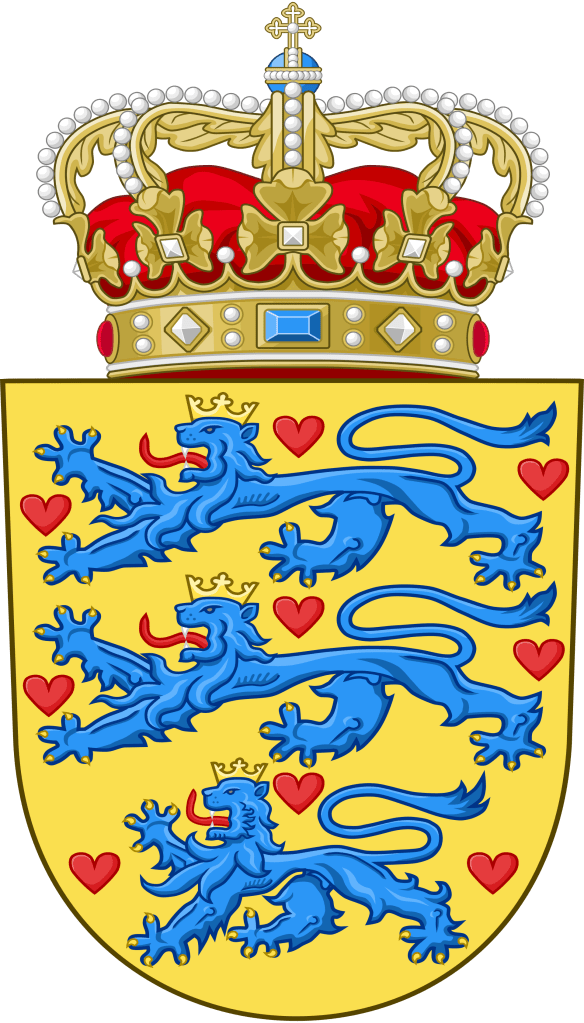
With the approaching abdication of Queen Margrethe II and the accession of King Frederik X of Denmark I’ve been reading up on the heraldry used by the country and the royal house. The state coat of arms consists of three pale blue lions passant wearing crowns accompanied by nine red lilypads (normally represented as heraldic hearts), all in a golden shield with the royal crown on top. The national coat of arms of Denmark is similar to the state coat of arms, but without the royal crown above the shield.
It is historically the coat of arms of the House of Estridsen, the dynasty which provided the kings of Denmark between 1047 and 1412. The current design was introduced in 1819, under Frederik VI. Previously, there had been no distinction between the “national” and the “royal” coat of arms. Since 1819, there has been a more complex royal coat of arms of Denmark separate from the national coat of arms. I’ll take a look at that in another post.
Historically, the lions faced the viewer rather than forward and the number of hearts was not regulated and could be much higher. The “heart” shapes originally represented waterlily pads; a royal decree of 1972 still specifies these figures as søblade (“lake leaves”). Frederik VI also fixed the number of hearts to nine and decreed that the heraldic beasts were lions, as opposed to leopards, and consequently facing forward in 1819. The blazon is: Or, three lions passant in pale azure crowned and armed Or langued gules, nine hearts Gules.
In her annual New Year message Queen Margrethe II of Denmark announced her intention to abdicate the throne on January 14, 2024 exactly 52 years to the day that she succeeded her father and became queen. She will be succeeded by her son, Crown Prince Frederik, who will reign as King Frederik X.
God bless Queen Margrethe, the last reigning queen in the world at the present time, and long live King Frederik!
Sincere good wishes to the Canadian Heraldic Authority (Autorité Héraldique du Canada) as they celebrate their 35th anniversary!
In 1988 the Queen of Canada issued letters patent granting permission for the Governor General “to exercise or provide for the exercise of all powers and authorities lawfully belonging to Us as Queen of Canada in respect of the granting of armorial bearings in Canada”. On June 4, 1988 Governor General Jeanne Sauvé authorized the creation of the CHA.
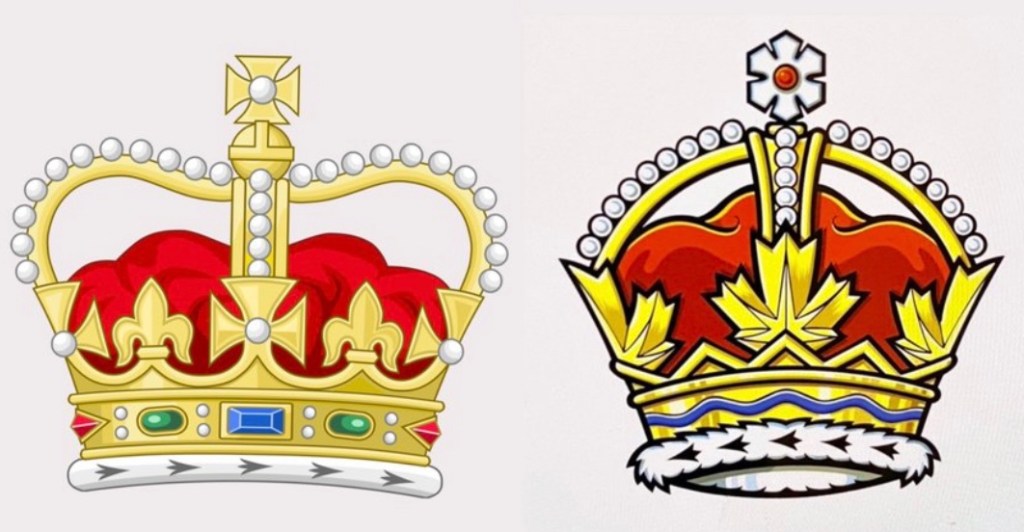
Today, the Canadian Government of Justin Trudeau unveiled a new heraldic Canadian Crown replacing the traditional St. Edward’s Crown used on Canada’s coat of arms, police & military badges. The design replaces what the government termed “religious symbols” (crosses & fleur-de-lis) with maple leaves & a snowflake.
The Canadian Heraldic Authority was apparently consulted in this process. Reactions so far have been mixed but mostly disapproving.
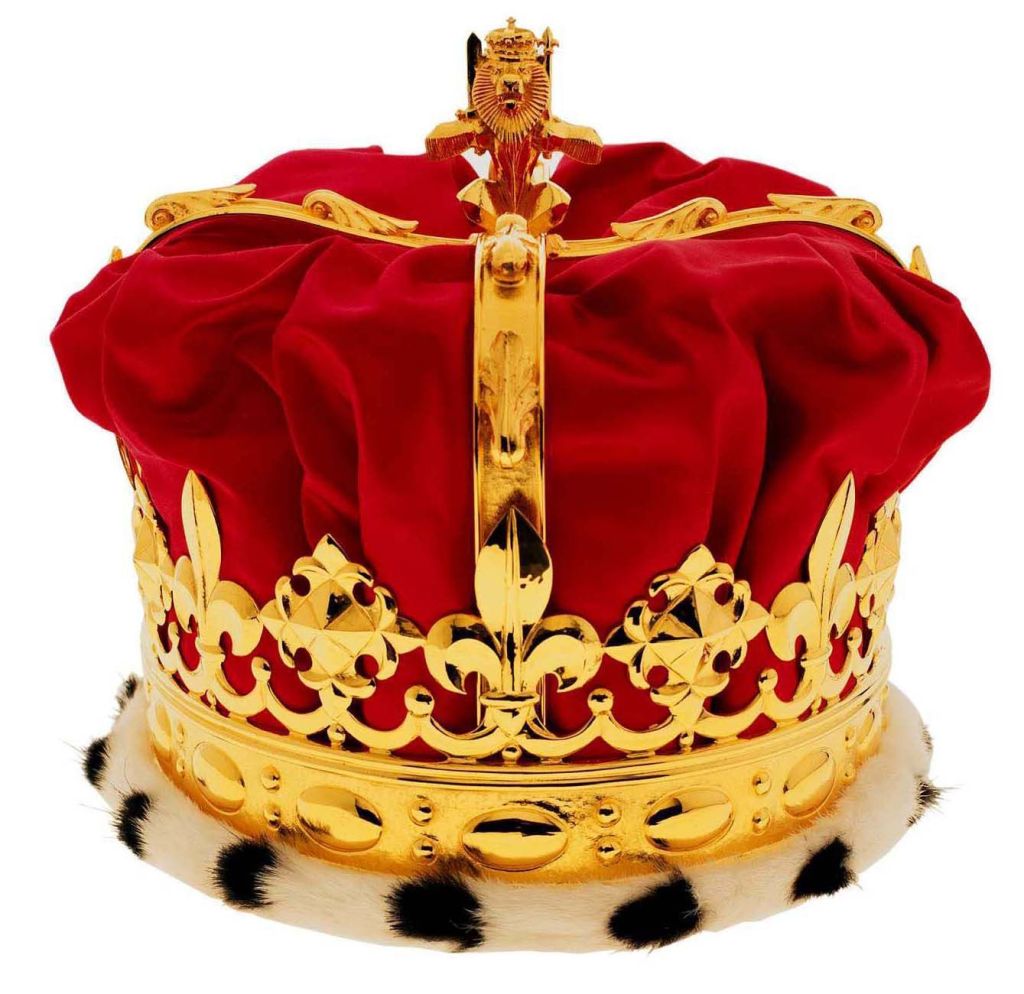
It was very interesting to read in the Times that Lord Lyon King-of-Arms, the senior heraldic officer in Scotland will not only take part in King Charles’ coronation on May 6 but will do so wearing the crown that had been commissioned and obtained by the Heraldry Society of Scotland back in the early 2000s. The arches on the crown, which are removable, will be removed for the coronation so it won’t too closely resemble the crown with which the King shall be crowned.
The expensive item and the trouble that went into commissioning and fabricating it was one of the reasons that, despite the Peers not being allowed to wear their coronets at the upcoming, more modernized, ceremony Lord Lyon–and indeed the other three English Kings-of-Arms–will be wearing their crowns. The coronation of the Sovereign is one of the only occasions on which these crowns are traditionally worn.
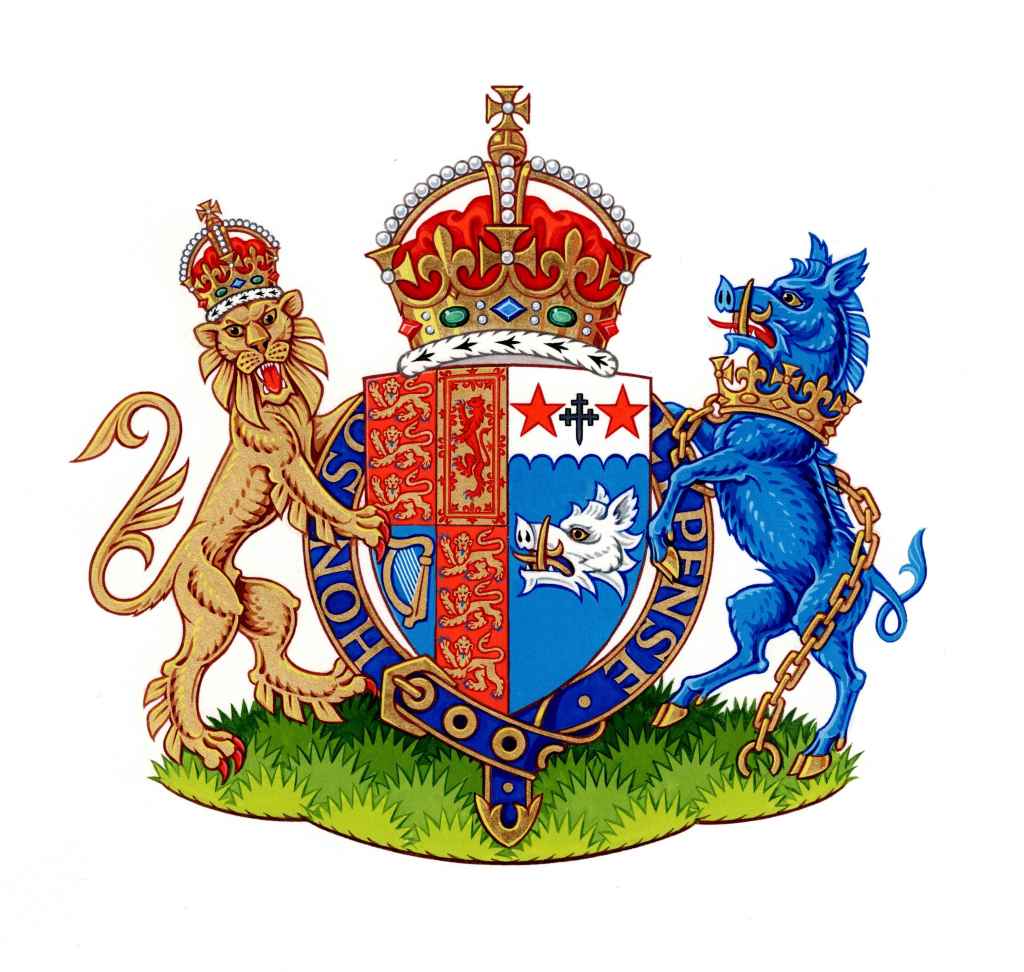
On February 21, HM King Charles III granted new arms to Her Majesty Queen Camilla. This is the first grant of arms made by the King and they replace the arms previously granted buy the late Queen Elizabeth on July 14, 2005. The arms granted are:
“Within the Garter Our Royal Arms impaling the Arms of Shand surmounted by Our Crown.”
The Supporters are a Lion Guardant Or Crowned proper (dexter) and to the sinister a Boar Azure armed and unguled Or langued Gules and gorged with a Coronet composed of Crosses formy and Fleurs-de-lys attached thereto a Chain reflexed over the back and ending in a Ring all Or (sinister).
This month marks the 80th anniversary of the office of Norroy and Ulster King of Arms. The office of Ulster King of Arms was created by King Edward VI on February 2, 1552, and for its first 36 years, appears to have been regarded as attached to the College of Arms; the two Ulsters in this period, Bartholomew Butler and Nicholas Narboon, had both been English Heralds before their appointment as Ulster. After the resignation of Narboon in 1588, subsequent Ulsters acted independently from the English College. On January 30, 1908, King Edward VII appointed Captain Nevile Rodwell Wilkinson King of Arms and Principal Herald of all that part of the United Kingdom of Great Britain and Ireland called Ireland, with the title of Ulster. Wilkinson exercised this office, based in Dublin Castle, through a period of great political turmoil in Ireland until his death on December 22, 1940. The political circumstances in Ireland at this time led to the decision to return the office of Ulster to the College of Arms in London, with responsibility for Northern Ireland alone, and united with the office of Norroy.
On January 29, 1931, King George V had appointed Algar Henry Stafford Howard, M.C., as King of Arms and Principal Herald of the North Part of England, with the title of Norroy. Howard still held this office on April 1, 1943, when King George VI additionally appointed him King of Arms and Principal Herald of that part of the United Kingdom of Great Britain and Northern Ireland called Northern Ireland, without prejudice to his existing appointment as Norroy and with the title of Ulster to be borne after that of Norroy. Howard held these joint offices until his promotion to Garter the next year, and on June 2, 1944, King George VI appointed Sir Gerald Woods Wollaston, K.C.B, K.C.V.O., King of Arms and Principal Herald of the North Part of England and of Northern Ireland, with the title of Norroy and Ulster, which has remained the form of the office to this day. The present Norroy and Ulster, Robert John Baptist Noel, was appointed by Queen Elizabeth II on April 6, 2021. He proclaimed the accession of His Majesty The King at Hillsborough Castle in Northern Ireland on September 10, 2022, the first time Ulster had performed such a duty in Ireland since the proclamation of King George V in Dublin on May 9, 1910.
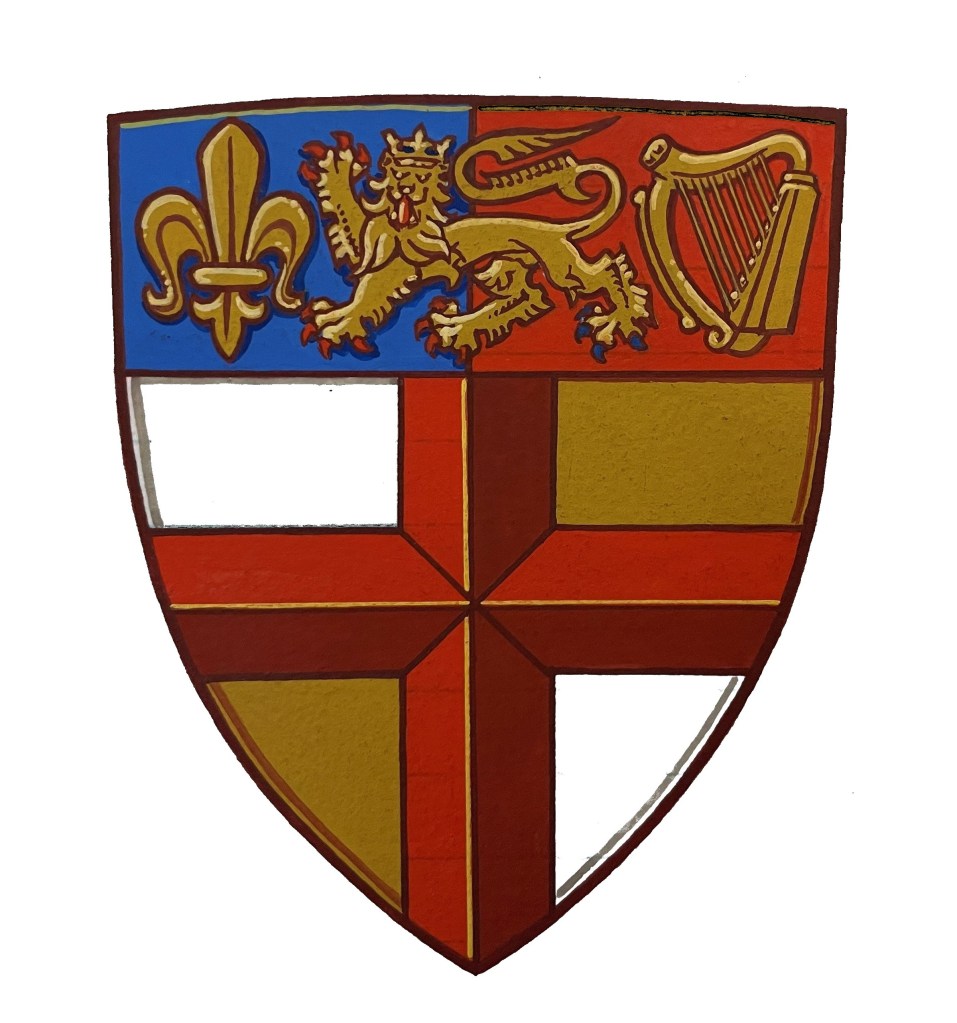
Between 1943 and 1980, holders of the office of Norroy and Ulster used the arms of office of one of the two offices, or both arms impaled on one shield. In 1980, Queen Elizabeth II approved new arms for the joint office. These are: Quarterly Argent and Or a Cross Gules on a Chief per pale Azure and Gules a Lion passant guardant crowned between a Fleur-de-lis and a Harp Or. Norroy and Ulster King of Arms is also ex officio King of Arms, Knight Attendant, Registrar, and Keeper of the Records of the Most Illustrious Order of Saint Patrick, offices which are purely nominal since the death of the last Knight of the order.
Text taken from the College of Arms Newsletter, No. 71 April, 2023
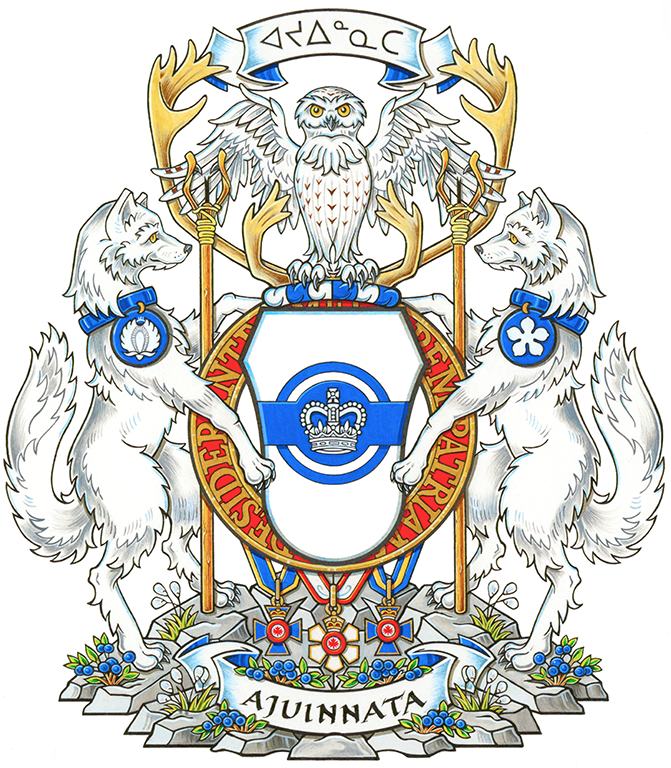
On October 28 the Canadian Heraldic Authority published the coat of arms that has been devised for the current Governor-General of Canada, Mary J. Simon, CC, CMM, COM, OQ, CD, FRCGS. Simon has been serving as Canada’s 30th Governor-General and representative of the King as Head of State since July 26, 2021. She is the first indigenous person to hold the office, being of Inuk origin.
For more information about the devisal of the coat of arms and the symbolism contained therein you can visit the website of the Governor-General’s Office HERE.





 EXARANDORUM