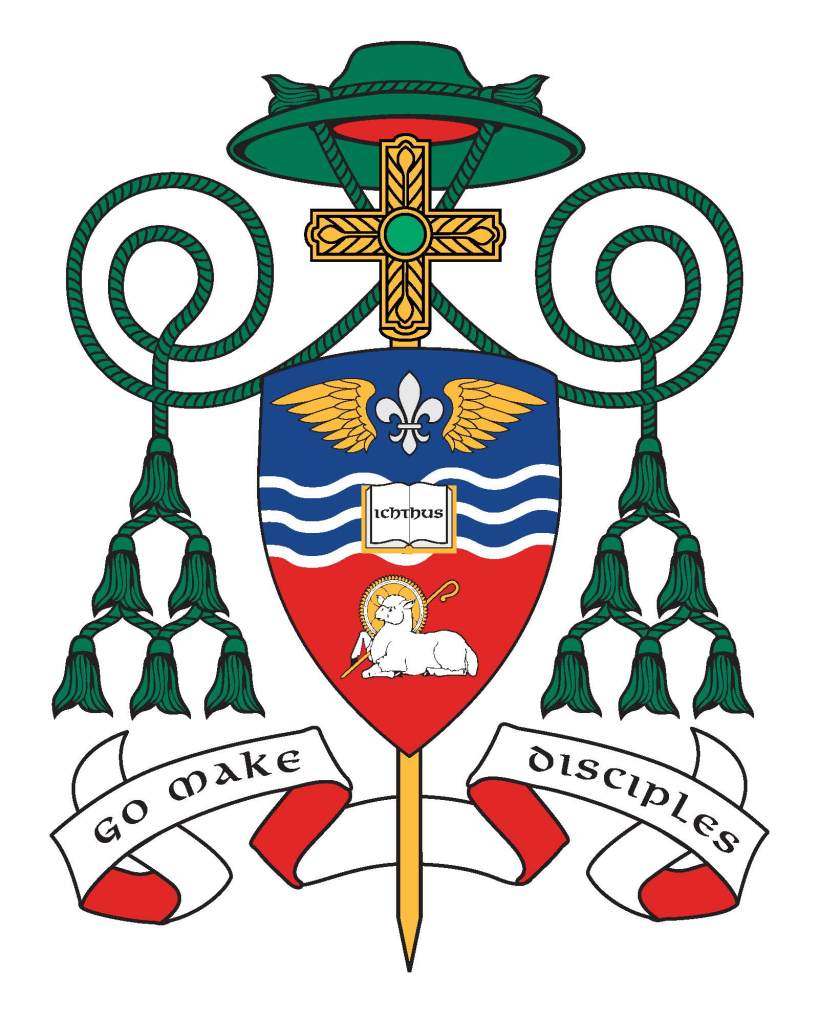
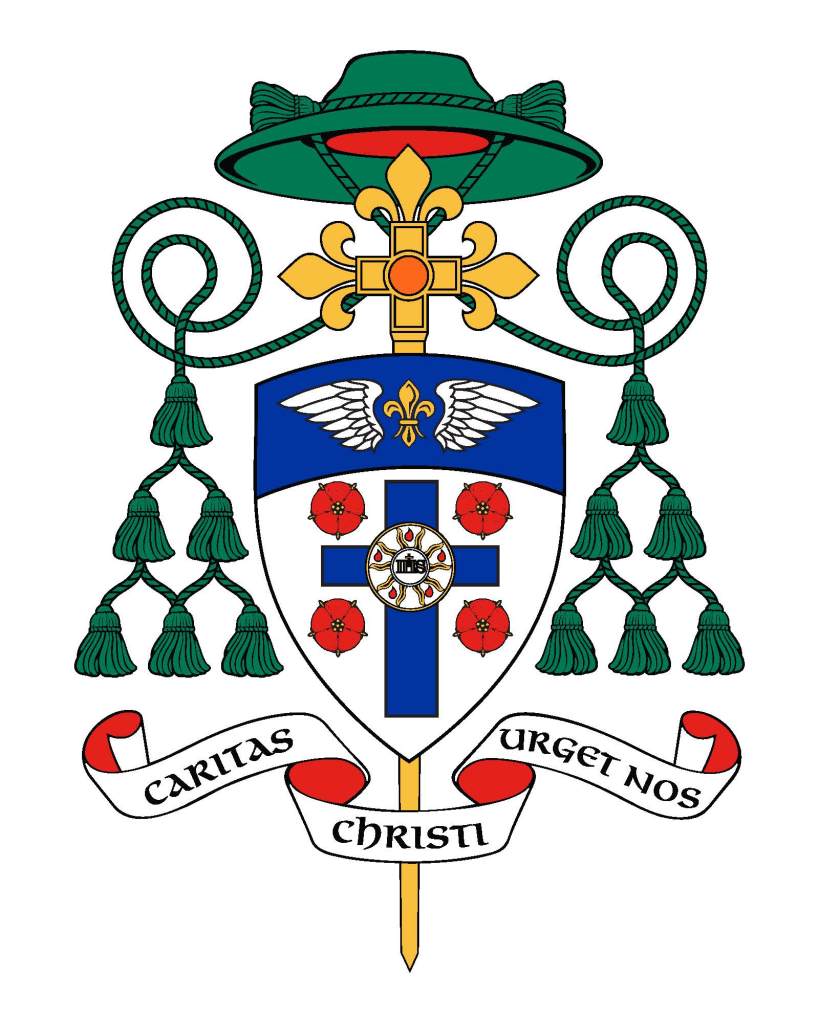
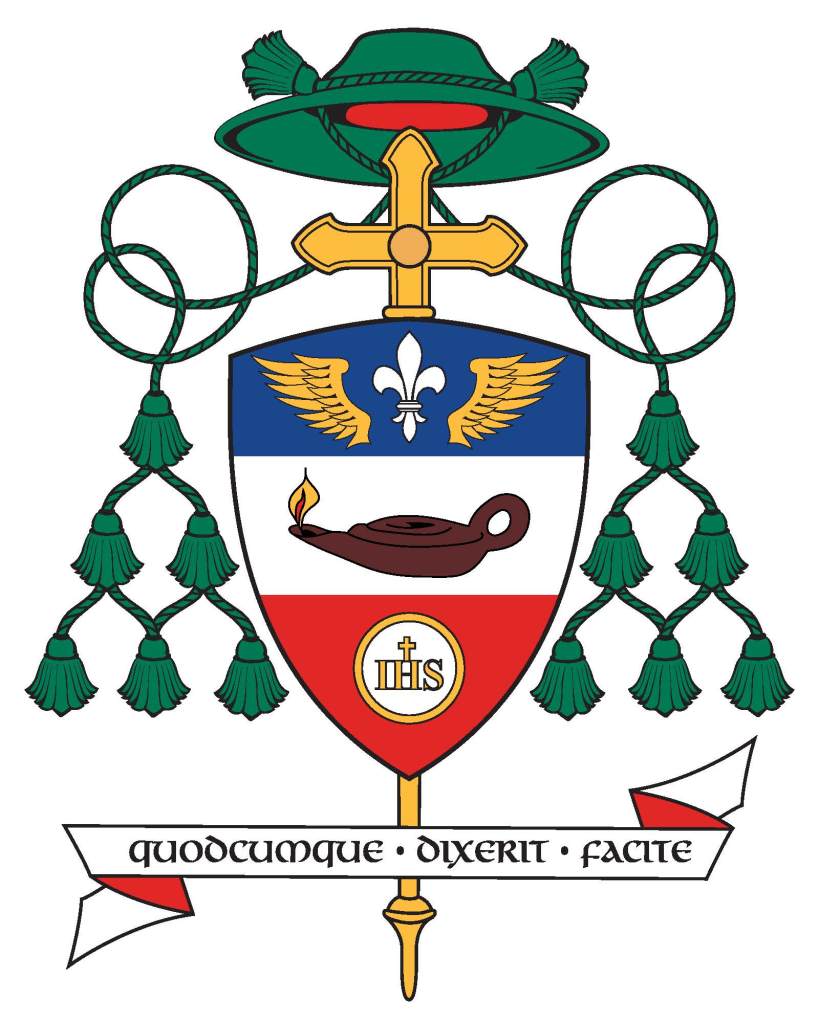
Category Archives: External Ornaments

Update For a Promotion

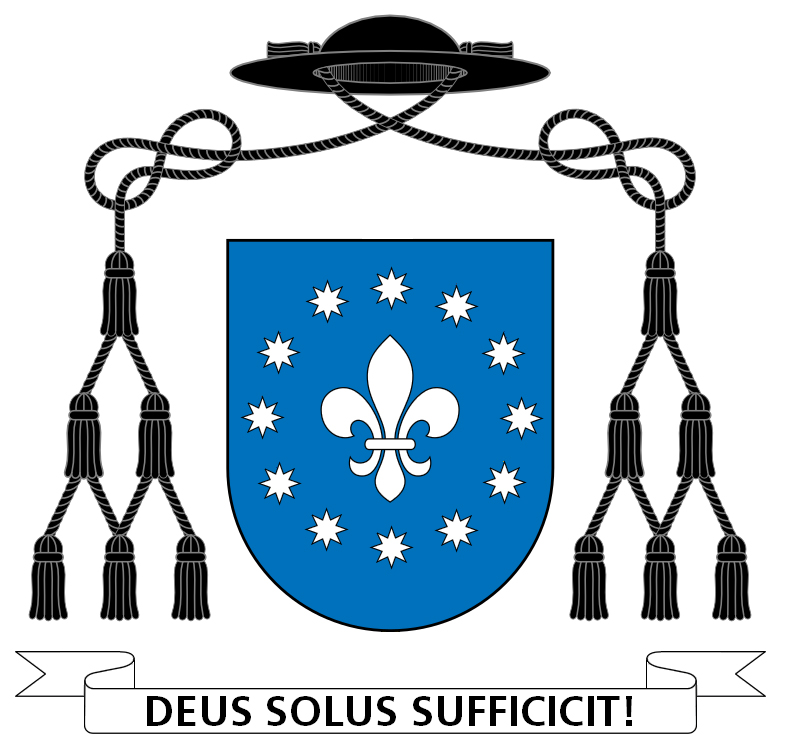
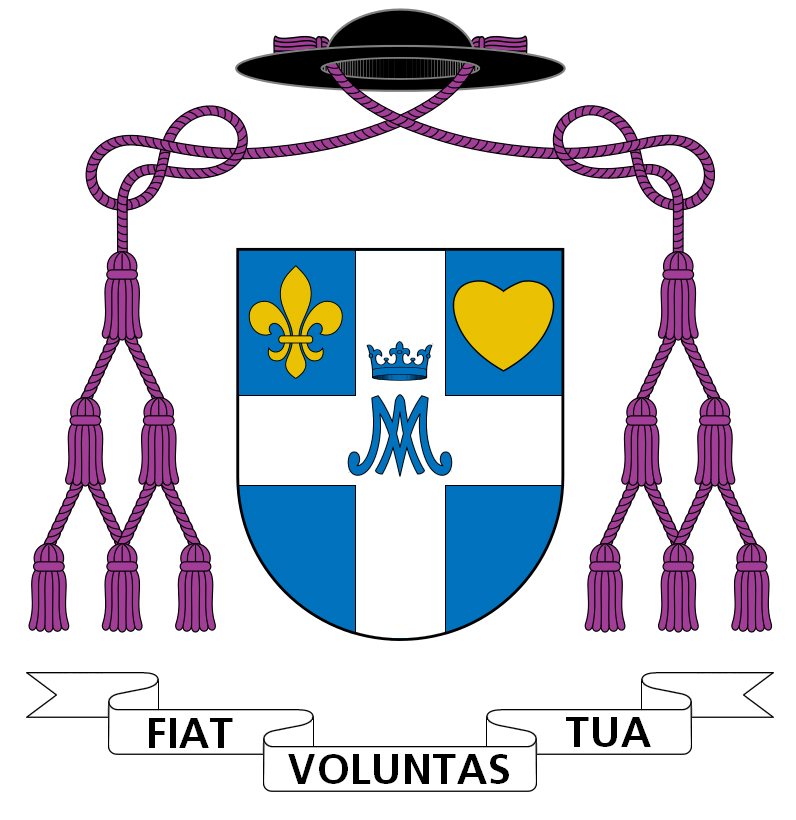
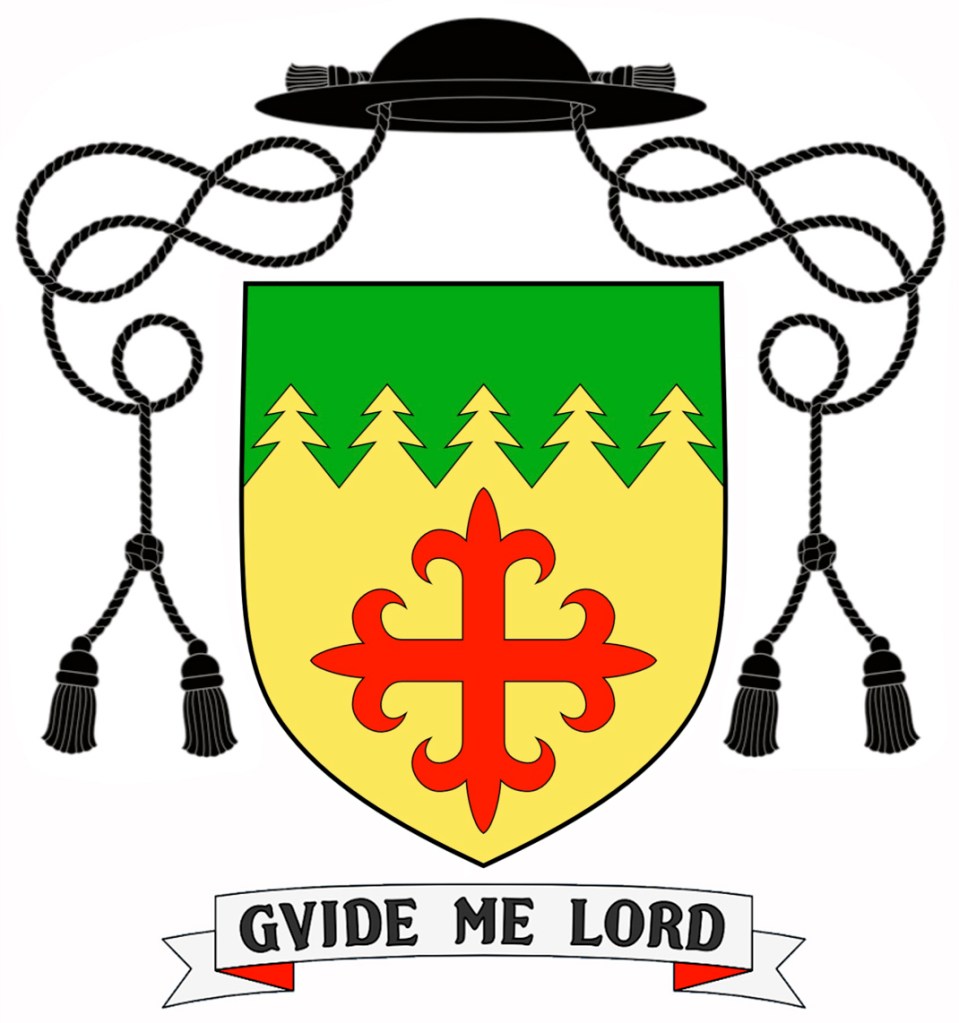
In January of 2019 I posted about the very nice arms granted to a clergyman in the UK. Fr. Adam Gaunt had received beautiful Letters Patent for his fine coat of arms and was eager to share them with me.

I recently saw online that he posted about some modifications to the ornamentation of his arms reflecting the fact that he has recently been named a Canon of York in the Church of England. So the galero now has six red tassels pendant on either side.

(artwork by Danilo Martins)

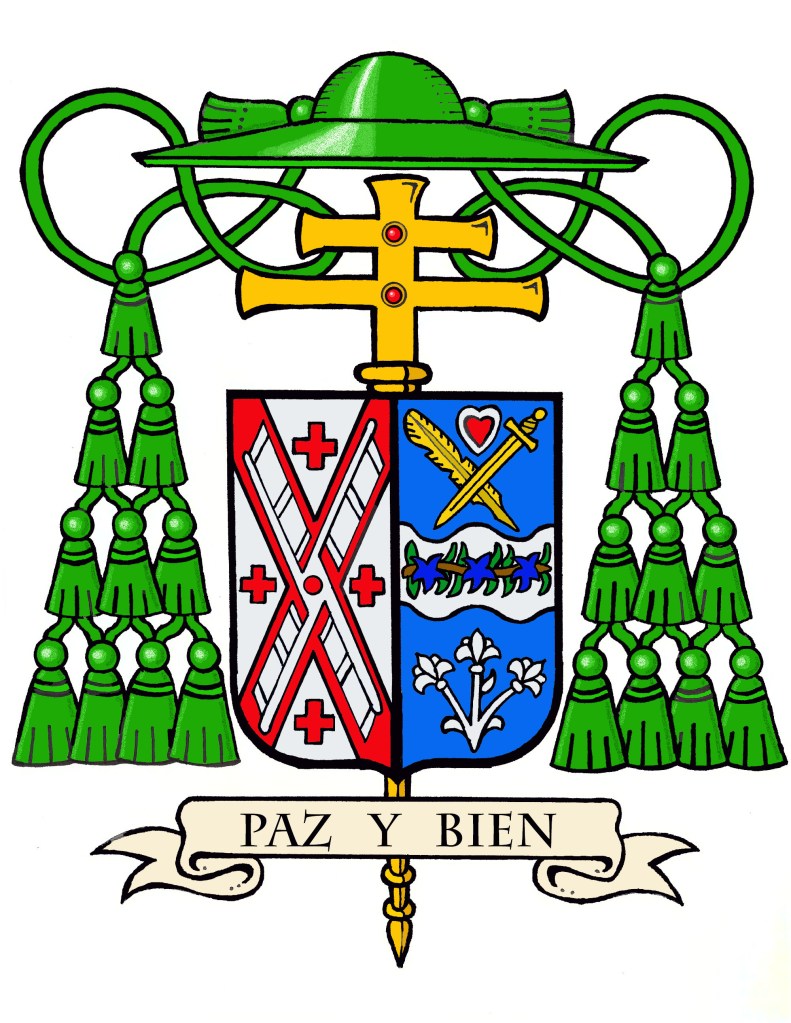
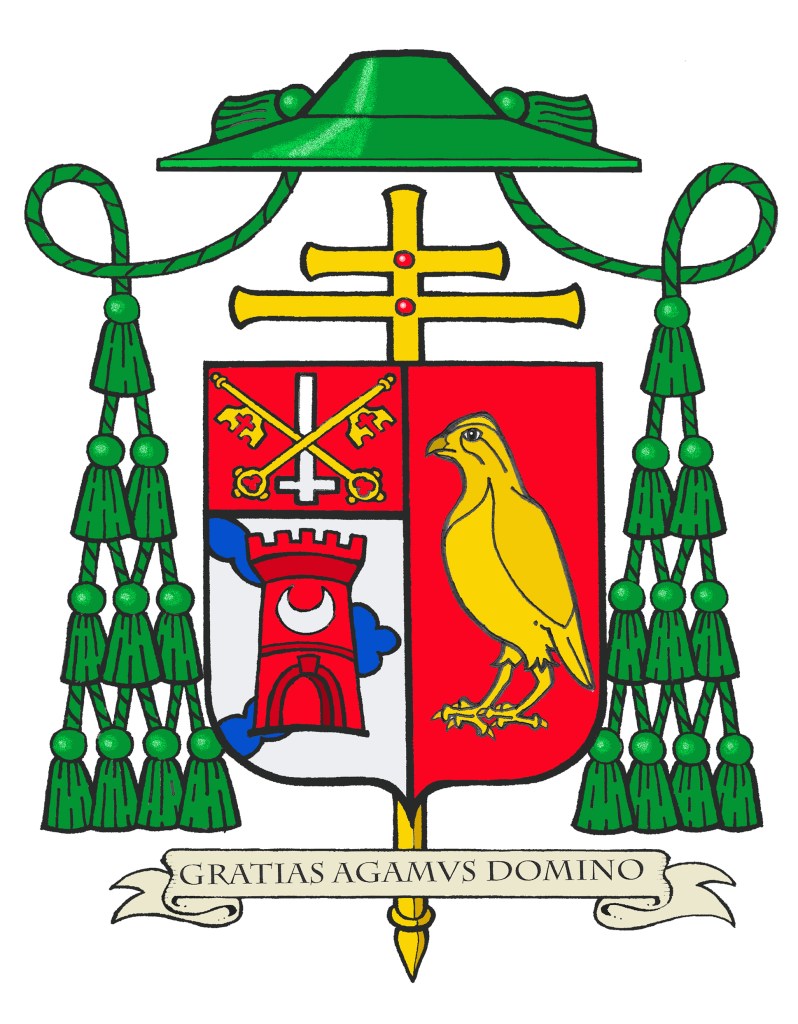
Archbishop McKnight

The Most Rev. Shawn McKnight (56) was installed as the fifth Archbishop of Kansas City in Kansas on May 26. I already talked about the very nice version of his coat of arms prepared for that occasion by Matthew Alderman. Immediately after his installation, the archbishop contacted me and asked for another rendering of his arms done by me. While that is somewhat unusual it is not unprecedented. It’s not uncommon for an armiger to have and use different renditions of his coat of arms done by different artists.

So, I undertook to do an emblazonment of the archbishop’s coat of arms for his use.

BLAZON: Arms impaled. In the dexter: Argent, a chevron invected issuant from the dexter, overall a tower embattled Gules charged with a crescent Argent; on a chief Gules a Latin cross reversed Argent surmounted by two keys in saltire Or. In the sinister: Gules a quail statant Or. The shield is ensigned with an archiepiscopal cross Or and an archbishop’s galero with cords and twenty tassels flanking the shield disposed in four rows of one, two, three and four all Vert. On a scroll below the shield is the motto, “Gratias Agamus Domino”.


EXPLANATION: The armorial bearings of Archbishop McKnight impale the coat of arms of his archiepiscopal See with his personal coat of arms. The coat of arms is composed of a shield with its charges (symbols), a motto and the external ornamentation. The shield is described (blazoned) in terms that are archaic to our modern language, and this description is presented as if given by the bearer with the shield being worn on the arm. Thus, where it applies, the terms dexter (right) and sinister (left) are reversed as the device is viewed from the front.


It is customary in heraldry that the arms of a Diocesan Bishop, or Ordinary, are joined side by side on the same shield with the arms of his See. In this case, these are the arms of the Archdiocese of Kansas City. Such marshaling is called impalement and employs the samemethod used when joining the coats of arms of two people who are married. In this way, the coat of arms, like the episcopal ring, is symbolic of the archbishop being “married” to his archdiocese. The arms of the Archdiocese of Kansas City are composed of a silver (white) field on which there is a blue chevron issuing from the side. The sides of the chevron are “invected” which means a line that consists of a series of circular arcs curving in the same direction, meeting at angles, forming points inward. This is to symbolize the Missouri River. Laid over this chevron is a red tower with an open archway and an embattled top. Imposed on the tower is a silver (white) crescent. The tower is a symbol of Fort Leavenworth. The original designation of the Archdiocese was the Diocese of Leavenworth (1877) and the church of the Immaculate Conception was the titular of the cathedral there. The crescent moon in heraldry is a symbol of Our Lady’s Immaculate Conception. The upper third of the shield, called a “chief” contains two crossed gold (yellow) keys superimposed over a silver (white) Latin cross upside down. These are symbols of St. Peter, the titular patron of the cathedral church. The keys are the “keys of the kingdom” bequeathed by Christ to St. Peter and the upside down cross recalls the manner of his crucifixion.


The personal coat of arms of Archbishop McKnight illustrates his personal devotion. The field is red and the one and only charge is a large gold (yellow) quail. The red color alludes to the devotion of Archbishop McKnight to the Sacred Heart of Jesus as well as the Immaculate Heart of the Blessed Virgin Mary. Quail are a symbol of God’s providential blessing and an Old Testament prefiguration of the Eucharist, as the Lord provided for his people in the desert with manna in the morning and quail in the evening (see Exodus 16:11-13; Numbers 11:31-32; Psalm 78:27 and Psalm 105:40). Quail-hunting is also a favorite sport of the Archbishop, an activity which requires the use of pointing, flushing and retrieving hunting dogs, and through which he experiences the beauty, harmony and providence of God in nature.

The external ornaments include a gold archiepiscopal cross with two horizontal bars (sometimes referred to as a patriarchal cross) placed vertically behind the shield decorated with red jewels. This is often mistaken for a processional cross like the one used in liturgical processions. However, like other heraldic ornaments the archiepiscopal cross has its origins in something which is no longer actually used. At one time all bishops had, in addition to the processional cross at the head of the procession, another cross carried directly in front of them by a cleric. This other cross was a sign of the office of bishop. It originated as a custom that such a cross was carried before archbishops only. Later, the cross was adopted for use by all bishops so archbishop’s added a second horizontal bar to their crosses to distinguish them from the episcopal cross of simple bishops. While no longer actually used it has remained a symbol of the archiepiscopal office in heraldry. Similarly, the broad-brimmed green galero was, at one time, worn by bishops in outdoor processions and cavalcades. No longer used it remains a heraldic symbol of the office of bishop and takes the place of the helmet, mantling and crest that would appear in the coat of arms of a layman. In Catholic heraldry the color and number of tassels on the galero indicates the rank of
the bearer. The double barred archiepiscopal cross and the green galero with twenty tassels signifies the coat of arms of an archbishop according to the Instruction of the Holy See, “Ut Sive” issued in 1969.


The motto chosen by Archbishop McKnight appears on a scroll below the shield, “Gratias Agamus Domino”. This is taken directly from the opening dialogue of the preface at the beginning of the Eucharistic Prayer at Mass (“Let us give thanks to the Lord”), and is derived from Psalm 107:1 and Psalm 118:1 (“Give thanks to the Lord Who is good, Whose love endures forever”).

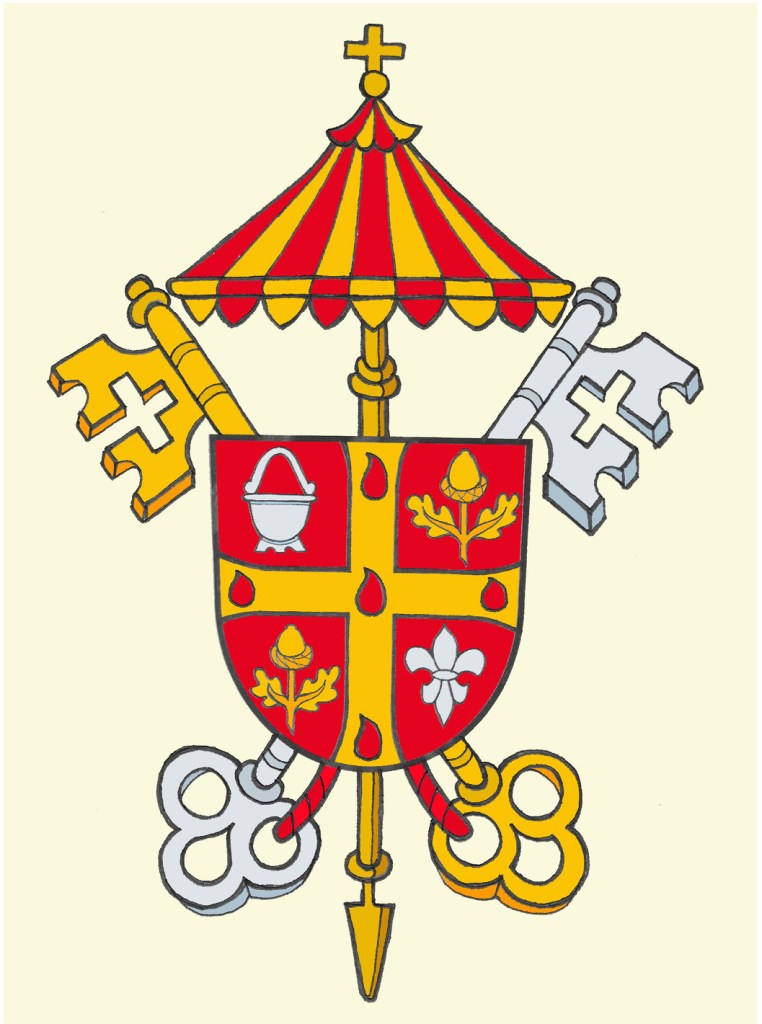
Arms for a Basilica

The Mission Church of San Diego (St. Didacus) de Alcalá was the second Spanish Mission church founded in 1769 by St. Junípero Serra. The present (5th) church building was designated a Minor Basilica by St. Paul VI in 1976. Going without any armorial bearings of its own for several decades I was approached some time ago by one of the priests of the Mission basilica to design a coat of arms for the church. This was done with the approval of the (then) Bishop of San Diego, Robert Cardinal McElroy, now the Metropolitan Archbishop of Washington, DC.

The blazon of the coat of arms is: Gules, a cross formy throughout Or charged with five gouttes de sang at the center point and extremities; between in the dexter chief quarter a Spanish stew pot Argent; in the sinister base quarter a fleur-de-lis Argent and in the other quarters an acorn slipped Or. The shield is ensigned with the ornaments of a Minor Basilica which are, two keys crossed in saltire behind the shield to dexter Argent and to sinister Or, and an ombrellino Proper standing behind the shield.

The basic design borrows, and reverses the colors from the coat of arms of the Diocese of San Diego. Instead of a gold (yellow) field with a red cross there is now a red field with a gold cross. The cross, which has slightly flared ends, is charged with five drops of blood. These represent the founder of the Mission, Junípero Serra, who was a Franciscan friar. So, the five drops recall the five wounds of the stigmata received by St. Francis of Assisi. Serra, the founder of the Mission, is symbolized by making a  reference to the Order to which he (and San Diego) belonged. That also honors all the other Franciscan missionaries who carried on the work at the Mission throughout the centuries. In addition, the present Mission church–the one designated a basilica–is the fifth church building used by the Mission. So, the five drops of blood also allude to the basilica itself being the fifth building in use as a church.

In the upper left corner is the pot that is a symbol of San Diego (St. Didacus), the patron of the Mission Basilica (as well as the diocese). As a Franciscan brother he was a selfless servant of the poor and was known to heal the sick with the Sign of the Cross, the central charge, and the Spanish stew pot in the upper left also symbolizes him. It indicates Diego’s boundless charity and tireless efforts to feed the hungry. In the lower right corner we see a fleur-de-lis which is borrowed from the coat of arms of St. Paul VI, the pope who raised the Mission church to the rank of Minor Basilica in 1976. Both of these are silver (off-white). 

The other two quadrants are charged with a gold (yellow) acorn. This is to give the Native Americans, who received the Gospel from the Franciscans and became their collaborators throughout the Mission era, representation on the coat-of-arms. It is a symbol of the agrarian traditions of the Native Americans, and also represents the potential for spiritual growth and transformation. Just as an acorn can grow into a mighty oak tree, it represents the idea that even small acts of faith and virtue can lead to great spiritual maturity and strength. This aligns with the Catholic teaching on the importance of nurturing one’s faith and virtues over time and refers to the Mission’s humble beginnings and growth. In addition, the acorn’s humble beginnings remind Catholics of the virtues of humility and simplicity. These qualities are highly valued in Catholic teachings, as exemplified by the lives of saints, such as St. Francis, St. Didacus, St. Junipero Serra, and the Franciscan Padres who often started with humble beginnings and grew in holiness and influence through their faith and actions. The acorn also symbolizes God’s provision and sustenance as a reminder of His care and providence, ensuring that His creation is provided for.

The external ornaments are the two crossed keys (one gold and one silver) bound together by a red cord and the ombrellino. The keys are an ornament granted to basilica churches to show their connection to the Holy See. They are the same as the keys seen in the coat of arms of the Holy See and of the Pope, recalling the “keys to the kingdom” given by Christ to St. Peter; one to bind and one to loosen. The ombrellino, a large red and gold canopy, is also a symbol of the Holy See and used as a symbol of such whenever the See is vacant. It also used to be employed as a symbol of papal administration in the time of the Papal States. Originally, it was a ceremonial canopy carried in procession to cover a dignitary such as the pope while walking or riding in a cavalcade. It is primarily symbolic now but all basilica churches are expected to have one which is to be carried in procession in the event of a papal visit. 

This was a fun and interesting project which I completed, coincidentally, on the same day that the Pope appointed a new Bishop of San Diego to succeed Cardinal McElroy.

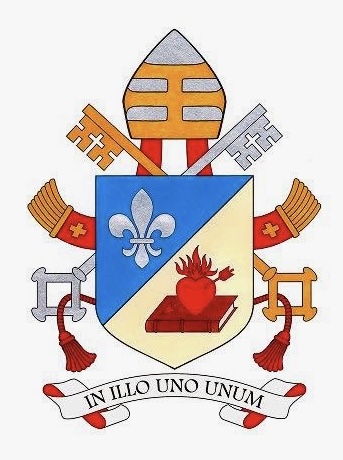
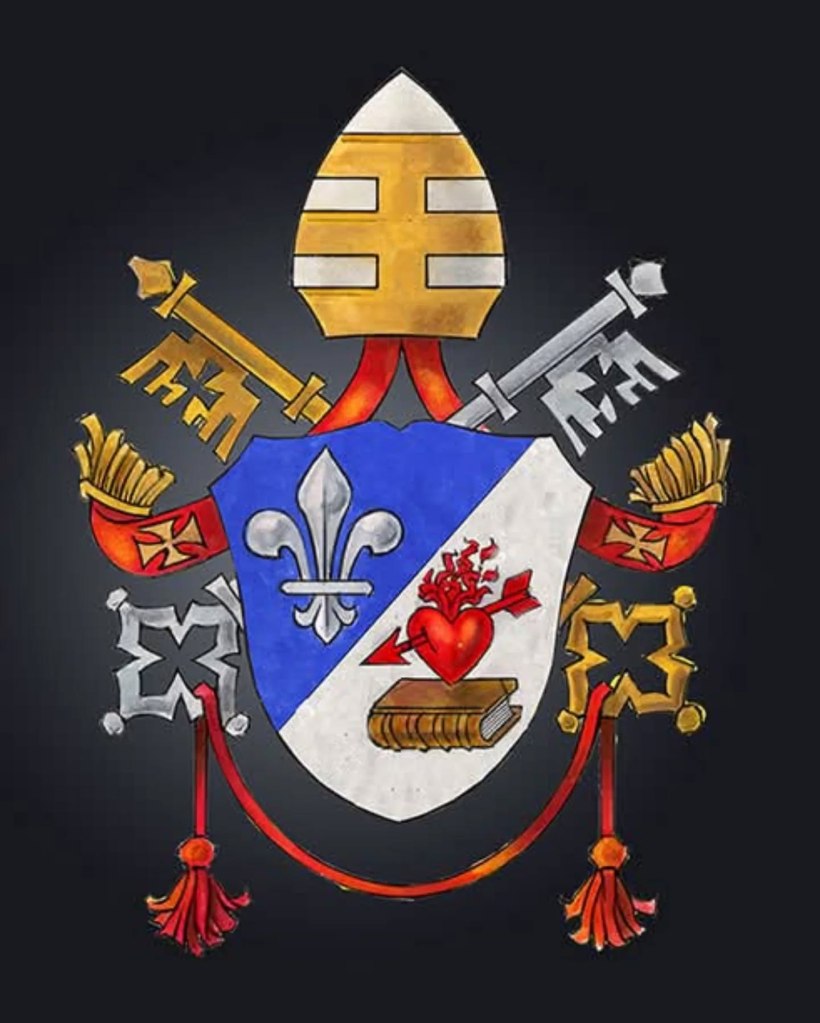
What Do YOU Think of Pope Leo’s Coat of Arms?

This question has been posed to me by numerous people since the Holy See released the image of the Pope’s coat of arms as pope. My answer is simply this: it looks pretty much like I expected.

Pope Leo already had a very good coat of arms as a bishop. I’m glad to see he didn’t feel the need to entirely change the design as others have done in the past. A coat of arms is a means of identification. It identifies you. It becomes associated with you in such a way that it shouldn’t be changed cavalierly. A change of position should warrant the use of different external ornaments to signify the new rank, not a full scale change in what is on the shield itself. So, I’m happy to see that the Pope left alone the arms that he assumed as a bishop 11 years ago.

I was not surprised to see the papal tiara rendered in the form of a kind of mitre. This began with Pope Benedict XVI and continued with Pope Francis I. So, we have now seen this for twenty years and I assumed it would be continued. It is, perhaps, important to note that the tiara has not been replaced with a mitre. Rather, it is the papal tiara rendered as a kind of mitre/tiara hybrid. This occurred at all because of ignorance. The argument to Benedict XVI was that since the tiara is, practically speaking, no longer worn it should not be depicted in the coat of arms. Nothing could be farther from the truth. In fact, since it is no longer worn that’s all the more reason it should be used in the coat of arms. It remains a symbol of the papacy. Most of the world’s monarchs no longer actually wear a crown but the use of a crown heraldically remains. Cardinals and bishops no longer wear an actual galero but the galero remains a heraldic emblem. (It is worth noting here that the tiara with the keys remains the emblem of the Holy See.)

St. Paul VI, in his reforms of 1969, decreed that the mitre and crozier which used to be in the coats of arms of all bishops in addition to the galero and episcopal/archiepiscopal cross should no longer be used in the arms of such prelates. He reasoned that the crozier and mitre were still used liturgically as emblems of the episcopal office and their practical use made using them as heraldic symbols redundant and inappropriate. (NOTE: the same is also true for the pallium) Whereas, the episcopal cross and galero—used at one time—had fallen into practical disuse and so were very appropriate to be used purely as heraldic ornaments. By that logic the same is true of the papal tiara. Since recent popes have chosen not to be crowned the use of the tiara as a purely heraldic emblem makes all the more sense.

Yet, those advising Benedict XVI, principally among them Archbishop Piero Marini and the late Cardinal di Montezemolo, argued that the tiara should be modified in its appearance to show that it is no longer actually worn. This was bad advice then and it has now been codified into enduring, though still equally poor advice. Nevertheless, it was easy to anticipate that Pope Leo would simply follow suit. So…no real surprise there.

Similarly, the slight change in tincture of the division of the field in base from Argent (silver or white artistically) to a kind of beige or buff color shows an appalling lack of understanding of heraldry. This is also displayed in the description of this tincture as “light”. Just what, precisely, is THAT supposed to mean ?!?! There isn’t an actual blazon to help clarify this. The lack of a proper blazon could be because no one at the Vatican knows how to write one; they simply don’t find it important enough to care about; or they feel it would be too esoteric and unintelligible for the average person. One can only hope that the reason is one of the latter two rather than the former.

But there isn’t a lot of evidence to dissuade me. For example, the tiara and keys and motto banner are all clearly just a “cut & paste” job from the arms of Pope Francis I. Really? With all the many competent heraldic artists and heraldic experts available to them no one at the Vatican bothered to reach out to anyone and just figured this could all be handled “in house” by someone with a computer? Is that the most appropriate way to prepare a new pope’s coat of arms? it shouldn’t be a matter of who can get it done first but of who can do it best. What a shame that it has been deemed acceptable simply to cobble something together from existing images.

It’s also probably worth noting that—just like all bishops—all of the popes have had an episcopal motto. However, by longstanding tradition and custom a motto is not supposed to be included in the armorial achievement of the Pope. In his seminal work, Heraldry in the Catholic Church (1978) Archbishop Bruno Heim notes that, “It is widespread custom to put a motto under the shield. It is often held, wrongly, by those who know little about heraldry, that the motto is indispensable; yet it is an addition which does not properly belong to the armorial bearings themselves.” (page 80)

So we see that, all in all, the new Pope’s coat of arms is unsurprising in its composition, disappointing in its execution, and uninspiring in its depiction with numerous errors that could have been avoided with a little creativity and some consultation with people who know what they are doing.

For example, in the hands of an artist of some merit the same exact design can be rendered in a manner that looks considerably better just by the good use of composition and artistic style.

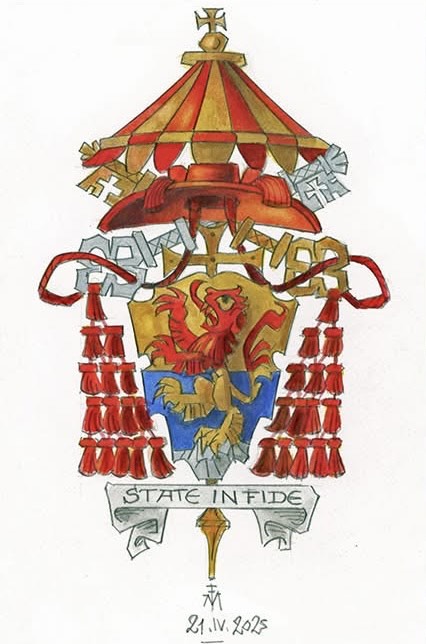
Take, for example, this sketch of the arms of Pope Leo XIV done on the evening of his election by the noted and competent heraldic artist, Marco Foppoli. We can see here that, in the hands of an expert with a great deal of experience, the original heraldic design can be rendered with the appropriate external ornaments in a way that maintains the simplicity that is desired while also creating a new and unique achievement for the armiger. Too bad that someone like Foppoli wasn’t consulted by officials at the Holy See.

Papal heraldry has been in a slow decline since the death of Archbishop Heim. It is sad but true. Unfortunately, at the outset of this new pontificate, there are no signs that this is going to change for the better anytime soon.

God Bless Pope Leo XIV!

Chamberlain of the Holy Roman Church

During the Sede Vacante the person in charge of the affairs of the Church is the Chamberlain (Camerlengo) of the Holy Roman Church. Since 2019 that man has been the (Irish-born) American, Kevin Cardinal Farrell, former Bishop of Dallas, Texas and also former Auxiliary Bishop of Washington, DC.

During the time of the Sede Vacante he functions as the caretaker of the Church and the Regent of the Vatican City-State. The symbol of the Church since the time of the existence of the Papal States, the crossed keys and ombrellino, are placed above his existing coat of arms in the achievement. These may always be used during his tenure in office but, practically speaking, most of those who are Camerlengo make use of these added ornaments only during the Sede Vacante. Special coins will be struck to mark this moment in the Church’s history bearing the arms of the Camerlengo.

This version of Farrell’s arms is by Marco Foppoli.

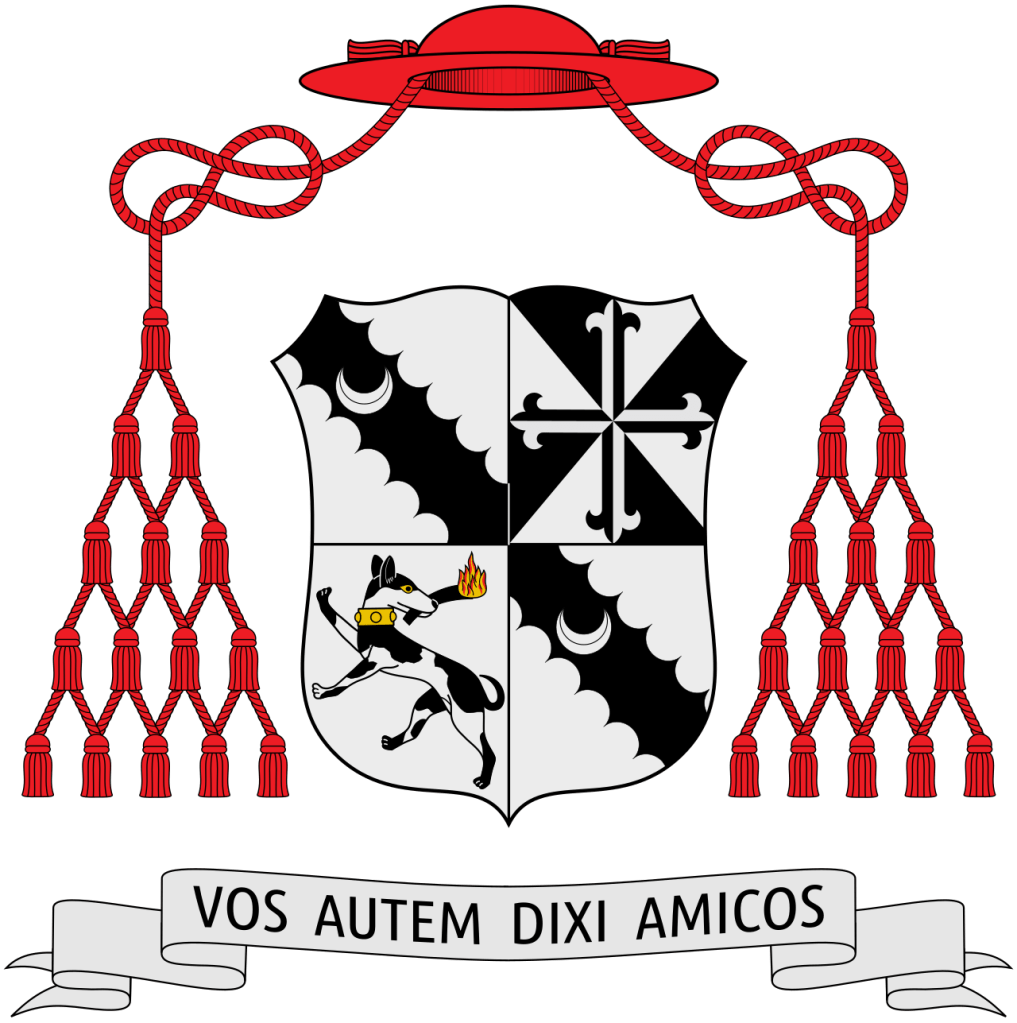
Timothy Cardinal Radcliffe, OP

It took a bit of time but the arms used by Timothy Cardinal Radcliffe, OP the Dominican friar who was created cardinal just last autumn by the late pope and who will now be an elector in the upcoming Conclave, has now been published.

He has not been ordained a bishop so there is no episcopal cross behind the shield in the achievement. Overall, he has chosen very Dominican looking symbols and a differenced version of the arms of Radcliffe. A very handsome coat of arms.

Cardinal McElroy Installed in the Capital

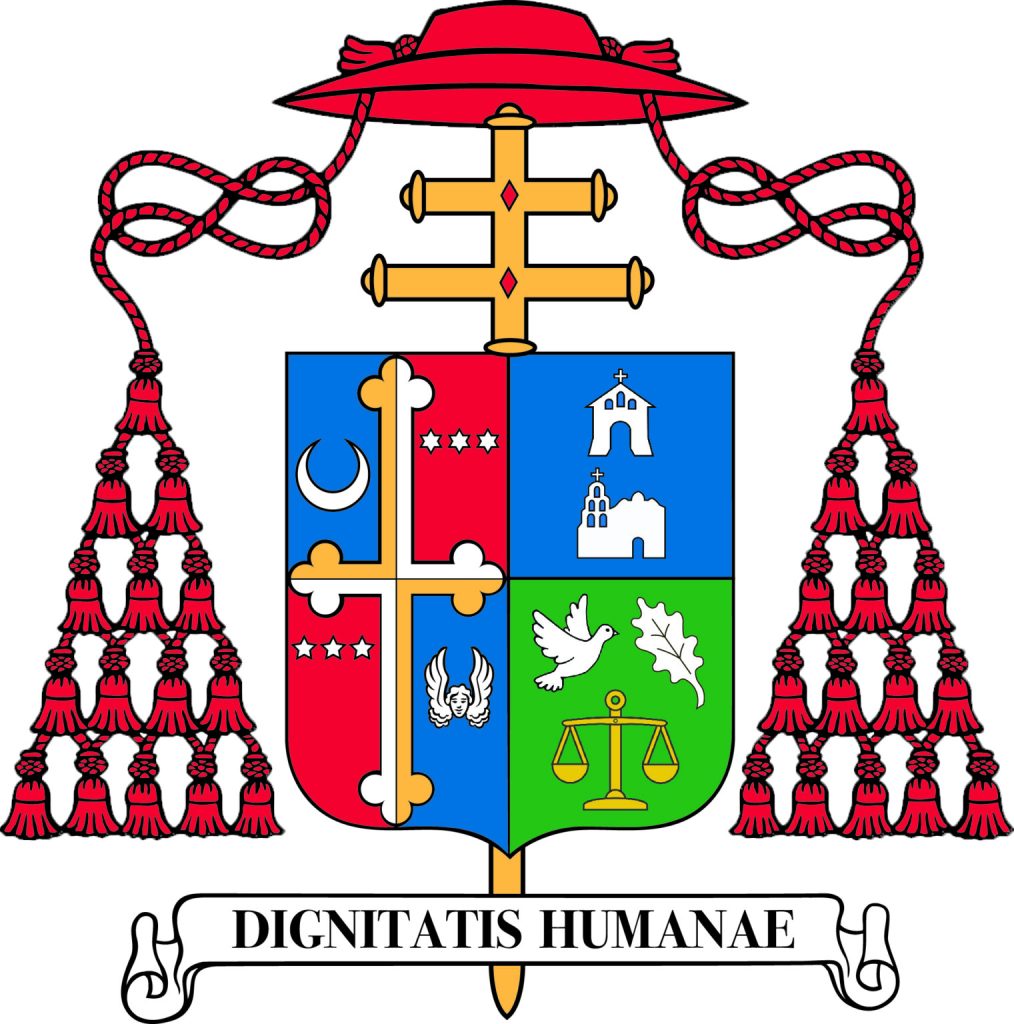
On March 11, His Eminence Robert Cardinal McElroy (71), Cardinal Priest of San Frumenzino ai Prati Fiscali, previously Bishop of San Diego (2015-2025) and originally a priest and Auxiliary Bishop (2010-2015) of San Francisco, was installed as the 8th Archbishop of Washington, DC.

At his appointment as Auxiliary Bishop he assumed a coat of arms which he then substantially changed when he moved to San Diego. In 2022 when he was created Cardinal I was privileged to assist him in preparing his coat of arms and at that time some further revisions and improvements to the design were made. At this most recent move, his personal arms, unchanged any further, were marshaled to those of the archdiocese and the episcopal cross was changed to an archiepiscopal cross.

From the website of the archdiocese we find the following:

Arms impaled. In the dexter: Quarterly Azure and Gules, a cross bottony over all quarterly Or and Argent; 1, a crescent Argent; 2, three mullets of six points fesswise in chief Argent; 3, as many mullets of five points fesswise in chief Argent; 4, a head erased affronté and winged all Argent. In the sinister: Per fess Azure and Vert, in chief the stylized silhouette of Mission San Francisco de Assis above, in base, that of Mission San Diego both Argent; in base below to dexter a dove turned to sinister volant wings addorsed and to sinister, an oak leaf both Argent scales Or.

The shield is ensigned with an archiepiscopal cross Or in pale behind the shield and surmounted by a cardinal’s galero with cords and fifteen tassels on either side in five rows of one, two, three, four and five all Gules.

On a scroll below the shield is the motto: “Dignitatis Humanae.”

The arms of the Archdiocese of Washington were devised in 1947 by William F. J. Ryan and modified in 2001 by Anthony W. C. Phelps, when the cross bottony was substituted for the original cross of chain links in silver. Cardinal McElroy’s arms were devised originally by Rev. Timothy Pelc. The present blazon of his arms was done by Rev. Guy Selvester. The rendering of the impaled arms was done by Georgina Wilkinson.”

Cardinal Bychok

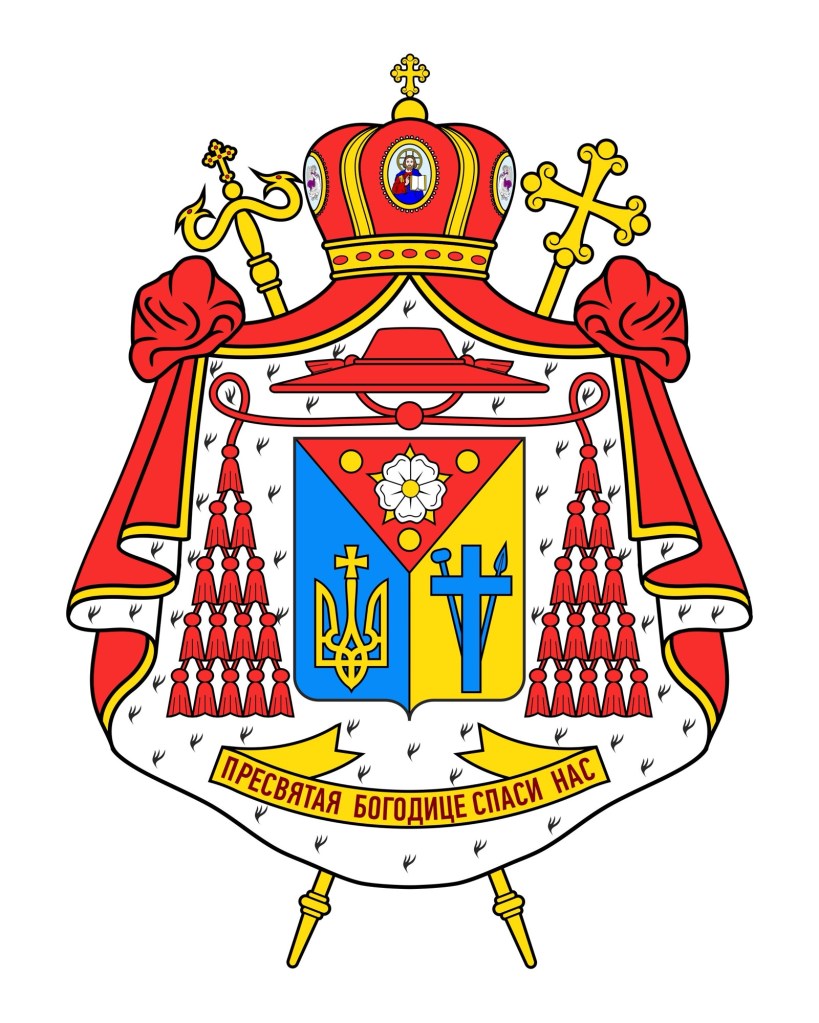
His Eminence, Mykola Bychok, CSsR (44) is a Ukrainian Catholic who serves as Eparch of Ss. Peter & Paul of Melbourne since 2020. On December 7 he will become the Church’s youngest cardinal.

The arms he assumed upon becoming a bishop were designed by others for him and he was not entirely satisfied with them. With his upcoming creation as a cardinal he saw this as an opportunity to tweak the design of his coat of arms.

The redesigned coat of arms does not depart that much from what he originally had but cleans it up a bit and adds the external ornament unique to Cardinals.

The blazon is: Tierced in pall; in chief, Gules a rose Argent, barbed and seeded Or between three bezants; in dexter base Azure a trident (tryzub) topped with a Greek cross, all Or; in sinister base Or a Latin cross on a perch of a staff topped by a sponge in bend and a spear in sinister bend all Azure. The shield is ensigned with the galero of a cardinal of the holy Roman Church with cords and 30 tassels disposed in five rows of one, two, three, four and five all Gules; the whole within a mantle Gules lined ermine surmounted by the Eastern mitra Gules; in saltire behind the mantle a crozier and a cross both Or.

The charges in chief symbolize the place he is from; the trident (differenced by the addition of a cross) is a symbol of Ukraine; the cross, sponge and spear are borrowed from the arms of the Redemptorist Order of which he is a member.

I was very happy to consult on this redesign and work to put it together with Mr. Richard d’Apice of the Australian Heraldry Society. As with all our collaborations the artwork has been deftly provided by Mr. Sandy Turnbull, also of the Australian Heraldry Society.

Archabbot Douglas Nowicki, OSB

Retired Archabbot of Saint Vincent Archabbey, Latrobe, Pennsylvania, Douglas R. Nowicki, O.S.B., (79), died Tuesday, July 23, in Allegheny General Hospital, Pittsburgh, following a brief illness. The eleventh Archabbot of Saint Vincent, he served from 1991 until he reached the retirement age of 75 in May of 2020, when he retired. He was the second longest-serving Archabbot in the 178-year history of Saint Vincent. With more than 150 monks, St. Vincent was the first Benedictine monastery in the United States, and is one of the largest monasteries in the world. He will be buried on July 29, 2024.

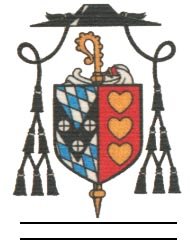
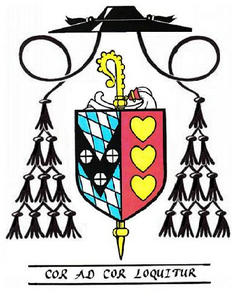
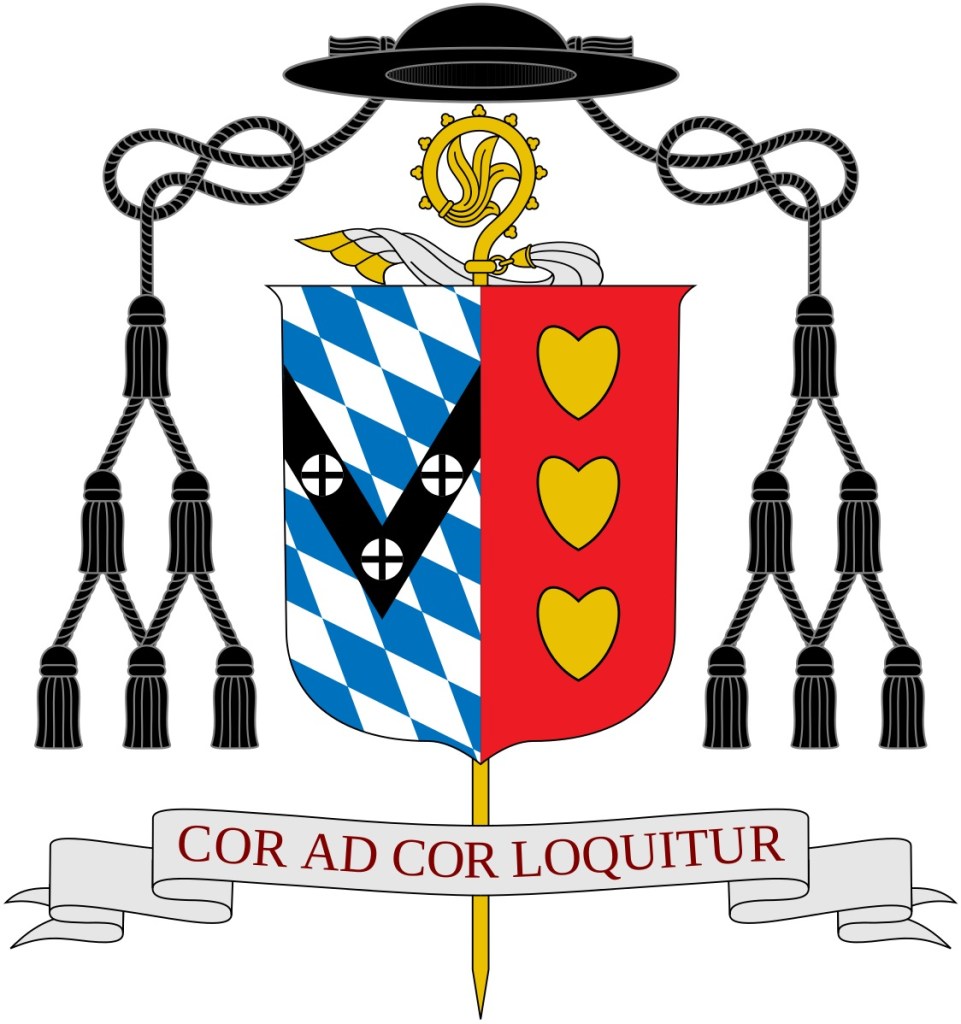
When he was elected in 1991 I was still a member of the monastic Community in Latrobe. My mentor—the late Géza Grosschmid, Ph.D.—and I were given the job of devising a coat of arms for the new Archabbot. Ultimately, Archabbot Douglas rejected the design Dr. Grosschmid suggested and went with a modified version of it devised by me. Essentially, it illustrated the motto, taken from St. John Henry Newman, “Cor Ad Cor Loquitur” which means “Heart Speaks To Heart”.

Above we see my original drawing of the coat of arms without the motto added. The dexter impalement depicts the coat of arms adopted by St. Vincent Archabbey in the early 20th Century under the abbatial term of the Rt. Rev. Alfred Koch, OSB, the 5th Archabbot of St. Vincent. It depicts the blue and silver elongated diamond-shaped fusils taken from the arms of the Royal House of Wittelsbach, the Kings of Bavaria. This alluded to the origin of the founding monk and first Archabbot of St. Vincent, Boniface Wimmer, OSB who was from St. Michael’s Abbey in Bavaria, as well as to the patronage and financial assistance given to the fledgling community through the Ludwigs-Missionverein, an organization established by King Ludwig I of Bavaria to support missionary efforts in the new world.

The black horizontal fess with three plates (white roundels) seen on the arms of William Penn is reshaped as an inverted chevron to form the letter “V” for Vincent and the three plates are charged with three crosses. The arms of the Archabbey are impaled—joined on the same shield—with the Archabbot’s personal arms. This marshaling of two separate coats of arms on the same shield employs the same method used for the coat of arms of two armigerous people who are married. It indicates the “marriage” of the armiger with the place of his jurisdiction with the arms of the jurisdiction occupying the place of the groom and the personal arms occupying the place of the bride.

The Archabbot’s personal arms, as I said, illustrate the motto.

I had also presented Archabbot Douglas with the option of displaying his arms ensigned by a galero with twenty tassels rather than merely twelve. In a manner similar to that of an archbishop using twenty tassels to a bishop’s twelve tassels, I proposed that as an Archabbot he also make use of this distinctive galero indicating his rank. Archabbots don’t actually have any greater jurisdiction or privileges over other Abbots (the one exception being that he may occupy a senior place in the procession whenever attending a gathering of several Abbots). In addition, none of the other previous ten Archabbots of St. Vincent made use of such a galero so, ultimately, he decided to honor that precedent and rejected the idea.

Although his two immediate predecessors had armorial achievements that did not display the usual veiled abbatial crozier Archabbot Douglas agreed with my suggestion he do so. When St. Paul VI reformed many things concerning the dress and externals of the hierarchy in 1969 one of his decisions included removing the mitre and crozier from the coats of arms of Cardinals, Archbishops and Bishops. They were seen as superfluous since episcopal coats of arms make use of the episcopal cross as the sign of the armiger holding the rank of (arch)bishop. However, it was not the intention to remove the use of the veiled crozier—a peculiarly abbatial heraldic symbol—from the coats of arms of Abbots. The veil became a symbol of abbatial croziers in a time before Abbots would have worn pontifical gloves when pontificating. The veil served the useful function of protecting the shaft of the crozier from dirt and oils from the hand. Later, even after pontifical gloves were used by Abbots, the veil, or sudarium, remained attached to the crozier to distinguish such a heraldic emblem from that of a bishop. Despite the reforms of St. Paul VI which referred to the coats of arms specifically of Cardinals, Archbishops and Bishops, the veiled crozier remains to this day as the heraldic emblem of Abbots and Abbesses.

As I said, Archabbot Douglas was happy to follow my advice in this regard. I noted on one of my subsequent visits to the Archabbey that the display of archabbatial coats of arms in the Archabbot’s outer office included a new rendering of Archabbot Douglas’ coat of arms with the veiled crozier omitted. It could be that there was simply an effort to have his coat of arms artistically conform to the pattern followed by his two immediate predecessors. One also is moved to wonder, however, if the person responsible was simply acting in ignorance? It would be hoped that the move was not a deliberate one. If it were, it would constitute an action displaying the most blatant ignorance of commonly accepted heraldic practices in the Church as laid out in the excellent and scholarly work of the late Bruno B. Heim, Heraldry in the Catholic Church, as well as in several other similar publications. In other words, don’t take my word for it! It’s verifiable independently of my opinion. In fact, my collaborator on this project for Archabbot Douglas, Dr. Grosschmid, was a close friend and collaborator of Archbishop Heim who was widely accepted as the foremost expert in Catholic ecclesiastical heraldry of his day. Dr. Grosschmid concurred with my assertion that the Archabbot’s coat of arms should employ the veiled crozier which is why I felt so comfortable advising the Archabbot in that way.

Nevertheless, in this later rendering it was omitted. I note, too, that Archabbot Douglas’ successor, Archabbot Martin de Porres Bartel, OSB, the twelfth Archabbot, similarly omits the veiled crozier from his armorial achievement, no doubt advised in the same manner that was (accidentally or deliberately) ignorant of the appropriate practices. I note, too, with some satisfaction that the Wikipedia article about Archabbot Douglas correctly displays his coat of arms according to the manner in which I designed it. (below)

May he Rest in Peace.

Some Recent Installations/Ordinations in the U.S.

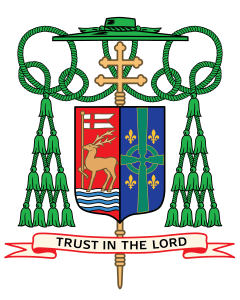
During the last month there have been some vacant Sees filled in the United States. The Most Reverend Christopher Coyne (65) succeeded to the See of Hartford on May 1 becoming its fourteenth bishop (and sixth archbishop). A very fine achievement depicted in the style of the late Deacon Paul Sullivan…except I think it is ill-conceived to place a green cross on a blue field. Yes, there is the slightest fimbriation on the cross to protect against violation of the so-called tincture “rule”. Nevertheless, the overall appearance is odd…and the fimbriation, such as it is, is entirely too narrow to the point of being almost invisible!

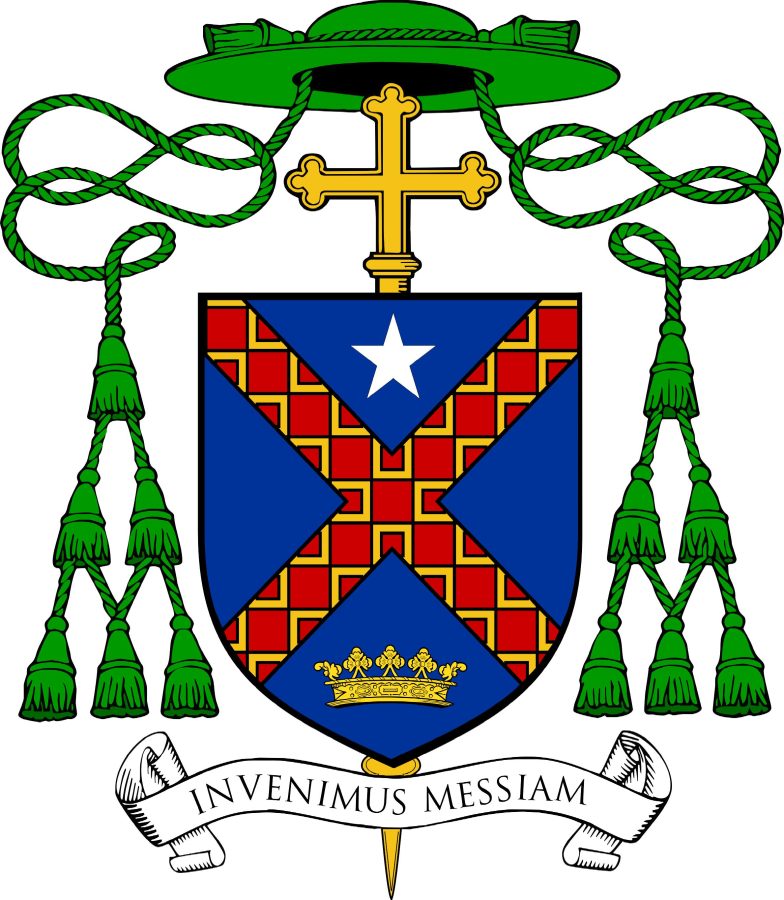
The Most Rev. James Ruggieri (56) was ordained a bishop and installed as the fourteenth Bishop of Portland Maine on May 7.

According to the diocesan website, “The personal arms of Bishop Ruggieri are divided horizontally (per fess). The upper half is painted white (argent) and bears an anchor painted blue (azure). It recalls the birthplace and home of the Bishop in the Diocese of Providence, Rhode Island. That state’s flag and seal comprise a gold anchor and a scroll with the motto “Hope.”

The anchor is an ancient symbol of the theological virtue of hope, deriving from the words of the Letter to the Hebrews: “We have this hope as a sure and steadfast anchor of the soul …” (Hebrews 6:19). In this depiction, the stock of the anchor is positioned on the shank to resemble a Passion Cross, an equally ancient symbol of the theological virtue of faith. As Pope Benedict XVI pointed out, “Hope, in fact, is a key word in Biblical faith—so much so that in several passages the words faith and hope seem interchangeable. Thus, the Letter to the Hebrews closely links the “fullness of faith” (10:22) to “the confession of our hope without wavering” (10:23).

In the lower half of the shield is a depiction of the five loaves and two fish that the Lord Jesus multiplied to feed five thousand men and their families. The only pre-resurrection miracle that is recounted in all four Gospels (Mt 14:13-21; Mk 6:32-44; Lk 9:10b-17; Jn 6:1-15), it holds a special place in the story of the public ministry of Jesus and points to the institution of the Eucharist at the Last Supper. The Feeding of the Five Thousand also highlights the cooperation of the apostles – whose successor the bishop is – with the Lord, both in the ministry of charity, and as celebrants and guardians of the Holy Eucharist and the other sacraments.”

The episcopal cross is depicted incorrectly, but more about that to follow.

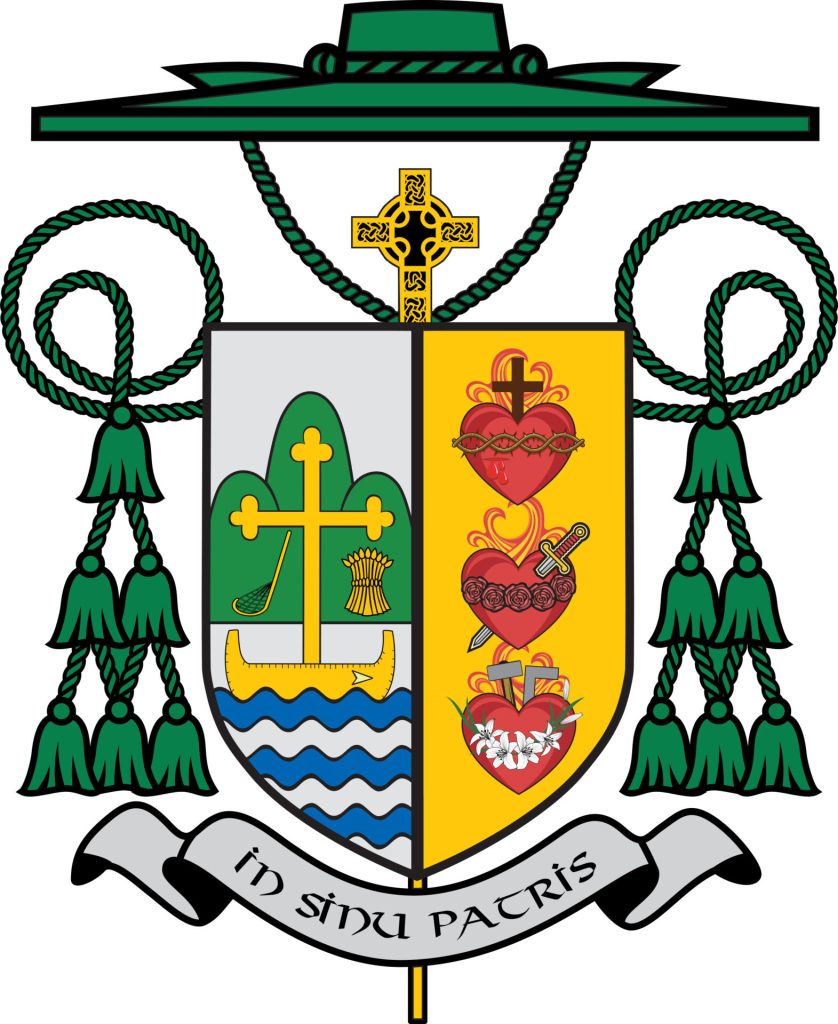
The Most Rev. William Battersby (64), Auxiliary Bishop of Detroit, was installed on May 20 as the eleventh Bishop of La Crosse, Wisconsin.

His coat of arms, while very simple, seems a bit overly given to the devotional. The explanation from the diocesan website says, “For the personal coat of arms of Bishop Battersby…at the top of the shield is a Celtic processional cross meant to honor Bishop Battersby’s Irish heritage. It is shaped like a traditional cross but with a ring, representing the sun, around the intersection of the stem and arms. The whole cross is decorated with ornate Gaelic patterns.

Bishop Battersby’s Coat of Arms includes the three Sacred Hearts. The hearts represent the Holy Family and symbolize the unending and boundless love for us. The wounded heart signifies his devotion to the Sacred Heart of Jesus. It also pays tribute to Sacred Heart Major Seminary where he prepared for the priesthood and at which he served as vice-rector and dean of seminarian formation at the time he was called to the episcopacy.

The second heart, the Immaculate Heart of Mary, signifies the trust and confidence that Bishop Battersby has in the Blessed Mother’s intercession and protection. The sword symbolizes the sorrows of Mary, the flames represent her burning love for Jesus and us, her children and the roses represent her purity. 

Bishop Battersby’s devotion to St. Joseph is represented in the third of the Sacred Hearts, the Chaste Heart of Joseph, inflamed with love and adorned with the white lily of purity, a symbol of his faith and steadiness.”

Again, I’ll say something about the episcopal cross below.

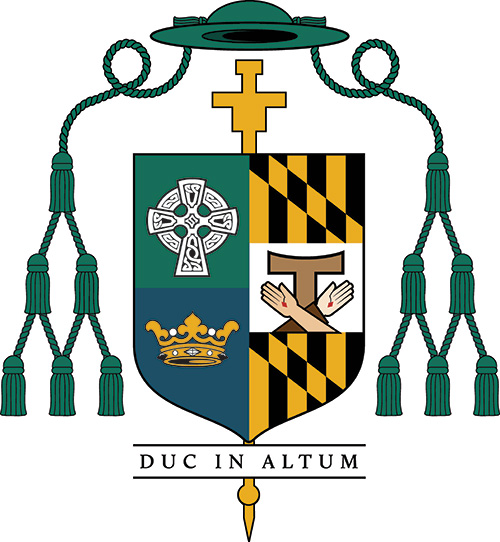
May 29 saw the ordination and installation of the Most Rev. Michael Martin, OFMConv (62) as the fifth Bishop of Charlotte, North Carolina.

The diocesan website describes his personal arms, “To the viewer’s right is the Franciscan coat of arms. Featuring the traditional Franciscan Tau cross with two arms crossing one another, it is rich in symbolism. The two arms, one Christ’s and the other St. Francis of Assisi’s, both bear the stigmata. They symbolize God’s love and Francis’s loving response to the Word made incarnate, Taberski explained. It is an image found throughout the ministries, friaries, missions and sites served by the Franciscan order.

On the right side of the shield, the top (known as the “chief”) and the bottom (the “base”) feature references to George Calvert and his son Cecil Calvert – the first and second barons of Baltimore. The Calverts were among the first Catholics to arrive in colonial America. They established the then Province of Maryland as a safe place for English Catholics to emigrate to since they were no longer able to freely practice their faith at home. In the coat of arms, the use of six vertical stripes – alternately gold and black, with the diagonal stripe in color – recalls Bishop Martin’s hometown of Baltimore.”

A nice simple design but perhaps the arms of Calvert would have looked better depicted once in the main part of the field with the Franciscan symbols occupying a chief? And again there is an incorrect episcopal cross!

So, my criticism of that, which I have often written about in this blog, is that, firstly, it is NOT a “processional” cross!! It is an episcopal cross—a heraldic symbol—which indicates the coat of arms belongs to a bishop. It is, in fact THE heraldic symbol indicating episcopal arms. The galero, while traditional, is not necessary, nor is a green galero with 12 tassels exclusive to the arms of bishops. But the inclusion of the episcopal cross is truly the sign—and the only essential one—to indicate that the achievement depicts the coat of arms of a bishop.

As an external ornament it is NOT subject to personalization. An armiger has a great deal of choice regarding what is depicted on the shield. However, the external ornaments are not subject to his whim, nor may they be used to convey further personal significance or symbolism. Rather, their purpose is to indicate rank in the overall achievement. The blazon may not specifiy a certain type, shape, color, ornamentation, or embellishment to the galero, or the episcopal cross. Each and every artist is free to depict the episcopal cross as he pleases.

This idea of extending the personal symbolism to the external ornaments is occurring more and more of late…as more and more people with very little background in, or knowledge of heraldry are being asked to design episcopal coats of arms. It is amateurish and a grossly mistaken thing to do.

Notker Wolf, OSB – RIP

The Most Rev. Notker Wolf, OSB (83) the former Abbot-Primate of the Benedictine Confederation (2000-2016) who, before that, served as the Archabbot of St. Ottilien Archabbey in Germany from 1977-2000 passed away in Frankfurt on April 3, 2024. He had been leading a pilgrimage to Italy but felt unwell. In trying to return home he stopped off overnight in Frankfurt awaiting a morning flight to Munich but passed away during the night in his hotel room.

His arms (rendered by the late Michael McCarthy) were slightly modified after he originally assumed them (second image). In addition, the artist chose to give his galero an extra row of tassels since he was Abbot-Primate of the Order but there is no precedent for such a decision. Abbot-Primate and Archabbots usually use a galero with twelve tassels as other Abbots do. The arms reflected his love of music as well as his own Benedictine monastic life.

May he rest in peace.

Priest—Cardinal—THEN Bishop

Ángel Cardinal Fernández Artime, S.D.B. (born August 21, 1960) is a priest of the Salesians of St. John Bosco, who has been their Rector Major since 2014, the first Spaniard to hold that office. 

On July 9, 2023, Pope Francis announced his plans to create him a cardinal at a consistory scheduled for 30 September. He is the first superior of a religious congregation be made a cardinal.  At that consistory he was assigned the rank of cardinal deacon with the title of Santa Maria Ausiliatrice in Via Tusculana.

Pope Francis told Fernandez he could continue to serve as rector until July 31,2024, when he will be given a new assignment. He was made a member of the Dicastery for Institutes of Consecrated Life and Societies of Apostolic Life on October 4, 2013. The Salesians plan to hold an election to replace him as rector in the spring of 2025.

His episcopal consecration is scheduled for April 20, 2024. Pope Francis has assigned him the titular see of Ursona with the title of archbishop.

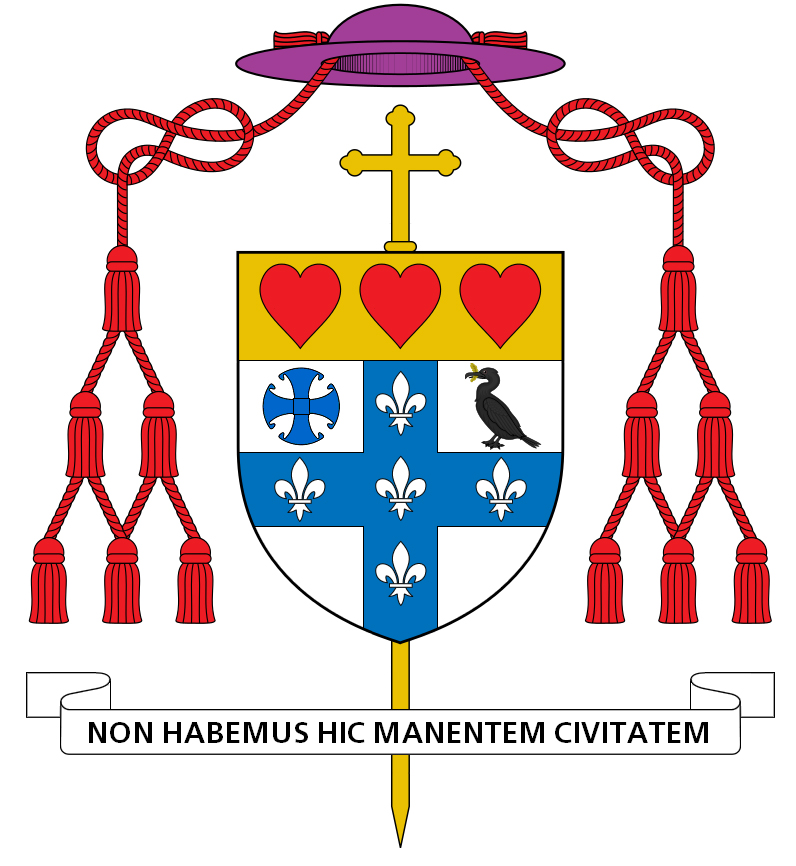
The coat of arms he assumed upon becoming a Cardinal (left) correctly omits any sort of episcopal cross behind the shield. Cardinals are not entitled to use this cross unless they possess the episcopal character. His coat of arms will have the addition of an archiepiscopal cross (right) after his ordination as an archbishop. Until then he uses the armorial bearings of a priest who is a cardinal and his coat of arms will be modified to indicate his rank as an archbishop after April 20.

A Philly Trifecta

On Friday, March 7 the Most Revs. Keith J. Chylinski (52), Christopher R. Cooke (50) and Efren V. Esmilla (61), all three priests of the Archdiocese of Philadelphia, were ordained bishops in the Church and appointed as Titular Bishop of Gunela, Titular Bishop of Malliana, and Titular Bishop of Ottana respectively, as well as Auxiliary Bishops of Philadelphia. Bishop Chylinski was fortunate to receive the Titular See of Gunela which had belonged most recently to Christophe Cardinal Pierre, the Apostolic Nuncio to the United States who was present at the liturgy of ordination. That’s rather unusual. He, of course, relinquished his episcopal titular see when he was created a Cardinal-Deacon.

The coats of arms of the three new Auxiliaries are:

There are two curious things about Bishop Chylinski’s coat of arms. The blazon and explanation say that the crosses are, “…crosses pattée, sometimes referred to as Maltese crosses…”

Indeed those depicted are Maltese crosses but that is definitely not the same thing as crosses pattée. Those are two different charges. The blazon should called them crosses of Malta. Pattée crosses have straight edges on them. In addition, it depicts and explains that the episcopal cross (which is incorrectly described as a “processional” cross, which it is not) has a blue gem at the center to honor Our Lady and also an escallop shell on the node to allude to St. James. Those two additions are heraldically unsupportable. The external ornaments indicate the rank of a bearer and are not subject to personalization in this manner. They are depicted generally in a conventionally accepted form and individual artists are free to depict them in their own style.

The blazon, which is not only an official description of a coat of arms but, truly, where the design of the coat of arms “lives” (as opposed to any one artistic rendering), may not stipulate the appearance and depiction of any of the external ornaments. It may indicate that they are part of the achievement but not how they are to be depicted. In ecclesiastical heraldry the Church regulates the use of the external ornaments. The blazon of the arms must be limited to the charges on the shield.

The L.A. “Quad”

On September 26, in an unprecedented liturgy, the Archdiocese of Los Angeles received four new Auxiliary Bishops at the same time. While it is unusual for any diocese to receive so many new bishops at once it seems almost fitting for the U.S.’s largest archdiocese of well over 4 million Catholics to receive the needed assistance in episcopal ministry in order to serve the people of southern California adequately. Bishops Albert Bahhuth (66), Matthew Elshoff, OFM. Cap.(68), Brian Nunes (58) and Slawomir Szkredka (49) were all ordained to the episcopate by the Most Rev. José Gomez, Archbishop of Los Angeles.

Their armorial bearings were all designed by James-Charles Noonan. As he usually does he makes a great deal about the shape of the episcopal cross in each achievement as well as the “significance” of the shape and color of the gemstone in each one. None of that is heraldically supportable. It may be his favorite idea but, as I have written about extensively in the past, the external ornaments in a coat of arms are not personalized not do they contain unique and special symbols particular to the armiger. That would require they be blazoned as such and would then have to be copied by any artist rendering the coat of arms. Only the charges on the shield are unique to the armiger.

Even there, Mr. Noonan has placed his own stamp on these four coats of arms. Acknowledging the unusual nature of four bishops being ordained at once he has included a similar chief in all four coats of arms as a means of tying them all together by the use of this similar charge. The idea in and of itself has some merit. The occasion was unique; something unique to mark it is a nice idea.

However, the coats of arms of auxiliary bishops do not contain charges that represent the jurisdiction in which they will serve as auxiliary bishop. A heraldic representation of possessing jurisdiction over a diocese belongs to the Ordinary of the diocese alone. In addition, a reference to the diocese (by borrowing a charge from the diocesan coat of arms) is quite common in heraldry. But, that isn’t what has occurred here. Instead of each coat of arms borrowing some charge from the arms of Los Angeles the four new bishop’s arms all bear an almost identical chief–an ordinary charge–in a manner not unlike those used to signify membership in a Religious Order or an Order of Chivalry.

Don’t misunderstand me: my criticism is not of the idea of heraldically marking the unusual circumstance of four bishops being ordained all at the same time. Rather, it is of the use of a near-identical charge, and one that sort of implies a kind of jurisdiction, that I am criticizing. It’s a clever devise. But, perhaps a bit “too clever” for its own good. In addition, one has to consider that all four of these bishops may not–indeed very likely will not–remain as auxiliaries of Los Angeles permanently. Once one of them is translated to another diocese the whole unifying symbolism uniting all four coats of arms begins to fall apart. Perhaps the use of a single similar charge employed differently in each of the coats of arms would have been a better solution?

The design of each of the rest of the four coats of arms is quite correct and very nice. As usual, Mr. Noonan’s regular collaborator in producing the artwork has shown herself capable of creating very fine work.

The following are the coats of arms of Bishops Bahhuth, Elshoff, Nunes and Szkredka:

Marshaling Various Coats of Arms During A Lifetime

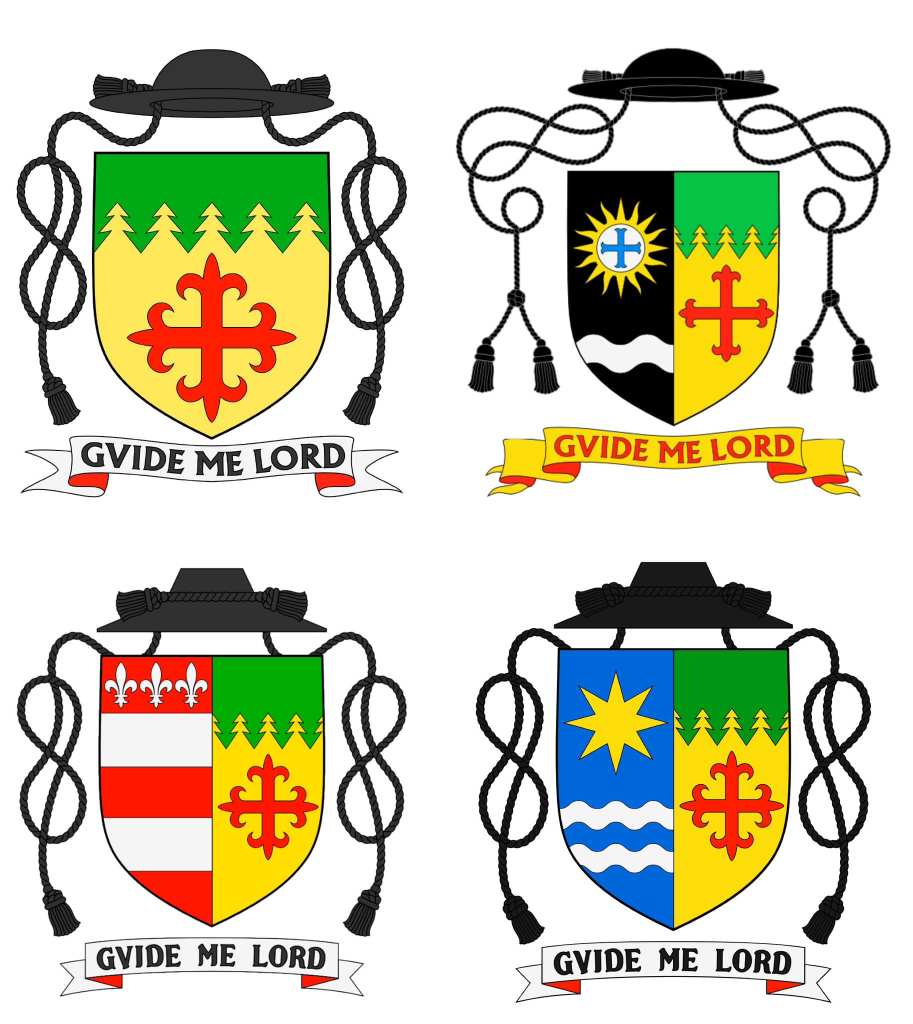
Throughout the course of my priesthood, after my time as a Parochial Vicar concluded and I began to be placed in charge of my assignments I also began the practice of 1) devising armorial bearings for the different places in which I have served and 2) marshaling those newly-devised coats of arms with my own. Having jurisdiction over the church or parish was then illustrated heraldically.

In the image above the first coat of arms (upper left) is my personal coat of arms assumed at ordination in 1997. The next image (upper right) shows my arms impaled with those of the Shrine of the Blessed Sacrament in Raritan, NJ where I served as the Sixth Rector (hence the four tassels instead of only two) from 2009-2015. The image at lower left shows my arms impaled with those of St. Joseph Church in Washington, NJ where I served as Administrator and then as the Twenty-Second Pastor from 2015-2023. During the last part of that time I was also Dean of the Morris Canal Deanery. The final image (lower right) shows my coat of arms impaled to the newly-devised parish coat of arms of St. Mary, Star of the Sea in South Amboy, NJ where I will serve as the Ninth Pastor from 2023 onwards.

(Artwork: Xavier Garcia)

Lovely Heraldic Achievements from Spain

One of my readers, Jorge Hernández Sánchez, from Seville who is also a heraldist has completed some 100 coats of arms specifically for ecclesiastical clients. He sent me quite a few of his creations. Many of them are wonderful examples of the coats of arms of prelates of various types below the rank of bishop. We see a preponderance of episcopal and archiepiscopal heraldry. It’s nice to see the armorial bearings of other ranks in the Church. The following are just a sampling of Jorge’s work…

Easy Come; Easy Go.

Last November, my Bishop appointed me to serve as the Dean of the Deanery in which my parish is located. That meant there was going to be a modification of my coat of arms. The addition of a second tassel to the galero in my armorial bearings was for the duration of the office of Dean only.

Just yesterday, my Bishop announced the appointment of three new Deans. Two of them are appointed to fill vacancies created by the retirement of two priests. The third is in my own Deanery where a vacancy is about to occur when I am transferred to a new assignment later this month. Since the extra tassel was only “pro hac vice” I must now reliquish it and revert to using the galero of a simple priest, with one tassel pendant on either side of the shield.

As it turns out, I served as a Dean for only nine months. At the time of my appointment last November, my bishop and I had no way of knowing that I would be transferred only the following summer.

Justin Trudeau Meddles in Heraldry

Today, the Canadian Government of Justin Trudeau unveiled a new heraldic Canadian Crown replacing the traditional St. Edward’s Crown used on Canada’s coat of arms, police & military badges. The design replaces what the government termed “religious symbols” (crosses & fleur-de-lis) with maple leaves & a snowflake.

The Canadian Heraldic Authority was apparently consulted in this process. Reactions so far have been mixed but mostly disapproving.