On August 8, Rev. Douglas Lucia (56) a priest of Ogdensburg, NY was ordained a bishop and installed as the 11th Bishop of Syracuse, NY. His coat of arms:
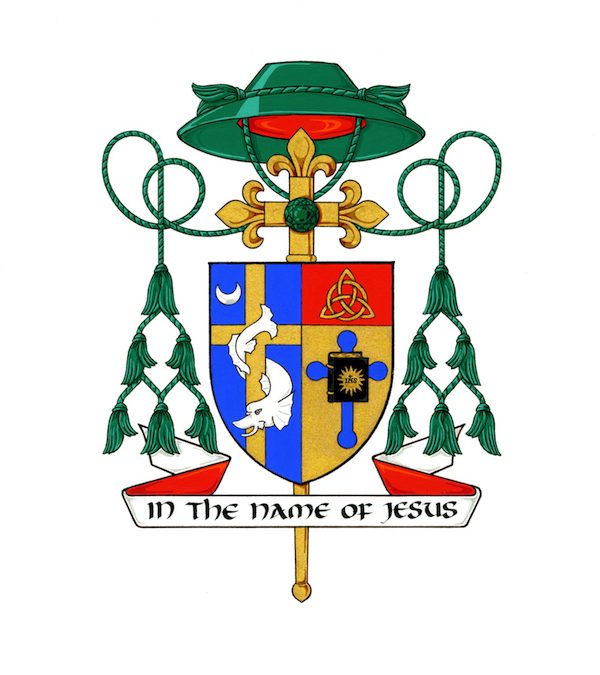
On August 8, Rev. Douglas Lucia (56) a priest of Ogdensburg, NY was ordained a bishop and installed as the 11th Bishop of Syracuse, NY. His coat of arms:
On Wednesday, August 21, the feast of St. Pius X, the Most Rev. Mark E. Brennan (72) until recently Auxiliary Bishop of Baltimore and Titular Bishop of Rusibisir, was installed as the 9th Bishop of Wheeling-Charleston, West Virginia. He succeeds the scandal ridden Bishop Michael Bransfield.
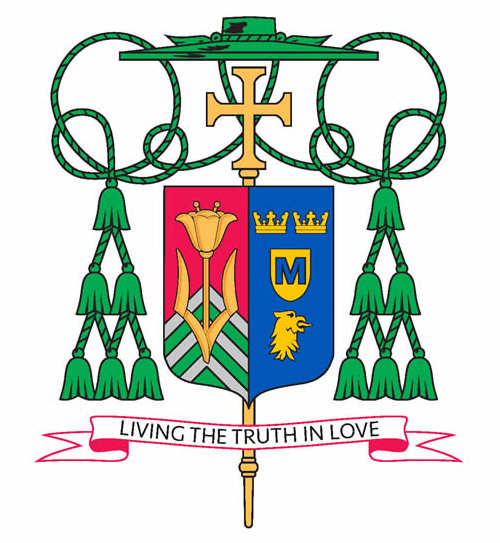
His coat of arms (above) is clearly a redesign of the coat of arms he assumed at the time he became a bishop. Normally, I am very critical of the practice of a bishop changing his coat of arms when transferring to a different assignment. A coat of arms is not “changeable” as it is a mark of personal identification.
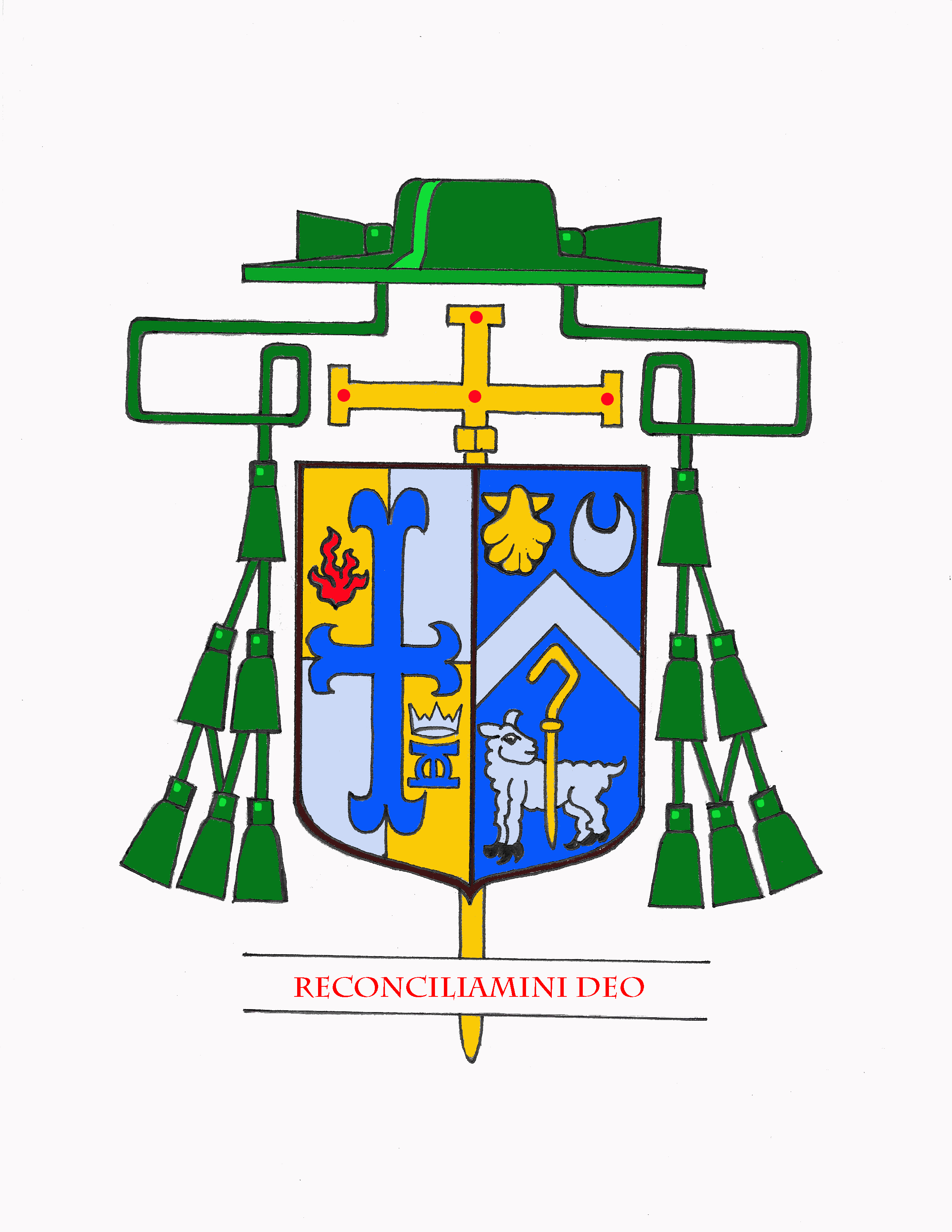
However, Bishop Brennan’s originally assumed arms (below) were rather busy and it would have been difficult to impale them well with the diocesan coat of arms. Of course, it is well worth pointing out that while impalement, symbolizing that the bishop is “married” to his diocese, is the norm for diocesan bishops in the United States but it is not mandatory by any means. I would hazard a guess that when Bishop Brennan assumed his coat of arms he did not think that he would ever be called upon to serve as a diocesan bishop and thought his episcopal ministry would be lived out as an Auxiliary of Baltimore. That’s not an unusual assumption when you consider he was already 69 years old when he was appointed a bishop and the mandatory age at which bishops must submit a resignation is 75!
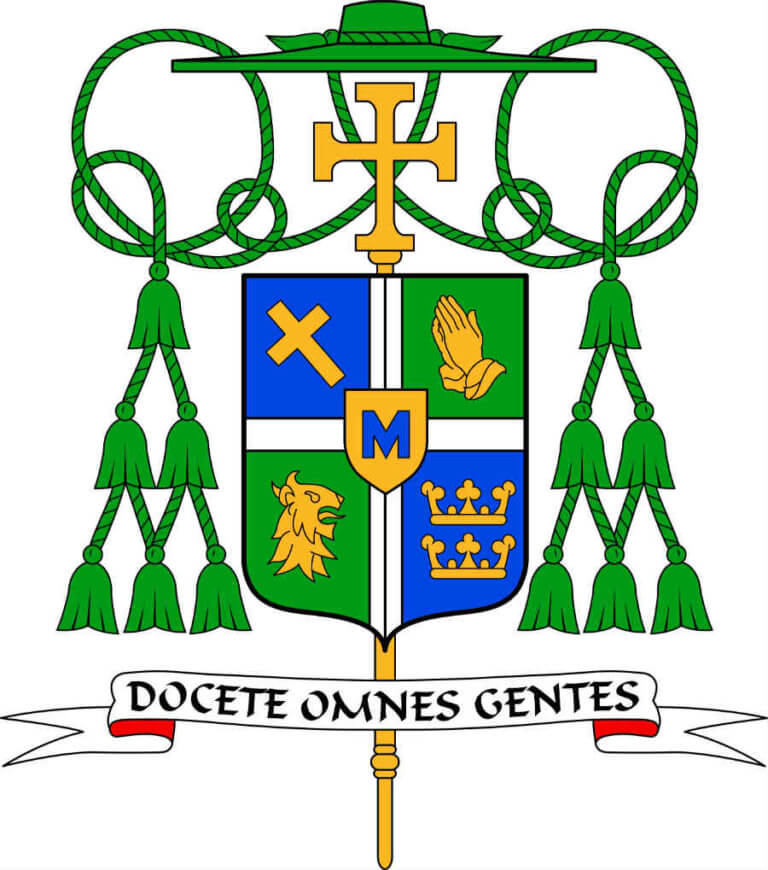
Nevertheless, his personal coat of arms has been redesigned to better harmonize and more easily be impaled with the coat of arms of the See of Wheeling-Charleston. In my opinion, my misgivings about redesigning arms aside, I think it is an improvement over the original coat of arms. The change of the motto, also not an absolutely necessary part of a coat of arms although erroneously thought to be so by many, is less problematic.
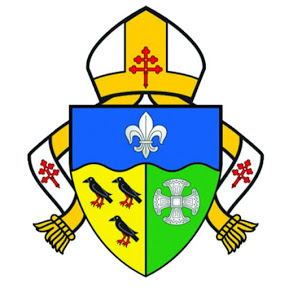
On July 25, 2019 the Most Rev. John Wilson (51), a priest and auxiliary bishop of Westminster was installed as the 11th Metropolitan Archbishop of Southwark. London is a unique city in that it contains two different ARCHdioceses, as well as also containing part of the territory of two dioceses. Everything south of the river Thames is in the Archdiocese of Southwark.
The archbishop employs the archdiocesan arms pictured below. They follow the more ancient custom in Britain of ensigning the shield with a bishop’s mitre rather than the more continental galero.
On July 26, 2019 the Most Rev. Robert Gruss (64), formerly Bishop of Rapid City, SD and prior to that a priest of Davenport, IA was installed as the seventh Bishop of Saginaw, MI. His coat of arms (below) is described on the diocesan website.
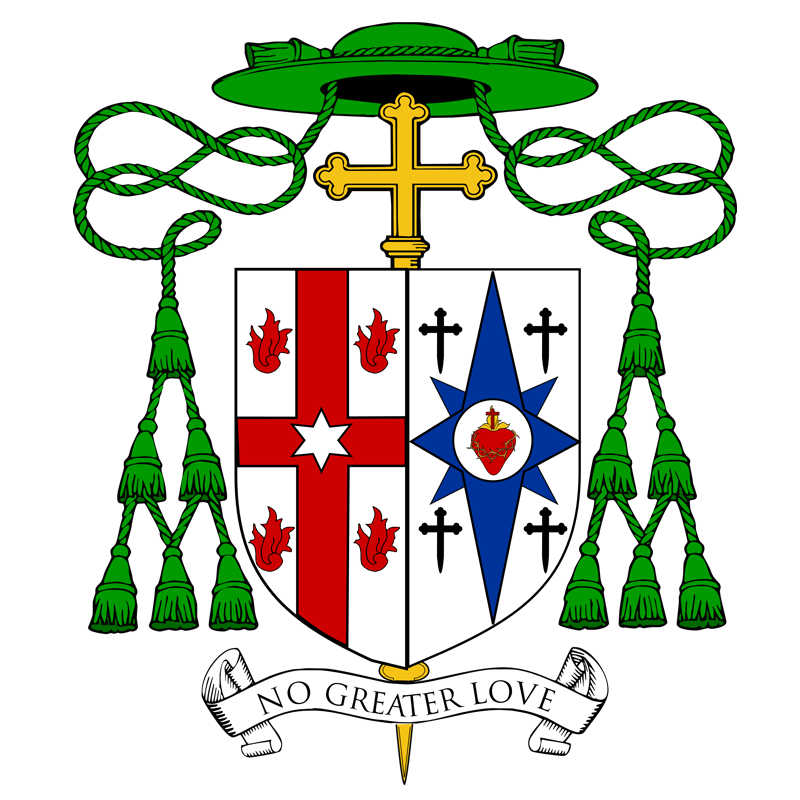
The Most Rev. Robert Christian, a Dominican friar, who has been the Auxiliary Bishop of the Archdiocese of San Francisco passed away on July 11, 2019 at age 70.
His coat of arms was assumed by him at the time of his episcopal ordination.
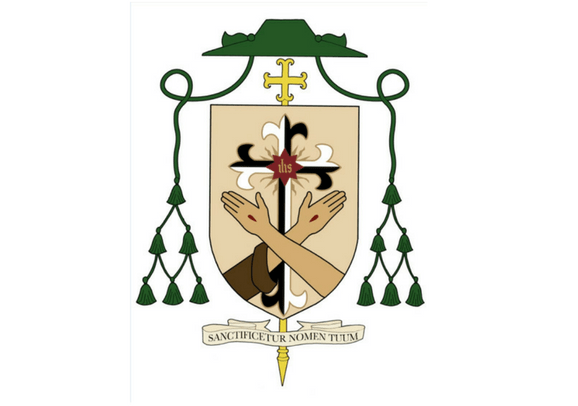
Umm…no. Sorry, but “beige” isn’t a heraldic color and, no, you may not just simply make up new rules and use whatever color you wish in heraldry. The science of heraldry limits the tinctures to be used and beige isn’t one of them. The Dominican cross and the usual Franciscan conformities (the arms of Christ and St. Francis crossed with each other) made for a nice combination of symbols for his Religious Community and the Archdiocese.
May he rest in peace.
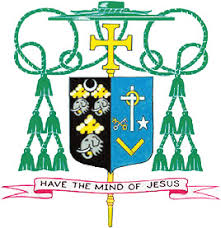
Bishop Joseph A. Galante, D.D., J.C.D. was born in Philadelphia and was ordained in 1964. He attended Lateran University in Rome, where he received his doctorate in canon law, and later the University of St. Thomas (Angelicum) in Rome, where he received his Master’s Degree in Spiritual Theology.
He served in the Archdiocese of Philadelphia until he was named by Pope John Paul II in December 1986 to be Undersecretary of the Congregation for Religious in Rome. He was a member of the Pontifical Council for Social Communications and chair of the United States Conference of Catholic Bishops’ Committee on Communications.
In October 1992 he was named Auxiliary Bishop of San Antonio, Texas. A year and a half later he was installed as Bishop of Beaumont, Texas. He became Coadjutor Bishop of Dallas in January 2000.
On April 30, 2004, Bishop Galante was installed as seventh bishop of the Diocese of Camden.
Bishop Galante retired on January 8, 2013. He entered into eternal life on May 25, 2019.
The Most Rev. Donald Hying (55), formerly a priest and auxiliary bishop of Milwaukee, Wisconsin and since 2014 the bishop of Gary, Indiana has been appointed the fifth Bishop of Madison, Wisconsin succeeding the late Robert Morlino. Bishop Hying will be installed in Madison on June 25, 2019.
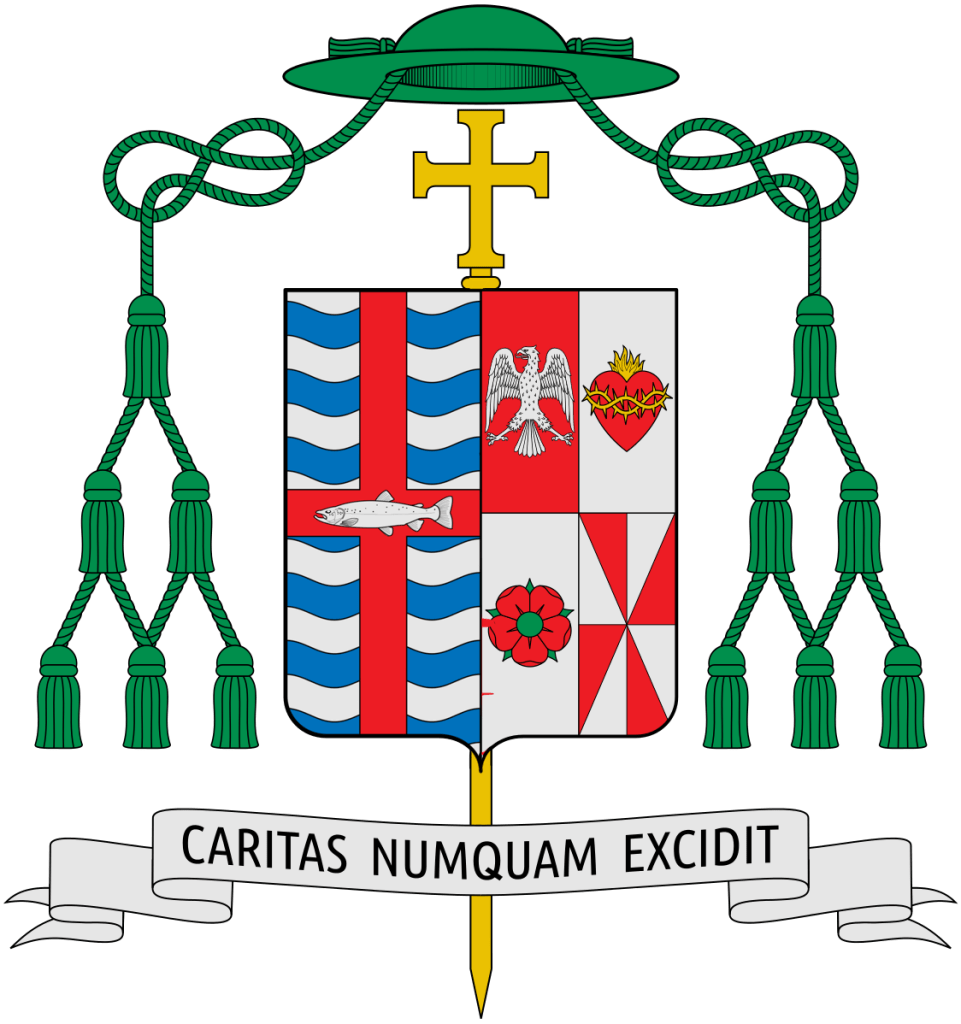
On Friday, March 29, 2019 the Most Rev. Robert Brennan, formerly Auxiliary Bishop of Rockville Centre, NY was installed as the twelfth Bishop of Columbus, Ohio. His personal arms now impaled with those of the See are described on the diocesan website.
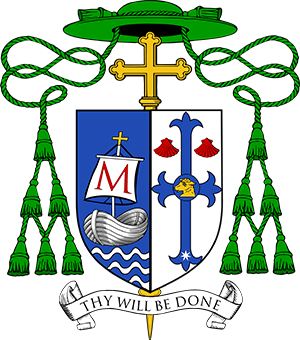
The Brennan coat of arms comprises a white shield with a blue heraldic lion, and two red hands in the top corners of the shield. Rather than use the original design Bishop Brennan has chosen to retain the overall coloration and layout of his family coat of arms, while employing charges more evocative of his own life of faith.
The main charge on the shield is the Cross, the foundation of the Christian faith. The arms of this particular Cross resemble a fleur-de-lis, a stylized lily often used as a symbol of the Virgin Mary.
At the bottom of the cross appears a small white star, a symbol of Our Lady. Its position recalls the moment of the Commendation, when, “standing by the cross of Jesus” (John 19:25), Mary became, at her Son’s command, the Mother of all of his disciples (cf. John 19:27). The star has seven points, recalling the seven Gifts of the Holy Spirit.
At the center of the cross appears a lamb’s head painted gold. The same charge figures prominently on the coat of arms of the Diocese of Rockville Centre, which Bishop Brennan served as a priest and bishop for nearly 30 years. Saint Agnes is the patroness of the Diocese of Rockville Centre, and of its Cathedral church, where Bishop Brennan resided for 16 years.
At the top of the shield are two scallop shells painted red. Although the charges are the same, they are used here to allude to two different saints: John the Baptist and James the Greater. Bishop Brennan attended Saint John the Baptist High School (West Islip) and Saint John’s University, and the patron of these schools is often depicted in sacred art using a shell to baptize the Lord Jesus. The date of Bishop Brennan’s ordination as a bishop — July 25, 2012 — is the feast of Saint James, the brother of Saint John the Evangelist and the first of the apostles to be martyred, during the persecution of the early Church (Acts 12:1-2). The red color of the shells recalls the fact that both of these saints gave their lives as martyrs for the faith.
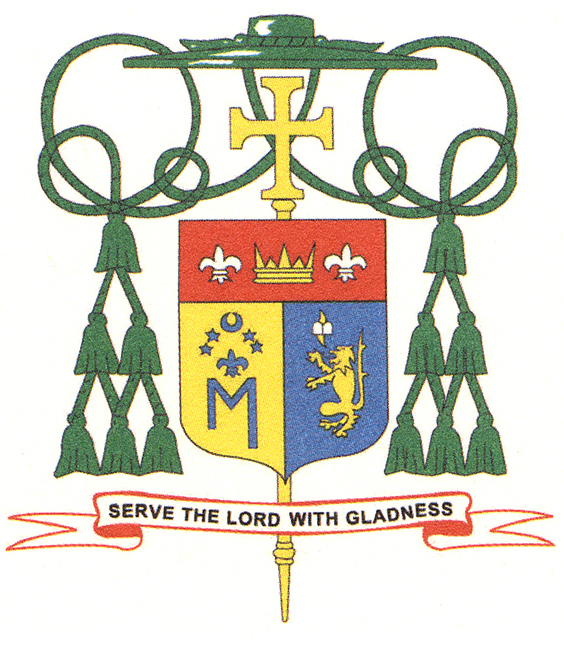
On Jan. 22, 2019 of the Most Rev. John Mortimer Smith, Bishop Emeritus (2010-2019) and Ninth Bishop of the Diocese of Trenton (1997-2010), former Coadjutor Bishop of Trenton (1995-1997), former Bishop of the Diocese of Pensacola-Tallahassee in Florida (1991-1995) and former Auxiliary Bishop of the Archdiocese of Newark (1988-1991) passed into eternal life. Bishop Smith died in Morris Hall Meadows, Lawrenceville, after a long illness. He was 83 years old.
His coat of arms (above) was assumed at the time he was ordained an Auxiliary Bishop in 1988. It is, in my opinion, a little too “busy” insofar as he tried to do too much. All those various charges represent different events/aspects of his priestly life and ministry, a kind of pictorial CV, which is precisely the type of thing I encourage new armigers to avoid all the time. It was particularly problematic and a little bit unattractive when it was marshaled to the arms of a See, such as Trenton, because all this was then squeezed into a narrow impalement (below). Perhaps, it would have been better to marshal the arms differently or to have simply borne his personal arms alone (something of which most American bishops cannot conceive because they think it isn’t permitted!)
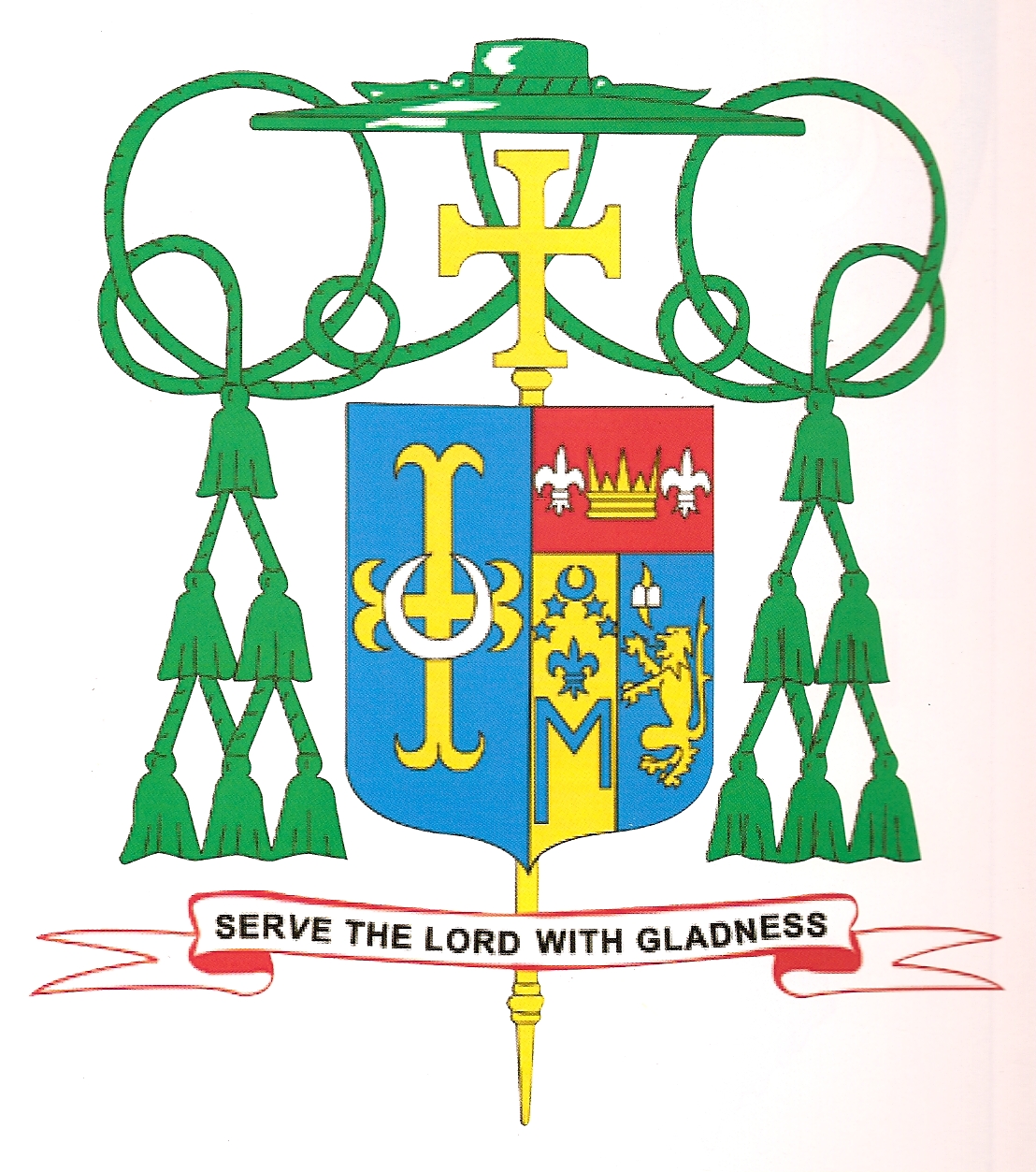
Aside from his less-than-wonderful coat of arms I met Bishop Smith on several occasions and found him to be a warm, outgoing and very kind man. He was very down-to-earth and easy to talk with. In the days when he was bishop of Trenton I hosted a 30-minute weekly radio program for my diocese and he told me on more than once occasion how he enjoyed listening to it in the car while driving to some event at which he was to preside. He was one of our biggest fans. May he rest in peace and receive the reward of his labors in the Lord’s vineyard.
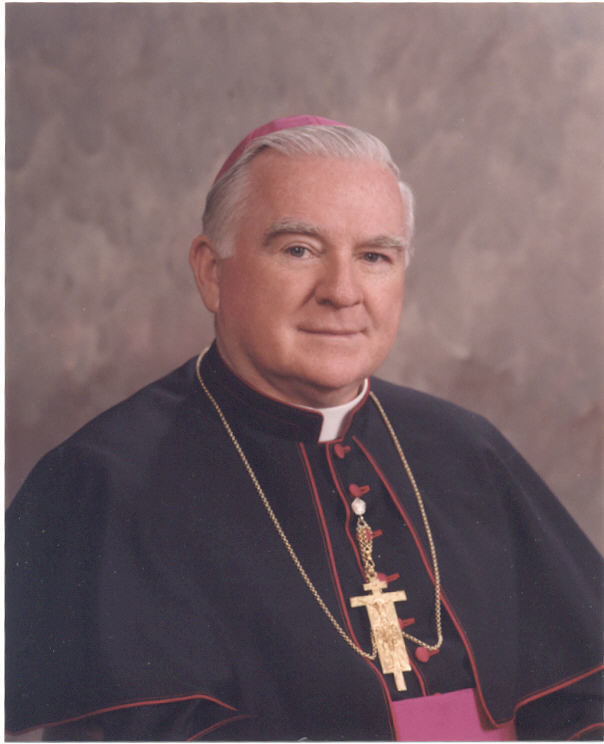
On December 28 the Most Rev. Robert Mulvee (88) retired VII Bishop of Providence, Rhode Island, formerly Bishop of Wilmington, Delaware and Auxiliary Bishop as well as a priest of Manchester, New Hampshire passed away. He will be buried on January 10th.
May he Rest in Peace.
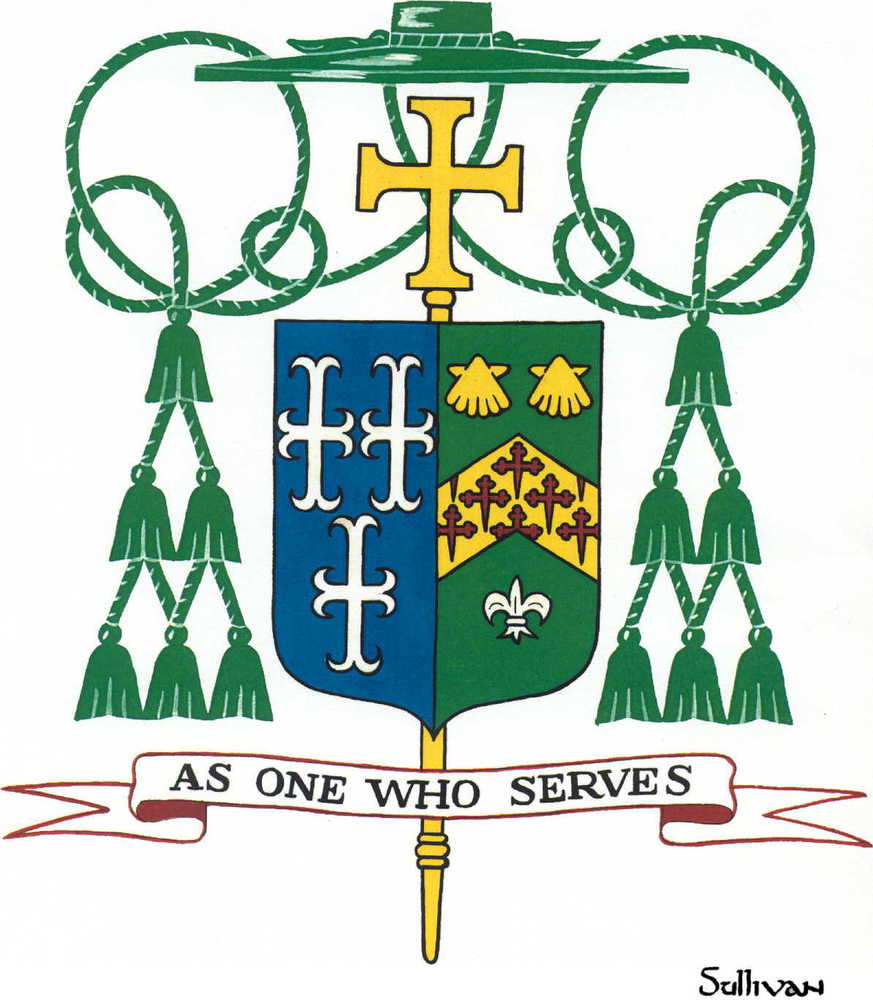
On November 24, 2018 the Most Rev. Robert Charles Morlino (71), Fourth Bishop of Madison, Wisconsin since 2003, died peacefully after a brief illness.
His coat of arms as described in information from the diocese:
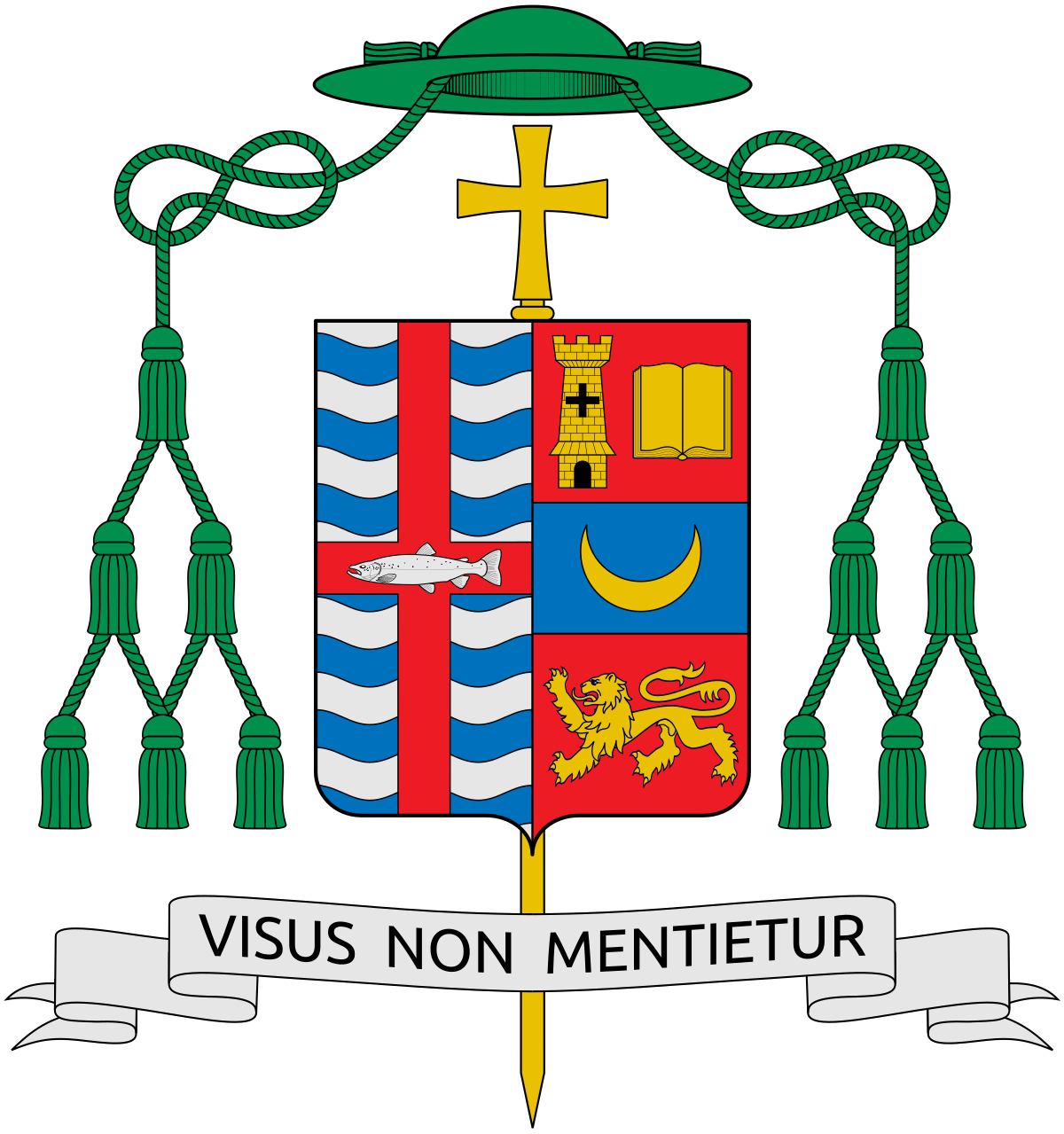
“The arms of the diocese are composed of a field that is wavy bars of silver (white) and blue. This is the traditional heraldic representation for water and the field of “water” is divided by a red cross into four sections to remind us of the lakes of the region around Madison. On the red cross is a fish and this conjunction of symbols is a classic symbolic representation for Saint Raphael, the titular of the Cathedral Church of Madison. Raphael means “healer of God” and his ministrations to men make interesting reading in the Book of Tobit in the Old Testament. The fish recalls the episode where Raphael ordered Tobias to cook a fish to eat but removed the heart, liver and gall for future medicinal use. Later the liver was used by Tobias to drive out the devil, who had slain seven of the previous husbands of Sara, his wife, while the gall was used to restore sight to his blind father.
The upper most part of the bishop’s arms contain a gold tower which symbolizes a place of refuge, strength and of safety. There is also a book which serves to reference the bishop’s thirst for knowledge of things that concern God and His Church.
There is also a gold crescent moon on a blue fess. The blue fess serves to recall not only the blue in which Our Lady is traditionally depicted, but also of water.
The “lion passant” of gold in the lowest part of the shield alludes to the strength and liveliness of His Excellency in all that he does, but most especially in defending the faith. This charge further seeks to reveal His Excellency’s strong devotion to Pope Saint Leo the Great that began to develop during the formation of his master’s thesis.
The red background, overall, calls to mind the blood of the martyrs.
The motto, “The Vision Will Not Disappoint” is from Habbakuk 2:3″
Requiescat in Pace.
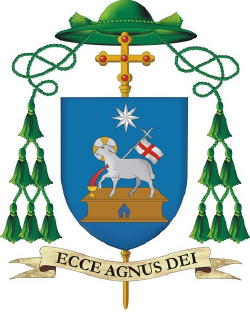
The Coat of Arms of Bishop Juan Miguel Betancourt, SEMV, depicts the Lamb of the Book of Revelation, slaughtered but victorious, the one who is the lamp for the Church (Rev 5:6; 21:23). The victory of Christ over sin and death through his sacrifice is reflected in the rays of power around his head (Rev 5:12; 17:14). The Lamb, giving his life for his Bride, the Church, through the shedding of his blood denotes the life of love and service of an ordained minister of the Church (Rev 14:1). The Lamb of God gives his life voluntarily so his Church can live and continue her mission of salvation in the world (John 10:17-18). The Lamb rests on a plain and unadorned wooden altar, evoking a life of simplicity, a life that wants to be spent in service signaling everyone to the Lamb, Christ the Savior. Finally, the Lamb also reminds us of Bishop Betancourt’s home, Puerto Rico, whose coat of arms is the oldest still in use in the New World.
The red and white banner, held by the Lamb, represents the local church of Hartford, which Bishop Betancourt has been called by the Lord to serve and give his life with joy and compassion, as well as his titular see of Curzola.
The Schoenstatt Shrine at the center of the altar represents the spirituality in which Bishop Betancourt has been formed through the charism of the Servants of the Holy Eucharist and of the Blessed Virgin Mary. The blue background is the presence of the Blessed Mother in the Church and the life of Bishop Betancourt. “Nothing without you, nothing without us” (Fr. Joseph Kentenich). “She is the great missionary, she will perform miracles” (St. Vincent Pallotti). The background also reminds Bishop Betancourt of the Church in the Archdiocese of Saint Paul and Minneapolis where he practiced his ministry of pastor, Scripture professor and formator of seminarians for more than a decade.
That strong presence of Mary is highlighted by the star. Mary, Stella Maris, reigns with her power of intercession and protection over every single member of the Body of Christ. In times of strife and distress in the Church, the Blessed Mother is the beacon of hope, promising strength, unity and security, inviting us to imitate the holiness and self-giving of her Son for the sake of his Bride. Traditionally, the eight-point star represents resurrection, salvation, super-abundance (of grace) and new beginnings.
He was ordained as the Auxiliary Bishop of Hartford on October 18, 2018.
On September 17 Blase Cardinal Cupich, Archbishop of Chicago will ordain three new Auxiliary Bishops. They and their newly assumed coats of arms are:
Mark Bartosic (57) Titular Bishop of Novatcata
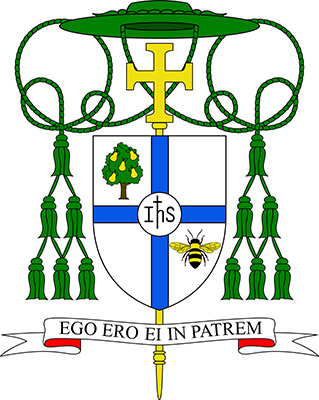
BLAZON: Argent, at center, upon a cross throughout azure, a plate charged with the monogram of the Holy Name, sable; to chief dexter a pear tree and to base sinister a bumble bee, both proper.
Robert Casey (50) Titular Bishop of Thuburbo Maius
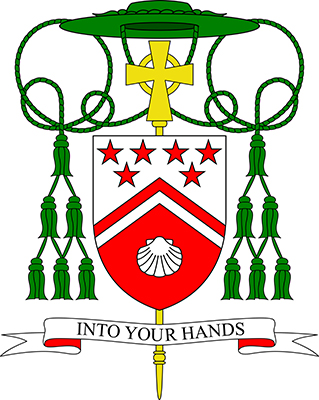
BLAZON: Argent and gules; a chevron party per chevron between in chief six stars, in two groups each two and one and in base an escallop all counterchanged.
Ronald Hicks (51) Titular Bishop of Munatiana
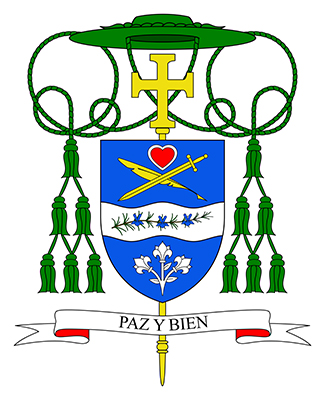
BLAZON: Azure, upon a fess wavy argent a sprig of rosemary proper; to chief per saltire a sword upon a quill below a heart gules fimbriated of the second, in base a spring of lily of three blossoms, also of the second.
All three (the work of Deacon Paul Sullivan) show a happy composition, good limited use of colors and make for nice clear designs. The arms of Bishop-elect Hicks is the most “crowded” and the fimbriation around the heart is probably there so that the heart could be depicted as red on a blue field. That’s unfortunate. It’s a “trick” to get around the tincture “rule” (of no color on color) but its a weak design element. It would have been better simply to have the heart be of gold or silver.
Here is a heraldic oddity. It involves the reduction in rank or demotion of a prelate. Now that Theodore McCarrick has resigned from the College of Cardinals he will no longer enjoy the privileges associated with it. For the time being he retains a coat of arms, although, I suppose that remains to be seen as well, and it bears the personal arms he assumed when he first became a bishop as Auxiliary Bishop of NY. He retains the double-barred cross and galero with 20 tassels of an archbishop because he is the Archbishop-emeritus of Washington, DC. The arms of theSee of Washington are not impaled with his personal arms because he is no longer the incumbent of that See. Having laid aside the dignity of a Cardinal he reverts to being Archbishop McCarrick.

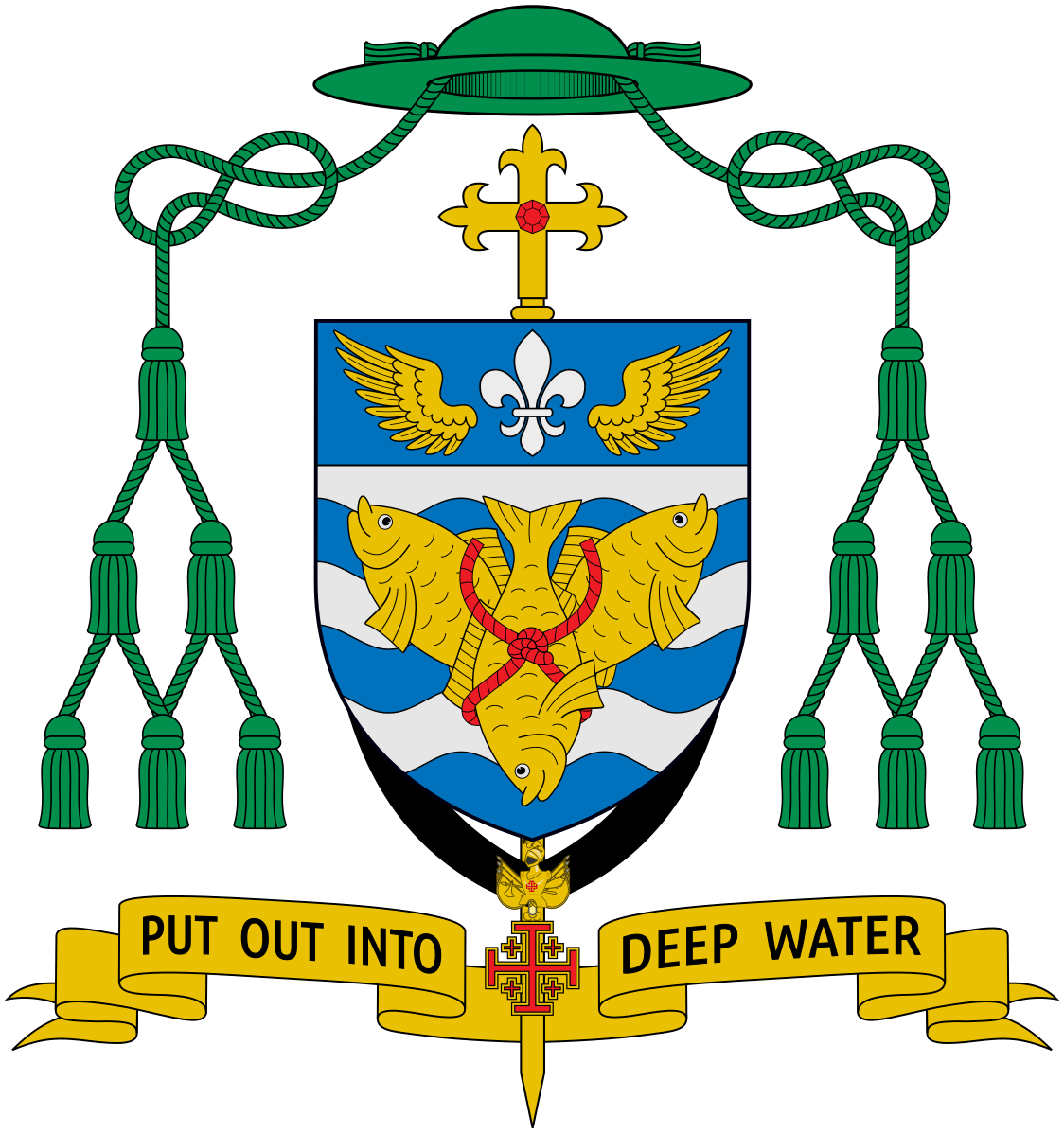
On Tuesday, July 24, the Most Rev. Richard G. Henning (53), a priest of Long Island’s Diocese of Rockville Centre and currently Rector of the Seminary of the Immaculate Conception, will be ordained a bishop and become Titular Bishop of Tabla and Auxiliary Bishop of Rockville Centre. Shortly after his appointment he asked me to assist in the design of his arms. The Bishop and I are classmates from our days attending Chaminade High School in Mineola, NY. His coat of arms is:
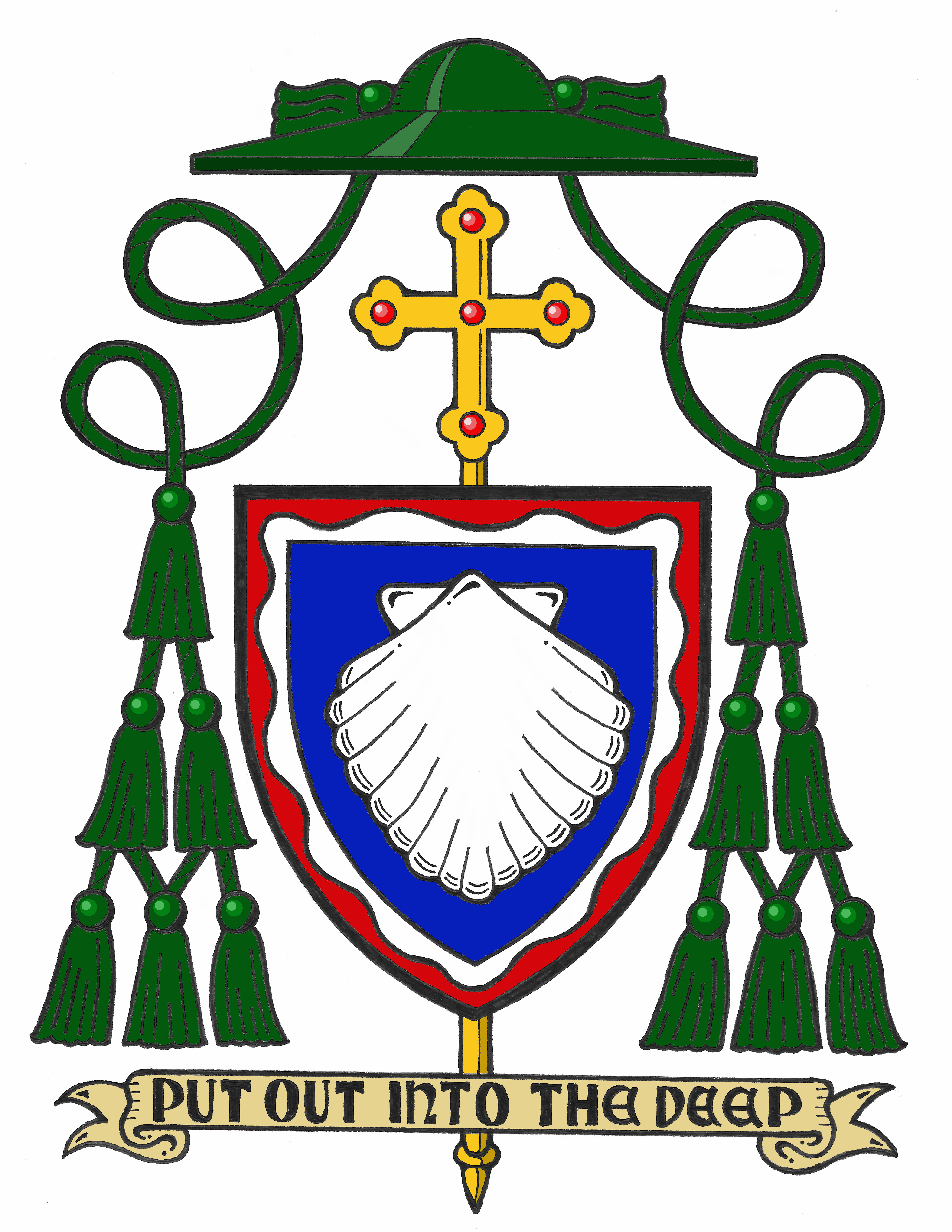
The blazon of the arms is: Azure, within a bordure parted wavy Argent and Gules an escallop shell Argent. The shield is ensigned with an episcopal cross Or charged with five jewels Gules and a bishop’s galero with cords and twelve tassels flanking the shield disposed in three rows of one, two and three all Vert. On a scroll below the shield is the motto, “Put Out Into The Deep”.
The shield is composed of a design depicted in red (Gules), white (Argent) and blue (Azure) which are the national colors of the United States.
Both the blue background and the single escallop shell allude to the sea as evoking the Bishop’s own background and the shell is also borrowed from the coat of arms of the See of Rockville Centre, the diocese in which he was born and raised and which he serves as a priest and bishop. The shell image also recalls the Bishop’s heritage in the Diocese of Brooklyn, dedicated to its patron, St. James. The ordination of the bishop takes place on the eve of the Feast of St. James. In concert with the Bishop’s motto, the shell is a traditional symbol of baptism and pilgrimage. It is in the depths of these waters that Christians find their salvation in Jesus Christ.
The white wavy line surrounding the blue field is similarly taken from the arms of Rockville Centre and it alludes to the diocese’s location on Long Island, NY. Furthermore, it indicates the sea as the place where the barque of St. Peter, an image used to evoke the Church, is located.
The blue background also evokes the Bishop’s devotion to the Blessed Virgin Mary and his years of service as a Professor and Rector at the Seminary of the Immaculate Conception. The red wavy portion of the border evokes the Bishop’s devotion to the Most Sacred Heart of Jesus and his service as the Director of the Sacred Heart Institute for the Ongoing Formation of the Catholic Clergy.
The external ornaments include a gold episcopal cross placed vertically behind the shield decorated with five red jewels symbolic of the wounds of Christ. This is often mistaken for a processional cross like the one used in liturgical processions. However, like other heraldic ornaments the episcopal cross has its origins in something which is no longer actually used. At one time all bishops had, in addition to the processional cross at the head of the procession, another cross carried directly in front of them by a cleric. This other cross was a sign of the office of bishop. While no longer actually used it has remained a symbol of the episcopal office in heraldry.
Similarly, the broad-brimmed green galero was, at one time, worn by bishops in outdoor processions and cavalcades. No longer used it remains a heraldic symbol of the office of bishop and takes the place of the helmet, mantling and crest that would appear in the coat of arms of a layman. In Catholic heraldry the color and number of tassels on the galero indicates the rank of the bearer. The single barred episcopal cross and the green galero with twelve tassels signifies the coat of arms of a bishop according to the Instruction of the Holy See, “Ut Sive” issued in 1969.
The motto chosen by Bishop Henning appears on a scroll below the shield. “Put Out Into The Deep” which is taken from Luke 5:4.
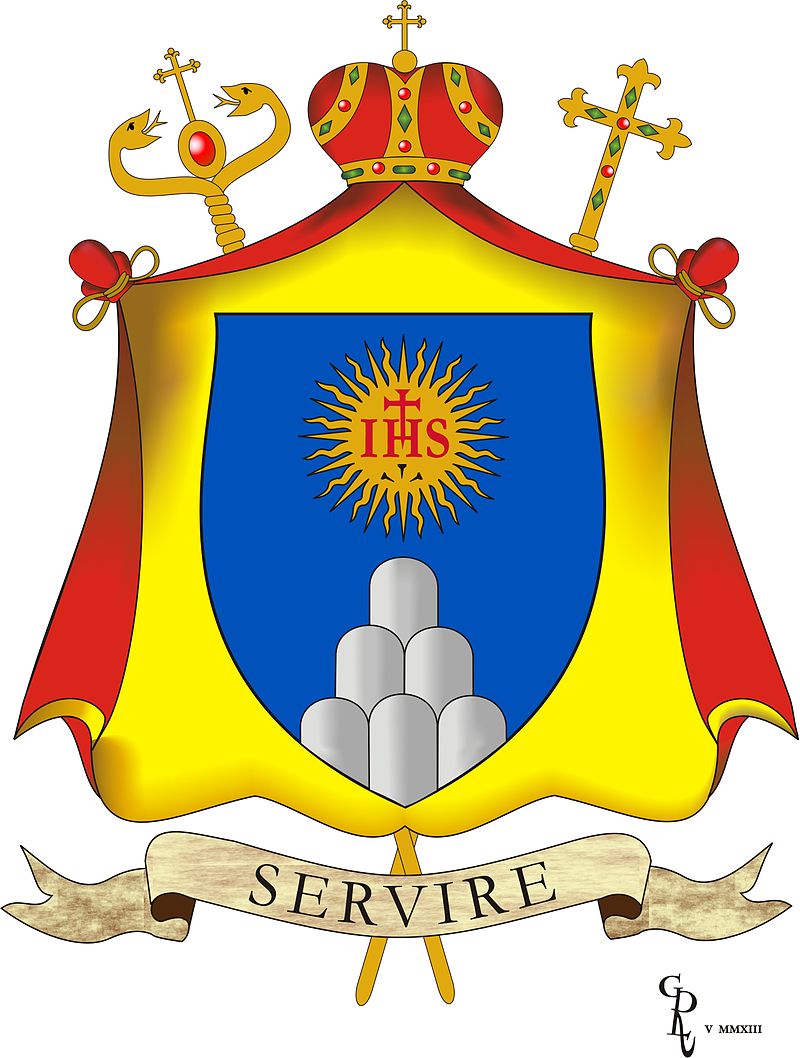
On June 30, 2018 the Most Reverend Milan Lach, S.J. who has been serving as Administrator of the Byzantine Catholic Eparchy of Parma, Ohio will be enthroned as the Eparch (Bishop) of Parma succeeding the Most Reverend John Kudrick. The eparch’s armorial bearings are:
On June 7, 2018 the Most Rev. Marc Trudeau was ordained as the Auxiliary Bishop of Los Angeles. His newly assumed coat of arms is:
Congratulations to my own bishop, Most Rev. James Checchio, 5th Bishop of Metuchen, on the 2nd anniversary of his ordination and installation. Ad Multos Annos!
Fr. Guy Selvester's blog of Ecclesiastical Heraldry
Fr. Guy Selvester's blog of Ecclesiastical Heraldry
Fr. Guy Selvester's blog of Ecclesiastical Heraldry
Fr. Guy Selvester's blog of Ecclesiastical Heraldry
Fr. Guy Selvester's blog of Ecclesiastical Heraldry
Fr. Guy Selvester's blog of Ecclesiastical Heraldry
Fr. Guy Selvester's blog of Ecclesiastical Heraldry
Fr. Guy Selvester's blog of Ecclesiastical Heraldry
Fr. Guy Selvester's blog of Ecclesiastical Heraldry
Fr. Guy Selvester's blog of Ecclesiastical Heraldry
Fr. Guy Selvester's blog of Ecclesiastical Heraldry
Fr. Guy Selvester's blog of Ecclesiastical Heraldry
 EXARANDORUM