After I had been commissioned to provide the coat of arms for the present Archbishop of New York, Archbishop Hicks, I was asked a short time afterward if I would be willing to make the necessary modifications to the armorial bearings of His Eminence, Timothy Cardinal Dolan that would reflect that he is now the Archbishop-Emeritus. It was simply a matter of removing the impalement for the Archdiocese of New York from his armorial achievement.
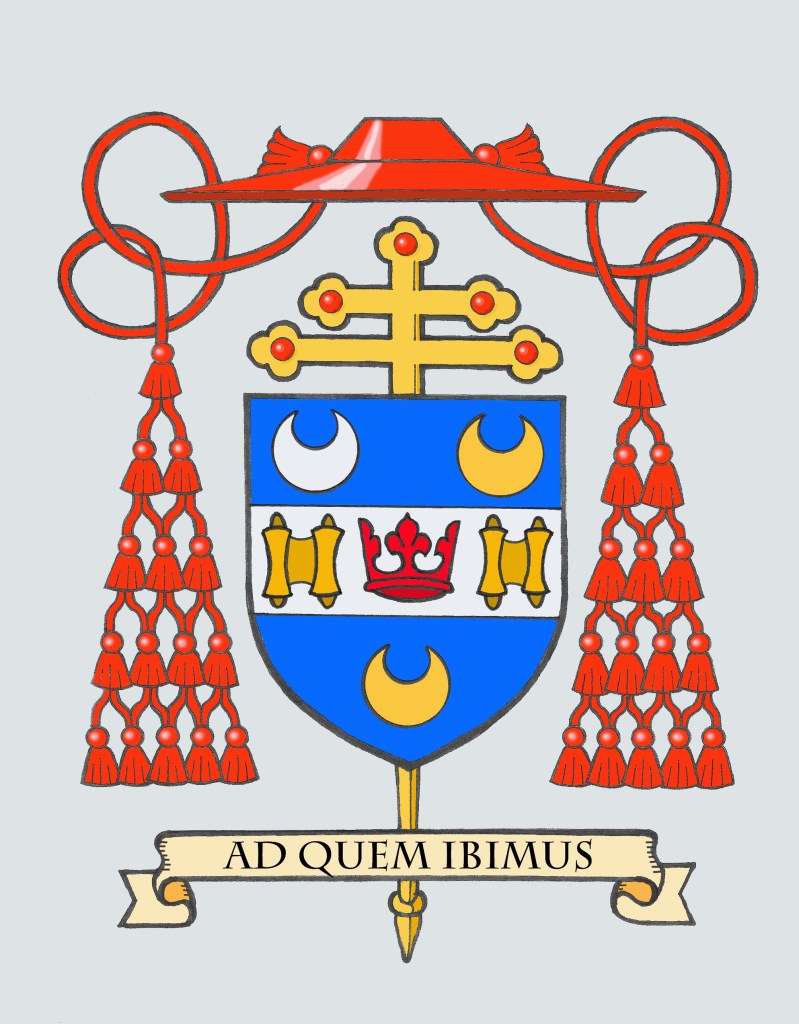
BLAZON: Azure, upon a fess Argent an open crown Gules between two ancient scrolls Proper; in chief two crescents, to dexter Argent, to sinister Or; in base a crescent Or. The shield is ensigned with an archiepiscopal cross Or in pale behind the shield and surmounted by a cardinal’s galero with cords and fifteen tassels on either side in five rows of one, two, three, four and five all Gules. On a scroll below the shield is the motto: “Ad Quem Ibimus”.
EXPLANATION: The cardinal’s coat of arms, is composed of a shield upon which there are symbolic charges, a motto and the external ornaments of rank. The shield which is the most important feature of any heraldic device is blazoned (i.e. described) in heraldic language from the point of view of the bearer with the shield being held on his arm. Thus, where it applies, the term “dexter” (right) and “sinister” (left) are reversed as the device is viewed from the front.
By heraldic custom observed in North America, the arms of a diocesan bishop are “impaled” side by side on the same shield to the arms of his jurisdiction. This signifies that the diocesan bishop, in this case, the cardinal, is “married” to the See. The same method of impalement is employed in the coat of arms of two married people who are armigerous. During his tenure as the 13th Bishop and 10th Archbishop of New York, Cardinal Dolan impaled his personal arms with those of the See of New York. Upon reaching his retirement it is customary to modify the full achievement of his armorial bearings to remove the impalement for the See of New York to indicate that he no longer exercises Ordinary Jurisdiction over the archdiocese.
For his personal arms Cardinal Dolan uses the design he assumed in 2001 upon becoming Auxiliary Bishop of St. Louis, and which he also used as Archbishop of Milwaukee, reflecting his priestly ministry and interests.
The Cardinal’s design is composed of a blue field on which is seen a silver (white) fess, a bar across the center of the design which is about one-third of the area of the shield. At the center of the fess is a red crown, taken from the arms of the Archdiocese of St. Louis, the Cardinal’s home, and which he first served in episcopal ministry. The crown is placed between two scrolls, that are described as “Proper,” or “as they appear naturally.” These scrolls are to honor the cardinal’s baptismal patron, St. Timothy, who was the recipient of two of St. Paul’s Epistles.
Above the fess are two crescents; one silver (white) and one gold (yellow), and one below which is also gold. The silver crescent honors our Blessed Mother, in her title of the Immaculate Conception, Patroness of the United States, and the charge is taken from the arms of the Pontifical North American College, in Rome, where Cardinal Dolan studied for the priesthood and later served for seven years as rector. The other two crescents, of gold, are taken from the Dolan family arms and honor the cardinal’s parents.
For his motto, Cardinal Dolan has selected the phrase “AD QUEM IBIMUS”. By the use of these words taken from St. John’s Gospel (John 6:68), Cardinal Dolan takes the words of St. Peter as was said to Jesus, “LORD, TO WHOM SHALL WE GO,” for truly the Lord is the way to all and eternal happiness.
The external ornaments include a gold archiepiscopal cross with two horizontal bars (sometimes referred to as a patriarchal cross) placed vertically behind the shield decorated with red jewels. This is often mistaken for a processional cross like the one used in liturgical processions. However, like other heraldic ornaments the archiepiscopal cross has its origins in something which is no longer actually used. In the Middle Ages such a cross, without a corpus, was carried directly in front of all archbishops and Papal Legates as a symbol of their authority. Later, the cross was adopted for use by all bishops so archbishop’s added a second horizontal bar to their crosses to distinguish them from the episcopal cross of simple bishops. While no longer actually used it has remained a symbol of the archiepiscopal office in heraldry. It is not, as is sometimes supposed, a symbol of the office of Metropolitan because the archiepiscopal cross is used by all archbishops, even those who are not Metropolitan Archbishops.
In addition, above the shield is the red ecclesiastical hat called a “galero” with fifteen tassels pendant on either side. This is the singular heraldic emblem that distinguishes the coat of arms of a cardinal. This broad brimmed hat, once worn in cavalcades, is no longer used but remains as a heraldic emblem. The galero was first bestowed on the Cardinals of the Roman Church by Pope Innocent IV at the First Council of Lyon in 1245. It was the first hat to be distinguished by the use of a specific color (scarlet) and it was also to be adorned with tassels. However, originally the number of tassels was not fixed. There are various examples of cardinals’ coats of arms that show as few as two tassels suspended from the galero and as many as seventy-two! What marked these coats of arms as those belonging to cardinals was that the galero, cords and tassels were red and nothing else. No one else could use such a red hat except a cardinal regardless of how many tassels were suspended from it. The number eventually was fixed at thirty (usually depicted as fifteen suspended on either side of the shield in a pyramidal pattern) only in 1832. A system for distinguishing the ranks of other clergy based on the color of the hat, of the cords and the number of the tassels did not come into existence until the Instruction of Pope St. Pius X “Inter Multiplices” in 1905.
These external ornaments are those used for a prelate with the rank of cardinal who is also an archbishop.
It was my great pleasure and my privilege to assist His Eminence with this project.
 EXARANDORUM