It never ceases to amaze me how people use and abuse heraldry especially when they usually begin almost any discussion of the topic by saying, “Well, I really don’t know much about heraldry, BUT…”. In particular, it is those who are frequently charged with displaying, disseminating, or publishing a particular coat of arms who decide to make the biggest mistakes in the interest of “making it look better”.
Now, I should pause here and state, categorically, that once I have designed and prepared a coat of arms the armiger is absolutely free to do with it as he/she pleases. There is no rule about taking the coat of arms they commissioned me to prepare and displaying it exclusively in the manner in which I gave it to them. To be frank, there are far better heraldic artists out there than me. I have never claimed to be an accomplished artist. My stated area of expertise is in devising a good and sound heraldic design; one that is in accord with good heraldic practices and accepted heraldic customs and conventions. That’s actually harder than most people think it is. You can’t just slap a bunch of symbols randomly onto a shield and call it a coat of arms!
I first began preparing artwork merely in the form of sketches to illustrate my design ideas for clients. In fact, when I originally started designing coats of arms for others I used to collaborate with a local artist to do the finished product. It was he who encouraged me to start doing the artwork myself. To this day I frequently prepare the design of a coat of arms but it is a different person who prepares the final artwork. Indeed, I have long said that the idea of slavishly copying one original, so-called “official” version of a coat of arms is antithetical to the whole concept of heraldic art. There isn’t only one way to depict a coat of arms, least of all in the manner it was originally rendered when first put into use. In addition, there is a vast difference between the work of a heraldic designer (the herald) and the work of preparing the artwork (the heraldic artist). The very concept of one person doing it all, like the “singer/song writer” is, and should be, rare. Most of the world’s greatest experts in the science of heraldry can’t draw to save their lives and the world’s foremost heraldic artists are frequently not well-versed in the concepts of heraldic design.
So, it’s really not unusual for a client of mine to have their coat of arms rendered again by a different artist. This is especially true because, these days, everyone wants digital art and I am still “old school” and actually draw the coats of arms I prepare. But, printing has moved into a new era, and the usual medium of communicating now is the internet. Having a vector image of a coat of arms allows it to be used on different platforms, or even in varying kinds of media at different sizes without the loss of resolution. So, dinosaurs like me may soon be out of a job.
I’ve grown accustomed to the idea that a client may, upon further reflection decide that they like the artistic style of another artist better (although, they do have ample opportunity to see examples of my work before commissioning me so they can’t claim to be surprised at how my artwork turns out!). In addition, as already stated, sometimes it is the desire to have the coat of arms in a digital format that causes clients to seek out the assistance of another (digital) artist.
However, there is also the person who decides that they’ll just do a hatchet job and cobble together an achievement from various sources. This offender is the worst kind. Take, for example, a recent commission of mine for a bishop in the United States. After commissioning me and receiving the finished coat of arms he decided that there was a slight error in the spelling of one of the words in his motto and he wanted that corrected. Fair enough, however, he didn’t ask me to do the correction. Instead he must have relied on someone in the diocese to which he was going which was, no doubt, preparing all sorts of materials surrounding his upcoming installation. But the motto wasn’t the only thing that got changed.
At some point a decision was made—I don’t know by whom, but it doesn’t really matter— not to use the artwork I had prepared. Apparently someone decided they liked the artwork of the coat of arms of the previous bishop which had been done by a heraldist who is now deceased. So what they decided to do, in addition to correcting the spelling in the motto, was to use the artwork of the previous bishop’s coat of arms and “cut and paste” my artwork of the sinister impalement containing the new bishop’s coat of arms onto this new achievement!
Now, as I have said, if it was desired to use a different artist’s work that’s fine. If it was desired to prepare a digital version of the coat of arms that’s fine too. But to simply lift my artwork and impose it onto another artist’s work to create some kind of Frankenstein’s monster of a final achievement is an example of what NOT to do! It’s insulting to me and to the deceased artist who did the previous bishop’s coat of arms and to the whole concept of good heraldic practice. This is to say nothing of the ethical questions involved with using someone else’s intellectual property and/or possible violations of copyright issues. In other words; it’s absolutely the wrong and stupid thing to do!
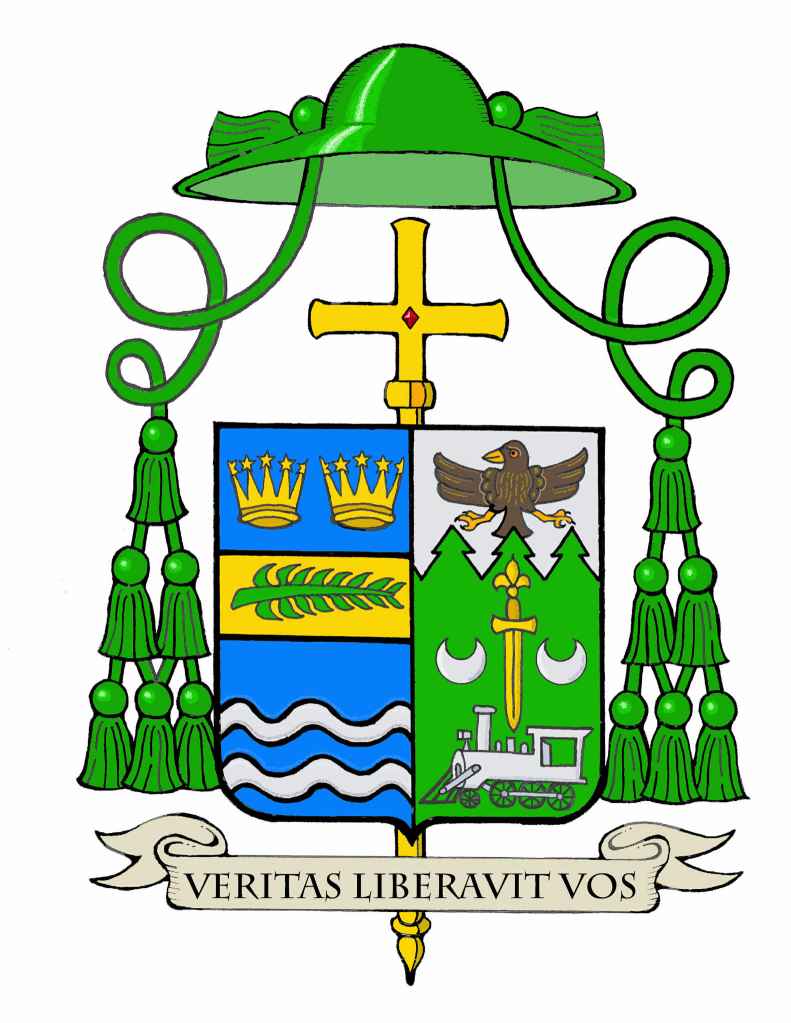
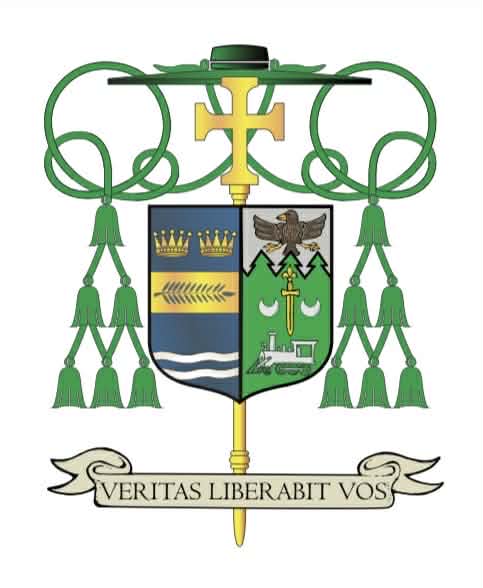
On the left we can see the version of the coat of arms as designed and rendered by me. This is what the client received. On the right we can see what ended up being used by the client. It contains the galero, cross and dexter impalement of the arms of the See done by the deceased artist as well as my artwork of the sinister impalement of the personal arms and the motto scroll with the word “Liberabit” spelled with a “b” instead of a “v” as originally requested by the client.
First off, it’s incredibly obvious that the arms of the See and the personal arms were drawn by two different people! In addition (and I understand I am prejudiced here) the overall appearance looks like it has been combined from different sources. The scroll is hugely and disproportionately outsized in comparison to the shield. The artwork of the personal arms looks to have a bad resolution and has also been distorted to fit a shield shape for which it was not intended. Yeah…even something like the shape of the shield goes into the design decisions made by me so that the charges aren’t just “crammed in” to a space on the shield.
Now, obviously, I prefer that my artwork be contained in an achievement that has been entirely prepared by me. But I will repeat that once I have delivered a coat of arms to a client they are perfectly free to have it rendered by a different artist. However, I feel quite comfortable in saying that the solution in this instance would have been to have a different artist render the entire coat of arms in his/her own style. One of the unfortunate consequences of the coming of the internet, online communication, the manipulation of images, etc. is the commonly accepted idea that simply “copy and paste” is an acceptable practice.
Well…it ISN’T. It’s ethically questionable, it’s insulting to the person who created the original, it creates substandard results and it looks cheap and ridiculous. By all means if you don’t like one artist’s work then go out and hire a different artist to give you what you want. But, to have the temerity and the presumption to slice up the work of various artists and then combine them is a textbook example of what NOT to do!
 EXARANDORUM
Surely, Father, this sort of conduct is also a breach of your copyright and/or the terms on which you supply the images?
Even that isn’t really my principal concern. I just think it’s in really bad taste and is completely wrong-minded. However, in future I shall have to consider putting something in writing concerning this at the time I am commissioned.