On Wednesday, February 26 the Most Rev. Lawrence John Sullivan (59), a priest of the Archdiocese of Chicago for the last 33 years, will be ordained as the Titular Bishop of Lamphua and Auxiliary Bishop of the Archdiocese of Chicago. Bishop-Elect Sullivan is one of five new auxiliary bishops appointed for the archdiocese by Pope Francis.
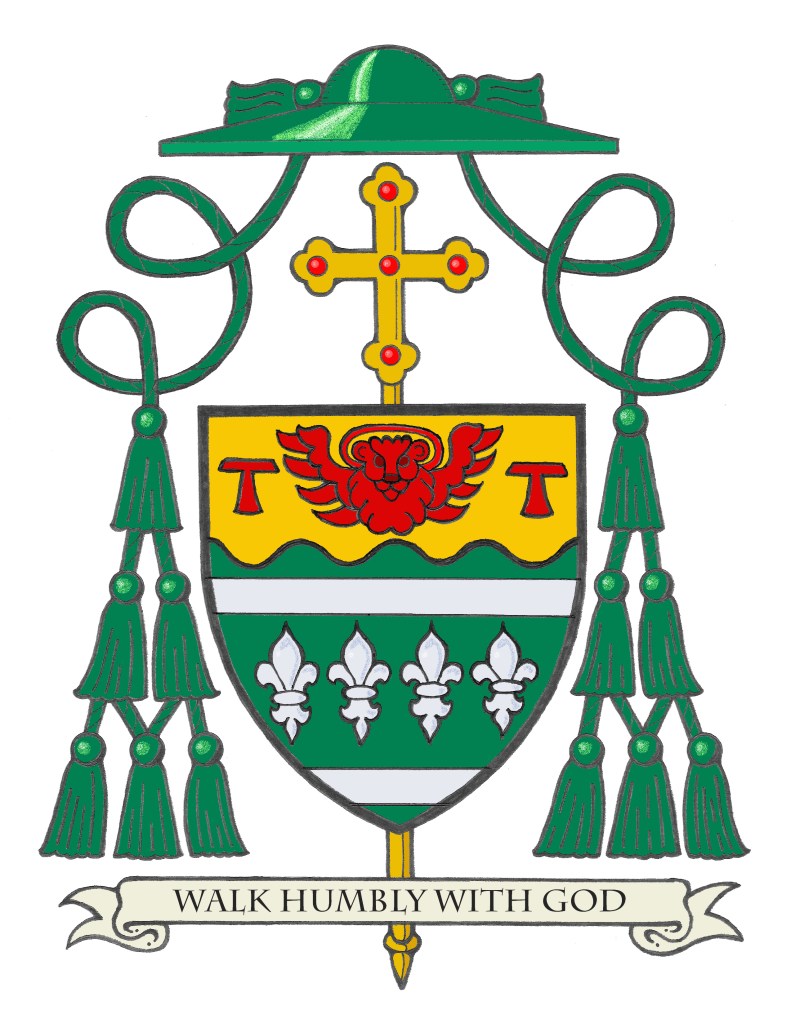
The blazon of the arms is: Vert, between two bars in chief and in base, four fleurs-de-lis fess wise all Argent; on a chief wavy Or between two Tau crosses the winged head of the lion of St. Mark all Gules.Shield ensigned with an episcopal cross Or behind the shield and a bishop’s galero Vert cords and twelve tassels disposed in three rows of one, two and three all Vert. On a scroll below the shield the motto: ”Walk Humbly With God”.
The armorial bearings of Bishop Sullivan symbolize his birthplace, his personal devotions and the place in which he has spent his life and ministry as a priest.
The basic design of the field echoes the design on the flag of Chicago, his native place. The background color has been changed to green as a nod to the Irish heritage of the Bishop. The two blue bars and four red stars on the Chicago flag have been differenced here and changed to two silver (white) bars and four silver (white) fleurs-de-lis. These fleurs-de-lis represent multiple things. One fleur-de-lis is taken from the coat of arms of Joseph Cardinal Bernardin who ordained the Bishop a priest; the second is taken from the coat of arms of Blaise Cardinal Cupich who will be the principal consecrator ordaining him to the episcopacy; the third is from the coat of arms of Mundelein Seminary where he received his priestly formation; the fourth is not from a coat of arms but is a heraldic symbol of St. Joseph, the patron saint of his College Seminary. It goes without saying that the fleurs-de-lis also figure prominently in the coat of arms of the archdiocese of Chicago. So, the design combines symbols from the city and the archdiocese where Bishop Sullivan was born, grew up and has served as a priest and will now serve as a bishop. Lastly, the fleur-de-lis is, itself, a heraldic symbol of Our Lady.
The upper third of the shield, called a “chief” is separated from the rest of the field by a wavy line alluding to both Lake Michigan and the Chicago River. On this gold (yellow) chief are two red crosses in the famous Tau shape. These represent the Bishop’s devotion to St. Francis of Assisi. This shape of cross is associated with the saint because he himself used it. Whenever writing anything, St. Francis placed a Tau cross at the top of the page.
Between these two crosses is the haloed head and wings of the Lion of St. Mark also depicted in red. This magnificent creature is symbolic of St. Mark as referenced in the prophecy of Ezekiel 1-2 and also in the Book of Revelation. St. Mark is the Bishop’s favorite evangelist and he likes and is drawn to the very human side of Christ depicted so well in Mark’s gospel. In addition, in his own personal spirituality Bishop Sullivan feels we are called to see Christ present in the world and that we see this in others and we, too, are called to be that presence of Christ for others, revealing the face of God–the very human God in Christ– to them. The combination of the colors green, gold and red are also used on the national flag of Lithuania and so they are a recognition of the Bishop’s Lithuanian ancestry as well.
The motto below the shield is “Walk Humbly With God”
The shield is also ensigned with those external ornaments that indicate the bearer is a bishop. The gold (yellow) episcopal cross, not to be confused with a processional cross, is placed vertically behind and extending above and below the shield. In former times archbishops, and later all bishops, had a cross mounted on a staff carried immediately in front of them while in procession or on solemn occasions. This cross was a symbol of their rank as bishop. While such an episcopal cross is no longer used practically it has been retained heraldically. In fact, there are other clerics who make use of the ecclesiastical hat with its many tassels but the one true heraldic emblem of a bishop, and the only essential one, is the episcopal cross placed behind the shield.
Above the shield is the ecclesiastical hat, called a galero which, in heraldry, replaces the martial helmet, mantling and crest. “The hat with six pendant tassels (green, purple or black) on each side is universally considered in heraldry as the sign of prelacy. It, therefore, pertains to all who are actually prelates.” (Heim, Bruno B., Heraldry in the Catholic Church 1978, page 114) The galero is green with green cords pendant from it and twelve green tassels arranged in a pyramid shape on either side of the shield. At one time in history bishops and archbishops wore green before adopting the more Roman purple we see today. In heraldry the green hat and tassels was retained for prelates with the rank of bishop according to the Instruction of the Secretariat of State, “Ut Sive” of March, 1969.
It was my pleasure and my privilege to assist Bishop-Elect Sullivan with the creation of his coat of arms. I was responsible for the design and also provided the artwork.
 EXARANDORUM
I love everything about this design. Meaningful and beautiful, yet simple. I especially like St Mark’s Winged and haloed head. Well done!
👍🏻
I too appreciate the image of St Mark as put forward in the icon.