Not long ago, in my capacity as my bishop’s ecumenical & interfaith officer, I attended a meeting with representatives of the Hindu community here in central New Jersey in an ongoing effort to increase contacts with the Catholic community and people of other faiths. A small part of our conversation touched on general misunderstandings between faith communities and the swastika was used as an example. In the Hindu, Jain and Buddhist faiths the symbol is a positive one. For all time, it was ruined by its adoption by the nazi party in Germany. There it wasn’t actually a “swastika”. Rather, it was a hooked cross (hakenkreuz in German) which was not an uncommon form of the cross used in Europe until its association with the nazis ruined its connotation.
It is, I think, always important to absolutely repudiate the ideas of national socialism or its bizarre stepchild, neo-nazism, which, tragically, still exists. My intention by this post is not to offend, but to educate.
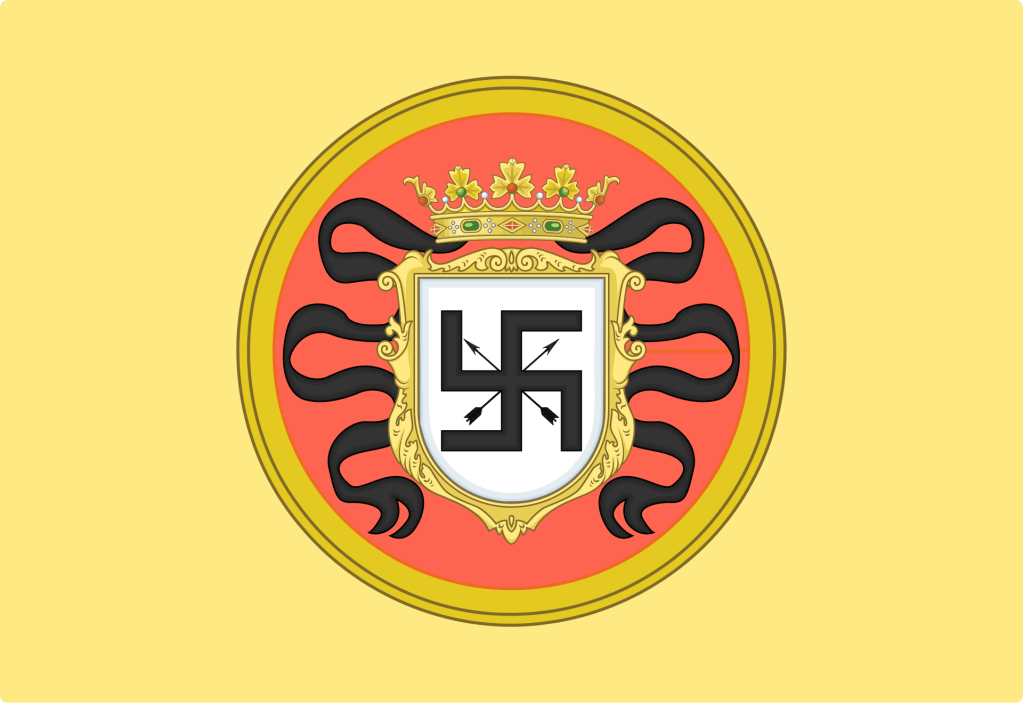
While its association with the horrors of WWII and the Holocaust will forever be with us the swastika (not the hakenkreuz), nevertheless, remains a religious symbol—and one without ANY nazi-related connotations—to other faiths. As such, it often has made its way into coats of arms in the past.
The image below depicts a banner with the armorial bearings of Hasekura Tsunenaga, also known as Don Felipe Francisco Hasekura after his conversion. He was a Japanese Samurai and emissary who traveled through the American continent and Europe in the 1600s. The arms and banner was granted to him after his conversion to Catholicism during his visit to Mexico City in 1614. An interesting blend of Japanese and European styles.
These days people would look upon this and THINK they know what it means…and be quite wrong. Such is the power of symbols. An positive religious symbol has been—in the West anyway—ruined forever because we cannot disconnect it from its terrible adoption by hateful people.
Back in 2015, I wrote a blog post about this same problem and the power of symbols which remain deeply rooted within us.
 EXARANDORUM
Hi, Father, I’ll just add my tuppence-worth to your article. Yes, indeed, the “crux gammata” (a cross made up by joining four greek “Gammas”) or the “fylfot” (as it is called by Fox-Davies) is part of Europe’s heraldic heritage. Mind you, you are absolutely correct in stating that this charge has been polluted to the degree it cannot be used any more. Nazi Germany not only corrupted that old symbol of the sun, they even depicted it the wrong way around. I am told that a crux gammata “reversed” like that is not a symbol of life any more, but the exact opposite.
Mind you, this just goes to prove that symbolism gets it right every once in a while …
In the Middle Ages, the crux gammata was well known, and its meaning must have been well known as well, at least unto the High Middle Ages. A good example is the Goesser Ornat, a rare example of a set of liturgical vestments dating from the 13th century, made at Goess, then a nunnery (see here: https://de.wikipedia.org/wiki/Stift_G%C3%B6%C3%9F). Parts of it were lost, but the Pluviale, Casula, Dalmatica and Tunica, all decorated with fine needlework, are kept in the Museum fuer Angewandte Kunst (MAK) at Vienna, Austria. The panels of religious images were separated by borders, decorated with … you guessed it. You can google “Goesser Ornat” and find some good images at https://sammlung.mak.at
The nuns producing the vestments apparently saw no difficulty in applying the old symbol to objects dedicated to the service of Christ. Nowadays, THAT sort of innocence has been thoroughly and permanently lost.