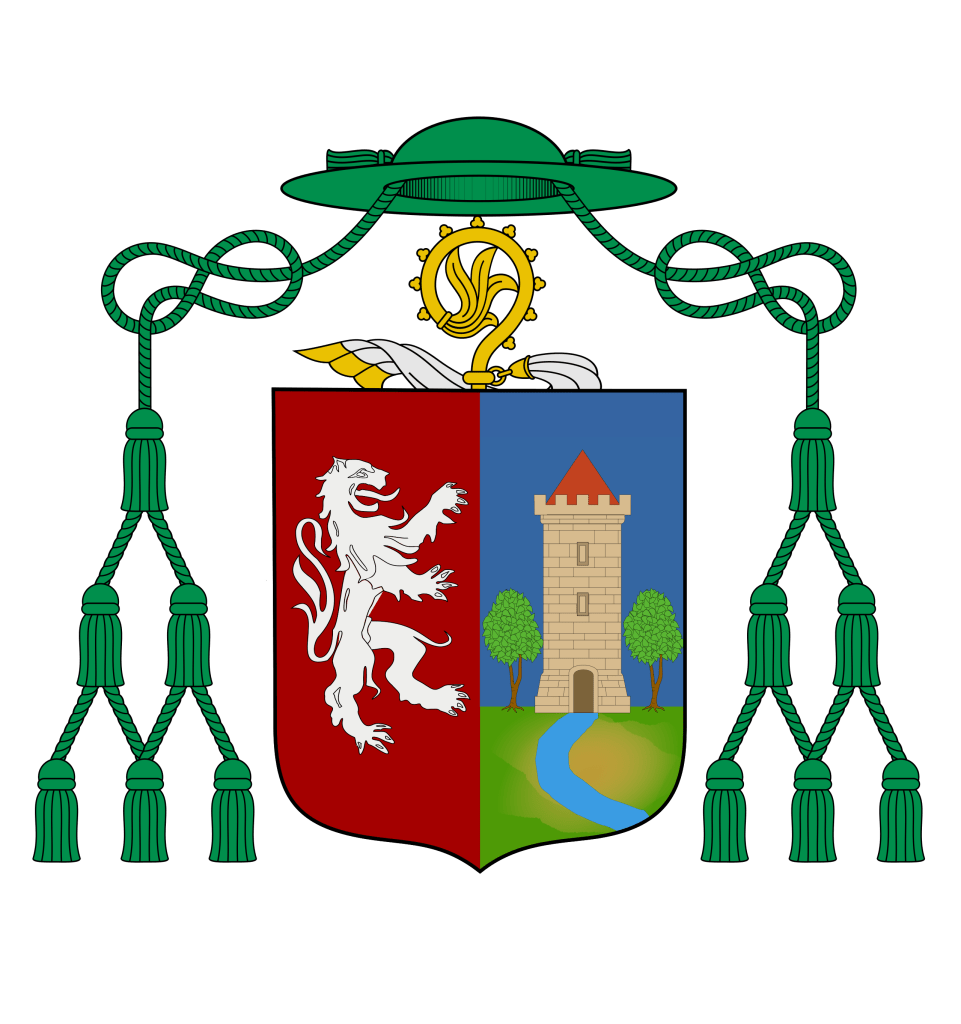
On March 8, 2023, the Right Rev. Antonio Fallica, OSB (63) who was appointed as the Abbot of the Territorial (Arch)Abbey of Montecassino on January 9, will be ordained to the priesthood. At the time of his appointment he was a Benedictine brother in Solemn Vows but not a cleric. It is a requirement that the holder of the office of Abbot be a cleric so he was ordained a Deacon on February 14 and is now being ordained a priest. Then he will be able to fully assume the office of Abbot. The arms (below) are those traditionally used by the (Arch)Abbey. It was also used by the last Abbot, Donato Ogliari, OSB who now serves as Abbot of St. Paul Outside-the-Walls in Rome and is currently still the Administrator of Montecassino until Abbot Antonio takes over. They are ensigned by a green galero rather than black because, although greatly reduced, the Abbey is still a Territorial Abbey (what used to be called an “Abbey Nullius”) and so its abbot uses the same galero as a bishop.
 EXARANDORUM
The abbot doesn’t have to be a priest anymore. Pope Francis changed the canon law. Now also lay brothers can be elected as Abbots. Montecassino is different because the Abbott als leader of a territorial abbey (abbatia nullius) has the same status like a bishop and must therefore be an ordained priest.
Actually, you have quite a few things mixed up in that comment. There were so many things wrong, it’s hard to know where to begin. Your first statement is not entirely true. While it is possible for a non-ordained Religious to be elected as an Abbot it is still considered to be very much an exception. Since Abbots are prelates in the Church and receive an abbatial blessing the general rule is that they must, in fact, be ordained. Each monastic Order that has Abbots have their own rules and regulations governing the criteria for eligibility for election as an Abbot. Some specify that one must be ordained to be an Abbot. Canon Law doesn’t govern this. As I said, each monastic Order has its own Constitutions which govern this. Among Benedictines each of the separate Congregations that are the constituent members of the Benedictine Confederation have their own rules about eligibility for election as Abbot. Some stipulate that a monk must be ordained. Those that do not make it clear that it is considered a highly unusual exception to elect a non-ordained monk as Abbot and that IF this should occur, the election is not valid until first confirmed by the Holy See. If a Brother, not a Priest, were elected he would also NOT receive the abbatial blessing, and would not, consequently, be accorded the privilege of using pontificals. Under such circumstances, most Communities would simply choose a Prior-Administrator instead to be their Superior. The monastic Orders all re-examined their Constitutions at the urging of the Holy See in the wake of the reforms of the Second Vatican Council. This all happened under St. Paul VI. Pope Francis had ABSOLUTELY NOTHING to do with this. In the case of Montecassino, the Abbot is a Territorial Abbot (the term Abbot-Nullius was changed…again by St. Paul VI) however, recently the territory has been so drastically reduced that it only takes in the property of the Abbey itself. The Abbot of Montecassino is no longer the Ordinary of some of the secular clergy in that region. He is now restricted to being the Ordinary of the monks only. The status of Territorial Abbot, which is considered a “quasi-bishop” was retained for historic reasons. So, it is true that would have affected the desire to have the current Abbot also be a priest. In addition, under present conditions, the monks of Montecassino don’t always elect their own Abbot. The last three Abbots there have been appointed directly by the Pope. However, I repeat, that generally speaking Abbots are to be elected from among the ORDAINED clergy. The possibility of a non-ordained monk being elected Abbot does exist, but that’s been the case since the 1970s. It’s very, VERY rare and is not considered the norm AND it’s nothing new and most certainly has had nothing to do with the current Pope. What Pope Francis did in 2022 was to allow non-clerical members of Institutes of Consecrated Life or of a Clerical Society of Apostolic Life to be allowed to serve as Major Superiors. Previous to that, only clergy could serve as Superiors in such Institutes or Societies. Abbots–as Prelates in the Church with the right to pontifical insignia–are in a separate category because they belong to a monastic Order rather than a Religious Institute or a Society of Apostolic Life. So, you are partially correct, but mostly mistaken.