Monthly Archives: March 2023

Bishop Celino, New Auxiliary of El Paso

The Most Rev. Anthony Cerdan Celino, (50) a priest of the Diocese of El Paso, Texas will be ordained the Titular Bishop of Maronana and Auxiliary of El Paso on March 31.
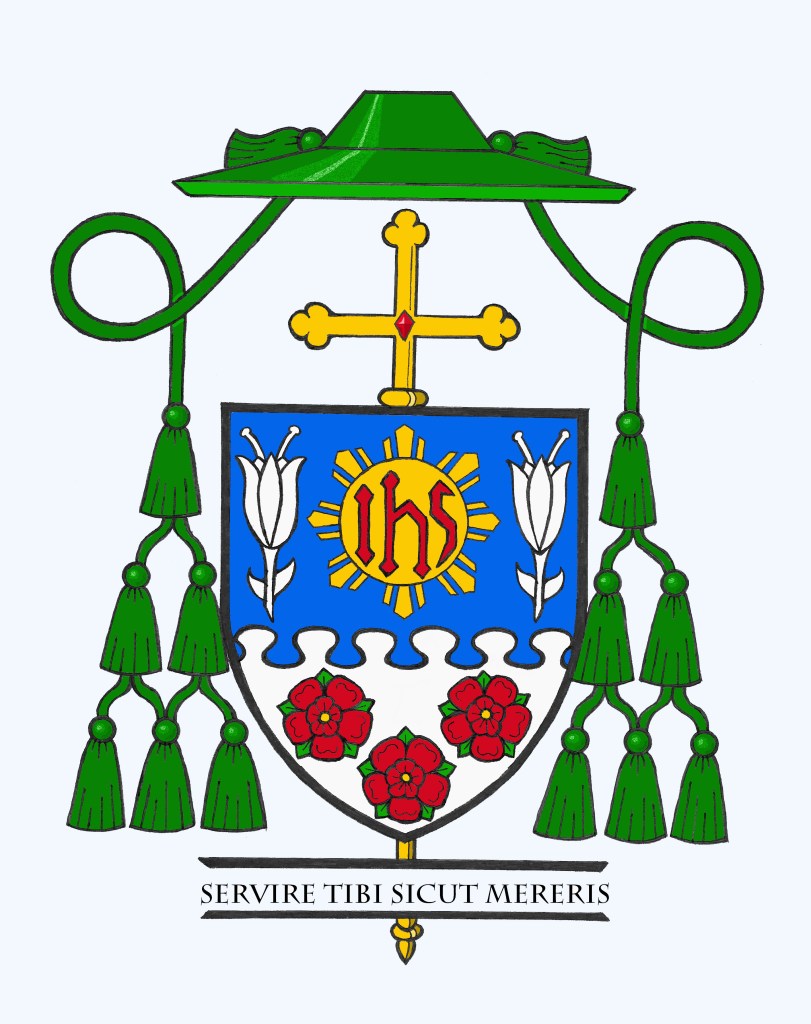
Bishop Celino’s armorial bearings represent his family name and symbols of his origins and his own devotional life. The main part of the shield is composed of a blue field and a silver (white) base with a distinctive division line called “nebuly” that is used in heraldic art to represent clouds. Together these elements suggest the sky as an allusion to the Bishop’s family name—Celino—which means a little sky.

The largest object in the daytime sky is, of course the sun. The main charge on the upper part of the shield is a gold (yellow) sun on which appears the three letters “IHS” in red. This sunburst charged with the monogram for the Holy Name of Jesus is used as a symbol for St. Ignatius Loyola, the founder of the Society of Jesus. The Bishop has had a particular devotion to St. Ignatius since his own confirmation. In addition, the particular way the sun is drawn is taken from the image of the sun on the coat of arms and the flag of the Philippines, the country where the Bishop was born.

On either side of the sun are two silver (white) lilies. The lily is traditionally used in heraldry to represent St. Anthony of Padua, the Bishop’s baptismal patron. In addition, having been born on the feast of St. Catherine of Siena (April 29) the Bishop has always had a devotion to her as well. Coincidentally, the heraldic symbol for St. Catherine is also a lily. So, the two lilies represent the Bishop’s patron saints.

The lower half shows three red roses on a silver (white) background which represents a cloud. The roses are symbols of Our Lady of Guadalupe, patroness of the Americas. In connection with the appearance of Our Lady to Juan Diego the miraculous blooming of roses in December occurred. Throughout his priesthood he has had a strong devotion to Mary specifically under this title.

The motto below the shield is “Servire Tibi Sicut Mereris” (To Serve You as You deserve) from the Prayer of Generosity attributed to St. Ignatius Loyola, as a further allusion to the Bishop’s great devotion to and inspiration from that saint..

The shield is ensigned with those external ornaments that indicate the bearer is a bishop. The gold (yellow) episcopal cross, not to be confused with a processional cross, is placed vertically behind and extending above and below the shield. In former times archbishops, and later all bishops, had a cross mounted on a staff carried immediately in front of them while in procession or on solemn occasions. This cross was a symbol of their rank as bishop. While such an episcopal cross is no longer used practically it has been retained heraldically. In fact, there are other clerics who make use of the ecclesiastical hat with its many tassels but the one true heraldic emblem of a bishop, and the only essential one, is the episcopal cross placed behind the shield.

Above the shield is the ecclesiastical hat, called a galero which, in heraldry, replaces the martial helmet, mantling and crest. “The hat with six pendant tassels (green, purple or black) on each side is universally considered in heraldry as the sign of prelacy. It, therefore, pertains to all who are actually prelates.” (Heim, Bruno B., Heraldry in the Catholic Church 1978, page 114) The galero is green with green cords pendant from it and twelve green tassels arranged in a pyramid shape on either side of the shield. At one time in history bishops and archbishops wore green before adopting the Roman purple we see today. In heraldry the green hat and tassels was retained for prelates with the rank of bishop according to the Instruction of the Secretariat of State, “Ut Sive” of March, 1969.

I was privileged to assist Bishop Celino with the design and execution of his coat of arms.
New Archbishop of Toronto

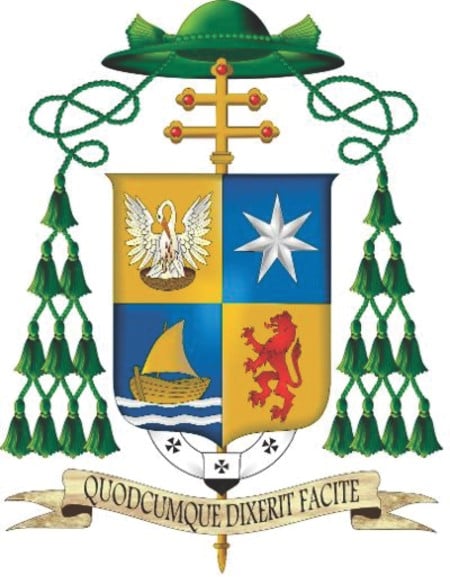
On March 25 the Most Rev. Frank Leo (51) a priest of Montreal, Canada who has served there as an Auxiliary Bishop only since September of 2022, was installed as the 14th Metropolitan Archbishop of Toronto. His coat of arms is:

Quoting the website of the Archdiocese the achievement is explained as follows:

Bishop Leo’s coat of arms is drawn from four principal aspects and devotions of his life and ministry, and is depicted on the shield in four quarters.

In the upper left (dexter chief) is found one of the most widespread Christological and Eucharistic symbols in Christian iconography: the pelican depicted opening its own flesh with its beak to feed its young with the blood that flows from it. This symbol refers to Christ himself as being the “Pie pellicane”, words found in the Adoro Te Devote, an ancient Eucharistic hymn attributed to Saint Thomas Aquinas: “Pie pellicane, Jesu Domine, me immundum munda tuo sanguine, cuius una stilla salvum facere totum mundum quit ab omni scelere” — “O loving Pelican, Jesus Lord, Unclean though I am, but cleanse me in your blood. One drop of which can free the entire world of all its sins.” It speaks of Christ shedding his own blood for all of humanity and how he continues to nourish us with his own flesh and blood in the Holy Mass. In the Gospel passage reported in. John 6:30, there is depicted a dialogue that took place in the synagogue at Capernaum. The Jews asked Jesus what sign he could perform so they might believe in him. They noted: “our ancestors ate manna in the desert.” Jesus replied that the real bread from heaven comes from the Father and it is himself, Jesus: “Truly, truly, I say to you, unless you eat the flesh of the Son of man and drink his blood, you have no life in you; he who eats my flesh and drinks my blood has eternal life, and I will raise him up at the last day. For my flesh is food indeed, and my blood is drink indeed. He who eats my flesh and drinks my blood abides in me, and I in him” (John 6:53-56). The Real Presence of Christ in the Eucharist as the One who nourishes us with his Sacred Body and Precious Blood is a fundamental doctrine of the Catholic faith.

A seven-point star is found on the upper right (sinister chief) and is the traditional and well-known Marian symbol par excellence. It refers to the invocation of the Virgin Mary as the Morning Star or “Stella matutina” found in the Litany of Loreto. The Morning Star is a sign of the coming day, preceding the rising sun. It is a promise of light, announcing the coming of the “sun of justice” (Malachi 4:1-3), the “daybreak from on high visiting us” (Luke 1:78). We know that the Blessed Mother is the Morning Star not for and through herself; she is indeed the reflection of God, her Creator and Redeemer. She exalts his glory and points to his light and salvation. According to Saint Bernard of Clairvaux, the great Troubadour of Mary, a star is a fitting comparison since it radiates light without losing its brightness, just as Our Lady, in giving birth to Christ did not lose her virginity. The symbolism of the star also refers to Our Lady as the Star of the Sea or “Stella Maris”, a title found in the medieval hymn Ave Maris Stella and whose praises are sung by the same Saint Bernard, famous for the invocation: Respice stellam, voca Mariam – Look upon the Star, call upon Mary. “If the winds of temptation arise; if you are driven upon the rocks of tribulation look to the star, call on Mary. If you are tossed upon the waves of pride, of ambition, of envy, of rivalry, look to the star, call on Mary. Should anger, or avarice, or fleshly desire violently assail the frail vessel of your soul, look at the star, call upon Mary.” Moreover, she is referred to as the Polar Star, or North Star, which navigators in antiquity looked to in seeking the right course so as to arrive safely to their destination. She is therefore our guiding light, our heavenly Mother, who is accompanies us as a loving companion on the journey of holiness in reaching Heaven, interceding for us. Finally, the Blessed Mother is also called the Star of the New Evangelization, which means she inspires and guides the Church’s apostolic efforts in bringing the Gospel to all peoples. The star is in silver (“argent”), a colour which depicts an array of heavenly attributes, personified in Our Lady’s purity, mercy and love. Bishop Leo entrusts his life, vocation and new pastoral ministry to her maternal mediation and intercession.

On the lower right (dexter base) is a boat floating on the waves and navigating amid the tempests. This is a well-known and clear reference to the Catholic Church established by Jesus Christ, the barque of Saint Peter. It is an ancient Christian symbol and reminds one of the struggles the Church endures, tossed about by raging winds, amid storms on the many rough seas of darkness and persecution but remaining set on its course and mission to bring to the harbour of salvation all of the travellers. Biblically, the imagery finds its origins in Noah’s ark in the deluge (Genesis and 1 Peter 3:20-21), and more clearly in the Gospel scene of Jesus protecting the boat of Saint Peter with him and the other apostles amid the stormy sea of Galilee (cf. Mark 4:35-41). 

The depiction of a lion is found on the lower right (sinister base) and is meant to recall the Bishop’s surname, Leo, which is Latin for lion. The lion is depicted as rampant, meaning “on its hind legs”, with the head in profile. Biblically, the lion is a symbol of courage, power and strength, the victory of God (cf. Genesis 49:9-10; Revelation 4:7). The lion is the emblem of dignity, of a powerful and fearless ruler, of majesty and strong leadership. It is likewise an image of Christ, the King of Kings. The Messianic title, the Lion of Judah, is applied to Christ himself as we read in the Book of Revelation (5:5): “Do not weep. The lion of the tribe of Judah, the root of David, has triumphed.” Finally, there is an ancient belief that lion cubs were born dead and after three days were brought to life by their father’s roar. The lion is in red, the colour of blood and also of charity, a reminder of the ardent and infinite love of the Father who sent to us his Only Begotten Son and who shed his blood for our redemption and for the forgiveness of sins. It signifies also that the virtue of charity is key and an integral part for the pastoral zeal of the new Bishop, as a successor to the Twelve Apostles of Jesus Christ.

Blue is the colour symbolizing the incorruptibility of the heavenly vault, of the ideals that rise upward, and represents detachment from the earthly and passing, and the soul’s ascent toward God. The colour gold, the first among the “noble” metals (those resistant to corrosion), is symbolic of the first virtue: faith. For it is through faith that we can fully understand the love and salvation that the eternal and loving Father offers to all of us, his beloved children in Christ Jesus.”

(Designed and emblazoned by Renato Poletti)

Bishop of Trieste

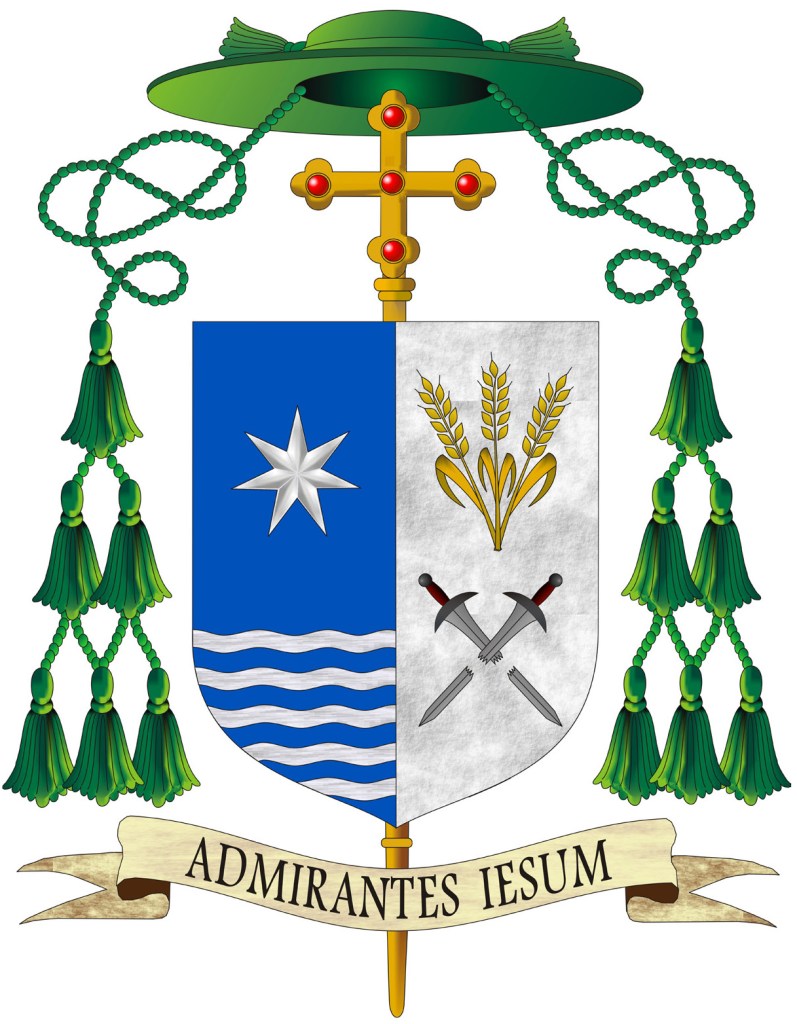
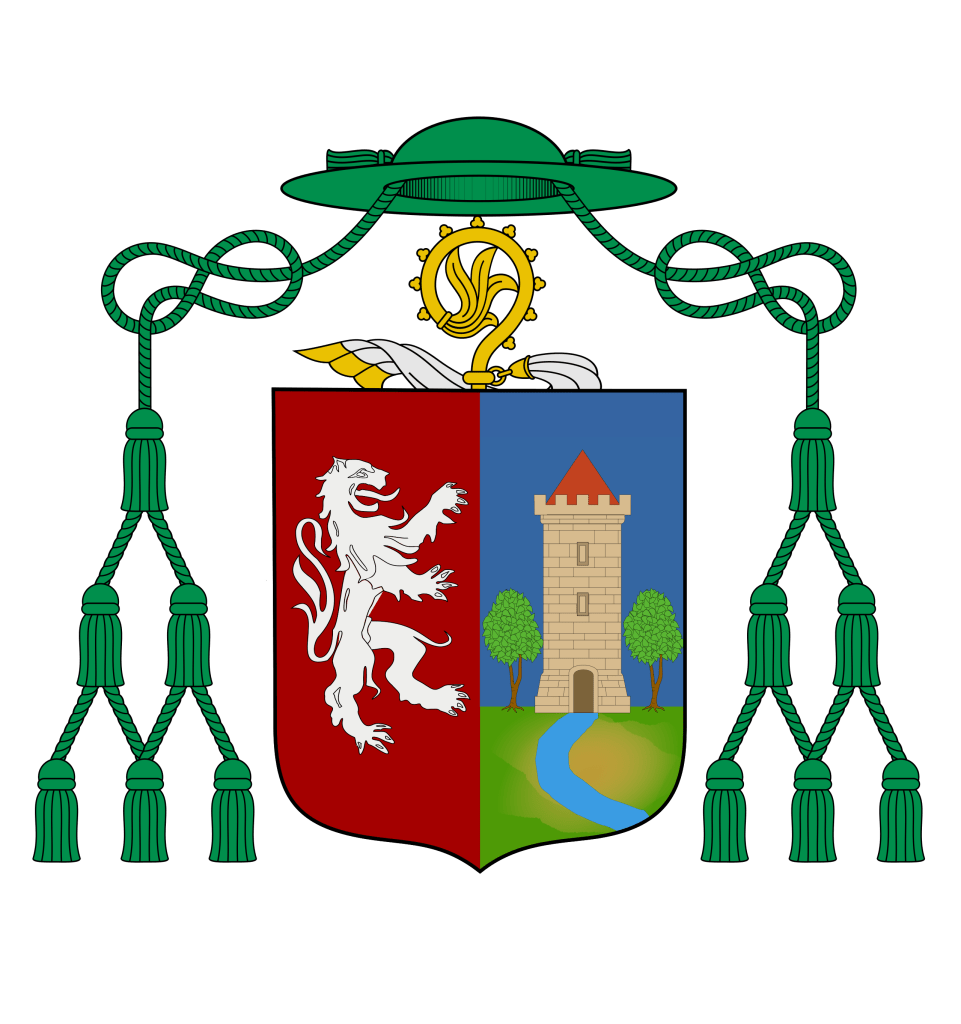
The Rev. Enrico Trevisi (59) a priest of Cremona was ordained a bishop on March 25 and will be installed as the 59th Bishop of Trieste on April 23. His coat of arms is:

I love the simplicity and boldness of the whole achievement. However, impalement is an odd choice considering the dexter impalement is not the diocesan coat of arms. Also, can you have Argent (silver) swords–keeping in mind grey is not a heraldic tincture or metal–on a field Argent?

No, no you can’t.

(The arms were designed and emblazoned by Renato Poletti and Gianluigi Di Lorenzo.)

Priesting of the Abbot of Montecassino

On March 8, 2023, the Right Rev. Antonio Fallica, OSB (63) who was appointed as the Abbot of the Territorial (Arch)Abbey of Montecassino on January 9, will be ordained to the priesthood. At the time of his appointment he was a Benedictine brother in Solemn Vows but not a cleric. It is a requirement that the holder of the office of Abbot be a cleric so he was ordained a Deacon on February 14 and is now being ordained a priest. Then he will be able to fully assume the office of Abbot. The arms (below) are those traditionally used by the (Arch)Abbey. It was also used by the last Abbot, Donato Ogliari, OSB who now serves as Abbot of St. Paul Outside-the-Walls in Rome and is currently still the Administrator of Montecassino until Abbot Antonio takes over. They are ensigned by a green galero rather than black because, although greatly reduced, the Abbey is still a Territorial Abbey (what used to be called an “Abbey Nullius”) and so its abbot uses the same galero as a bishop.