Danish Coat of Arms

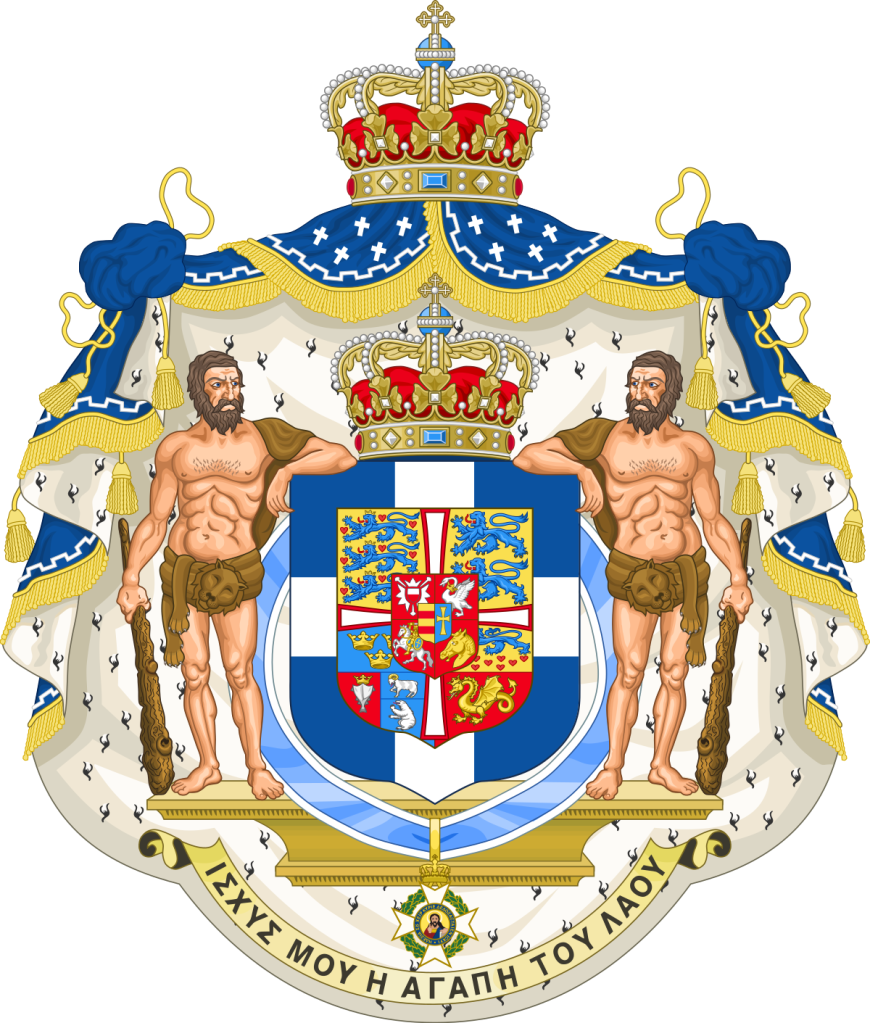
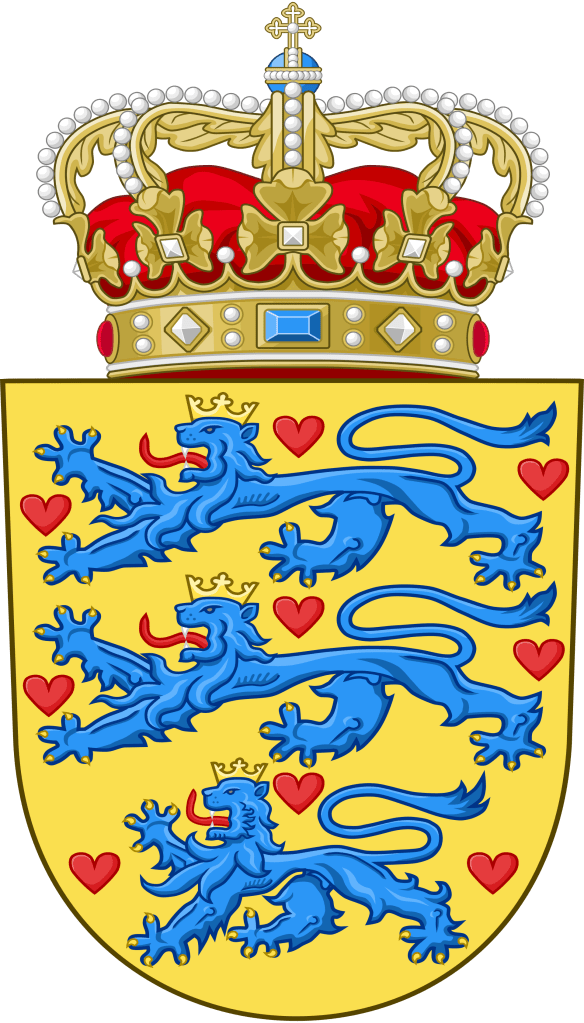
With the approaching abdication of Queen Margrethe II and the accession of King Frederik X of Denmark I’ve been reading up on the heraldry used by the country and the royal house. The state coat of arms consists of three pale blue lions passant wearing crowns accompanied by nine red lilypads (normally represented as heraldic hearts), all in a golden shield with the royal crown on top. The national coat of arms of Denmark is similar to the state coat of arms, but without the royal crown above the shield.

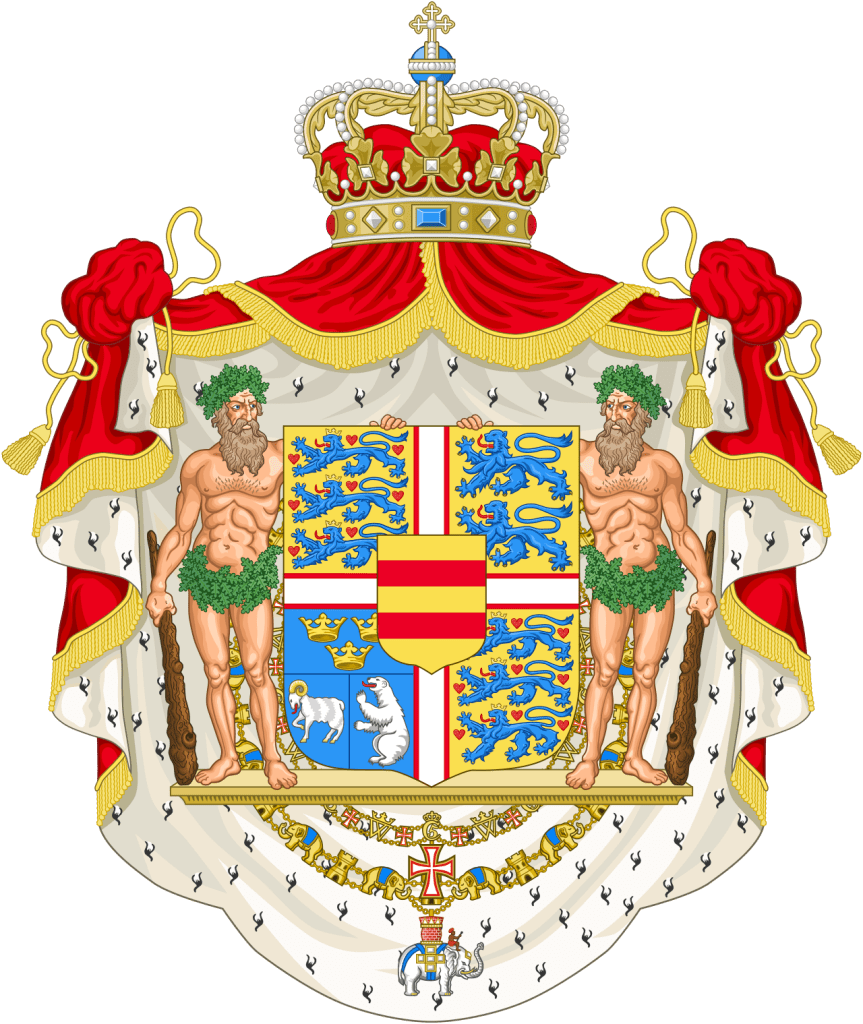
It is historically the coat of arms of the House of Estridsen, the dynasty which provided the kings of Denmark between 1047 and 1412. The current design was introduced in 1819, under Frederik VI. Previously, there had been no distinction between the “national” and the “royal” coat of arms. Since 1819, there has been a more complex royal coat of arms of Denmark separate from the national coat of arms. I’ll take a look at that in another post.

Historically, the lions faced the viewer rather than forward and the number of hearts was not regulated and could be much higher. The “heart” shapes originally represented waterlily pads; a royal decree of 1972 still specifies these figures as søblade (“lake leaves”). Frederik VI also fixed the number of hearts to nine and decreed that the heraldic beasts were lions, as opposed to leopards, and consequently facing forward in 1819. The blazon is: Or, three lions passant in pale azure crowned and armed Or langued gules, nine hearts Gules.

ABDICATION!

In her annual New Year message Queen Margrethe II of Denmark announced her intention to abdicate the throne on January 14, 2024 exactly 52 years to the day that she succeeded her father and became queen. She will be succeeded by her son, Crown Prince Frederik, who will reign as King Frederik X.

God bless Queen Margrethe, the last reigning queen in the world at the present time, and long live King Frederik!

Worth Repeating

Last year I shared this idea as we approached the Christmas season. I thought I was worth seeing again.

At this festive time of year it is a bit of fun to wonder if there is a bishop in the Church who can claim to have jurisdiction over the North Pole and, thus, be Santa Claus’ pastor. I think such a claim might be made by the Territorial Prelature of Tromsø which is in the northernmost part of Norway. A portion of the territory of the prelature is above the arctic circle.

The Prelature is currently served by an Administrator

Bishop Strickland

The Most Rev. Joseph E. Strickland (65), originally a priest of Dallas, Texas, later incarnated to Tyler, Texas and since 2012 Bishop of Tyler was removed from that office on November 11, 2023 by the Roman Pontiff.

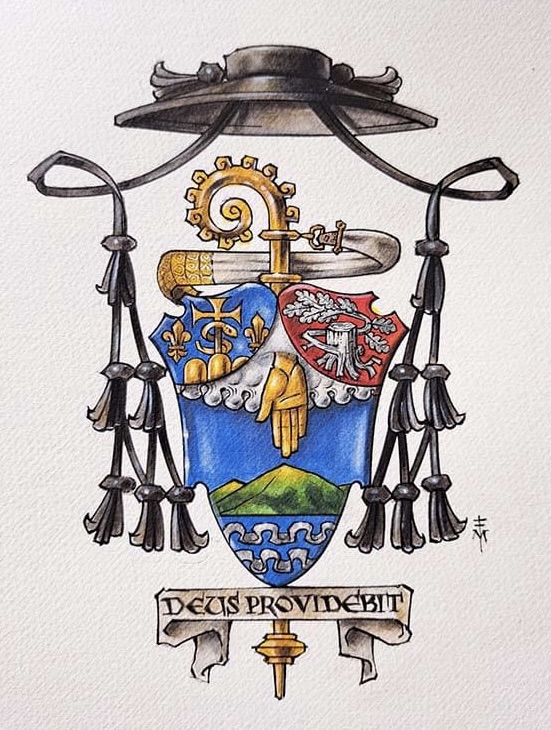
Back in 2012 when he was appointed as Fourth Bishop of Tyler I had the happy task of designing his coat of arms. Now that he has ceased to be the Bishop of Tyler his coat of arms will be modified to reflect that reality. He remains a bishop in the Church and, as such, retains the use of his armorial bearings. His coat of arms at the time of his ordination and installation was:

Now that he has been removed as Ordinary of Tyler, his armorial bearings will appear as this:

The Scarlet Nuncio

On September 30 Pope Francis held a Consistory in order to create new cardinals of the Holy Roman Church. Among those was the Frenchman from the Archdiocese of Rennes, Christophe Cardinal Pierre (77), who since 2016 has served as Apostolic Nuncio to the United States of America. He was named Cardinal Deacon of San Benedetto fuori Porta San Paolo. The arms he assumed on becoming a bishop in 1995 are now ensigned with the scarlet galero of a cardinal.

Bishop Maekawa, OP

On October 12, the Most Rev. Stephen Maekawa, OP (55) a priest of the Order of Preachers (i.e. the Dominicans) living and working in Alaska was ordained a bishop and installed as the 10th Bishop of Fairbanks, Alaska.

His coat of arms is:

According to the diocesan website:

In the right side of the shield (to the observer’s left), we find represented the coat of arms of the Diocese of Fairbanks. At the base, the North Star is suspended on a blue field over the mountains of Alaska, which appear in white. In the upper section, between two red roses on a field of gold, is the Sacred Heart of Jesus, titular symbol of the Cathedral of the diocese. The roses, representing St. Therese of Lisieux, patroness of the Alaska Missions, recall her promise, “After my death I will let fall a shower of roses.

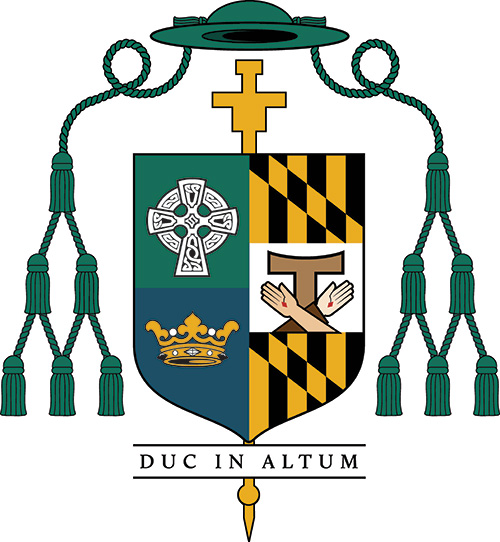
In the left side of the shield (to the observer’s right) is the personal coat of arms of Bishop Maekawa. The black and white cross is the from the coat of arms of the Order of Preachers founded by St. Dominic in 1216. The waves represent the waters of baptism and the family name Maekawa which means “before the river.” The episcopal motto “Duc in Altum” is Jesus’ command to the Apostle Peter, “Put out into the Deep” which reminds us to trust in the Lord Jesus believing that all creation belongs to God: “The earth is the Lord’s and all it holds, the world and those who dwell in it.” (Ps 24:1)

I think, unsurprisingly, the bishop has chosen a simple coat of arms reflecting his Religious community. It harmonizes well with the diocesan arms with which it is impaled. A nice design that doesn’t try to do too much–perhaps the single biggest error made by most new American bishops.

Passing of Bishop Birmingham

I heard the sad news today of the sudden and unexpected passing of the Most Rev. Kevin Birmingham, Titular Bishop of Dolia and Auxiliary Bishop of Chicago. He passed from this life on October 1, 2023. he was 51. May he rest in peace.

I was privileged to design the bishop’s coat of arms when he became a bishop in 2020.

The L.A. “Quad”

On September 26, in an unprecedented liturgy, the Archdiocese of Los Angeles received four new Auxiliary Bishops at the same time. While it is unusual for any diocese to receive so many new bishops at once it seems almost fitting for the U.S.’s largest archdiocese of well over 4 million Catholics to receive the needed assistance in episcopal ministry in order to serve the people of southern California adequately. Bishops Albert Bahhuth (66), Matthew Elshoff, OFM. Cap.(68), Brian Nunes (58) and Slawomir Szkredka (49) were all ordained to the episcopate by the Most Rev. José Gomez, Archbishop of Los Angeles.

Their armorial bearings were all designed by James-Charles Noonan. As he usually does he makes a great deal about the shape of the episcopal cross in each achievement as well as the “significance” of the shape and color of the gemstone in each one. None of that is heraldically supportable. It may be his favorite idea but, as I have written about extensively in the past, the external ornaments in a coat of arms are not personalized not do they contain unique and special symbols particular to the armiger. That would require they be blazoned as such and would then have to be copied by any artist rendering the coat of arms. Only the charges on the shield are unique to the armiger.

Even there, Mr. Noonan has placed his own stamp on these four coats of arms. Acknowledging the unusual nature of four bishops being ordained at once he has included a similar chief in all four coats of arms as a means of tying them all together by the use of this similar charge. The idea in and of itself has some merit. The occasion was unique; something unique to mark it is a nice idea.

However, the coats of arms of auxiliary bishops do not contain charges that represent the jurisdiction in which they will serve as auxiliary bishop. A heraldic representation of possessing jurisdiction over a diocese belongs to the Ordinary of the diocese alone. In addition, a reference to the diocese (by borrowing a charge from the diocesan coat of arms) is quite common in heraldry. But, that isn’t what has occurred here. Instead of each coat of arms borrowing some charge from the arms of Los Angeles the four new bishop’s arms all bear an almost identical chief–an ordinary charge–in a manner not unlike those used to signify membership in a Religious Order or an Order of Chivalry.

Don’t misunderstand me: my criticism is not of the idea of heraldically marking the unusual circumstance of four bishops being ordained all at the same time. Rather, it is of the use of a near-identical charge, and one that sort of implies a kind of jurisdiction, that I am criticizing. It’s a clever devise. But, perhaps a bit “too clever” for its own good. In addition, one has to consider that all four of these bishops may not–indeed very likely will not–remain as auxiliaries of Los Angeles permanently. Once one of them is translated to another diocese the whole unifying symbolism uniting all four coats of arms begins to fall apart. Perhaps the use of a single similar charge employed differently in each of the coats of arms would have been a better solution?

The design of each of the rest of the four coats of arms is quite correct and very nice. As usual, Mr. Noonan’s regular collaborator in producing the artwork has shown herself capable of creating very fine work.

The following are the coats of arms of Bishops Bahhuth, Elshoff, Nunes and Szkredka:

Two for San Diego

On September 28 of this year the Most Rev. Michael Pham (56), a priest of the Diocese of San Diego, CA will be ordained a bishop and will serve as Titular Bishop of Cercina and Auxiliary Bishop of San Diego. On the same day, the Most Rev. Felipe Pulido (53), a priest of the Diocese of Yakima, WA will be ordained the Titular Bishop of Buffada and also serve as Auxiliary Bishop of San Diego.

I was happy to assist both of these new bishops with the creation of their respective coats of arms. The armorial bearings of Bishop Pham are:

The shield is divided horizontally to depict a silver (white) sky above a blue wavy ocean. The ocean is criss-crossed by diagonal lines in order to create a pattern suggestive of a fisherman’s net. This has more than one meaning. First, it represents that after 1975 while still living in Vietnam the bishop’s father became a fisherman to provide for his family. In addition, the net indicates not only the task of an apostle (or a successor to an apostle) of being a “fisher of men” but it also alludes to the New Evangelization where we are exhorted to put out into the deep (Duc in Altum). This symbolizes both the bishop’s priestly and episcopal ministry. 

In the upper part of the shield the main charge is a boat on the waves under full sail. The boat also alludes to the work of a fisherman. In addition, a boat, in heraldry, is often used as a symbol of the Church itself, often referred to as the barque of Peter, who was a fisherman himself. On the sail of the boat in the center is a red beehive surrounded by two green palm branches. The beehive is a symbol of St. John Chrysostom, the bishop’s baptismal patron saint. Chrysostom was the archbishop of Constantinople and renowned for his inspiring preaching. So, he was known as a “honey-tongued” preacher, hence the beehive as his symbol. The palm branches are an ancient symbol of martyrdom. The bishop’s family comes from the first diocese in the north of Vietnam where his ancestors were among the first martyrs for the faith in that part of the world.

On either side of the boat are eight red tongues of fire which also have more than one meaning. First, they are symbols of the Holy Spirit which, the Sacred Scriptures remind us, descended on the Apostles as tongues of fire at Pentecost. This was the beginning of their ministry to go out into the world to preach the Gospel so it is another symbol of Evangelization. Throughout his priestly ministry the bishop has worked with various groups of different ethnic and cultural backgrounds. Many flames represent a diversity of communities. Bishop Pham strengthened the cultural communities found in the diocese and shared them with the larger Catholic community. He has served as Episcopal Vicar of the Office of Ethnic & Intercultural Communities. Six years ago, he launched the first-ever Pentecost Mass for All Peoples, which has come to attract more than 2,000 faithful annually. So, symbols of the Holy Spirit were seen to appropriately reflect this ministry. It also reflects how, on Pentecost, when the Holy Spirit descended, people from many different and various places, languages and cultures heard the Apostles speaking in their own languages. The red of the boat, the beehive and the tongues of fire is a further allusion to the blood of the martyrs.

The motto below the shield is, “Hiệp Nhất trong Chúa Kitô” which means “One in Christ” or “United in Christ” in Vietnamese. This motto reflects the work the bishop has done throughout his priesthood to help various communities and to work towards the unity of diverse cultures and groups within the People of God.

The armorial bearings of Bishop Pulido are:

The shield is divided into four quarters with wavy horizontal lines from top to bottom. In the first and fourth quarters the lines alternate blue and silver (white) while in the other two quarters they alternate red and gold (yellow).

The blue and white lines represent the Blessed Virgin Mary. In addition, they suggest water which also alludes to Jesus washing the feet of His disciples. In addition, they can be seen as referring to the waters of Baptism. The red and gold (yellow) lines represent the Holy Spirit and fire. In addition, the colors can be seen as referring to the Blood (as well as water) that poured from the side of the Lord at His crucifixion. They are also seen as referring to bread (gold/yellow) and wine (red) as a reference to the Eucharist. In this way these lines also refer back to the foot washing because Jesus was showing His disciples the kind of self-sacrificing service they were called to which was about to be played out in His sacrifice on the cross and would be experienced for them in the future whenever they came together to share the Eucharist.

At the center of the shield is a silver (white) roundel called a plate. On this plate is a simple symbolic representation of the Mandatum (washing of the feet). The outer edge of this roundel, or plate is a line composed of small humps. Such a line is called “invected” in heraldry. It is borrowed from the coat of arms of the Diocese of Yakima, WA where Bishop Pulido served as a priest before being named a bishop.

The motto below the shield is, “Building Communio” which is what the bishop sees as the purpose and goal of his episcopal ministry.

Mechelen-Brussel

On September 3 the new Archbishop of Mechelen-Brussel (Malines-Bruxelles) was ordained a bishop and was installed as the 23rd Archbishop. The Most Reverend Luc Terlinden (54) is of the noble family of the viscounts and barons Terlinden. This makes him the first archbishop who is from the nobility since Mgr. de Méan (who was the last Prince-Bishop of Liège and died as Archbishop in 1830). There have been other nobles named as bishops in Belgium, however. It is disappointing that the archbishop chose to create and assume new arms (below) that only slightly refer to his noble family’s coat of arms (above, left). I’m sure many fine heraldist and genealogists are disappointed at that. The arms he has assumed aren’t bad, per se. Rather, it is that his ancestral arms are far better.

Marshaling Various Coats of Arms During A Lifetime

Throughout the course of my priesthood, after my time as a Parochial Vicar concluded and I began to be placed in charge of my assignments I also began the practice of 1) devising armorial bearings for the different places in which I have served and 2) marshaling those newly-devised coats of arms with my own. Having jurisdiction over the church or parish was then illustrated heraldically.

In the image above the first coat of arms (upper left) is my personal coat of arms assumed at ordination in 1997. The next image (upper right) shows my arms impaled with those of the Shrine of the Blessed Sacrament in Raritan, NJ where I served as the Sixth Rector (hence the four tassels instead of only two) from 2009-2015. The image at lower left shows my arms impaled with those of St. Joseph Church in Washington, NJ where I served as Administrator and then as the Twenty-Second Pastor from 2015-2023. During the last part of that time I was also Dean of the Morris Canal Deanery. The final image (lower right) shows my coat of arms impaled to the newly-devised parish coat of arms of St. Mary, Star of the Sea in South Amboy, NJ where I will serve as the Ninth Pastor from 2023 onwards.

(Artwork: Xavier Garcia)

A New Parish; A New Parish Coat of Arms


Next week I’m moving to a new assignment as Pastor of St. Mary Church in South Amboy, NJ. The parish was established in 1851 dedicated to St. Mary, Star of the Sea. In 1853 property for the present church was purchased and in 1854 the appointment of its first resident pastor occurred.
 
While the parish still is, and always has been, dedicated to Our Lady under the title of “Star of the Sea” it has always been known simply as St. Mary’s. That’s actually rather common. People like short hand and nicknames and many churches dedicated to various titles of Mary are known by their parishioners simply as St. Mary’s.
 
As I prepare to begin my tenure as Pastor I looked to designing armorial bearings as a symbol for the parish. This has been my custom for years. So, naturally I took as a starting point the canonical patronal title of the parish—St. Mary, Star of the Sea—to devise the coat of arms. That title lends itself very well to a clear and simple design evoking the parish’s patroness.
 
I know the parish will always be known with great affection as St. Mary’s. I hope we can also foster the occasional use of the beautiful name of its patroness, Star of the Sea (in Latin: Stella Maris).
 
As Pastor of the parish I will impale my own armorial bearings with those of the parish. 
 
(The heraldic art is the work of Xavier Garcia)

Lovely Heraldic Achievements from Spain

One of my readers, Jorge Hernández Sánchez, from Seville who is also a heraldist has completed some 100 coats of arms specifically for ecclesiastical clients. He sent me quite a few of his creations. Many of them are wonderful examples of the coats of arms of prelates of various types below the rank of bishop. We see a preponderance of episcopal and archiepiscopal heraldry. It’s nice to see the armorial bearings of other ranks in the Church. The following are just a sampling of Jorge’s work…

Easy Come; Easy Go.

Last November, my Bishop appointed me to serve as the Dean of the Deanery in which my parish is located. That meant there was going to be a modification of my coat of arms. The addition of a second tassel to the galero in my armorial bearings was for the duration of the office of Dean only.

Just yesterday, my Bishop announced the appointment of three new Deans. Two of them are appointed to fill vacancies created by the retirement of two priests. The third is in my own Deanery where a vacancy is about to occur when I am transferred to a new assignment later this month. Since the extra tassel was only “pro hac vice” I must now reliquish it and revert to using the galero of a simple priest, with one tassel pendant on either side of the shield.

As it turns out, I served as a Dean for only nine months. At the time of my appointment last November, my bishop and I had no way of knowing that I would be transferred only the following summer.

Bishop Lohse of Kalamazoo

On July 25, the Feast of St. James, Rev. Mons. Edward M. Lohse (61) a priest of the Diocese of Erie, PA since 1989 (and a man who was two years ahead of me at St. Vincent Seminary) is being ordained and installed as the Fifth Bishop of Kalamazoo, Michigan.

The cross in chief is from the attributed arms of St. Edward the Confessor. The division line wavy is from the arms of the See of Erie and it represents the lakeshore where Erie lies. On the fess are symbols of the Jesuit Order and the Benedictine Order both of which profoundly influenced the bishop’s formation and spirituality. The base uses the blue and silver fusils from the arms of Wittelsbach and, by extension, of Bavaria to symbolize his family and faith, both of which have their origins in Bavaria.

The arms are simple, clear and contrast nicely with the somewhat unfortunate arms of the See of Kalamazoo. I think a better composition of the arms would have been to place the Bavarian fusils in chief with the wavy division line beneath them and then have blue field with the cross throughout and the two symbols of the orders in the first and fourth quarters. That’s merely an opinion, mind you, and in matters of taste there can be no real dispute. However, the pattern of fusils in bend looks better at the top of the shield where the eye is first naturally drawn. A solid chief with a patterned base makes a weak composition, in my opinion, because it looks top-heavy.

In addition, the essentially silver (white) backgrounds of both of the roundels placed on a silver fess looks washed out and weak. They would have contrasted better being on a blue field and “popped” a bit more. Also, the cross and lettering on the medal of St. Benedict should be black, rather than blue. I suppose the same could be asserted for the letters on the Jesuit symbol as well.

Overall, it is still a good design and Bishop Lohse certainly has a coat of arms that is better than many other US bishops. That’s not saying much, however, given the appallingly bad heraldry employed by most US bishops. Nevertheless, I think this is a decent coat of arms. My criticism is intended to convey only that it could have been a little better without changing any of the symbolism, but just arranging it better.