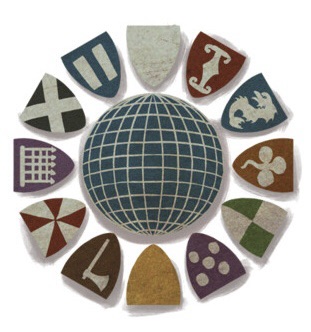
I was recently contacted by Maurizio Gorra, AIH who is preparing to publish a heraldic work that may be of some interest to you. So, I herein share the information about this publication with you for your consideration.
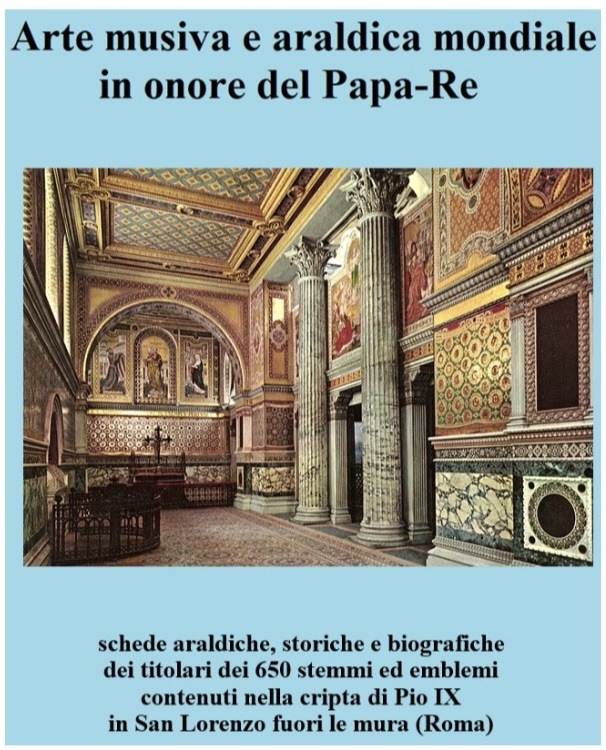
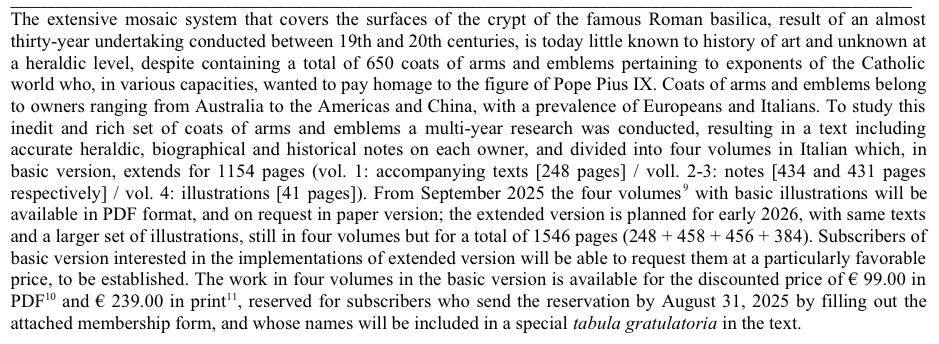
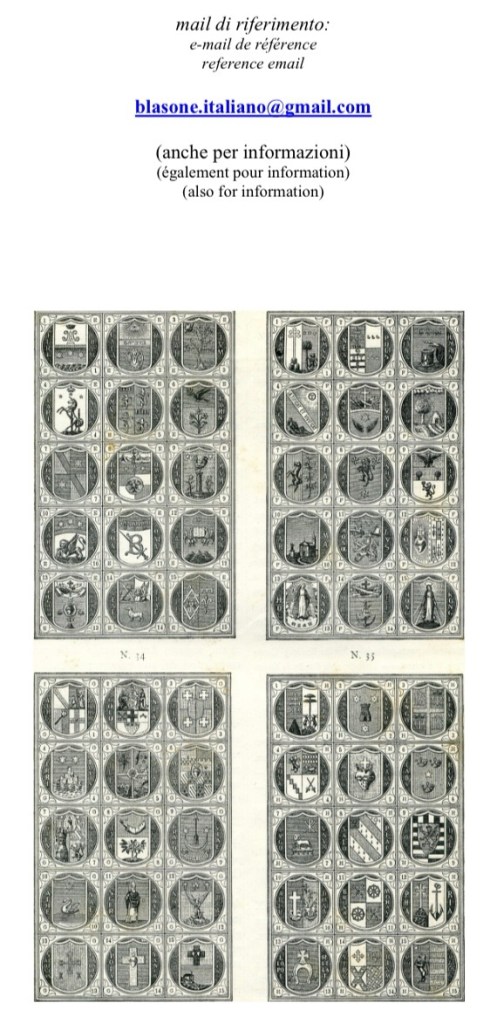
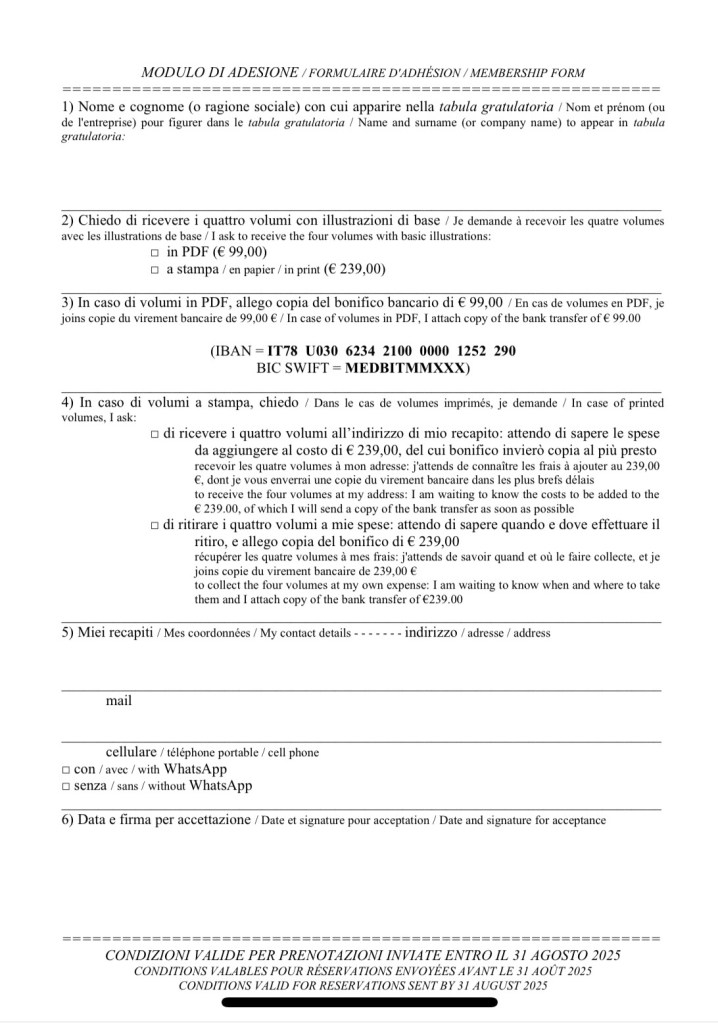
I was recently contacted by Maurizio Gorra, AIH who is preparing to publish a heraldic work that may be of some interest to you. So, I herein share the information about this publication with you for your consideration.
Happy International Heraldry Day!
International Heraldry Day was established in 2013 by the International Association of Amateur Heralds (IAAH). The date, June 10, was chosen to commemorate a significant event in heraldic history: on this day in 1128, Geoffrey Plantagenet, Count of Anjou, was knighted by King Henry I of England. During the ceremony, Geoffrey received a blue shield adorned with six golden lions, which is considered one of the earliest known examples of a fully formed coat of arms.
So, celebrate heraldry today!
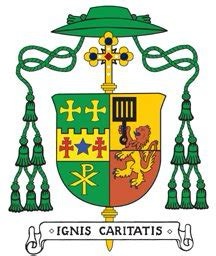
On June 8, 2025–Pentecost Sunday—the Most Reverend Lawrence Brandt (86), a priest of Erie who served from 2004-2015 as the fourth Bishop of Greensburg, Pennsylvania passed away.
May he rest in peace.
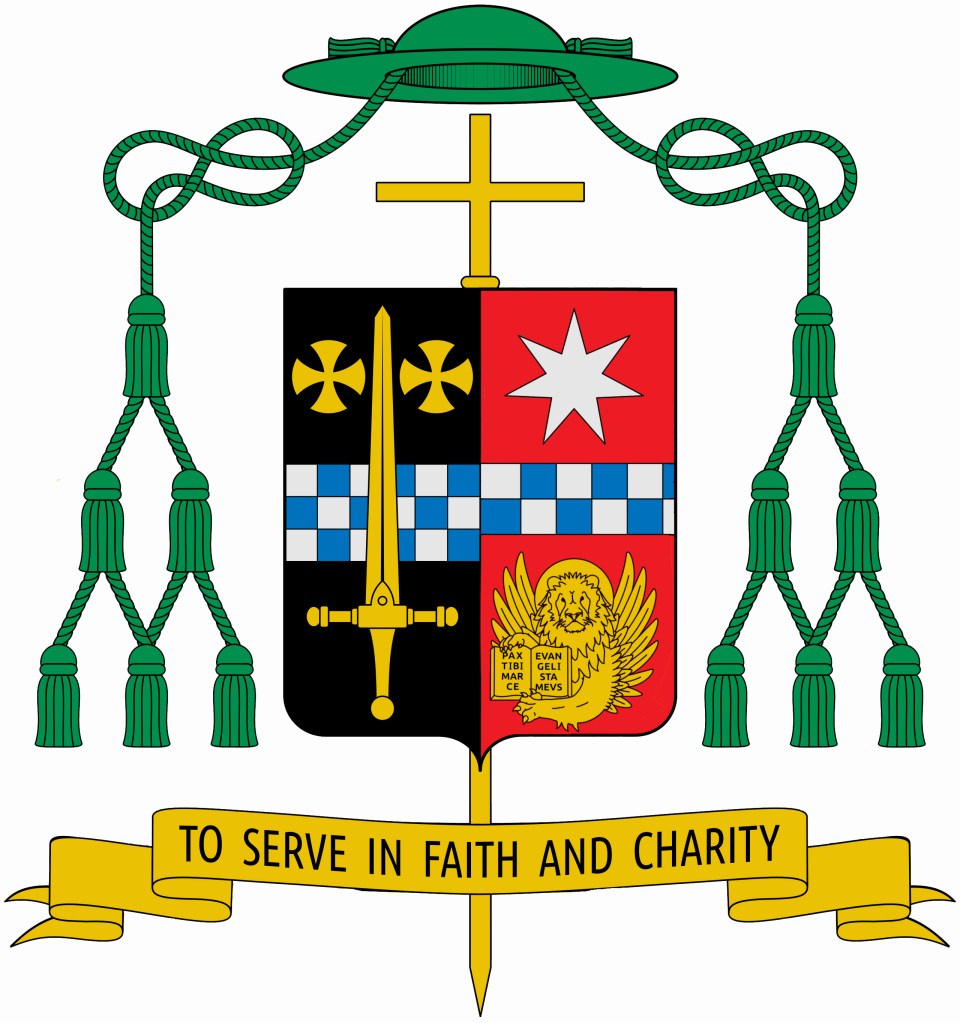
Today, His Holiness, Pope Leo XIV appointed the Most Rev. Mark Anthony Eckman (66), a priest of Pittsburgh and since 2021 the Auxiliary Bishop of Pittsburgh, as the 13th Bishop of the Diocese of Pittsburgh.
His armorial bearings, which not only allude to St. Mark but also, by use of the checkerboard taken from the arms of the See of Pittsburgh (and which, in turn, are borrowed from the arms of William Pitt, where they allude to his tenure as Chancellor of the Exchequer) now line up with the same checkerboard when his arms are impaled with those of the See.
It looks a bit odd, however, that the fess in his personal arms is more narrow than that in the arms of the See. It would probably work better artistically, if the two were of the same width. That would give the appearance of a single fess that crosses the two impaled arms but that’s simply the way it will appear. That’s one of the pitfalls of choosing charges and ordinaries directly from another coat of arms. Of course, it must be said that at the time Bishop Eckman assumed his own arms he could have no idea that one day he’d be named Bishop of Pittsburgh and impale his arms with those of the diocese. His personal arms, in my opinion, harmonizes nicely with the diocesan coat of arms making for a pleasing achievement.
NOTE: I have now been reliably informed that the bishop has, in fact, decided to slightly modify the fess in his personal arms so that it is identical to the one in the diocesan arms. So, problem solved!
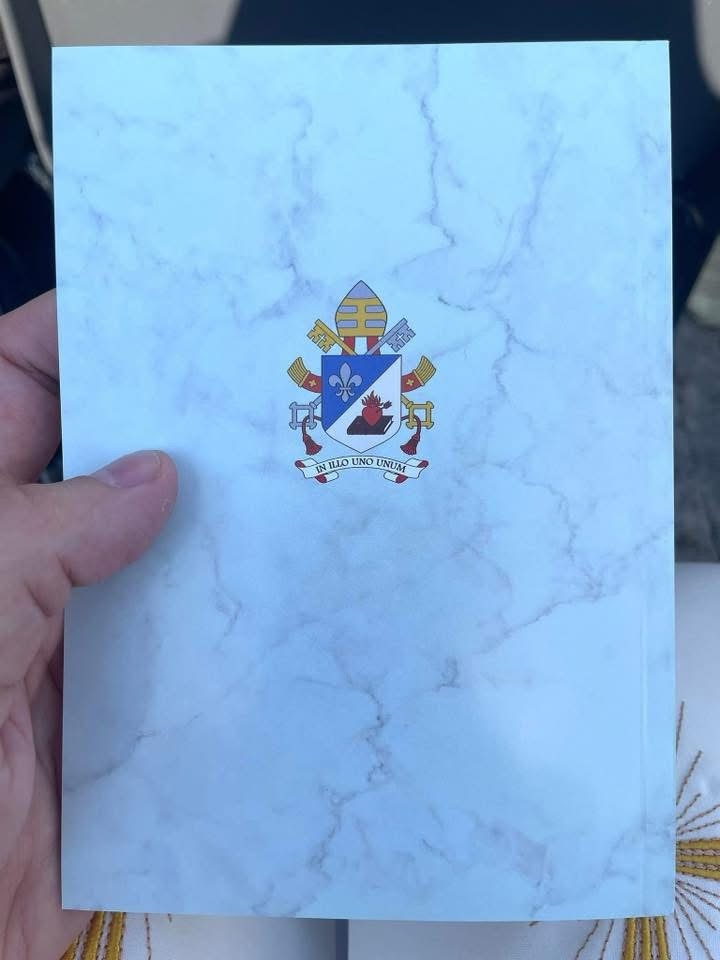
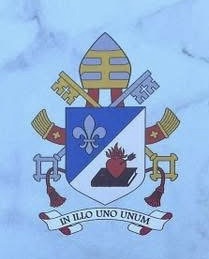
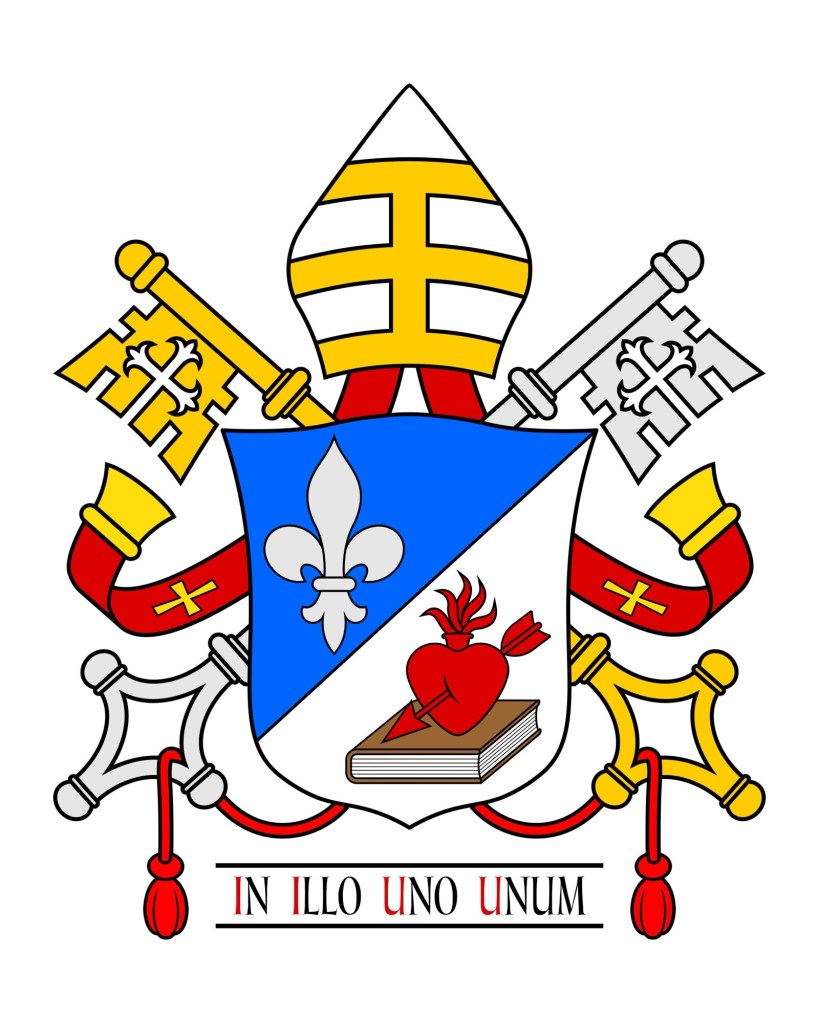
For reasons unknown, perhaps because of all the internet chatter (?) the Holy See has now corrected the armorial bearings of Pope Leo XIV to display a field of Azure & White as well as a fleur-de-lis of a more gray or metallic silver while both are blazoned Argent.
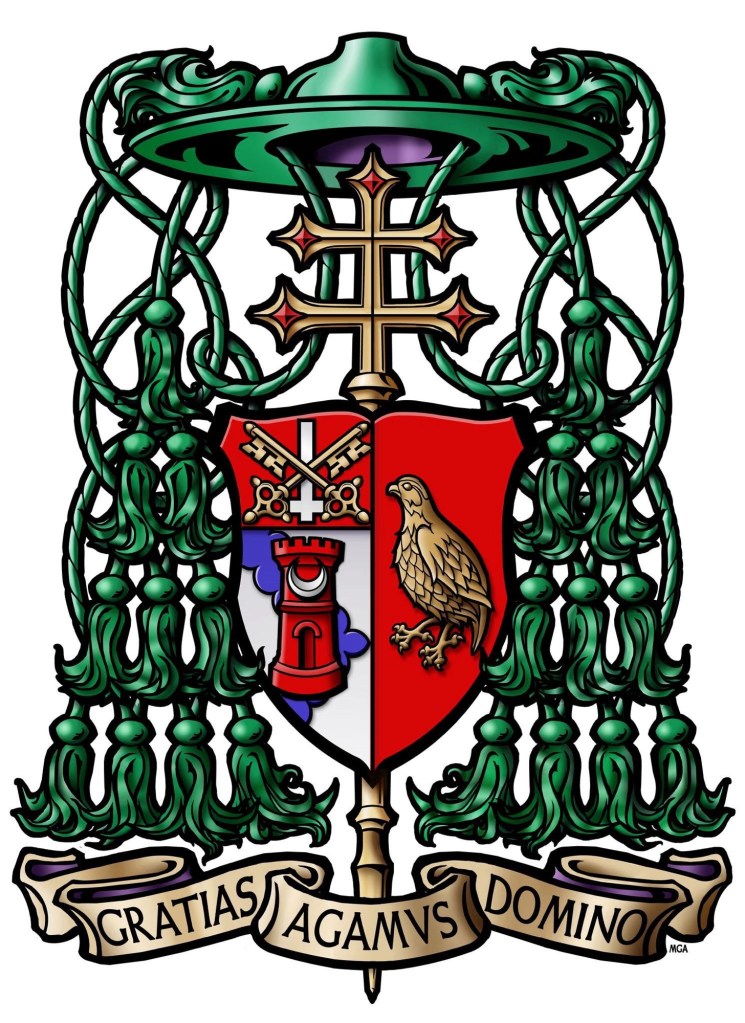
The Most Reverend Shawn McKnight (56), a priest of Wichita and who from 2018-2025 served as Bishop of Jefferson City, Missouri, was installed today as the 12th Bishop and 5th Metropolitan Archbishop of Kansas City in Kansas.
His very simple and striking coat of arms arms was marshaled to those of Kansas City and very ably rendered by Matthew Alderman.
The Mission Church of San Diego (St. Didacus) de Alcalá was the second Spanish Mission church founded in 1769 by St. Junípero Serra. The present (5th) church building was designated a Minor Basilica by St. Paul VI in 1976. Going without any armorial bearings of its own for several decades I was approached some time ago by one of the priests of the Mission basilica to design a coat of arms for the church. This was done with the approval of the (then) Bishop of San Diego, Robert Cardinal McElroy, now the Metropolitan Archbishop of Washington, DC.
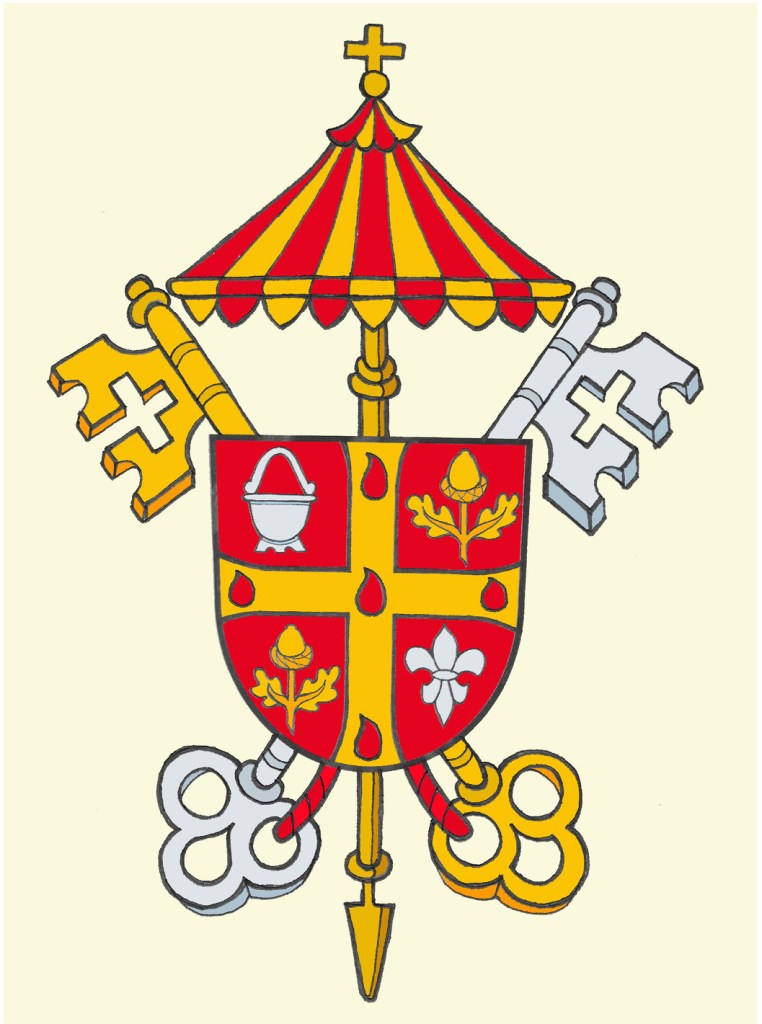
The blazon of the coat of arms is: Gules, a cross formy throughout Or charged with five gouttes de sang at the center point and extremities; between in the dexter chief quarter a Spanish stew pot Argent; in the sinister base quarter a fleur-de-lis Argent and in the other quarters an acorn slipped Or. The shield is ensigned with the ornaments of a Minor Basilica which are, two keys crossed in saltire behind the shield to dexter Argent and to sinister Or, and an ombrellino Proper standing behind the shield.
The basic design borrows, and reverses the colors from the coat of arms of the Diocese of San Diego. Instead of a gold (yellow) field with a red cross there is now a red field with a gold cross. The cross, which has slightly flared ends, is charged with five drops of blood. These represent the founder of the Mission, Junípero Serra, who was a Franciscan friar. So, the five drops recall the five wounds of the stigmata received by St. Francis of Assisi. Serra, the founder of the Mission, is symbolized by making a reference to the Order to which he (and San Diego) belonged. That also honors all the other Franciscan missionaries who carried on the work at the Mission throughout the centuries. In addition, the present Mission church–the one designated a basilica–is the fifth church building used by the Mission. So, the five drops of blood also allude to the basilica itself being the fifth building in use as a church.
In the upper left corner is the pot that is a symbol of San Diego (St. Didacus), the patron of the Mission Basilica (as well as the diocese). As a Franciscan brother he was a selfless servant of the poor and was known to heal the sick with the Sign of the Cross, the central charge, and the Spanish stew pot in the upper left also symbolizes him. It indicates Diego’s boundless charity and tireless efforts to feed the hungry. In the lower right corner we see a fleur-de-lis which is borrowed from the coat of arms of St. Paul VI, the pope who raised the Mission church to the rank of Minor Basilica in 1976. Both of these are silver (off-white).
The other two quadrants are charged with a gold (yellow) acorn. This is to give the Native Americans, who received the Gospel from the Franciscans and became their collaborators throughout the Mission era, representation on the coat-of-arms. It is a symbol of the agrarian traditions of the Native Americans, and also represents the potential for spiritual growth and transformation. Just as an acorn can grow into a mighty oak tree, it represents the idea that even small acts of faith and virtue can lead to great spiritual maturity and strength. This aligns with the Catholic teaching on the importance of nurturing one’s faith and virtues over time and refers to the Mission’s humble beginnings and growth. In addition, the acorn’s humble beginnings remind Catholics of the virtues of humility and simplicity. These qualities are highly valued in Catholic teachings, as exemplified by the lives of saints, such as St. Francis, St. Didacus, St. Junipero Serra, and the Franciscan Padres who often started with humble beginnings and grew in holiness and influence through their faith and actions. The acorn also symbolizes God’s provision and sustenance as a reminder of His care and providence, ensuring that His creation is provided for.
The external ornaments are the two crossed keys (one gold and one silver) bound together by a red cord and the ombrellino. The keys are an ornament granted to basilica churches to show their connection to the Holy See. They are the same as the keys seen in the coat of arms of the Holy See and of the Pope, recalling the “keys to the kingdom” given by Christ to St. Peter; one to bind and one to loosen. The ombrellino, a large red and gold canopy, is also a symbol of the Holy See and used as a symbol of such whenever the See is vacant. It also used to be employed as a symbol of papal administration in the time of the Papal States. Originally, it was a ceremonial canopy carried in procession to cover a dignitary such as the pope while walking or riding in a cavalcade. It is primarily symbolic now but all basilica churches are expected to have one which is to be carried in procession in the event of a papal visit.
This was a fun and interesting project which I completed, coincidentally, on the same day that the Pope appointed a new Bishop of San Diego to succeed Cardinal McElroy.
On May 20, the Most Rev. Bruce Lewandowski, CSsR (57), a Redemptorist and formerly Auxiliary Bishop of Baltimore, will be installed as the 10th Bishop of Providence, R.I. I had previously written about the bishop’s coat of arms when he was first made Auxiliary Bishop.
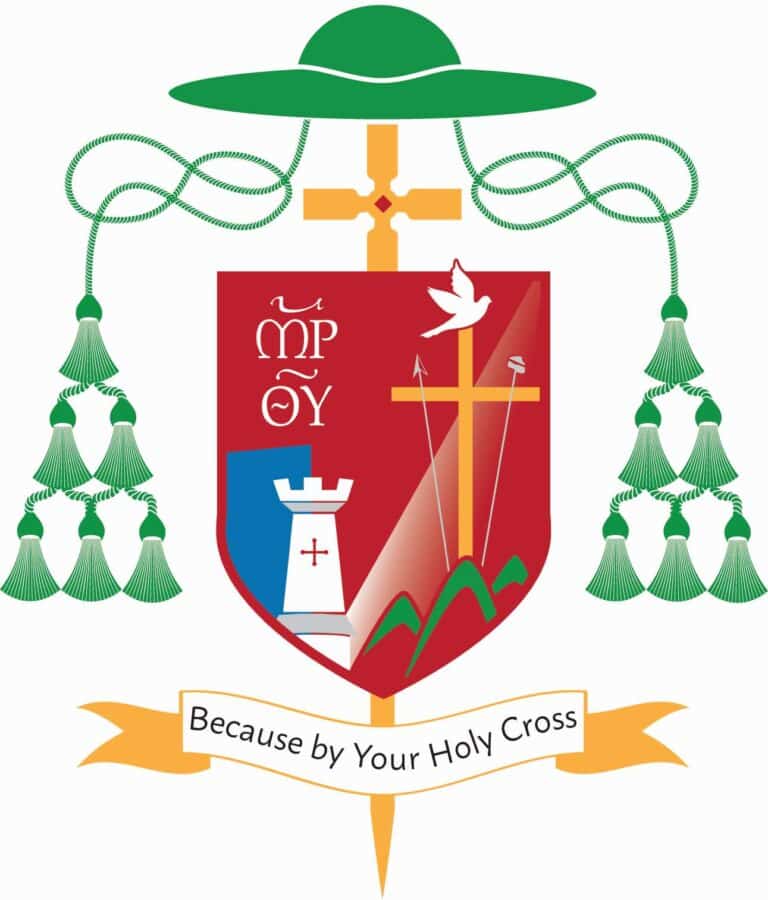
Now that he is moving to become a diocesan bishop his armorial bearings will now be marshaled to those of his diocese. The Bishop had employed his sister, a Felician Sister who “works in media” for her Province to design his coat of arms. As they were back then, so too, are they something of a dumpster fire, heraldically speaking.
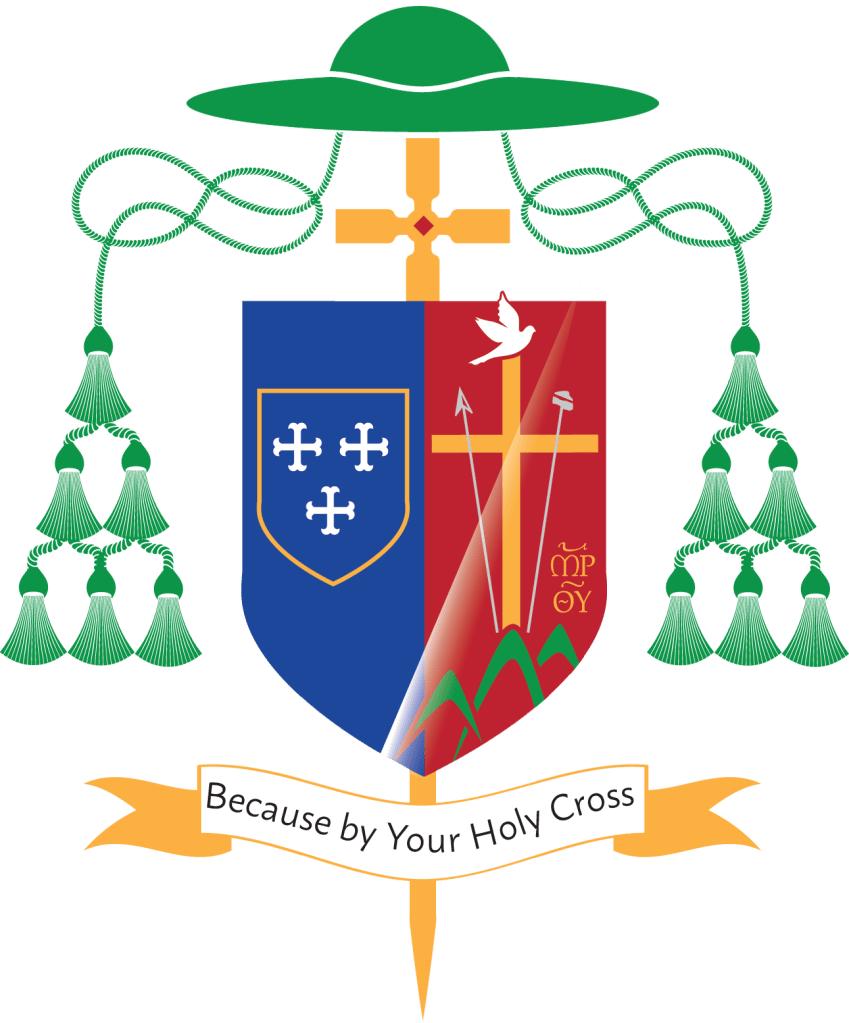
In an interview for The Catholic Review, the Baltimore archdiocesan newspaper, in 2020 the Bishop said, “Why would I ask anyone else?” when asked why his sister was designing his coat of arms. I think I can answer that. How about: in order to turn to someone with knowledge of a specific topic that isn’t really a DIY project? How about that? In her own part of the same interview, Sr. Lewandowski remarked about some of the particular elements of her design:
“The Holy Spirit is depicted as breaking the upper edge of the shield ‘as it is the privilege of the Holy Spirit to inspire new life and envision endless possibilities for the Church, God’s people,’ the description says. The designer noted that she was not sure if that was “allowed” but in her research she did not find any parameters that said it couldn’t be done that way.” (emphasis added)
All I can say is that must have been one quick and not very diligent Google search. Even the most cursory bit of online research should have clued her in to the fact that charges emerging through the edges of the field was a puerile and amateurish mistake. Quite frankly, I don’t see how she could have done any research and reached the conclusion that she did! There are numerous resources out there for someone unfamiliar with good heraldic practices, to say nothing of the huge online presence of groups and organizations that could have happily offered her assistance in her project.
But, this, instead, is the worst kind of so-called heraldry: heraldry as logo. (It summons up the bile just by thinking about it!).
In the same aforementioned article she said:
“…she believes a bishop’s coat of arms should tell people who he is and what he stands for. And I believe it should be a more spiritual piece, not just a historical piece,” she said. “And a lot of the coats of arms that I’ve seen and that I kind of read into, it’s a real historical document, but it doesn’t always tell you who the bishop is. She said she tried to tie in Bishop-designate Lewandowski’s spirituality into the symbols she used.”
Well, she got the first part right. A coat of arms should tell people who the armiger is. But, then she rode that right off the rails with the second part. A coat of arms does not tell people what the armiger stands for. It is for identification alone. I have often mentioned that a coat of arms is not one’s C.V. in pictures. Similarly, it isn’t an expression of personal ideology; a manifesto of one’s own spirituality or (for the clergy) a catechetical tool that expresses one’s personal beliefs as a kind of pictorial homily. Unfortunately, that’s precisely how the Lewandowski kids decided to view this project, with disastrous results.
In the latest rendering the overcrowded and poorly composed original coat of arms now falls victim to, perhaps, my second favorite pet peeve: they were changed in order to combine well with the diocesan arms. That’s not an option, full stop. (I suppose Sister didn’t find anything in her research that said she couldn’t do that either!) In addition, the charges form the personal arms are still going beyond the divisions and boundaries of the shield and/or spilling over from one impalement to the other. Clearly, this is also the classic mistake of thinking that the diocesan arms now somehow “become” part of the bishop’s coat of arms rather than being an example of two distinct and separate coats of arms marshaled together on one shield so as to express the relationship between the two!
The list of things wrong with this just goes on and on, and on…
Suffice it to say that he had a poorly designed coat of arms to begin with which would have and could have benefitted greatly from some expertise and advice from an organization, an individual, or even a decent book on the subject in order to take the elements and arrange and depict them according to good heraldic practices. Now, that poorly designed coat of arms has been badly modified and marshaled inexpertly to the point that the diocesan coat of arms of the See of Providence is depicted incorrectly!
EPIC FAIL!
But…what do you expect when a coat of arms is approached as an exercise in graphic design to tell us who the armiger really is? I’ll leave that question unanswered, thank you.
This question has been posed to me by numerous people since the Holy See released the image of the Pope’s coat of arms as pope. My answer is simply this: it looks pretty much like I expected.
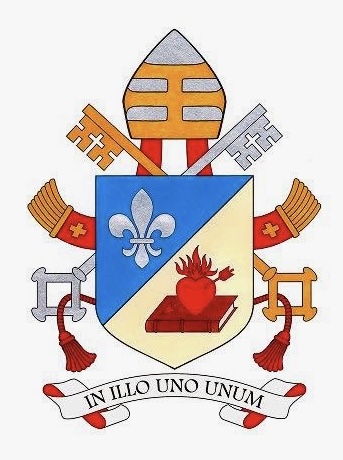
Pope Leo already had a very good coat of arms as a bishop. I’m glad to see he didn’t feel the need to entirely change the design as others have done in the past. A coat of arms is a means of identification. It identifies you. It becomes associated with you in such a way that it shouldn’t be changed cavalierly. A change of position should warrant the use of different external ornaments to signify the new rank, not a full scale change in what is on the shield itself. So, I’m happy to see that the Pope left alone the arms that he assumed as a bishop 11 years ago.
I was not surprised to see the papal tiara rendered in the form of a kind of mitre. This began with Pope Benedict XVI and continued with Pope Francis I. So, we have now seen this for twenty years and I assumed it would be continued. It is, perhaps, important to note that the tiara has not been replaced with a mitre. Rather, it is the papal tiara rendered as a kind of mitre/tiara hybrid. This occurred at all because of ignorance. The argument to Benedict XVI was that since the tiara is, practically speaking, no longer worn it should not be depicted in the coat of arms. Nothing could be farther from the truth. In fact, since it is no longer worn that’s all the more reason it should be used in the coat of arms. It remains a symbol of the papacy. Most of the world’s monarchs no longer actually wear a crown but the use of a crown heraldically remains. Cardinals and bishops no longer wear an actual galero but the galero remains a heraldic emblem. (It is worth noting here that the tiara with the keys remains the emblem of the Holy See.)
St. Paul VI, in his reforms of 1969, decreed that the mitre and crozier which used to be in the coats of arms of all bishops in addition to the galero and episcopal/archiepiscopal cross should no longer be used in the arms of such prelates. He reasoned that the crozier and mitre were still used liturgically as emblems of the episcopal office and their practical use made using them as heraldic symbols redundant and inappropriate. (NOTE: the same is also true for the pallium) Whereas, the episcopal cross and galero—used at one time—had fallen into practical disuse and so were very appropriate to be used purely as heraldic ornaments. By that logic the same is true of the papal tiara. Since recent popes have chosen not to be crowned the use of the tiara as a purely heraldic emblem makes all the more sense.
Yet, those advising Benedict XVI, principally among them Archbishop Piero Marini and the late Cardinal di Montezemolo, argued that the tiara should be modified in its appearance to show that it is no longer actually worn. This was bad advice then and it has now been codified into enduring, though still equally poor advice. Nevertheless, it was easy to anticipate that Pope Leo would simply follow suit. So…no real surprise there.
Similarly, the slight change in tincture of the division of the field in base from Argent (silver or white artistically) to a kind of beige or buff color shows an appalling lack of understanding of heraldry. This is also displayed in the description of this tincture as “light”. Just what, precisely, is THAT supposed to mean ?!?! There isn’t an actual blazon to help clarify this. The lack of a proper blazon could be because no one at the Vatican knows how to write one; they simply don’t find it important enough to care about; or they feel it would be too esoteric and unintelligible for the average person. One can only hope that the reason is one of the latter two rather than the former.
But there isn’t a lot of evidence to dissuade me. For example, the tiara and keys and motto banner are all clearly just a “cut & paste” job from the arms of Pope Francis I. Really? With all the many competent heraldic artists and heraldic experts available to them no one at the Vatican bothered to reach out to anyone and just figured this could all be handled “in house” by someone with a computer? Is that the most appropriate way to prepare a new pope’s coat of arms? it shouldn’t be a matter of who can get it done first but of who can do it best. What a shame that it has been deemed acceptable simply to cobble something together from existing images.
It’s also probably worth noting that—just like all bishops—all of the popes have had an episcopal motto. However, by longstanding tradition and custom a motto is not supposed to be included in the armorial achievement of the Pope. In his seminal work, Heraldry in the Catholic Church (1978) Archbishop Bruno Heim notes that, “It is widespread custom to put a motto under the shield. It is often held, wrongly, by those who know little about heraldry, that the motto is indispensable; yet it is an addition which does not properly belong to the armorial bearings themselves.” (page 80)
So we see that, all in all, the new Pope’s coat of arms is unsurprising in its composition, disappointing in its execution, and uninspiring in its depiction with numerous errors that could have been avoided with a little creativity and some consultation with people who know what they are doing.
For example, in the hands of an artist of some merit the same exact design can be rendered in a manner that looks considerably better just by the good use of composition and artistic style.
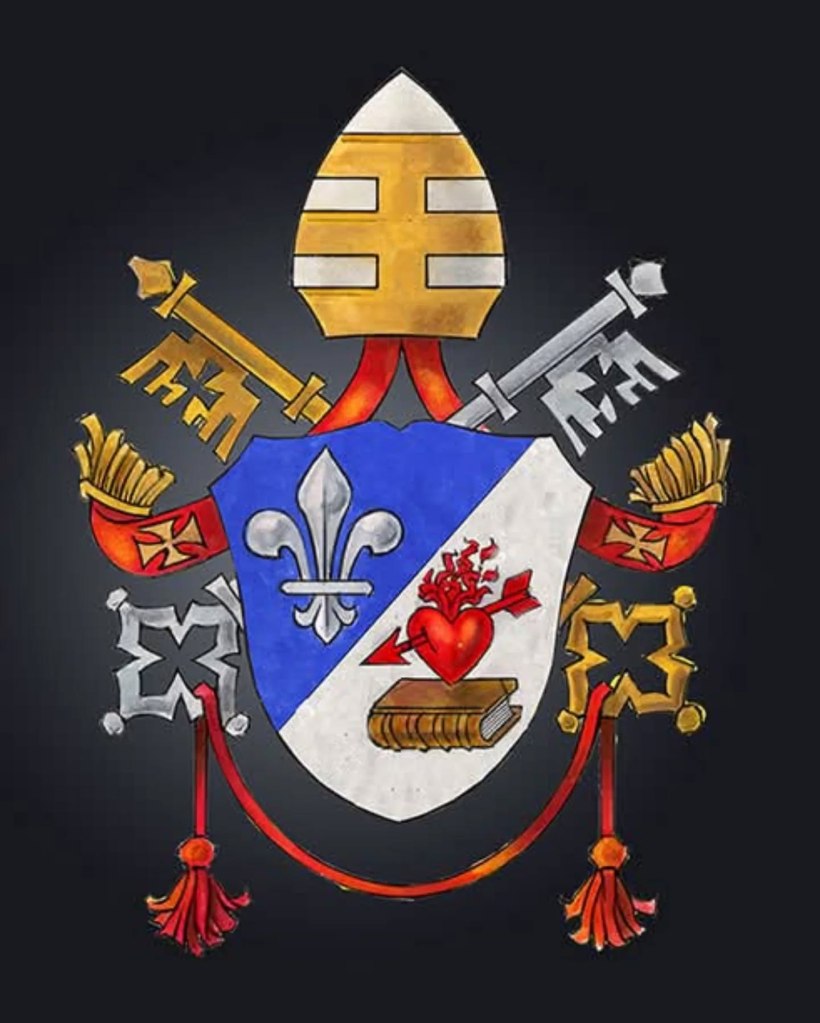
Take, for example, this sketch of the arms of Pope Leo XIV done on the evening of his election by the noted and competent heraldic artist, Marco Foppoli. We can see here that, in the hands of an expert with a great deal of experience, the original heraldic design can be rendered with the appropriate external ornaments in a way that maintains the simplicity that is desired while also creating a new and unique achievement for the armiger. Too bad that someone like Foppoli wasn’t consulted by officials at the Holy See.
Papal heraldry has been in a slow decline since the death of Archbishop Heim. It is sad but true. Unfortunately, at the outset of this new pontificate, there are no signs that this is going to change for the better anytime soon.
God Bless Pope Leo XIV!
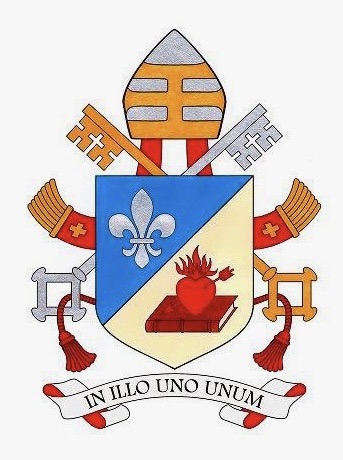
(artwork by Sandy Turnbull)
The Most Rev. Gerald Thomas Walsh (83), Titular Bishop of Altiburus and Auxiliary Bishop Emeritus of New York passed away on May 5, 2025. May he rest in peace.
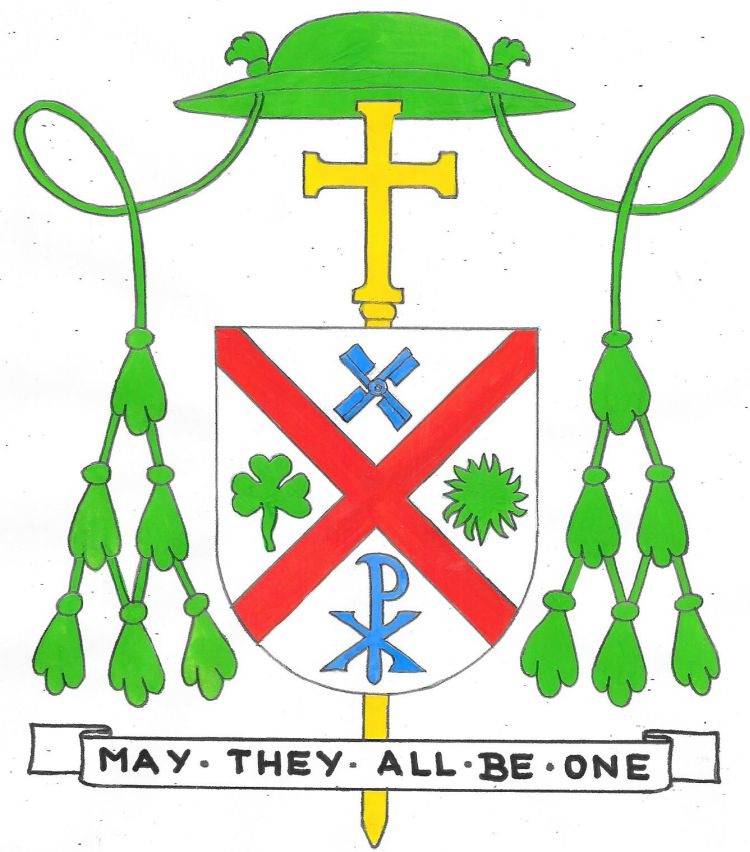
During the Sede Vacante the person in charge of the affairs of the Church is the Chamberlain (Camerlengo) of the Holy Roman Church. Since 2019 that man has been the (Irish-born) American, Kevin Cardinal Farrell, former Bishop of Dallas, Texas and also former Auxiliary Bishop of Washington, DC.
During the time of the Sede Vacante he functions as the caretaker of the Church and the Regent of the Vatican City-State. The symbol of the Church since the time of the existence of the Papal States, the crossed keys and ombrellino, are placed above his existing coat of arms in the achievement. These may always be used during his tenure in office but, practically speaking, most of those who are Camerlengo make use of these added ornaments only during the Sede Vacante. Special coins will be struck to mark this moment in the Church’s history bearing the arms of the Camerlengo.
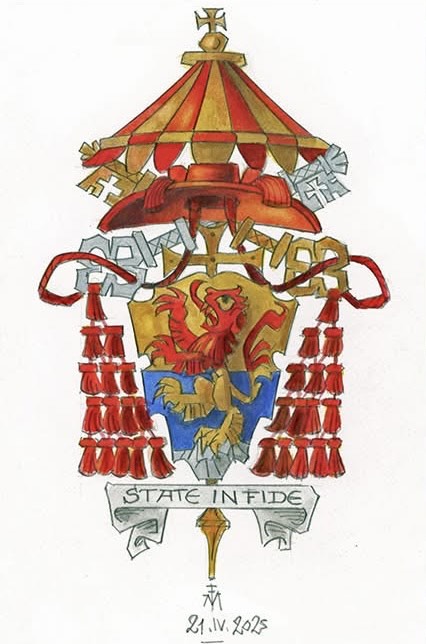
This version of Farrell’s arms is by Marco Foppoli.
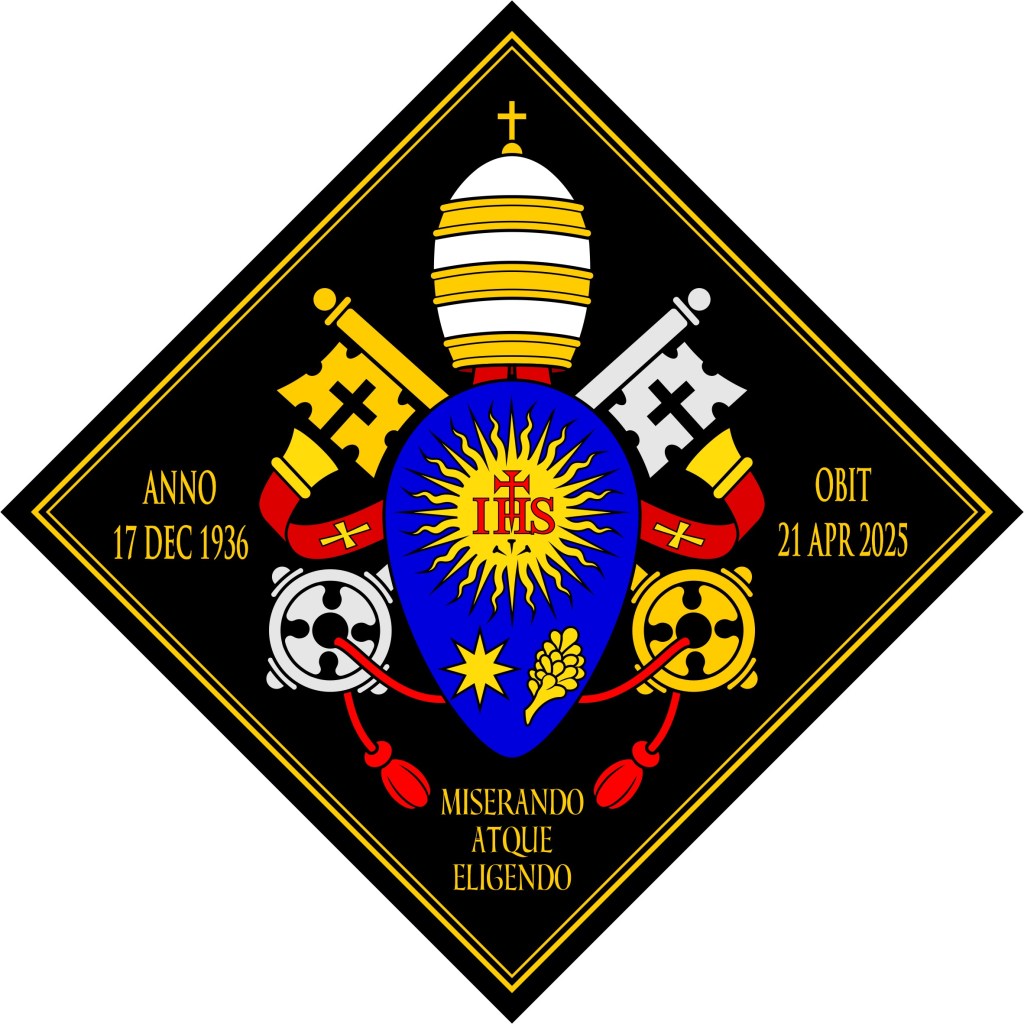
In the midst of all the news out there about the death and burial of Pope Francis I didn’t bother to post anything. In addition, I was dealing with some personal matters during that time as well that prevented me from having the time for posting. We now find ourselves in the midst of the nine official days of mourning for a pope, the so-called Novemdiales. Now, the world waits the start of the Conclave which will commence on May 7.
I post here a funerary hatchment made by the Australian Heraldic Artist, Mr. Sandy Turnbull. May Pope Francis Rest in Peace.
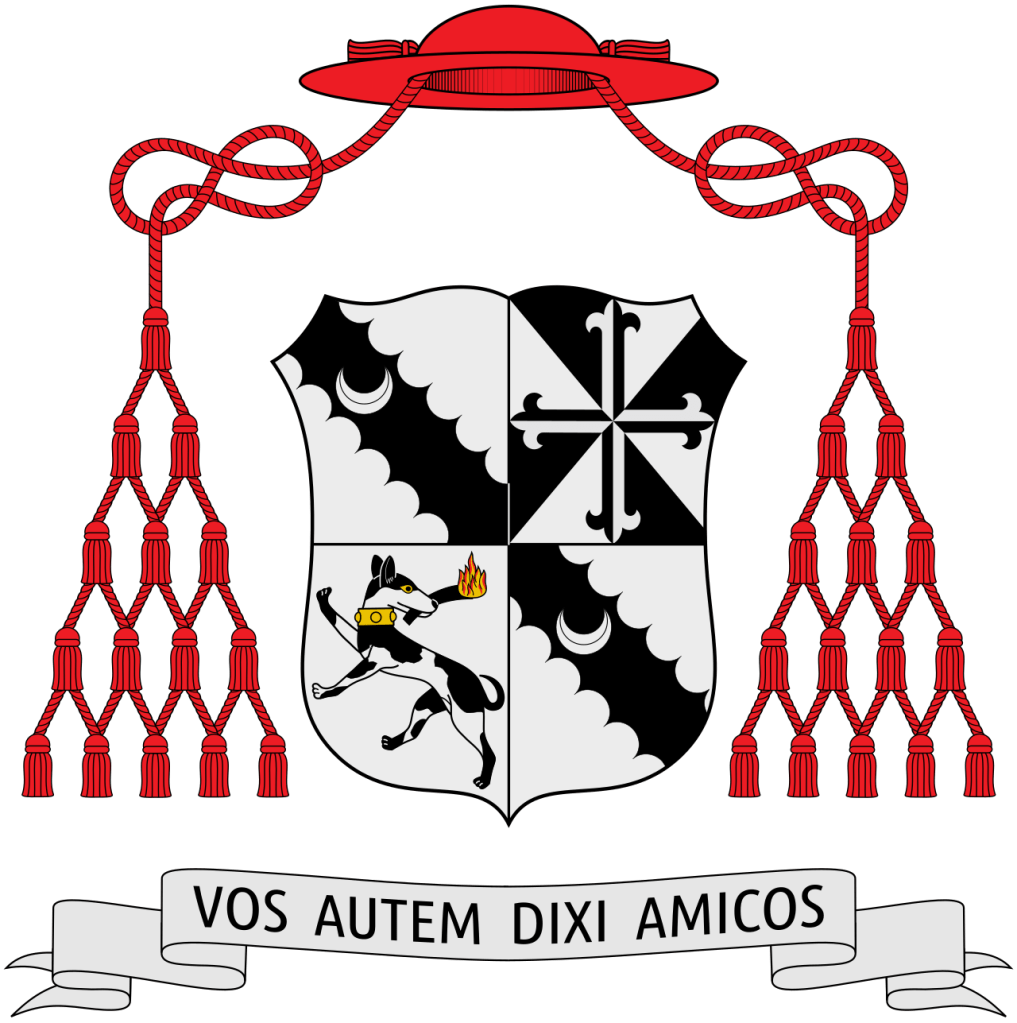
It took a bit of time but the arms used by Timothy Cardinal Radcliffe, OP the Dominican friar who was created cardinal just last autumn by the late pope and who will now be an elector in the upcoming Conclave, has now been published.
He has not been ordained a bishop so there is no episcopal cross behind the shield in the achievement. Overall, he has chosen very Dominican looking symbols and a differenced version of the arms of Radcliffe. A very handsome coat of arms.
I received an interesting piece of correspondence today from a reader concerning the coat of arms of the See of Johannesburg, South Africa. The archbishop there, Stephen Cardinal Brislin, who has served there since 2024 (arms below) issued a recent decree determining the appearance and uses of the coat of arms of the archdiocese of Johannesburg and authorizing its use.
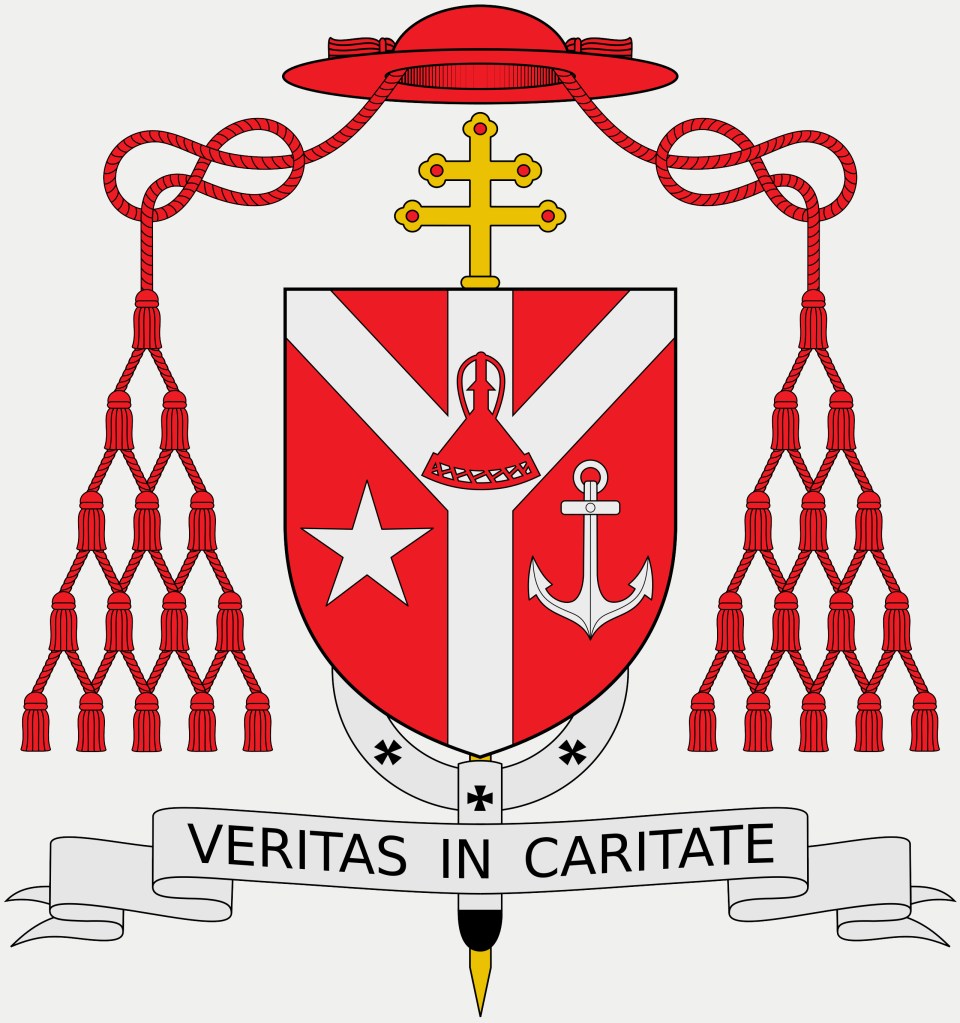
His decree specifies that this coat of arms is to be used by all Chancery Staff and Departments of the Archdiocese for all official correspondence. He goes on to say that any department wishing to use it in letterhead must first obtain his permission and that it may not be used for personal use.
It is to be published in the archdiocesan paper which will then constitute its promulgation. This decree will be in effect unless specifically repealed by either him, or one of his successors as archbishop.
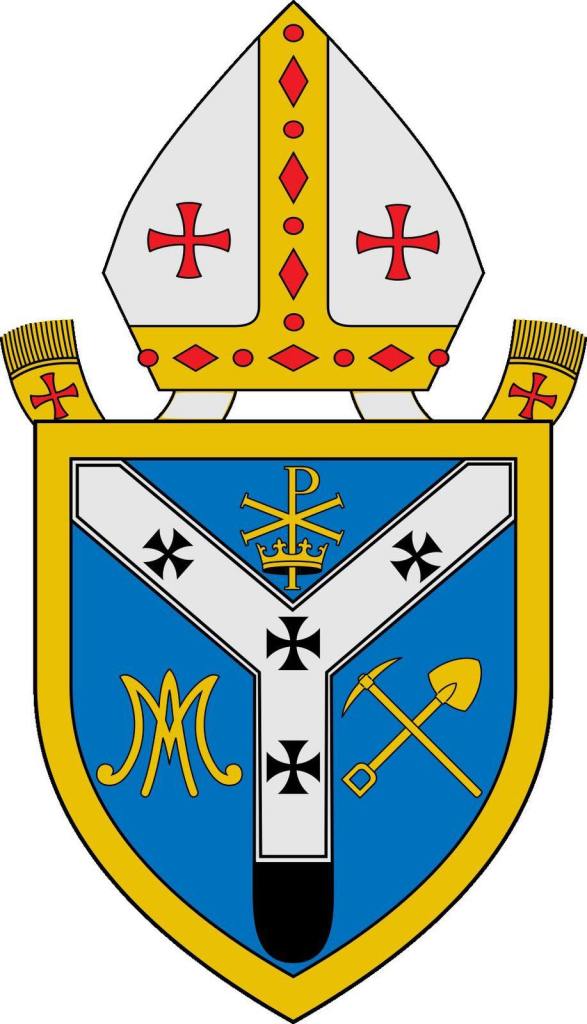
The blazon of the arms is: “Azure, within a bordure Or, a pall Proper between, in chief, the letters Chi and Rho enfiling an open crown, to dexter, the monogram of Our Lady and to sinister a pick-axe and shovel in saltire, all Or; all within a bordure Or.”
I think it’s great that in a country where it is not the custom for the Ordinary to impale his own arms with those of the See, a prelate has taken enough interest to devise an archdiocesan coat of arms as distinct from his own coat of arms and then also to regulate its use by his own authority. Far too little attention is paid to heraldry by so many bishops and when they do it is often to “modernize” it or to try to make it more “relevant” and by so doing they ruin it. Here, the archdiocese has a suitable coat of arms—perhaps a bit busy for some, but really not a poor design at all—and is establishing by archiepiscopal decree that its use must be authorized. I applaud this effort on the part of the Archdiocese of Johannesburg.
On March 18 the Most Reverend Edward J. Weisenburger (64), originally a priest of Oklahoma City, former Bishop of Salina, Kansas, and most recently Bishop of Tucson, Arizona, will be installed as the 10th Bishop and 6th Archbishop of Detroit, Michigan.
His immediate predecessor, Archbishop Allen Vigneron, had the archdiocese’s coat of arms redesigned into a logo-like emblem in 2017.
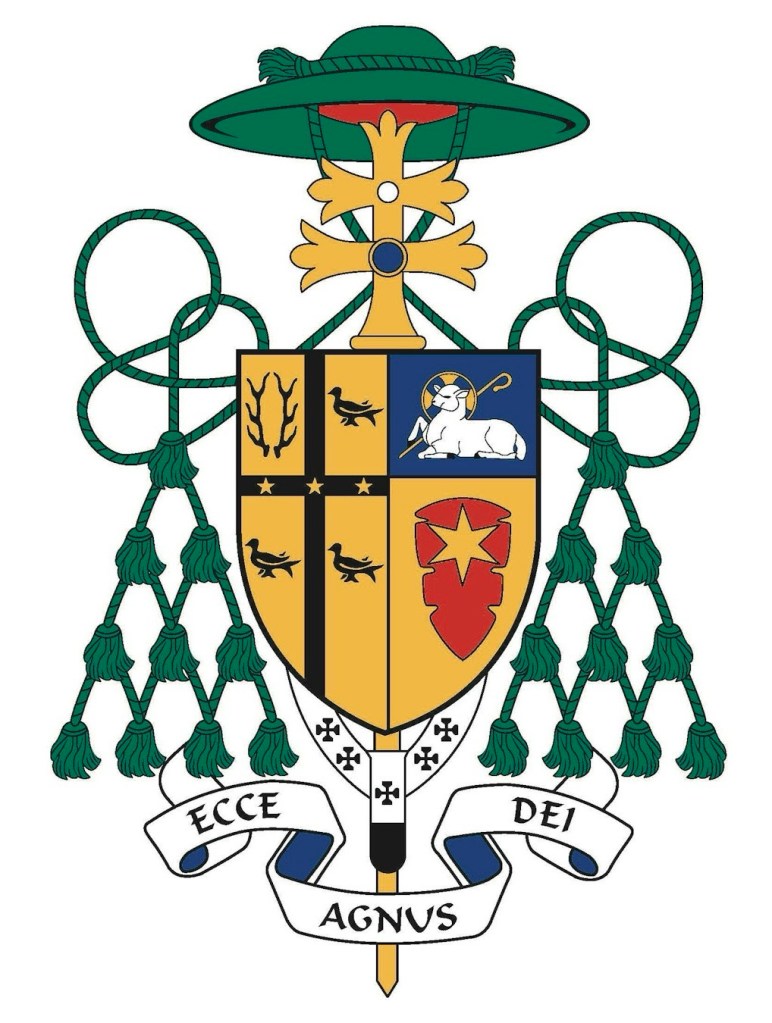
Thankfully, Archbishop Weisenburger has chosen to impale his personal arms with the traditional version of the archdiocesan coat of arms adopted in 1937 to indicate a sense of continuity with his predecessors. Excellent choice!
A few months ago I was approached about providing assistance to the Episcopal Diocese of Wisconsin on a redesign of their coat of arms. The diocese encompasses the entire state of Wisconsin and is composed of a reunification of three dioceses in the state—Milwaukee, Eau Claire, and Fond Du Lac— into one jurisdiction. Each of the former dioceses had its own armorial bearings and the task at hand was to come up with an entirely new design that could please everyone and borrow some design elements from all three. Not an easy task.
A commission was put together of people from within the state who had some background in various fields like art, communications, web design, or Episcopal Church history, and the bishop (the former bishop of Fond Du Lac). I was asked to be the heraldic consultant and we gathered via zoom for several meetings and exchanged numerous pieces of correspondence with quite a few sketches going back and forth. After identifying themes, common characteristics and ideas for what the new arms should express we began to hone it down to just a few, which quickly became two and then we made final tweaks until we got to the result. I didn’t provide the artwork this time but simply guided the process of designing the coat of arms.
The end result is:

The use of blue was common in all three existing arms, as was images of water. So, the blue field contains two wavy lines as symbolic of the lakes and rivers of Wisconsin as well as a reference to the waters of Baptism. The two crosses fleury in chief are for the Christian faith that undergirds every effort of the people in the diocese and has a subtle nod to the French influence on the region. The fret of three fish is an obvious Trinitarian symbol and also alludes to the three former jurisdictions being united into one. The fish is, of course, an early Christian symbol and is, therefore, a fitting element to use to symbolize three Christian communities now united as one.
I would blazon this: Azure, two barrulets wavy Argent; in chief between two crosses fleury Argent a fret of three fishes Or. The shield is ensigned with a bishop’s miter and a crozier and key in saltire behind the shield all Or.
My favorite little “cheeky” thing that was snuck in are the two crosses on the ends of the fanons that hang from the bishop’s mitre. They are composed of four triangles conjoined at the center…looking slightly like four wedges of cheese since Wisconsin is known as a very large dairy-producing state. The nickname of someone from Wisconsin is the affectionate term: “Cheese-Head”.
This was a long process but one that undertaken seriously by people dedicated to their task. My gratitude to Fr. Chris Corbin for shepherding the commission along as its chair and for providing the final artwork as well! The arms is also used by the diocese on its diocesan seal.

Fr. Guy Selvester's blog of Ecclesiastical Heraldry
Fr. Guy Selvester's blog of Ecclesiastical Heraldry
Fr. Guy Selvester's blog of Ecclesiastical Heraldry
Fr. Guy Selvester's blog of Ecclesiastical Heraldry
Fr. Guy Selvester's blog of Ecclesiastical Heraldry
Fr. Guy Selvester's blog of Ecclesiastical Heraldry
Fr. Guy Selvester's blog of Ecclesiastical Heraldry
Fr. Guy Selvester's blog of Ecclesiastical Heraldry
Fr. Guy Selvester's blog of Ecclesiastical Heraldry
Fr. Guy Selvester's blog of Ecclesiastical Heraldry
Fr. Guy Selvester's blog of Ecclesiastical Heraldry
Fr. Guy Selvester's blog of Ecclesiastical Heraldry
 EXARANDORUM