Category Archives: Work of Other Artists

Danish Coat of Arms Updated

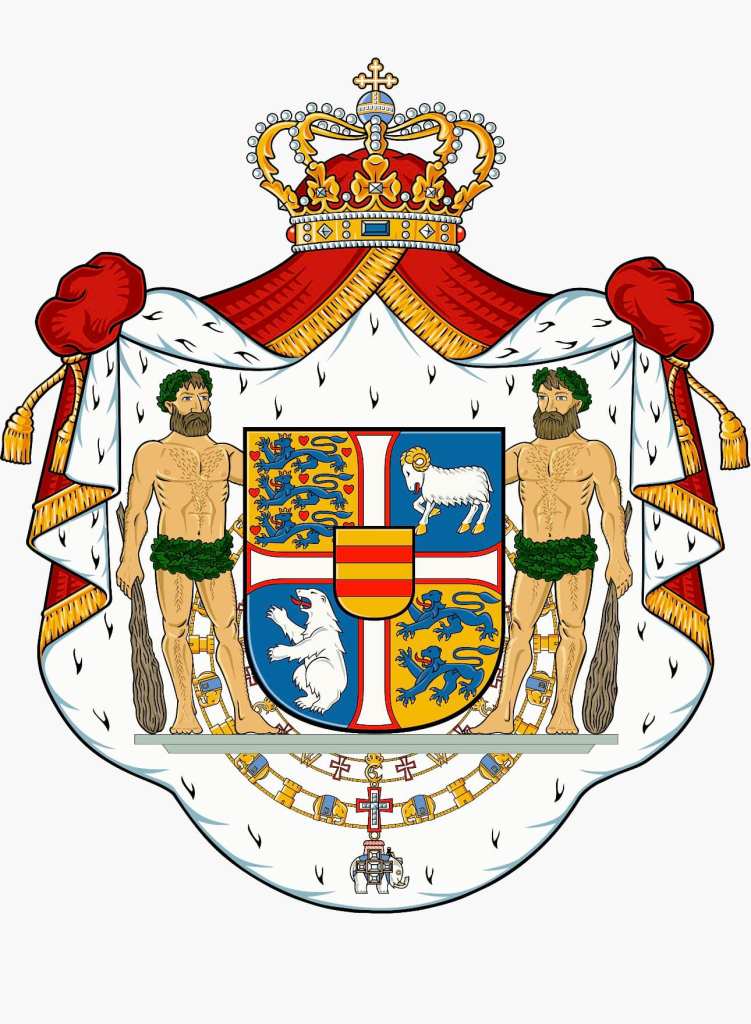
HM, King Frederik X has undertaken to issue a new, updated version of the Danish royal coat of arms dated December 20, 2024. The new version, prepared by Ronny Skov Andersen, simplifies the overall design.

It removes the three crowns of the Kalmar union and gives the arms of the Faeroe Islands and Greenland their own quarterings. It also places the arms of Denmark, originally the arms of the House of Estridsen, in the first quarter and instead of repeating it in the fourth quarter the arms of Schleswig are placed there. In addition, the Dannebrog, the cross that divides the shield into four quarters, has been returned to a more traditional form with the ends of the arms slightly flared. Overall, there remains the dynastic inescutcheon for the arms of the House of Oldenburg. The new version is:

The blason could be written as: A shield quartered by a cross pattée throughout Argent fimbriated Gules; first quarter Or, three lions passant in pale Azure crowned and armed Or langued Gules, nine hearts Gules (for Denmark); second quarter Azure a ram passant Argent armed and unguled Or (for the Faroe Islands); third quarter, Azure a polar bear rampant Argent (for Greenland); fourth quarter, Or two lions passant in pale Azure armed Or langued Gules (for Schleswig). Overall an escutcheon Or two bars Gules (for Oldenburg) the whole surrounded by the Collars of the Order of the Dannebrog and the Order of the Elephant. Supporters two woodwoses armed with clubs Proper standing on a pedestal. All surrounded by a mantle Gules doubled Ermine crowned with a royal crown and tied up with tasseled strings Or.

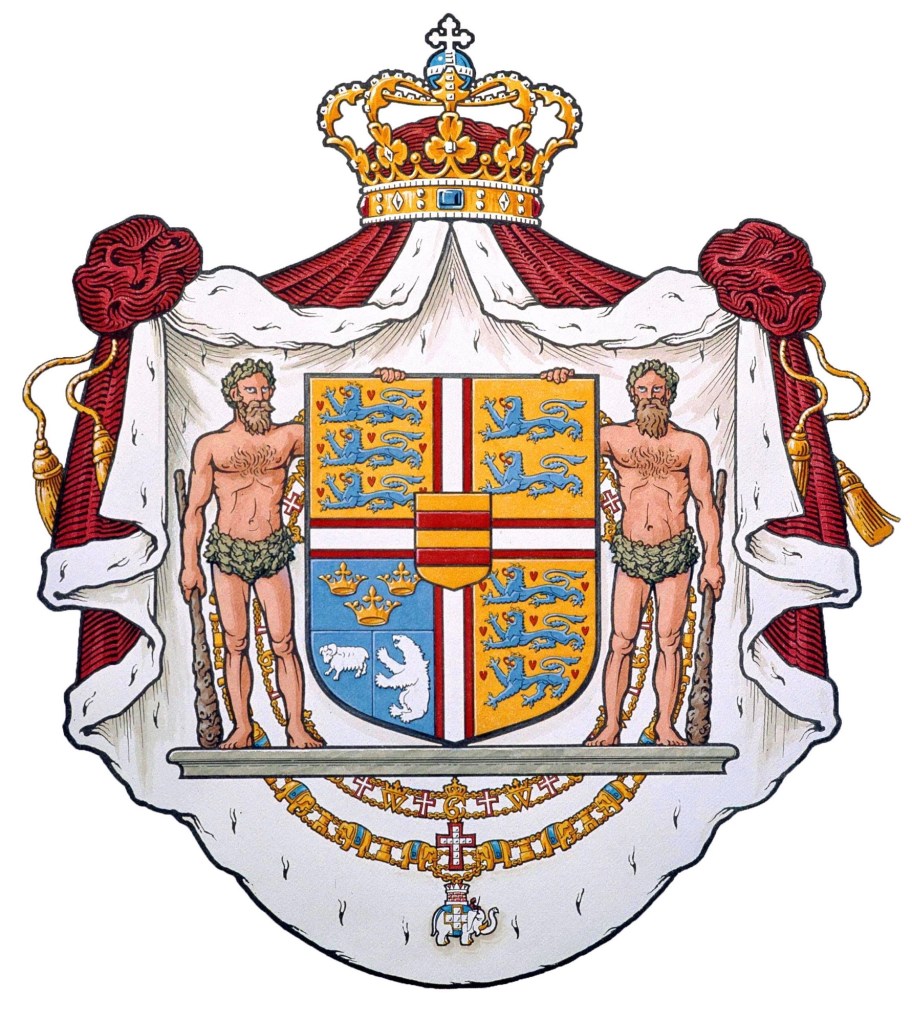
This replaces the version of the coat of arms that had been modified after the reign of King Frederik IX by Queen Margrethe which had been in use since 1972. (below)

I think this updated version is aesthetically more pleasing. It is a slightly less busy composition and the juxtaposition of the arms of Denmark and those of Schleswig provide a more pleasing visual. There is no longer the multiplication of lions and the two quarters with fields Or look better on a diagonal from each other, as do the two quarters with fields Azure. It all seems less imbalanced. I also happen to think the style of the cross looks better that the simple cross throughout.

It is exciting to see heraldry—long erroneously thought by the ignorant to be stagnant and encrusted with the weight of history and therefore irrelevant to today’s society—being updated and dynamic. The current situation calls for an updated symbol of the monarchy. This was true in 1972 and it is just as true some 52 years later. I applaud the efforts of His Majesty and also Ronny Andersen and those who worked with him to devise this updated coat of arms.

Feast of St. Nicholas

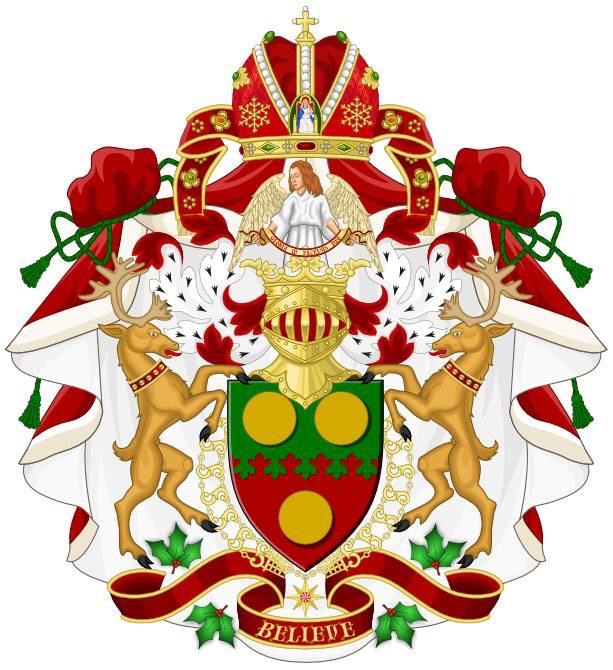
Some years back there was a discussion about the devisal of attributed arms for St. Nicholas of Myra (aka Santa Claus). My fellow heraldry enthusiast, Michael Quigley, proposed this design.

Attributed arms are created for individuals who didn’t bear a coat of arms themselves. Either, they are fictitious characters, they simply didn’t have a coat of arms or they may have lived prior to the development of heraldry.

St. Nicholas was definitely a real person but he lived from A.D. 270 – 343, roughly nine hundred years before heraldry existed.

This fanciful coat of arms employs an Eastern mitre and the traditional 3 gold coins associated with St. Nicholas from the story of him ransoming three children from being sold into slavery. It also uses deer (reindeer) supporters, fir twigs and the colors green and red so associated with the legend of Santa Claus and Western Christmas lore and custom.

December 6 is the feast of St. Nicholas.

Cardinal Bychok

His Eminence, Mykola Bychok, CSsR (44) is a Ukrainian Catholic who serves as Eparch of Ss. Peter & Paul of Melbourne since 2020. On December 7 he will become the Church’s youngest cardinal.

The arms he assumed upon becoming a bishop were designed by others for him and he was not entirely satisfied with them. With his upcoming creation as a cardinal he saw this as an opportunity to tweak the design of his coat of arms.

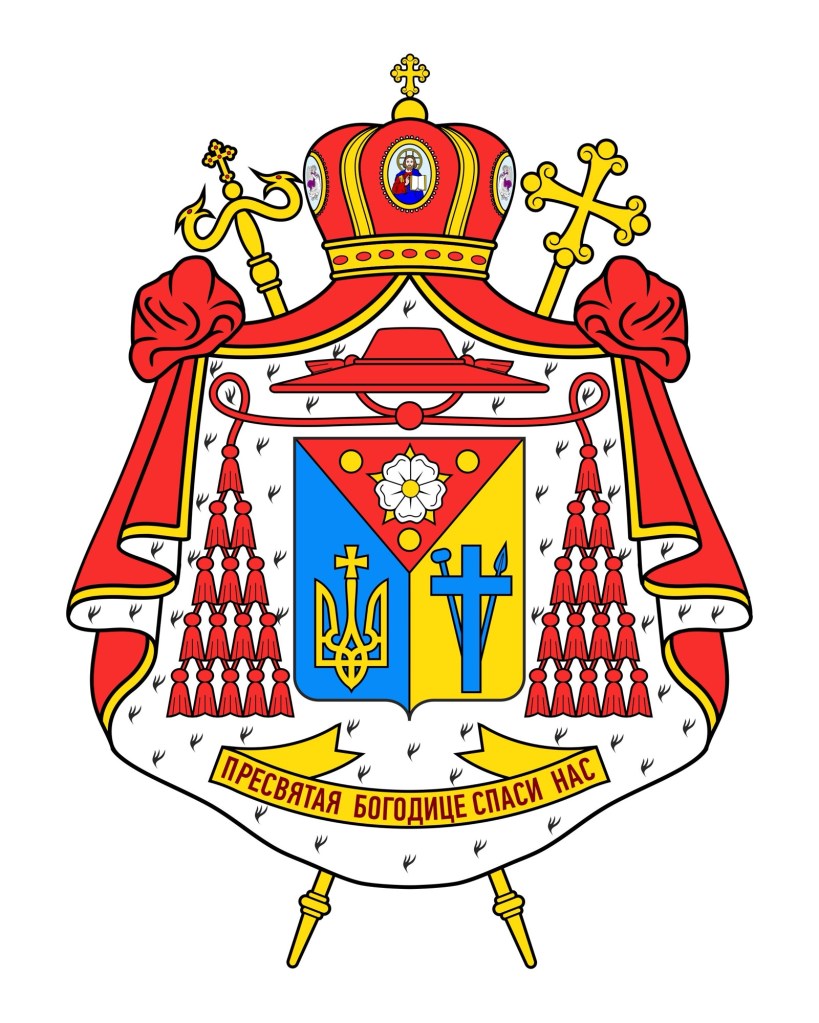
The redesigned coat of arms does not depart that much from what he originally had but cleans it up a bit and adds the external ornament unique to Cardinals.

The blazon is: Tierced in pall; in chief, Gules a rose Argent, barbed and seeded Or between three bezants; in dexter base Azure a trident (tryzub) topped with a Greek cross, all Or; in sinister base Or a Latin cross on a perch of a staff topped by a sponge in bend and a spear in sinister bend all Azure. The shield is ensigned with the galero of a cardinal of the holy Roman Church with cords and 30 tassels disposed in five rows of one, two, three, four and five all Gules; the whole within a mantle Gules lined ermine surmounted by the Eastern mitra Gules; in saltire behind the mantle a crozier and a cross both Or.

The charges in chief symbolize the place he is from; the trident (differenced by the addition of a cross) is a symbol of Ukraine; the cross, sponge and spear are borrowed from the arms of the Redemptorist Order of which he is a member.

I was very happy to consult on this redesign and work to put it together with Mr. Richard d’Apice of the Australian Heraldry Society. As with all our collaborations the artwork has been deftly provided by Mr. Sandy Turnbull, also of the Australian Heraldry Society.

Marshaling is Everything! (Bp. Martin UPDATED)

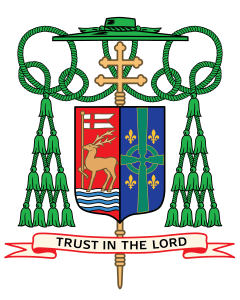
You may recall that in a post about several new bishops’ installations I wrote the following about the coat of arms of Bp. Martin of Charlotte, N.C.:

May 29 saw the ordination and installation of the Most Rev. Michael Martin, OFMConv (62) as the fifth Bishop of Charlotte, North Carolina.

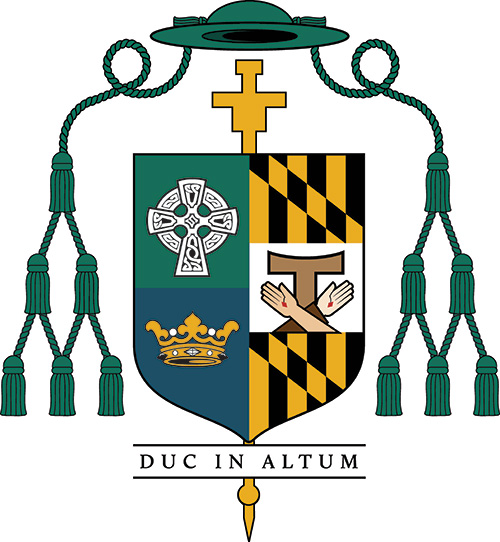
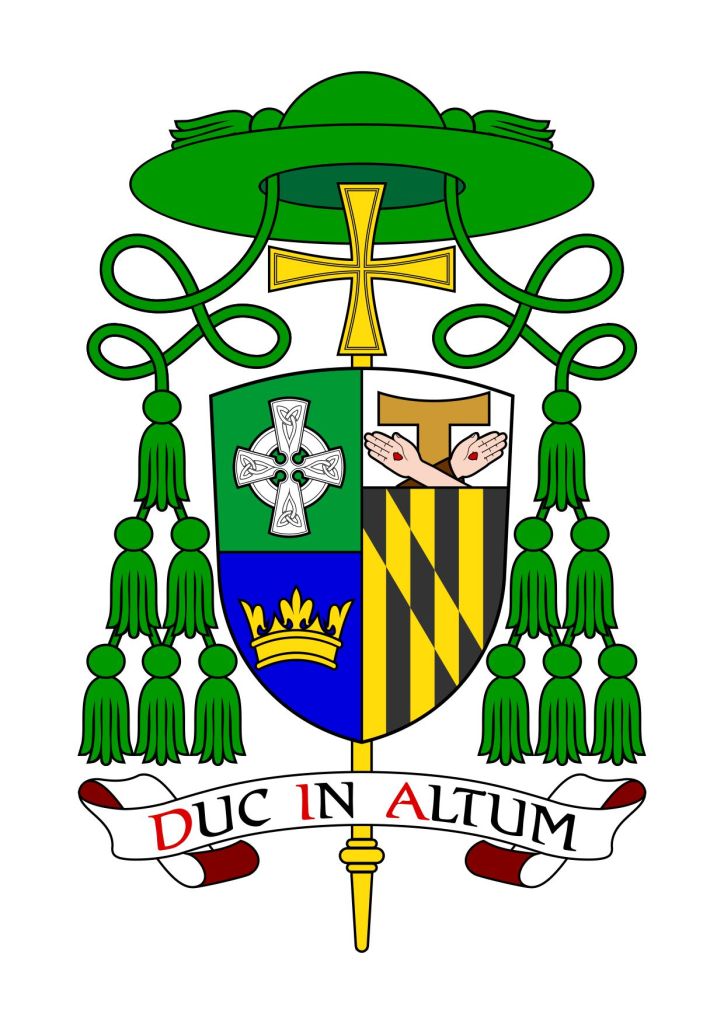
The diocesan website describes his personal arms, “To the viewer’s right is the Franciscan coat of arms. Featuring the traditional Franciscan Tau cross with two arms crossing one another, it is rich in symbolism. The two arms, one Christ’s and the other St. Francis of Assisi’s, both bear the stigmata. They symbolize God’s love and Francis’s loving response to the Word made incarnate, Taberski explained. It is an image found throughout the ministries, friaries, missions and sites served by the Franciscan order.

On the right side of the shield, the top (known as the “chief”) and the bottom (the “base”) feature references to George Calvert and his son Cecil Calvert – the first and second barons of Baltimore. The Calverts were among the first Catholics to arrive in colonial America. They established the then Province of Maryland as a safe place for English Catholics to emigrate to since they were no longer able to freely practice their faith at home. In the coat of arms, the use of six vertical stripes – alternately gold and black, with the diagonal stripe in color – recalls Bishop Martin’s hometown of Baltimore.”

A nice simple design but perhaps the arms of Calvert would have looked better depicted once in the main part of the field with the Franciscan symbols occupying a chief?

Well, my friend and frequent collaborator, Mr. Sandy Turnbull of the Australian Heraldry Society, read that post and decided to have a bit of fun and create a new emblazonment of Bp. martin’s coat of arms that followed my advice. I’d say the result (below) speaks for itself. I was right! The whole achievement does look better as I suggested. See? One can’t just throw things onto a shield and call it heraldry. How the design is arranged—to be aesthetically pleasing as well as heraldically correct—is a large part of good heraldic design.

Bishop Beckman of Knoxville, Tennessee

The Most Rev. James Beckman, (61) a priest of the Diocese of Nashville since 1990 was ordained a bishop and installed as the Fourth Bishop of Knoxville on July 26. For reasons I don’t fully understand, his installation Mass took place in a local convention center despite the fact that only a few years ago in 2018 the diocese undertook to build a $30 million dollar new cathedral with an area of 28,000 feet and a seating capacity of 1,358. It begs the question: what was the new cathedral for?

The armorial bearings he assumes upon becoming a bishop are the following. The diocesan coat of arms, designed when the diocese was established in 1988 are a dumpster fire and the less said about them the better. After all, this bishop had no hand in designing them and he wisely conformed to the convention of not changing them since they have been in use for 36 years already.

According to information from the Diocesan website his personal arms contain what they do because…

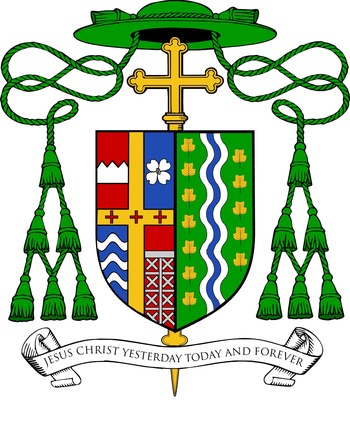
Bishop-elect Beckman is an avid hiker and has a deep appreciation for the beauty of God’s creation. His coat of arms reflects this part of his life, in which he has found much solace and communion with God in prayer. His personal arms display a symbolic natural setting on a field of green (vert), which also has ties to the bishop’s heritage, and to Sacred Scripture.

The bishop’s surname is German, and derives from the word beck, which means a stream or brook. This is depicted by the wavy vertical lines (pale wavy) painted white and blue (argent and azure) in the center of the shield. This also recalls the prophecy related by St. John the Evangelist about the City of God, the New Jerusalem, which he sees in a vision near the end of the Book of Revelation: “Then the angel showed me, the river of the water of life, bright as crystal, flowing from the throne of God and of the Lamb through the middle of the street of the city” (Rev 22:1).  

John also saw, “on either side of the river, the tree of life with its twelve kinds of fruit, yielding its fruit each month. The leaves of the tree were for the healing of the nations” (Rev 22:2).  The tree of life and its fruit are alluded to here by twelve leaves of the tulip poplar (Liriodendron tulipifera). This was chosen as the state tree of Tennessee in 1947.  It is an appropriate symbol for the state that comprises both the Diocese of Nashville, where Bishop-elect Beckman was born and served as a priest, and the Diocese of Knoxville, which he will serve as its bishop.

The charges were chosen for good reasons. The coat of arms is clear and uncomplicated. The only real down side is that they are impaled with the awful coat of arms of the See.

Burlington’s Own Bishop McDermott

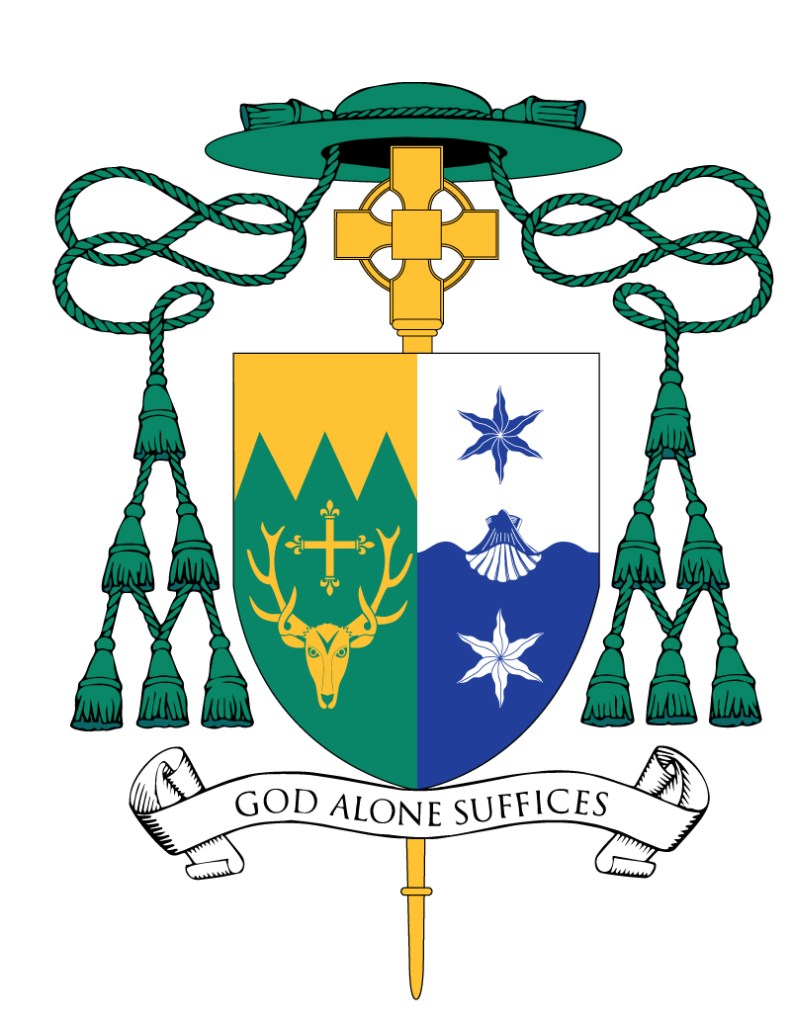
The Most Rev. John J. McDermott (61), a priest of the Diocese of Burlington, Vermont who recently served—twice—as diocesan administrator in the interim times between bishops, was ordained a bishop and installed as the XI Bishop of Burlington on July 15th.

His assumed armorial bearings are understated and impale well with the rather nice coat of arms of the diocese.

According to information provided by the Diocese: “the Bishop’s personal coat of arms is divided horizontally by a wavy line (per fess wavy)into two sections painted respectively white and blue (argent and azure). Following high school, Bishop McDermott attended the United States Coast Guard Academy in New London, Connecticut, and this allusion to the sea refers to those days as they were important to his discernment to become a priest, as well as to the waters of Lake Champlain. 

Two six-pointed wavy stars (estoilles) appear, one in the “sky” to refer to Our Lady,the Star of the Sea, and the other in the “sea” itself. A six-pointed star is a traditional symbol not only of Our Lady but also of Saint Joseph, as a descendant of the royal house of King David. Its position here depicts the holiness of Saint Joseph as a reflection of that of his Immaculate spouse. 

Between the stars is a scallop shell, a traditional attribute of Saint John the Baptist, the Bishop’s baptismal patron saint. The shell is divided along the same wavy line as the shield, as if it were being dipped into the water at the moment of conferring Baptism. The shell and the stars are all painted counterchanged, that is, blue where the field is white, and white where the field is blue.

A pleasant coat of arms which kept things nice and simple, that is to say, clear.

Same Tune; Different Arrangement

For quite a few years now I have collaborated with Messrs. Richard d’Apice, AM, KCSG, AIH and Sandy Turnbull on a small committee called the “Ecclesiastical Working Party” under the auspices of the Australian Heraldry Society. Together, we have created coats of arms for dioceses and bishops in Australia, and also in some other countries in the Pacific region, since some time around 2011.

Mr. d’Apice acts as the corresponding secretary, as it were, for the group. He is the point of contact and communication for the client with the group. In addition, an enthusiastic heraldist for much of his life, he has input into the designs we propose. That’s where I come in. Frequently I act as the consultant on the design either by proposing a different alternative to that of Mr. d’Apice; or by making suggestions to enhance or “tweak” his proposal. Together, we are able to reach consensus and present a single proposed design to the client. This, in turn, is still often modified further as the process continues. I also assist with the composition of the blazon.

For the artwork, we hand off to the talents of Mr. Turnbull. Occasionally, I might provide a sketch merely to illustrate the proposal or one of my suggestions. But, the initial draft as well as the final artwork is provided by Sandy.

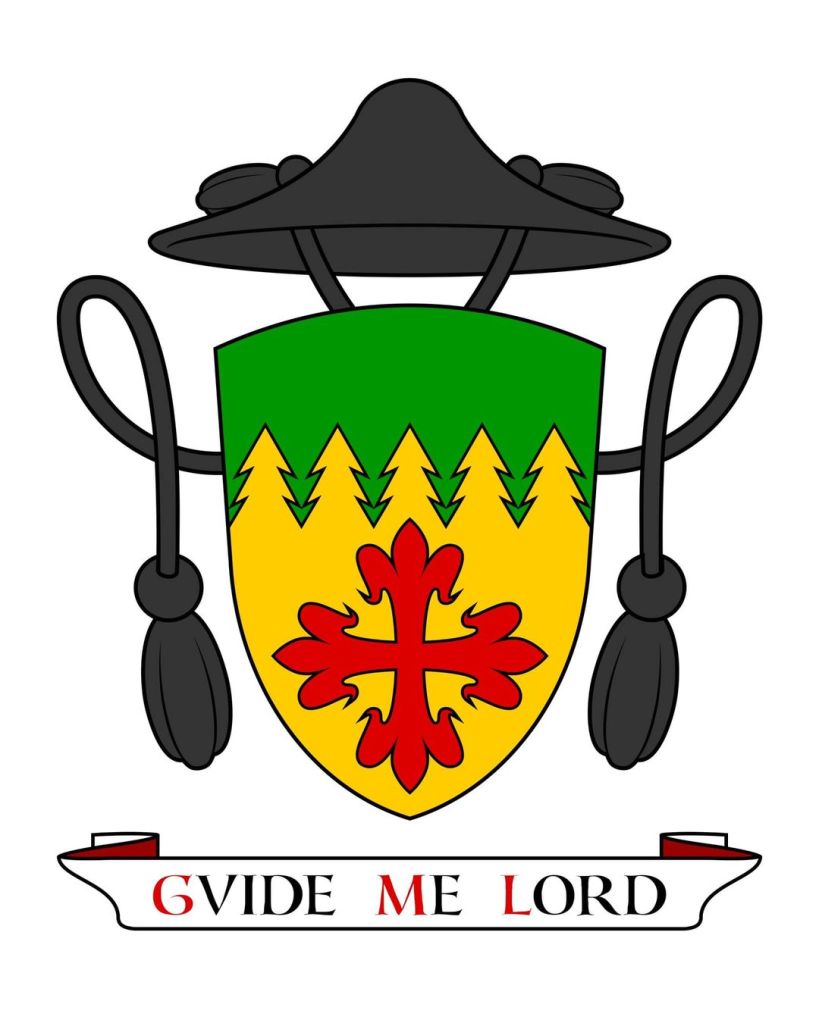
He surprised me not long ago. After years of collaboration on numerous coats of arms he created a rendering in his own style of my armorial bearings and presented it to me. I’m very pleased with it and I’m happy to share it with you now.

For those not already familiar with it the blazon is:

Or, a Greek cross fleury; a chief sapiné Vert.

The line of fir trees suggests my surname, Selvester (originally Silvestri and later anglicized after emigrating to the U.S.) which means a forest dweller, or woodsman. It represents my paternal Italian heritage. The colors green and gold allude to my maternal Irish ancestry. The red cross of faith is the single charge but its arms terminate in fleurs-de-lis as symbolic of both Our Lady and the Blessed Trinity. The motto is a pun on my given name, Guy, which means “a guide”. The shield is ensigned with the galero of a priest.

It’s always nice to have one’s coat of arms rendered by different artists in their own distinctive style. I am especially pleased with this one.

Caddy to Cairns (UPDATED!)

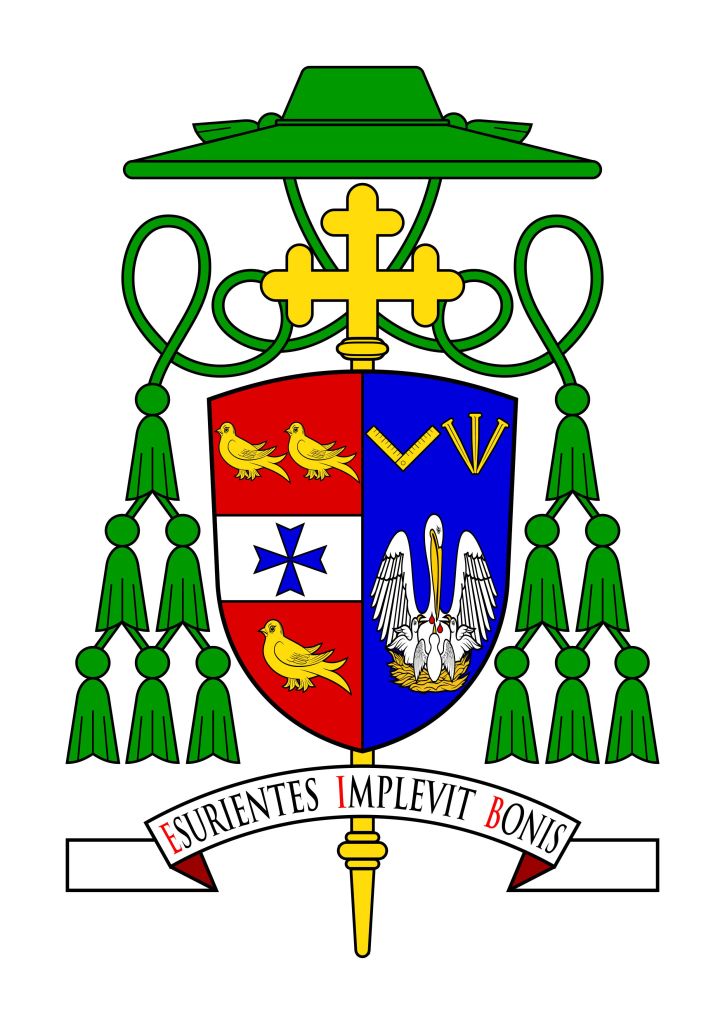
The Rev. Joseph Caddy (64) a priest of the Archdiocese of Melbourne in Australia will be ordained a bishop on August 15 and installed as the 10th Bishop of Cairns, Australia.

His armorial achievement, to be assumed upon episcopal ordination, is as follows:

The existing arms of the diocese occupy the dexter impalement. The personal arms consist of the pelican in its piety. This is borrowed from the coat of arms of Corpus Christi College which was the seminary attended by the armiger. Its eucharistic imagery is also reflected in the motto which translates to, “He fills the hungry with good things”. The carpenter’s square in chief is a reference to his Baptismal patron, Joseph and because his father, grandfather, and one brother are/were all carpenters.

The three Passion nails meeting in base allude to the coat of arms traditionally used by the English Caddy family which depict three piles engrailed meeting in base. The square and the nails, then, are a reference to his given and family names.

I was happy to act as a consultant on the design of the bishop’s personal arms in conjunction with Mr. Richard d’Apice, AM, KCSG. The artwork was very nicely done by Mr. Sandy Turnbull of Australia. Both are members of the Australian Heraldry Society.

UPDATE: Thanks to a comment from a regular reader asking about the diocesan arms we made a change. His question prompted me to refer back to my collaborators. In turn, the Diocese of Cairns was contacted and I, myself, delved into the pretty good small library of my own which I have amassed over the last thirty years. It turns out that our original depiction showed an fimbriation that really shouldn’t have been there! So, it was back to the drawing board for Mr. Turnbull who promptly made the correction. The end result is the corrected , and I think improved, coat of arms for Bishop Caddy, well in time for his ordination & installation.

And all thanks to a reader of this blog!

Some Recent Installations/Ordinations in the U.S.

During the last month there have been some vacant Sees filled in the United States. The Most Reverend Christopher Coyne (65) succeeded to the See of Hartford on May 1 becoming its fourteenth bishop (and sixth archbishop). A very fine achievement depicted in the style of the late Deacon Paul Sullivan…except I think it is ill-conceived to place a green cross on a blue field. Yes, there is the slightest fimbriation on the cross to protect against violation of the so-called tincture “rule”. Nevertheless, the overall appearance is odd…and the fimbriation, such as it is, is entirely too narrow to the point of being almost invisible!

The Most Rev. James Ruggieri (56) was ordained a bishop and installed as the fourteenth Bishop of Portland Maine on May 7.

According to the diocesan website, “The personal arms of Bishop Ruggieri are divided horizontally (per fess). The upper half is painted white (argent) and bears an anchor painted blue (azure). It recalls the birthplace and home of the Bishop in the Diocese of Providence, Rhode Island. That state’s flag and seal comprise a gold anchor and a scroll with the motto “Hope.”

The anchor is an ancient symbol of the theological virtue of hope, deriving from the words of the Letter to the Hebrews: “We have this hope as a sure and steadfast anchor of the soul …” (Hebrews 6:19). In this depiction, the stock of the anchor is positioned on the shank to resemble a Passion Cross, an equally ancient symbol of the theological virtue of faith. As Pope Benedict XVI pointed out, “Hope, in fact, is a key word in Biblical faith—so much so that in several passages the words faith and hope seem interchangeable. Thus, the Letter to the Hebrews closely links the “fullness of faith” (10:22) to “the confession of our hope without wavering” (10:23).

In the lower half of the shield is a depiction of the five loaves and two fish that the Lord Jesus multiplied to feed five thousand men and their families. The only pre-resurrection miracle that is recounted in all four Gospels (Mt 14:13-21; Mk 6:32-44; Lk 9:10b-17; Jn 6:1-15), it holds a special place in the story of the public ministry of Jesus and points to the institution of the Eucharist at the Last Supper. The Feeding of the Five Thousand also highlights the cooperation of the apostles – whose successor the bishop is – with the Lord, both in the ministry of charity, and as celebrants and guardians of the Holy Eucharist and the other sacraments.”

The episcopal cross is depicted incorrectly, but more about that to follow.

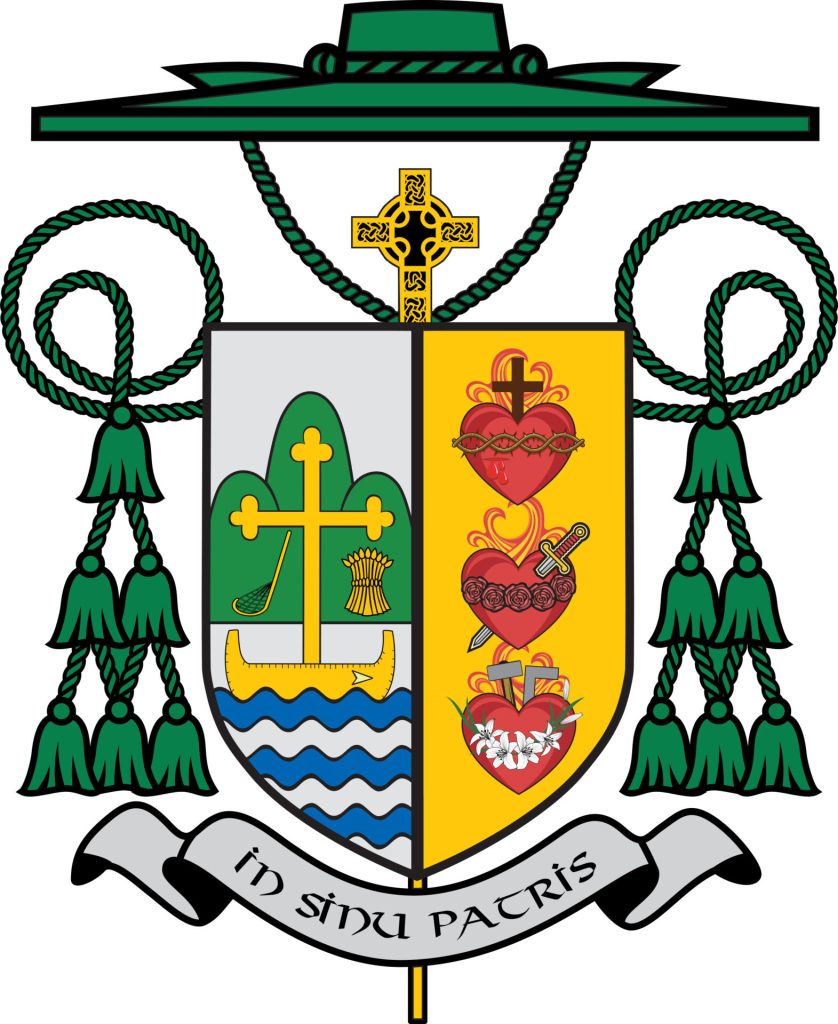
The Most Rev. William Battersby (64), Auxiliary Bishop of Detroit, was installed on May 20 as the eleventh Bishop of La Crosse, Wisconsin.

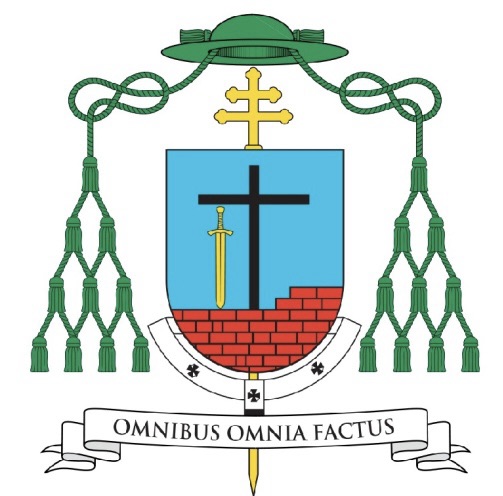
His coat of arms, while very simple, seems a bit overly given to the devotional. The explanation from the diocesan website says, “For the personal coat of arms of Bishop Battersby…at the top of the shield is a Celtic processional cross meant to honor Bishop Battersby’s Irish heritage. It is shaped like a traditional cross but with a ring, representing the sun, around the intersection of the stem and arms. The whole cross is decorated with ornate Gaelic patterns.

Bishop Battersby’s Coat of Arms includes the three Sacred Hearts. The hearts represent the Holy Family and symbolize the unending and boundless love for us. The wounded heart signifies his devotion to the Sacred Heart of Jesus. It also pays tribute to Sacred Heart Major Seminary where he prepared for the priesthood and at which he served as vice-rector and dean of seminarian formation at the time he was called to the episcopacy.

The second heart, the Immaculate Heart of Mary, signifies the trust and confidence that Bishop Battersby has in the Blessed Mother’s intercession and protection. The sword symbolizes the sorrows of Mary, the flames represent her burning love for Jesus and us, her children and the roses represent her purity. 

Bishop Battersby’s devotion to St. Joseph is represented in the third of the Sacred Hearts, the Chaste Heart of Joseph, inflamed with love and adorned with the white lily of purity, a symbol of his faith and steadiness.”

Again, I’ll say something about the episcopal cross below.

May 29 saw the ordination and installation of the Most Rev. Michael Martin, OFMConv (62) as the fifth Bishop of Charlotte, North Carolina.

The diocesan website describes his personal arms, “To the viewer’s right is the Franciscan coat of arms. Featuring the traditional Franciscan Tau cross with two arms crossing one another, it is rich in symbolism. The two arms, one Christ’s and the other St. Francis of Assisi’s, both bear the stigmata. They symbolize God’s love and Francis’s loving response to the Word made incarnate, Taberski explained. It is an image found throughout the ministries, friaries, missions and sites served by the Franciscan order.

On the right side of the shield, the top (known as the “chief”) and the bottom (the “base”) feature references to George Calvert and his son Cecil Calvert – the first and second barons of Baltimore. The Calverts were among the first Catholics to arrive in colonial America. They established the then Province of Maryland as a safe place for English Catholics to emigrate to since they were no longer able to freely practice their faith at home. In the coat of arms, the use of six vertical stripes – alternately gold and black, with the diagonal stripe in color – recalls Bishop Martin’s hometown of Baltimore.”

A nice simple design but perhaps the arms of Calvert would have looked better depicted once in the main part of the field with the Franciscan symbols occupying a chief? And again there is an incorrect episcopal cross!

So, my criticism of that, which I have often written about in this blog, is that, firstly, it is NOT a “processional” cross!! It is an episcopal cross—a heraldic symbol—which indicates the coat of arms belongs to a bishop. It is, in fact THE heraldic symbol indicating episcopal arms. The galero, while traditional, is not necessary, nor is a green galero with 12 tassels exclusive to the arms of bishops. But the inclusion of the episcopal cross is truly the sign—and the only essential one—to indicate that the achievement depicts the coat of arms of a bishop.

As an external ornament it is NOT subject to personalization. An armiger has a great deal of choice regarding what is depicted on the shield. However, the external ornaments are not subject to his whim, nor may they be used to convey further personal significance or symbolism. Rather, their purpose is to indicate rank in the overall achievement. The blazon may not specifiy a certain type, shape, color, ornamentation, or embellishment to the galero, or the episcopal cross. Each and every artist is free to depict the episcopal cross as he pleases.

This idea of extending the personal symbolism to the external ornaments is occurring more and more of late…as more and more people with very little background in, or knowledge of heraldry are being asked to design episcopal coats of arms. It is amateurish and a grossly mistaken thing to do.
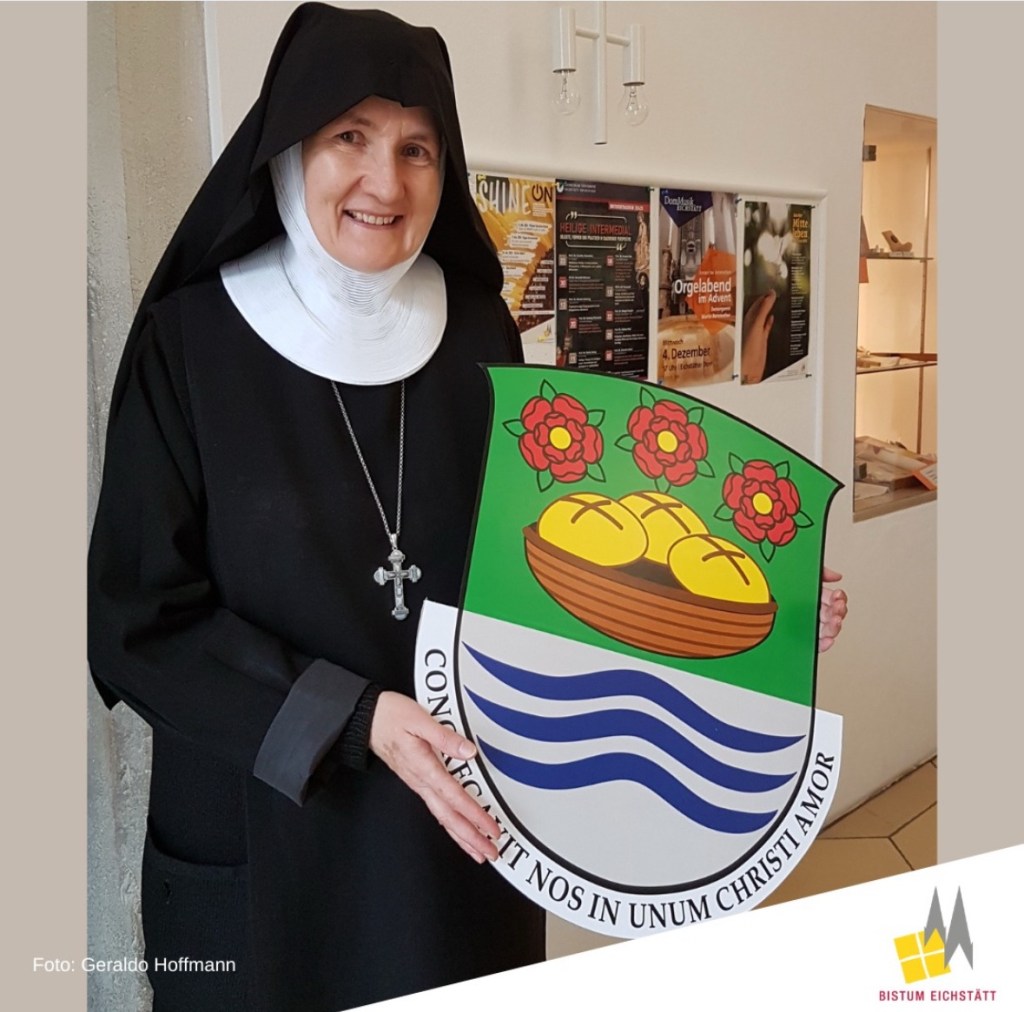
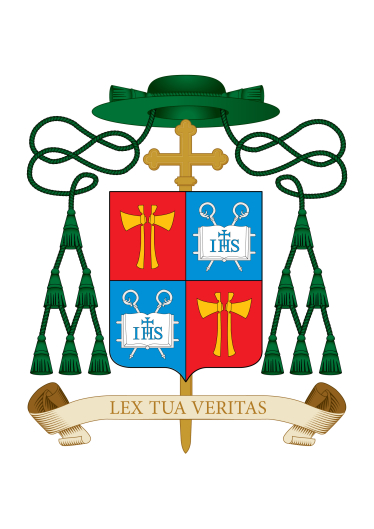
Cardinal Gibbons

The varied armorial bearings of James Cardinal Gibbons. I often speak about the incorrect practice of a prelate deciding to change or modify his existing coat of arms. Even when arms are assumed (as opposed to granted by a heraldic authority) the bearer should not feel free to completely change them. Sometimes arms are augmented to reflect a new honor received or a change in status. However, completely changing a coat of arms, once assumed, should be avoided.

Gibbons was made Vicar Apostolic of North Carolina which did not yet have its own diocese, in 1868 and served there until he was made Bishop of Richmond, Virginia from 1872-1877. He bore the first coat of arms in both of those places. When he was made archbishop of Baltimore in 1877 he simply modified the external ornaments to reflect his promotion but still used the same shield depicting the seated Virgin Mary. Over the course of the next 44 years of his tenure in Baltimore he then changed his coat of arms no less than three times!

He adopted the arms showing the Holy Spirit descending from a cloud over the globe and also made use of an impalement depicting a pall (pallium). This would have been before the archdiocese had a coat of arms for itself and Gibbons was simply doing with this variant what many an archbishop had done. Namely, using an impalement with a pallium to indicate the status of a metropolitan archbishop.

In 1911, however, he changed his arms entirely again and adopted the coat of arms he bore until his death in 1921. These were done for him by Pierre Chaignon La Rose and I would think that what brought about the last change was the adoption of an archdiocesan coat of arms with which Gibbons’ personal arms were impaled. No doubt La Rose, who was fond of “correcting” coats of arms he didn’t like, convinced Gibbons to adopt the last design which was based on the arms of Gibbons used in Ireland (by a family the cardinal may or may not have had any connection to) differenced by the escallop shell, a symbol of St. James.

I have to admit his original coat of arms wasn’t very good and the final one he ended up with was rather good. But, the process of making many and varied changes throughout his life is not good at all.

Notker Wolf, OSB – RIP

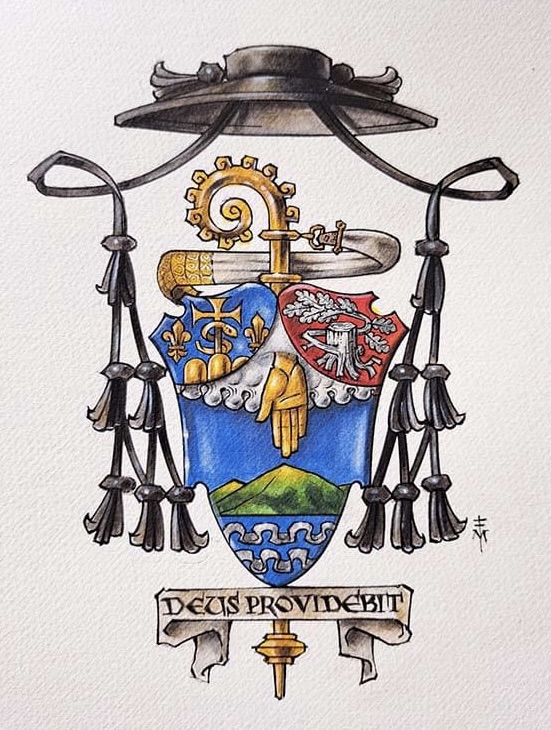
The Most Rev. Notker Wolf, OSB (83) the former Abbot-Primate of the Benedictine Confederation (2000-2016) who, before that, served as the Archabbot of St. Ottilien Archabbey in Germany from 1977-2000 passed away in Frankfurt on April 3, 2024. He had been leading a pilgrimage to Italy but felt unwell. In trying to return home he stopped off overnight in Frankfurt awaiting a morning flight to Munich but passed away during the night in his hotel room.

His arms (rendered by the late Michael McCarthy) were slightly modified after he originally assumed them (second image). In addition, the artist chose to give his galero an extra row of tassels since he was Abbot-Primate of the Order but there is no precedent for such a decision. Abbot-Primate and Archabbots usually use a galero with twelve tassels as other Abbots do. The arms reflected his love of music as well as his own Benedictine monastic life.

May he rest in peace.

Bishop Barbosa

On Saturday, February 3, the Most Rev. Christiano Barbosa (47) a priest of the Archdiocese of Boston, was ordained as the Titular Bishop of Membressa and Auxiliary Bishop of Boston by His Eminence Sean Cardinal O’Malley, OFM Cap.

The anchor is a fitting charge and placing it overall is also fine heraldically but having it right up against the rather unnecessary “diminished” bordure when they are both gold is heraldically questionable and artistically awkward. The use of the constellation of the Southern Cross as a symbol for Brazil is also a bit odd since it’s usually associated with Australia or New Zealand owing to its inclusion on the flag of those nations.

Other than that the rest of the achievement is fine.

Bishop Dorsonville RIP

The Most Rev. Mario Dorsonville (63) a native of Bogotá, Colombia who incardinated as a priest of the Archdiocese of Washington, DC in 1999, and who also served as Auxiliary bishop of that same archdiocese from 2015-2023 before being appointed as the 5th Bishop of Houma-Thibodaux on February 1, 2023, sadly passed away on January 19, 2024. His funeral will take place on February 1 exactly one year after the announcement of his appointment as bishop of the diocese. May he rest in peace.

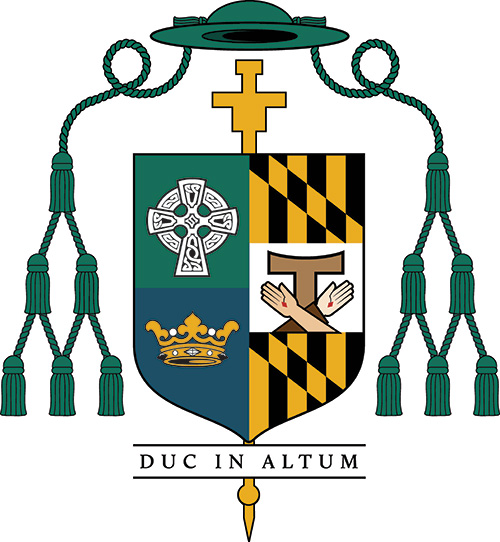
Bishop Maekawa, OP

On October 12, the Most Rev. Stephen Maekawa, OP (55) a priest of the Order of Preachers (i.e. the Dominicans) living and working in Alaska was ordained a bishop and installed as the 10th Bishop of Fairbanks, Alaska.

His coat of arms is:

According to the diocesan website:

In the right side of the shield (to the observer’s left), we find represented the coat of arms of the Diocese of Fairbanks. At the base, the North Star is suspended on a blue field over the mountains of Alaska, which appear in white. In the upper section, between two red roses on a field of gold, is the Sacred Heart of Jesus, titular symbol of the Cathedral of the diocese. The roses, representing St. Therese of Lisieux, patroness of the Alaska Missions, recall her promise, “After my death I will let fall a shower of roses.

In the left side of the shield (to the observer’s right) is the personal coat of arms of Bishop Maekawa. The black and white cross is the from the coat of arms of the Order of Preachers founded by St. Dominic in 1216. The waves represent the waters of baptism and the family name Maekawa which means “before the river.” The episcopal motto “Duc in Altum” is Jesus’ command to the Apostle Peter, “Put out into the Deep” which reminds us to trust in the Lord Jesus believing that all creation belongs to God: “The earth is the Lord’s and all it holds, the world and those who dwell in it.” (Ps 24:1)

I think, unsurprisingly, the bishop has chosen a simple coat of arms reflecting his Religious community. It harmonizes well with the diocesan arms with which it is impaled. A nice design that doesn’t try to do too much–perhaps the single biggest error made by most new American bishops.

The L.A. “Quad”

On September 26, in an unprecedented liturgy, the Archdiocese of Los Angeles received four new Auxiliary Bishops at the same time. While it is unusual for any diocese to receive so many new bishops at once it seems almost fitting for the U.S.’s largest archdiocese of well over 4 million Catholics to receive the needed assistance in episcopal ministry in order to serve the people of southern California adequately. Bishops Albert Bahhuth (66), Matthew Elshoff, OFM. Cap.(68), Brian Nunes (58) and Slawomir Szkredka (49) were all ordained to the episcopate by the Most Rev. José Gomez, Archbishop of Los Angeles.

Their armorial bearings were all designed by James-Charles Noonan. As he usually does he makes a great deal about the shape of the episcopal cross in each achievement as well as the “significance” of the shape and color of the gemstone in each one. None of that is heraldically supportable. It may be his favorite idea but, as I have written about extensively in the past, the external ornaments in a coat of arms are not personalized not do they contain unique and special symbols particular to the armiger. That would require they be blazoned as such and would then have to be copied by any artist rendering the coat of arms. Only the charges on the shield are unique to the armiger.

Even there, Mr. Noonan has placed his own stamp on these four coats of arms. Acknowledging the unusual nature of four bishops being ordained at once he has included a similar chief in all four coats of arms as a means of tying them all together by the use of this similar charge. The idea in and of itself has some merit. The occasion was unique; something unique to mark it is a nice idea.

However, the coats of arms of auxiliary bishops do not contain charges that represent the jurisdiction in which they will serve as auxiliary bishop. A heraldic representation of possessing jurisdiction over a diocese belongs to the Ordinary of the diocese alone. In addition, a reference to the diocese (by borrowing a charge from the diocesan coat of arms) is quite common in heraldry. But, that isn’t what has occurred here. Instead of each coat of arms borrowing some charge from the arms of Los Angeles the four new bishop’s arms all bear an almost identical chief–an ordinary charge–in a manner not unlike those used to signify membership in a Religious Order or an Order of Chivalry.

Don’t misunderstand me: my criticism is not of the idea of heraldically marking the unusual circumstance of four bishops being ordained all at the same time. Rather, it is of the use of a near-identical charge, and one that sort of implies a kind of jurisdiction, that I am criticizing. It’s a clever devise. But, perhaps a bit “too clever” for its own good. In addition, one has to consider that all four of these bishops may not–indeed very likely will not–remain as auxiliaries of Los Angeles permanently. Once one of them is translated to another diocese the whole unifying symbolism uniting all four coats of arms begins to fall apart. Perhaps the use of a single similar charge employed differently in each of the coats of arms would have been a better solution?

The design of each of the rest of the four coats of arms is quite correct and very nice. As usual, Mr. Noonan’s regular collaborator in producing the artwork has shown herself capable of creating very fine work.

The following are the coats of arms of Bishops Bahhuth, Elshoff, Nunes and Szkredka: