Category Archives: Fr. Guy’s designs

Bishop Persaud of Mandeville

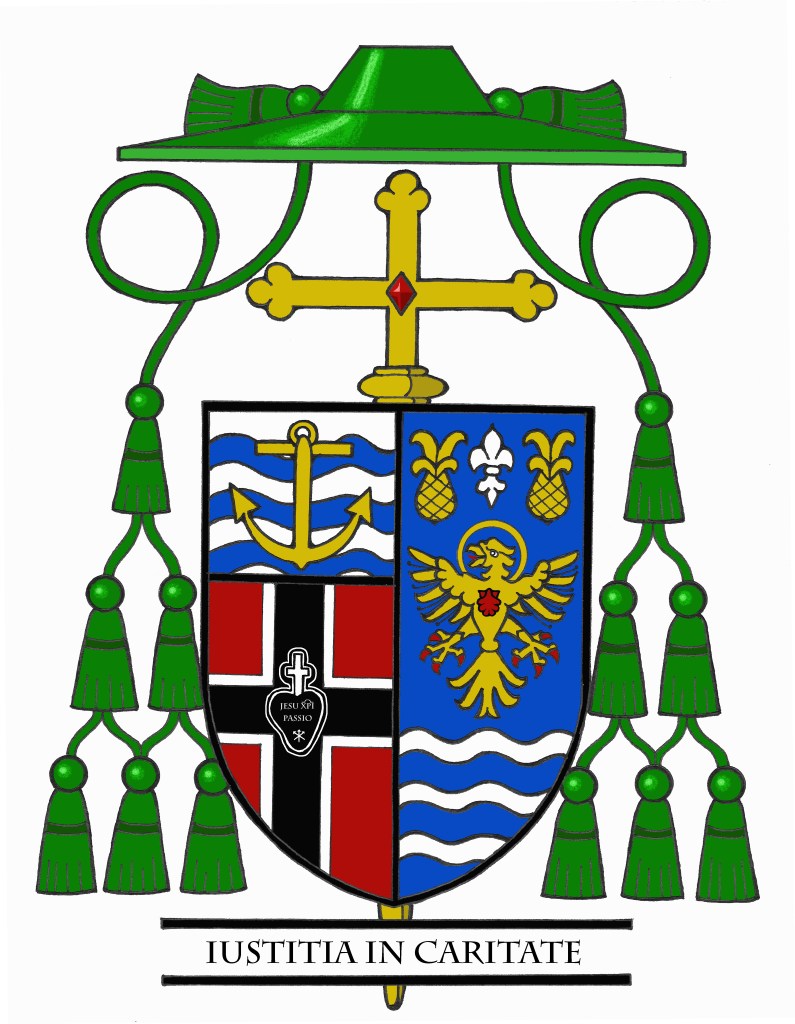
On September 19 the Most Rev. John Derek Persaud (64) a priest of the Diocese of Georgetown, Guyana will be ordained a bishop and installed as the fourth bishop of Mandeville, Jamaica. I was pleased to be able to design his personal coat of arms and marshal it to the existing armorial bearings of the See.

The coat of arms of the Diocese of Mandeville depicts a red field on which there is a black cross filling the space. The cross is outlined in silver (white) to offset it from the red background. In the middle of the cross is the heart with the cross on top of it that is the emblem of the Congregation of the Passion of Jesus, more commonly known as “The Passionists” who were instrumental in the foundation of the diocese. On the upper third of the shield, called a “chief” are blue and silver (white) wavy bars suggesting the waves of the ocean with a gold (yellow) anchor, a symbol of Hope, placed overall.

Bishop Persaud’s arms depict a blue background on which there is a gold (yellow) eagle bearing a red scallop shell on its breast. The halo on the eagle’s head indicates it is the symbol of St. John, the Apostle and Evangelist. The given name John means “a gift from God”. In addition, the bishop’s family name, Persaud, means “gracious gift” derived from the Hindi word, “Prasad”. As both the bishop’s given name and family name have similar meanings the eagle as a symbol of St. John represents both. The red scallop shell on its breast is a heraldic symbol for St. Augustine, to whom the bishop has a special devotion.

In the lower part of the shield the silver (white) wavy lines suggest waves of the sea. This is borrowed from the coat of arms of the bishop’s native country, Guyana, the name of which means, “Land of many waters”. In addition, they also appear in the arms of the See of Mandeville so they possess a double meaning. Above the eagle there are two gold (yellow) pineapples borrowed from the coat of arms of Jamaica, the bishop’s newly adopted country. These are on either side of a silver (white) fleur-de-lis, a heraldic symbol for Our Lady.

The motto below the shield is, “Iustitia in Caritate” (Justice in Love)

The shield is also ensigned with those external ornaments that indicate the bearer is a bishop. The gold (yellow) cross is placed vertically behind and extending above and below the shield. This is often mistakenly thought to be a processional cross like those used in liturgical processions. However, in former times archbishops, and later all bishops, had a cross mounted on a staff carried immediately in front of them while in procession or on solemn occasions. This cross was a symbol of their rank as bishop. While such an episcopal cross is no longer used practically it has been retained heraldically. In fact, there are other clerics who make use of the ecclesiastical hat with its many tassels but the one true heraldic emblem of a bishop, and the only essential one, is the episcopal cross placed behind the shield.

Above the shield is the ecclesiastical hat, called a galero which, in heraldry, replaces the martial helmet, mantling and crest. “The hat with six pendant tassels (green, purple or black) on each side is universally considered in heraldry as the sign of prelacy. It, therefore, pertains to all who are actually prelates.” (Heim, Bruno B., Heraldry in the Catholic Church 1978, page 114) The galero is green with green cords pendant from it and twelve green tassels arranged in a pyramid shape on either side of the shield. At one time in history bishops and archbishops wore green before adopting the more Roman purple we see today. In heraldry the green hat and tassels was retained for prelates with the rank of bishop according to the Instruction of the Secretariat of State, “Ut Sive” of March, 1969.

Do The Work

I’m very gratified whenever someone tells me that they regularly take a look at this blog. Sometimes they will mention that they have learned a thing or two in what they’ve read here and sometimes they also, jokingly or occasionally chidingly, tell me that they are surprised at the sharpness of my criticisms. With increasing frequency, however, I’m also hearing often in both direct contact with me or in other places on the internet where heraldic enthusiasts congregate that those of us who seem to know more about heraldry should do more to educate those who wish to learn more.

First, let me say that the “those who wish to learn more” frequently fall into two categories. There are those who, for whatever reason, have an interest in learning as much as they can about heraldry for their own enrichment. They understand that a study of heraldry means delving into a world of history, genealogy, symbolism and, lastly, art. Heraldry is a science as well as an art. It isn’t just about pretty pictures or “cool” images of dragons and basilisks. It’s not the domain of medieval fantasists (although many of them do enjoy it) or social-climbing faux nobles. It is a perfectly good hobby, so to speak; a wonderful subject to which one can devote a lifetime of study and learning. In addition, a few also become intimately involved in it as a profession or as an avocation and create new coats of arms for the deserving and the desirous. Whether someone becomes a practitioner of heraldic design and art or simply remains a great enthusiast it is a topic about which you can never stop learning more.

But then there is the other type who, again for whatever reason, have an interest in heraldry but don’t really care all that much about learning the “why and wherefore” of heraldic history or design. They have no interest whatsoever in the many ways the development of heraldry differs from country to country or during different centuries. They have, perhaps, read one or two books on heraldry (or maybe even as many as three!) and have now decided that they’ve “got this”. They are now as expert on the topic as the Garter King of Arms. Therefore, the time has come for them to hang out a shingle and begin creating coats of arms themselves…as a “herald”.

Ironically, despite being convinced of their own expertise, it is this second category who seem to complain the most and the loudest that those individuals and organizations online who offer criticism of heraldic designs owe it to everyone else to educate them more.

Well, first of all, reading someone’s criticism of a design should actually help the less educated to learn more in itself. Although, having said that, I must admit that when I come across really appalling examples I often don’t go into a detailed analytical criticism of the coat of arms but just express my great displeasure by means of some exclamation like, “Awful!”. I’ll grant you that someone is hardly likely to learn much from that other than that I didn’t like it.

My area of particular interest is, obviously, ecclesiastical heraldry. This is an interesting sub-set of heraldry that crosses over time and boundaries and has many rules, customs and traditions of its own despite the fact that there is no umbrella heraldic authority over the entire Church. In places where a heraldic authority does exist the coats of arms of clerics are just as subject to that local authority as the armorial bearings of anyone else. The Church makes no claim to having some kind of supra-national jurisdiction over the regulation of heraldry worldwide. Famously, St. John XXIII (himself a heraldic enthusiast) wanted to establish a Pontifical Office of Heraldry. His former secretary and good friend, Abp. Bruno Heim, talked him out of it. Heim said that one couldn’t legislate in matters of taste. He also had a healthy respect for the different ways heraldry developed in different countries and a real love of heraldic creativity. He knew such a Pontifical Office would tend to standardize Church heraldry and stifle creativity.

So, that’s one of the reasons there isn’t now, nor is there likely to be, an office to regulate the armorial bearings of clergy, prelates and institutions in the Church.

Throughout history the Church has primarily concerned itself with the external ornaments of heraldry. That is, those things that are placed around the shield rather than on it which indicate the rank and/or function of the armiger in question. What actually goes onto the shield is a matter of individual taste or family history or inheritance or anything else that would make for a unique mark of identification for the bearer of the coat of arms. The Church has no great desire to get into that. Those are precisely the kinds of things some heraldic authorities do get into. I know someone who had applied for a grant from the College of Arms in England and the individual wanted the shield divided per bend. He was told to modify that request because, in England, they preferred not to divide the field that way. I know of another case where a bishop wished to receive a grant from the Court of Lord Lyon. His arms were designed by a very competent expert in heraldry but they contained a field chequy and Lord Lyon didn’t allow such a field so the design had to be changed. The Holy See has neither the time, the resources to devote, or the desire to get into that kind of heraldic regulation. Rather, it tends to concern itself with things like the appropriate color of the tassels on a galero to indicate a Prothonotary Apostolic, etc.

So claiming that it is the job of the Holy See to provide guidance in this area isn’t the answer especially as they already do to some extent. Similarly, it isn’t the job of the various heraldic societies that exist to make sure everyone knows every and any rule of the heraldic science. For the most part those societies exist for people who already know and appreciate heraldry somewhat and wish to share their love of the subject with other enthusiasts. There is an educational element to that but it comes primarily from mutual enrichment rather than mere instruction. There are the many heraldic artists in the world, many of whom now have a website to display their work and solicit business. But they are not necessarily experts in heraldry. Rather, many of them are happy to provide heraldic artwork, itself a speciality that not every competent artist can undertake, but it is not necessarily their task to educate. Finally, there are the heraldic enthusiasts like myself who have a website or blog and who, sometimes a bit flippantly, offer exposure and criticism in an effort promote good heraldic practices and, perhaps, help some people to avoid bad ones. But, I put it to you that while having such a blog may help others to learn that does not make it incumbent upon me to attempt to provide an exhaustive course of study in the particulars of ecclesiastical heraldry. After all, this is something I do for fun!

No, the problem in the world today, especially since the advent of the internet and social media, is that, as usual, people want something for nothing. They want some quick and easy way to skip over the hard stuff and be provided with all the answers they need at the click of a mouse. To put it another way, they don’t want to do the work.

Occasionally, someone is kind enough to describe me as an “expert” in ecclesiastical heraldry, especially Catholic heraldry. That’s very kind. To the extent that it may be true it is so for one reason and for one reason only. It’s because I undertook to begin a serious study of heraldry when I was a young man and have stayed with it for over 35 years. I started doing this before there was an internet (or one to speak of) and it was difficult to communicate with others who shared my enthusiasm. But, I was willing to delve, to do research, to read extensively, to slowly build up a personal heraldic library, to seek the advice of experts and then eventually to come under the tutelage of a person who could critique my own ideas and help me to learn by making mistakes. I did the work!

There are a lot of resources available…if you’re willing to roll up your sleeves and do some good, old-fashioned research. You can’t learn about heraldry by reading an book, or two, or even three. You definitely can’t learn about ecclesiastical heraldry by looking at pictures of other bishop’s coats of arms alone. For example, if you look in the back of a really good book on Church heraldry like Bruno Heim’s Heraldry in the Catholic Church you’ll find not only a bibliography but several appendixes quoting papal documents. How many people have undertaken to look up and obtain full texts of those documents and then have them translated into their own language if they don’t have a good command of Latin?

I did.

How many people who claim to really love Church heraldry look at the books in Heim’s bibliography and then set out to obtain as many of them as possible for your own library, or at least track copies of them down in a lending library?

I did.

How many heraldic enthusiasts who can draw reasonably well have said no to undertaking heraldic commissions because they realize they don’t really know enough about heraldry to create a coat of arms for someone else so they wait several years in order to learn more and become more competent in the field before daring to be so bold as to design a coat of arms for someone else?

I did.

To become really good at this -not the world’s greatest, but just really good- takes a lot of effort, a lot of time and a lot of work. Sadly, there are too many people involved with the creation of heraldry who simply don’t want to make the effort, put in the time or do the work. THAT’S why there is so much bad heraldry floating around the Church. It’s because too many people who have no business whatsoever creating coats of arms are doing so. For a bishop to go to a friend, or relative, or seminarian and say, “You draw well. Why don’t you do my coat of arms?” is like me going to a friend and saying, “You know how to sew on a button so why don’t you make me a chasuble?” It’s preposterous! But, it happens all the time. Ignorant dilettantes who don’t have the sense to seek out the advice of someone with greater expertise, let alone refer their “client” to someone with greater expertise, are getting involved in droves in the design and creation of coats of arms in the Church. Not only are the resulting designs really bad but then they have the audacity to say that someone else: the Holy See, a heraldic society, or even a blogger should provide more guidance and instruction to them so that they can avoid mistakes.

Well, I don’t agree. I’m living proof that the resources and material are out there and can be found with a little effort. What is required is having the humility to start out as a student and not jump immediately into attempting to do something about which you know very little as though anyone can do it. It requires the ability genuinely to learn from criticism instead of simply becoming defensive in the face of it. Most importantly, instead of expecting someone else to provide you with ready-made answers at your fingertips so that you can reap all the benefit of the years of effort someone else has made to increase their knowledge and expertise while at the same time barely lifting a finger yourself you need to…

DO. THE. WORK!
Bishop Marshall of Alexandria, Louisiana

On August 20, 2020, the Most Rev. Robert Marshall (61) up until now a priest of the Diocese of Memphis, Tennessee will be ordained a bishop and installed as the thirteenth bishop of Alexandria, Louisiana. The diocese was founded originally as the diocese of Natchitoches and was later called Alexandria and then Alexandria-Shreveport until Shreveport was separated to be its own diocese in 1986.

Bishop Marshall’s coat of arms impaled with those of Alexandria are:

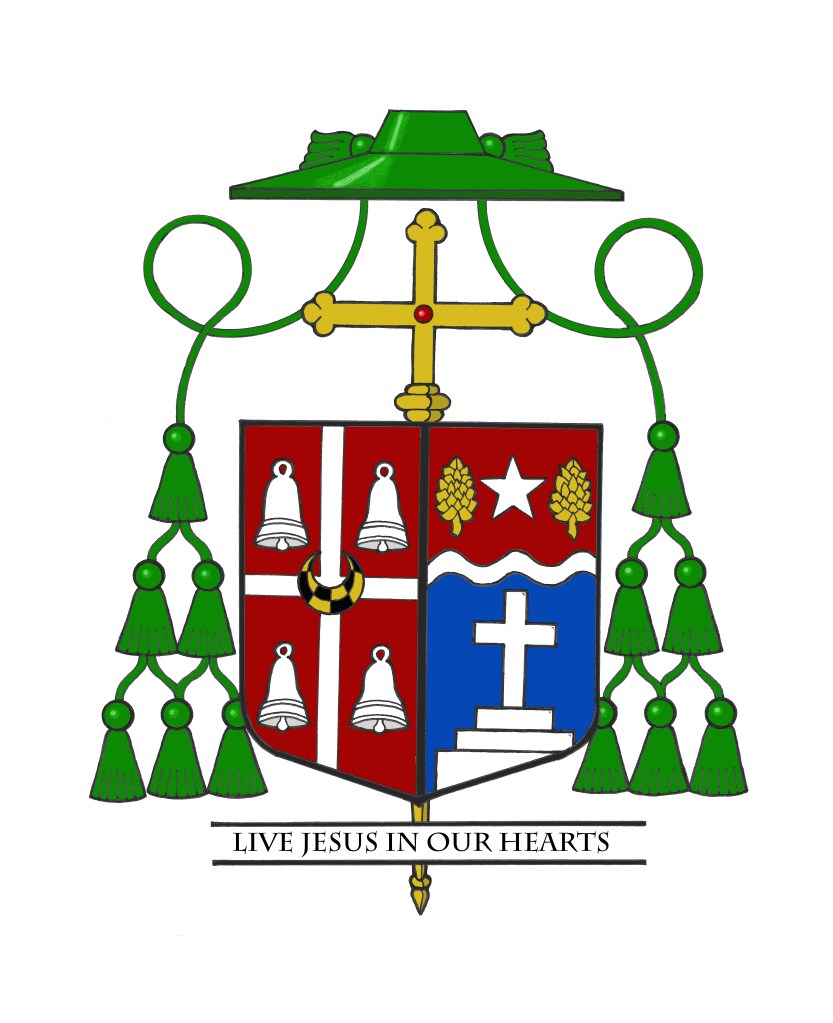
To the left we see the arms of the Diocese of Alexandria. The red background represents the Red River which runs through the city. The silver (white) cross stands for the Christian faith and is surrounded by four bells borrowed from the ancient See of Alexandria, Egypt for which the city that is the seat of the diocese is named. Over all of this is a crescent divided into gold (yellow) and black checks. This is borrowed from the Spanish arms for the family “Xavier” and serves as an allusion to St. Francis Xavier, the titular patron of the cathedral church.

Bishop Marshall’s arms depict a blue background with a silver (white) Cross of Calvary. This type of cross is depicted as a Latin cross (the lower arm being longer than the other three) atop three gradings or steps. Both the background color and the cross are derived from the coat of arms associated with the name “Martin”. This was the bishop’s mother’s maiden name and is used to honor his family heritage. The lower portion of the field is divided from the upper third called a “chief” by a narrow silver (white) wavy line. This wavy line represents the Mississippi River near to which the bishop has lived for most of his life. In addition, a symbol of the Mississippi River is included in the coat of arms of the Diocese of Memphis in which the bishop served as a priest prior to becoming a bishop.

 On the red background of the chief are a single silver (white) five-pointed star between two gold (yellow) pine cones. The star comes from the emblem of the LaSalle Christian Brothers who educated the bishop both in his high school and college years as well as educating his father and uncles. That Religious Community of men had a profound and lasting impact on not only the bishop’s education but also on his spiritual life and journey and on the lives of his family. The red background and pine cones are borrowed from the coat of arms of the bishop’s patron saint, St. Robert Bellarmine.

The motto below the shield is, “Live, Jesus In Our Hearts” from a prayer attributed to St. John Baptist de La Salle (1651-1719), founder of the Institute of the Brothers of the Christian Schools and patron saint of teachers of youth.  The prayer is used multiple times each day in LaSallian schools throughout the world.  It is used most frequently in dialog.  The leader says, “Live Jesus in our hearts,” and the students respond, “Forever!”

It was my privilege to design the bishop’s personal arms, marshal them to the arms of the See and emblazon them.

Bishop Tylka of Peoria

On July 23, the Most Rev. Louis Tylka (50), a priest of the Archdiocese of Chicago, will be ordained a bishop in the Church and also become the Coadjutor Bishop of Peoria, Illinois. A Coadjutor Bishop functions within the diocese very much like an Auxiliary Bishop and has duties that are at the discretion of the Diocesan Bishop. However, what distinguishes a Coadjutor Bishop is that he has a right to automatically succeed to the See on the death or resignation of the current Diocesan Bishop. So, when the day comes that Bishop Jenky, CSC of Peoria leaves office Bishop-Elect Tylka will immediately succeed him as Diocesan Bishop.

The coat of arms he assumes now is his personal arms alone which will, in due time, be impaled with those of the Diocese of Peoria after he succeeds to the See.

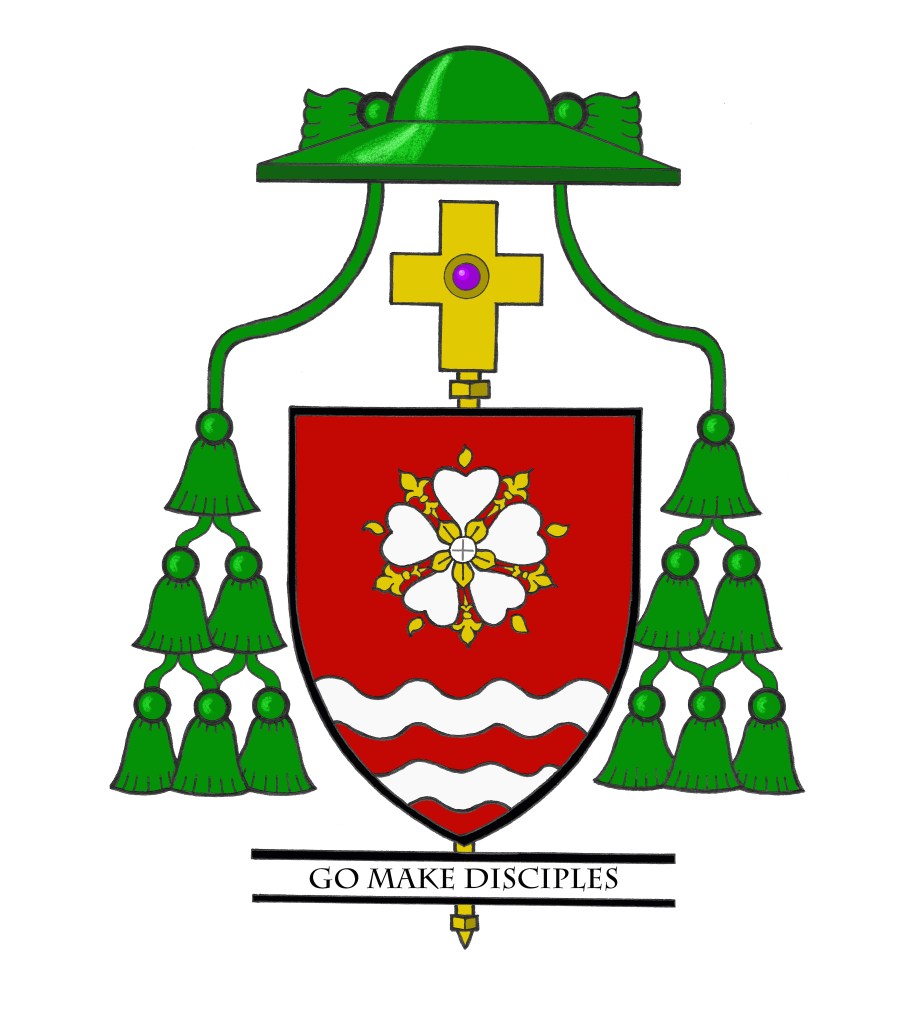
The field is red which is a color associated with the Holy Spirit. The life of any priest and bishop is placed under the guidance of the Holy Spirit. The two silver (white) “waves,” at the bottom of the shield symbolize Lake Michigan (the shores of the archdiocese of Chicago where Bishop Tylka served prior to becoming a bishop) and Lake St. Mary (at the seminary which the bishop attended). Together the waves hearken to our Baptism which initiates into the life of Christ and also alludes to John the Baptist.

The main charge – a mystical rose – is composed of several elements that are layered as each aspect of our faith builds upon the various encounters we have with the Lord, the Church and others. Together, they create a symbol of the Blessed Virgin Mary. This is a slight reference to the parish of Mater Christi where the bishop served for ten years as pastor. In addition, the rose also alludes to the need to grow in our faith which blossoms as it grows. The larger petals of the rose consist of heart-shapes surmounted by small tongues of fire resembling the traditional image of the Sacred Heart of Jesus. This represents His sacrificial love for us. The flames above each heart also remind us of the Holy Spirit. Coincidentally, the Sacred Heart was a particular devotion of St. Julie Billiart, the patroness of the parish in which the bishop has served as pastor for the last six years.)

At the center of the rose are five gold (yellow) petals surrounding a silver (white) roundel on which there is a cross. This represents the Sacred Host in the monstrance and it is placed at the center of the whole image as a way of expressing the Eucharist being at the center of the life of faith. Traditionally a heraldic rose is depicted with thorns which, in this instance, have been shaped like the fleur-de-lis. This has multiple meanings as it alludes to St. Joseph and to the bishop’s home parish of St. Joseph, St. Louis the King (the bishop’s baptismal patron) and the Archdiocese of Chicago (from whose coat of arms they were borrowed).

Blazoning this complex charge was a bit challenging but it turned out to be, “…a Mystical Rose composed of five heart-shaped petals Argent each surmounted by a tongue of fire Or surrounding an inner circle of petals Or; seeded with a plate charged with a Greek cross Sable and barbed with fleurs-de-lis Or.” In general, it’s considered a good practice to keep a blazon as succinct as possible but sometimes, especially as in this case when coming up with something new and unique, it’s best simply to describe it as thoroughly as possible in case someone in the future will be working from the blazon.

The motto below the shield is, “Go Make Disciples” from Matthew 28:19.

The Bishop-Elect requested an emblazonment that was as simple as possible and also reflected his preference for a more modern style.

I was very pleased and happy to design and emblazon Bishop Tylka’s achievement.

Bishop McGovern of Belleville

On July 22 the Most Rev. Michael McGovern (56) a priest of the Archdiocese of Chicago, will be ordained a bishop in the Church and installed as the IX Bishop of the Diocese of Belleville, Illinois.

The new bishop is assuming a personal coat of arms which will be impaled with the arms of the See:

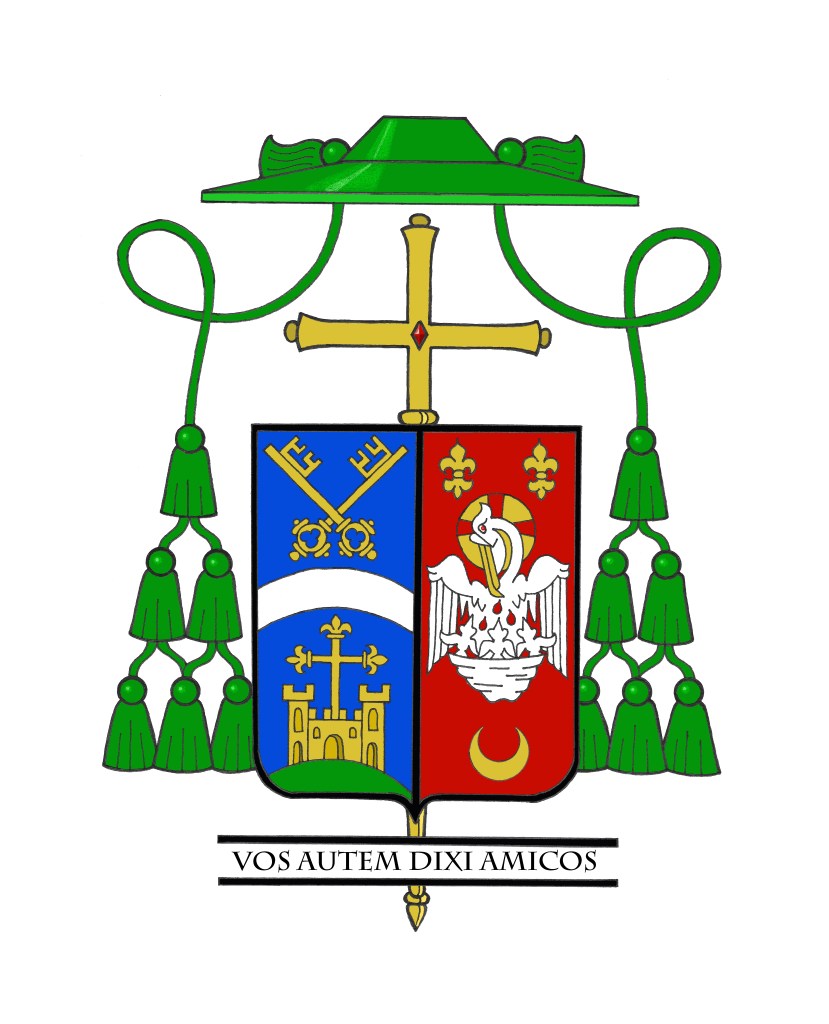
In the dexter (left side as we view it) impalement, Belleville is symbolized by a blue field with a green mount or hill rising from the base of the design. This hill has a dual significance. It refers to Compton Hill, the name of Belleville until 1814, and to Cahokia Mounds near which Bishop Laval of Quebec established the first mission serving the Cahokia Native Americans in 1699. On the top of the hill is a castle which is the traditional symbol for a city (“ville”). It is rendered in gold for beauty (“belle”) which identifies the See city, Belleville. Rising above the castle is a gold cross with arms that end in fleur-de-lis to honor the French missionaries who served the Native Americans of Southern Illinois. Above the castle is an arched bar which is taken from the Coat of Arms of His Holiness, Pope Leo XIII who erected Belleville as a Diocese in 1887. Just above this bar are the symbolic “keys to the Kingdom of Heaven” given by Christ to Simon Peter, the rock on which He built the Church. This is in recognition of the diocese’s Cathedral Church of Saint Peter.

The personal coat of arms assumed by Bishop McGovern combines symbols that are meaningful to him reflecting his spiritual life and priestly ministry. The field is red, a color associated with the Holy Spirit as well as with the Passion of the Lord. The life and ministry of a priest and bishop are rooted in the Paschal sacrifice of Christ and guided by the Holy Spirit. The main charge, a silver (white) pelican in its piety, symbolizes the discipleship to Christ to which all Christians are called. It depicts a pelican vulning its breast, or picking at its own flesh to feed its young with its blood. This is clearly an image of Christ and the Eucharist who calls us all together as His brothers and feeds us with His Body & Blood.

Below the pelican is a gold (yellow) crescent which is a symbol of Our Lady under her title of the Immaculate Conception, the patroness of the United States of America. Above the pelican are two gold fleurs-de-lis which, while also being a symbol associated with Our Lady, are included here because they are taken from the coat of arms of the Archdiocese of Chicago where Bishop McGovern served as a priest prior to becoming a bishop.  

The motto below the shield is, “Vos Autem Dixi Amicos”, taken from John 15:15. Jesus says to His disciples, “I have called you friends, for everything that I learned from my Father I have made known to you.” This, too, is an allusion to the fellowship of discipleship which Jesus gives to all people.

It was both my privilege and my pleasure to design and emblazon the bishop’s coat of arms as well as to marshal them to the existing coat of arms of the See of Belleville..

Bishop Ramon Bejarano

On July 14, the feast of St. Katherine Tekakwitha, the Most Rev. Ramon Bejarano (50), a priest of the Diocese of Stockton, California will be ordained the Titular Bishop of Carpi and the Auxiliary Bishop of San Diego, California.

The coat of arms he is assuming is the following:

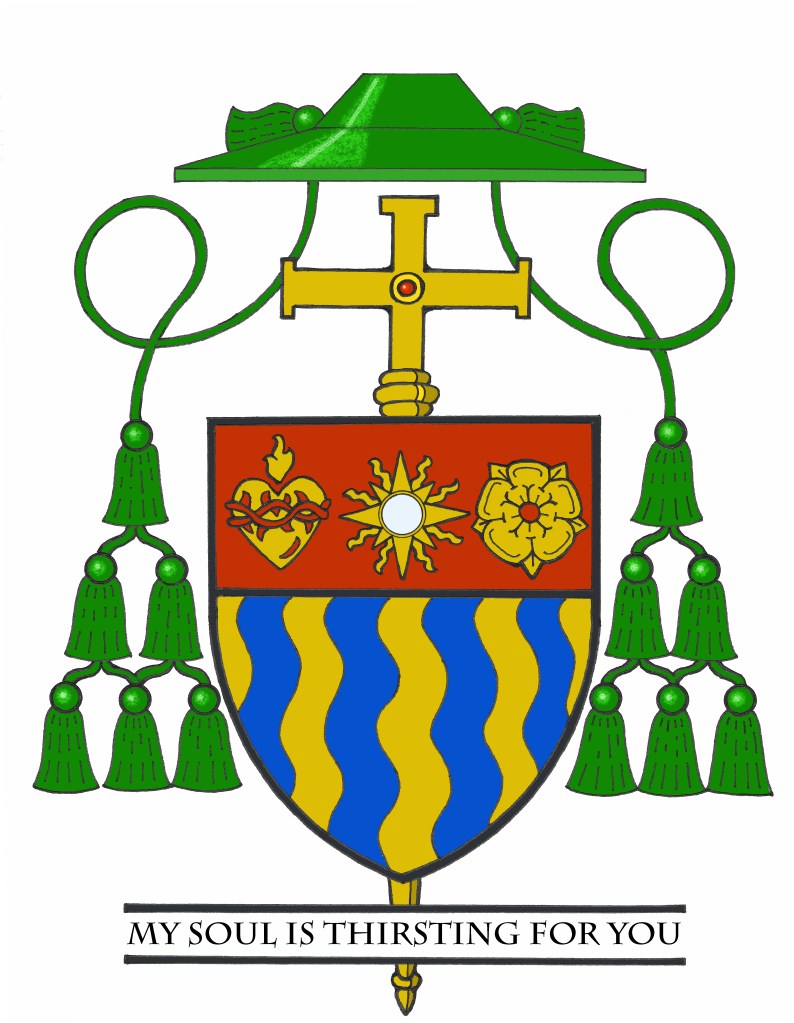
The personal coat of arms combines symbols that are meaningful to him reflecting his spiritual life and priestly ministry. The main part of the shield shows a gold background on which are four wavy vertical lines. These represent flowing waters. This alludes to his chosen motto and also symbolizes the graces that come from the Divine life to quench our thirst for God.

The upper third of the shield, called a “chief” is red because it is borrowed for the coat of arms of the Order of Mercy, the Mercedarians, of which the bishop’s patron saint, Raymond Nonnatus, was a member. The central symbol resembles a monstrance because St. Raymond is often depicted artistically holding a monstrance. Furthermore, the Eucharist is, for Bishop Bejarano, the inspiration for his priestly vocation. It was through the Eucharist that he received his call to the priesthood at age seven and which keeps his faith and his ministry going. It represents the call to offer oneself as a living sacrifice.

The monstrance is flanked on either side by an image of the Sacred Heart alluding to the mercy of God and echoing the idea of a sacrificial offering of oneself united to the sacrifice of Christ and of a rose for Our Lady. In particular, it is an allusion to Our Lady of Guadalupe, patroness of the Americas. This is for the bishop’s Hispanic heritage.In connection with the appearance of Our Lady to Juan Diego the miraculous blooming of roses in December occurred.

The motto below the shield is, “My Soul Is Thirsting For You” from Psalm 63. He chose this because he sees it as also connected with St. Augustine’s phrase about our restless heart. (“Our hearts are restless, O God, until they rest in Thee”) The human heart seeks God, and Bishop Bejarano sees the need for evangelization for so many thirsting souls.

The shield is also ensigned with those external ornaments that indicate the bearer is a bishop. The gold (yellow) cross is placed vertically behind and extending above and below the shield. This is often mistakenly thought to be a processional cross like those used in liturgical processions. In former times archbishops, and later all bishops, had a cross mounted on a staff carried immediately in front of them while in procession or on solemn occasions. This cross was a symbol of their rank as bishop. While such an episcopal cross is no longer used practically it has been retained heraldically. In fact, there are other clerics who make use of the ecclesiastical hat with its many tassels but the one true heraldic emblem of a bishop, and the only essential one, is the episcopal cross placed behind the shield.

Above the shield is the ecclesiastical hat, called a galero which, in heraldry, replaces the martial helmet, mantling and crest. At one time in history bishops and archbishops wore green before adopting the more Roman purple we see today. In heraldry the green hat and tassels was retained for prelates with the rank of bishop according to the Instruction of the Secretariat of State, “Ut Sive” of March, 1969.

It was my privilege and pleasure to design and execute Bishop Bejarano’s coat of arms.

Bishop Kevin Sweeney of Paterson, NJ

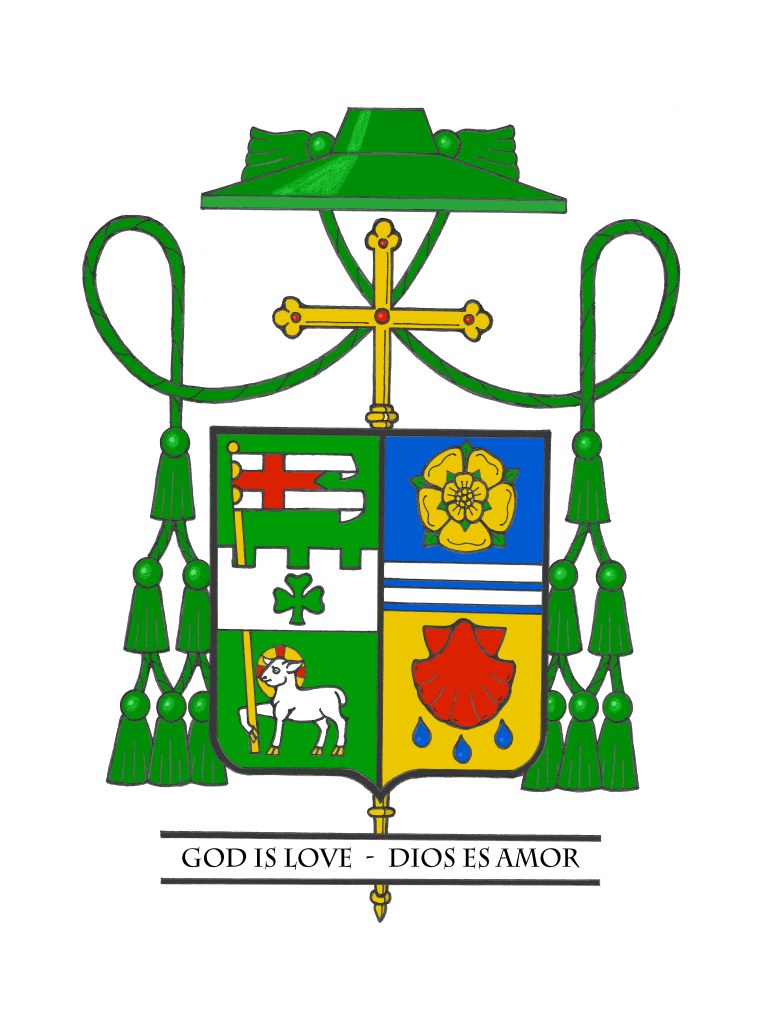
On July 1, 2020 the Most Rev. Kevin Sweeney (50) a priest of the Diocese of Brooklyn since 1997 will be ordained a bishop and installed as the 8th Bishop of Paterson, New Jersey. The coat of arms he is assuming is the following:

On the left from the viewer’s perspective, is the coat of arms of the Diocese of Paterson. The main charge, the Paschal Lamb holding the banner of victory, is the symbol for St. John the Baptist, the titular of the Cathedral. It was John who said: “Behold the lamb of God, who takes away the sin of the world” (John 1:12).

The trefoil, more commonly called a shamrock is a symbol of St. Patrick. The silver (white) division line with a crenelated upper edge represents the Lord’s protection of the city (and diocese).

On the right from the viewer’s perspective is the coat of arms assumed by Bishop Sweeney upon being named a bishop. It is joined (impaled) on the same shield with those of the diocese to indicate that Bishop Sweeney possesses jurisdiction over the diocese and that he is symbolically “married” to it. This manner of combining two coats of arms on the same shield is the method of marshaling that has been used for centuries by two armigerous people who get married.

The two main colors of the coat of arms are blue and gold (yellow) borrowing from the coat of arms of St. John Paul II whose life and pontificate greatly influenced the vocation and ministry of Bishop Sweeney. The main charge on the lower gold (yellow) field is a red escallop shell. This is a symbol of St. James, the titular of the Cathedral-Basilica in Brooklyn, and is borrowed from the coat of arms of the Diocese of Brooklyn where Bishop Sweeney was born and raised, educated and ordained a priest prior to becoming a bishop. There are three blue drops of water falling below the shell which make the shell also a symbol of St. John the Baptist, the titular of the cathedral in Paterson. In addition, this charge emphasizes the importance of Baptism as our incorporation into the Body of Christ and the call to holiness that is received by all followers of Jesus.

The upper part of the shield, is colored blue and contains two silver (white) horizontal lines as well as a golden rose. The white lines against the blue background allude to the distinctive blue and white habit worn by St. Teresa of Calcutta, the foundress of the Missionaries of Charity. This saintly woman also had a profound influence on Bishop Sweeney and he wished to commemorate her as a saint to whom he looks for inspiration in his priestly, and episcopal ministry. The golden rose is a symbol of Our Lady. The gold (yellow) rose alludes to Our Lady of Knock in particular and by this the bishop honors his Irish heritage. However, the rose also has a double symbolism in that it is an allusion to Our Lady of Guadalupe, patroness of the Americas. In connection with the appearance of Our Lady to Juan Diego a miraculous blooming of roses in December occurred so this flower, regardless of its color, is associated with Our Lady of Guadalupe.

The motto below the shield, in English and in Spanish, is, “God Is Love – Dios Es Amor”. 

The shield is also ensigned with the gold (yellow) cross placed vertically behind and extending above and below the shield. This is often mistakenly thought to be a processional cross like those used in liturgical processions. In former times archbishops, and later all bishops, had a cross mounted on a staff carried immediately in front of them on all solemn occasions. This cross was a symbol of their rank as bishop. While such an episcopal cross is no longer used practically it has been retained heraldically. In fact, there are other clerics who make use of the ecclesiastical hat with its many tassels but the one true heraldic emblem of a bishop, and the only essential one, is the episcopal cross placed behind the shield.

Above the shield is the ecclesiastical hat, called a galero which, in heraldry, replaces the martial helmet, mantling and crest. The galero is green with green cords pendant from it and twelve green tassels arranged in a pyramid shape on either side of the shield. At one time in history bishops and archbishops wore green before adopting the more Roman purple we see today. In heraldry the green hat and tassels was retained for prelates with the rank of bishop according to the Instruction of the Secretariat of State, “Ut Sive” of March, 1969.

I was pleased and privileged to design the bishop’s personal coat of arms and to marshal them to the arms of his diocese and execute the artwork. Bishop Sweeney and I first became acquainted 28 years ago when we were in the seminary. Ad Multos Annos!

Archabbot Douglas R. Nowicki, OSB

The Rt. Rev. Douglas R. Nowicki, OSB who served as Archabbot of St. Vincent Archabbey from January 8, 1991 until May 11, 2020. His successor will be elected June 22. During his tenure as Archabbot of the Archabbey he bore his personal arms impaled with those of the Archabbey itself. This form of marshaling two different coats of arms together, called “impaling” is rather the same as combining the two separate coats of arms of two armigerous people who are married to each other. Because the Archabbot has jurisdiction over the monastery his arms (in the position of the “groom”) are displayed together with the arms of his jurisdiction (in the position of the “bride”) on the same shield. When the tenure giving him such jurisdiction comes to an end the privilege of impaling his arms also comes to an end and he bears his personal arms alone. Accordingly, as of May 11, 2020 Archabbot Douglas’ coat of arms now appears as illustrated.

I designed his personal coat of arms in 1991 and prepared the original artwork used at the time of his archabbatial blessing.

Bishop Romero, Auxiliary of Rockville Centre, NY

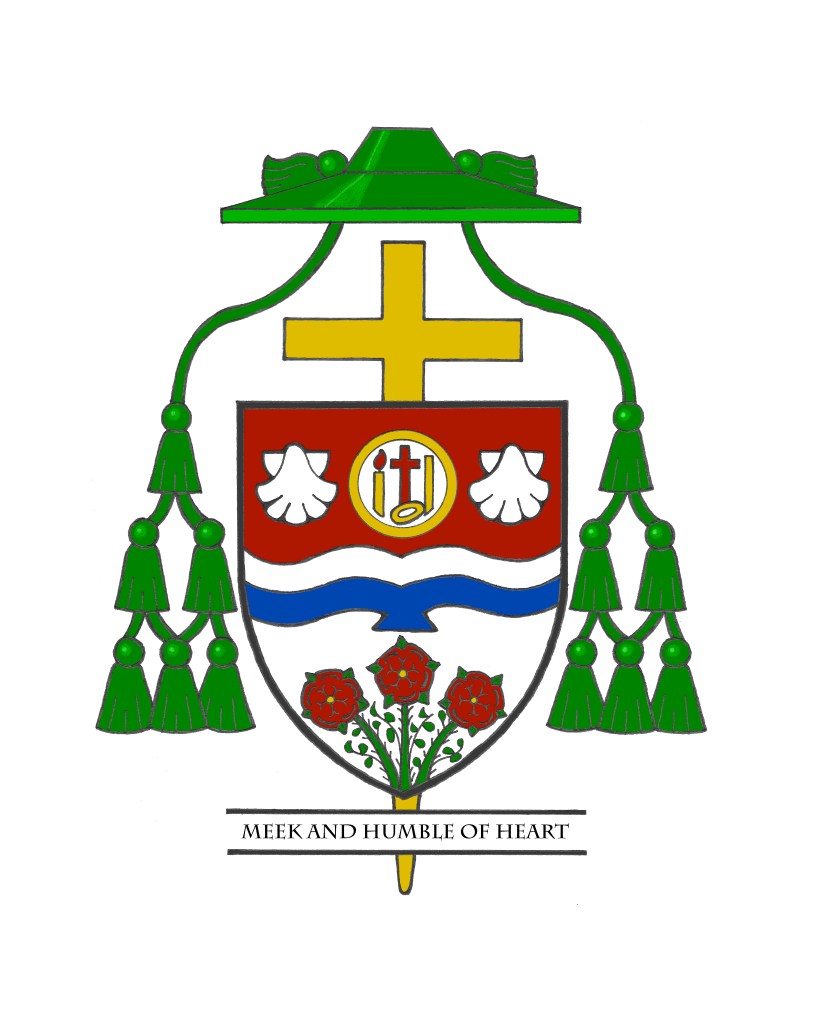
On June 29, the Solemnity of Ss. Peter & Paul, the Most Rev. Luis Miguel Romero Fernández, M.Id. (66) a native of Palencia, Spain and a member of the Idente Missionaries currently serving as a pastor in the Diocese of Rockville Centre which covers two thirds of New York’s Long Island, will be ordained the Titular Bishop of Egara and Auxiliary Bishop of Rockville Centre. The coat of arms I assisted him in designing which he will assume as a bishop are as follows:

The coat of arms assumed by Bishop Romero reflects his Religious Community, the diocese in which he serves, his previous ministry and his heritage. The colors used in this coat of arms are primarily red, white and blue, the national colors of the United States because the bishop wishes to honor the country in which he now lives and serves as both a priest and bishop. The main charge, or feature, across the middle of the shield is a bar specifically shaped to suggest an open book with the blue lower portion representing the binding and spine of the book and the white upper portion suggesting the pages. This is used to symbolize the many years the bishop spent working in a university setting as a teacher and administrator.

The lower portion of the shield depicts three red roses on their green stems. This is an allusion to the miracle of the roses in December that accompanied the apparition of Our Lady of Guadalupe to Juan Diego. As such they serve as a symbol of Our Lady, especially Our Lady of Guadalupe, patroness of the Americas and a particular devotion to the Hispanic peoples. This is for all the many years the bishop has spent in priestly ministry outside his native Spain serving Spanish-speaking people in other countries, especially in the Americas.

The upper part of the shield contains the symbol of the Community to which the bishop belongs, the Idente Missionaries. He is the first member of this community to be appointed a bishop so it was of great importance for him to include the community emblem in his own coat of arms. This is flanked by two escallop shells taken from the coat of arms of the Diocese of Rockville Centre in which he has served as a priest and pastor and which he is now called to serve in a greater capacity as a bishop.

The motto below the shield is, “Meek And Humble Of Heart” (Matthew 11:29)

The bishop specifically asked that the episcopal cross behind the shield and the galero be depicted in as simple a style as possible so they are depicted without any ornamentation. This, of course, is not reflected in the blazon because the blazon does not specify the manner of the depiction of the external ornaments. Rather, this was merely the simple manner in which the bishop requested this depiction be rendered.

New Auxiliary Bishop of Newark (part I)

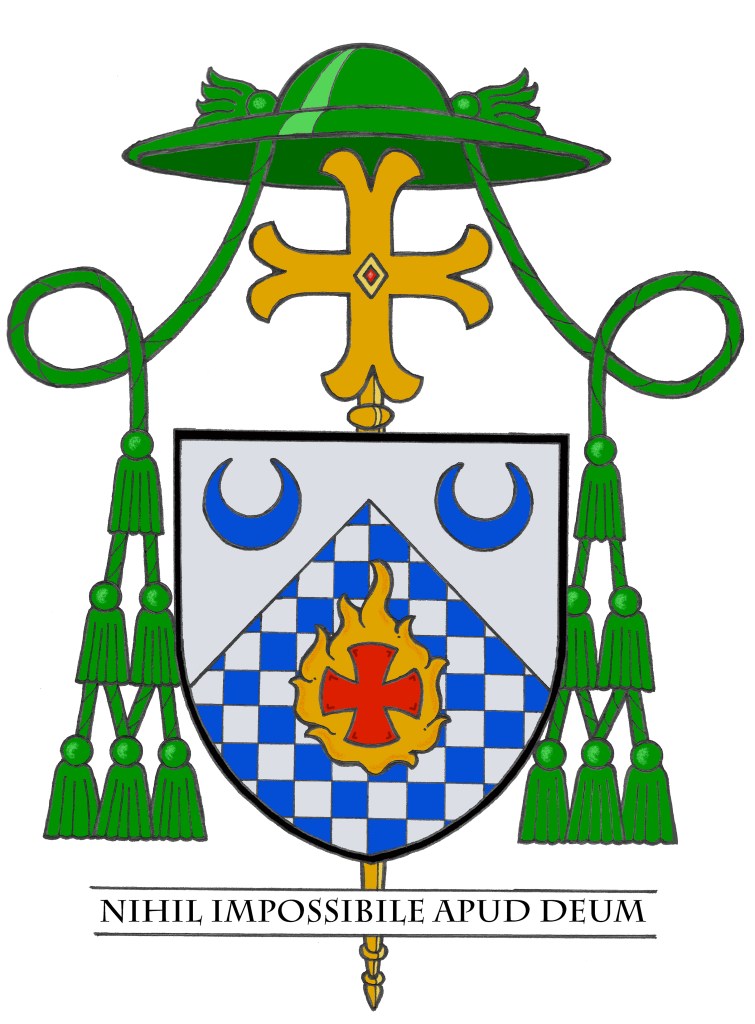
On June 30, 2020 the Most Rev. Elias Lorenzo, OSB (59) up until now the Abbot-Praeses of the American-Cassinese Congregation of Benedictine Monks and a monk of St. Mary’s Abbey in Morristown, New Jersey will be ordained as the Titular Bishop of Tabuda and Auxiliary Bishop of the archdiocese of Newark, New Jersey. The coat of arms assumed by him is the following:

Upon his election as Abbot-Praeses (i.e. President) of the American-Cassinese Congregation in 2016 I had the privilege of designing the coat of arms he would assume as an Abbot. Upon his appointment to the episcopacy Bishop Lorenzo decided, correctly in my opinion, not to change his arms in any way except to update the external ornaments from those of an Abbot to those of a Bishop. His armorial bearings reflect his family name, the community of his profession, his past ministry and his monastic patron.

The shield is divided by a line shaped like a chevron. This creates the general shape alluding to a mountain, in this case Mount Carmel, the mountain associated with the prophet Elijah from whose name the name Elias is derived. The large tongue of fire in the center of the lower portion of the shield (referred to as “in base”) combined with the mountain allude to St. Elias.

In addition, the blue and silver (white) checked pattern also has a multi-layered meaning. The American-Cassinese Congregation was founded by Benedictines from St. Michael’s Abbey in Bavaria. The motherhouse of the Congregation, St. Vincent Archabbey in Pennsylvania, makes use of the blue and silver fusils (a kind of elongated diamond pattern) from the coat of arms of Bavaria in its own coat of arms. Several other monasteries in the Congregation which are daughter houses or grand daughter houses of St. Vincent also make use of this pattern. One such abbey is St. Mary’s in Morristown, New Jersey. At this monastery Bishop Elias entered monastic life, made his profession of vows and was ordained. In his coat of arms the blue and silver (white) fusils have been turned sideways forming a grid of blue and white squares or checks. The grid pattern suggests the gridiron on which St. Lawrence was roasted alive as the means of his martyrdom. This is an allusion to the Abbot’s surname, “Lorenzo” which in Italian means “Lawrence”. The grid of blue and white squares combined with the fire represents St. Lawrence while at the same time the blue and white squares are a slightly differenced reference to the coat of arms of St. Mary’s Abbey as well as Bavaria in general as the homeland of the Congregation’s founders.

At the center of the flame there is a red rounded cross. This cross is taken from the coat of arms of Sant’Anselmo in Rome where, for seven years before his election as Abbot-President , the armiger was served as Prior of the monastic community.

Above the chevron in the upper portion of the shield (referred to as “in chief”) there are two blue crescents. The crescent has long been associated with Our Lady in particular under her title of the Immaculate Conception. That title is also the one by which Mary is the Patroness of the United States of America. In addition, crescents appear in the coat of arms of St. Mary’s Abbey and the coat of arms of the Delbarton School, the Abbey’s principal apostolate, both of with which Bishop Elias is closely associated.

The motto below the shield is taken from Luke 1:37 and is translated as, “Nothing is impossible with God”.

New Auxiliary Bishop of Newark (part II)

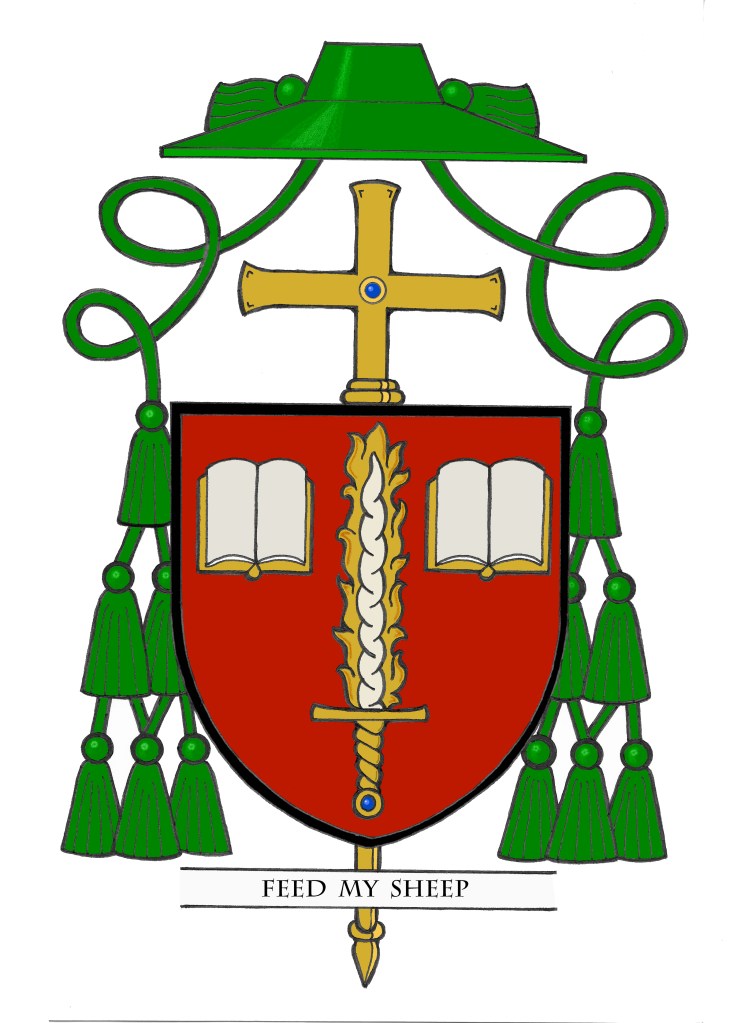
On June 30, 2020 the Most Rev. Michael Saporito (58) will be ordained as the Titular Bishop of Luperciana and Auxiliary Bishop of the archdiocese of Newark, New Jersey. The coat of arms assumed by him is the following:

Bishop Saporito worked with me to choose and assume a coat of arms reflecting his priestly life and ministry. The red background is borrowed from the coat of arms of the Archdiocese of Newark where the upper third of that shield (called a chief) is colored red. The bishop’s whole life, priesthood and, now, episcopate has been spent in the service of the Archdiocese.

The central symbol, or charge, is the flaming sword that is used as a symbol of his baptismal patron, St. Michael the Archangel. Michael, reckoned as the commander of the heavenly hosts wields the sword that symbolizes righteousness and God’s justice.

The sword, with a silver blade surrounded by golden flames and gold handle has two open books on either side. The pages of the books are blank and silver (white) while the books are bound in gold (yellow). These symbolize the Sacred Scriptures in both Testaments and are a reminder of the need for and the work of evangelization in the Church. The Bishop has devoted a part of his priestly ministry to the New Evangelization. 

The motto below the shield is “Feed My Sheep” (John 21:17)

New Auxiliary Bishop of Newark (part III)

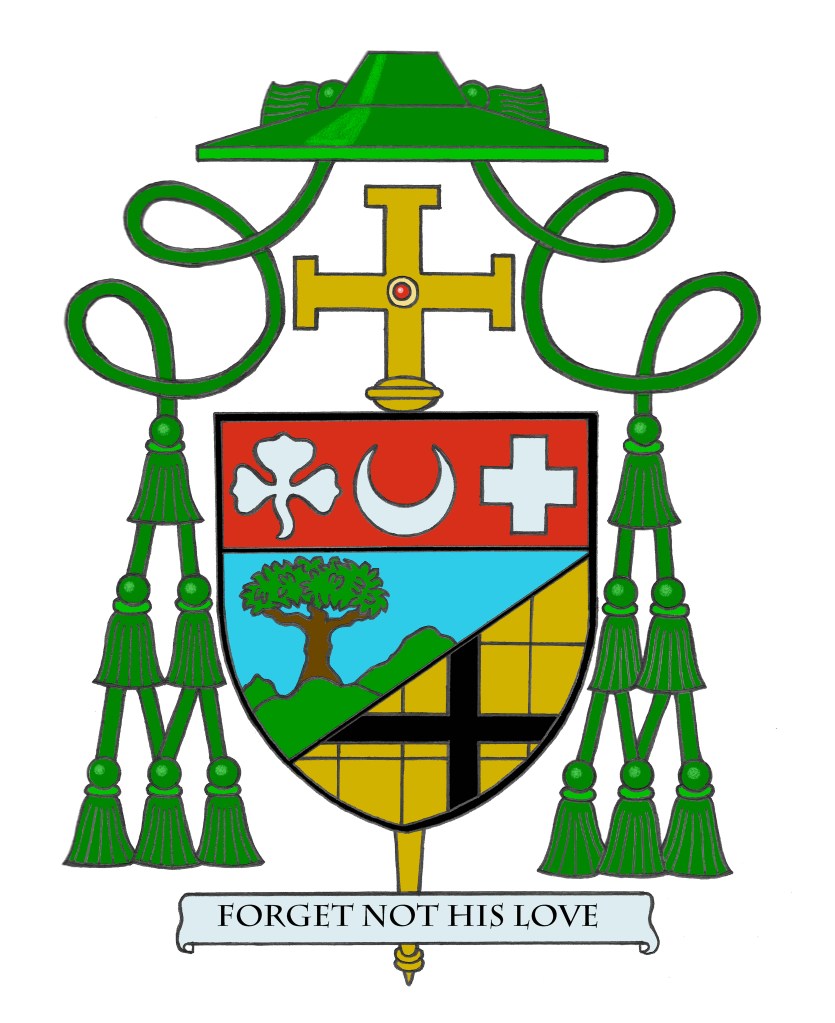
On June 30, 2020 the Most Rev. Gregory Studerus (72) will be ordained as the Titular Bishop of Tarasa in Byzacena and Auxiliary Bishop of the archdiocese of Newark, New Jersey. The coat of arms assumed by him is the following:

Shortly after his appointment Bishop Studerus contacted me and asked me to help design his coat of arms. He had some ideas based on a coat of arms in his possession reportedly belonging to his family as well as an abstract idea for representing urban ministry. The landscape was acceptable but I advised making the urban ministry symbol a bit less abstract and slightly more conventional. The chief takes off on the arms of the archdiocese with one of the trefoils being changed to a Green cross.

The main portion of the shield is divided by a diagonal line running from the viewer’s upper right to the lower left. This is called dividing the field with a bend sinister. The upper portion depicts a tree growing from a green hillside. The tree is depicted as we would find it in nature and shows three branches as an allusion to the Holy Trinity. All of this is set against a light blue sky. In heraldry blue is one of the five tinctures used. However, there is also the possibility of using what are known as “stains” in heraldry and among these are Bleu Celeste which is a decidedly lighter shade of blue than that usually used in heraldry and is frequently used to depict the sky. This symbol is borrowed from a coat of arms that was adopted by the bishop’s family. This section of the shield symbolizes Bishop Studerus’ love and concern for the environment.

The lower portion shows a black cross on a gold (yellow) background with the four quadrants of the cross being intersected with thin black lines spaced unevenly suggesting a map of city streets. This section of the shield symbolizes Bishop Studerus’ forty years of priestly ministry served in the city.

The upper third of the shield, called a “chief” takes it red color by borrowing from the coat of arms of the See of Newark which has a similar red chief with a crescent flanked by two trefoils. Here we see three symbols alluding to the cultural influences in the bishop’s life. The trefoil resembles the shamrock which is a symbol of St. Patrick and of Ireland. It is used here to allude to the Irish heritage of the bishop’s mother. The crescent in the center is symbolic of the Immaculate Conception of Mary which is the titular patron of the United States of America. The cross with four equally long bars, known as a “Greek cross”, does not in this instance symbolize anything Greek. Rather, it is the same cross found in the coat of arms and on the flag of Switzerland and it alludes to the Swiss heritage of the bishop’s father. All three are colored silver (white).

The motto below the shield is, “Forget Not His Love” (Psalm 103)

Sacerdotal Assumption

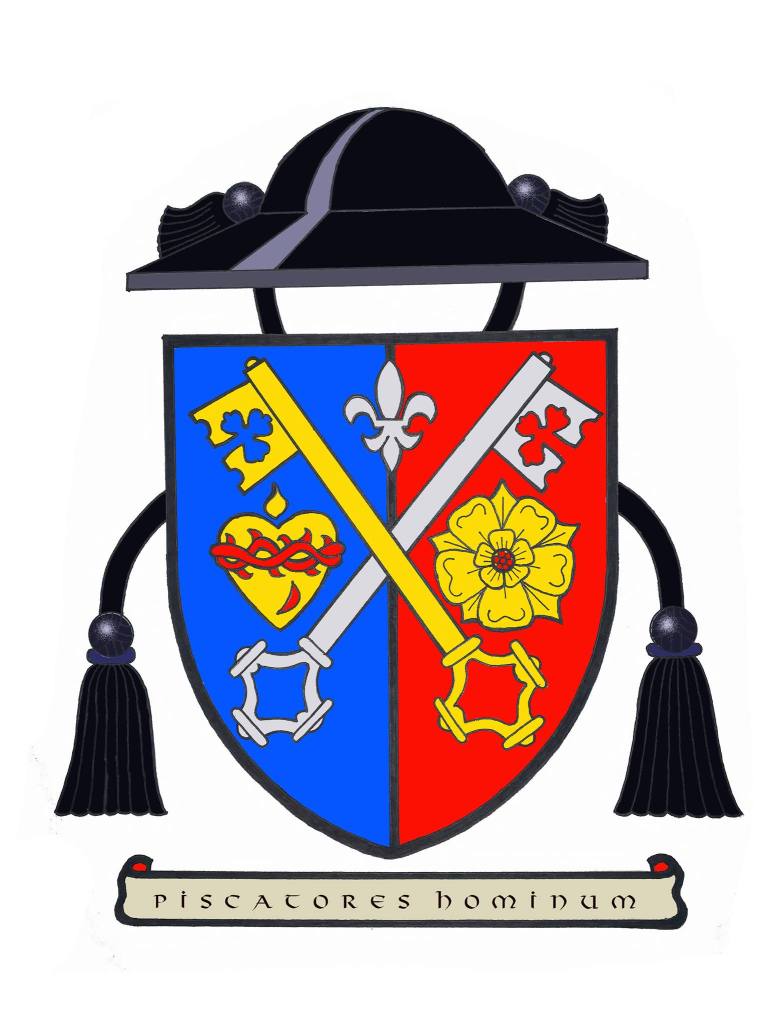
These are the armorial bearings I recently designed to be assumed by an American priest. The blazon is:

Divided per pale Azure and Gules; overall two keys in saltire, blades to chief with notches forming the outline of a trefoil, the dexter Or and the sinister Argent; between in chief a fleur-de-lis Argent; to dexter the Sacred Heart of Jesus Or, enfiled of a crown of thorns and wounded Gules enflamed Or; to sinister a rose Or, seeded Gules. The shield is ensigned with a priest’s galero with cords and two tassels all Sable. Below the shield on a scroll is the motto, “Piscatores Hominum”.

Bishop Mackinlay of Sandhurst

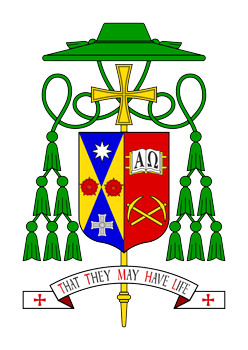
On October 16 the Most Rev. Shane Mackinlay (54), a priest of the diocese of Ballarat, was ordained a bishop and installed as the Eighth Bishop of Sandhurst, Australia.

His coat of arms is blazoned: Gules, two pickaxes in saltire, blades upwards Or; in chief an open book Argent bound Or with the Greek letter Α on the dexter page and the Greek letter Ω on the sinister page both Sable; impaling Per saltire or and azure on the former in fess two roses gules, in chief an estoile (eight-pointed star) and in base a representation of the Paderborn Cross argent.

The crossed pickaxes are the tools of goldmining, which was integral to the founding of both Ballarat and Bendigo. The bible comes from the arms of Catholic Theological College and reflects its motto, Tolle lege, the admonition that prompted St Augustine to take up and read the bible, which led to his baptism. In the arms of the see the gold of the field represents the goldfields, which are located within the diocese. The blue and the roses represent the Virgin Mary, Mother of God, who, under the title Our Lady of Good Counsel, is Patroness of the Diocese. The Paderborn Cross at the base is an ancient Christian symbol discovered in an eighth-century grave beneath the Cathedral at Paderborn, Germany, which was the home city of Dr Henry Backhaus, the pioneer priest of the Bendigo Goldfields.

The diocesan arms were designed by myself and Bishop Shane’s personal arms were designed by Richard d’Apice AM KCSG and myself and both are illustrated by Sandy Turnbull.

Another Ordinary Australian

On August 27 Monsignor Carl Reid, PA, (68) a Canadian who converted to Catholicism in 2012, was installed as the second Ordinary of the Personal Ordinariate of Our Lady of the Southern Cross in Australia. His personal arms were granted by the Canadian Heraldic Authority and are impaled with the arms of the Ordinariate. Richard d’Apice (in consultation with myself) assisted the Canadian heralds with the design of the personal arms. Mr. d’Apice and I designed the arms of the Ordinariate as well.

The unusual use of the crozier has been a precedent set among the Personal Ordinariates after their establishment by Pope Benedict XVI. It derives from the use of the crozier to denote Ordinary Jurisdiction while at the same time leaves off the sudarium (veil) attached to the crozier in abbatial arms which has become a symbol proper to abbots. Msgr. Reid exercises full Ordinary Jurisdiction and makes use of the pontificalia while celebrating the Sacraments like a bishop but does not possess the episcopal office. NOTE: The Personal Ordinary for the UK does not make use of a coat of arms and the Personal Ordinary for N. America is a bishop.

The artwork is by the talented Australian, Sandy Turnbull.

Archbishop Comensoli of Melbourne

On August 1, the Most Rev. Peter Comensoli (54) was installed as the Archbishop of Melbourne, Australia.

IMG_8322


The personal Arms of Archbishop Peter Comensoli were assumed in 2011 on his ordination as titular Bishop of Tigisi in Numidia and borne by him as Auxiliary of the Archdiocese of Sydney (2011-2014). He bore them impaled with the Arms of the Diocese of Broken Bay as its third Bishop (2014-2018). According to the usual custom in Melbourne he has chosen to use his personal arms alone.
The arms and motto are blazoned as follows: Azure, on a Latin cross inverted Or four seven-pointed mullets (or Commonwealth stars) Gules, in the first quarter a lion’s head erased Argent crined and langued Or and in the second a unicorn’s head erased Argent crined and armed Or respectant.
The motto ‘Praedicamus Christum Crucifixum’ is a quotation from the Apostle Paul’s first epistle to the Corinthians (1Cor1.23), and can be translated as ‘We preach Christ crucified.’
The inverted Latin Cross symbolises the Bishop’s nominal patron, the Apostle Peter and the stars reflect the Southern Cross, which shines out over the Great South Land of the Holy Spirit. The lion and the unicorn respectively symbolise the mind and the heart of love.
I was privileged to help design these arms back in 2011 along with Richard d’Apice. They are emblazoned by Sandy Turnbull.

Bishop Richard Henning

On Tuesday, July 24, the Most Rev. Richard G. Henning (53), a priest of Long Island’s Diocese of Rockville Centre and currently Rector of the Seminary of the Immaculate Conception, will be ordained a bishop and become Titular Bishop of Tabla and Auxiliary Bishop of Rockville Centre. Shortly after his appointment he asked me to assist in the design of his arms. The Bishop and I are classmates from our days attending Chaminade High School in Mineola, NY. His coat of arms is:

HenningFinal1c


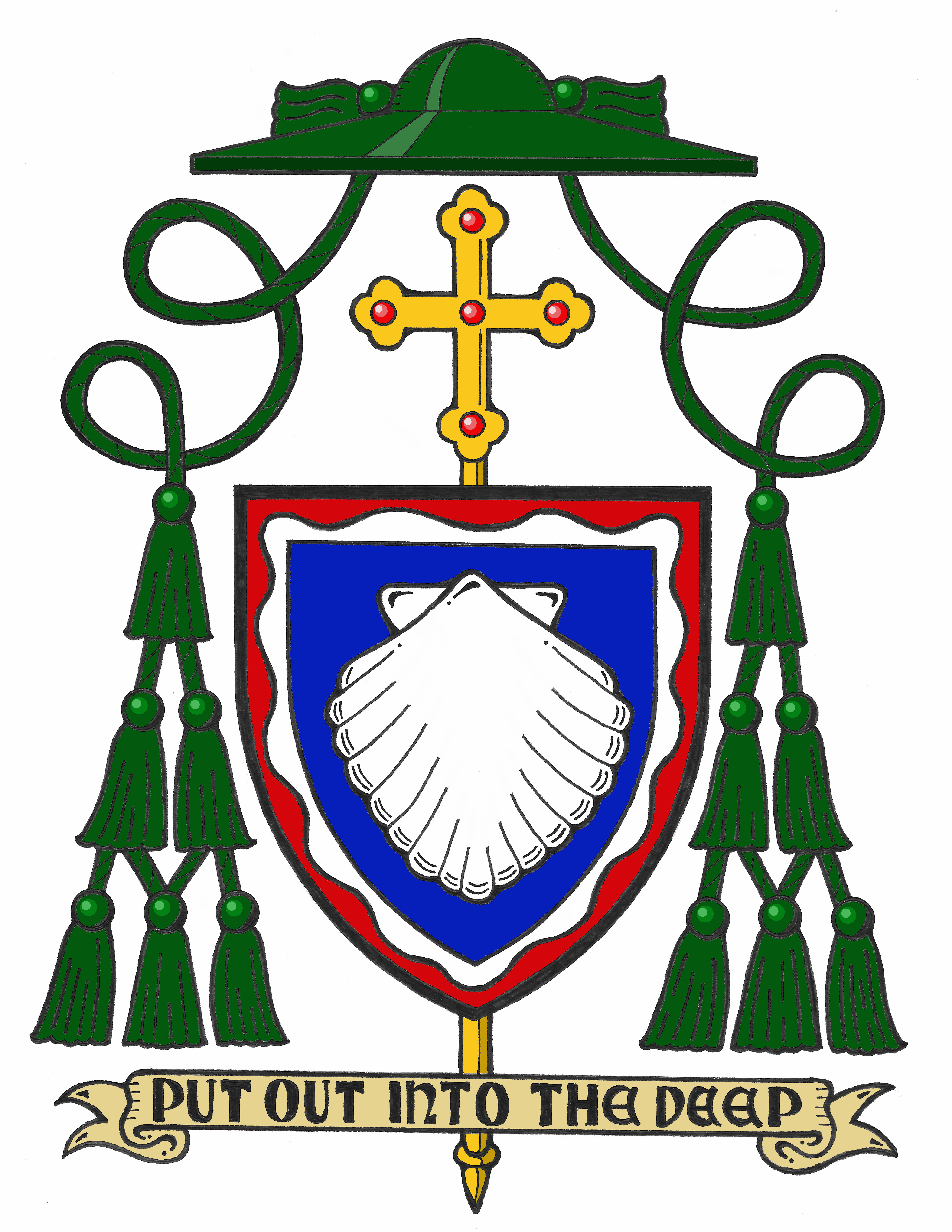
The blazon of the arms is: Azure, within a bordure parted wavy Argent and Gules an escallop shell Argent. The shield is ensigned with an episcopal cross Or charged with five jewels Gules and a bishop’s galero with cords and twelve tassels flanking the shield disposed in three rows of one, two and three all Vert. On a scroll below the shield is the motto, “Put Out Into The Deep”.

The shield is composed of a design depicted in red (Gules), white (Argent) and blue (Azure) which are the national colors of the United States.

Both the blue background and the single escallop shell allude to the sea as evoking the Bishop’s own background and the shell is also borrowed from the coat of arms of the See of Rockville Centre, the diocese in which he was born and raised and which he serves as a priest and bishop. The shell image also recalls the Bishop’s heritage in the Diocese of Brooklyn, dedicated to its patron, St. James. The ordination of the bishop takes place on the eve of the Feast of St. James. In concert with the Bishop’s motto, the shell is a traditional symbol of baptism and pilgrimage. It is in the depths of these waters that Christians find their salvation in Jesus Christ.

The white wavy line surrounding the blue field is similarly taken from the arms of Rockville Centre and it alludes to the diocese’s location on Long Island, NY. Furthermore, it indicates the sea as the place where the barque of St. Peter, an image used to evoke the Church, is located.

The blue background also evokes the Bishop’s devotion to the Blessed Virgin Mary and his years of service as a Professor and Rector at the Seminary of the Immaculate Conception. The red wavy portion of the border evokes the Bishop’s devotion to the Most Sacred Heart of Jesus and his service as the Director of the Sacred Heart Institute for the Ongoing Formation of the Catholic Clergy.

The external ornaments include a gold episcopal cross placed vertically behind the shield decorated with five red jewels symbolic of the wounds of Christ. This is often mistaken for a processional cross like the one used in liturgical processions. However, like other heraldic ornaments the episcopal cross has its origins in something which is no longer actually used. At one time all bishops had, in addition to the processional cross at the head of the procession, another cross carried directly in front of them by a cleric. This other cross was a sign of the office of bishop. While no longer actually used it has remained a symbol of the episcopal office in heraldry.

Similarly, the broad-brimmed green galero was, at one time, worn by bishops in outdoor processions and cavalcades. No longer used it remains a heraldic symbol of the office of bishop and takes the place of the helmet, mantling and crest that would appear in the coat of arms of a layman. In Catholic heraldry the color and number of tassels on the galero indicates the rank of the bearer. The single barred episcopal cross and the green galero with twelve tassels signifies the coat of arms of a bishop according to the Instruction of the Holy See, “Ut Sive” issued in 1969.

The motto chosen by Bishop Henning appears on a scroll below the shield. “Put Out Into The Deep” which is taken from Luke 5:4.

+Rt. Rev. Giles Hayes, OSB R.I.P.

GILES5

The Right Reverend Giles Hayes, OSB (79) the Tenth Abbot of St. Mary’s Abbey in Morristown, New Jersey (founded in 1884 as St. Mary’s Abbey in Newark, a daughter house of St. Vincent Archabbey in Pennsylvania and later moved to Morristown) passed away on March 7, 2018.

He was elected Abbot in 2006 at which time he commissioned me to design and execute his abbatial coat of arms. He led the community until 2014.

The arms of the Abbey (in the first and fourth quarters above) are clearly based on those of the community’s motherhouse.

May he Rest in Peace.